Australia ABN & TFN Tax ID Guide — Format, Validation & Compliance
Australian Business Number (ABN)
Australian enterprises use the Australian Business Number (ABN) as a unified identifier for all interactions with the Australian Taxation Office (ATO) and other government departments. The ABN is the key component for tax identification, GST registration, and issuing compliant tax invoices. Its introduction followed the Small Business Deregulation Task Force Report, replacing the fragmented system of ACN, ARBN, and agency-specific identifiers with a single number that state, territory, and local government regulatory bodies also accept to streamline registration requirements.
ABN Format and Structure
The ABN is an 11-digit number displayed as XX XXX XXX XXX:
| Segment | Digits | Meaning |
|---|---|---|
| Check digits | 2 | Derived from the nine-digit identifier via mod-89 |
| Unique identifier | 9 | Issued sequentially by the Australian Business Register |
For companies registered under the Corporations Act, the ABN is formed by prefixing two check digits to their Australian Company Number (ACN) or Australian Registered Business Number (ARBN) issued by ASIC.
Regex Pattern
| Pattern | Description |
|---|---|
^\d{11}$ | Raw 11-digit string (no spaces) |
^\d{2} \d{3} \d{3} \d{3}$ | Display format with spaces (XX XXX XXX XXX) |
^\d{2}\s?\d{3}\s?\d{3}\s?\d{3}$ | Accepts both spaced and unspaced |
A regex match alone is insufficient — the mod-89 checksum must also pass.
Mod-89 Validation Algorithm
The ABN uses a modulus 89 checksum based on the following weighting factors: [1]
| Position | 1 | 2 | 3 | 4 | 5 | 6 | 7 | 8 | 9 | 10 | 11 |
|---|---|---|---|---|---|---|---|---|---|---|---|
| Weight | 10 | 1 | 3 | 5 | 7 | 9 | 11 | 13 | 15 | 17 | 19 |
Steps:
- Subtract 1 from the first (leftmost) digit.
- Multiply each of the 11 digits by its corresponding weight.
- Sum all 11 products.
- Divide the sum by 89 — if the remainder is 0, the ABN is valid.
Example — ABN 53 004 085 616:
Digits: 5  3  0  0  4  0  8  5  6  1  6
Step 1: 4  3  0  0  4  0  8  5  6  1  6  (subtract 1 from first digit)
×Wts:  10  1  3  5  7  9 11 13 15 17 19
Products: 40+3+0+0+28+0+88+65+90+17+114 = 445
445 ÷ 89 = 5 remainder 0 → VALID
You can verify any ABN free of charge via the ABN Lookup tool at abr.business.gov.au. For how-to steps, see our ABN verification guide.
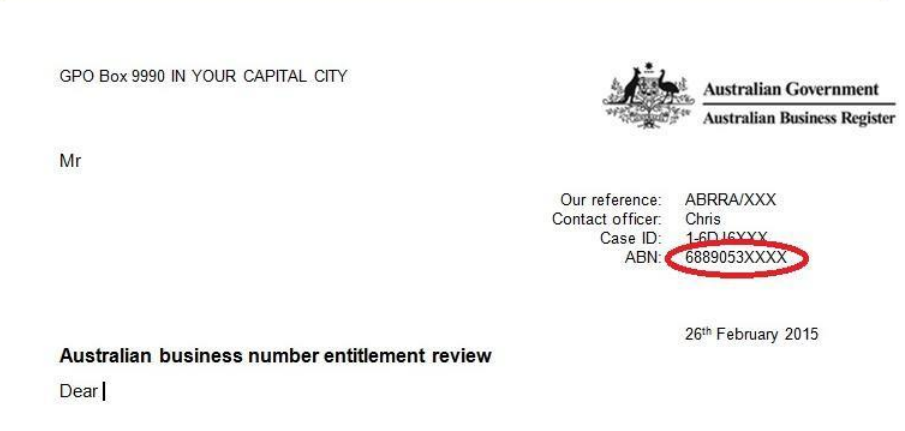 |
| Australian Business Number |
Australian Tax File Number (TFN)
The Tax File Number (TFN) is Australia's individual and entity-level tax identifier, governed by the Income Tax Assessment Act 1936. Individuals, companies, trusts, partnerships, and superannuation funds all receive a TFN for filing income tax returns, reporting information to the ATO, and participating in the superannuation system. Unlike the ABN (which is a business identifier), the TFN is a personal identifier — sole traders use their personal TFN for income tax and their ABN for business transactions.
TFN Format
The TFN is an 8- or 9-digit number compiled using an internal check-digit algorithm. It is displayed on ATO correspondence as three groups of three digits (XXX XXX XXX) but stored as a plain numeric string internally.
| Pattern | Description |
|---|---|
^\d{8,9}$ | Raw string (8 or 9 digits) |
^\d{3} \d{3} \d{3}$ | Standard 9-digit display format |
TFNs are not publicly searchable — verification is only available to authorised parties (e.g., employers via their payroll systems).
Application: TFN applications accept one primary document (birth certificate, passport, or citizenship certificate) plus up to two secondary documents. Temporary visa holders with work rights can apply online via myID; individuals living outside Australia must submit paper form NAT 2628. [2]
Related Resources
- How to verify an ABN — step-by-step guide
- Australia GST guidelines and invoice requirements
- New Zealand IRD tax ID guide
- Canada SIN & BN tax ID guide
- Singapore UEN & TIN guide
Frequently Asked Questions
My contractor invoice was short-paid — why did my client hold back 47%?
This is the PAYG no-ABN withholding rule. When you supply goods or services worth more than A$75 (excluding GST) and do not quote an ABN on the invoice, your client is legally required to withhold 47% of the gross payment and remit it to the ATO — the rate matches the top marginal income tax rate and has applied since 1 July 2017. The withheld amount is not lost: you can claim it back as a tax credit in your income tax return. To prevent withholding, quote your ABN on every invoice. If a legitimate exception applies — for instance, the supply is a private hobby activity — you can provide a completed "Statement by a supplier" form to the payer instead. [3] [4]
The ATO cancelled my ABN without warning — what happens now and can I get it back?
The Australian Business Register runs an ongoing integrity program that flags ABNs showing no business activity — no income in tax returns, no BAS lodgements, no third-party trading evidence. Cancellations can proceed after the ABR attempts contact, but notice is not always received. A cancelled ABN forces every client to withhold 47% from your invoices, and you may lose GST registration and any linked business name. To restore it, apply at abr.business.gov.au — your original ABN number can be reactivated if you re-establish entitlement. Check the "Historical details" tab on ABN Lookup to confirm the exact cancellation date and identify which invoices were affected. [5] [6]
I hit the GST threshold mid-year without realising — am I liable for GST on past invoices?
Yes. If your GST turnover exceeded A$75,000 in any 12-month period, you were required to register within 21 days of becoming aware of this. The ATO can backdate your GST registration by up to four years, making you liable for 10% GST on sales made since the required registration date — even if you never included GST in those prices. Additionally, a penalty of up to 20 penalty units (A$6,600 at the rate of A$330 per unit effective 7 November 2024) may apply for failure to register when required. Late registration often goes undetected until an audit or a customer queries it with the ATO; the safest course is to register immediately and contact the ATO proactively about backdating. [7] [8]
I'm on a working holiday visa — will my employer withhold the right amount of tax without my TFN?
Without a TFN, your employer must withhold at the maximum rate of 45% regardless of how little you earn. Providing your TFN allows employers registered with the ATO as "working holiday maker employers" to apply the concessional flat rate of 15% on your first A$45,000 of income for the year (higher thresholds follow a separate schedule). If your employer has not registered as a WHM employer, they must withhold at standard foreign resident rates — 32.5% up to A$135,000 — even when you have a TFN. Apply for a TFN via the ATO website or Australia Post before starting work; processing takes up to 28 days. Any excess withheld is recoverable through your year-end tax return, but the cash-flow cost during the year is real. [9] [10]
Does getting an ABN automatically register my business for GST?
No — ABN registration and GST registration are completely separate steps. An ABN is required for virtually all business activity, but GST registration only becomes compulsory once your GST turnover reaches A$75,000 in a 12-month period (A$150,000 for non-profit organisations). A common mistake reported on ATO Community forums is sole traders who hold an ABN, cross the threshold mid-year, and face a backdated GST liability on invoices that never included GST. Once over the threshold, you must register within 21 days, then issue tax invoices and lodge BAS returns (quarterly by default). Voluntary registration below the threshold is permitted and may benefit businesses with significant input tax credit claims. [11] [12]
As an overseas business selling digital products to Australians, do I need an ABN?
You do not need an ABN, but you do need GST registration once your GST turnover from Australian consumers reaches A$75,000 in any 12-month period — this covers imported digital services (SaaS, streaming, e-books, online courses) and low-value physical goods under A$1,000. Non-resident businesses with no Australian establishment use simplified GST registration, accessed via an AUSid account on the ATO's non-resident online services portal. Under simplified registration you collect and remit 10% GST on B2C sales but cannot claim input tax credits; standard registration is required if you want to claim credits. If you sell through an electronic distribution platform (marketplace), GST liability typically shifts to the platform operator, which may remove your own registration obligation below the threshold. [13] [14]
As a sole trader, do I need both a TFN and an ABN, or do they replace each other?
Both are required for different purposes and neither replaces the other. Your TFN is your personal tax identity — you use it to lodge income tax returns, access superannuation, and interact with the ATO as an individual. Your ABN is your business identity — you quote it on invoices, register for GST, and use it in dealings with other businesses and government agencies. A sole trader uses a single personal TFN (no separate "business TFN" exists) while quoting their ABN for all commercial transactions. Operating with only one of the two means your income tax reporting and your business obligations cannot be properly reconciled, which triggers withholding issues and may attract ATO review. [15] [16]
How Lookuptax can help you?
Lookuptax VAT validation revolutionizes tax number validation with its robust platform, empowering businesses to seamlessly verify tax IDs across over 100 countries. Our cutting-edge technology ensures accurate and efficient validation, reducing errors and enhancing compliance.