South Korea Tax ID Guide — RRN, BRN & CRN
South Korea operates three distinct tax identification number systems managed by two separate authorities: the Ministry of the Interior (for individuals) and the National Tax Service (NTS) district tax offices (for businesses). Understanding which number applies to your situation — and where it must appear on official documents — prevents invoice rejections, withheld payments, and NTS filing errors. This guide covers all three systems: the Resident Registration Number (RRN), the Business Registration Number (BRN), and the Corporation Registration Number (CRN).
Resident Registration Number (주민등록번호)
The Resident Registration Number (RRN) is issued by the Ministry of the Interior to Korean citizens residing in the country. It serves as the primary individual tax identifier for income tax returns, transfer tax, inheritance tax, and gift tax filings. Employers also reference it when calculating and remitting withholding tax on wages and salaries. [1]
For Common Reporting Standard (CRS) reporting purposes, a Passport Number issued by the Ministry of Foreign Affairs is accepted as an alternative TIN for Korean nationals residing abroad or non-resident individuals without an RRN.
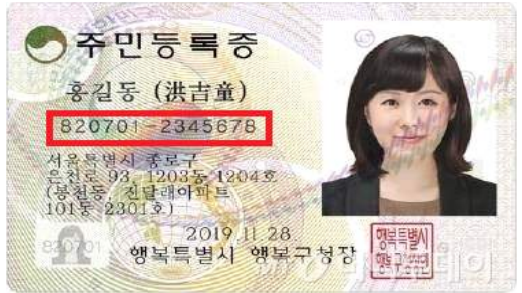 |
| Resident Registration Card |
Format and Structure
The RRN is a 13-digit number formatted as XXXXXX-XXXXXXX.
| Field | Detail |
|---|---|
| Total length | 13 digits |
| Format | YYMMDD-NSSSSSC |
| Digits 1–6 | Date of birth (YYMMDD) |
| Digit 7 | Gender and century code (1/2 = 1900s male/female; 3/4 = 2000s male/female; 5/6 = foreign nationals 1900s; 7/8 = foreign nationals 2000s) |
| Digits 8–12 | Region of registration and sequential serial number |
| Digit 13 | Check digit (Luhn-style weighted checksum) |
| Example | 850102-1234567 (male born 2 January 1985) |
The seventh digit encodes both gender and birth century, which is why "0" is never used — values run from 1 through 9, with higher values reserved for foreign nationals and overseas Koreans.
Privacy Restrictions
Since August 2014, the Personal Information Protection Act (PIPA) prohibits any person or entity from collecting or processing an RRN without an explicit statutory basis. Consent alone is not sufficient. For online identity verification, businesses must use surrogate methods such as IPIN, mobile carrier verification, or digital certificates instead of requesting an RRN directly.
Business Registration Number (사업자등록번호)
The Business Registration Number (BRN) is issued by the head of a district tax office under the National Tax Service (NTS). It is the primary tax identifier for all NTS filings, including VAT returns, corporate income tax returns, and withholding tax submissions. Every business operator must apply for business registration for each place of business within 20 days of starting business, and may apply before starting (VAT Act Art 8(1)); the district tax office assigns the number per place of business (VAT Enforcement Decree Art 12(1)). [2] [9]
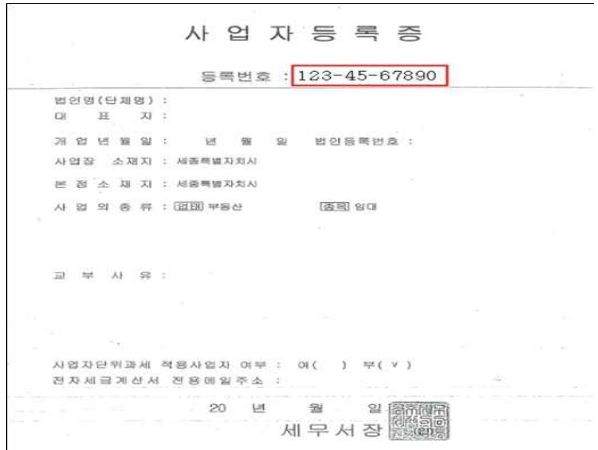 |
| Business Registration Certificate (사업자등록증) |
Format and Structure
| Field | Detail |
|---|---|
| Total length | 10 digits |
| Format | XXX-XX-XXXXX |
| Digits 1–3 | District tax office code |
| Digits 4–5 | Business type code (01–79 = individual; 81–84 = corporation) |
| Digits 6–9 | Registration sequence number |
| Digit 10 | Check digit |
| Example | 123-45-67890 |
Verification
The NTS provides a free online BRN verification tool through the Hometax portal. You can confirm whether a BRN is active and matches a registered entity before issuing or accepting a tax invoice. This is essential for B2B transactions — the recipient's registration number is a mandatory particular of a tax invoice, and a tax invoice missing or misstating one blocks the buyer's input VAT credit (VAT Act Arts 32(1), 39(1)2). [2]
Electronic Tax Invoice Obligations
Korean law requires corporations, and individual businesses above a turnover threshold, to issue electronic tax invoices (전자세금계산서) — through the NTS Hometax system, a registered issuing agent (ASP) or their own ERP. See the South Korea e-invoicing guide. Corporations have been subject to this requirement since 2011. For sole proprietors (개인사업자), the threshold has been progressively lowered: KRW 300 million (July 2019 – June 2022), KRW 200 million (July 2022 – June 2023), KRW 100 million (July 2023 – June 2024), and KRW 80 million (from July 2024), measured on prior-year supply value per place of business, taxable and exempt supplies combined. [3] An electronic tax invoice must be transmitted to the NTS by the day after its issue date. [10] For the full VAT picture — invoice content, filing deadlines and penalties — see the South Korea VAT guide.
Corporation Registration Number (법인등록번호)
When a legal entity registers its foundation with the court, it receives a Corporation Registration Number (CRN) managed by the Supreme Court's registry. The CRN proves legal existence and is distinct from the BRN issued by the NTS. While the CRN is accepted as a TIN in CRS and FATCA reporting contexts, it is not a valid tax invoice identifier. [1]
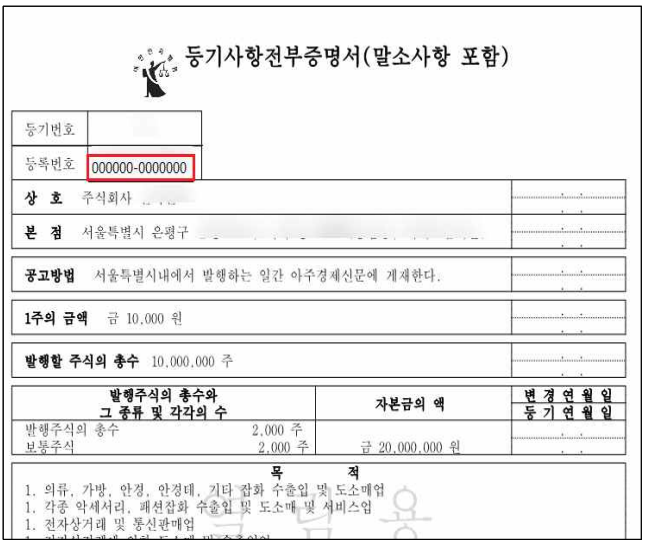 |
| Certified Copy of the Corporation Registry |
Format and Structure
| Field | Detail |
|---|---|
| Total length | 13 digits |
| Format | XXXXXX-XXXXXXX |
| Issuing authority | Supreme Court Registry (법원) |
| Used on tax invoices | No — BRN required instead |
| Accepted as TIN in | CRS/FATCA reporting |
| Example | 110111-1234567 |
A newly incorporated foreign subsidiary often confuses these two numbers. The court registry extract shows the CRN; the NTS-issued Business Registration Certificate (사업자등록증) shows the BRN. Always request the BRN from the certificate, not the court document.
Which Number Goes Where
| Context | Required Number |
|---|---|
| Korean electronic tax invoice (전자세금계산서) | BRN |
| VAT return filing via Hometax | BRN |
| Corporate income tax return | BRN |
| Withholding tax on employee wages | RRN (employee) + BRN (employer) |
| CRS/FATCA financial account reporting | RRN or CRN or Passport Number |
| Court registry filings and legal existence | CRN |
Foreign Businesses and Korean VAT
Foreign companies without a Korean legal entity selling digital services (software, cloud, streaming, online advertising) to Korean consumers must register with the NTS under the Simplified Business Operator (간편사업자 등록) scheme. Korea applies a zero-threshold rule — simplified business registration is due within 20 days of starting to supply electronic services to Korea, with no minimum turnover (VAT Act Art 53-2(1)). The VAT rate is 10%, with quarterly filing deadlines on the 25th of the month following each quarter (Art 53-2(4)). [2]
Electronic services supplied to a Korean-registered business for its taxable or exempt business are outside simplified registration (Art 53-2(1)); where that customer does not use the service in its taxable business, it withholds and pays the VAT under proxy payment, Korea's form of reverse charge (Art 52). Verify the Korean buyer's BRN to confirm B2B status. [2]
For a broader overview of how VAT registration works across jurisdictions, see the VAT and GST registration guide. For comparison with a similar Asia-Pacific system, the Japan Tax ID Guide covers My Number and Corporate Number rules including the Qualified Invoice system.
Frequently Asked Questions
Can a Korean business legally collect my RRN (주민등록번호) for a routine commercial transaction?
No. Since August 2014, the Personal Information Protection Act (PIPA) prohibits any person or entity from collecting or processing a Resident Registration Number (RRN) without an explicit legal basis — consent alone is not sufficient. [5] Unauthorized collection carries a fine of up to KRW 30 million; failure to protect an RRN that was lawfully collected exposes the processor to a fine of up to KRW 500 million. Under February 2026 PIPA amendments, repeat or large-scale violations (affecting 10 million or more individuals, or within three years of a prior violation) now attract administrative fines of up to 10% of total annual revenue. [6] Businesses must instead use surrogate identification methods (IPIN, mobile verification, or digital certificate) for online identity checks. If a commercial vendor demands your RRN for a purpose with no statutory basis — such as a loyalty programme sign-up — you may refuse and file a complaint with the Personal Information Protection Commission (PIPC).
What is the difference between a Business Registration Number (BRN) and a Corporation Registration Number (CRN), and which one must appear on a Korean tax invoice?
These are two separate identifiers issued by different authorities. The Business Registration Number (사업자등록번호) is a 10-digit number (XXX-XX-XXXXX) issued by the district tax office under the NTS — it is the primary tax identifier for all VAT, corporate tax, and withholding filings. [9] The Corporation Registration Number (법인등록번호) is a 13-digit number (XXXXXX-XXXXXXX) issued by the court registry when a legal entity is incorporated; it proves legal existence and is accepted as a TIN in CRS/FATCA contexts, but it is not a tax invoice field. On Korean electronic tax invoices (전자세금계산서) and all NTS filings, only the BRN is valid. Entering only the CRN is a common error among newly incorporated foreign subsidiaries and will cause the recipient's input VAT claim to be rejected. Always obtain the BRN from the NTS-issued Business Registration Certificate (사업자등록증), not from the court registry extract. [1]
I run a foreign SaaS business with no Korean entity. Do I need to register for Korean VAT before my first B2C sale?
Yes — Korea applies a zero-threshold rule for non-resident digital service providers. There is no minimum turnover exemption: registration via the NTS Hometax "Simplified Business Operator" scheme (간편사업자 등록) is mandatory within 20 days of starting to supply electronic services (software, cloud, streaming, online advertising) to Korean consumers (VAT Act Art 53-2(1)). [2] Once registered, you charge 10% VAT and file quarterly returns by the 25th of the month following each quarter. A penalty of 1% of total supply value applies for failure to register on time, accruing up to the day simplified registration is completed — meaning a foreign provider who has been selling to Korean consumers for two years without registration faces significant back-penalties on top of uncollected VAT. B2B electronic services supplied to a Korean-registered business for its taxable or exempt business do not require the foreign supplier to register: a customer that uses the service in its taxable business accounts for nothing, while an exempt, non-business or input-blocked customer withholds and pays the VAT under proxy payment, Korea's form of reverse charge. Verify the buyer's BRN to confirm B2B status. From 1 July 2025, foreign digital intermediary platforms must also submit quarterly transaction-detail reports to the NTS under Article 75 of the VAT Act (Art 75(1)6, in force 1 July 2025). [2]
My Korean sole proprietorship just crossed KRW 80 million in annual sales. Must I now issue electronic tax invoices, and what are the penalties for missing the transmission deadline?
Yes, from 1 July of the following year. Since July 2024, sole proprietors (개인사업자) whose previous-year supply value reached KRW 80 million or more must issue electronic tax invoices (전자세금계산서) for all VAT-liable supplies, starting on 1 July of the year after the threshold was reached, regardless of whether they are general or simplified VAT taxpayers. [3] This threshold was progressively lowered from KRW 300 million to KRW 200 million (July 2022), KRW 100 million (July 2023) and then KRW 80 million (July 2024), so businesses that were exempt two years ago may be non-compliant today without realising it. Corporations have been subject to mandatory e-invoicing since 2011. An electronic tax invoice must be transmitted to the NTS by the day after its issue date; the 10th of the following month is the deadline for issuing a monthly consolidated invoice, not for transmission. [10] Penalties are graduated: 2% of supply value for not issuing an invoice by the final-return deadline, 1% for issuing late or on paper, 0.3% for transmitting to the NTS late, and 0.5% for not transmitting by the final-return deadline. [7] Pre-enrol in the Hometax e-invoicing module before the obligation activates — enrolment takes several working days.
As a foreign employee in Korea, should I elect the 19% flat income tax rate during year-end settlement (연말정산), or use the progressive tax rates?
Foreign workers who began employment in Korea by 31 December 2026 may elect a flat income tax rate of 19% (plus 1.9% local income tax) on employment income in lieu of the standard progressive rates of 6%–45%. [8] The critical trade-off: electing the flat rate forfeits all other income deductions, tax exemptions, and tax credits — including the earned income deduction, dependent deductions, and insurance premium credits that Korean taxpayers use to reduce their effective rate. The flat rate is advantageous primarily for high earners whose marginal progressive rate exceeds 19%, and it is unavailable if the employee works for a related-party company (as defined by the tax authority). [8] The election must be submitted to the employer at the time of year-end settlement or to the NTS at annual return filing; the NTS publishes a multilingual Year-End Tax Settlement guide (available in English, Chinese, and Vietnamese) for foreign residents each January.
Related Resources
- South Korea VAT guide — the 10% rate, business registration, tax invoice content, the electronic tax invoice mandate, filing deadlines and penalties
- Japan Tax ID Guide — My Number & Corporate Number — Japan's comparable dual-number system with Qualified Invoice compliance rules
- China TIN Guide — USCC, Citizen ID & Tax Registration — 18-character Unified Social Credit Code and individual resident ID
- Singapore TIN Guide — UEN and NRIC/FIN system for the region's major financial hub
- What is Reverse Charge? — How Korean B2B digital service transactions shift VAT liability to the buyer
- How to Register for VAT, Sales Tax, and GST — Country-by-country registration guide including Korea's Simplified Business Operator scheme
How Lookuptax can help you in VAT validation?
Lookuptax VAT validation revolutionizes VAT number validation with its robust platform, empowering businesses to seamlessly verify VAT numbers across over 100 countries. Our cutting-edge technology ensures accurate and efficient validation, reducing errors and enhancing compliance.