Peru TIN number guide
Registro Único del Contribuyente (RUC)
In Peru, individuals, legal entities, and other entities adhere to the guidelines set by the Single Taxpayers' Registry Law, specifically Legislative Decree 943 (governed by Superintendence Resolution No. 210-2004/SUNAT). Registration in the Single Taxpayers' Registry (RUC) is a mandatory step for obtaining tax registration. The National Superintendence of Customs and Tax Administration (SUNAT) is responsible for overseeing and managing this registry.
RUC Format The RUC in Peru is an 11-digit identifier, organized into distinct structures: a) For individuals using DNI for identification: Prefix 10 + DNI + verification digit. b) Individuals using other identity documents: Prefix 15 + random number + verification digit. c) Legal entities: Prefix 20 + random number + verification digit.
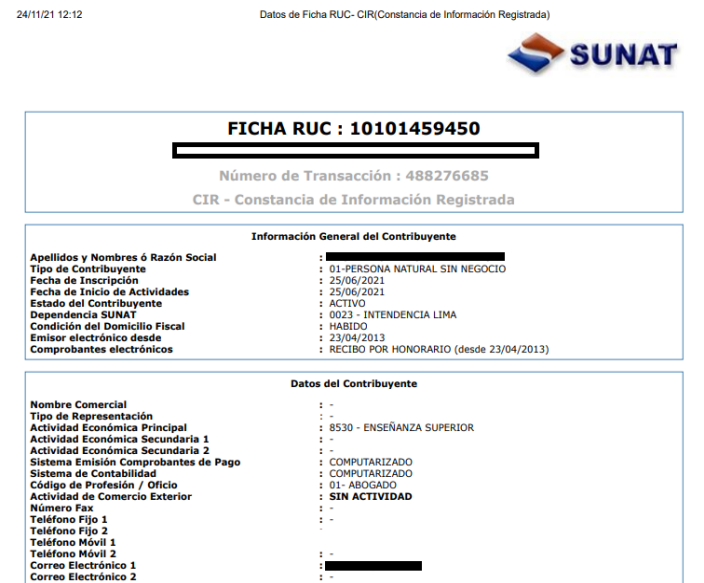 |
| Registered Information Voucher (CIR) |
Official Database RUC Search
How Lookuptax can help you in VAT validation?
Lookuptax VAT validation revolutionizes VAT number validation with its robust platform, empowering businesses to seamlessly verify VAT numbers across over 100 countries. Our cutting-edge technology ensures accurate and efficient validation, reducing errors and enhancing compliance.
Every taxpayer who issues facturas or boletas in Peru does so electronically, identified by the RUC. For who must issue, the OSE and SUNAT channels, UBL 2.1 format and penalties, see our Peru e-invoicing guide. For the IGV itself — rates, registration, filing and the rules for foreign sellers — see the Peru IGV guide.
Frequently Asked Questions
Can a foreigner register for a RUC before obtaining a residence visa, or is there a Migraciones–SUNAT catch-22?
SUNAT's RUC registration page offers a digital route and an in-person route, but the online options — the App Personas SUNAT route and getting a Clave SOL online — are 'Solo para personas naturales identificadas con DNI' (only for individuals identified with a DNI, the Peruvian national ID). The carné de extranjería appears only among the documents for in-person registration. So a foreign individual registers for a RUC in person at SUNAT, identifying themselves with a carné de extranjería. Non-domiciled suppliers of digital services to Peruvian consumers are a separate case: they register in the RUC only online, through SUNAT Virtual. [1] [2]
Do non-resident digital service platforms need to register for a RUC and collect Peru's IGV?
Yes, if they sell to consumers. Under Legislative Decree No. 1623, a non-domiciled supplier of digital services, or of intangibles downloaded over the internet, to Peruvian-resident individuals who do not carry on a business must register in the RUC, online only through SUNAT Virtual, and act as an IGV collection agent (an intermediation platform also withholds from the underlying seller). SUNAT states that collection began on 1 December 2024. The supplier applies the IGV rate to the full price it charges. No domicile in Peru is required, and registration does not create a permanent establishment. The tax must be declared and paid, in PEN or USD, within the first ten working days of the following month. Sales to Peruvian businesses are outside this regime: the business customer pays the IGV on the imported service itself. If a supplier does not register, file or pay, Legislative Decree No. 1623 lets the government list it so that banks, card issuers and telecom operators collect the IGV instead, but that backstop enters into force only with its own regulation and is not yet operating as at 13 October 2026. [3] [2] [4]
Why does a Peruvian business refuse to pay an invoice when the supplier's RUC shows 'Baja de Oficio'?
SUNAT can unilaterally set a RUC to 'Baja de Oficio Provisional' (provisional cancellation by official action) if it presumes the taxpayer has ceased activity — for instance due to missed filings. While in this state the holder cannot legally issue electronic invoices (facturas electrónicas), and buyers correctly reject such documents because the CDR (Constancia de Recepción) from SUNAT will return a 'Rechazada' status. To unblock payments, the supplier must reactivate the RUC at a SUNAT center before re-issuing the invoice. Buyers can verify live RUC status at the official portal before accepting any invoice. [5] [6]
What income tax is withheld from payments made by Peruvian companies to non-domiciled foreign service providers?
A Peruvian payer that pays or credits Peruvian-source income to a non-domiciled person must withhold the income tax and pay it to SUNAT as a final tax. Services carried out in Peru are Peruvian-source income, and so are digital services and technical assistance used in Peru; services performed entirely abroad generally are not. For non-domiciled companies the rates include 30% for royalties and for other income such as most services; 15% for technical assistance used in Peru, with an auditor's report required when one contract is worth more than 140 UIT; and 5% for dividends. Interest on foreign loans is taxed at 4.99% only if, for cash loans, the foreign currency is shown to have entered Peru and the interest does not exceed the prevailing preferential rate in the lender's market plus 3 points; interest paid to a related foreign lender, or above that cap, is taxed at 30%. [7] [8] [9]
Have the RER and the Régimen MYPE Tributario been abolished?
No. As at 13 October 2026 the Régimen MYPE Tributario, the Régimen Especial (RER) and the Régimen General of income tax all still apply. SUNAT's Resolution 000075-2026/SUNAT, in force from 1 June 2026, makes new RUC registrants who opt for any of those three regimes electronic issuers from the day they register. Choose the regime when you register; SUNAT's Emprender portal compares the regimes and their conditions. [10] [11]