Bangladesh TIN and BIN number guide
Bangladesh's income-tax number is the Taxpayer's Identification Number (TIN), in Bangla করদাতা শনাক্তকরণ নম্বর (টিআইএন). It is issued online as the 12-digit e-TIN. The Income Tax Act 2023 says: "বোর্ড নিবন্ধিত করদাতাকে একটি করদাতা শনাক্তকরণ নম্বর (টিআইএন) প্রদান করিবে" — "The Board shall issue a Taxpayer's Identification Number (TIN) to the registered assessee" (s.261(2)). [1] [2]
VAT and turnover tax use a different number, the Business Identification Number (BIN), ব্যবসায়িক শনাক্তকরণ নম্বর. Both are issued by the National Board of Revenue (NBR) (জাতীয় রাজস্ব বোর্ড), but through different wings and portals:
- the income-tax wing runs the e-TIN system at secure.incometax.gov.bd;
- the VAT wing issues the BIN through the eVAT system (
vat.gov.bd).
A company in Bangladesh normally holds both, and the BIN application asks for the e-TIN. For VAT rates, invoicing and returns, see the Bangladesh VAT guide.
Bangladesh's Tax IDs at a Glance
| e-TIN | BIN | WIN | |
|---|---|---|---|
| Bangla name | করদাতা শনাক্তকরণ নম্বর (টিআইএন) | ব্যবসায়িক শনাক্তকরণ নম্বর (BIN) | উইথহোল্ডার শনাক্তকরণ নম্বর (ডব্লিউআইএন) |
| Tax | Income tax | VAT and turnover tax | Tax deducted or collected at source |
| Law | Income Tax Act 2023, s.261 | VAT and Supplementary Duty Act 2012, s.4 | Income Tax Act 2023, s.263 (as substituted from 1 July 2026) |
| Format | 12 digits | 13 digits, printed NNNNNNNNN-NNNN | For a TIN holder, the TIN itself |
| Regex | ^\d{12}$ | ^\d{9}-\d{4}$ | — |
| Example (illustrative, not issued) | 123456789012 | 123456789-0101 | — |
| Who holds it | Anyone who must file a return or show proof of a return, plus anyone who registers voluntarily | VAT-registered and turnover-tax-enlisted persons | Anyone obliged to deduct or collect tax at source |
| Portal | secure.incometax.gov.bd | eVAT (vat.gov.bd) | — |
| Public lookup | None anonymous | NBR "13 Digit BIN" search | — |
The regex patterns are ours, derived from the official descriptions below. NBR publishes no specimen e-TIN or BIN, so both examples are placeholders.
e-TIN (Taxpayer's Identification Number)
| Field | Detail |
|---|---|
| Format | 12 numeric digits |
| Regex | ^\d{12}$ |
| Example | 123456789012 (illustrative only) |
| Issued by | NBR, through the e-TIN system |
| Fee | None |
| Document | A system-generated, printable TIN certificate |
Twelve digits since 2013. NBR replaced the old 10-digit TIN with the 12-digit e-TIN. Its notice on the e-TIN portal says: "জাতীয় রাজস্ব বোর্ড দ্রুত ও উন্নততর সেবা প্রদানের উদ্দেশ্যে করদাতাদের বর্তমান ১০ (দশ) ডিজিটের TIN পরিবর্তন করে e-TIN পদ্ধতির মাধ্যমে অনলাইনে নতুন ১২ (বার) ডিজিটের TIN প্রদানের ব্যবস্থা বিগত ০১/০৭/২০১৩ তারিখ হতে চালু করেছে। নতুন এ পদ্ধতি প্রবর্তনের ফলে ১ জানুয়ারী ২০১৪ থেকে পুরোনো ১০ (দশ) ডিজিট TIN আর কার্যকর থাকবে না।" In our translation: NBR began issuing new 12-digit TINs online through the e-TIN system from 1 July 2013, replacing taxpayers' 10-digit TINs, and from 1 January 2014 the old 10-digit TIN is no longer effective. [3] NBR's income-tax FAQ still describes the e-TIN the same way: "ইহা ১২ ডিজিটের ১টি নম্বর" ("it is a 12-digit number"). [4]

Check digit. NBR publishes no check-digit algorithm for the e-TIN and no structure inside the 12 digits. Validate the format (12 digits), then use one of NBR's checks under How to Verify where you can.
What you need to apply. NBR's e-TIN FAQ lists the details each type of taxpayer gives: [5]
| Taxpayer | Details asked for |
|---|---|
| Bangladeshi adult | Name, valid National ID (NID) number, date of birth as on the NID |
| Bangladeshi minor | Name, guardian's name, guardian's TIN, photo |
| NRB, foreigner, or Bangladeshi without an NID | Passport number and issue date, visa number and issue date, photo |
| Company | Name, registration number and registration date, as registered |
| Registered firm | Name, registration number and date |
| Unregistered firm | The partners' TINs and names |
| Others (AOP, HUF, local authority, AJP) | The authorised person's TIN |
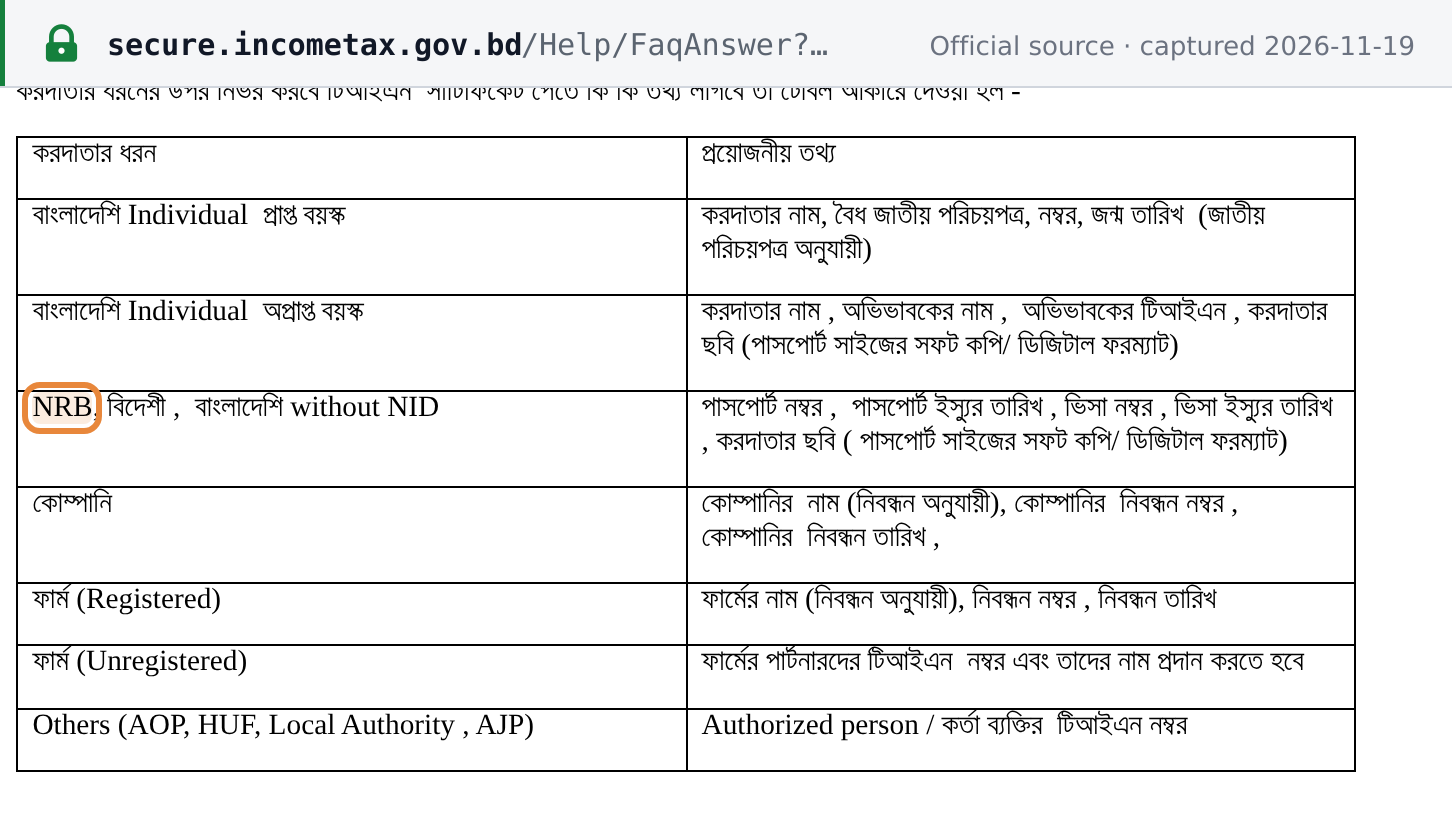
The same table appears in NBR's own income-tax FAQ. [4] The e-TIN certificate is free: "আপনাকে e- TIN সার্টিফিকেট এর জন্য কোন ধরনের ফী প্রদান করতে হবে না" ("you do not have to pay any fee for the e-TIN certificate"). [5]
Cancelling a TIN. Under s.262(1), a person applies to cancel their registration if, for example, they no longer have to show proof of a return and no longer need to file, have died or been dissolved, have left Bangladesh permanently with no income-earning activity there, or hold a duplicate or wrong registration. The tax authority cancels only after checking that no dues, pending assessment or dispute remain (s.262(2)). Cancellation makes the TIN inactive, dormant and unusable publicly; it does not delete NBR's records (s.262(5)). [1]
BIN (Business Identification Number)
| Field | Detail |
|---|---|
| Format | 13 digits, printed NNNNNNNNN-NNNN |
| Regex | ^\d{9}-\d{4}$ |
| Structure | 9-digit core (8 serial digits + 1 check digit) · 4-digit suffix for the VAT Commissionerate and Division |
| Example | 123456789-0101 (illustrative only) |
| Issued by | NBR, through eVAT |
| Fee | None; never needs renewal |
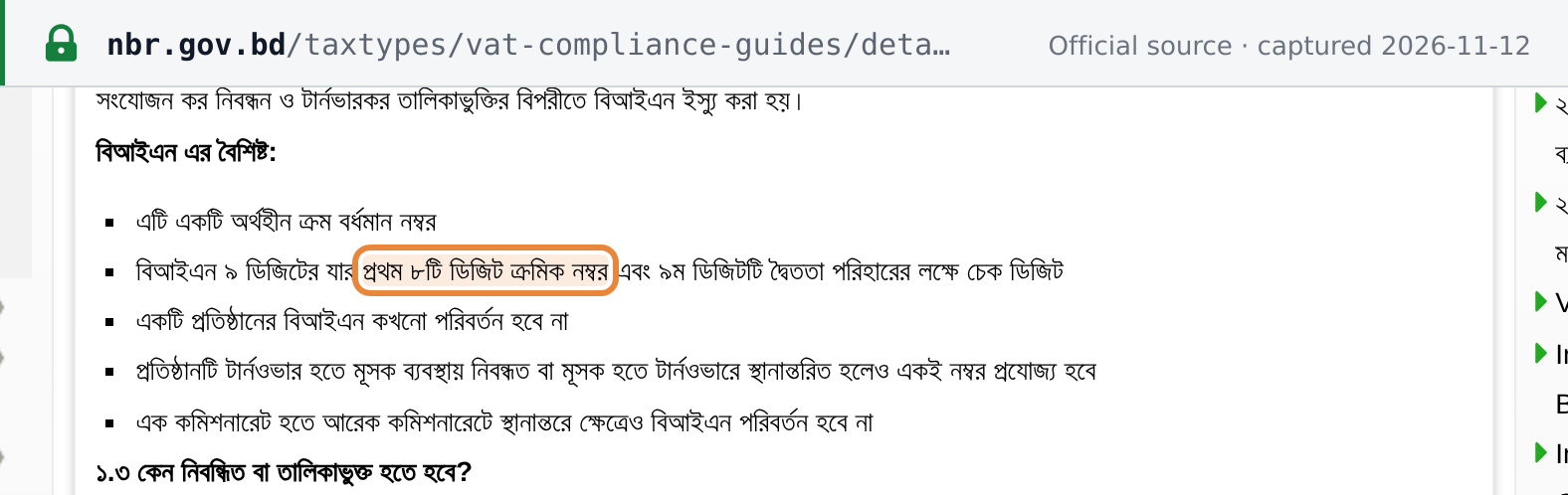
The 9-digit core. NBR's Compliance Guide on registration describes the BIN as "একটি অর্থহীন ক্রম বর্ধমান নম্বর" (a meaningless ascending number): "বিআইএন ৯ ডিজিটের যার প্রথম ৮টি ডিজিট ক্রমিক নম্বর এবং ৯ম ডিজিটটি দ্বৈততা পরিহারের লক্ষে চেক ডিজিট" — 9 digits, the first 8 a serial number and the 9th a check digit to prevent duplication. The core never changes, including when a business moves between VAT and turnover tax or between Commissionerates. NBR does not publish the check-digit algorithm. [6]
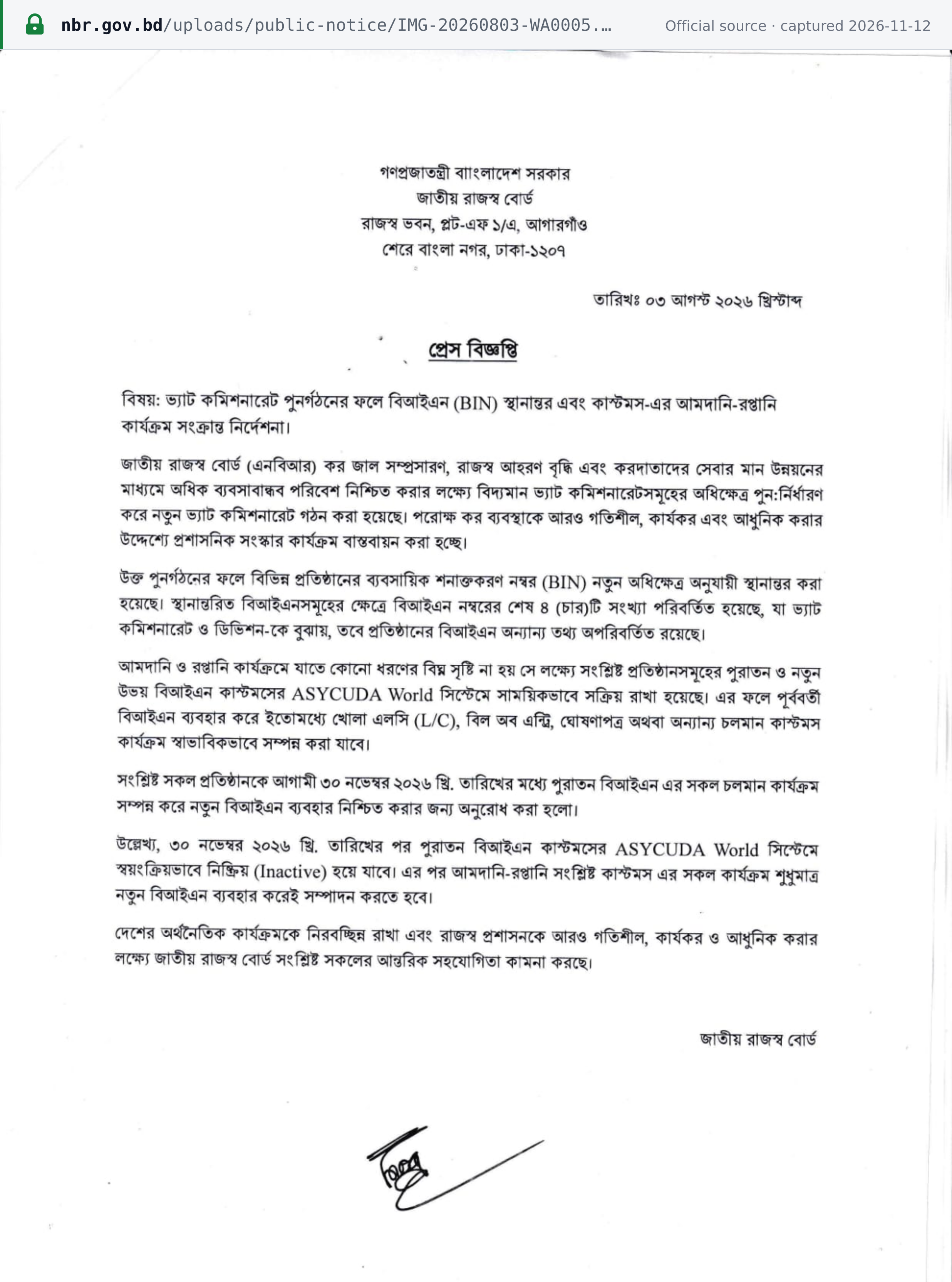
The 4-digit suffix. In a press release dated 3 August 2026, NBR said that after its VAT Commissionerates were restructured, the BINs of various businesses moved to new jurisdictions and the last 4 digits of those BINs changed; the suffix denotes the VAT Commissionerate and Division. Old and new BINs both stay active in Customs' ASYCUDA World system until 30 November 2026. After that date the old BIN becomes Inactive there and import and export work must use the new one. [7] A BIN copied from a document dated before August 2026 may therefore carry an old suffix.
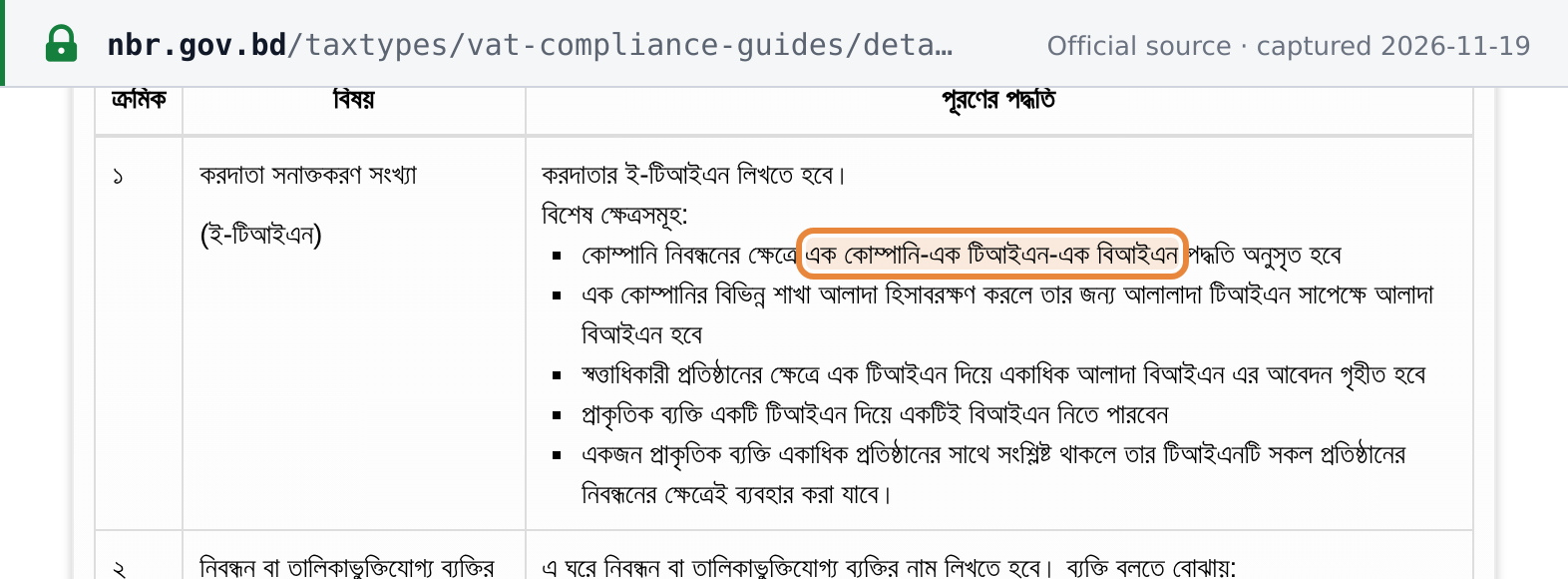
The BIN needs the e-TIN. Field 1 of the VAT registration and enlistment application (Mushak-2.1) is the applicant's e-TIN. NBR's guidance on that field reads: "কোম্পানি নিবন্ধনের ক্ষেত্রে এক কোম্পানি-এক টিআইএন-এক বিআইএন পদ্ধতি অনুসৃত হবে" — for companies, "one company – one TIN – one BIN". It goes on:
- branches of a company that keep separate accounts get separate BINs, each against a separate TIN;
- a proprietorship may apply for several BINs on one TIN;
- a natural person can take only one BIN with one TIN;
- a natural person linked to several businesses may use their TIN for all of those registrations.
No fee is payable for VAT registration or turnover-tax enlistment, and a registration "কখনো নবায়নের প্রয়োজন নেই" (never needs renewal) until it is cancelled. [6]
WIN (Withholder Identification Number)
From 1 July 2026, s.263 of the Income Tax Act 2023, as substituted by the Finance Act 2026 (Act 96 of 2026, s.137), makes a withholder's TIN its WIN. NBR's official English text of the Act (October 2025) predates this change and still prints the old s.263, so we quote the current Bangla text on the Laws of Bangladesh site:
"২৬৩। (১) এই আইনের অংশ ৭ এর অধীন যাহাদের কর কর্তন বা আদায় করিবার বাধ্যবাধকতা রহিয়াছে, তাহাদের উইথহোল্ডার শনাক্তকরণ নম্বর (ডব্লিউআইএন) থাকিতে হইবে এবং এইরূপ প্রত্যেক ব্যক্তির করদাতা শনাক্তকরণ নম্বর (টিআইএন) হইবে উইথহোল্ডার শনাক্তকরণ নম্বর (ডব্লিউআইএন)।"
Our translation: "Those obliged to deduct or collect tax under Part 7 of this Act must have a Withholder Identification Number (WIN), and the Taxpayer's Identification Number (TIN) of every such person shall be the WIN."
A withholder that is not obliged to hold a TIN may be given a WIN in the manner the Board prescribes (s.263(2)). A withholder that failed to get one because it has no TIN may be given a Temporary Withholder Number (TWIN) (s.263(3)). [1] The Board has not published a WIN or TWIN format for withholders without a TIN.
Who Must Register
e-TIN: no threshold of its own
The Income Tax Act sets no separate income or turnover threshold for the e-TIN. Under s.261(1) a person must register as a taxpayer if they: [1] [2]
- (a) are an assessee;
- (b) must file a return under s.166;
- (c) must furnish proof of submission of a return under s.264 (see below);
- (d) are willing to pay tax or file a return (voluntary registration).
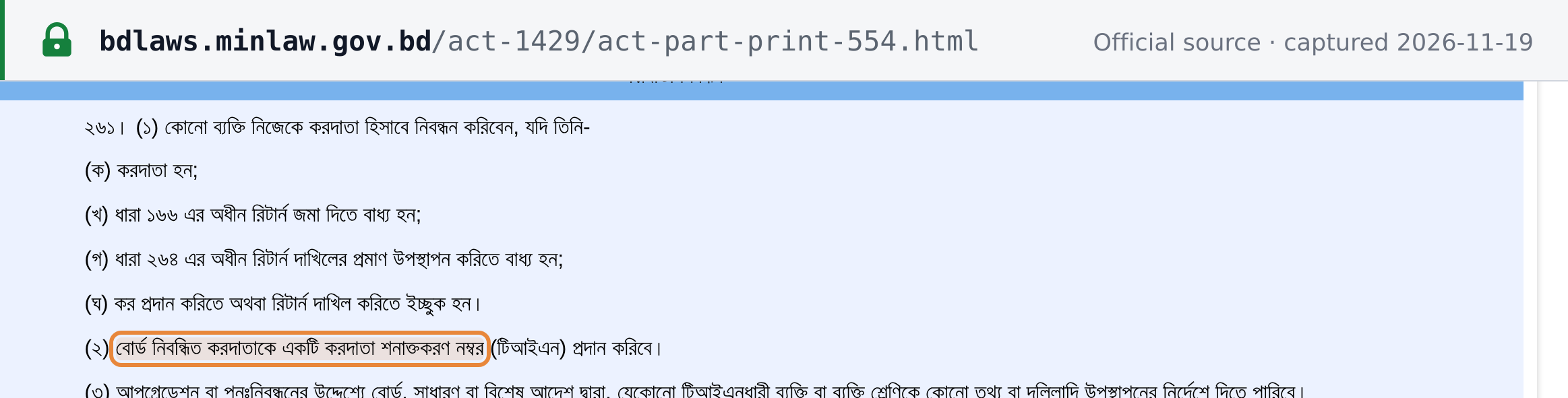
If someone who should have registered has not, the tax authority may register them and issue the TIN itself (s.261(4)). [1]
Who must file a return (and so needs a TIN). Under s.166(1), as at 19 November 2026, a return is due from a person who: [8]
- has income above the tax-free limit for the income year;
- was assessed in any of the previous 3 years;
- is a company, a shareholder-director or shareholder-employee of a company, a firm or partner of a firm, an association of persons, an employee holding an executive or managerial post, a public servant, or a non-resident with a permanent establishment in Bangladesh;
- receives income that enjoys an exemption or a reduced rate under Part 6, Chapter 1;
- is registrable under s.261, or must furnish proof of a return under s.264.
Every company therefore needs an e-TIN whatever its income. Section 166(2), as substituted by Act 89 of 2026, lists those who need not file, among them "কোনো অনিবাসী স্বাভাবিক ব্যক্তি যাহার বাংলাদেশে কোনো স্থায়ী স্থাপনা (permanent establishment) নাই" — a non-resident individual with no permanent establishment in Bangladesh. [8] The tax-free income limit itself is set each year in the Finance Act.
BIN: VAT registration and turnover-tax enlistment
As at 19 November 2026, with effect from 9 January 2025, the VAT and Supplementary Duty Act 2012 sets two turnover thresholds, both measured over 12 months: [9]
| Turnover in 12 months | Obligation | Deadline |
|---|---|---|
| Up to BDT 3,000,000 (30 lakh) | No BIN needed on turnover grounds | — |
| Above BDT 3,000,000 (s.2(48)) up to BDT 5,000,000 | Turnover-tax enlistment (BIN) | Apply within 30 days (s.10(1)) [10] |
| Above BDT 5,000,000 (50 lakh) (s.2(57)) | VAT registration (BIN) | Apply within 15 days, form VAT-2.1, or VAT-2.2 for a non-resident (Rules r.4(1)) [11] |
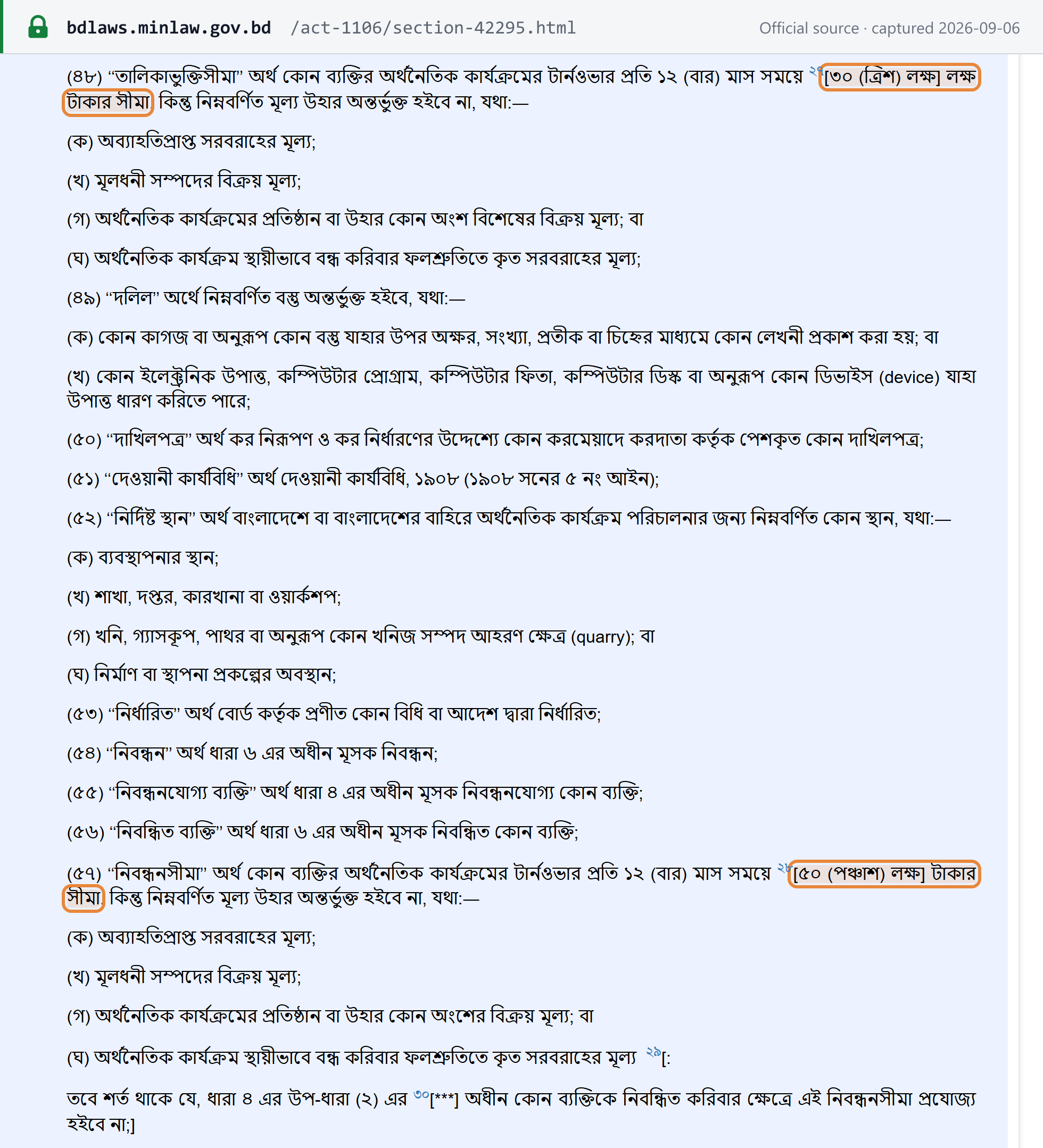
Some persons must register whatever their turnover (s.4(2)): among them suppliers of goods or services subject to supplementary duty, tender, contract or work-order suppliers, importers and exporters, branch, liaison or project offices of foreign entities, and appointed VAT agents. [12]
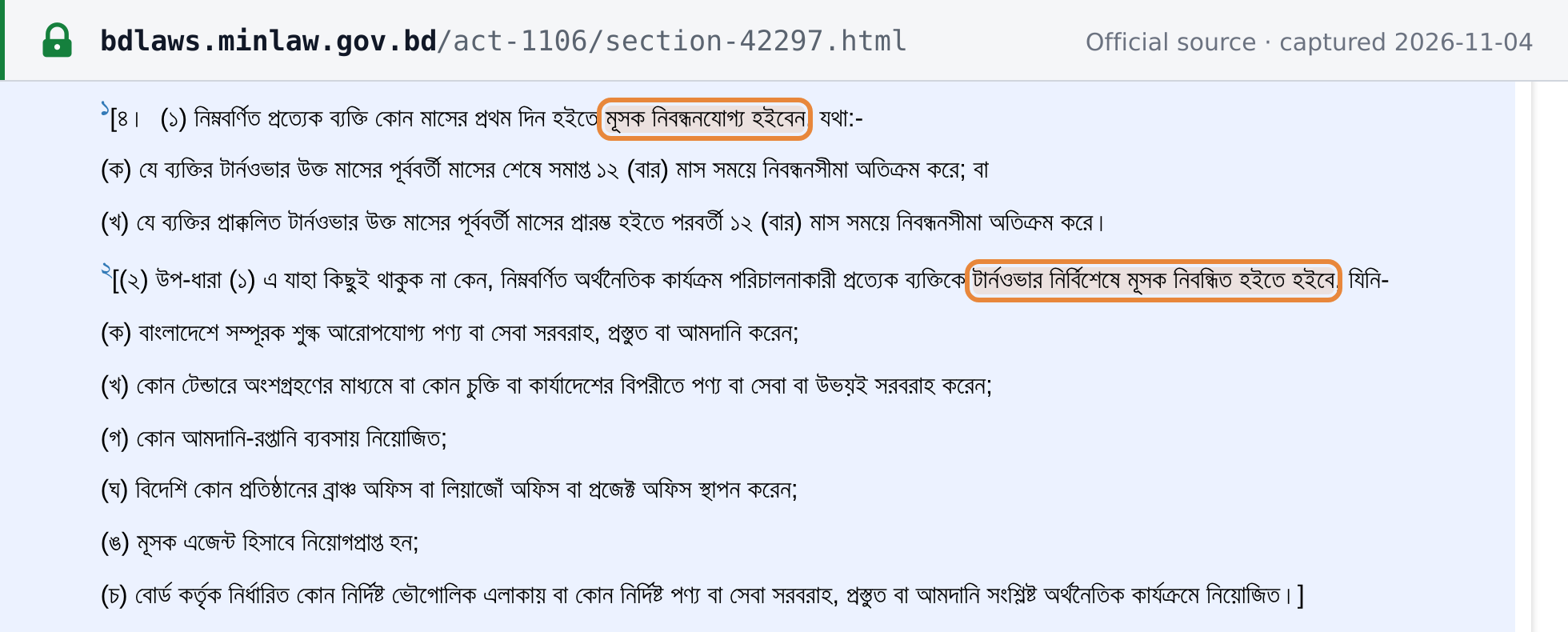
A BIN is now a precondition for everyday business. From 1 July 2026, s.4(3), inserted by the Finance Act 2026, requires a BIN or proof of enlistment to open or operate a business bank or NBFI account, take a loan, renew a trade licence, open an MFS merchant account, join a trade body, get an electricity or gas connection, or register a business vehicle with BRTA. [12]
TIN Certificate or Proof of Return?
Many transactions in Bangladesh need evidence of tax status, and the law separates two documents:
- the TIN certificate, the system-generated certificate with your name and TIN that you get on registration;
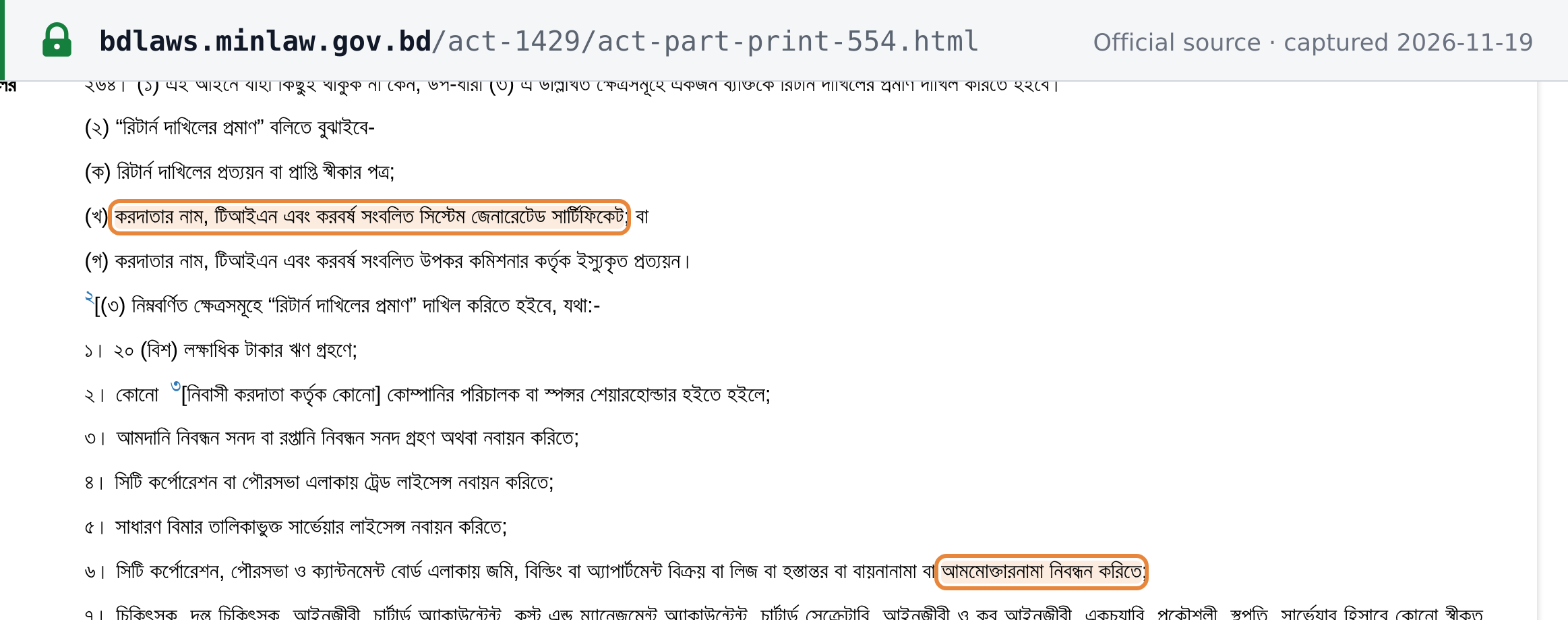
- the proof of submission of return (PSR), which s.264(2) defines as an acknowledgement of a filed return, a system-generated certificate with the taxpayer's name, TIN and assessment year, or a certificate from the Deputy Commissioner of Taxes with the same details. [1]
Section 264(3) was substituted by the Finance (2025-2026 Financial Year) Act 2026 (Act 89 of 2026) and amended again by the Finance Act 2026 (Act 96 of 2026) from 1 July 2026. NBR's English text of the Act predates both, so we work from the current Bangla text. As at 19 November 2026 it lists 40 cases that need a PSR, followed by a proviso listing 12 cases where the TIN certificate is enough. [1] The lists change in most Finance Acts.
Selected PSR cases (s.264(3)):
| Item | Case (our summary of the Bangla text) |
|---|---|
| 1 | Taking a loan of more than BDT 20 lakh — "২০ (বিশ) লক্ষাধিক টাকার ঋণ গ্রহণে" |
| 2 | Becoming a director or sponsor shareholder of a company, by a resident taxpayer (words "নিবাসী করদাতা কর্তৃক কোনো" inserted from 1 July 2026) |
| 3 | Obtaining or renewing an import or export registration certificate |
| 4 | Renewing a trade licence in a city corporation or paurashava area |
| 6 | Registering the sale, lease, transfer, bainanama or power of attorney of land, a building or an apartment in a city corporation, paurashava or cantonment board area — with no value threshold |
| 20 | Opening a letter of credit for imports |
| 21–22 | Fixed deposits, or savings-certificate purchases, of more than BDT 10 lakh |
| 29 | Registering, transferring or renewing the fitness of a motor vehicle other than a two- or three-wheeler |
| 33 | Submitting tender documents, by a resident taxpayer |
| 34 | Filing a bill of entry to import or export goods |
| 40 | Renewing the approval of an education institution that must file returns (added from 1 July 2026) |
Where the TIN certificate is enough. The proviso begins: "তবে নিম্নবর্ণিত ক্ষেত্রসমূহে “রিটার্ন দাখিলের প্রমাণ” দাখিলের পরিবর্তে নাম ও টিআইএন সংবলিত সিস্টেম জেনারেটেড প্রত্যয়নপত্র দাখিল করিতে হইবে" — in our translation, "in the following cases a system-generated certificate containing name and TIN shall be submitted instead of proof of return". Its 12 items include a new trade licence in a city corporation or paurashava, registering a cooperative society, "ক্রেডিট কার্ড গ্রহণ ও নবায়নে" (getting or renewing a credit card), membership of a professional body, a post-office savings account of more than BDT 5 lakh, licences for e-commerce businesses, and any non-individual in its year of incorporation or the year after. Neither list applies to a person who need not file a return under s.166(2): the sub-section closes with "এই উপ-ধারার বিধান প্রযোজ্য হইবে না" (the provisions of this sub-section shall not apply). [1]
Enforcement. The official handling an application covered by s.264 must not process it without the PSR or TIN certificate (s.264(5)), and can be fined up to BDT 10 lakh for failing to ensure it is submitted (s.264(7)). A taxpayer with business or professional income must display the latest PSR at the place of business, on pain of a fine of BDT 20,000 to 50,000 (s.265). [1]
Withholding: the PSR matters, not the TIN
Dividends. From 1 July 2026, s.117 as substituted by the Finance Act 2026 (Act 96 of 2026, s.72) sets one rate for each kind of resident shareholder, with no TIN test. The current Bangla text reads:
[13]"১১৭। বাংলাদেশে নিবন্ধিত কোনো কোম্পানি কোনো শেয়ারহোল্ডারকে বা ইউনিট হোল্ডারকে লভ্যাংশ প্রদানকালে, কোনো নিবাসীর ক্ষেত্রে, উক্ত লভ্যাংশ হইতে নিম্নরূপে কর কর্তন করিবেন, যদি- (ক) শেয়ারহোল্ডার বা ইউনিট হোল্ডার স্বাভাবিক ব্যক্তি হয়, তাহা হইলে ১৫% (পনেরো শতাংশ); (খ) শেয়ারহোল্ডার বা ইউনিট হোল্ডার স্বাভাবিক ব্যক্তি ব্যতীত অন্যান্য ব্যক্তি হয়, তাহা হইলে ২০% (বিশ শতাংশ)"
Our translation: "A company registered in Bangladesh, when paying a dividend to a shareholder or unit holder who is resident, shall deduct tax from the dividend as follows: (a) if the shareholder or unit holder is a natural person, 15%; (b) if the shareholder or unit holder is a person other than a natural person, 20%."
The earlier rule, which charged a shareholder other than a company 10% if it held a TIN and 15% if it did not, still appears in NBR's English text of October 2025 but no longer applies. [2] Section 117 now covers residents only; this page does not cover the rate for non-resident shareholders.
The 50% surcharge turns on the PSR. Under s.142(1), where the person being paid "রিটার্ন দাখিলের প্রমাণ উপস্থাপন করিতে ব্যর্থ হইলে" (fails to produce proof of return submission), the rate of deduction or collection at source is 50% higher than the applicable rate. A proviso added by Act 89 of 2026 excludes persons who need not file under s.166(2) and persons the Board has exempted from the PSR under s.264(4). Under s.142(2), the rate is also 50% higher where the payee is not paid by bank transfer. [13]
Penalties tied to the TIN and the return
- Using someone else's TIN, or a fake one, on a return or any document that requires a TIN: a fine of up to BDT 20,000 (s.268). [14]
- Not filing a return without reasonable cause: 10% of the tax on the last assessed income, at least BDT 1,000, plus BDT 50 a day while the failure continues. For an individual never assessed before, the penalty is capped at BDT 5,000; for a previously assessed individual, at 50% of the tax on the last assessed income or BDT 1,000, whichever is higher (s.266(1)). [14]
How to Register for an e-TIN
Registration is online at secure.incometax.gov.bd and takes two steps: [5]
- Create a user account. Choose "Register" and enter a user ID, password, security question, mobile number and e-mail address; foreigners also select their country. The registration form lists countries with their dialling codes. An e-TIN activation code is sent to the mobile; entering it completes the account.
- Apply for the TIN. Log in and choose "New Registration" (or "Re-registration" to convert an old 10-digit TIN), then give the details for your taxpayer type listed above.
The certificate is generated by the system and can be printed: "অবশ্যই আপনি টিআইএন সার্টিফিকেট প্রিন্ট করতে করতে পারবেন" ("you can certainly print the TIN certificate"). Parents' names cannot be corrected by the user once the certificate exists; NBR asks taxpayers to e-mail info@incometax.gov.bd. [5]
e-Return is a separate system. Filing a return online at etaxnbr.gov.bd needs the TIN plus a mobile number registered biometrically against the filer's own NID. NBR's FAQ says: "e-Return সিস্টেমে রেজিস্ট্রেশনের জন্য আপনার টিআইএন ও জাতীয় পরিচয়পত্র ব্যাবহার পূর্বক বায়োমেট্রিক পদ্ধতিতে নিবন্ধিত সিমকার্ড সম্বলিত মোবাইল ফোন নম্বর প্রয়োজন" and tells users to dial *16001# to check the SIM is in their name. [4] The biometric requirement belongs to e-Return, not to e-TIN registration.
For the BIN, the Bangladesh VAT guide covers VAT registration, and the cross-country registration guide explains the general process.
Non-Residents and Foreign Businesses
- Foreign individuals can get an e-TIN online. NBR's e-TIN FAQ gives NRBs, foreigners and Bangladeshis without an NID their own route, using passport and visa details and a photo, and the account form accepts a foreign country. [5]
- Whether a non-resident needs a TIN follows from s.166: a non-resident with a permanent establishment in Bangladesh must file, so must register; a non-resident individual without one need not file. [8]
- Foreign companies. NBR's FAQ asks a company for its name, registration number and registration date "as registered", which assumes a Bangladesh company registration. NBR publishes no separate route for a foreign company that is not registered in Bangladesh. Branch, liaison and project offices of foreign entities must register for VAT whatever their turnover (VAT Act s.4(2)). [5] [12]
- Foreign suppliers of electronic services. Electronic services supplied by a non-resident with no fixed place in Bangladesh to an unregistered person in Bangladesh are supplied in Bangladesh (VAT Act s.17). The non-resident must appoint a VAT agent; registration is in the non-resident's name and the non-resident remains liable (s.19). [15] [19] Rule 16(2) of the VAT Rules lists who may act as VAT agent: a VAT consultant, an ICAB chartered accountant, an ICMAB accountant, a Bangladesh Bar Council lawyer, a retired VAT official not below Assistant Commissioner, an FBCCI-nominated private-sector representative, a Chartered Secretary, or "such a reputed consultant firm or Chartered Accountant firm or legal consultant firm registered in Bangladesh who has obtained primary consent from the non-resident person". The agent applies online on form VAT-3.1 and receives a VAT-3.2 "VAT Agent Certificate" valid for 3 years (r.16(3)–(4)). [11]
E-invoicing. No e-invoicing registration number rides on the e-TIN or BIN. Bangladesh has no clearance e-invoicing mandate; NBR's fiscal-device "VAT Smart Challan" rules for listed business categories work on the BIN. [20] See the global e-invoicing status table.
How to Verify a Bangladeshi Tax ID
| Number | Official route | What it confirms |
|---|---|---|
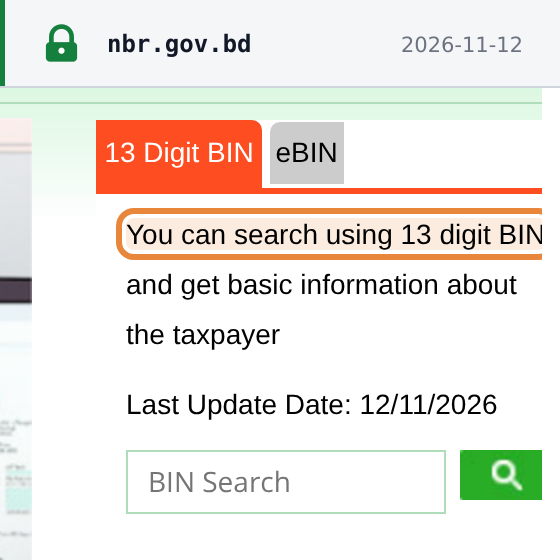
| BIN | "13 Digit BIN" search on the NBR homepage — free, no login | Basic information about the registered taxpayer |
| e-TIN | "Third Party TIN Verification" on the e-TIN system — registered users only | Whether a 12-digit e-TIN is correct, checked against name and date of birth for individuals, or name and address for other taxpayers [21] |
| e-TIN + return | e-Return "Return Verify" at etaxnbr.gov.bd — public, with a captcha | Whether a return (PSR) is on record for a TIN and assessment year |
BIN. NBR's homepage panel says: "You can search using 13 digit BIN and get basic information about the taxpayer". Enter the BIN as NBR prints it, NNNNNNNNN-NNNN. Start from the homepage search box. [16] For a step-by-step walkthrough, see how to verify a Bangladesh BIN.
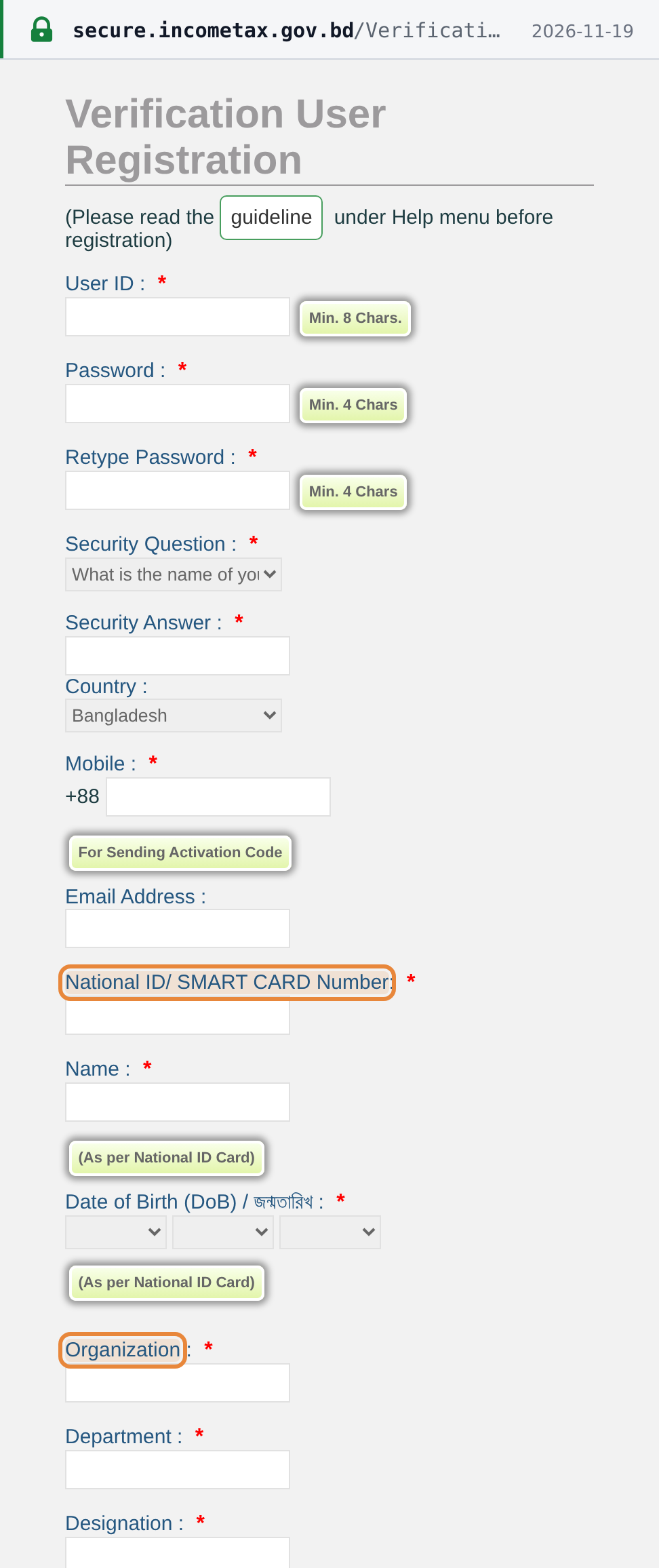
e-TIN. There is no anonymous e-TIN lookup. The e-TIN system's "Third Party TIN Verification" menu opens a "Verification User Registration" form that asks for a "National ID/ SMART CARD Number", name and date of birth "(As per National ID Card)", and the user's "Organization", "Department" and "Designation". It is built for organisations whose staff hold a Bangladeshi NID. [17] NBR's 2015 guide to the service says the account is for the person responsible at an organisation providing a service for which checking the 12-digit e-TIN is mandatory under the income-tax law ("যে সকল সেবা প্রদানের জন্য ১২ডিজিটের e-TIN যাচাই আয়কর আইনে বাধ্যতামূলক করা হয়েছে সে সকল প্রতিষ্ঠানের সংশ্লিষ্ট সেবা প্রদানকারী হিসাবে দায়িত্ব প্রাপ্ত ব্যক্তি"). The applicant uploads a signed application and posts a hard copy to NBR, and NBR issues a user ID after checking it. With that ID, "ব্যক্তি শ্রেণীর করদাতাদের ক্ষেত্রে করদাতার নাম, e-TIN ও জন্ম তারিখ এবং অন্যান্য করদাতাদের ক্ষেত্রে করদাতার নাম, ঠিকানা ও e-TIN এর তথ্য Input দিয়ে ১২ ডিজিটের e-TIN এর সঠিকতা যাচাই করা যাবে" — in our translation, the correctness of a 12-digit e-TIN can be checked by entering the name, e-TIN and date of birth for individual taxpayers, or the name, address and e-TIN for other taxpayers. [21]
Return filed? NBR's public e-Return "submission verification" page takes a "TIN No" ("12 Digit TIN No. is required!") and an "Assessment Year", and on a match shows the assessee's name, TIN and assessment year. It confirms that a return exists for that year, which is what a bank or registry checks under s.264. [18]
Format check. The LookupTax Bangladesh BIN validator checks a BIN's format. LookupTax has no e-TIN validator; check that an e-TIN has 12 digits.
Frequently Asked Questions
My old TIN has 10 digits. Is it still valid?
No. NBR began issuing 12-digit e-TINs on 1 July 2013 to replace the 10-digit TIN, and the old 10-digit TIN stopped being effective on 1 January 2014. If you still hold a 10-digit number, log in to the e-TIN system at secure.incometax.gov.bd and choose Re-registration to get a 12-digit e-TIN.
Do I need proof of a filed return, or just my TIN certificate, to get a credit card or register a flat?
It depends on the transaction. As at 19 November 2026, section 264(3) of the Income Tax Act 2023 lists 40 cases that need proof of submission of return (PSR) and 12 cases where the system-generated TIN certificate is enough. Getting or renewing a credit card is in the TIN-certificate list. Registering the sale, lease, transfer, bainanama or power of attorney of land, a building or an apartment in a city corporation, paurashava or cantonment area needs a PSR, whatever the value. Neither list applies to a person who need not file a return under section 166(2). The lists change in most Finance Acts.
Will a company deduct more tax from my dividend if I do not have a TIN?
Not since 1 July 2026. Section 117, as substituted by the Finance Act 2026, has a Bangladeshi company deduct 15% from a dividend paid to a resident natural person and 20% from one paid to any other resident, with no TIN test. The older 10% rate for TIN holders and 15% for others no longer applies. What can raise the rate is section 142(1): if you cannot produce proof of a filed return, tax deducted at source is 50% higher, unless you are not required to file or the Board has exempted you.
I am a foreigner without a Bangladeshi NID. Can I get an e-TIN online?
Yes. NBR's e-TIN FAQ gives NRBs, foreigners and Bangladeshis without an NID their own online route: you give your passport number and issue date, visa number and issue date, and a photo, and the account form lets you choose your country. The biometric SIM check applies to e-Return filing, not to e-TIN registration.
How can I check a supplier's or customer's TIN?
There is no anonymous public e-TIN lookup. NBR's Third Party TIN Verification needs a registered verifier account with a Bangladeshi NID and your organisation, department and designation. For a business, search its BIN on the NBR homepage to see basic information about the registered taxpayer. To confirm that someone filed a return for a given year, use the public Return Verify page on etaxnbr.gov.bd with the 12-digit TIN and the assessment year.
Do I need a TIN before I can get a BIN?
Yes. Field 1 of the VAT registration and enlistment application (Mushak-2.1) is the applicant's e-TIN. NBR's guidance is one company, one TIN, one BIN: separately accounted branches get separate BINs against separate TINs, a proprietorship may hold several BINs on one TIN, and a natural person can take only one BIN with one TIN.
What happens if a TIN that is not mine ends up on my return or documents?
Under section 268 of the Income Tax Act 2023, using another person's TIN or a fake TIN on a return or any document that requires a TIN, without reasonable cause, can bring a fine of up to BDT 20,000. Correct the document with your own e-TIN. Mistakes in your own certificate, such as a misspelt parent's name, cannot be fixed by you once the certificate exists; NBR asks taxpayers to e-mail info@incometax.gov.bd.
As a foreign SaaS provider selling to consumers in Bangladesh, do I need a BIN?
Yes. Electronic services supplied by a non-resident with no fixed place in Bangladesh to an unregistered person in Bangladesh are treated as supplied in Bangladesh (VAT Act section 17). You must appoint a VAT agent and register in your own name, and you remain liable for the VAT (section 19). The agent must be one of the persons listed in rule 16(2) of the VAT Rules, such as a VAT consultant, chartered accountant, lawyer or a Bangladesh-registered consultancy firm with your consent, and holds a VAT-3.2 VAT Agent Certificate.
Recent changes
- 2026-08-03 — NBR changed the last 4 digits (the VAT Commissionerate and Division suffix) of BINs moved to new jurisdictions; old and new BINs both stay active in ASYCUDA World until 30 November 2026. (National Board of Revenue)
- 2026-07-01 — The Finance Act 2026 substituted s.117 of the Income Tax Act 2023: dividends to resident natural persons are taxed at source at 15% and to other residents at 20%, with no TIN-based rate. (Laws of Bangladesh)
- 2026-07-01 — The Finance Act 2026 substituted s.263: a withholder's TIN serves as its Withholder Identification Number (WIN), with a temporary number (TWIN) for withholders without a TIN. (Laws of Bangladesh)
- 2026-07-01 — The Finance Act 2026 inserted s.4(3) of the VAT and SD Act 2012: a BIN or proof of enlistment is required for business bank accounts, loans, trade-licence renewal, MFS merchant accounts, trade-body membership, utility connections and business vehicle registration. (Laws of Bangladesh) — see event
Related Resources
- Bangladesh VAT guide — rates, registration, invoicing and returns
- How to verify a Bangladesh BIN on the NBR portal
- LookupTax Bangladesh BIN validator
- Bangladesh tax changes — chronology
- How to register for VAT, GST and sales tax
- E-invoicing status and networks by country
- Worldwide tax rates reference
- Neighbouring countries' tax IDs: India and Pakistan
How Lookuptax can help you ?
Lookuptax VAT validation revolutionizes VAT number validation with its robust platform, empowering businesses to seamlessly verify VAT numbers across over 100 countries. Our cutting-edge technology ensures accurate and efficient validation, reducing errors and enhancing compliance.