Canada Tax ID Guide — SIN, BN, ITN, GST/HST & QST Formats
Canada has no single tax identification number. Its identifiers are issued by three authorities. Employment and Social Development Canada (ESDC), through Service Canada, issues the Social Insurance Number (SIN) that individuals use to work and file taxes. The Canada Revenue Agency (CRA) issues the Business Number (BN) and the program accounts built on it (the GST/HST account is RT), the Individual Tax Number (ITN) for non-residents who cannot get a SIN, and the trust account number. Revenu Québec issues the Québec sales tax (QST) registration number and, for businesses located in Québec, also handles GST/HST registration. [1] [2] For GST/HST rates, invoicing and filing, see the Canada GST/HST guide.
Canada's Tax Identifiers at a Glance
| Identifier | Format | Who has it | Issued by | How it is issued |
|---|---|---|---|---|
| Social Insurance Number (SIN) | 9 digits — ^\d{9}$, shown as 123 456 789 (illustrative) | Individuals who work in Canada or receive government benefits; temporary residents' SINs start with 9 | ESDC / Service Canada | On application, free |
| Individual Tax Number (ITN) | 9 digits — ^\d{9}$ | Non-resident individuals not eligible for a SIN | CRA (Sudbury Tax Centre) | Form T1261; allow 6 to 8 weeks |
| Business Number (BN) | 9 digits — ^\d{9}$ | Businesses (one BN per business) | CRA | Business Registration Online or Form RC1 |
| Program account number (e.g. GST/HST) | BN + 2 letters + 4 digits — ^\d{9}[A-Z]{2}\d{4}$, e.g. 123456789 RT 0001 | Businesses registered for a CRA program | CRA | Added to the BN on registration |
| Trust account number | T + 8 digits — ^T\d{8}$ | Trusts that file a T3 return | CRA | Trust Account Registration online service or Form T3APP |
| QST number (general system) | 10 digits + TQ + 4 digits — ^\d{10}TQ\d{4}$, e.g. 1234567890 TQ 0001 | QST registrants | Revenu Québec | With the GST at Revenu Québec |
| QST number (specified system) | NR + 8 digits — ^NR\d{8}$ | Certain suppliers outside Québec and digital platform operators | Revenu Québec | Online, under the specified system |
Every example above is illustrative, not a real registration.
Social Insurance Number (SIN)
| Field | Detail |
|---|---|
| Format | 9 digits, commonly written 123 456 789 (illustrative) |
| Issued by | Service Canada, for ESDC |
| Who must apply | Every individual resident or employed in Canada who files an income tax return, or about whom an information return is made (Income Tax Act s.237(1)) |
| Temporary residents | SIN always starts with 9 and expires with the work permit, study permit or visitor record |
| Citizens and permanent residents | SIN "is permanent and does not expire" |
| Public lookup | None |
ESDC says: "To work in Canada or access government programs and benefits, you need a 9-digit identifier known as Social Insurance Number (SIN)." For Canadian citizens and permanent residents, "Your SIN is permanent and does not expire". [3] Under Income Tax Act s.237(1), every individual "who was resident or employed in Canada at any time in a taxation year and who files a return of income", or about whom an information return is to be made, must apply for a SIN. [4]
Temporary residents. ESDC states that "SINs issued to temporary residents always start with "9"" and that "Your SIN expires on the same date your work permit, study permit or visitor record expires". You must update your SIN record when you receive a new permit with a new expiry date. A temporary resident "can start working as soon as you apply for a SIN", and if the SIN expires while an application to extend the permit is pending (maintained status), "you can continue working with your expired SIN until IRCC makes a decision". Applications take about 5 business days online and about 20 business days by mail. [5]
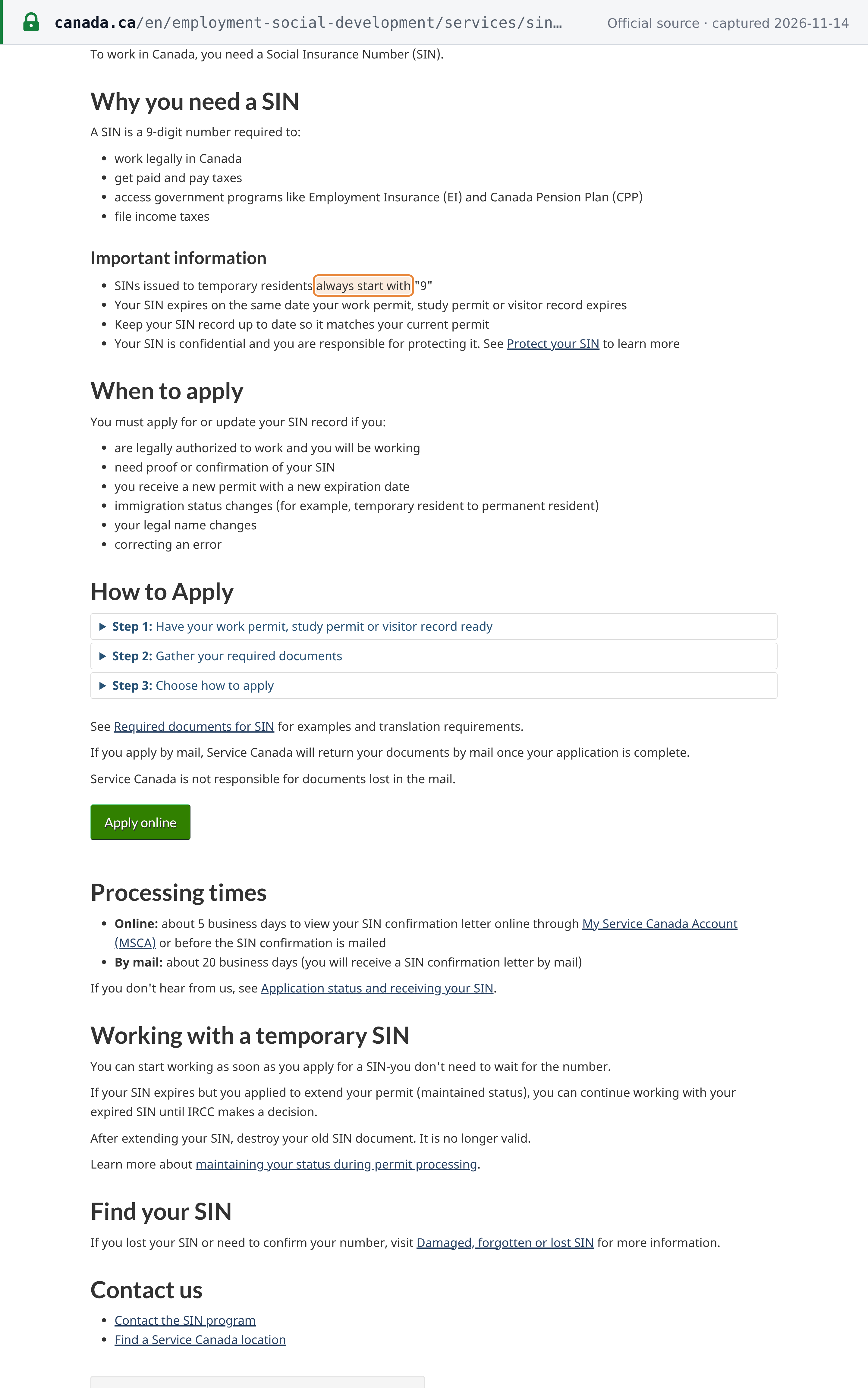
ESDC publishes no meaning for the other leading digits on its SIN pages. The CRA's business-registration page sends a person whose "SIN starts with 0" to the non-resident registration route, without explaining what a 0-series SIN is. [6]
Employers. An employer must ask a new employee for the SIN "within three days after the day on which the employment begins" (Employment Insurance Regulations s.89(2)). [7] If the employee does not provide it, the employer must inform Service Canada within 6 days of the employee starting work, and a CAD 100 penalty may apply. [1]
Other businesses. ESDC's SIN Code of Practice says: "It isn’t against the law to ask for an individual’s SIN", but "The law doesn’t allow private sector businesses to require a client’s SIN for purposes other than income reporting. No one can deny you a product or service for refusing to provide your SIN when the law doesn’t require it." [8]
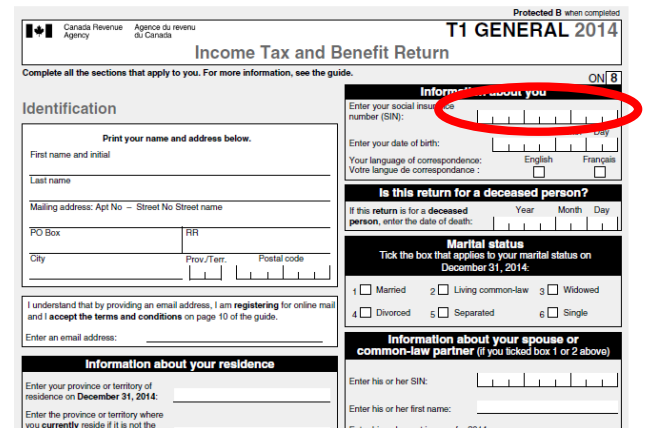 | 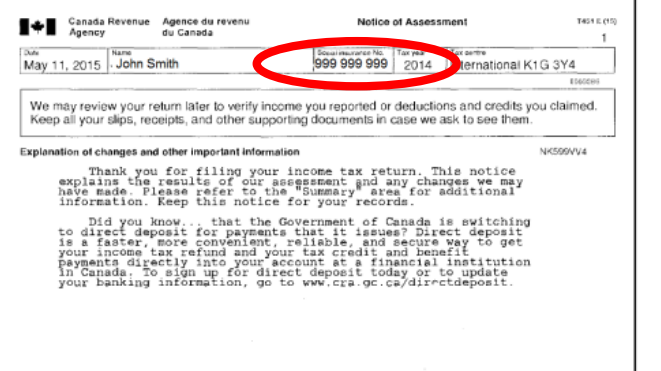 |
| SIN on income tax return (illustration) | SIN on notices of tax assessment (illustration) |
Individual Tax Number (ITN)
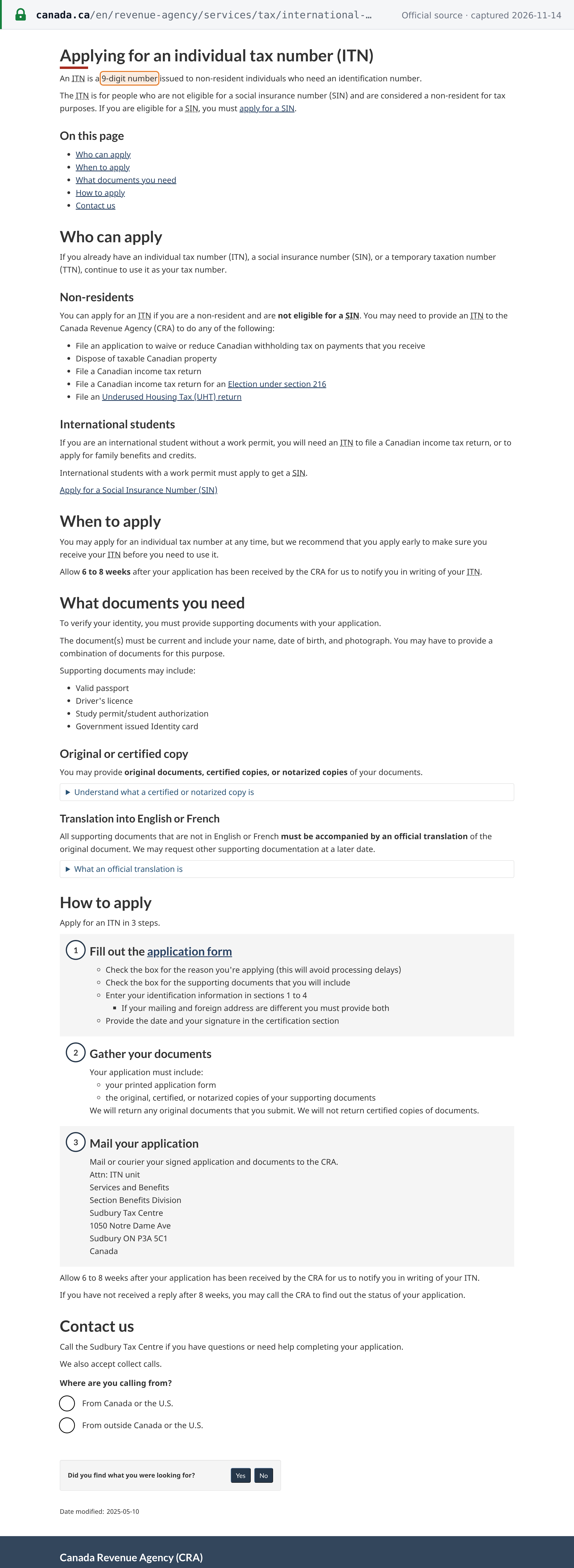
The CRA describes the ITN as "a 9-digit number issued to non-resident individuals who need an identification number". It is "for people who are not eligible for a social insurance number (SIN) and are considered a non-resident for tax purposes. If you are eligible for a SIN, you must apply for a SIN." Anyone who already has an ITN, a SIN or a temporary taxation number (TTN) keeps using it. [9]
The CRA lists the purposes for which a non-resident may need an ITN:
- applying to waive or reduce Canadian withholding tax on payments received;
- disposing of taxable Canadian property;
- filing a Canadian income tax return, including a return for an election under section 216;
- filing an Underused Housing Tax (UHT) return.
International students without a work permit need an ITN to file a return. Those with a work permit "must apply to get a SIN". Apply on Form T1261 by mail or courier to the ITN unit of the Sudbury Tax Centre, with identity documents, and allow 6 to 8 weeks after the CRA receives the application. [9] The CRA publishes no rule for the ITN's leading digits.
Selling Canadian property. Under Income Tax Act s.116(5), a purchaser of taxable Canadian property from a non-resident is liable to remit 25% of the amount by which its cost exceeds the certificate limit (50% for certain property, such as a rental building, under s.116(5.3)), within 30 days after the end of the month of the purchase, unless the CRA has issued a clearance certificate under s.116(4) or another listed exception applies. [10] The CRA puts it as: "the purchaser is entitled to withhold 25% (50% on certain types of property)". [11] The trigger is the missing certificate, not a missing ITN. The ITN matters because the CRA asks a seller without a SIN, TTN or ITN to "send your ITN application separately and in advance of your disposition request in order to avoid delays." [11]
Business Number (BN) and Program Accounts
"When you register your business, you get a unique 9-digit business number (BN) that identifies your business." Also, "You can only have one BN for your business." [12] The BN is not a tax account in itself. When a business registers for a CRA program, "a program identifier and reference number is added to your existing business number (BN). Together they become your CRA program account number". A program account number consists of: [13]
- the unique 9-digit BN;
- a 2-letter program identifier for the account type;
- a 4-digit reference number to tell apart program accounts of the same type.
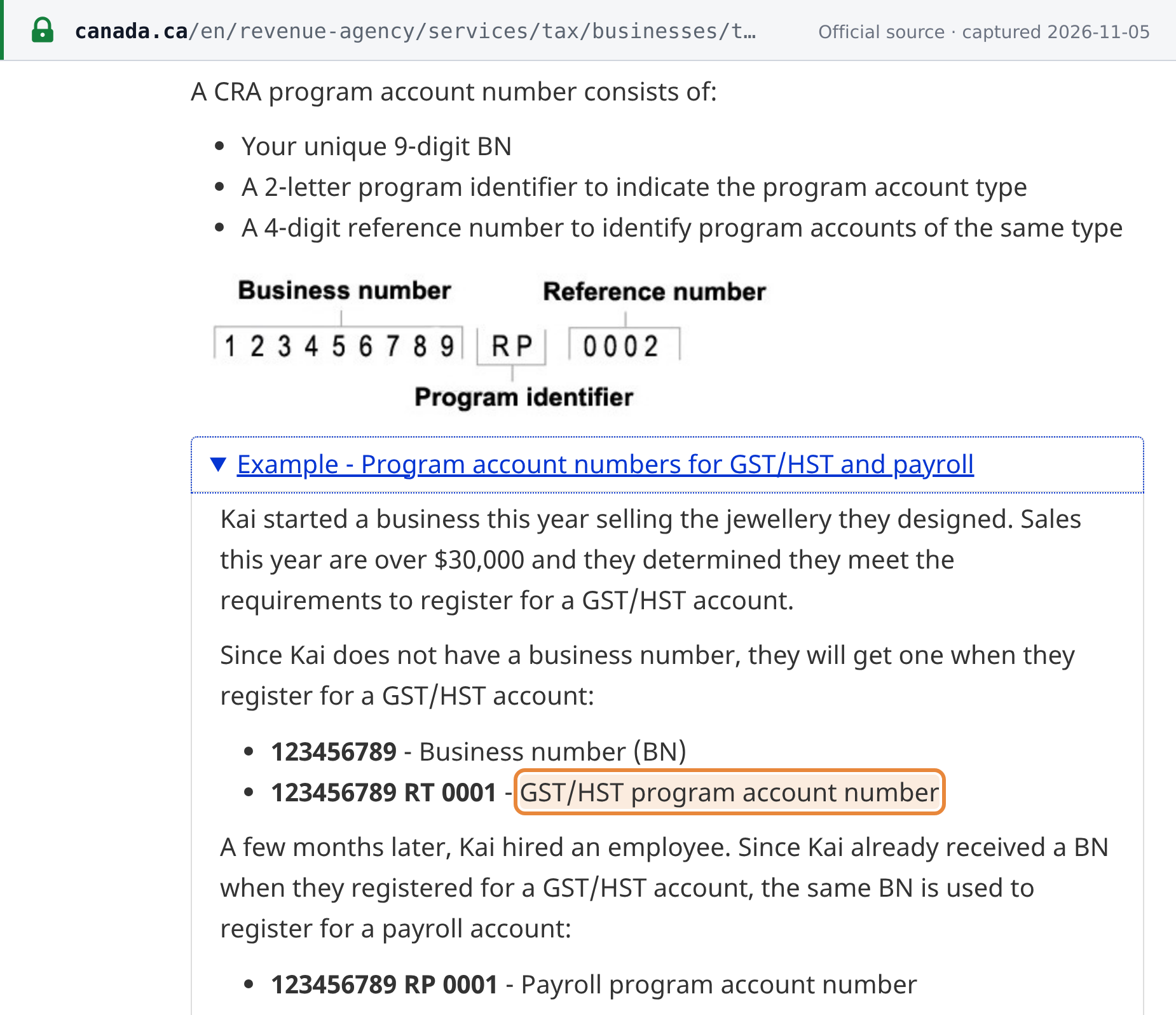
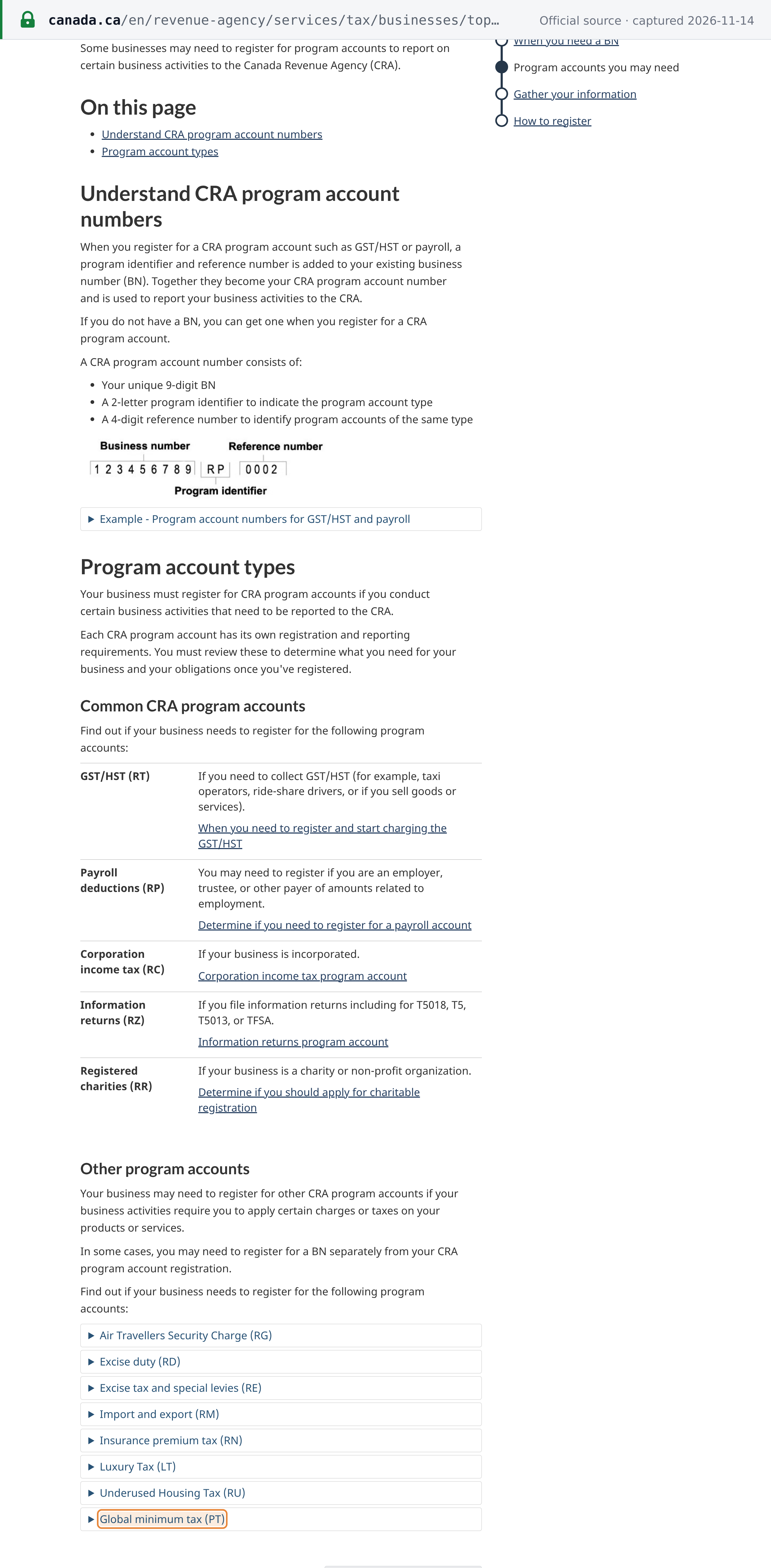
Each program account is registered separately: a GST/HST account does not create a payroll account. The CRA lists these program identifiers: [13]
| Identifier | Program account |
|---|---|
| RT | GST/HST |
| RP | Payroll deductions |
| RC | Corporation income tax |
| RZ | Information returns (including T5018, T5, T5013 and TFSA) |
| RR | Registered charities |
| RG | Air Travellers Security Charge |
| RD | Excise duty |
| RE | Excise tax and special levies |
| RM | Import and export |
| RN | Insurance premium tax |
| LT | Luxury Tax |
| RU | Underused Housing Tax |
| PT | Global minimum tax |
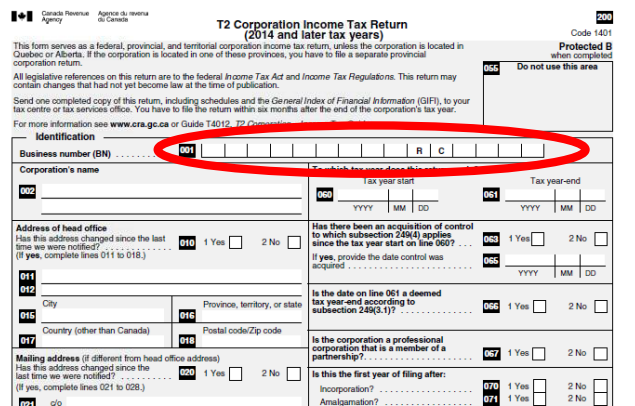 | 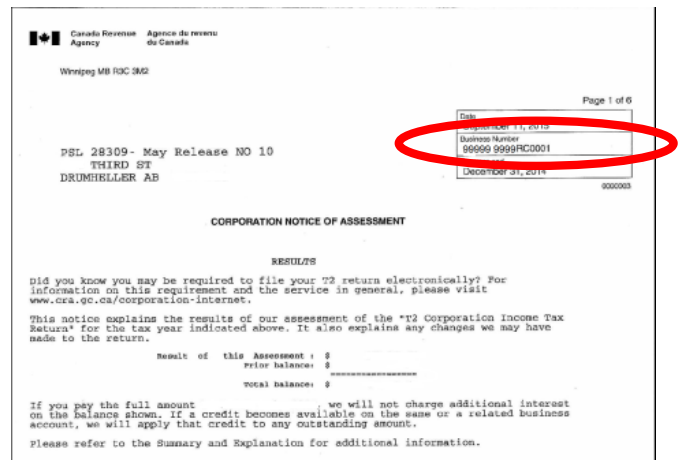 |
| BN on income tax return (illustration) | BN on notices of tax assessment (illustration) |
GST/HST Registration Number
The GST/HST account is the BN's RT program account. CRA Guide RC4022 says: "When you register, you will have a 15-digit registration number. The 9-digit BN identifies the business followed by 2 letters which identifies the program (RT is for the GST/HST program) and a 4 digit number which identifies the specific account, for example: 123456789 RT 0001." [14] Two of the 15 characters are letters. On invoices the number is often written without spaces, 123456789RT0001.
The HST is the harmonized federal and provincial tax charged in Ontario, Nova Scotia, New Brunswick, Newfoundland and Labrador, and Prince Edward Island. There is no separate HST number: the same RT account covers GST and HST.
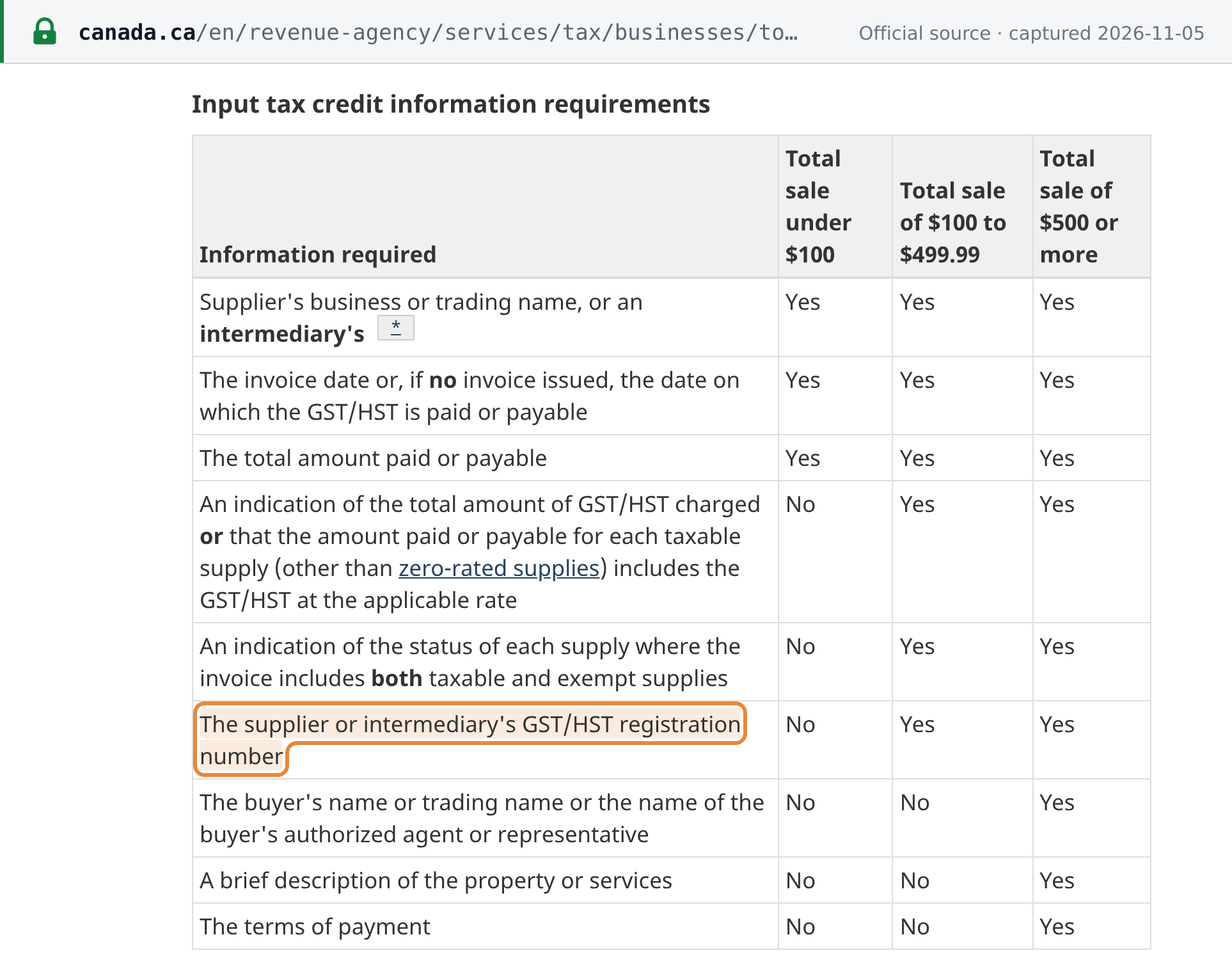
On invoices. A supplier must show its GST/HST registration number on the supporting documentation when the total is CAD 100 or more. Under the Input Tax Credit Information (GST/HST) Regulations s.3(b)(i), documentation of "$100 or more and less than $500" must carry "the registration number assigned under section 241 of the Act to the supplier or the intermediary". [15] [16]
Trust Account Number
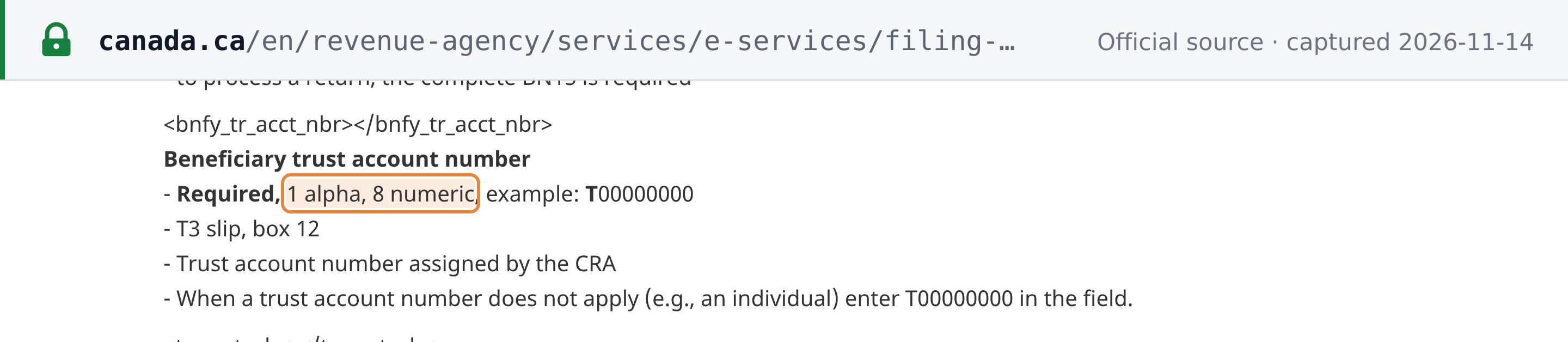
A trust account number is a T followed by eight digits. The CRA's T3 electronic-filing specification describes the beneficiary trust account number as "1 alpha, 8 numeric, example: T00000000". [17] "You need a trust account number to file a T3 return." It can be obtained instantly with the CRA's Trust Account Registration online service, or on Form T3APP. [18]
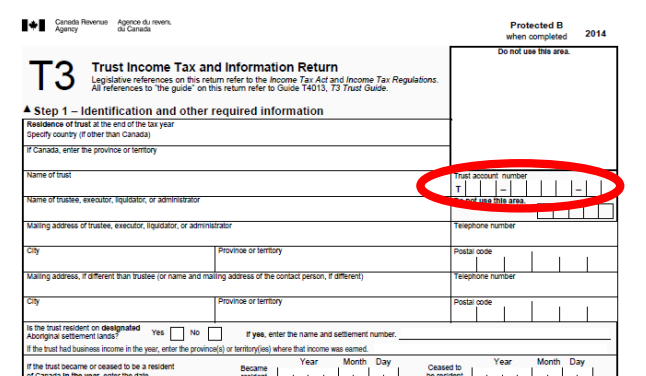 | 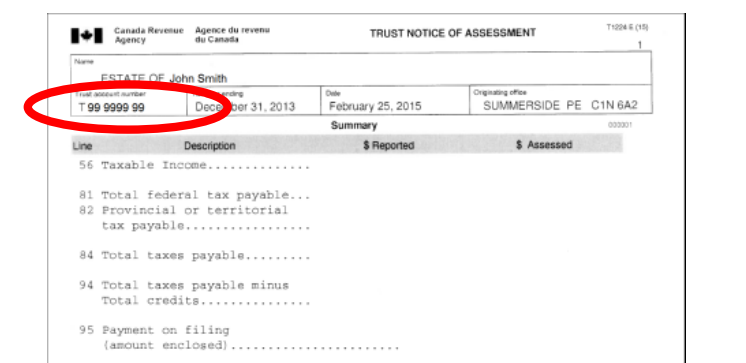 |
| Trust account number on income tax return (illustration) | Trust account number on notices of tax assessment (illustration) |
Québec Sales Tax (QST) Registration Number
Revenu Québec administers the QST, and in Québec it also administers the GST/HST. The CRA says: "If your business is physically located in Quebec, the GST/HST is administered by Revenu Québec. You must register and file your GST/HST returns with Revenu Québec and use their forms." [2] A QST number takes one of two forms:
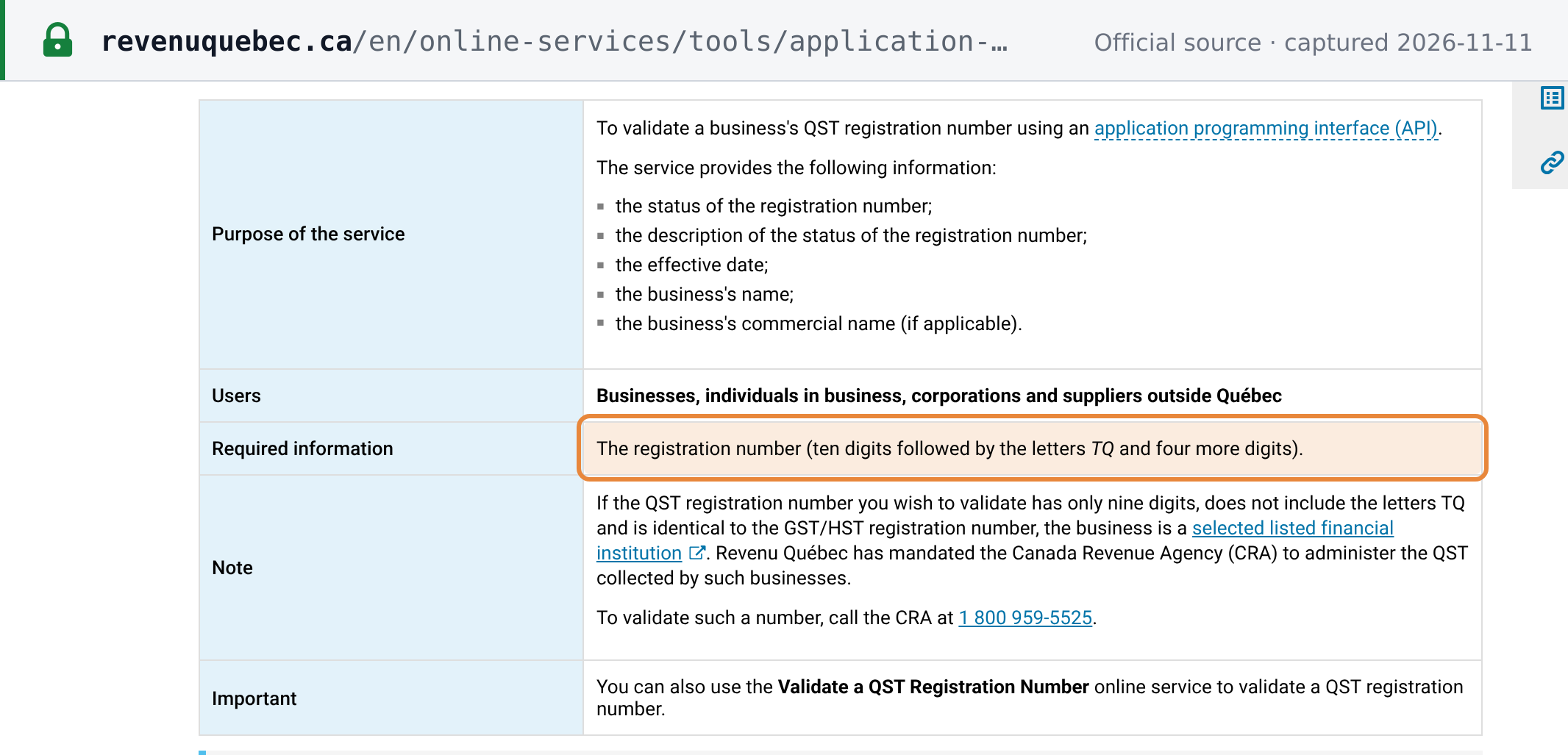
- General system: "ten digits followed by the letters TQ and four more digits", displayed as
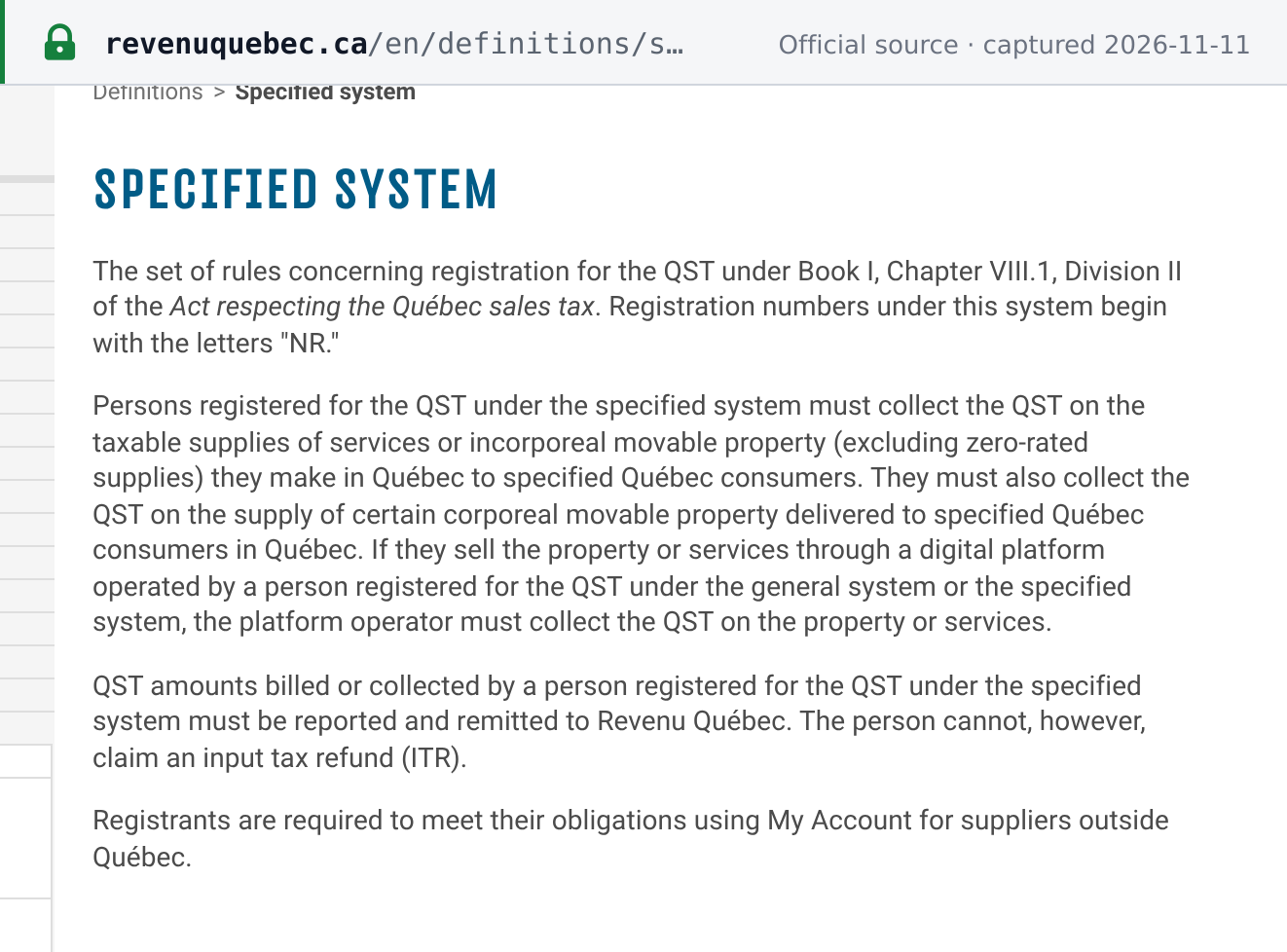
1234567890 TQ 0001(illustrative). A selected listed financial institution instead uses a nine-digit number identical to its GST/HST number, without TQ. [19] - Specified system: since 1 January 2019, certain suppliers outside Québec and certain digital platform operators have had to register for the QST. "Their QST registration numbers contain the letters "NR" (instead of the letters "TQ")." Revenu Québec's published list of specified-system registrants shows each number as NR followed by eight digits, written with spaces, for example
NR 0013 0061. [20] [21] [32]
Check Digits
As at 2026-11-14, no Canadian authority publishes a check-digit algorithm for these numbers:
- SIN: ESDC's SIN pages and its SIN Code of Practice describe a 9-digit number and give no check-digit, modulus or Luhn rule. Many validation libraries apply the Luhn (mod 10) test to SINs. That is a community convention, not an ESDC or CRA rule, so treat its result as a heuristic.
- BN and ITN: the CRA describes both only as 9-digit numbers. The CRA's GST/HST Registry rejects some nine-digit numbers, such as
123456789, as "GST/HST number is not valid." before any search, so the CRA applies a check of some kind, but it does not publish it. - QST: Revenu Québec's validation service checks the format described above. Revenu Québec publishes no check digit.
Validate against the official registries listed under How to Verify a Canadian Tax Number.
Who Must Register for GST/HST
Excise Tax Act s.240(1) sets the rule: "Every person who makes a taxable supply in Canada in the course of a commercial activity engaged in by the person in Canada is required to be registered". The exceptions are a small supplier, a person whose only commercial activity is selling real property otherwise than in the course of a business, and "a non-resident person who does not carry on any business in Canada". [22] Self-employed taxi and commercial ride-sharing drivers must register even if they are small suppliers. A business that provides only exempt supplies generally cannot register. [23]
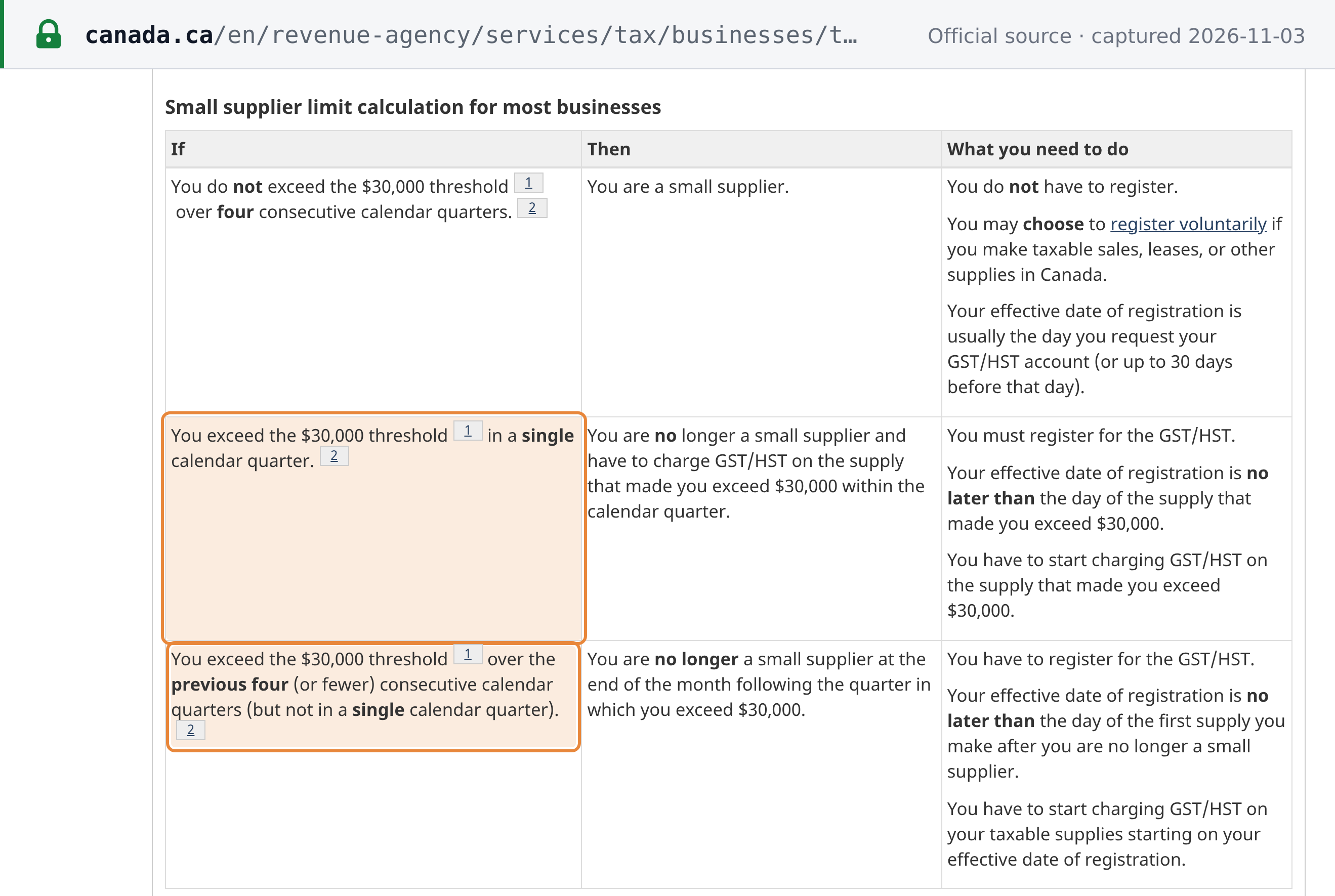
The small-supplier threshold, as at 2026-11-14, is CAD 30,000 (CAD 50,000 for a public service body) of worldwide taxable supplies, including zero-rated supplies, made by the business and its associates (ETA s.148). Supplies of financial services, sales of capital property and goodwill from the sale of a business are left out. [24] [23]
| You exceed CAD 30,000 … | You stop being a small supplier … |
|---|---|
| in a single calendar quarter | with the supply that took you over: you charge GST/HST on that supply, and your effective date of registration is no later than that day |
| over the previous four (or fewer) consecutive calendar quarters, but not in a single quarter | at the end of the month following the quarter in which you went over |
You must apply within 29 days of the first taxable supply made other than as a small supplier (RC4022; ETA s.240(2.1)). Below the threshold, a small supplier engaged in a commercial activity in Canada may choose to register voluntarily; taxi and commercial ride-sharing drivers must register regardless. [14] [22]
| Situation | Rule |
|---|---|
| Non-resident that carries on business in Canada | Registers under the normal GST/HST regime, on the same CAD 30,000 small-supplier test. A permanent establishment is not required to be carrying on business in Canada. [23] |
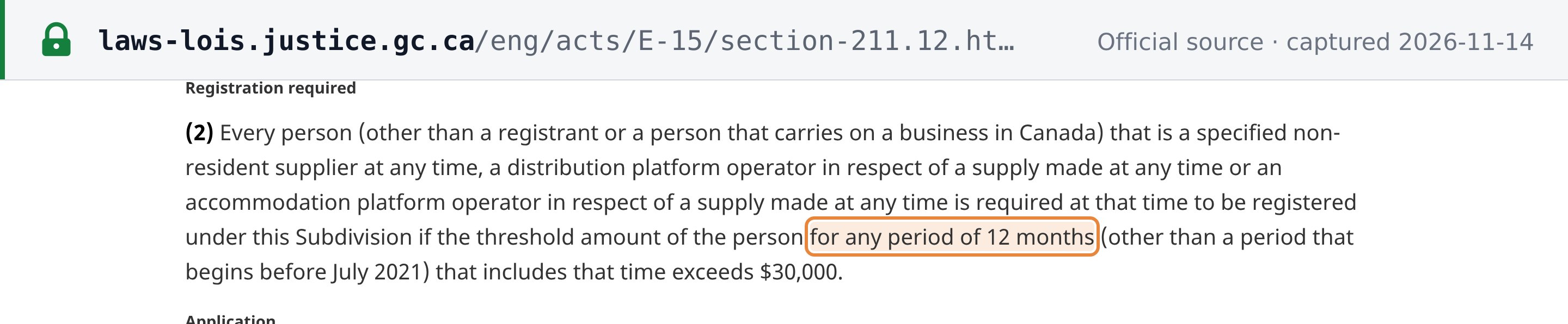
| Non-resident that does not carry on business in Canada and sells digital products or services or platform-based short-term accommodation to Canadian consumers, or a distribution or accommodation platform operator | Must register under the simplified GST/HST regime when its "threshold amount … for any period of 12 months" of those specified supplies exceeds CAD 30,000 (ETA s.211.12(2); in force since 1 July 2021). Simplified registrants cannot claim input tax credits. [25] [26] |
| Non-resident supplying qualifying goods (goods located in Canada) | Normal GST/HST regime only; the simplified regime is not available. [27] |
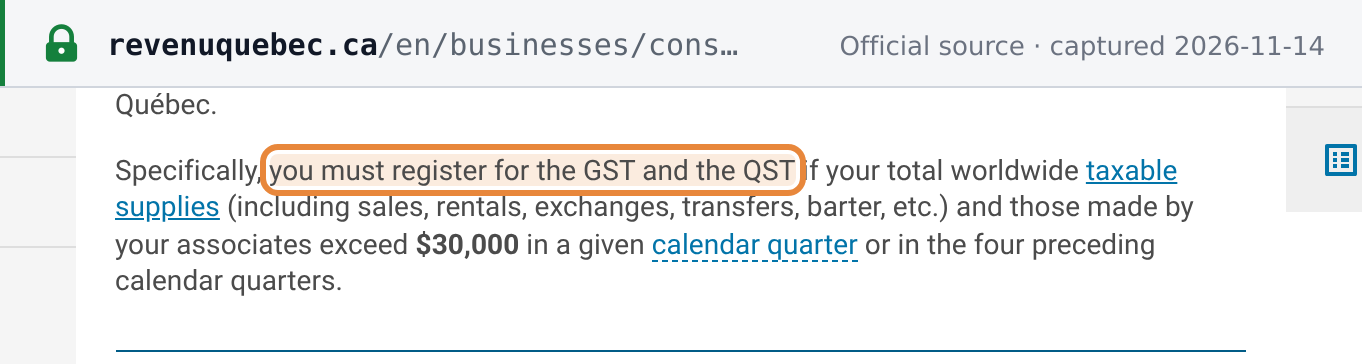
| Business carrying on commercial activities in Québec | Registers for the GST and the QST together at Revenu Québec once its worldwide taxable supplies, with its associates, exceed CAD 30,000 in a calendar quarter or the four preceding quarters. [28] |
| Supplier outside Canada, not registered under the general GST/HST system, selling to Québec consumers | Must register under the specified QST system as soon as its threshold amount of taxable supplies for a 12-month period exceeds CAD 30,000. [29] |
The same threshold appears in the worldwide VAT, GST and sales tax registration thresholds table.
How to Register
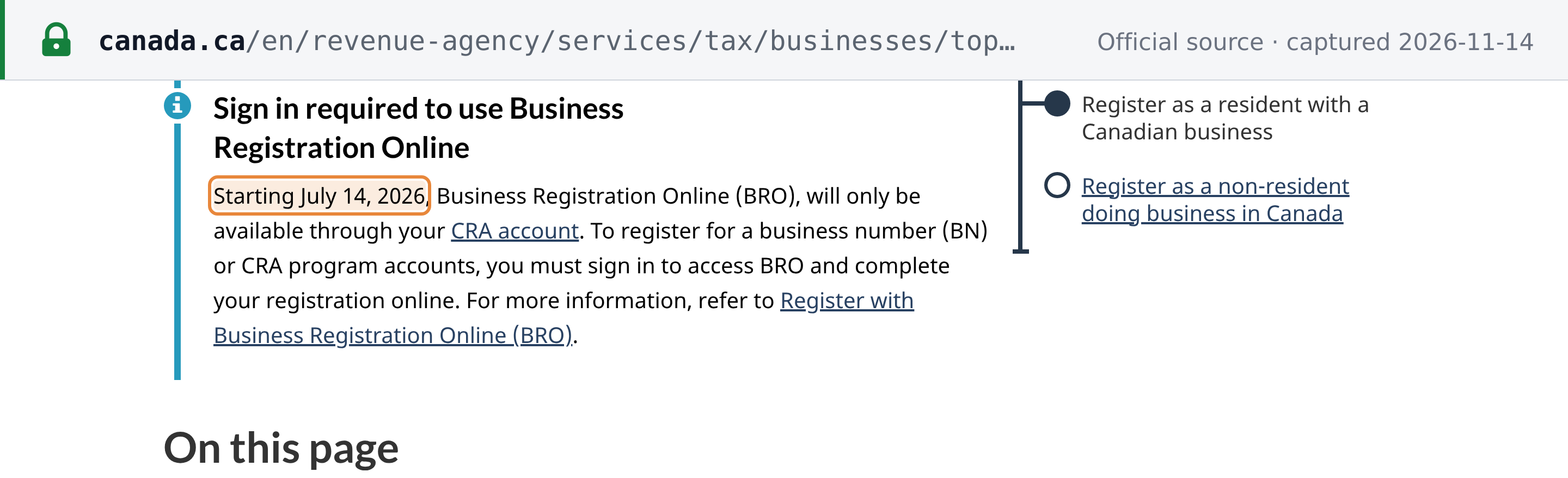
- Residents outside Québec register for a BN and program accounts through Business Registration Online (BRO). "Starting July 14, 2026, Business Registration Online (BRO), will only be available through your CRA account": you must sign in to register. The BN is issued at once and "won't be sent to you", so save or print it. BRO is unavailable daily from 3 am to 6 am ET. Form RC1 by mail remains the paper route. [2]
- No phone registrations. Since 3 November 2025, new BN and program-account registrations "must be done online"; callers to the Business Enquiries line are directed to BRO. [30]
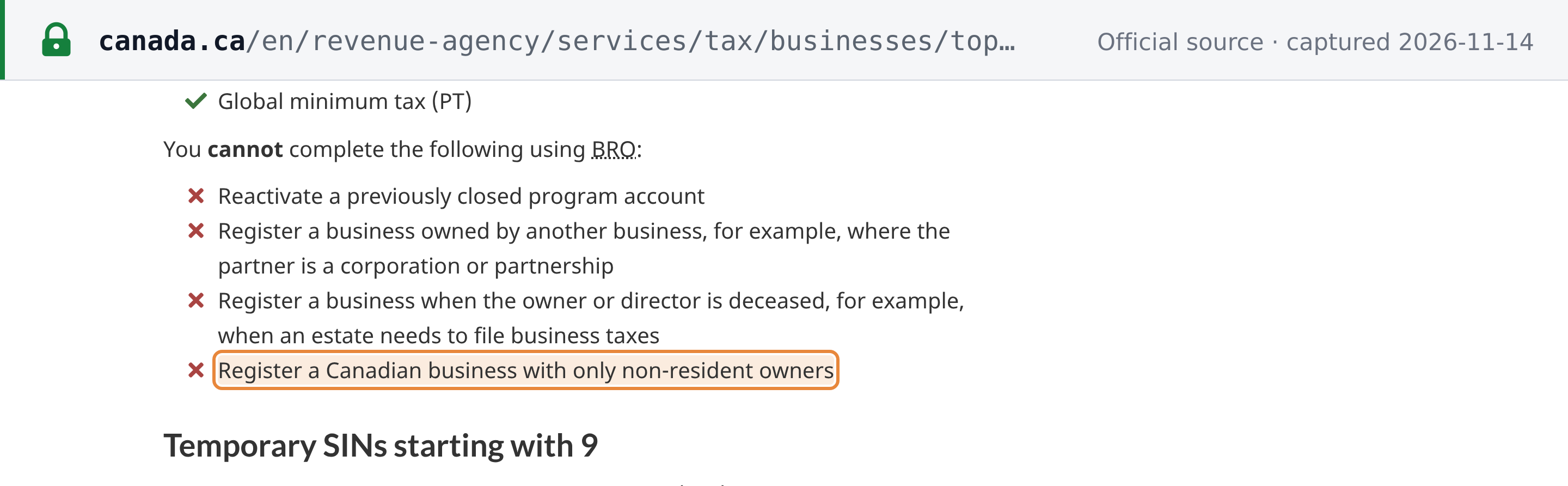
- What BRO cannot do. The CRA lists four cases: reactivating a previously closed program account; registering a business owned by another business (for example, where a partner is a corporation or partnership); registering a business whose owner or director is deceased; and registering a Canadian business with only non-resident owners. For these, the CRA says you will "need to call the CRA’s BE line for help or register by paper". [2] [30]
- Temporary SIN holders. An owner, director, partner or trustee whose SIN starts with 9 must use BRO. [2]
- Non-residents. A business incorporated or located outside Canada, or an owner whose SIN starts with 0 or who has no SIN, registers through the CRA's non-resident registration route. [6]
- Businesses located in Québec register for the GST/HST and the QST with Revenu Québec. [28]
LookupTax has no Canada-specific registration walkthrough yet. For the general process across jurisdictions, see how to register for VAT, GST and sales tax.
E-Invoicing and the BN
As at 14 November 2026, Canada had no e-invoicing mandate, and no e-invoicing registration number rides on the BN. The CRA's 2025–26 Departmental Plan undertook to "identify and evaluate opportunities that electronic invoicing (e-invoicing) can provide to improve GST/HST compliance through business-to-business transactions". [31] Its 2026–27 Departmental Plan contains no e-invoicing commitment, and the Budget 2026 tax-measures annex announces no e-invoicing measure. [33] [34] Follow later developments in the Canada tax changes chronology and the global e-invoicing status tracker.

How to Verify a Canadian Tax Number
| What you want to confirm | Official tool | What it returns |
|---|---|---|
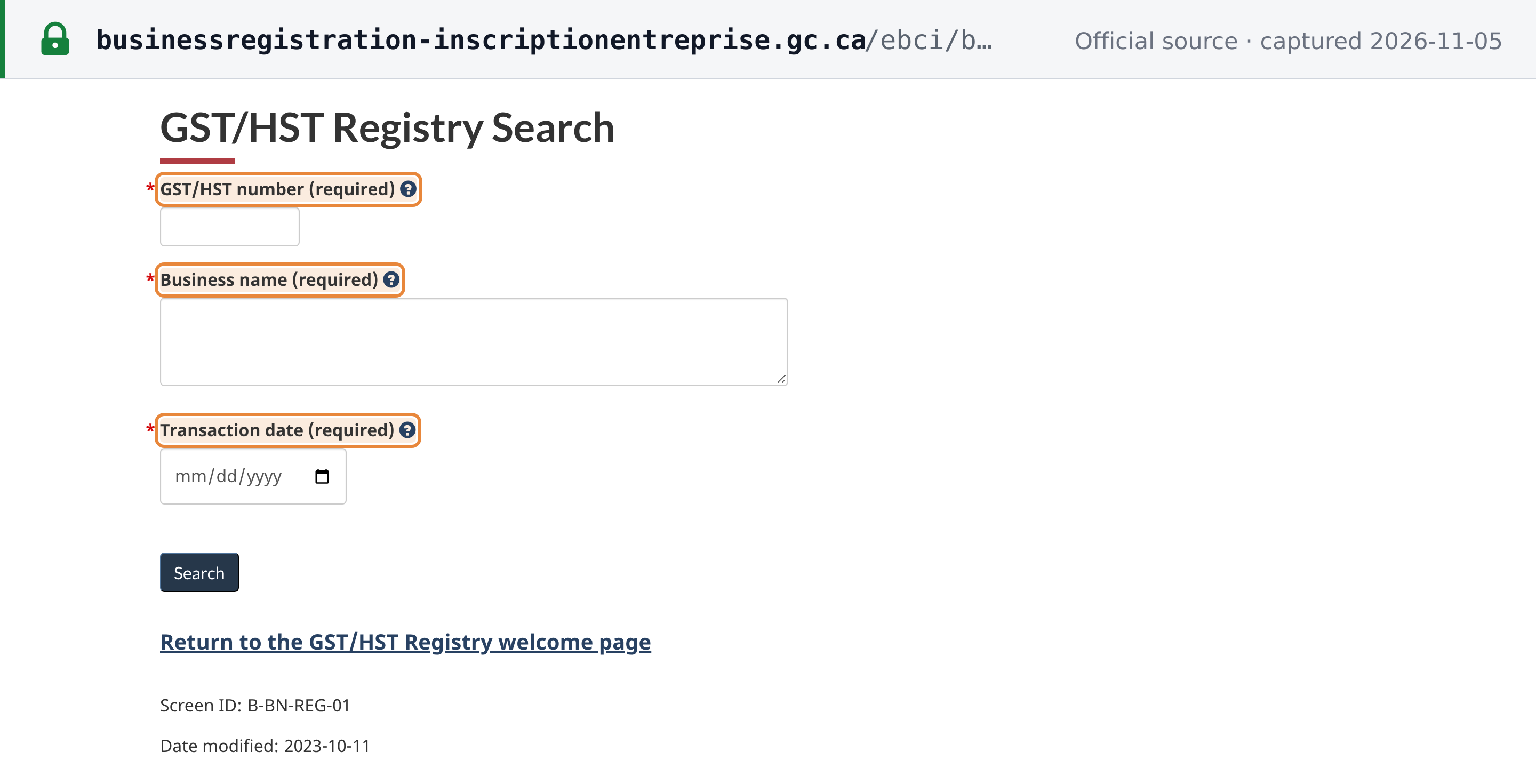
| A supplier is GST/HST-registered | CRA GST/HST Registry: enter the first 9 digits (the BN), the business name and the transaction date | Whether the number was registered on that date |
| A non-resident digital supplier is a simplified registrant | The CRA's separate Simplified GST/HST Registry list | Simplified registrants and their numbers |
| A QST number (TQ or NR) is valid | Revenu Québec, Validate a QST Registration Number | Whether the number is registered |
| A SIN, ITN, BN on its own or trust account number | No public lookup | — |
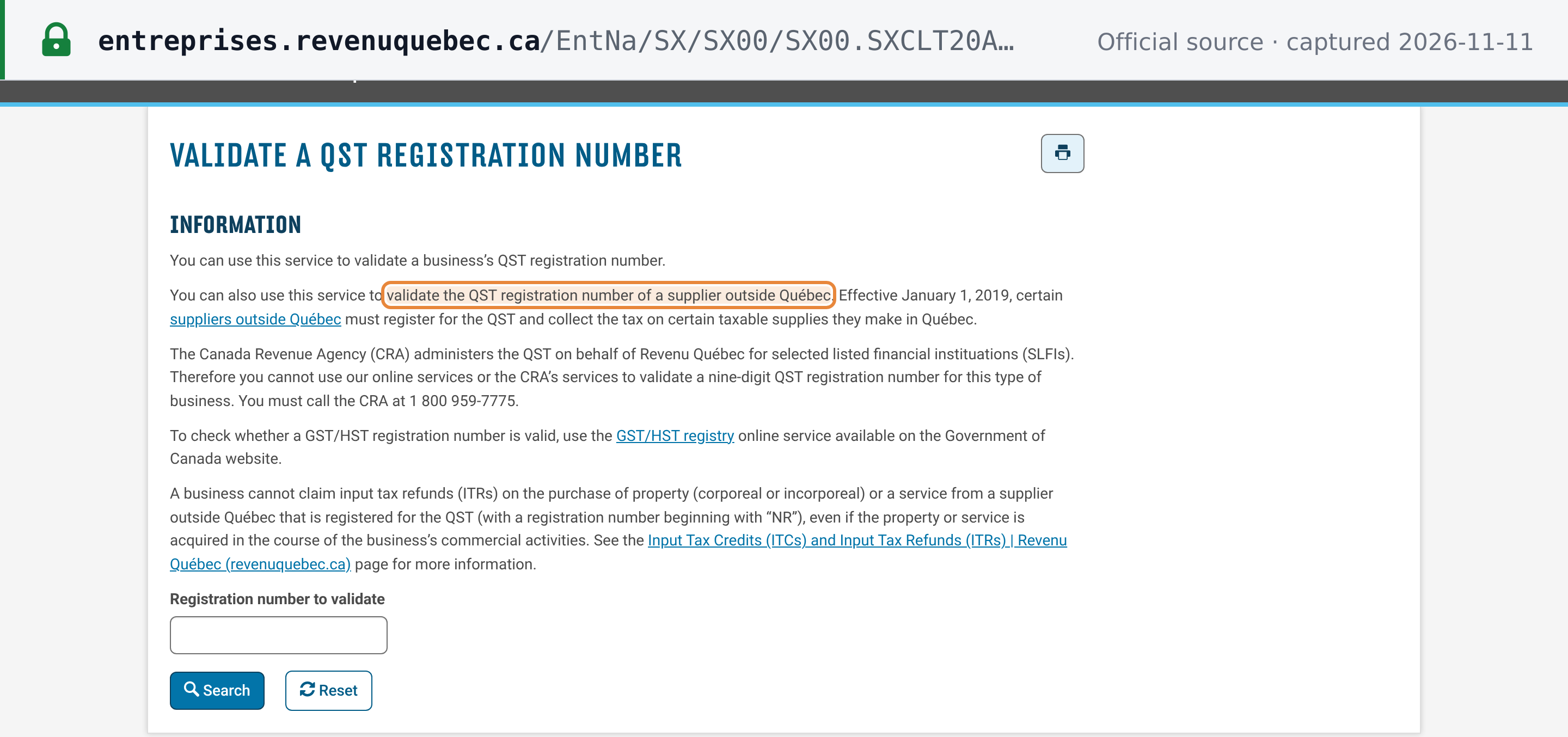
For step-by-step checks, see how to verify a GST/HST number in Canada, how to verify a QST number and how to verify a provincial sales tax (PST) number. To check a number's format instantly, use the LookupTax Canada Business Number validator, GST/HST number validator or QST number validator.
Frequently Asked Questions
I went over C$30,000 in sales without registering for GST/HST. From when did I have to charge it?
It depends on how you went over. If your worldwide taxable supplies exceeded C$30,000 in a single calendar quarter, you stopped being a small supplier with the supply that took you over, and you had to charge GST/HST on that supply. If you exceeded C$30,000 only over the previous four consecutive calendar quarters, you stopped being a small supplier at the end of the month following the quarter in which you went over. Either way, you must register within 29 days. The test counts the supplies of your associates too, leaves out financial services, sales of capital property and goodwill, and is C$50,000 for public service bodies. Once registered, CRA Guide RC4022 says a new registrant that was a small supplier may be able to claim input tax credits for GST/HST on property on hand for its commercial activities when it became a registrant, and for GST/HST payable before registration on services supplied to it after registration.
Can my landlord or a business demand my Social Insurance Number as a condition of service?
They can ask, but they cannot require it. ESDC's SIN Code of Practice says it isn't against the law to ask for a SIN, but the law doesn't allow private sector businesses to require a client's SIN for purposes other than income reporting, and no one can deny you a product or service for refusing to provide your SIN when the law doesn't require it. It adds that you aren't legally required to give your SIN for a credit check. Your employer is different: under the Employment Insurance Regulations, an employer must ask a new employee for the SIN within three days after employment begins, because it is used for income reporting.
As a non-resident selling digital services to Canadians, do I register under the simplified GST/HST regime or the normal regime, and does it matter?
It depends on whether you carry on business in Canada. A non-resident that does not carry on business in Canada and sells digital products or services to Canadian consumers must register under the simplified GST/HST regime once its threshold amount of those supplies for any 12-month period exceeds C$30,000; the regime has applied since 1 July 2021. Simplified registrants cannot claim input tax credits, although they can claim certain net tax deductions. A business required to register under the simplified regime may, if it meets certain conditions, voluntarily apply for the normal regime, but it cannot be registered under both at the same time. A non-resident that does carry on business in Canada registers under the normal regime unless it is a small supplier, and a supplier of goods located in Canada can only use the normal regime.
Does registering for federal GST/HST also cover my obligation to collect Québec sales tax?
Not by itself, but it depends where you are. A business located in Québec registers for the GST/HST and the QST together at Revenu Québec, which administers the GST/HST in Québec. A business registered with the CRA outside Québec has a separate QST question. Since 1 January 2019, certain suppliers outside Québec and certain digital platform operators have had to register for the QST under the specified system; a supplier outside Canada that is not registered under the general GST/HST system must do so once its taxable supplies to specified Québec consumers exceed C$30,000 over 12 months. Their QST numbers start with NR instead of containing TQ.
As a non-resident, do I need an Individual Tax Number before selling Canadian real property, and what happens if I skip it?
If you have no SIN, temporary taxation number or ITN, the CRA asks you to file Form T1261 for an ITN separately and in advance of your section 116 disposition request, to avoid delays. Allow 6 to 8 weeks. What protects the sale is the clearance certificate, not the ITN itself. Under Income Tax Act s.116(5), unless the CRA has issued a certificate under s.116(4) or another listed exception applies, the purchaser is liable to remit 25% of the amount by which the cost of the property exceeds the certificate limit (50% for certain property, such as a rental building, under s.116(5.3)), within 30 days after the end of the month of the purchase.
My B2B customer says they cannot claim an Input Tax Credit because my GST/HST number is missing from my invoice. Who is at fault?
The invoice needs fixing. Under the Input Tax Credit Information (GST/HST) Regulations, supporting documentation for a total of C$100 or more must show the supplier's GST/HST registration number, and under Excise Tax Act s.169(4) your customer cannot claim the credit until it holds documentation with the required information. The number is your 9-digit BN, the letters RT and a 4-digit reference, for example 123456789 RT 0001. Check your number on the free CRA GST/HST Registry and reissue the invoice with it.
I tried to register my BN by phone after November 2025. Why was I redirected online?
Since 3 November 2025, new BN and CRA program account registrations must be done online through Business Registration Online (BRO), and callers to the Business Enquiries line are directed there. Since 14 July 2026, BRO is only available through your CRA account, so you must sign in to register. BRO issues the BN at once and does not send it to you, so save or print it. BRO cannot reactivate a previously closed program account, register a business owned by another business, register a business whose owner or director is deceased, or register a Canadian business with only non-resident owners; for those cases, call the CRA's Business Enquiries line or register on paper.
Related Resources
- Canada GST/HST guide — rates, registration, invoicing and filing
- How to verify a GST/HST number in Canada
- How to verify a Québec QST number
- How to verify a provincial sales tax (PST) number in Canada
- Canada tax changes — chronology
- Worldwide VAT, GST and sales tax registration thresholds
- Global e-invoicing status tracker
- United Kingdom tax ID guide — another multi-identifier system (UTR, National Insurance number, VAT number)
- Australia tax ID guide — the ABN and TFN side by side
How Lookuptax can help you?
Lookuptax VAT validation revolutionizes VAT number validation with its robust platform, empowering businesses to seamlessly verify VAT numbers across over 100 countries. Our cutting-edge technology ensures accurate and efficient validation, reducing errors and enhancing compliance.