Japan Tax ID Guide — My Number & Corporate Number
Japan operates two distinct tax identification number systems under the Social Security and Tax Number System (社会保障・税番号制度), introduced in 2015: the Individual Number (My Number / マイナンバー) for natural persons, and the Corporate Number (法人番号) for legal entities. The two numbers serve different purposes, are issued by different authorities, and carry fundamentally different privacy rules. Japan's tax system is also notable for its Consumption Tax (消費税) — a VAT-equivalent levy currently set at 10% (8% on food and drink) — which underpins the Qualified Invoice registration requirements described below. For the consumption-tax rules themselves — rates, thresholds, invoice content and filing — see the Japan consumption tax guide.
Individual Number (My Number)
The Individual Number, commonly known as "My Number," is a 12-digit numeric identifier assigned to every person registered in Japan's Resident Register (住民基本台帳). It is issued automatically — residents do not apply for it. The issuing authority is the Digital Agency (デジタル庁), which oversees the overall system; the physical notification card is sent by the resident's municipal office. [1]
Format and Structure
| Field | Detail |
|---|---|
| Length | 12 digits, numerals only |
| Regex | ^\d{12}$ |
| Example (illustrative) | 123456789012 |
| Check digit | Last (12th) digit, calculated by modulo-11 algorithm |
| Issued to | All registered residents, including foreign nationals with medium-to-long-term residence status |
The number is derived from the Resident Register Code (住民票コード) but is algorithmically one-way: the Resident Register Code cannot be reconstructed from the My Number.
Check digit algorithm (My Number): The 12th digit is validated using a weighted sum of the first 11 digits. Positions 1–5 use weights 6, 5, 4, 3, 2; positions 6–11 use weights 7, 6, 5, 4, 3, 2. The weighted sum is divided by 11; the remainder is subtracted from 11. If the result exceeds 9, the check digit is 0. [2]
Who Receives a My Number
- Japanese citizens registered as residents
- Foreign nationals with a residence card (在留カード) for medium-to-long-term status or special permanent residence — including working visa holders, students, and spouses
- Newborns upon birth registration
- Individuals moving to Japan from abroad, upon residence registration
Visitors on short-term stay (90 days or less), diplomatic visa holders, and individuals not registered in the Resident Register are not assigned a My Number. [3]
Permitted Uses — Strict Legal Restriction
Unlike the Corporate Number, the My Number carries strict statutory restrictions on collection and use. Employers, financial institutions, and government agencies may only collect and use an Individual Number for the specific purposes listed in the Act on the Use of Numbers to Identify a Specific Individual in the Administrative Procedure (番号利用法, as amended May 30, 2017):
- Tax purposes: withholding tax slips (源泉徴収票), income tax returns, consumption tax returns
- Social security: pension enrollment, health insurance, unemployment benefit administration
- Disaster response
Collecting a My Number for any other purpose is a criminal offence. Individual violators face up to four years imprisonment and/or fines up to ¥2 million. [1]
Where to Find Your My Number
The My Number appears on two documents:
- Notification card (通知カード): a paper card mailed automatically from the municipal office to the registered address. It contains the number but is not a valid ID document.
- Individual Number Card (マイナンバーカード): a plastic card issued on application (online, by mail, or at a photo booth), bearing the holder's name, address, date of birth, gender, My Number, and a facial photo. Processing takes approximately one month after application. This card functions as a government-issued photo ID.
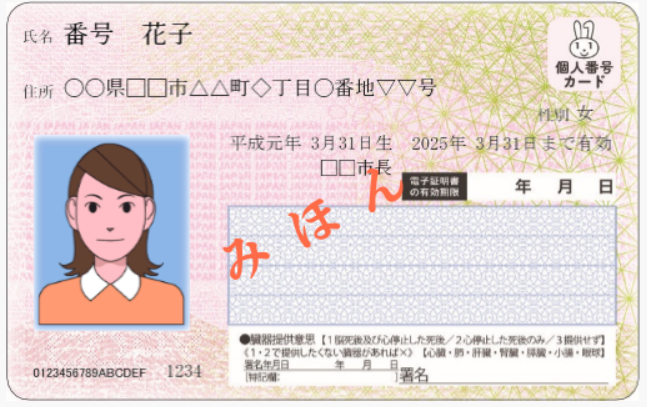 |
| Sample My Number Card |
Corporate Number (法人番号)
The Corporate Number is a 13-digit numeric identifier assigned by the Commissioner of the National Tax Agency (NTA) to legal entities and certain unincorporated associations. Unlike the My Number, the Corporate Number has no restrictions on use — anyone may freely reference and republish it.
Format and Structure
| Field | Detail |
|---|---|
| Length | 13 digits, numerals only |
| Regex | ^\d{13}$ |
| Check digit | 1st (leading) digit |
| Base number | Digits 2–13: the 12-digit Company Number (商業登記法) for registered corporations |
| Official example | 7000012050002 (National Tax Agency itself) |
For companies registered under the Companies Act (会社法, Law No. 86 of 2005) or other incorporation laws, the Corporate Number equals the 12-digit Commercial Registration Number prepended with a 1-digit check digit. The check digit is computed by the NTA at the time of assignment using a modulo-9 algorithm specified in the Ministry of Finance Ordinance (法人番号の指定等に関する省令, Ministry of Finance Ordinance No. 70 of 2014). [4]
Qualified Invoice Registration Number (適格請求書発行事業者登録番号)
Since 1 October 2023, any business that issues Qualified Invoices (適格請求書) under Japan's Invoice System must also register as a Qualified Invoice Issuer. The registration number is the Corporate Number prefixed with the letter "T" — giving a 14-character identifier in the format T + 13 digits (e.g., T1234567890123). The qualified invoice system sets invoice-content rules; it is not an e-invoicing mandate, and Peppol e-invoicing (JP PINT) is voluntary — see the global e-invoicing status tracker for how other countries compare.
This T-number is separate from the Corporate Number for unregistered entities and from the Individual Number. Sole proprietors and foreign businesses without a Corporate Number are assigned a unique 13-digit registration number (not derived from a Commercial Registration Number) and receive the same "T" prefix.
The NTA Qualified Invoice Issuer Announcement Site (invoice-kohyo.nta.go.jp) is the only authoritative database for confirming T-number validity.
Who Receives a Corporate Number
The NTA automatically assigns a Corporate Number (without any application) to:
- National government organs (国の機関)
- Local public entities (地方公共団体)
- Registered corporations — companies established under the Companies Act, general incorporated associations, general incorporated foundations, and similar entities
- Unincorporated associations or foundations with a duty to file corporate tax, consumption tax, or withhold income tax on salaries
Certain partnerships — Silent Partnerships (匿名組合), Limited Investment Partnerships (投資事業有限責任組合), and similar pass-through structures — are generally not assigned Corporate Numbers. Non-qualifying unincorporated bodies may apply to the NTA Commissioner for voluntary designation if they meet specific conditions. [3]
Official Lookup Portals
| Purpose | Portal | URL |
|---|---|---|
| Verify a company exists and its registered name/address | NTA Corporate Number Publication Site | houjin-bangou.nta.go.jp |
| Confirm Qualified Invoice Issuer registration (T-number) | NTA Invoice Issuer Announcement Site | invoice-kohyo.nta.go.jp |
Search the Corporate Number Publication Site by company name, address, or 13-digit number. Results include the entity's full legal name, registered address, change history, and the Corporate Number. The database is updated daily.
Japan's Three Tax Numbers at a Glance
A common source of confusion is the existence of multiple overlapping identifiers. This table clarifies which number applies in each context:
| Number | Digits | Who holds it | Publicly searchable | Privacy restrictions |
|---|---|---|---|---|
| Individual Number (My Number) | 12 | Natural persons resident in Japan | No | Strict — criminal penalties for misuse |
| Corporate Number (法人番号) | 13 | Legal entities and qualifying associations | Yes (NTA portal) | None |
| Qualified Invoice T-number | 14 (T + 13) | VAT-registered Qualified Invoice Issuers | Yes (NTA invoice portal) | None |
| Consumption Tax Registration (foreign) | 13 | Foreign businesses registered for JCT | Yes (NTA portal) | None |
Cross-Border Implications
Foreign Businesses Selling into Japan
Foreign companies selling cross-border B2C electronic services (SaaS, apps, streaming, e-books) to Japanese consumers become taxable for Japan Consumption Tax (JCT) — and must file and pay — once taxable sales to Japanese customers exceed ¥10 million in a base period (generally two fiscal years prior) — one of the lower registration thresholds globally, as surveyed in our worldwide VAT and GST registration thresholds guide. A business that registers as a qualified invoice issuer receives a registration number made of "T" plus its 13-digit Corporate Number. For a step-by-step walkthrough of registering for consumption tax and equivalent indirect taxes in other jurisdictions, see how to register for VAT, GST, and sales tax.
As of April 2025, the Platform Taxation (プラットフォーム課税) regime introduced by the 2024 Tax Reform makes digital platform operators that collect over ¥5 billion a year for foreign sellers' B2C digital services in Japan, once designated by the NTA Commissioner as specified platform businesses, file and pay JCT in place of those sellers — similar to the EU's deemed supplier model. [5]
Withholding on Payments to Non-Residents
Japanese payers must withhold 20.42% (20% base rate + 2.1% reconstruction surtax) from Japan-source income — including royalties, certain professional fees, and technical service income — paid to non-residents without a permanent establishment in Japan. Japan has tax treaties with over 80 countries that may reduce or eliminate this rate; treaty relief requires submission of Form 1 (様式1) before payment is made. [6]
CRS Reporting and My Number Collection
Financial institutions in jurisdictions that are party to the Multilateral Convention on Mutual Administrative Assistance in Tax Matters, or that have a bilateral tax treaty with Japan, are required to collect Individual Numbers from Japanese resident account holders for CRS automatic exchange of information. Institutions in jurisdictions meeting neither condition are exempt from this collection requirement. [7]
Frequently Asked Questions
I am a tax-exempt freelancer (免税事業者) — if I do not register for the Qualified Invoice System, will my business clients legally be able to demand a price cut?
This is the central pain point that triggered a 450,000-signature petition when the system launched on 1 October 2023. If you remain unregistered, your clients cannot claim input tax credit on the consumption tax portion of your invoices. Under the Anti-Monopoly Act guidelines issued by the Japan Fair Trade Commission (JFTC), a business client that unilaterally demands a lower price to offset the lost tax credit — without negotiation — risks violating the Subcontract Act (下請法). The NTA's transitional relief partially softens the cost: since 1 October 2026 buyers can deduct 70% of the tax-equivalent amount (to 30 September 2028), then 50% (to 30 September 2030), then 30% (to 30 September 2031) — after which the credit disappears entirely under the 2026 tax reform extension. Registering ends this pressure permanently but obligates you to file consumption tax returns. [8] [9] [17]
How do I verify that a supplier is both a valid legal entity and a registered Qualified Invoice Issuer — and why are these two separate lookups?
Holding a Corporate Number does not automatically make a business a Qualified Invoice Issuer. Corporate Number registration and Invoice System registration are managed by two separate NTA portals. To confirm a company exists, search the NTA Corporate Number Publication Site (houjin-bangou.nta.go.jp) by name or 13-digit number — it returns the entity's registered name, address, and change history. To confirm invoice registration, use the NTA Qualified Invoice Issuer Announcement Site (invoice-kohyo.nta.go.jp) and enter the supplier's “T” + 13-digit registration number (e.g. T1234567890123). If your supplier's T-number is absent or shows a cancellation date, any input tax credits you claim on their invoices will be disallowed on audit. Always run both checks before processing a new vendor. [10] [11]
As a non-resident individual providing services to a Japanese company, why is 20.42% withheld from my invoice — and can a tax treaty reduce it?
Japan's domestic tax law requires the payer to withhold 20.42% (20% base rate plus 2.1% reconstruction surtax) from Japan-source income paid to non-residents with no permanent establishment in Japan, including royalties, certain technical fees, and professional service income — per the NTA's non-resident income tax schedule. [6] The rate is not negotiable at the invoice level; the Japanese payer is legally obligated to remit it to the NTA. However, Japan has tax treaties with over 80 countries that often reduce or eliminate this withholding — for example, the US-Japan treaty caps many service payments at 0%. To benefit, you must submit a Relief from Japanese Income Tax application form (様式1/Form 1) to the payer before payment is made; retroactive refund claims are possible but involve filing a Japanese tax return. Contact the NTA's international tax office or a Japanese tax adviser for treaty eligibility. [12]
What does switching from a White Return to a Blue Return (青色申告) actually save a sole proprietor — and what is the hard application deadline?
The Blue Return (青色申告) is one of the most impactful, underused elections for self-employed residents. Filing electronically via e-Tax with double-entry bookkeeping unlocks a special deduction of up to ¥650,000 from business or real estate income — versus zero deduction under the standard White Return. Even filing on paper with double-entry records yields ¥550,000. A simplified single-entry option gives only ¥100,000. Additional advantages include: deducting salaries paid to family members as genuine business expenses; carrying forward net operating losses for three years; and enhanced depreciation rules for small assets. The application for Blue Return approval must be submitted to your local tax office by 15 March of the first tax year you want to use it (or within two months of starting a new business mid-year). Missing this deadline means filing White Return for the entire year — and the ¥650,000 deduction cannot be retroactively claimed. [13]
Does a foreign company selling digital services (SaaS, apps, streaming) to Japanese consumers need to register with the NTA for consumption tax, and what is the threshold?
Yes. Japan taxes cross-border B2C electronic services under its consumption tax rules, and a foreign provider becomes a taxable business once its taxable sales to Japanese customers exceed ¥10 million in the base period (two years prior); registering as a qualified invoice issuer remains optional. Foreign providers must either have a local tax representative or open a Japanese office to register. The 2024 Tax Reform further introduced Platform Taxation (effective April 2025): digital platform operators — such as app stores or marketplaces — that collect over ¥5 billion for foreign sellers' B2C digital services in Japan are designated by the NTA Commissioner as specified platform businesses, and the platform itself becomes liable for consumption tax rather than the underlying sellers. Foreign companies at or below the ¥10 million threshold are exempt, but those above it that fail to file and pay risk penalties and back-tax assessments. The NTA publishes the list of designated platforms. [5] [14] [18] [19]
I registered for the Qualified Invoice System under client pressure in 2023 — can I simply cancel and return to tax-exempt status?
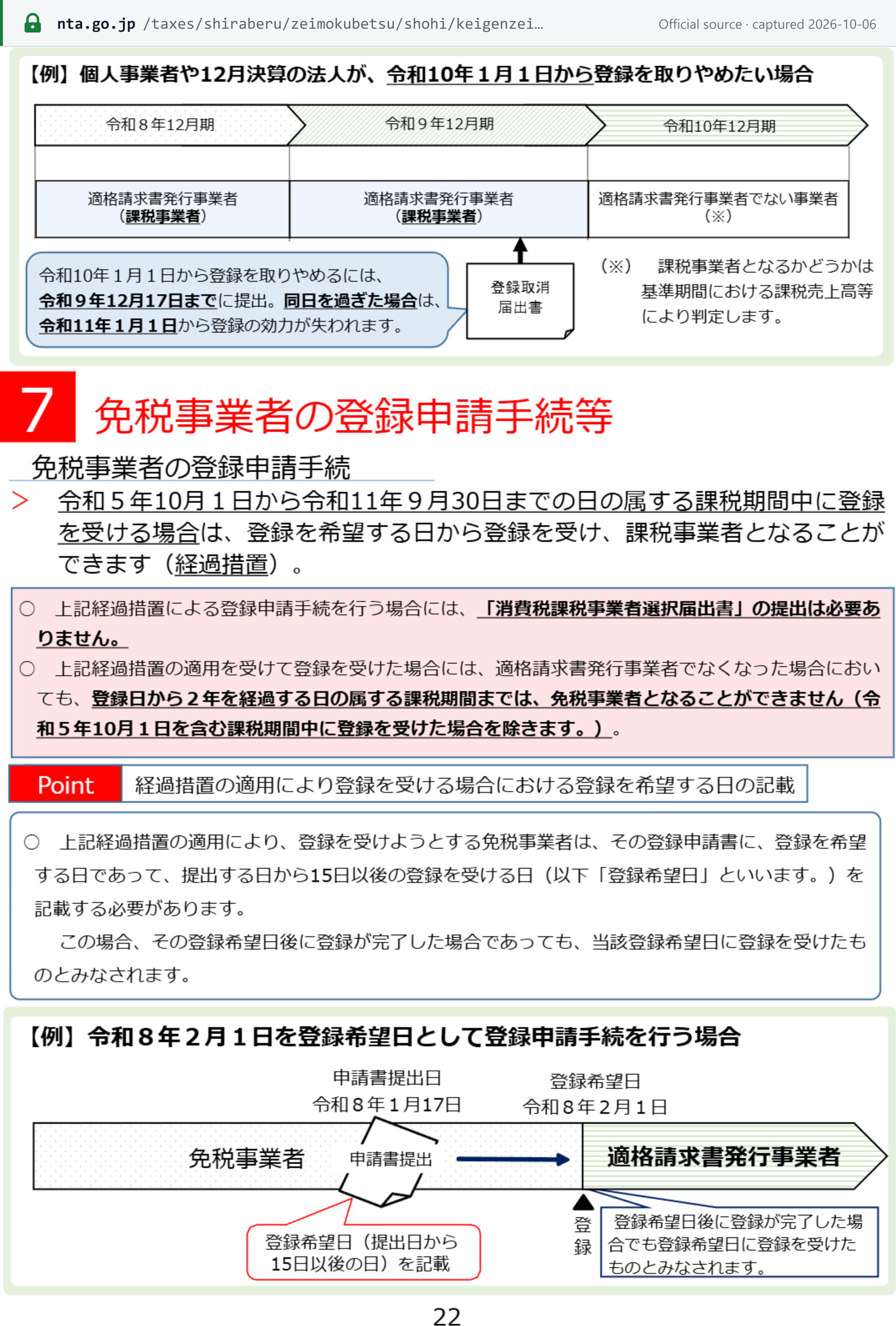
Yes, if your base-period taxable sales are ¥10 million or less. An exempt business that registers under the transitional measure normally cannot return to exemption until the taxable period that includes the day two years after registration — but the NTA states that this lock-in does not apply to a registration made during the taxable period that included 1 October 2023. To cancel, submit the “Notification of Cancellation of Registration as a Qualified Invoice Issuing Business” (適格請求書発行事業者の登録の取消しを求める旨の届出書) at least 15 days before the first day of the taxable period in which you want the cancellation to take effect; the deadline is not extended when it falls on a weekend or holiday. For a sole proprietor cancelling from 1 January 2028, that means filing by 17 December 2027. If you had also filed the taxable-business election, you must file the withdrawal notice (消費税課税事業者選択不適用届出書) as well, and the election cannot be withdrawn within two years of becoming taxable. Cancellation restores your exemption only if your taxable sales remain at or below the ¥10 million threshold. Freelancers considering cancellation should also account for any outstanding consumption tax return obligations before the effective cancellation date. [8] [15] [16]
Related Resources
- Japan consumption tax guide — rates, registration, invoices and filing
- Japan tax changes — chronology
- Consumption Tax — glossary definition and global context
- Input Tax Credit — how it works and why it matters for invoice compliance
- Global e-invoicing status tracker — Qualified Invoice and other mandates by country
- Worldwide VAT, GST, and consumption tax registration thresholds
- How to register for VAT, GST, and sales tax — step-by-step guides by jurisdiction
How Lookuptax can help you in VAT validation?
Lookuptax VAT validation revolutionizes VAT number validation with its robust platform, empowering businesses to seamlessly verify VAT numbers across over 100 countries. Our cutting-edge technology ensures accurate and efficient validation, reducing errors and enhancing compliance.