Moldova TIN number guide
Identification Number of Person (IDNP)
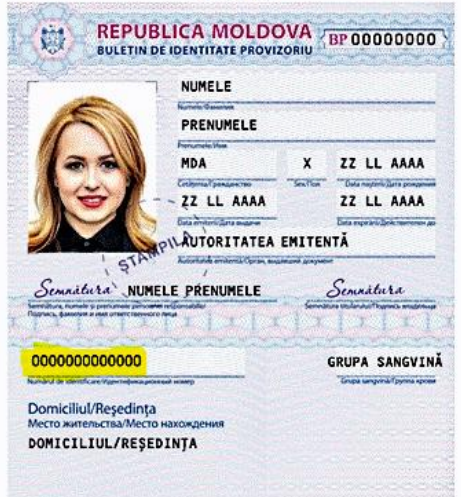
In the Republic of Moldova, the individual's identification number follows international conventions and is abbreviated as "Identification Number of Person" or IDNP. This unique IDNP is allocated to every natural person upon their initial data entry into the State Register of the Population (R.S.P.). Importantly, the IDNP remains constant throughout the entire duration of the recorded data, seamlessly integrated into all documents associated with the respective natural person.
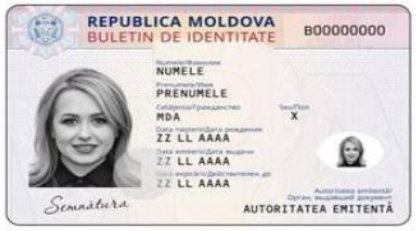 |  |
| Identity card - front | Identity card - back |
IDNP Format
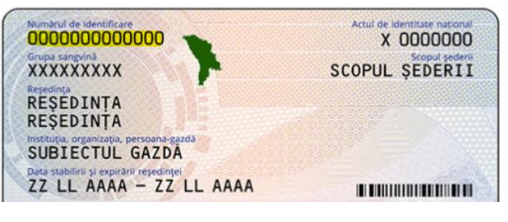
In line with Annex no. 2 appended to the Government Decision of the Republic of Moldova no. 333 dated 18.03.2023, endorsing the Concept of the automated information system "State Population Register" and the Regulation governing the State Population Register, the IDNP (Identification Number of Person) serves as the fundamental identification key for natural persons in the Republic of Moldova. This IDNP is a 13-digit series organized meticulously, with the following breakdown:
IDNP: 2ГГГXXXYYYYYK
- 2: Identifies the natural person within the array of state identifiers.
- ГГГ: Represents the last three digits of the IDNP award year.
- XXX: Denotes the code of the registrar's office.
- YYYYY: Signifies the sequential registration number for the respective year in the corresponding office.
- K: Serves as the check digit, determined by a special algorithm.
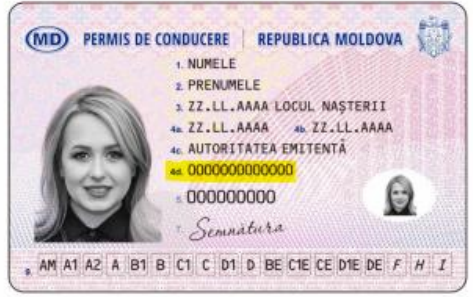 | 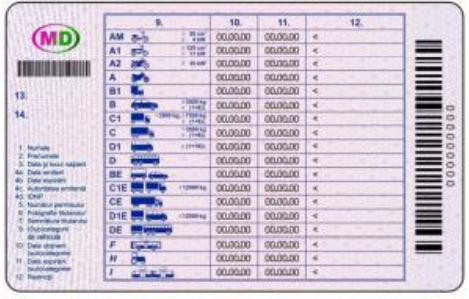 |
| Driving License - front | Driving License - back |
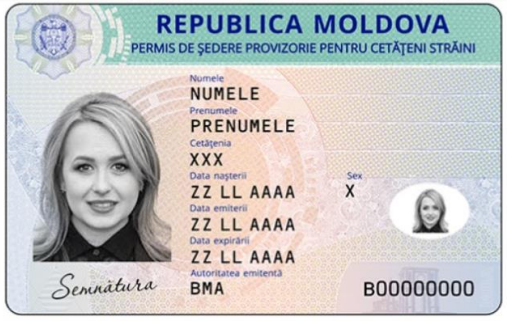 |  |
| Residence Permit - front | Residence Permit - back |
 |
| Temporary ID card |
Official database INDP Search
Identification Number of Organization (IDNO)
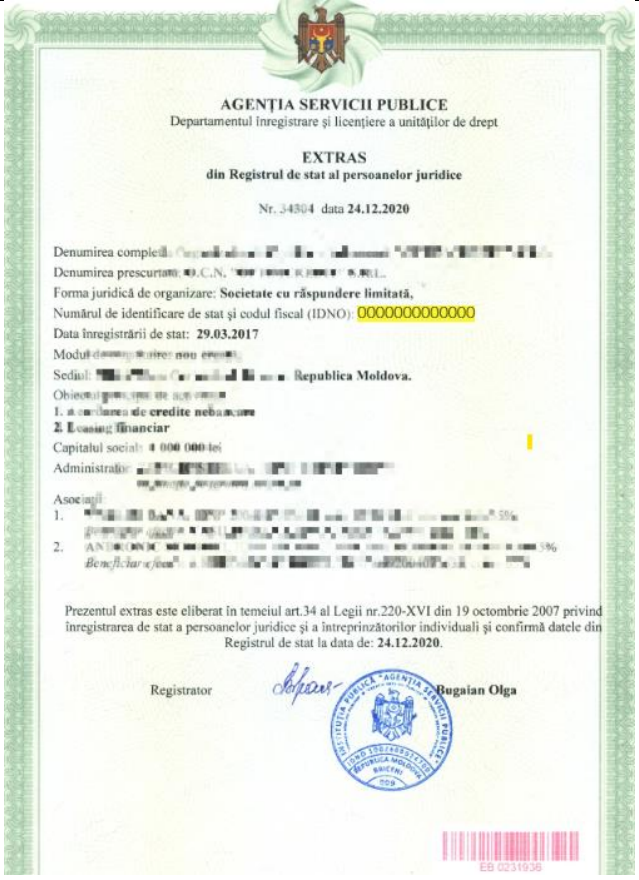
In the Republic of Moldova, the official identification number for legal entities adheres to global standards and is abbreviated as "Identification Number of Organization" or IDNO. Resident legal entities seamlessly acquire their IDNO (TIN) upon completing the registration process with the state registration body, namely the Public Services Agency.
It's noteworthy that only legal entities formed in accordance with normative acts, allied law firms, and associated law enforcement offices or notary offices are eligible to apply for the assignment of a tax code through the State Tax Service.
IDNO Format
In adherence to Annex no. 2 linked to the Government Decision of the Republic of Moldova no. 272 dated 06.03.2002, outlining measures for establishing the automated information system, the IDNO (Identification Number of Organization) emerges as the primary identification marker for legal entities within the country. This IDNO is a precisely structured series of 13 digits, detailed as follows:
IDNO: 1XXXYYYZZZZZK
1: Signifies the index of the identification number of the legal unit, representing the general compartment to which the object of identification pertains. XXX: Corresponds to the last three digits of the year in which the identification number was allocated. YYY: Represents the code of the authority (office) responsible for registering the legal unit. ZZZZZ: Denotes the sequential registration order number within that year and specific office. K: Functions as the check digit in this meticulously organized series.
 |
| Registration Certificate for Entities |
Official Database - IDNO Search
VAT number
Moldovan VAT number consists of 7 digits. Format : 1234567
How Lookuptax can help you in VAT validation?
Lookuptax VAT validation revolutionizes VAT number validation with its robust platform, empowering businesses to seamlessly verify VAT numbers across over 100 countries. Our cutting-edge technology ensures accurate and efficient validation, reducing errors and enhancing compliance.
Frequently Asked Questions
Does a foreign company need to register for VAT in Moldova before its first digital sale, and is there a threshold?
No threshold applies to non-resident companies supplying electronic services to Moldovan resident individuals (B2C). Registration with the State Tax Service (SFS) is mandatory from the very first transaction. Non-residents register through a simplified electronic procedure on the SFS portal, then calculate, declare, and remit 20% VAT quarterly by the 25th of the month following each quarter. B2B supplies are handled via reverse charge by the Moldovan business customer and do not trigger a non-resident registration obligation. [1] [2]
My Moldovan client is deducting 12% from my invoice before paying me — is this correct, and how do I reclaim it?
Yes, this is the standard withholding tax under Article 71 of Moldova's Tax Code, which applies to payments to non-residents for services sourced in Moldova. The Moldovan payer retains 12% and remits it to the state budget by the 25th of the following month. If your country has a Double Tax Treaty (DTT) with Moldova — Moldova has over 50 operational DTTs — the treaty rate may be lower or zero, but you must supply a valid tax residency certificate to the Moldovan payer before payment is made; it cannot be applied retroactively. [3] [4]
What qualifies a company for Moldova's IT Park 7% unified tax, and what happens if revenue from eligible activities drops below 70%?
To join the Moldova Innovation Technology Park (MITP), a company registered in Moldova must derive at least 70% of its monthly and annual sales revenue from eligible IT or creative-industry activities listed in Law no. 77/2016. The 7% unified tax replaces corporate income tax, personal income tax, social contributions, health insurance, and several local taxes, but cannot fall below the minimum of MDL 5,220 per employee per month (30% of the 2026 forecast average salary of MDL 17,400). Breaching the 70% threshold for more than two months in a year triggers loss of resident status, and the company reverts to standard taxation from the following month. [5] [6]
A non-resident legal entity has taxable assets or a permanent establishment in Moldova — how does it obtain an IDNO?
Non-resident legal entities that hold taxable assets in Moldova, have a permanent representative office or fixed base there, or have other tax obligations under Moldovan law do not receive an IDNO automatically upon entering the country. They must apply directly to the State Tax Service (SFS) for assignment of a tax code, submitting an application together with incorporation documents translated and notarised, an extract from the home-country commercial register, and proof of the presence triggering registration (lease agreement, asset ownership documents, etc.). The resulting tax code functions as the entity's IDNO for all Moldovan tax filings and invoices. [7] [8]
Who must issue e-Factura invoices in Moldova, and what happens if a supplier issues a paper invoice?
Two groups must issue electronic tax invoices through the State Tax Service e-Factura system: VAT payers on the list of mandatory e-invoice users approved by the SFS (Fiscal Code, Article 117(1¹)), and suppliers executing public-procurement contracts, including sectoral procurement, concessions and small-value procurement (Article 117(1²), as amended by Law No. 187/2025). Supplies of electricity, heat, natural gas, electronic communications and utility services are excluded. Since 1 January 2026, Article 102(18), which denied the buyer the VAT deduction on a non-electronic invoice from a listed supplier, has been repealed. No law or SFS order setting a general B2B e-Factura mandate had been published in Monitorul Oficial as at 5 October 2026. Every tax invoice must show the fiscal code (IDNO) of both supplier and buyer (Article 117(2)). [9] [10]
Related Resources
- Moldova VAT guide — rates, the MDL 1.7 million registration threshold, e-Factura and filing rules