How to verify DIC in Czech Republic?
DIC verification on MOJE DANĚ website
You can check the validity of DIC on the Czech MOJE DANĚ website for free. You can access the DIC lookup service here. Using this tool you can search for a company by the DIC number. You also have an option to search multiple DICs at a time.
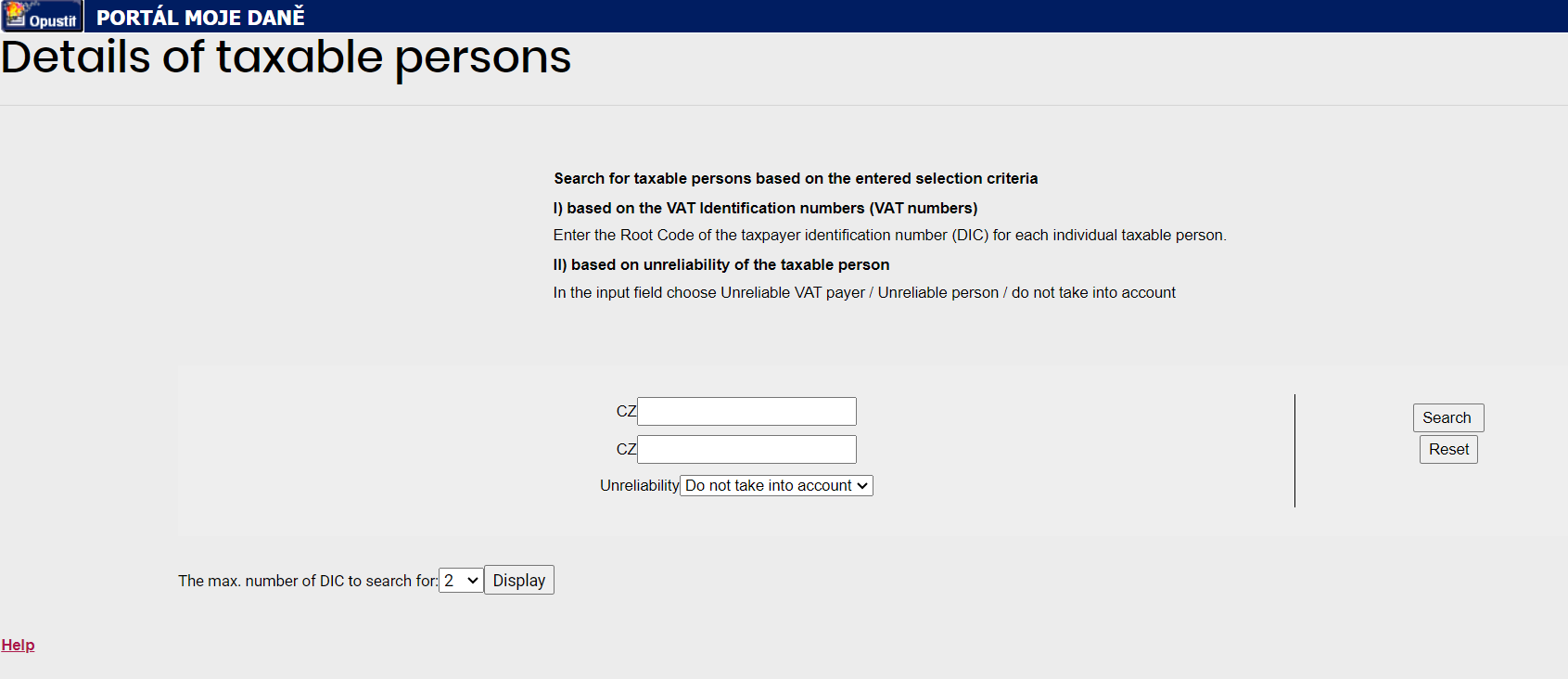 |
| DIC lookup - Czech |
Example DIC: 45799504
A successful verification of the DIC on the MOJE DANĚ website will return the following details
- VAT identification number (DIC)
- Trade name
- Seat / place of residence
- Date of validation
- Details of an unreliable VAT payer
- Unreliable VAT payer: Yes/No
- Bank account numbers for publication
- Date of publication
- Information on registration
- Type of registration
- VAT registration valid from date
- VAT registration valid until date
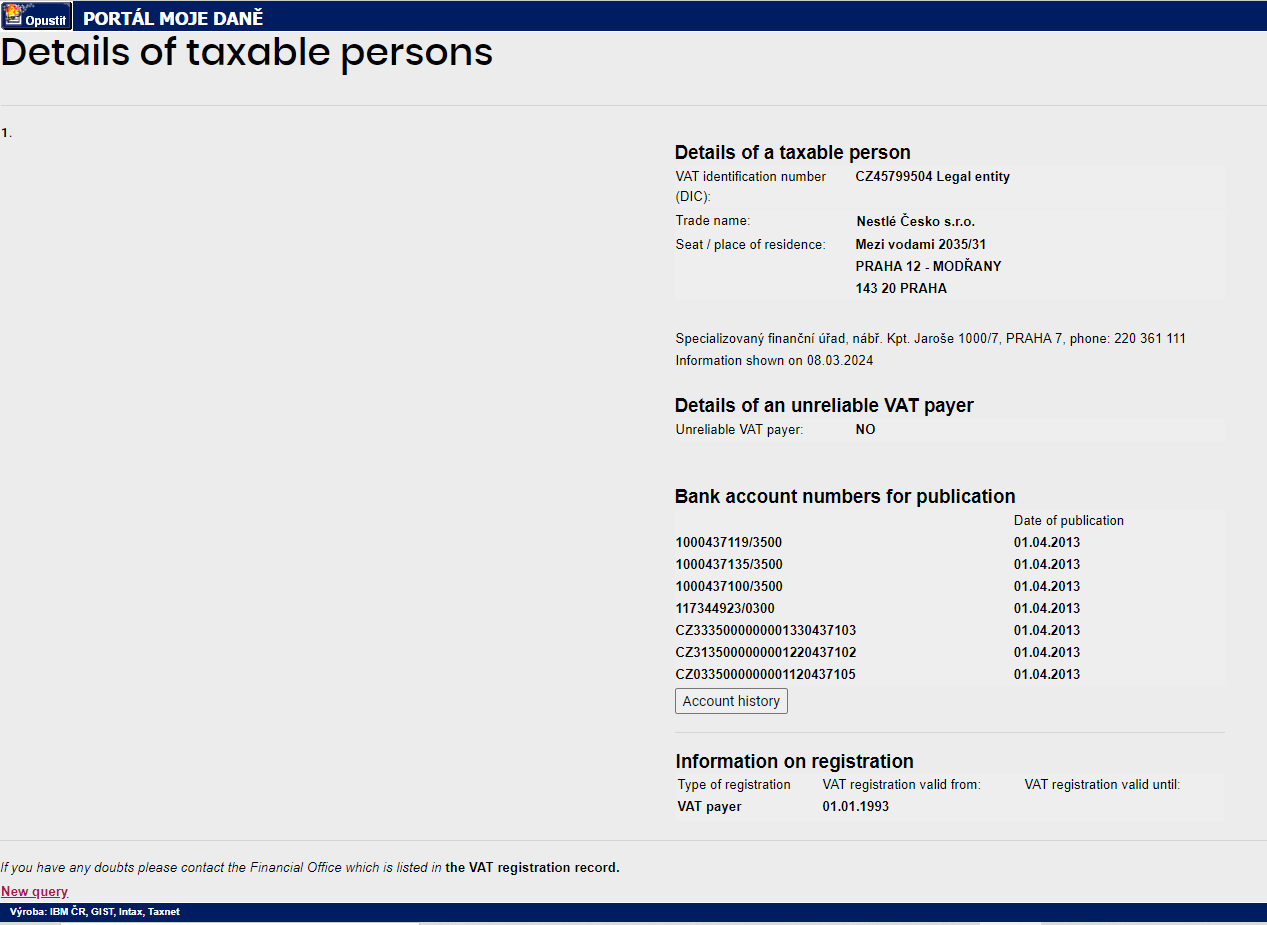 |
| Successful DIC Verification |
For more details on Czech tax identifiers, see our Czech Republic Tax ID Guide. For registration, rates, invoicing and the buyer-liability rules, see the Czech Republic VAT guidelines, and to check a number instantly use Lookuptax's Czech DIČ validator.
Frequently Asked Questions
What does "Unreliable VAT payer" (nespolehlivý plátce DPH) mean, and what are the consequences for buyers?
The Czech tax administration decides that a VAT payer is an 'unreliable VAT payer' (nespolehlivý plátce DPH) when it seriously breaches its obligations in tax administration (Section 106a of VAT Act 235/2004 Sb.), and the decision is published in the VAT payer register. The General Financial Directorate publishes nine criteria for a serious breach; one of them is cumulative VAT arrears of at least CZK 500,000 for at least three consecutive calendar months. For buyers, the consequence is guarantee liability under Section 109, rewritten from 1 January 2025: a VAT payer is liable for its supplier's unpaid VAT if, when the tax became chargeable, it knew or should and could have known that the tax would deliberately not be paid. That knowledge is presumed, unless the buyer proves otherwise, in separate cases, each enough on its own: the supplier is published as an unreliable payer (Section 109(2)(a)), or the price is paid wholly or partly to a bank account the tax office has not published in the register (Section 109(2)(c)), whatever the amount. Where the liability applies, the tax office can collect the supplier's unpaid VAT from you even though you already paid the supplier. Check both the status and the published accounts before paying. [1] [2]
What is the difference between DIC and IČO in Czech Republic, and which one should be on a VAT invoice?
The IČO (Identifikační číslo osoby) is the general business registration number assigned to every legal entity and sole trader in the Czech Republic — it is 8 digits and identifies the business regardless of tax status. The DIČ (Daňové identifikační číslo) is the tax identification number the Financial Administration assigns when a person registers for a tax; it consists of the prefix 'CZ' followed by the IČO (e.g. CZ45799504) for legal entities, or 'CZ' followed by the individual's birth number (rodné číslo) for sole traders. Holding a DIČ does not by itself mean VAT registration: a business can hold a DIČ for income tax without being a VAT payer, and a business registered for no tax has only an IČO. A Czech VAT invoice shows the DIČ of the supplier and of the customer (Section 29(1)(b) and (d) of the VAT Act); a DIČ that has not been assigned is left out (Section 29(3)). To confirm VAT registration, check the VAT payer register or VIES. [1] [2]
When should I use EU VIES versus the Czech MOJE DANĚ portal to verify a Czech DIC?
Use EU VIES (ec.europa.eu/taxation_customs/vies/) when you need to confirm a Czech DIC for EU cross-border transactions — VIES provides a confirmation number you can retain as documentary evidence for intra-community supplies. Use the Czech MOJE DANĚ portal for Czech-specific details that VIES does not provide: the unreliable VAT payer status, the list of approved bank accounts, and exact VAT registration validity dates. For complete due diligence, check both. [1] [2]
My Czech supplier's bank account does not appear in the MOJE DANĚ register — should I pay to it?
No — not without taking on a VAT risk. Under Section 98 of the Czech VAT Act, the tax office publishes in the payer register the bank accounts each VAT payer designated for publication. Since 1 January 2025, paying a supplier wholly or partly to an account that is not published there creates a rebuttable presumption, under Section 109(2)(c), that you knew or should have known the supplier's VAT would deliberately not be paid, making you liable as guarantor for its unpaid VAT, whatever the amount. If a supplier asks you to pay to an unlisted account, ask them to have it published in the register first or to use a listed account. Do not accept explanations that the account is "new" or "temporary" — a legitimate supplier can have its account published before requesting payment. [1] [2]
Can a foreign company operating in Czech Republic have a Czech DIC, and does the format differ?
Yes. Under the General Financial Directorate's methodological guidance on recording foreign persons (ref. 9299/23), a foreign legal person's DIČ is built on its Czech IČO if it has one (CZ followed by 8 digits); otherwise the tax office assigns its own identifier after the CZ prefix. A foreign individual who has a Czech birth number (rodné číslo) receives a DIČ based on that number. The length of the suffix therefore does not mark a business as foreign: 8 digits after CZ usually reflect an IČO, 10 digits belong to individuals with a birth number issued in or after 1954, and 9 digits to those born earlier. The MOJE DANĚ portal handles all formats in the same lookup. Foreign companies with Czech VAT obligations include those making domestic supplies, distance sales exceeding EU thresholds, or those with a Czech fixed establishment. [1]
Does the Czech Tax Administration support batch DIC verification?
Yes. The MOJE DANĚ portal supports multi-DIC verification in a single query — you can submit multiple DIC numbers at once. The Czech Tax Administration also offers a machine-readable XML web service for DIC verification that returns VAT registration status, unreliable payer flag, and registered bank accounts in structured XML. Access requires registration with the Czech Tax Administration portal and is subject to usage terms. [1]
How Lookuptax can help you in VAT validation?
Lookuptax VAT validation revolutionizes VAT number validation with its robust platform, empowering businesses to seamlessly verify VAT numbers across over 100 countries. Our cutting-edge technology ensures accurate and efficient validation, reducing errors and enhancing compliance.