Costa Rica TIN Number Guide — Cédula, DIMEX & NITE Formats
Costa Rica uses four distinct tax identification numbers depending on whether the taxpayer is a citizen, a resident foreigner, an unincorporated foreign entity, or a domestic legal person. Mismatching the ID type on a factura electrónica causes immediate system rejection — so choosing the right number matters as much as getting the digits right.
Cédula de Persona Física (Physical Person ID)
The Cédula de Persona Física identifies Costa Rican citizens for all tax and civil purposes. It is issued by the Tribunal Supremo de Elecciones (TSE) / Registro Civil.
Format: X–XXXX–XXXX Structure: 9 digits (hyphens optional)
The first segment is the province of birth (1–9), the second is the volume/book number, and the third is the folio entry. There is no published Luhn-style checksum; the Dirección General de Tributación (DGT) validates against the Registro Civil's live database.
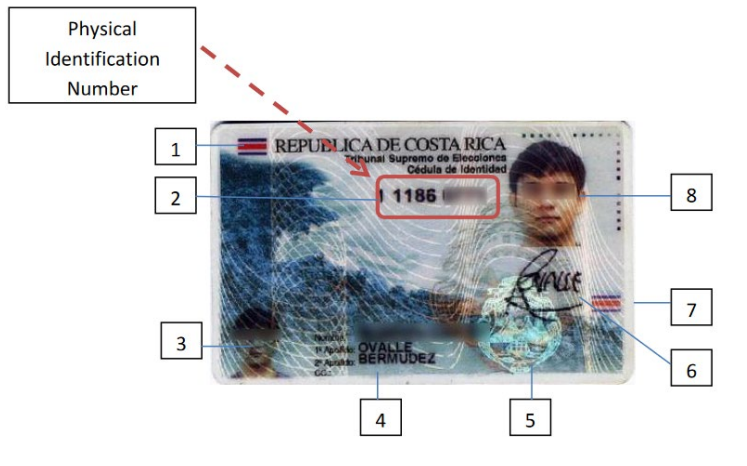 |
| Cédula de Persona Física |
- Costa Rica flag
- Identification number
- Decreased photo
- Names, surnames and known as
- Coat of arms of Costa Rica in gold print
- Citizen signature
- Decreased flag
- Color photo
Cards issued before September 2016 do not carry the unique consecutive number (número consecutivo) on the reverse side — a critical fact for TRIBU-CR self-registration (see FAQ below).
Cédula de Persona Jurídica (Legal Entity ID)
The Cédula de Persona Jurídica — commonly called Cédula Jurídica — identifies all legally incorporated entities registered with the Registro Nacional.
Format: X-XXX-XXXXXX Structure: 10 digits (hyphens optional)
The three segments encode: the country identifier (always 3 for Costa Rica), the entity-type code (3 digits), and the sequential registration number (6 digits).
Entity Type Codes
The middle three digits indicate the legal form of the entity:
| Code | Entity Type |
|---|---|
| 3-101-XXXXXX | Sociedad Anónima (S.A.) |
| 3-102-XXXXXX | Sociedad de Responsabilidad Limitada (S.R.L.) |
| 3-103-XXXXXX | Sociedad en Comandita |
| 3-104-XXXXXX | Sociedad Colectiva |
| 3-003-XXXXXX | Organismos Internacionales |
| 3-004-XXXXXX | Asociaciones Cooperativas |
| 3-006-XXXXXX | Asociaciones (non-profit) |
Knowing the entity type code helps you identify whether a supplier's Cédula Jurídica is from an S.A. or an association — relevant for applying correct withholding rates and for validating the ID type field in factura electrónica version 4.4.
Since May 2025, new S.A. and S.R.L. companies no longer receive a company name at incorporation — the Cédula Jurídica number itself serves as the legal identifier under Law 10729.
Documento de Identidad Migratorio para Extranjeros (DIMEX)
DIMEX is issued by the Dirección General de Migración y Extranjería (DGME) to legal residents — temporary or permanent — who are not Costa Rican citizens.
Format: XXXXXXXXXXX or XXXXXXXXXXXX Structure: 11 or 12 digits
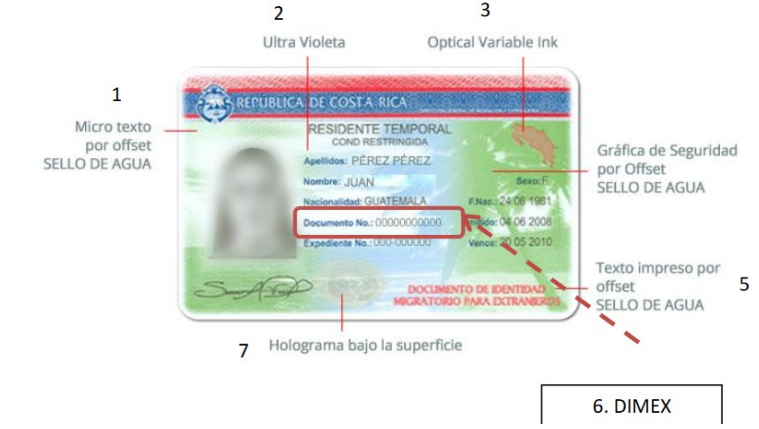 |
| DIMEX |
- Offset micro text (watermark)
- Ultra violet mark
- Optical variable ink mark
- Offset Security graphic (watermark)
- Offset printed text (watermark)
- Document (DIMEX) number: 11 or 12 numerals
- Hologram under the surface
The DIMEX number is the tax ID used in all DGT systems, factura electrónica issuance, and income tax returns for foreign residents. Applicants waiting for their DIMEX card (processing times of 18–24 months are common) can request an interim NITE from DGT to continue operating legally (see FAQ below).
Número de Identificación Tributario Especial (NITE)
NITE is issued by the Dirección General de Tributación to entities or individuals who need a Costa Rican tax ID but are ineligible for a Cédula Jurídica or DIMEX. This includes unincorporated foreign entities, non-resident digital service providers, and foreigners still awaiting their DIMEX.
NITE for natural persons: Format: 3–120–XXXXXX Structure: 10 digits (hyphens optional)
NITE for corporations: Format: 3–130–XXXXXX Structure: 10 digits (hyphens optional)
The prefix 3-120 signals a foreign natural person; 3-130 signals a foreign legal entity. Both are valid ID types in factura electrónica version 4.4 and in TRIBU-CR.
Costa Rica's tax identifiers are listed in the worldwide directory of VAT and tax ID names.
Official database: Tax status lookups now run through TRIBU-CR's Oficina Virtual Tributaria (OVi) at ovitribucr.hacienda.go.cr. The former ATV link (atv.hacienda.go.cr) was decommissioned on 6 October 2025.
For a broader view of how Costa Rica's system compares in the region, see the TIN guides for Nicaragua, El Salvador, Panama, and Colombia.
Frequently Asked Questions
My pre-2016 cédula doesn't have a consecutive number — how do I register for TRIBU-CR?
TRIBU-CR, which replaced ATV as Costa Rica's tax portal on 6 October 2025, requires the unique consecutive number (número consecutivo) printed on the reverse of your Cédula de Persona Física during the self-registration step. [1] Cédulas issued before September 2016 do not carry this code, so self-registration online is impossible without a renewed card. [2] The fix is to renew your cédula at a Registro Civil office before attempting account creation. During the renewal period your old ATV/TRIBU-CR data is inaccessible; if you have a filing deadline, email the Dirección General de Tributación at [email protected] to request an extension.
The factura electrónica system rejected my invoice because of an "ID type mismatch" — what does this mean?
Version 4.4 of the factura electrónica framework, mandatory since 1 September 2025, validates that the receiver's identification type (Cédula Física, Cédula Jurídica, DIMEX, NITE, or "non-domiciled foreigner") exactly matches the type registered in the DGT's Registro Único Tributario (RUT). [3] A common error is issuing to a DIMEX holder using the "Cédula Física" type code, or to a NITE entity using "Cédula Jurídica." [4] A rejected invoice is legally void for deduction purposes; you must issue a credit note and reissue the corrected document. Always confirm the ID type with your counterparty before issuing — the TRIBU-CR OVi lookup returns both the number and its registered type.
Do non-resident SaaS or digital service providers need a NITE to collect Costa Rica IVA?
Yes. Since Executive Decree N° 41779-H took effect on 1 October 2020, foreign digital service providers — including SaaS, streaming, app stores, and e-learning platforms — are subject to 13% IVA on supplies to Costa Rican consumers with no registration threshold. [5] [6] Non-residents who register voluntarily obtain a NITE (format 3-130-XXXXXX for corporations) and file quarterly returns. The alternative — doing nothing — lets Costa Rican financial institutions withhold 13% at source, but eliminates any reclaim mechanism for over-collected amounts, making voluntary NITE registration the preferred route for recurring B2C revenue.
I'm waiting 18+ months for my DIMEX — can I operate and invoice legally in the meantime?
Yes, but you must act proactively. The DGME comprobante (application receipt) is legally recognised as temporary identification under migration law, yet expat community reports confirm that many banks and government agencies refuse to accept it in practice. [7] [8] The reliable workaround is to apply for a NITE (format 3-120-XXXXXX) directly from the DGT before your DIMEX arrives. A NITE is accepted across all DGT systems for tax registration, factura electrónica issuance, and income tax filing. Once your DIMEX is issued, notify DGT to cancel the NITE and re-register under your permanent DIMEX number.
As of September 2025, must I issue an electronic purchase invoice when I pay a foreign software vendor?
Yes, and this catches many SMEs off guard. Version 4.4 of the factura electrónica framework introduces a reverse-charge obligation under the Anti-Tax Fraud Law (Ley N° 9416): Costa Rican VAT-registered buyers must issue an electronic comprobante de compra al exterior for every payment to a non-resident supplier for software licences, SaaS subscriptions, cloud services, or consulting. [9] [10] Failure to issue this document means the expense is not deductible for income tax and attracts a penalty of up to two base salaries. Businesses in the Régimen Simplificado are exempt. The free government platform TicoFactura (launched 6 October 2025) supports the new format at no cost.
How do I verify a Cédula Jurídica or NITE online, and what replaced the old ATV link?
The old ATV portal (atv.hacienda.go.cr) was decommissioned on 6 October 2025. Tax status lookups for all ID types — Cédula Física, Cédula Jurídica, DIMEX, and NITE — now run through the Oficina Virtual Tributaria (OVi) inside TRIBU-CR at ovitribucr.hacienda.go.cr. [11] [12] Public queries do not require a login: select the ID type from the dropdown, enter the number, and the system returns registration status, economic activity, and applicable tax regime. Any third-party page still linking to atv.hacienda.go.cr now reaches an error page.
What do the middle digits of a Cédula Jurídica reveal about the company?
The three middle digits encode the legal form of the entity. The most common are 101 (Sociedad Anónima / S.A.) and 102 (Sociedad de Responsabilidad Limitada / S.R.L.); code 006 indicates a non-profit Asociación. [13] [14] This matters in two practical scenarios: (a) withholding agents apply different rates depending on whether the payee is a corporation or a cooperative, and (b) factura electrónica version 4.4 requires selecting "Cédula Jurídica" as the ID type for all 3-1XX and 3-0XX codes — using "NITE" for a registered Cédula Jurídica holder will cause an immediate system rejection.
Related Resources
- Nicaragua TIN guide — NIT format and RUC registration for comparison across Central America
- El Salvador TIN guide — NIT and DUI formats, including e-invoicing obligations
- Panama TIN guide — RUC format and ITBMS registration
- Colombia TIN guide — NIT structure and DIAN validation
- Worldwide directory of VAT and tax ID names
How Lookuptax can help you ?
Lookuptax VAT validation revolutionizes VAT number validation with its robust platform, empowering businesses to seamlessly verify VAT numbers across over 100 countries. Our cutting-edge technology ensures accurate and efficient validation, reducing errors and enhancing compliance.