Czechia TIN / DIČ Guide — Format, Check Digit, IČO & VAT Registration
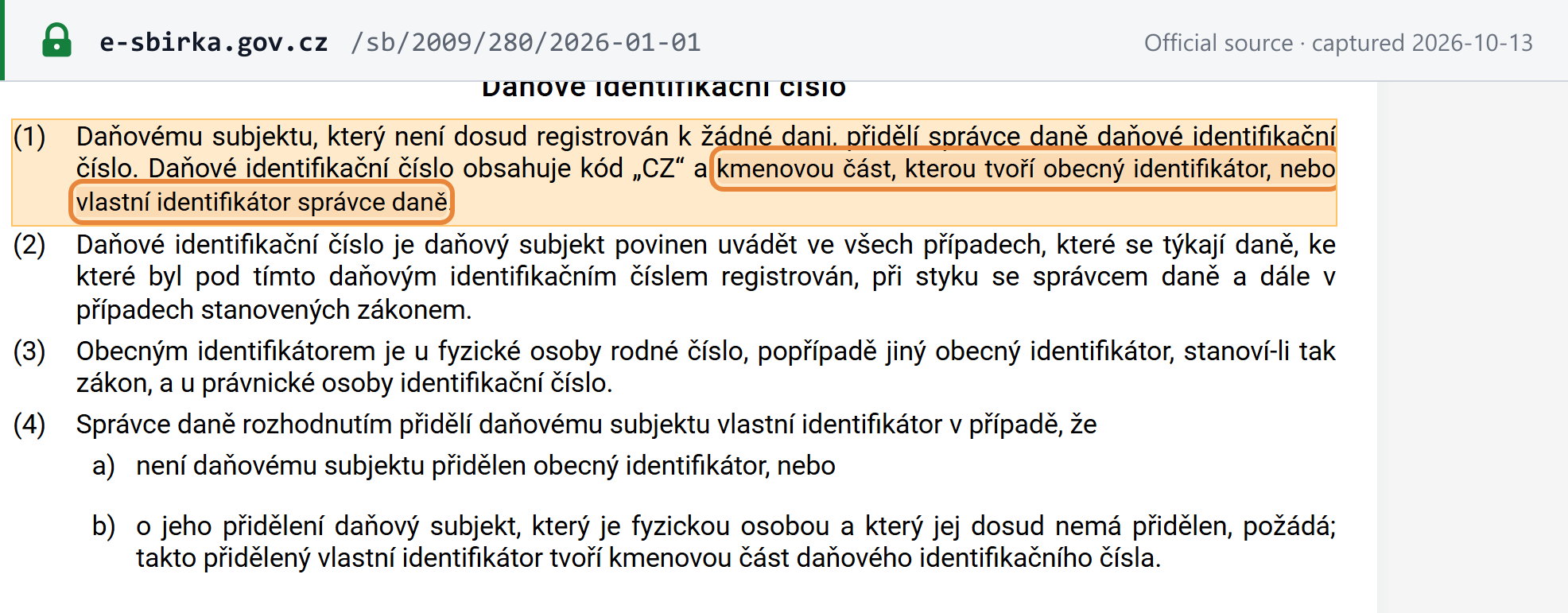
The Czech tax identification number is the daňové identifikační číslo (DIČ). The tax administrator — for most taxes the Financial Administration (Finanční správa), acting through the local tax office — assigns it when a person first registers for any tax. Under § 130 of the Tax Procedure Code, a DIČ consists of the code "CZ" and a core part, which is the person's general identifier — the rodné číslo (birth number) for an individual, the IČO (identification number) for a legal person — or an identifier the tax administrator assigns itself. [1] The same CZ-prefixed number is the Czech VAT number used in VIES. For VAT rates, invoicing and filing, see the Czech Republic VAT guide.
Czech Tax IDs at a Glance
| Number | Issuer | Format | Who has one | Check digit |
|---|---|---|---|---|
| DIČ — legal person | Tax office | CZ + 8-digit IČO | Companies and other legal persons registered for a tax | Not published for the IČO |
| DIČ — individual | Tax office | CZ + 10-digit rodné číslo (9 digits if born before 1954), or CZ + IČO | Individuals registered for a tax | Rodné číslo divisible by 11 (from 1954) |
| DIČ — special identifier | Tax office | CZ + 9 digits starting with 6 | Individuals without a rodné číslo; entities without an IČO | — |
| IČO | Assigned through the register of persons by the registering body | 8 digits, no prefix | Companies, trade licence holders and other registered persons | Not published |
| SME scheme number | Tax office | e.g. CZ12345678901-EX | Czech businesses using the EU cross-border SME exemption | — |
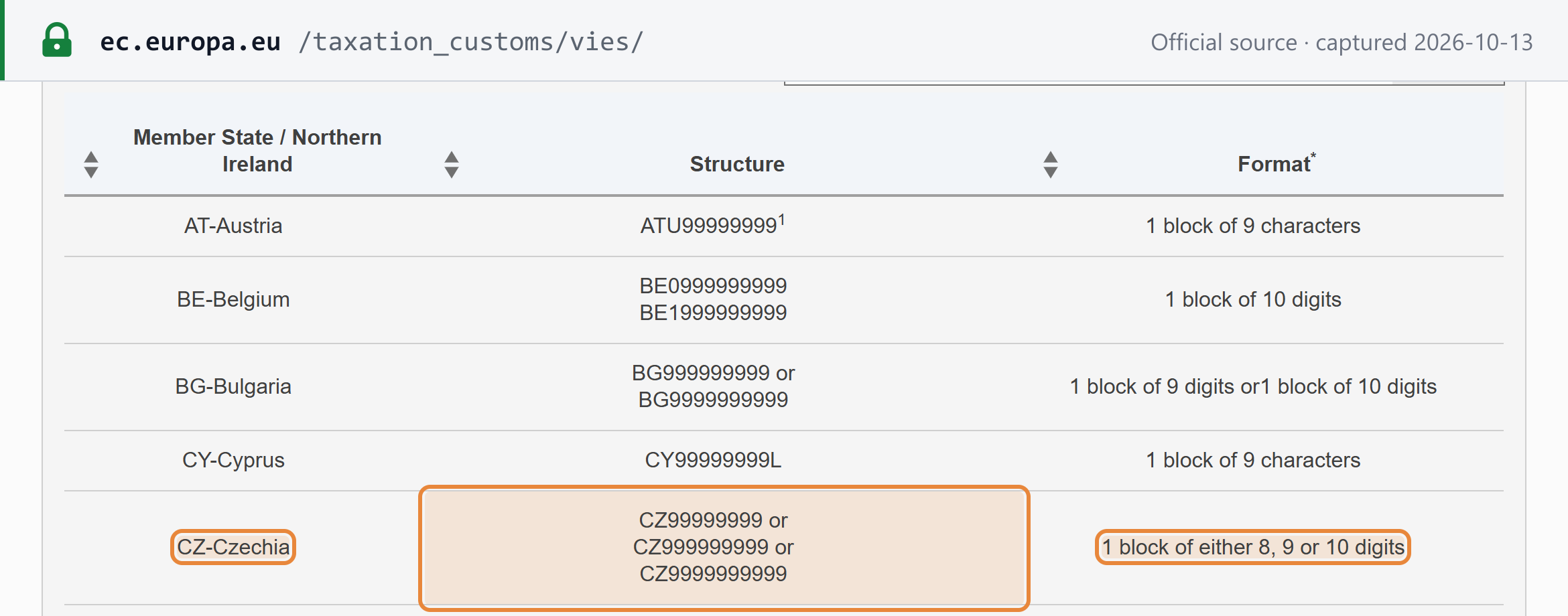
The structure of each core part is set out in the Czech TIN information sheet published by the OECD: 8 digits for the business identification number, 9 or 10 for the personal identification number, and 9 digits with a first digit of 6 for the special (generated) identification number. The same sheet notes that an individual's DIČ can be built on their business registration number (IČO) as well as their personal number. [2] In VIES, a Czech VAT number is therefore CZ followed by 8, 9 or 10 digits. [3]
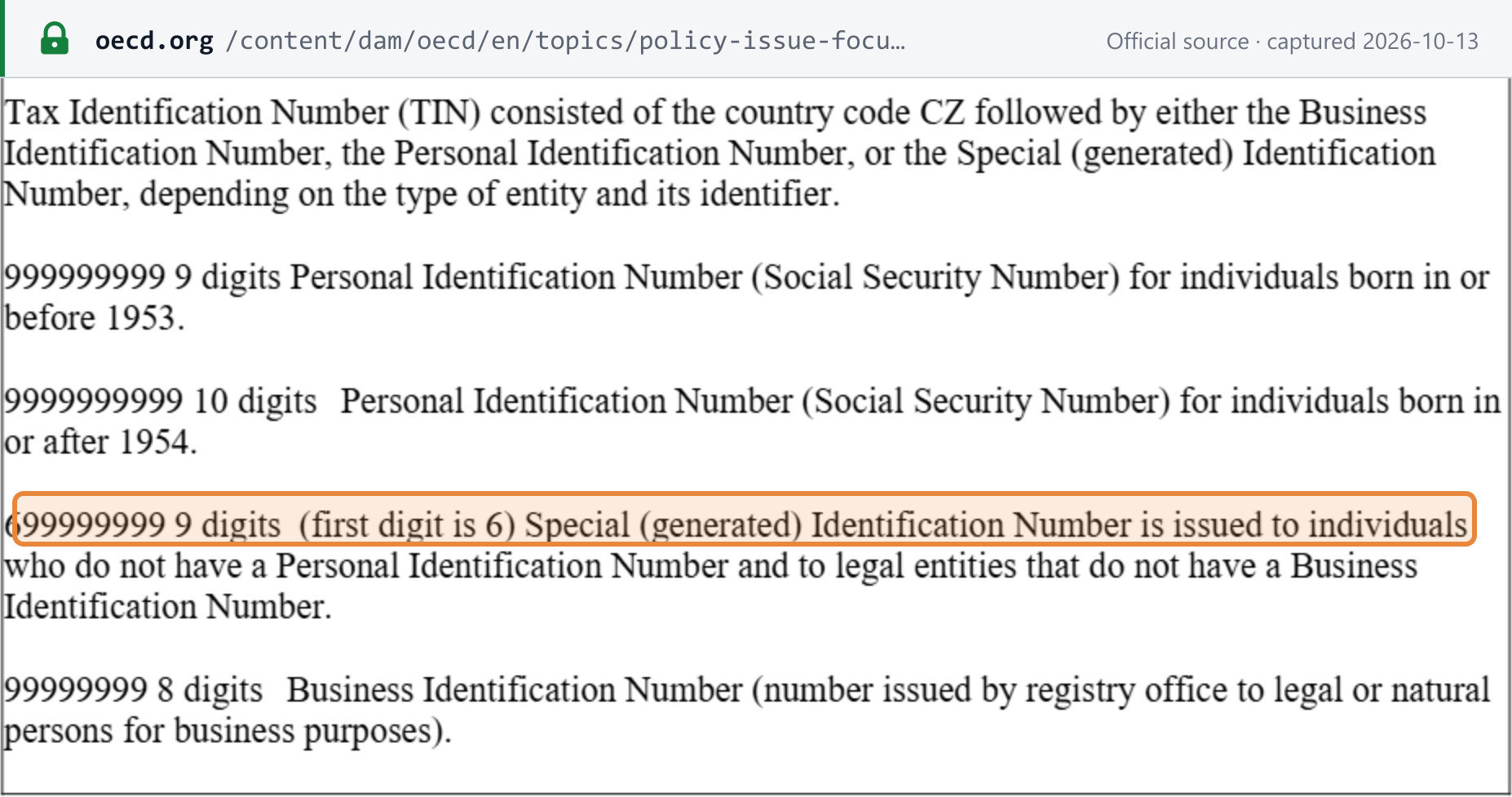
A 9-digit core part is either the birth number of someone born before 1954 — whose first two digits are the year of birth, 00 to 53 — or a special identifier, which starts with 6.
IČO (Identification Number)
The IČO is an 8-digit numeric code that uniquely identifies a person in the Czech register of persons. It is assigned when a company is entered in the commercial register or a sole trader obtains a trade licence, and once assigned it is never given to anyone else, even after the original holder ceases to exist. [4] It appears on invoices, contracts and public registers with no country prefix.
An IČO is not a tax number. A company's DIČ is CZ + its IČO, but the DIČ exists only once the company has registered for a tax. A business can therefore hold an IČO with no DIČ at all.
No official check-digit rule for the IČO is published. Validators commonly apply a weighted modulus-11 check (weights 8 to 2 on the first seven digits), but that is industry practice rather than a rule set by the register's administrator. Confirm an IČO with an ARES lookup.
Rodné číslo (Birth Number) and Its Check Digit
| Field | Detail |
|---|---|
| Format | YYMMDD/XXXX — date of birth, then a 4-digit suffix |
| Length | 10 digits; 9 digits (3-digit suffix) for people born before 1 January 1954 |
| Month | +50 for women; +20 (men) or +70 (women) in an extra series used when a day's numbers run out |
| Check | The whole 10-digit number is divisible by 11 without remainder |
| Issued by | Ministry of the Interior |
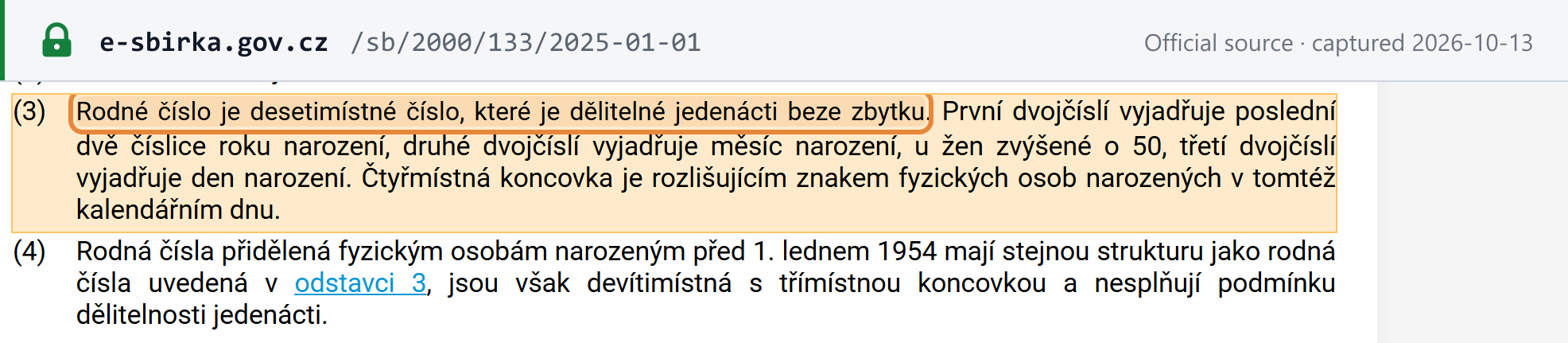
The Population Register Act defines the rodné číslo as "a ten-digit number which is divisible by eleven without remainder". Numbers assigned to people born before 1 January 1954 have the same structure but only nine digits, with a three-digit suffix, and do not meet the divisibility condition. [5] The slash is part of the written form but is dropped in the DIČ: an individual's DIČ is CZ followed by the ten (or nine) digits.
To check a 10-digit number: confirm the month field is 01–12, 21–32, 51–62 or 71–82, that the day is a real date, and that the number modulo 11 is 0. A 9-digit number can be checked for structure only.
Replacing the birth number in a DIČ
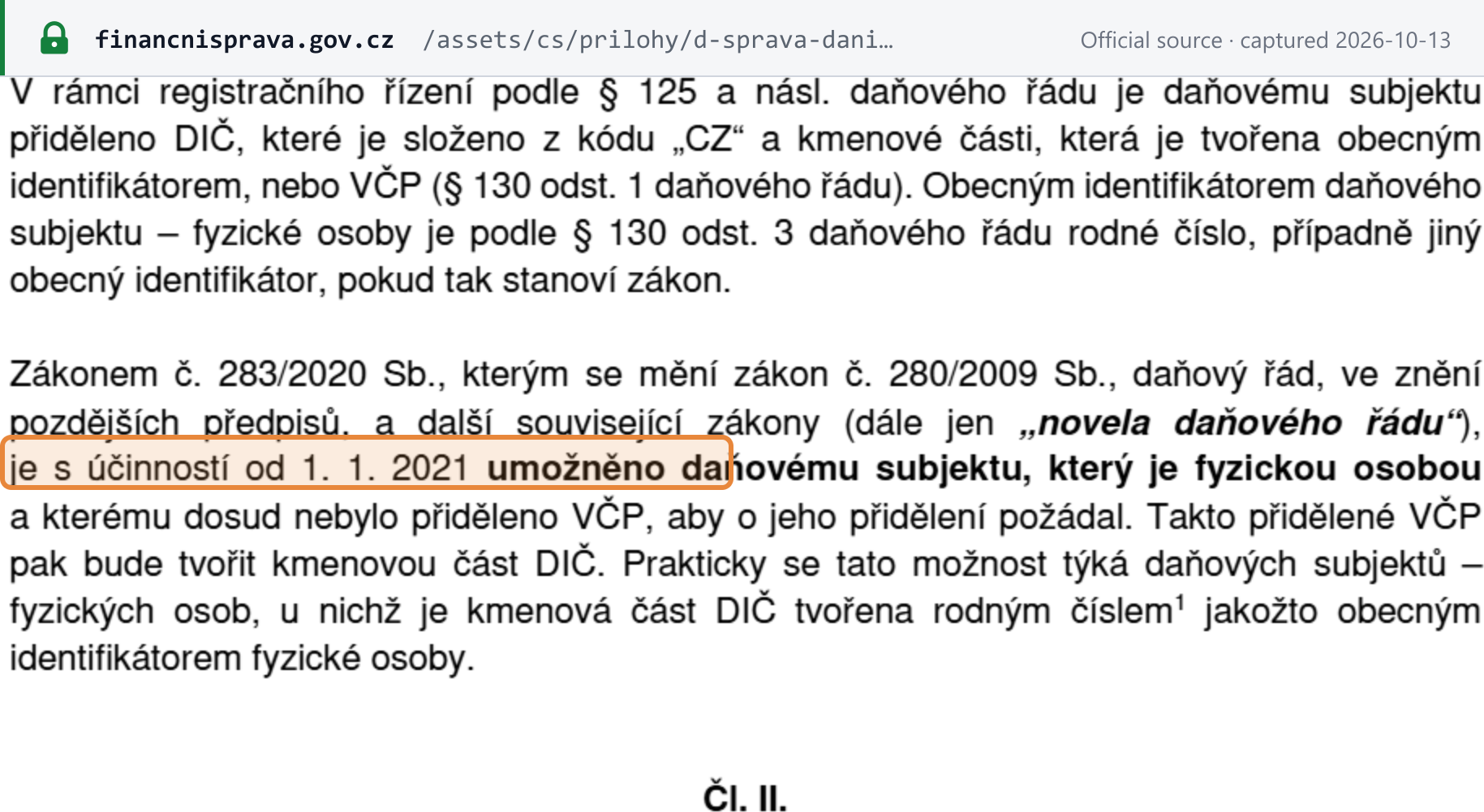
Because a DIČ built on a rodné číslo reveals the holder's date of birth and sex, an individual has been able since 1 January 2021 to ask the tax office, once, to assign an identifier of its own (vlastní identifikátor) to replace the birth number in the DIČ. [6] According to the Financial Administration's methodological instruction 79651/20/7700-10123-010450:
- the request can be made together with a first registration application or at any time after registering — a person with no tax registration cannot ask;
- for a VAT payer, the new DIČ takes effect on the first day of a tax period at least 40 days after the decision; for other taxpayers, on a working day at least 40 days after it;
- a VAT payer using the EU One Stop Shop must register for OSS again under the new DIČ;
- the change cannot be reversed.
The tax office does not publish what format the replacement identifier takes. Anyone who keeps Czech supplier or customer data should expect an individual's DIČ to change this way.
Sole Traders Since 2024
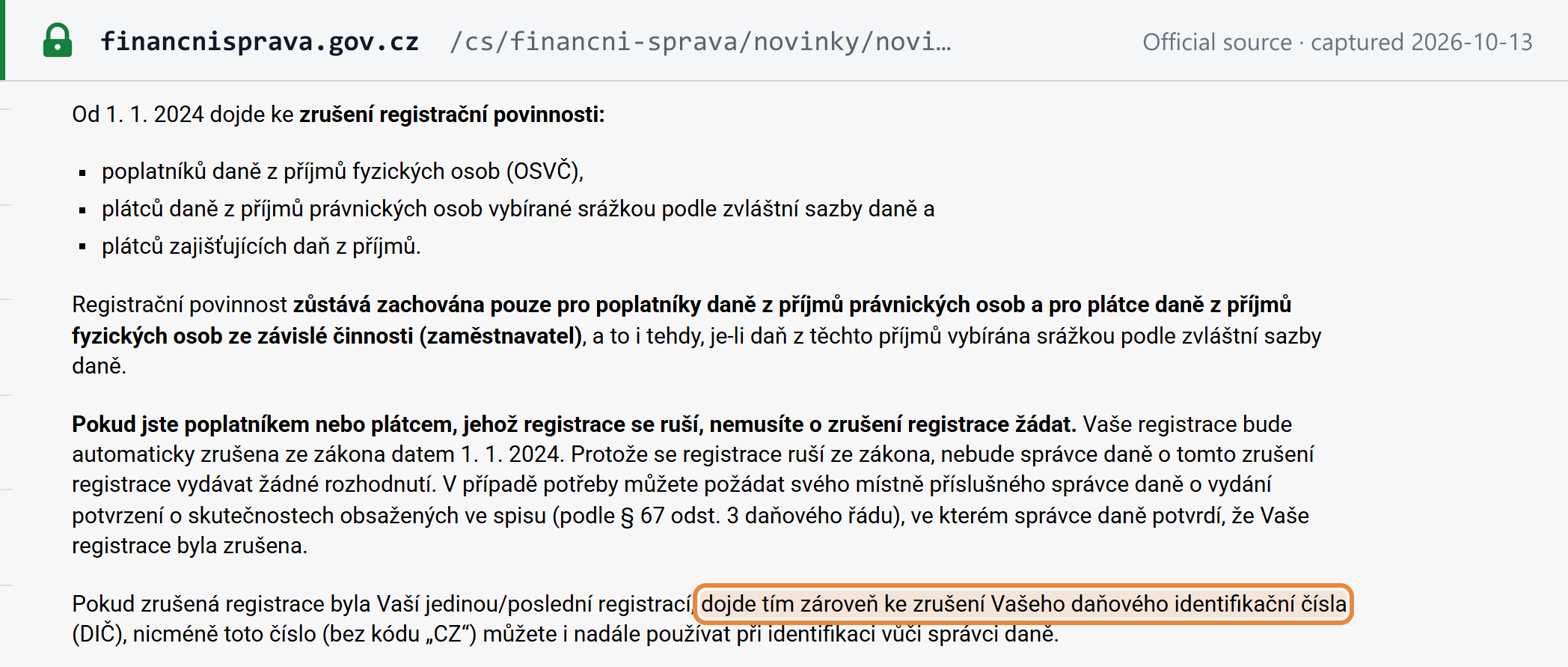
From 1 January 2024, self-employed individuals (OSVČ) no longer register for income tax. Their existing income-tax registrations were cancelled by law, and the Financial Administration explained that where this was a person's only registration, their DIČ was cancelled too — though they can still use the number, without "CZ", to identify themselves to the tax office. [7]
In practice, a Czech sole trader who is not registered for VAT, or as an employer, may have no active DIČ at all. That is expected, not a sign that something is wrong. Registration for VAT, where the rules below apply, is mandatory and produces a DIČ.
Who Must Register for VAT
| Who | Rule |
|---|---|
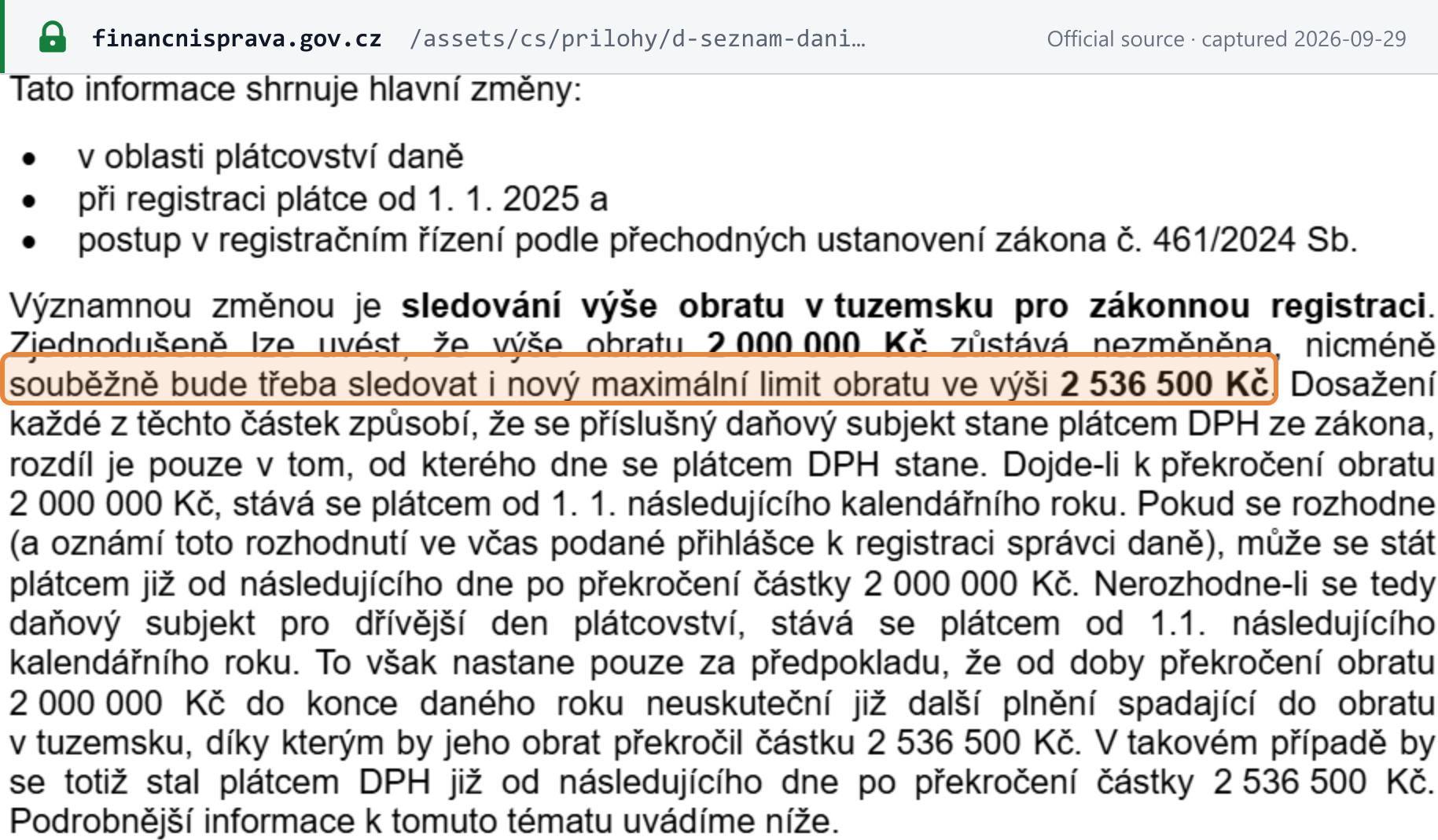
| Business with its seat (registered office) in Czechia | Payer from 1 January of the next year once turnover in a calendar year exceeds CZK 2,000,000, or from the day after turnover exceeds CZK 2,536,500 |
| Deadline | Apply within 10 working days, electronically only |
| Business without a Czech seat, including a foreign company with only a Czech branch | No threshold — payer from the first taxable supply in the Czech Republic, unless the supply is reverse-charged or declared through OSS |
| Identified person (identifikovaná osoba) | A non-payer that makes taxable acquisitions of goods from other EU countries (above CZK 326,000), receives services from a supplier not established in Czechia, or supplies B2B services taxed in another EU country — apply within 15 days |
The two thresholds apply to turnover in a calendar year since 1 January 2025. [8] [9] The tax office normally decides on a registration within 30 days of the application. [18]
Identified persons ("light VAT")
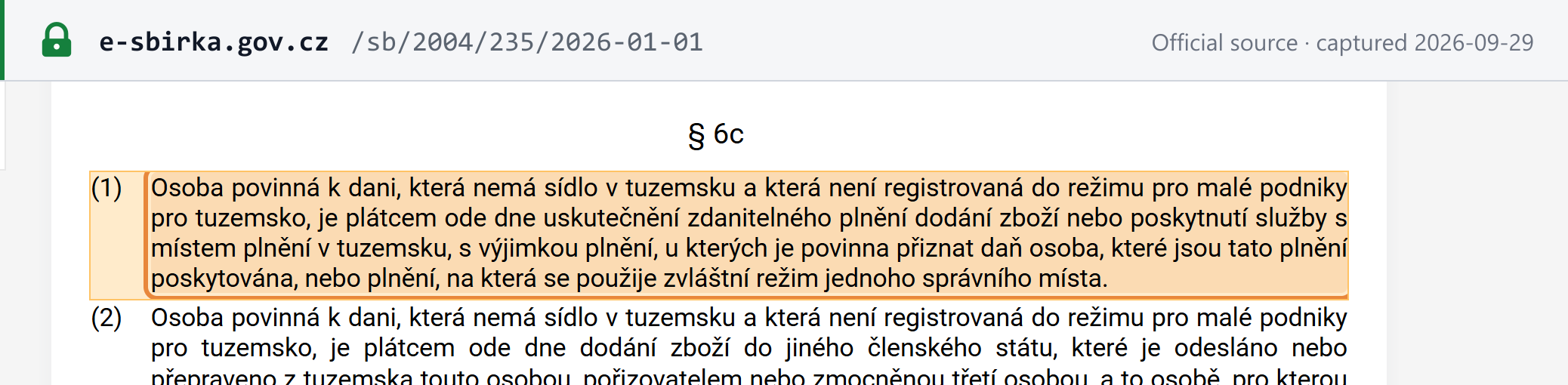
A business that is not a VAT payer becomes an identified person — and receives a CZ-prefixed DIČ for VAT purposes — from the first of: a taxable acquisition of goods from another EU country — for a non-payer, acquisitions become taxable once their value in the current and previous calendar year exceeds CZK 326,000 (§ 6g); receiving a service from a supplier not established in the Czech Republic, whether that supplier is in the EU or not, such as a US software or advertising platform (§ 6h); or supplying a B2B service whose place of supply is another EU country (§ 6i). [19] It must apply to register within 15 days. [10] Failing to meet any registration duty can be fined up to CZK 500,000 under § 247a of the Tax Procedure Code. [11]

How to Register
VAT registration applications, deregistration requests and changes to registration details must be filed electronically only, on the prescribed form available in the MOJE daně portal (Daň z přidané hodnoty → Registrace → Přihláška k registraci). [12] Changes to registration details must be reported within 15 days. Businesses without a Czech seat, residence or establishment register with the Tax Office for the Moravian-Silesian Region.
Cross-Border Notes
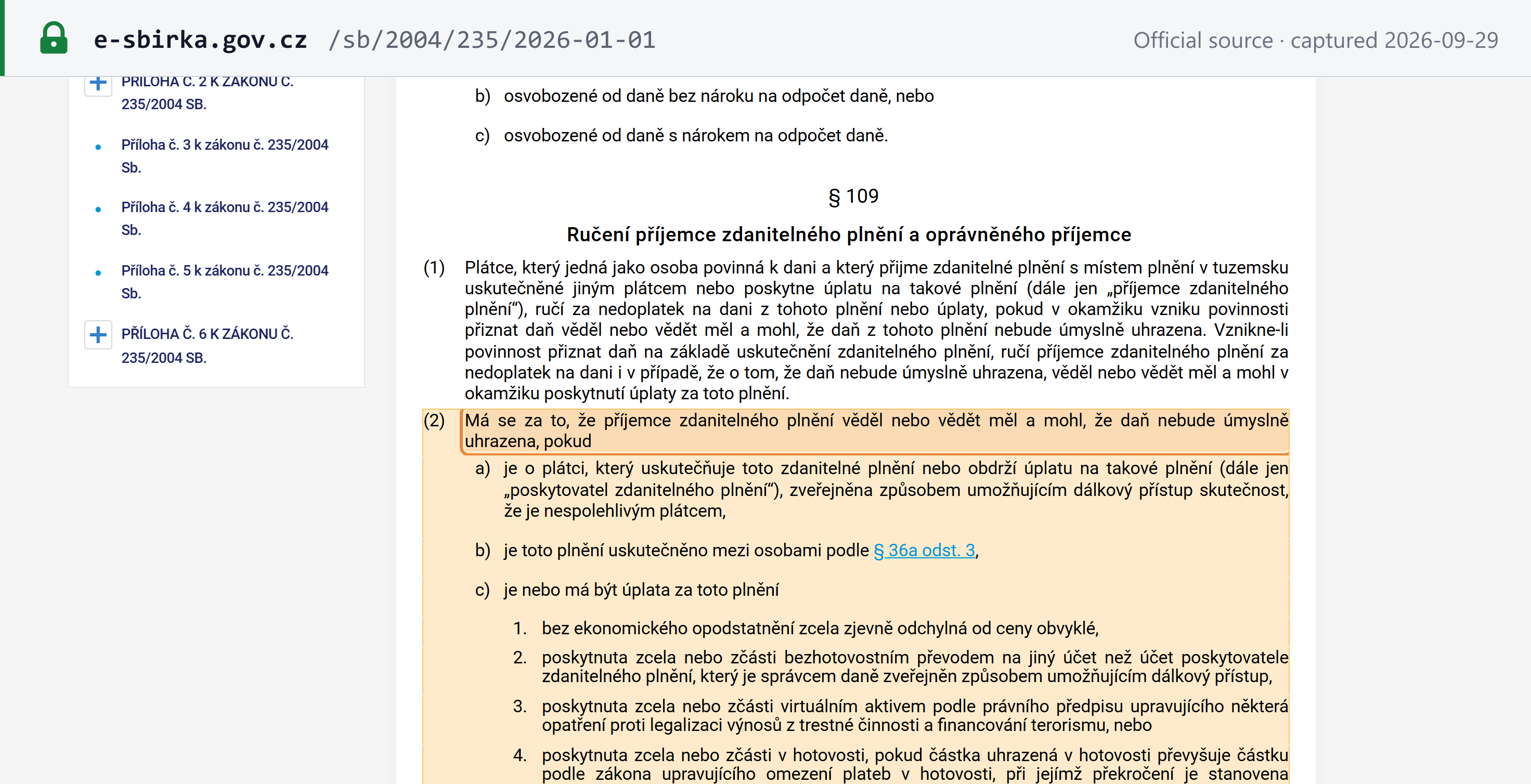
- No threshold for businesses without a Czech seat. A business whose seat is not in the Czech Republic is a VAT payer from its first taxable supply there; supplies under the reverse charge or declared through the One Stop Shop do not count. [13]
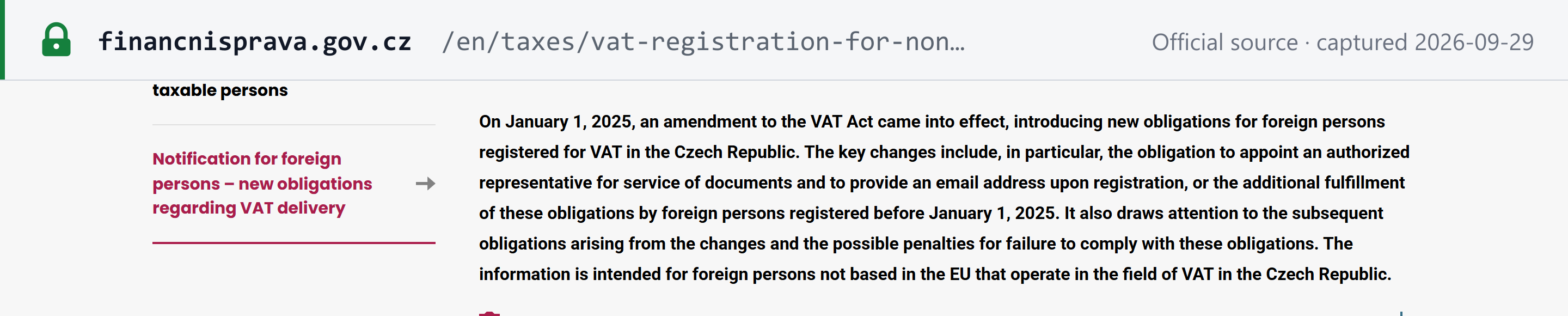
- Non-EU businesses that register directly must, since January 2025, give an e-mail address and appoint an authorised representative for the service of documents. [14]
- EU SME scheme — a Czech business using the EU cross-border small-business exemption receives a separate number with an
-EXsuffix, such asCZ12345678901-EX, built on a different principle from the DIČ: it contains neither the birth number nor the IČO. [15] See the EU VAT SME scheme.
E-invoicing
As of 13 October 2026 there is no B2B or B2C e-invoicing mandate in the Czech Republic: an electronic invoice requires the buyer's consent, and public bodies are obliged only to accept e-invoices in the European standard. No e-invoicing registration number is tied to the DIČ. The revived sales-recording system (EET 2.0), published as Act No. 180/2026 Sb. on 7 October 2026, records cash and card sales for income tax from 1 January 2027 — it is not an e-invoicing regime. See the Czech Republic e-invoicing guide.
How to Verify a Czech DIČ
| What you want to confirm | Official tool | What it shows |
|---|---|---|
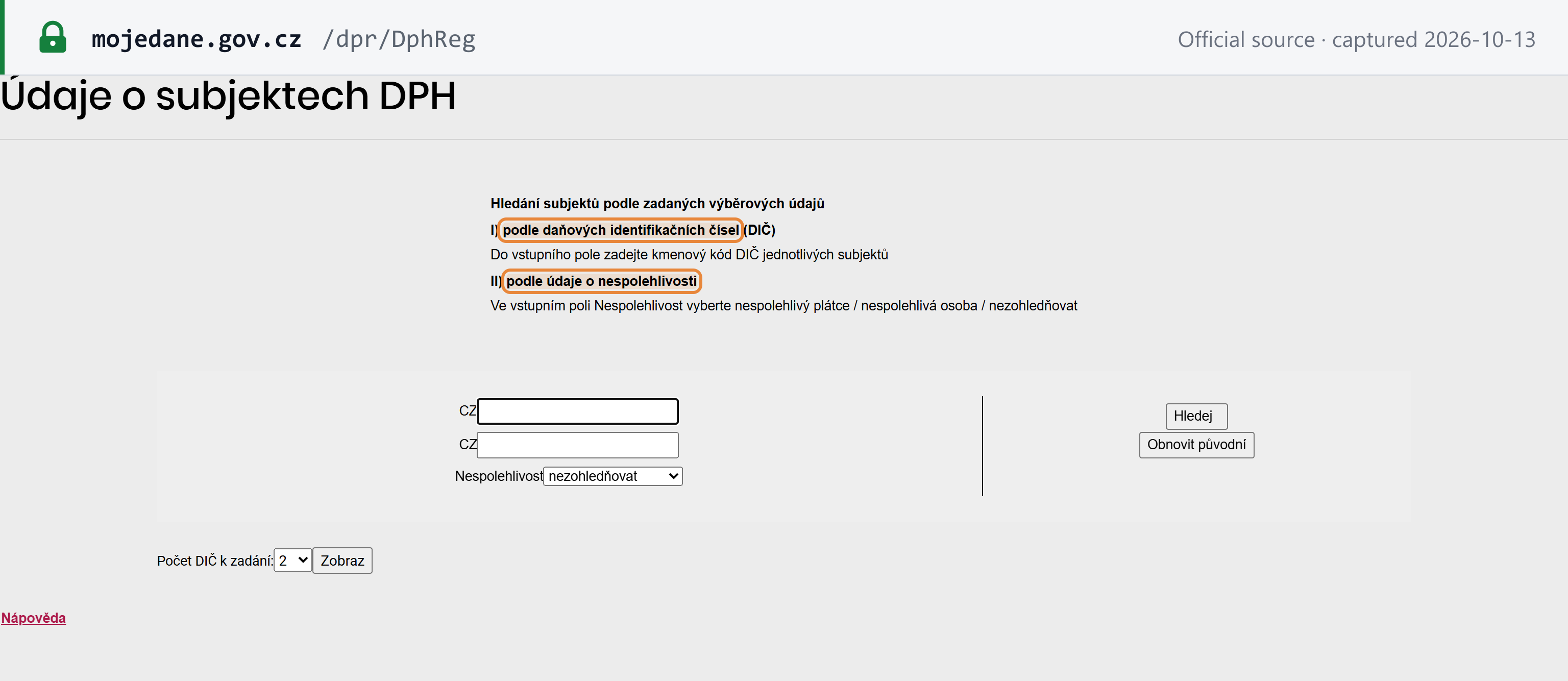
| A business is a VAT payer or identified person | Financial Administration VAT register (Subjekty DPH) — search by DIČ | Name, registered office, published bank accounts and unreliable-payer status |
| A VAT number is valid for intra-EU trade | EU VIES | Valid or invalid, queried in real time against the Czech register |
| The DIČ belonging to an IČO | Ministry of Finance ARES | Registered details including the DIČ — for information only, not legal proof |
The VAT register must publish each payer's and identified person's DIČ, name, registered office and designated bank accounts. [16] Check it before paying a Czech supplier: since 2025 a VAT payer is presumed to have known about a supplier's VAT fraud — and becomes liable for the unpaid VAT — where the supplier is published as an unreliable payer or the payment goes to a bank account not published in the register. [17]
VIES checks the Czech database in real time, so a newly registered business appears as soon as the Czech register is updated. A DIČ that exists but is not shown as valid in VIES usually belongs to a business that was never registered for VAT, or has been deregistered. For a walkthrough, see how to verify a Czech DIČ. To check the format and check digit instantly, use the Lookuptax Czech DIČ validator.
Recent Changes
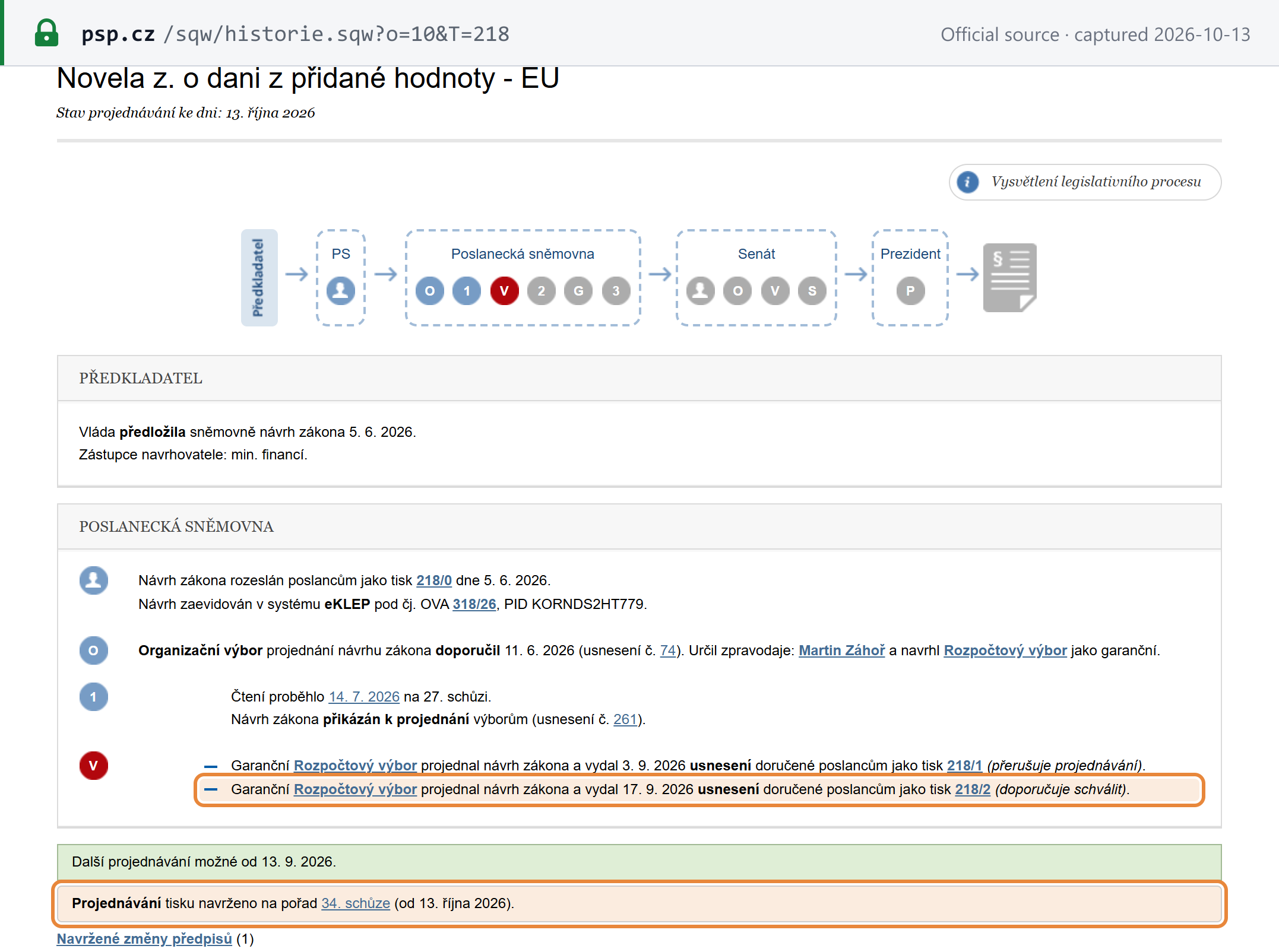
- 2026-10-13 — Print 218, the first Czech bill implementing the EU's ViDA package (OSS changes from 1 January 2027, call-off stock repealed from 1 July 2028), is awaiting second reading in the Chamber of Deputies. It does not change the DIČ, the CZK 2 million threshold or registration deadlines. (Chamber of Deputies) — see event
- 2026-10-07 — The EET 2.0 sales-recording act was published as Act No. 180/2026 Sb. (Chamber of Deputies)
- 2025-01-01 — VAT registration thresholds moved to a calendar-year test (CZK 2,000,000 and CZK 2,536,500); non-EU businesses must appoint a representative for service of documents.
- 2024-01-01 — Income-tax registration of self-employed individuals abolished; DIČs that rested only on that registration were cancelled.
Frequently Asked Questions
Is a Czech VAT number the same as the DIČ?
Yes. A business registered for VAT, as a payer or an identified person, uses its DIČ — CZ followed by 8, 9 or 10 digits — as its VAT number. But not every DIČ is VAT-registered: a company registered only as an employer, for example, also has a DIČ. Check the VAT register or VIES to confirm VAT registration.
My DIČ disappeared after 2024. What happened?
From 1 January 2024, self-employed individuals no longer register for income tax, and their existing income-tax registrations were cancelled by law. Where that was your only tax registration, your DIČ was cancelled with it. You can still quote the number without CZ when dealing with the tax office. If you register for VAT or as an employer, you receive a DIČ again.
Why does VIES say a Czech VAT number is invalid when the supplier has a DIČ?
VIES queries the Czech register in real time, so the number is either not registered for VAT or has been deregistered. A DIČ held only for other taxes, such as employer withholding, is not in VIES. Search the number in the Financial Administration's VAT register (Subjekty DPH) to see its VAT status.
Is a 9-digit Czech DIČ valid?
It can be. A 9-digit core part is either the birth number of a person born before 1954, which has no check digit, or a special identifier starting with 6 assigned to someone without a birth number or IČO. Both are valid formats, and VIES accepts CZ followed by 8, 9 or 10 digits.
My DIČ is based on my rodné číslo. Can I get a different number?
Yes. Since 1 January 2021 an individual can ask the tax office, once, to assign its own identifier to replace the birth number in the DIČ — when first registering for a tax or at any time afterwards. For a VAT payer the new DIČ takes effect from the first day of a tax period at least 40 days after the decision, and a VAT payer using the EU One Stop Shop must register for OSS again under the new number. The change cannot be reversed.
How do I check the check digit of a Czech DIČ?
For an individual whose DIČ is built on a 10-digit rodné číslo, the 10 digits must be divisible by 11 without remainder. Nine-digit birth numbers, for people born before 1954, have no check. No official check-digit rule is published for the IČO or for the special identifiers starting with 6, so confirm those through the VAT register, VIES or ARES.
When does a business without a Czech seat need a Czech DIČ?
There is no threshold. A business whose seat is not in the Czech Republic — including a foreign company with only a Czech branch — becomes a VAT payer from its first taxable supply in the Czech Republic, unless the supply is reverse-charged or declared through the One Stop Shop. It registers with the Tax Office for the Moravian-Silesian Region, and since 2025 a non-EU business must also appoint an authorised representative for service of documents.
Do I need to register in Czechia as an identified person?
You do if your business is not a VAT payer but makes taxable acquisitions of goods from other EU countries (above CZK 326,000 a year), receives services from a supplier not established in the Czech Republic, or supplies B2B services whose place of supply is another EU country. You must apply within 15 days, and failing to register can be fined up to CZK 500,000.
Related Resources
- Czech Republic VAT guide — rates, registration, invoicing and the control statement
- How to verify a Czech DIČ
- Czech Republic e-invoicing guide (ISDOC)
- Czech Republic tax changes — chronology
- EU VIES and INTRASTAT — a guide for EU traders
- EU One Stop Shop (OSS) explained
- Call-off stock explained
- Reverse charge explained
- Worldwide VAT, GST and sales tax registration thresholds
- Neighbouring tax ID guides: Slovakia, Germany
How Lookuptax can help you?
Lookuptax VAT validation revolutionizes VAT number validation with its robust platform, empowering businesses to seamlessly verify VAT numbers across over 100 countries. Our cutting-edge technology ensures accurate and efficient validation, reducing errors and enhancing compliance.