Nigeria TIN number guide
TIN
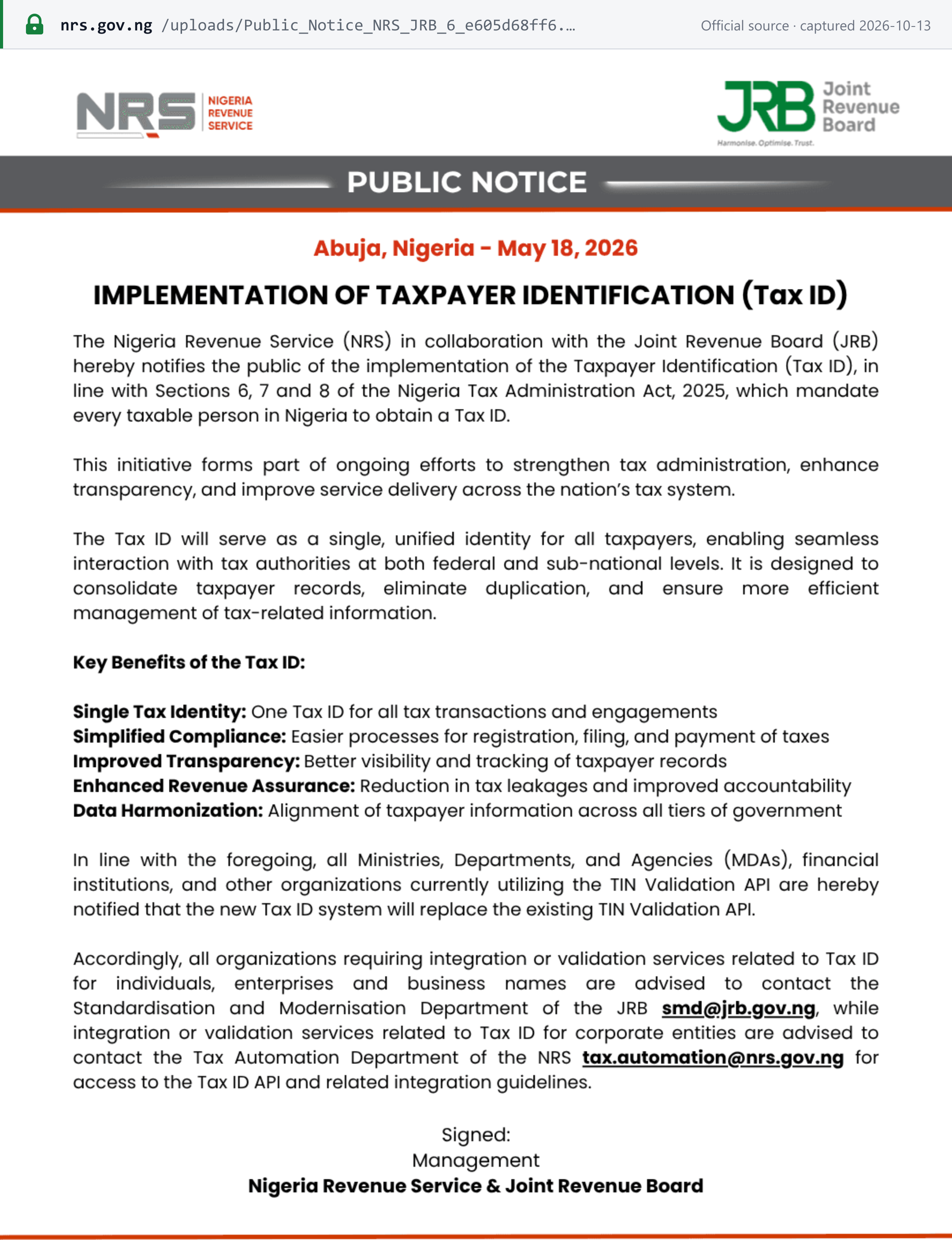
In Nigeria, every taxable person — individuals and business entities alike — is identified by a Tax ID, the successor to the Tax Identification Number (TIN). The Joint Revenue Board (JRB) and the Nigeria Revenue Service (NRS), formerly the Federal Inland Revenue Service (FIRS), jointly announced the Tax ID, which they describe as "a unique, system-generated number assigned to all taxable persons in Nigeria for the purpose of tax administration". [1] Their joint notice of 18 May 2026 says the Tax ID "will serve as a single, unified identity for all taxpayers, enabling seamless interaction with tax authorities at both federal and sub-national levels." [2]
Format
From 1 January 2026 the Tax ID is a 13-digit number. The JRB and NRS announcement states that "The use of the new Tax ID becomes effective from January 1, 2026, replacing previously issued TINs." [1]
- Older numbers. TINs issued before 2026, including those issued by the former FIRS, were replaced by the 13-digit Tax ID from 1 January 2026. If you hold an older TIN, retrieve your Tax ID and use that instead. [1] [3]
- An individual's Tax ID is linked to their 11-digit National Identification Number (NIN); a company's or other non-individual's Tax ID is linked to its Corporate Affairs Commission (CAC) registration number. The NIN or CAC number is used to retrieve the Tax ID — it is not the Tax ID itself. [1]
- Retrieve a Tax ID on the Nigerian Tax ID Portal (NRS) or at taxid.jtb.gov.ng. [1]
- The joint NRS/JRB public notice of 18 May 2026 states that "the new Tax ID system will replace the existing TIN Validation API". [2]
For how the Tax ID is used for VAT — on invoices, for non-resident suppliers and for e-invoicing — see the Nigeria VAT guide.
How Lookuptax can help you in VAT validation?
Lookuptax VAT validation revolutionizes VAT number validation with its robust platform, empowering businesses to seamlessly verify VAT numbers across over 100 countries. Our cutting-edge technology ensures accurate and efficient validation, reducing errors and enhancing compliance.
Frequently Asked Questions
Is my NIN the same as my Tax ID, and is my old TIN still valid?
No to both. Since 1 January 2026 a separate 13-digit Tax ID, announced jointly by the Joint Revenue Board and the Nigeria Revenue Service, has replaced previously issued TINs. For individuals the Tax ID is linked to the National Identification Number (NIN); for companies it is linked to the CAC registration number. You use your NIN or CAC number to retrieve your Tax ID on the Tax ID portal at taxid.nrs.gov.ng. [1]
Does a foreign company selling digital services to Nigerian customers need to register for VAT and a Tax ID?
Yes. For VAT there is no threshold for non-residents: section 151(1) of the Nigeria Tax Act 2025 requires a non-resident that makes taxable supplies to Nigeria to register and include VAT on its invoices, and a Nigerian business customer withholds the VAT and remits it to the Nigeria Revenue Service. Registration, filing and payment are done on the NRS self-service portal (Rev360). [4] [5]
When must withholding tax deducted from a supplier be remitted?
By the 21st day of the month following the month of deduction, according to the Nigeria Revenue Service tax calendar. [6]
When is my business required to issue e-invoices through the NRS Merchant Buyer Solution, and what happens if I don't?
The Nigeria Revenue Service is phasing in its Electronic Fiscal System (EFS), the Merchant Buyer Solution (MBS), by annual turnover. Large taxpayers (above ₦5 billion) went live on 1 August 2025, with implementation extended to November 2025, and were required to be fully compliant by 31 July 2026. Medium taxpayers (₦1 billion–₦5 billion) were scheduled to go live on 1 July 2026, with enforcement from January to March 2027, and emerging taxpayers (below ₦1 billion) on 1 July 2027. NRS describes these timelines as indicative. Each cleared invoice carries an Invoice Reference Number (IRN), and NRS tells buyers to accept only compliant e-invoices with a valid IRN. Failing to process a taxable supply through the fiscalisation system carries an administrative penalty of ₦200,000, plus 100% of the tax due, plus interest at the CBN Monetary Policy Rate. [7] [8] [9]
Do I need a separate Tax ID for each state where my business operates?
No. The Joint Revenue Board and the Nigeria Revenue Service describe the Tax ID as a single, unified identity for all taxpayers, for dealing with tax authorities at both federal and sub-national levels. The NRS tax calendar gives the PAYE remittance deadline as the 10th day of the following month, against the 21st for VAT and withholding tax. [2] [6]