Brazil Tax ID Guide — CPF and CNPJ Numbers Explained
Brazil issues two primary tax identification numbers: the CPF for individuals and the CNPJ for legal entities. Both are administered by the Secretaria Especial da Receita Federal do Brasil (RFB) and are required for banking, invoicing, property ownership, and public-sector contracts. Understanding their formats, validation rules, and the major changes arriving in 2026 is essential for any business operating in or with Brazil.
Cadastro de Pessoas Físicas — CPF
The CPF ("Cadastro de Pessoas Físicas") is the individual taxpayer registry number assigned to Brazilian nationals and to foreign nationals who hold assets, accounts, or economic interests in Brazil. It is governed by Normative Instruction RFB 1.548/2015.
Format: 11 digits, written as NNN.NNN.NNN-DD where the final two digits (DD) are check digits.
Mod-11 checksum: The first check digit is calculated by multiplying the first nine digits by weights 10 through 2, summing the products, and subtracting (sum mod 11) from 11 — if the result is 10 or 11, the check digit is 0. The second check digit repeats the same algorithm over all ten digits with weights 11 through 2. Any CPF with the same digit repeated eleven times (e.g., 111.111.111-11) is structurally invalid regardless of checksum.
 |
| CPF — Cadastro de Pessoas Físicas |
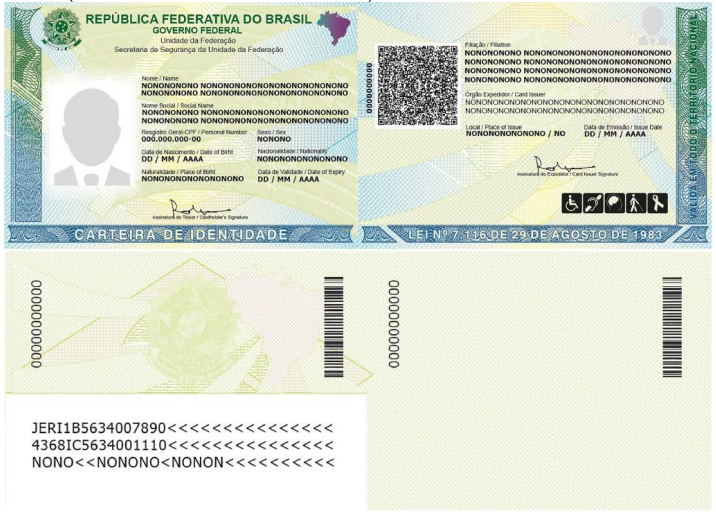 |
| ID Card — Carteira de Identidade Nacional (CIN) |
CPF Status Values
The Receita Federal assigns one of five statuses to each CPF:
| Status | Practical Consequence |
|---|---|
| Regular | Fully active — all transactions permitted |
| Suspended | Temporary block — banking and property transactions blocked |
| Null | Duplicate registration cancelled |
| Cancelled | Permanently revoked |
| Pending Regularisation | Missing mandatory update |
A CPF in any status other than "Regular" will cause NF-e invoice rejections, bank account denials, and property transfer refusals. You can check status free of charge via the CPF verification portal.
Cadastro Nacional da Pessoa Jurídica — CNPJ
The CNPJ ("Cadastro Nacional da Pessoa Jurídica") is the company tax registration number issued to legal entities — corporations, partnerships, branches, non-profits, and foundations. It is governed by Normative Instruction RFB 2.119/2022.
Format (current): 14 digits, written as NN.NNN.NNN/BBBB-DD
| Segment | Positions | Meaning |
|---|---|---|
| Root | 1–8 | Unique company identifier |
| Branch suffix | 9–12 | Headquarter = 0001; each subsidiary increments |
| Check digits | 13–14 | Mod-11 verification pair |
Mod-11 checksum: Two check digits computed by separate weighted-sum passes over the preceding 12 digits. The weights cycle through the sequence 2, 3, 4, 5, 6, 7, 8, 9. If a remainder is 0 or 1, the corresponding check digit is 0.
Alphanumeric CNPJ from July 2026
Normative Instruction RFB 2229/2024 introduces an alphanumeric CNPJ format effective July 2026 for new registrations only. Existing all-numeric CNPJs are not renumbered.
Key technical changes:
- The first 12 characters (root + branch) may contain letters A–Z alongside digits 0–9.
- Letters map to their ASCII value minus 48 (A = 17, B = 18, … Z = 42) before the checksum is calculated; digits retain face value.
- The two check digits remain numeric.
- Example new-format CNPJ:
12.ABC.345/01DE-35
Any ERP, billing system, NF-e library, or API that validates CNPJ against a purely numeric regular expression will reject valid new-format CNPJs from suppliers. The Receita Federal provides a free CNPJ Alfanumérico Simulator at servicos.receitafederal.gov.br/servico/cnpj-alfa for developers to test updated validation logic before go-live. [1] [2]
You can verify any CNPJ via the official REDESIM portal — see the CNPJ verification guide for step-by-step instructions.
CNPJ Status Values
| Status | Meaning |
|---|---|
| Ativa | Active — normal operations |
| Inapta | Inactive due to missed tax filings — invoicing and banking blocked |
| Suspensa | Temporarily suspended |
| Baixada | Cancelled — company deregistered |
| Nula | Registration voided |
A CNPJ classified as inapta cannot issue NF-e invoices or conduct banking transactions. Regularisation requires submitting all outstanding declarations (DCTF, DIRF, SPED) through the eCAC portal, paying late-filing penalties, and waiting for daily status refresh.
Foreigners
Non-resident individuals or foreign entities that hold real estate, vehicles, company stakes, bank accounts, or investments in Brazil must register for a CPF or CNPJ, respectively.
Foreign companies seeking to invest directly must also pre-register with the Banco Central do Brasil via the SCE-CDNR system before opening a CNPJ. A Brazilian-resident representative (procurador) holding a valid CPF and a properly scoped power-of-attorney is mandatory for all foreign-owned CNPJ registrations under Article 6, §1 of IN RFB 2119/2022.
Brazil's 2026 Tax Reform — CBS and IBS
Lei Complementar 214/2025 (signed 16 January 2025) implements the consumption tax reform mandated by Constitutional Amendment 132/2023. It replaces five taxes — PIS, COFINS, IPI, ICMS, and ISS — with two new levies over a 2026–2033 transition:
- CBS (federal): Contribuição sobre Bens e Serviços
- IBS (state/municipal): Imposto sobre Bens e Serviços
2026 is a test phase: NF-e invoices must show CBS at 0.9% and IBS at 0.1% (combined 1%), offsettable against existing PIS/COFINS. During the adaptive period under Ato Conjunto RFB/CGIBS nº 1/2025, leaving the IBS/CBS fields blank caused neither fines nor document rejection; the fields became mandatory from 3 August 2026 for NF-e and NFC-e, with other document types phased in through 1 January 2027 under Ato Conjunto RFB/CGIBS nº 4/2026. Automatic rejection of documents missing the fields has been deferred by Ato Técnico Conjunto nº 01/2026, so such documents are still authorised for now. ICMS and ISS are fully replaced only in 2033. [3] [4] [12] [13] [16]
Foreign digital service providers selling to Brazilian consumers must obtain a CNPJ for CBS/IBS registration from 2026 onward — the reform closes the prior exemption gap for non-established suppliers.
Simples Nacional sublimit extended to IBS (from 1 January 2027)
Resolução CGSN nº 190/2026 (dated 4 August 2026; published in the Diário Oficial da União of 10 August 2026) extends the existing R$3.6 million Simples Nacional sublimit — until now used only to decide when a Simples-enrolled company must collect ICMS and ISS outside its unified DAS payment — to also govern IBS collection, effective 1 January 2027. For a CNPJ holder, this does not change registration or Simples Nacional enrollment status: a company that crosses R$3.6 million in gross revenue (while staying under the general Simples ceiling) remains "Ativa" and enrolled in Simples Nacional; from 2027 it additionally collects IBS through the regular-regime rules on the excess, the same way it already handles ICMS and ISS today. If you are checking a CNPJ for Simples Nacional status, this sublimit is not visible on the REDESIM cadastral lookup — see How to verify a CNPJ number in Brazil for the dedicated Consulta de Optantes tool. For the broader CBS/IBS transition, see the Brazil country guide. [11] [15]
Nanoempreendedores: no CBS/IBS CNPJ obligation through 2028
A nanoempreendedor is an individual whose gross revenue is below 50% of the MEI ceiling and who has not joined the MEI regime; under art. 26, IV of Lei Complementar 214/2025 such a person is not a CBS/IBS taxpayer. [3] Ato Conjunto RFB/CGIBS nº 6, de 28 de agosto de 2026, signed by Receita Federal and the Comite Gestor do IBS, waives the nanoempreendedor from the obligation to register in the unified-identification registry via CNPJ and from issuing the CBS/IBS electronic fiscal documents, with effect until 31 December 2028. The waiver does not apply to a nanoempreendedor who opts into the regular IBS/CBS regime under art. 26, §1, II of LC 214/2025. In practice, a very small individual supplier may legitimately sell or be paid under a CPF with no CNPJ. [14] (signed text)
Cooperative societies: option for the specific IBS/CBS regime (2027)
Cooperative societies under article 271 of Lei Complementar 214/2025 can elect the specific IBS/CBS regime (rates reduced to zero on operations expressly provided in law). The Receita Federal and the Comitê Gestor do IBS announced the Joint Guidance on 18 September 2026: for effect in 2027 the option can be made in the Receita Federal Services Portal between 1 September and 31 October 2026, takes effect on 1 January 2027, and requires both registering the option and sending the list of members with admission dates. [15]
MEI — Microempreendedor Individual
MEI is a simplified self-employment regime capped at R$81,000 annual gross revenue (2025 limit). The MEI holds a CNPJ and pays a single monthly DAS (Documento de Arrecadação do Simples) covering INSS, ISS, and ICMS.
Exceeding the cap triggers disqualification:
- Up to 20% over cap (up to R$97,200): disqualification effective January 1 of the following year; DAS surcharge on the excess with fine and interest.
- More than 20% over cap: disqualification is retroactive to January 1 of the current year — the entire year is recalculated at Simples Nacional ME rates, often producing a large back-tax assessment.
Resolution CGSN 183/2025 now combines revenues earned under both CPF and CNPJ for the same activity when calculating the R$81,000 ceiling, closing a widely used workaround. [5]
Frequently Asked Questions
Non-resident foreigners: must I visit a Brazilian consulate to get a CPF, and what happens if I miss the annual re-registration?
Foreign individuals residing outside Brazil must apply in person at a Brazilian consulate for first-time CPF enrollment — online self-enrollment is reserved for residents inside Brazil. A rule effective January 13, 2025 requires all non-resident CPF holders to complete an annual re-registration by December 31 each year using the Receita Federal mobile app (selfie plus passport scan). Missing this deadline places the CPF in "Suspended" status, which blocks banking, property purchases, and any NF-e transaction requiring your CPF. If data discrepancies prevent completion of the mobile re-registration, a new application must be submitted via the e-consular system. Remote support is available at [email protected]. [6] [7]
Why does registering a foreign-owned company for a CNPJ require a Brazilian-resident procurador, and what powers must that person hold?
Under Article 6, §1 of Normative Instruction RFB 2119/2022, any entity domiciled abroad that becomes a partner in — or directly registers — a Brazilian legal entity must appoint a legally constituted representative (procurador) resident in Brazil. That representative must hold powers to manage the entity's Brazilian assets and rights and to receive legal citations in lawsuits filed against the foreign partner. This is distinct from a simple signing authority: without the correct power-of-attorney scope, the Receita Federal will reject the CNPJ application outright. The procurador must hold a valid CPF. Foreign companies making direct investment must also pre-register with the Banco Central via the SCE-CDNR system before the CNPJ application. [8] [9]
From July 2026, will my existing CNPJ change to the new alphanumeric format, and will current validation libraries break?
Existing all-numeric CNPJs are unaffected — the Receita Federal has confirmed no retroactive renumbering. The alphanumeric format (letters A–Z mixed with digits 0–9 in the first 12 characters; two numeric check digits unchanged) applies only to new registrations from July 2026, under Normative Instruction RFB 2229/2024. Letters map to ASCII value minus 48 (A = 17, B = 18, …, Z = 42) before the checksum is applied. Any ERP, billing library, or NF-e validator that uses a purely numeric CNPJ regex will reject new-format CNPJs from suppliers after July 2026 — a breaking change already tracked in the validator.js project (issue #2639, fixed in PR #2644). The Receita Federal's free CNPJ Alfanumérico Simulator lets developers test updated logic now. [1] [2]
What are the CBS and IBS taxes, when do they replace ICMS/ISS, and what must businesses do in 2026?
Lei Complementar 214/2025 (signed January 16, 2025) implements Brazil's consumption tax reform. It creates the federal CBS and the state/municipal IBS to replace PIS, COFINS, IPI, ICMS, and ISS over a 2026–2033 transition. In 2026 (test phase), all taxpayers must issue NF-e invoices showing CBS at 0.9% and IBS at 0.1% (combined 1%), offsettable against PIS/COFINS; during the adaptive period under Ato Conjunto RFB/CGIBS nº 1/2025, blank IBS/CBS fields caused neither fines nor rejection, and the fields became mandatory from 3 August 2026 for NF-e and NFC-e, phased by document type through 1 January 2027 (Ato Conjunto RFB/CGIBS nº 4/2026). Automatic rejection of documents missing the fields has been deferred by Ato Técnico Conjunto nº 01/2026, so such documents are still authorised for now. ICMS and ISS are fully replaced only in 2033. Foreign digital service providers must obtain a CNPJ for CBS/IBS registration from 2026. Businesses should update their fiscal systems and NF-e XML layouts immediately — the Receita Federal and IBS Management Committee published joint orientation guidelines in December 2025. [3] [4]
What triggers automatic exclusion from the MEI regime, and what are the retroactive tax consequences?
An MEI is automatically disqualified if annual gross revenue exceeds R$81,000 (2025 limit). Exceeding the cap by up to 20% (i.e., up to R$97,200) triggers exclusion from January 1 of the following year — additional DAS is owed on the excess with fine and interest. Exceeding by more than 20% in a single year makes disqualification retroactive to January 1 of that year: the entire year is recalculated under Simples Nacional ME rates, often producing a large back-tax bill. Resolution CGSN 183/2025 now combines revenues received under both CPF and CNPJ for the same activity when calculating the R$81,000 limit, closing a common workaround where sole traders invoiced partly under their personal CPF and partly under their MEI CNPJ. [5] [3]
My CNPJ shows "inapta" on the Receita Federal lookup — can I still issue NF-e invoices and what do I do to fix it?
A CNPJ classified as inapta (ineligible) means the company has failed to submit mandatory declarations — typically DCTF, DIRF, or SPED — for two or more consecutive years. Consequences are immediate and severe: NF-e and NFS-e issuance is blocked, banking institutions must refuse current-account operations and loans, and the company's partners may be barred from opening new CNPJs. To regularise: access the eCAC Portal using a digital certificate (e-CPF or e-CNPJ); switch to the company's profile; check "Consultar situação fiscal" to generate a list of pending submissions; file all outstanding declarations; pay assessed late-filing penalties; and monitor the status, which the Receita Federal refreshes daily at 5 PM. Engaging a licensed contador (accountant) is strongly recommended to avoid errors in backdated filings. [8] [10]
The new R$3.6 million Simples Nacional sublimit now covers IBS — does that change a CNPJ's registration or Simples status?
No. Resolução CGSN nº 190/2026 (dated 4 August 2026; published in the Diário Oficial da União of 10 August 2026) extends the existing R$3.6 million Simples Nacional sublimit — previously relevant only to ICMS/ISS collection outside the unified DAS — to also apply to IBS, effective 1 January 2027. This is a change to how tax is calculated above the sublimit, not to a company's CNPJ registration or its Simples Nacional enrollment: a CNPJ holder that crosses R$3.6 million in gross revenue stays "Ativa" and enrolled in Simples, and continues to appear that way on both the REDESIM cadastral lookup and the Consulta de Optantes do Simples Nacional. From 1 January 2027, such a company additionally collects IBS through regular-regime rules on the revenue above the sublimit — the same mechanism it already uses for ICMS and ISS. [11] [15]
Recent changes
- 2026-09-18 — Receita Federal and the Comitê Gestor do IBS announced the Joint Guidance opening the option for cooperative societies (art. 271, Lei Complementar 214/2025) to elect the specific IBS/CBS regime: option between 1 September and 31 October 2026, effective 1 January 2027, with registration of the option and the list of members with admission dates. (Receita Federal do Brasil) — see event
- 2026-08-28 — Ato Conjunto RFB/CGIBS nº 6, de 28 de agosto de 2026, waives the nanoempreendedor from registering in the CBS/IBS unified registry via CNPJ and from issuing CBS/IBS electronic fiscal documents, until 31 December 2028; the waiver does not apply to a nanoempreendedor who opts into the regular IBS/CBS regime. See Nanoempreendedores. (Comite Gestor do IBS) — see issue
- 2026-08-04 — Resolução CGSN nº 190/2026 (dated 4 August 2026; published in the DOU of 10 August 2026) extended the R$3.6 million Simples Nacional sublimit — previously governing only ICMS/ISS collection outside the unified DAS — to also cover IBS collection, effective 1 January 2027. See Simples Nacional sublimit extended to IBS. (Receita Federal do Brasil; SIJUT record) — see issue
How Lookuptax can help you?
Lookuptax VAT validation revolutionizes VAT number validation with its robust platform, empowering businesses to seamlessly verify VAT numbers across over 100 countries. Our cutting-edge technology ensures accurate and efficient validation, reducing errors and enhancing compliance.

Related Resources
- How to verify a CNPJ number in Brazil — Step-by-step REDESIM portal guide
- How to verify a CPF number in Brazil — Receita Federal CPF status lookup
- Argentina Tax ID Guide — CUIT/CUIL for comparison with neighboring Latin American identifiers
- Colombia Tax ID Guide — NIT structure and e-invoicing mandates
- Worldwide Tax Rates — Compare Brazil's CBS/IBS rates against other countries' VAT and GST rates