Morocco TIN number guide
ICE (Identifiant Commun de l'Entreprise)
The ICE is the common business identifier. Taxpayers must show it on their invoices and on all their tax returns, and invoices must also show the buyer's ICE (Code Général des Impôts, articles 145-VIII and 145-III-4°). [1] The official ICE portal is www.ice.gov.ma.
Identifiant Fiscal (IF)
The identifiant fiscal is the tax identification number issued by the local tax office, and it must appear on invoices (Code Général des Impôts, article 145-III-2°). [1] It also serves as the VAT identifier (see below).
Registre de Commerce (RC)
Also known as Numéro d'enregistrement de la société auprès du registre du commerce de Casablanca.
Numéro de TVA (VAT)
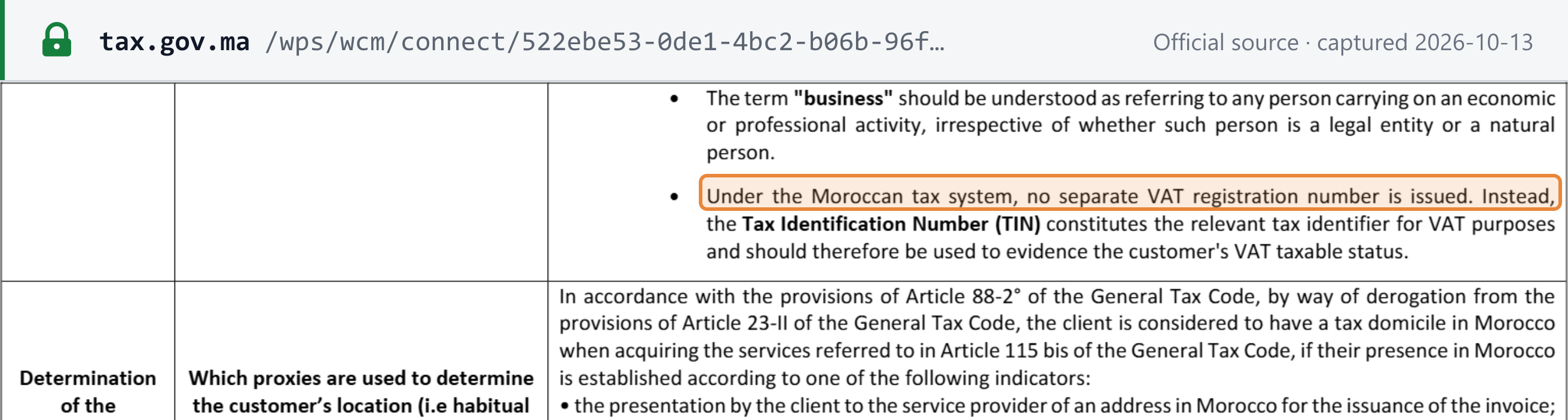
Morocco issues no separate VAT number. The DGI states that "no separate VAT registration number is issued" and that the Tax Identification Number — the Identifiant Fiscal (IF) above — is the identifier for VAT purposes. Invoices must also show the seller's ICE and the buyer's ICE (Code Général des Impôts, articles 145-VIII and 145-III-4°). [1] [2] For VAT rates, registration and filing, see the Morocco VAT guide.
Caisse Nationale de Sécurité Sociale (CNSS)
The role of Morocco's Caisse Nationale de Sécurité Sociale (CNSS) is to provide insurance for all private sector employees.
How Lookuptax can help you in VAT validation?
Lookuptax VAT validation revolutionizes VAT number validation with its robust platform, empowering businesses to seamlessly verify VAT numbers across over 100 countries. Our cutting-edge technology ensures accurate and efficient validation, reducing errors and enhancing compliance.
Frequently Asked Questions
Why was my invoice rejected by a Moroccan client even though all amounts and descriptions were correct?
A Moroccan invoice must show the customer's ICE (Identifiant Commun de l'Entreprise) as well as the supplier's own identifiers. Article 145-III-4° of the Code Général des Impôts requires the buyer's ICE on invoices for financial years opened from 1 January 2019, and article 145-VIII requires taxpayers to show their own ICE on invoices and tax returns. A taxpayer whose own ICE is missing or wrong on an invoice or return is fined MAD 100 per omission or error (article 198 ter, which applies to article 145-VIII), and a buyer cannot deduct VAT without a compliant invoice. Before invoicing a Moroccan company, ask for its ICE. [1]
Does a foreign SaaS or digital-services company need to register for TVA in Morocco even without a local office?
Yes, if it sells to consumers, with no minimum threshold and without a local representative. Under article 115 bis of the Code Général des Impôts, a non-resident with no establishment in Morocco that supplies remote, dematerialised services to Moroccan customers who are not subject to VAT (B2C) must register on the DGI's Taxation on Digital Services platform and obtain a tax identifier there. The DGI announced on 14 May 2026 that the platform was accessible, and the formalities apply from 11 June 2026 under article 28 of Decree No. 2-25-862. The DGI says the appointment of a local physical tax representative is not required, and registration applies from the first dirham of B2C sales. Returns are quarterly, filed and paid before the end of the first month of each quarter, at the standard 20% rate and with no deduction of input VAT. Sales to VAT-registered Moroccan businesses stay under the reverse charge applied by the client. [1] [2] [3]
Is e-invoicing mandatory in Morocco, and which businesses must comply first?
Not yet. Article 145-IX of the Code Général des Impôts, added by the 2018 Finance Law, requires businesses subject to corporate tax, income tax on professional income or VAT to adopt a computerised invoicing system that meets technical criteria set by the tax administration, with the details to be fixed by regulation for each sector. As at 13 October 2026 no implementing decree or order has been published on the DGI's website, so no e-invoicing system, format, timeline or first group of businesses is in force. Invoices must still carry the seller's IF and the ICE of both parties. [1]
What tax benefit does Casablanca Finance City (CFC) status provide, and does it affect a company's IF registration?
CFC-status companies receive a full corporate tax (IS) exemption for the first five consecutive fiscal years, followed by a preferential IS rate that is converging to 20% by 2026 under Morocco's broader tax reform (from the prior 15% rate). Dividends distributed to non-resident shareholders remain exempt from withholding tax. CFC status does not create a separate IF number — the company registers for its IF through the DGI in the same way as any other Moroccan entity, and the IF is used for all tax filings. The preferential regime is administered by the CFC Authority, and compliance evidence must be maintained with the DGI. [1] [2]