How to verify EORI Number in EU?
The EORI (Economic Operators Registration and Identification) number identifies a person for customs purposes in the EU. The European Commission describes it as "mandatory for the clearance of all types of customs operations in the customs territory of the EU, such as import, export and transit".[1]
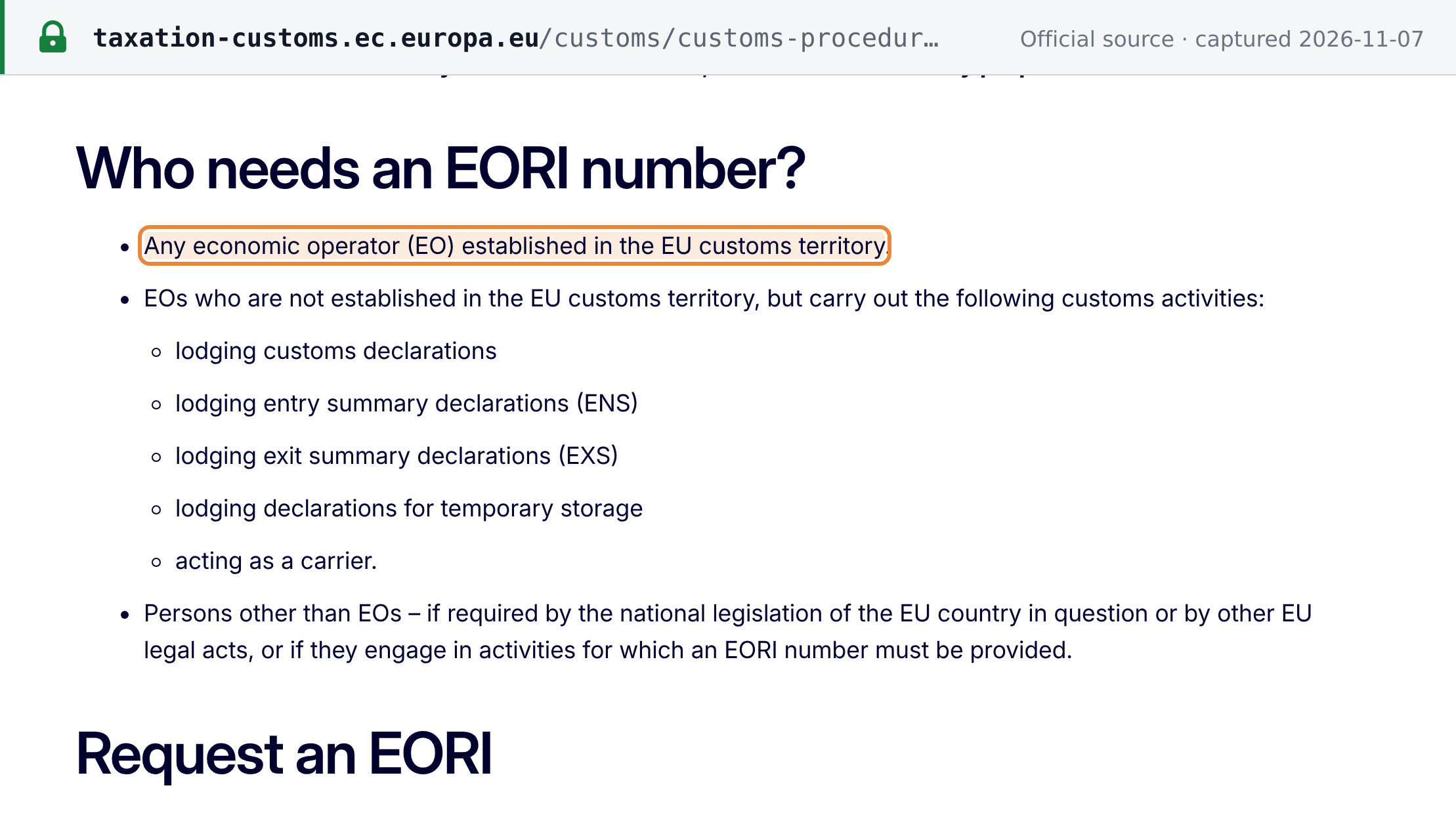
Not every business needs one. Economic operators established in the EU customs territory register with the customs authorities of the place where they are established (Article 9(1) of the Union Customs Code, which applies from 1 May 2016). Operators established outside the EU register only before they carry out certain customs activities, such as lodging a customs declaration, and other persons only where EU or national law requires it.[2] [3] The Commission's guidance gives the example of an EU supplier that sells raw materials already in free circulation to an EU manufacturer and is involved in no customs activity: it "is under no obligation to apply for an EORI number".[4]
 Source snapshot captured 2026-11-07 — original
Verify an EORI number on the European Commission portal
The European Commission (DG TAXUD) runs a free public EORI number validation page covering numbers issued by EU Member States and XI numbers issued for Northern Ireland. GB numbers are not on it: they are checked on HMRC's service (see GB and XI numbers below). The Commission's guidance says this public interface requires "no identification, authentication or authorisation by the system".[4] The portal publishes no quota and shows no CAPTCHA.
The "Last import date" under the page title shows when the central database was last refreshed. The Commission's EOS FAQ says the databases "are daily synchronised" with the national customs administrations.[5]
Step 1: Open the EORI number validation portal
Go to the European Commission's EORI number validation page at ec.europa.eu/taxation_customs/dds2/eos/eori_validation.jsp. It is free and needs no login.
Step 2: Enter the full EORI number
Type the full EORI number, starting with the two-letter code of the issuing country, in capitals and with no spaces (for example FI2655044-9, NL863997260 or DE5834171), then click Validate.
Before it submits, the page checks the input and shows one of these messages if something is wrong: "No EORI number entered!", "No spaces allowed!", or "An EORI number must start with two uppercase letters (the ISO code of the country that granted the number) followed by maximum 15 alphanumeric characters".[6]
Step 3: Read the result
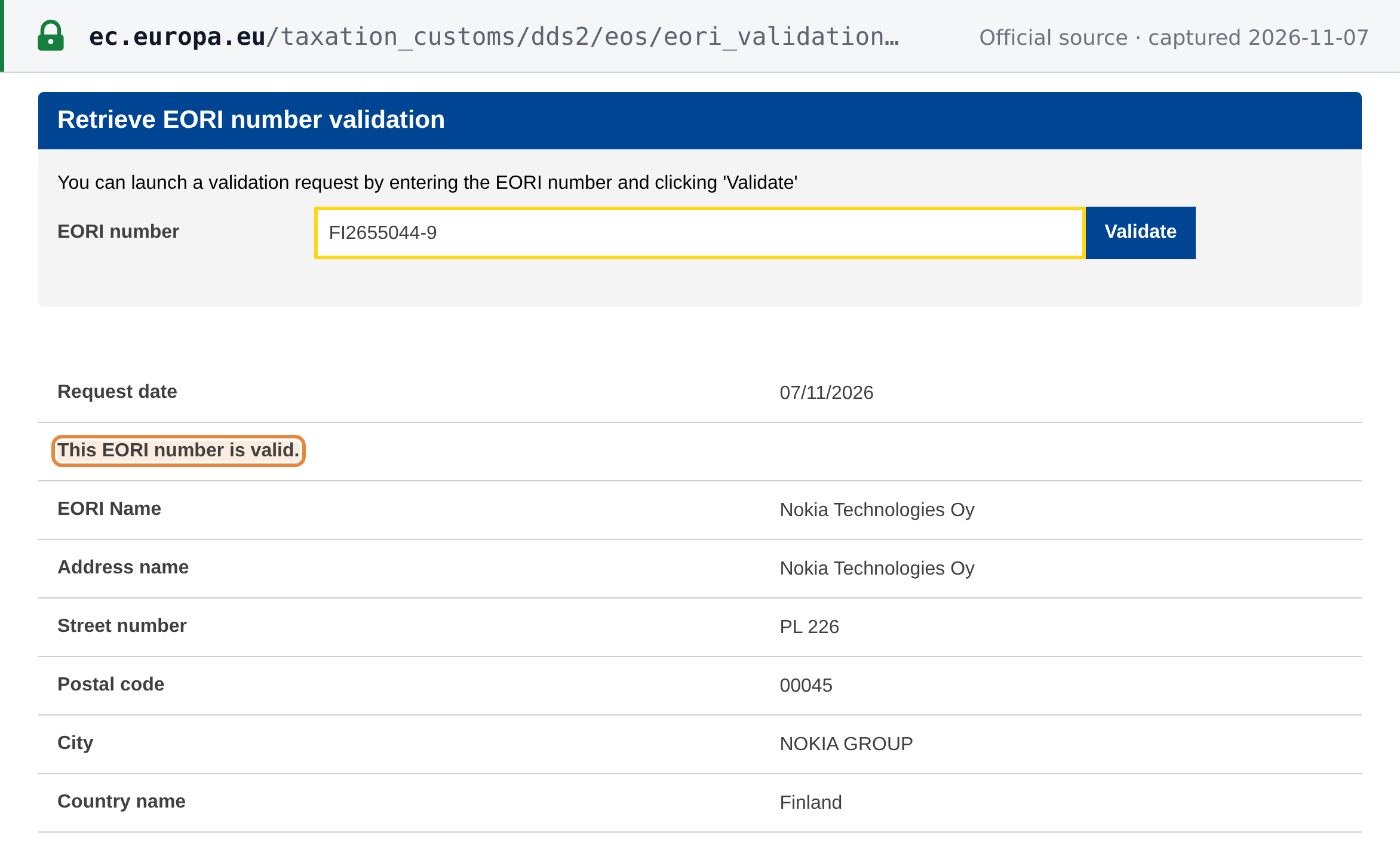
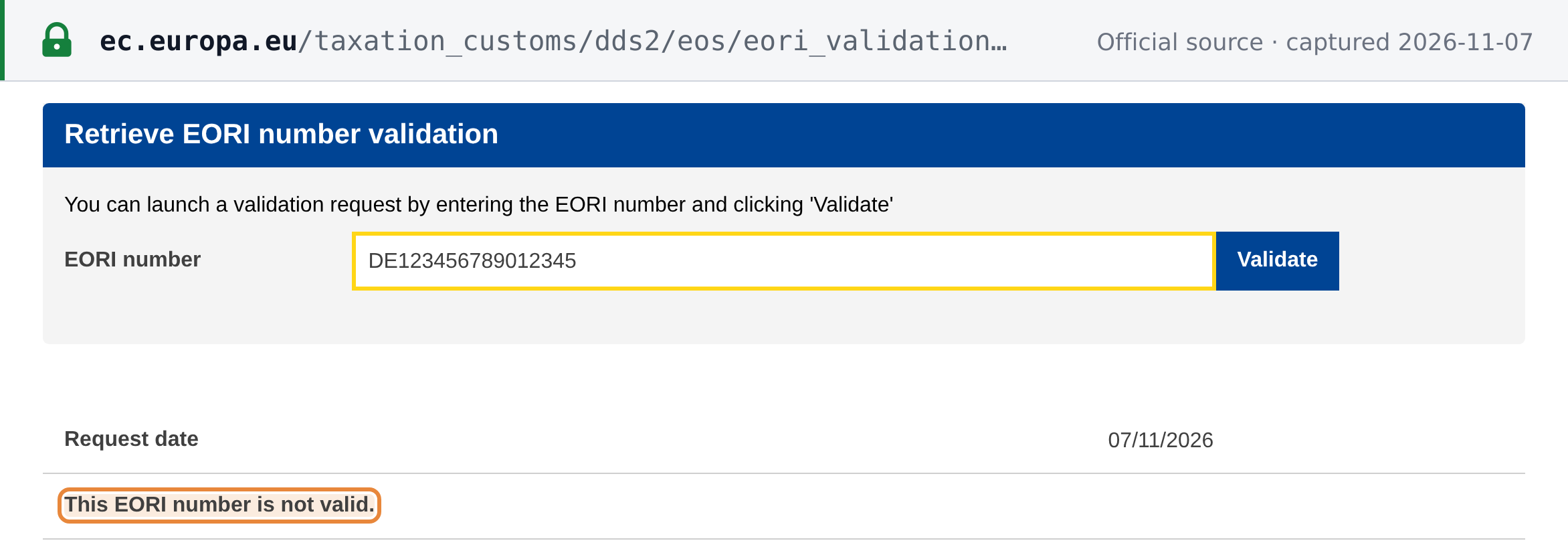
A valid number shows Request date, "This EORI number is valid.", EORI Name, Address name, Street number, Postal code, City and Country name. The name and address rows are blank if the holder did not consent to publication. A number that fails shows only Request date and "This EORI number is not valid.", with no reason given.
 Source snapshot captured 2026-11-07 — original
What the result means
Valid, with name and address. The number is active in the central EORI system, and the holder consented to publication of its name and address.
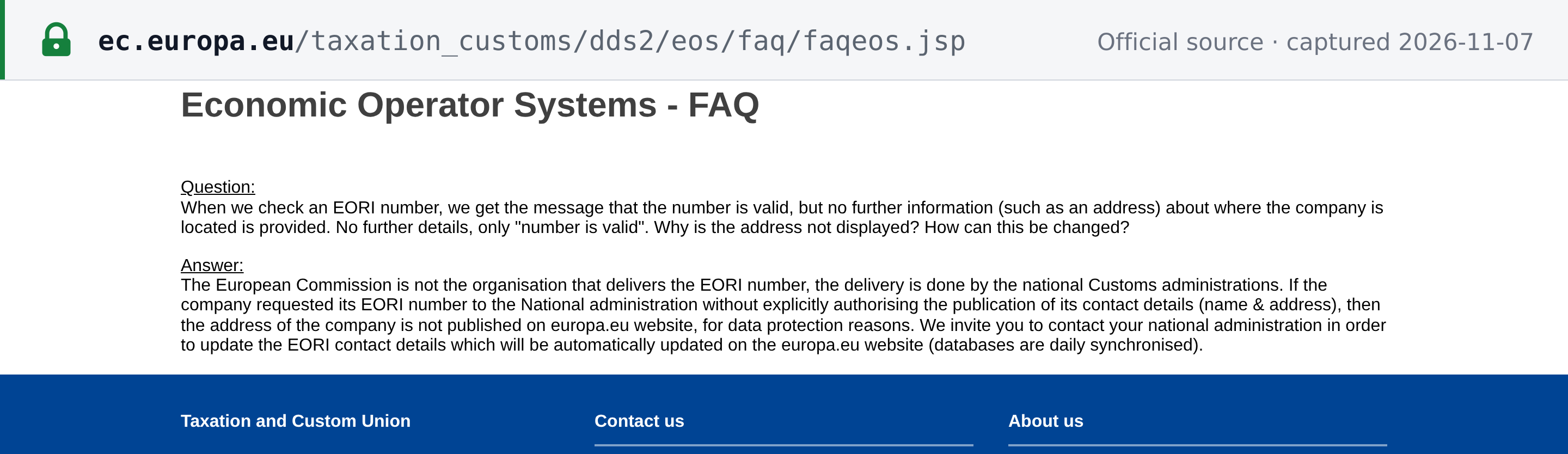
Valid, with blank name and address rows. The number is active, but the holder did not consent to publication. This is not an error. The Commission's EOS FAQ explains that "If the company requested its EORI number to the National administration without explicitly authorising the publication of its contact details (name & address), then the address of the company is not published on europa.eu website, for data protection reasons."[5] The guidance adds that refusing publication "will in no way affect either processing of their application for an EORI number or any customs formalities involving the person concerned".[4] If you need the holder's name, ask the counterparty for it and match it against its other documents.
 Source snapshot captured 2026-11-07 — original
"This EORI number is not valid." The portal gives no reason code. The number may never have been issued or may be mistyped, it may have been invalidated, it may be a GB number (checked only by HMRC), or it may be newly issued and not yet uploaded to the central system. The next section covers each case.
 Source snapshot captured 2026-11-07 — original
Common reasons for a "not valid" result
- Formatting. Each of these returns "not valid" for a number that is valid in its correct form: a dropped hyphen (
FI26550449instead ofFI2655044-9), an extra leading zero (NL0863997260), and a German 4-digit branch number appended to the EORI (DE58341710000). The form itself blocks a lowercase country prefix (fi2655044-9), an embedded space ("No spaces allowed!") and a number without its two-letter country prefix. - Newly issued numbers. A number can be usable nationally before it reaches the central system. The Commission's guidance asks the issuing Member State to "upload the new EORI record in the central EOS, as soon as possible".[4] Ireland's entry in the Commission's EORI National Implementation document (28 June 2022) says "It will take up to 48 hours for the information to appear on the Central European EORI database".[7] If a counterparty's number was issued in the last few days, check again before treating it as wrong.
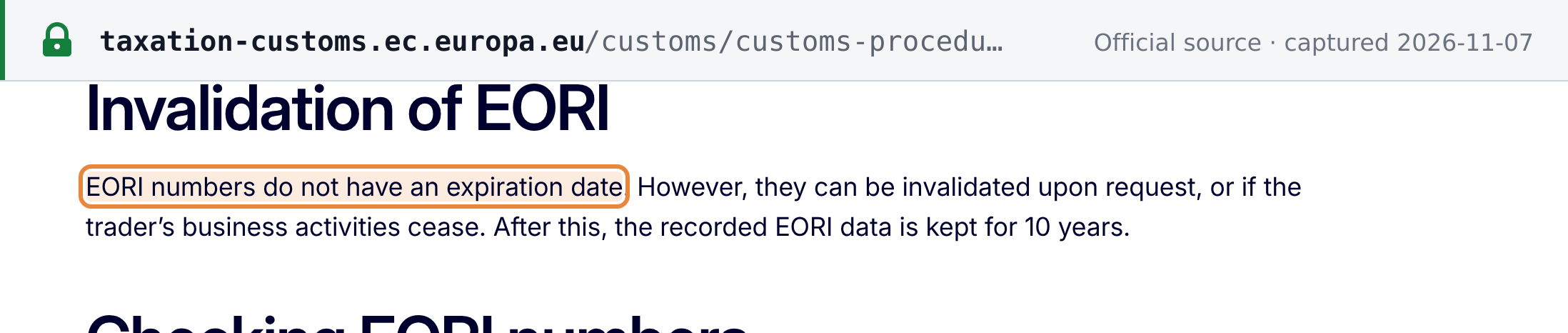
- Invalidated numbers. EORI numbers have no expiry date, but customs invalidate a number "upon request by the registered person" or "when the customs authority is aware that the registered person has ceased the activities requiring the registration" (Article 7(1) of Delegated Regulation (EU) 2015/2446).[8] The portal shows no invalidation date: an invalidated number looks the same as an unknown one.
- GB numbers. These are not in the Commission's system. Check them on HMRC's service.
 Source snapshot captured 2026-11-07 — original
EORI number format
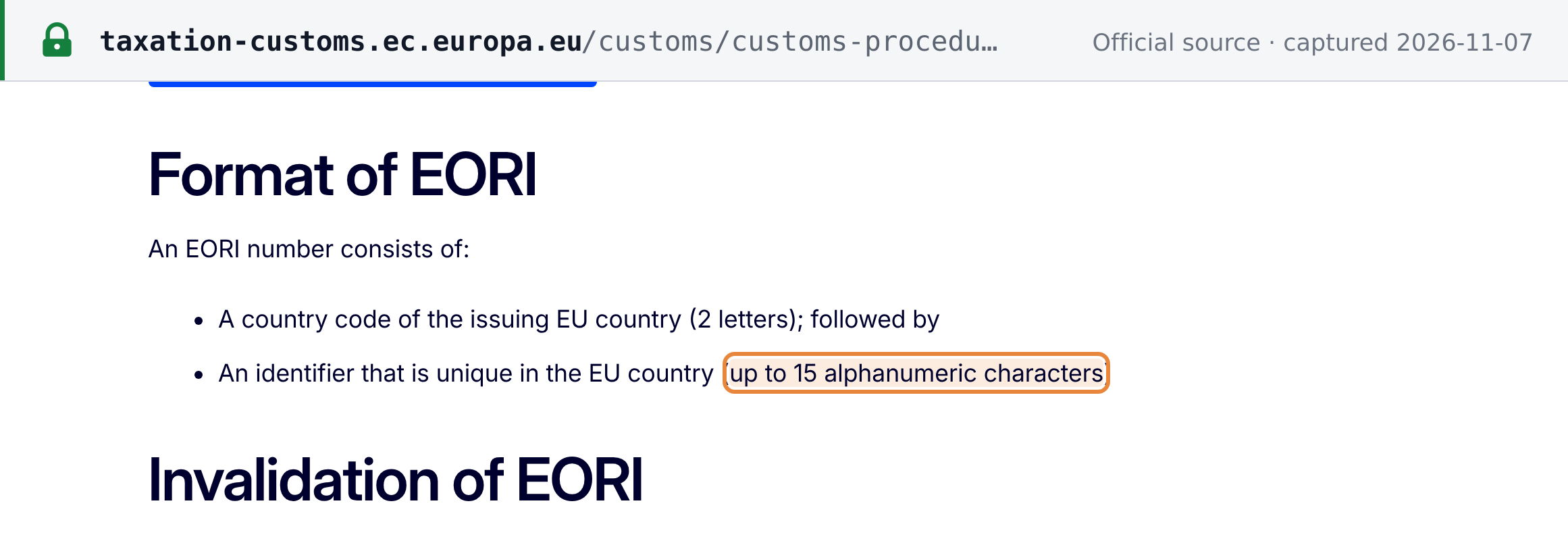
The European Commission states the format as "A country code of the issuing EU country (2 letters); followed by An identifier that is unique in the EU country (up to 15 alphanumeric characters)".[1] That is 3 to 17 characters in total, which is also the length the portal accepts. The guidance lets each Member State decide "whether a number already assigned (e.g., the VAT number) will be reused for composition of EORI number or a new one must be composed", so the part after the prefix differs from country to country.[4]
 Source snapshot captured 2026-11-07 — original
National patterns, where an official source states one:
- Netherlands: NL + 9 digits. The Commission's National Implementation document (28 June 2022) says the EORI is "NL" plus the fiscal number, zero-padded "so that the EORI number will always be 'NL' + 9 numbers".[7]
- Belgium: BE + the 10-digit Crossroads Bank for Enterprises number, according to the same 2022 document.[7]
- Germany: German customs' English EORI pages on zoll.de publish no fixed length for DE numbers, and
DE5834171(DE + 7 digits) validates on the portal. German customs separately assigns each EORI holder a 4-digit branch number, "0000" for the head office.[10] Do not append it when you check the EORI on the Commission portal. - Finland:
FI2655044-9validates on the portal, and the same digits without the hyphen do not. Keep the hyphen. - France: FR + SIREN (9 digits) or FR + SIRET (14 digits), with the SIRET form being withdrawn. French customs (DGDDI) says: "Tout opérateur peut obtenir un EORI SIREN depuis avril 2023" and "Les EORI SIRET seront tous désactivés durant le second semestre 2026 à une date qui sera communiquée bien en avance par l'administration" (page updated 9 December 2025).[9] See our French EORI verification guide.
 Source snapshot captured 2026-11-07 — original
GB and XI numbers
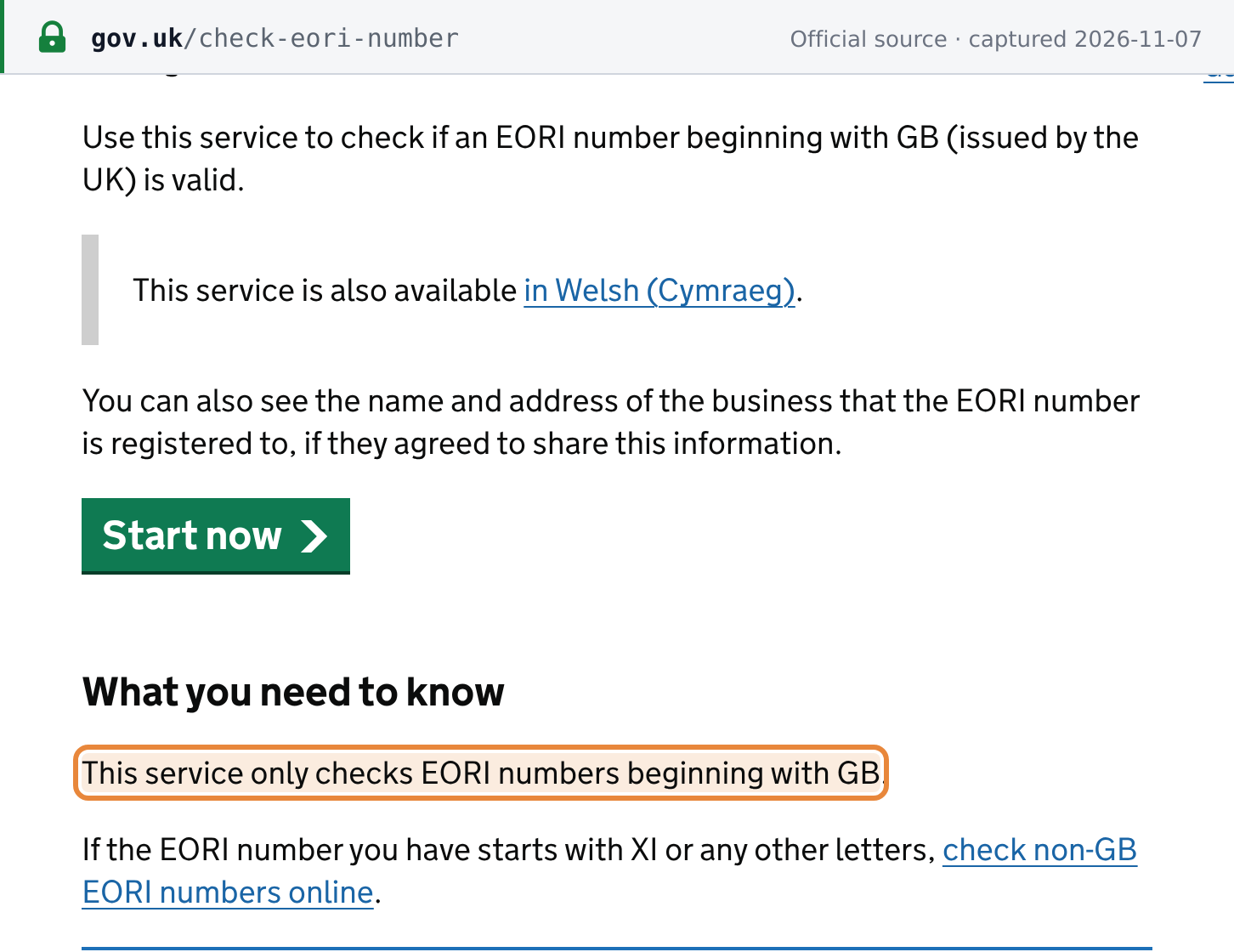
GOV.UK says HMRC's Check an EORI number service "only checks EORI numbers beginning with GB", and "If the EORI number you have starts with XI or any other letters, check non-GB EORI numbers online", linking to the Commission portal.[11] HMRC's checker describes a GB number as "This will start with ‘GB’ followed by 12 or 15 numbers, for example GB123456789000."[12] XI numbers are issued by HMRC for Northern Ireland, and GOV.UK says "You must have applied for a GB EORI number before you can get an XI EORI number".[13] For when an XI number is needed, see EORI numbers for Northern Ireland on GOV.UK and our Northern Ireland tax ID guide.
 Source snapshot captured 2026-11-07 — original
Related resources
- How to verify a French EORI number
- How to verify an EU VAT number on VIES, the separate check for VAT numbers
- How to verify a UK VAT number
- Northern Ireland tax ID guide
- Free links to official VAT number databases
Frequently Asked Questions
What is the difference between an EORI number and a VAT number, and which one goes on a customs declaration?
An EORI number identifies a person for customs purposes: Delegated Regulation (EU) 2015/2446 defines it as an identification number, unique in the customs territory of the Union, assigned by a customs authority to register a person for customs purposes. The European Commission describes it as mandatory for the clearance of all types of customs operations in the EU customs territory, such as import, export and transit. A VAT number identifies a business for VAT and is checked on VIES, not on the EORI portal. Each Member State decides whether to reuse an existing number, such as the VAT number, to build the EORI, so the two can look alike, but each is checked on its own system. A business that is VAT-registered but has no customs activity has no obligation to apply for an EORI number. [1] [2] [3]
My non-EU company ships goods to EU customers. Do I need my own EORI number, or can I use my freight forwarder's?
It depends on who lodges the declarations. The Commission's guidance says a Chinese or Swiss exporter whose goods are consigned to an EU consignee is not required to apply for an EORI number. A non-EU operator must register before it lodges a customs declaration, an entry or exit summary declaration or a temporary storage declaration itself, or acts as a carrier by sea, inland waterway or air (Article 5(1) of Delegated Regulation (EU) 2015/2446, which lists exceptions). The declarant must normally be established in the EU customs territory, with exceptions such as transit, temporary admission and occasional declarations (Article 170 of the Union Customs Code). An indirect customs representative acts in its own name and is the declarant, and the person on whose behalf the declaration is made is also a debtor for the customs debt (Articles 18 and 77(3) of the Union Customs Code). [1] [2] [3]
The EORI number starts with GB and the European Commission portal says it is not valid. Why?
GB numbers are issued by HMRC and are checked only on HMRC's own service. GOV.UK states that its checker only checks EORI numbers beginning with GB, and that a number starting with XI or any other letters should be checked on the European Commission portal. HMRC's checker describes a GB number as GB followed by 12 or 15 numbers, for example GB123456789000. XI numbers are issued by HMRC for Northern Ireland, and you must have applied for a GB number before you can get one. GOV.UK says you usually need an XI number to move goods into Northern Ireland from Great Britain, to move goods from Northern Ireland to another non-EU country, or to make a declaration or apply for a customs decision in Northern Ireland, and that you do not need one if you already have an EU EORI number. [1] [2] [3] [4]
The portal says the EORI number is valid but shows no name or address. Is something wrong?
No. The Commission publishes a holder's name and address only if the holder consented to publication. Its EOS FAQ says that if the company requested its EORI number from the national administration without explicitly authorising the publication of its contact details, the address is not published, for data protection reasons. The holder can ask its national customs administration to update its details, and the databases are synchronised daily. A valid result with blank name and address rows still confirms that the number is active. [1] [2]
A French supplier gave me a 14-digit FR EORI based on its SIRET. Is it still usable?
French customs (DGDDI) says any operator has been able to obtain an EORI based on its 9-digit SIREN since April 2023, and that the SIREN EORI must be used in European customs applications. It says SIRET-based EORI numbers are still accepted except in European customs applications, and that all of them will be deactivated during the second half of 2026, on a date the administration will announce well in advance (DGDDI page updated 9 December 2025). Ask the supplier for its FR + SIREN EORI and check that number on the portal. [1]
Can an EORI number be invalidated, and how does that show on the portal?
Yes. EORI numbers have no expiry date, but customs must invalidate a number on the holder's request, or when it is aware that the holder has ceased the activities requiring registration (Article 7 of Delegated Regulation (EU) 2015/2446). The Commission says the recorded data is kept for 10 years after invalidation. The portal shows no invalidation date or reason: an invalidated number returns the same "This EORI number is not valid." message as a mistyped or unknown one. [1] [2]
Does a valid EORI result confirm that the company is an Authorised Economic Operator (AEO)?
No. The EORI portal shows only whether the number is valid and, where the holder consented, its name and address. AEO status has its own public search, the Commission's Authorised Economic Operators query page, where you select any combination of country, authorisation type and holder name. It is not searched by EORI number. [1] [2]
How Lookuptax can help with tax ID validation
Lookuptax helps teams verify tax IDs against official sources across more than 100 countries, reduce onboarding errors, and keep audit trails for cross-border compliance.