How to verify VAT number in Saudi Arabia?
VAT number verification on ZATCA website
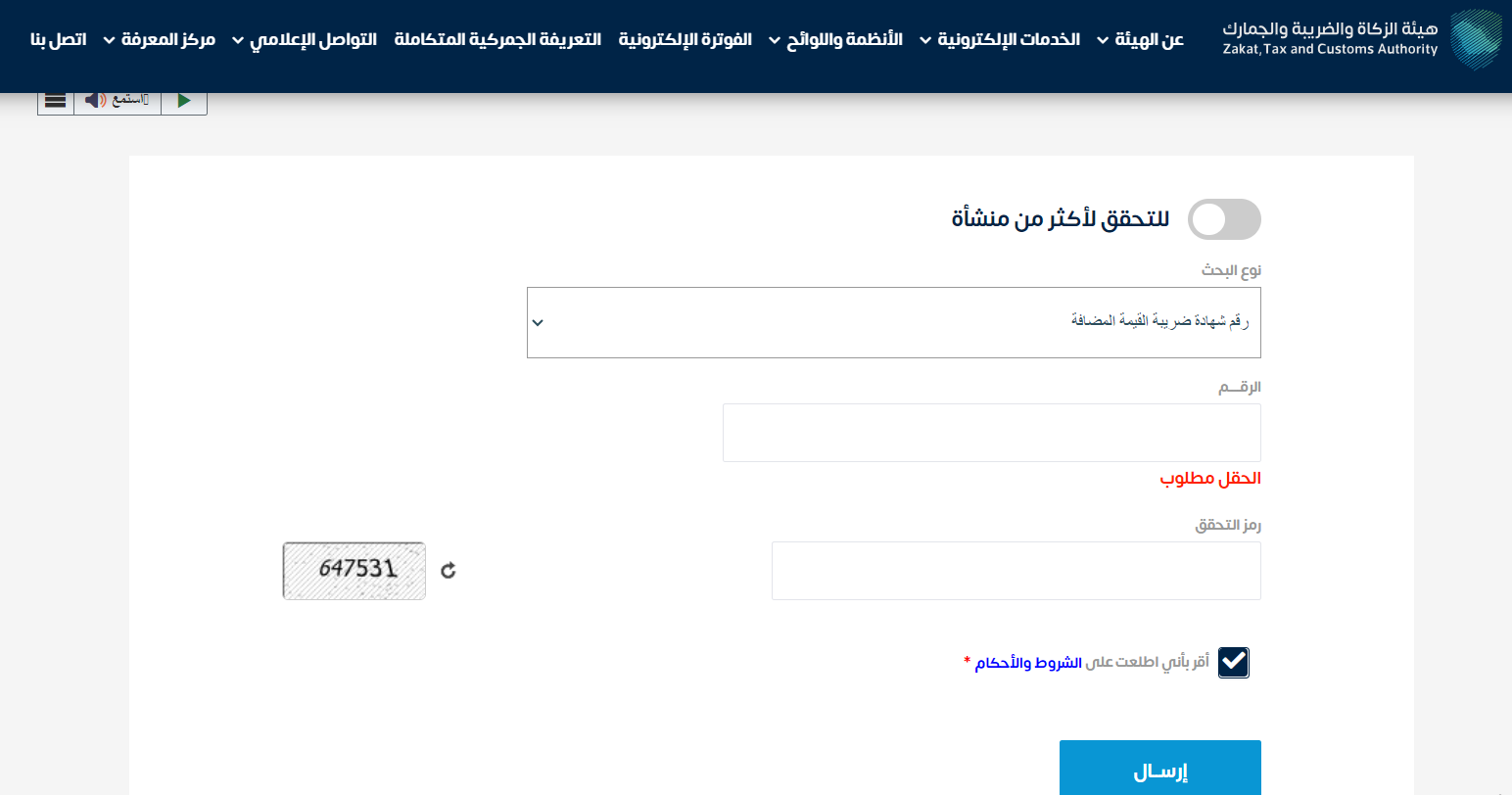
VAT number search option is available for free on the Saudi Arabian ZATCA website. You can access the VAT number search here. You can search a business by its VAT number, VAT certificate number, or CR No (Commercial Register). This search requires you to clear a CAPTCHA for successful VAT number validation.
To verify a Saudi Arabia VAT number:
- Go to the ZATCA Taxpayer Lookup portal.
- Complete the CAPTCHA challenge.
- Enter the 15-digit VAT number (TIN), VAT certificate number, or CR number.
- Submit — results appear immediately.
Format: 15 digits, first and last digit 3 — pattern 3XXXXXXXXXXXXX3 (ZATCA rule BR-KSA-40). [2]
 |
| VAT number verification on ZATCA website in Saudi |
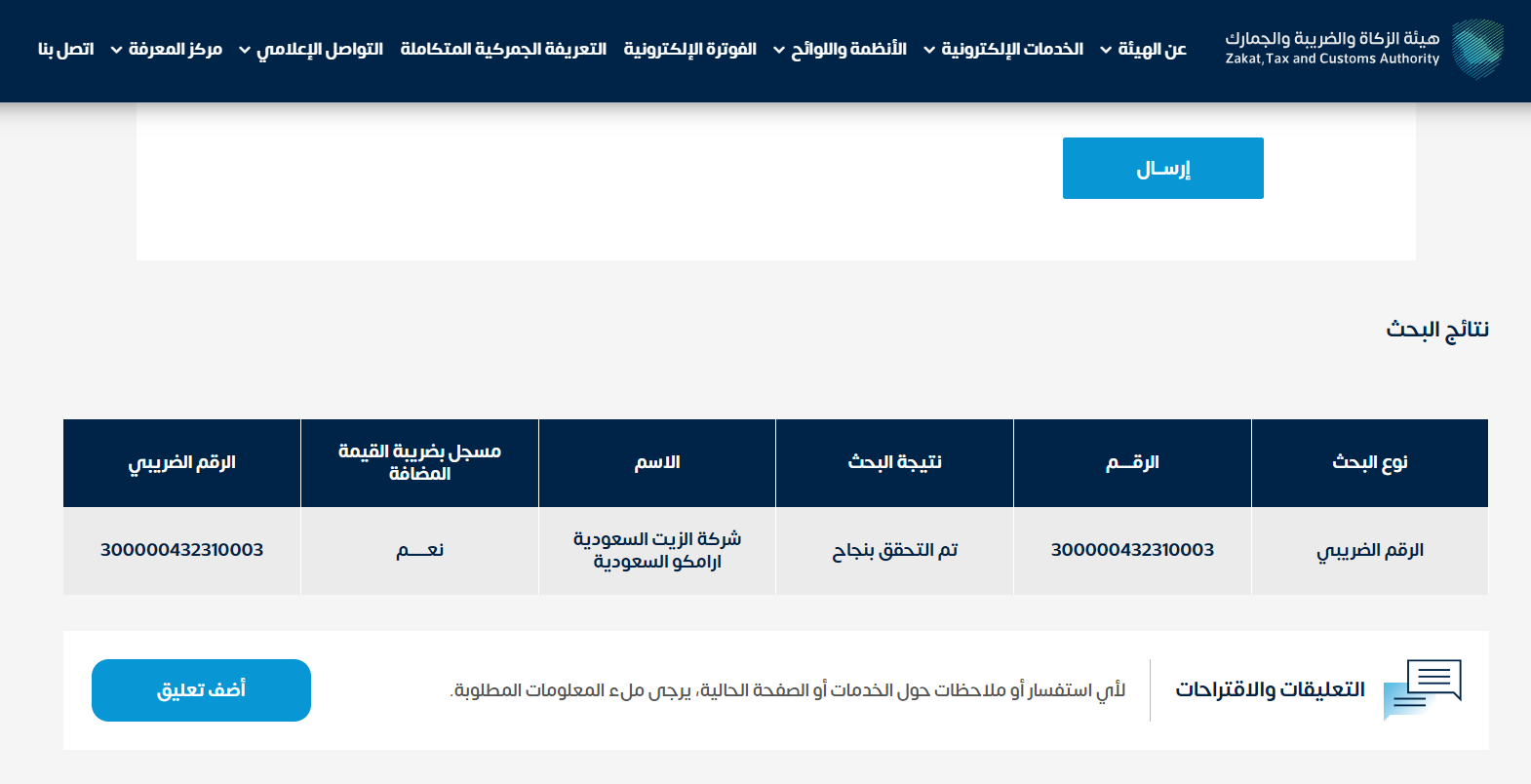
A successful verification of the VAT number on the ZATCA lookup tool will return the following details:
- VAT number
- Name of the business
- Whether registered for VAT
- Status of verification
 |
| VAT Verification details on ZATCA website |
For more details on Saudi Arabia tax identifiers, see our Saudi Arabia Tax ID Guide. For VAT registration, invoicing, e-invoicing and filing rules, see the Saudi Arabia VAT guide.
Frequently Asked Questions
What is the format of a Saudi Arabia VAT number (TIN), and how is it structured?
A Saudi Arabia VAT number (the VAT registration number, also called the tax identification number or TIN) is 15 digits long and purely numeric, and its first and last digits are both 3, so it follows the pattern 3XXXXXXXXXXXXX3. ZATCA's e-invoicing business rule BR-KSA-40 states that the seller VAT registration number or seller group VAT registration number must contain 15 digits, with the first and last digits 3. The number must appear on tax invoices, and members of a VAT group use the group's number. (Source: ZATCA E-Invoice XML Implementation Standard, rule BR-KSA-40) [2]
What is Saudi Arabia's VAT registration threshold, and what categories of businesses are exempt?
VAT was introduced on 1 January 2018 at 5%, and under Royal Order A/638 the standard rate became 15% for supplies made from 1 July 2020. A resident business must register when its taxable supplies exceed SAR 375,000 over the past 12 months, or are expected to exceed it over the next 12 months. Voluntary registration is available from SAR 187,500 of taxable supplies or taxable expenses. Non-residents liable to Saudi VAT must register regardless of turnover. No type of business is exempt from registration as such, although a person making only zero-rated supplies may ask to be excluded from mandatory registration. Certain supplies are exempt: financial services charged through an implicit margin, life insurance, and the sale or residential lease of real estate. Zero-rated supplies include exports of goods outside the GCC, qualifying services to non-GCC residents, international transport, qualifying medicines and medical goods, and investment gold, silver and platinum. A person that is not registered must not issue tax invoices. (Source: GCC Unified VAT Agreement, Articles 50-51; VAT Implementing Regulations) [6] [4]
What is the Saudi e-invoicing system (Fatoorah) and how does it affect VAT verification?
Saudi Arabia's e-invoicing system is FATOORA (فاتورة), run by ZATCA. Phase 1 (generation) has applied since 4 December 2021 to all taxpayers except non-residents: invoices must be generated and stored electronically by a compliant solution, and handwritten invoices or invoices made with text-editing or spreadsheet software are no longer acceptable. Phase 2 (integration) has applied from 1 January 2023 in waves set by VAT-taxable revenue; the latest, Wave 25, covers revenue above SAR 187,500 in 2022, 2023, 2024 or 2025 and must integrate by 1 February 2027. In Phase 2, standard (B2B and B2G) tax invoices must be cleared by ZATCA before they are shared with the buyer, and simplified (B2C) tax invoices must be reported to ZATCA within 24 hours of generation. For verification, a Phase 2 invoice carries a cryptographic stamp and a QR code that can be scanned with ZATCA's VAT App; the supplier's VAT number can be checked on ZATCA's taxpayer lookup. (Source: ZATCA e-invoicing roll-out phases; ZATCA Wave 25 announcement; ZATCA E-Invoicing Detailed Guideline) [7] [8] [5]
I searched the ZATCA portal but my supplier's VAT number was not found — what are the possible reasons?
If a ZATCA VAT number search returns no result: (1) Incorrect format — ensure you are entering the full 15-digit VAT number, which starts and ends with 3 (not just the 10-digit Zakat certificate number); (2) Deregistered — the supplier may have deregistered. Optional deregistration is available where supplies over the last 12 months and expected supplies over the next 12 months each do not exceed SAR 375,000 (VAT Implementing Regulations, Article 13(6)). Deregistration is mandatory in some cases, including a resident whose supplies or expenses over the last 12 months did not exceed the voluntary threshold of SAR 187,500, whose supplies over the last 24 months did not exceed SAR 375,000, and who does not expect to exceed SAR 187,500 over the next 12 months (Article 13(3)). ZATCA can also cancel a registration where the person is no longer eligible (Article 13(5)); (3) New registration lag — new VAT registrations can take 3–7 business days to appear in the public portal; (4) CAPTCHA or portal issue — retry with a fresh session; (5) Searching by wrong identifier — try searching by VAT certificate number or CR number instead. If the ZATCA portal confirms the TIN does not exist and the supplier cannot produce a ZATCA-issued VAT certificate, treat the invoice as non-VAT and do not claim input VAT. (Source: ZATCA, VAT Implementing Regulations, Article 13) [3] [4]
Can foreign businesses claim Saudi VAT refunds on purchases made in Saudi Arabia?
In limited cases. A business carrying on economic activity outside the GCC can apply to ZATCA to be treated as an eligible person and reclaim Saudi VAT on goods and services supplied to it in the Kingdom, in either of the two cases in Article 72(1) of the VAT Implementing Regulations: it is established in a country with a VAT-like tax and is registered for that tax; or it is established in such a country and that country refunds tax to Saudi residents in a similar way. Applications follow the Article 70 process, and claims are made on a calendar-year basis only (Article 72(3)). The 2024 amendments to Article 70 set a six-month claim window and a SAR 5,000 minimum claim; ZATCA has not said explicitly whether these apply to Article 72 claimants. A business registered for VAT in Saudi Arabia instead recovers excess input tax through its VAT returns: it can request a refund with the return or within five years after the end of the calendar year concerned, and ZATCA must initiate payment within 60 days of approval (Article 69). (Source: VAT Implementing Regulations, Articles 69, 70 and 72; ZATCA Guideline for Amendments to the Implementing Regulation of VAT) [4] [9]
How does ZATCA verify the QR code on a Saudi e-invoice — what does the QR code contain?
It depends on the e-invoicing phase. In Phase 1 (generation), a QR code is required on simplified tax invoices only, carrying basic invoice and taxpayer information; it is not mandated on standard tax invoices. In Phase 2 (integration), the QR code is mandatory with additional information: 9 tags in TLV (Tag-Length-Value) base64 format. For standard (B2B) tax invoices in Phase 2, ZATCA generates the QR code string at clearance, together with its cryptographic stamp; for simplified invoices, the taxpayer's e-invoicing solution generates it. Buyers and other stakeholders can validate a Tax Invoice or Simplified Tax Invoice by scanning its QR code with ZATCA's VAT App, which checks that the QR code content is compliant and displays the verification result. (Source: ZATCA E-Invoicing Detailed Guideline) [5]
What are the penalties for failing to display a valid VAT number on invoices in Saudi Arabia?
ZATCA's VAT penalties table has no line specific to a missing or invalid VAT number on an invoice; a breach of other provisions of the VAT Law or Regulations carries a fine of up to SAR 50,000. ZATCA's separate e-invoicing violations schedule treats omitting the buyer's VAT number from a tax invoice as a violation that starts with a warning and then escalates; not issuing e-invoices starts at SAR 5,000 and deleting or amending them at SAR 10,000. The other fines are: issuing a tax invoice while not registered, up to SAR 100,000; failure to apply for VAT registration, SAR 10,000; failure to submit the tax return, 5%-25% of the tax that should have been declared; failure to pay tax due, 5% of the unpaid tax for each month or part of a month; failure to keep tax invoices, books and records, up to SAR 50,000; obstructing ZATCA employees, up to SAR 50,000; filing an incorrect return or a document that lowers the tax due, 50% of the difference; and tax evasion, at least the VAT due and up to three times the value of the goods or services. A fine may be doubled if the same violation is repeated within three years. ZATCA's fines-cancellation initiative, extended to 31 December 2026, covers late registration, late payment, late filing and VAT return-correction fines, but not evasion fines, fines under Article 45 of the VAT Law, or penalties on any return that falls due after 30 June 2026. (Source: ZATCA VAT penalties page; ZATCA e-invoicing violations and fines announcement; ZATCA announcement of 29 June 2026) [10] [11] [12]
How Lookuptax can help you in VAT number validation?
Lookuptax VAT number validation revolutionizes VAT number validation with its robust platform, empowering businesses to seamlessly verify VAT numbers across over 100 countries. Our cutting-edge technology ensures accurate and efficient validation, reducing errors and enhancing compliance.