Ireland Tax ID Numbers — PPSN, Tax Reference Number, VAT Number and CHY Explained
Ireland has no single "TIN". Individuals are identified by the Personal Public Service Number (PPS Number or PPSN; in Irish, Uimhir Phearsanta Seirbhíse Poiblí, UPSP), which the Department of Social Protection (DSP) allocates and which Revenue uses as the individual's tax number. [2] [3] Businesses trade and file under a Tax Reference Number (TRN), which the Office of the Revenue Commissioners issues "when you register for tax as a sole trader, trust, partnership or company". [1] A business registered for VAT (Cáin Bhreisluacha, CBL, in Irish) quotes its VAT registration number with the IE prefix, and a charity with a charitable tax exemption holds a Revenue CHY number. Companies also have a CRO number from the Companies Registration Office, which they need before they can register for tax. [6] For VAT rates, invoicing and filing, see the Ireland VAT guide.
Ireland's Tax IDs at a Glance
| Number | Format | Example | Who has it | Issued by | How |
|---|---|---|---|---|---|
| PPS Number (PPSN / UPSP) | 7 digits + 1 or 2 letters | 1234567T — illustrative | Individuals | Department of Social Protection | Automatically when a birth is registered; otherwise on application |
| Tax Reference Number (TRN) | 7 digits + 1 or 2 letters (five formats accepted, see below) | 1234567TH — Revenue specification example | Sole traders (the TRN is the PPSN), partnerships, trusts, companies | Revenue | On registration for tax |
| VAT registration number | IE + 8 or 9 characters | IE 1234567AA — Revenue specimen letter | Businesses registered for VAT | Revenue | On VAT registration, domestic-only or intra-EU |
| CHY number | CHY + digits | CHY 1234 — illustrative | Charities exempt under TCA 1997 ss.207, 208 or 208A | Revenue | On application, after registering with the Charities Regulator |
| CRO number | Company registration number | — | Companies | Companies Registration Office | On incorporation |
PPS Number (PPSN)
| Field | Detail |
|---|---|
| Official name | Personal Public Service Number (PPS Number, PPSN); Irish: Uimhir Phearsanta Seirbhíse Poiblí (UPSP) |
| Format | 7 digits followed by 1 or 2 letters |
| Regex | ^\d{7}[A-Z]{1,2}$ |
| Example | 1234567T — illustrative |
| Issued by | Department of Social Protection |
The gov.ie service page states that "A PPS Number is always 7 numbers followed by either one or two letters." [2] The Minister for Social Protection allocates the number under section 262 of the Social Welfare Consolidation Act 2005, and may issue one only when satisfied as to the person's identity. [4] Revenue's Tax and Duty Manual 37-00-07b states that the PPS number "is to be used by individuals in all dealings with Public Service Agencies, including Revenue" and "is essential to register for tax". [3]

Who gets one, and how (as at 14 November 2026).
- Children born in the Republic are given a PPS Number when their birth is registered with the General Register Office. If a birth is not registered within 180 days, a parent or guardian must apply. [2]
- Adults (18 or older) apply online at MyWelfare with a basic or verified MyGovID account. The service is available to people resident on the island of Ireland and to people resident abroad. [2] Applicants who live on the island of Ireland then attend an in-person appointment at a PPS Number Allocation Centre to complete the application. [9]
- People living abroad who need a number to deal with an Irish state agency, such as Revenue, can apply online at MyWelfare or by post. [2] The postal route uses form REG1; individuals can no longer apply by email, but applications made by third parties (for example solicitors or accountants) can still be sent by post or to cis@welfare.ie. Someone who only intends to relocate must wait until they are in Ireland to apply. [9]
- Most people already have one — Citizens Information says you have a PPS number if you were born in Ireland in or after 1971 or started work in Ireland after 1979. [9]
The second letter, and when a number changes. Historically a wife took her husband's number with a W appended — Revenue's example is 1234567A becoming 1234567AW. The practice stopped in the 1990s, but existing W numbers stay in use until the holder needs or chooses to change them; Revenue names separation, the death of a spouse, Local Property Tax and Capital Acquisitions Tax as reasons a number may need to change. [3] Citizens Information says the holder of a W number must get a new PPS number if their spouse has died or the couple are divorced or separated. [9] Since 2013 the DSP has also issued "new format" numbers, which Revenue's specifications describe as 7 digits and 2 check characters. [17] [8] A PPSN is personal data: Revenue "will not share an individual's PPSN with any other party unless authorised to do so by legislation". [3]
Tax Reference Number (TRN)
| Field | Detail |
|---|---|
| Official name | Tax Reference Number (TRN) — Revenue's term |
| Format | 7 digits + 1 check character, or 7 digits + 2 check characters (new format); a company's new-format number ends in H. Revenue also accepts the legacy 8A12345T shape and letter-prefixed numbers |
| Regex | ^(?:\d{7}[A-Z]{1,2}|\d[A-Z]\d{5}[A-Z]|[A-Z]\d{7}[A-Z]{1,2})$ |
| Example | 1234567T, 1234567TA, 1234567TH — examples in Revenue's file specification |
| Issued by | Revenue, on registration for tax |
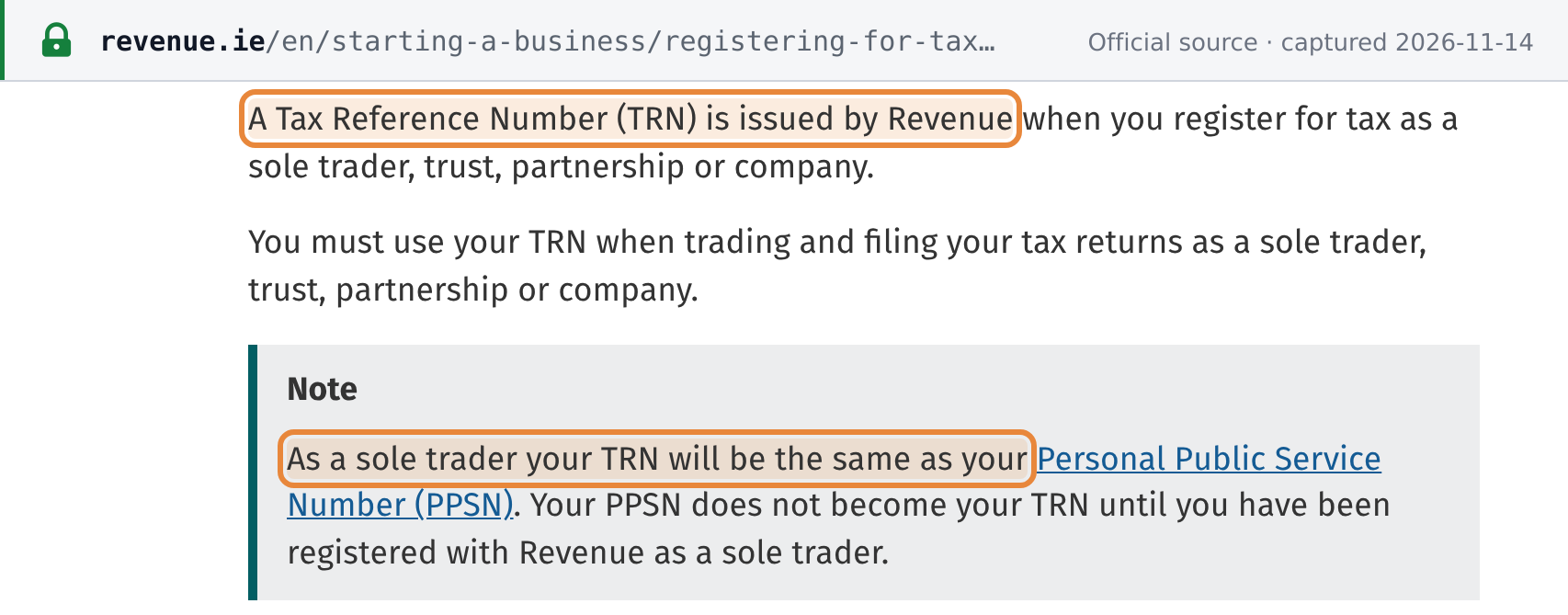
Revenue issues a TRN "when you register for tax as a sole trader, trust, partnership or company", and "You must use your TRN when trading and filing your tax returns". For a sole trader the TRN is the PPSN — but "Your PPSN does not become your TRN until you have been registered with Revenue as a sole trader." [1] Companies, partnerships and trusts receive their own TRN on registration; Revenue tells a new company "You will be given a Tax Reference Number (TRN) to use when trading and filing your tax returns." [6] The TRN is not printed on identity documents; Revenue notifies it on registration, and it appears on tax returns. [16]
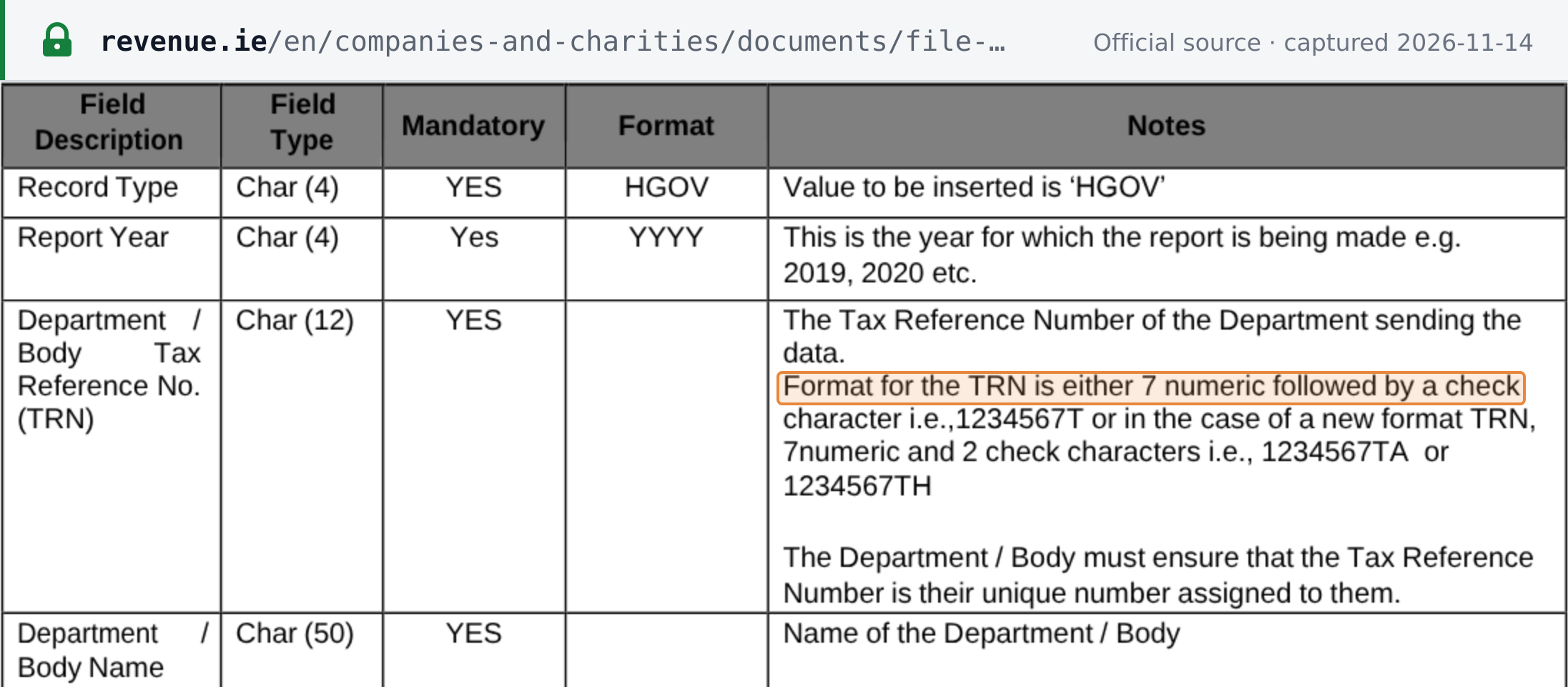
Format. Revenue's file specification for government payments (updated December 2024) gives the TRN format as "either 7 numeric followed by a check character i.e.,1234567T or in the case of a new format TRN, 7numeric and 2 check characters i.e., 1234567TA", and adds: "If the number refers to a company then the new format number will end in H i.e., 1234567TH". [8]
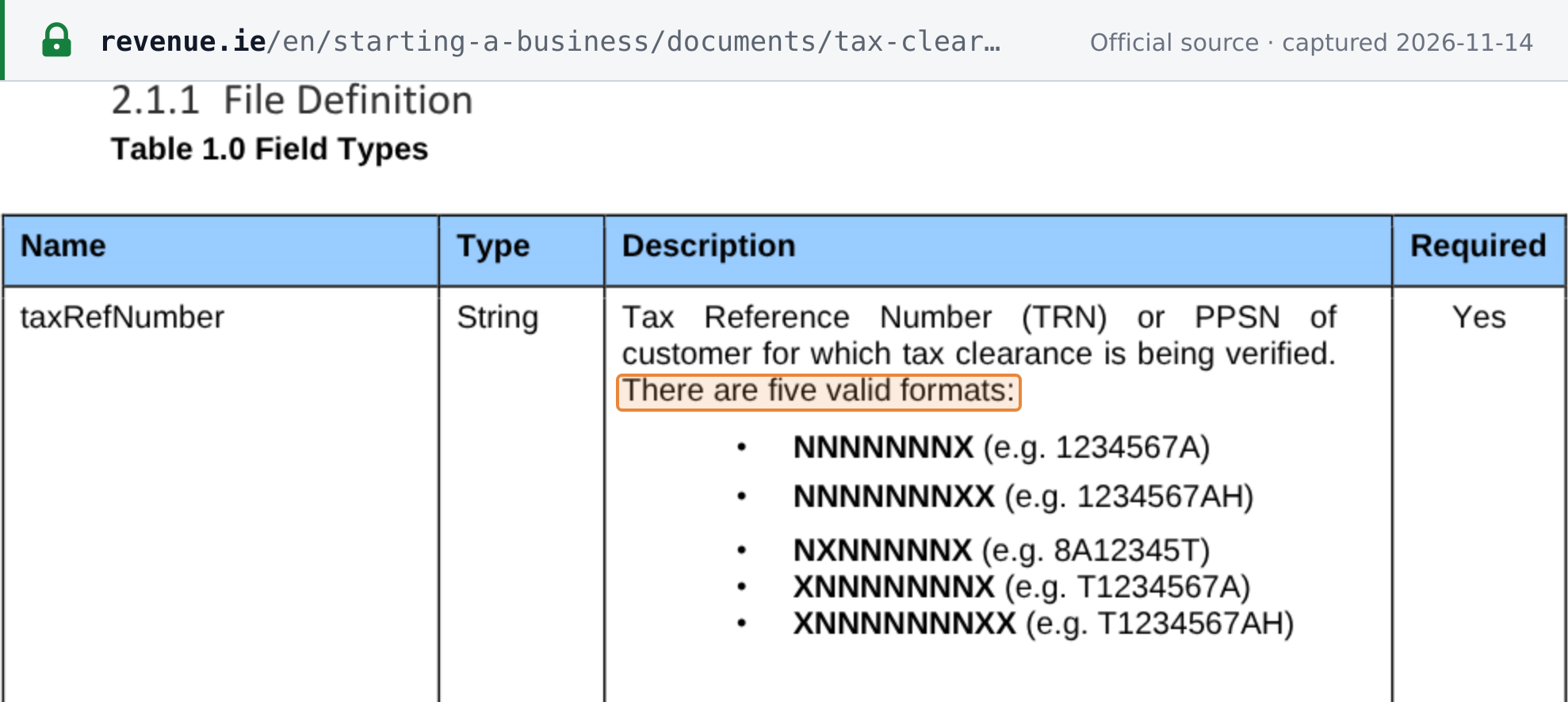
Revenue's eTax Clearance verification specification (version 1.3, 29 June 2021) is broader: for the "Tax Reference Number (TRN) or PPSN" field, "There are five valid formats" — NNNNNNNX (e.g. 1234567A), NNNNNNNXX (e.g. 1234567AH), NXNNNNNX (e.g. 8A12345T), XNNNNNNNX (e.g. T1234567A) and XNNNNNNNXX (e.g. T1234567AH), where N is a digit and X a letter. Its change history records that "old style VAT Numbers are valid". [7] The specification does not say which taxpayers hold the letter-prefixed formats, so accept them in a validator rather than expect them.
PPSN and TRN check character
The first letter after the seven digits of a PPSN or TRN is a check character. Revenue's Local Property Tax payment-provider specification (January 2013) states that the PPS number uses "modulus 23 validation" and that "Modulus 23 validation checks should be used" on both old- and new-format numbers. [17] For the calculation itself, that specification refers to a page on the former welfare.ie website, which is no longer online, and no current Revenue or gov.ie page publishes the weights. Validate the structure locally, then confirm a VAT number on VIES (see How to Verify).
VAT Registration Number (VAT / CBL)
| Field | Detail |
|---|---|
| Official name | VAT registration number; VAT is Cáin Bhreisluacha (CBL) in Irish |
| Format | IE + 8 or 9 characters: 7 digits + 1 or 2 letters, or the legacy shape digit, letter (or + / *), 5 digits, letter |
| Regex | ^IE(?:\d{7}[A-Z]{1,2}|\d[A-Z+*]\d{5}[A-Z])$ |
| Example | IE 1234567AA — Revenue's specimen registration letter |
| Issued by | Revenue, on VAT registration |
Revenue assigns a registration number to each person it registers for VAT (Value-Added Tax Consolidation Act 2010, s.65(2)). [5] Revenue's specimen registration letters give the VAT number in the same 7-digit-plus-letter(s) shape as a TRN, with the IE prefix, and its tax clearance specification accepts "old style VAT Numbers" in its TRN field. [11] [7] The European Commission's VIES FAQ gives the Irish structure as IE9S99999L or IE9999999WI — "1 block of 8 characters or 1 block of 9 characters" — where 9 is a digit, S is "A letter; a digit; "+" or "*"" and L is a letter. [10] Three shapes are in circulation:
| Shape | Example | Notes |
|---|---|---|
| 9 characters: 7 digits + 2 letters | IE1234567AA | The new format introduced with the 2013 range extension; Revenue's specimen letter uses it, and a company's new-format number ends in H [17] [8] [11] |
| 8 characters: 7 digits + 1 check letter | IE1234567T | The older shape, used by both individuals and non-individuals; still valid [16] [8] |
8 characters, legacy: digit, letter / + / *, 5 digits, letter | IE8A12345T | VIES's IE9S99999L; Revenue states that "old style VAT Numbers are valid" [7] |
The VIES legend does not define the W and I in IE9999999WI, and no official source lists the permitted second letters, so a validator should accept any letter there rather than only W. Neither the Commission nor Revenue publishes a check-digit calculation for the legacy 8-character shape.
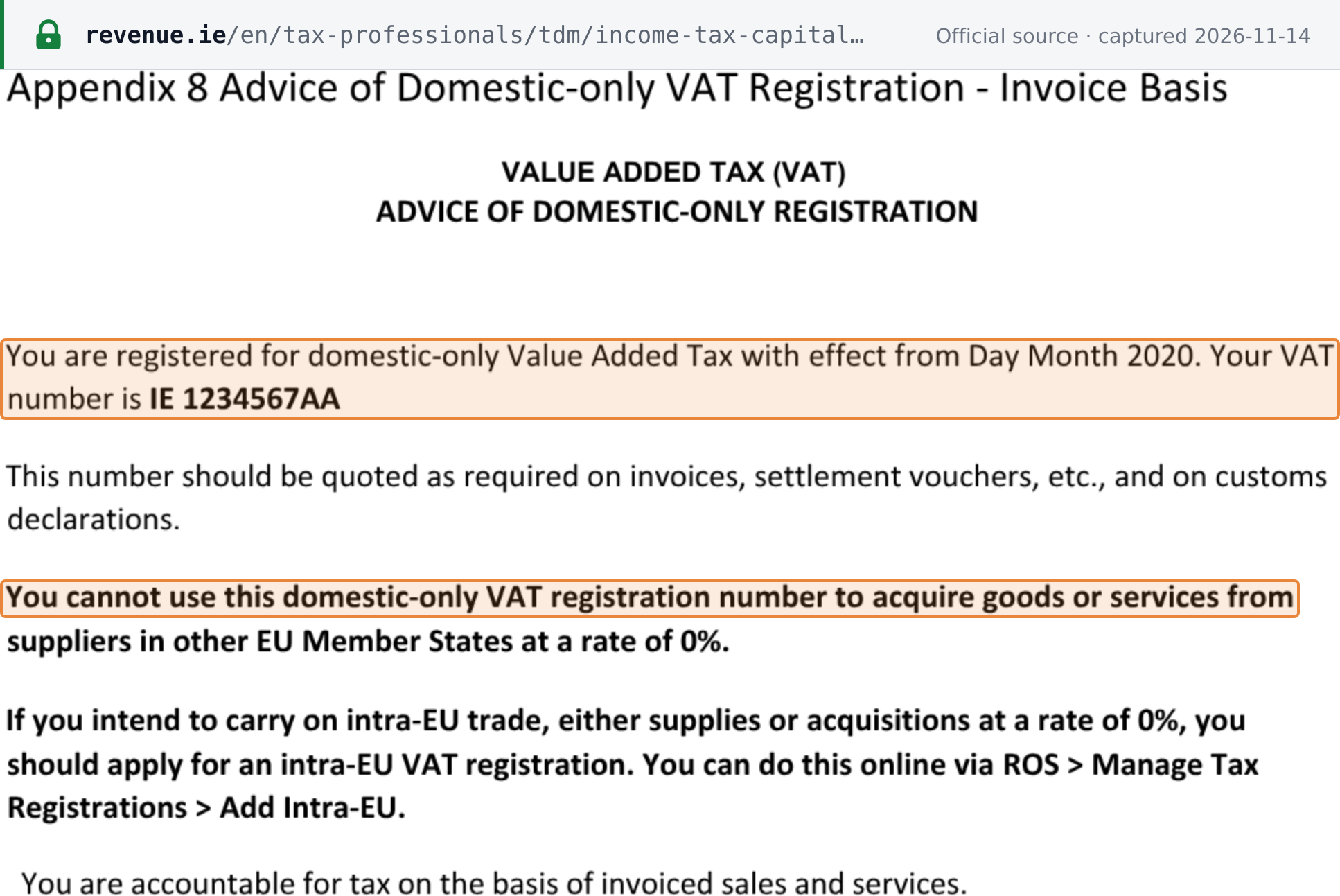
Revenue's VAT registration guidelines (Tax and Duty Manual 38-01-03b, updated May 2026) reproduce the letter a business receives: "Your VAT number is IE 1234567AA". The letter adds that the number "should be quoted as required on invoices, settlement vouchers, etc., and on customs declarations." [11]
Two-tier registration: domestic-only vs intra-EU
Ireland has run a two-tier VAT registration since June 2019. An applicant chooses a domestic-only or an intra-EU registration. Revenue says domestic registration "is sufficient for trading within the State and with non-EU countries", that "Domestic-only customers may apply for intra-EU status at any time", and that an applicant approved for intra-EU status "will be automatically registered on the EU VAT Information Exchange System (VIES)". An intra-EU application must be supported by evidence of trade, or of an intention to trade, with other EU Member States — for example invoices, contracts, leases or detailed business plans. [12]
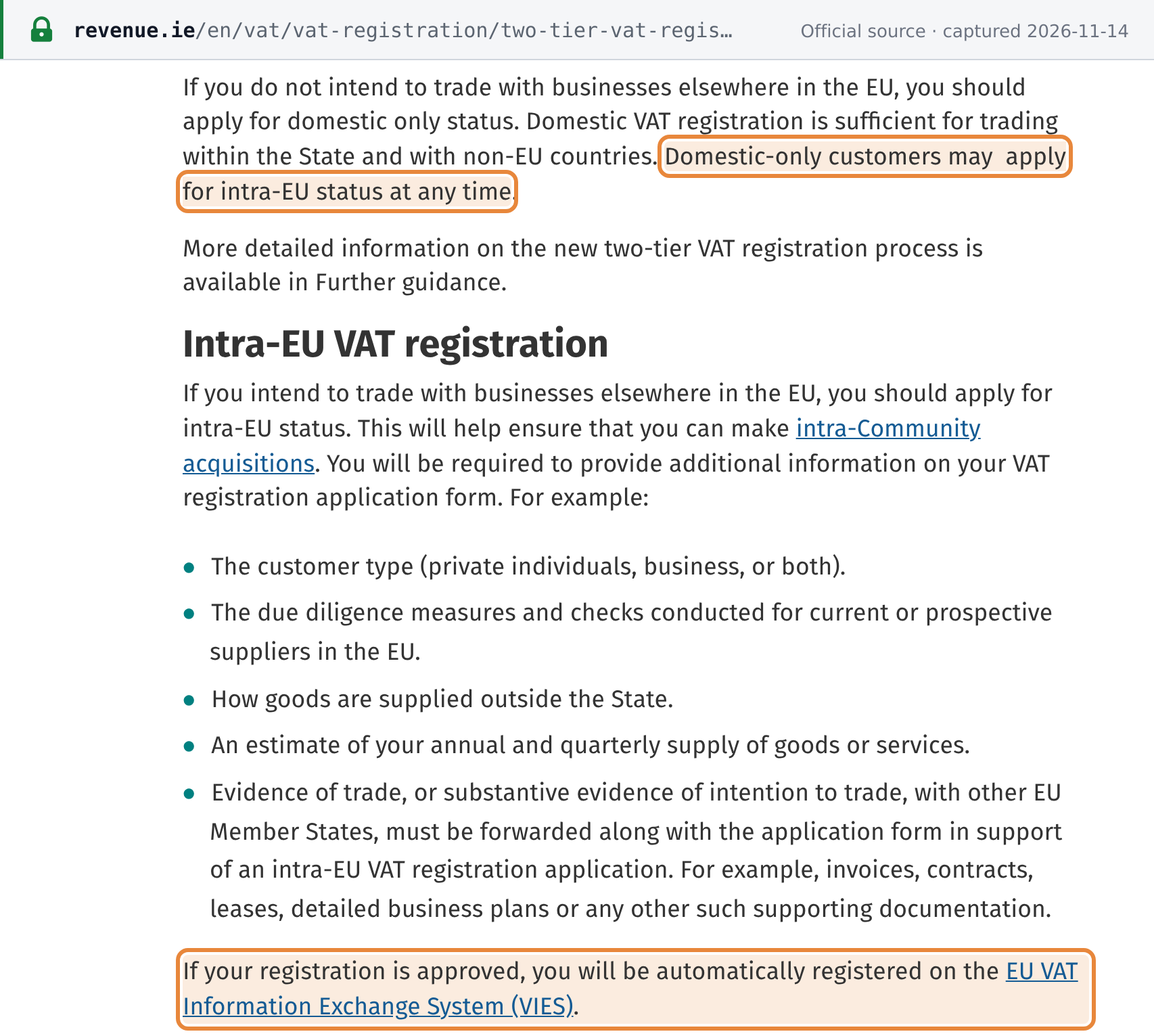
A domestic-only number is a valid Irish VAT number, but it is not on VIES, and Revenue's specimen letter warns: "You cannot use this domestic-only VAT registration number to acquire goods or services from suppliers in other EU Member States at a rate of 0%." To upgrade, the business applies online "via ROS > Manage Tax Registrations > Add Intra-EU". Registrations that were live before two-tier registration was introduced are treated as having intra-EU status. [11]
CHY Number
| Field | Detail |
|---|---|
| Official name | CHY number, defined in s.208B(1) Taxes Consolidation Act 1997 |
| Format | CHY followed by digits (1 to 5 digits according to the OECD's 2016 TIN sheet; no current Revenue page states a format) |
| Example | CHY 1234 — illustrative |
| Issued by | Revenue (Charities and Sports Exemptions Unit) |
Since the Finance (No. 2) Act 2023, the CHY number has a statutory definition: "a unique identifying number issued by the Revenue Commissioners to a charity that is exempt from income tax under section 207, 208 or 208A". The same section allows Revenue to publish "the name, address and CHY number of a charity". [13] A charity must first be registered with the Charities Regulator; it can then apply to Revenue's Charities and Sports Exemptions Unit for the charitable tax exemption. [14] The format above rests on the OECD's 2016 Ireland TIN sheet. [16]
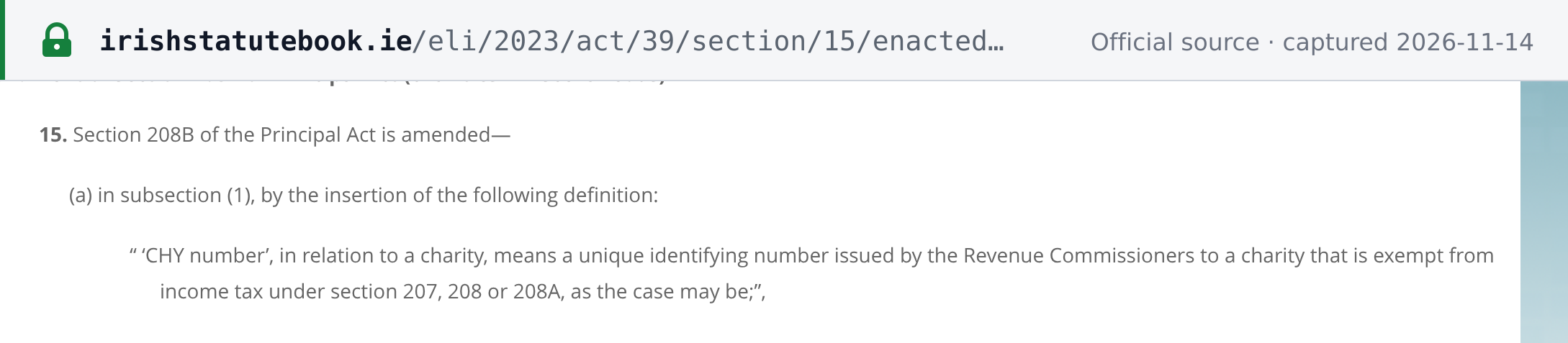
A CHY number is not a VAT number. Revenue states: "There is no general Value-Added Tax (VAT) exemption for charities." A charity that makes taxable supplies registers for VAT like any other business. [15]
CRO Number (Companies)
A company's CRO number is the number under which the Companies Registration Office registers it when it is incorporated under the Companies Act 2014. [34] It is a company-register number, not a tax number, but Revenue requires it first: "To register for tax, you must have a Companies Registration Office (CRO) number issued by the CRO." [6] A non-resident company registering on form TR2(FT) gives its home-country "registered number" and its VAT number in its country of establishment instead. [32] To look up an Irish company by its number, use the Companies Registration Office's CORE website or the Lookuptax Irish CRO number checker.
Who Must Register
Tax registration (the TRN). Revenue states: "You must register for tax with Revenue when you: become a sole trader / set up a trust or partnership / or / start a new company." [27]
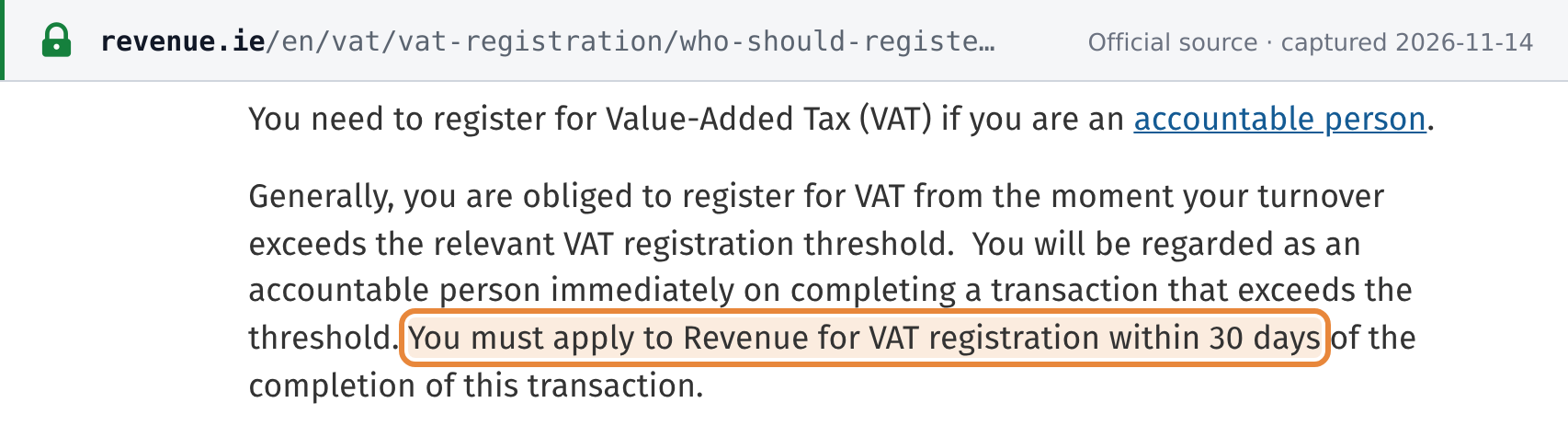
VAT registration. You must register for VAT if you are an "accountable person". Revenue explains: "Generally, you are obliged to register for VAT from the moment your turnover exceeds the relevant VAT registration threshold. You will be regarded as an accountable person immediately on completing a transaction that exceeds the threshold. You must apply to Revenue for VAT registration within 30 days of the completion of this transaction." [18] The 30-day period is set by s.65(3)(a) of the VAT Consolidation Act 2010. [5] Below the threshold a business may use the SME Scheme or elect to register; a business that has yet to make taxable supplies must register to reclaim VAT on its start-up costs. A person making only exempt or non-taxable supplies "is not required to register", but may have to register to acquire goods from other Member States or to receive services from abroad. [18]
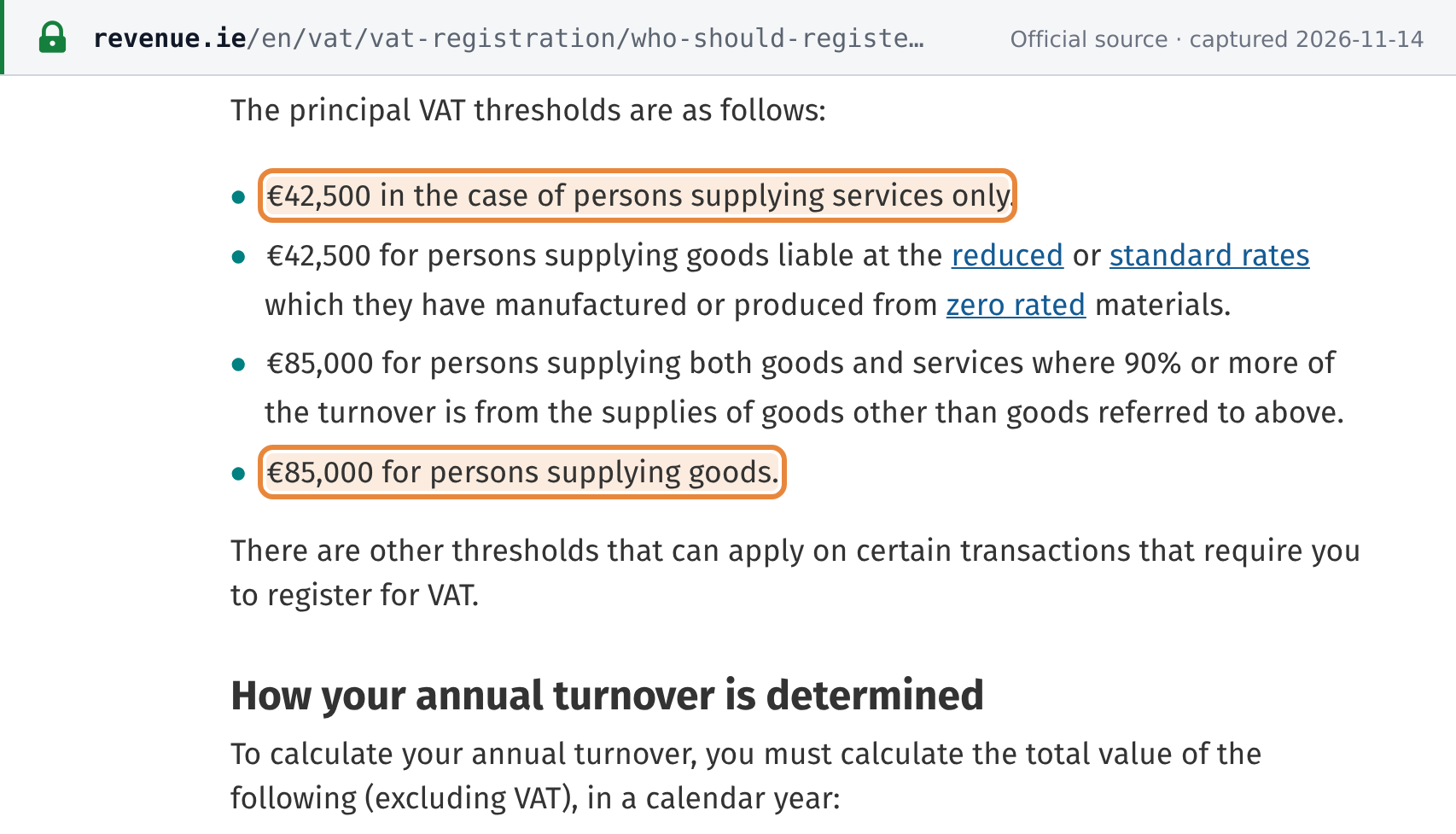
VAT registration thresholds (as at 14 November 2026). Turnover is measured in a calendar year — the current one or the previous one — not over a rolling 12 months. [19] [24]
| Business | Threshold |
|---|---|
| Supplies of services only | EUR 42,500 |
| Goods at the reduced or standard rate that the business manufactured or produced from zero-rated materials | EUR 42,500 |
| Goods and services, where 90% or more of turnover is from goods | EUR 85,000 |
| Supplies of goods | EUR 85,000 |
| Intra-Community distance sales of goods and cross-border telecommunications, broadcasting and electronic services into Ireland (EU-wide) | EUR 10,000 |
| Acquisitions of goods from other EU Member States | EUR 41,000 |
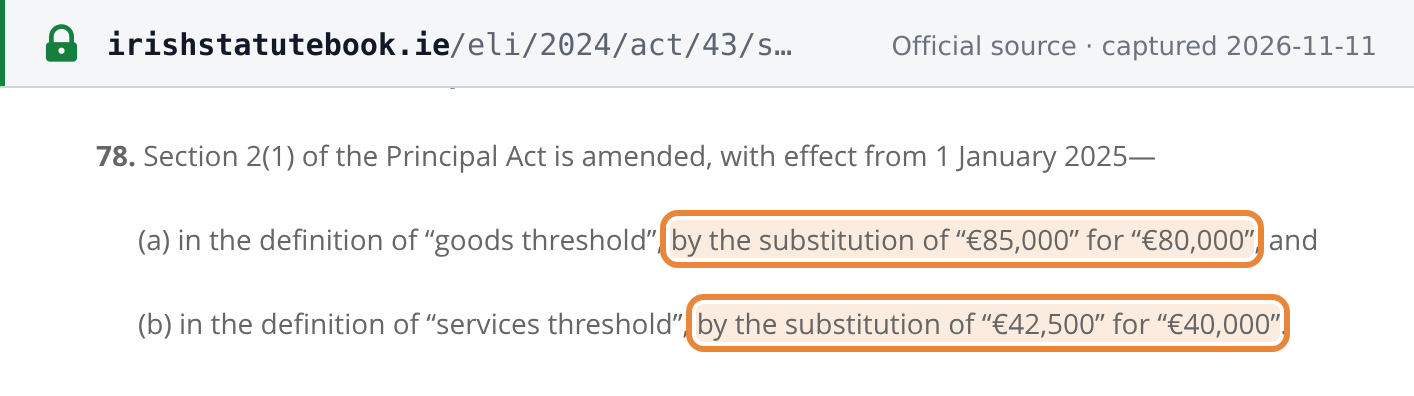
Sources: Revenue's VAT thresholds page [19] and its "Other VAT thresholds" page. [20] The EUR 85,000 goods threshold and EUR 42,500 services threshold are defined in s.2(1) of the VAT Consolidation Act 2010 and apply from 1 January 2025, when Finance Act 2024 s.78 raised them from EUR 80,000 and EUR 40,000. [21]
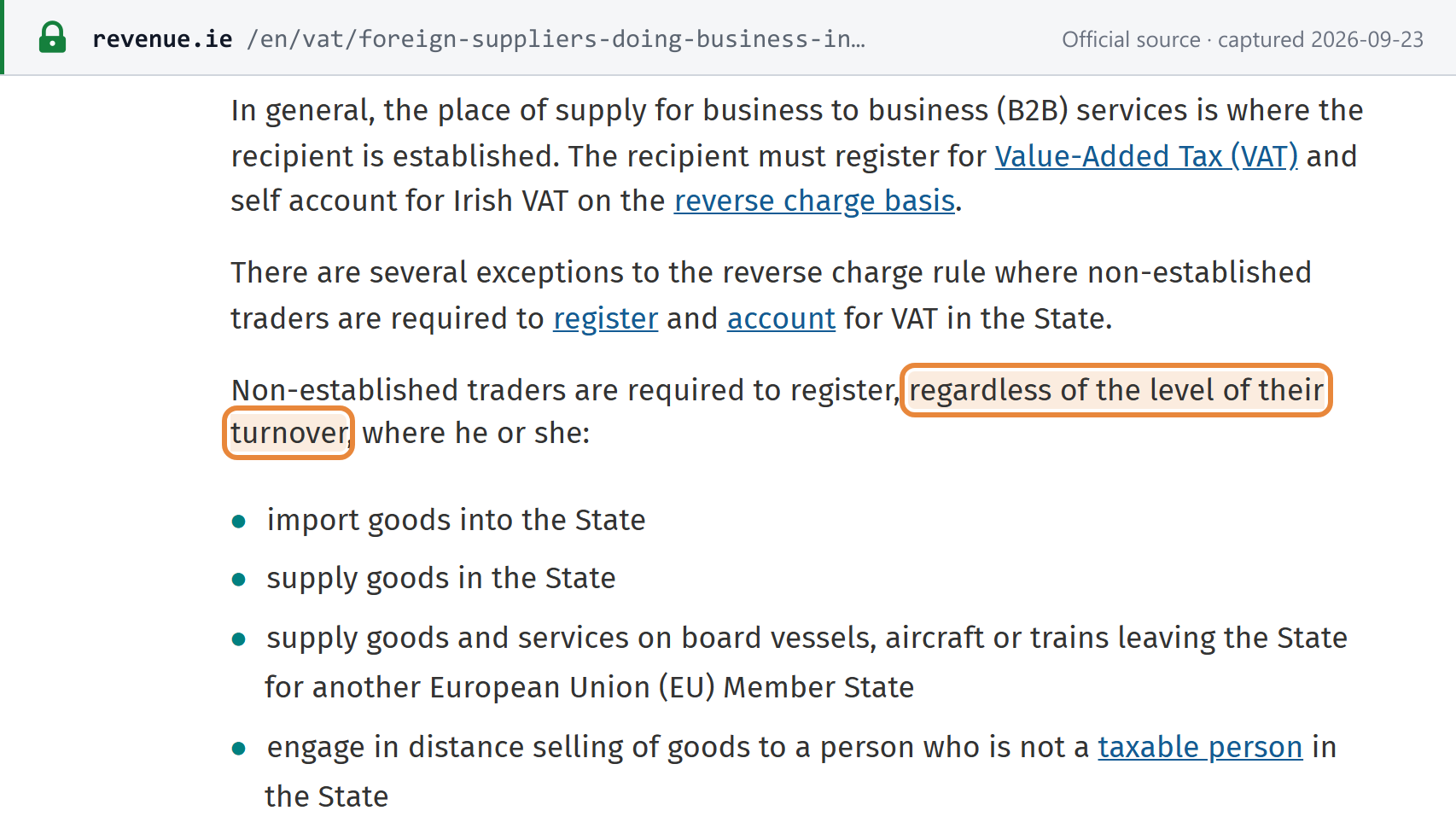
Non-established businesses — no threshold. Revenue states: "A business, while not established in the State, needs to register and account for Value-Added Tax (VAT) if they supply taxable goods or services in the State. This applies irrespective of the level of turnover, unless they avail of the VAT SME Scheme." [22] In the statute, the turnover thresholds do not apply to a person not established in the State, subject to the SME scheme in s.92D (VAT Consolidation Act 2010 s.6(3)). [24] B2B services are the main exception in practice: the Irish business customer accounts for the VAT under the reverse charge. A non-established trader must register, "regardless of the level of their turnover", where it imports goods, supplies goods in Ireland, supplies goods or services on board vessels, aircraft or trains leaving Ireland for another Member State, distance-sells goods to non-taxable persons in Ireland or supplies services connected with Irish property. [23]
For other countries' thresholds, see the worldwide VAT registration thresholds table.
How to Register
- Online (eRegistration). Businesses established in Ireland register for tax, including VAT, online through Revenue Online Service (ROS); "All paper applications received which could otherwise be completed online, will be returned to you or your tax agent." [26] A sole trader needs a PPSN before registering. [33]
- Paper forms. Customers who are not eligible for eRegistration — including companies that have no Irish-resident directors, and charities and other unincorporated bodies not represented by an agent — use Form TR1 (resident individuals, partnerships, trusts and unincorporated bodies), TR1(FT) (their non-resident equivalents), TR2 (resident companies) or TR2(FT) (non-resident companies). [25]
- Businesses not established in Ireland send the paper TR1(FT) or TR2(FT) to Business Taxes Registrations, Office of the Revenue Commissioners, P.O. Box 1, Wexford. [26]
Revenue publishes no standard processing time for a registration. The registration section of the Ireland VAT guide covers voluntary registration, group registration and deregistration.
E-invoicing and the Proposed Tax Reference Number for Unregistered Customers
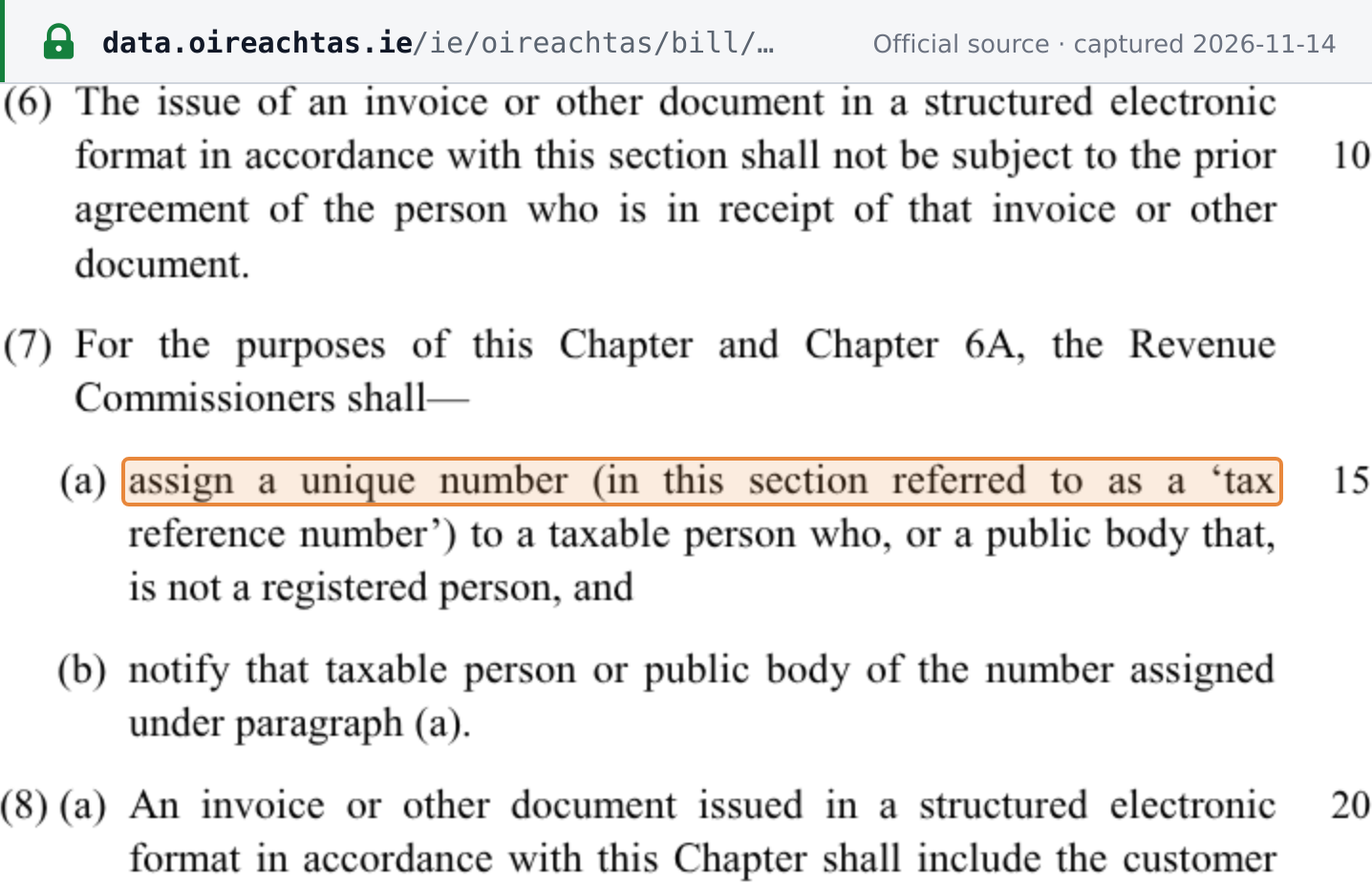
As at 14 November 2026, no law yet requires businesses to issue e-invoices; public bodies are already required to receive them under S.I. No. 258 of 2019 (see the e-invoicing guide below). The Finance (No. 2) Bill 2026 (Bill 98 of 2026) would insert a new section 66A into the VAT Consolidation Act 2010 (section 52 of the Bill as amended in Dáil Select Committee on 12 November 2026). It is still a Bill and may change before enactment. Under the proposed s.66A(8)(a), a structured electronic invoice "shall include the customer identification number of the person to whom the supply is made". That number is the customer's VAT registration number if it is registered. If it is not, s.66A(7) would require Revenue to "assign a unique number (in this section referred to as a ‘tax reference number’) to a taxable person who, or a public body that, is not a registered person" and to notify them of it. [28] If enacted in this form, it would create a new Revenue-issued identifier for e-invoicing purposes, distinct from the VAT number.
For Revenue's phased timetable and the Peppol network, see e-invoicing in Ireland.
Cross-border. Irish VAT numbers carry the IE prefix. Northern Ireland businesses use XI-prefixed numbers for trade in goods with the EU — see the Northern Ireland tax ID guide. A foreign supplier checking an Irish customer should remember that a domestic-only Irish number is valid but not on VIES (see above).
How to Verify an Irish Tax ID
| What you want to confirm | Where | What it tells you |
|---|---|---|
| An Irish VAT number used for intra-EU trade | VIES (European Commission) | Whether the number is registered for intra-EU trade. A domestic-only Irish registration is not on VIES and returns "invalid" |
| A business's tax clearance | Revenue's tax clearance verification, in ROS | Whether a Tax Clearance Certificate is current — needs the business's Tax Clearance Access Number (TCAN) and its TRN or PPSN |
| A charity's tax exemption | Revenue's list of bodies with charitable tax exemption | Names and addresses of exempt charities, updated quarterly |
| A company | CORE (Companies Registration Office) | The company register |
Revenue describes VIES as the system that "enables traders to confirm the VAT registration numbers of their customers in other European Union (EU) Member States", adding that "The VIES system applies to intra-EU trade only." [29] Revenue publishes no public lookup for a TRN, a PPSN or a domestic-only VAT number. Its tax clearance check lets another person confirm your clearance status only if you give them "your Tax Clearance Access Number (TCAN) and either your: Tax Reference Number or Personal Public Service Number (PPSN)". [30] Revenue's quarterly charities list (information correct as at 5 October 2026) shows each charity's name and address but not its CHY number. [31]
For a step-by-step guide, see how to verify an EU VAT number in VIES. To check an Irish VAT number's format and VIES status, use the Lookuptax Ireland VAT number validator.
Frequently Asked Questions
Can I get an Irish PPS number from abroad?
Yes, if you need one to deal with an Irish state agency such as Revenue. As at 14 November 2026, gov.ie says you can apply online at MyWelfare, which is available to people resident abroad and needs a basic or verified MyGovID account, or by post using form REG1. Individuals can no longer apply by email; applications made on your behalf by a third party such as a solicitor or accountant can still go by post or to cis@welfare.ie. If you only intend to move to Ireland, you must wait until you are there to apply. The Department of Social Protection, not Revenue, issues the number, and it publishes no standard processing time.
My Irish supplier's VAT number fails on VIES, but they say they are registered. Why?
They probably hold a domestic-only VAT registration. Ireland's two-tier system lets a business register for domestic-only or intra-EU VAT, and only intra-EU registrations are automatically registered on VIES. A domestic-only number is a valid Irish VAT number, but Revenue's own registration letter says it cannot be used to acquire goods or services from suppliers in other EU Member States at a rate of 0%. The supplier can apply for intra-EU status at any time, online through ROS (Manage Tax Registrations, Add Intra-EU), with evidence of intra-EU trade such as invoices, contracts or business plans. Registrations that were live before two-tier registration began are treated as intra-EU.
Is my Tax Reference Number the same as my PPSN?
If you are a sole trader, yes, but only once you have registered with Revenue as a sole trader; until then your PPSN is not a TRN. Companies, partnerships and trusts get their own TRN from Revenue when they register for tax, separate from any director's or partner's PPSN.
Why do some Irish VAT numbers have 9 characters after IE and others 8?
Both are valid. Numbers in the new format have 7 digits and 2 letters, such as IE1234567AA in Revenue's specimen letter, and a company's new-format number ends in H. Older numbers have 8 characters: 7 digits and a check letter (IE1234567T), or the legacy shape of a digit, a letter, 5 digits and a letter (IE8A12345T), which Revenue still accepts. The European Commission describes the Irish VAT number as 1 block of 8 characters or 1 block of 9 characters.
My PPSN ends in W. Do I need a new number?
Not automatically. Wives were once given their husband's number with a W added; the practice stopped in the 1990s, and existing W numbers stay in use until the holder needs or chooses to change them. Citizens Information says the holder of a W number must get a new PPS number if their spouse has died or the couple are divorced or separated; Revenue also says a number may need to change for Local Property Tax or Capital Acquisitions Tax purposes.
Does a foreign company with no Irish office need an Irish VAT number?
It depends on what it supplies. Most B2B services to Irish businesses do not require registration, because the Irish customer accounts for the VAT under the reverse charge. A business not established in Ireland that supplies taxable goods or services in Ireland must register irrespective of its turnover, unless it uses the EU VAT SME Scheme; the EUR 85,000 goods and EUR 42,500 services thresholds apply only to established businesses. Revenue lists importing goods, supplying goods in Ireland, distance sales of goods to non-taxable persons and services connected with Irish property among the cases. A non-resident company registers on paper with Form TR2(FT), and non-resident individuals, partnerships and trusts with Form TR1(FT).
Can I check an Irish company's tax number online?
Only an intra-EU VAT number, through VIES. Revenue publishes no public lookup for a Tax Reference Number, a PPSN or a domestic-only VAT number. Its tax clearance verification shows whether a business holds a current Tax Clearance Certificate, but only if the business gives you its Tax Clearance Access Number (TCAN) together with its TRN or PPSN. A company's registration details are on the Companies Registration Office register, CORE.
Related Resources
- Ireland VAT guide — rates, registration, invoicing and filing
- E-invoicing in Ireland — Revenue's programme and Peppol
- How to verify an EU VAT number in VIES
- Ireland tax changes — chronology
- Lookuptax Ireland VAT number validator
- Lookuptax Irish CRO number checker
- Northern Ireland tax ID guide — XI-prefixed VAT numbers
- United Kingdom tax ID guide — UTR, NINO and GB VAT numbers
- Worldwide VAT, GST and sales tax registration thresholds
- Worldwide directory of VAT and tax ID names