How to verify EIN in United States?
An EIN (Employer Identification Number) is the 9-digit federal tax ID the IRS assigns to businesses and other entities. Unlike an EU VAT number, it has no public register. Which official check you can use depends on who you are and what kind of entity you are checking:
| You want to check | Official route | Who can use it | What it tells you |
|---|---|---|---|
| Any payee's name + EIN | IRS TIN Matching | Payers that file certain Forms 1099, with an IRS account | Match code 0–8; never the name |
| What a payee says its EIN is | Form W-9 | Anyone paying a US person | Self-certified name and TIN |
| A charity or other exempt organization | IRS Tax Exempt Organization Search | Anyone | Exempt-status records, searchable by EIN |
| A company that files with the SEC | SEC EDGAR | Anyone | EIN shown on each filing's index page |
| An entity with a Texas franchise-tax account | Texas Comptroller search | Anyone | Texas account status, searchable by EIN |
No public federal EIN search
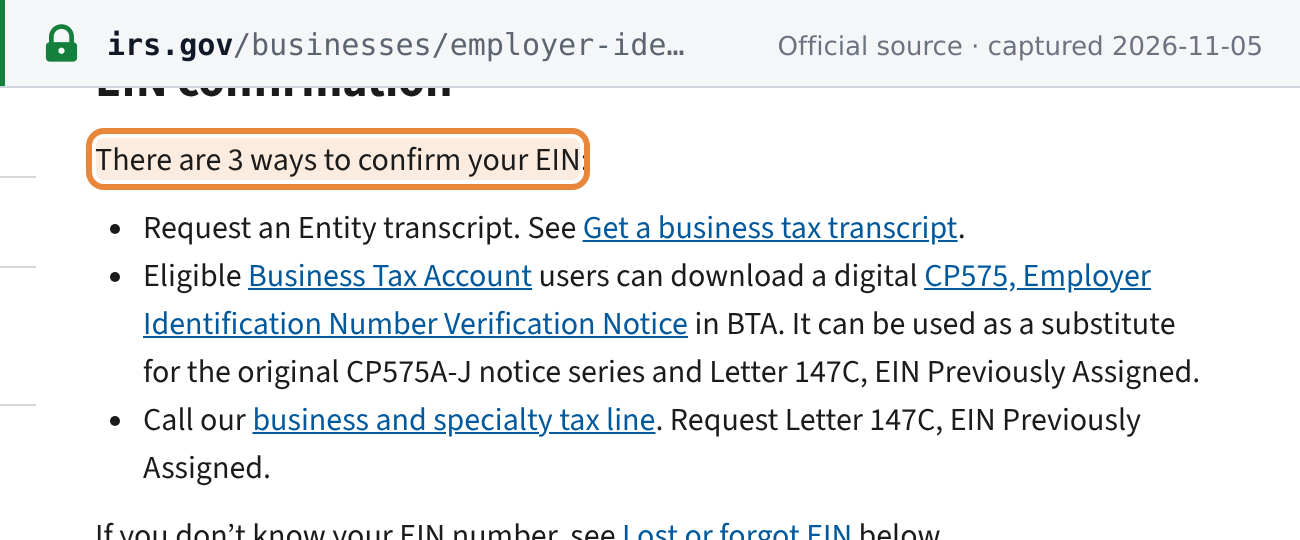
The IRS EIN page offers no public search by EIN (as at 2026-11-05). It lists three ways to confirm an EIN: an entity transcript, a digital CP575 notice in Business Tax Account, and Letter 147C by phone. All three are for the business that holds the number, and the IRS gives an EIN over the phone only after verifying the caller's identity, "if you're authorized to receive it". [1] Publication 2108 (Rev. 11-2024) states that IRC 6103 protects the confidentiality of TINs and that IRC 3406 permits disclosure of name/TIN combinations to certain payers, for reportable payments subject to backup withholding only. [2]
 Source snapshot captured 2026-11-05 — original
IRS TIN Matching: the federal name-and-EIN check
IRS Taxpayer Identification Number (TIN) Matching is the IRS's own check of a name and EIN against its records. It is free and voluntary, but it is not open to the public. [1] [2]
Who can use it (as at 2026-11-05):
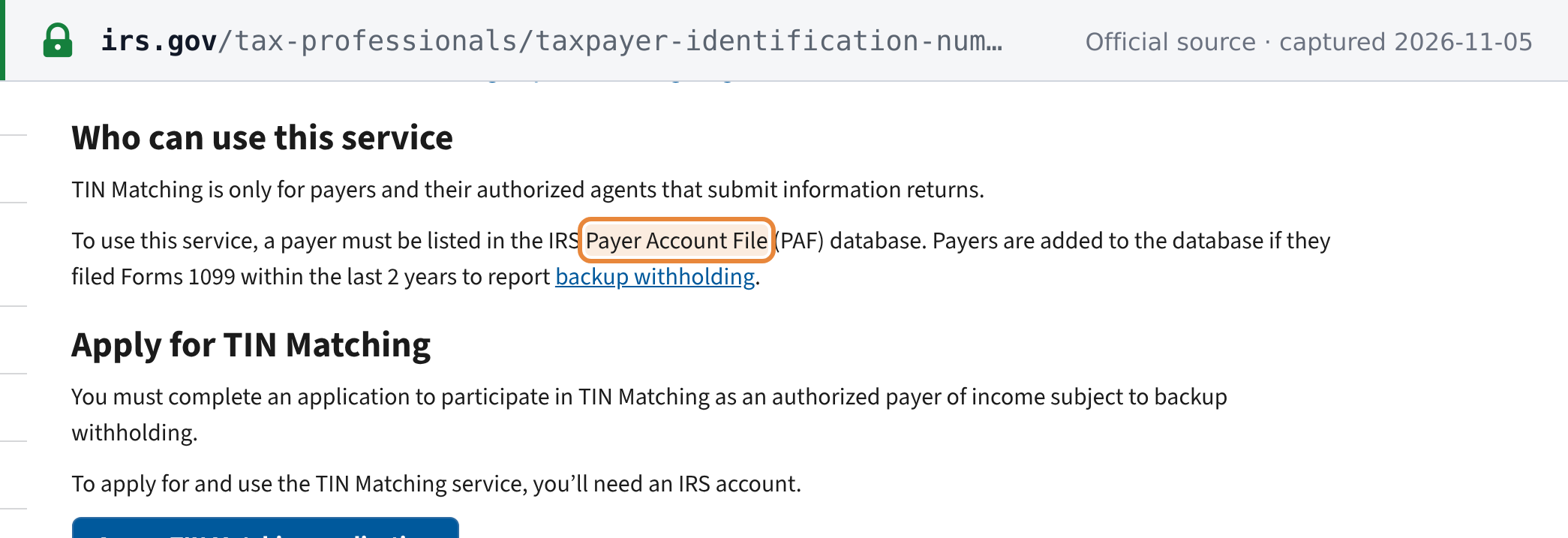
- Only payers, and their authorized agents, that submit information returns. The payer must be listed in the IRS Payer Account File (PAF), which it joins once it has filed Forms 1099 within the last 2 years.
- The payer applies as an authorized payer of income subject to backup withholding, and needs an IRS account to apply and use the service.
- Matching is allowed only for name/TIN combinations for income subject to backup withholding reported on Forms 1099-B, DIV, INT, MISC, NEC, OID, K, G or PATR. Pub 2108 says the program cannot enroll payers that file none of these forms, nor employers filing Forms W-2.
- A payer may not use match results to decide whether to open or close an account with a payee.
 Source snapshot captured 2026-11-05 — original
Availability. TIN Matching runs inside IRS e-Services, which is available 24 hours a day except Sunday from 12 a.m. to 4 p.m. ET for system maintenance. A failed session in that window says nothing about the EIN. [1]
Steps
The application sits behind IRS sign-in; Publication 2108's exhibits show its screens. The steps below follow Publication 2108 (Rev. 11-2024). [1]
- Collect a signed Form W-9 from the payee showing its legal name and EIN (see below).
- Sign in to IRS e-Services with your IRS account. [2]
- Apply for TIN Matching and accept the Terms of Agreement. The application is made by the payer firm; authorized agents work under the payer's account.
- Submit the name and EIN.
- Interactive: up to 25 name/TIN combinations at a time, with a response within 5 seconds. One user ID can submit up to 9,999 interactive requests in 24 hours.
- Bulk: a
.txtfile of up to 100,000 combinations, one per line asTIN type;TIN;name;account number (optional). TIN type 1 is an EIN, 2 an SSN and 3 unknown. Results come back to a secure mailbox within 24 hours, can be downloaded for 30 days, and are purged 3 days after you open them.
- Read the response indicator for each line (table below).
Pub 2108 suggests entering pairs one at a time and printing each result screen if you want a record for the payee's file, and says a payer may cite a name/TIN match as reasonable cause if the IRS later asserts an information-return penalty. [1]
What the result means
TIN Matching returns a number, not a record. It never shows you the name the IRS holds or any other detail about the entity. [1]
| Code | Meaning (Pub 2108, FAQ 9) |
|---|---|
| 0 | Name/TIN combination matches IRS records |
| 1 | Missing TIN, or TIN not 9-digit numeric |
| 2 | TIN not currently issued |
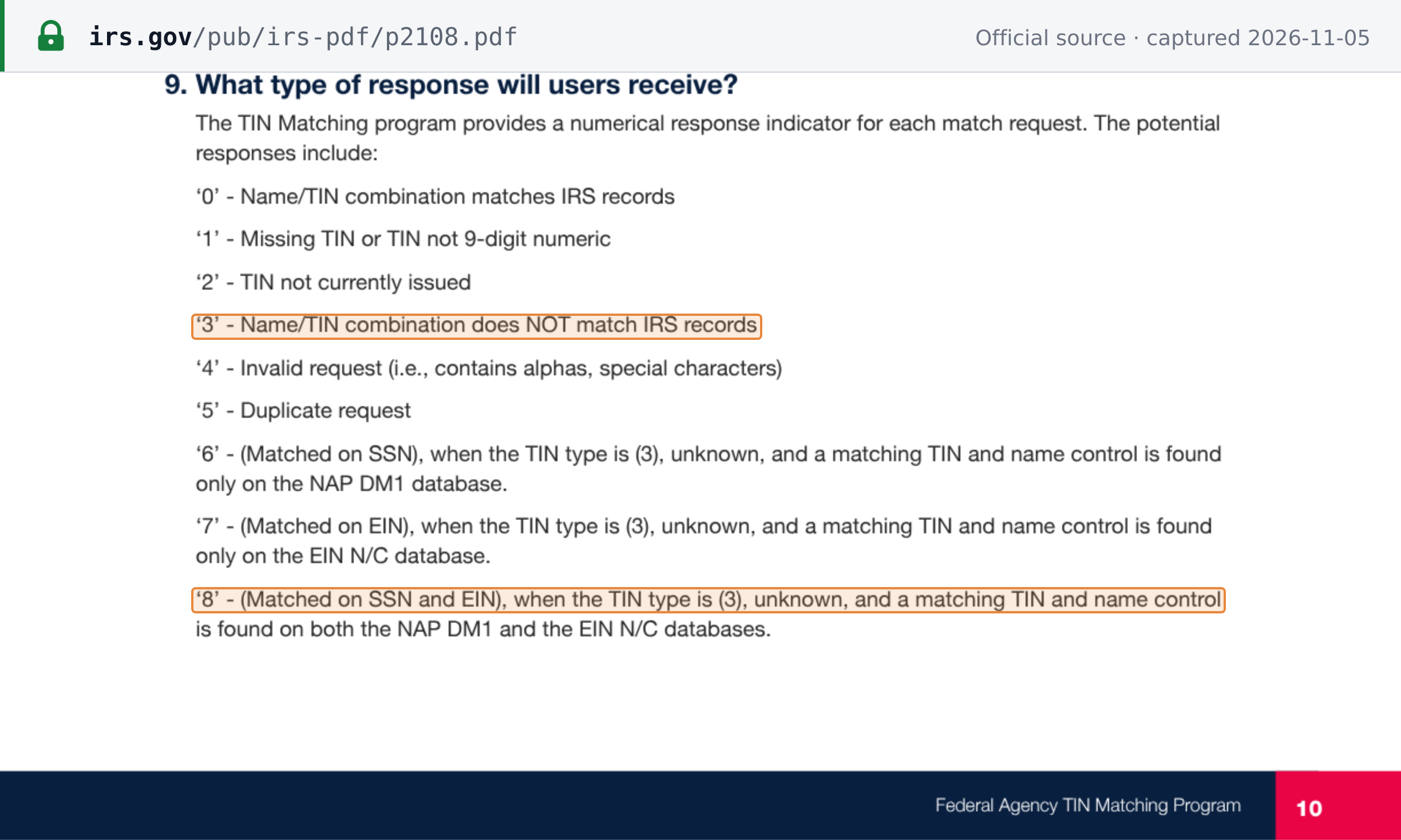
| 3 | Name/TIN combination does NOT match IRS records |
| 4 | Invalid request (for example, letters or special characters) |
| 5 | Duplicate request |
| 6 | Matched on SSN (TIN type 3 only) |
| 7 | Matched on EIN (TIN type 3 only) |
| 8 | Matched on both SSN and EIN (TIN type 3 only) |
 Source snapshot captured 2026-11-05 — original
A code 3 is more often a name problem than a bad number. See common false negatives before you treat it as fraud.
Form W-9: the payee's certified EIN
If you cannot use TIN Matching, the official document is Form W-9 (current revision: March 2024). A payer uses it to get the payee's correct name and TIN, and a valid W-9 must be signed and dated under penalties of perjury. It is a self-certification: it records what the payee says, and you cannot check it against IRS records from the form alone. [1] [2]
Two Part I rules on the form explain many later mismatches. A sole proprietor with an EIN may enter either its SSN or its EIN. A single-member LLC that is disregarded as an entity separate from its owner enters the owner's SSN or EIN, with the owner's name on line 1; an LLC taxed as a corporation or partnership enters its own EIN. [1]
A business that holds the EIN can prove it with IRS paper rather than its own word: the CP575 notice issued with the EIN, a digital CP575 from Business Tax Account, or Letter 147C (EIN Previously Assigned). [1]
When an EIN does not match: CP2100, "B" notices and backup withholding
If you file a Form 1099 whose name/TIN does not match, the IRS writes to you, the payer, not to the payee. The sequence in Publication 1281 (Rev. 12-2023): [1]
- The IRS sends the payer a CP2100 or CP2100A, "Notice of Possible Payee TIN Discrepancy". The payer must track whether another arrives for the same payee within 3 years. [2]
- The payer sends the payee a First "B" Notice with a Form W-9.
- If the payee does not return a signed W-9, the payer must begin backup withholding no later than 30 business days after the date of the CP2100 notice or the date it was received, whichever is later. [1] The backup withholding rate is 24% (as at 2026-11-05). [3] [4]
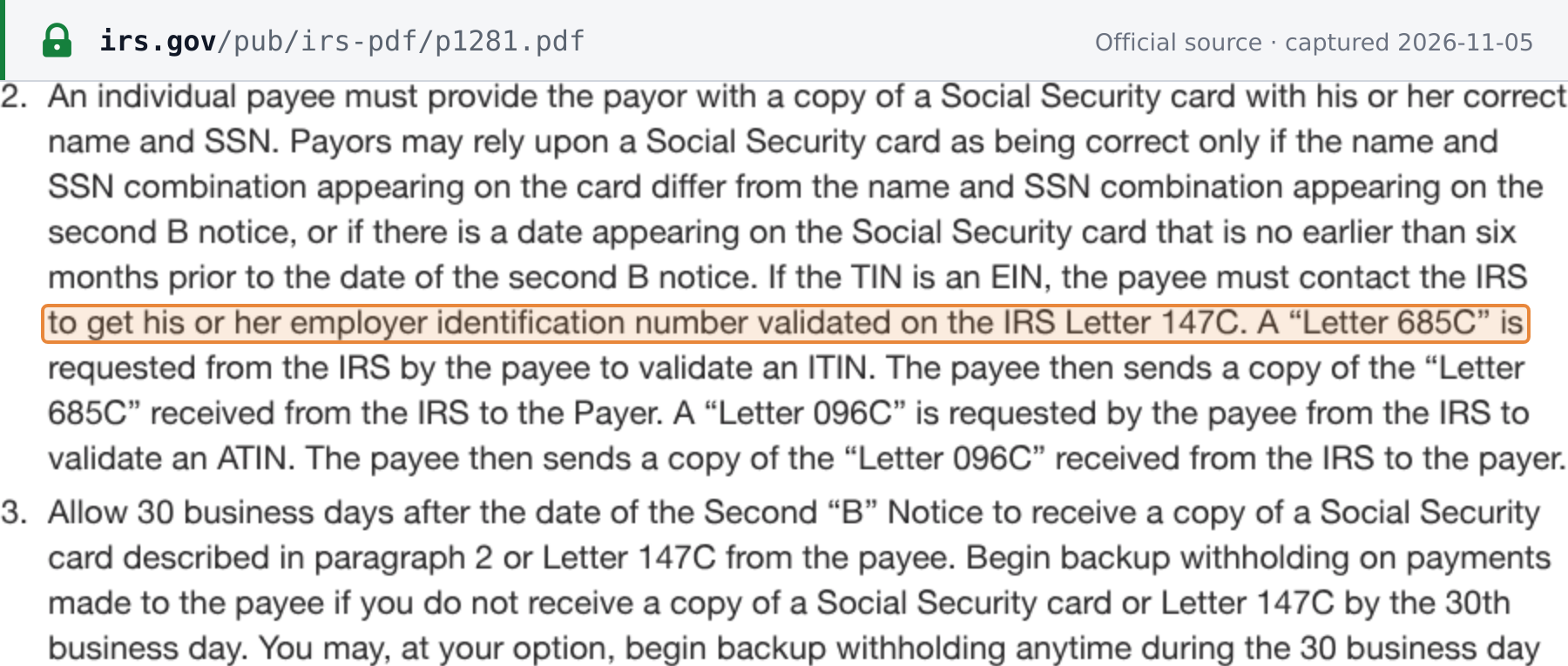
- On a second mismatch within 3 years, the payer sends a Second "B" Notice. If the TIN is an EIN, a new W-9 is not enough: the payee must get its EIN validated by the IRS on Letter 147C, and the payer begins backup withholding if the letter has not arrived by the 30th business day.
 Source snapshot captured 2026-11-05 — original
Charities and other exempt organizations: IRS Tax Exempt Organization Search
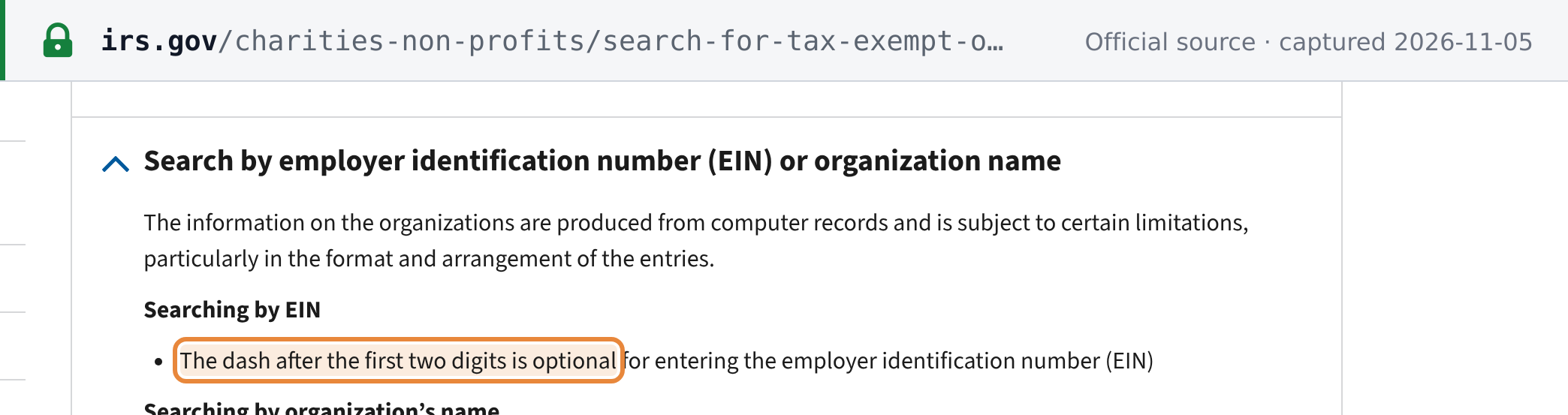
For exempt organizations, anyone can search the IRS Tax Exempt Organization Search tool at apps.irs.gov/app/eos by EIN or organization name. The dash after the first two digits is optional. [1]
It draws on five IRS data sets: Form 990-series returns, Form 990-N (e-Postcard) filings, Publication 78 data, the automatic revocation of exemption list, and determination letters (those dated on or after 1 January 2014). Two limits matter for a not-found result [1]:
- Some donees eligible to receive tax-deductible contributions, such as churches, group ruling subordinates and governmental units, may not be listed in Publication 78 data.
- A name on the auto-revocation list does not necessarily reflect the organization's current tax-exempt status.
Smaller organizations, with annual gross receipts normally of $50,000 or less, are generally eligible to file the Form 990-N e-Postcard instead of Form 990 or 990-EZ (as at 2026-11-05). [1]
 Source snapshot captured 2026-11-05 — original
SEC filers: EDGAR shows the EIN but cannot search by it
For companies that file with the US Securities and Exchange Commission, SEC EDGAR publishes the EIN, but you have to find the company first. The EDGAR full-text and company search takes a company name, ticker, CIK number or individual's name, not an EIN. [1]
- Search EDGAR for the company by name or ticker.
- Open any filing and its filing index page. The filer block shows "EIN." with the 9-digit number, next to the state of incorporation. [2]
- Compare it with the EIN you were given. The Form 10-K cover page also carries the "I.R.S. Employer Identification No." [3]
For bulk checks, the SEC's data.sec.gov APIs need no authentication or API key. [4] The SEC's documentation does not list an EIN field, but a submissions response such as data.sec.gov/submissions/CIK0000320193.json carries "ein":"942404110" for Apple Inc. Automated requests should declare a User-Agent in their request headers. [5]
 Source snapshot captured 2026-11-05 — original
Texas only: Franchise Tax Account Status Search
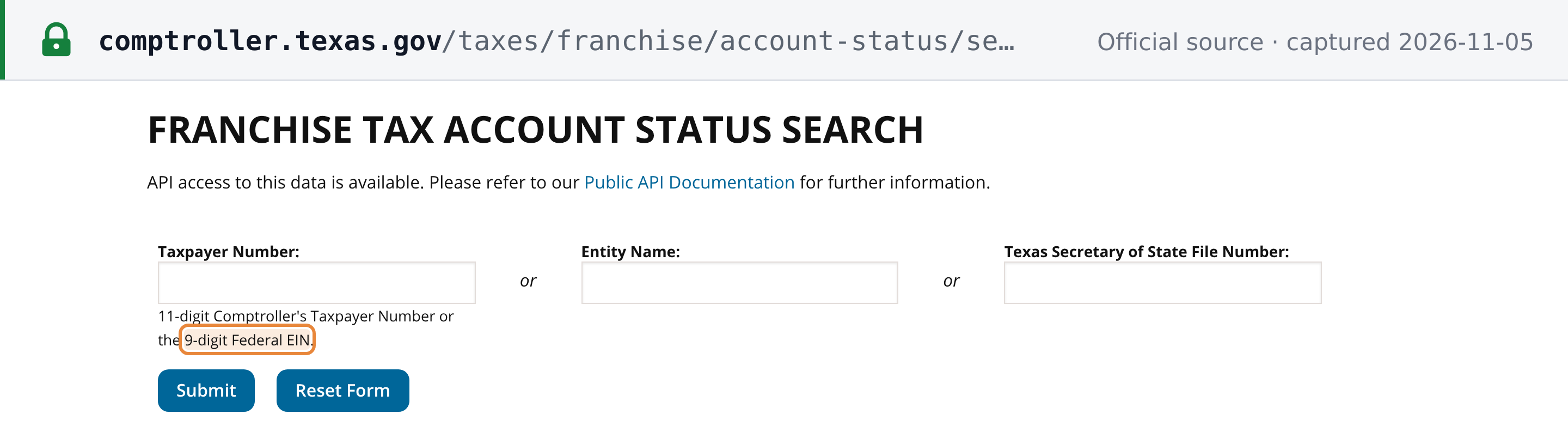
The Texas Comptroller's Franchise Tax Account Status Search is a state lookup, not an EIN register. It accepts the 11-digit Comptroller's Taxpayer Number or the 9-digit federal EIN, an entity name (2–50 characters) or a Texas Secretary of State file number (6–10 digits). It is free, needs no login, and the Comptroller documents a public API. [1] The old address mycpa.cpa.state.tx.us/coa/ redirects there.
- Open the search page and enter the 9-digit EIN without the hyphen.
- Submit. The results table lists Name, Taxpayer Number and Zip. For example, searching
942404110returns APPLE INC. with Texas taxpayer number 19424041101. - Open the result. The detail page shows the Texas Taxpayer Number, mailing address, Right to Transact Business in Texas (the franchise-tax account status), state of formation, SOS registration status and date, Texas SOS file number, registered agent and registered office, and the officers and directors from the latest Public Information Report. It does not display the federal EIN itself. [2]
Scope. Only entities with a Texas franchise-tax record appear. Public Information Reports are filed by corporations, LLCs, limited partnerships, professional associations and financial institutions organized in Texas or with nexus in Texas. A not-found result means the entity has no Texas franchise-tax account, not that the EIN is invalid. [2]
The Texas 11-digit taxpayer number is not an EIN, though it can contain one. The Comptroller says a 9-digit EIN may serve as the base for an 11-digit number prefixed with 1, while numbers prefixed with 3 are assigned by the Comptroller and contain no EIN. [3] In the Apple example above, 19424041101 is 1, then the EIN 942404110, then one more digit.
 Source snapshot captured 2026-11-05 — original
EIN number format
An EIN is a 9-digit number written 12-3456789 (XX-XXXXXXX). [1] [2] Our United States Tax ID guide covers the EIN alongside SSNs and ITINs.
 Source snapshot captured 2026-11-05 — original
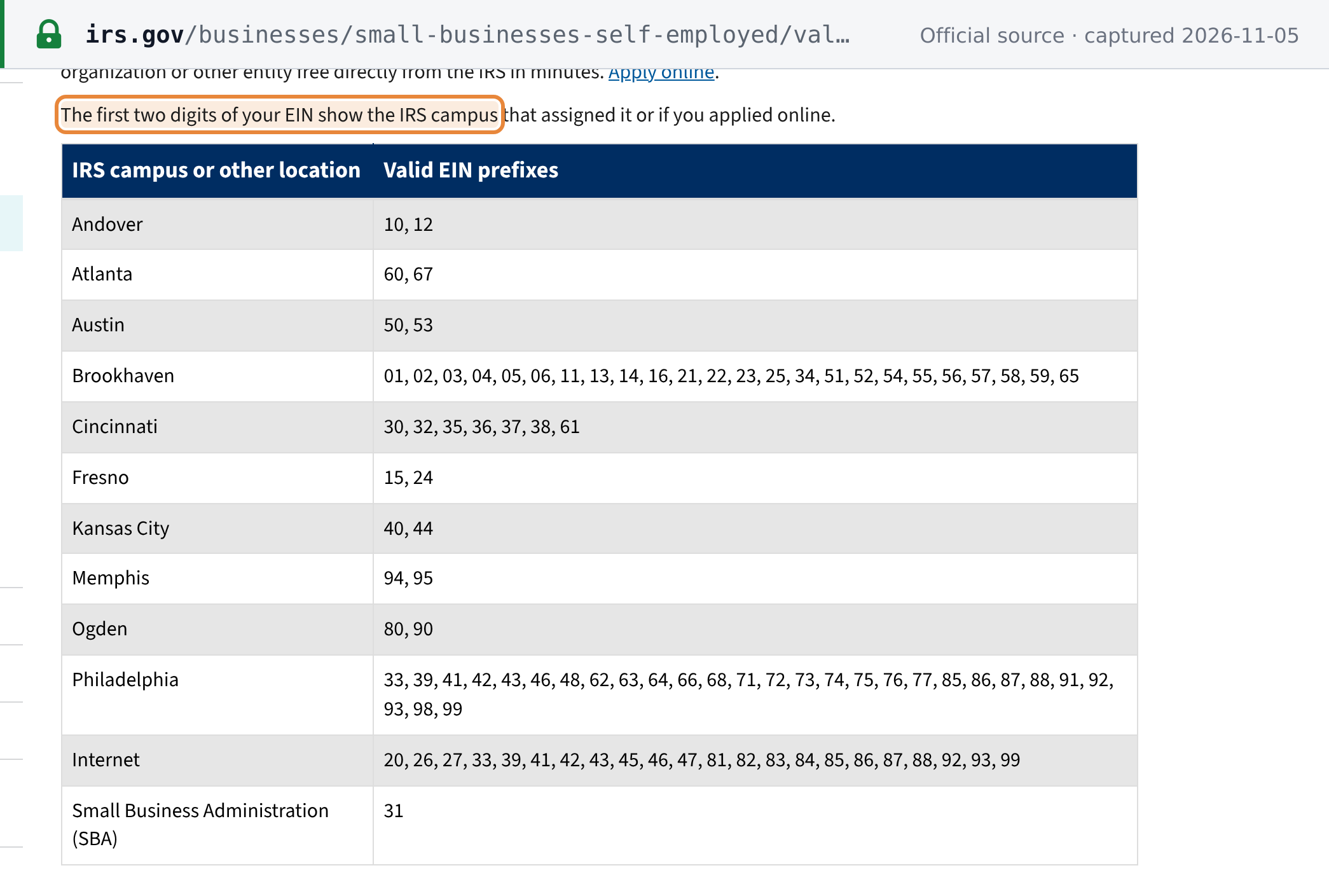
The first two digits show the IRS campus that assigned the EIN, "or if you applied online". The IRS Valid EINs page lists 83 distinct valid prefixes. The prefixes listed for Internet applications overlap those of the Philadelphia campus (33, 39, 41–43, 46, 85–88, 92, 93, 99), so a prefix does not reliably tell you where or how an EIN was issued. [1]
Seventeen two-digit prefixes were not on the IRS list as at 2026-11-05: 00, 07, 08, 09, 17, 18, 19, 28, 29, 49, 69, 70, 78, 79, 89, 96 and 97. An EIN starting with one of these is a red flag. A listed prefix proves nothing on its own. None of the IRS format sources (the Form SS-4 instructions, Publication 1635 and the Valid EINs page) describes a check digit, and Pub 2108 treats "TIN not currently issued" as something only a match against IRS records can show. [1] [2]
 Source snapshot captured 2026-11-05 — original
Common false negatives
A failed check is often caused by something other than a fake number:
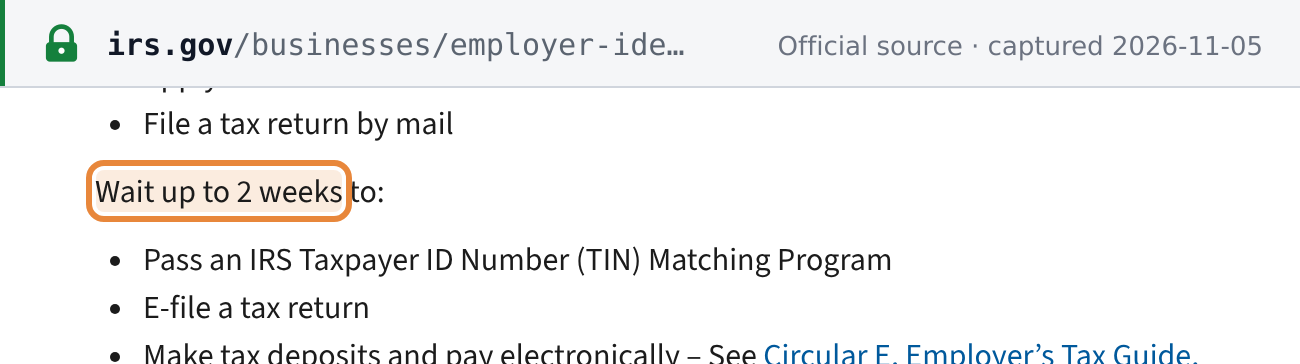
- The EIN is new. The IRS says to wait up to 2 weeks before a new EIN will pass TIN Matching. [1]
- The name does not match the IRS name control. The IRS matches on a name control of up to four characters. For most organizations it comes from the entity's name on the original Form SS-4; for a partnership, from its trade or business name (or, if there is none, the last name of the first partner listed on the SS-4); for a sole proprietor, from the owner's last name. A trade name, or a legal-name change the IRS has not recorded, can return code 3 with a correct EIN. Pub 2108 recommends matching on the legal name from W-9 line 1; the trade name from line 2 can match only if a return using it has already been filed and accepted. [2] [4]
- A disregarded single-member LLC. Its W-9 carries the owner's name and TIN. Matching the LLC's own name against the owner's number, or the reverse, can return code 3. [3]
- SSN and EIN confusion. Both are 9 digits (an SSN is hyphenated XXX-XX-XXXX). Submitting with TIN type 3 makes the IRS check both the SSN and EIN files, and codes 6, 7 and 8 tell you which one matched. [4]
- A lost leading zero. Prefixes 01–06 are valid. A spreadsheet that stores the EIN as a number drops the leading zero and leaves 8 digits, which returns code 1. Pub 1281 gives the same warning for opening IRS CP2100 data files in Excel: set or convert fields to text "so that leading zeros are not truncated". [2]
- Characters in the TIN. A TIN with letters, hyphens or other characters can come back as code 1 (missing TIN) or code 4 (invalid request); Pub 2108 describes it both ways. Submit the 9 digits only. In bulk files, also omit special characters from business names except hyphens (-) and ampersands (&). [4]
- Too many attempts. Submitting the same TIN with different names, or the same name with different TINs, suspends your TIN Matching access for 96 hours after four attempts. [4]
- A deactivated EIN. The IRS cannot cancel an EIN but can deactivate it. [1] The IRS publications on TIN Matching (Pub 2108 and Pub 1281) do not say how a deactivated EIN responds.
- A Texas miss. Not found in the Texas Comptroller search means no Texas franchise-tax account, not an invalid EIN.
 Source snapshot captured 2026-11-05 — original
Related resources
- United States Tax ID guide: EIN, SSN and ITIN formats.
- United States sales tax guide: an EIN is a federal ID, not a state sales-tax registration.
- US EIN validator: check an EIN's format instantly.
- Need an EIN? The IRS issues them free at Get an employer identification number.
Frequently Asked Questions
Is there a public IRS website where I can look up any company's EIN?
The IRS EIN page offers no public search by EIN (as at 2026-11-05). Its three confirmation routes (an entity transcript, a digital CP575 in Business Tax Account, and Letter 147C by phone) are all for the business that holds the EIN, and Publication 2108 states that IRC 6103 protects the confidentiality of TINs. The federal check open to third parties is IRS TIN Matching, and only payers that file certain Forms 1099 can use it. [1] [2]
Can I run TIN Matching before I file my first Form 1099?
Usually not. Only payers listed in the IRS Payer Account File can use TIN Matching, and the IRS adds payers to that file once they have filed Forms 1099 within the last 2 years. Until then, collect a signed Form W-9 and keep it on file. Timing also matters on the payee's side: the IRS says a newly issued EIN can take up to 2 weeks before it will pass TIN Matching. [1] [2]
TIN Matching returned code 3 for a contractor's EIN. Is the number fake?
Not necessarily. Code 3 means the name and TIN combination does not match IRS records. The IRS matches on a name control of up to four characters, which for most organizations comes from the name on the original Form SS-4. A trade name entered instead of the legal name, a legal-name change the IRS has not recorded, or a single-member LLC entered under its own name instead of its owner's can all return 3 with a correct EIN. Check the name on the W-9, use TIN type 3 if the number might be an SSN, and ask the payee which name the IRS holds. [1] [2]
What happens if I file a 1099 with an EIN that does not match IRS records?
The IRS sends you, the payer, a CP2100 or CP2100A notice. You then send the payee a First "B" Notice with a Form W-9. If no signed W-9 comes back, you must start backup withholding at 24% no later than 30 business days after the date of the CP2100 notice or the date you received it, whichever is later. If the same payee's name and TIN mismatch again within 3 years, a Second "B" Notice applies, and an EIN holder must get its EIN validated on IRS Letter 147C. [1] [2]
How do I check the EIN of a US charity or other tax-exempt organization?
Use the IRS Tax Exempt Organization Search, which can be searched by EIN or organization name; the dash after the first two digits is optional. It draws on Form 990-series returns, Form 990-N (e-Postcard) filings, Publication 78 data, the automatic revocation list and determination letters. Some eligible donees, such as churches, group ruling subordinates and governmental units, may not be listed, and a name on the auto-revocation list does not necessarily reflect current tax-exempt status. [1]
Can I find the EIN of a publicly traded company?
If the company files with the SEC, yes, but you cannot search EDGAR by EIN. EDGAR searches by company name, ticker, CIK number or individual's name. The index page of each filing shows the filer's EIN, and the Form 10-K cover page asks for the I.R.S. Employer Identification No. For example, the index of Apple Inc.'s 10-K filed in November 2026 shows EIN 942404110. [1] [2]
Does an EIN have a check digit I can validate offline?
None of the IRS format sources (the Form SS-4 instructions, Publication 1635 and the IRS Valid EINs page) describes a check digit. What you can check offline is the shape, nine digits written 12-3456789, and the prefix: 17 two-digit prefixes (00, 07, 08, 09, 17, 18, 19, 28, 29, 49, 69, 70, 78, 79, 89, 96, 97) were not on the IRS valid-prefix list as at 2026-11-05. An unlisted prefix is a red flag. A listed prefix proves nothing, because only IRS records show whether a number was actually issued. [1] [2]
How Lookuptax can help you validate tax IDs
Lookuptax checks tax identification numbers, including the US EIN format, across more than 100 countries from one platform, so you can catch mistyped and malformed numbers before they reach an invoice or an information return.