Germany Tax ID Numbers — IdNr, Steuernummer, USt-IdNr and W-IdNr Explained
Germany uses four main tax identification numbers. Every individual has an Identifikationsnummer (IdNr, colloquially Steuer-ID). Every tax file kept at a local tax office (Finanzamt) has a Steuernummer (StNr). Businesses trading within the EU use the Umsatzsteuer-Identifikationsnummer (USt-IdNr), Germany's VAT identification number. The newest is the Wirtschafts-Identifikationsnummer (W-IdNr), a business identifier that is still being rolled out. The IdNr, the USt-IdNr and the W-IdNr are issued by the Federal Central Tax Office (BZSt — Bundeszentralamt für Steuern); the Steuernummer is issued by the competent Finanzamt of the federal state (Land). Under § 139a(1) of the Fiscal Code (Abgabenordnung, AO), natural persons receive an Identifikationsnummer and economically active persons a Wirtschafts-Identifikationsnummer. [1] The BZSt describes the USt-IdNr as a separate number that it issues to businesses in addition to the Steuernummer. [2] For VAT rates, invoicing and filing, see the Germany VAT guide.
Germany's Tax IDs at a Glance
| Number | Format | Example | Who has it | Issued by | Accepted on an invoice? |
|---|---|---|---|---|---|
| IdNr (Steuer-ID) | 11 digits; the last is a check digit | 02476291358 — official test number | Every individual registered in Germany; non-residents with German income | BZSt, automatically | No |
| Steuernummer | 10 or 11 digits in the standard Land notation (some offices print fewer); 13 digits in the federal schema | 97/815/08154 = 1197081508154 — ELSTER test tax office, Berlin | Each taxpayer file at a Finanzamt — individuals, businesses and other entities | Finanzamt of the Land | Yes, for domestic invoices (or the USt-IdNr) |
| USt-IdNr | DE + 9 digits | DE123456789 — illustrative | Businesses, on application | BZSt | Yes — it or the Steuernummer satisfies § 14(4); mandatory, with the customer's, on intra-EU supplies of goods and cross-border B2B services (§ 14a) |
| W-IdNr | DE + 9 digits + - + 5-digit distinguishing number | DE123456789-00001 — BZSt example | Every economically active person, allocated in stages | BZSt, automatically | No (as at 14 November 2026) |
A fifth number, the Kleinunternehmer-Identifikationsnummer (KU-IdNr), exists only for German small businesses that use the EU small-business scheme in other member states — see below.
Identifikationsnummer (IdNr / Steuer-ID)
| Field | Detail |
|---|---|
| Official name | Identifikationsnummer (IdNr), § 139b AO — also called Steuer-ID or steuerliche Identifikationsnummer |
| Format | 11 digits: ten digits and a check digit |
| Regex | ^[1-9]\d{10}$ for issued numbers (test numbers may start with 0), plus the structural rules below |
| Example | 02476291358 — the official test IdNr in the ELSTER specification |
| Issued by | BZSt, automatically — no application |
The BZSt describes the IdNr as an eleven-digit number that contains no information about the person. It is permanently valid and does not change when you move house, change your name or change your marital status. [3] The ordinance on the identification number (StIdV § 1) defines it as ten digits plus a check digit as the eleventh digit. [4] A person may receive only one IdNr, and each number is issued only once (§ 139b(1) AO). [5] Under § 139a(1) AO the number may not be formed or derived from other data about the person, and it serves to identify taxpayers unambiguously in taxation and administrative procedures. [1] It is not one of the numbers that § 14(4) no. 2 of the VAT Act (UStG) requires on an invoice — see which number goes on an invoice.
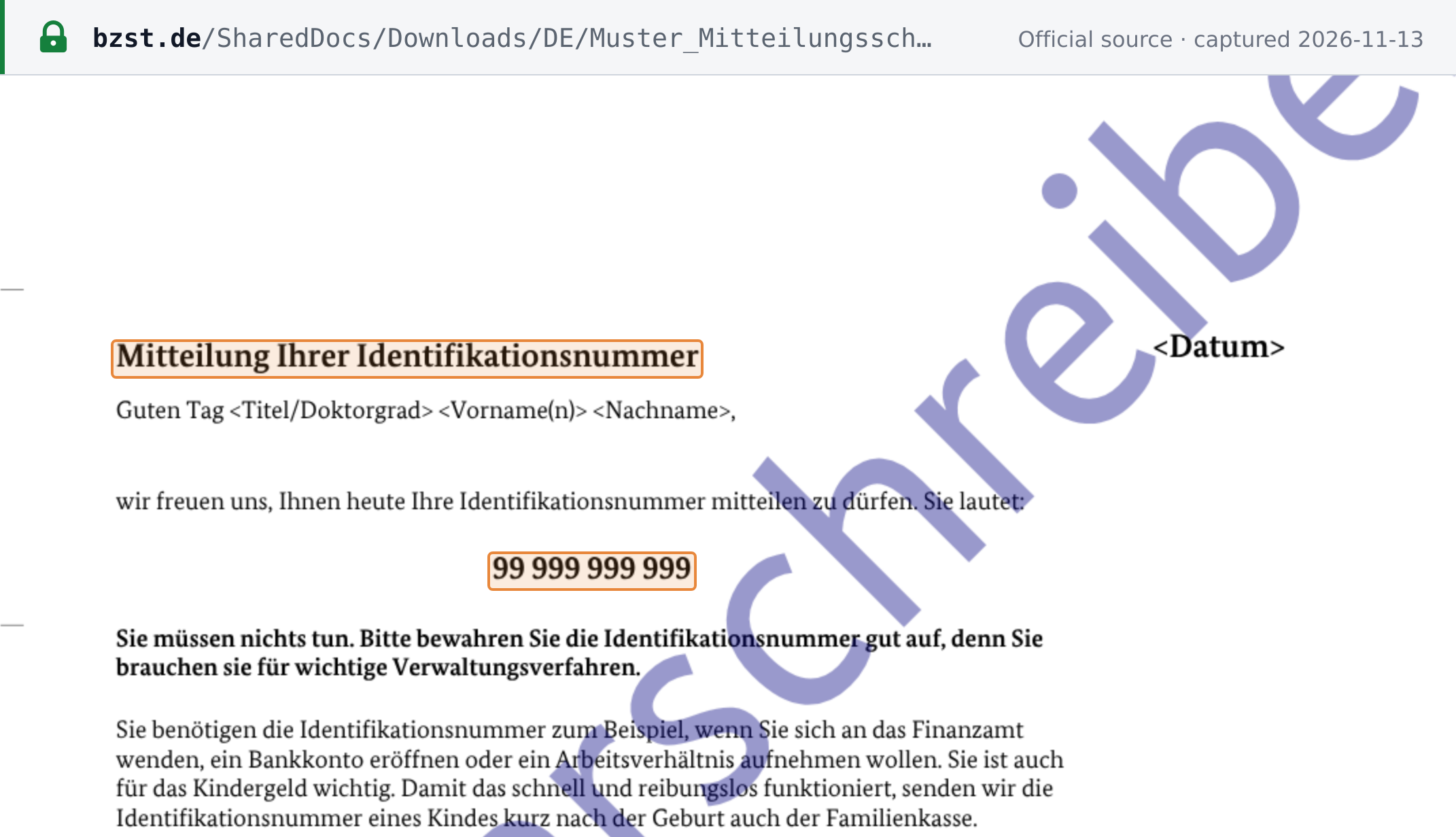
Who receives one.
- Residents — the BZSt assigns the IdNr as soon as the registration office (Meldebehörde) has sent it the required data; there is no application. If no IdNr has arrived three months after you registered your address, the BZSt asks you to send it a copy of your identity document and your registration certificate (Meldebestätigung). [6]
- Non-residents with German income — they are generally assigned an IdNr while their income tax return is processed. [7]
- Employees who live abroad (for example seasonal workers) — the employer's Betriebsstättenfinanzamt arranges the allocation of the IdNr; the application to that office can be made on form 010250 (Antrag auf Vergabe einer steuerlichen Identifikationsnummer für nicht meldepflichtige Personen durch das Finanzamt). [6]
For data-protection reasons the BZSt communicates the IdNr only by letter, and never by telephone. If you have lost it, you can request a new notification through the BZSt's online form or the BZSt online portal (BOP). [3] The BZSt says processing can currently take up to four weeks, and up to ten weeks where it has queries. [33] [34] The data stored with it are deleted 20 years after the end of the calendar year in which the holder died (StIdV § 4). [4]
IdNr structure rules
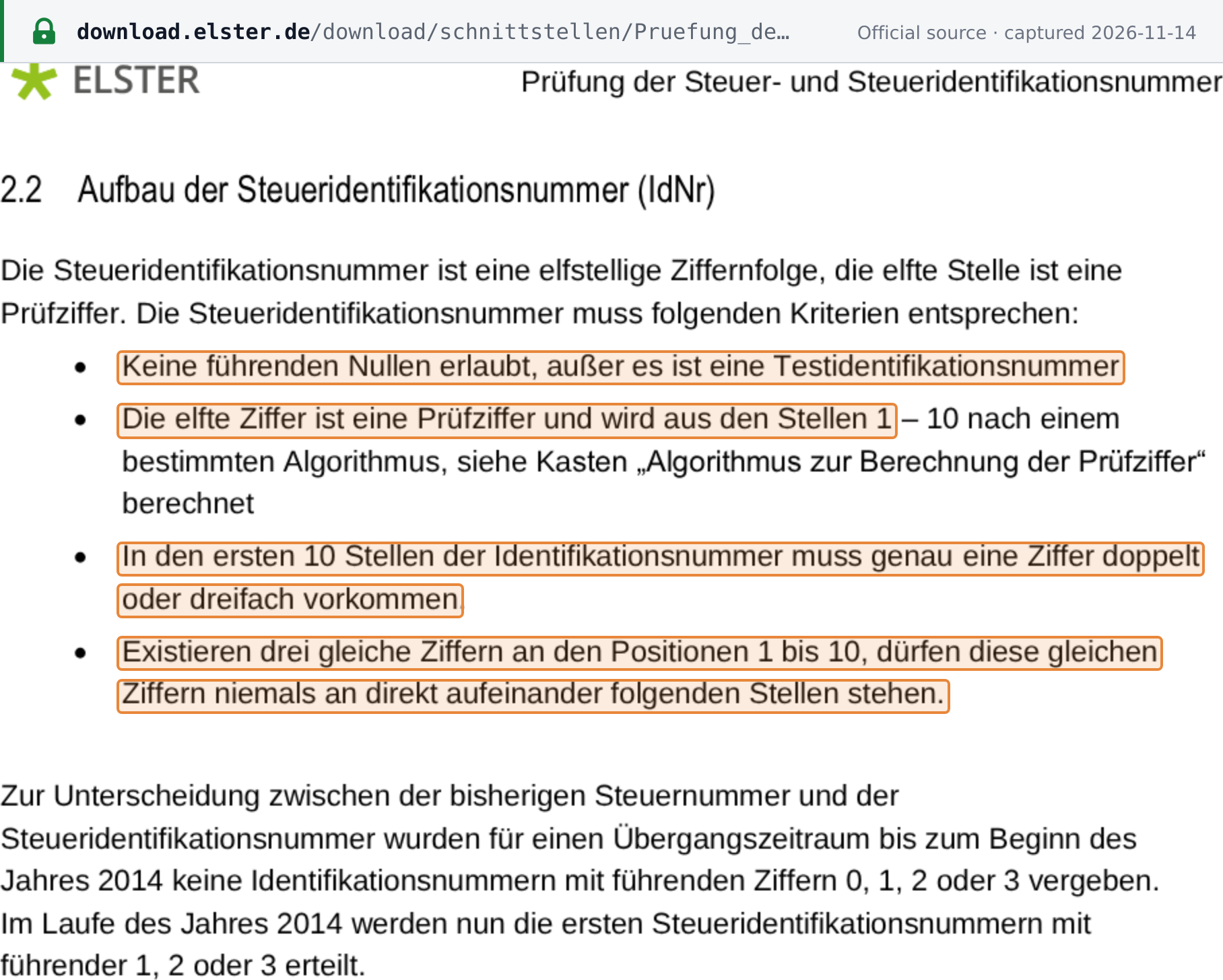
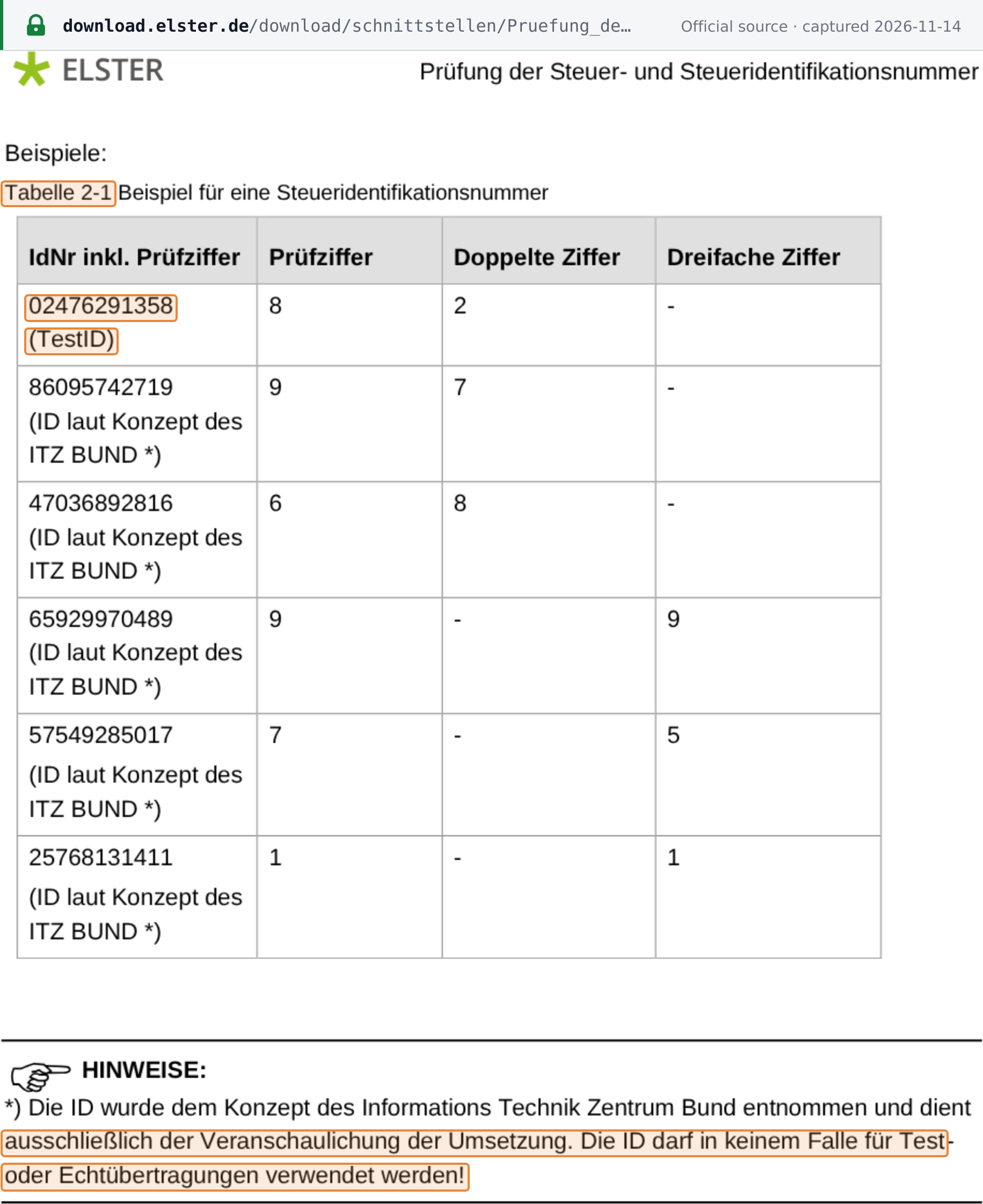
The ELSTER interface specification Prüfung der Steuer- und Steueridentifikationsnummer, published by the Bavarian State Tax Office for the tax administration's ELSTER platform, sets out the rules an IdNr must meet: [8]
- No leading zero, unless it is a test identification number.
- The eleventh digit is a check digit, calculated from digits 1–10.
- In the first ten digits, exactly one digit must occur twice or three times.
- If a digit occurs three times, those three digits may never stand at directly consecutive positions (two of the three may be adjacent, as in the specification's sample
65929970489).
The specification adds that until the start of 2014 no IdNr was issued with a leading 0, 1, 2 or 3, and that numbers beginning with 1, 2 or 3 have been issued since 2014.
IdNr check digit
The specification publishes the algorithm as program code. Applied digit by digit to the first ten digits: [8]
- Start with
product = 10. - For each digit
d:sum = (d + product) mod 10; ifsumis 0, set it to 10; thenproduct = (2 × sum) mod 11. - The check digit is
11 − product; if that gives 10, the check digit is 0.
This is the hybrid scheme known as ISO/IEC 7064 MOD 11,10, although the specification does not use that name. Implement it with each digit's numeric value — the published code reads the character at each position.
Worked example with the official test number 02476291358: the running product after each of the first ten digits is 9, 2, 1, 5, 2, 8, 3, 8, 2, 3, and 11 − 3 = 8, the eleventh digit. The specification's other sample numbers come from a concept by the federal IT centre (ITZBund) and, in the specification's words, may in no case be used for test or live transmissions.
Steuernummer
| Field | Detail |
|---|---|
| Official name | Steuernummer (StNr) |
| Format | Standard Land notation: 10 or 11 digits, layout varies by Land — but some Bavarian tax offices omit the three-digit office number, and Hessen's leading 0 is often dropped. Federal schema: 13 digits |
| Regex | ^\d{13}$ for the federal schema; no single pattern covers the Land notations |
| Example | 97/815/08154 (Berlin notation) = 1197081508154 (federal schema) — ELSTER test tax office |
| Issued by | The Finanzamt that keeps the taxpayer's file |
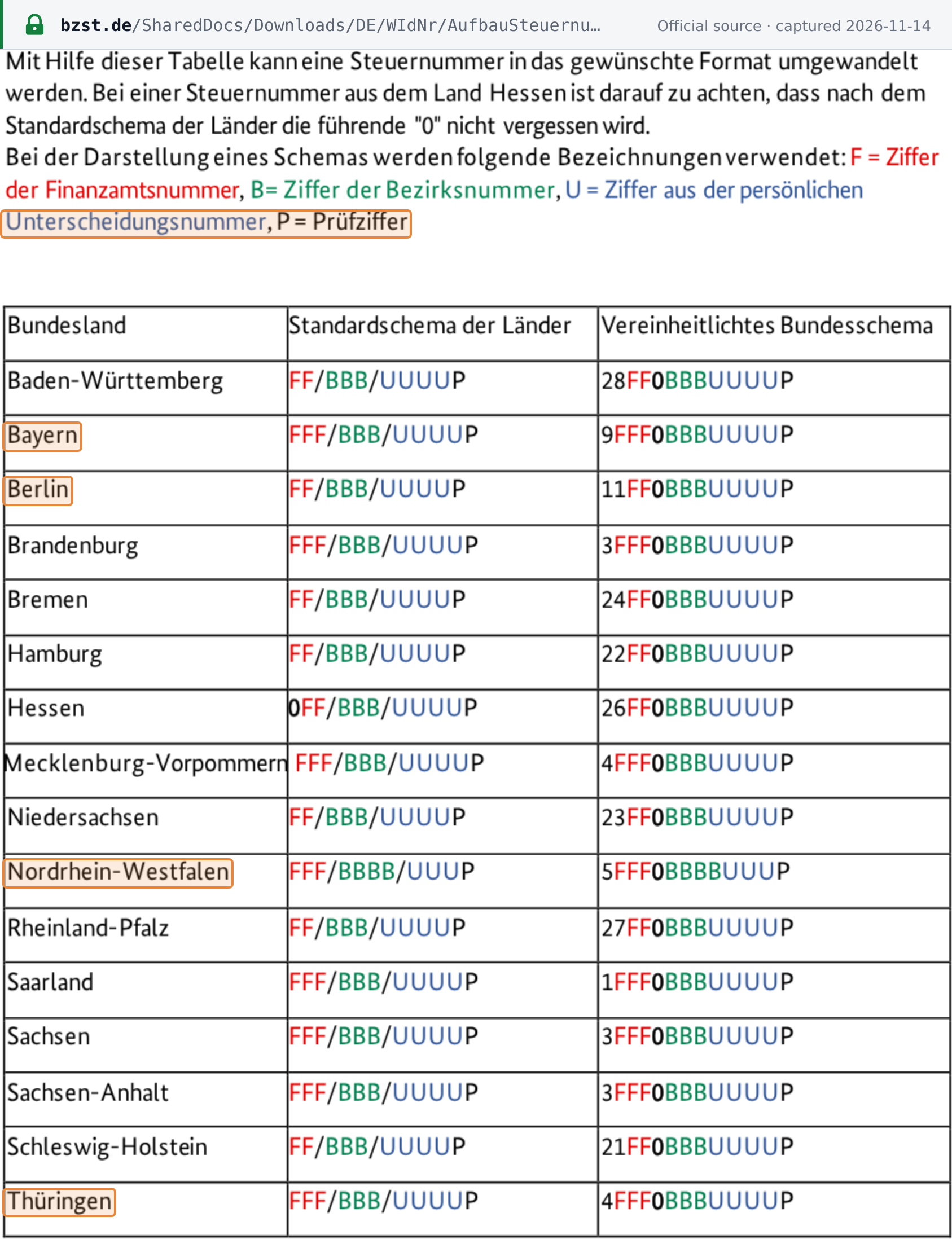
The Steuernummer is made up of the tax office number (F), a district number (B), a personal distinguishing number (U) and a check digit (P). Tax offices mostly print it in the Land notation, whose layout depends on the federal state; the 13-digit federal schema (vereinheitlichtes Bundesschema) used in electronic filing starts with a four-digit federal tax office number, followed by a 0. [8] [9] [10] The BZSt's conversion table: [9]
| Land | Land notation | Federal schema (13 digits) |
|---|---|---|
| Baden-Württemberg | FF/BBB/UUUUP | 28FF0BBBUUUUP |
| Bayern | FFF/BBB/UUUUP | 9FFF0BBBUUUUP |
| Berlin | FF/BBB/UUUUP | 11FF0BBBUUUUP |
| Brandenburg | FFF/BBB/UUUUP | 3FFF0BBBUUUUP |
| Bremen | FF/BBB/UUUUP | 24FF0BBBUUUUP |
| Hamburg | FF/BBB/UUUUP | 22FF0BBBUUUUP |
| Hessen | 0FF/BBB/UUUUP | 26FF0BBBUUUUP |
| Mecklenburg-Vorpommern | FFF/BBB/UUUUP | 4FFF0BBBUUUUP |
| Niedersachsen | FF/BBB/UUUUP | 23FF0BBBUUUUP |
| Nordrhein-Westfalen | FFF/BBBB/UUUP | 5FFF0BBBBUUUP |
| Rheinland-Pfalz | FF/BBB/UUUUP | 27FF0BBBUUUUP |
| Saarland | FFF/BBB/UUUUP | 1FFF0BBBUUUUP |
| Sachsen | FFF/BBB/UUUUP | 3FFF0BBBUUUUP |
| Sachsen-Anhalt | FFF/BBB/UUUUP | 3FFF0BBBUUUUP |
| Schleswig-Holstein | FF/BBB/UUUUP | 21FF0BBBUUUUP |
| Thüringen | FFF/BBB/UUUUP | 4FFF0BBBUUUUP |
F = tax office number, B = district number, U = distinguishing number, P = check digit. In Hessen, keep the leading 0 in the Land notation. The first four digits of the federal form are the federal tax office number. Its leading digit or digits indicate the Land only in part: Bayern starts with 9 and Nordrhein-Westfalen with 5, but 3 is shared by Brandenburg, Sachsen and Sachsen-Anhalt, and 4 by Mecklenburg-Vorpommern and Thüringen — only the full four-digit number identifies the office. The ELSTER specification also notes that some Bavarian tax offices increasingly print the number without the three-digit office number, and that Hessen's leading 0 is often dropped. The separators also vary in practice — the ELSTER specification's examples print some Länder without slashes — so do not validate on the slashes. [8]
Check digit. The Länder use three check-digit procedures: the modified 11 procedure (Rheinland-Pfalz), the 2 procedure (Baden-Württemberg, Hessen and Schleswig-Holstein) and the 11 procedure (all other Länder, with Land-specific weights). The ELSTER specification maps each Land to its procedure (section 6.3) and describes each one (sections 6 and 7). Its Table 4-1 gives example numbers of test tax offices in both formats, for example Bayern 198/815/08152 = 9198081508152 and Nordrhein-Westfalen 400/8150/8159 = 5400081508159. [8]
Tied to the tax office. Because the Steuernummer contains the number of the Finanzamt that keeps the file, it is specific to that office. If your file moves to another Finanzamt — for example after you move into another district — the new office may issue a new Steuernummer and tells you in writing. For employers, ELSTER publishes a separate guide on wage-tax files that the administration transfers to another office together with a change of tax number (Aktenabgabe verbunden mit einem Steuernummernwechsel). [11] A business can also hold several Steuernummern: the BZSt links each W-IdNr distinguishing number to the Steuernummer under which that activity is kept at the competent tax office. [10]
Still the filing number. The BZSt states that the IdNr, the Steuernummer and the USt-IdNr will continue to be used alongside the W-IdNr, and that the Steuernummer is to be replaced by the W-IdNr only "perspektivisch - nach einer Übergangsphase -" (in the longer term, after a transition period). It gives no date. Tax returns are still filed with the Steuernummer. [10]
Umsatzsteuer-Identifikationsnummer (USt-IdNr)
| Field | Detail |
|---|---|
| Official name | Umsatzsteuer-Identifikationsnummer (USt-IdNr.), § 27a UStG |
| Format | Country code DE followed by nine digits |
| Regex | ^DE\d{9}$ |
| Example | DE123456789 — illustrative, the number the BZSt itself uses in examples |
| Issued by | BZSt, on application |
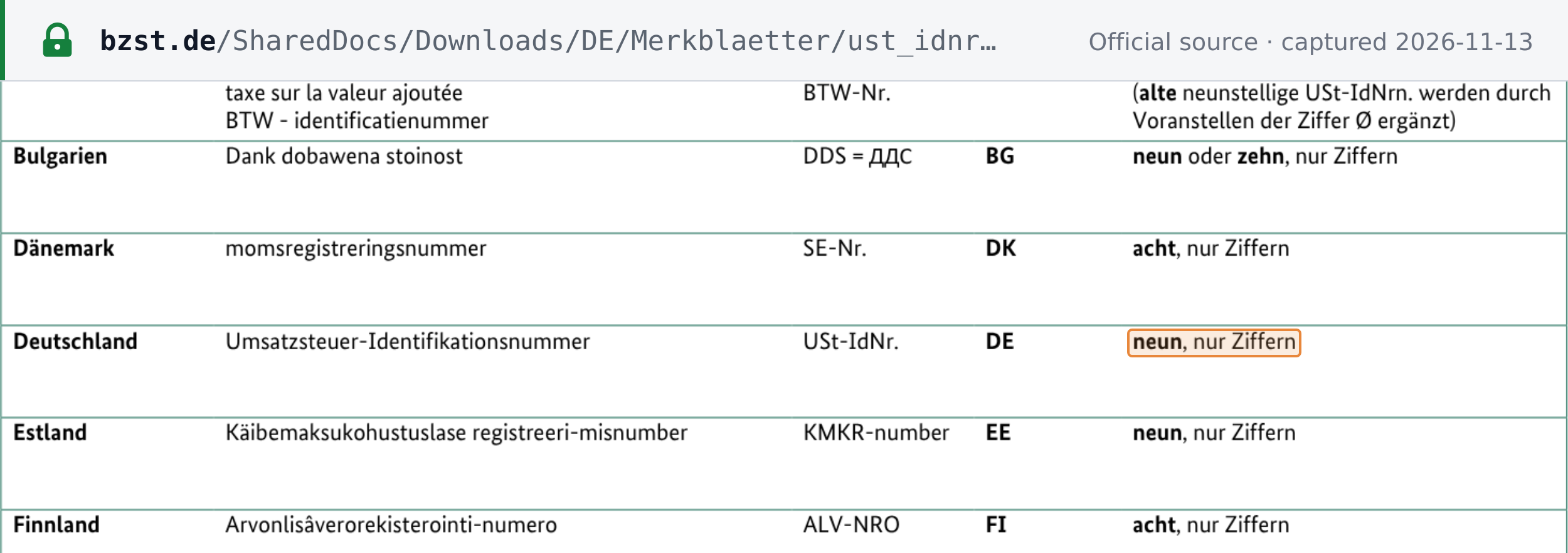
The BZSt's overview of VAT number formats in the EU member states gives the German number as the prefix DE followed by nine characters, digits only. [12] Unlike in several other member states, it is not the number under which the business is registered for VAT, but an additional number issued in a separate procedure.
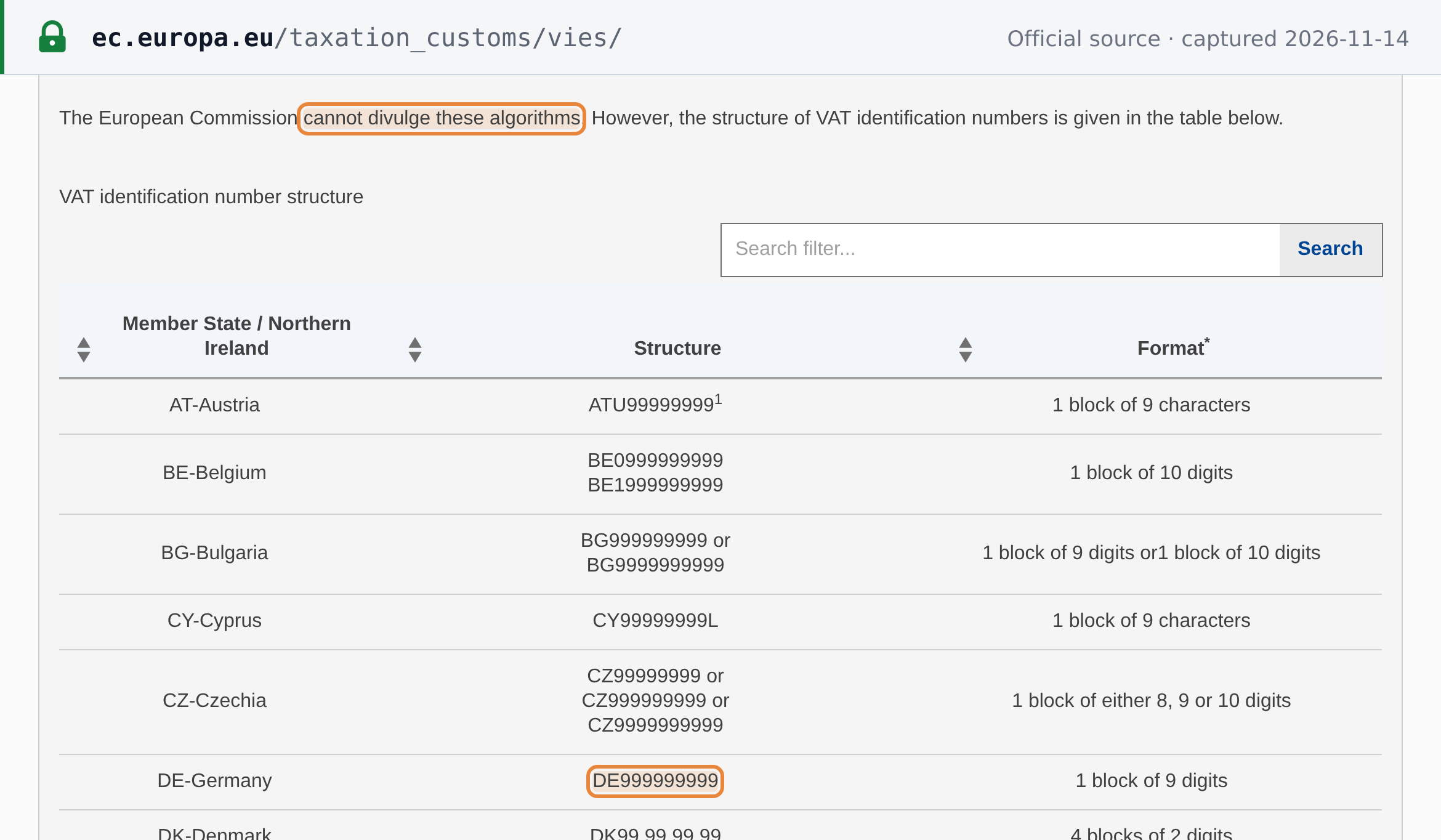
Check digit — none published. Neither the BZSt's format overview nor the European Commission's VIES FAQ publishes a check-digit algorithm for the German USt-IdNr; the Commission states that it cannot divulge these algorithms and publishes only each country's structure. [12] [13] Validate a German USt-IdNr against VIES rather than by a calculation. The BZSt offers no test numbers either: for tests, it says, use your own USt-IdNr. [14]
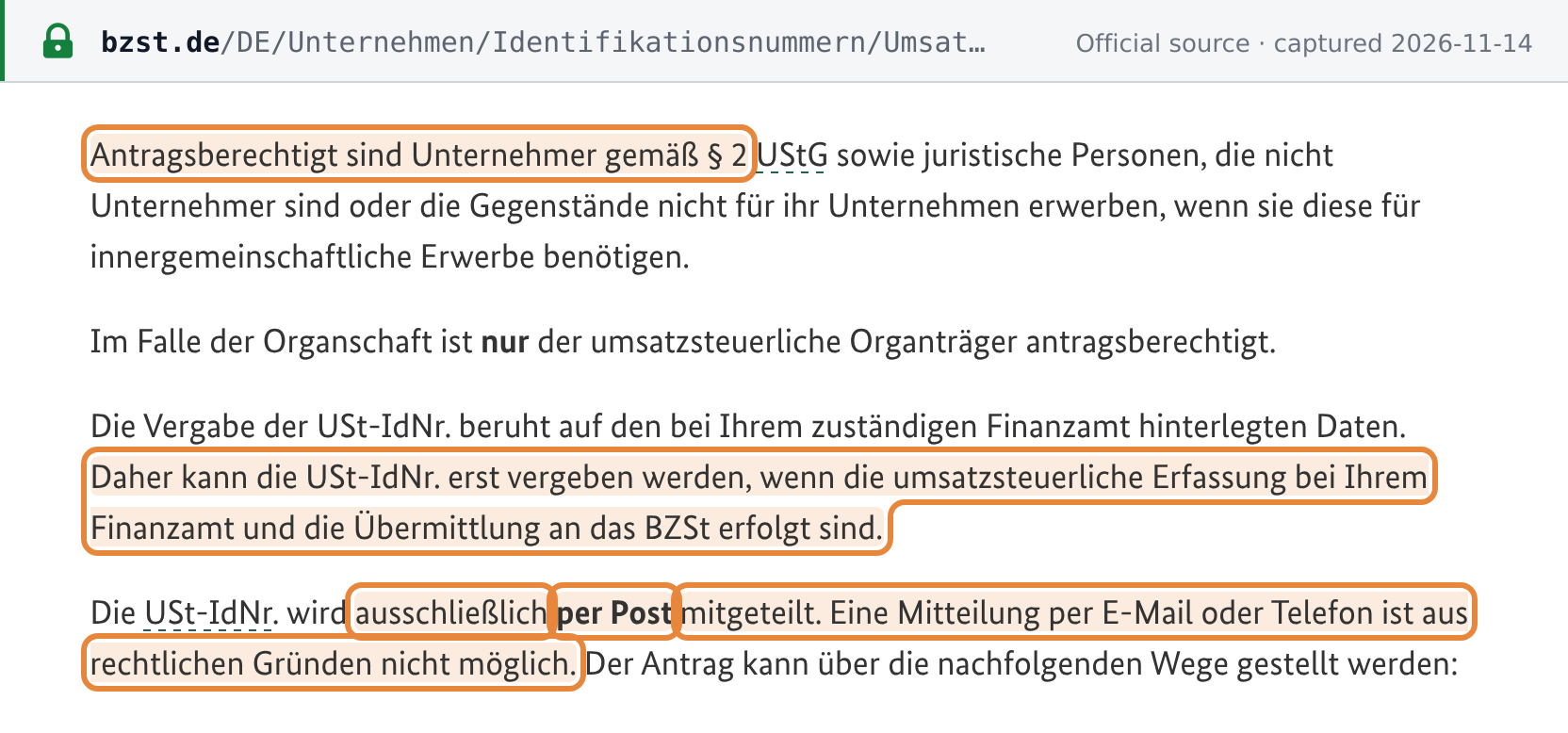
Who can get one. The BZSt issues a USt-IdNr on application to entrepreneurs within the meaning of § 2 UStG, and to legal persons that are not entrepreneurs, or that do not acquire goods for their business, if they need it for intra-EU acquisitions. In a VAT group (Organschaft), only the controlling company (Organträger) may apply. The number is based on the data held by your Finanzamt, so it can be issued only after you have been registered for VAT there and the Finanzamt has passed the data to the BZSt — the BZSt notes that this forwarding can take a few weeks. The USt-IdNr is sent by post only, never by e-mail or telephone. [2] In the application you give your name, address and the Steuernummer under which you are registered for VAT (§ 27a(1) UStG). [15]
A new business ticks the USt-IdNr box in the Fragebogen zur steuerlichen Erfassung (tax registration questionnaire) it sends to its Finanzamt; a business that is already registered applies to the BZSt online or in writing. The BZSt lists the cases that need a USt-IdNr, among them intra-EU supplies and acquisitions of goods, triangular transactions, call-off stock, and services received from, or supplied to, businesses in other member states where the customer owes the VAT. [2]
Wirtschafts-Identifikationsnummer (W-IdNr)
| Field | Detail |
|---|---|
| Official name | Wirtschafts-Identifikationsnummer (W-IdNr.), § 139c AO |
| Format | DE + nine digits, structured like the USt-IdNr, plus a hyphen and a five-digit distinguishing number (Unterscheidungsmerkmal) |
| Regex | ^DE\d{9}-\d{5}$ |
| Example | DE123456789-00001 — the BZSt's example for a first economic activity |
| Issued by | BZSt, automatically — an application is neither necessary nor possible |
The W-IdNr was introduced on 24 October 2024 (WIdV § 1(1)). [16] Every economically active person — natural persons in business, legal persons and associations of persons — receives one (§ 139a(3) AO), and each of its activities, businesses and permanent establishments gets its own five-digit distinguishing number; the first is 00001 (§ 139c(5a) AO). [1] [17] According to the BZSt, the W-IdNr is valid for the whole duration of the economic activity, even through an interruption, and does not change when master data such as the registered seat or the company name change. The BZSt charges nothing for it. [10]
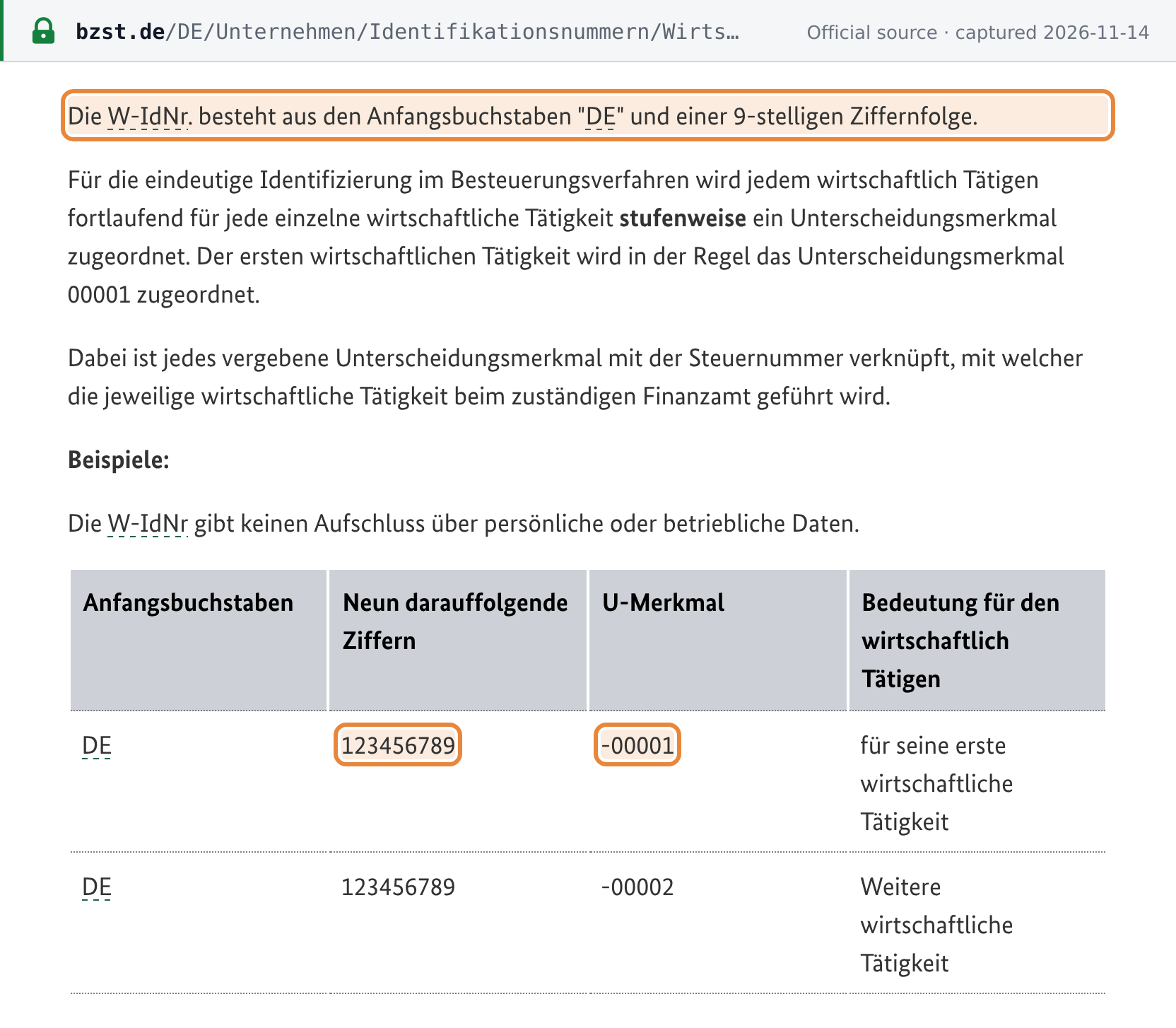
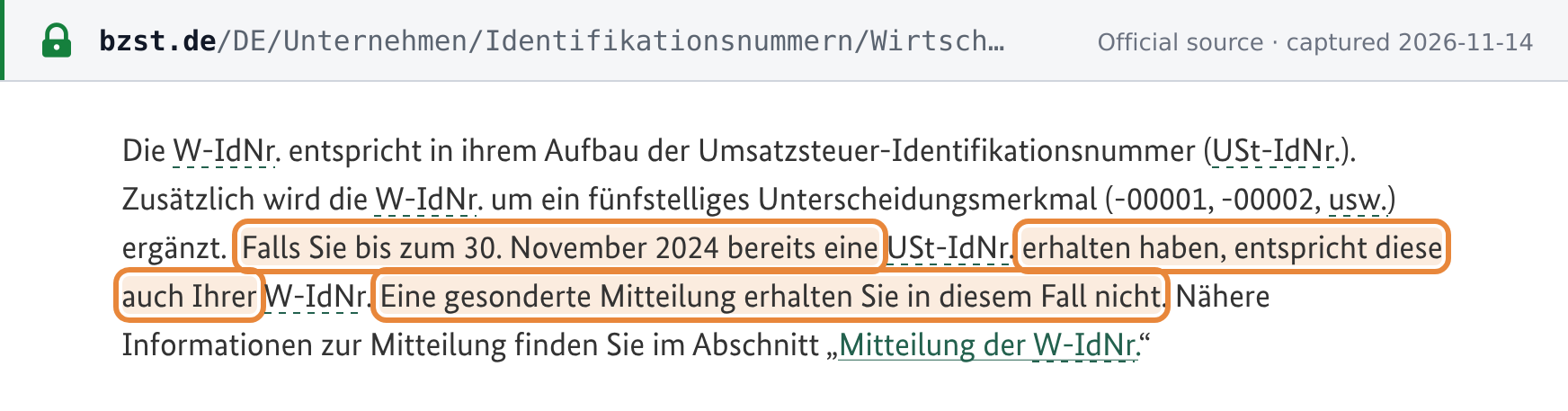
If you already had a USt-IdNr, it is your W-IdNr. For a business that held a USt-IdNr by 30 November 2024, that USt-IdNr is also its W-IdNr from 3 December 2024, with -00001 appended — DE123456789 becomes DE123456789-00001. These businesses receive no individual letter: the BZSt informed them by a public notice in the Federal Tax Gazette (BStBl 2024 I p. 1269). [10] [18] Businesses that had no USt-IdNr by that date, or that start trading later, receive the W-IdNr in their ELSTER mailbox. A business that gets its W-IdNr first and applies for a USt-IdNr later receives a USt-IdNr with the same digits, notified separately. The W-IdNr does not replace the USt-IdNr, which must still be applied for separately and remains required for intra-EU trade. [10]
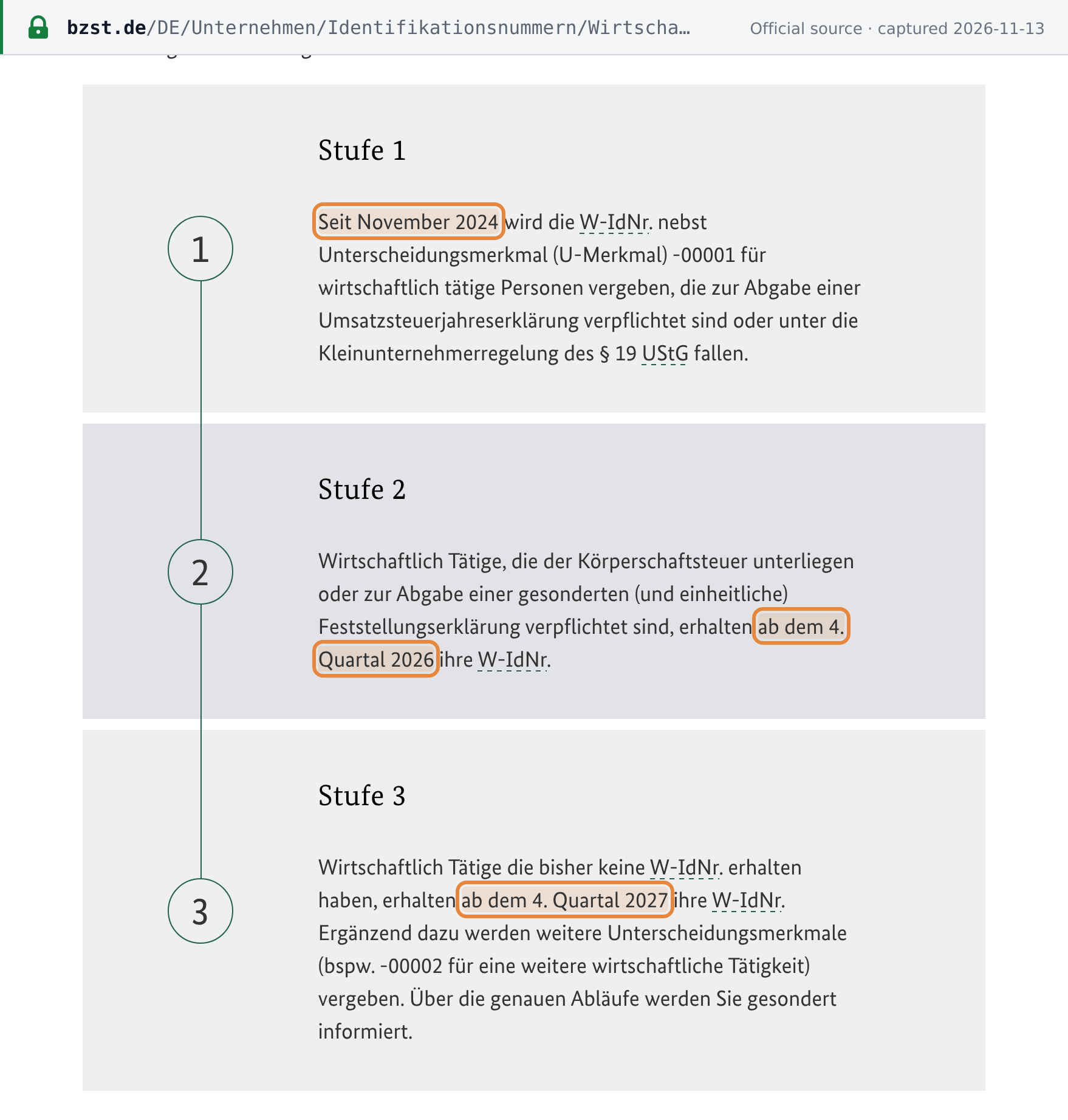
Allocation in stages. As at 14 November 2026, the BZSt's W-IdNr page (dated 10 September 2026) gives this schedule: [10]
| Stage | From | Who receives a W-IdNr |
|---|---|---|
| 1 | November 2024 | Economically active persons obliged to file an annual VAT return, and small businesses under § 19 UStG — with distinguishing number -00001 |
| 2 | 4th quarter of 2026 | Those subject to corporation tax or obliged to file a separate (and uniform) determination return (Feststellungserklärung) |
| 3 | 4th quarter of 2027 | All remaining economically active persons; further distinguishing numbers (such as -00002) are also issued |
The ordinance still names 1 July 2025 as the date from which all other economically active persons are to receive a W-IdNr (WIdV § 1(4)); the BZSt's current schedule above is later. [16] Until the initial allocation is complete, giving the W-IdNr on tax return forms is optional, and returns are filed with the Steuernummer as before. [10]
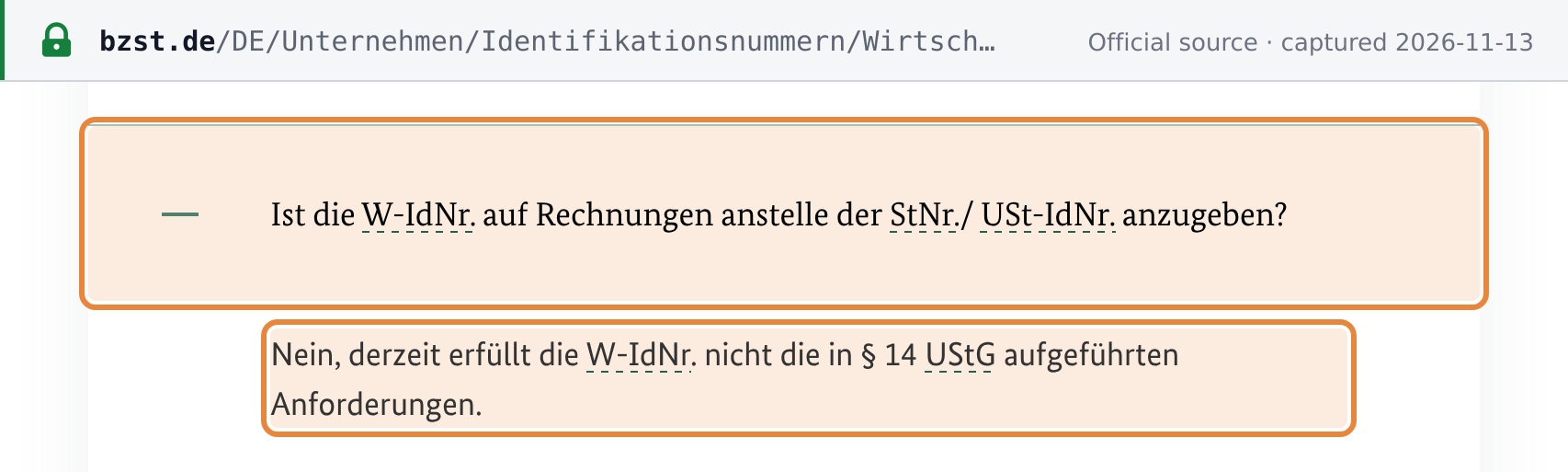
Not an invoice number. Asked whether the W-IdNr is to be given on invoices instead of the Steuernummer or USt-IdNr, the BZSt answers: "Nein, derzeit erfüllt die W-IdNr. nicht die in § 14 UStG aufgeführten Anforderungen" — no, the W-IdNr currently does not meet the requirements of § 14 UStG. It is also not mandatory on business letters. A provider of digital services must show its USt-IdNr or its W-IdNr in the legal notice (Impressum) of its website if it holds one of them (§ 5(1) no. 6 of the Digital Services Act, DDG); the Steuernummer is not required there. [10] [19]
Kleinunternehmer-Identifikationsnummer (KU-IdNr)
A small business established in Germany that wants to use the small-business exemption in another EU member state must join the BZSt's special reporting procedure, and the BZSt issues it a Kleinunternehmer-Identifikationsnummer (§ 19a(1) UStG). One condition is that its turnover in the EU did not exceed EUR 100,000 in the previous calendar year and does not exceed it in the current year. [20] The application is made only electronically through the BZSt online portal, and the business must already be registered for VAT at its Finanzamt. The German exemption (§ 19 UStG) and the EU scheme (§ 19a UStG) are independent of each other, and neither a USt-IdNr nor a W-IdNr is needed to apply. [21] Under Article 284(3) of the EU VAT Directive (as replaced by Directive (EU) 2020/285), the number carries the suffix "EX"; the BZSt does not publish the rest of its structure. [32]
Who Must Register for VAT
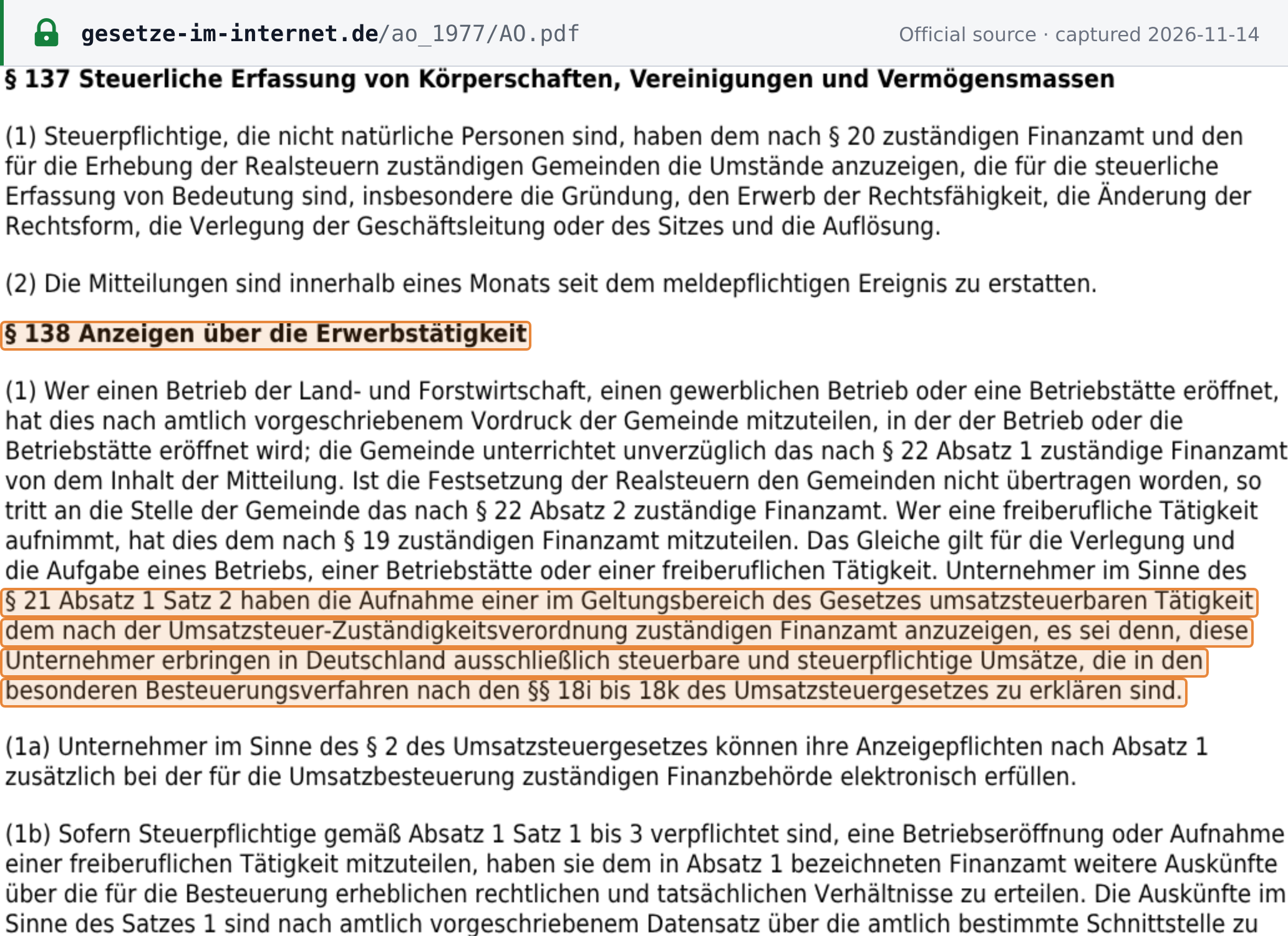
Germany has no VAT registration threshold — for resident or non-resident businesses. Anyone who opens a commercial business or a permanent establishment must notify the municipality, and anyone who takes up a freelance activity must notify the Finanzamt (§ 138(1) AO). Resident businesses then send their Finanzamt the Fragebogen zur steuerlichen Erfassung electronically (§ 138(1b)). Notifications are due within one month of the event (§ 138(4)). [22] The Finanzamt then issues the Steuernummer; the USt-IdNr follows from the BZSt on application.
Non-established businesses (§ 21(1) sentence 2 AO) must notify the start of a VAT-taxable activity in Germany to the Finanzamt that the VAT jurisdiction ordinance (Umsatzsteuer-Zuständigkeitsverordnung) assigns to their country — unless all their taxable supplies in Germany are declared under the OSS/IOSS special schemes (§§ 18i–18k UStG). [22]
EUR 25,000 / EUR 100,000 is an exemption, not a threshold. A small business established in Germany is exempt from charging VAT (§ 19 UStG) if its total turnover did not exceed EUR 25,000 in the previous calendar year and does not exceed EUR 100,000 in the current year (as at 14 November 2026). While the exemption applies, the exemption for intra-EU supplies and the rules on stating VAT numbers on invoices (§ 14a) do not apply (§ 19(1) sentence 2). [23] The exemption does not remove the duty to notify the start of the business under § 138 AO. [22] The EUR 10,000 EU-wide limit for B2C distance sales and telecom, broadcasting and electronic services (§ 3c(4) UStG) decides where such sales are taxed; it is not a German registration threshold. [24] See the worldwide VAT registration thresholds table.
How to Register
- Steuernummer — register with your Finanzamt by sending the Fragebogen zur steuerlichen Erfassung through ELSTER; non-established businesses use the Finanzamt responsible for their country.
- USt-IdNr — tick the box in the same questionnaire, or apply to the BZSt later. [2]
- IdNr and W-IdNr — no application; both are allocated automatically.
For the full walkthrough, documents and the competent tax offices for foreign businesses, see how to register for VAT in Germany.
Which Number Goes on an Invoice
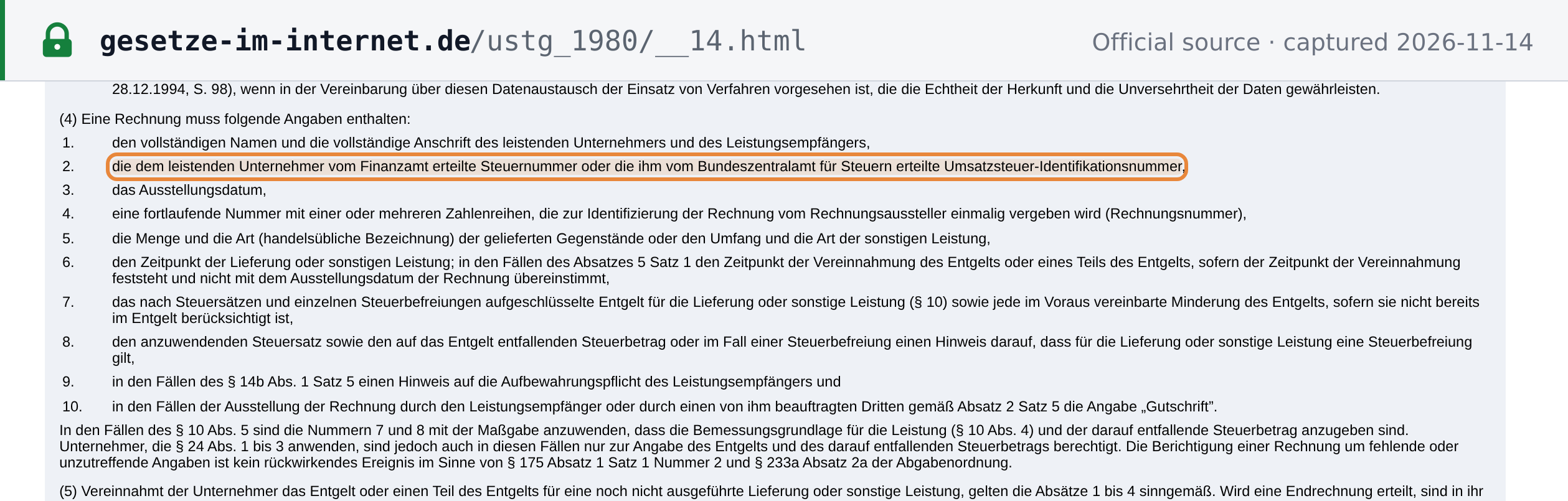
A German invoice must state the supplier's Steuernummer issued by the Finanzamt, or its USt-IdNr issued by the BZSt (§ 14(4) sentence 1 no. 2 UStG). [25] Either one satisfies the rule. The USt-IdNr becomes mandatory, together with the customer's, on an intra-EU supply of goods (§ 14a(3) UStG) and on a B2B service that a German business supplies in another member state under § 3a(2) UStG (§ 14a(1) sentence 3) — there the Steuernummer alone is not enough. [26] The IdNr is not one of the numbers § 14(4) names, and the BZSt states that the W-IdNr currently does not meet the § 14 requirements either (see above).
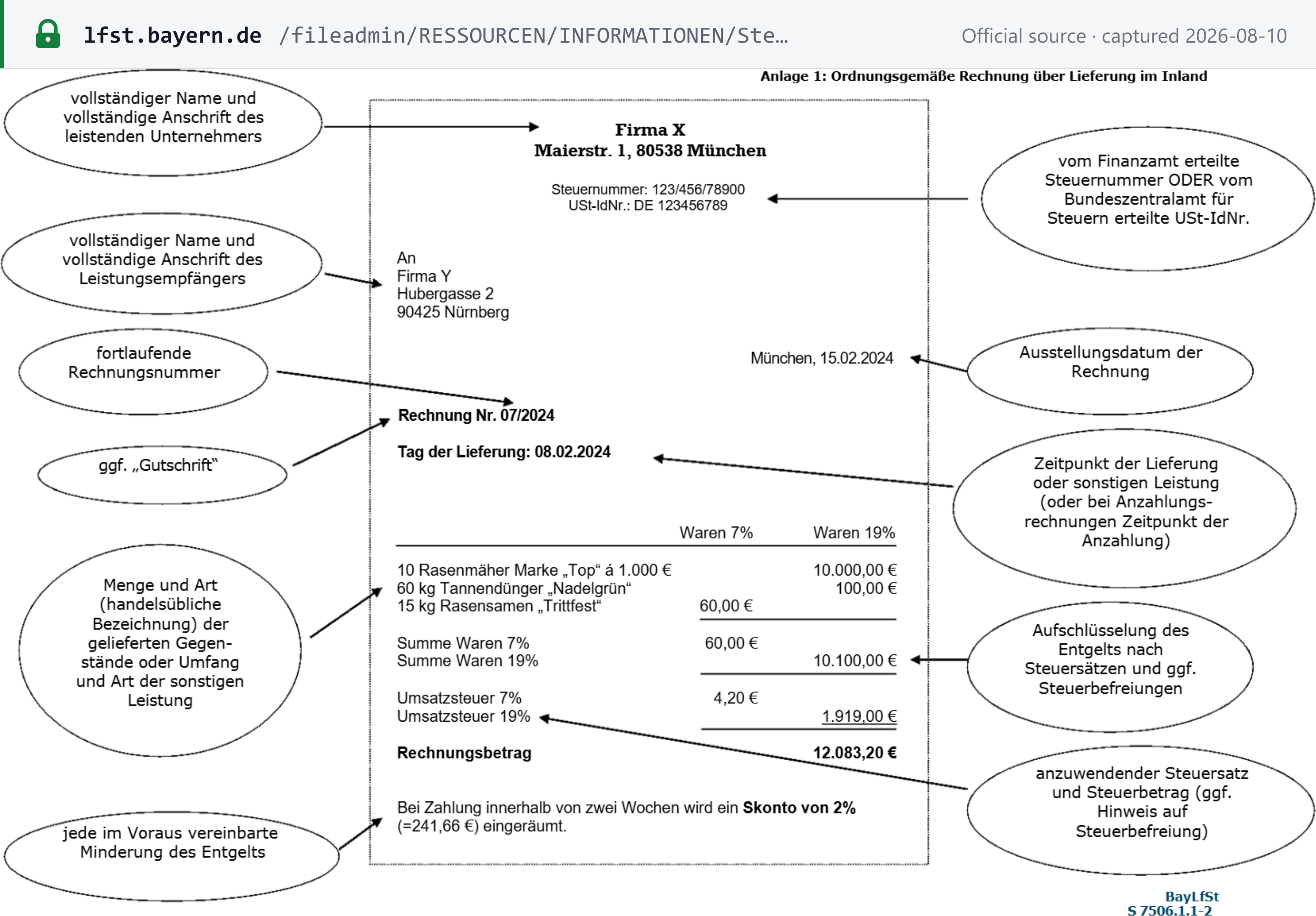
Germany's B2B e-invoicing mandate creates no separate registration number: an e-invoice carries the same Steuernummer or USt-IdNr. As at 14 November 2026, every business established in Germany must be able to receive e-invoices since 1 January 2025; issuers whose previous-year turnover exceeded EUR 800,000 must send them for supplies from 1 January 2027, and other issuers from 1 January 2028 (§ 27(38) UStG). [25] [27] See the Germany e-invoicing guide.
How to Verify a German Tax ID
| Number | Official tool | What it confirms |
|---|---|---|
German USt-IdNr (DE…) | EU VIES — open to anyone | Whether the number is valid for intra-EU trade |
| Another member state's VAT number, checked by a German business | BZSt eVatR — online form or REST API; requires your own DE USt-IdNr | Simple confirmation: valid or not. Qualified confirmation: also whether the name, legal form, street, postcode and town you entered match |
| IdNr | No public lookup — the BZSt tells only the holder, by letter | — |
| Steuernummer | No public lookup | Format and check digit only, using the ELSTER specification |
| W-IdNr | No public lookup. As at 14 November 2026, the BZSt plans a basic machine query procedure (MAV) at the end of 2027, for financial institutions only [10] | — |
eVatR checks foreign numbers, not German ones. On request, the BZSt confirms to a German business the validity of a VAT number "issued by another member state", together with the holder's name and address (§ 18e no. 1 UStG). It confirms German numbers only to operators of electronic interfaces under § 25e UStG (§ 18e no. 3). [28] [29] To check a German USt-IdNr, use VIES. The old XML-RPC interface at evatr.bff-online.de has been obsolete since 30 November 2025; the BZSt now offers the online form and a REST API. [30]
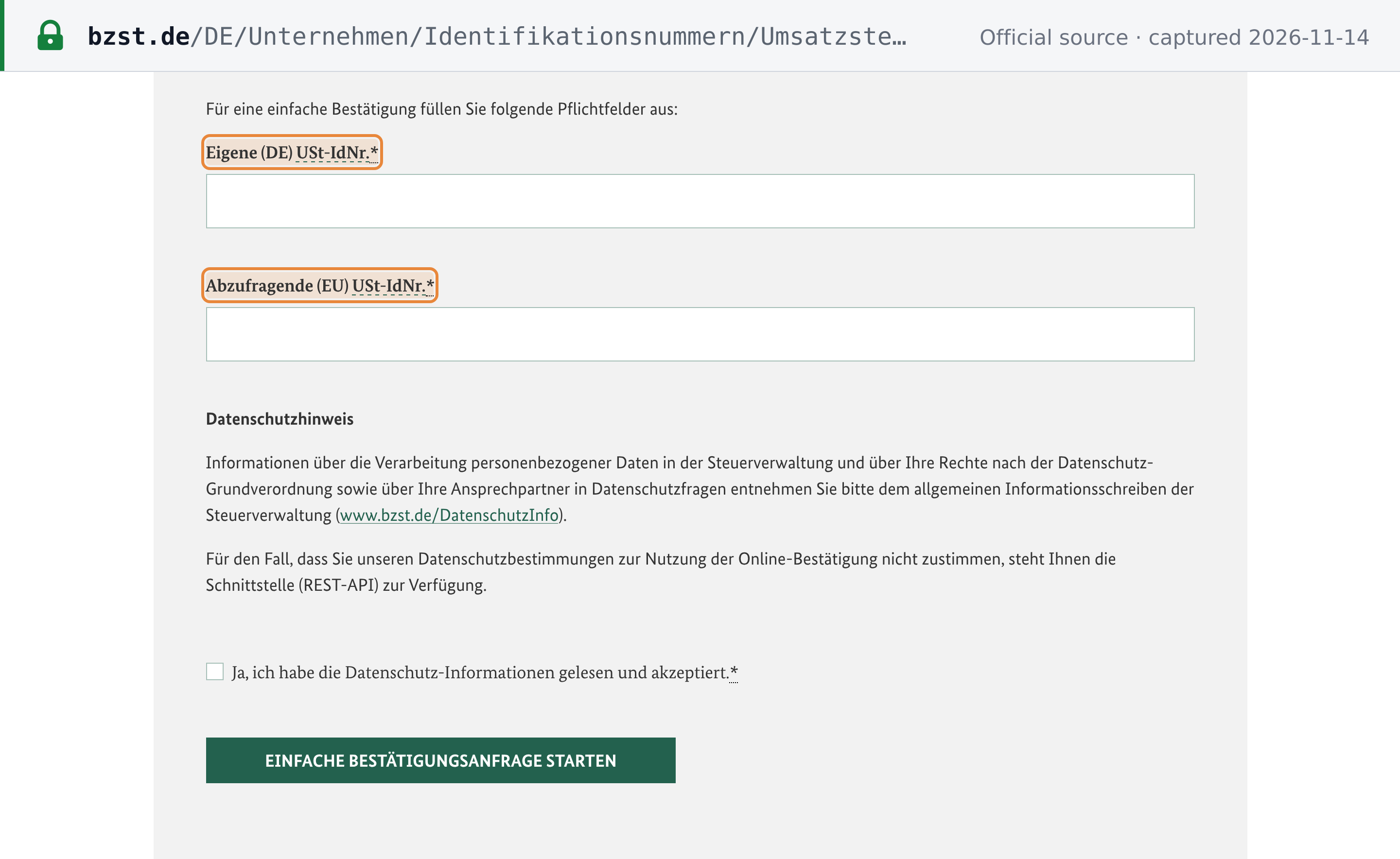
The BZSt's rules for the confirmation service: a simple confirmation must always come before a qualified one; the service is free; and the BZSt sends no written confirmation. With the online form, you keep the printout, or the result as a screenshot or in another common format, as your record. [31] [14]
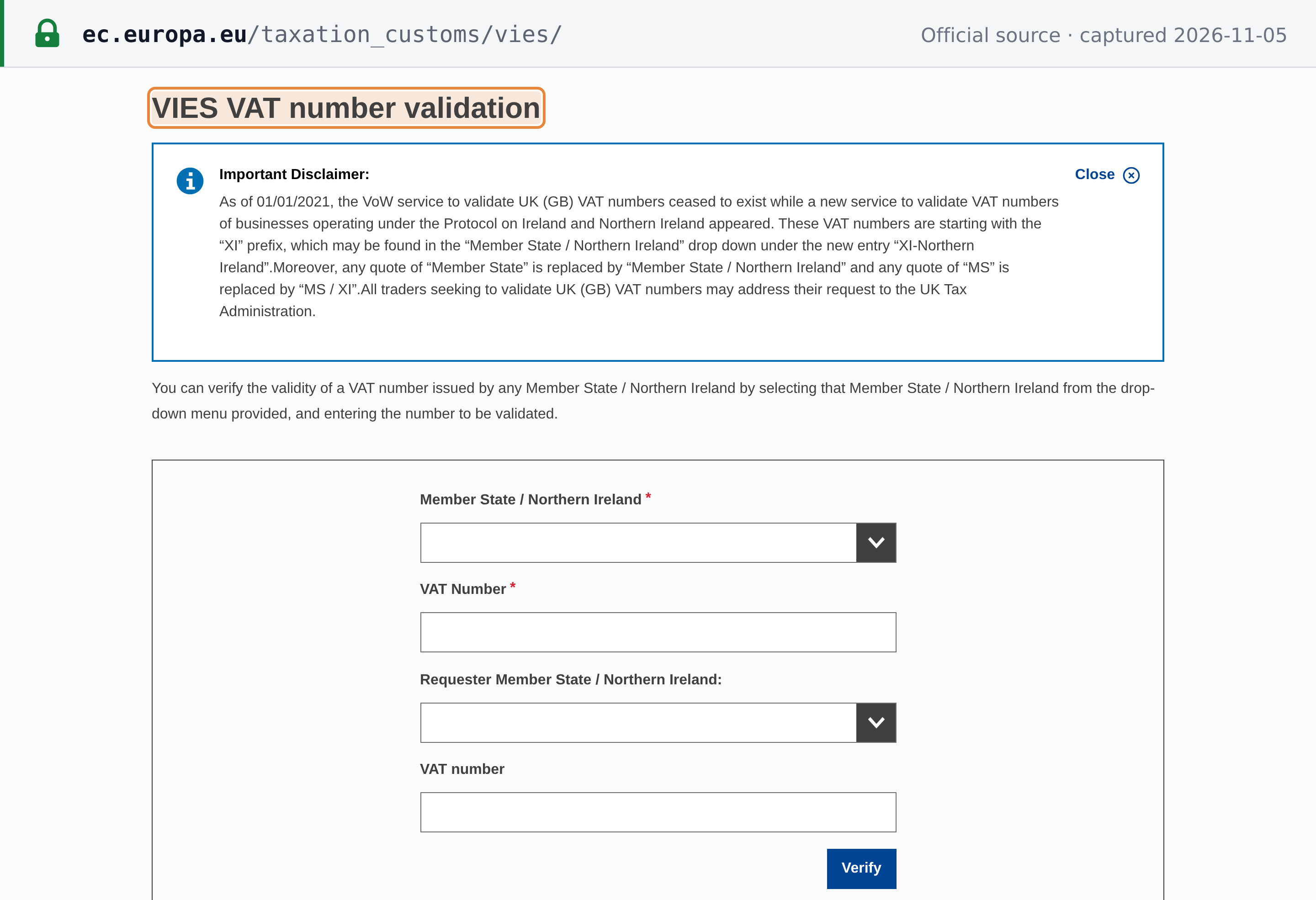
For a step-by-step guide, see how to verify an EU VAT number in VIES. To check a USt-IdNr's format instantly, use the Lookuptax Germany USt-IdNr validator.
Frequently Asked Questions
Which tax number goes on a German invoice — Steuernummer, USt-IdNr or the new W-IdNr?
The Steuernummer or the USt-IdNr — either satisfies § 14(4) no. 2 UStG. On an intra-EU supply of goods, and on a B2B service you supply in another member state, the invoice must show both your USt-IdNr and your customer's. The W-IdNr does not: the BZSt states that it currently does not meet the § 14 UStG requirements, so do not put it on an invoice in place of the Steuernummer or USt-IdNr. The personal IdNr is not an invoice number either.
What happens to my Steuernummer when I move to a different Finanzamt district?
The Steuernummer contains the number of the tax office that keeps your file — the first four digits of its 13-digit federal form — so it is specific to that Finanzamt. If your file moves to another Finanzamt, for example after you move into another district, the new office may issue a new Steuernummer and tells you in writing. If you receive a new Steuernummer, update your invoice templates, because § 14 UStG requires the Steuernummer issued to you by the Finanzamt, or your USt-IdNr. Your IdNr does not change when you move, and the BZSt says the W-IdNr does not change when master data such as the registered seat change.
I lost my Steuer-ID letter — can I retrieve my IdNr online?
Not as an online display: the BZSt communicates the IdNr only by letter, and not by telephone. You can request a new notification through the BZSt's online form or the BZSt online portal (BOP), and the letter is sent by post. The BZSt says processing can currently take up to four weeks, and up to ten weeks where it has queries. The three-month rule in the BZSt FAQ is about a first IdNr after registering your address, not about a new notification.
I had a USt-IdNr before December 2024. Why did I never receive a W-IdNr letter?
Because there is none. If you held a USt-IdNr by 30 November 2024, that number became your W-IdNr from 3 December 2024, with -00001 added — DE123456789 becomes DE123456789-00001. The BZSt announced this by public notice in the Federal Tax Gazette instead of writing to each business, and you can request a new notification through its form. Businesses without a USt-IdNr by that date receive the W-IdNr in their ELSTER mailbox. You do not need it on invoices: the BZSt states that the W-IdNr currently does not meet the § 14 UStG requirements.
Why does the BZSt qualified confirmation say “does not match” for a valid EU VAT number?
The qualified confirmation compares the name, legal form, street, postcode and town you entered with the data registered for the number. According to the BZSt, spelling mistakes, transposed letters or special characters usually do not cause a “does not match” result, and it applies a tolerance whose details it does not disclose. A mismatch therefore usually means the details you entered differ from the registered ones, so ask your business partner for its name and address exactly as registered. A simple confirmation must always be run first. The BZSt sends no written confirmation: keep the printout or a screenshot of the result. Questions about the legal consequences go to your Finanzamt.
Does a Kleinunternehmer need a USt-IdNr to sell to EU customers?
Not to use the EU small-business scheme: the BZSt says neither a USt-IdNr nor a W-IdNr is needed to apply. A German small business that wants the small-business exemption in other member states applies under § 19a UStG through the BZSt online portal while registered for VAT at its Finanzamt; its EU-wide turnover must stay at or below EUR 100,000, and the BZSt issues it a Kleinunternehmer-Identifikationsnummer. The German exemption under § 19 UStG applies while total turnover did not exceed EUR 25,000 in the previous calendar year and does not exceed EUR 100,000 in the current year; while it applies, the exemption for intra-EU supplies and the § 14a rules on stating VAT numbers on invoices do not apply. Sales to consumers in other member states are tested separately: above EUR 10,000 a year EU-wide in distance sales and telecom, broadcasting and electronic services, VAT is due in the customers' countries, and to declare it through the One-Stop-Shop a business applies to the BZSt with its USt-IdNr. Separately, the BZSt's general list of cases that need a USt-IdNr includes receiving services from a business in another member state, which concerns small businesses too.
Related Resources
- Germany VAT guide — rates, registration, invoicing and filing
- How to register for VAT in Germany
- How to verify an EU VAT number in VIES
- Germany e-invoicing — XRechnung, ZUGFeRD and the B2B mandate
- Germany tax changes — chronology
- Lookuptax Germany USt-IdNr validator
- Worldwide VAT, GST and sales tax registration thresholds
- Worldwide directory of VAT and tax ID names
How Lookuptax can help you in VAT validation?
Lookuptax VAT validation revolutionizes VAT number validation with its robust platform, empowering businesses to seamlessly verify VAT numbers across over 100 countries. Our cutting-edge technology ensures accurate and efficient validation, reducing errors and enhancing compliance.