Austria Tax ID Numbers — Steuernummer, UID (ATU) and Firmenbuchnummer Explained
Austria has no single all-purpose tax ID. A business meets three numbers: the Steuernummer (tax number, St.Nr.), a 9-digit number that identifies the taxpayer's file and tax account for every tax, VAT included; the Umsatzsteuer-Identifikationsnummer (UID-Nummer, VAT identification number), written ATU plus 8 digits; and the Firmenbuchnummer (FN, commercial-register number), which is not a tax number at all. The Steuernummer and the UID are issued by the tax office — the Finanzamt Österreich, or the Finanzamt für Großbetriebe for large businesses — under the Federal Ministry of Finance (BMF — Bundesministerium für Finanzen). The Firmenbuchnummer is assigned in the commercial register (Firmenbuch) kept by the courts, which the public searches through the Ministry of Justice's JustizOnline service. The Unternehmensserviceportal (USP), the federal business portal for which the BMF is responsible, puts the distinction in two sentences: "Das Finanzamt erteilt eine 9-stellige Steuernummer, die der Ordnungsbegriff des Unternehmens ist, und legt einen neuen Steuerakt an." … "Von der Steuernummer zu unterscheiden ist die Umsatzsteuer-Identifikationsnummer (UID)." (The tax office issues a 9-digit tax number, which is the company's reference identifier, and opens a new tax file. … The tax number is to be distinguished from the VAT identification number, UID.) [1] For VAT rates, invoicing and filing, see the Austria VAT guide.
Austria's Tax IDs at a Glance
| Steuernummer | UID-Nummer | Firmenbuchnummer (FN) | |
|---|---|---|---|
| Local name | Steuernummer (St.Nr.) | Umsatzsteuer-Identifikationsnummer (UID) | Firmenbuchnummer |
| Format | 9 digits, printed 99 999/9999 | ATU + 8 digits | Up to 6 digits + a check letter, written FN 100233 i |
| Regex | ^\d{9}$ (separators removed) | ^ATU\d{8}$ | ^\d{1,6}[a-z]$ ("FN" and spaces removed) |
| Example | 03 999/9032 — BMF "fictitious" number | ATU99999999 — the European Commission's structure notation | FN 100233 i — fictitious example in a Ministry of Justice training script |
| Who has it | Every taxpayer registered with the tax office; individuals only if liable to tax | VAT-registered businesses (see who must register) | Every entity entered in the Firmenbuch |
| Issued by | Finanzamt Österreich / Finanzamt für Großbetriebe | Same tax offices | Firmenbuch courts |
| Public lookup | None | EU VIES; FinanzOnline UID confirmation procedure | JustizOnline (court fees apply) |
| On a VAT invoice? | Not required by § 11 UStG | Yes — see which number goes on an invoice | Not required by § 11 UStG |
Steuernummer
| Field | Detail |
|---|---|
| Official name | Steuernummer (St.Nr.) |
| Format | 9 digits; the first two are the number of the tax office (Finanzamtsnummer) |
| Display | 99 999/9999 (BMF); the Finanzamt für Großbetriebe prints it with a hyphen, e.g. 11-999/9118. Spaces, hyphens and slashes are display only |
| Regex | ^\d{9}$ after removing separators |
| Example | 03 999/9032 — the BMF's "fictitious" Steuernummer for the Vienna 3/6/7/11/15 Schwechat Gerasdorf office |
| Issued by | The tax office, when the taxpayer registers |
The tax office opens a tax account (Abgabenkonto) under the taxpayer's name and Steuernummer, and every payment runs through it: "Unter dem jeweiligen Namen und der Steuernummer richtet das Finanzamt ein Abgabenkonto ein. Auf dieses Konto muss das Unternehmen in der Folge sämtliche Zahlungen, wie z.B. für Umsatz-, Einkommen-, Körperschaftsteuer, lohnabhängige Abgaben, Normverbrauchsabgabe etc. leisten." (Under the respective name and tax number the tax office sets up a tax account. The business must then make all payments to this account, for example for VAT, income tax, corporation tax, payroll levies, the standard fuel consumption levy, etc.) [1] So the Steuernummer covers VAT as well as the direct taxes. "Abgabenkontonummer" is not the official name of the number: the Abgabenkonto is the account kept under the Steuernummer.
The BMF states that the nine-digit Steuernummer must be given when paying through the banks' "Finanzamtszahlung" (tax office payment) service, that it is first notified in writing when the tax account is allocated, and that it appears on every written document from the office, such as assessments (Bescheide). It also states: "Die Steuernummer bleibt unveränderlich." (The tax number does not change.) Only the bank details can change with the office. [2] Since the 2021 reform there is one national Finanzamt Österreich, with local Dienststellen; the first two digits still identify the office, as the BMF's table shows (03 = Dienststelle Wien 3/6/7/11/15 Schwechat Gerasdorf, 68 = Dienststelle Graz-Stadt, 11 = Finanzamt für Großbetriebe).
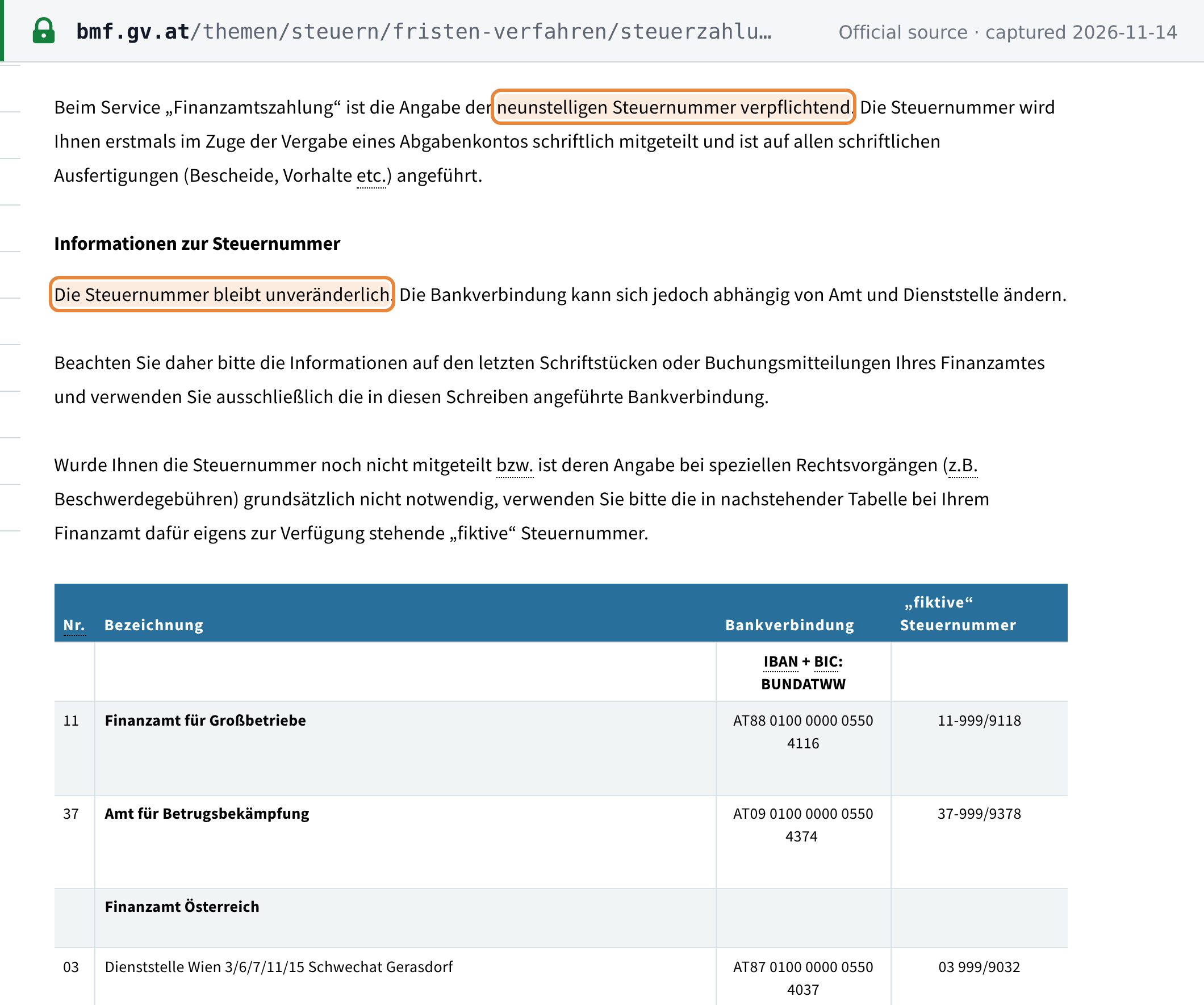
Fictitious numbers are safe examples. The BMF publishes one "fiktive" Steuernummer per office, for payments made before a number has been notified. They identify no taxpayer, which makes them the right test values. [2]
No card, no public register. Austria issues no tax ID card: the Steuernummer is printed on assessments, and the OECD's Austria TIN sheet confirms that no TIN cards are issued, that individuals receive one only if they are liable to tax, and that no TIN verification tool is available. [23] Taxpayers manage the number through FinanzOnline, the BMF's e-tax portal; since 1 October 2025 FinanzOnline can be accessed only with two-factor authentication ("Mit 1. Oktober 2025 wird der Zugang zu FinanzOnline nur mehr mit einer 2-Faktor-Authentifizierung möglich sein"). [19]
Umsatzsteuer-Identifikationsnummer (UID)
| Field | Detail |
|---|---|
| Official name | Umsatzsteuer-Identifikationsnummer (UID-Nummer), Art. 28 of the UStG 1994 annex (Binnenmarktregelung) |
| Format | 11 characters: country code AT, a fixed U, then 8 digits |
| Regex | ^ATU\d{8}$ |
| Example | ATU99999999 — the European Commission's structure notation; no official sample number is published |
| Issued by | The tax office — automatically for most VAT-registered businesses, on application for the rest |
The USP describes the UID as "eine individuelle Identifikationsnummer für Unternehmen, die zur Umsatzsteuer registriert sind. Jedes Unternehmen erhält nur eine österreichische UID, auch wenn es mehrere Betriebe hat bzw. mehrere Tätigkeiten ausübt." (an individual identification number for businesses registered for VAT. Each business receives only one Austrian UID, even if it has several establishments or carries on several activities.) Giving the UID signals that you are buying as a business, not as a consumer, and where the business is established. [3]
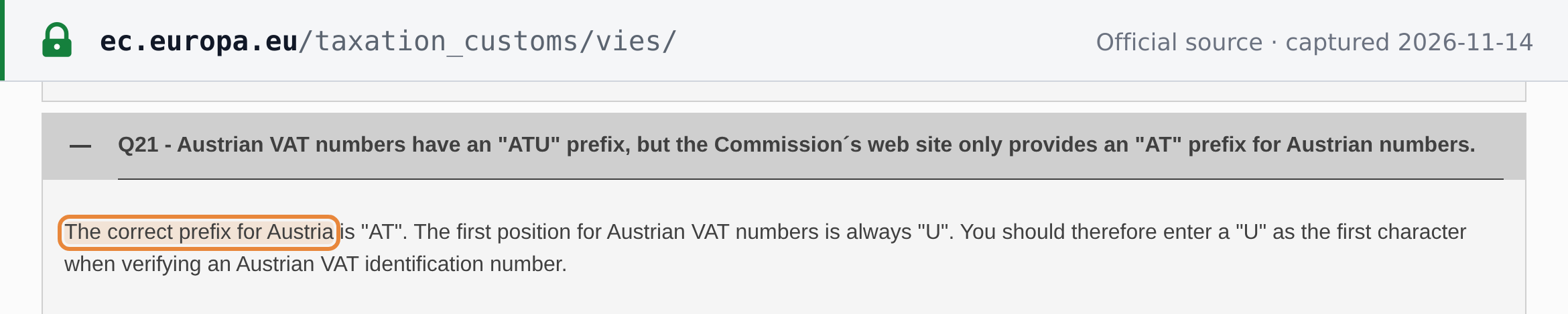
The U belongs to the number, not to the country code. VIES, the European Commission's VAT number check, lists Austria under the country code AT, not ATU. Its FAQ explains: "The correct prefix for Austria is "AT". The first position for Austrian VAT numbers is always "U". You should therefore enter a "U" as the first character when verifying an Austrian VAT identification number." [4] So a system that stores the country code separately should store AT and U12345678; the number fails if the U is dropped (AT + 12345678).
Common format errors:
AT12345678— theUis missing.ATU1234567— only 7 digits.ATU 1234 5678— strip spaces before validating; the stored form has none.DE…orCHE-…numbers — the German VAT number has noU, and the Swiss "UID" (CHE-123.456.789) is a different system with the same abbreviation.
Numbers that are not UIDs: EU, IM, IN and -EX
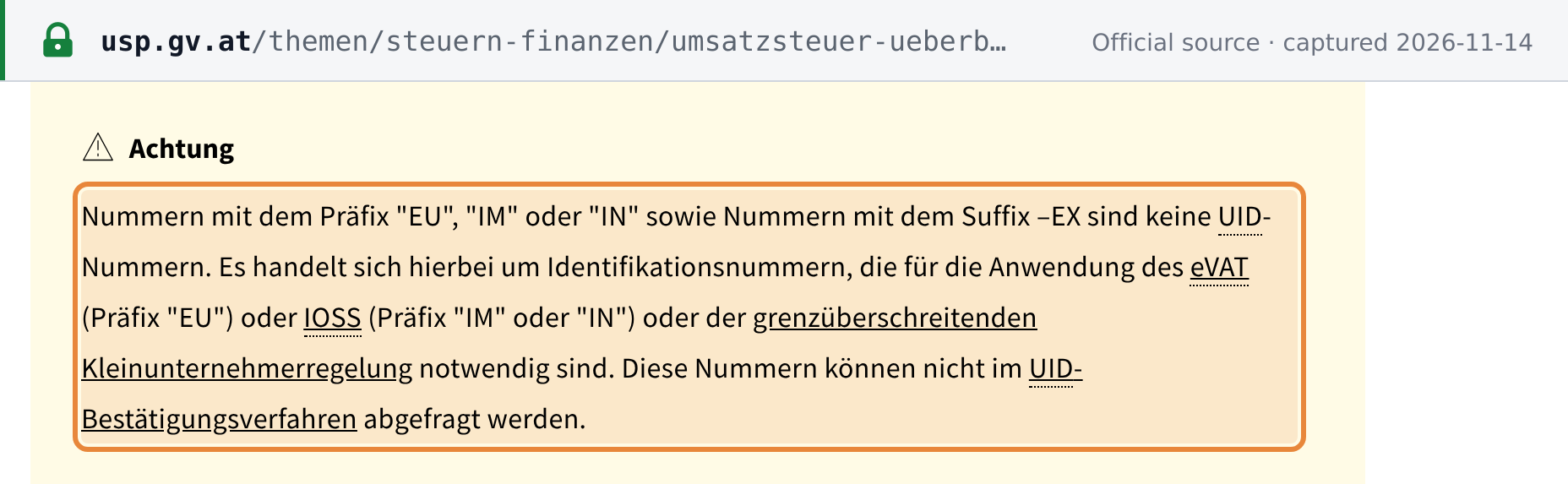
The USP warns: "Nummern mit dem Präfix "EU", "IM" oder "IN" sowie Nummern mit dem Suffix –EX sind keine UID-Nummern." (Numbers with the prefix EU, IM or IN and numbers with the suffix -EX are not UID numbers.) They are identification numbers for the non-Union One-Stop-Shop scheme (prefix EU), the Import One-Stop-Shop (prefix IM or IN) or the cross-border small-business scheme (suffix -EX), and they cannot be checked in the UID confirmation procedure. [3] A validator that rejects them as UIDs is right to do so; see the OSS explainer and the EU VAT SME scheme explainer.
Firmenbuchnummer (FN)
| Field | Detail |
|---|---|
| Official name | Firmenbuchnummer (FN), § 30 of the Commercial Register Act (Firmenbuchgesetz, FBG) |
| Format | Up to six digits followed by a check character, a lowercase letter |
| Regex | ^\d{1,6}[a-z]$ (remove the "FN" label and spaces first) |
| Example | FN 100233 i — from a Ministry of Justice training script whose data are fictitious |
| Issued by | The Firmenbuch courts, on entry in the register |
The USP: "Jedem Rechtsträger wird im Firmenbuch eine Nummer (die Firmenbuchnummer) zugewiesen, die aus maximal sechs Ziffern und einem Prüfbuchstaben besteht." (Every legal entity is assigned a number in the Firmenbuch, the Firmenbuchnummer, consisting of at most six digits and a check letter.) [5] The statute says each entity is kept "unter einer fortlaufenden Nummer" (under a sequential number). [6] The Ministry of Justice's training script adds that the number is allocated nationwide in sequence and that "Zu jeder Firmenbuchnummer wird ein Prüfzeichen in Form eines Kleinbuchstaben (zB FN 100233 i) vergeben" (each Firmenbuchnummer is given a check character in the form of a lowercase letter, e.g. FN 100233 i); the script states that its names and data are invented. [7]

As at 14 November 2026 the USP lists the entities entered: sole traders once their turnover exceeds EUR 700,000 in two consecutive financial years or EUR 1 million in one year, general and limited partnerships (OG, KG), AG, GmbH and FlexCo companies, cooperatives, mutual insurance associations, savings banks, private foundations, European companies, cooperatives and economic interest groupings (SE, SCE, EEIG), and other entities whose registration the law provides for. [5] Domestic entities and domestic branches of foreign entities are also assigned a European Unique Identifier (EUID) (FBG § 37(2)). [8] The FN is a company-law identifier, not a tax number, and § 11 UStG does not require it on invoices.
The official search is JustizOnline. Searches and extracts carry court fees; as at 14 November 2026 the USP lists EUR 4.89 for a current extract and EUR 8.20 for an extract with historical (deleted) data. [5] Private websites such as firmenbuch.at resell extracts as authorised clearing agents (Verrechnungsstellen); they are not the official portal.
Check Digits — None Published
None of the three numbers has an officially published check-digit algorithm:
- UID — neither the USP's UID pages nor Art. 28 of the UStG annex publish one, and the European Commission states that it "cannot divulge these algorithms" and publishes only the structure (
ATU99999999for Austria). [4] Open-source validators implement a check on the last digit, but it is a convention, not an official rule: validate a UID through VIES or FinanzOnline. - Steuernummer — the BMF and USP pages cited here publish no algorithm, and the OECD sheet gives none. [2] [23] Check the length and the office prefix; confirm the number against the taxpayer's assessment notice.
- Firmenbuchnummer — the Ministry of Justice says only that a lowercase check letter is assigned. [7] Confirm an FN in JustizOnline.
To check a UID's format instantly, use the Lookuptax Austria UID validator.
Who Must Register
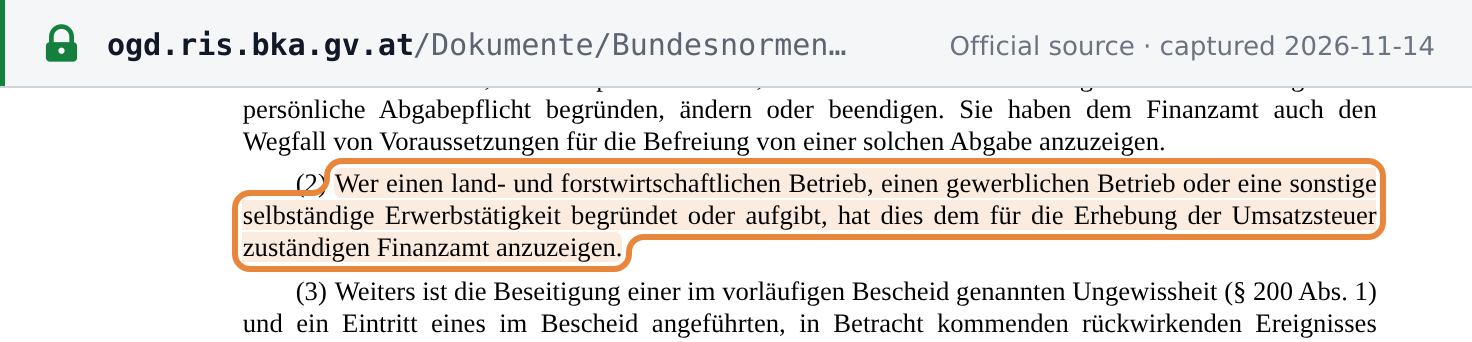
Every business must notify the tax office — Austria has no registration threshold. Under § 120(2) of the Federal Fiscal Code (Bundesabgabenordnung, BAO): "Wer einen land- und forstwirtschaftlichen Betrieb, einen gewerblichen Betrieb oder eine sonstige selbständige Erwerbstätigkeit begründet oder aufgibt, hat dies dem für die Erhebung der Umsatzsteuer zuständigen Finanzamt anzuzeigen." (Anyone who starts or gives up an agricultural or forestry business, a commercial business or another self-employed activity must notify the tax office responsible for VAT.) [9] The notification is due within one month of the event (BAO § 121). [10] The tax office then issues the Steuernummer. The EUR 55,000 small-business limit below is an exemption from charging VAT, not a registration threshold.
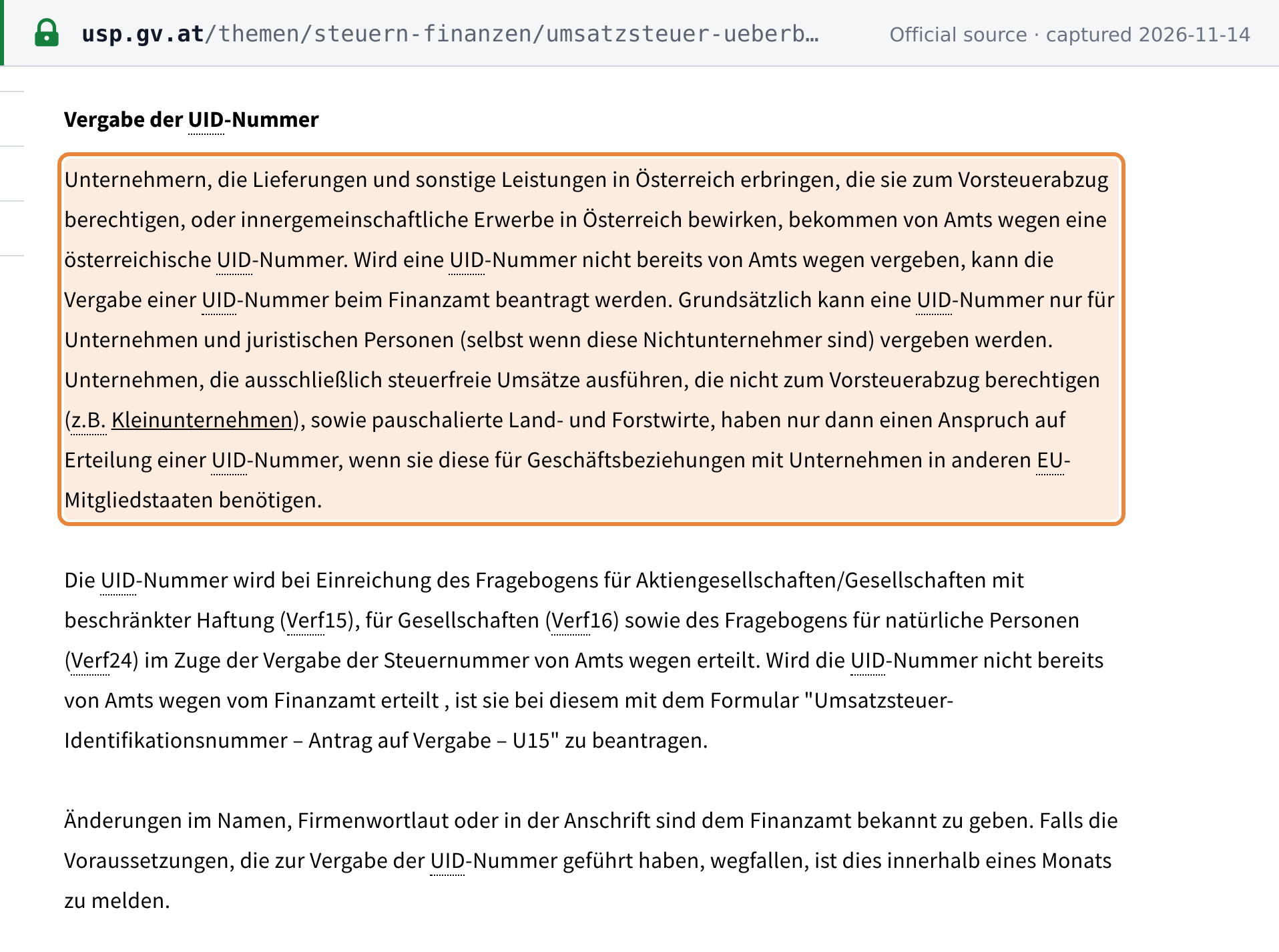
Who receives a UID. The tax office must issue a UID to businesses that make supplies in Austria carrying the right to deduct input tax, make intra-EU acquisitions, or use the § 25b or Art. 25a special schemes. Businesses that make only exempt supplies without input-tax deduction, and flat-rate farmers, receive one only on application and only if they need it for intra-EU supplies or acquisitions or for cross-border services under the reverse charge. In a VAT group (Organschaft), each legal person can obtain its own UID on application. Changes in the circumstances on which the UID was granted — in particular giving up the business — must be reported to the tax office within one calendar month (Art. 28(1) of the UStG annex). [11] In practice the UID is issued ex officio together with the Steuernummer when the registration questionnaire is filed (Verf15 for AG and GmbH, Verf16 for other companies, Verf24 for natural persons); otherwise it is applied for on form U15. [3]
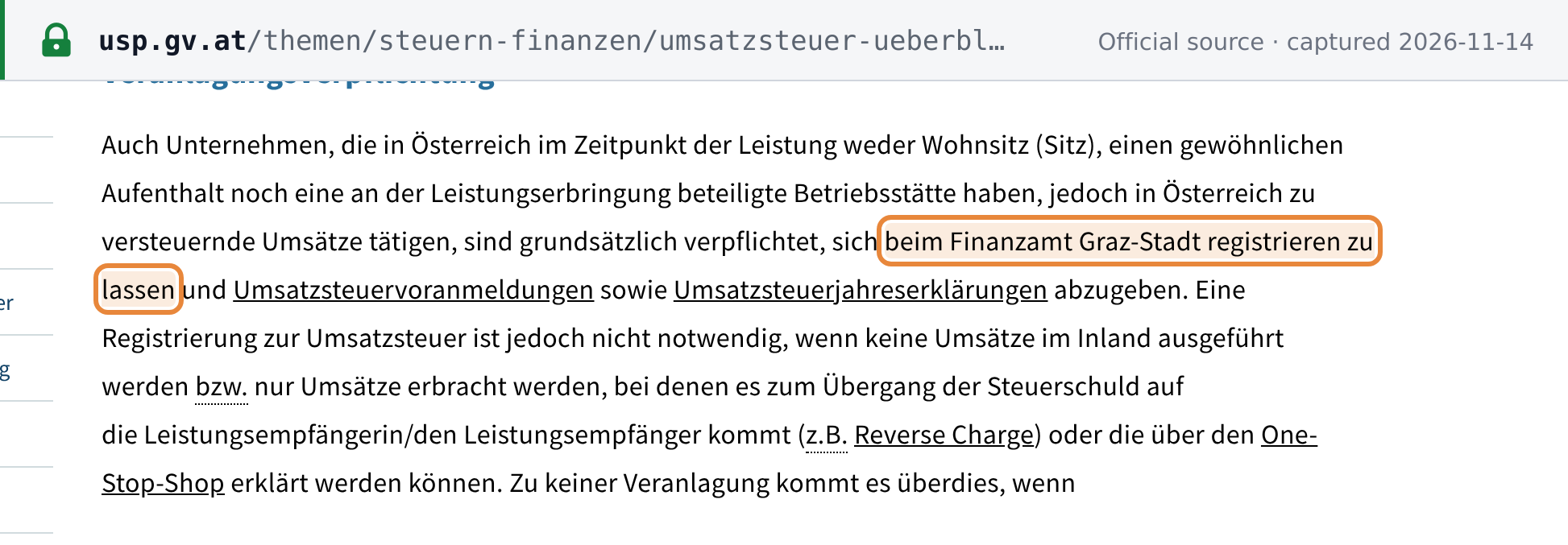
Non-established businesses: no threshold. The USP: businesses with no residence, seat or participating establishment in Austria that make supplies taxable in Austria "sind grundsätzlich verpflichtet, sich beim Finanzamt Graz-Stadt registrieren zu lassen und Umsatzsteuervoranmeldungen sowie Umsatzsteuerjahreserklärungen abzugeben" (are in principle obliged to register with the Graz-Stadt tax office and file VAT advance returns and annual VAT returns). Registration is not needed if they make no supplies in Austria, or only supplies for which the customer owes the VAT (reverse charge) or which can be declared through the One-Stop-Shop. [16] A business with no residence, seat or establishment in the EU that makes taxable supplies in Austria must appoint a fiscal representative, except for supplies for which the customer is liable under § 27(4) UStG, or where its home state has a mutual-assistance agreement with Austria comparable in scope to the EU's (§ 27(7) UStG). [17]
Kleinunternehmer exemption — EUR 55,000
As at 14 November 2026, a small business (Kleinunternehmer) is exempt from charging VAT under § 6(1) Z 27 UStG if its turnover "die Umsatzgrenze von 55 000 Euro (Kleinunternehmergrenze) im vorangegangenen Kalenderjahr nicht, und im laufenden Jahr noch nicht übersteigen" (did not exceed the turnover limit of EUR 55,000 in the previous calendar year and does not yet exceed it in the current year). The limit is measured on the full agreed consideration, not on a net amount after notional VAT. [12] The EUR 55,000 limit has applied since 1 January 2025; until 31 December 2024 it was EUR 35,000. [13] The USP calls it a gross limit: "Die neue Umsatzgrenze ist eine Brutto-Grenze." [14] See the event record for the 2025 change.

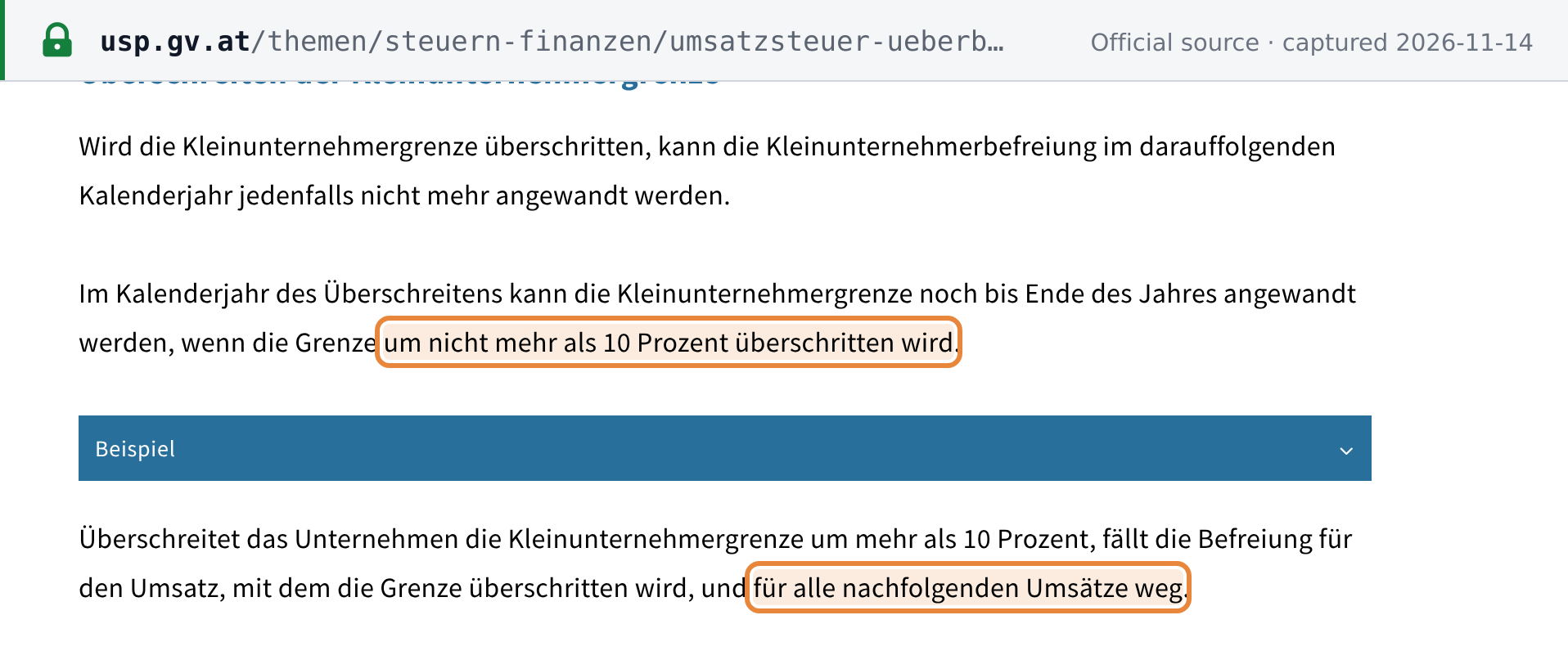
Crossing the limit. If turnover exceeds EUR 55,000 by no more than 10% (up to EUR 60,500), the exemption still applies until the end of that calendar year and is lost from the next year. If it exceeds the limit by more than 10%, "fällt die Befreiung für den Umsatz, mit dem die Grenze überschritten wird, und für alle nachfolgenden Umsätze weg" (the exemption falls away for the supply with which the limit is exceeded and for all subsequent supplies). [13] The statute says the exemption is no longer applicable "ab diesem Zeitpunkt" (from that point). [12] Supplies made earlier in the year stay exempt; the USP labels retroactive taxation of the whole calendar year as the old law, in force until 31 December 2024.
A domestic small business can waive the exemption (option for taxation, form U12); the USP states the waiver "bindet für fünf Jahre" (binds for five years). A Kleinunternehmer receives a UID only if it needs one for business with other EU member states, on form U15. [13]
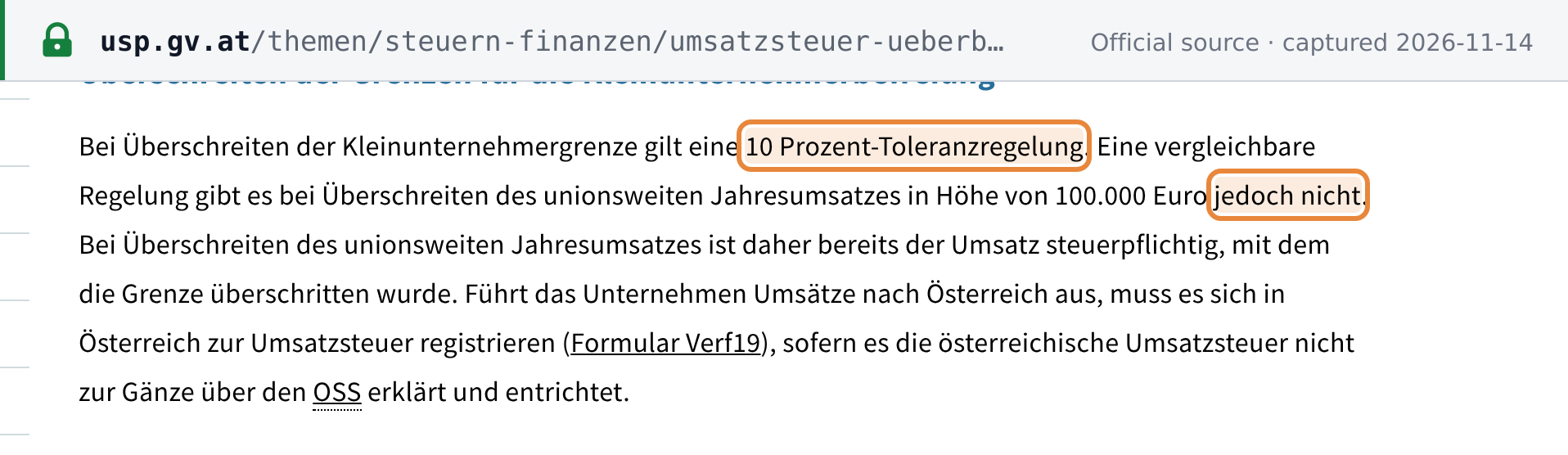
EU businesses (cross-border SME scheme, since 1 January 2025). A business established in another member state can use Austria's exemption without registering in Austria if it applies in its home state, its Austrian turnover stays within EUR 55,000 and its EU-wide turnover within EUR 100,000 in the previous and the current calendar year. The exemption applies only once the home state has issued its small-business number with the suffix -EX. The 10% tolerance applies to the EUR 55,000 limit, but "Eine vergleichbare Regelung gibt es bei Überschreiten des unionsweiten Jahresumsatzes in Höhe von 100.000 Euro jedoch nicht" (there is no comparable rule for exceeding the EU-wide annual turnover of EUR 100,000): the supply that crosses it is already taxable, and the business must register in Austria on form Verf19 unless it declares and pays all its Austrian VAT through the One-Stop-Shop. [15] See the EU VAT SME scheme explainer and the event record.
See also the worldwide VAT registration thresholds table.
How to Register
- Domestic businesses — file the registration questionnaire for your legal form (Verf15 for AG and GmbH, Verf16 for other companies, Verf24 for natural persons). The tax office issues the Steuernummer and, in the same step, the UID ex officio; where no UID was issued, apply on form U15. [3]
- Non-established businesses — apply to Finanzamt Österreich, Dienststelle Graz-Stadt, for a Steuernummer before the first VAT advance return, with the questionnaire Verf19; corporations add the specimen-signature sheet Verf26 in original and a copy of their commercial-register extract and/or articles; every applicant adds proof of registration as a business, in original. [16] The office's address is Conrad von Hötzendorf-Straße 14-18, 8010 Graz, and "Es sollten sämtliche Eingaben in deutscher Sprache eingereicht werden" (all submissions should be made in German). [18]
- FinanzOnline access from abroad — natural persons resident in a state with eIDAS-compliant electronic identification can log on with it directly; others can obtain login details through the BMF's video identification procedure, together with the questionnaire Verf17, Verf18 or Verf19 if they have no Steuernummer yet. [20] Companies have a separate video identification route (form FON1U); where several people are jointly authorised to represent the company, all of them must take part, unless one is excused by a certified special power of attorney bearing a qualified electronic signature. [28]
For the general process across countries, see how to register for VAT, GST and sales tax.
Which Number Goes on an Invoice
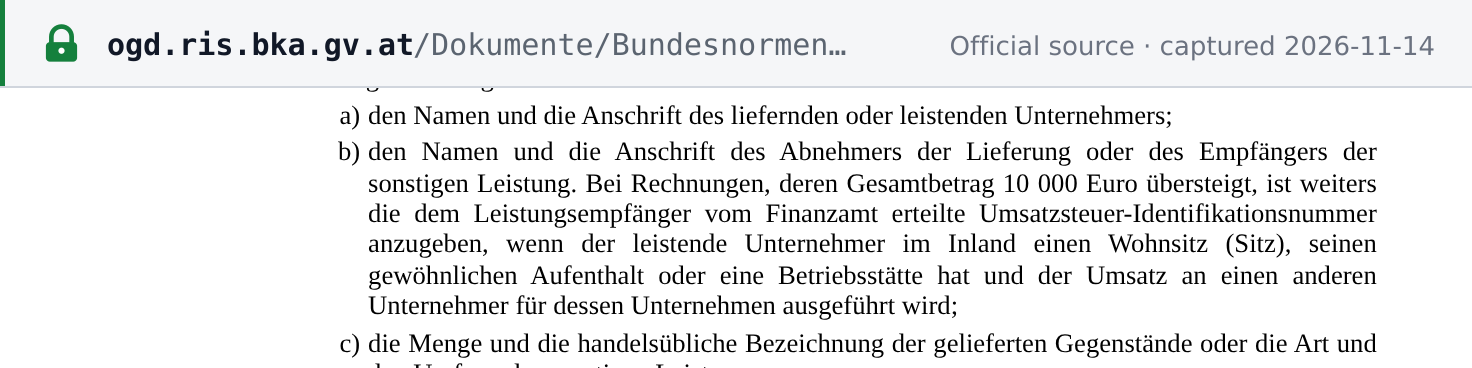
Under § 11 UStG (version in force since 24 December 2025), an invoice must show: [21]
-
the supplier's own UID, where the supplier makes supplies in Austria carrying the right to deduct input tax (§ 11(1) Z 3 lit. i);
-
the customer's UID as well, where the invoice total exceeds EUR 10,000, the supplier has a residence, seat or establishment in Austria, and the supply is made to another business for its business (§ 11(1) Z 3 lit. b);
-
the customer's UID and a reference to the customer's liability on reverse-charge invoices (§ 11(1a)).
Invoices of up to EUR 400, and invoices issued by a business using the Kleinunternehmer exemption, may use the simplified content of § 11(6), which does not include a UID. [21] The Steuernummer and the Firmenbuchnummer are not among the § 11 invoice particulars.
E-invoicing. As at 14 November 2026, Austria requires structured e-invoices only for supplies to the federal government, and there is no B2B e-invoicing mandate; no separate e-invoicing registration number rides on the UID. [24] Between businesses, an electronic invoice counts as an invoice only if the recipient agrees to it: "Als Rechnung gilt auch eine elektronische Rechnung, sofern der Empfänger dieser Art der Rechnungsausstellung zustimmt" (§ 11(2) UStG). [21] See the Austria e-invoicing guide.
How to Verify an Austrian Tax ID
| Number | Official tool | What it confirms |
|---|---|---|
Austrian UID (ATU…) | EU VIES — free, no login; choose AT and enter U + 8 digits | Whether the number is valid for intra-EU trade; for Austrian numbers VIES also displays name and address |
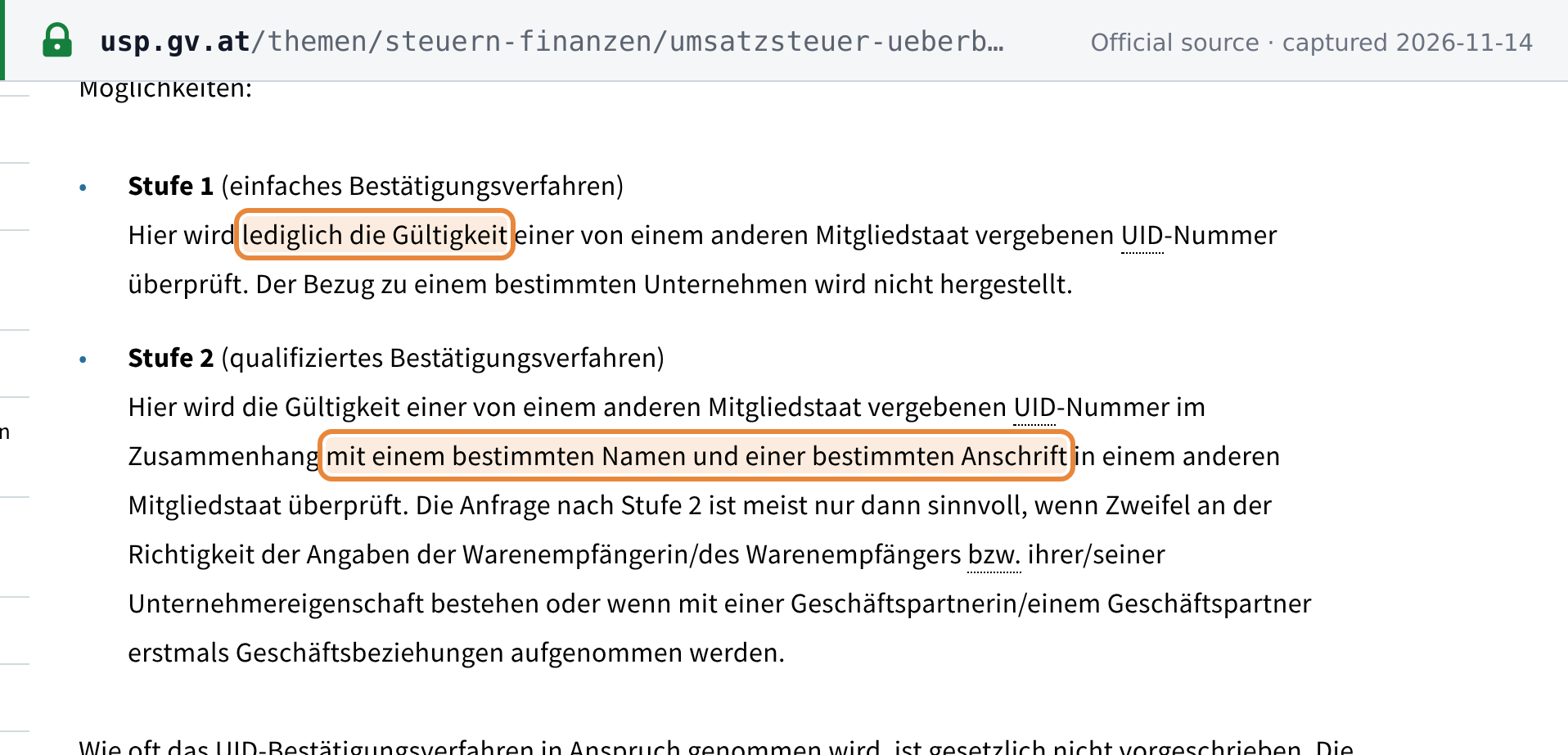
| Another member state's VAT number, checked by an Austrian business | FinanzOnline UID confirmation procedure (UID-Bestätigungsverfahren) — login required | Level 1: validity only. Level 2: validity together with a specific name and address |
| Steuernummer | No public lookup | Format only; confirm against the taxpayer's assessment notice |
| Firmenbuchnummer | JustizOnline Firmenbuchabfrage — court fees apply | Registered entity, its data and its history |
The USP: "Jedes Unternehmen hat die UID-Nummern-Abfrage verpflichtend über FinanzOnline durchzuführen." (Every business must carry out UID queries through FinanzOnline.) Level 1 (einfaches Bestätigungsverfahren) checks only the validity of a UID issued by another member state; level 2 (qualifiziertes Bestätigungsverfahren) checks it together with a specific name and address. How often the procedure is used is not prescribed by law, and a UID confirmed as valid can be treated as valid for the whole day of the query. [22] The printed confirmation is a voucher to be kept under § 132 BAO. [3] Queries and confirmations are free of stamp duty (Art. 28(3) of the UStG annex). [11]
The European Commission describes VIES as "a real-time system which checks the validity of VAT identification numbers against the databases maintained by Member States". [4] For a step-by-step guide, see how to verify an EU VAT number in VIES. To check an Austrian UID's format instantly, use the Lookuptax Austria UID validator.
Frequently Asked Questions
My Austrian client deducted 20% from my invoice — what is § 99 EStG withholding?
An Austrian business paying a foreign provider must withhold a special tax under § 99 of the Income Tax Act (EStG) on income from work as a writer, lecturer, artist, architect, sportsperson, performance artist or entertainment co-worker that is performed or exploited in Austria, and on commercial or technical consultancy performed in Austria; licence fees and fees for posting employees to Austria are also covered. The rate is 20% of the gross amount, including costs such as flights and hotels that the payer covers or reimburses; only VAT reduces the base. Income under § 99(1) Z 6 and 7 EStG (certain real-estate fund income and silent partnerships) is taxed at 27.5%; where the recipient is a corporation, the payer may withhold 23% instead. For providers from the EU or EEA, net taxation is possible under conditions: 20% on income up to EUR 20,000 a year and 25% above, or a flat 23% where the provider is a corporation. The payer remits the tax by the 15th of the following month, reports it on form E 19 and is liable for the correct withholding. Where a double tax treaty takes away Austria's taxing right — usually for writers, lecturers and consultants, not for artists and sportspersons — the payer may refrain from withholding if you provide a residence certificate from your tax office on form ZS-QU 1 (natural persons) or ZS-QU 2 (legal persons). For payments of up to EUR 10,000 a year per recipient the certificate may be dispensed with, but the payer must still meet due-diligence and documentation duties. [25] [26] [27]
I crossed the Kleinunternehmer threshold mid-year — do I owe VAT on all my earlier invoices?
Not under the rules in force since 1 January 2025. The small-business exemption applies while turnover did not exceed EUR 55,000 in the previous calendar year and has not yet exceeded it in the current year; the full agreed consideration counts, with no notional VAT taken out. If you exceed EUR 55,000 by no more than 10% (up to EUR 60,500), the exemption still applies until the end of that year and is lost from 1 January of the next year. If you exceed it by more than 10%, the exemption is lost for the supply that crosses the limit and for all later supplies; supplies made earlier in that year stay exempt. Taxing the whole calendar year retroactively was the rule until 31 December 2024.
As an EU company, can I use Austria's small-business exemption without an Austrian UID?
Yes. Since 1 January 2025 a business established in another member state can use the exemption without registering in Austria if it applies for the scheme in its home state, its Austrian turnover stays within EUR 55,000 and its EU-wide turnover within EUR 100,000 in the previous and the current calendar year. The exemption applies only once the home state has issued its small-business number with the suffix -EX. The 10% tolerance applies to the EUR 55,000 Austrian limit but not to the EUR 100,000 EU-wide limit: exceeding that makes the supply that crosses it taxable already, and the business must then register for VAT in Austria on form Verf19 unless it declares and pays all its Austrian VAT through the One-Stop-Shop. An -EX number is not a UID and cannot be checked in the UID confirmation procedure.
How do I get an Austrian UID as a non-established foreign company?
A business with no residence, seat or participating establishment in Austria that makes supplies taxable in Austria registers with Finanzamt Österreich, Dienststelle Graz-Stadt, and applies there for a Steuernummer before its first VAT advance return. It need not register if it makes only supplies for which the customer owes the VAT (reverse charge) or supplies that can be declared through the One-Stop-Shop. For the Steuernummer and the UID it files the questionnaire Verf19; corporations add the specimen-signature sheet Verf26 in original and a copy of their commercial-register extract and/or articles; every applicant adds proof of registration as a business, in original. Submissions should be in German. A business established outside the EU must generally also appoint a fiscal representative. For FinanzOnline access, natural persons from states with eIDAS-compliant electronic identification log on with it directly; others can obtain login details through the BMF's video identification procedure. [20] [28]
My ERP stores the Austrian VAT number as U12345678 without AT — is that wrong?
Not if the country code is stored separately. In VIES, Austria's country code is AT and the number starts with U: the European Commission says the correct prefix for Austria is AT, that the first position of an Austrian VAT number is always U, and that you should enter a U as the first character when verifying. Storing AT and U12345678 in separate fields matches that model. The error to watch for is dropping the U — AT plus 12345678 fails. On invoices, print the full UID with its country code: ATU followed by 8 digits.
Why does a number starting with EU, IM or IN, or ending in -EX, fail the UID check?
Because it is not a UID. The USP states that numbers with the prefix EU, IM or IN and numbers with the suffix -EX are not UID numbers: they are identification numbers for the non-Union One-Stop-Shop scheme (EU), the Import One-Stop-Shop (IM or IN) or the cross-border small-business scheme (-EX), and they cannot be queried in the UID confirmation procedure. Ask your business partner for its UID in the ATU format if it has one.
Does my Steuernummer change if I move within Austria?
No. The BMF states that the Steuernummer does not change; only the tax office's bank details can change with the office and branch, so use the bank details on your latest letter from the tax office. Some older descriptions, including the OECD's Austria TIN sheet, still say that a tax number can change when a taxpayer moves; follow the BMF.
Related Resources
- Austria VAT guide — rates, registration, invoicing and filing
- How to verify an EU VAT number in VIES
- How to register for VAT, GST and sales tax
- E-invoicing in Austria (e-Rechnung)
- Austria tax changes — chronology
- Lookuptax Austria UID validator
- Worldwide VAT, GST and sales tax registration thresholds
- EU VAT SME scheme explainer
- Germany tax ID guide — the German VAT number is DE + 9 digits, with no U
- Switzerland tax ID guide — the Swiss UID (CHE-123.456.789) is a different number with the same abbreviation
How Lookuptax can help you in VAT validation?
Lookuptax VAT validation revolutionizes VAT number validation with its robust platform, empowering businesses to seamlessly verify VAT numbers across over 100 countries. Our cutting-edge technology ensures accurate and efficient validation, reducing errors and enhancing compliance.