Australia GST guidelines
| FACTSHEET | |
|---|---|
| Country code | AU |
| Tax name | GST |
| Tax Authority | Australian Taxation Office |
Information on the invoice
Sales Under $1000
Tax invoices for sales under $1,000 that are subject to tax must have enough details to clearly show the following 7 things:
- The document is meant to be a tax invoice.
- Who the seller is.
- The seller's Australian business number (ABN).
- The date the invoice was created.
- A short description of the items sold, including the amount sold and the price per item (if applicable).
- The amount of GST owed (if any) - this can be shown separately or, if the GST amount is exactly one-eleventh of the total price, a statement saying 'Total price includes GST'.
- The extent to which each sale on the invoice is subject to tax.
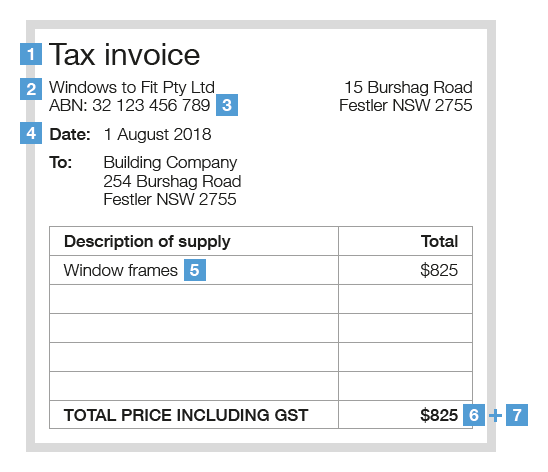 |
| Tax invoice for a sale under $1,000 |
Sales of $1,000 or more
Tax invoices for sales of $1,000 or more also need to show the buyer's identity or ABN.
If your tax invoices meet the requirements for sales of $1,000 or more, you can also use them for sales of lesser amounts.
- GST included in each line item
- the sale is clearly identified as being fully taxable by the words 'Total price includes GST'
- the buyer's identity for sales of $1,000 or more.
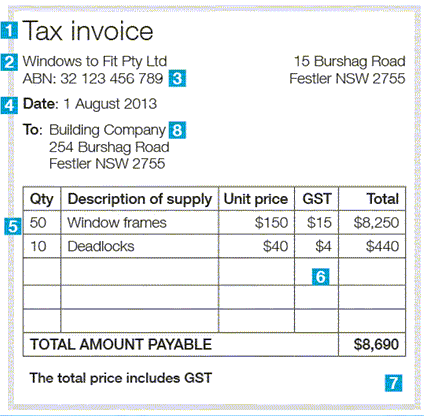 |
| Tax invoice for a sale of $1,000 or more |
Invoice requirements
Australia's tax-invoice rules live in section 29-70 of the A New Tax System (Goods and Services Tax) Act 1999 (GST Act), and the Commissioner's binding view on them is GST Ruling GSTR 2013/1 Goods and services tax: tax invoices. [1] [2]
Mandatory content
A tax invoice must contain enough information for each of the following to be clearly ascertained — the information does not have to be stated in a set format or with set wording, but it must be findable in, or determinable from, the document itself. Information that can only be obtained from an external source (for example, looking the supplier up on the Australian Business Register) is not clearly ascertained. [2]
| Required information | Legal basis | Notes |
|---|---|---|
| That the document is intended to be a tax invoice | s.29-70(1)(d) | Satisfied by "Tax Invoice", "GST Invoice" (or "Recipient Created Tax Invoice") in the heading, or by a statement in the body. An eInvoice issued under the A-NZ Peppol Invoice Specification satisfies this even without those words. [2] [3] |
| The supplier's identity and the supplier's ABN | s.29-70(1)(c)(i) | Legal name or registered business name is sufficient; a builder's registration or licence number is not. [1] [2] |
| The recipient's identity or the recipient's ABN | s.29-70(1)(c)(ii) | Required only where the total price is at least A$1,000, or where the document is a recipient-created tax invoice. Below A$1,000 the buyer need not be identified at all. [1] [3] |
| What is supplied — including the quantity (if applicable) and the price | s.29-70(1)(c)(iii) | A part number or code alone is not enough to identify what was supplied. Where several separate supplies are billed on one document (e.g. a monthly statement), the price of each must be determinable. [2] |
| The extent to which each supply is a taxable supply | s.29-70(1)(c)(iv) | Met by showing the GST for each taxable line, by a statement of the taxable extent, or by a reference mark against taxable items with a corresponding statement. [2] |
| The date the document is issued | s.29-70(1)(c)(v) | — [1] |
| The amount of GST (if any) payable on each supply | s.29-70(1)(c)(vi) | May be shown separately, or — where the GST is exactly 1/11 of the total price — replaced by the statement "Total price includes GST". [1] [3] |
| That the GST is payable by the supplier — recipient-created tax invoices only | s.29-70(1)(c)(vii) | e.g. "The GST payable of $xx.xx is payable by the supplier." [2] |
| The GST branch registration number — only where the supply is made through a GST branch | s.54-50(1) | Otherwise the document is not a tax invoice. [2] |
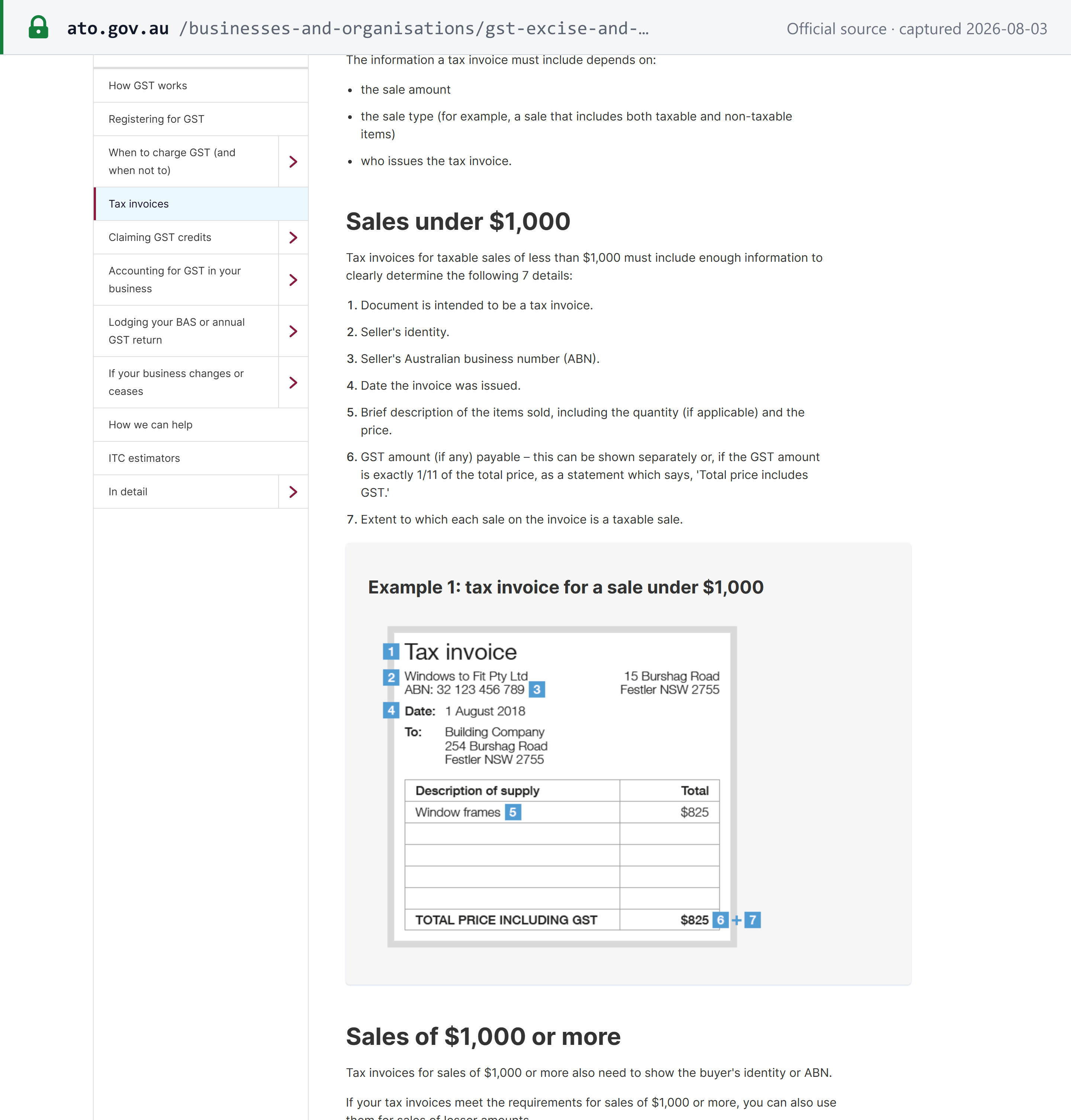 Source snapshot captured 2026-08-03 — original
Two safety valves exist where a document falls short. Under s.29-70(1A) the recipient may itself treat a deficient document as a tax invoice if the missing information can be clearly ascertained from other documents the supplier gave it (a product list, an email, a business card, an earlier tax invoice). Under s.29-70(1B) the Commissioner has a discretion to treat a particular document as a tax invoice even though it is not one; the discretion is exercised case by case under Law Administration Practice Statement PS LA 2004/11, and once exercised the document is a tax invoice for both supplier and recipient from the date it was created. [1] [2]
Issuance deadline and numbering
There is no general obligation to issue a tax invoice for every taxable supply. The trigger is a request: the supplier must give the recipient a tax invoice within 28 days after the recipient requests it, unless the sale is A$82.50 (including GST) or less. [1] [3]
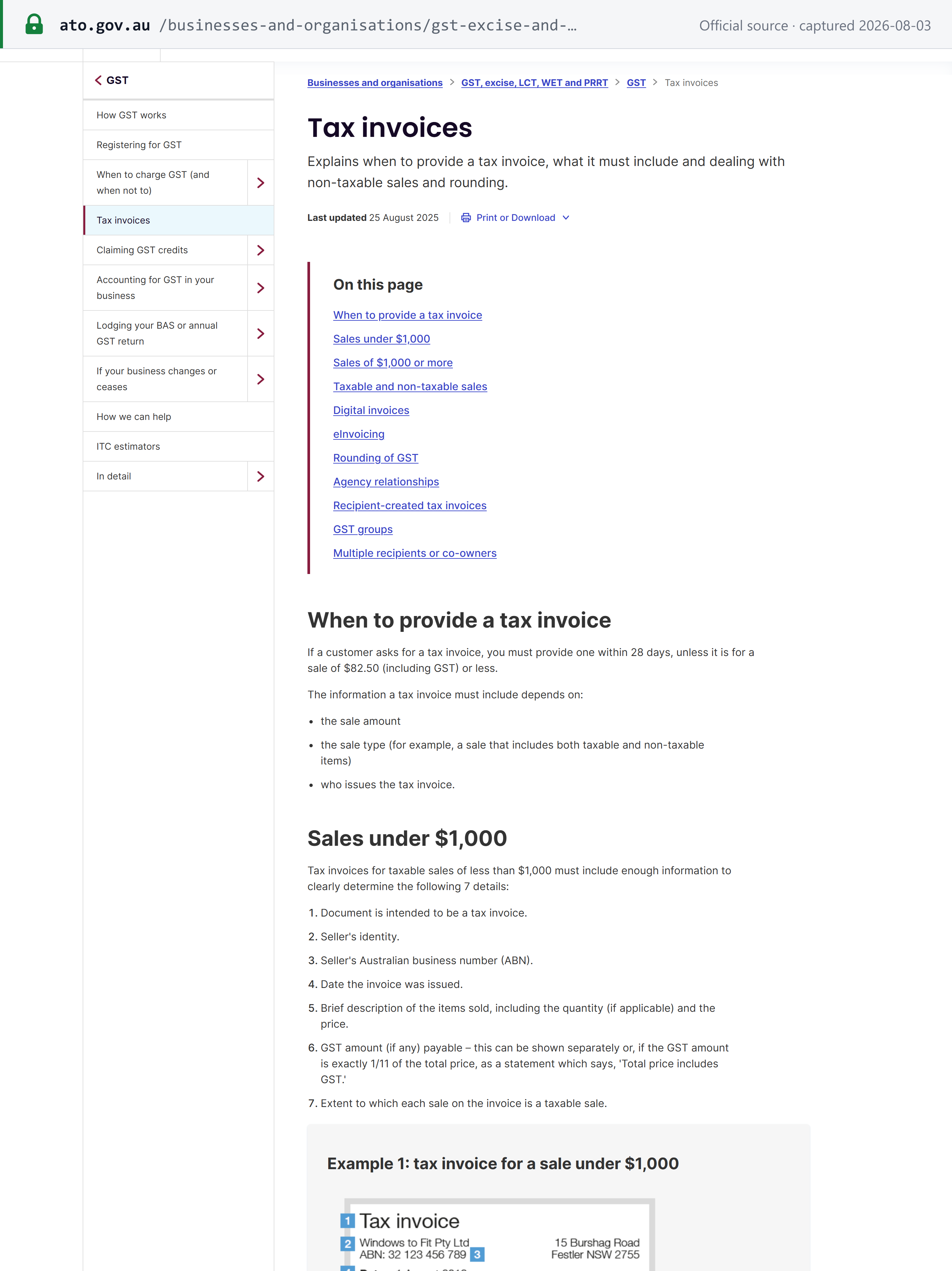 Source snapshot captured 2026-08-03 — original
No tax invoice is required at all — and the buyer can claim the GST credit without one — where the value of the taxable supply is A$75 or less (the A$82.50 GST-inclusive figure the ATO publishes). Where several taxable supplies are made in a single transaction, the Commissioner applies the threshold to their aggregate value, so five A$20 taxable items in one transaction do require a tax invoice. [2]
Numbering: Australia prescribes none. An invoice number — sequential, unique or otherwise — is not among the particulars listed in s.29-70(1)(c), and neither the GST Act nor GSTR 2013/1 imposes a serialisation rule. This line is not omitted for want of a source; the rule genuinely does not exist. Where a supplier realises an issued document did not meet the requirements, the fix is to cancel and reissue it, and the replacement document is then the tax invoice for that supply. [1] [2]
Recipient-created tax invoices (RCTIs)
In defined cases the buyer, not the seller, issues the tax invoice. The class of supplies for which this is allowed is set by the Commissioner under s.29-70(3), and the instrument currently in force is the A New Tax System (Goods and Services Tax): Recipient Created Tax Invoice Determination 2023 (LI 2023/20, F2023L00785), which repealed the roughly forty industry-specific 2017 determinations and replaced them with three general classes. [4]
An RCTI may be issued by a government related entity or a large business entity, or by any GST-registered business entity that itself determines the value of the supply it acquires. In every case both parties must be registered for GST when the RCTI is issued, and the recipient must issue the RCTI to the supplier within 28 days of the supply — or of the date it determines the value — retain the original or a copy for five years, and hold a written agreement with the supplier. The agreement may be a separate document or embedded in the RCTI itself, in which case the supplier has 21 days to object before it takes effect. [4] [3]
Credit and debit notes — Australia uses "adjustment notes"
Australia has no statutory credit note or debit note for GST. The single correction document is the adjustment note under s.29-75, and it covers movements in both directions — a cancelled supply, a changed price, a supply becoming or ceasing to be taxable, or an acquisition becoming or ceasing to be creditable. Do not map Australian practice onto the credit-note / debit-note split used in EU-style VAT systems. [5]
The supplier must issue the adjustment note within 28 days of the earlier of a request by the recipient, or becoming aware of the adjustment where a tax invoice was issued or requested. Where the original document was (or would have been) an RCTI, the recipient issues a recipient-created adjustment note instead. The note must be issued by the supplier, set out the issuer's ABN, be in the approved form, and allow the following to be clearly ascertained: that the document is intended as an adjustment note and what the effect of the adjustment is; the supplier's identity; the recipient's identity or ABN (where the underlying tax invoice was for A$1,000 or more, or where a non-taxable supply of A$1,000 or more became taxable); the issue date; a brief explanation of the reason for the adjustment; the amount of the adjustment to the GST payable; and the difference between the price before and after the adjustment event. Where the GST is 1/11 of the price, a statement that the price difference includes GST may replace the GST-adjustment figure. [5]
An adjustment note is not needed to attribute a decreasing adjustment of A$75 or less, is never needed for an increasing adjustment, and is not used for bad debts — writing off a bad debt is not an adjustment event. Nor is an adjustment note required where the adjustment event falls in the same tax period as the original attribution. [5]
Currency and language
A tax invoice may be expressed in a foreign currency. What the GST Act requires is that the GST payable be ascertainable in Australian dollars, so the invoice must either state the GST in AUD, or carry enough information for the buyer to work it out — the price or value in AUD, or the foreign-currency amount plus the conversion rate used, or a statement such as: "The GST is calculated in Australian currency at the exchange rate published by the RBA at 4.00pm Australian Eastern Time on the business day prior to the date of this tax invoice." The same applies to adjustment notes. [6]
The rate may be an agreed rate, a publicly available rate of a foreign exchange organisation (a commercial bank's buying, selling or spot rate), or the Reserve Bank of Australia 4.00pm Australian Eastern Time rate for the conversion day or the day before it. Whichever is chosen must be used consistently; alternating between rates to reduce GST is treated as not following the Commissioner's determination. The conversion day for a supplier accounting on a non-cash basis is the earlier of the receipt date and its chosen transaction date or invoice date; on a cash basis the supplier may choose the transaction date, the invoice date or the receipt date. [6]
On language, the GST Act does not prescribe a language for the invoice document itself, and no ATO source stating one could be confirmed — so no invoice-language rule is asserted here. What is fixed is the records rule: GST records must be in English, or readily accessible and easily convertible into English. [7]
Simplified invoices
Australia has no simplified-invoice regime in the European sense — there is no reduced-field "simplified tax invoice" document type. What exists instead are two separate reliefs, and they should not be conflated:
- a de-minimis: no tax invoice is required where the value of the taxable supply is A$75 or less (A$82.50 including GST), though the buyer must still hold records explaining its GST credit; [2] [3]
- a reduced identity requirement: below A$1,000 the invoice need not show the buyer's identity or ABN. Every other particular still applies, so this is a lighter field set rather than a different document. An invoice built to the A$1,000-and-over specification can be used for smaller sales too. [1] [3]
Retention
Records that record and explain taxable supplies, creditable acquisitions, GST-free and input-taxed supplies must be retained for the longest of: five years after the completion of the transactions or acts to which they relate; the period of review for any assessment those records relate to; and, where an assessment has been amended, the refreshed four-year review period for the latest amendment. Records must be in English or readily accessible and easily convertible into English, and must let the taxpayer's liabilities and entitlements be readily ascertained. Failure to keep or retain them is a strict-liability offence carrying 30 penalty units, plus an administrative penalty under s.288-25. [7]
Electronic-only archiving is accepted — printed or electronic records are equally valid. An RCTI issuer must separately retain the original RCTI or a copy for five years. [8] [4]
Technical format
No schema is mandated. A tax invoice need not be on paper: a PDF emailed to the customer, an EDI message or any other electronic record is in the approved form provided it meets s.29-70(1), because "document" means any record of information. [2] [3]
Australia has adopted the Peppol framework as its common eInvoicing standard, and the ATO accepts that an eInvoice issued by a supplier in accordance with the A-NZ Peppol Invoice Specification satisfies the "intended to be a tax invoice" requirement even where it does not carry the words "Tax Invoice" or "GST invoice", provided it contains all the mandatory data. Peppol eInvoicing is voluntary for business-to-business supplies; it is not a clearance or continuous-transaction-control mandate. [3]
Frequently Asked Questions
Do I have to register for GST as soon as I exceed AUD 75,000 in a single month?
No. The AUD 75,000 threshold (AUD 150,000 for non-profits) is based on annual GST turnover — past 12 months or projected next 12 months. You have 21 days from the date you cross or expect to cross the threshold to apply. If you register late, the ATO can back-date your registration and require GST to be remitted on earlier supplies — without the ability to recoup that GST from customers. [1]
Can I have an ABN without registering for GST?
Yes. An ABN and GST registration are separate. An ABN is required for most business activities; GST registration is only mandatory once you cross the turnover threshold. Voluntary GST registration is available below the threshold — useful if you have significant input tax credit (ITC) claims, e.g. a startup buying equipment before generating revenue. Once registered, you must charge GST on taxable supplies and lodge BAS returns. [1]
Do foreign businesses selling digital services to Australians need to register for GST?
Yes. Since 1 July 2017, foreign businesses supplying digital products (streaming, software, apps, e-books) to Australian consumers must register for GST if Australian sales exceed AUD 75,000. Where the supply is made through an electronic distribution platform (such as Amazon, Apple App Store or Google Play), the platform operator — instead of the underlying supplier — is treated as the supplier and accounts for the GST (GST Act s 84-55(1)), unless the narrow s 84-55(4) exception applies. Since 1 July 2018, the rule extended to foreign sellers of low-value physical goods (customs value AUD 1,000 or less) above the same threshold. GST rate: 10%. [1]
What is the difference between GST-free and input-taxed supplies?
Both attract no GST on sale, but differ for input tax credit (ITC) purposes. GST-free (e.g. basic food, medical services, exports): no GST charged on the sale, but you can still claim ITCs on related purchases. Input-taxed (e.g. financial services, residential rent): no GST charged, and you cannot claim ITCs on related purchases. Getting this wrong is a common ATO audit trigger for mixed-supply businesses. [1]
Do I need to lodge my BAS monthly or quarterly?
Quarterly (default for most businesses): GST turnover under AUD 20 million. Monthly (mandatory): GST turnover AUD 20 million or more; optional for smaller businesses. Annually (by instalments): turnover under AUD 75,000. Late lodgement and payment attract a Failure to Lodge (FTL) penalty and General Interest Charge (GIC). The ATO sets your reporting frequency on registration. [1]
What must a valid Australian tax invoice contain?
To support an ITC claim, a valid tax invoice must include: (1) the words "tax invoice" prominently; (2) supplier's identity and ABN; (3) date of issue; (4) description of the supply; (5) GST amount (or "Total price includes GST"); (6) whether each supply is taxable. For supplies AUD 1,000+, also include the recipient's identity or ABN. Australia has no separate "simplified tax invoice" document type — below AUD 1,000 the same tax invoice simply need not identify the recipient; see Simplified invoices above. [1]
For more details on Australian tax identifiers including ABN, see our Australia Tax ID Guide. To verify an Australian ABN, see our ABN verification guide.