Canada GST / HST guidelines
| FACTSHEET | |
|---|---|
| Country code | CA |
| Tax name | Goods and Services Tax (GST) and the Harmonized Sales Tax (HST). |
| Tax Authority | Canada Revenue Agency |
Overview
GST or Goods and Sevices Tax is applicable for most of the supplies of goods and services in Canada. The taxes to be charged depends on the type of supply and the place of supply.
Recent changes
Dated, officially-sourced changes to Canadian sales tax, newest first. The full history is in our worldwide tax-updates feed.
- 2026-10-01 — British Columbia Order in Council No. 408/2026 (approved 21 September 2026) exempts accounting, architectural, engineering, non-residential real estate and security services from PST from 1 October 2026, following the 18 September 2026 announcement that the government intended to delay the expansion; the order states no end date. See PST. (Province of British Columbia) — see event
- 2026-07-15 — Québec zero-rates certain food products (including individual portions of ice cream, frozen yogurt and similar frozen desserts, small portions of baked goods, desserts, fruit and vegetable platters, salted or seasoned nuts and cereal bars) and hygiene products (toilet paper and facial tissues) for QST purposes; GST continues to apply. The hygiene products are zero-rated throughout the supply chain; the food zero-rating does not apply at establishments where substantially all food sales are taxable (most restaurants), through vending machines or under catering contracts. Details are in Information Bulletin 2026-4 of the Ministère des Finances. See QST. (Revenu Québec) — see event
- 2026-07-01 — Manitoba expanded its Retail Sales Tax (RST) exemption for grocery-store food and beverages to cover additional items — including previously taxable ready-to-eat prepared foods, snack foods and carbonated beverages — alongside new exemptions for prenatal vitamins and qualifying manufacturing/processing machinery; the exemption still excludes sales by restaurants, licensed premises, cinemas/entertainment venues and vending machines. (Manitoba Finance) — see issue
PST
PST stands for "Provincial Sales Tax," which is a type of sales tax levied by some provinces in Canada on the purchase of goods and services. Each province in Canada has its own tax laws and may impose its own PST rate, if applicable.
British Columbia — PST expansion to professional services (exempted from 1 October 2026)
British Columbia's 7% PST had been scheduled to expand, from 1 October 2026, to certain professional services: accounting and bookkeeping, architectural, geoscientist and engineering services, non-residential real estate commissions and services, and security and private investigation services.
On 18 September 2026, the Government of British Columbia announced that, citing ongoing international trade uncertainty, it intended to delay that expansion. [1]
In response to new and ongoing international trade disruptions and the economic uncertainty they are creating, government intends to delay the PST expansion to professional services that had been scheduled to take effect on Oct. 1, 2026.
Order in Council No. 408/2026, approved on 21 September 2026 under sections 236 and 241 of the Provincial Sales Tax Act, put the delay into law: [2]
- Effective 30 September 2026, it amends B.C. Reg. 114/2026 by repealing section 4 of Schedule 1 and section 4 of Schedule 2.
- Effective 1 October 2026, it adds Divisions 4.1 to 4.5 to Part 4 of the Provincial Sales Tax Exemption and Refund Regulation (B.C. Reg. 97/2013), exempting accounting services, architectural services, engineering services, non-residential real estate services and security services from the tax imposed under Divisions 4.1 to 4.5 of Part 5 of the Act.
- The order states no end date.
So from 1 October 2026 PST is not charged on these services under the order, and the existing exemption stays in place.
HST
HST stands for "Harmonized Sales Tax," which is a consumption tax in Canada. It combines the federal Goods and Services Tax (GST) with the Provincial Sales Tax (PST) of certain provinces. The HST simplifies the tax system by creating a single, harmonized tax rate instead of separate federal and provincial taxes.
QST
QST stands for "Quebec Sales Tax," which is a consumption tax in the province of Quebec, Canada. It is a provincial tax that is separate from the federal Goods and Services Tax (GST).
Zero-rated for QST from 15 July 2026: as announced by the Québec government on 25 May 2026, certain food and hygiene products have been zero-rated for QST purposes since 15 July 2026. GST continues to apply to these products. Details are in Information Bulletin 2026-4 of the Ministère des Finances. [3]
The zero-rated food products are:
- ice cream, frozen pudding, ice milk, sherbet or frozen yogurt (and products containing them) in individual portions of less than 500 g or 500 ml;
- doughnuts, cookies, sweet-coated croissants, cakes, muffins, pastries, tarts, pies and similar products in individual portions of less than 230 g, or in packages of fewer than six units;
- puddings, flavoured gelatine, mousse and similar desserts in individual portions;
- fruit salads and prepared fruit platters, and prepared vegetable platters;
- salted or seasoned seeds or nuts;
- bars or loose mixtures made primarily of rolled oats or other cereals, seeds, nuts or dried fruit.
These foods remain subject to QST when sold at establishments where all or substantially all food and beverage sales are taxable under section 177 of the Act respecting the Québec sales tax (including most restaurants), through vending machines, or under catering contracts. Toilet paper and facial tissues are zero-rated throughout the supply chain. [3]
Participating province
Participating province refers to a province in Canada that has harmonized its provincial sales tax with the GST to implement the harmonized sales tax (HST). Participating provinces include New Brunswick, Newfoundland and Labrador, Nova Scotia, Ontario, and Prince Edward Island.
Non-participating province
Non-participating province refers to a province or territory in Canada that has not harmonized its provincial sales tax with the GST.
Tax Rates
The rates for taxable supplies depends on the province or territory. The current rates of GST/ HST are as follows. The Non-participating provinces might have PST in addition to the GST
- A zero-rated supply has a 0% GST/HST rate throughout all of Canada. For example, basic groceries are taxable at the rate of zero (0% GST/HST) in every province and territory
- 5% (GST) in Alberta, British Columbia, Manitoba, Northwest Territories, Nunavut, Quebec, Saskatchewan, and Yukon
- 13% (HST) in Ontario
- 15% (HST) in New Brunswick, Newfoundland and Labrador, and Prince Edward Island
- 14% (HST) in Nova Scotia — reduced from 15% on 1 April 2025, when the provincial portion fell from 10% to 9% [NS]
Total Sales tax in Provinces
| Province | Type | PST | GST | HST | Total Tax Rate |
|---|---|---|---|---|---|
| Alberta | GST | 5% | 5% | ||
| British Columbia | GST + PST | 7% | 5% | 12% | |
| Manitoba | GST + PST | 7% | 5% | 12% | |
| New Brunswick | HST | 15% | 15% | ||
| Newfoundland and Labrador | HST | 15% | 15% | ||
| Northwest Territories | GST | 5% | 5% | ||
| Nova Scotia | HST | 14% | 14% | ||
| Nunavut | GST | 5% | 5% | ||
| Ontario | HST | 13% | 13% | ||
| Prince Edward Island | HST | 15% | 15% | ||
| Quebec | GST + *QST | *9.975% | 5% | 14.98% | |
| Saskatchewan | GST + PST | 6% | 5% | 11% | |
| Yukon | GST | 5% | 5% |
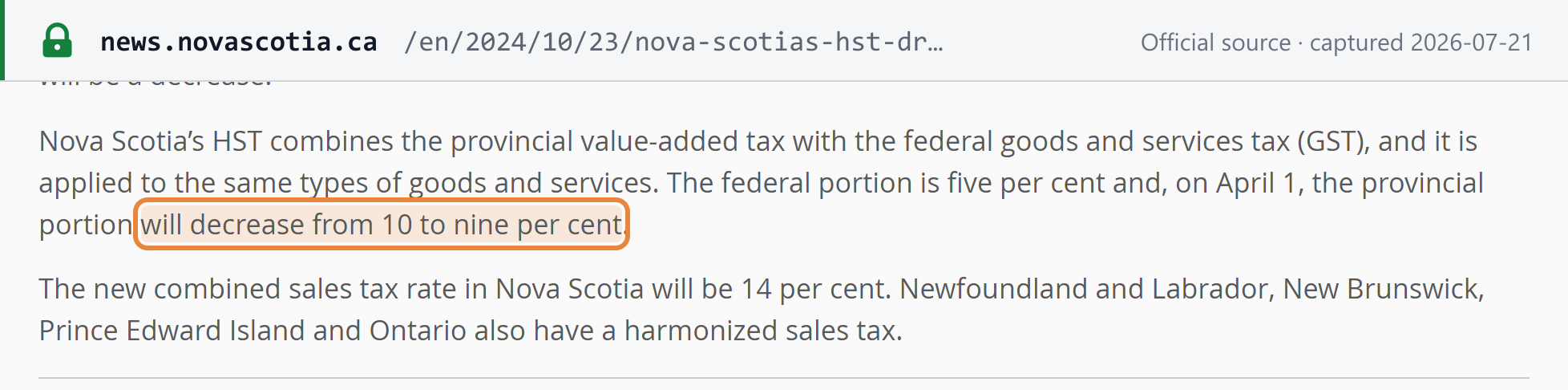 Source snapshot captured 2026-07-21 — original
Manitoba grocery exemption note: Manitoba's 7% Retail Sales Tax (RST) rate is unchanged, but the RST exemption for grocery-store food and beverages was expanded effective 1 July 2026 to cover additional items (see Recent changes above). [1]
Invoice requirements
Canada has no prescribed invoice format. What it has instead is a tiered documentary standard: the larger the sale, the more information the supplier must give a GST/HST-registrant purchaser so that purchaser can claim an input tax credit. Get it wrong and the supplier is still fine — it is the buyer who loses the ITC. [1]
What every customer must be told
Whether by cash register receipt, invoice, contract or posted sign, you must make clear whether GST/HST applies and whether it is included in the price or added separately, showing: [2]
- the GST/HST rate that applies to the supply; and
- the amount paid or payable and the GST/HST amount as separate lines, or a clear statement that the total includes GST/HST.
Where HST applies, show the total HST rate — do not break out the federal and provincial parts separately.
Input tax credit information requirements
| Information required | Under $100 | $100 to $499.99 | $500 or more |
|---|---|---|---|
| Supplier's business or trading name, or an intermediary's | Yes | Yes | Yes |
| The invoice date, or if no invoice issued, the date the GST/HST is paid or payable | Yes | Yes | Yes |
| The total amount paid or payable | Yes | Yes | Yes |
| An indication of the total GST/HST charged, or that the amount for each taxable supply (other than zero-rated) includes GST/HST at the applicable rate | No | Yes | Yes |
| An indication of the status of each supply where the invoice includes both taxable and exempt supplies | No | Yes | Yes |
| The supplier's or intermediary's GST/HST registration number | No | Yes | Yes |
| The buyer's name or trading name, or that of the buyer's authorised agent or representative | No | No | Yes |
| A brief description of the property or services | No | No | Yes |
| The terms of payment | No | No | Yes |
An intermediary is a registrant who, acting as your agent or under an agreement with you, causes or facilitates the making of the supply by you. [1]
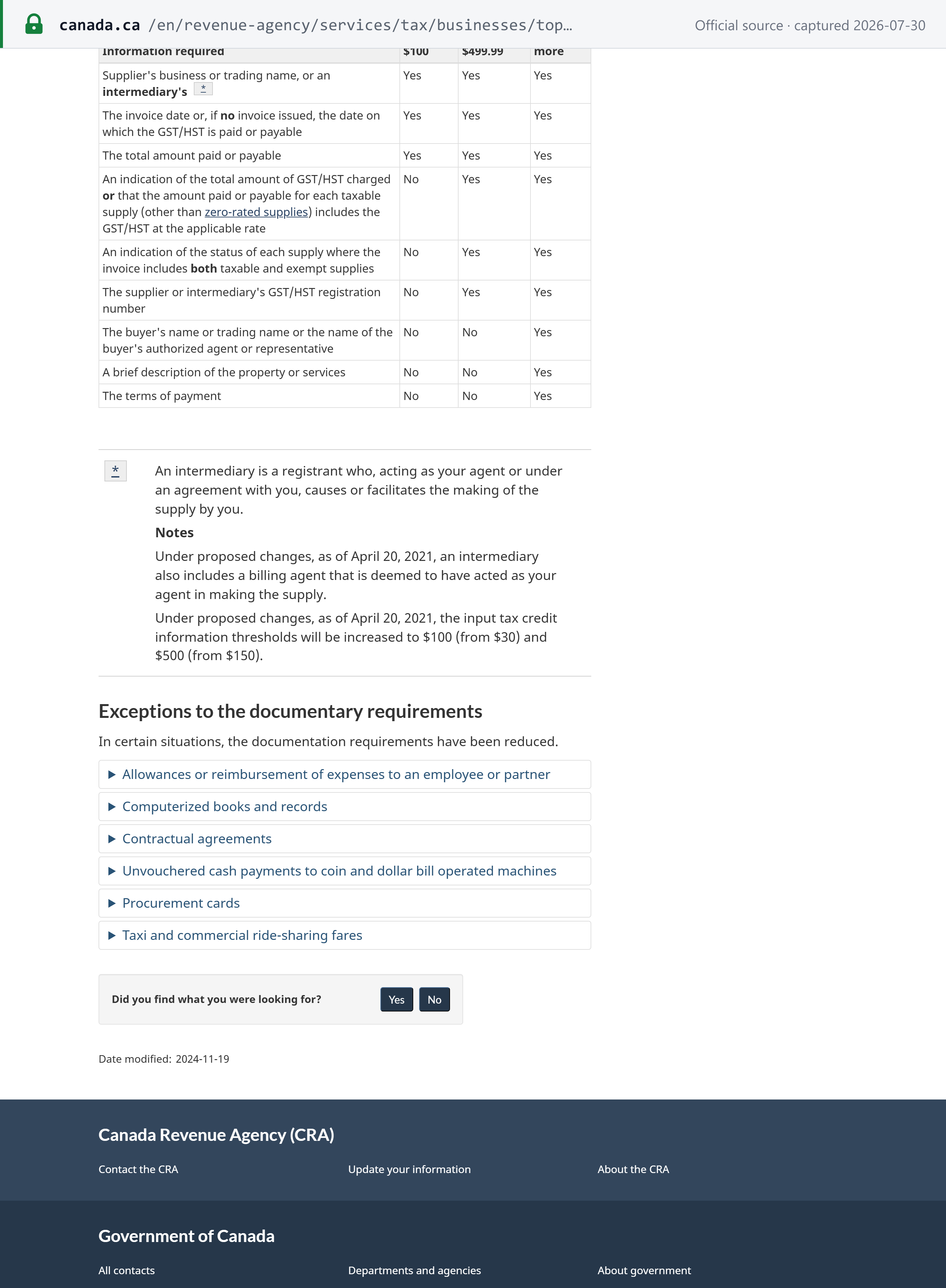 Source snapshot captured 2026-07-30 — original
CRA's chart uses $100 and $500, but the note directly beneath it reads: under proposed changes, as of April 20, 2021, the input tax credit information thresholds will be increased to $100 (from $30) and $500 (from $150). The older $30 / $150 figures are what a great many third-party guides and accounting systems still carry, and CRA has left the "proposed" wording in place on a page last modified 19 November 2024. Build to the $100 / $500 tiers — that is what CRA's own chart applies — but do not be surprised to meet the old numbers in software defaults or in advice written before 2021. [1]
What a compliant invoice looks like
CRA publishes the requirements as a tier chart, not as a specimen — there is no CRA sample invoice and no prescribed form. The sheet below is one we built to show where the $500-and-over row of that chart lands on a page, since that tier is the superset: satisfy it and the two lower tiers are satisfied too.
Invoice
| Description of property or services | Quantity | Amount |
|---|---|---|
| Structural steel brackets, galvanised | 120 units | CAD 3,600.00 |
| On-site installation labour | 16 hours | CAD 1,440.00 |
- Subtotal
- CAD 5,040.00
- GST at 5%
- CAD 252.00
- Total amount payable
- CAD 5,292.00
- Four items on this sheet are required only at the $500-and-over tier: the purchaser's name, the description of what was supplied, the terms of payment, and — read with the chart above — the fuller identification of the supply.
- Where an invoice mixes taxable and exempt supplies, the status of each supply must be indicated. A single-status invoice like this one needs no such marking.
- CRA accepts either an indication of the total GST/HST charged, as shown here, or a statement that each taxable amount includes GST/HST at the applicable rate.
Exceptions to the documentary requirements
CRA reduces the requirements in six situations: allowances or reimbursement of expenses to an employee or partner; computerized books and records; contractual agreements; unvouchered cash payments to coin- and dollar-bill-operated machines; procurement cards; and taxi and commercial ride-sharing fares. [1]
Invoice date drives the return
The invoice date determines when you report and remit. Your GST/HST return for the reporting period covering the invoice date must include the GST/HST you charged — whether or not you have been paid. [2]
QST is a separate check
A GST/HST number and a QST number are different registrations, verified in different places: GST/HST through CRA's Confirming a GST/HST account number service, QST through Revenu Québec. See QST above. [1]
Retention
Records must generally be kept for six years from the end of the last year to which they relate. CRA may require invoices to be kept longer. [2]
Reference links
- Province of British Columbia — Order in Council No. 408/2026
- Government of British Columbia — B.C. pauses PST expansion to professional services amid ongoing trade uncertainty
- Revenu Québec — Details regarding the zero-rating of certain products for QST purposes (7 August 2026)
- Revenue Agency - Tax rates
- Québec sales tax
- GST/HST for non-residents
Frequently Asked Questions
How does the $30,000 small supplier threshold work in Canada?
The small supplier limit ($30,000; $50,000 for public service bodies) has two tests, and they end small-supplier status at different times. Exceed $30,000 in a single calendar quarter and you stop being a small supplier on the supply that takes you over — you charge GST/HST on that supply, and your registration is effective no later than that day. Exceed it only over four consecutive calendar quarters and you stop being a small supplier at the end of the month following the quarter in which you went over; registration is effective no later than your first supply after that. Either way, you must apply within 29 days of your effective date of registration. Revenues from associated persons are combined — you cannot split activity across two businesses to double the threshold. [1]
Why do I need two separate registrations in Quebec?
Quebec did not harmonize its sales tax into HST. You need: (1) Federal GST registration with CRA (format: 9XXXXXXXXRT0001); and (2) Quebec Sales Tax (QST) registration with Revenu Québec (format: XXXXXXXXXX-TQ-0001). A CRA registration does not automatically register you for QST, and vice versa. Non-residents supplying digital services to Quebec consumers may have separate QST obligations. [1]
I'm in BC billing a customer in Ontario — do I charge HST (13%) or GST (5%)?
For most tangible goods shipped from BC to Ontario, Ontario HST (13%) applies (place of supply = where goods are received). For services, BC's rate generally applies if the service is performed in BC, but specific place-of-supply rules exist for real property, travel, and cross-border services. For digital services, the consumer's location determines the rate. Multi-province billing requires careful rule application. [1]
What is the difference between zero-rated and exempt supplies in Canada?
Both are charged at 0% GST/HST, but differ on input tax credit (ITC) eligibility. Zero-rated (Schedule VI — basic groceries, exports, prescription drugs): supplier can still claim ITCs on related purchases. Exempt (Schedule V — healthcare, residential rent, financial services): no GST/HST charged, and supplier cannot claim ITCs on inputs. Misclassifying a zero-rated supply as exempt loses ITC claims; misclassifying an exempt supply as zero-rated leads to incorrect ITC claims that CRA may assess. [1]
Is British Columbia's PST expansion to professional services going ahead on 1 October 2026?
No. Order in Council No. 408/2026, approved on 21 September 2026, exempts accounting, architectural, engineering, non-residential real estate and security services from PST from 1 October 2026 by adding Divisions 4.1 to 4.5 to Part 4 of the Provincial Sales Tax Exemption and Refund Regulation (B.C. Reg. 97/2013); effective 30 September 2026 it also repeals section 4 of Schedule 1 and section 4 of Schedule 2 of B.C. Reg. 114/2026. The order states no end date. It follows the 18 September 2026 announcement that the government intended to delay the expansion. See PST. [2]
Do non-resident businesses need to register for GST/HST when selling digital services to Canadians?
Yes. Since 1 July 2021, non-residents supplying digital services (streaming, software, SaaS) to Canadian consumers must register for GST/HST under the simplified regime once Canadian sales exceed $30,000 over 12 months. Platform operators (marketplaces) are also required to register and collect GST/HST on behalf of suppliers in many cases. Quebec has separate QST rules for non-resident digital suppliers. [1]
For more details on Canadian tax identifiers, see our Canada Tax ID Guide.