Pakistan sales tax guidelines
| FACTSHEET | |
|---|---|
| Country code | PK |
| Tax name | Sales Tax (federal, on goods) and provincial Sales Tax on Services |
| Tax Authority | Federal Board of Revenue (FBR) for goods; provincial revenue authorities for services |
Overview
Pakistan has no VAT. It levies sales tax, split between two layers of government, and which layer applies decides every rate, registration and return below. [1] [6]
Layering. Rates checked 2026-09-29.
| Layer | What is taxed | Law | Authority | Standard rate |
|---|---|---|---|---|
| Federal | Supplies of goods by registered persons, and imports of goods | Sales Tax Act 1990 | Federal Board of Revenue (FBR), Inland Revenue | 18% (s.3(1)) [1] |
| Provincial — Sindh | Services | Sindh Sales Tax on Services Act 2011 | Sindh Revenue Board (SRB) | 15% (s.8(1)) [6] |
| Provincial — Khyber Pakhtunkhwa | Services | Khyber Pakhtunkhwa Sales Tax on Services Act 2022 | Khyber Pakhtunkhwa Revenue Authority (KPRA) | 15% (s.9(1)) [7] |
| Federal territory — Islamabad Capital Territory | Services | Islamabad Capital Territory (Tax on Services) Ordinance 2001 | FBR (Provincial Taxes Wing) | 15% — set entry by entry in the Schedule; no single standard-rate clause [8] |
| Provincial — Punjab | Services | Punjab Sales Tax on Services Act 2012 | Punjab Revenue Authority (PRA) | 16% from 1 July 2025 — the Punjab Finance Act 2025 moved Punjab to a negative list: "All services, except those specified …" are taxed at sixteen percent (Second Schedule, Part I, S/N 1). The rate for 2026-27 under the Punjab Finance Act 2026 is not confirmed. [16] |
| Provincial — Balochistan | Services | Balochistan Sales Tax on Services Act 2015 | Balochistan Revenue Authority (BRA) | Rate not confirmed from an official source. |
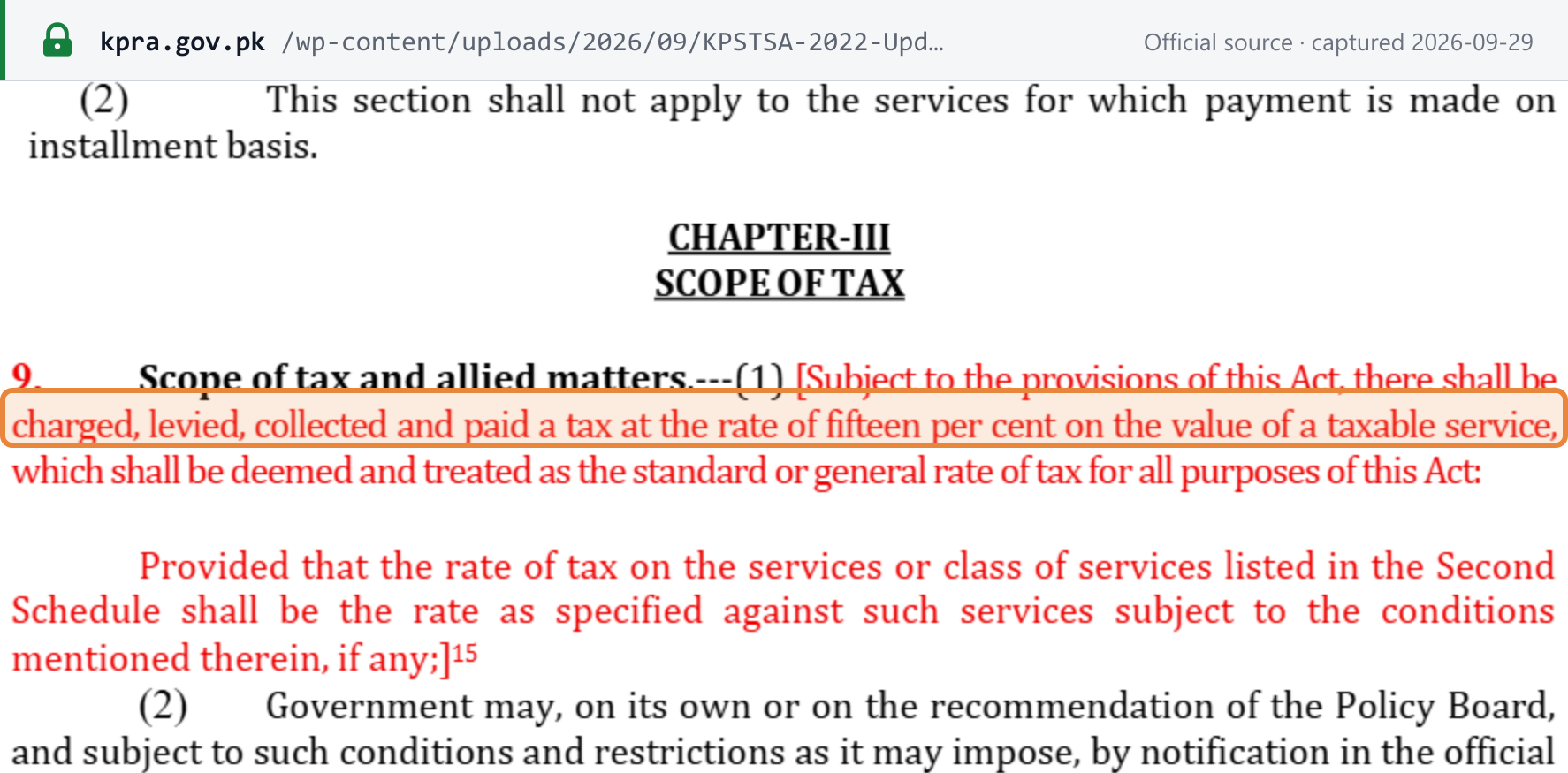
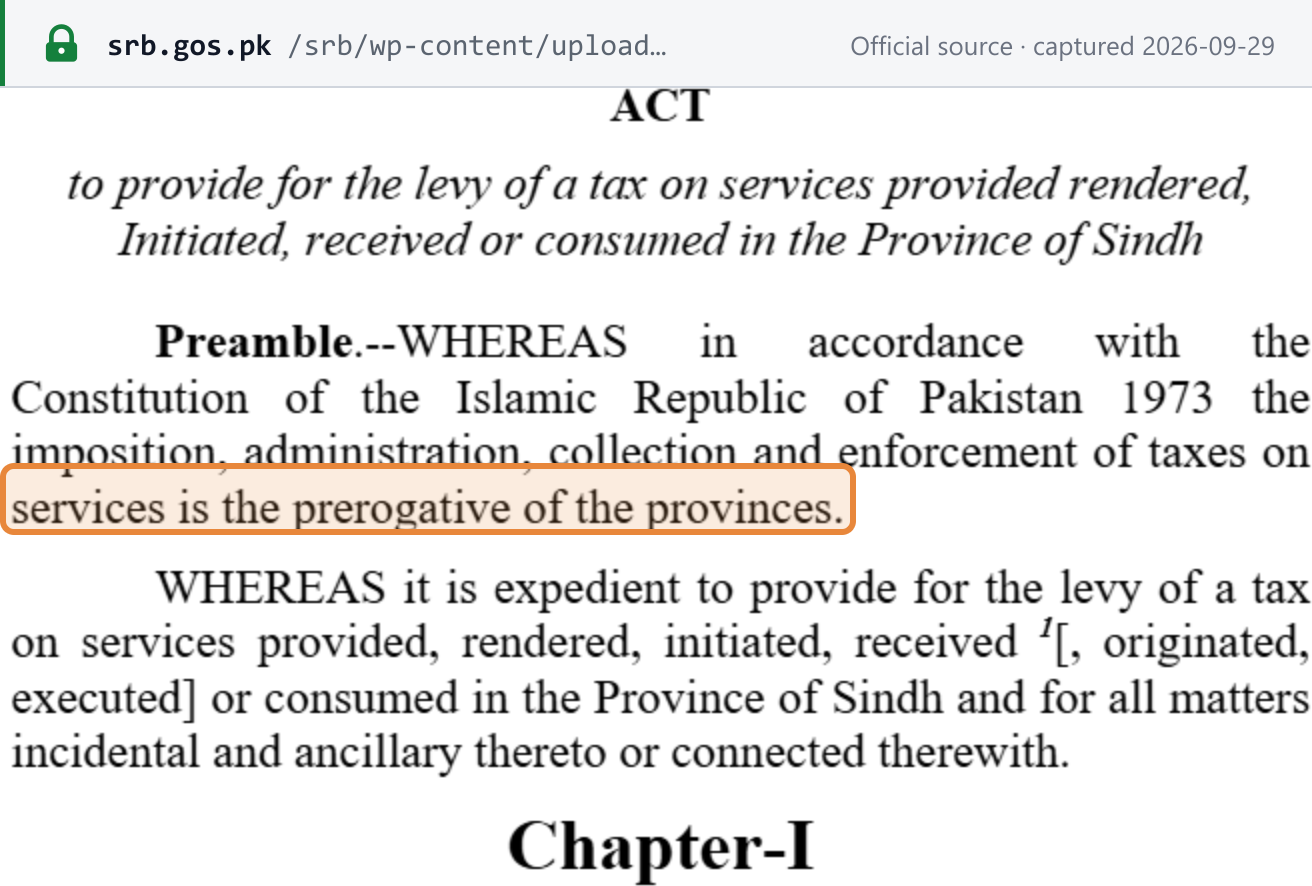
The split comes from the Constitution. The Sindh Act's preamble recites that "the imposition, administration, collection and enforcement of taxes on services is the prerogative of the provinces". The federal Act respects the line: federal withholding excludes "the services liable to pay sales tax under a Provincial enactment" (s.3(7)), and input tax is blocked on "services in respect of which input tax adjustment is barred under the respective provincial sales tax law" (s.8(1)(j)). [6] [1]
The rest of this guide covers the federal sales tax on goods in full. Provincial services tax is covered where it changes the answer: rates, imported services and reverse charge, and registration in Sindh.
Currency. All amounts are in Pakistani rupees (PKR); the statutes write "Rs." or "rupees".
Tax year and tax periods. The federal financial year begins on 1 July: the Finance Act, 2026 gives effect to "the financial proposals of the Federal Government for the year beginning on the first day of July, 2026". The sales tax return is monthly unless the Board notifies a quarterly or annual return — see Filing and payment. [2]
The 2026 budget law. The Finance Act, 2026 is Act No. XLIII of 2026. The President assented on 26 June 2026, it was published in the Gazette of Pakistan (Extraordinary) the same day, and it came into force on 1 July 2026 "unless otherwise provided" (s.1). [2]
Registration
Who should register
Federal registration is a category rule, not a turnover test. Section 14(1) of the Sales Tax Act 1990 requires "every person engaged in making taxable supplies in Pakistan, including zero-rated supplies", who falls in one of these categories to register: [1]
- (a) a manufacturer who is not running a cottage industry;
- (b) a retailer liable to sales tax, other than a retailer that pays sales tax through its electricity bill under s.3(9);
- (c) an importer;
- (d) an exporter that intends to claim sales tax refunds on its zero-rated supplies;
- (e) a wholesaler, dealer or distributor;
- (f) a person required to register under another federal or provincial law.
If a liable person does not apply, the Commissioner Inland Revenue "shall compulsorily register such person after providing an opportunity of being heard" (s.14(2A), added by the Finance Act 2025). [3]
Registration threshold
Not applicable as a general rule — there is no turnover threshold for sales tax on goods (Sales Tax Act 1990 s.14(1)). Two figures do matter:
- Cottage industry — PKR 8 million. A manufacturer escapes category (a) only if it meets all four conditions of s.2(5AB): no industrial gas or electricity connection; located in a residential area; a labour force of no more than ten workers; and "annual turnover from all supplies does not exceed eight million rupees". Neither the Finance Act 2025 nor the Finance Act, 2026 amends this definition. [1]
- Tier-1 retailer — PKR 200 million, from 1 July 2026. The Finance Act, 2026 redefines "Tier-1 retailer" (s.2(43A)). It adds "a retailer having turnover exceeding two hundred million rupees either by way of declaration or from worked back value of turnover from tax deduction under section 236G or 236H of Income Tax Ordinance, 2001 … during the immediately preceding twelve consecutive months"; limits the wholesaler-cum-retailer limb to those "having turnover more than two hundred million rupees"; and omits two former limbs, (f) and (g). Tier-1 retailers must integrate their outlets with the FBR (see E-invoicing status); other retailers pay through their electricity bills (see Rates). [2]
Non-resident registration
- Goods sold from abroad. Section 14 lists no registration category for a seller outside Pakistan. Imported goods are taxed at the border instead (s.3(1)(b)) — see Cross-border rules. [1]
- Digitally ordered goods sold from within Pakistan. The Finance Act 2025 added s.14(1A): "Every person including a non-resident person except who is running a cottage industry and the retailers who are required to pay sales tax through electricity bills under sub-section (9) of section 3, selling digitally ordered goods from within Pakistan through online marketplace, website or software application … shall apply … for registration." Under new s.14(1B), a marketplace or courier must not serve an e-commerce seller that lacks an NTN and, where s.14(1A) applies, a sales tax registration. [3]
- Services from abroad. Provincial reverse charge. In Sindh, a person that receives a taxable service from a non-resident and is not registered "shall be deemed to be a registered person" for that tax period (Sindh Act s.24(3)). [6]
Tax identification number
Federal registrants are identified by their NTN (National Tax Number, 7 digits) or, for individuals, their CNIC (13 digits). FBR's digital-invoicing API labels the seller field sellerNTNCNIC with "7 or 13 digit of seller NTN/CNIC". Point-of-sale invoices still print both the "Sales Tax Registration Number (STRN) and National Tax Number (NTN)". FBR publishes no check-digit rule. [10] [4]
For the formats and where each number comes from, see Lookuptax's Pakistan TIN number guide. To check a counterparty's number, use Lookuptax's Pakistan NTN validator.
How to register
- Where. On FBR's computerised system, IRIS, in Form STR-1, "before making any taxable supplies" (Sales Tax Rules 2006 r.5(1)).
- Documents (r.5(2)): a bank account certificate in the business's name; the gas and electricity consumer numbers; particulars of all branches; GPS-tagged photographs of the business premises, and for a manufacturer also of its machinery and industrial electricity or gas meter; and for an individual, an association of persons or a single-member company (other than a manufacturer), a balance sheet showing business capital, assets and liabilities.
- Biometrics. After registration, the registrant or its authorised person must visit a NADRA e-Sahulat centre "within a month for bio-metric verification". If it fails to, its name "shall be taken off the sales tax Active Taxpayer List" (r.5(4)).
- Timeline. The Rules set no processing time for a standard registration. A temporary registration for a manufacturer is issued "within seventy-two hours" (r.5A(2)).
Provincial registration is separate. In Sindh, registration "will be required for all persons who … are residents" and "provide any taxable service" (Sindh Act s.24(1)); register on the SRB e-portal. KPRA publishes its own e-registration guide on kpra.gov.pk. [6]
Voluntary registration
Available in limited form. "Persons not engaged in making of taxable supplies in Pakistan, if required to be registered for making imports or exports, or under any provisions of the Act, or any other Federal law, may apply for registration" (s.14(2)). Registration matters commercially: only a registered person may deduct input tax (s.8(3)) or issue a tax invoice (s.23(2)), and a buyer without a registration number pays the 4% further tax (s.3(1A)). [1]
Deregistration
- Who. A registered person that ceases business, whose supplies become exempt, or who "ceases to remain registered" (Sales Tax Rules r.11(1)).
- Procedure. Apply to the Commissioner Inland Revenue in Form STR-3. Cancellation takes effect on a specified date, "but not later than ninety days from the date of such application or the date all the dues outstanding against such person are deposited by him, whichever is later".
- Final return. Before de-registration, the person must furnish "a final return to the commissioner" (Sales Tax Act s.28).
Group registration
Not available. The Sales Tax Act 1990 and the Sales Tax Rules 2006 contain no VAT-group provision. The Rules point the other way: "In case a person holds multiple sales tax registrations, he shall retain only one registration and surrender all other registrations" (r.10(1)). [4]
Rates
Federal rates on goods below; for the provincial rates on services, see the layering table in the Overview.
| Rate | Applies to | Source |
|---|---|---|
| 18% (standard) | Taxable supplies by a registered person, and imports of goods (s.3(1)) | Sales Tax Act 1990 [1] |
| +4% further tax | Taxable supplies to a person without a registration number, or not an active taxpayer — on top of the rate otherwise due (s.3(1A)) | Sales Tax Act 1990 [1] |
| 18% of the printed retail price | Third Schedule goods (s.3(2)(a)) | Sales Tax Act 1990; Finance Act, 2026 [2] |
| Reduced rates, item by item | Eighth Schedule goods (s.3(2)(aa)) — examples below | Sales Tax Act 1990; Finance Acts 2025 and 2026 |
| 5% / 7.5% of the electricity bill | Retailers other than Tier-1 retailers, through their monthly electricity bills (s.3(9)) | Sales Tax Act 1990 [1] |
| 0% | Exports, Fifth Schedule goods, and stores for conveyances leaving Pakistan (s.4) | Sales Tax Act 1990 [1] |
| Exempt | Sixth Schedule goods (s.13) — see Exemptions | Sales Tax Act 1990 |
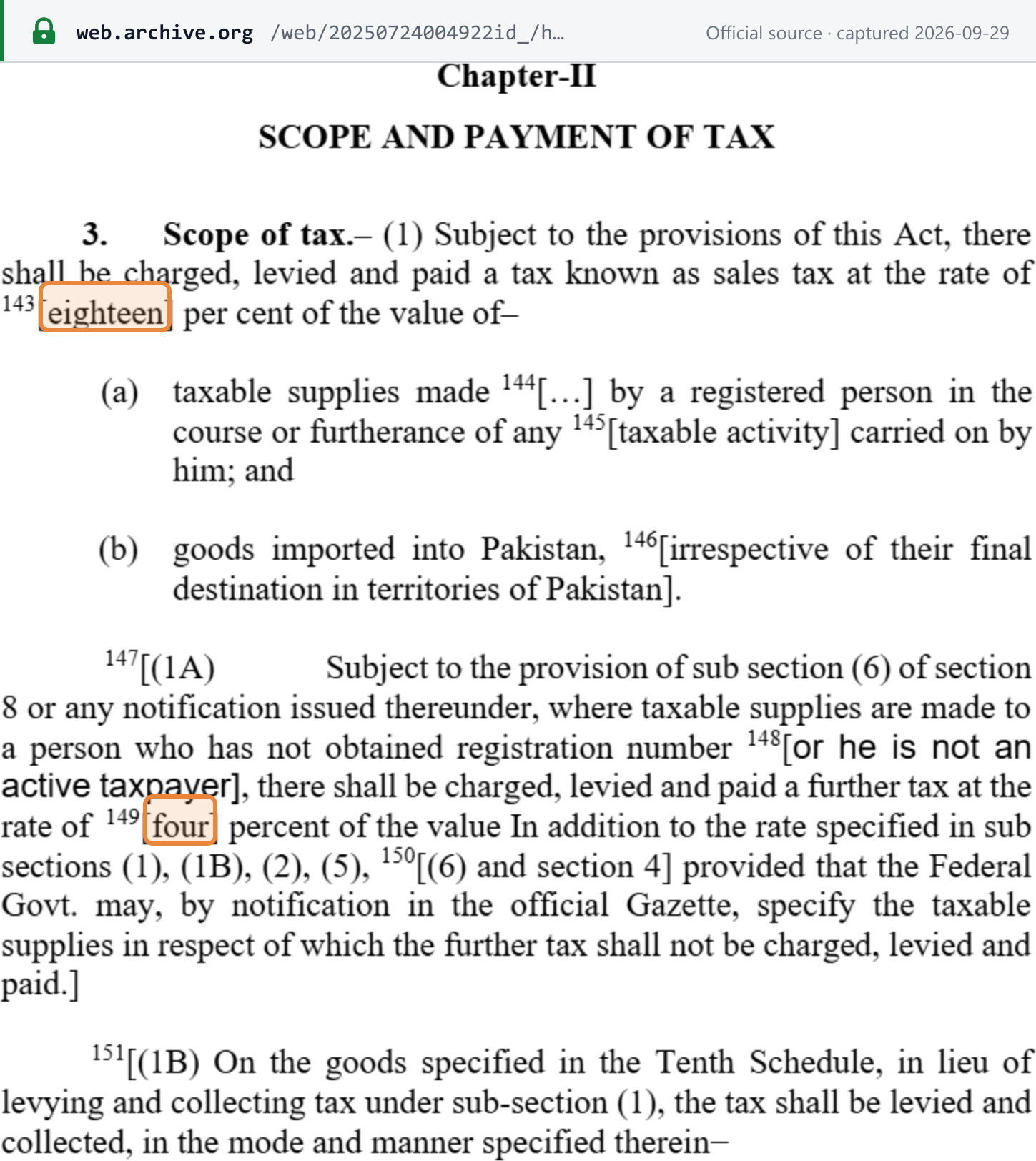
Standard rate — 18%. Section 3(1) charges sales tax "at the rate of eighteen per cent of the value of" taxable supplies made by a registered person and goods imported into Pakistan. The consolidation's footnote records that "eighteen" was "Substituted for seventeen vide Finance (Supplementary) Act, 2023". FBR's Circular No. 01 of 2023, dated 28 February 2023, explains: "the standard rate of sales tax has been increased from 17% to 18%". The start date of the 18% rate is set by S.R.O. 179(I)/2023 and is not covered in this guide. Neither the Finance Act 2025 nor the Finance Act, 2026 amends s.3(1) (checked 2026-09-29). [1] [11]
Further tax — 4%. Where taxable supplies are made "to a person who has not obtained registration number or he is not an active taxpayer, there shall be charged, levied and paid a further tax at the rate of four percent of the value" in addition to the other rates (s.3(1A)). The Federal Government may exclude supplies by notification. Zero-rating under s.4 operates "except those of sub-section (1A)", so further tax applies to zero-rated supplies to unregistered buyers too. [1]
Extra tax. The Federal Government may levy tax "at such extra rate or amount" of up to eighteen per cent of value on notified goods or persons (s.3(5)). Currently notified extra-tax rates are not covered in this guide. [1]
Retail-price regime (Third Schedule). Third Schedule goods are taxed at 18% "of the retail price", which the manufacturer or importer prints on the pack (s.3(2)(a)). From 1 July 2026 the Finance Act, 2026 adds entries 56–75, including edible fats and oils in retail packing, confectionery, pasta, sauces, plastic household articles, bags and cases, sanitaryware, crockery, cosmetics, tissue paper, jams and "Footwear (all types) except where the manufacturer exclusively sells its products through digitally integrated and POS compliant retail outlets". A higher notified rate on a newly listed item continues after its inclusion. [1] [2]
Retailers below Tier-1. Tax is charged "through their monthly electricity bills, at the rate of five percent where the monthly bill amount does not exceed rupees twenty thousand and at the rate of seven and half percent where the monthly bill amount exceeds the aforesaid amount" (s.3(9)). Section 3(12) lets the Government replace these rates by notification. [1]
Reduced rates (Eighth Schedule) are set item by item. Examples:
- Agricultural machinery and equipment — 7% (named in s.8(1)(k), which also blocks input tax on it). [1]
- Photovoltaic cells and modules (8541.4200, 8541.4300) — 10% (Finance Act 2025, entry 90). [3]
- Electric buses of 25 seats or more and electric trucks, CBU (8702.4090, 8704.6030) — 1% (Finance Act, 2026, entry 80 as substituted). [2]
Zero rate. Section 4 charges tax at zero per cent on "goods exported, or the goods specified in the Fifth Schedule" and on "stores and provisions for consumption aboard a conveyance proceeding to a destination outside Pakistan". Fifth Schedule examples include supplies to diplomats and privileged organisations, inputs for Export Processing Zones, supplies to exporters under the Duty and Tax Remission Rules, and supplies to the Gwadar special economic zone. [1]
Former tribal areas — stepped rate. Plant, machinery and industrial inputs for these areas, and supplies within them, were taxed at 10% for 2025-26 and are taxed at 12% for 2026-27 (Finance Act 2025, Eighth Schedule entry 89). [3]
Announced future rates. Two are legislated:
- Former tribal areas. The same entry steps the rate up to 14% for 2027-28 and 16% for 2028-29. [3]
- Aircraft. Imports and leases of aircraft by any Pakistan-registered airline become exempt "effective from the first day of July, 2027" (Finance Act, 2026, Sixth Schedule entry 181A). [2]
No change to the 18% standard rate has been legislated.
Cross-border rules
Imports and exports
- Imports of goods — 18%, collected like customs duty. "The tax in respect of goods imported into Pakistan shall be charged and paid in the same manner and at the same time as if it were a duty of customs payable under the Customs Act, 1969" (s.6(1)). [1]
- Value-addition tax at import — 3%. The Twelfth Schedule adds a 3% ad valorem "value addition tax", collected at import on taxable goods in addition to the s.3 tax, with exclusions such as raw materials imported by a manufacturer for its own use. From 1 July 2026 the Finance Act, 2026 makes a manufacturer that sells imported goods on "in the same state" pay the 3% with default surcharge. It also sets a 1% rate for coal supplied exclusively and directly to Independent Power Producers. [1] [2]
- De minimis. The Sales Tax Act and Rules set no sales tax de minimis for low-value imports. Customs-side rules are not covered in this guide.
- Exports are zero-rated (s.4). Excess input tax on them is refunded within 45 days (see Refunds). An exporter registers only if it wants refunds (s.14(1)(d)).
- Imported services — provincial reverse charge. In Sindh, a service "provided to a resident person by a non-resident person in the course of an economic activity" is taxable "whether or not the said resident person is an end consumer" (s.3(2) and its Explanation), and "the liability to pay the tax shall be on the person receiving the service" (s.9(2)). In Khyber Pakhtunkhwa, every service is taxable unless listed in the First Schedule, including services provided "by a resident or non-resident". The Act explains that this covers "services provided by non- resident to resident, whether or not the said resident is an end- consumer of such services" (s.3(1)), and the recipient is liable (s.10(2)). [6] [7]
Digital products and services
- Digital services fall under the provincial services Acts, through the reverse charge above.
- Digitally ordered goods supplied from within Pakistan. From the Finance Act 2025, the liability to collect and pay tax sits with the payment intermediary (a bank, financial institution, exchange company or payment gateway) where payment is digital, and with the courier on cash-on-delivery (new s.3(3)(c)). The rate is 2% of the gross value of supplies (Eleventh Schedule entry 8). For a cottage industry and for retailers other than Tier-1, that withholding is the final discharge of their liability (s.3(7A)). [3]
- Digitally ordered supplies from outside Pakistan. The Finance Act 2025 text also enacts a separate Digital Presence Proceeds Tax Act 2025. It charges foreign vendors with a "significant digital presence" in Pakistan, and payment intermediaries deduct it when remitting payment abroad. It is not a sales tax. Its rate and threshold are not covered in this guide. [3]
Foreign companies selling into Pakistan — B2B and B2C
| B2B | B2C | |
|---|---|---|
| Goods shipped from abroad | The importer pays 18%, plus the 3% value-addition tax where it applies, at customs. The foreign seller has no registration route (s.14 lists none). | Same: tax is collected at import. The foreign seller does not register. |
| Goods sold from stock in Pakistan through a marketplace, website or app | The seller must register, non-resident or not (s.14(1A)). | Same. The payment intermediary or courier also collects 2% (s.3(3)(c)). |
| Services | Provincial reverse charge: the resident business recipient accounts for the tax (Sindh s.9(2); KP s.10(2)). | Both Acts put liability on the recipient even where it is a consumer: Sindh s.3(2) applies "whether or not the said resident person is an end consumer", and the KP Act "whether or not the said resident is an end- consumer". Neither Act gives the foreign supplier a registration route. |
Marketplace / platform deemed-supplier liability
Pakistan uses collection by intermediaries rather than a full deemed-supplier rule. For digitally ordered goods supplied from within Pakistan, the payment intermediary or courier collects the tax at 2% (above). Online marketplaces, payment intermediaries and couriers file monthly statements, and must not serve an e-commerce seller that lacks an NTN — and, where s.14(1A) applies, a sales tax registration (s.14(1B)). [3] For how other countries handle this, see Lookuptax's explainer on marketplace deemed-supplier rules.
Place of supply
- Goods. The federal Act distinguishes a domestic supply (s.3(1)(a)) from an import (s.3(1)(b)); it has no separate place-of-supply code.
- Services. Each province sets its own rule. Sindh taxes services provided from an office or place of business in Sindh, and services from non-residents to residents. Where a person has an office in Sindh and another outside it, they "shall be treated as separate legal persons" (Sindh Act s.3(3)). Sindh and Khyber Pakhtunkhwa each publish Place of Provision of Services Rules 2023 with the detailed rules. [6]
Invoice requirements
Mandatory content
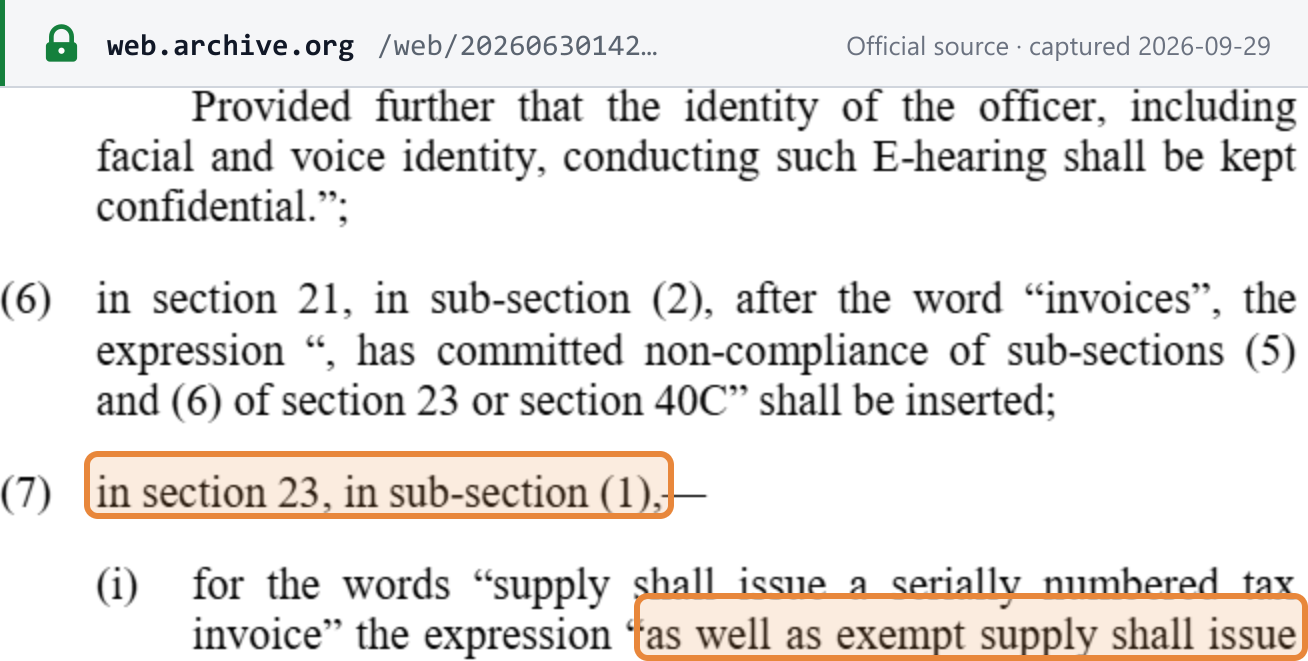
Section 23(1) of the Sales Tax Act 1990 governs the federal tax invoice. The Finance Act, 2026 rewrote its opening words from 1 July 2026. A registered person making a taxable supply "as well as exempt supply shall issue a tax invoice including an advance receipt invoice, bearing a verifiable and unique FBR invoice number". A new proviso adds that "the condition of a verifiable and unique FBR invoice number shall be applicable from the time as notified by the Board". No Board notification fixing that start date had been seen as of 2026-09-29. [2]
The invoice is issued "in Urdu or English language" and carries: [1]
| # | Particular | Provision |
|---|---|---|
| 1 | Name, address and registration number of the supplier | s.23(1)(a) |
| 2 | Name, address and registration number of the recipient. For supplies by a manufacturer or importer to an unregistered distributor, the distributor's CNIC or NTN instead | s.23(1)(b) |
| 3 | Date of issue | s.23(1)(c) |
| 4 | Description and quantity of goods — for textile yarn and fabric, including count, denier and construction | s.23(1)(d) |
| 5 | Value exclusive of tax | s.23(1)(e) |
| 6 | Amount of sales tax | s.23(1)(f) |
| 7 | Value inclusive of tax | s.23(1)(g) |
| 8 | Verifiable and unique FBR invoice number — from a date the Board will notify | s.23(1), as amended by the Finance Act, 2026 |
Two further rules apply. Where goods are transported, the registered person must ensure "the generation and linkage of the tax invoice with the e-Bilty" (proviso added by the Finance Act 2025). And "not more than one tax invoice shall be issued for a taxable supply". [3] [1]
Issuance deadline
At the time of supply (s.23(1)). For goods, the time of supply is "the time at which the goods are delivered or made available to the recipient of the supply or the time when any payment is received by the supplier in respect of that supply, whichever is earlier" (s.2(44)(a)). [1]
Numbering and sequencing
Before 1 July 2026, s.23(1) required a "serially numbered tax invoice". The Finance Act, 2026 substituted those words with the requirement for a verifiable and unique FBR invoice number. Sequencing now rests on that FBR-issued number once the Board notifies its start date. For point-of-sale invoices, the Rules separately require a "unique sequential invoice number". Under the digital-invoicing API, FBR returns the invoice number: 22 digits for an NTN-based seller and 28 for a CNIC-based seller. [2] [4] [10]
Credit and debit notes
A registered person may issue a debit or credit note where a supply is cancelled, goods are returned, or the nature or value of the supply changes, and adjust its output tax in the return (s.9). From 1 July 2026, issuance "shall be governed by the mechanism including electronic adjustments, as may be prescribed by the Board" (Finance Act, 2026). Suppliers enter debit and credit notes in Annex-I of the return by the 10th of the following month (Sales Tax Rules r.18(3)). In the digital-invoicing API, a debit note is document type 9 and must reference the original invoice. [1] [2] [4] [10]
Currency and language
- Language: Urdu or English (s.23(1)).
- Currency and FX: the Sales Tax Act and Rules contain no rule on foreign-currency invoices or FX conversion for domestic supplies. Imports are valued under the Customs Act (s.2(46)).
Document types
| Document | When it is used | Source |
|---|---|---|
| Tax invoice | Every taxable supply by a registered person — and, from 1 July 2026, every exempt supply | s.23(1); Finance Act, 2026 |
| Advance receipt invoice | On advance payment. "An invoice in the format as may be notified by the Board" (new s.2(1AA)); the Board may notify who may issue one within the notified system | Finance Act, 2026 |
| POS fiscal invoice | Every sale from a Tier-1 retailer's notified outlet, through an electronic fiscal device, in the standardised format. The buyer's name is recorded only where the customer "is liable for the tax or credit or invoice value is above Rs.100,000/-" | Sales Tax Rules, POS format (S.R.O. 1006(I)/2021) |
| Debit or credit note | Change in the supply or its value | s.9 |
| Electronic invoice through the FBR digital-invoicing API | Registered persons notified under S.R.O. 1852(I)/2025 — see E-invoicing status | Sales Tax Rules Chapter XIV |
Only a registered person, or a person paying retail tax, may issue an invoice under s.23 (s.23(2)). [1] [2] [4]
Self-billing
Not provided for. Section 23 and Chapter XIV of the Sales Tax Rules contain no self-billing mechanism, and s.23(2) restricts issuing invoices to the registered supplier or a retail-tax payer. [1]
Retention and audit trail
- Retention — 6 years. Records and documents are kept "for a period of Six years after the end of the tax period to which such record or documents relate", or longer until any proceedings are finalised (s.24). [1]
- Electronic storage and audit trail. The Sales Tax Rules consolidated to 1 January 2025 make the integrated supplier keep records "for a period of six years on electronic media" (r.150S). Data must be stored so that "information at the time of original transmission of invoice is re-created at the time of departmental audit" (r.150V). Inland Revenue officers get "physical and online remote access to the record, system, logs and documents" (r.150W). S.R.O. 69(I)/2025 later substituted Chapter XIV. [4] [14]
- Tier-1 POS. "Every adjustment, modification or cancellation must be recorded duly maintaining logs for each activity". The electronic fiscal devices "shall be tamper-proof and all the data recorded thereon shall be backed up at an offline site", and the POS system may not issue temporary or draft invoices. [4]
Technical format
Federal e-invoices are JSON messages posted in real time to FBR's REST API, run by PRAL (Pakistan Revenue Automation (Pvt.) Ltd). The format is not UBL, and Pakistan does not use Peppol. See E-invoicing status.
A specimen of a compliant invoice
The official specimen (retail POS). The Sales Tax Rules set a "standardized format" for Tier-1 POS invoices, inserted by S.R.O. 1006(I)/2021, and append a sample invoice "for ease of replication". The format lists the printed particulars in four blocks. It opens with the business name, address, STRN and NTN, and POS registration number. It then gives a unique sequential invoice number, date and time, and payment mode. The item lines carry item-wise tax rates ("0% if exempt"), the tax charged, discounts and a "PoS service fee of Re.1/- per invoice". The FBR block holds the FBR fiscal invoice number (XXXXXX-DDMMYYHHMMSS-0001), the FBR POS logo, a verifiable QR code of 7×7 mm, and the statement "Verify this invoice through FBR Tax Asaan Mobile App or SMS at 9966". [4] (archived copy)
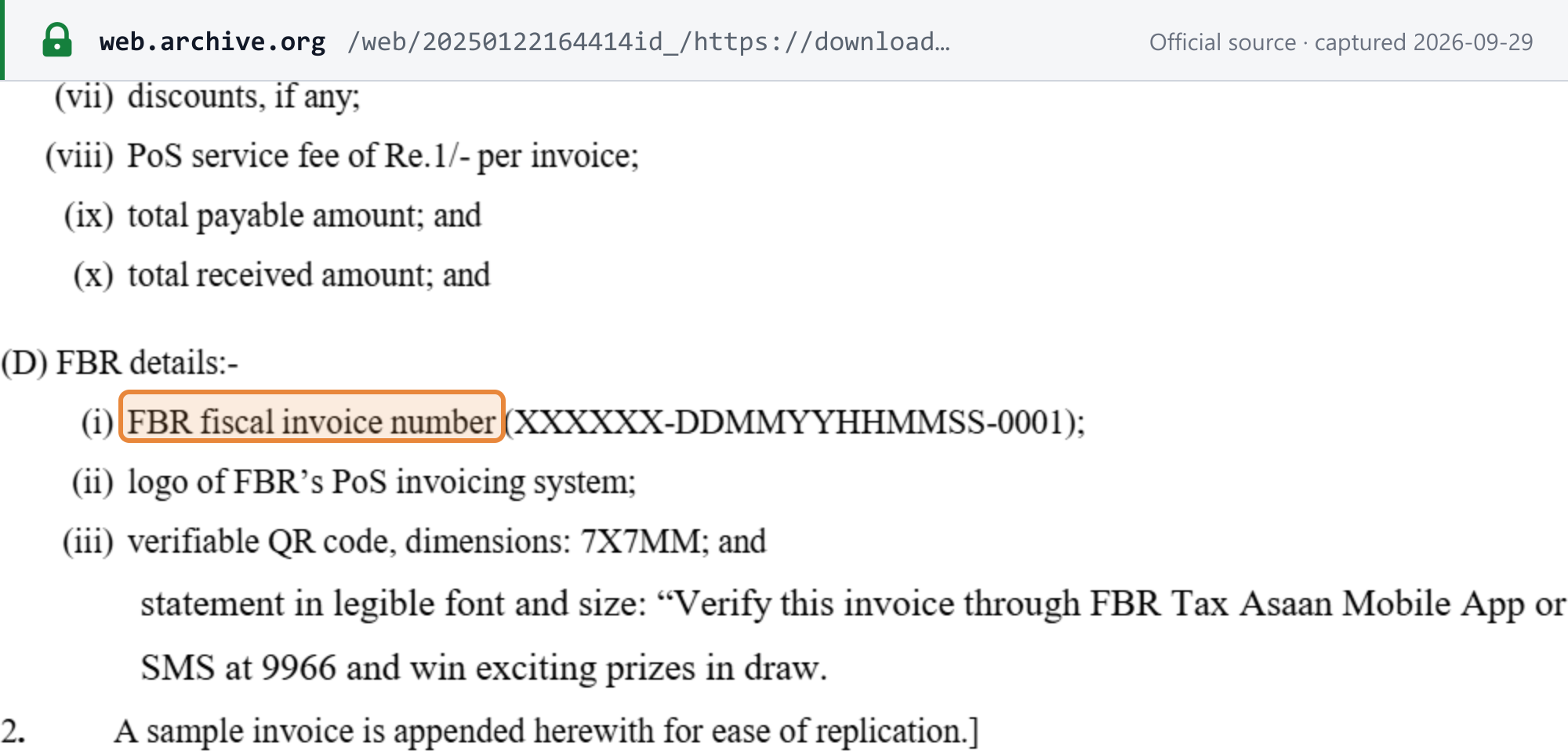
Illustration — a section 23 tax invoice between registered businesses. No official specimen exists for a B2B tax invoice. The layout below is Lookuptax's own illustration of the s.23(1) particulars. Every name, number and amount in it is fictional:
Sales Tax Invoice
| Descriptions.23(1)(d) | Quantitys.23(1)(d) | Unit price (excl. tax) | Value (excl. tax)s.23(1)(e) |
|---|---|---|---|
| Steel office cabinets | 100 | PKR 5,000 | PKR 500,000 |
- Value exclusive of taxs.23(1)(e)
- PKR 500,000
- Sales tax rates.3(1)
- 18%
- Amount of sales taxs.23(1)(f)
- PKR 90,000
- Value inclusive of taxs.23(1)(g)
- PKR 590,000
- The recipient is registered and on the Active Taxpayer List, so no further tax is charged. Had it been unregistered or inactive, a further 4% of the value (PKR 20,000) would be added under s.3(1A).
- Only one tax invoice may be issued for a taxable supply — s.23(1), proviso.
- Where the goods are transported, the invoice must be linked to the e-Bilty — s.23(1), proviso added by the Finance Act 2025.
- Issued through FBR digital invoicing, the invoice must also carry the Digital Invoicing System logo and a QR code (version 2.0, 25×25, printed 1.0 × 1.0 inch), per PRAL's DI API specification.
E-invoicing status
Status (as of 2026-09-29): mandatory for every sales tax registered person. The phased go-live dates under S.R.O. 1852(I)/2025 ran from 1 November 2025 to 31 December 2025, and all have passed. Separately, the Finance Act, 2026 requires an FBR invoice number on every invoice, from a date the Board has not yet notified.
System. FBR Digital Invoicing (DI), a real-time web API run by PRAL. Taxpayers integrate their ERP or POS software "through a licensed integrator or PRAL" (S.R.O. 1852). S.R.O. 69(I)/2025 provides that "PRAL shall provide free of cost integration services to the registered persons on demand" (r.150XF(2)). Retail sales at Tier-1 outlets run on the older POS integration, which applied "Commencing from the 1stDecember, 2019" (Sales Tax Rules r.150ZEA(2)). [5] [14] [4]
Legal basis. The Finance Act 2025 added s.23(5)–(6). Under them the Board "may require any person or class of persons to integrate their electronic invoicing system with the Board's Computerized System for real time reporting of sales", and licensed integrators do the integration. The procedure is in Chapter XIV of the Sales Tax Rules, as substituted by S.R.O. 69(I)/2025. [3] [14]
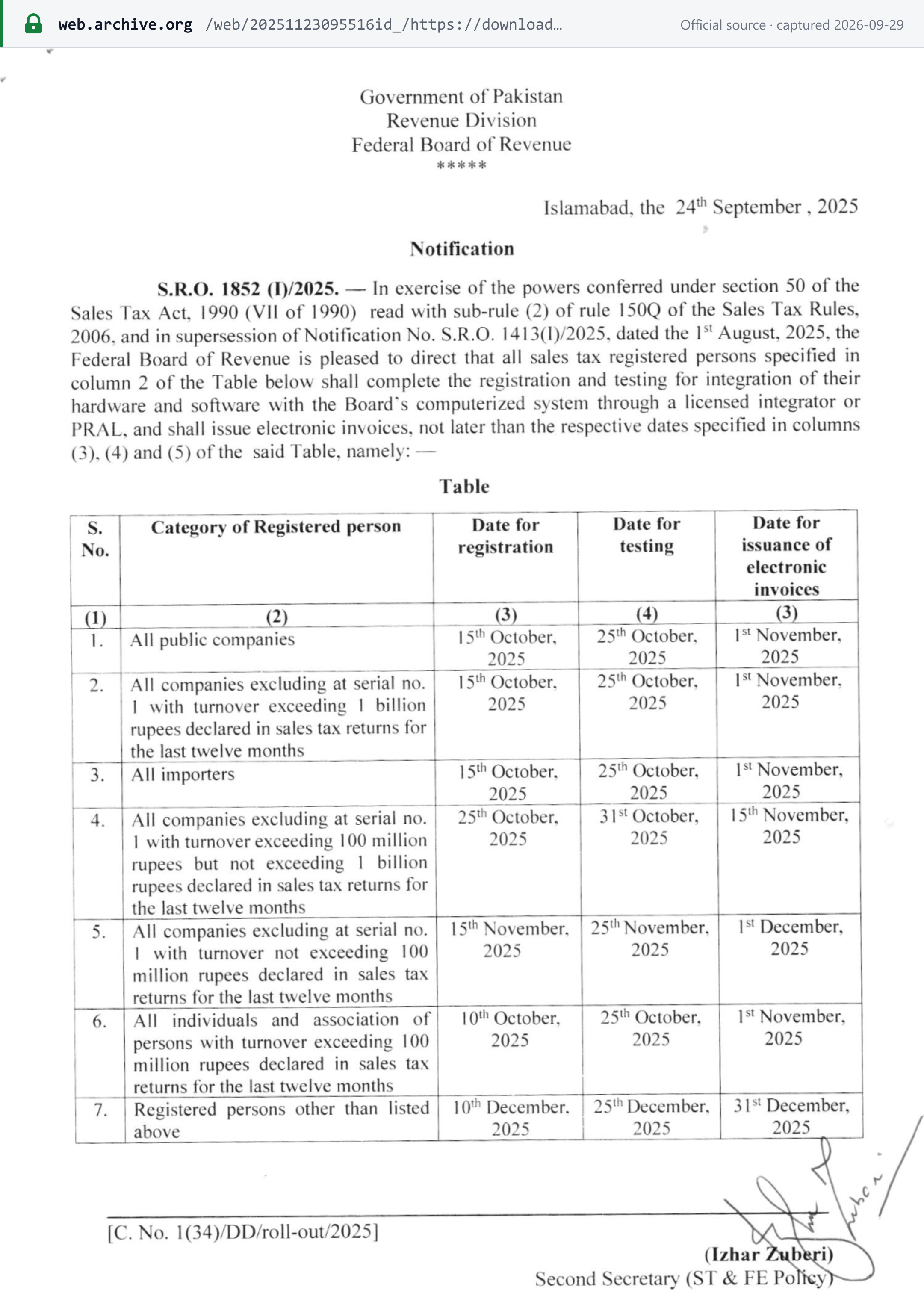
Phase timeline — S.R.O. 1852(I)/2025, 24 September 2025. Issued "in supersession of Notification No. S.R.O. 1413(I)/2025, dated the 1st August, 2025", it directs that the registered persons in each category "shall complete the registration and testing for integration … and shall issue electronic invoices, not later than" these dates. Turnover is as "declared in sales tax returns for the last twelve months": [5] (archived copy)
| # | Category of registered person | Registration by | Testing by | Issue e-invoices by |
|---|---|---|---|---|
| 1 | All public companies | 15 Oct 2025 | 25 Oct 2025 | 1 Nov 2025 |
| 2 | Other companies, turnover above PKR 1 billion | 15 Oct 2025 | 25 Oct 2025 | 1 Nov 2025 |
| 3 | All importers | 15 Oct 2025 | 25 Oct 2025 | 1 Nov 2025 |
| 4 | Other companies, turnover above PKR 100 million up to PKR 1 billion | 25 Oct 2025 | 31 Oct 2025 | 15 Nov 2025 |
| 5 | Other companies, turnover up to PKR 100 million | 15 Nov 2025 | 25 Nov 2025 | 1 Dec 2025 |
| 6 | Individuals and associations of persons, turnover above PKR 100 million | 10 Oct 2025 | 25 Oct 2025 | 1 Nov 2025 |
| 7 | All other registered persons | 10 Dec 2025 | 25 Dec 2025 | 31 Dec 2025 |
Earlier schedules, now superseded. S.R.O. 709(I)/2025 of 22 April 2025 set 1 May 2025 for corporate and 1 June 2025 for non-corporate registered persons. S.R.O. 1413(I)/2025 of 1 August 2025 replaced it, with a first wave on 1 September 2025. S.R.O. 1852 replaced that in turn. Its first date is 1 November 2025, not 1 September 2025. [13] [12]
Format. PRAL's "Technical Specification for DI API" (v1.12): "Digital Invoicing sharing mode will be real-time using Web API shared by FBR". Invoices are posted as JSON to https://gw.fbr.gov.pk/di_data/v1/di/postinvoicedata, with a sandbox endpoint for scenario testing first, and authentication uses a PRAL-issued security token valid for 5 years. Header fields include invoiceType, invoiceDate, sellerNTNCNIC, sellerProvince, buyerNTNCNIC, buyerProvince and buyerRegistrationType. Item fields include hsCode, rate, quantity, valueSalesExcludingST, salesTaxApplicable, furtherTax, extraTax and sroScheduleNo. The response returns the FBR invoiceNumber. Each printed invoice must carry the Digital Invoicing System logo and a QR code. [10]
Scope.
- B2B: yes — every registered person under S.R.O. 1852.
- B2C: yes. The DI payload supports
buyerRegistrationType: "Unregistered", and Tier-1 retail runs on the POS integration. - B2G: no separate regime in the Act, the Rules or the SROs. Government buyers are covered only as recipients.
- Provincial services: Sindh runs its own POS integration and invoice verification.
Enforcement from 1 July 2026 (Finance Act, 2026).
- The Commissioner may suspend a registration for non-compliance with s.23(5)–(6) (s.21(2)).
- Failing to integrate when required carries a penalty of up to PKR 1 million, and "if he continues to commit the offence after one month of the imposition of first penalty … up to five million rupees". The business premises may be sealed "with or without imposition of penalty" (s.33, entry 25).
- The Board may raise or lower a person's input-tax adjustment limit "on the basis of compliance or non- compliance with the production monitoring, digital invoicing, e-bility, POS, or any other electronic system" (s.8B).
No FBR instrument after S.R.O. 1852 changes these dates (checked 2026-09-29).
For the full picture — onboarding through IRIS and licensed integrators, the JSON API, offline mode, the 72-hour cancellation window and S.R.O. 1666(I)/2026 — see E-invoicing in Pakistan: FBR Digital Invoicing.
Filing and payment
Filing frequency
Monthly. Every registered person furnishes a return "indicating the purchases and the supplies made during a tax period" (s.26(1)). The Board may require quarterly returns, or an annual return in addition, by notification. Retailers other than Tier-1 retailers do not file: "Every person, excluding a retailer not being a tier-1 retailer, … shall file the return as specified in the form STR-7" (Sales Tax Rules r.14(1)). [1] [4]
Return due date
- Sales annex by the 10th. Suppliers submit sales data in Annex-C, and debit and credit notes in Annex-I, "by the 10th day of the month following the end of the tax period" (r.18(3)). The data pre-populates buyers' purchase annexes.
- Pay by the 15th, file by the 18th (checked 2026-09-29). The statutory due date is "the 15th day of the month following the end of the tax period" (s.2(9)). "In cases where due date has been prescribed as 15th of a month, the tax due shall be deposited by the 15th and the return shall be submitted electronically by 18th of the same month" (r.18(9)). Some utilities have later dates set in the same rule.
- Provincial returns are filed separately. In Sindh, the due date is also "the 15th day of the month following the end of the tax period" (Sindh Act s.2(36)).
Revisions and matching. A buyer's return stays provisional until its supplier files. If the supplier does not file by the last day of the due month, those invoices and the input tax on them are deleted from the buyer's return (r.18(3), proviso). A return may be revised within 120 days with the Commissioner's approval, and no approval is needed within 60 days where the revision increases the tax or reduces a refund (Finance Act 2025, new s.26(3A)). S.R.O. 1655(I)/2026 of 25 September 2026 adds an IRIS "advance intimation" of return discrepancies, and the time given to respond "shall not be less than seven days". [4] [3] [15]
Payment due date and method
Payment is due by the 15th (above). Tax is paid "through deposit in a bank designated by the Board" or another mode the Board specifies (s.6(3)). In practice that means a designated National Bank of Pakistan branch on challan STR-11, "or through electronic payment system devised for this purposes" (r.18(8)). [1] [4]
Additional listings
- The monthly return carries its annexes: Annex-A for purchases, Annex-C for sales, Annex-I for debit and credit notes, and Annex-J for production data from listed manufacturers.
- Online marketplaces, payment intermediaries and couriers file monthly statements (Finance Act 2025).
- Goods in transit need an e-Bilty (Finance Act 2025, s.40C).
- No separate annual sales tax return applies unless the Board notifies one (s.26(1)).
Input-tax recovery and blocked items
- Deduction. Input tax is deducted against output tax. The 4% further tax is not deductible. A missed deduction can be claimed "in the return for any of the six succeeding tax periods" (s.7(1)). Only a registered person may deduct (s.8(3)).
- 90% cap. Input tax adjustable in a period is capped at "ninety per cent of the output tax for that tax period", except on fixed assets and capital goods (s.8B(1)). The excess is adjusted or refunded "on yearly basis in the second month following the end of the financial year" (s.8B(3)). Tier-1 retailers that are not integrated lose part of their adjustable input tax (s.8B(6)).
- Blocked (s.8(1)), among others:
- goods and services "acquired for personal or non-business consumption";
- building and construction materials and other goods attached to immovable property, other than pre-fabricated buildings and goods for resale or for direct use in manufacture;
- vehicles of Chapter 87, their parts, electrical and gas appliances, furniture, furnishings and office equipment (other than electronic cash registers), unless acquired for resale;
- services on which the provincial law bars input tax;
- agricultural machinery taxed at 7%;
- fake invoices, and tax the supplier did not declare or deposit.
- Mixed supplies. A person with taxable and non-taxable supplies reclaims only the proportion attributable to taxable supplies (s.8(2)).
- Penalties from 1 July 2026. Claiming input tax that does not match the supplier's declared output carries a penalty of 20% of the unmatched amount (Finance Act, 2026, s.33 entry 30).
Refunds
- Zero-rated supplies and exports. Where input tax exceeds output tax "on account of zero rated local supplies or export", the excess "shall be refunded … not later than forty-five days of filing of refund claim" (s.10(1)).
- Other excess input tax "may be carried forward to the next tax period".
- The Act and the Rules provide no refund scheme for non-residents and no bad-debt relief.
Exemptions
Exempt supplies
Goods listed in the Sixth Schedule are exempt (s.13(1)). The Finance Act, 2026 changes the list from 1 July 2026. It adds wheat and rice bran (entry 27A); newsprint, books and magazines "but excluding brochures, leaflets and directories" (entry 32 as substituted); contraceptives (182); female sanitary pads and tampons (183); and, "effective from the first day of July, 2027", aircraft imported or leased by any Pakistan-registered airline (181A). [1] [2]
Exempt is not zero-rated.
| Zero-rated | Exempt | |
|---|---|---|
| Taxable supply? | Yes, at 0% — registration covers "zero-rated supplies" (s.14(1)) | No — outside the tax (s.13) |
| Input tax | Deductible, and refundable where in excess (s.10(1)) | Not deductible — s.8(1)(a) blocks input tax on goods or services used "for any purpose other … for taxable supplies" |
| Mixed businesses | — | Apportion (s.8(2)) |
| Invoice | Tax invoice | Tax invoice required from 1 July 2026 (Finance Act, 2026) |
Special regimes
- Retail-price regime. Third Schedule goods are taxed at 18% of the printed retail price (see Rates).
- Retailers below Tier-1. Tax is paid through the electricity bill, at 5% or 7.5%.
- Cottage industry. Outside mandatory registration. Its e-commerce sales are settled by the 2% withholding as a final discharge.
- Export Processing Zones, the Gwadar special economic zone and duty-and-tax remission for exporters. Zero-rated through the Fifth Schedule.
- Commercial importers. The 3% value-addition tax at import (Twelfth Schedule).
- Margin scheme, cash accounting, flat-rate small-business scheme. None in the Act or the Rules.
Offences and penalties
Offences
Criminal exposure is tried by a Special Judge. [1] [3]
| Conduct | Exposure on conviction | Source |
|---|---|---|
| Failing to register within 60 days of starting a taxable activity | Up to 3 years' imprisonment, or a fine up to the tax involved, or both | s.33, entry 7, proviso |
| Not paying tax within 60 days of an officer's notice | Up to 3 years, or a fine up to the tax involved, or both | s.33, entry 5, proviso |
| Tax fraud (s.2(37)) — including false or forged documents, invoices without a supply, and fictitious input tax | Up to 5 years, plus the tax lost, a penalty of 100% of it and default surcharge | s.33, entry 13, as substituted by the Finance Act 2025 |
| Abetting tax fraud | Up to 5 years, "or with fine which may extend to ten million rupees, or with both" | s.33, entry 13A (Finance Act 2025) |
Arrest is possible, among other conditions, where "the amount involved in tax fraud exceeds fifty million rupees" (s.37A(8), as substituted by the Finance Act 2025).
Penalties
The Finance Act, 2026 raised the main penalties in the s.33 table from 1 July 2026: [2] [1]
| Entry | Default | Penalty from 1 July 2026 | Before |
|---|---|---|---|
| 1 | Return not filed by the due date | PKR 50,000; if filed within 10 days of the due date, PKR 2,000 per day ¹ | PKR 10,000; PKR 200 per day |
| 2 | Failure to issue an invoice | PKR 25,000 or 5% of the tax involved, whichever is higher | PKR 5,000 or 3% |
| 3 | Issuing an unauthorised invoice showing tax | PKR 50,000 or 10% of the tax involved, whichever is higher | PKR 10,000 or 5% |
| 5 | Late payment or non-payment of tax | PKR 50,000 or 5% of the tax involved, whichever is higher; if paid within 10 days, PKR 5,000 per day | PKR 10,000 or 5%; PKR 500 per day |
| 7 | Failure to apply for registration | PKR 50,000 or 5% of the tax involved, whichever is higher (plus the offence above) | PKR 10,000 or 5% |
| 8 | Failure to maintain records | PKR 50,000 or 5% of the tax involved, whichever is higher | PKR 10,000 or 5% |
| 25 | Failure to integrate when required | Up to PKR 1 million; up to PKR 5 million if it continues a month after the first penalty; premises may be sealed | Up to PKR 1 million |
| 29 | Simulated or fictitious invoices | A penalty equal to the invoices' face value; the issuer is named on a public register | — |
| 30 | Input tax not matched to the supplier's output | 20% of the unmatched input tax, plus reversal and default surcharge | — |
¹ The Finance Act, 2026 amends entry 1 by replacing words — "for the word "ten", the word "fifty"" — and entry 1 contains "ten" twice ("ten thousand rupees" and "within ten days"). The table reads the change as applying to the rupee amount, which is the natural reading.
Default surcharge (interest). "Twelve percent per annum or KIBOR plus three percent per annum, whichever is higher", on the tax due or a refund erroneously paid. Where the default is tax fraud, the rate is "two per cent per month" (s.34(1)). Neither the Finance Act 2025 nor the Finance Act, 2026 amends it. [1]
Frequently asked questions
We sell to customers in Pakistan from abroad — do we have to register for Pakistani sales tax?
For goods shipped from abroad, no. Section 14 of the Sales Tax Act 1990 lists no registration category for a seller outside Pakistan: sales tax of 18% is charged on the import and is paid at customs in the same manner as a customs duty (s.3(1)(b) and s.6(1)). A non-resident that sells digitally ordered goods from within Pakistan through an online marketplace, website or app must register under s.14(1A), which the Finance Act 2025 added. Services are taxed by the provinces, not by the federal Act. In Sindh and Khyber Pakhtunkhwa a service provided by a non-resident to a resident is taxable, and the resident recipient is liable to pay the tax (reverse charge); both Acts say this applies whether or not the recipient is an end consumer. Neither provincial Act gives the foreign supplier its own registration route. [1] [3] [6] [7]
What is the sales tax registration threshold in Pakistan?
There is no general turnover threshold for sales tax on goods. Section 14(1) of the Sales Tax Act 1990 requires registration by category: manufacturers other than a cottage industry, retailers liable to sales tax other than those paying through their electricity bill, importers, exporters seeking refunds, wholesalers, dealers and distributors, and persons required to register under another law. The only turnover figure is inside the cottage-industry exclusion: a manufacturer with no industrial gas or electricity connection, located in a residential area, with no more than ten workers and annual turnover of no more than PKR 8 million. Separately, from 1 July 2026 the Finance Act, 2026 makes a retailer with turnover above PKR 200 million over the preceding twelve months a Tier-1 retailer. [1] [2]
Which authority taxes our services, and at what rate?
Sales tax on services is provincial. The Sindh Revenue Board charges 15% (Sindh Sales Tax on Services Act 2011, s.8(1)). The Khyber Pakhtunkhwa Revenue Authority charges 15% (Khyber Pakhtunkhwa Sales Tax on Services Act 2022, s.9(1)). In the Islamabad Capital Territory the FBR sets rates entry by entry in the Schedule to the ICT (Tax on Services) Ordinance 2001, with those entries at 15%. In Punjab, the Punjab Finance Act 2025 taxes all services not otherwise specified at 16% from 1 July 2025; the rate for 2026-27 is not confirmed. The Balochistan rate is not confirmed from an official source. Each province runs its own registration and return, separate from the federal return for goods. [6] [7] [8] [16]
Why did our supplier add an extra 4% to the invoice?
Because you were treated as unregistered or inactive. Section 3(1A) of the Sales Tax Act 1990 charges a further tax of 4% of the value, on top of the rate otherwise due, where taxable supplies are made to a person who has not obtained a registration number or is not an active taxpayer. It applies to zero-rated supplies too, because the zero-rating in section 4 operates subject to section 3(1A). Registering, and staying on the Active Taxpayer List, removes it. [1]
Which e-invoicing deadline applies to us, and has it passed?
Every date has passed. S.R.O. 1852(I)/2025 of 24 September 2025, which superseded S.R.O. 1413(I)/2025, set the dates by which registered persons must issue electronic invoices: 1 November 2025 for all public companies, other companies with turnover above PKR 1 billion, all importers, and individuals and associations of persons with turnover above PKR 100 million; 15 November 2025 for other companies with turnover above PKR 100 million up to PKR 1 billion; 1 December 2025 for other companies with turnover up to PKR 100 million; and 31 December 2025 for every other registered person. Turnover means turnover declared in sales tax returns for the last twelve months. Integration is through a licensed integrator or PRAL. From 1 July 2026, failing to integrate when required carries a penalty of up to PKR 1 million, and up to PKR 5 million if the failure continues one month after the first penalty (Finance Act, 2026). [5] [2]
Important websites
| Site | Purpose |
|---|---|
| FBR IRIS | Federal sales tax registration (Form STR-1) and monthly returns |
| FBR e-services | Payment slips (PSID) and taxpayer services |
| FBR sales tax SROs | Notifications such as S.R.O. 1852(I)/2025 |
https://gw.fbr.gov.pk/di_data/v1/di/postinvoicedata | FBR digital-invoicing API endpoint (for integrators; not a browser page) |
| SRB e-registration | Sindh services tax registration |
| SRB taxpayer search | Checking a Sindh registration |
| SRB how to pay | Paying Sindh services tax |
| SRB POS invoice verification | Verifying a Sindh POS invoice |
| KPRA | Khyber Pakhtunkhwa services tax — e-registration and e-filing guides (the old kpra.kp.gov.pk domain no longer connects) |
| Punjab Revenue Authority | Punjab services tax |
| Balochistan Revenue Authority | Balochistan services tax |
To check a counterparty's NTN, use Lookuptax's Pakistan NTN validator.
Recent changes
- 2026-09-25 — S.R.O. 1655(I)/2026 adds Chapter XII-A to the Sales Tax Rules: IRIS sends an "advance intimation" of return discrepancies, with at least seven days to respond before legal action. (Federal Board of Revenue)
- 2026-06-26 — Finance Act, 2026 (Act No. XLIII of 2026) gazetted, in force from 1 July 2026. Tax invoices must bear a verifiable and unique FBR invoice number, from a date the Board will notify, and must be issued for exempt supplies and advance receipts too. Tier-1 retailers are redefined on a PKR 200 million turnover test. Twenty items join the Third Schedule, and the s.33 penalties rise. (Federal Board of Revenue) — see event: FBR invoice number and event: Sales Tax Act expansion
- 2025-12-31 — The last e-invoicing date under S.R.O. 1852(I)/2025: all remaining registered persons. (Federal Board of Revenue)
- 2025-11-01 — The first e-invoicing date under S.R.O. 1852(I)/2025: public companies, companies with turnover above PKR 1 billion, importers, and individuals and associations of persons with turnover above PKR 100 million. (Federal Board of Revenue)
- 2025-09-24 — S.R.O. 1852(I)/2025 re-sets the e-invoicing schedule, superseding S.R.O. 1413(I)/2025 of 1 August 2025 (which had itself superseded S.R.O. 709(I)/2025 of 22 April 2025). (Federal Board of Revenue)
- 2023-02-28 — FBR Circular No. 01 of 2023 explains the Finance (Supplementary) Act 2023, which raised the standard rate from 17% to 18%. (Federal Board of Revenue)
Ahead — scheduled changes that have not yet taken effect:
- The FBR invoice number on every tax invoice applies from a date the Board has yet to notify (Finance Act, 2026).
- The exemption for aircraft imported or leased by Pakistan-registered airlines starts on 1 July 2027 (Finance Act, 2026).
- The former-tribal-areas rate steps up to 14% for 2027-28 and 16% for 2028-29 (Finance Act 2025).
For the full chronology, see Pakistan tax changes on Lookuptax.
Reference links
Where an FBR link is unavailable, the archived copy is the same FBR document.
- FBR — Sales Tax Act, 1990, updated by Finance Act 2024 up to 30.06.2024 (PDF) (archived copy)
- FBR — Finance Act, 2026 (Act No. XLIII of 2026), Gazette of Pakistan Extraordinary, 26 June 2026 (PDF) (archived copy)
- FBR — Finance Act, 2025, as passed by the National Assembly (PDF) (archived copy)
- FBR — Sales Tax Rules, 2006, updated up to 01-01-2025 (PDF) (archived copy)
- FBR — S.R.O. 1852(I)/2025, 24 September 2025, e-invoicing schedule (PDF) (archived copy)
- Sindh Revenue Board — Sindh Sales Tax on Services Act, 2011, consolidated (PDF)
- KPRA — Khyber Pakhtunkhwa Sales Tax on Services Act, 2022, updated to Finance Act 2026 (PDF)
- FBR — Islamabad Capital Territory (Tax on Services) Ordinance, 2001, as amended up to 30 June 2025 (PDF) (archived copy)
- Punjab Revenue Authority — Punjab Sales Tax on Services Act, 2012, 13th edition 2022-2023 (PDF) (archived copy)
- FBR / PRAL — Technical Specification for DI API, v1.12 (PDF) (archived copy)
- FBR — Circular No. 01 of 2023, Finance (Supplementary) Act 2023, 28 February 2023 (PDF) (archived copy)
- FBR — S.R.O. 1413(I)/2025, 1 August 2025 (PDF) (archived copy)
- FBR — S.R.O. 709(I)/2025, 22 April 2025 (PDF) (archived copy)
- FBR — S.R.O. 69(I)/2025, 29 January 2025, Sales Tax Rules Chapter XIV (PDF) (archived copy)
- FBR — S.R.O. 1655(I)/2026, 25 September 2026, Sales Tax Rules Chapter XII-A (PDF) (archived copy)
- Punjab Laws — Punjab Finance Act 2025 (archived copy)
Related Lookuptax pages: