How to Register for SST in Malaysia (Sales Tax and Service Tax)
Malaysia has no VAT or GST. Its indirect taxes are sales tax and service tax (together "SST"), administered by the Royal Malaysian Customs Department (RMCD, also JKDM). They are two separate registrations, each with its own number. A manufacturer registers for sales tax, a provider of prescribed services registers for service tax, and a business that does both holds two numbers. Foreign sellers use two further regimes with their own portals: MySToDS for digital services and MyLVG for low-value goods.
This page covers the process: which registration applies, on which portal, by what date, with which form, and what you receive. For SST rates, the Group K counting rules and the MyInvois e-invoicing timeline, see the Malaysia SST guide. For the TIN and NRIC formats, see the Malaysia TIN guide.
Who must register
Liability for both taxes is tested on a rolling 12-month value, at the end of each month. A person becomes liable at the end of any month where either (a) that month plus the 11 preceding months has exceeded the threshold, or (b) there are reasonable grounds to believe that month plus the 11 succeeding months will exceed it, whichever is earlier:
"Any person who provides any taxable service is liable to be registered at the following time, whichever is the earlier: (a) at the end of any month, where the total value of all his taxable services in that month and the eleven months immediately preceding that month has exceeded the total value of taxable service prescribed under subsection (1); or (b) at the end of any month, where there are reasonable grounds for believing that the total value of all his taxable services in that month and the eleven months immediately succeeding that month will exceed the total value of taxable services prescribed under subsection (1)." (Service Tax Act 2018, s.12(2)) [1]
The Sales Tax Act 2018 applies the same test to manufacturers (s.12(2)). [2] Section 12(3) of the Service Tax Act lets the Minister prescribe that a person providing a particular service is liable from the date the business starts. That power is the basis for the services with a Nil threshold in the table below. [1]
Sales tax: manufacturers of taxable goods
A manufacturer of taxable goods must register once the sale value of its taxable goods exceeds RM500,000 in 12 months. The same threshold applies to a sub-contract manufacturer, measured on the value of the work it does on taxable goods. The figure is set by the Sales Tax (Total Sale Value of Taxable Goods) Order 2018, P.U.(A) 209/2018, and has applied since 1 September 2018 (as at 2026-09-23): [3]
"The total sale value of taxable goods for the purpose of registration of any manufacturer under subsection 12(1) of the Act shall be five hundred thousand ringgit."
RMCD's current registration guide (6 March 2026) restates both limbs: sale value of taxable goods, and a sub-contractor's work value, each over RM500,000 in 12 months. [4]
Exempt from registration. The Sales Tax (Exemption From Registration) Order 2018, P.U.(A) 208/2018, as amended by P.U.(A) 277/2022 (gazetted 1 September 2022), exempts a person who "operates only one manufacturing operation out of several operations in a manufacturing chain" listed in Schedule A, "irrespective of the total sales value of the taxable goods" (para 2(1)). A person carrying on several unrelated Schedule A operations is also exempt (para 2(1A)). The substituted Schedule A has 16 items. They include ready-mixed concrete, the preparation of foods or drinks by Group B food and beverage operators or their central kitchens, personal tailoring, eyesight testing and lenses, the repair of used goods, and cleaning. [5] [33] Such persons may still apply to register (Sales Tax Act s.20(2)). [2] Companies in special areas are not registered as manufacturers under the Sales Tax Act. The 2026 registration guide (FAQ 3) names licensed manufacturing warehouses, and free zones are also special areas under the Act's definition in s.2. [4] [2]
Service tax: the threshold depends on the service group
The service-tax threshold is set per taxable service group in the First Schedule to the Service Tax Regulations 2018 (P.U.(A) 214/2018), as amended by P.U.(A) 62/2024 (Group J, in operation from 26 February 2024), P.U.(A) 172/2025 (the 1 July 2025 expansion) and P.U.(A) 201/2025. The default is RM500,000, but several groups differ. Current figures as at 2026-09-23:
| Group / item | Threshold (12 months) | Instrument |
|---|---|---|
| Groups A, C, D, E, F, G and I (most items) | RM500,000 | P.U.(A) 214/2018 [6] |
| Group G professional services | More than RM500,000 across Group G services, "whether combined or singly" | P.U.(A) 214/2018 [6] |
| Group B food and beverage | RM1,500,000 | P.U.(A) 214/2018 [6] |
| Group H item 1, card line of credit | Nil | P.U.(A) 172/2025 [7] |
| Group H items 2–4: insurance and takaful, financial-services fees and commissions, other financial services | RM1,000,000 | P.U.(A) 201/2025 reg 3(a) [8] |
| Group I items 14–16: private healthcare, traditional and complementary medicine, allied health | RM1,500,000 | P.U.(A) 172/2025 [7] |
| Group J item 1: logistics, delivery and courier services | RM500,000 | P.U.(A) 62/2024 [34] |
| Group J item 2: customs agents' services for the release of goods from customs control | Nil | P.U.(A) 62/2024 [34] |
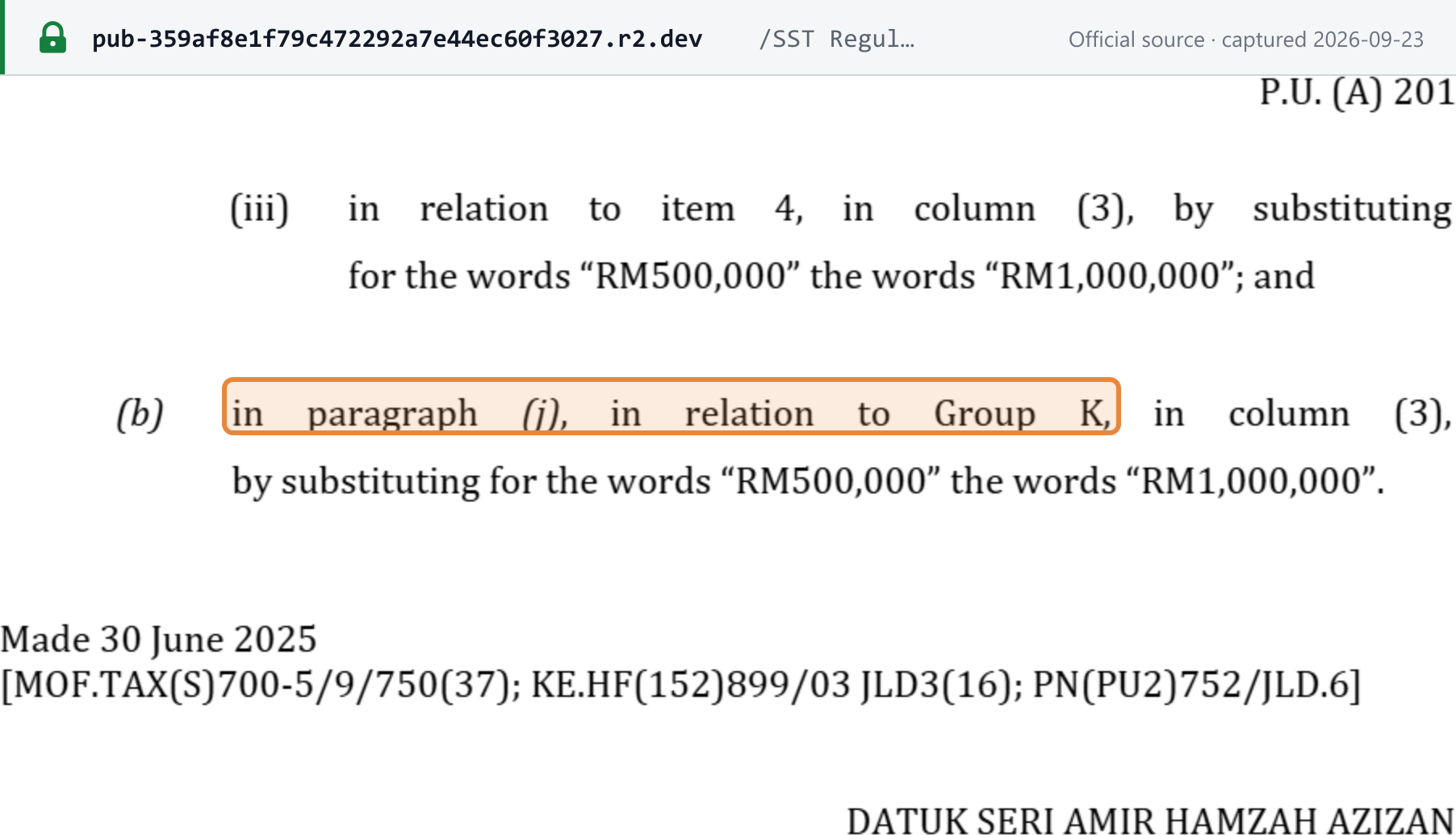
| Group K rental or leasing | RM1,000,000 | P.U.(A) 201/2025 reg 3(b) [8] |
| Group L construction works, excluding residential buildings and related public facilities | RM1,500,000 | P.U.(A) 172/2025 [7] |
| Group M private education, items 1–3 | Nil | P.U.(A) 172/2025 [7] |
Notes on the table:
- Groups H and K moved from RM500,000 to RM1,000,000. P.U.(A) 172/2025 as made set RM500,000 for Group H items 2–4 and Group K. P.U.(A) 201/2025, in operation from 1 July 2025, substituted "RM1,000,000" in each case. [8] RMCD's current industry guides give the same figures: RM1,000,000 for financial services [9], more than RM1 million for rental or leasing [10], and more than RM1,500,000 for construction work. [11] Some RMCD summary pages still show RM500,000 for these groups. Rely on the gazetted regulations.
- Group M item 1 covers pre-school to post-secondary education at private institutions registered under the Education Act 1996 that charge fees exceeding RM60,000 per student for each academic year. Special schools and language centres are excluded. [7]
- Joint providers of rental test separately. From 1 July 2025, persons who jointly provide rental or leasing services under one agreement "shall be treated as separate entities and are required to register individually as service providers based on their respective total taxable services (threshold value)" (Service Tax Policy No. 4/2026). [12]
Already registered and adding a newly taxable service
An existing service tax registrant does not re-register when it starts providing another taxable service. It notifies RMCD "immediately" when "he provides other taxable services in addition to the taxable services that he has been registered" (Service Tax Regulations 2018 reg 9(1)(e)) [6], and adds the new service type to its registration in MySST. The financial services guide puts it this way:
"Existing registered service providers are required to update their registration details in the MySST portal by adding the new service type (Financial Services) in their registration info and begin charging service tax on taxable financial services provided from the effective date." (para 83) [9]
The construction guide says the same for construction work services (para 109). [11] For rental, the timing depends on the existing group. A registrant in Groups A to E adds rental to its registration without a new registration. A registrant in any other group adds rental once its rental services separately reach the threshold (rental guide v2, paras 33–34). [10]
Non-established businesses
What a foreign business must do depends on what it sells into Malaysia.
Digital services to Malaysian consumers: register as a foreign registered person on MySToDS. A foreign service provider (FSP) supplying digital services to consumers in Malaysia must register once the value of those services exceeds RM500,000 in 12 months. The regime sits in Part IXA of the Service Tax Act, inserted by Act A1597. Registration opened on 1 October 2019, and the tax has been charged since 1 January 2020: [13]
"Any foreign service provider who provides any digital service to consumer with the total value of digital services exceeding five hundred thousand ringgit shall be liable to be registered." (Service Tax (Digital Services) Regulations 2019, reg 2)
A "consumer" is someone who meets any two of the statutory tests, for example paying through a Malaysian card or payment facility, or using a Malaysian IP address or phone code. The FSP definition also covers foreign operators of online platforms "for buying and selling goods or providing services" that make transactions for digital services on behalf of others. [14] The ordinary registration sections do not apply to an FSP: A1597 adds "This section shall not apply to a foreign service provider" to s.12, and s.13, s.14 and s.15 carry the same disapplication. [14]
Low-value goods: register as a registered seller on MyLVG. Sales tax on low-value goods (LVG) brought into Malaysia has applied since 1 January 2024. [15] Part IIIA of the Sales Tax Act (inserted by Act A1671, as amended by Act 851) defines a "seller" as "a person, whether in or outside Malaysia, who sells low value goods on an online platform or operates an online marketplace for the sales and purchase of low value goods". [16] [30] The registration threshold is RM500,000 in total sale value of LVG (P.U.(A) 409/2022). [17] The application form is LVG-01. [18]
Other taxable services to Malaysian businesses: the supplier does not register. Service tax is also charged on "imported taxable service", meaning "any taxable service acquired by any person in Malaysia from any person who is outside Malaysia" (Finance Act 2018), with effect from 1 January 2019. A Malaysian business that is not itself a taxable person accounts for the tax on a declaration and pays it "not later than the last day of the month following the end of the month in which the payment on the service has been made by him or invoice is received by him" (Service Tax Act s.26A(1)). [19] The declaration form is SST-02A. [18]
Fiscal or local representative. RMCD's FSP guidance names no local-representative requirement: Part IXA of the Service Tax Act, the Digital Services Regulations, Form DST-01 and the FSP registration appendix set none (checked 2026-09-23). DST-01 takes the foreign business registration number "recognized by the relevant authority in such country" and a foreign address. [20]
Voluntary registration
A person who is not liable may apply to register under s.14 of either Act:
"(1) Any person who is not liable to be registered under section 12 may apply to the Director General for registration as a registered person in the form and manner as determined by the Director General. (2) Upon receipt of the application under subsection (1), the Director General may approve the registration from such date as he may determine subject to such conditions as he deems fit." (Service Tax Act s.14, as amended by Finance (No. 2) Act 2023 [Act 851]; Sales Tax Act s.14(1) is amended in the same way) [1] [30]
Voluntary applicants use the same Form SST-01 (General Ruling No. 6/2026, Lampiran II item 1 and Lampiran III item 1). [18] Three limits apply:
- No voluntary route for FSPs. A1597 adds s.14(3): "This section shall not apply to a foreign service provider." [14]
- No voluntary route for LVG sellers. New s.11B(2) of the Sales Tax Act lists section 14 among the provisions that "shall not apply to low value goods". [16]
- Manufacturers of non-taxable goods are not eligible. RMCD's general sales tax guide lists "Pengilang barang tidak bercukai (tidak layak untuk pendaftaran secara sukarela)", meaning manufacturers of non-taxable goods are not eligible for voluntary registration. [21]
Minimum period. Neither Act, neither set of regulations, RMCD's 2026 sales tax registration guide nor its general sales tax guide sets a minimum registration period for voluntary registrants (checked 2026-09-23). The only statutory minimum found is for a separately registered service-tax branch, which stays registered for "not less than two years or such other shorter period as the Director General may determine" (Service Tax Act s.17(6)). [1]
Deadline: the month rule, not 30 days
The deadline is not "30 days" from crossing the threshold. A liable person must apply by the last day of the month after the month in which liability arose:
"Any person who is liable to be registered under section 12 shall apply to the Director General for registration as a registered person in the form and manner as determined by the Director General not later than the last day of the month following the month in which he is liable to be registered as referred to in paragraph 12(2)(a) or (b) or subsection 12(3)." (Service Tax Act s.13(1), as amended by Finance (No. 2) Act 2023 [Act 851] with effect from 1 January 2024) [1] [30]
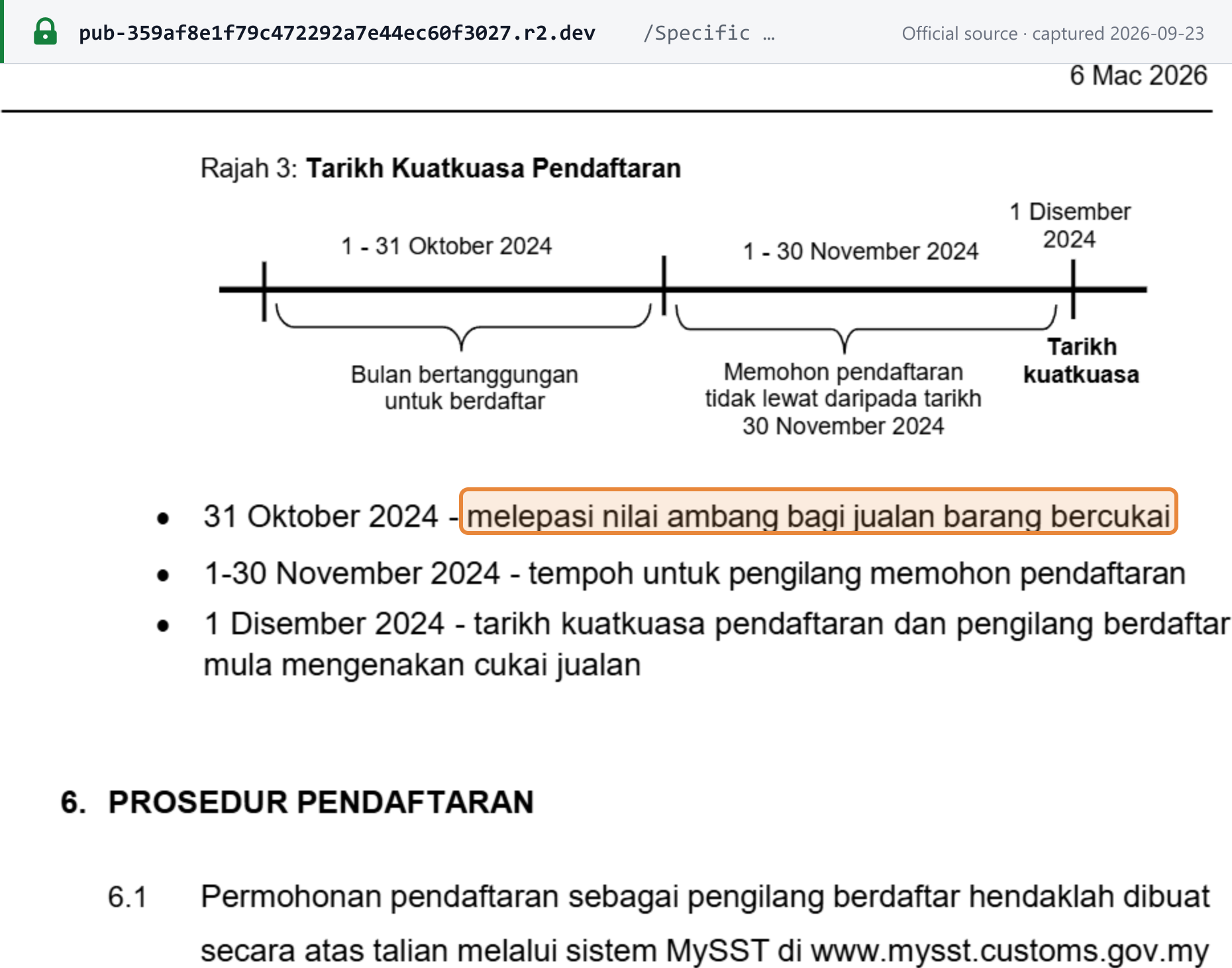
Sales Tax Act s.13(1) sets the same deadline for manufacturers, and Service Tax Act s.56C(1) sets it for FSPs, both in the same amended wording. [2] [14] [30] Because liability arises at a month end, the window is always the whole of the following calendar month. RMCD's rental guide gives a worked example. A lessor that reached the threshold in August 2025 registers during September 2025. Registration takes effect on 1 October 2025 under s.13(3), and service tax is charged from that date. [10] The 2026 sales tax registration guide shows the same pattern (Rajah 3): threshold passed on 31 October 2024, application during 1–30 November 2024, registration effective 1 December 2024. [4]
Where to register
Registration is electronic only. General Ruling (Ketetapan Umum) No. 6/2026, in force from 21 September 2026, requires registration applications under the Tourism Tax, Sales Tax and Service Tax Acts to be submitted to the Director General "secara elektronik sahaja" (electronically only, para 6). Para 7 names the portal for each regime: [18]
| Registration | Portal | Form |
|---|---|---|
| Sales tax (manufacturers) and service tax (service providers) | MySST | SST-01 |
| Digital services by foreign service providers | MySToDS | DST-01 |
| Low-value goods sellers and marketplace operators | MyLVG | LVG-01 |
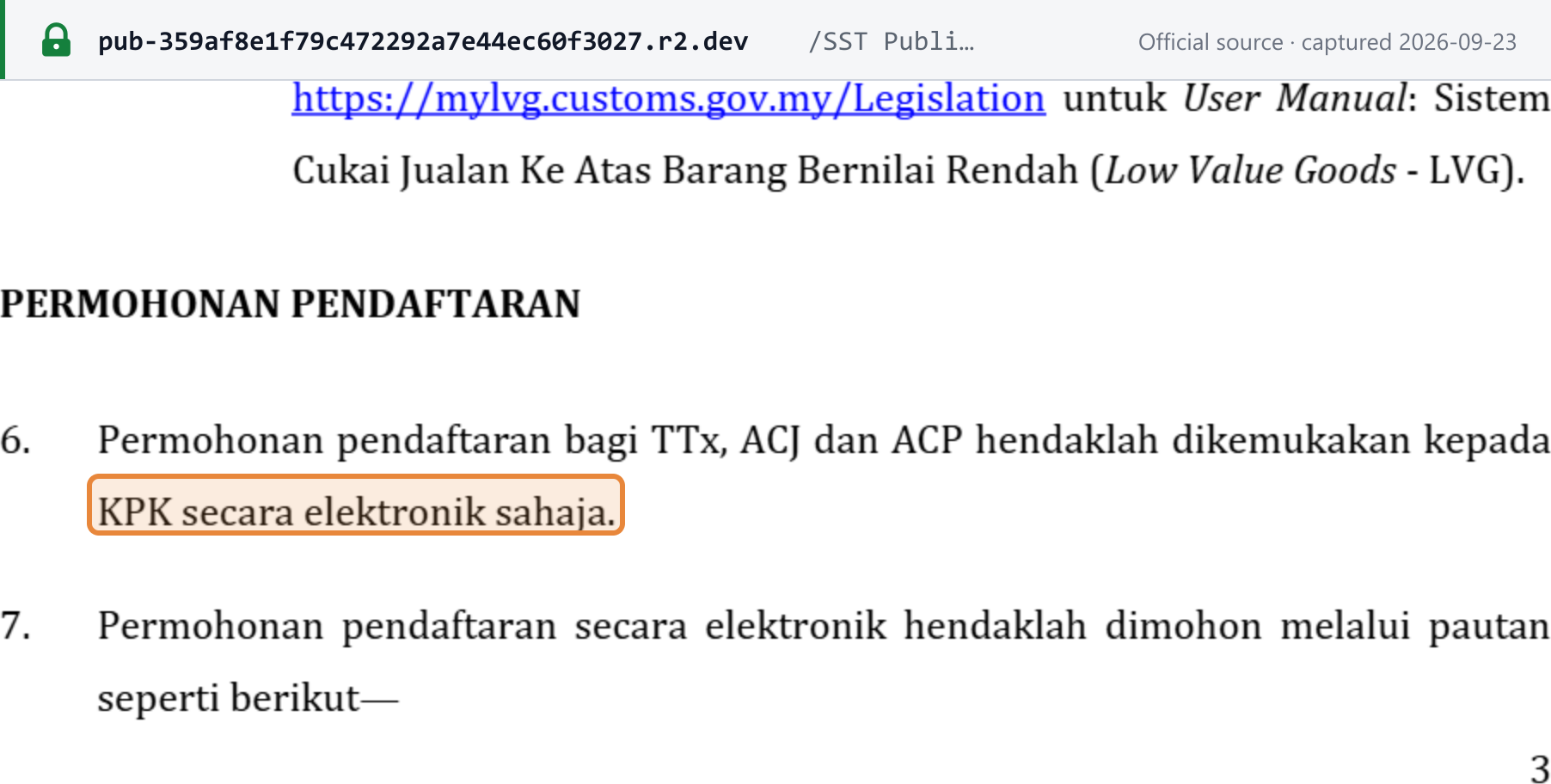
The Acts, as amended from 1 January 2024, leave the form and manner of a registration application to the Director General, and GR 6/2026 is where the Director General sets it. [30] GR 6/2026 replaces General Ruling No. 1/2025. Its post and courier channel is for returns and payments to the Customs Processing Centre, not for registration. [18] RMCD publishes no paper registration route (checked 2026-09-23).
Direct links to the application screens:
- New sales tax registration: sst01.customs.gov.my/account/register-license/1
- New service tax registration: sst01.customs.gov.my/account/register-license/2
- Registration status inquiry: sst01.customs.gov.my/account/inquiry
- MySST login: sst01.customs.gov.my/account/login
- MySToDS Form DST-01: mystods.customs.gov.my/stods/registration
- MySToDS search for foreign registered persons: mystods.customs.gov.my/stods/search_frp
Prerequisites and documents
Form SST-01 is the application for both sales tax and service tax. The business owner, or a person the owner authorises, completes it online in the MySST registration module:
"Permohonan pendaftaran sebagai pengilang berdaftar hendaklah dibuat secara atas talian melalui sistem MySST di www.mysst.customs.gov.my oleh pemilik perniagaan atau orang yang diberi kuasa olehnya melalui Borang SST-01 seperti dalam Lampiran 1 yang diisi dalam modul pendaftaran sistem MySST." (2026 registration guide, para 6.1: the application is made online via MySST by the business owner or a person they authorise, on Form SST-01 in the MySST registration module) [4]
SST-01 has three parts: A Business Particulars, B Manufacturing or Service Details, and C Declaration. The information it asks for, from the SST-01 screens reproduced in the 2026 guide (Lampiran 1) and RMCD's MySST registration user manual: [4] [23]
- Business type, and the Business Registration No. or Identity Card No. (mandatory).
- Registered name and address, and trade name.
- Telephone and e-mail.
- Director or owner details: name, address, phone, IC or passport, and date of appointment.
- For sales tax, the finished goods and their tariff codes, and any other manufacturing premises. For service tax, the service group and service-type code.
- The business commencement date, the manufacturing or service commencement date, and the date of achieving the threshold.
- The annual taxable sales or service value, in ringgit.
- For sales tax, the percentage of goods sold locally, exported, sold to designated or special areas, or other.
- The financial year end month.
- For Part C, the applicant's name, IC or passport, designation, phone and e-mail.
Four fields are marked "Jika Ada" / "If Any": GST Registration No., Tourism Tax Registration No., Income Tax Reference No. and Customs Audit Reference No.
Supporting documents. RMCD's registration user manual and 2026 registration guide describe no document-upload step (checked 2026-09-23). The Part C declaration covers "the information stated in this form and any supporting documents furnished". One category has a stated attachment. An application from a petroleum manufacturer must be "accompanied with plans and drawings" of the site, the business premises layout, the plant, machinery, pipelines, meters and devices, and the storage tanks (Sales Tax Regulations 2018 reg 19). [22]
Prior registrations. The mandatory identifier is the SSM Business Registration No. or a MyKad Identity Card No. For how the SSM number works, including for foreign companies registered with SSM, see How to verify a registration number in Malaysia. An LHDN Tax Identification Number is not a precondition: SST-01 asks for the Income Tax Reference No. only "if any". [4] The TIN becomes mandatory later, on MyInvois e-invoices. See After registration.
Foreign digital service providers (Form DST-01). DST-01 asks for: [20]
- The foreign business registration number "recognized by the relevant authority in such country".
- The business name, address, and trading or brand name.
- Telephone, website and business e-mail address, which "will be used as mySToDS User ID".
- Proprietors, directors or authorised persons, with passport or other ID.
- The financial year end month and the type or types of digital service.
- The last day of the month in which the threshold was exceeded.
- The total value of digital services, in ringgit.
- An applicant declaration.
The process, step by step
Sales tax or service tax on MySST
From RMCD's 2026 registration guide (paras 6.1–6.3) and the MySST registration user manual: [4] [23]
- Open New Registration on MySST and choose the tax. Choose Sales Tax Registration or Service Tax Registration. Sales tax and service tax are separate registrations, each with its own number, so a business liable for both applies for each.
- Complete Part A: Business Particulars. A "Save and Continue Later" option is available once the e-mail address is entered. MySST shows an application SST reference number and station name. Keep the reference number: the manual warns that the user "must remember SST Reference Number in order to retrieve data that already submitted".
- Complete Part B: manufacturing or service details. For sales tax, enter the finished goods and tariff codes. For service tax, enter the service group and service-type code. Add the commencement dates, the date the threshold was reached, the annual taxable value and the financial year end month.
- Complete Part C: Declaration, and submit.
- Receive the decision by e-mail. Approval comes "melalui surat kelulusan pendaftaran secara emel oleh sistem MySST" (as a registration approval letter e-mailed by the MySST system). A rejection is e-mailed through the same system.
- Expect verification by your controlling station. "Bahagian CDN / stesen mengawal akan menjalankan verifikasi ke atas permohonan pendaftaran yang telah diluluskan dalam tempoh tiga puluh (30) hari selepas surat kelulusan dikeluarkan." (The controlling station verifies approved applications within 30 days after the approval letter is issued, para 6.2.)
- Log in to MySST with the credentials RMCD sends you. MySST is where you file returns and maintain your registration.
Foreign digital service providers on MySToDS
RMCD's FSP guide (Appendix 1, para 9) sets out the steps: [20]
- Go to mystods.customs.gov.my and click Registration to open Form DST-01.
- Fill in all mandatory fields in Part A: Business Particular.
- Click Next and complete Part B: Service Details.
- Click Next and complete Part C: Applicant Declaration.
- Click Submit, choose a security question and answer, enter the security captcha, and click Submit again.
- Confirmation of the application is sent to the business e-mail address.
"Save as Draft" e-mails an application number, and "Search Draft Application" reopens a saved draft. On approval, the FSP "will receive a notification via business email address with the information of User ID, temporary password and approval letter" (para 10).
Low-value goods sellers on MyLVG
Sellers apply on Form LVG-01 at mylvg.customs.gov.my. [18] This page does not set out the MyLVG application steps; follow the forms on the MyLVG portal.
When registration takes effect
Registration takes effect on the first day of the month after the month you apply:
"The Director General shall register the person under subsection (1) with effect from the first day of the month following the month in which the application under subsection (1) is made or from such earlier date as may be agreed between the Director General and the person but such date shall not be earlier than the date the person becomes liable to be registered." (Service Tax Act s.13(3)) [1]
Sales Tax Act s.13(3) is materially the same. [2] For FSPs, "the effective date of registration is on the first day of the month following the month in which the application is made" (Appendix 1, para 8). [20]
How registration is confirmed
The regulations require written notice and a number: "the Director General shall assign a registration number to the person whose registration has been approved by a notification in writing" (Service Tax Regulations 2018 reg 7(2), as amended by P.U.(A) 413/2023 from 1 January 2024; Sales Tax Regulations 2018 reg 3(2), as amended by P.U.(A) 415/2023, is to the same effect). [31] [32] An approved FSP is likewise "notified in writing by the Director General and assigned with a registration number" (Digital Services Regulations reg 4). [13]
RMCD's sample approval letter (2026 guide, Lampiran 2) shows what you receive. It lists: [4]
- the sales tax registration number and the controlling station
- the application date, effective date and accounting basis
- the first, second and subsequent taxable periods, each with its return and payment due date
In the sample, an application dated 1 August 2025 takes effect on 1 September 2025. The first taxable period runs from 1 to 30 September 2025 (one month), the second from 1 October to 30 November 2025, and every two months after that. Your own first period is the one printed on your approval letter.
Processing time and fees
Processing time. Neither Act, the 2018 regulations, GR 6/2026 nor RMCD's 2026 registration guide sets a time for deciding an application (checked 2026-09-23). The only published time figure is the controlling station's verification within 30 days after the approval letter (step 6).
Fees. No registration fee for sales tax, service tax, FSP or LVG registration appears in the Sales Tax Act, the Service Tax Act, the Sales Tax, Service Tax or Digital Services Regulations, GR 6/2026, RMCD's 2026 registration guide or the FSP registration appendix (checked 2026-09-23).
Branches, partnerships and split businesses
- Branches (service tax only). A registered person may apply for a branch or division to be registered in its own name (Service Tax Act s.17(1)). A branch registered this way stays registered for at least two years, or a shorter period the Director General sets (s.17(6)).
- Partnerships. Registration is "in the name of the firm" (s.16(1)(a)). A departing partner must notify RMCD "within thirty days from the date of cessation" (s.16(3)(a)). Limited liability partnerships are outside s.16 (s.16(10)).
- Anti-splitting. Under s.15, the Director General may direct that businesses artificially separated to stay below a threshold be treated as a single taxable person.
Sources: Service Tax Act 2018, ss.15–17. [1]
After registration
First filing. Sales tax and service tax returns are filed on Form SST-02. After the first period, each taxable period is two months long, ending on the last day of a month (s.25(1) of each Act). [1] Your approval letter assigns the first and later periods and the due date for each. Each return is due by the last day of the month after the period ends, as the Malaysia SST guide explains. A nil return is still required for a period with no taxable sales: "Jika tiada jualan barang bercukai dan pembayaran cukai bagi sesuatu tempoh bercukai, Penyata SST-02 'NIL RETURN' perlu juga dikemukakan" (2026 guide, para 7(iv)). Keep records for seven years (para 7(v)). [4]
Foreign registered persons have a taxable period of "three months ending on the last day of any month of any calendar year". They file Form DST-02 by the last day of the following month (Service Tax Act s.56H(1) and (4)). [14]
E-invoicing (MyInvois). MyInvois is a separate system run by LHDN, the Inland Revenue Board. An e-invoice carries the supplier's TIN assigned by IRBM, and the supplier's SST registration number where the supplier is SST-registered. The SST number is "not applicable to Suppliers that are not SST-registered". [24] The MyInvois data dictionary allows "a maximum of two SST registration numbers … separated by a semicolon", which fits a business registered for both sales tax and service tax, and a supplier that is not SST-registered enters "NA". [26] A business without a TIN can obtain one through the e-Daftar option on the MyTax portal. [24] Whether and when the e-invoicing mandate applies to you is covered in the country guide's MyInvois section.
Invoices. A registered person's invoice must show "the name, address and identification number of the registered person" (Service Tax Regulations 2018 reg 10(1)(c)) [6]. The Sales Tax Regulations require the same of a registered manufacturer (reg 7(c)). [22] An unregistered person must not issue an invoice showing an amount that purports to be service tax (Service Tax Act s.21(2)), and doing so is an offence under s.21(4). [1] A foreign registered person's invoice must show its registration number (FSP guide, para 45). [25] Neither Act nor either set of regulations requires a registration certificate to be displayed at the premises (checked 2026-09-23).
Keeping the registration current. Changes of name, address, partners, status, goods or services, and opened or closed premises must be notified "immediately" (Sales Tax Regulations reg 6; Service Tax Regulations reg 9). The 2026 guide (paras 7(vi)–(viii)) splits who handles which change: [4]
- Amend it yourself in MySST: trade name, correspondence address, and adding other taxable goods.
- Write to the controlling station: name, registered address, partners, status, password reset, changes to goods, premises, and amending the effective date.
- Write to the Internal Tax Division at headquarters: an address change that moves you to another station, the taxable period, reactivation, and the e-mail address.
Deregistration. A registered person that stops providing taxable services, or stops being liable, "shall notify the Director General in writing of that fact and the date of cessation within thirty days from the date of cessation" (Service Tax Act s.19(1); Sales Tax Act s.18(1) is parallel). [1] Since the 2020 amendments, whether you have stopped being liable is tested on the current month and the 11 preceding months. [27] [28] A manufacturer applies by letter to its controlling station, and it must keep charging tax and filing SST-02 until the cancellation date is approved (2026 guide, paras 8.1–8.2). [4] For service tax, s.20A, added in 2020, lets the Director General vary a registration instead of cancelling it, for example to remove one taxable service. [27] An FSP whose digital services no longer exceed the threshold can apply for cancellation online through MySToDS (FSP guide, para 43). [25] [29]
Penalties for late registration
Failing to apply by the s.13(1) deadline is an offence. It carries no specific penalty, so the general penalty applies:
"(4) Where any person fails to comply with subsection (1), the Director General shall register that person on the date as the Director General may determine but not earlier than the date he is liable to be registered under section 12. (5) Any person who fails to comply with subsection (1) commits an offence." (Service Tax Act s.13(4)–(5)) [1]
"Any person who commits an offence under this Act for which no penalty is expressly provided shall, on conviction, be liable to a fine not exceeding thirty thousand ringgit or to imprisonment for a term not exceeding two years or to both." (Service Tax Act s.79; Sales Tax Act s.94 is word-identical) [1] [2]
In practice, a late registrant faces three consequences:
- A fine of up to RM30,000, imprisonment of up to two years, or both, on conviction.
- Backdated registration. The Director General registers you from a date it chooses, which can be as early as the date you became liable (s.13(4)).
- A best-judgment assessment. Where a taxable person "fails to apply for registration under section 13", the Director General "may assess to the best of his judgment the amount of service tax due and payable" (s.27(1)(a)).
For FSPs, s.56C(4) sets its own penalty for missing the deadline: a fine not exceeding RM30,000, imprisonment for up to two years, or both. [14]
Frequently asked questions
Can I register for SST in Malaysia before I reach the threshold?
Yes, for sales tax and service tax. Section 14 of each Act lets a person who is not liable apply for voluntary registration, and the Director General approves it from a date and on conditions he decides. There is no voluntary route for foreign digital service providers or for low-value-goods sellers, and RMCD's sales tax guide says manufacturers of non-taxable goods are not eligible. [1] [21]
I crossed the threshold on the 3rd of the month. Do I have 30 days to register?
No. Malaysian law does not use a 30-day window. Liability is tested at the end of a month, and you must apply not later than the last day of the following month. Registration then takes effect on the first day of the month after the month in which you apply, unless RMCD agrees an earlier date, which cannot be earlier than the date you became liable. [1]
We are a foreign company. Do we need to register for SST in Malaysia?
It depends on what you sell. Foreign providers of digital services to consumers in Malaysia register on MySToDS using Form DST-01 once their digital services exceed RM500,000 in 12 months. Sellers and marketplace operators of low-value goods brought into Malaysia register on MyLVG using Form LVG-01 above RM500,000. For other taxable services supplied to Malaysian businesses, the foreign supplier does not register; the Malaysian business customer declares and pays the service tax on Form SST-02A. [13] [17] [19]
We are already SST-registered and now provide rental, construction or financial services. Do we register again?
No. An existing service tax registrant adds the new service type to its existing registration in MySST and charges service tax from the effective date. RMCD's rental guide says a registrant in Groups A to E adds rental straight away, while a registrant in any other group adds it once its rental services separately reach the Group K threshold. [9] [10]
Is my SST registration number the same as my TIN?
No. The Royal Malaysian Customs Department issues SST registration numbers; the Inland Revenue Board (LHDN) issues the TIN. Form SST-01 asks for the Income Tax Reference No. only if you have one, so a TIN is not a precondition for SST registration. MyInvois e-invoices, however, carry the TIN on every e-invoice and also the SST registration number where the party is SST-registered, with up to two SST numbers allowed. [4] [26]
How long does SST registration take, and is there a fee?
RMCD does not publish a processing time, and no registration fee appears in the Acts, the regulations, General Ruling No. 6/2026 or RMCD's 2026 registration guide (checked 2026-09-23). The approval letter arrives by e-mail and sets out your registration number, effective date and taxable periods. The only published time figure is that the controlling station verifies approved registrations within 30 days of the approval letter. [4]
Related resources
- Malaysia SST guide: rates, the threshold table and Group K counting rules, exemptions and the MyInvois timeline.
- Malaysia TIN guide: TIN, NRIC and SST registration number formats.
- How to verify a registration number in Malaysia: SSM BRN lookup and how the BRN differs from an SST number.
- Malaysia TIN validator: check a Malaysian TIN.
- VAT registration thresholds by country: the global threshold table.
- How to register for sales tax, VAT and GST: registration guides for other countries.
- Malaysia tax-change chronology: dated, sourced updates to Malaysian tax rules.
Official sources
- Service Tax Act 2018 (Act 807) — RMCD MySST
- Sales Tax Act 2018 (Act 806) — RMCD MySST
- Sales Tax (Total Sale Value of Taxable Goods) Order 2018, P.U.(A) 209/2018 — RMCD MySST
- Panduan Pendaftaran Di Bawah Akta Cukai Jualan 2018 (6 March 2026) — RMCD
- Sales Tax (Exemption From Registration) Order 2018, P.U.(A) 208/2018 — RMCD MySST
- Service Tax Regulations 2018, P.U.(A) 214/2018 — RMCD MySST
- P.U.(A) 172/2025, amending the Service Tax Regulations 2018 (in operation 1 July 2025) — RMCD MySST
- P.U.(A) 201/2025, amending the Service Tax Regulations 2018 (in operation 1 July 2025) — RMCD MySST
- Guide on Financial Services, Version 2 (24 October 2025) — RMCD
- Panduan Perkhidmatan Sewaan atau Pajakan, Versi 2 (14 May 2026) — RMCD
- Guide on Construction Work Services (17 March 2026) — RMCD
- Service Tax Policy No. 4/2026 (Rental or Leasing) — RMCD
- Service Tax (Digital Services) Regulations 2019, P.U.(A) 269/2019 — RMCD MySST
- Service Tax (Amendment) Act 2019 (Act A1597) — RMCD MySST
- Sales tax on imported low value goods sold online (press release) — Ministry of Finance Malaysia
- Sales Tax (Amendment) Act 2022 (Act A1671) — RMCD MySST
- Sales Tax (Total Sale Value of Low Value Goods) Order 2022, P.U.(A) 409/2022 — RMCD MySST
- Ketetapan Umum Bil. 6/2026 (General Ruling No. 6/2026) — RMCD
- Finance Act 2018 (Act 812) — RMCD MySST
- Guide on Digital Service by FSP, Appendix 1 (30 March 2020) — RMCD MySToDS
- Panduan Umum Cukai Jualan, v4 — RMCD MySST
- Sales Tax Regulations 2018, P.U.(A) 203/2018 — RMCD MySST
- MySST User Manual (Registrant): Registration, Version 5.0 — RMCD MySST
- e-Invoice Guideline, Version 4.8 — Inland Revenue Board of Malaysia
- Guide on Digital Service by Foreign Service Provider, V2 — RMCD
- MyInvois SDK: Invoice v1.1 data dictionary — Inland Revenue Board of Malaysia
- Service Tax (Amendment) Act 2020 (Act A1632) — RMCD MySST
- Sales Tax (Amendment) Act 2020 (Act A1631) — RMCD MySST
- Service Tax (Amendment) Act 2022 (Act A1672) — RMCD MySST
- Finance (No. 2) Act 2023 (Act 851) — RMCD MySST
- P.U.(A) 413/2023, amending the Service Tax Regulations 2018 — RMCD MySST
- P.U.(A) 415/2023, amending the Sales Tax Regulations 2018 — RMCD MySST
- P.U.(A) 277/2022, amending the Sales Tax (Exemption From Registration) Order 2018 — RMCD MySST
- P.U.(A) 62/2024, amending the Service Tax Regulations 2018 (Group J) — RMCD MySST