Sweden Tax ID Guide — Personnummer, Organisationsnummer & VAT Number
Sweden has no separate "tax number". Its tax identification numbers are the identity numbers people and organisations already hold: the personnummer (personal identity number) for people who are or have been registered in the Swedish population register, the samordningsnummer (coordination number) for people who never have been, and the organisationsnummer (organisation number) for legal persons. [1] A business registered for VAT also has a momsregistreringsnummer (VAT number): SE, its 10-digit organisationsnummer — or a sole trader's personnummer — and 01. Personal numbers and VAT numbers are issued by the Swedish Tax Agency (Skatteverket); organisation numbers are assigned by the authority that registers the organisation, most often the Swedish Companies Registration Office (Bolagsverket). For VAT rates, invoicing and filing, see the Sweden VAT guide.
Sweden's Tax IDs at a Glance
| Number | Issuer | Format | Who has one | Check digit |
|---|---|---|---|---|
| Personnummer | Skatteverket | YYMMDD-NNNC (10 digits) | Everyone registered in the population register | Luhn (modulus 10) |
| Samordningsnummer | Skatteverket | YYMMDD-NNNC, day of birth + 60 | People who are not and have never been registered | Luhn |
| Organisationsnummer | The registering authority (mostly Bolagsverket; Skatteverket keeps the central register) | NNNNNN-NNNN (10 digits), third digit 2 or higher | Companies, partnerships, associations, foreign legal persons — not sole traders | Luhn |
| Momsregistreringsnummer (VAT number) | Skatteverket | SE + 10 digits + 01 — e.g. SE999999999901 | VAT-registered businesses only | The 10th digit of the base number |
| F-skatt | Skatteverket | A status, not a number | Approved business operators | — |
Personnummer (Personal Identity Number)
| Field | Detail |
|---|---|
| Format | YYMMDD-NNNC — date of birth, a 3-digit birth number and a check digit |
| Length | 10 digits; stored in registers as 12 digits (YYYYMMDDNNNC) |
| Separator | Hyphen, which becomes + in the year the person turns 100 |
| Sex | The birth number is odd for men and even for women |
| Check digit | Luhn (modulus 10) |
| Test example | 800102-2386 — a Skatteverket test number |
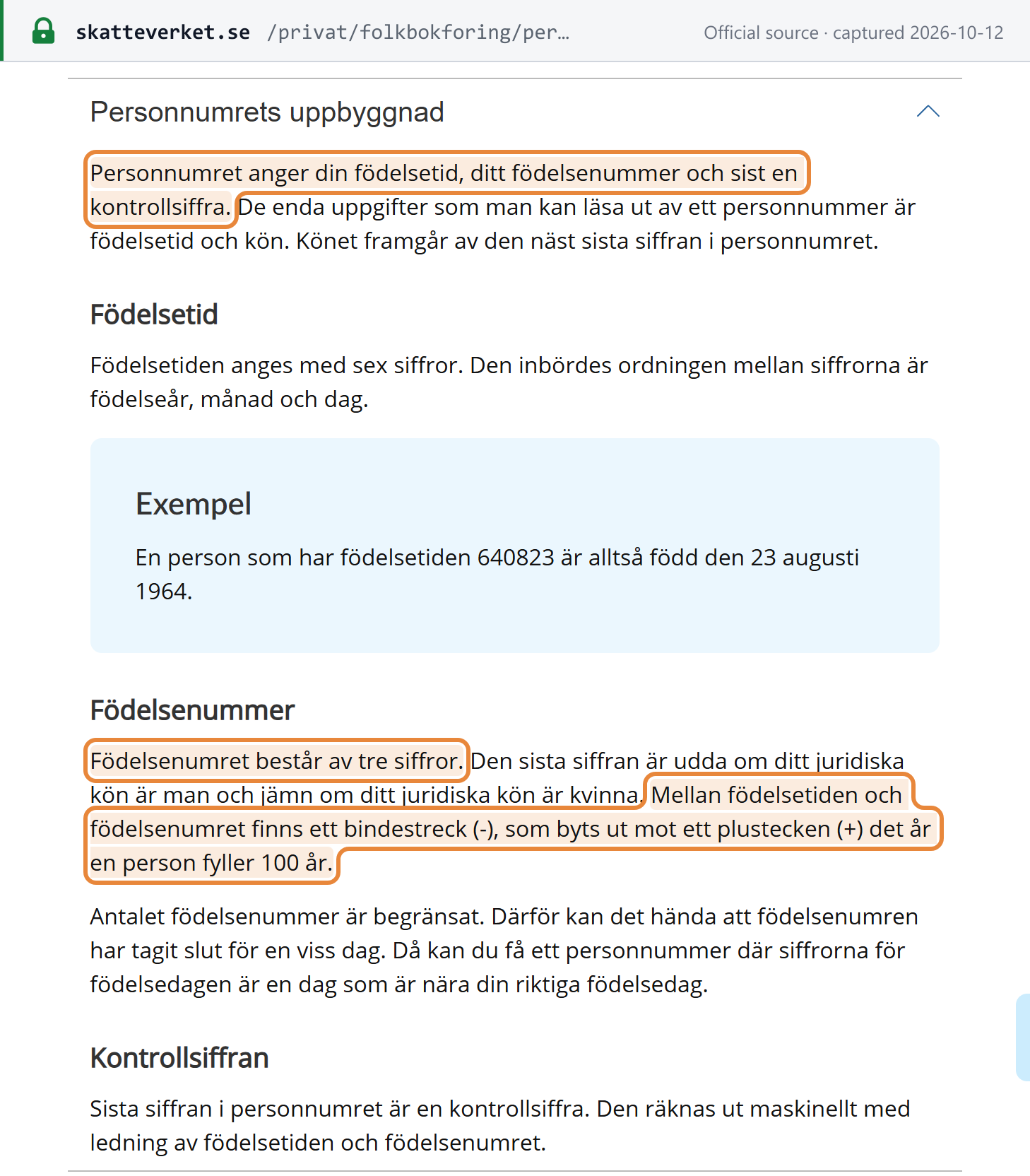
Every person registered in the Swedish population register (folkbokförd) receives a personnummer from Skatteverket. Its structure is set by law (folkbokföringslagen 18 §): six digits for the date of birth, a three-digit birth number that is odd for men and even for women, and a check digit. If a date of birth has run out of birth numbers, a nearby day of the month may be used instead, so the date part is not always the exact birthday. [2]
A personnummer is kept for life, including after the holder emigrates; the only information it reveals is the date of birth and sex. [3] For testing, use Skatteverket's published test personnummer, which may only be used in test environments — never a number that could belong to a real person. [4]
Samordningsnummer (Coordination Number)
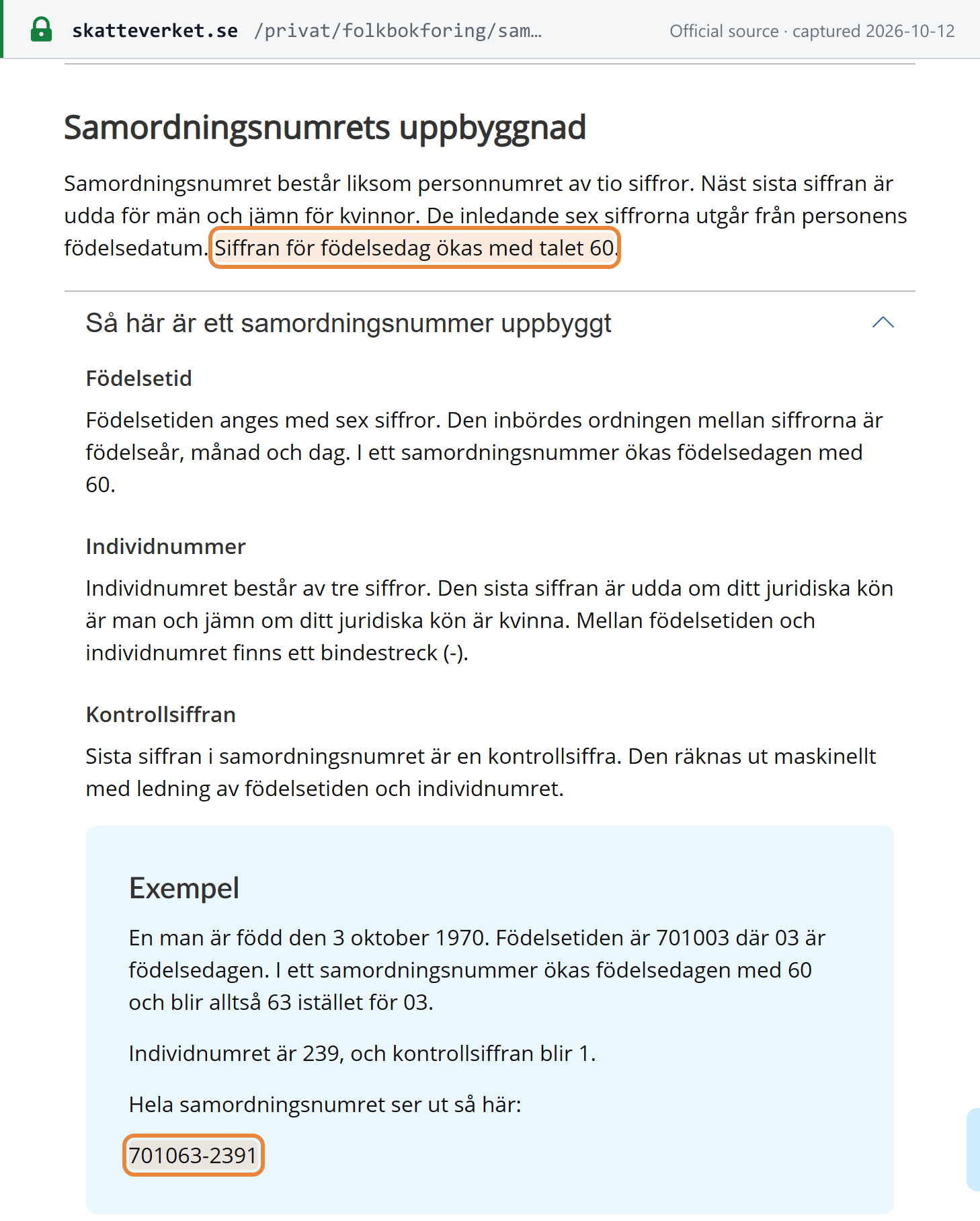
A samordningsnummer identifies a person who is not, and has never been, registered in the Swedish population register — for example someone working in Sweden for less than a year. It has the same layout as a personnummer, but 60 is added to the day of birth: Skatteverket's example for a man born on 3 October 1970 is 701063-2391. [5] [6]
- How it is issued — on the person's own application, which requires an in-person identity check at a Skatteverket service office, or at the request of an authority. Skatteverket can also assign one in connection with an application for F-skatt.
- Validity — five years. A number that is not renewed by the end of the fifth calendar year after it was assigned or last renewed is declared dormant (vilande). [6]
- Replacement — if the person is later registered in the population register, they receive a personnummer instead.
- From 1 December 2026 — fingerprints and a facial image are taken and registered at the identity check (Lag 2026:1455). The number format does not change. [6]
Organisationsnummer (Organisation Number)
| Field | Detail |
|---|---|
| Format | NNNNNN-NNNN — 10 digits, written with a hyphen after the sixth |
| Regex | ^\d{2}[2-9]\d{7}$ (hyphen removed) |
| Third digit | Always 2 or higher, so it cannot be mistaken for a personnummer's month digit (Skatteverket, SKV 709) |
| Check digit | Last digit, Luhn (modulus 10) |
| Example | 556036-0793 — Saab AB |
| Issued to | Legal persons: limited companies, partnerships, economic and non-profit associations, foundations, estates, foreign legal persons |
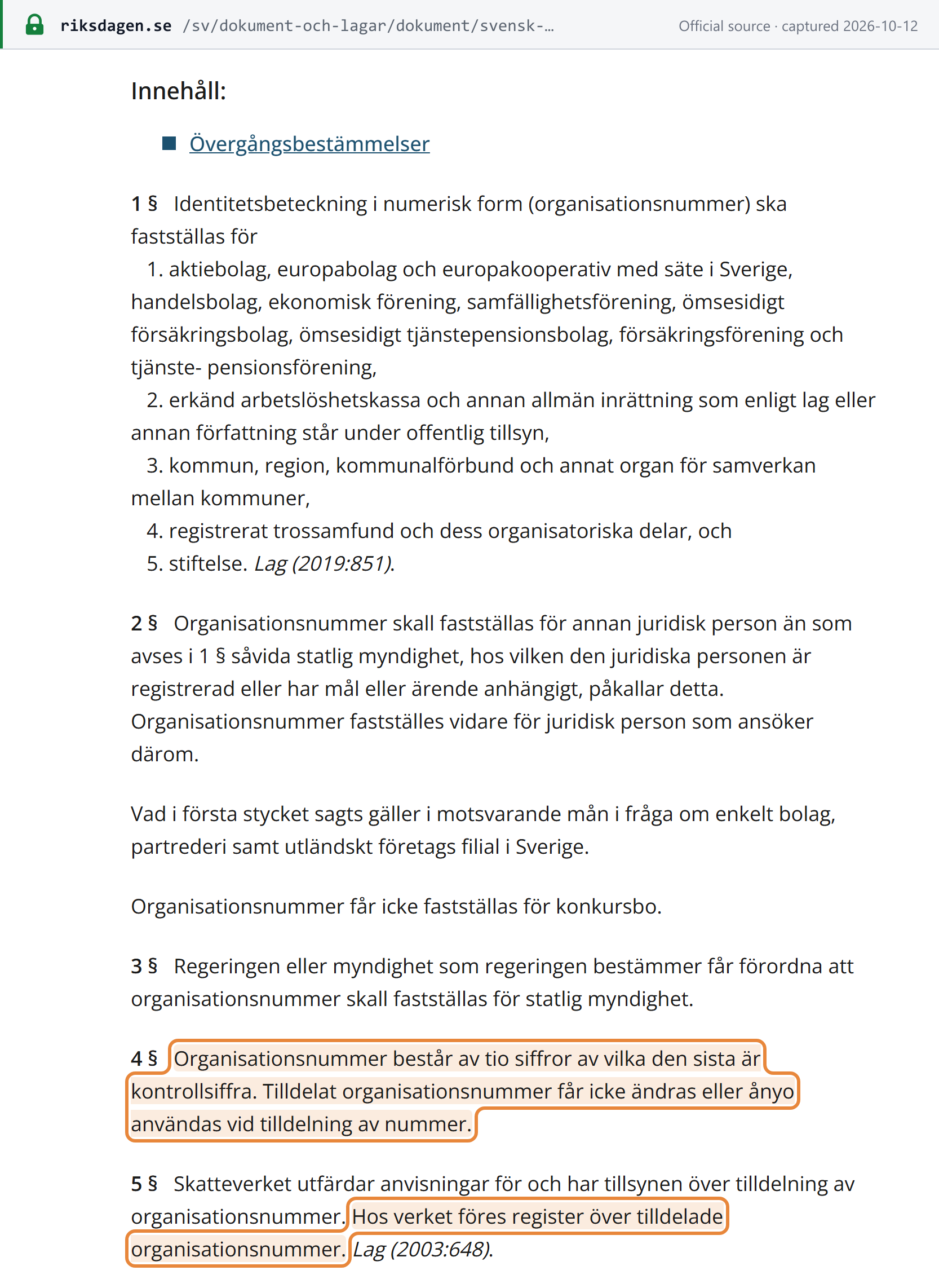
The law states that an organisation number "consists of ten digits, the last of which is a check digit", and that an assigned number may never be changed or reused (Lag 1974:174 om identitetsbeteckning för juridiska personer m.fl., 4 §). Skatteverket keeps the central register of organisation numbers. [7] The number is assigned by whichever authority registers the organisation — Bolagsverket for limited companies, trading partnerships and economic associations; Skatteverket for non-profit associations, estates, foundations and foreign legal persons; Statistics Sweden for public bodies. [8]
What the first digit suggests. The first digit is a group number. Bolagsverket notes that it is not a reliable guide to legal form, but for many organisations: 5 = limited company (aktiebolag), branch, bank or insurer; 9 = trading or limited partnership; 7 or 8 = housing co-operative, economic association or business-run non-profit association; 2 = religious community (also 8); 20 = state authority, assigned by Statistics Sweden. [9] The legal form itself is recorded separately and cannot be read from the number. [22]
Sole traders have no organisationsnummer. A sole trader (enskild näringsidkare) uses their personnummer as the business identifier. [9]
12-digit forms. Payroll and other system files often store numbers with 12 digits: a personnummer with its full four-digit birth year, and an organisationsnummer prefixed with 16. Skatteverket's employer-declaration specification describes this "century digit" convention. The identifier itself — and the base of the VAT number — is the 10-digit form. [10]
Momsregistreringsnummer (VAT Number)
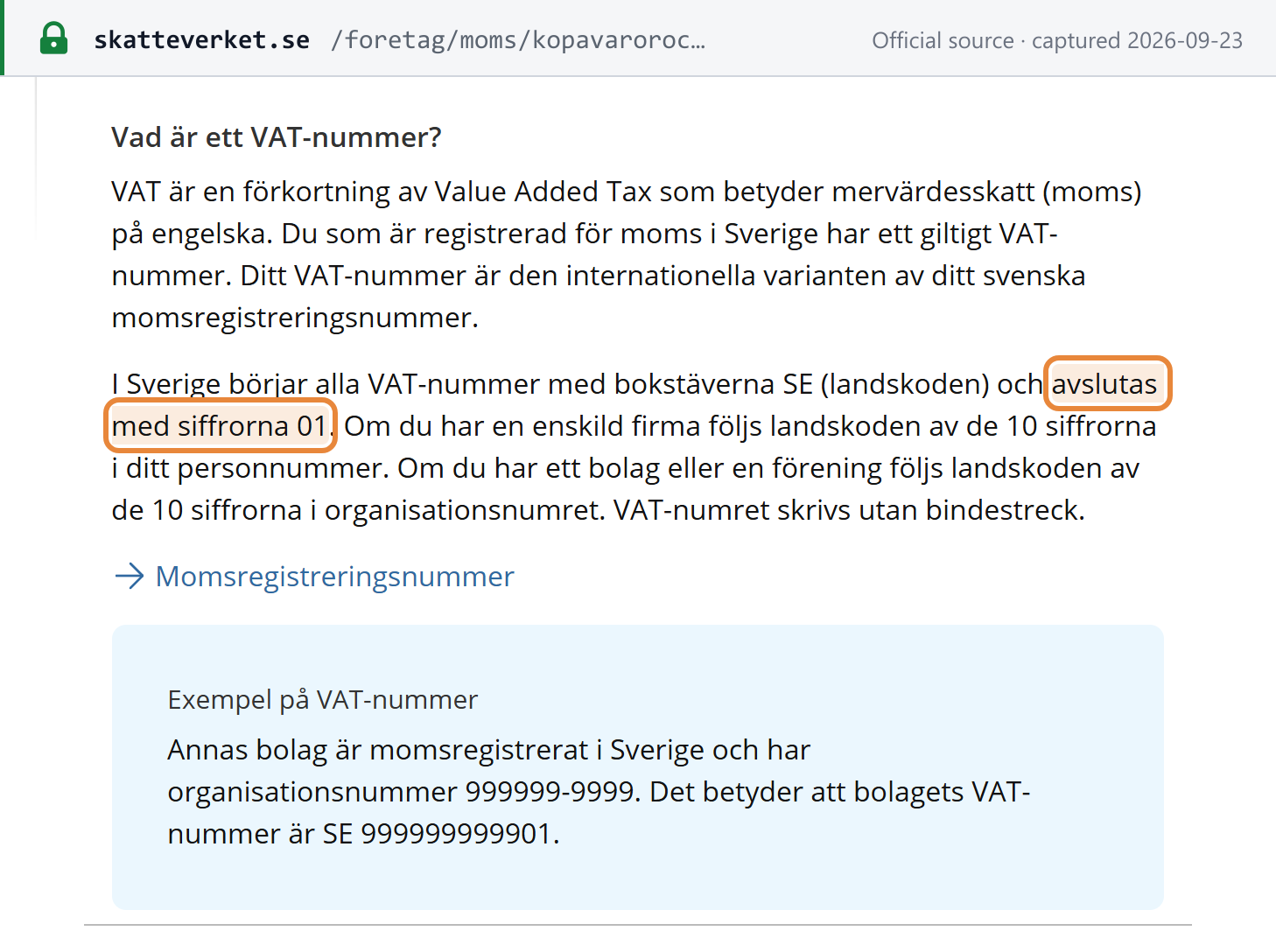
Skatteverket describes the structure: every Swedish VAT number starts with the country code SE and ends with 01; in between are the 10 digits of the organisationsnummer for a company or association, or of the personnummer for a sole trader. It is written without a hyphen — Skatteverket's example company with organisation number 999999-9999 has the VAT number SE999999999901. [11]
| Field | Detail |
|---|---|
| Length | SE + 12 digits (14 characters) |
| Regex | ^SE\d{10}01$ |
| Digits 1–10 | Organisationsnummer, or the sole trader's personnummer |
| Digits 11–12 | Always 01 |
| Example | SE556036079301 — Saab AB |
A VAT number exists only once Skatteverket has registered the business for VAT; it arrives on the registration extract (registerutdrag). An organisationsnummer on its own does not mean a business is VAT-registered. [12]
F-skatt
F-skatt is an approval, not a number. It shows that a business operator pays its own preliminary tax and social charges. A Swedish customer paying for work (services) by a contractor that is not approved for F-skatt must withhold tax — and pay employer contributions if the contractor is a natural person; the approval does not matter for purchases of goods. An approved business writes "Godkänd för F-skatt" on every invoice. Foreign companies with business in Sweden can also apply. [13]
Check Digit: Luhn (Modulus 10)
Skatteverket documents the check-digit method for personal identity numbers as "modulus 10 with the weights 1 and 2" (SKV 704): [14]
- Multiply the first nine digits alternately by 2 and 1, starting with 2.
- Add the digits of the products together (12 counts as 1 + 2).
- Subtract the last digit of the sum from 10.
- The result is the check digit; if it is 10, the check digit is 0.
Worked example — Saab AB 556036-0793: 5×2 = 10 → 1, 5, 6×2 = 12 → 3, 0, 3×2 = 6, 6, 0, 7, 9×2 = 18 → 9. Sum = 37; 10 − 7 = 3, matching the last digit.
The same method applies to the samordningsnummer. The law also gives the organisationsnummer a check digit but does not set out the method; organisation numbers pass the same modulus-10 calculation — for example Saab above, and Bolagsverket's own 202100-5489. For a VAT number, apply the check to the 10-digit base — the trailing 01 is not part of it.
Watch out for illustrative numbers that fail: 556000-0000, a common placeholder, would need check digit 1. A number that passes the check is well-formed — it does not show that it was assigned or is VAT-registered.
Who Must Register for VAT
| Who | Rule |
|---|---|
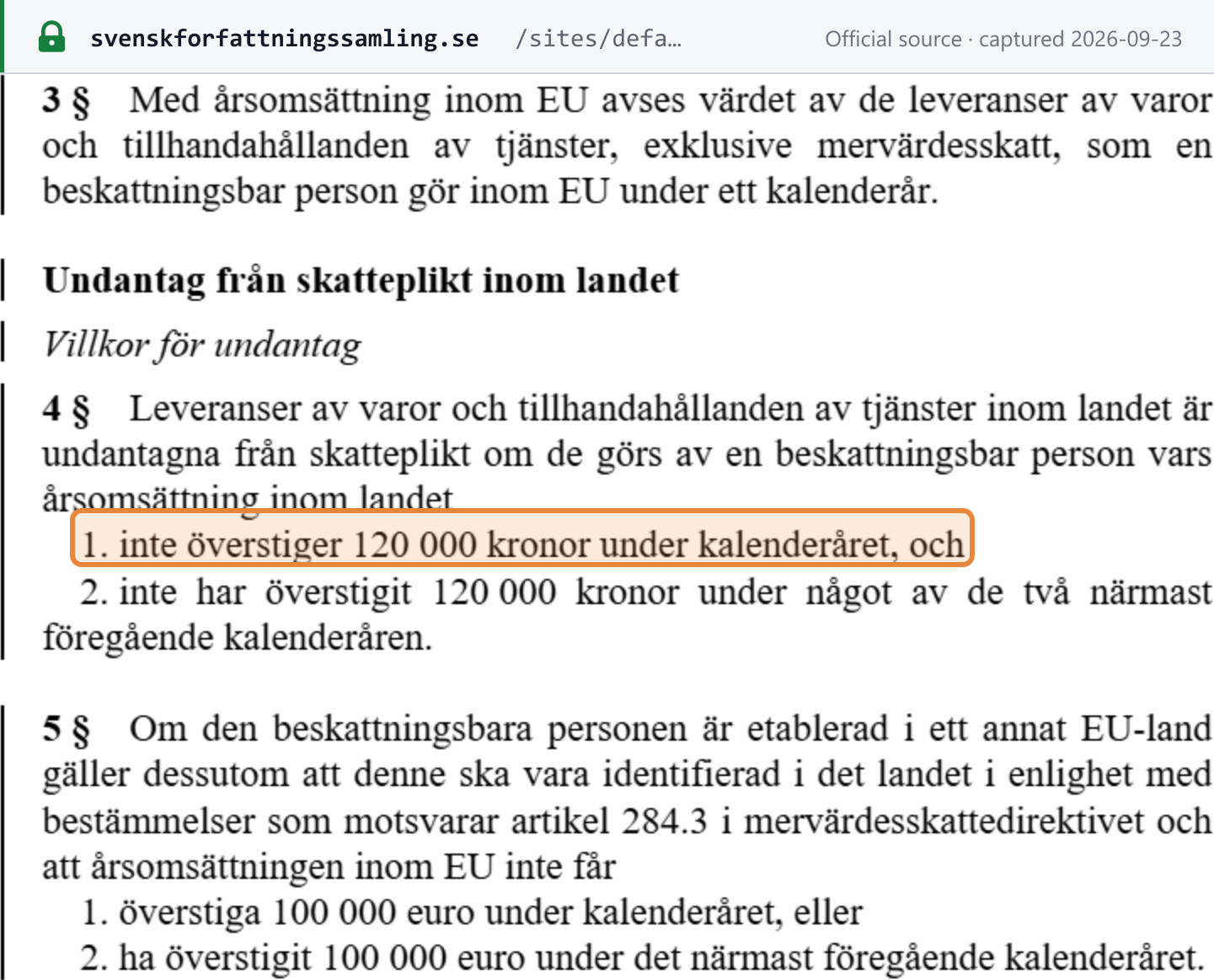
| Businesses established in Sweden | Must register once annual turnover in Sweden exceeds SEK 120,000 (excluding VAT). The exemption applies only while turnover does not exceed SEK 120,000 in the current calendar year and did not exceed it in either of the two preceding calendar years. |
| Below SEK 120,000 | Registration is voluntary. |
| Purchases of goods from other EU countries | Registration is required once such purchases exceed SEK 90,000 in a year. |
| Businesses established outside the EU | No threshold — registration before taxable sales in Sweden; a representative (ombud) in Sweden or the EEA must be appointed. |
| Businesses established in another EU country | May use the Swedish exemption only through the EU cross-border SME scheme. |
The SEK 120,000 threshold has applied since 1 January 2025 (Mervärdesskattelag 2023:200, 18 kap. 4 §, as amended by SFS 2024:942). [15] [12] [16] Compare other countries in the worldwide VAT registration thresholds table.
How to Register
- Swedish businesses register for VAT, F-skatt and as an employer through verksamt.se (with Swedish e-identification) or on the paper form Företagsregistrering (SKV 4620).
- Foreign businesses use Skatteverket's e-service Registrera utländsk verksamhet i Sverige, which needs no Swedish e-identification, or form SKV 4632. A home-country registration certificate no older than three months is required, and processing takes about two to eight weeks. A foreign legal person can also obtain a Swedish organisationsnummer without registering to pay tax. [17] [16]
The steps are covered in the Sweden VAT guide's registration section; for other countries, see how to register for VAT, GST and sales tax.
Cross-Border Notes
- Selling B2B into Sweden. A supplier not established in Sweden that sells to a Swedish business usually does not register: the customer accounts for the VAT under the reverse charge, and the invoice must show the customer's VAT number. See foreign companies selling into Sweden.
- Foreign contractors and F-skatt. A Swedish customer must withhold tax on payments for work unless the contractor is approved for F-skatt, so foreign service businesses often apply for it.
- Individuals working in Sweden briefly. A person working in Sweden for less than a year can get a samordningsnummer and is taxed either under preliminary A-tax or the special income tax for non-residents (SINK). [5]
E-invoicing and the Peppol ID
As at 2026-10-13, e-invoicing is mandatory for invoices to the public sector arising from procurements started on or after 1 April 2019 (Lag 2018:1277), for suppliers in any country; Peppol BIS Billing 3 is the recommended format. B2B e-invoicing is voluntary. [18] The Peppol ID is built on the organisationsnummer: scheme 0007 followed by the number (e.g. 0007:5512345678) is recommended, while a sole trader whose personnummer is their business ID may use a GLN (scheme 0088) instead so the personnummer is not published. Using the VAT number as a Peppol ID is specifically discouraged. [19] See Peppol e-invoicing in Sweden.
How to Verify a Swedish Tax ID
| What you want to confirm | Official tool | What it returns |
|---|---|---|
| A VAT number is valid for intra-EU trade | EU VIES | Valid or invalid, with name and address for Sweden |
| A company is approved for F-skatt, registered for VAT and as an employer | Skatteverket Hämta företagsinformation — free, no e-ID | Status per company, one company per query |
| Which company an organisationsnummer belongs to | Bolagsverket Sök företagsinformation — free | Name ↔ organisation number, for organisations Bolagsverket registers |
| A personnummer or samordningsnummer | None online | Enquiries can be made at a Skatteverket office |
Skatteverket accepts only VIES as evidence that a customer was VAT-registered; it cannot accept answers from other services if the information later turns out to be wrong. [20] Since 1 July 2026 Skatteverket can also have a VAT number shown as invalid in VIES where there is a clear risk that the number will be used for VAT fraud. [21] Personal identity and coordination numbers have no online check. [1]
For a walkthrough of the VIES check, see how to verify an EU VAT number in VIES. To check the format and check digit instantly, use the Lookuptax Sweden VAT number validator or organisationsnummer validator.
Frequently Asked Questions
Is a Swedish VAT number the same as the organisationsnummer?
No, but it is built from it. A Swedish VAT number is SE, followed by the 10-digit organisationsnummer (or a sole trader's personnummer), followed by 01 — for example SE999999999901 for organisation number 999999-9999. It exists only after Skatteverket has registered the business for VAT, so having an organisationsnummer does not mean a company is VAT-registered.
I'm a sole trader. Does my VAT number expose my personnummer?
Yes. A sole trader has no organisationsnummer, so the VAT number is built from the owner's personnummer, and VIES shows the name and address for Swedish VAT numbers. For e-invoicing, Upphandlingsmyndigheten suggests that a sole trader can use a GLN as their Peppol ID so the personnummer is not registered in the network.
A bank or a foreign form asks for my Swedish TIN. Which number is it?
For an individual, it is your personnummer, or your samordningsnummer if you have never been registered in the Swedish population register. For a company or other legal person, it is the organisationsnummer. The VAT number is not the TIN.
I'm a foreign freelancer without a personnummer. How do I get F-skatt?
Apply through Skatteverket's e-service Registrera utländsk verksamhet i Sverige, which does not require Swedish e-identification, or on form SKV 4632. Skatteverket can assign you a samordningsnummer in connection with your F-skatt application. Until you are approved, Swedish customers must withhold tax from what they pay you for work.
Why does VIES say a Swedish VAT number is invalid?
Check first that the number ends in 01 and has 12 digits after SE — leaving off the 01 is a common mistake. Next, check the 10-digit base for a typing error using the Luhn check digit. Otherwise the business may not be registered for VAT yet, or, since 1 July 2026, Skatteverket may have had the number shown as invalid because of a risk of VAT fraud.
How do I check that a Swedish contractor has F-skatt and is VAT-registered?
Use Skatteverket's free service Hämta företagsinformation. It shows whether a company is approved for F-skatt, registered for VAT and registered as an employer, one company per query. If the contractor is not approved for F-skatt, you must withhold tax on payments for work.
My system shows a 12-digit number. Which form is correct?
Both refer to the same identifier. Population registers store the year of birth with four digits, so a personnummer such as 800102-2386 becomes 198001022386, and payroll files prefix organisation numbers with 16. The identifier itself, and the base of the VAT number, is the 10-digit form.
Does a samordningsnummer expire?
It is valid for five years. If it is not renewed by the end of the fifth calendar year after it was assigned or last renewed, it is declared dormant. Renewal requires a new identity check in person. If you are later registered in the population register, you receive a personnummer instead.
Related Resources
- Sweden VAT guide — rates, registration, invoicing and filing
- Peppol e-invoicing in Sweden
- How to verify an EU VAT number in VIES
- Official national VAT number lookups by country
- Sweden tax changes — chronology
- Reverse charge explained
- Worldwide VAT, GST and sales tax registration thresholds
- Global e-invoicing status tracker
- Nordic tax ID guides: Norway, Denmark, Finland
How Lookuptax can help you in VAT validation?
Lookuptax VAT validation revolutionizes VAT number validation with its robust platform, empowering businesses to seamlessly verify VAT numbers across over 100 countries. Our cutting-edge technology ensures accurate and efficient validation, reducing errors and enhancing compliance.