South Africa Tax Number Guide — Income Tax, VAT & PAYE
South Africa's tax identification number is the income tax reference number — a 10-digit number the South African Revenue Service (SARS) allocates as a taxpayer reference number under section 24 of the Tax Administration Act, 2011. It is the number SARS reports as the TIN for international exchange of information, and it is valid for life. SARS issues separate numbers for VAT (a 10-digit number starting with 4) and for employers' PAYE, SDL and UIF accounts, while the company registration number comes from a different body, the Companies and Intellectual Property Commission (CIPC), and the 13-digit identity number from the Department of Home Affairs. [1] For VAT rates, invoices and filing, see the South Africa VAT guide.
South Africa's Tax Numbers at a Glance
| Number | Issuer | Format | Check digit | Who holds it | Public lookup |
|---|---|---|---|---|---|
| Income tax reference number (the TIN) | SARS | 10 digits, starts 0, 1, 2, 3 or 9 — ^[01239]\d{9}$ | Yes — modulus 10 | Registered taxpayers; companies automatically via CIPC | No — SARS does not disclose it to third parties |
| VAT registration number | SARS | 10 digits, starts 4 — ^4\d{9}$ | Yes — modulus 10 | VAT vendors only | Yes — SARS VAT Vendor Search |
| PAYE reference number | SARS | 10 digits, starts 7 — ^7\d{9}$ | Yes — modulus 10, first digit read as 4 | Employers registered for PAYE | No |
| SDL / UIF reference number | SARS | L or U + 9 digits | Yes — as PAYE | Employers | No |
| Customs client number | SARS Customs | Numeric; structure not published | Not published | Registered importers and exporters | No — confidential |
| Company registration number | CIPC | YYYY/NNNNNN/NN | None published | Companies and close corporations | Via CIPC e-services |
| Identity number | Home Affairs | 13 digits, YYMMDDSSSSCAZ | Yes — Luhn | South African citizens and permanent residents | No |
The first digit is the quickest way to tell SARS's 10-digit numbers apart: 0, 1, 2, 3 or 9 is an income tax number, 4 is a VAT number and 7 is a PAYE number.
Income Tax Reference Number
| Field | Detail |
|---|---|
| Length | 10 numeric digits |
| Regex | ^[01239]\d{9}$ |
| First digit | 0, 1, 2, 3 or 9 |
| Check digit | 10th digit, modulus 10 (see below) |
| Example (SARS documentation) | 0001339050 |
| Issued to | Any person registered for income tax — individuals, companies, trusts |
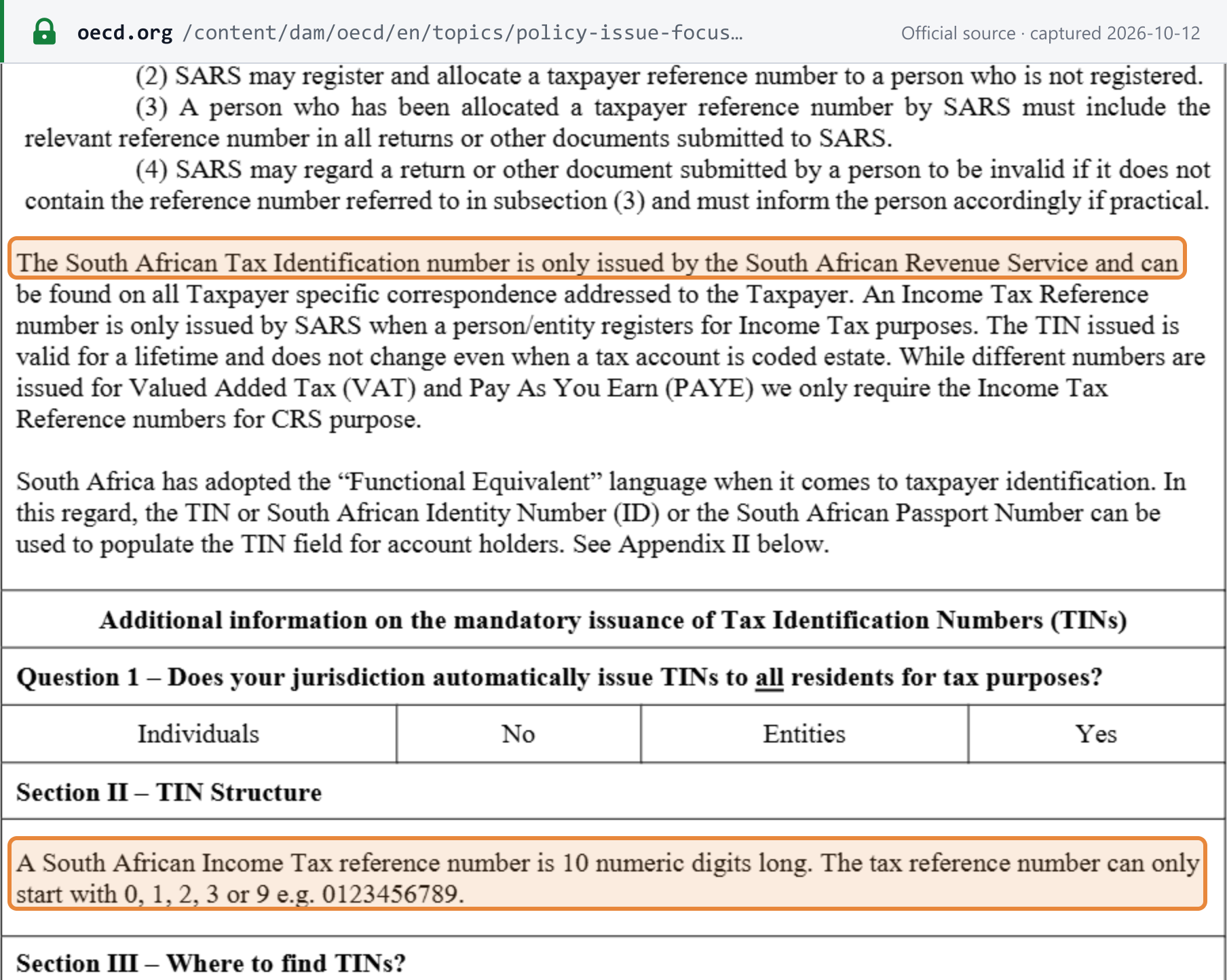
SARS states that an income tax reference number "is 10 numeric digits long" and "can only start with 0, 1, 2, 3 or 9". [1] The example 0123456789 printed on that same SARS information sheet does not pass the check digit, so do not use it as a test number; 0001339050 and 0667056642 are worked examples from SARS's own employer-reconciliation specification and both pass. [2]
Who receives one
- Companies are registered for income tax automatically. SARS says CIPC-registered companies "are not required to perform a separate SARS tax registration for Income Tax", because registration happens "via a direct interface with CIPC". [3]
- Individuals are not issued a number automatically on birth or residence. They are registered when they first register on SARS eFiling (a valid South African ID is required), through their employer, or at a SARS branch. Since July 2022 SARS has also automatically registered certain individuals using third-party data. [4]
The number stays the same for life, including when a taxpayer's account becomes a deceased estate. [1]
VAT Registration Number
| Field | Detail |
|---|---|
| Length | 10 numeric digits |
| Regex | ^4\d{9}$ |
| First digit | Always 4 |
| Prefix | None — South Africa does not use a ZA prefix |
| Check digit | 10th digit, modulus 10 |
| Example (synthetic, passes the check) | 4123456784 |
| Issued to | VAT vendors, on VAT registration |
SARS describes a VAT number as "a unique number, which comprises of 10 digits and starts with the number 4". [5] A VAT number is issued only to a person that registers for VAT — holding an income tax number does not make a business a VAT vendor. A vendor's enterprises are normally registered under one VAT number, but separately identifiable branches or divisions may be registered under their own numbers, so one business can legitimately hold more than one. [6]

Employer Numbers: PAYE, SDL and UIF
An employer registers for Pay-As-You-Earn (PAYE), the Skills Development Levy (SDL) and Unemployment Insurance Fund (UIF) contributions on form EMP101e or through eFiling, and receives three linked references: [2] [7]
| Reference | Format | SARS example |
|---|---|---|
| PAYE | 7 + 9 digits | 7230767891 |
| SDL | L + 9 digits | L230767891 |
| UIF | U + 9 digits | U230767891 |
The last nine digits of the three references are the same. The UIF reference to use on SARS returns is the one SARS issues, not the number the UIF itself allocates. An employer becomes liable for SDL when it expects total salaries to exceed R500,000 over the next 12 months. [7]
Customs Client Number
Importers and exporters that complete SARS's Registration, Licensing and Accreditation process (online, or on form DA 185) receive a numeric customs code, also called a Customs Client Number, importer's code or exporter's code. It is not the tariff code used to classify goods.
Format and checksum — not published. SARS treats customs codes as confidential and states that "the algorithm used by SARS to generate this numeric code, including any validation (including check digit modulus rules) is not shared publicly". A trader can retrieve its own code through the "Request my Customs Code" online query. (Checked 2026-10-13.) [8]
CIPC Company Registration Number
Companies and close corporations receive an enterprise (registration) number from CIPC in the form year/sequence/type — YYYY/NNNNNN/NN, for example 2002/015527/30, the number Eskom Holdings SOC Ltd prints on its own certificates. [9] It identifies the company on the companies register; it is not a tax number, even though SARS uses the CIPC registration to create the company's income tax number automatically. A company registered without a reserved name takes its registration number as its name, followed by "(South Africa)". CIPC publishes no check-digit rule for the enterprise number (checked 2026-10-13).
South African Identity Number
The identity number is a 13-digit number allocated by the Department of Home Affairs to South African citizens and permanent residents; the identity document that carries it is issued from age 16. [10] It is not a tax number, but SARS accepts it — or a South African passport number — as the functional equivalent of a TIN for international reporting when no income tax number is available. [1]
| Segment | Meaning |
|---|---|
YYMMDD | Date of birth |
SSSS | Sequence — 0000–4999 female, 5000–9999 male |
C | Citizenship — 0 citizen, 1 permanent resident, 2 refugee |
A | Not officially defined in SARS's description |
Z | Check digit (Luhn algorithm) |
SARS's documentation example is 8001015009087. Never use a real person's ID number for testing.
Check Digit Algorithms
Unlike many tax authorities, SARS publishes the check-digit rules for its income tax, VAT and employer reference numbers in its technical specifications.
Income tax and VAT numbers (modulus 10)
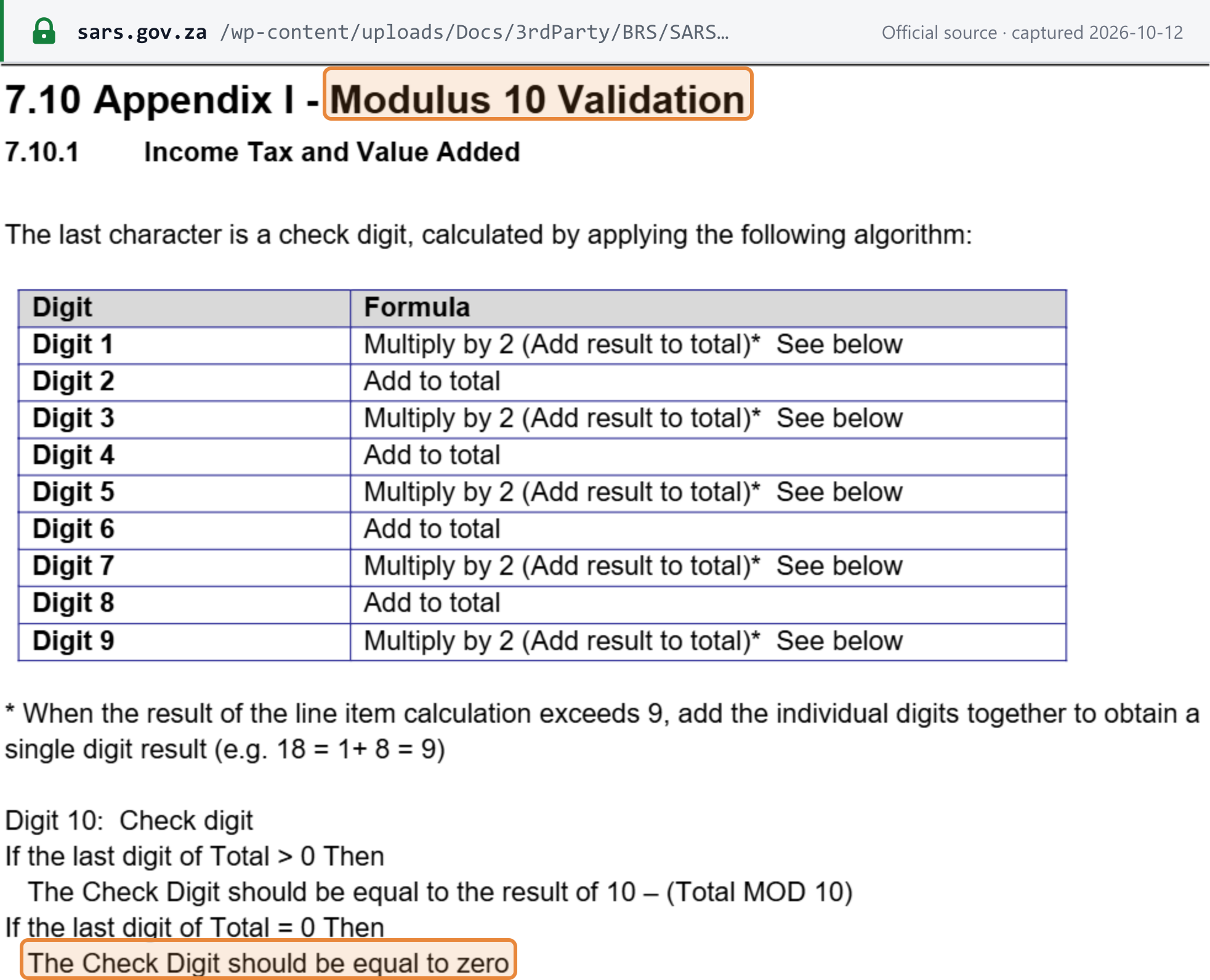
SARS's specification sets out the rule for "Income Tax and Value Added" reference numbers: [11]
- Multiply digits 1, 3, 5, 7 and 9 by 2. Where a result exceeds 9, add its two digits together (for example 18 → 1 + 8 = 9).
- Add digits 2, 4, 6 and 8 unchanged.
- Add everything together.
- If the total ends in 0, the check digit is 0; otherwise it is 10 minus the last digit of the total.
- The result must equal the 10th digit.
Worked example — VAT number 4740101508: digits 1, 3, 5, 7, 9 doubled give 8 + 8 + 2 + 2 + 0 = 20; digits 2, 4, 6, 8 give 7 + 0 + 0 + 5 = 12; total 32; 10 − 2 = 8, which matches the last digit. This is the standard Luhn algorithm applied to ten digits.
PAYE, SDL and UIF numbers
The same modulus-10 calculation applies, except that the first character is replaced with 4 before calculating. For SARS's example 7230767891, the total is 49 and the check digit is 10 − 9 = 1. [2]
Identity number
SARS calls its identity-number check "modulus 13", after the number's 13 digits, but the arithmetic is Luhn: add the digits in odd positions 1–11; take the digits in even positions as one number, double it and add the digits of the result; add the two sums; subtract the last digit of the total from 10 (keeping only the last digit if the answer is 10). For 8001015009087 the sums are 13 and 20, the total is 33, and 10 − 3 = 7. [2]
A number that passes its check digit is well-formed — it does not prove SARS issued it or that the holder is registered for VAT.
Who Must Register for VAT
Any "person" carrying on an enterprise — an individual, company, partnership, trust or municipality — must register for VAT once taxable supplies exceed the compulsory threshold. Employees, hobbies and persons making only exempt supplies are outside the system.
| Threshold | Amount | Measurement | Since |
|---|---|---|---|
| Compulsory registration | R2,300,000 | Taxable supplies in any consecutive 12 months, or committed in writing | 1 April 2026 (previously R1,000,000) |
| Voluntary registration | R120,000 | Taxable supplies in the past 12 months | 1 April 2026 (previously R50,000) |
| Foreign electronic-services suppliers | R2,300,000 | Taxable supplies to South Africa; liable at the end of the month the threshold is exceeded | 1 April 2026 |
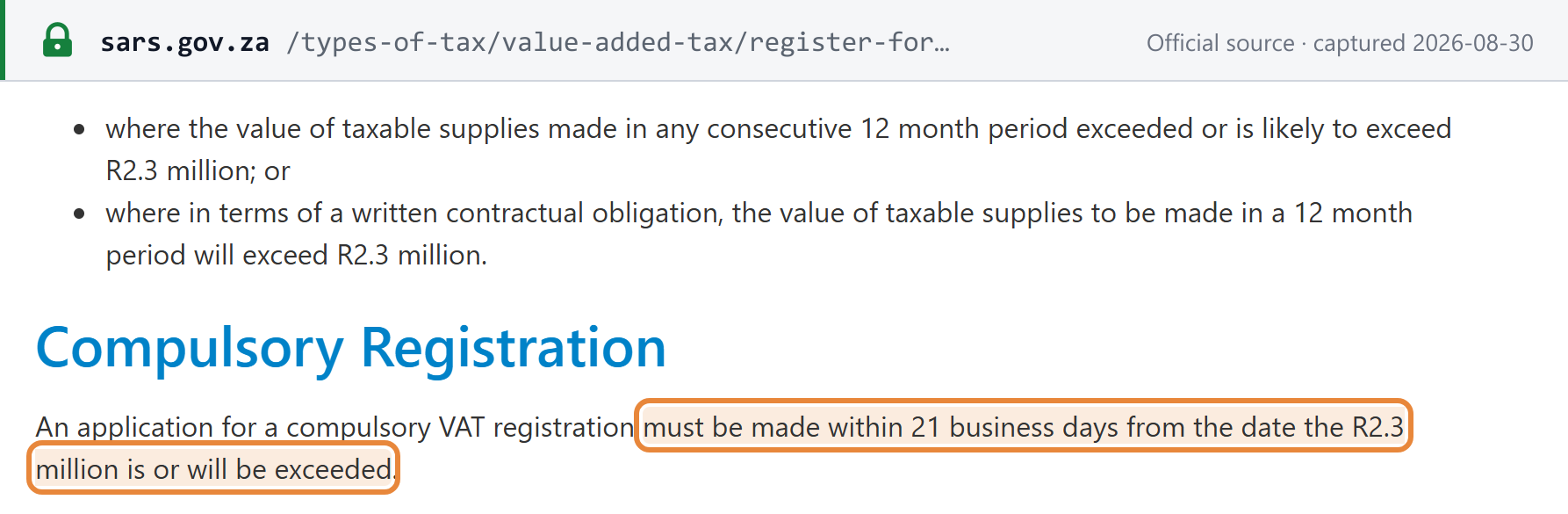
A compulsory registration must be applied for within 21 business days of the date the threshold is or will be exceeded. [12] [13]
Legal status, as at 2026-10-13. SARS has applied the higher thresholds to new registrations from 1 April 2026. The amending 2026 Rates Bill had not been enacted on that date — the only 2026 amendment Acts SARS lists (Acts 3, 4 and 5 of 2026) do not change the registration threshold — and SARS's Budget 2026 FAQ states that it is issued "subject to Parliament's legislative process". A business already registered under the old R1 million threshold is not deregistered automatically. [14] [23] See the event record for the threshold change and the worldwide VAT registration thresholds table.
How to Register
- Income tax: companies are registered automatically through CIPC. Individuals register on first use of SARS eFiling, through their employer, or at a SARS branch (non-residents bring a passport and permit). [4]
- VAT: apply on eFiling or book a virtual appointment through SARS eBooking. SARS validates every application before allocating a VAT number; if it issues a review notice, supporting documents are due within 21 business days or the application is rejected. Where no risk is identified, the number is issued immediately. [12]
- Employers: form EMP101e or eFiling, for PAYE, SDL and UIF together. [7]
- Customs: the Registration, Licensing and Accreditation process on eFiling, or form DA 185.
For the general registration process across jurisdictions, see how to register for VAT, GST and sales tax.
Cross-Border Notes
Foreign suppliers of electronic services
A foreign supplier of electronic services (or an intermediary) is in scope when two of three connections to South Africa are present: the customer is a South African resident, payment comes from a South African bank, or the customer has a South African business, residential or postal address. Registration becomes compulsory above R2.3 million of such supplies. A foreign supplier does not need to open a South African bank account, and may file monthly or two-monthly, with monthly preferred by SARS. [15] The wider rules are compared in VAT on digital services by non-resident suppliers.
Withholding on payments to non-residents
South African payers withhold final taxes from certain payments to non-residents: 15% on royalties, 15% on interest and 20% dividends tax (since 22 February 2017). A lower treaty rate is claimed by giving the South African payer a declaration before payment — for royalties, the Withholding Tax on Royalties Declaration. [16] [17] [18]
E-invoicing
As at 2026-10-13 South Africa has no e-invoicing mandate and no e-invoicing registration number tied to the VAT number. The Tax Administration Laws Amendment Act 4 of 2026 introduced e-invoice definitions and a power to make voluntary e-reporting regulations, and SARS's VAT Modernisation Consultation Paper (17 August 2026) proposes a digital VAT model; comments close on 16 October 2026. SARS's indicative timeline is consultation in 2026/2027 and phased implementation from 2030, starting with a voluntary pilot. [19] [20] See e-invoicing in South Africa.
How to Verify a South African Tax Number
| What you want to confirm | Official tool | What it returns |
|---|---|---|
| A supplier is a registered VAT vendor | SARS VAT Vendor Search — public, no login | Trading name, VAT number and SARS office, for an exact match only |
| A taxpayer's tax affairs are in order | SARS Tax Compliance Status verification (eFiling or the SARS Online Query System) | Compliant (green) or non-compliant (red) at the time of the check — needs the taxpayer's tax number and a PIN the taxpayer gives you [22] |
| A company exists | CIPC e-services | Company details by enterprise number |
There is no public lookup for income tax numbers: SARS will not give a person's tax number to anyone other than their tax practitioner or someone holding a power of attorney. [4] The VAT Vendor Search database is updated weekly, so a newly registered vendor may not appear yet. [21]
For a step-by-step walkthrough of the vendor search, see how to verify a South African VAT number. To check the format and check digit of a VAT number instantly, use the Lookuptax South Africa VAT number validator.
Frequently Asked Questions
I have a 10-digit number from SARS. Is it my income tax number, my VAT number or my PAYE number?
Look at the first digit. An income tax reference number starts with 0, 1, 2, 3 or 9, a VAT number always starts with 4, and an employer's PAYE reference starts with 7. All three end in a check digit calculated with SARS's modulus-10 rule, so a mistyped digit will usually fail the check.
Can I look up a supplier's or customer's income tax number?
No. SARS does not publish income tax numbers and will not disclose a person's tax number to a third party unless that party is their tax practitioner or holds a power of attorney. To confirm a business is VAT-registered, search its VAT number on the SARS VAT Vendor Search. To confirm its tax affairs are in order, ask it for a Tax Compliance Status PIN and verify the PIN on SARS eFiling.
I registered a company with CIPC. Is the CIPC registration number my tax number?
No. The CIPC number in the form YYYY/NNNNNN/NN identifies the company on the companies register. SARS registers a CIPC company for income tax automatically through a direct interface with CIPC and issues a separate 10-digit income tax reference number. VAT is a separate registration that the company must apply for itself once it is required or chooses to register.
Our turnover is between R1 million and R2.3 million. Do we still have to register for VAT?
From 1 April 2026 SARS applies a compulsory registration threshold of R2.3 million in taxable supplies over any 12 consecutive months, up from R1 million. Below that, registration is voluntary once supplies have exceeded R120,000 in the past 12 months. As at 2026-10-13 SARS was applying the new figure while the amending legislation had not yet been enacted. A business that is already registered is not deregistered automatically.
Why doesn't my supplier's VAT number show up on the SARS VAT Vendor Search?
The search only returns a result for an exact match on the VAT number or the exact trading name SARS holds, and its database is updated weekly, so a vendor registered in the last few days may not appear yet. Check the number for typing errors first — a VAT number is 10 digits starting with 4 and must pass the modulus-10 check — and confirm the trading name SARS has on record.
I sell software or streaming services to South African customers from abroad. Do I need a South African VAT number and a local bank account?
You must register for VAT once your taxable supplies of electronic services to South Africa exceed R2.3 million, counting a supply where two of three connections apply: the customer is South African resident, pays from a South African bank, or has a South African address. You receive a standard 10-digit VAT number starting with 4. SARS does not require a foreign electronic-services supplier to open a South African bank account.
What is a customs code, and can I check whether one is valid?
A customs code, also called a Customs Client Number, is the number SARS allocates to importers and exporters after registration for customs. SARS treats customs codes as confidential and does not publish how they are generated or checked, so there is no public format or check-digit test. A trader can retrieve its own code through the SARS "Request my Customs Code" online query.
Is my South African ID number a tax number?
Not as such. Your tax number is the 10-digit income tax reference number SARS issues when you register. SARS does, however, accept the 13-digit identity number, or a South African passport number, as a substitute for the TIN in international reporting when no tax number is available, and you need a valid ID number to register on SARS eFiling.
Related Resources
- South Africa VAT guide — rates, registration, invoices and filing
- How to verify a South African VAT number on SARS eFiling
- E-invoicing in South Africa — the proposed digital VAT model
- VAT on digital services by non-resident suppliers
- South Africa tax changes — chronology
- Worldwide VAT, GST and sales tax registration thresholds
- Global e-invoicing status tracker
- Official national VAT number lookups by country
- How to register for VAT, GST and sales tax
How Lookuptax can help you in VAT validation?
Lookuptax VAT validation revolutionizes VAT number validation with its robust platform, empowering businesses to seamlessly verify VAT numbers across over 100 countries. Our cutting-edge technology ensures accurate and efficient validation, reducing errors and enhancing compliance.