E-Invoicing in South Africa: Status and VAT Rules
| Country | South Africa |
| Status - B2G | No mandate — proposed Phase 5b, not before 2030 (not law) |
| Status - B2B | No mandate — proposed Phase 5a, not before 2030 (not law) |
| Status - B2C | No mandate — proposed Phase 5d, not before 2030 (not law) |
| Status - Non-residents | No mandate; scope of any future mandate not yet determined |
| Formats | None mandated. EN16931 CIUS, UN/CEFACT CII and Peppol PINT BIS reported as proposed candidate formats (corroborated by advisories, not yet confirmed against SARS primary text) |
| Authority | South African Revenue Service (SARS) |
| Network name | None live. Proposed "Digital VAT Model" (e-Invoicing + Interoperability Framework + e-Reporting) |
| Legislation | Value-Added Tax Act 89 of 1991, ss.20–21 (in force); Tax Administration Laws Amendment Act 4 of 2026 (in force 1 April 2026 — definitions and voluntary framework only) |
Overview
South Africa has no live mandatory B2B, B2G or B2C e-invoicing system. Two separate things exist, and this guide keeps them apart throughout:
- Law in force today — the Value-Added Tax Act 89 of 1991, ss.20–21, sets out what a valid tax invoice, credit note and debit note must contain, in any medium including electronic. The Tax Administration Laws Amendment Act 4 of 2026 (Government Gazette 54447, in force 1 April 2026) added statutory definitions of "e-invoice," "e-debit note," "e-credit note," "e-reporting" and "interoperability framework," plus a power for the Minister to regulate a voluntary e-reporting system. Definitions and a regulation-making power are not a mandate.
- A proposal, not law — SARS's VAT Modernisation Consultation Paper (17 August 2026), open for comment to 16 October 2026, describes a five-phase path to a mandatory "Digital VAT Model." Under that proposal, mandatory rollout would not begin before 2030.
Administering authority for both: the South African Revenue Service (SARS). [1] [2]
For the broader VAT picture — rates, registration thresholds, filing — see the South Africa VAT guide. To check a South African VAT number, see How to verify a VAT number in South Africa.
Mandate status & timeline
No mandate exists, and none carries an effective date. The only e-invoicing-adjacent milestone actually in force is the Tax Administration Laws Amendment Act 4 of 2026, effective 1 April 2026. It inserted the definitions above and section 74(1B), empowering the Minister to make regulations "prescribing the requirements for participation by a vendor in a voluntary e-reporting system." Nothing about that date requires any vendor to issue, receive or report an e-invoice. [1]
A note on the global status table.
docs/einvoicing-status-networks.mdlists South Africa's row as "enacted — effective 2026-04-01." Read narrowly: that describes only Act 4 of 2026's statutory definitions and voluntary regulation-making power coming into force on that date. It does not mean a live e-invoicing mandate exists — this guide's own research and SARS's own texts confirm there is none.
The proposed Digital VAT Model — a five-phase path, not a timetable you can rely on
On 17 August 2026 SARS released its VAT Modernisation Consultation Paper, the first time it put a named model on the table. It proposes a Digital VAT Model built from three components — e-Invoicing, an Interoperability Framework, and e-Reporting — to "connect SARS across the VAT value chain to every point of sale... using e-Invoices, an Interoperability Framework and e-Reporting to enable trusted, structured, and near real-time transactional data flows." [1]
The paper sets out a five-phase rollout (pp.15–16 of the Consultation Paper). This table is corroborated by three independent secondary summaries — KPMG TaxNewsFlash, TechCentral and VATupdate — that each report matching phase names, windows and the 2030-start/36-month figure; this guide's own research could not extract clean text directly from the Consultation Paper PDF, so treat the table as sourced via corroboration rather than a direct primary quote, pending independent confirmation:
| Phase | Name | Window | What happens |
|---|---|---|---|
| 1 | Preparation | 2026/2027 (~12 months) | Stakeholder consultation; publication of draft VAT regulations |
| 2 | Solution development | 2027/2028 (~12 months) | Standards, specifications and operating model defined; VAT regulations promulgated |
| 3 | Validation / QA | 2028/2029 (~6 months) | Quality-assurance testing with voluntary participants |
| 4 | Pilot | 2029/2030 (~6 months) | Live, production-like testing with volunteers from priority segments |
| 5 | Phased implementation | From 2030, ~36 months | Staged mandatory rollout: 5a large taxpayers/B2B, 5b B2G, 5c MSME, 5d B2C |
Mandatory rollout is not proposed to begin before 2030 and would run roughly 36 months, sequenced large taxpayers/B2B first, then B2G, then MSME, then B2C — the reverse of jurisdictions such as France or Saudi Arabia, where B2G came first. No phase of this table is in force; it is a proposal open for comment.
 Source snapshot captured 2026-08-18 — original
Comment deadline. SARS opened the paper for comment on 17 August 2026: "SARS calls on all impacted and interested stakeholders to study the Consultation Paper and submit written comments by 16 October 2026." As of this guide's last update (20 September 2026), no SARS response document, revised paper or implementation timetable beyond the phase table above had been published, and the comment window remained open. [6]
Background. A 2023 Discussion Paper on Value-Added Tax Modernisation earlier proposed phased digital transmission of VAT data, starting with the roughly 80% of VAT revenue contributed by large, monthly and B2G filers — but it carried an explicit SARS disclaimer that it did not represent SARS's official view. Treat it as direction-of-travel context that predates the named Digital VAT Model, not a dated milestone; see the South Africa VAT guide for the fuller history. [7]
Source snapshot captured 2026-08-07 — original
Legal basis
| Instrument | Number / gazette | In-force date | What it governs | Link |
|---|---|---|---|---|
| Value-Added Tax Act, 1991 | Act 89 of 1991, ss.20 (tax invoices) and 21 (credit/debit notes) | In force; s.20 particulars list as currently framed dates from 8 Jan 2016 | Tax invoice / credit-debit-note content requirements today, in any medium | sars.gov.za |
| Tax Administration Laws Amendment Act 4 of 2026 | GG 54447 | In force 1 April 2026 | Inserts e-invoice/e-debit note/e-credit note/e-reporting/interoperability-framework definitions (VAT Act s.1) and s.74(1B) (Minister's power to regulate a voluntary e-reporting system) | sars.gov.za |
| Tax Administration Act 28 of 2011 | ss.29–30 | In force | Record-keeping, including electronic records, and Commissioner authorisation for non-standard or offshore electronic storage | sars.gov.za |
| VAT Notice 1594 | GG 45624, 10 December 2021 | In force | Prescribes a separate tax-invoice particulars list for registered non-resident electronic-services suppliers | Referenced in SARS's electronic-services FAQ † |
| Binding General Ruling (VAT) 11 (Issue 3) | 9 March 2020 | In force | Exchange rate for converting foreign-currency consideration to Rand for VAT purposes | sars.gov.za † |
| Binding General Ruling (VAT) 28 (Issue 3) | 10 February 2023 | In force | Minimum information on credit/debit notes under s.21(5) for electronic-services suppliers, exchange rate, advertised/quoted prices | sars.gov.za † |
| Electronic Communications and Transactions Act 25 of 2002 | — | In force (general law) | Reported by secondary sources to set integrity/authenticity standards e-invoices must meet | Not confirmed against SARS-primary text † |
| VAT Modernisation Consultation Paper | Released 17 August 2026 | Consultation only — not in force | Proposes the Digital VAT Model; comment period to 16 October 2026 | sars.gov.za |
† Instrument correctly identified and linked, but this guide's research could not extract clean primary text from the PDF this session — treat the description in that row as reported, pending independent confirmation before relying on any specific figure attributed to it.
Scope
What a valid tax invoice must contain
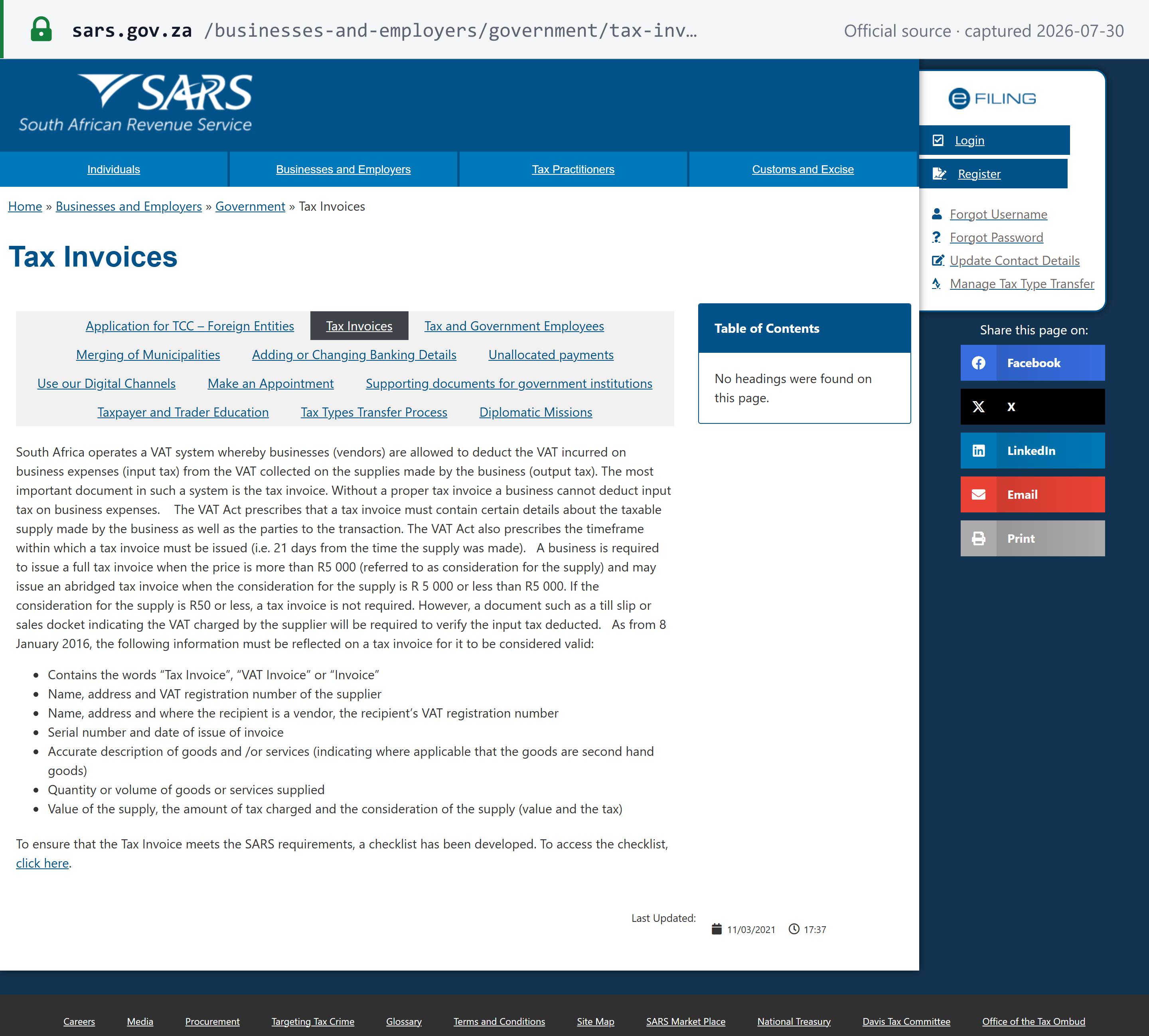
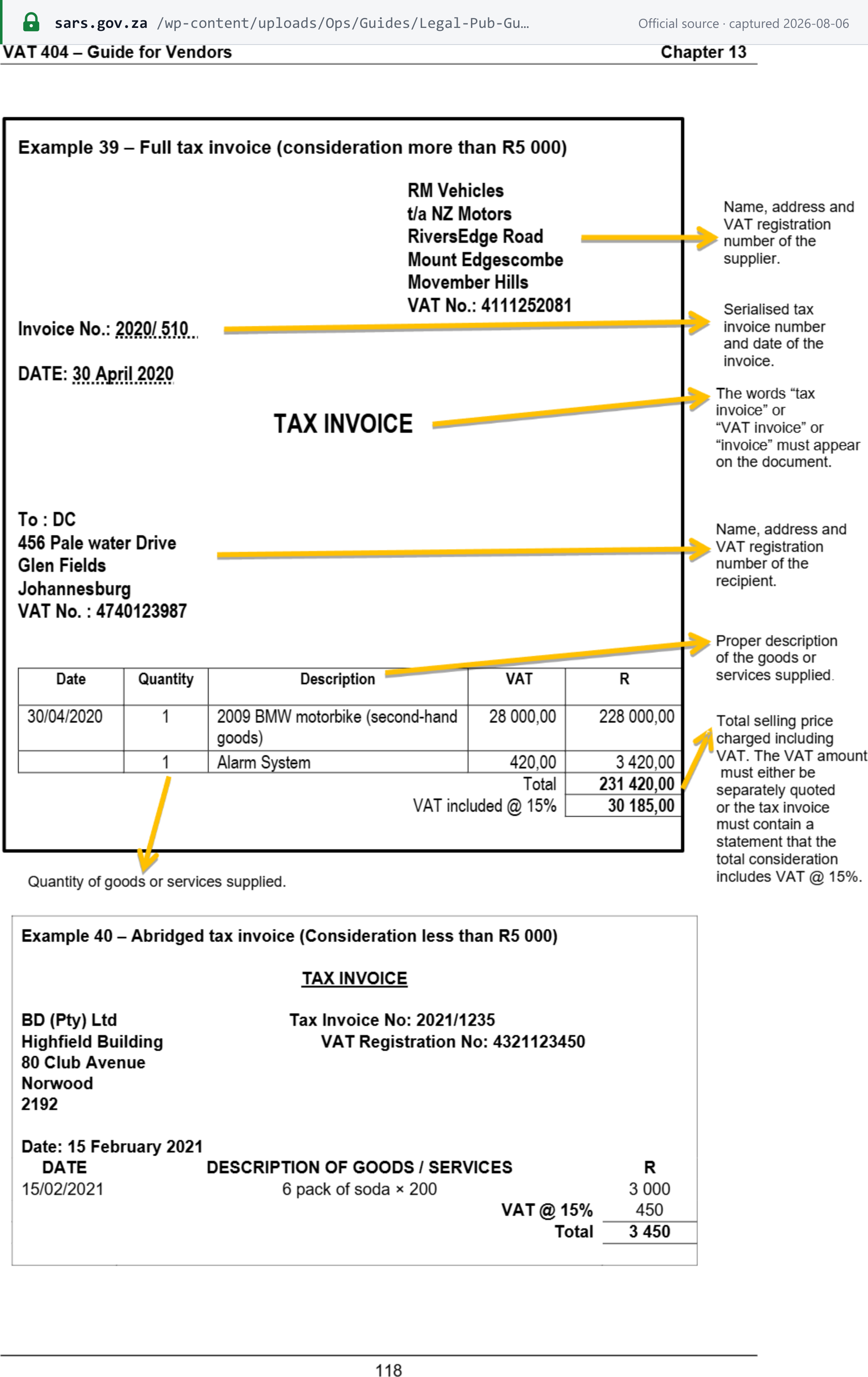
The particulars a tax invoice must carry are set by s.20(4)–(5) of the VAT Act, and don't change because the document happens to be issued electronically rather than on paper. The full seven-row particulars table and worked examples (VAT404 Guide, Examples 39–41) live on the South Africa VAT guide's Invoice requirements section — not repeated here. The two figures an e-invoicing reader needs at a glance:
| Consideration for the supply | Document required |
|---|---|
| More than R5,000 | Full tax invoice |
| R5,000 or less | Abridged tax invoice permitted |
| R50 or less | No tax invoice required — a till slip or sales docket showing the VAT charged suffices |
A tax invoice — full or abridged, paper or electronic — must be issued within 21 days of the supply, whether or not the recipient asks for one. [1]
 Source snapshot captured 2026-07-30 — original
 Source snapshot captured 2026-08-03 — original
Credit and debit notes (s.21)
Corrections are made under section 21 of the VAT Act. The required particulars broadly mirror the tax invoice: the words "credit note" or "debit note," supplier and recipient details, the date, the amount of the adjustment and the tax on it, an explanation of the circumstances, and information identifying the original transaction. The Act sets no explicit time limit for issuing a credit or debit note — the adjustment is made in the tax period in which the error or change becomes apparent. [1] For non-resident electronic-services suppliers, Binding General Ruling (VAT) 28 additionally sets the minimum information required on a credit or debit note under s.21(5), the exchange rate to use, and how advertised or quoted prices must be shown — see Foreign currency below.
Non-resident electronic-services suppliers use a different list
Registered foreign suppliers of electronic services do not use the s.20(4) particulars list above. Their tax invoices must instead carry the particulars prescribed by VAT Notice 1594 (Government Gazette 45624, 10 December 2021). See the South Africa VAT guide's electronic-services section for the registration and scope rules that go with it.
Electronic invoicing as currently permitted
Electronic issuance and retention are permitted today under the ordinary tax-invoice rules — the VAT Act does not require a tax invoice to be on paper, and Act 4 of 2026's own "e-invoice" definition presupposes that a tax invoice can already be "issued, transmitted and received in a structured electronic format." Several secondary, non-SARS-primary sources report that SARS's VAT News 20 (September 2002) and VAT News 22 (September 2003) state a vendor needs no prior Commissioner approval to adopt electronic invoicing, and that an electronic tax invoice must meet the integrity and authenticity standards of the Electronic Communications and Transactions Act 25 of 2002. Neither claim could be independently confirmed against a SARS-hosted document for this guide — treat both as widely reported, not verified.
Recipient consent. No SARS-published rule was found conditioning the validity of an electronic tax invoice on the recipient's prior consent, unlike, for example, the EU e-invoicing framework. (Checked 2026-09-20.)
Retention. Records, including tax invoices, must be retained for 5 years. [2] Retention format — including for electronic records — and the Commissioner's power to authorise non-standard or offshore electronic storage sit in ss.29–30 of the Tax Administration Act 28 of 2011. [3]
Foreign currency, language and numbering
Foreign currency. Binding General Ruling (VAT) 11 (Issue 3, 9 March 2020) sets the exchange rate a vendor must use to convert foreign-currency consideration to Rand for VAT purposes. Secondary sources report that a vendor may use the South African Reserve Bank's daily exchange rate at the time of supply, and that the VAT amount itself must always be expressed in Rand — this guide's research could not extract the ruling's primary text to confirm the figure directly, so treat it as reported pending confirmation. For non-resident electronic-services suppliers, Binding General Ruling (VAT) 28 additionally covers the exchange rate to use on credit and debit notes and how advertised or quoted prices must be shown — same confirmation caveat applies.
Language. No explicit statutory language requirement for a tax invoice was located on SARS's tax-invoice page or in the sections of the VAT Act reviewed for this guide. Do not assume English is mandated. (Checked 2026-09-20.)
Numbering. Section 20(4) requires only a "serial number" — no SARS statement was found requiring unbroken sequential numbering of the kind some continuous-transaction-control systems mandate elsewhere. Don't describe South Africa's rule as stricter than the Act states. (Checked 2026-09-20.)
Non-established businesses and B2G
Non-established businesses. Whether an eventual mandate would cover non-resident or foreign suppliers is not yet determined — this is exactly the kind of question the Consultation Paper is meant to settle, and SARS has not stated a position. (Checked 2026-09-20.)
B2G. No distinct e-invoicing channel for supplies to government exists today. Under the proposed five-phase rollout, B2G (Phase 5b) explicitly follows large-taxpayer/B2B (Phase 5a) rather than leading it — a genuine point of difference from jurisdictions such as France or Saudi Arabia, where B2G came first.
Format & network
CTC model. SARS names the model in its own Consultation Paper, not merely through commentary: the paper states that the programme's components "will establish a Decentralised Continuous Transaction Control and Exchange (DCTCE) model", "hereinafter referred to as the 'Digital VAT Model'". Its glossary defines the Digital VAT Model as "The proposed SARS 5-corner DCTCE operating model" and defines Five-Corner Model as an interoperability model spanning supplier, supplier's service provider, buyer's service provider, buyer and SARS's service provider as the fifth corner; Figure 1 is captioned "Five independent corners. Decentralised exchange." So the model is decentralised and five-corner by SARS's own description — closer to a Peppol-style interchange than a clearance model — with accredited service providers validating and transmitting, and SARS receiving a data subset for risk management and pre-filled returns. None of it is in force. [1]
Formats. The Consultation Paper states that "e-Invoices must adhere to an e-Invoice standard/specification (e.g. EN16931 CIUS, UN/CEFACT Cross-Industry Invoice, or Peppol PINT BIS)" and that a compliant e-invoice "is not merely a PDF, scanned image or emailed document". These are proposals in a consultation, not obligations: nothing is mandated today. [2]
Peppol. No SARS statement was found either endorsing or ruling out the Peppol network. Peppol PINT BIS being one of the three candidate formats reportedly floated is not the same as South Africa joining the Peppol network — the two should not be conflated.
QR codes / cryptographic stamps / e-reporting mechanics. Not yet specified by SARS at this stage of the consultation.
Onboarding / how to comply
Not applicable — there is nothing to register for. No portal, accreditation regime or sandbox exists for e-invoicing today, because participation under Act 4 of 2026's s.74(1B) is voluntary and no regulations have yet been prescribed. (Checked 2026-09-20.)
The only action available to a reader right now is responding to the Consultation Paper by 16 October 2026. SARS states that "Responses must be submitted by using the link in the Consultation Paper" — no separate public submission portal or email distinct from the paper's own instructions was found. [1]
Penalties
Not applicable to e-invoicing specifically — nothing is mandated, so nothing can be penalised for non-use. (Checked 2026-09-20.)
The one live consequence today applies to any tax invoice, paper or electronic: without a valid tax invoice, a vendor cannot deduct input tax. That is a denial of a benefit, not a fine, and it attaches to any invoice defect, not to e-invoicing as such. [1] General understatement and non-compliance penalties under Chapters 15–16 of the Tax Administration Act could in principle apply to a vendor who falsifies or fails to retain records, but no penalty figure specific to invoice record-keeping was sourced for this guide — treat as unknown rather than an estimate.
Frequently asked questions
Is e-invoicing mandatory in South Africa?
No. There is no mandatory B2B, B2G or B2C e-invoicing or clearance system in force in South Africa. The Tax Administration Laws Amendment Act 4 of 2026 (Government Gazette 54447, effective 1 April 2026) inserted statutory definitions of "e-invoice," "e-debit note," "e-credit note," "e-reporting" and "interoperability framework" into the VAT Act, and a new section 74(1B) empowering the Minister of Finance to make regulations for a voluntary e-reporting system — but it created no obligation to issue, receive or report e-invoices. SARS's VAT Modernisation Consultation Paper, released 17 August 2026, proposes a mandatory "Digital VAT Model" with a phased rollout that would not begin before 2030, and remains open for public comment until 16 October 2026. It is a consultation, not law, and carries no effective date. [1] [2]
Can I issue e-invoices voluntarily today, and do I need SARS's permission?
Yes, informally — nothing in the VAT Act bars a vendor from issuing electronic tax invoices today, provided they carry the ordinary section 20(4)/(5) particulars; the Act does not require a tax invoice to be on paper. Several secondary, non-SARS-primary sources report that SARS's VAT News 20 (September 2002) and VAT News 22 (September 2003) state a vendor needs no prior Commissioner approval to adopt e-invoicing, and that an electronic tax invoice must meet the integrity and authenticity standards of the Electronic Communications and Transactions Act 25 of 2002. Neither claim could be independently confirmed against a SARS-hosted document for this guide, so treat both as widely reported rather than verified. [1]
What is the Digital VAT Model, and when does it start?
The Digital VAT Model is the mandatory e-invoicing and real-time reporting system SARS proposed in its VAT Modernisation Consultation Paper of 17 August 2026, built from three components: e-Invoicing, an Interoperability Framework, and e-Reporting. The paper sets out a five-phase path — Phase 1 Preparation (2026/27), Phase 2 Solution development (2027/28), Phase 3 Validation/QA (2028/29), Phase 4 Pilot (2029/30), and Phase 5 Phased implementation (from 2030, roughly 36 months, sequenced large taxpayers/B2B, then B2G, then MSME, then B2C). SARS states implementation is expected to commence during the 2030 calendar year. This phase table is corroborated by three independent summaries of the paper but could not be re-confirmed against the paper's primary text for this guide, and none of it is law: public comment on the proposal closes 16 October 2026, and no earlier effective date exists. [1] [2]
Does the new e-invoice definition in Act 4 of 2026 change what I have to do today?
No. Act 4 of 2026 added the vocabulary — "e-invoice" is now defined as a tax invoice that is issued, transmitted and received in a structured electronic format allowing its automatic and electronic processing, and that complies with such further requirements as the Minister may prescribe by regulation — and gave the Minister power under section 74(1B) to regulate a voluntary e-reporting system. It did not make e-invoicing mandatory, did not create a reporting obligation, and no regulations have yet been prescribed under that power. A vendor's obligations under sections 20 and 21 of the VAT Act are unchanged. [1]
Recent changes
- 2026-08-17 — SARS releases its VAT Modernisation Consultation Paper, proposing a Digital VAT Model with three components — e-Invoicing, an Interoperability Framework and e-Reporting — for public comment until 16 October 2026. South Africa's first declared e-invoicing/CTC direction; no legal instrument has been enacted and there is no effective date. (South African Revenue Service) — see issue
- 2026-04-01 — Tax Administration Laws Amendment Act 4 of 2026 (Government Gazette 54447) inserts e-invoice, e-debit note, e-credit note, e-reporting and interoperability-framework definitions into the VAT Act and gives the Minister power (s.74(1B)) to prescribe requirements for a voluntary e-reporting system. No mandatory e-invoicing obligation is created. (South African Revenue Service / National Treasury) — see issue
Related resources
- South Africa VAT guide — the full tax-invoice particulars table, worked examples, rates, registration thresholds and filing rules.
- How to verify a VAT number in South Africa — a valid recipient VAT number is one of the mandatory tax-invoice particulars.
- E-invoicing status and networks worldwide — South Africa's row reads "enacted"; that refers only to Act 4 of 2026's definitions, not a live mandate (see the note under Mandate status & timeline above).
Important links
- SARS — VAT Modernisation programme page
- SARS — VAT Modernisation Consultation Paper (17 August 2026)
- SARS — Tax Administration Laws Amendment Act 4 of 2026 (GG 54447, 1 April 2026)
- SARS — Discussion Paper on Value-Added Tax Modernisation (2023)
- SARS — Tax invoices (particulars, thresholds, 21-day deadline)
- SARS — VAT 404 Guide for Vendors
- SARS — FAQs: Supplies of Electronic Services (Issue 4, 2 April 2025)
- SARS — Record-keeping (Tax Administration Act ss.29–30)