E-Invoicing in Luxembourg — B2G on Peppol and the B2B Bill 8815
Overview
Luxembourg has two e-invoicing regimes at very different stages. Business-to-government (B2G) e-invoicing is law and fully phased in: every economic operator that invoices a contracting authority or entity under a public contract or concession must send a compliant structured e-invoice through Peppol or MyGuichet.lu. Guichet.lu, the State's business portal, says the obligation applies "pour tous les opérateurs économiques depuis le 18 mars 2023" (to all economic operators since 18 March 2023). (Guichet.lu, page last modified 8 June 2026)
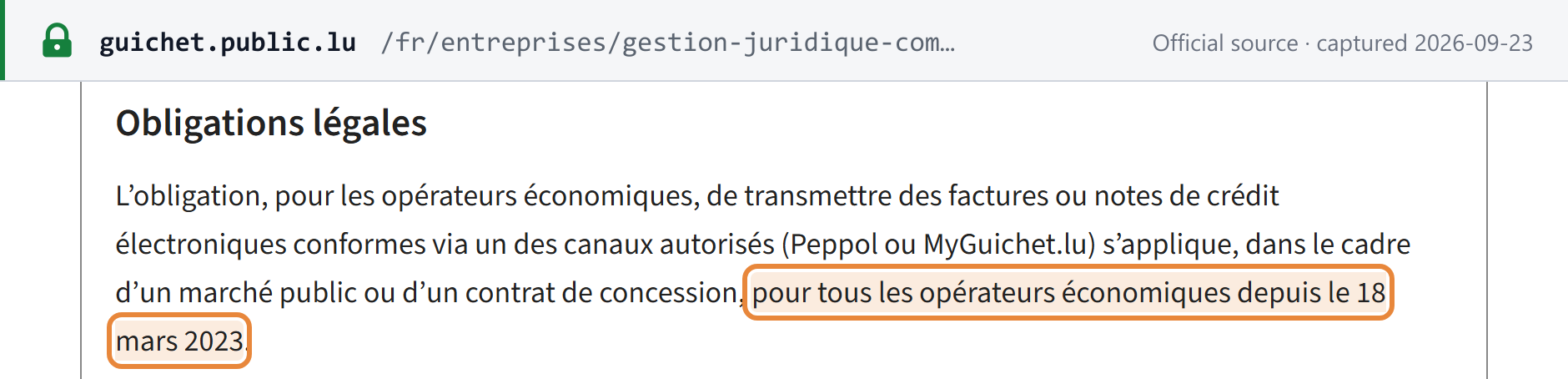 Source snapshot captured 2026-09-23 — original
Business-to-business (B2B) e-invoicing is only a bill. Finance Minister Gilles Roth deposited Projet de loi n° 8815 with the Chamber of Deputies on 30 July 2026. As deposited, it would make every Luxembourg business receive compliant e-invoices from 1 January 2028, and issue them from 1 July 2028 (larger issuers) or 1 January 2029 (everyone else). As at 30 September 2026 the bill is still at the deposited stage in the Chamber's Finance Committee. Nothing in it is law yet. (Chambre des Députés — dossier 8815)
There is no tax-authority platform. The system is run by the Ministère de la Digitalisation (Ministry for Digitalisation), which OpenPeppol lists as Luxembourg's Peppol Authority, and not by the VAT administration (AED). Public bodies receive through the government's Peppol access point and its "salle de courrier digitale" (digital mailroom); suppliers without a Peppol connection use two MyGuichet.lu online forms. The State portal for the programme is efacturation.public.lu, which the ministry runs with the Chambre de commerce and the Chambre des métiers. (OpenPeppol — Peppol Authorities; efacturation.public.lu — Secteur public)
The legal basis in one line: the loi du 16 mai 2019 on e-invoicing in public procurement (which transposed Directive 2014/55/EU), as amended by the loi du 13 décembre 2021, with the règlement grand-ducal du 13 décembre 2021 designating Peppol. Bill 8815 would amend the same 2019 law and the VAT law.
| Luxembourg | |
|---|---|
| B2G | Mandatory. Public buyers receive since 18 April 2019 (central) and 18 April 2020 (sub-central); every supplier issues since 18 March 2023 |
| B2B (domestic) | Proposed only — Projet de loi n° 8815 (deposited 30 July 2026): receive from 1 January 2028; issue from 1 July 2028 or 1 January 2029 |
| B2C | No obligation, and none in the bill |
| Non-residents | In scope for B2G, with the same channels. Outside the proposed B2B scope, which requires issuer and recipient both to be established in Luxembourg |
| Format | EN 16931-1:2017 in UBL or UN/CEFACT CII. Peppol BIS Billing 3.0 (UBL) recommended; the upload form also takes XRechnung 3.0.1. From 1 October 2026, XRechnung older than 3.0 is refused |
| Network | Peppol (common delivery network), or two MyGuichet.lu forms (manual entry or upload). Email is not an authorised channel |
| CTC model | Decentralised Peppol interchange; no clearance, no tax-authority reporting |
| Authority | Ministère de la Digitalisation (Peppol Authority); CTIE runs the State access point |
| Legislation | Loi du 16 mai 2019; loi du 13 décembre 2021; RGD du 13 décembre 2021; Projet de loi n° 8815 (bill) |
Mandate status & timeline
B2G: in force, every phase passed
| Phase | Who / what | Date | Status | Legal basis |
|---|---|---|---|---|
| Buyers receive — central | Central contracting authorities must receive and process EN 16931 e-invoices | 18 April 2019 | passed | Loi du 16 mai 2019, arts 4 and 6 [1] |
| Buyers receive — sub-central | Sub-central contracting authorities and contracting entities (not central purchasing bodies) | by 18 April 2020 | passed | Loi du 16 mai 2019, art. 6 [1] |
| Supplier law in force | Loi du 13 décembre 2021 (supplier obligation, art. 4bis) enters into force | 18 December 2021 | passed | Government communiqué, 15 March 2022 [4] |
| Suppliers — wave 1 | Large operators (all not in waves 2 or 3) | 18 May 2022 (5 months after entry into force) | passed | Loi du 16 mai 2019, art. 6(2), inserted by art. 4 of the loi du 13 décembre 2021 [2] |
| Suppliers — wave 2 | Operators not exceeding two of three limits at the 2019 balance-sheet date: balance-sheet total EUR 20 million, net turnover EUR 40 million, 250 full-time staff | 10 months after entry into force, at the latest (18 October 2022, derived) | passed | Loi du 16 mai 2019, art. 6(2), inserted by art. 4 of the loi du 13 décembre 2021 [2] |
| Suppliers — wave 3 | Operators not exceeding two of EUR 4.4 million / EUR 8.8 million / 50 staff, or unable to give 2019 figures (in practice, newly created businesses) | 18 March 2023 (15 months, at the latest) | passed | Loi du 16 mai 2019, art. 6(2), inserted by art. 4 of the loi du 13 décembre 2021; Guichet.lu [3] |
| XRechnung cut-off | From this date, XRechnung versions older than 3.0 are refused, over Peppol and on the upload form | 1 October 20261 | effective 1 October 2026 | Ministry notice [5] |
The 2021 law counts the supplier waves in months from its entry into force. The government's communiqué of 15 March 2022 anchors them to the calendar: the law "est entrée en vigueur le 18 décembre 2021" and applies "selon un échéancier fixé selon la taille des entreprises entre le 18 mai 2022 et le 18 mars 2023" (on a timetable set by company size between 18 May 2022 and 18 March 2023). Neither source states the middle date; 18 October 2022 is 18 December 2021 plus the statutory 10 months. (Gouvernement du Luxembourg, 15 March 2022)
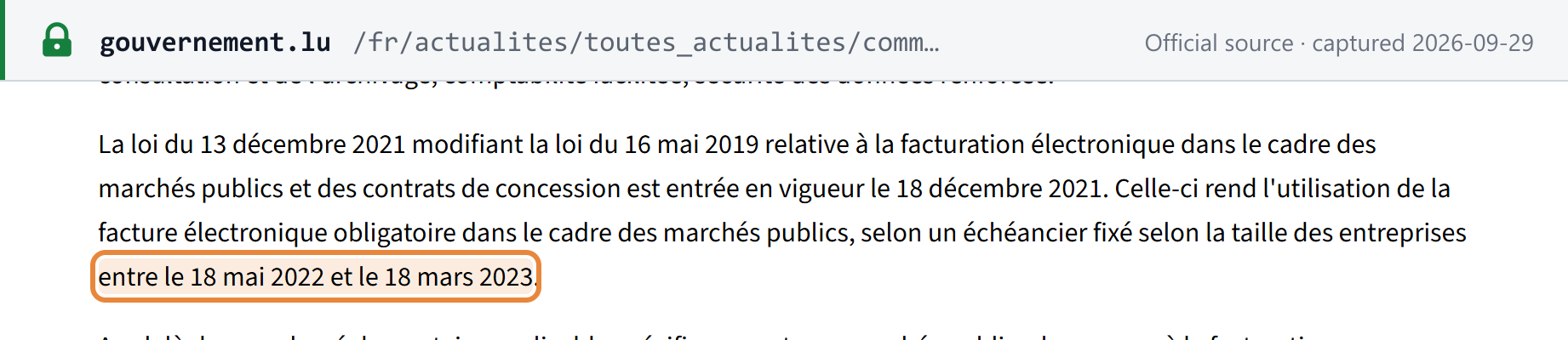 Source snapshot captured 2026-09-29 — original
Postponements. None. The B2G waves ran on the statutory timetable.
B2B: a bill, not law
Everything in this table is proposed. It is the text of Projet de loi n° 8815 as deposited on 30 July 2026, and it can change in committee, after the Conseil d'État's opinion, or in the vote. [6]
| Proposed step | Who | Proposed date | Bill article |
|---|---|---|---|
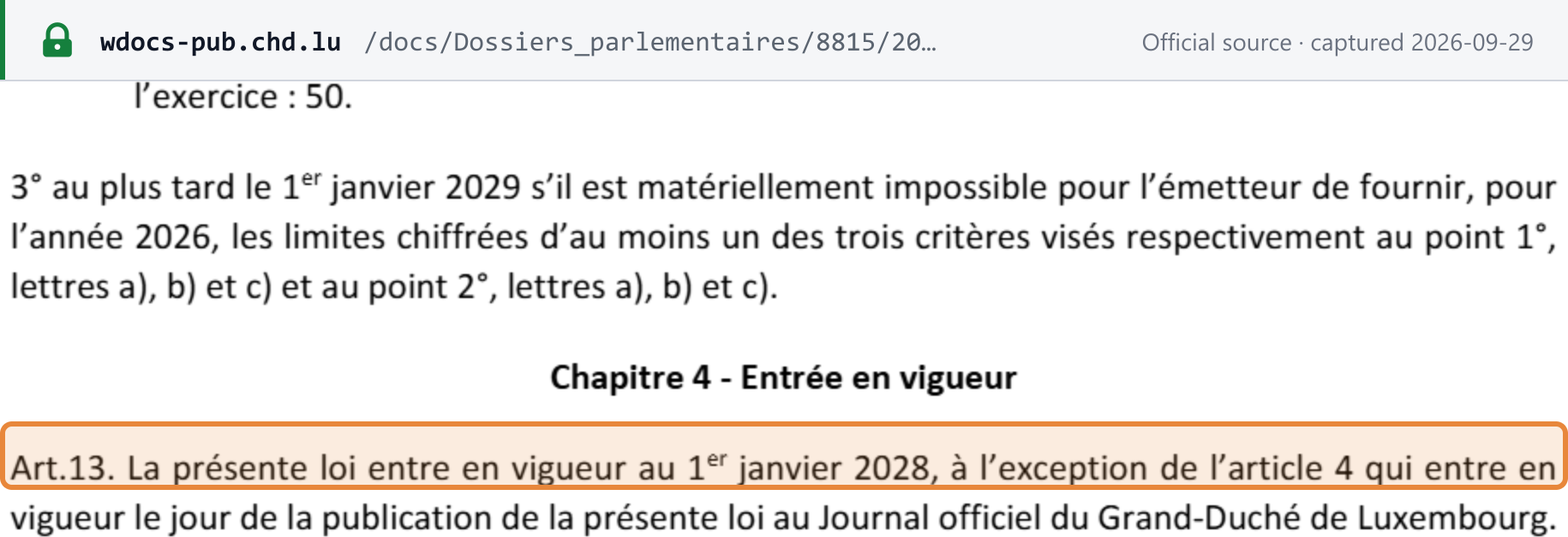
| Law enters into force; obligation to receive and process compliant e-invoices | All recipients in scope | 1 January 2028 | Art. 13 (entry into force); art. 6 (new art. 4 of the 2019 law); commentary to art. 13 |
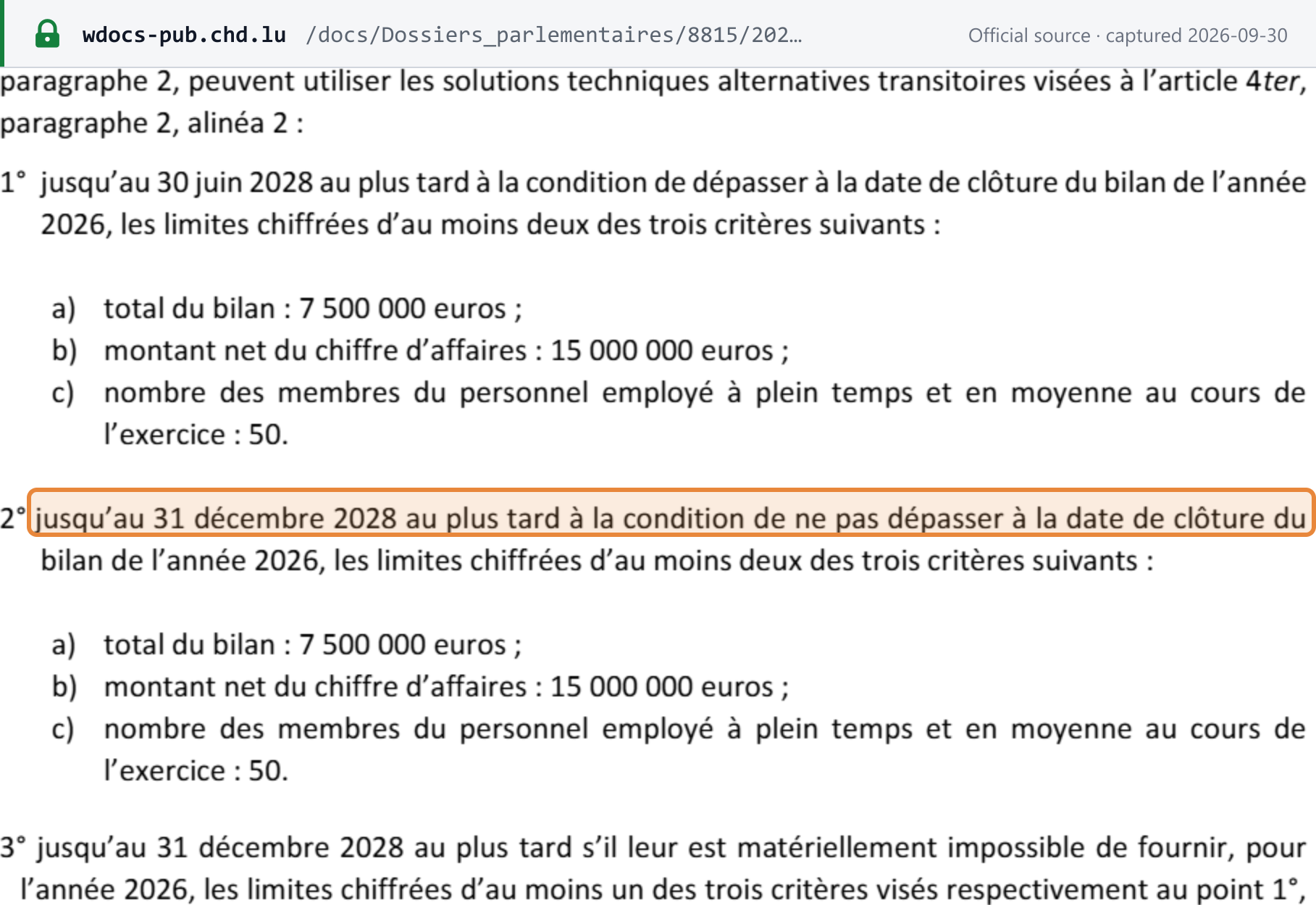
| Transitional non-automated reception solutions end | Recipients exceeding two of three limits at the 2026 balance-sheet date | 30 June 2028 | Art. 9 (new art. 5, 1°) |
| Transitional reception solutions end | Recipients not exceeding two of three limits, or unable to give 2026 figures | 31 December 2028 | Art. 9 (new art. 5, 2° and 3°) |
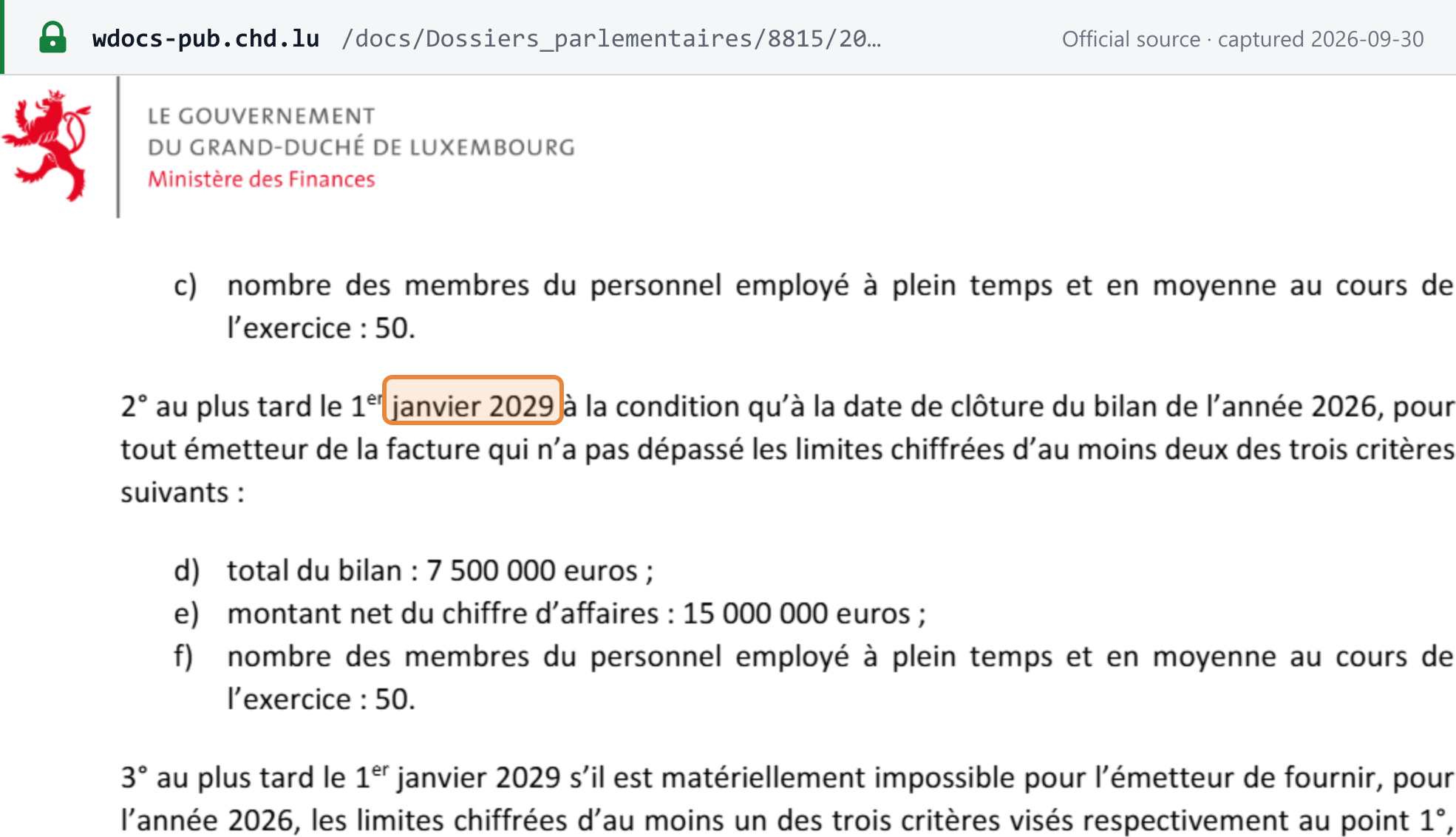
| Obligation to issue and transmit — wave 1 | Issuers that exceeded two of three limits at the 2026 balance-sheet date: balance-sheet total EUR 7,500,000, net turnover EUR 15,000,000, 50 full-time staff | by 1 July 2028 | Art. 12, 1° |
| Issue and transmit — wave 2 | All other issuers, and those unable to give 2026 figures | by 1 January 2029 | Art. 12, 2° and 3° |
The ministry's portal summarises the calendar this way — receiving and processing "pour toutes les entreprises luxembourgeoises à partir du 1 janvier 2028", and issuing and transmitting "pour les grandes et moyennes entreprises luxembourgeoises à partir du 1er juillet 2028 et pour toutes les entreprises à partir du 1er janvier 2029". The bill itself does not use the words "large" or "medium"; the test is the three statutory limits in art. 12. (efacturation.public.lu, 30 July 2026)
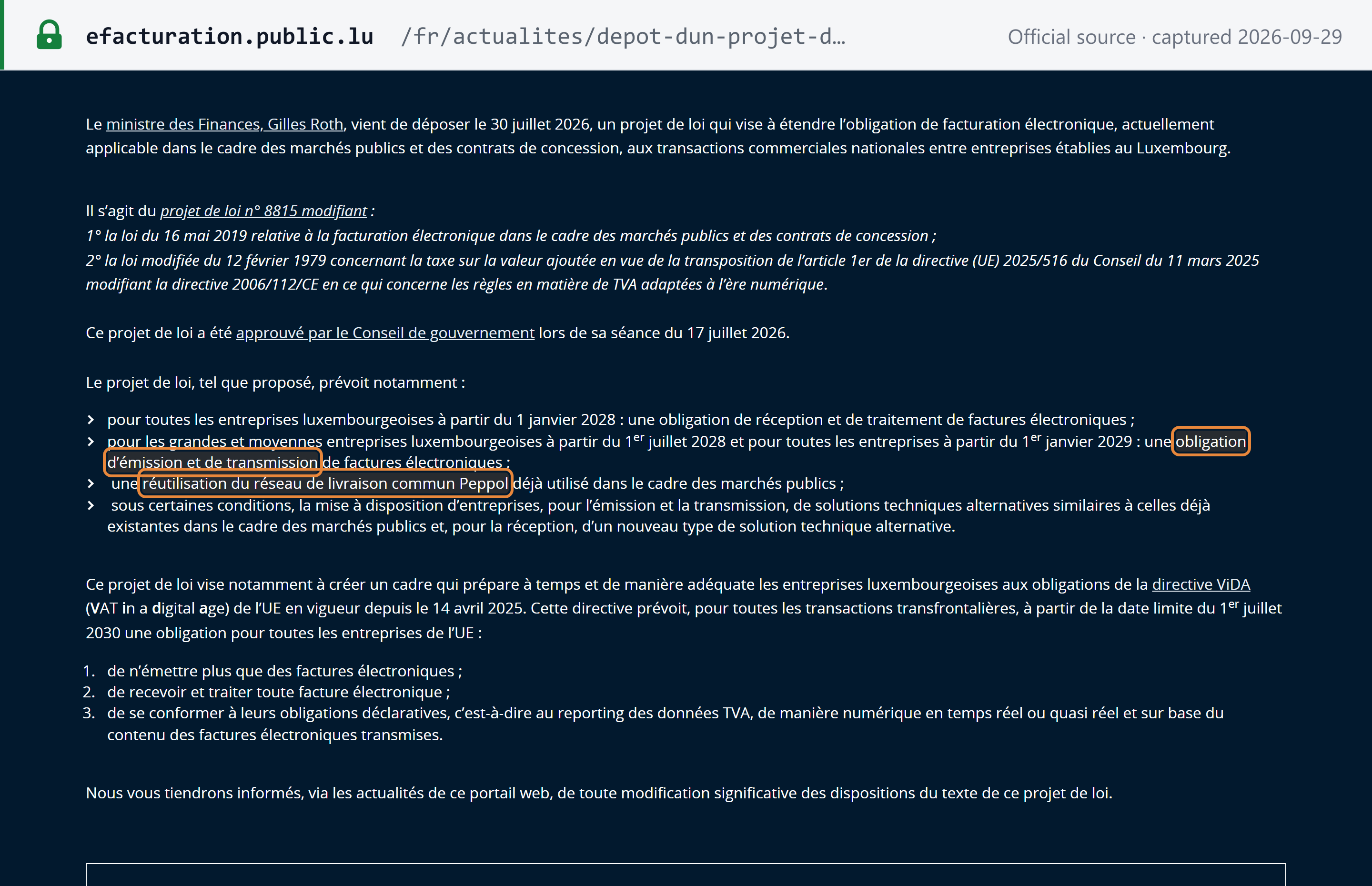 Source snapshot captured 2026-09-29 — original
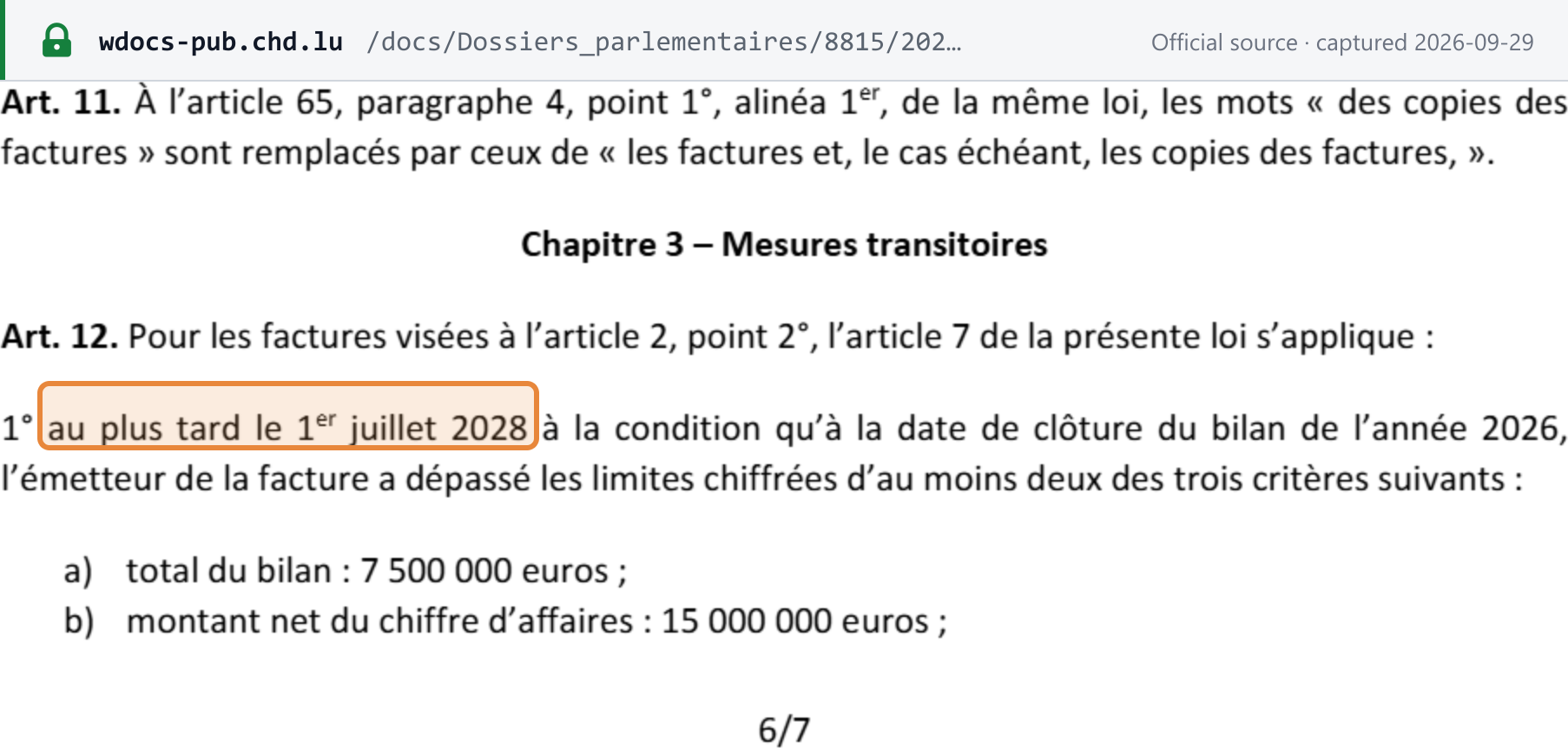 Source snapshot captured 2026-09-29 — original
 Source snapshot captured 2026-09-30 — original
 Source snapshot captured 2026-09-29 — original
 Source snapshot captured 2026-09-30 — original
Where the bill stands (as at 30 September 2026).
- 17 July 2026 — the Council of Government approved the draft law. In the same item it endorsed a draft grand-ducal regulation that will fix the common delivery network and the alternative solutions for B2B. The text of that draft regulation has not been published. (Gouvernement, 17 July 2026)
- 30 July 2026 — deposited in the Chamber and sent to the Commission des Finances.
- 18 September 2026 — the committee appointed a rapporteur and the bill was presented. That is the dossier's latest entry. Its status is still "Déposé(e)", and no Conseil d'État opinion or professional-chamber opinion has been filed. (Chambre des Députés — dossier 8815, checked 2026-09-30)
 Source snapshot captured 2026-09-23 — original
The date of the next parliamentary step is not known. Luxembourg's B2B bill is one of two ViDA bills deposited that day; the other, Projet de loi n° 8812, concerns platforms and the One-Stop-Shop and is not about e-invoicing.
Why now. The bill transposes art. 1 of Council Directive (EU) 2025/516 (ViDA), which lets Member States impose domestic B2B e-invoicing. Its explanatory memorandum links the bill to ViDA's digital reporting of intra-EU transactions "à partir du 1er juillet 2030", and says businesses will run two distinct regimes between 2028/2029 and 1 July 2030. The memorandum also reports that the number of e-invoices received in Luxembourg grew from a marginal volume in 2021 to more than 1.54 million in 2025. [6]
Legal basis
In force (B2G):
- Loi du 16 mai 2019 relative à la facturation électronique dans le cadre des marchés publics
et des contrats de concession (Doc. parl. 7271), which transposes Directive 2014/55/EU. Art. 4
obliges contracting authorities and entities to receive and process e-invoices that conform to
the latest version of the European standard and to one syntax on the Commission's list. Art. 6
sets the reception dates (18 April 2019, and 18 April 2020 at the latest for sub-central bodies).
Art. 1 excludes defence and security contracts declared secret. ELI
/eli/etat/leg/loi/2019/05/16/a345/jo. [1] - Loi du 13 décembre 2021 (Doc. parl. 7750) amending the 2019 law. It inserts art. 4bis
(suppliers must issue and transmit every invoice to a contracting authority or entity as a
compliant e-invoice), art. 4ter (the common delivery network and the alternative solutions)
and the phase-in in art. 6(2). Published in the Journal officiel on 14 December 2021, in
force on 18 December 2021. ELI
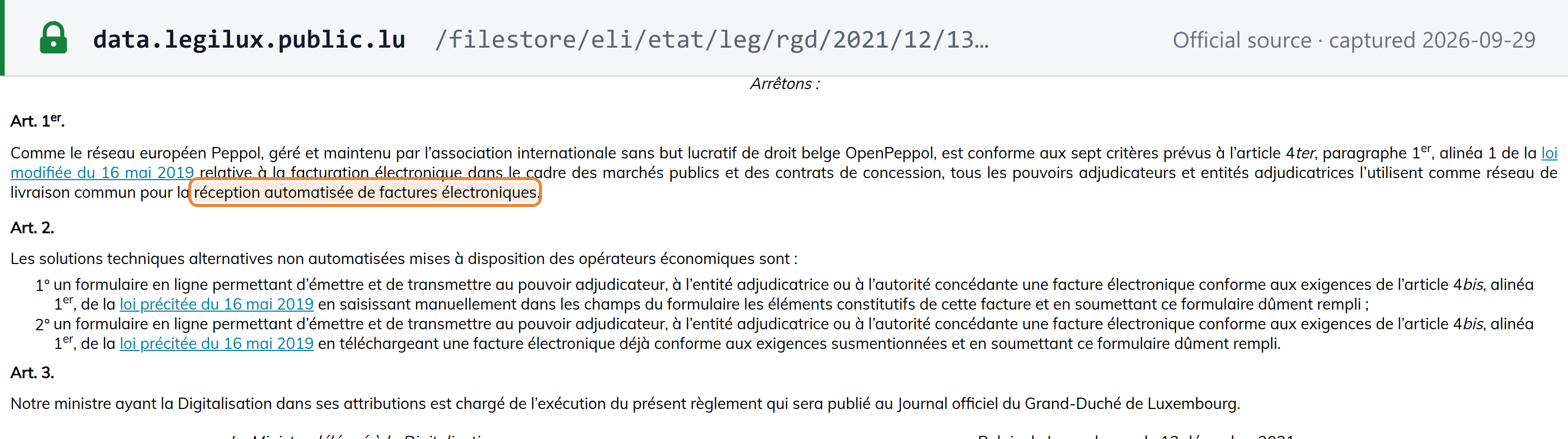
/eli/etat/leg/loi/2021/12/13/a869/jo. [2] [16] [4] - Règlement grand-ducal du 13 décembre 2021 portant fixation du réseau de livraison commun.
Art. 1 designates Peppol (run by OpenPeppol AISBL) as the common delivery network that all
contracting authorities and entities use for automated receipt. Art. 2 provides the two
alternatives: an online form for keying an invoice and an online form for uploading an
already-compliant e-invoice. ELI
/eli/etat/leg/rgd/2021/12/13/a870/jo. [7]
 Source snapshot captured 2026-09-30 — original
 Source snapshot captured 2026-09-29 — original
 Source snapshot captured 2026-09-29 — original
VAT law (all invoices). The loi modifiée du 12 février 1979 concernant la TVA governs invoice content and retention for every invoice, electronic or not. Art. 63(13) currently makes the use of an electronic invoice "soumise à l'acceptation du destinataire" (subject to the recipient's acceptance), which is why B2B e-invoicing is voluntary today. Art. 65 sets retention (see Archiving). [9]
Proposed (B2B):
- Projet de loi n° 8815, deposited 30 July 2026. It would amend the 2019 law (new scope in art. 1, definitions in art. 2, the receiving duty in art. 4, the issuing duty in art. 4bis, a nine-criterion network test in art. 4ter, transitional and permanent alternative solutions with usage fees) and the VAT law (art. 63: definitions, a new para. 4bis issuing duty, and an exception to the acceptance rule). It transposes art. 1 of Directive (EU) 2025/516. Not law. [6] [10]
- A draft grand-ducal regulation fixing the common delivery network and the alternative technical solutions, endorsed by the Council of Government on 17 July 2026. Its text has not been published. Separately, the bill says that a grand-ducal regulation will set the ceilings for the low-volume alternative solutions. [12]
Scope
B2G: who must issue
Every economic operator, for every amount. The obligation covers "tout opérateur économique qui transmet une facture ou note de crédit à destination d’un pouvoir adjudicateur ou d’une entité adjudicatrice dans le cadre d'un marché public ou d'un contrat de concession". Guichet.lu adds that a public contract includes "contrats qui concernent seulement des petites sommes, par exemple 1.000 euros ou même moins" and contracts awarded without a tender. Credit notes are legally invoices and follow the same rules. [3]
The invoice date governs, not the contract date. The ministry's FAQ says the criterion in the law "n’est pas une éventuelle date de conclusion d’un contrat, mais bien la date d’émission de la facture". A contract signed before 2022 does not keep paper or PDF invoicing alive. [8]
Exclusions. Art. 4bis does not apply to public contracts concluded:
- in development cooperation;
- by diplomatic missions or consulates;
- for international exhibitions abroad;
- for State, official or working visits abroad.
The 2019 law also excludes defence and security contracts whose award and performance are declared secret. [2] [1]
B2B: proposed scope under bill 8815
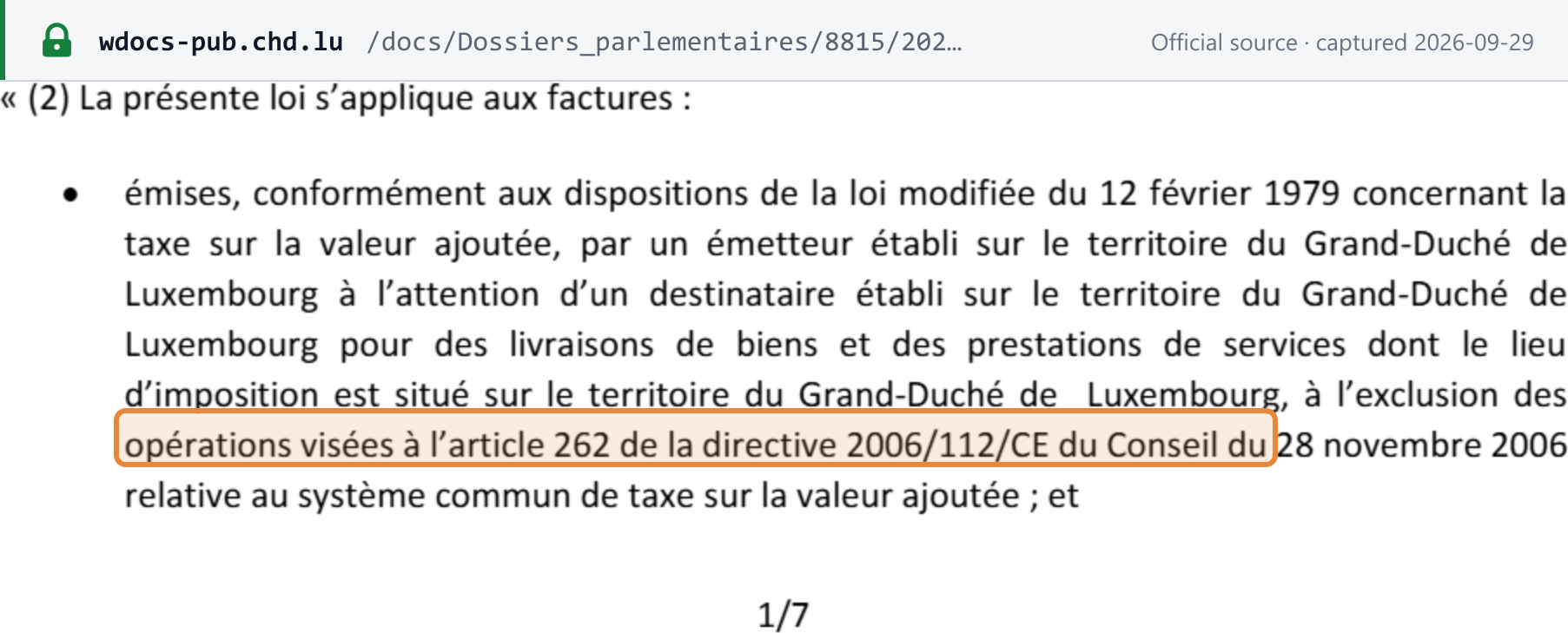
As deposited, the bill would cover invoices that meet all four conditions (new art. 1(2) of the 2019 law, via bill art. 2):
- issued by an issuer established in Luxembourg;
- to a recipient established in Luxembourg;
- for supplies of goods or services whose place of taxation is Luxembourg;
- where the VAT law requires an invoice.
Excluded, as drafted:
- transactions covered by art. 262 of Directive 2006/112/EC (intra-EU supplies and services reported in recapitulative statements);
- invoices issued by occasional taxable persons supplying new means of transport;
- invoices to persons who are taxable only temporarily under the VAT-law housing regime (art. 4(5), second sentence);
- intra-EU distance sales of goods to consumers deemed to take place in Luxembourg (art. 14(3)(a)).
The bill also covers compliant e-invoices that Luxembourg issuers send voluntarily, such as the State or communes acting as public authority. Its commentary adds that contracting authorities will themselves have to issue many compliant e-invoices, so the government access point and digital mailroom are to be opened for sending as well as receiving. [6]
 Source snapshot captured 2026-09-29 — original
Non-established businesses
- B2G: in scope. The ministry's FAQ says the law applies to every business invoicing the public sector, "qu’il s’agisse d’une entreprise luxembourgeoise ou étrangère", and that foreign operators "disposent exactement des mêmes canaux de transmission" (have exactly the same transmission channels) as Luxembourg operators. They can use Peppol, or MyGuichet.lu with an eIDAS electronic ID from another EU or EEA country. A no-login form exists for exceptional cases: the supplier first asks the recipient body for a one-time code and must attach a purchase order or another contractual document. Attachments are PDF only, up to 15 MB each. [8] [3]
- The manual-entry form has known gaps. The FAQ lists cases where it cannot yet be used, including suppliers from Greece in every case. Suppliers affected should use Peppol or the upload form. [8]
- B2B (proposed): outside scope as drafted. The bill requires both issuer and recipient to be established in Luxembourg, and its new VAT-law art. 63(4bis) addresses "l’assujetti établi à l’intérieur du pays". A non-established supplier, including one registered for VAT in Luxembourg, would therefore not be an issuer under the proposed obligation. The bill does not define "établi", so whether a Luxembourg fixed establishment of a foreign company counts is not settled by the text. [6]
 Source snapshot captured 2026-09-29 — original
B2C
Not applicable. Luxembourg has no B2C e-invoicing obligation: the law in force concerns public buyers only. Bill 8815 is limited to invoices the VAT law requires between established operators, and expressly excludes intra-EU distance sales of goods to consumers.
Simplified invoices
B2G: art. 4bis covers "toute facture" to a public buyer and makes no separate provision for simplified invoices. B2B: the VAT law allows simplified invoices of EUR 100 or less including VAT (art. 63(10)). Bill 8815 does not carve simplified invoices out, and touches them only through a consequential amendment to art. 63(10)–(11) (art. 10, 5° and 6°, deleting the words ", alinéa 2"). Whether an invoice of EUR 100 or less between established businesses must be a compliant e-invoice is not stated. [9] [6]
Format & network
CTC model: Peppol interchange, no clearance
Luxembourg uses a decentralised Peppol interchange (the 4-corner model) with ordinary post-audit. The State does not clear, validate for tax purposes or stamp B2G invoices; its access point and digital mailroom only forward them. The ministry's FAQ puts it this way: "le ministère de la Digitalisation ne fait que transmettre les factures électroniques au destinataire, il ne peut pas modifier ou rectifier une facture" (the ministry only forwards e-invoices to the recipient and cannot modify or correct an invoice). Once transmitted, an e-invoice cannot be rectified: a new invoice, or a credit note, must be issued. [8]
The upload form is the one place a check happens before delivery. The MyGuichet.lu back office checks conformity with the European standard, and a non-compliant or undeliverable invoice comes back to the user as an error message instead of being delivered. [3]
Integrity mechanics: not applicable. The 2019 and 2021 laws and the 2021 regulation set no clearance step, no tax-authority reporting, and no QR-code, hash or cryptographic-stamp requirement for B2G e-invoices, and Guichet.lu and efacturation.public.lu describe none. Bill 8815's commentary prefers a decentralised, federated network to a central platform, which it describes as a single point of failure.
Channels: Peppol or MyGuichet.lu only
- Peppol, through a Peppol access point connected to the supplier's billing software.
- MyGuichet.lu upload form (guichet.lu/efacture-transmission) for an e-invoice file the supplier's software already produces.
- MyGuichet.lu manual-entry form (guichet.lu/efacture-saisie) for keying an invoice online.
Email is not an authorised channel, even for a compliant file: "D’autres canaux de transmission que Peppol ou MyGuichet.lu ne sont pas autorisés." The FAQ adds that a PDF or Word document sent by email is not an e-invoice at all, because an e-invoice must be "lisible et interprétable automatiquement par un logiciel sans intervention humaine" (machine-readable and interpretable by software without human intervention). [3] [8]
Formats: EN 16931 in UBL or CII
- Legal test: the latest version of the European standard, EN 16931-1:2017, in one of the two syntaxes on the Commission's list: XML UBL (ISO/IEC 19845:2015) or UN/CEFACT CII. The ministry's FAQ names EN 16931 in UBL or CII and does not refer to a national CIUS.
- Recommended: the FAQ calls Peppol BIS Billing 3.0 in XML UBL the standard e-invoice used in Peppol. "Ce standard est le seul que tous les points d’accès Peppol sont obligés d’être à même de recevoir et de traiter" (it is the only standard every Peppol access point must be able to receive and process), so the ministry strongly recommends it. Other compliant formats can travel on Peppol, but many access points cannot receive them.
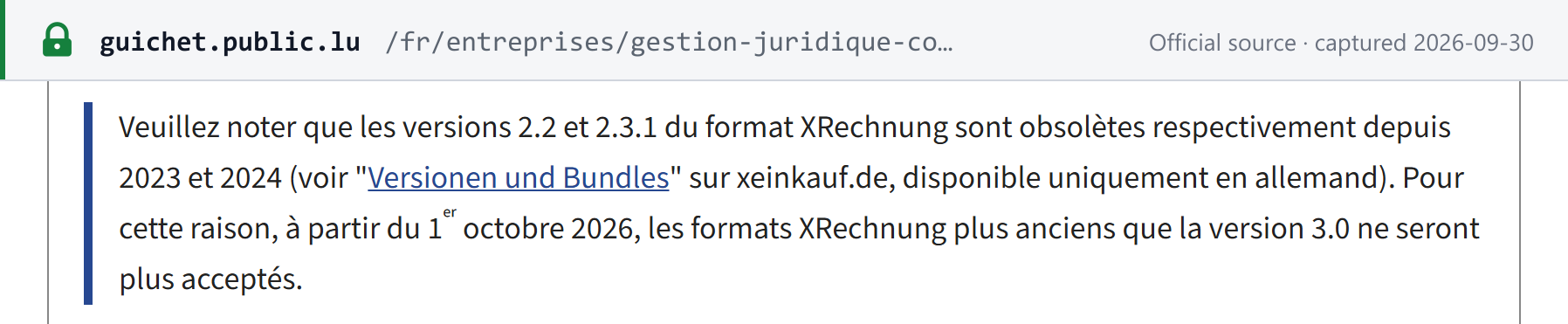
- Upload form, formats accepted: Peppol BIS Billing 3.0 (UBL), XRechnung 3.0.1 (UBL) and XRechnung 3.0.1 (CII), each for invoices and credit notes. From 1 October 2026, XRechnung 2.2.0 and 2.3.1 are refused. [8] [3]
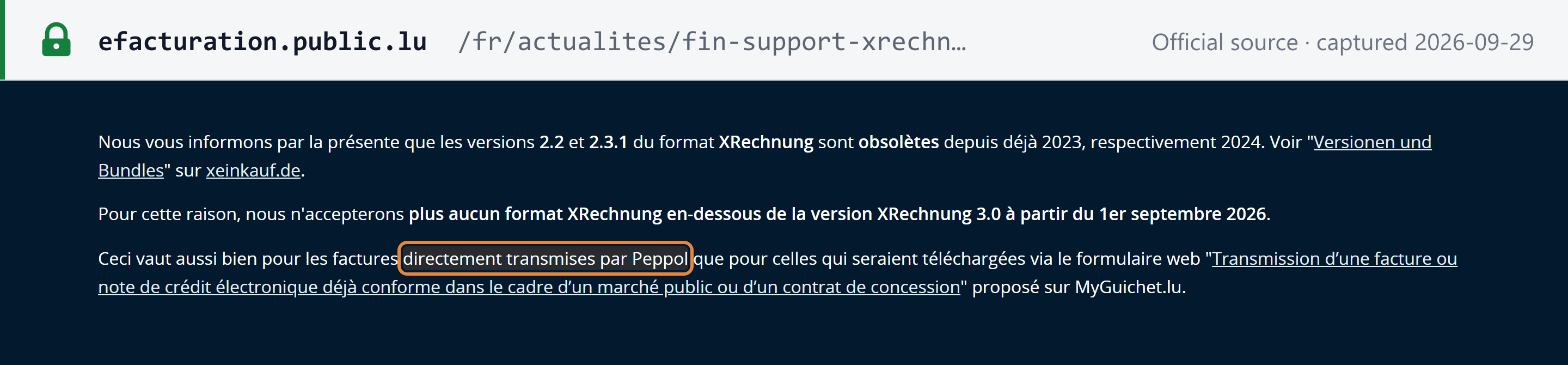
From 1 October 2026, XRechnung versions older than 3.0 are refused, over Peppol as well as on the upload form.1 The ministry's notice says the cut-off "vaut aussi bien pour les factures directement transmises par Peppol que pour celles qui seraient téléchargées via le formulaire web" (applies both to invoices sent directly over Peppol and to those uploaded through the web form). Suppliers sending XRechnung 2.2 or 2.3.1 must move to XRechnung 3.0.1 or to Peppol BIS Billing 3.0. [5]
 Source snapshot captured 2026-09-30 — original
 Source snapshot captured 2026-09-29 — original
Peppol addressing: scheme 9938
A Luxembourg body's Peppol participant ID is either its VAT number or its 11-digit number in
the register of legal persons (the matricule). Both use code list 9938 (LU:VAT), for public
and private bodies alike: "La codelist à utiliser dans Peppol pour les 2 types de numéros est
toujours la liste 9938, c’est-à-dire LU:VAT." Examples in the FAQ take the form 9938:lu10061242
or 9938:12345678910. XRechnung senders must add the issuer's and recipient's Peppol IDs
themselves (cbc:EndpointID schemeID="9938" in UBL, ram:URIID schemeID="9938" in CII).
[8]
The ministry publishes the list of public bodies and contracting entities on Peppol, with their endpoint IDs, as XLSX and JSON open data on its public-sector page; the Peppol Directory can also be searched. For the number formats, see Lookuptax's Luxembourg tax ID guide. [13]
 Source snapshot captured 2026-09-29 — original
B2B under bill 8815 (proposed)
- Same format test. The bill defines a « facture électronique conforme » as one that conforms to the European standard and to a syntax on the list published under Directive 2014/55/EU art. 3(2). Its commentary says this changes nothing of substance from the B2G test.
- One common delivery network for issuing, transmitting and receiving, which must meet nine criteria in the new art. 4ter(1): national and cross-border interoperability; openness; open digital sovereignty; security (availability, confidentiality, integrity, non-repudiation); privacy and data protection by default; conformity with the eIDAS definition of an electronic registered delivery service (Regulation (EU) 910/2014, art. 3(36)); wide national and cross-border use; and default capability to exchange compliant e-invoices and other structured purchase and invoice documents.
- Peppol. The bill leaves the choice of network to a grand-ducal regulation and does not name Peppol. The ministry's portal says the bill provides for "une réutilisation du réseau de livraison commun Peppol déjà utilisé dans le cadre des marchés publics" (reuse of the Peppol common delivery network already used in public procurement).
- Corrections and self-billing. A document that amends a compliant e-invoice would itself count as a compliant e-invoice and must be issued in the same format as the original. Self-billing could produce compliant e-invoices.
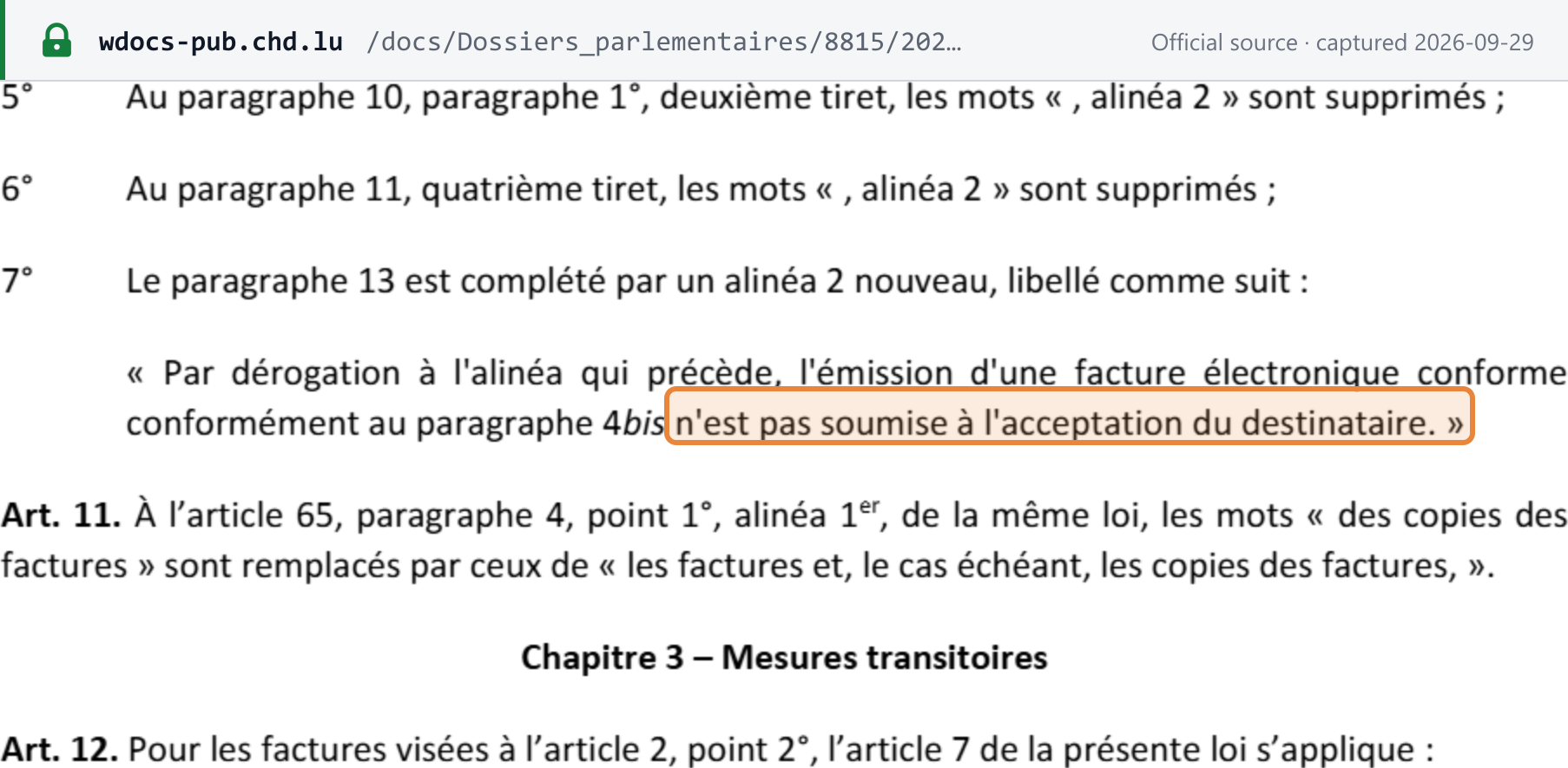
- No refusal. A new second paragraph in VAT-law art. 63(13) would say that issuing a compliant e-invoice under para. 4bis "n'est pas soumise à l'acceptation du destinataire" (is not subject to the recipient's acceptance).
- Other issuer duties. An issuer could not charge any extra fee merely for issuing a compliant e-invoice. Every Luxembourg-established issuer would have to be able to receive and process return messages over the network (receipt confirmations, rejections, error, validation and payment messages). Only the compliant e-invoice is authentic: attachments are allowed but are never the invoice, so every mandatory particular must be in the structured data. [6] [11]
 Source snapshot captured 2026-09-29 — original
E-reporting
Not applicable today. No transaction reporting runs alongside B2G e-invoicing, and bill 8815 adds none. Its memorandum ties B2B e-invoicing to ViDA's digital reporting of intra-EU transactions from 1 July 2030, which Luxembourg has not yet transposed. The only related obligation today is FAIA, the standard audit file the AED can request (see Lookuptax's SAF-T explainer).
Archiving
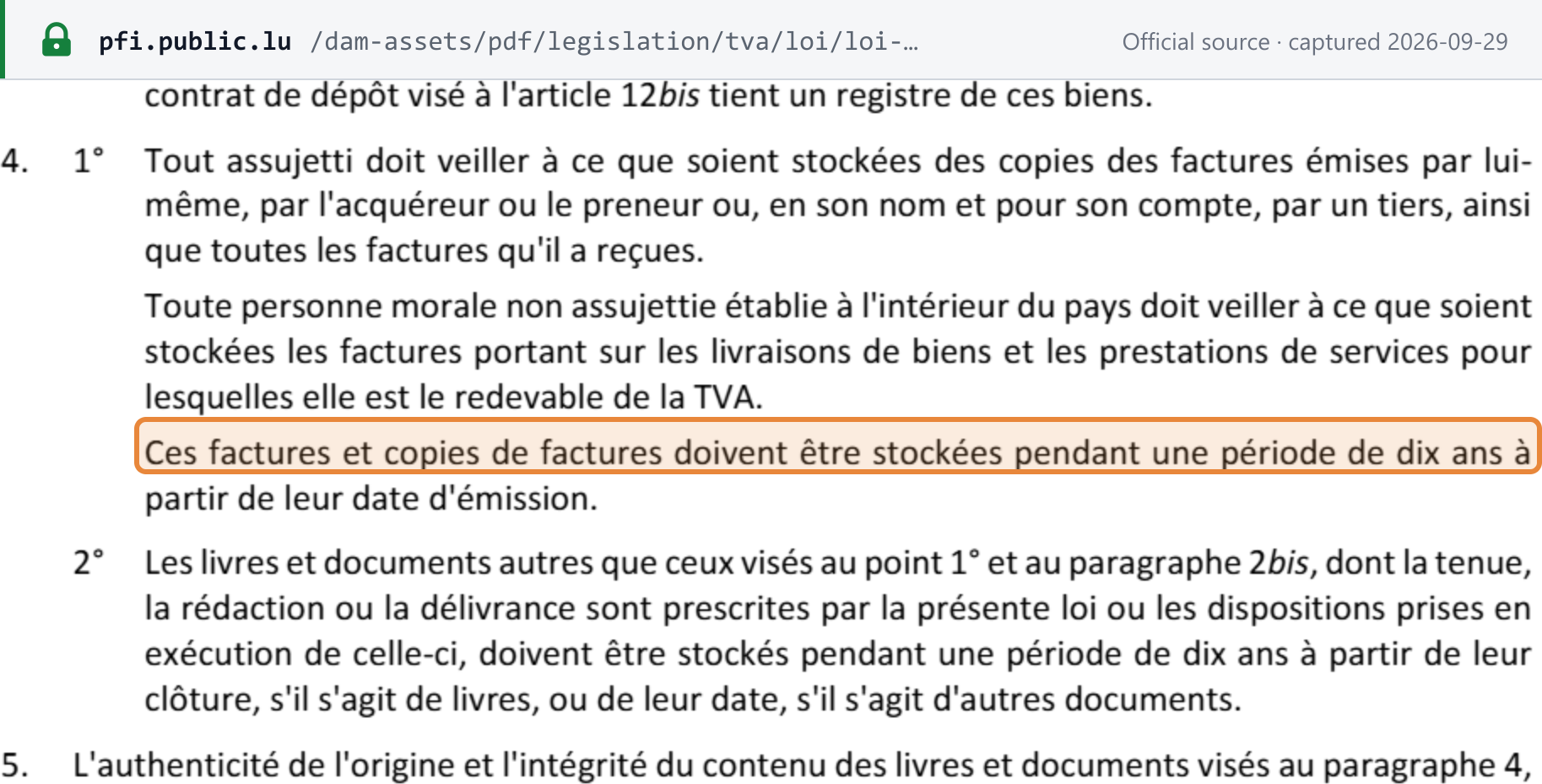
The e-invoicing law has no archiving rule of its own; the VAT law applies. Invoices issued (copies) and received are kept for 10 years from their date of issue (art. 65(4)). Electronic storage is valid if the data guaranteeing authenticity of origin and integrity are stored electronically too (art. 65(5)). Authenticity, integrity and legibility must be ensured from issue to the end of the retention period (art. 63(14)). Bill 8815 would reword art. 65(4) so that the duty covers "les factures et, le cas échéant, les copies des factures". [9]
 Source snapshot captured 2026-09-29 — original
Onboarding: how to comply
Choosing a channel
- Peppol — connect your billing software to Peppol through a Peppol access point, either via a Peppol-certified service provider or with software that is connected out of the box. The FAQ says Peppol is always preferable for volume.
- MyGuichet.lu — suits businesses that send few invoices a month. It needs a professional space on MyGuichet.lu, opened with LuxTrust, the Luxembourg eID or a foreign eIDAS electronic ID. [8]
Accreditation of providers
Not applicable beyond Peppol. No Luxembourg law or official e-invoicing page sets a national accreditation or certification of service providers other than Peppol certification. The authoritative list is OpenPeppol's register of certified service providers; the Chambres publish non-exhaustive lists of national and international providers on efacturation.public.lu's guides page, along with a mapping of EN 16931 business terms to the MyGuichet.lu fields. [14]
Testing
- Validate files first with a public validator or the Peppol schematron. The ministry points to tools such as testbed.peppol.org. It warns that test sends over Peppol must not be used to check conformity.
- Then test delivery against the State test environment (using SMK) with two participants:
Ministère de la Digitalisation
9938:LU31168204, and CTIE9938:LU10889245-TESTor9938:lu10889245. - If an invoice is refused before it reaches the recipient, ask the ministry for the reason at [email protected]. [8]
Support for SMEs
The "SME Packages – Digital" programme offers a subsidy of up to EUR 5,000 towards digitalisation projects that include e-invoicing. The House of Entrepreneurship and the Chambre des métiers provide personal support. [8]
B2B alternatives and usage fees (proposed)
Bill 8815 would keep non-network alternatives, of three kinds (new art. 4ter(2)):
- manual issue and transmission for operators, national and foreign, not yet on the network (today's MyGuichet.lu forms), subject to ceilings;
- transitional reception solutions for Luxembourg recipients, from 1 January 2028 until 30 June 2028 or 31 December 2028 (see the timeline);
- permanent issue and receipt solutions for Luxembourg businesses with very few invoices a year. The ceilings will be set by grand-ducal regulation and are not yet known.
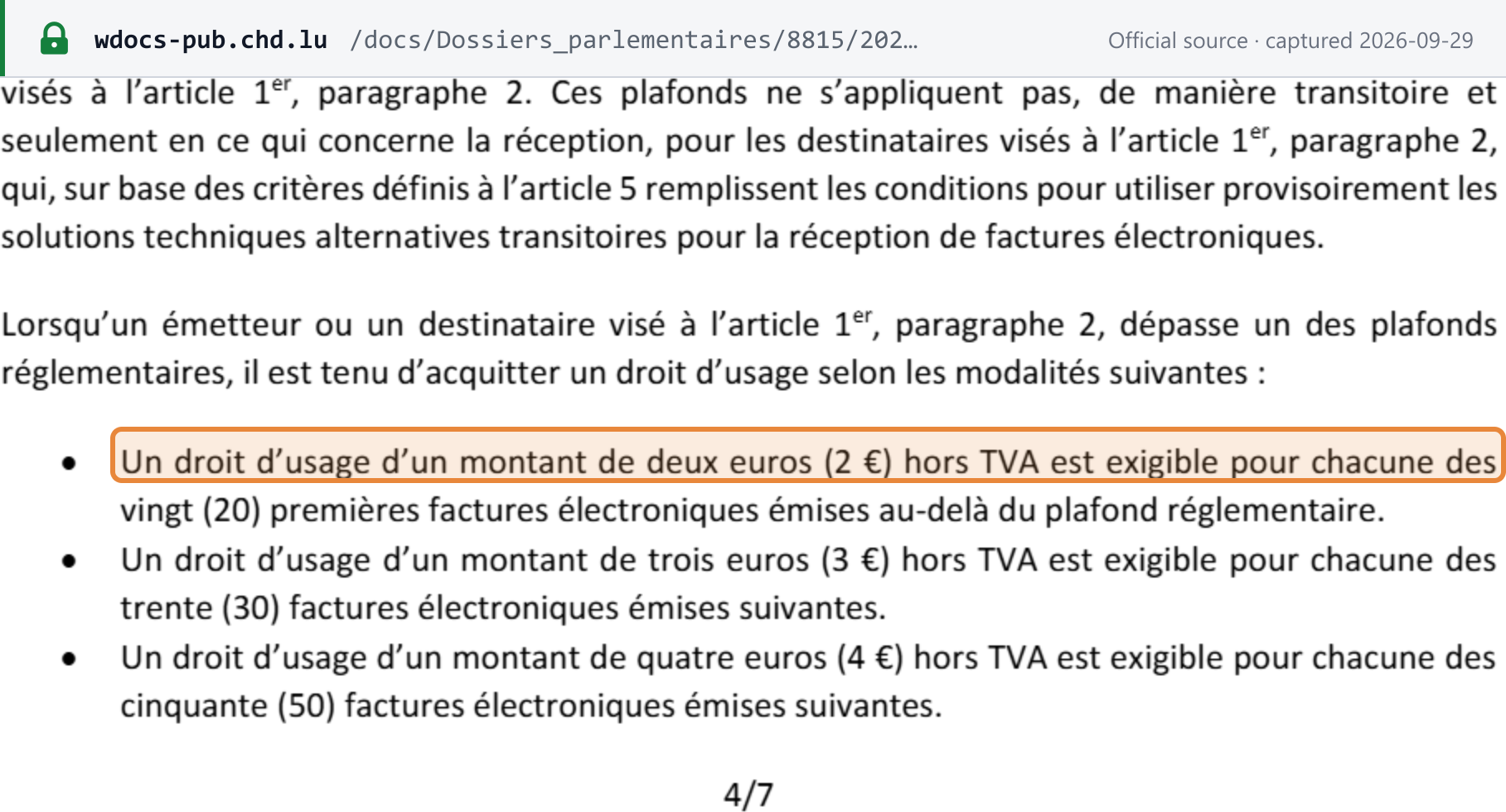
Above a ceiling, a usage fee per e-invoice, excluding VAT, would apply:
| E-invoices above the regulatory ceiling | Fee per e-invoice (excl. VAT) |
|---|---|
| First 20 | EUR 2 |
| Next 30 | EUR 3 |
| Next 50 | EUR 4 |
| Beyond those 100 | EUR 5 |
The same scale would apply to e-invoices received. The bill's commentary says the fee is set deliberately high to push users towards private-sector access providers. [6]
 Source snapshot captured 2026-09-29 — original
Penalties
B2G: no sanctions article. The law of 16 May 2019, as amended in 2021, consists of articles 1 to 6 (with 4bis and 4ter). None of them sets a fine or other sanction for a supplier that does not e-invoice, and no such fine has been published. What the rules do say is that channels other than Peppol or MyGuichet.lu "ne sont pas autorisés" (are not authorised), that a non-conforming upload is returned with an error message instead of being delivered, and that only the compliant e-invoice is authentic. [3] [1] [2]
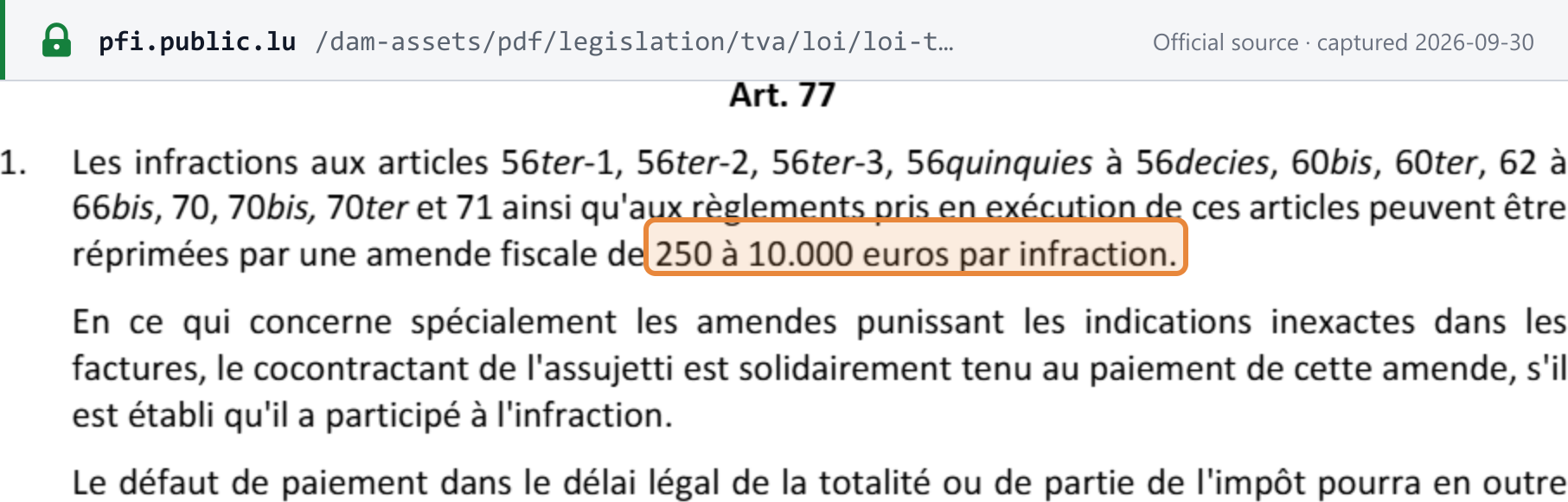
B2B (proposed): no specific sanction. Bill 8815 contains no sanctions clause for the new e-invoicing duties, and neither the government nor the AED has published a penalty position on them. For context, the VAT law's general fine for breaches of its invoicing articles (art. 77(1), covering arts 62 to 66bis) is EUR 250 to 10,000 per infringement; the bill places the new issuing duty in art. 63 and does not amend art. 77. How that general rule would be applied to the new duty has not been stated by any authority. [9] [6]
 Source snapshot captured 2026-09-30 — original
Frequently asked questions
Can we email a PDF invoice to a Luxembourg ministry or commune?
No. Under a public contract or concession, invoices and credit notes must be compliant structured e-invoices sent through Peppol or MyGuichet.lu. Guichet.lu states that other channels are not authorised and that even a compliant e-invoice may not be sent by email; the ministry adds that a PDF or Word file is not an e-invoice at all. (Guichet.lu; efacturation.public.lu FAQ, checked 2026-09-29)
We are a foreign supplier without a Luxembourg VAT number. How do we invoice a Luxembourg public body?
The B2G obligation applies to foreign suppliers too, with exactly the same channels as Luxembourg suppliers. Use Peppol through any Peppol access point, or MyGuichet.lu with an eIDAS electronic ID from another EU or EEA country. In exceptional cases a no-login form can be used with a one-time code obtained from the recipient body and a purchase order or other contractual document attached. (efacturation.public.lu FAQ; Guichet.lu)
What is a Luxembourg public body's Peppol ID?
It is the body's VAT number or its 11-digit number in the register of legal persons, both under code list 9938 (LU:VAT) — for example 9938:lu10061242 or 9938:12345678910. The ministry publishes the list of public bodies and their endpoint IDs as XLSX and JSON on efacturation.public.lu. (efacturation.public.lu FAQ)
Our public contract was signed before 2022. Do its invoices have to be e-invoices?
Yes. The ministry's FAQ says the criterion in the law is the invoice's date of issue, not the date the contract was concluded. Every invoice issued since your wave's date (18 March 2023 at the latest) must be a compliant e-invoice. (efacturation.public.lu FAQ)
We still send XRechnung 2.3.1. Will Luxembourg public bodies accept it?
Not from 1 October 2026. From that date, XRechnung versions older than 3.0 (2.2 and 2.3.1) are refused, both over Peppol and on the MyGuichet.lu upload form. Move to XRechnung 3.0.1 or to Peppol BIS Billing 3.0, which the ministry recommends. The ministry's notice gives 1 October 2026 in its title, as does Guichet.lu, although one sentence in the notice's body says 1 September 2026. (efacturation.public.lu; Guichet.lu)
When does B2B e-invoicing start in Luxembourg?
It has not been enacted. Projet de loi n° 8815, deposited on 30 July 2026, proposes that every business in scope receive compliant e-invoices from 1 January 2028, and issue them from 1 July 2028 if it exceeded two of three limits at its 2026 balance-sheet date (balance-sheet total EUR 7.5 million, net turnover EUR 15 million, 50 staff) or from 1 January 2029 otherwise. As at 30 September 2026 the bill is at the deposited stage in the Chamber's Finance Committee, and these dates can change. (Chambre des Députés, dossier 8815)
Are non-resident businesses caught by the B2B bill?
Not as drafted. The bill covers only invoices from an issuer established in Luxembourg to a recipient established in Luxembourg, so a non-established supplier would not be an issuer under the proposed obligation even if it is registered for VAT in Luxembourg. The bill does not define "established", so the position of a Luxembourg fixed establishment of a foreign company is not settled. Non-residents remain fully in scope for B2G. (Projet de loi n° 8815, art. 2 and art. 10)
Could a Luxembourg customer refuse our e-invoice under the B2B bill?
No, if the bill passes as deposited. Today the VAT law makes an electronic invoice subject to the recipient's acceptance (art. 63(13)); the bill adds that issuing a compliant e-invoice under the new art. 63(4bis) is not subject to that acceptance. (Projet de loi n° 8815, art. 10)
Is there a fine for not e-invoicing?
For B2G, the e-invoicing law contains no sanctions article; Guichet.lu states that channels other than Peppol or MyGuichet.lu are not authorised. For B2B, bill 8815 contains no specific sanction and no authority has published a penalty position. The VAT law's general fine for breaches of its invoicing articles is EUR 250 to 10,000 per infringement (art. 77), but how it would apply to the proposed duty has not been stated. (Loi du 16 mai 2019 as amended; VAT law art. 77)
How long must e-invoices be kept?
Ten years from their date of issue, under art. 65(4) of the VAT law. Electronic storage is valid if the data guaranteeing authenticity of origin and integrity are also stored electronically, and authenticity, integrity and legibility must be ensured for the whole period. (VAT law arts 63 and 65)
Recent changes
- 2026-09-18 — Projet de loi n° 8815 (B2B e-invoicing): the Commission des Finances appointed a rapporteur and the bill was presented; it remains at the deposited stage. (Chambre des Députés) — see event
- 2026-07-30 — Projet de loi n° 8815 deposited. As deposited, it proposes receiving compliant e-invoices from 1 January 2028 and issuing from 1 July 2028 or 1 January 2029; it is a bill, not law. (Chambre des Députés) — see event
- 2026-07-17 — The Council of Government approved the B2B e-invoicing bill and endorsed a draft grand-ducal regulation on the common delivery network and alternative solutions. (Gouvernement du Luxembourg) — see event · issue
- 2026-07-10 — The ministry announced the end of support for XRechnung 2.2 and 2.3.1: from 1 October 2026, XRechnung versions older than 3.0 are refused over Peppol and on the upload form. (efacturation.public.lu)
- 2023-03-18 — B2G e-invoicing through Peppol or MyGuichet.lu became mandatory for all economic operators, completing the phased roll-out. (Guichet.lu)
For the full chronology, see Luxembourg tax changes on Lookuptax.
Related resources
- Luxembourg VAT guide — rates, registration, invoice particulars, filing and penalties
- Luxembourg tax identification numbers — the VAT number and the 11-digit number double as Peppol IDs under scheme 9938
- Validate a Luxembourg VAT number
- Luxembourg tax-change chronology — every tracked Luxembourg change, dated and sourced
- E-invoicing status and networks worldwide — Luxembourg's row in global context
- Peppol network explainer and Peppol requirements by country
- ViDA — VAT in the Digital Age — the directive bill 8815 transposes, and the 2030 reporting it prepares for
- SAF-T explainer — context for Luxembourg's FAIA audit file
- How to verify an EU VAT number (VIES)
- Neighbouring Peppol and CTC mandates: Belgium, Germany, France
Important websites
- efacturation.public.lu — the State e-invoicing portal (news, FAQ, guides)
- Dossiers et FAQ — the ministry's official Q&A, including Peppol IDs and test participants
- Guides — provider lists, EN 16931 field mapping, sample invoices
- Secteur public — public bodies on Peppol, with endpoint IDs (XLSX, JSON)
- MyGuichet.lu upload form and manual-entry form
- Peppol Directory and Peppol-certified service providers
- Chambre des Députés — dossier 8815 — the B2B bill's parliamentary progress
Reference links
- [1] Legilux — Loi du 16 mai 2019 relative à la facturation électronique dans le cadre des marchés publics et des contrats de concession
- [2] Legilux — Loi du 13 décembre 2021 modifiant la loi du 16 mai 2019
- [3] Guichet.lu — Transmission d'une facture électronique dans le cadre d'un marché public ou d'un contrat de concession
- [4] Gouvernement du Luxembourg — communiqué du 15 mars 2022 (facturation électronique)
- [5] efacturation.public.lu — Fin du support pour les formats XRechnung 2.2 et 2.3.1
- [6] Chambre des Députés — Projet de loi n° 8815, document de dépôt, 30 July 2026 (PDF)
- [7] Legilux — Règlement grand-ducal du 13 décembre 2021 portant fixation du réseau de livraison commun
- [8] efacturation.public.lu — Dossiers et FAQ
- [9] AED — Loi modifiée du 12 février 1979 concernant la TVA, texte coordonné au 1er janvier 2026 (PDF)
- [10] Chambre des Députés — Dossier parlementaire n° 8815
- [11] efacturation.public.lu — Dépôt d'un projet de loi sur la facturation électronique entre entreprises
- [12] Gouvernement du Luxembourg — Conseil de gouvernement du 17 juillet 2026
- [13] efacturation.public.lu — Secteur public
- [14] efacturation.public.lu — Guides
- [15] OpenPeppol — Peppol Authorities
- [16] Gouvernement du Luxembourg — communiqué du 14 décembre 2021 (facturation électronique obligatoire)