E-Invoicing in Denmark — Nemhandel, OIOUBL, Peppol and Default Enrolment
Overview
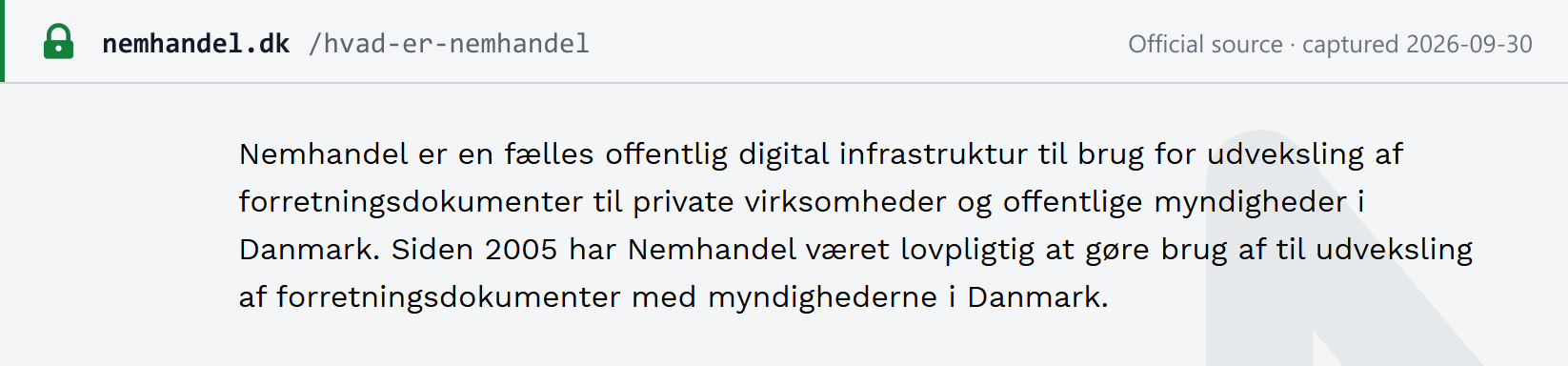
Denmark's e-invoicing system is Nemhandel, which Erhvervsstyrelsen (the Danish Business Authority, ERST) describes as "en fælles offentlig digital infrastruktur" (a common public digital infrastructure) for exchanging business documents between private businesses and public authorities. Its use with public authorities has been compulsory since 2005: "Siden 2005 har Nemhandel været lovpligtig at gøre brug af til udveksling af forretningsdokumenter med myndighederne i Danmark" (since 2005, using Nemhandel has been mandatory for exchanging business documents with the authorities in Denmark). (Nemhandel — Hvad er Nemhandel)
 Source snapshot captured 2026-09-30 — original
Denmark has three different rules, and they are often confused:
- B2G: mandatory. Invoices to public authorities must be received electronically and must quote the authority's EAN location number (BEK nr. 206/2011).
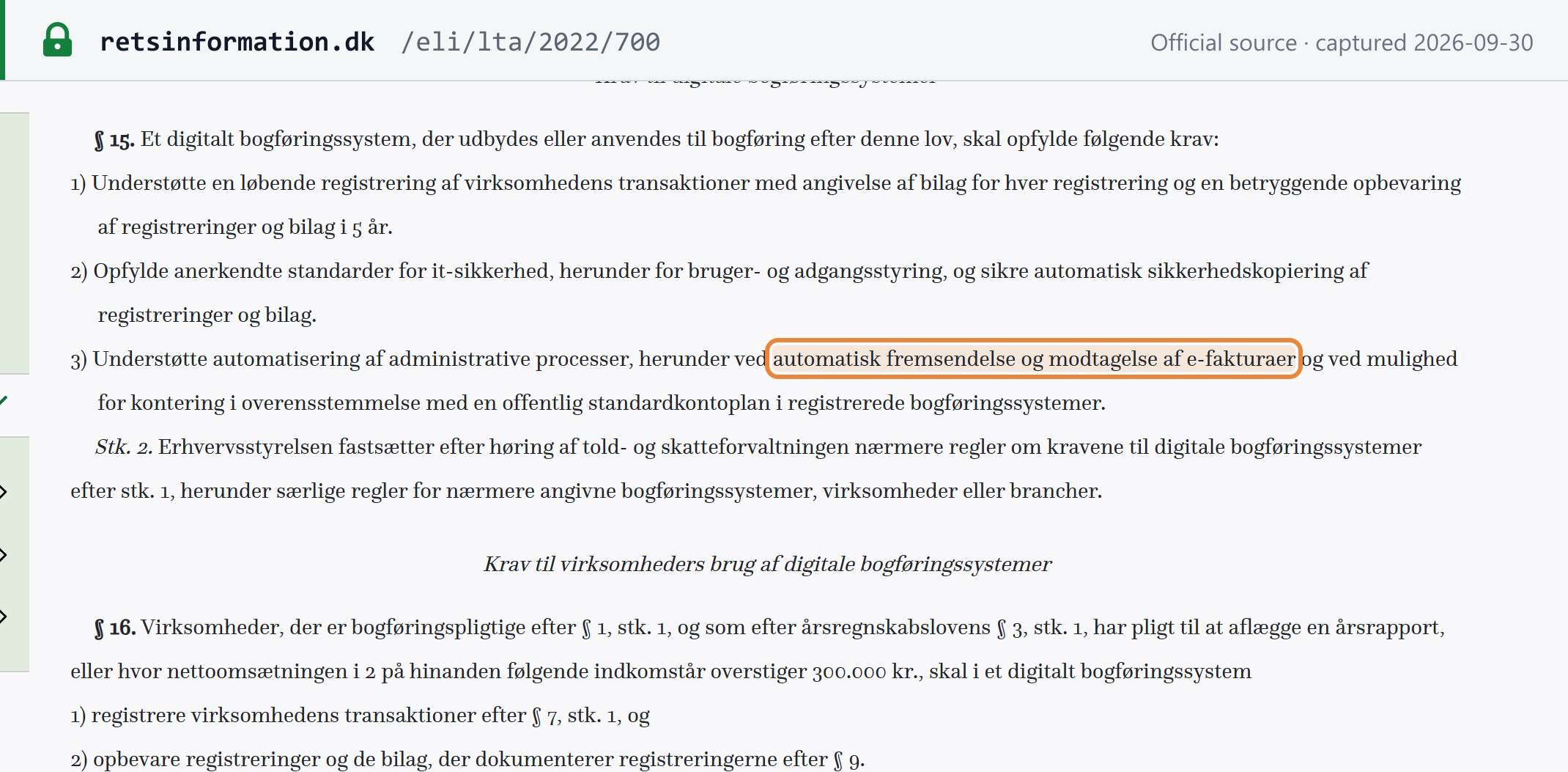
- Bookkeeping systems: e-invoice capable, and now enrolled by default. The Bookkeeping Act requires digital bookkeeping systems to support "automatisk fremsendelse og modtagelse af e-fakturaer" (automatic sending and receipt of e-invoices). From 29 September 2026, BEK nr. 811/2026 requires providers of registered systems to enrol their customers in e-invoicing unless the customer opts out within four weeks.
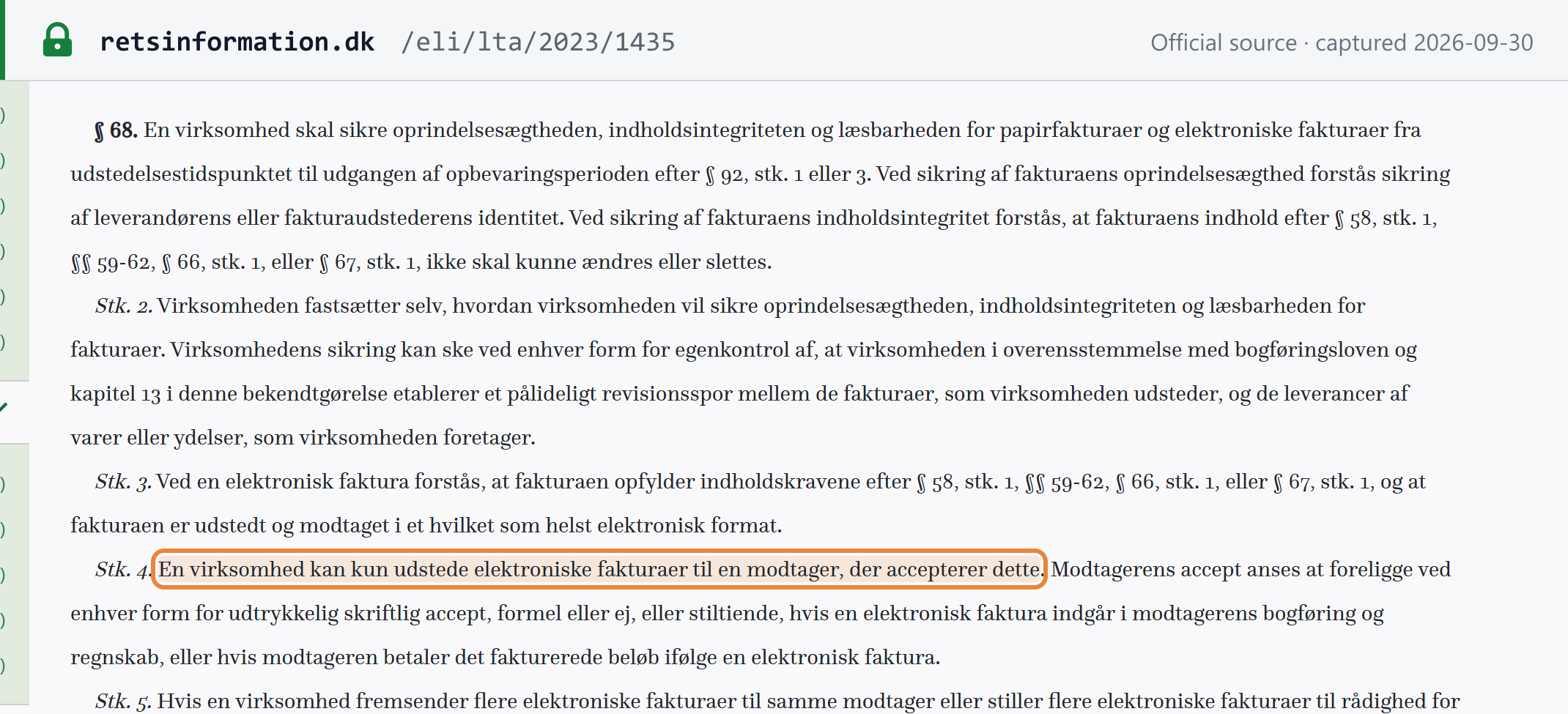
- B2B and B2C: no mandate. The VAT executive order still lets a business issue electronic invoices "kun … til en modtager, der accepterer dette" (only to a recipient that accepts this). ERST's own summary of the new enrolment rule is: "E-fakturering bliver en mulighed" (e-invoicing becomes an option).
The infrastructure is run by ERST, under the Ministry of Industry, Business and Financial Affairs. ERST keeps the receiver register, Nemhandelsregisteret (NHR), and is Denmark's Peppol Authority. Since 1 January 2024 the infrastructure has had two legally equal networks, Nemhandel eDelivery and Peppol eDelivery (lov nr. 1764/2023 and BEK nr. 1811/2023). On 30 September 2026 the Nemhandel home page counted 67,633 receivers in Nemhandelsregisteret and said that 99% of invoices to the public sector arrive as e-invoices. (Nemhandel)
| Denmark | |
|---|---|
| B2G | Mandatory since 2005. Invoices to public authorities must be sent so they are received electronically, quoting the authority's EAN (GLN) number. A web form on virk.dk is the fallback |
| B2B (domestic) | No mandate. Digital bookkeeping systems must be able to send and receive e-invoices; since 29 September 2026 registered systems must enrol customers by default (four-week opt-out). E-invoices still need the recipient's acceptance under VAT law |
| B2C | No mandate |
| Non-residents | Nemhandel needs a Danish CVR number and MitID Erhverv, so foreign businesses use Peppol. The B2G rule applies to every supplier; there is no B2B obligation |
| Formats | OIOUBL 2.1 and Peppol BIS Billing 3.0 with a Danish CIUS. OIOUBL 3 is cancelled; Nemhandel BIS 4 (Peppol BIS 4 with Danish extensions) is planned for 2028–2029 (indicative) |
| Networks | Nemhandel eDelivery and Peppol eDelivery, legally equal ("sidestillede") |
| CTC model | Four-corner interchange; no clearance, no stamping, no tax-authority reporting |
| Authority | Erhvervsstyrelsen (runs Nemhandel and NHR; Peppol Authority). The B2G settlement order is issued by the Ministry of Finance |
| Legislation | BEK 206/2011 and BEK 354/2010 (B2G); lov 1764/2023 and BEK 1811/2023 (networks); lov 700/2022 (Bookkeeping Act); BEK 97/2023 as amended by BEK 811/2026 and BEK 205/2024 (system requirements); BEK 1435/2023 § 68 (VAT) |
Mandate status & timeline
B2G is the only e-invoicing mandate. The digital-bookkeeping phases below oblige businesses to use an e-invoice-capable system; they do not oblige anyone to send B2B invoices electronically. Digital-bookkeeping phases apply from the first financial year starting on or after the date shown, so a business with a non-calendar financial year comes in later.
| Date | What happens | Who | Status | Legal basis |
|---|---|---|---|---|
| 2005 | E-invoicing to public authorities becomes mandatory | Suppliers to the public sector | passed | Nemhandel [1] |
| 1 May 2011 | Public authorities must send and receive OIOUBL invoices | Public authorities | passed | BEK 354/2010 § 1, stk. 3 [4] |
| 1 February 2023 (1 November 2023 for systems already on the market) | Requirements for registered digital standard bookkeeping systems apply | System providers | passed | BEK 97/2023 § 13 [8] |
| 1 January 2024 | Nemhandel and Peppol become the two equal networks of the common digital infrastructure | Public bodies; any business corresponding with them | passed | Lov 1764/2023 § 12; BEK 1811/2023 [5] [6] |
| First financial year starting on or after 1 July 2024 | Digital bookkeeping in a registered standard system | Businesses obliged to file an annual report | passed | BEK 1342/2023 § 1, stk. 1, nr. 1 [9] |
| First financial year starting on or after 1 January 2025 | Digital bookkeeping in a non-registered (own or custom) system meeting BEK 205/2024 | Businesses obliged to file an annual report | passed | BEK 1342/2023 § 1, stk. 1, nr. 2; BEK 205/2024 [9] [11] |
| First financial year after the order's entry into force on 1 January 2026 | Digital bookkeeping | Businesses not obliged to file an annual report, with net turnover above DKK 300,000 in 2 consecutive income years | passed | BEK 297/2025 §§ 1–2 [10] |
| 5 March 2026 | ERST cancels the OIOUBL 3 invoice package and plans the move to Nemhandel BIS 4 | Whole market | passed | ERST document strategy [13] |
| 29 September 2026 | Default enrolment in e-invoicing with a four-week opt-out, and the other new system requirements (BEK 811/2026 published 28 September 2026) | Providers of registered systems and their customers | in force | BEK 811/2026 § 2, stk. 1 [12] |
| 1 March 2027 | Providers must confirm the identity of new and existing CVR-registered customers with MitID at first login; existing customers then go through the opt-out enrolment | Providers of registered systems and their customers | upcoming | BEK 811/2026 § 1, nr. 6 and § 2, stk. 2 [12] |
| 1 January 2028 | MitID confirmation for users who add or change bank details, SE or GLN numbers; locked sender data from CVR on outgoing documents | Providers of registered systems and their users | upcoming | BEK 811/2026 § 1, nr. 7 and § 2, stk. 3; Bilag 3 [12] |
| November 2027 – May 2029 (indicative) | OIOUBL 2.1 to Nemhandel BIS 4 migration: comment period, phase-in, phase-out | Whole market | planned, indicative | ERST document strategy §5 [13] |
| 1 July 2030 | EU requirement for e-invoicing of intra-EU B2B supplies and digital reporting (ViDA) | Member States | EU law; no Danish bill yet | Directive (EU) 2025/516 [17] |
The latest phase: default enrolment under BEK 811/2026
BEK nr. 811 af 22. september 2026 amends the requirements order for digital standard bookkeeping systems (BEK 97/2023). It was published in Lovtidende on 28 September 2026 and entered into force the next day: "Bekendtgørelsen træder i kraft den 29. september 2026." The MitID identity check (§ 1, nr. 6) follows on 1 March 2027, and the MitID check on changes to supplementary data (§ 1, nr. 7) on 1 January 2028. [12]
 Source snapshot captured 2026-09-30 — original
What the order requires of a registered system (new Bilag 2):
- Enrol, withdraw, decline (item 5). New and existing end customers must be able to enrol in, and withdraw from, the common digital infrastructure, and to say they do not want enrolment.
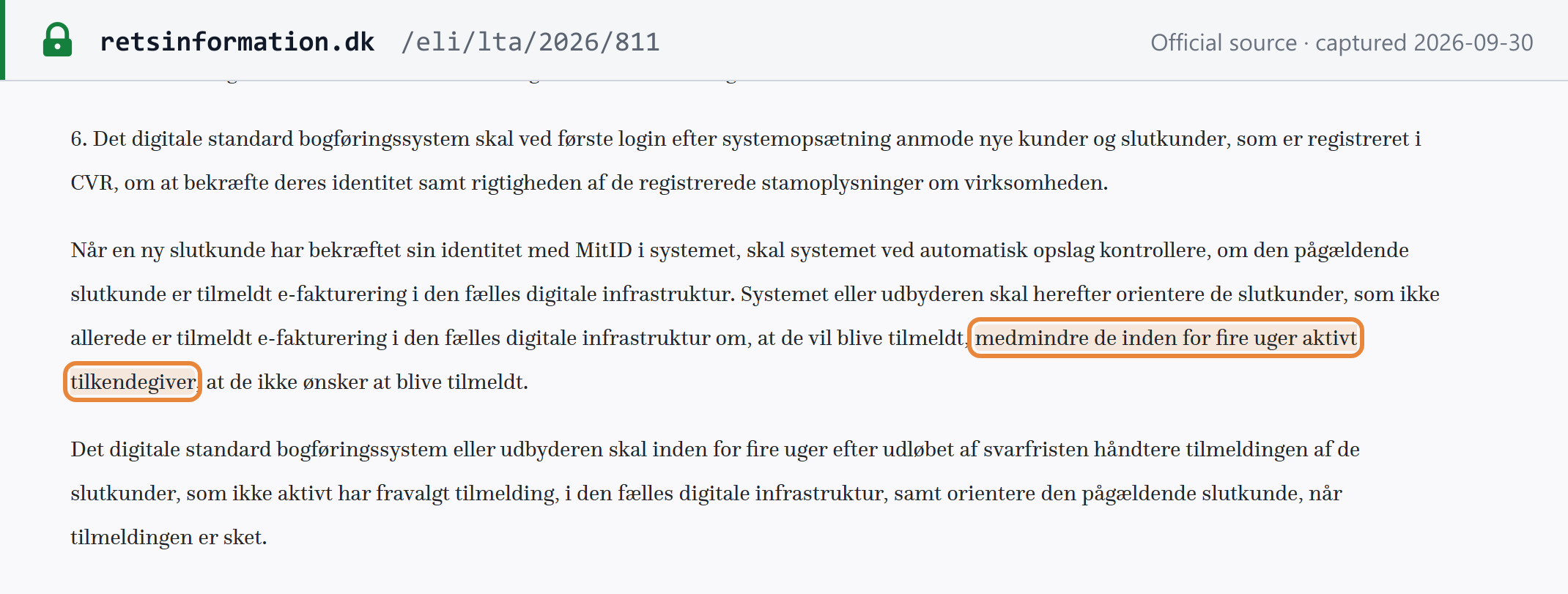
- New customers (item 6). At first login after set-up the customer confirms its identity. If it is not already enrolled, the system or provider must tell it that it "vil blive tilmeldt, medmindre de inden for fire uger aktivt tilkendegiver, at de ikke ønsker at blive tilmeldt" (will be enrolled unless it actively indicates within four weeks that it does not wish to be). Enrolment must follow within four weeks of that deadline, and the customer is told.
- Existing customers (item 7). The same sequence runs at the first login after the MitID identity requirement is implemented, which ties it to 1 March 2027.
- Recipient lookup (item 8). The system looks recipients up automatically in Nemhandelsregisteret. For manual invoicing it must "tydeligt gøre brugeren opmærksom på" (clearly draw the user's attention to) a recipient that can receive the invoice as an e-invoice.
- Storage (item 3). Documents sent and received are stored and cannot be deleted by users.
In practice, new-customer enrolment follows the MitID identity confirmation at first login, a duty that applies from 1 March 2027 (§ 1, nr. 6). [12]
 Source snapshot captured 2026-09-30 — original
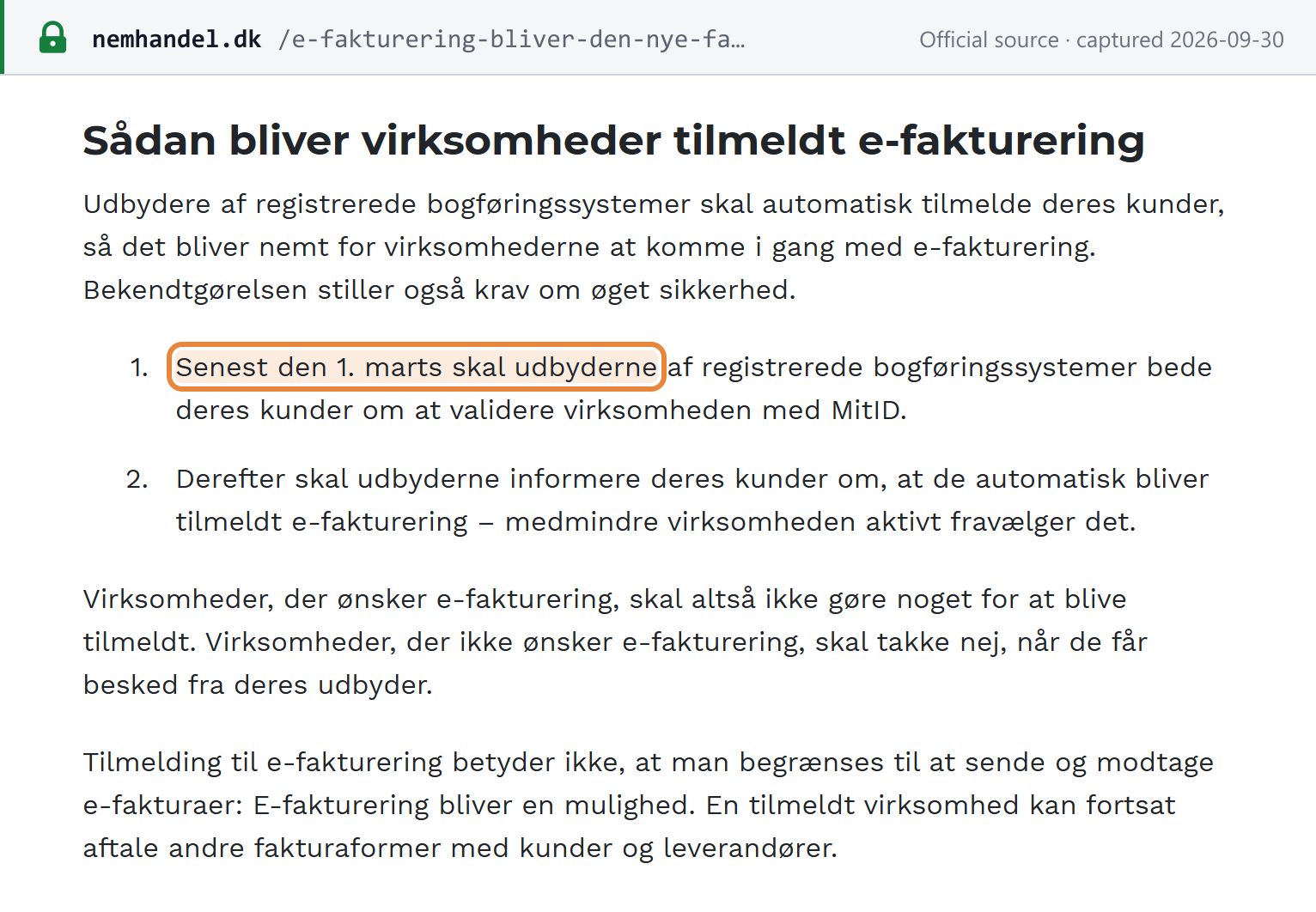
ERST announced the rules on 28 September 2026. It says they apply to registered systems used by about 350,000 businesses; that providers must ask customers to validate the business with MitID by 1 March; and that enrolment "betyder ikke, at man begrænses til at sende og modtage e-fakturaer: E-fakturering bliver en mulighed" (does not restrict you to sending and receiving e-invoices: e-invoicing becomes an option). An enrolled business can still agree other invoice forms with its customers and suppliers, and can ask its provider to enrol it straight away. (Nemhandel news, 28 September 2026)
 Source snapshot captured 2026-09-30 — original
How the dates moved. ERST put the draft out to public hearing (hearing 71305) from 1 July 2026 to 17 August 2026. The hearing record gave a planned entry into force of 1 January 2027. The final order came into force earlier, on 29 September 2026, with the MitID step for existing customers deferred to 1 March 2027. Anyone planning against the hearing dates should use the dates in BEK 811/2026. The hearing draft's wording that e-invoicing be the "first presented option" was replaced in the final text by the duty to clearly alert the user. (Høringsportalen — hearing 71305)
More phases. ERST has not announced a B2B e-invoicing mandate. The Bookkeeping Act lets the minister require covered businesses to record purchases and sales with e-invoices as documentation (§ 18). As at 30 September 2026 no order has been issued under that power. [7]
ViDA: no domestic mandate announced
Council Directive (EU) 2025/516 (ViDA) lets Member States require domestic e-invoicing without the recipient's acceptance, and requires e-invoicing and digital reporting for intra-EU B2B supplies from 1 July 2030. ERST's hearing letter of 1 July 2026 refers to the 2030 cross-border requirement and presents default enrolment as a way to spread e-invoicing "på frivillig basis" (on a voluntary basis) in the meantime. The government's implementation plan on Regelforum says ViDA will be implemented by amending the VAT Act (momsloven) and possibly the VAT executive order. No Danish bill or ministry statement taking up the domestic-mandate option had been published as at 30 September 2026. (ERST hearing letter, 1 July 2026 (PDF); Regelforum — ViDA)
Postponements. None for B2G. The only moved date is the default-enrolment rule, whose planned 1 January 2027 start (hearing stage) became 29 September 2026, with the MitID step for existing customers from 1 March 2027.
Legal basis
B2G (public authorities):
- BEK nr. 206 af 11. marts 2011 om elektronisk afregning med offentlige myndigheder, issued by the Ministry of Finance under the Public Payments Act. It sets the EAN-number and reference rules (§§ 3–4), the duty to send invoices so that they are received electronically (§ 5) and the authority's right to defer payment of a non-compliant invoice (§ 6). It is in force. [2]
- BEK nr. 1832 af 28. december 2023 amends BEK 206/2011 from 1 January 2024. It repeals § 5, stk. 3, § 6, stk. 1 and § 7 (§ 7 was the old OIORASP transport rule), so the payment-deferral rule is now § 6, stk. 1. [3]
- BEK nr. 354 af 26. marts 2010 on OIOUBL invoices to public authorities: authorities must send and receive OIOUBL invoices "fra og med 1. maj 2011" (§ 1, stk. 3). Its transport rule was repealed by BEK nr. 1831/2023 from 1 January 2024. The annex to this order reproduces an old OIOUBL specification; the current one is OIOUBL 2.1, published by ERST. [4] [23]
 Source snapshot captured 2026-09-30 — original
The common digital infrastructure (both networks):
- Lov nr. 1764 af 28. december 2023 om fælles digital infrastruktur for elektronisk dataudveksling ved samhandel og rapportering. ERST runs the infrastructure and Nemhandelsregisteret (§ 3); public bodies must use it for e-documents and e-commerce where it supports the use case (§ 5, stk. 1); fines (§ 11). In force 1 January 2024 (§ 12). [5]
- BEK nr. 1811 af 28. december 2023 on networks for document exchange. The infrastructure consists of Nemhandel and Peppol (§ 3); public bodies must connect to all included networks (§ 6); a business corresponding with a public body chooses the network (§ 7); registration in Nemhandelsregisteret is free (§ 19). Annex 1: "Nemhandel eDelivery og Peppol eDelivery er sidestillede" (are equal). In force 1 January 2024. ERST's news of 2 January 2024 says neither the law nor the order introduced new requirements for authorities or businesses. [6] (Nemhandel — Ny lovgivning om Nemhandel, 2 January 2024)
Digital bookkeeping (e-invoice capability):
- Lov nr. 700 af 24. maj 2022 om bogføring (the Bookkeeping Act). § 15, stk. 1, nr. 3 requires every digital bookkeeping system to support automatic sending and receipt of e-invoices; § 16 says who must use such a system; § 18 is the power, not yet used, to require e-invoices as documentation; § 33 sets fines. [7]
- BEK nr. 97 af 26. januar 2023 (requirements for registered digital standard bookkeeping systems), as amended by BEK nr. 811 af 22. september 2026 (default enrolment, MitID, locked sender data). [8] [12]
- BEK nr. 205 af 29. februar 2024 (requirements for non-registered systems), in force 1 January 2025. [11]
- BEK nr. 1342 af 24. november 2023 and BEK nr. 297 af 20. marts 2025 set when each group of businesses must start digital bookkeeping. [9] [10]
 Source snapshot captured 2026-09-30 — original
VAT (all invoices): the VAT executive order, BEK nr. 1435 af 29. november 2023 (momsbekendtgørelsen), sets invoice content (§ 58), the electronic-invoice and integrity rules (§ 68) and retention (§ 92). [16]
Pending (not law): the Ministry of Finance has drafted a new order on electronic settlement with public authorities that would replace BEK 206/2011. Its entry-into-force date is a placeholder ("[DATO]"), and BEK 206/2011 remains in force. (Draft order, Høringsportalen document store (PDF))
Scope
B2G: every supplier to a public authority
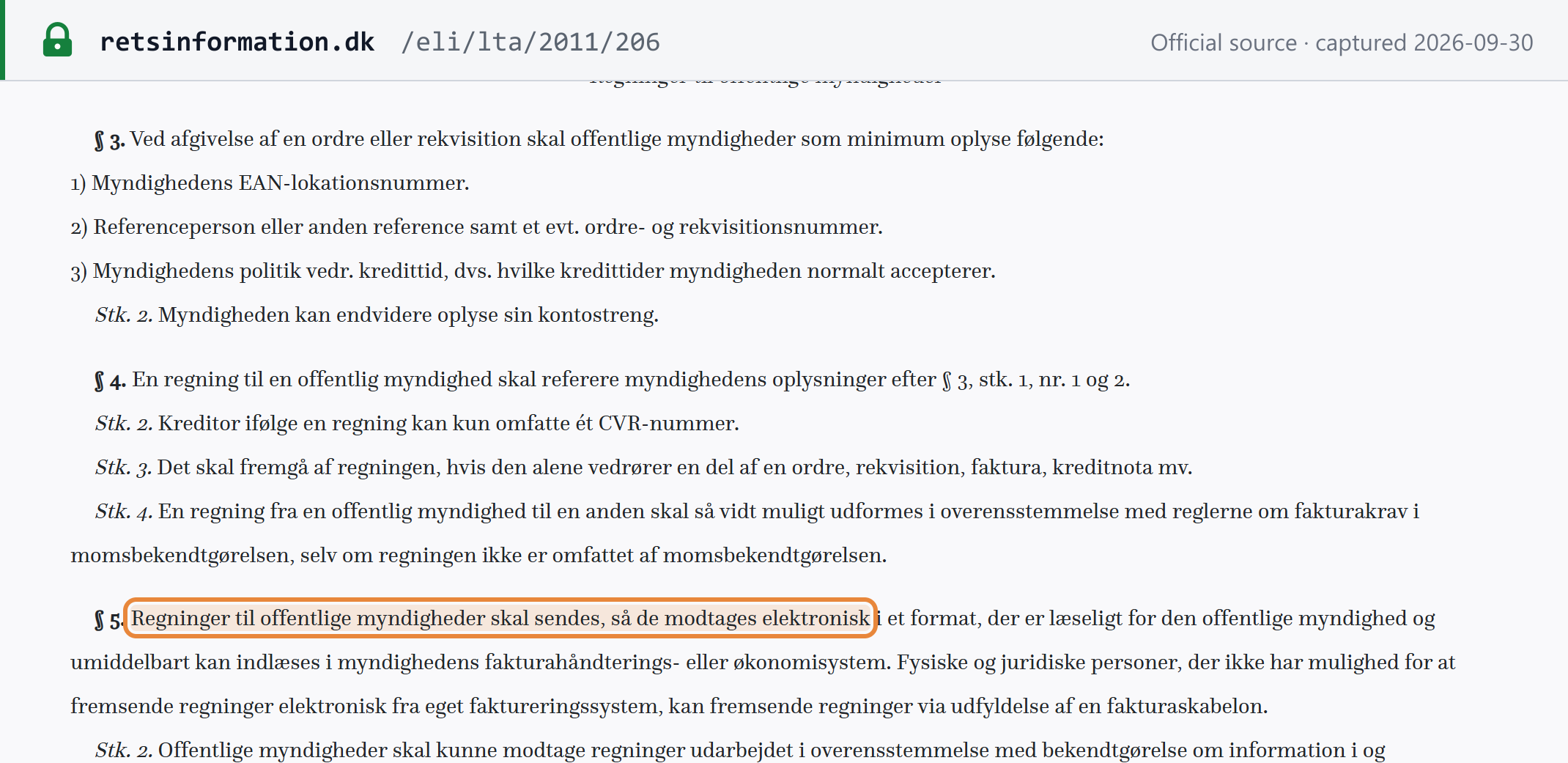
- Electronic receipt. "Regninger til offentlige myndigheder skal sendes, så de modtages elektronisk" in a format the authority can load directly into its invoice-handling or finance system (BEK 206/2011 § 5, stk. 1). ERST's guide (last updated 10 June 2019) puts it plainly: "Du skal altid bruge e-fakturering, når du fakturerer offentlige kunder" (you must always use e-invoicing when you invoice public customers).
- EAN number and reference. When ordering, the authority must give at least its EAN location number and a reference person or reference (§ 3). The invoice must quote both (§ 4). An invoice may name only one creditor CVR number (§ 4).
- No system of your own. A supplier that cannot send e-invoices from its own system may use an invoice template (§ 5). In practice this is the NemHandel Fakturablanket on virk.dk, used with personal MitID or MitID Erhverv, which sends an invoice or credit note to any authority.
- No residence test. § 5 draws no line between Danish and foreign suppliers. [2] [21] [22]
Public e-ordering. Since 1 January 2025, BEK nr. 1164/2024 has required certain public purchases to be made as e-commerce (e-order, e-sales-order or punch-out). The private party chooses whether its orders run over Nemhandel or Peppol. This is an ordering rule, not an invoicing rule. [25]
B2B: no mandate
- Recipient acceptance. Under the VAT executive order an electronic invoice is any invoice that meets the content rules and "er udstedt og modtaget i et hvilket som helst elektronisk format" (is issued and received in any electronic format) (§ 68, stk. 3). "En virksomhed kan kun udstede elektroniske fakturaer til en modtager, der accepterer dette" (§ 68, stk. 4). Acceptance may be express, or tacit when the recipient books or pays the invoice. [16]
- Free choice. ERST's guide (last updated 10 June 2019): "Du kan frit vælge om du vil anvende e-fakturering overfor private virksomheder" (you may freely choose whether to e-invoice private businesses). [21]
- What the Bookkeeping Act does require. A business must keep its books in a digital system that can send and receive e-invoices if it is obliged to file an annual report under the Financial Statements Act, or its net turnover exceeded DKK 300,000 in 2 consecutive income years (§ 16, stk. 1). The system must be registered with ERST or meet § 15 on its own (§ 16, stk. 2). The test is the annual-report duty or turnover, not VAT registration. [7]
- What default enrolment does. Under BEK 811/2026 a customer of a registered system is enrolled in e-invoicing through the common digital infrastructure unless it opts out. That does not oblige it to send or accept only e-invoices; it can still agree other invoice forms with its trading partners. [12]
 Source snapshot captured 2026-09-30 — original
Two meanings of "e-invoice". For VAT, a PDF sent by email is an electronic invoice if the recipient accepts it. The Bookkeeping Act defines an "e-faktura" more narrowly, as an invoice or credit note "udstedt, sendt og modtaget i et struktureret, elektronisk format" (issued, sent and received in a structured electronic format) that can be processed automatically (§ 3). A PDF is not an e-faktura in that sense, and it does not meet the B2G rule, which requires a format the authority can load directly. [7]
Non-established businesses
- Nemhandel: not available without a Danish CVR. ERST's access-point page says Nemhandel "er beregnet til handel inden for Danmarks grænser" (is meant for trade within Denmark's borders) and that participation requires a Danish CVR number and a MitID Erhverv certificate. Businesses trading with foreign companies should use Peppol instead. [18]
- B2G: in scope, over Peppol. Public bodies must be connected to every network in the infrastructure (BEK 1811/2023 § 6), and the supplier chooses the network (§ 7), so a foreign supplier can invoice a Danish authority over Peppol. [6]
- B2B: no obligation. No rule requires a foreign business to e-invoice Danish customers; the acceptance rule in § 68 applies.
- Digital bookkeeping. Whether a foreign business registered for Danish VAT without a Danish establishment falls under the Bookkeeping Act's digital-system duty is not addressed in the Act or its orders. Check with ERST before relying on either answer.
B2C
Not applicable. No Danish instrument requires e-invoices to consumers, and ERST has announced none. The § 68 acceptance rule applies to any electronic invoice.
Excluded transactions and simplified invoices
Not applicable for B2B and B2C, since there is no mandate to exclude transactions from. For B2G, BEK 206/2011 applies to every invoice ("regning") to a public authority and sets no value floor and no transaction exclusions. The VAT executive order's simplified-invoice rules (§ 66) govern invoice content, not the channel. [2] [16]
Format & network
CTC model: four-corner interchange, no clearance
Denmark uses interchange, not clearance or real-time reporting. Invoices travel from the sender's access point to the receiver's access point over Nemhandel eDelivery or Peppol eDelivery. Neither the tax authority nor ERST validates, stamps or stores invoices centrally. ERST's Nemhandelsregisteret (NHR) is the lookup service (SMP); it is free and integrated with the CVR register. [19]
ERST's eDelivery Q&A (April 2023) says Nemhandel eDelivery "follows the Peppol specifications", with Danish additions:
- access points sign with a MitID system certificate;
- the receiving access point validates the schema before the transport acknowledgment and the schematron before forwarding;
- if the mandatory schematron check fails, the receiving access point must return a Message Level Response / Application Response, so senders must also be able to receive those messages. [19]
Integrity mechanics. Denmark uses no QR code, hash or state signature on e-invoices. Documents may be signed with digital certificates, and BEK 1811/2023 Annex 3 says signature validation "er den eneste verifikationsmetode Nemhandel anerkender som bevis på dokumentets originalitet og uforvanskethed" (is the only verification method Nemhandel recognises as proof of a document's originality and integrity). [6]
Formats today: OIOUBL 2.1 and Peppol BIS Billing 3.0
- OIOUBL 2.1, ERST's national UBL customisation. Specification at oioubl21.oioubl.dk; validator at oioubl.nemhandel.dk.
- Peppol BIS Billing 3.0 with a Danish CIUS. ERST releases the Danish CIUS and schematron packages; its release announced on 3 August 2026 (CIUS 1.17.0 and Peppol BIS3-Other 1.2.14) was for implementation on 17 August 2026. [24]
What systems must support.
- Non-registered (own or custom) systems must automatically send and receive e-invoices and credit notes via Nemhandel in OIOUBL (and send an application response) and in Peppol BIS (and send a message level response and an invoice response). They must also be able to generate a SAF-T file defined by ERST (BEK 205/2024 § 5). [11]
- Registered standard systems must send and receive the required documents "i alle de netværk i den fælles digitale infrastruktur som understøtter disse dokumenter" (in all the networks of the common digital infrastructure that support these documents), with response messages for first receipt, delivery after technical validation, commercial acceptance, and technical errors or commercial objections (BEK 97/2023 Bilag 2, as rewritten by BEK 811/2026). [12]
OIOUBL 3 cancelled; Nemhandel BIS 4 planned
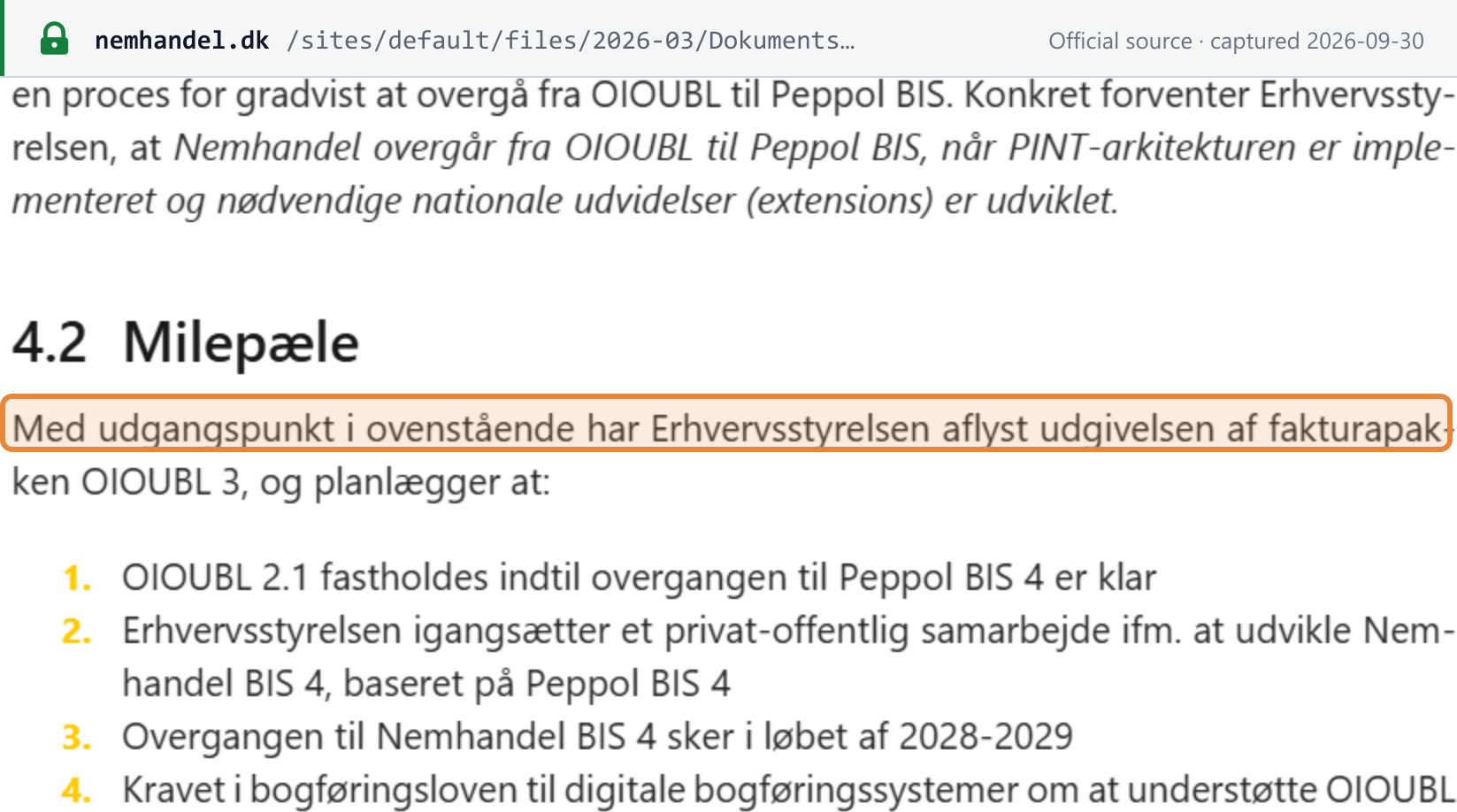
ERST released OIOUBL 3 as a release candidate in November 2024. Its document strategy of 5 March 2026 cancelled the invoice package: "Erhvervsstyrelsen aflyst udgivelsen af fakturapakken OIOUBL 3" (ERST has cancelled the release of the OIOUBL 3 invoice package). The plan is:
- OIOUBL 2.1 stays until the transition to Peppol BIS 4 is ready.
- ERST develops Nemhandel BIS 4, "den europæiske standard Peppol BIS 4 med nationale udvidelser" (the European standard Peppol BIS 4 with national extensions), with the market.
- The transition takes place during 2028–2029.
- The Bookkeeping Act requirement to support OIOUBL is then removed, and OIOUBL is phased out: "OIOUBL udfases ved overgangen til Nemhandel BIS 4" (OIOUBL is phased out at the transition to Nemhandel BIS 4). [13]
 Source snapshot captured 2026-09-30 — original
Indicative calendar (strategy §5). Every date depends on Peppol BIS 4 and on European standardisation work, and can move:
| Period | Step |
|---|---|
| November 2027 – May 2028 | Release-candidate comment period |
| May – November 2028 | Phase-in: Nemhandel BIS 4 voluntary, OIOUBL still required |
| November 2028 – May 2029 | Phase-out: the roles swap, then OIOUBL 2.1 support ends |
ERST expects the move to be "fuldt gennemført medio 2029" (fully completed by mid-2029). After the consultation it kept the move from OIOUBL to Peppol, "startende med fakturaen" (starting with the invoice), and now foresees an 18-month migration period in total, to be split with the industry. [14] [15]
Some older Nemhandel documentation pages still link an "OIOUBL 3 Release Candidate". They predate the cancellation.
Peppol and addressing
Denmark is Peppol-based: Peppol eDelivery is one of the two legal networks, and ERST is the Peppol Authority (BEK 1811/2023 Annex 2). Receivers in NHR are addressed by GLN/EAN, DK:CVR, DK:SE or P-number; a receiver without a CVR number needs a GLN. Public authorities' EAN numbers are registered in the same register (BEK 206/2011 § 11). To check a Danish business's CVR number, see how to verify a CVR number. [20] [6]
For the FIK payment code that many Danish invoices carry, see the FIK number explainer.
E-reporting
Not applicable. Denmark has no transaction reporting alongside e-invoicing. The nearest obligation is that bookkeeping systems must be able to export a SAF-T file defined by ERST; see the SAF-T explainer. [11]
Archiving
- 5 years from the end of the financial year the material relates to (Bookkeeping Act § 12; VAT executive order § 92, stk. 1), including for businesses below the VAT registration threshold.
- 10 years for material on the acquisition of, or building work on, real property used in a registered business (§ 92, stk. 3).
- Authenticity of origin, integrity of content and legibility must be ensured from issue to the end of the retention period, for paper and electronic invoices alike (§ 68, stk. 1).
- Registered systems must keep transactions and vouchers for 5 years in a structured, machine-readable format, and sent and received e-invoice documents cannot be deleted by users (BEK 811/2026 Bilag 1 and 2). Non-registered systems need a weekly full backup held by an unrelated party on a server in the EU or EEA (BEK 205/2024 § 4). [7] [16] [12] [11]
Onboarding: how to comply
Choosing a route
- Through your bookkeeping system. Most Danish businesses send and receive e-invoices through their registered bookkeeping system, whose provider connects to an access point. Under BEK 811/2026 the provider handles enrolment in the common digital infrastructure for you, unless you opt out.
- Through an access point or service provider. Businesses with their own ERP connect through a Nemhandel or Peppol access point. A provider registering you in Nemhandelsregisteret must be able to prove your consent (BEK 1811/2023 § 19).
- Without a system (B2G only). The NemHandel Fakturablanket on virk.dk sends an invoice or credit note to any public authority, logged in with MitID or MitID Erhverv. [12] [6] [22]
Registering as a receiver
Registration in Nemhandelsregisteret is free for every service recipient (BEK 1811/2023 § 19). ERST's NHR guide describes choosing the receiver's identifier type (GLN/EAN, DK:CVR, DK:SE or P-number) and entering the identifier; Danish businesses log in with MitID Erhverv. Foreign businesses without a CVR number use Peppol and are registered through their Peppol access point. [20] [18]
Accreditation of providers
- Nemhandel access points. ERST approves and sets up access points on documented compliance with a recognised information-security standard (for example ISO 27001) and the Peppol access-point specifications. "Der er ikke krav om en formel certificering" (there is no requirement for formal certification). [18]
- Peppol access points join the Peppol network under its own rules; ERST is Denmark's Peppol Authority (BEK 1811/2023 Annex 2). [6]
- Bookkeeping systems. Standard systems are registered with ERST (Bookkeeping Act § 20); registration is not a certification of e-invoicing as such. A business may instead use a non-registered system that meets § 15 and BEK 205/2024 itself. [7]
Testing
- Validate OIOUBL files with ERST's OIOUBL validator.
- ERST publishes a guide to the Nemhandel demo and test environment in its guides index.
- ERST's code, API and schematron repository is at git.erst.dk/openebusiness/common, which BEK 811/2026 Bilag 2 names.
Checklist for a business
- Confirm whether you must keep digital books (annual-report duty, or net turnover above DKK 300,000 in 2 consecutive income years) and which phase applies to your financial year.
- If you use a registered system, expect your provider to ask you to confirm your identity with MitID and to tell you about enrolment. Decide within the four weeks whether to opt out.
- If you supply public authorities, collect the EAN number and reference with each order and send OIOUBL or Peppol BIS invoices, or use the virk.dk form.
- Keep supporting both OIOUBL 2.1 and Peppol BIS 3.0 for now, and plan for Nemhandel BIS 4 in 2028–2029.
Penalties
No fixed amounts. None of the e-invoicing or bookkeeping instruments sets a fine amount.
- Bookkeeping Act § 33. A fine for breaching the bookkeeping and retention rules (§§ 7–9 and 12–14), the digital-system duty (§ 16, stk. 1–2, and § 17), § 19 and § 20, stk. 2 (§ 33, stk. 1, nr. 3), and failure to comply with orders issued under § 26 (nr. 4). Fines take account of "virksomhedens omsætning, overtrædelsens grovhed og varighed, og om der er tale om gentagne overtrædelser" (the business's turnover, the gravity and duration of the breach, and whether it is repeated). Particularly extensive breaches draw an aggravated fine ("skærpet bøde"). Legal persons can be liable, and the limitation period is 5 years. [7]
- BEK 205/2024 § 6. Breach of §§ 3–5, including the e-invoice capability rule for non-registered systems, is punishable by a fine. [11]
- BEK 97/2023 § 12. Providers of registered systems that breach §§ 5–11 can be fined. [8]
- Lov 1764/2023 § 11. Fines for intentional or grossly negligent breaches by public bodies, service providers and those with an information duty. [5]
- B2G invoices. A public authority "kan udskyde betalingen af en regning, der ikke opfylder kravene i §§ 4 og 5" (may defer payment of an invoice that does not meet §§ 4 and 5) and must tell the supplier. [2]
There is no penalty for not sending B2B e-invoices, because there is no duty to send them.
Frequently asked questions
Is e-invoicing mandatory for B2B in Denmark from 2026?
No. The Bookkeeping Act requires businesses in scope to use a digital bookkeeping system that can send and receive e-invoices, and since 29 September 2026 BEK 811/2026 requires registered systems to enrol their customers in e-invoicing unless they opt out within four weeks. Neither rule obliges a business to send its B2B invoices electronically. VAT law still lets a business issue electronic invoices only to a recipient that accepts them (momsbekendtgørelsen § 68, stk. 4), and ERST says e-invoicing "becomes an option". The only mandate is for invoices to public authorities, in place since 2005. (BEK 811/2026; BEK 1435/2023 § 68; Nemhandel, 28 September 2026)
My bookkeeping provider says I will be enrolled in e-invoicing. What happens, and can I refuse?
Yes, you can refuse. Under BEK 811/2026 your provider asks you to confirm your identity with MitID at login; for existing customers this applies from 1 March 2027. If you are not already enrolled, you are told you will be enrolled unless you actively decline within four weeks, and enrolment then happens within four weeks after that deadline. You can withdraw later. Being enrolled does not stop you agreeing PDF or paper invoices with your customers and suppliers. (BEK 811/2026, Bilag 2, items 5–7; Nemhandel, 28 September 2026)
We are a foreign company. Can we use Nemhandel, and must we e-invoice Danish customers?
Nemhandel requires a Danish CVR number and a MitID Erhverv certificate, so ERST tells businesses trading across the border to use Peppol. Danish public authorities must be connected to both networks and the supplier chooses which to use, so you can invoice them over Peppol, and the B2G e-invoicing rule applies to you as to any supplier. There is no obligation to e-invoice Danish private-sector customers. (Nemhandel, access points; BEK 1811/2023 §§ 6–7; BEK 206/2011 § 5)
What is an EAN number, and where do we get the authority's?
It is the public authority's EAN (GLN) location number, which routes the e-invoice to the right unit. When ordering, the authority must give you at least its EAN number and a reference person or reference, and your invoice must quote both. Authorities' EAN numbers are also registered in Nemhandelsregisteret. An invoice to an authority may name only one creditor CVR number. (BEK 206/2011 §§ 3, 4 and 11)
OIOUBL or Peppol BIS: which should we build? What about OIOUBL 3.0?
Both OIOUBL 2.1 and Peppol BIS Billing 3.0 (with the Danish CIUS) are valid today, and bookkeeping systems must support both networks. OIOUBL 3 will not be released: ERST cancelled it in its document strategy of 5 March 2026. The plan is to move to Nemhandel BIS 4, which is Peppol BIS 4 with Danish extensions, during 2028–2029, and then phase OIOUBL out. That calendar is indicative. (BEK 205/2024 § 5; BEK 811/2026; ERST document strategy, 5 March 2026)
Does a PDF invoice sent by email count as an e-invoice?
For VAT, yes, if the recipient accepts it: an electronic invoice is one issued and received in any electronic format (momsbekendtgørelsen § 68, stk. 3). For the Bookkeeping Act, no: an e-faktura must be issued, sent and received in a structured electronic format that can be processed automatically (§ 3). A PDF also does not meet the B2G rule, which requires a format the authority can load directly into its system. (BEK 1435/2023 § 68; lov 700/2022 § 3; BEK 206/2011 § 5)
How long must e-invoices be kept?
Five years from the end of the financial year the material relates to, and ten years for material on the acquisition of, or building work on, real property used in a registered business. The invoice's authenticity, integrity and legibility must be ensured for the whole period. (Bookkeeping Act § 12; BEK 1435/2023 §§ 68 and 92)
What is the fine for breaking the e-invoicing or digital-bookkeeping rules?
No instrument sets a fixed amount. The Bookkeeping Act provides for fines that take account of the business's turnover, the gravity and duration of the breach and any repetition, with aggravated fines for particularly extensive breaches and a five-year limitation period. For B2G invoices, a public authority may defer payment of an invoice that does not meet the rules. There is no penalty for not sending B2B e-invoices, because there is no duty to send them. (Bookkeeping Act § 33; BEK 205/2024 § 6; BEK 206/2011 § 6)
Will Denmark make domestic e-invoicing mandatory under ViDA?
Nothing has been announced. ViDA requires e-invoicing for intra-EU B2B supplies from 1 July 2030 and lets Member States mandate domestic e-invoicing. ERST's hearing letter of 1 July 2026 presents default enrolment as a way to spread e-invoicing on a voluntary basis until then, and the government's plan is to implement ViDA through the VAT Act. As at 30 September 2026 no Danish bill taking up the domestic option had been published. (ERST hearing letter, 1 July 2026; Regelforum; Directive (EU) 2025/516)
Recent changes
- 2026-09-29 — BEK nr. 811/2026 entered into force (published 28 September 2026): registered bookkeeping systems must enrol customers in e-invoicing unless they opt out within four weeks; MitID identity checks from 1 March 2027 and locked CVR sender data from 1 January 2028. E-invoicing stays voluntary under VAT law. (Retsinformation)
- 2026-07-01 — ERST opened the public hearing on the default-enrolment draft (closed 17 August 2026); the planned 1 January 2027 start was replaced by the dates in BEK 811/2026. (Høringsportalen) — see event
- 2026-05-27 — After consultation, ERST confirmed the move from OIOUBL to Peppol, starting with the invoice, over an 18-month migration. (Nemhandel)
- 2026-03-05 — ERST's document strategy cancelled the OIOUBL 3 invoice package and planned the move to Nemhandel BIS 4 in 2028–2029 (indicative). (Nemhandel (PDF))
- 2026-01-01 — BEK nr. 297/2025 entered into force: businesses without an annual-report duty and with net turnover above DKK 300,000 in 2 consecutive income years move to digital bookkeeping from their next financial year. (Retsinformation)
- 2024-01-01 — Lov nr. 1764/2023 and BEK nr. 1811/2023 made Nemhandel and Peppol the two equal networks of the common digital infrastructure. (Retsinformation)
For the full chronology, see Denmark tax changes on Lookuptax.
Related resources
- Denmark VAT guide — rates, registration, invoice requirements, filing and penalties
- Denmark tax identification numbers — CVR and SE numbers, which double as Nemhandel receiver IDs
- How to verify a Danish CVR number
- Validate a Danish CVR number
- FIK number explainer — the Danish payment reference on invoices
- Denmark tax-change chronology — every tracked Danish change, dated and sourced
- E-invoicing status and networks worldwide — Denmark's row in global context
- Peppol network explainer
- ViDA — VAT in the Digital Age — the 2030 cross-border e-invoicing requirement
- SAF-T explainer — context for the standard-file export bookkeeping systems must support
Important websites
- Nemhandel — ERST's e-invoicing site: news, releases (CIUS and schematron), guides, support
- Nemhandelsregisteret guide — registering as a receiver
- NemHandel Fakturablanket on virk.dk — web form to invoice a public authority without a system
- OIOUBL 2.1 specification and OIOUBL validator
- ERST code and schematron repository
- BEK nr. 811/2026 on Retsinformation — the default-enrolment order
- Peppol — access-point list and specifications
Reference links
- [1] Nemhandel — Hvad er Nemhandel
- [2] Retsinformation — BEK nr. 206 af 11/03/2011 om elektronisk afregning med offentlige myndigheder
- [3] Retsinformation — BEK nr. 1832 af 28/12/2023 (amending BEK 206/2011)
- [4] Retsinformation — BEK nr. 354 af 26/03/2010 om OIOUBL elektronisk regning
- [5] Retsinformation — Lov nr. 1764 af 28/12/2023 om fælles digital infrastruktur
- [6] Retsinformation — BEK nr. 1811 af 28/12/2023 om netværk til dokumentudveksling
- [7] Retsinformation — Lov nr. 700 af 24/05/2022 om bogføring
- [8] Retsinformation — BEK nr. 97 af 26/01/2023 om krav til digitale standard bogføringssystemer
- [9] Retsinformation — BEK nr. 1342 af 24/11/2023 (digital bookkeeping in-force dates)
- [10] Retsinformation — BEK nr. 297 af 20/03/2025 (digital bookkeeping, 2026 phase)
- [11] Retsinformation — BEK nr. 205 af 29/02/2024 om krav til ikke-registrerede digitale bogføringssystemer
- [12] Retsinformation — BEK nr. 811 af 22/09/2026 (default enrolment)
- [13] ERST — Dokumentstrategi, 5 March 2026 (PDF)
- [14] ERST — Høringsnotat om dokumentstrategi, 18 May 2026 (PDF)
- [15] Nemhandel — Afsluttet høring om overgangen til Peppol, 27 May 2026
- [16] Retsinformation — BEK nr. 1435 af 29/11/2023 (momsbekendtgørelsen)
- [17] EUR-Lex — Council Directive (EU) 2025/516 (ViDA)
- [18] Nemhandel — Adgangspunkter i Nemhandel
- [19] Nemhandel — Q&A regarding the transition to Nemhandel eDelivery
- [20] Nemhandel — Vejledning til Nemhandelsregisteret (NHR)
- [21] Nemhandel — Guide til e-fakturering
- [22] Virk.dk — NemHandel Fakturablanket
- [23] Retsinformation — BEK nr. 1831 af 28/12/2023 (amending BEK 354/2010)
- [24] Nemhandel — Opdateringer og releases
- [25] Nemhandel — Definition af e-handel