E-invoicing in Peru: SUNAT's SEE, OSE validation and the CDR
Overview
Peru's e-invoicing system is SUNAT's Sistema de Emisión Electrónica (SEE), the Electronic Issuance System. Invoices, sales receipts and linked notes issued through it are comprobantes de pago electrónicos (CPE). SUNAT is the Superintendencia Nacional de Aduanas y de Administración Tributaria, the tax and customs authority. It runs the system and a dedicated micro-site, cpe.sunat.gob.pe, with sections for CPE, SEE, the electronic waybill (GRE), the SIRE e-ledgers, norms and FAQs.
The SEE is an umbrella over several issuing channels. SUNAT describes it as "compuesto, entre otros, por el SEE-SOL, el SEE-Del contribuyente, el SEE-Facturador SUNAT (SFS) y el SEE-Operador de Servicios Electrónicos (OSE)" (made up of, among others, SEE-SOL, SEE-Del Contribuyente, the SUNAT Facturador and the Electronic Services Operator channel). (RS 000075-2026/SUNAT, recitals, checked 2026-09-24) The channels are compared under Onboarding.
Legal basis in one line. The Ley Marco de Comprobantes de Pago (Decreto Ley N.° 25632) lets SUNAT decide who must issue electronically. Every obligation on this page is a Resolución de Superintendencia (RS) issued under that power, so there is no single "e-invoicing law". The full instrument list is under Legal basis.
Model: clearance-style validation. The issuer signs a UBL 2.1 XML and sends it to SUNAT or to a private, SUNAT-accredited OSE. SUNAT or the OSE checks it and returns a CDR (Constancia de Recepción, the receipt). A rejected document has no tax validity. Peru does not require the document to clear before the customer gets it; instead there is a short post-issue submission window of 3 calendar days for facturas. See Format & network.
| Peru | |
|---|---|
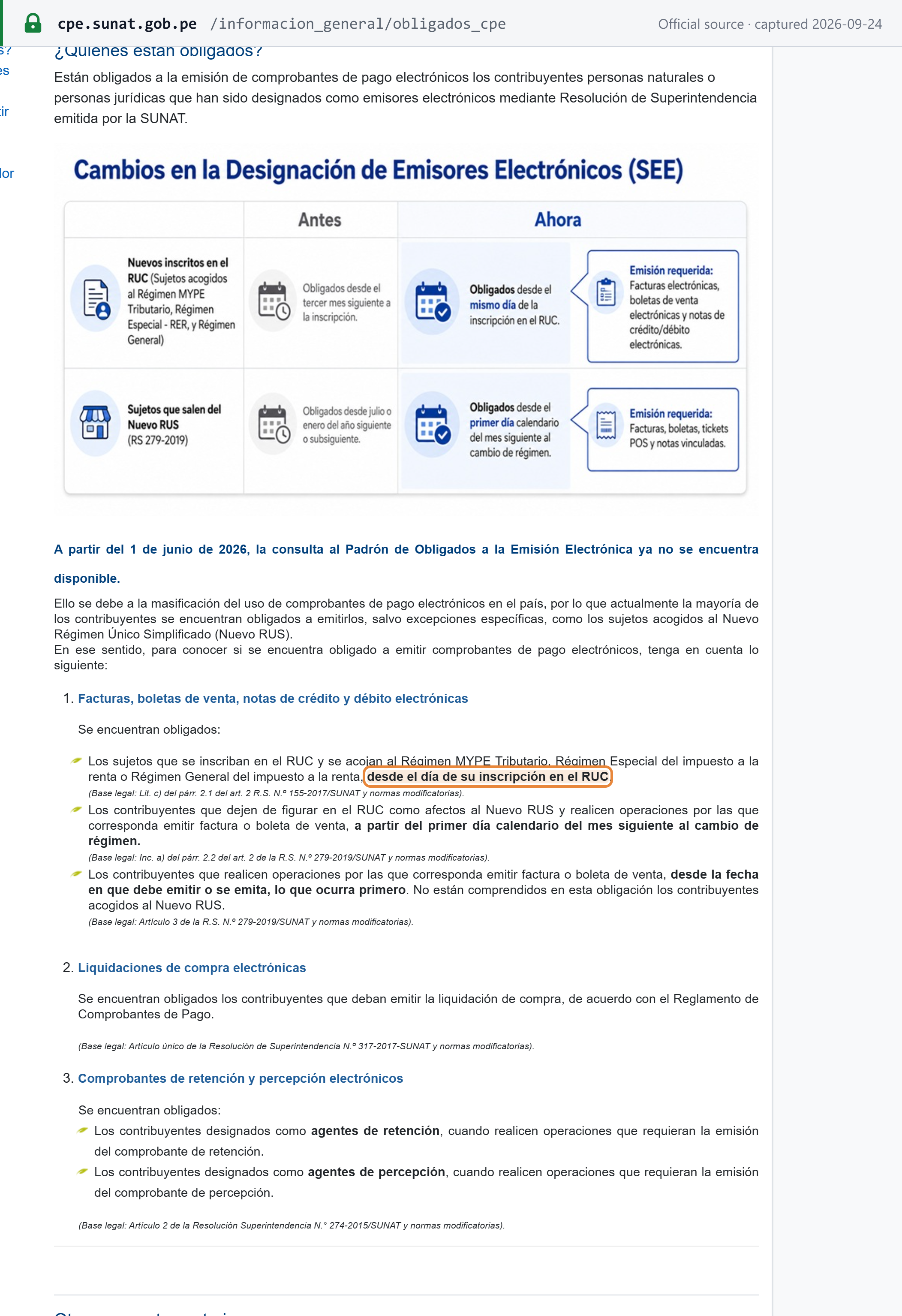
| Status | Live national mandate. Since 2022 (last income bands 1 April / 1 June 2022) every taxpayer that must issue a factura or boleta is a designated e-issuer; new RUC registrants from the day of registration since 1 June 2026; the Nuevo RUS is excluded (RS 279-2019/SUNAT art. 3.1 and 3.2(c)) |
| B2B | Mandatory: electronic factura to buyers with a RUC |
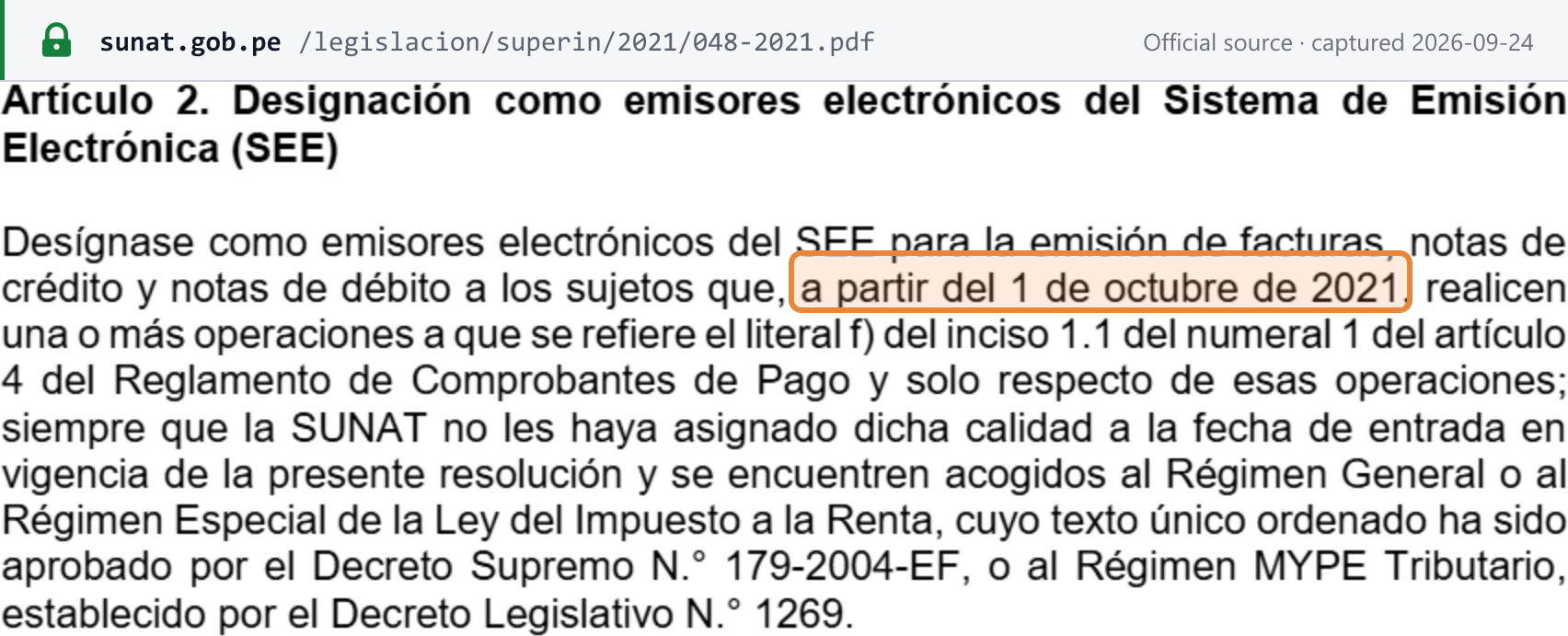
| B2G | Mandatory, same SEE/CPE flow (explicit designation for State suppliers from 1 October 2021) |
| B2C | Mandatory: electronic boleta de venta or ticket POS to final consumers |
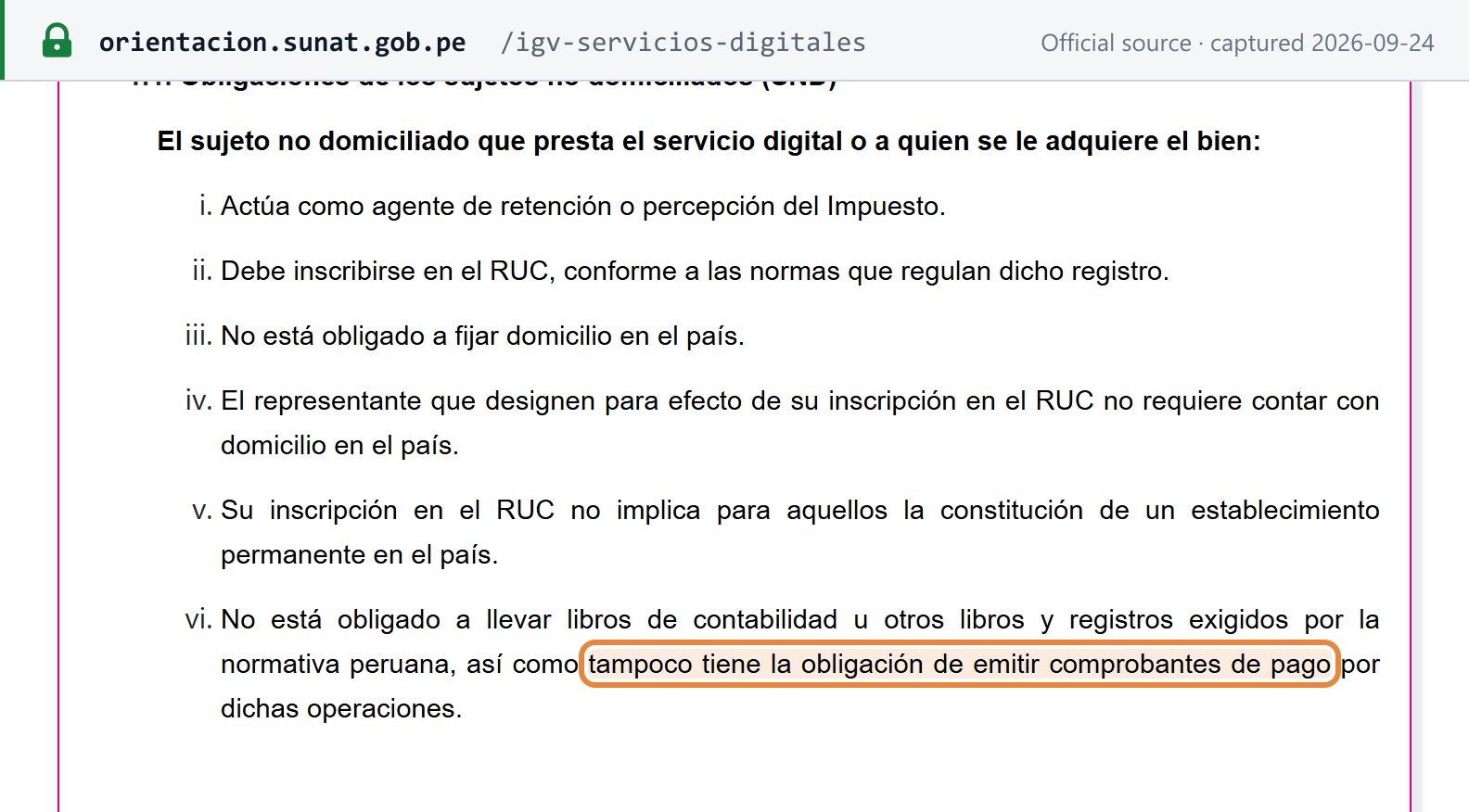
| Non-residents | A non-domiciled provider of digital services to individuals in Peru who are not carrying on a business (DL 1623) must register in the RUC and collect IGV, but has no obligation to issue comprobantes de pago for those operations |
| New businesses | E-issuers from the day of RUC registration (since 1 June 2026) |
| Format | XML, OASIS UBL 2.1 (only version allowed since 1 January 2018); SUNAT validation rules and catalogues |
| Network | SUNAT SEE (national). Direct to SUNAT, or via an accredited OSE. Not Peppol-based |
| Integrity | XML digital signature; QR code on the printed representation |
| Authority | SUNAT · cpe.sunat.gob.pe |
| Next change | RS 000048-2026 (airport-services DAE, joint-venture DOAE, gas GRP collectors): in force 1 January 2027, new designations 1 April 2027, after RS 000143-2026 postponed it |
| Legislation | Decreto Ley 25632; RS 300-2014/SUNAT (SEE); RS 279-2019/SUNAT (universal designation); RS 000075-2026/SUNAT (new registrants) |
SUNAT's own summary is that e-issuance is now the norm. From 1 June 2026 it withdrew the old "Padrón de Obligados" lookup because "actualmente la mayoría de los contribuyentes se encuentran obligados a emitirlos, salvo excepciones específicas, como los sujetos acogidos al Nuevo Régimen Único Simplificado (Nuevo RUS)." (most taxpayers are currently required to issue them, except for specific exceptions such as those in the Nuevo RUS.) (SUNAT — ¿Quiénes están obligados?, page last modified 1 June 2026, checked 2026-09-24)
 Source snapshot captured 2026-09-24 — original
Mandate status & timeline
Peru designated e-issuers in waves for eight years, then covered everyone. RS 097-2012/SUNAT created the SEE-Del Contribuyente channel in 2012 but did not create a general obligation, so "mandatory since 2012" is wrong.
| Phase | Who | Mandatory from | Legal basis | Status |
|---|---|---|---|---|
| First designation | Taxpayers listed in the annex (large taxpayers) | 1 October 2014 | RS 374-2013/SUNAT [1] | Passed |
| 2018 waves | IGV withholding/perception agents at 30 June 2017, principales contribuyentes, annex I (1 January 2018); annexes II, III, IV (1 May, 1 August, 1 November 2018). Also automatic triggers: exports ≥ 75 UIT or income ≥ 150 UIT in a year → designated from 1 November of the next year | 1 January – 1 November 2018 | RS 155-2017/SUNAT [2] | Passed |
| Exporters | Goods exporters (from their first export); services exporters | 1 July 2018 (goods); 1 January 2018 (services) | RS 20-2018/SUNAT; RS 312-2017/SUNAT [3] | Passed |
| Income band ≥ 75 UIT (2019 income) | Facturas, notes, boletas | 1 January 2021 | RS 279-2019/SUNAT as amended by RS 000128-2021 [4] | Passed |
| B2G | Anyone issuing facturas to public-sector entities, for those operations only (Régimen General, Especial or MYPE Tributario) | 1 October 2021 | RS 000048-2021/SUNAT [5] | Passed |
| Income band ≥ 23 and below 75 UIT | Facturas and notes / boletas and ticket POS | 1 January 2022 / 1 April 2022 | RS 279-2019 as amended by RS 000128-2021 [4] | Passed |
| Income band below 23 UIT | Facturas and notes / boletas and ticket POS | 1 April 2022 / 1 June 2022 | RS 279-2019 as amended by RS 000128-2021 [4] | Passed |
| Universal | Everyone not yet covered who, from 1 January 2022, carries out operations requiring a factura or boleta (Nuevo RUS excluded) | 1 January 2022 | RS 279-2019/SUNAT, art. 3.1 [6] | In force |
| New RUC registrants | New registrants in the Régimen MYPE Tributario, Régimen Especial or Régimen General: from the day of RUC registration. Taxpayers leaving the Nuevo RUS: from the first day of the following month | 1 June 2026 | RS 000075-2026/SUNAT [7] | In force |
| DAE-SEAE, DOAE, GRP collectors | Airport-services authorised document, joint-venture attribution document and natural-gas Garantía de Red Principal collectors move into the SEE | Resolution in force 1 January 2027; designations 1 April 2027 (both postponed) | RS 000048-2026/SUNAT as amended by RS 000143-2026/SUNAT [8] | Enacted, not yet in force |
The universal rule reads: "Desígnase como emisores electrónicos a los sujetos no comprendidos en los artículos 1 y 2 que a partir del 1 de enero del 2022 realicen operaciones por las que corresponda emitir factura o boleta de venta, en cuyo caso deben emitir factura electrónica, boleta de venta electrónica o ticket POS y las notas electrónicas vinculadas a estos." (Those not covered by articles 1 and 2 who, from 1 January 2022, carry out operations requiring a factura or boleta are designated e-issuers and must issue an electronic factura, electronic boleta or ticket POS and the linked electronic notes.) (RS 279-2019/SUNAT, art. 3.1, checked 2026-09-24)
 Source snapshot captured 2026-09-24 — original
Current rule for new businesses: e-issuer from the day of RUC registration
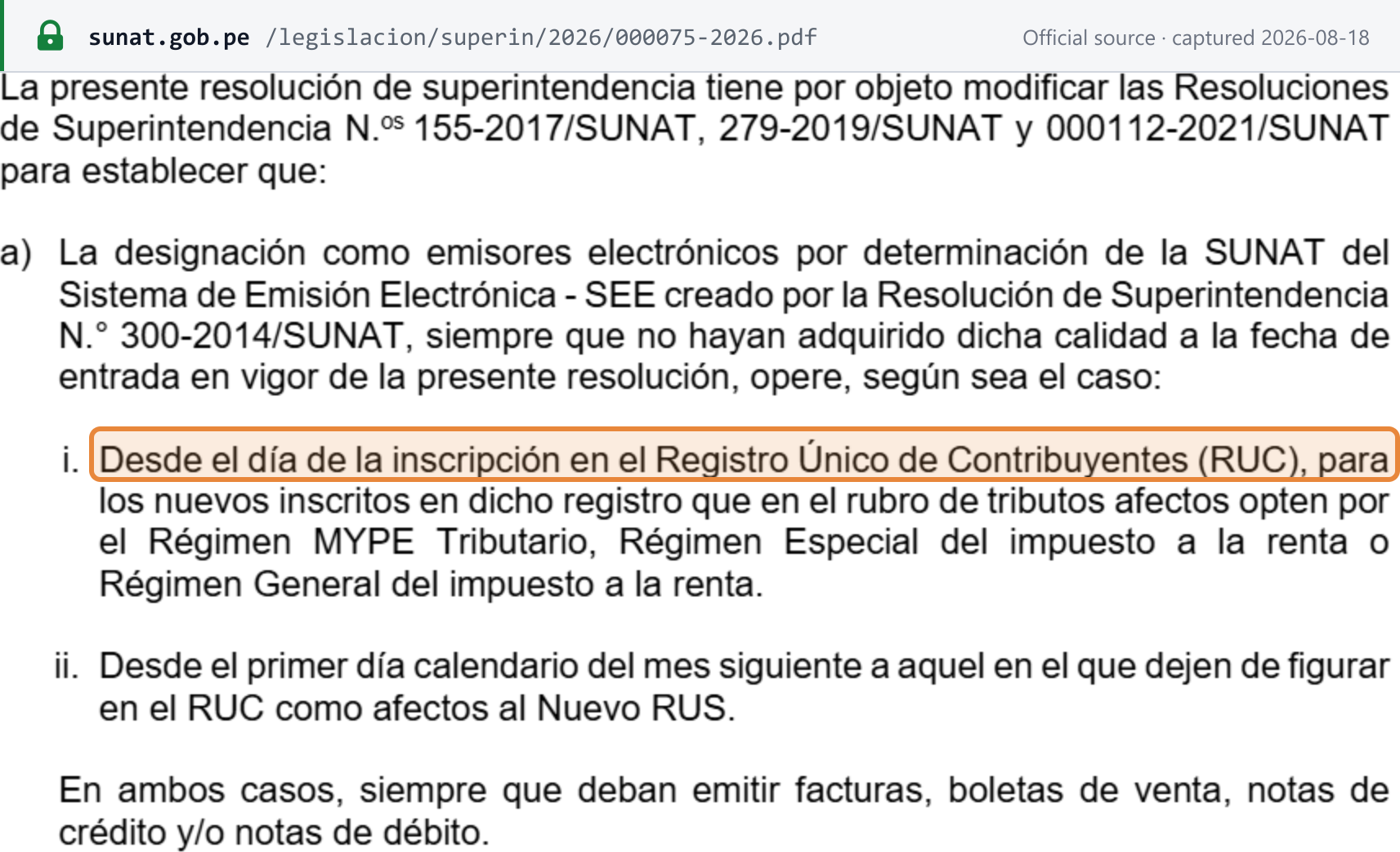
RS 000075-2026/SUNAT, dated 29 April 2026 and in force 1 June 2026, replaced the old new-registrant rule. Under RS 155-2017, a new registrant became an e-issuer from the first day of the third month after registering. Now the designation applies "Desde el día de la inscripción en el Registro Único de Contribuyentes (RUC), para los nuevos inscritos en dicho registro que en el rubro de tributos afectos opten por el Régimen MYPE Tributario, Régimen Especial del impuesto a la renta o Régimen General del impuesto a la renta." (From the day of RUC registration, for new registrants who opt for the MYPE Tributario, Special or General income-tax regime.) (RS 000075-2026/SUNAT, checked 2026-09-24)
- Taxpayers leaving the Nuevo RUS become e-issuers "Desde el primer día calendario del mes siguiente a aquel en el que dejen de figurar en el RUC como afectos al Nuevo RUS." (From the first calendar day of the month after they stop being registered in the Nuevo RUS.)
- Transitional rule: new registrants (RS 155-2017 art. 2.1(c)) and taxpayers leaving the Nuevo RUS (RS 279-2019 art. 2.1) whose designation had not taken effect by 31 May 2026 became e-issuers on 1 June 2026.
- The same resolution requires these taxpayers to keep their sales and purchase registers in SIRE from the moment they must keep them. See E-reporting.
 Source snapshot captured 2026-08-18 — original
Postponed: RS 000048-2026 now starts on 1 January 2027, not 1 August 2026
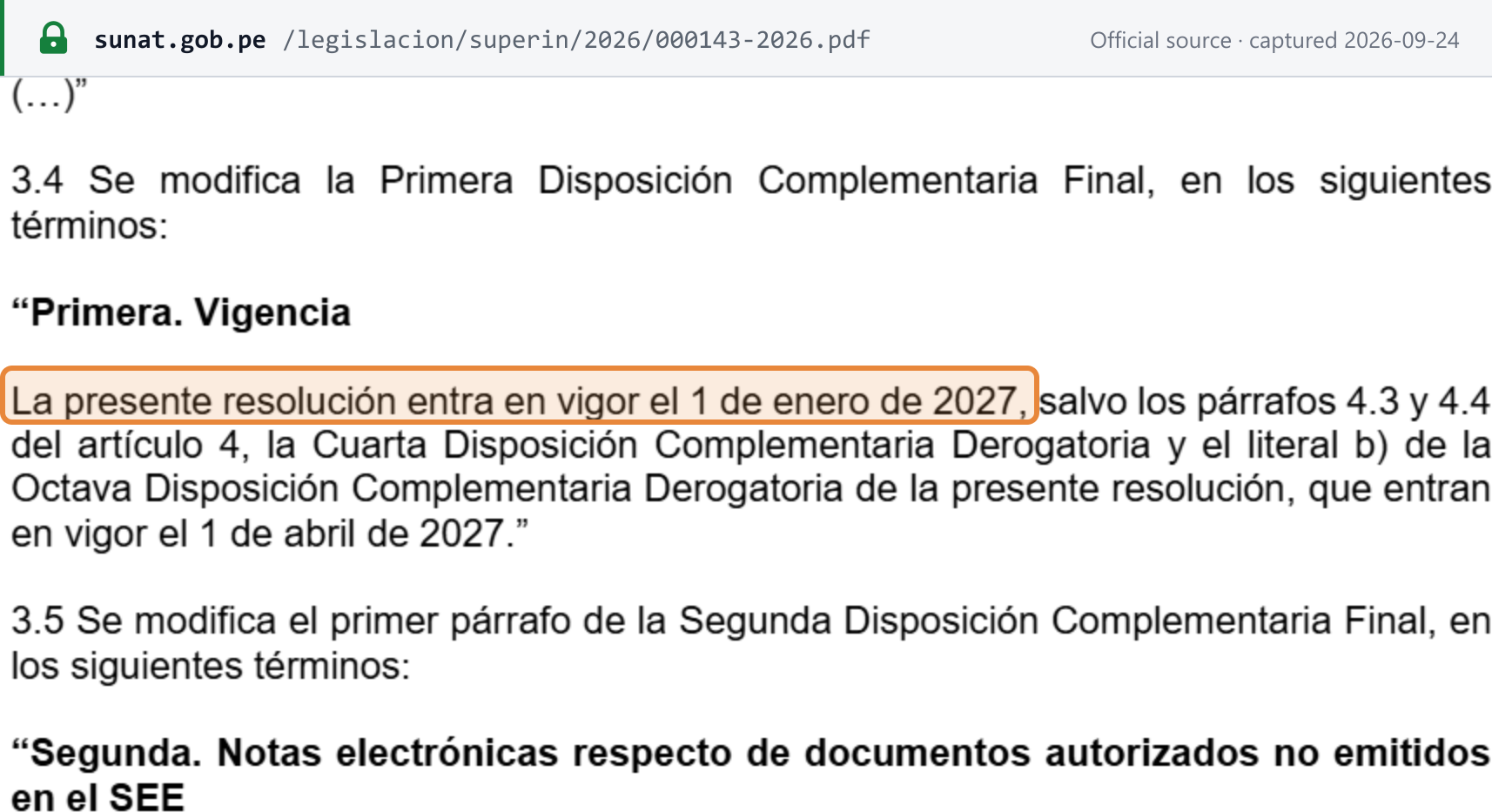
RS 000048-2026/SUNAT never came into force on 1 August 2026. It was dated 26 March 2026 and was due to start on 1 August 2026, with its new designations from 1 November 2026. On 31 July 2026, the day before, El Peruano published RS 000143-2026/SUNAT (dated 29 July 2026). It moved the dates:
| Provision of RS 000048-2026 | Original date | New date |
|---|---|---|
| Entry into force of the resolution | 1 August 2026 | 1 January 2027 |
| Paras 4.3 and 4.4 of art. 4; 4th complementary repeal provision; item b) of the 8th | 1 November 2026 | 1 April 2027 |
| E-issuer designations: DAE-SEAE issuers, DOAE issuers, GRP collectors | 1 November 2026 | 1 April 2027 |
SUNAT's stated reason: "se considera conveniente postergar la fecha de la entrada en vigor de la Resolución del 1 de agosto de 2026 al 1 de enero de 2027, así como de las designaciones indicadas en el considerando anterior del 1 de noviembre de 2026 al 1 de abril de 2027, a fin de otorgar un plazo adicional a los sujetos involucrados para la adecuada implementación de sus sistemas" (it is appropriate to postpone the Resolution's entry into force from 1 August 2026 to 1 January 2027, and the designations from 1 November 2026 to 1 April 2027, to give those involved extra time to implement their systems). (RS 000143-2026/SUNAT; publication date from El Peruano, checked 2026-09-24)
 Source snapshot captured 2026-09-24 — original
What survives for implementers who built against the old calendar: the substance of RS 000048-2026 is unchanged; only the dates moved. From the dates above:
- DAE-SEAE (airport services to passengers). Issuers are CORPAC S.A., airport concessionaires, and the local or regional governments that run airports. They must issue it "mediante el SEE- Del contribuyente o el SEE-OSE" (through SEE-Del Contribuyente or SEE-OSE).
- DOAE (documento de atribución, the attribution document for consortia and joint ventures without separate accounting). It moves into the SEE. "La remisión del DOAE a la SUNAT se debe realizar hasta en un plazo máximo de siete (7) días calendario desde el día siguiente de la fecha de emisión." (The DOAE must be sent to SUNAT within 7 calendar days from the day after issue.) A DOAE sent late does not count as a DOAE.
- Garantía de Red Principal collectors (natural gas, Ley 27133 art. 7.6) become SEE issuers for those operations.
- Contingency narrowed (art. 8.1): where an electronic factura or boleta is due, affected issuers may no longer fall back on certain authorised documents and must instead issue "una factura o una boleta en formato impreso o importado por imprenta autorizada" (a factura or boleta printed or imported by an authorised printer).
- Transitional: electronic credit and debit notes on certain authorised documents issued up to 31 December 2026 may still follow each channel's current rules. Forms 836/847 may be filed until 31 December 2026 and Form 837 until 31 March 2027.
(RS 000048-2026/SUNAT, RS 000143-2026/SUNAT, checked 2026-09-24)
SUNAT has not announced a further general phase. The mandate already covers every factura and boleta issuer outside the Nuevo RUS; remaining changes are about document types and channels. (Observation from SUNAT's 2026 index of Resoluciones de Superintendencia, which runs to 19 September 2026, checked 2026-09-24.)
Legal basis
The framework power is Decreto Ley N.° 25632 (Ley Marco de Comprobantes de Pago), art. 3 lit. f). As RS 000075-2026 summarises it, "la SUNAT señalará los mecanismos de control para la emisión o utilización de comprobantes de pago, incluyendo la determinación de los sujetos que deberán o podrán utilizar la emisión electrónica" (SUNAT sets the controls for issuing comprobantes, including deciding who must or may issue electronically). The document rules are in the Reglamento de Comprobantes de Pago (RCP, RS 007-99/SUNAT).
| Instrument | Date | What it does |
|---|---|---|
| RS 097-2012/SUNAT | 2012 | Creates SEE-Del Contribuyente |
| RS 374-2013/SUNAT | 27 December 2013 | First mandatory designation, from 1 October 2014 |
| RS 300-2014/SUNAT | 2014 | Creates the SEE umbrella |
| RS 199-2015/SUNAT | 23 July 2015 | PSE register (signing/sending providers) |
| RS 182-2016/SUNAT | 25 July 2016 | SEE-Facturador SUNAT (SFS) |
| RS 117-2017/SUNAT | 9 May 2017 | SEE-OSE and the OSE register; UBL version schedule; QR code |
| RS 155-2017/SUNAT | 26 June 2017 | 2018 designation waves and automatic triggers |
| RS 279-2019/SUNAT | 30 December 2019 | Income-band and universal designation |
| RS 000193-2020/SUNAT | 5 November 2020 | Payment-method fields; a next-day send rule, in force 1–4 January 2023, then replaced by RS 000003-2023 |
| RS 000048-2021/SUNAT | 8 April 2021 | B2G designation from 1 October 2021 |
| RS 000112-2021/SUNAT | 30 July 2021; published 31 July 2021 | SIRE: electronic sales register (RVIE) |
| RS 000128-2021/SUNAT | 27 August 2021 | Final income-band dates |
| RS 000040-2022/SUNAT | 21 March 2022; published 24 March 2022 | Approves SIRE and the electronic purchase register (RCE) module |
| RS 000123-2022/SUNAT | 8 July 2022 | Electronic waybill (GRE) designation |
| RS 000003-2023/SUNAT | 4 January 2023; published 5 January 2023 | 3-calendar-day send window; applies to facturas issued from 5 January 2023 |
| RS 000048-2026/SUNAT | 26 March 2026 | DAE-SEAE, DOAE, GRP collectors (in force 1 January 2027 after RS 143) |
| RS 000075-2026/SUNAT | 29 April 2026; in force 1 June 2026 | New registrants from the day of RUC registration |
| RS 000143-2026/SUNAT | 29 July 2026; published 31 July 2026 | Postpones RS 000048-2026 |
Also relevant: RS 188-2010/SUNAT created SEE-SOL. SIRE is regulated by RS 000112-2021/SUNAT (sales register) and RS 000040-2022/SUNAT (SIRE and purchase register). The binding technical standard is OASIS UBL 2.1, set by the RS 117-2017 definitions, together with SUNAT's published validation rules. SUNAT's index of e-invoicing norms is at cpe.sunat.gob.pe/node/98 (checked 2026-09-24).
Scope
B2B — in scope. The electronic factura goes to a buyer with a RUC (Peru's taxpayer number): "Se emite a favor del adquiriente que cuente con número de RUC, salvo en el caso de no domiciliados" (It is issued to a buyer with a RUC, except for non-domiciled buyers), the exception being exports. It supports income-tax costs and IGV input credit: "Se utiliza para sustentar costos ó gastos para efectos del Impuesto a la Renta y el crédito fiscal del Impuesto General a las Ventas." (SUNAT — Factura electrónica, checked 2026-09-24) B2B has no separate phase: it applies to every designated issuer (see the timeline).
B2G — in scope, same system. Since 1 October 2021, facturas for operations with public-sector entities must be electronic (RS 000048-2021/SUNAT). SUNAT's portal describes no separate B2G platform; these invoices use the same SEE/CPE flow. (Observation from cpe.sunat.gob.pe, checked 2026-09-24.)
B2C — in scope. The boleta de venta electrónica "Es un comprobante de pago que se emite a consumidores finales." (is issued to final consumers.) It gives no IGV credit and no cost or expense deduction. (SUNAT, checked 2026-09-24)
- Boletas can be reported to SUNAT or the OSE one by one, or through a resumen diario (daily summary). SUNAT's SEE-OSE page gives up to 7 calendar days from issue for the summary route. (SUNAT — OSE, checked 2026-09-24)
- The ticket POS (SEE-Consumidor Final) is issued from a point-of-sale device. It is opt-in: open to Nuevo RUS taxpayers, and to other regimes only for restaurant and bar activities. (SUNAT — SEE-Consumidor Final, checked 2026-09-24)
Non-residents. A non-domiciled provider of digital services to individuals in Peru who are not carrying on a business (DL 1623) must register in the RUC and collect IGV, but has no obligation to issue comprobantes de pago for those operations. SUNAT's wording: such a provider "No está obligado a llevar libros de contabilidad u otros libros y registros exigidos por la normativa peruana, así como tampoco tiene la obligación de emitir comprobantes de pago por dichas operaciones." (It need not keep Peruvian accounting books or registers, nor issue comprobantes de pago for those operations.) (SUNAT Orientación — IGV servicios digitales, checked 2026-09-24) A Peruvian business buying services from a foreign supplier records the foreign invoice through SUNAT's non-domiciled module and pays the IGV on Form 1662 (RS 000047-2026, from 1 July 2026). That is an IGV payment flow, not SEE e-invoicing.
 Source snapshot captured 2026-09-24 — original
Exports — in scope. Exporters were designated early: goods from 1 July 2018 (from the first export, RS 20-2018/SUNAT), services from 1 January 2018 (RS 312-2017/SUNAT). Both are now covered by the general obligation. On SEE-SOL the export factura goes to the foreign buyer by email: "Excepción: Operaciones de Exportación, mediante su remisión al correo electrónico del adquiriente o usuario." (SUNAT — SEE-SOL, checked 2026-09-24)
Excluded and exceptions.
- Nuevo RUS (the simplified regime for micro-businesses): "Los contribuyentes acogidos al Nuevo Régimen Único Simplificado - NRUS, no se encuentran obligados a emitir sus comprobantes de pago de forma electrónica" (Nuevo RUS taxpayers are not required to issue electronically). They may opt in. (SUNAT FAQ 8, citing RS 279-2019 art. 3.2(c), checked 2026-09-24)
- Paper in limited cases. A designated issuer may still issue pre-printed paper documents if its establishment is in a listed zone with little or no internet, or in contingency, when a cause outside its control stops electronic issuance. Contingency documents must be reported to SUNAT "en el plazo de hasta el sétimo día calendario contado desde el día calendario siguiente al de su emisión" (by the 7th calendar day after the day of issue). (SUNAT — contingencia, checked 2026-09-24)
Simplified invoices. Not applicable as a separate regime. Peru has no value threshold that swaps the factura for a simplified invoice; the split is by buyer (factura to a RUC holder, boleta to a final consumer). (Observation from the SUNAT document-type pages, checked 2026-09-24.)
Documents in scope of the SEE. SUNAT lists: factura electrónica, boleta de venta electrónica, nota de crédito and nota de débito electrónica, recibo por honorarios electrónico (independent professionals), comprobante de retención electrónico and comprobante de percepción electrónico (IGV withholding and perception vouchers, mandatory for designated agents under RS 274-2015/SUNAT), liquidación de compra electrónica, recibo de servicios públicos electrónico. The SEE also carries the electronic waybill (GRE) and electronic authorised documents (DAE). (SUNAT, checked 2026-09-24)
Electronic waybill (GRE)
The guía de remisión electrónica is compulsory: "a partir del 1 de enero de 2024, quienes tengan la calidad de remitentes o transportistas están obligados a emitirla en forma electrónica" (from 1 January 2024, shippers and carriers must issue it electronically). (RSNATI 000031-2026, checked 2026-09-24)
- It is issued through SEE-SOL / the Emprender app or SEE-Del Contribuyente: "Las GRE no se podrán emitir a través del SEE- OSE" (GREs cannot be issued through SEE-OSE).
- It needs an accepted CDR before the goods move: "debiendo contar con la CDR con estado aceptada antes del inicio del traslado". (SUNAT — GRE, checked 2026-09-24)
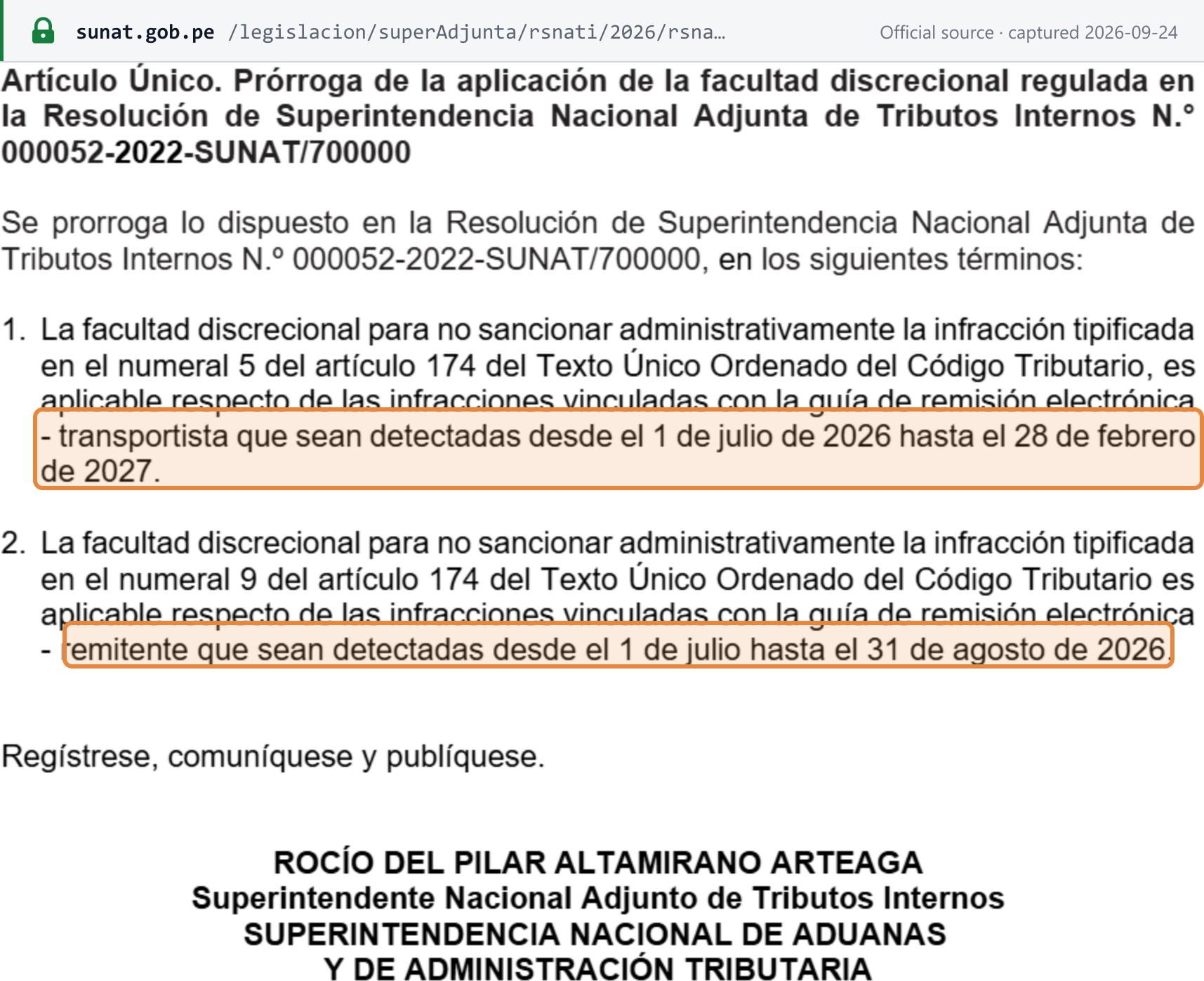
- Non-sanction relief (RSNATI 000031-2026-SUNAT/700000, dated 27 June 2026): carrier (transportista) GRE infractions detected from 1 July 2026 to 28 February 2027 are not sanctioned in the cases listed in Annex I of RSNATI 000052-2022-SUNAT/700000. The shipper (remitente) relief covered infractions detected from 1 July to 31 August 2026 and has now lapsed. No further extension was found on sunat.gob.pe, gob.pe or elperuano.pe (checked 2026-09-24).
- Who issues the GRE-remitente: RS 000108-2026/SUNAT (published 31 May 2026, in force 1 June 2026) changes who must issue the GRE-remitente and adds GRE-por-evento cases.
 Source snapshot captured 2026-09-24 — original
Format & network
CTC model: validation by SUNAT or an OSE, with a CDR
Peru runs a clearance-style model with a short post-issue window:
- The issuer builds and signs the UBL XML.
- It sends the XML to SUNAT (SEE-Del Contribuyente, SFS) or to its contracted OSE (SEE-OSE). RS 117-2017 (def. 1.24) defines the OSE as the party "Al sujeto inscrito en el Registro OSE que comprueba" what is issued in SEE-OSE: a private company on SUNAT's register that checks each document's essential conditions.
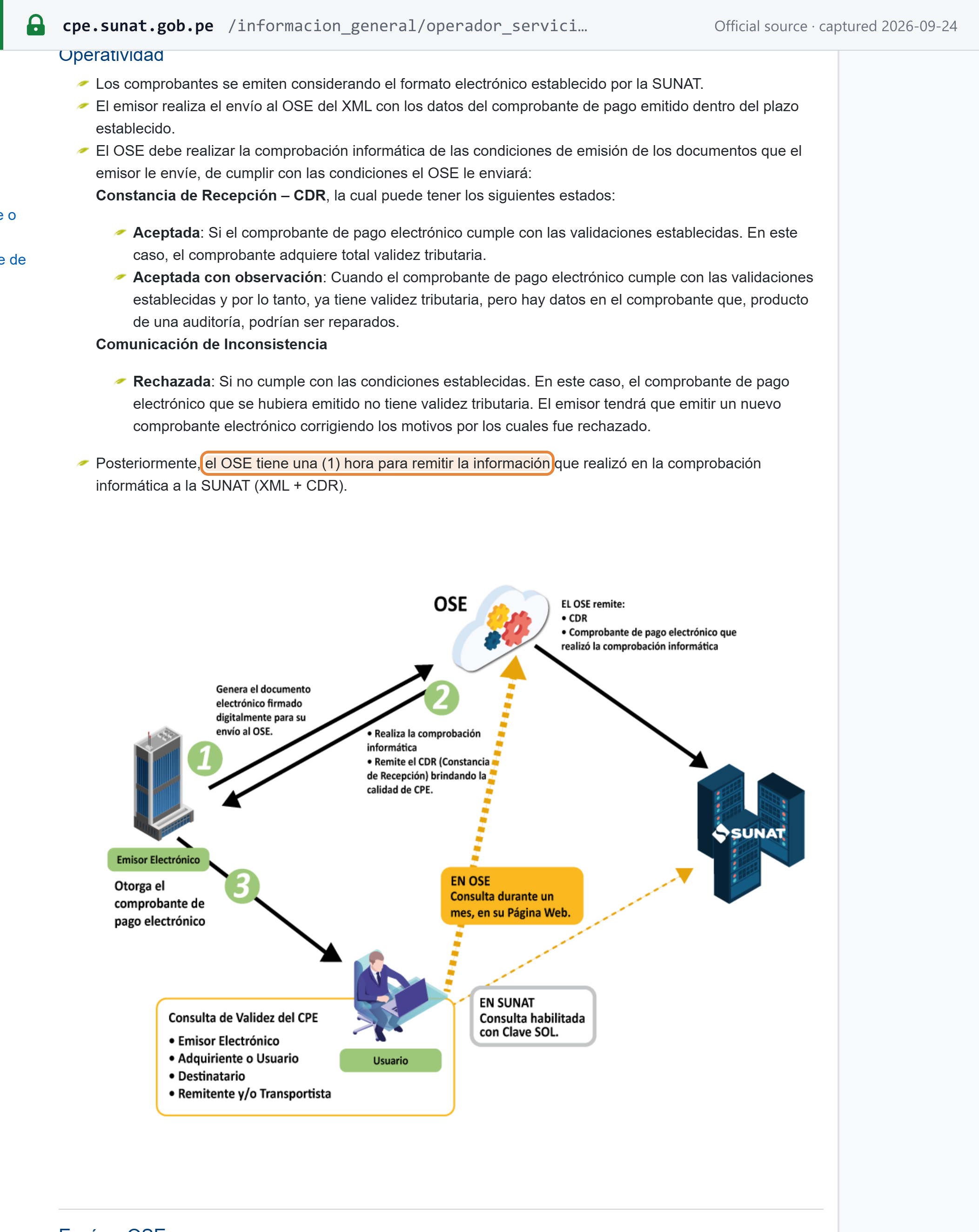
- SUNAT or the OSE checks the document and returns a CDR (Constancia de Recepción):
- Aceptada: "Si el comprobante de pago electrónico cumple con las validaciones establecidas. En este caso, el comprobante adquiere total validez tributaria." (It passes the checks and has full tax validity.)
- Aceptada con observación: valid, but some data is flagged and could be adjusted on audit.
- A document that fails is Rechazada. Through an OSE this comes as a Comunicación de Inconsistencias. A rejected document has no tax validity and the issuer must issue a new, corrected one.
- The OSE forwards everything to SUNAT: "Posteriormente, el OSE tiene una (1) hora para remitir la información que realizó en la comprobación informática a la SUNAT (XML + CDR)." (The OSE then has one hour to send SUNAT the XML and the CDR.)
(SUNAT — Operador de Servicios Electrónicos, page last modified 30 May 2025; RS 117-2017/SUNAT, checked 2026-09-24)
 Source snapshot captured 2026-09-24 — original
The customer can receive the invoice before SUNAT does: "No es obligatorio que primero se envíe el ejemplar de la factura (y sus correspondientes notas de crédito y débito asociadas) a la SUNAT antes de enviarla al cliente." (It is not mandatory to send the factura to SUNAT before sending it to the customer.) (SUNAT — SEE-Del Contribuyente, checked 2026-09-24) SUNAT still recommends sending first, because a rejected invoice has no validity.
Submission deadline: 3 calendar days for facturas
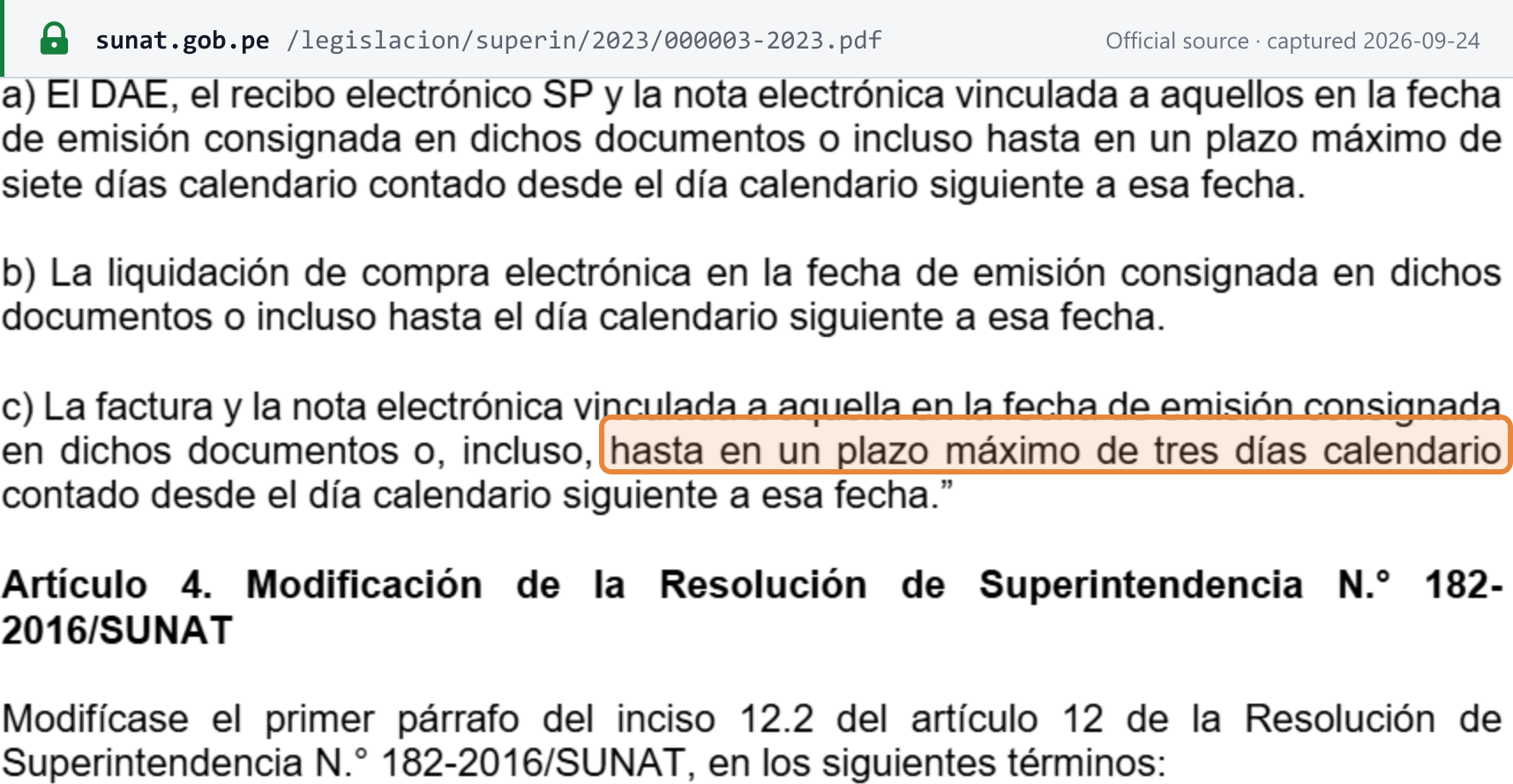
Facturas and their linked notes must reach SUNAT or the OSE on the issue date "o, incluso, hasta en un plazo máximo de tres días calendario contado desde el día calendario siguiente a esa fecha" (or within a maximum of three calendar days counted from the next day). (RS 000003-2023/SUNAT, dated 4 January 2023, published 5 January 2023, checked 2026-09-24)
- The next-day rule of RS 193-2020 was in force only from 1 to 4 January 2023. RS 000003-2023 replaced it, and the 3-day window applies to facturas issued from 5 January 2023. SUNAT's portal FAQ #10 still quotes the old next-day rule; the resolution and the SEE-Del Contribuyente and SFS channel pages give 3 days. SUNAT's FAQ #15 on the same page confirms the next-day rule applied only 1–4 January 2023: "estuvo vigente del 01.01.2023 al 04.01.2023" (it was in force from 1 January to 4 January 2023). (SUNAT — preguntas frecuentes, checked 2026-09-24)
 Source snapshot captured 2026-09-24 — original
- A late factura is not a factura. SUNAT's SFS page: "Si el envío es posterior, será rechazado aún cuando hubiere sido entregado al adquiriente o usuario." (If sent later it will be rejected even if the customer already received it.) (SUNAT — Facturador SUNAT, checked 2026-09-24)
- Other windows in the same article: DAE, electronic public-utility receipts (recibo SP) and their linked notes, 7 calendar days (SEE-Del Contribuyente; recibo SP issued through SEE-Empresas Supervisadas has until the 10th calendar day of the following month, per SUNAT FAQ #13 citing RS 000160-2020); liquidación de compra, next day. Boleta daily summaries, 7 calendar days (see Scope).
 Source snapshot captured 2026-09-24 — original
XML standard: UBL 2.1
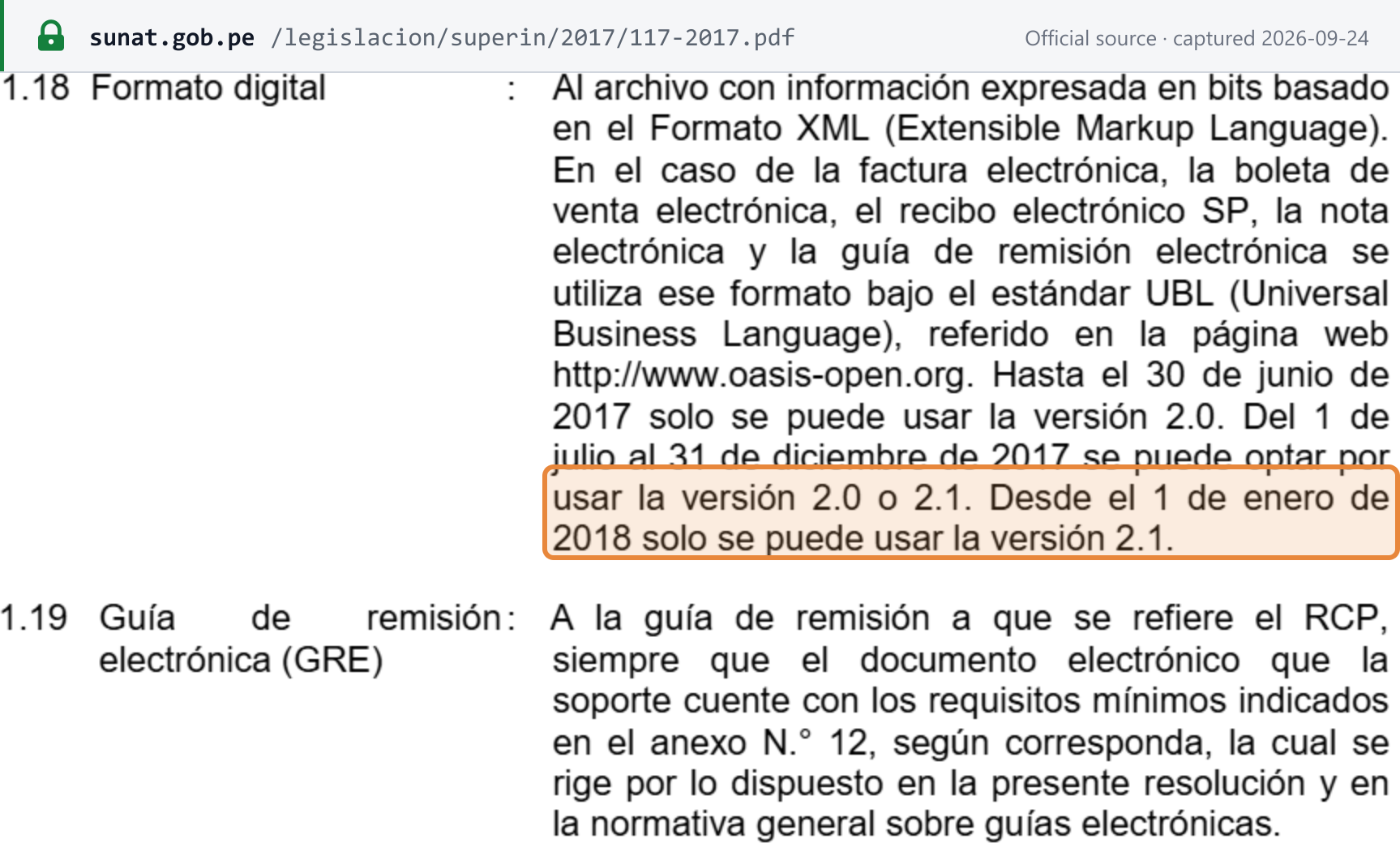
- Facturas, boletas, notes, recibos SP and GRE use XML in the OASIS UBL standard. The version schedule in RS 117-2017 (def. 1.18) ends with "Desde el 1 de enero de 2018 solo se puede usar la versión 2.1." (From 1 January 2018 only version 2.1 may be used.) A transitional exception for some earlier issuers ran to 31 August 2019 (RS 133-2019).
- SUNAT's XML guide sets
cbc:UBLVersionIDto "2.1" andcbc:CustomizationIDto "2.0" (the SUNAT structure version): "Para nuestro caso corresponderá a la versión 2.0 de la factura electrónica." (SUNAT XML guide, factura UBL 2.1, checked 2026-09-24) - National rules are SUNAT's validation rules and catalogues; the latest set on the portal is "Reglas de validación - actualizado al 26.08.2026". (SUNAT — Guías y manuales, checked 2026-09-24)
- Not Peppol-based, no EN 16931 CIUS. SUNAT's portal and resolutions describe no Peppol profile or network (checked 2026-09-24).
 Source snapshot captured 2026-09-24 — original
Integrity: digital signature and QR code
- Every XML carries a digital signature (
ds:SignatureinsideUBLExtensions): "La firma deberá realizarse con el certificado digital que el emisor de la factura comunicó previamente a SUNAT." (It must be made with the certificate the issuer registered with SUNAT.) If a PSE signs for the issuer, the PSE's own certificate is used. - Certificates must come from providers on the ROPS register run by INDECOPI (SUNAT — conceptos generales, checked 2026-09-24). SUNAT also offers a free Certificado Digital Tributario (CDT) to eligible taxpayers; it is authorised to do so "hasta el 31 de diciembre del 2027" (until 31 December 2027). (SUNAT — CDT, checked 2026-09-24)
- The printed representation must carry a QR code: "A partir del 1.1.2018 solo se debe colocar el código QR." (From 1 January 2018 only the QR code may be used.) (RS 117-2017/SUNAT, checked 2026-09-24)
- On SEE-SOL, SUNAT itself secures the documents, so the issuer needs no certificate.
E-reporting alongside: SIRE
The SIRE (Sistema Integrado de Registros Electrónicos) is regulated by RS 000112-2021/SUNAT (sales register) and RS 000040-2022/SUNAT (SIRE and purchase register). It keeps the electronic sales register (RVIE) and purchase register (RCE). It works from proposals SUNAT builds out of the documents issued in the SEE. RS 000075-2026 ties a new taxpayer's SIRE start to the date it becomes an e-issuer.
SIRE start dates have moved several times. For principales contribuyentes with net income above 2,300 UIT, RS 000392-2025 set period June 2026, and RS 000125-2026/SUNAT (published 30 June 2026) postponed it again, to period October 2026. A discretionary non-sanction window covers periods August 2026 to January 2027, with corrections allowed to 28 February 2027. (SUNAT — SIRE, page last modified 31 August 2026, checked 2026-09-24)
Onboarding: how to comply
Choose an issuing channel
| Channel | What it is | Who it suits | Certificate |
|---|---|---|---|
| SEE-SOL (portal and app) | Issue on SUNAT's website or app with your Clave SOL; SUNAT stores the documents. "La emisión es GRATUITA." (Issuing is free.) | Low volume | Not needed |
| SEE-Facturador SUNAT (SFS) | Free SUNAT desktop app that turns TXT/JSON/XML into signed UBL and sends it to SUNAT | "medianos y pequeños contribuyentes que cuentan con sistemas computarizados y tienen un alto volumen de facturación" (small and mid-sized businesses with computer systems and high invoice volume) | Needed |
| SEE-Del Contribuyente | Your ERP sends directly to SUNAT's web service | In-house integration | Needed, or a PSE signs for you |
| SEE-OSE | Your ERP sends to a contracted OSE, which validates and returns the CDR | Most integrated issuers; required for large taxpayers (below) | Needed, or a PSE signs for you |
(SUNAT — SEE-SOL; SUNAT — Facturador SUNAT; checked 2026-09-24)
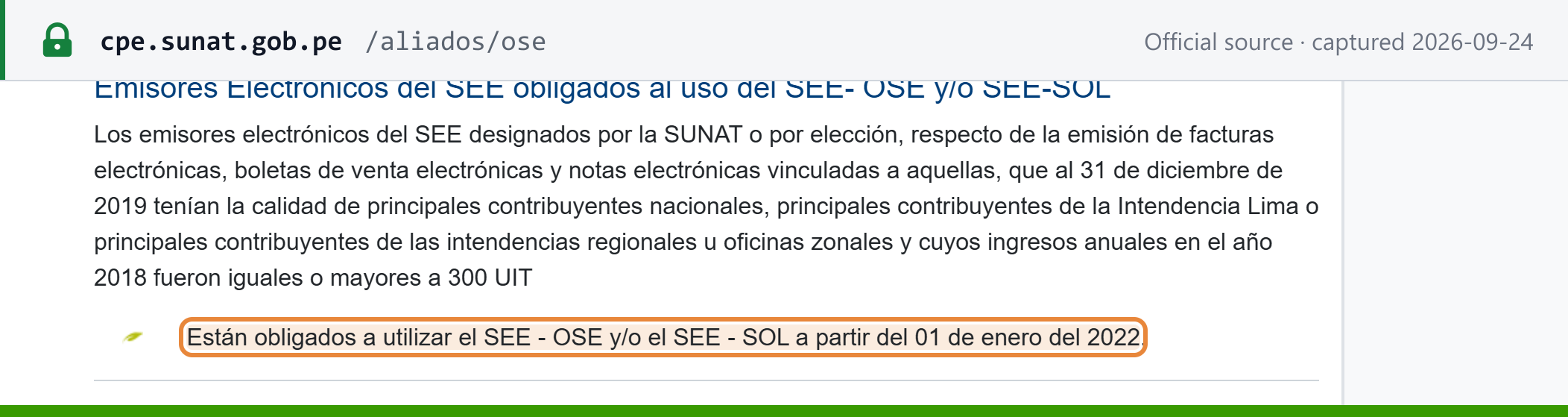
Large taxpayers cannot send directly to SUNAT. Taxpayers that were principales contribuyentes at 31 December 2019 with 2018 income of at least 300 UIT "Están obligados a utilizar el SEE - OSE y/o el SEE - SOL a partir del 01 de enero del 2022." (must use SEE-OSE and/or SEE-SOL from 1 January 2022.) (SUNAT — OSE, checked 2026-09-24)
 Source snapshot captured 2026-09-24 — original
Register in SUNAT Operaciones en Línea
For SEE-Del Contribuyente, SFS or SEE-OSE, log in to SUNAT Operaciones en Línea (SOL) with your Clave SOL and:
- Register a digital certificate and an email address ("Cargar un certificado digital y un correo electrónico,"), or authorise one or more PSE to sign for you.
- For SEE-OSE, authorise your OSE ("Vincular o autorizar a 1 o más operadores de servicios electrónicos - OSE"). "Cabe señalar que dicha autorización surte efecto desde el día calendario siguiente a aquél en que se efectúo el registro." (The authorisation takes effect from the calendar day after registration.)
Preconditions: the RUC must not be no habido (unlocatable), suspended or cancelled, and the taxpayer must be subject to third-category income tax (or the Nuevo RUS where relevant). (SUNAT — OSE; SUNAT — SEE-Del Contribuyente; checked 2026-09-24)
Issuers do not go through a homologation (certification) test. SUNAT's portal describes "inscripción y homologación" only for OSE and PSE accreditation. (Observation from SUNAT — conceptos generales, checked 2026-09-24.)
Accredited providers: PSE and OSE
- PSE (Proveedor de Servicios Electrónicos, RS 199-2015/SUNAT) signs and sends for the issuer "utilizando su propio certificado digital para la firma de los comprobantes de pago electrónicos, y no el del contribuyente" (with its own certificate, not the taxpayer's). The issuer stays responsible for the content. Registration needs capital or net assets of at least 150 UIT, at least 5 employees and ISO/IEC 27001 certification. A PSE removed from the register may keep serving for 90 calendar days, and SUNAT notifies its clients. (SUNAT — PSE, checked 2026-09-24)
- OSE (RS 117-2017/SUNAT) must be a legal entity in the Régimen General with capital or net assets of at least 300 UIT and a bank guarantee (carta fianza), and must pass SUNAT's test process. Once registered, it must hold ISO/IEC 27001 certification from the start of its second year, guarantee at least 99.96% annual availability, let users consult documents for one month, and send each CDR to SUNAT within one hour. (SUNAT — OSE, checked 2026-09-24) SUNAT publishes a list of OSE validity links, dated 7 July 2025 (SUNAT — Operador de Servicios Electrónicos, checked 2026-09-24).
Testing environment
SUNAT runs a beta SOAP web service "EXCLUSIVO PARA PRUEBAS" (for testing only) alongside production:
- Beta:
https://e-beta.sunat.gob.pe/ol-ti-itcpfegem-beta/billService?wsdl - Production:
https://e-factura.sunat.gob.pe/ol-ti-itcpfegem/billService?wsdl - Validity check:
https://e-factura.sunat.gob.pe/ol-it-wsconsvalidcpe/billValidService?wsdl - CDR status:
https://e-factura.sunat.gob.pe/ol-it-wsconscpegem/billConsultService?wsdl
(SUNAT — web services list, linked from Guías y manuales, checked 2026-09-24)
Penalties
E-invoicing failures are penalised under article 174 of the Código Tributario (Tax Code). Tabla I applies to third-category taxpayers, including the MYPE Tributario.
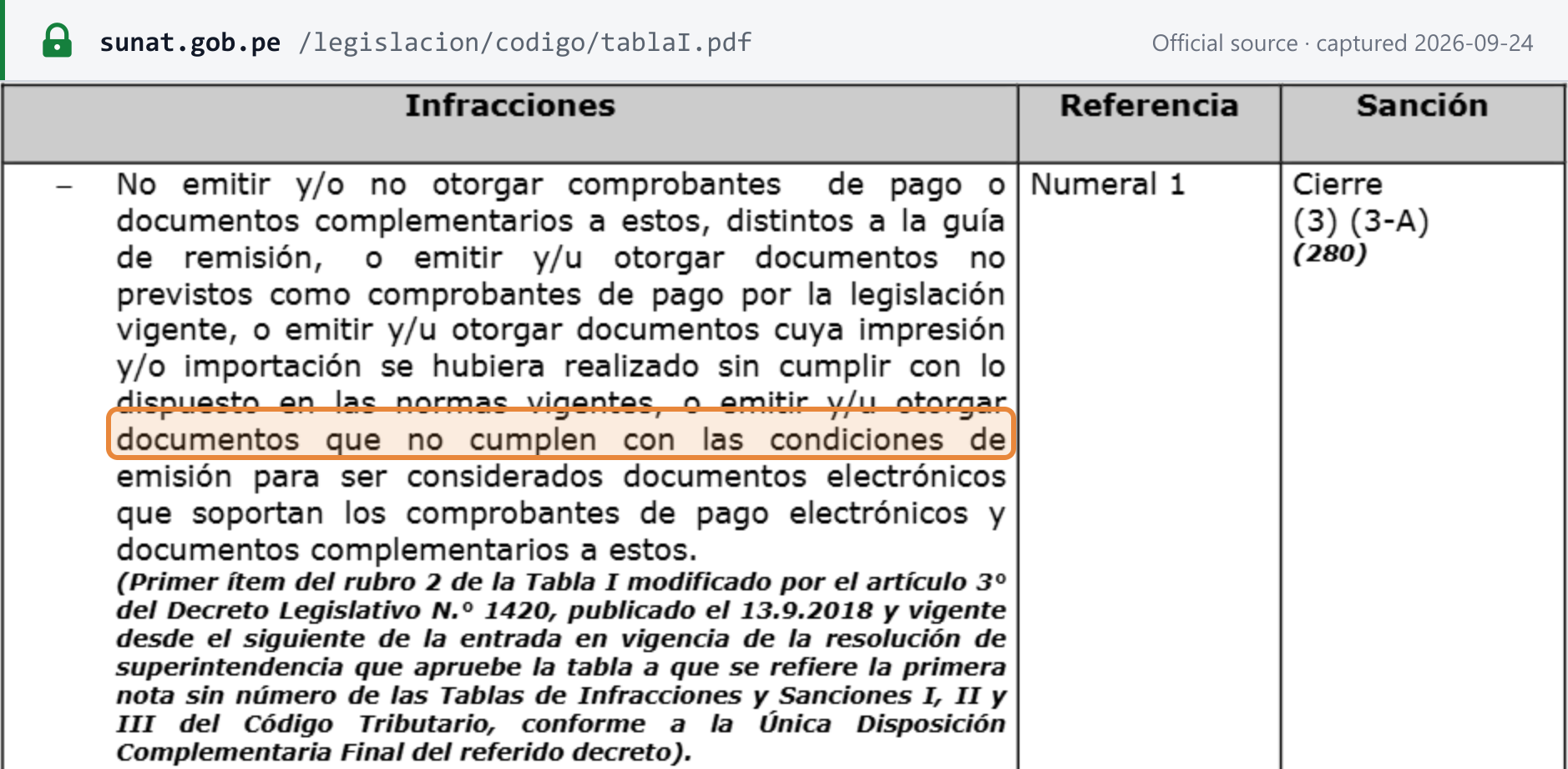
Art. 174 num. 1: not issuing, or issuing documents that fail the e-document conditions. This covers not issuing or delivering comprobantes, issuing documents not recognised as comprobantes, and issuing documents "que no cumplen con las condiciones de emisión para ser considerados documentos electrónicos que soportan los comprobantes de pago electrónicos y documentos complementarios a estos." (that do not meet the issuance conditions to count as electronic documents supporting electronic comprobantes.) A factura sent after the 3-day window, or rejected, fails those conditions.
- Sanction: cierre (temporary closure of the establishment), "con un máximo de diez (10) días calendario" (maximum 10 calendar days).
- Note (3): "La multa que sustituye al cierre señalada en el inciso a) del cuarto párrafo del artículo 183 no podrá ser menor a 2 UIT." (A fine replacing closure cannot be less than 2 UIT.)
- Note (3-A): where the failure to issue or deliver was not committed or detected in a commercial establishment or professional office (for example, online sales), the sanction is a fine of 1 UIT in Tabla I (50% of the UIT in Tabla II). Applying this fine to a late or rejected factura is our reading, which treats that factura as not issued; the note itself speaks only of failure to issue or deliver.
Num. 2 (documents that fail the comprobante requirements) and num. 3 (documents that do not match the regime or operation type): 50% of the UIT or cierre in Tabla I. Per note (4), "La sanción de cierre se aplicará a partir de la segunda oportunidad en que el infractor incurra en la misma infracción." (Closure applies from the second time the same infraction is committed.) In Tabla II (for example, Régimen Especial and fourth-category individuals), num. 2 is 25% of the UIT or cierre. (Código Tributario — Tabla I; Tabla II; checked 2026-09-24)
 Source snapshot captured 2026-09-24 — original
In soles for 2026. The UIT (Unidad Impositiva Tributaria, the tax reference unit) for 2026 is S/ 5,500: "Durante el año 2026, el valor de la Unidad Impositiva Tributaria (UIT) como índice de referencia en normas tributarias será de S/ 5 500,00 (Cinco Mil Quinientos y 00/100 Soles)." (DS 301-2025-EF, El Peruano, published 17 December 2025, checked 2026-09-24) The soles amounts below are our arithmetic at that value, not figures SUNAT publishes:
| Rule | UIT | Soles in 2026 |
|---|---|---|
| Minimum fine replacing closure, num. 1, Tabla I (note 3) | 2 UIT | S/ 11,000 |
| Fine where not in an establishment, num. 1, Tabla I (note 3-A) | 1 UIT | S/ 5,500 |
| Minimum fine replacing closure, num. 1, Tabla II (note 3) | 1 UIT | S/ 5,500 |
| Fine where not in an establishment, num. 1, Tabla II (note 3-A) | 50% UIT | S/ 2,750 |
| Num. 2 fine, Tabla I | 50% UIT | S/ 2,750 |
| Num. 2 fine, Tabla II | 25% UIT | S/ 1,375 |
 Source snapshot captured 2026-09-24 — original
Enforcement posture (dated).
- Art. 174 num. 1: SUNAT applies discretion not to sanction in defined cases (RSNAO 051-2015-SUNAT/60000 and 054-2015-SUNAT/60000; RS 200-2016-SUNAT). SUNAT lists the cases on its orientation page. (SUNAT Orientación, checked 2026-09-24)
- GRE: carrier infractions (num. 5) detected through 28 February 2027 are not sanctioned in the listed cases; shipper relief (num. 9) ended 31 August 2026 (see GRE).
- SIRE e-ledgers (art. 175 num. 2 and 10): relief for periods August 2026 to January 2027, corrections to 28 February 2027.
- An OSE that breaches its obligations can be fined or removed from the register under a separate RS 117-2017 sanction scale, published on the SUNAT OSE page.
Frequently asked questions
I just registered my RUC. When do I have to start issuing electronic invoices?
From the day you register, if you opt for the Régimen MYPE Tributario, Régimen Especial or Régimen General. RS 000075-2026/SUNAT made this the rule from 1 June 2026; before that, new registrants had until the first day of the third month after registering. Nuevo RUS taxpayers are not obliged. If you leave the Nuevo RUS, you become an e-issuer from the first day of the following month. (SUNAT, checked 2026-09-24)
My factura reached the customer, but I sent it to SUNAT or my OSE four days after the issue date. Is it valid?
No. A factura and its linked notes must be sent on the issue date or within 3 calendar days counted from the next day (RS 000003-2023/SUNAT). A later submission is rejected even if the customer already has the document, so it does not count as a factura. Issuing documents that fail the e-document conditions is an art. 174 num. 1 infraction, sanctioned with closure of up to 10 calendar days. Where the failure was not committed or detected in an establishment, the sanction is a fine of 1 UIT (S/ 5,500 in 2026) for Tabla I taxpayers, or 50% of the UIT (S/ 2,750) under Tabla II; applying that fine to a late factura is our reading, which treats it as not issued. SUNAT's FAQ #10 still shows the old next-day rule; SUNAT's FAQ #15 on the same page confirms the next-day rule applied only 1–4 January 2023, and the resolution's 3-day window is the one in force. (SUNAT, checked 2026-09-24)
What is the difference between "aceptada con observación" and a rejection?
A CDR marked "aceptada con observación" means the invoice passed validation and has tax validity, but some data was flagged and could be adjusted on audit. A rejection (Rechazada, sent by an OSE as a Comunicación de Inconsistencias) means the document has no tax validity; you must issue a new, corrected document. (SUNAT OSE page, checked 2026-09-24)
Do I need an OSE, or can I send invoices directly to SUNAT?
Most issuers can choose: send directly to SUNAT (SEE-Del Contribuyente or the free SUNAT Facturador), use SUNAT's free SEE-SOL portal, or contract an OSE. The exception is large taxpayers: principales contribuyentes at 31 December 2019 with 2018 income of at least 300 UIT must use SEE-OSE and/or SEE-SOL from 1 January 2022, and cannot send directly to SUNAT. (SUNAT, checked 2026-09-24)
Does a foreign SaaS or digital-services provider have to issue Peruvian e-invoices?
No. A non-domiciled provider of digital services to individuals in Peru who are not carrying on a business (DL 1623) must register in the RUC and collect IGV, but has no obligation to issue comprobantes de pago for those operations. A Peruvian business that buys services from a foreign supplier pays the IGV itself on Form 1662 (RS 000047-2026). (SUNAT Orientación, checked 2026-09-24)
Does RS 000048-2026 (DAE-SEAE, DOAE, gas GRP) apply from 1 August 2026?
No. RS 000143-2026/SUNAT, published on 31 July 2026, postponed it before it took effect. RS 000048-2026 now enters into force on 1 January 2027, and its new e-issuer designations for DAE-SEAE issuers, DOAE issuers and Garantía de Red Principal collectors start on 1 April 2027. The content is unchanged; only the dates moved. (SUNAT, checked 2026-09-24)
Does a Nuevo RUS micro-business have to issue electronically?
No. Nuevo RUS taxpayers are not required to issue comprobantes electronically, but they may opt in, for example with the ticket POS or SEE-SOL. (SUNAT FAQ 8, citing RS 279-2019/SUNAT, checked 2026-09-24)
Recent changes
- 2026-07-31 — RS 000143-2026/SUNAT, published in El Peruano, postponed RS 000048-2026 from 1 August 2026 to 1 January 2027 and moved the DAE-SEAE, DOAE and Garantía de Red Principal e-issuer designations from 1 November 2026 to 1 April 2027. (SUNAT) — see event record
- 2026-06-27 — RSNATI 000031-2026 extended GRE non-sanction relief: carriers to 28 February 2027, shippers to 31 August 2026 (since lapsed). (SUNAT)
- 2026-06-01 — RS 000075-2026/SUNAT in force: new RUC registrants in the MYPE Tributario, Especial or General regime are e-issuers from the day of registration. (SUNAT) — see event record
- 2026-03-26 — RS 000048-2026/SUNAT issued, bringing the airport-services DAE-SEAE, the joint-venture DOAE and gas GRP collectors into the SEE. It was due to start on 1 August 2026 but was postponed by RS 000143-2026 before taking effect; it now starts 1 January 2027, with designations from 1 April 2027. (SUNAT) — see event record
Related resources
- E-invoicing status and networks worldwide — Peru row in global context
- Peru tax identification number (RUC) — the RUC every factura buyer and issuer carries
- E-invoicing in Brazil — the other Latin American clearance model
- Peru tax-change chronology — every tracked Peruvian change, dated and sourced
- Validate a Peruvian RUC
Important websites
- cpe.sunat.gob.pe — SUNAT's e-invoicing portal (CPE, SEE, GRE, SIRE)
- Who must issue electronically — SUNAT's current obligation summary
- Guías y manuales — XML guides, XSD/XSL, validation rules and catalogues, web-service list
- SUNAT norms index and GRE norms
- OSE register and rules · PSE register and rules
- Certificado Digital Tributario — SUNAT's free certificate for eligible taxpayers
- SUNAT — entry to SUNAT Operaciones en Línea (Clave SOL)
- Tax Code penalty Tabla I