E-invoicing in Austria: e-Rechnung an den Bund
Overview
Austria has one e-invoicing mandate: invoices to the federal government (Bund) must have been structured e-invoices since 1 January 2014. They are submitted through e-Rechnung.gv.at, run by the Federal Ministry of Finance (BMF), either through the Business Service Portal (Unternehmensserviceportal, USP) or over Peppol. [1]
Between businesses there is no mandate. An electronic invoice — a PDF by e-mail as much as an XML file — counts as an invoice only if the recipient consents and its authenticity, integrity and legibility are guaranteed (§ 11 Abs. 2 UStG). [2]
Legal basis in one line. § 5 of the ICT Consolidation Act (IKT-Konsolidierungsgesetz, IKTKonG) and the e-Invoicing Ordinance (e-Rechnungsverordnung, BGBl. II Nr. 505/2012) set the federal B2G mandate; § 11 Abs. 2 of the VAT Act (UStG 1994) governs electronic invoices generally. [3]
| Austria | |
|---|---|
| B2G (federal) | Mandatory since 1 Jan 2014 for suppliers to federal agencies |
| B2G (Länder, municipalities) | No obligation on suppliers; all nine Länder can receive through e-Rechnung.gv.at |
| B2B | No mandate. Electronic invoices need the recipient's consent |
| B2C | No e-invoicing; receipts may be given digitally from 1 Oct 2026 |
| Non-residents | Federal mandate applies to foreign suppliers only "as technically feasible"; paper still accepted from them |
| Format | ebInterface 4.3, 5.0, 6.0 or 6.1; UBL 2.1 (Peppol BIS Billing 3.0) |
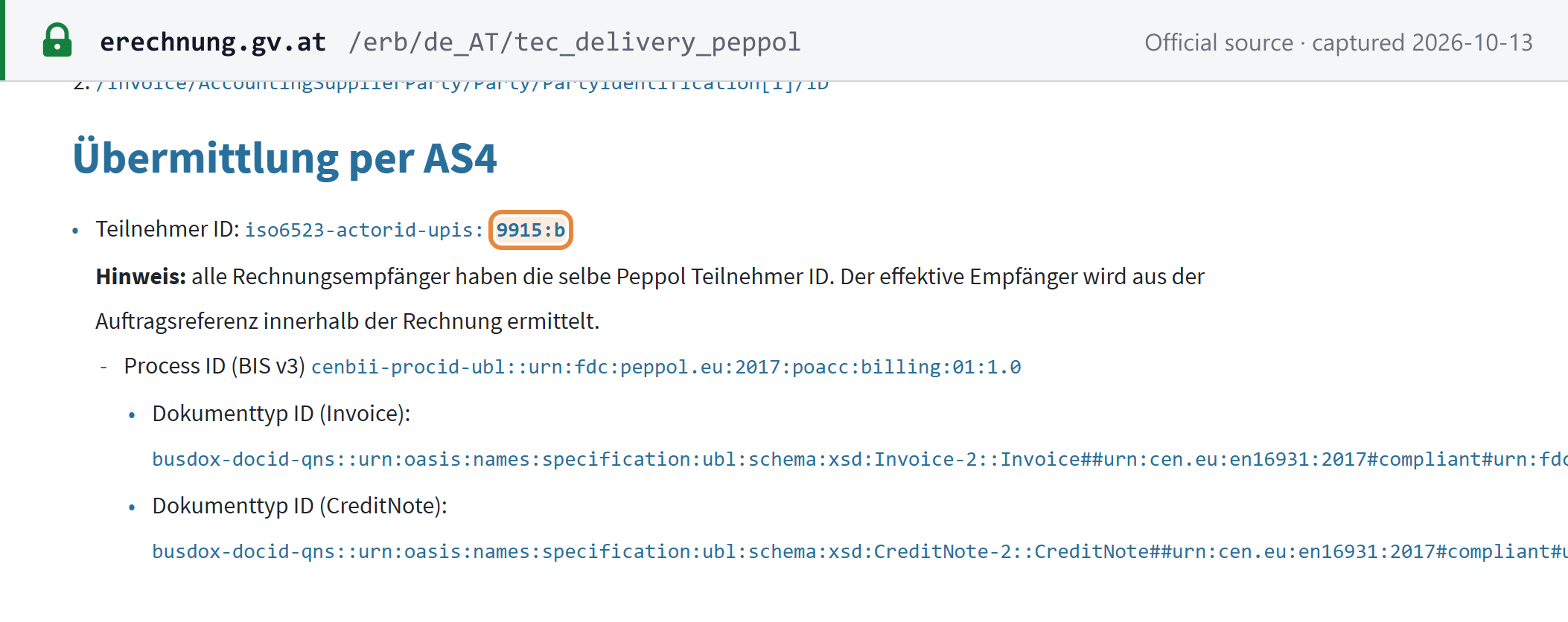
| Network | USP (form, upload, web service) or Peppol, participant ID 9915:b |
| Model | Federal: automated formal check on submission; B2B: post-audit, no clearance or reporting |
| Authority | Federal Ministry of Finance (BMF) |
| Legislation | IKTKonG § 5; e-Rechnungsverordnung BGBl. II Nr. 505/2012; UStG § 11 Abs. 2; E-Rechnung-UStV |
For Austrian VAT rates, registration and invoice content, see the Austria VAT guide.
Mandate status & timeline
| Date | Scope | What | Instrument | Status (at 13 Oct 2026) |
|---|---|---|---|---|
| 1 Jan 2013 | All businesses | Electronic invoices treated like paper invoices (recipient's consent still required); integrity safe harbours | § 11 Abs. 2 UStG; E-Rechnung-UStV § 1 | In force |
| 1 Jan 2014 | Suppliers to the federal government | Structured e-invoices mandatory, via USP or Peppol | IKTKonG § 5; BGBl. II Nr. 505/2012 | In force |
| 18 Apr 2019 / 18 Apr 2020 | All contracting authorities, above-threshold procurement | Must accept EN 16931 e-invoices (no duty on suppliers to send) | § 368 BVergG 2018 | In force |
| 6 Apr 2022 | e-Rechnung.gv.at | ebInterface 4.0–4.2 no longer accepted | BMF technical change | Passed |
| 1 Oct 2026 | Retail receipts | Receipts may be given digitally | § 132a BAO | In force |
| 1 Jul 2030 | Intra-EU B2B supplies | Structured e-invoices by default and digital reporting (EU-wide) | Directive (EU) 2025/516 | EU law; national transposition due by 30 Jun 2030 |

No domestic B2B mandate has been proposed. As of 13 October 2026, no Austrian bill, ministerial draft in consultation or BMF announcement introduces mandatory B2B e-invoicing or e-reporting, and Austria has not used the option, available to EU member states since 14 April 2025 under the ViDA Directive, to mandate domestic e-invoicing. The government programme for 2025–2029 mentions only extending secure electronic delivery between companies to "XML invoices". See the ViDA explainer. [5]

What ViDA does bind Austria to. From 1 July 2030, intra-EU supplies between businesses will need structured e-invoices (EN 16931) issued within 10 days, with per-transaction digital reporting, in every member state. [5]
Legal basis
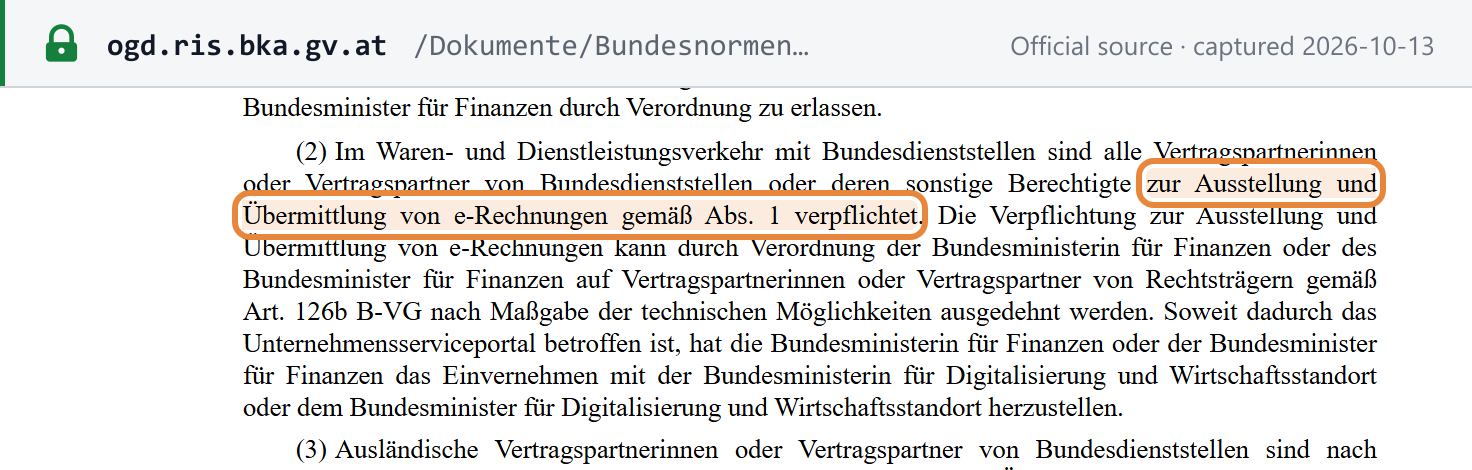
The federal mandate. IKTKonG § 5 Abs. 2 obliges all contracting partners of federal agencies to issue and transmit e-invoices, and § 7 applies it to transactions after 31 December 2013. An e-invoice is recognised only if authenticity of origin, integrity of content and legibility are guaranteed, and it must contain at least the § 11 Abs. 1 UStG particulars. [3]
The ordinance. The e-Rechnungsverordnung (BGBl. II Nr. 505/2012), in force since 1 January 2014 and unchanged since, names the two channels — the USP or the PEPPOL transport infrastructure — and excludes cash and immediate payments. Besides the VAT particulars, a federal e-invoice must carry the supplier number, the order reference (Auftragsreferenz), position numbers where the order gives them, IBAN and BIC, payment terms and the supplier's e-mail address. [6] [7]

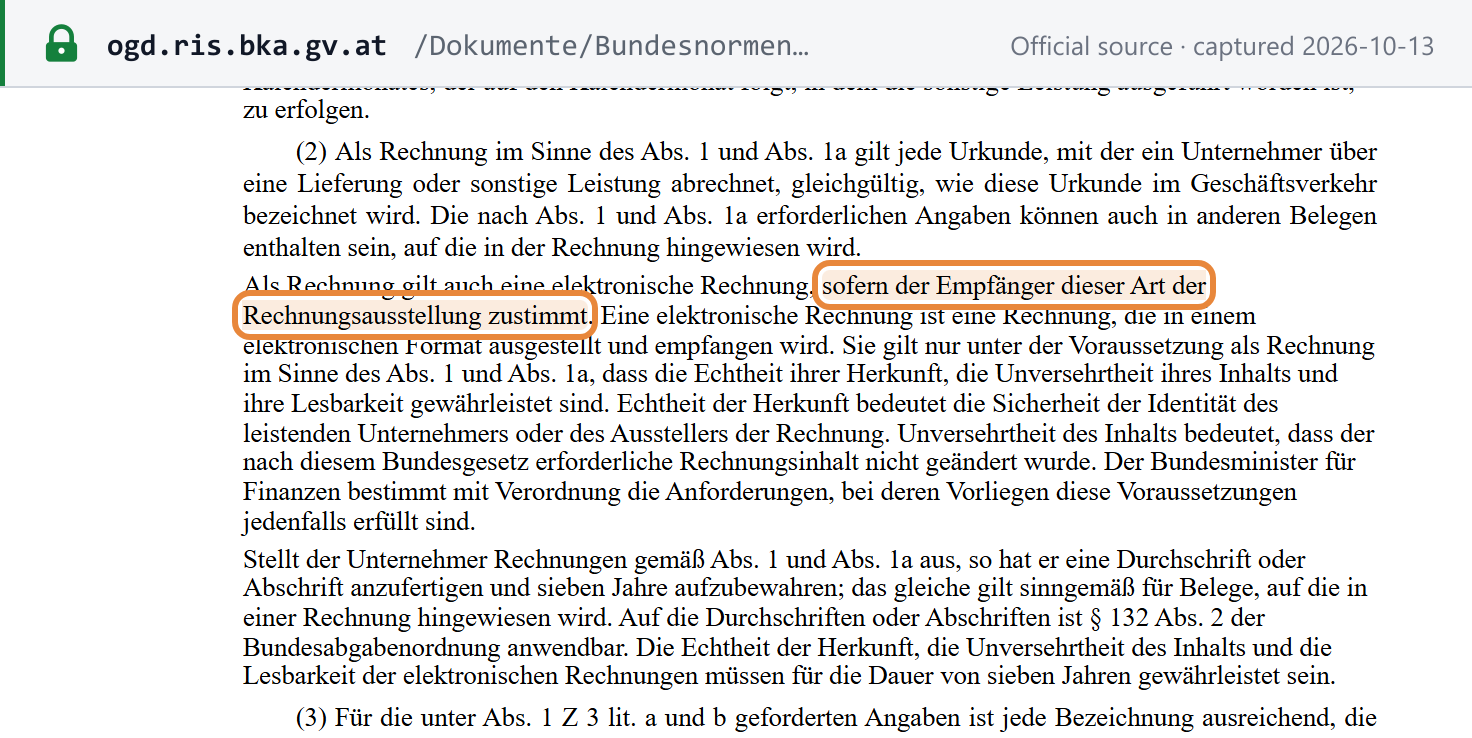
Electronic invoices generally. Under § 11 Abs. 2 UStG, an electronic invoice is one issued and received in an electronic format; it counts as an invoice only with the recipient's consent and only if authenticity of origin, integrity of content and legibility are guaranteed — for seven years. [2]
Scope
Federal government. The recipients that belong to the Bund are all federal ministries and their subordinate offices, the Parliament, the Presidential Chancellery, the Administrative and Constitutional Courts, the Ombudsman Board and the Court of Audit. Some transactions need no e-invoice even there, including cash and card payments, rent instalments, leasing and insurance contracts. [8] [9]
Länder, cities and municipalities. They can receive e-invoices through e-Rechnung.gv.at, but suppliers have no legal obligation to send them that way. The only rule beyond the Bund is a duty on every contracting authority to accept EN 16931 e-invoices in above-threshold procurement (§ 368 BVergG 2018). [8] [10]

B2B. No mandate. Businesses may invoice each other electronically — by e-mail, PDF, web download, scanned paper invoice, fax or structured XML — if the recipient consents. An invoice sent in several formats (for example PDF and XML) must say so, to avoid owing the VAT twice because it was shown on two invoices. These rules also apply to EU and non-EU businesses operating in Austria. [11]
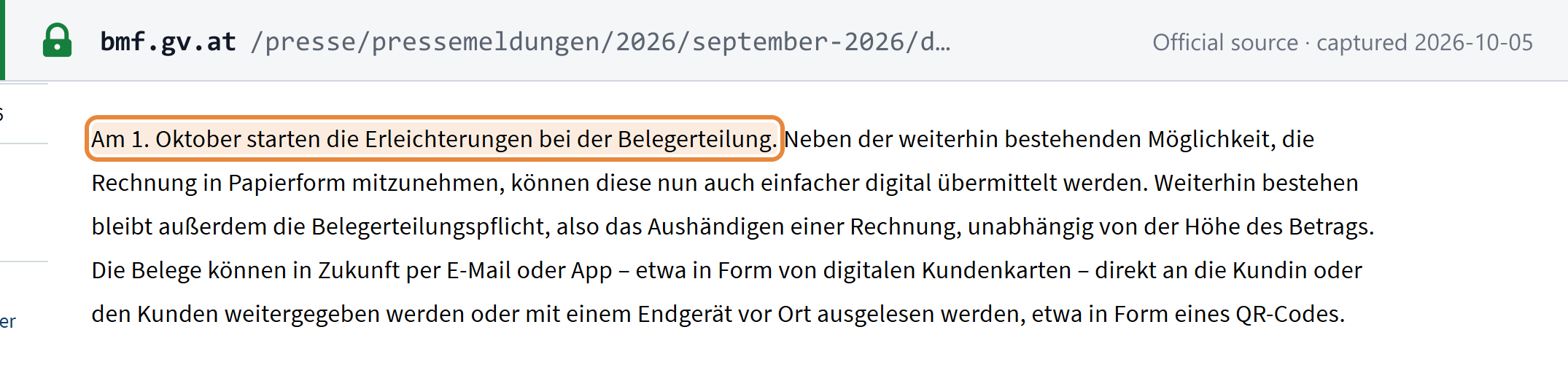
B2C. No e-invoicing. Retail sales fall under the cash-register and receipt rules; from 1 October 2026 a receipt may be given digitally, by e-mail, app or QR code, but the duty to give one remains whatever the amount. [12] [24]
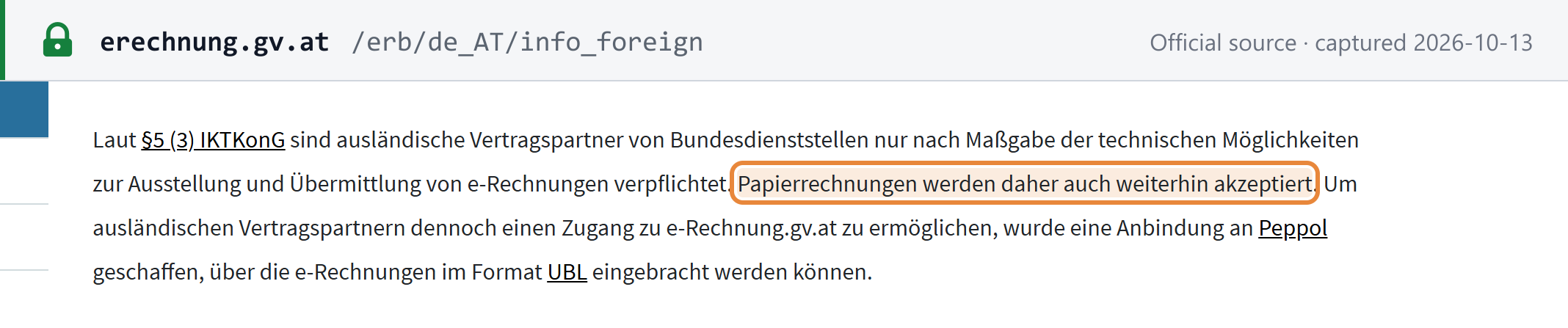
Foreign suppliers. Under IKTKonG § 5 Abs. 3, foreign contracting partners of federal agencies must e-invoice only as far as technically feasible, so the federal government still accepts their paper invoices. A foreign supplier with a permanent establishment in Austria counts as domestic and is covered by the mandate. [13]
Format & network
The model. For federal invoices, e-Rechnung.gv.at runs an automated formal check on submission. Only once the invoice passes and the agency takes it over does it count as properly submitted; the portal then e-mails the supplier a PDF rendering with a receipt timestamp, which is the base date for the payment term. An invoice that fails counts as not submitted. Between businesses the model is post-audit: there is no clearance and no invoice reporting. See CTC e-invoicing models. [3] [14]
Formats. e-Rechnung.gv.at accepts:
- ebInterface 4.3, 5.0, 6.0 and 6.1 — the Austrian XML invoice standard specified by WKÖ/AUSTRIAPRO; 6.1 is recommended, and versions 4.0 to 4.2 have not been accepted since 6 April 2022;
- UBL 2.1 invoices and credit notes, over Peppol and also by upload and web service, using the Peppol BIS Billing 3.0 document type.
Austria has two national CIUS of EN 16931: CIUS AT NAT (the statutory rules) and CIUS AT GOV (e-Rechnung.gv.at's federal rules, built on AT NAT). [4] [15] [16]

Peppol. All e-Rechnung.gv.at recipients share one Peppol participant ID, 9915:b, received over AS4; the actual recipient is worked out from the order reference in the invoice. [17] Peppol senders need no USP registration. [19]
Integrity. Under § 1 of the E-Rechnung-UStV, authenticity and integrity of an electronic invoice are in any case guaranteed by an internal control process with a reliable audit trail, by transmission through the USP or Peppol, by a qualified electronic signature or seal, or by EDI. E-invoices carry no QR code, hash chain or clearance stamp; cash-register receipts, which can count as small-amount invoices, do carry a signed machine-readable code under the cash-register rules. [18]

Onboarding: how to comply
For federal invoices, choose a channel:
- Peppol — through any Peppol access point, addressed to
9915:b, with the order reference in the invoice. No USP account needed. - USP — after logging in to Mein USP → Meine Services → e-Rechnung.gv.at: the online form, an upload of an ebInterface or UBL file, or a web service for automated submission.
- A third party — a service provider or tax adviser can create and submit invoices from its own USP account; you then need no USP registration yourself.
Registering on the USP. The business must already be recorded by an authority (company register, trade register or tax office); non-Austrian businesses first apply for a register entry. The person you appoint as USP administrator needs a digital signature (ID Austria or EU Login). A FinanzOnline supervisor account is needed only if nobody in the business can sign alone. [20]
Testing. test.erechnung.gv.at accepts test uploads without a USP login; test invoices are never processed or paid. [21]
Providers. The e-invoicing ordinance lets service providers and other authorised persons submit on a supplier's behalf, and any Peppol access point can reach e-Rechnung.gv.at; the BMF publishes no list of accredited providers. [19]
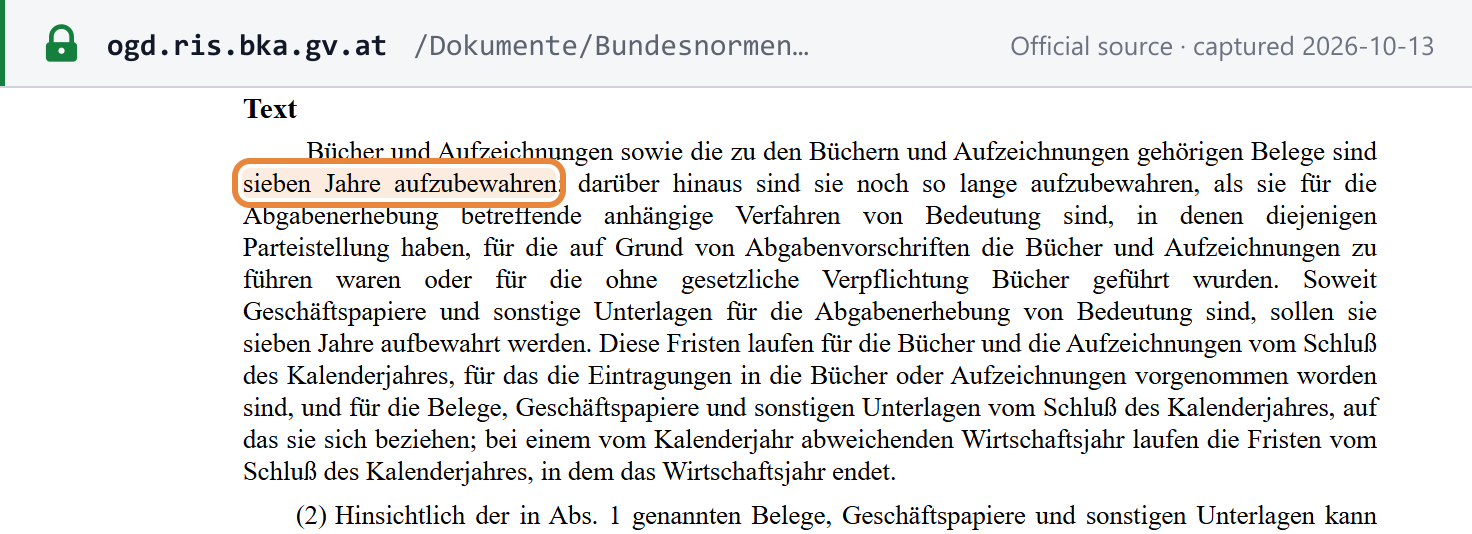
Archiving. Books, records and vouchers must be kept for seven years (BAO § 132), and records relating to land for 22 years (UStG § 18 Abs. 10). Storage on data carriers is allowed if a complete, faithful reproduction is guaranteed; e-invoices may also be kept as paper printouts if the § 11 conditions are met. [22] [11]
Penalties
- Federal invoices. No fine is set. The consequence is practical: federal agencies accept no paper invoices from domestic suppliers, and an invoice that fails the formal check counts as not submitted, so the payment term does not start. [3]
- Record-keeping and receipts. Deliberately breaching a tax duty to keep records or to issue or keep vouchers is a fiscal regulatory offence under § 51 FinStrG, with a fine of up to EUR 5,000. [23]
- Input tax. An electronic invoice sent without the recipient's consent, or without guaranteed authenticity and integrity, is not an invoice under § 11 UStG and does not support input-tax deduction. [2]
Frequently asked questions
Is B2B e-invoicing mandatory in Austria?
No. Electronic invoices between businesses are allowed only with the recipient's consent, and no Austrian bill or draft for a B2B mandate had been published as of 13 October 2026. Austria has not used the EU option, available since 14 April 2025, to mandate domestic e-invoicing. From 1 July 2030 the EU's ViDA rules require structured e-invoices for intra-EU supplies between businesses.
Do we have to e-invoice a Land or a municipality?
No statute requires it. All nine Länder can receive e-invoices through e-Rechnung.gv.at, but the mandate applies only to suppliers of the federal government. In above-threshold procurement, every contracting authority must accept EN 16931 e-invoices if you send them.
We are a foreign supplier to a federal ministry. Must we use e-Rechnung.gv.at?
Only as far as technically feasible, so paper invoices are still accepted from foreign suppliers. If you have a permanent establishment in Austria, you count as a domestic supplier and must send e-invoices.
Do we need a USP account to send invoices over Peppol?
No. Peppol senders are authenticated by their Peppol certificates. All e-Rechnung.gv.at recipients share the Peppol participant ID 9915:b, and the order reference in the invoice decides which agency receives it.
Recent changes
- 2026-10-01 — Receipts may be given digitally (e-mail, app or QR code) under § 132a BAO; the duty to issue a receipt remains whatever the amount. (BMF) — see event
Related resources
- Austria VAT guide
- Austria tax ID guide and how to verify an EU VAT number
- E-invoicing status and networks by country
- ViDA — VAT in the Digital Age
- Peppol guide
- Germany e-invoicing and Hungary e-invoicing
- Austria tax changes on Lookuptax