E-invoicing in Slovenia: ZIERDED and the 2028 B2B mandate
Overview
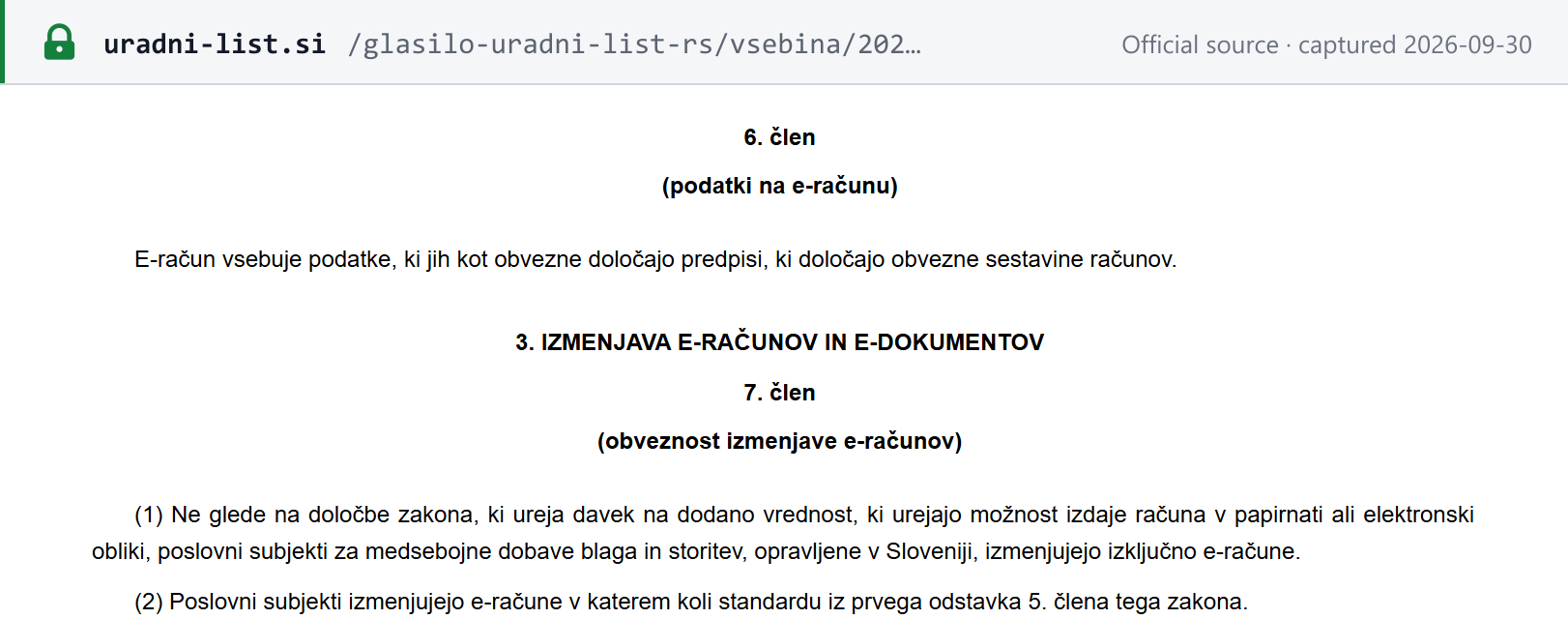
From 1 January 2028, businesses in Slovenia must exchange exclusively e-invoices for the goods and services they supply to each other in Slovenia. Paper and PDF invoices stop being an option between businesses, even though the VAT Act still allows them in general. The rule is Art. 7(1) of the ZIERDED (Zakon o izmenjavi elektronskih računov in drugih elektronskih dokumentov, the Act on the Exchange of Electronic Invoices and Other Electronic Documents): business entities "za medsebojne dobave blaga in storitev, opravljene v Sloveniji, izmenjujejo izključno e-račune" (exchange exclusively e-invoices for mutual supplies of goods and services performed in Slovenia). (Uradni list RS 85/2025, checked 2026-09-29)
 Source snapshot captured 2026-09-30 — original
Three bodies share the system. The Public Payments Administration (Uprava Republike Slovenije za javna plačila, UJP) keeps the list of registered e-route providers, runs the single entry and exit point for public-sector invoices and routes invoices sent through the free FURS application. The Financial Administration (Finančna uprava Republike Slovenije, FURS) supervises the B2B e-invoicing duty and provides that free application. The Market Inspectorate (Tržni inšpektorat) supervises e-invoices to consumers. (ZIERDED Art. 23)
Slovenia's model is decentralised interchange, not clearance. Invoices travel between the two parties through e-route providers, the Peppol network, a direct link the two parties agree on, or the FURS application. ZIERDED contains no provision for sending invoice data to FURS, for pre-validating or clearing invoices, or for a QR code or cryptographic stamp. FURS checks compliance after the fact.
| Slovenia | |
|---|---|
| B2B (domestic) | Exclusive e-invoicing from 1 January 2028 (ZIERDED Art. 7(1)); e-mail exchange between businesses prohibited |
| B2G | Mandatory since 1 January 2015; suppliers to budget users issue only e-invoices, exchanged only through UJP; current basis ZPJS Arts. 44–50 |
| B2C | Voluntary: e-invoices only with the consumer's prior express agreement (ZIERDED Art. 8). Cash and card sales have been fiscally verified in real time since 2 January 2016 (ZDavPR) |
| Non-established businesses | Not addressed by any official guidance published so far; see Scope |
| Format | e-SLOG (current invoice version e-SLOG 2.0), an EN 16931 syntax on the European Commission's list, or another international standard agreed by contract |
| Network | Registered e-route providers (ponudniki e-poti), Peppol, direct exchange with both parties' consent, or the free FURS application via UJP |
| Clearance / e-reporting | None for B2B or B2G |
| Authority | UJP (provider list, B2G), FURS (B2B supervision, free app), Market Inspectorate (B2C) |
| Legislation | ZIERDED (Uradni list RS 85/2025, item 3032); ZPJS (Uradni list RS 85/2025, item 3030); ZDavPR (Uradni list RS 57/2015, as amended) |
Mandate status & timeline
| Phase | Who / what | Date | Status | Legal basis |
|---|---|---|---|---|
| B2G e-invoicing | Suppliers to budget users (proračunski uporabniki) send e-invoices only, through UJP | 1 January 2015 | passed, in force | ZOPSPU-A (Uradni list RS 111/2013) [1]; since 21 November 2025 ZPJS Art. 44 [2] |
| B2C fiscal verification | Every invoice paid in "cash" (including cards and cheques) verified by FURS in real time | 2 January 2016 | passed, in force | ZDavPR Art. 24 [3] |
| ZPJS in force | B2G rules move to the new Payment and Public Finance Services Act; ZOPSPU-1 repealed | 21 November 2025 (15th day after publication on 6 November 2025) | passed | ZPJS Arts. 69–70 [2] |
| ZIERDED in force | The Act is in force; its obligations do not yet apply | 6 December 2025 (30th day after publication on 6 November 2025) | passed | ZIERDED Art. 28(2) [4] |
| Implementing regulations | Six Ministry of Finance regulations due within 12 months of entry into force | by about 6 December 2026 | pending; none had been published as of 30 September 2026 | ZIERDED Art. 27 [4] |
| E-route providers | Chapter 4 (provider list, registration, strike-off, recipient records, service quality) applies; providers can apply to UJP | 1 April 2027 | enacted, upcoming | ZIERDED Art. 28(1) [4] |
| Provider list | UJP's list of e-route providers is established | 1 October 2027 | enacted, upcoming | ZIERDED Art. 26 [4] |
| B2B mandate | All business entities exchange only e-invoices with each other; no e-mail; fines apply | 1 January 2028 | enacted, upcoming | ZIERDED Arts. 7, 9, 24, 28(1) [4] |
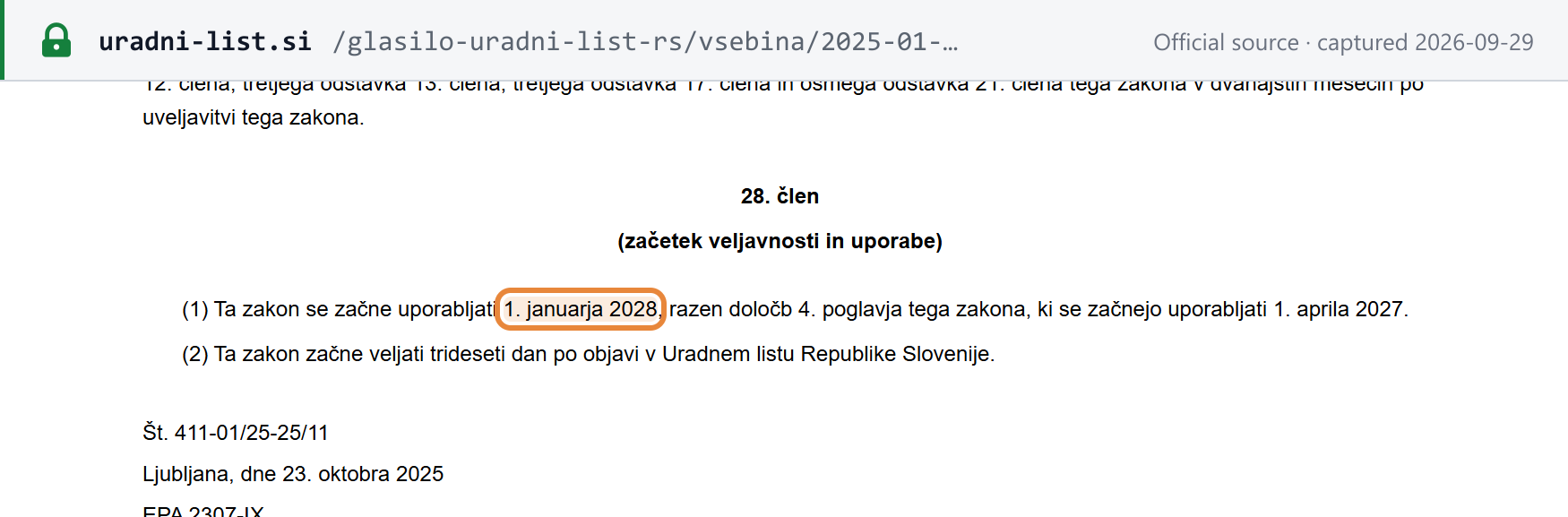
Art. 28 fixes the two B2B dates in one sentence: "(1) Ta zakon se začne uporabljati 1. januarja 2028, razen določb 4. poglavja tega zakona, ki se začnejo uporabljati 1. aprila 2027." (This Act applies from 1 January 2028, except Chapter 4, which applies from 1 April 2027.) The Act entered into force on 6 December 2025, the thirtieth day after publication (Art. 28(2)). There is no phasing by company size or turnover: every business entity starts on the same day.
 Source snapshot captured 2026-09-29 — original
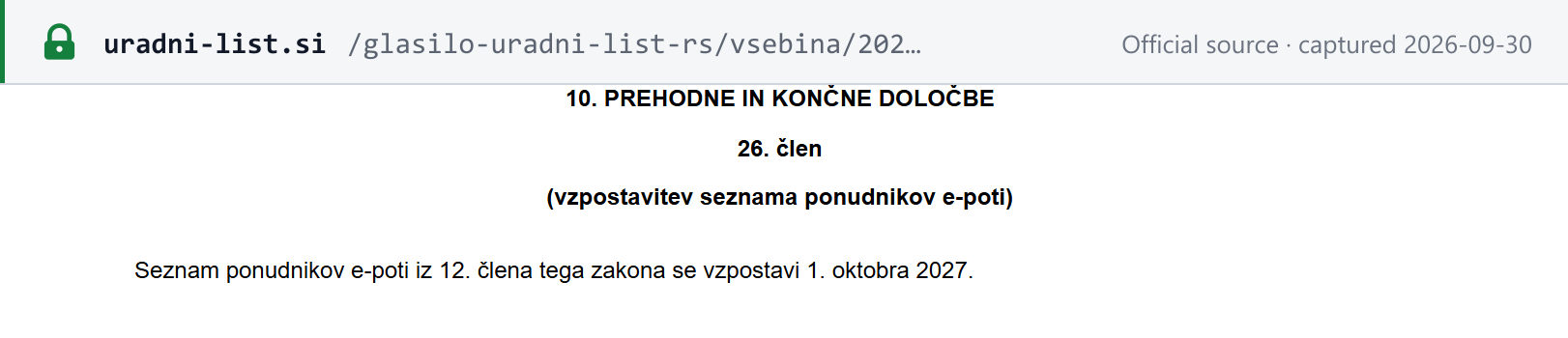
Two provider dates. Providers can register from 1 April 2027, when Chapter 4 starts to apply, but Art. 26 says the list itself "se vzpostavi 1. oktobra 2027" (is established on 1 October 2027). The Act does not say how the months between the two dates work; that is left to the implementing regulations.
 Source snapshot captured 2026-09-30 — original
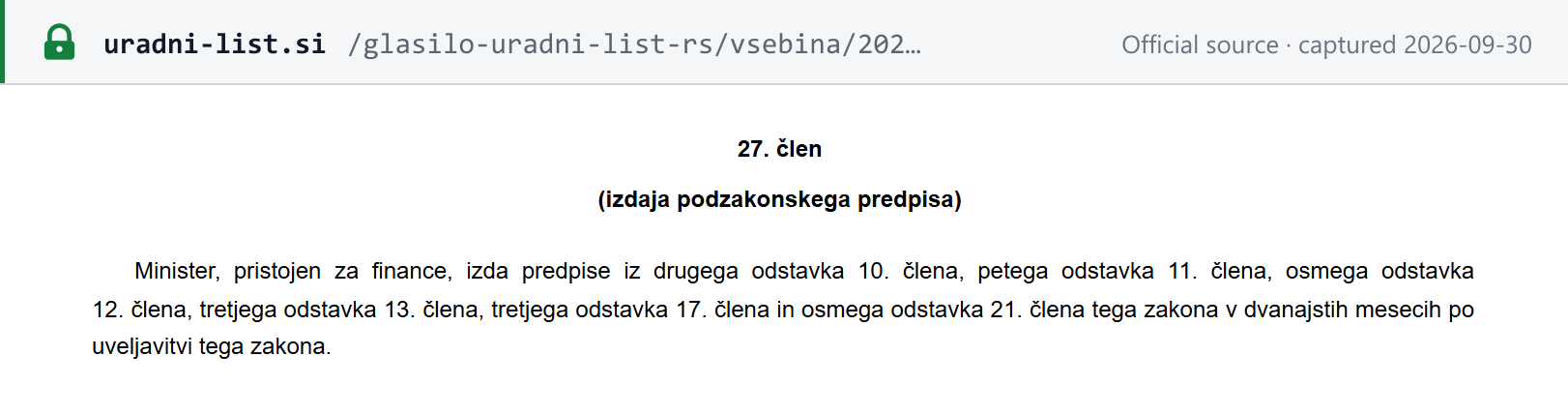
Implementing regulations are still pending. Art. 27 requires the Minister of Finance to issue six regulations within twelve months of the Act taking effect, that is by about 6 December 2026. They cover B2G exchange through UJP (Art. 10(2)), the conditions for using the FURS application (Art. 11(5)), provider codes and data flows for the list (Art. 12(8)), registration applications and checks (Art. 13(3)), provider service quality (Art. 17(3)) and joint-controller duties (Art. 21(8)). None had been published as of 30 September 2026. Until they are, the detail of provider registration and of access to the FURS application is not known.
 Source snapshot captured 2026-09-30 — original
No postponement of any ZIERDED date has been announced.
Legal basis
-
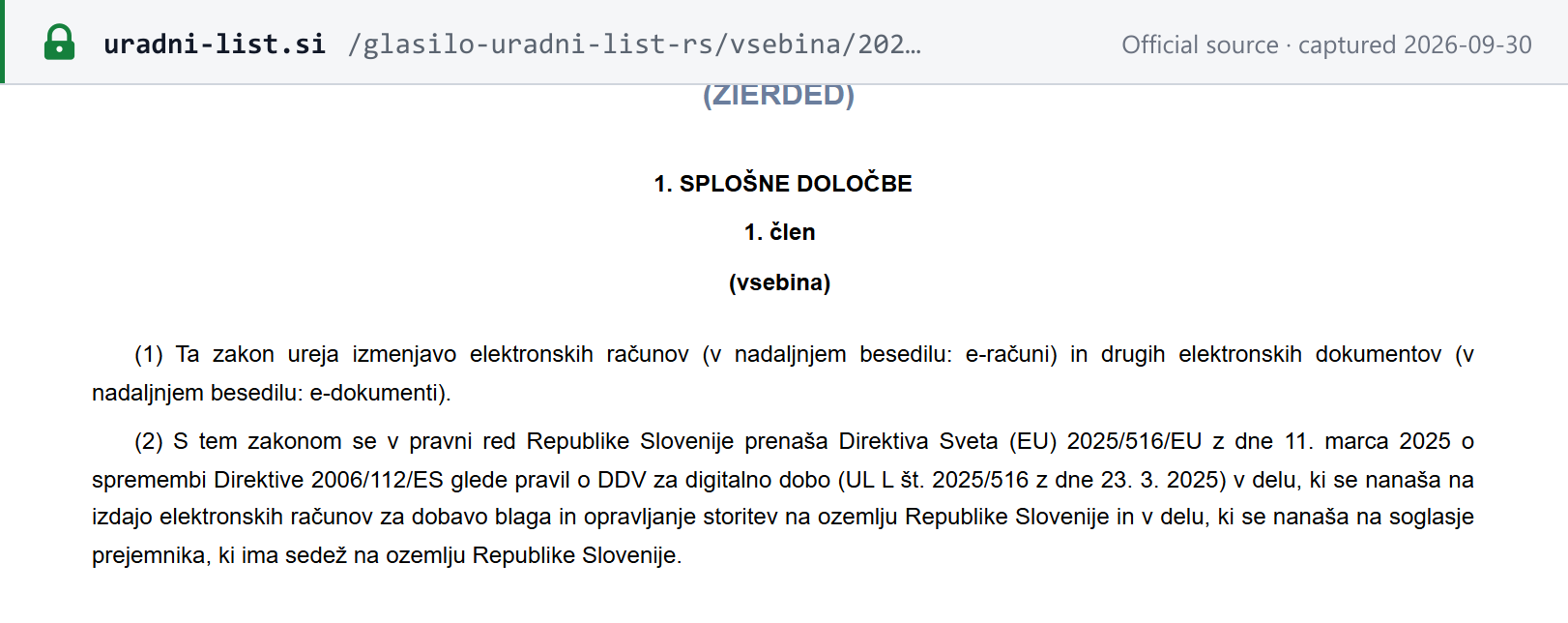
ZIERDED — Zakon o izmenjavi elektronskih računov in drugih elektronskih dokumentov, adopted by the National Assembly on 23 October 2025, published in Uradni list RS 85/2025 of 6 November 2025 (item 3032), in force 6 December 2025, applying from 1 April 2027 (Chapter 4) and 1 January 2028 (everything else). It governs B2B and B2C exchange of e-invoices and other e-documents such as orders and delivery notes. Under Art. 4 it also applies to budget users and contracting authorities unless ZPJS provides otherwise. [4]
-
ViDA, in part. ZIERDED Art. 1(2) transposes Council Directive (EU) 2025/516 (ViDA) only in the part on issuing e-invoices for supplies on Slovenian territory and the part on the consent of a recipient established in Slovenia. The Act does not transpose the rest of the Directive, such as digital reporting for intra-EU supplies.
 Source snapshot captured 2026-09-30 — original
 -
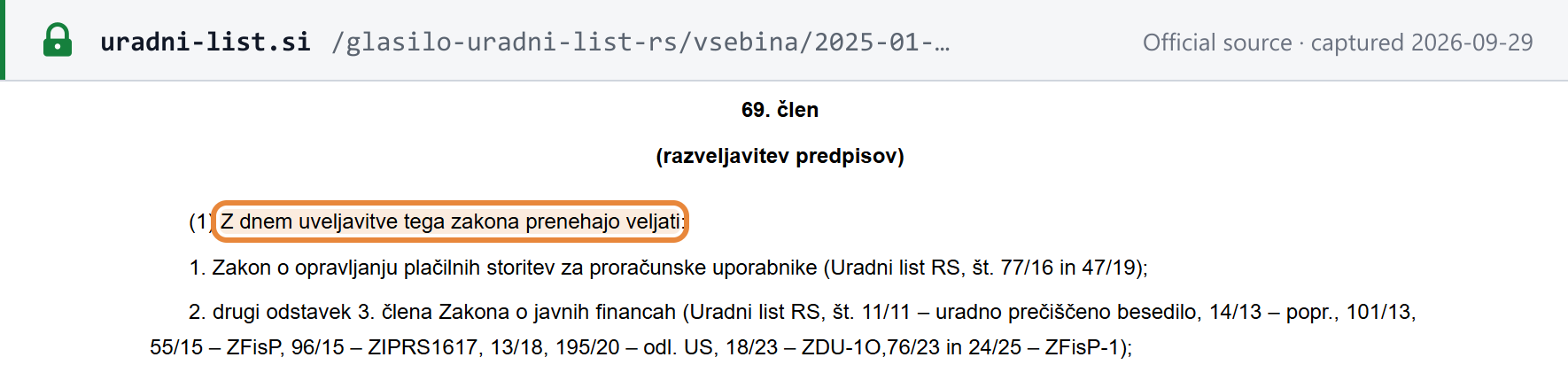
ZPJS — Zakon o plačilnih in javnofinančnih storitvah (Payment and Public Finance Services Act), published in Uradni list RS 85/2025 (item 3030) alongside ZIERDED and in force 21 November 2025. Arts. 44–50 are now the B2G e-invoicing rules; ZPJS transposes Directive 2014/55/EU on e-invoicing in public procurement. [2]
-
ZOPSPU-1 (Uradni list RS 77/2016, 47/2019), the previous B2G basis, was repealed by ZPJS Art. 69(1) with effect from 21 November 2025. ZOPSPU-A (Uradni list RS 111/2013) introduced mandatory B2G e-invoicing from 1 January 2015.
 Source snapshot captured 2026-09-29 — original
 -
Pravilnik o načinu izmenjave elektronskih računov prek enotne vstopne in izstopne točke pri UJP (Uradni list RS 32/2019), the B2G exchange rulebook. ZPJS repeals it but keeps it applying until the new regulations under ZPJS Art. 46(5) and Art. 52(4) start to apply; no successor had been published as of 30 September 2026. It accepts e-SLOG and EN 16931 syntaxes on the Commission list and lists the B2G channels, including e-SENS and PEPPOL. [5]
-
ZDavPR — Zakon o davčnem potrjevanju računov (Fiscal Verification of Invoices Act), Uradni list RS 57/2015, amended by 69/17, 3/22, 40/23 and 100/24 (per FURS's August 2026 guide). It governs real-time verification of cash invoices, not e-invoicing. [3]
-
ZDDV-1 (VAT Act) Art. 82 sets the invoice content; ZIERDED Art. 6 applies it to e-invoices. See Lookuptax's Slovenia VAT guide, Invoice requirements.
-
e-SLOG, the national standard, is published by the Chamber of Commerce and Industry of Slovenia (GZS). ZIERDED Art. 5(3) names GZS as the publisher of the standards and of the latest e-SLOG version once the National e-Invoice Forum confirms it.
Scope
B2B: who is covered
The duty in Art. 7(1) is addressed to business entities (poslovni subjekti), who "izmenjujejo" (exchange) e-invoices for supplies between them made in Slovenia. Read with the recipient-list rules elsewhere in the Act (every recipient is recorded on UJP's recipient list with the standard it receives, Art. 12(4), and its provider keeps that record up to date, Art. 16), the duty covers the recipient as well as the issuer. Art. 2, point 1 defines business entities as "vse enote Poslovnega registra Slovenije ter fizične osebe, ki opravljajo dejavnost in niso samostojni podjetniki" (all units of the Slovenian Business Register and natural persons carrying on an activity who are not sole traders under the Companies Act). That covers companies, sole traders (s.p.), branches entered in the Business Register, public bodies registered there and self-employed professionals. ZIERDED sets no turnover threshold and no exemption for small businesses or for businesses outside the VAT system.
 Source snapshot captured 2026-09-29 — original
What counts as an e-invoice. Art. 2, point 4 defines an e-račun as an invoice or any equivalent accounting document, whatever it is called — "dobropis, bremepis, avansni račun, zahtevek za plačilo, obračun negativnih obresti in podobno" (credit note, debit note, advance invoice, payment request, negative-interest statement and the like) — "izdana, poslana in prejeta v strukturirani elektronski obliki, ki omogoča samodejno in elektronsko obdelavo" (issued, sent and received in a structured electronic form that allows automatic and electronic processing). Credit notes and advance invoices are therefore in scope. The Act does not mention PDFs; on the Act's definition in Art. 2, point 4, a PDF is not a structured form that allows automatic processing, so it does not qualify as an e-račun.
Non-established businesses
No official guidance has been published on whether foreign businesses are covered. The Act applies to business entities as defined in Art. 2, point 1 and to supplies "opravljene v Sloveniji" (made in Slovenia). It does not say how that applies to a foreign company that is registered for VAT in Slovenia but has no Slovenian branch, and neither FURS, UJP nor the Ministry of Finance has addressed the question; no guidance had been published as of 30 September 2026. No official source has said either what a Slovenian recipient must do with an invoice from such a supplier. A Slovenian branch (podružnica) is a unit of the Business Register. If you invoice Slovenian businesses from abroad, wait for the implementing regulations and FURS guidance before planning on either answer.
Excluded transactions
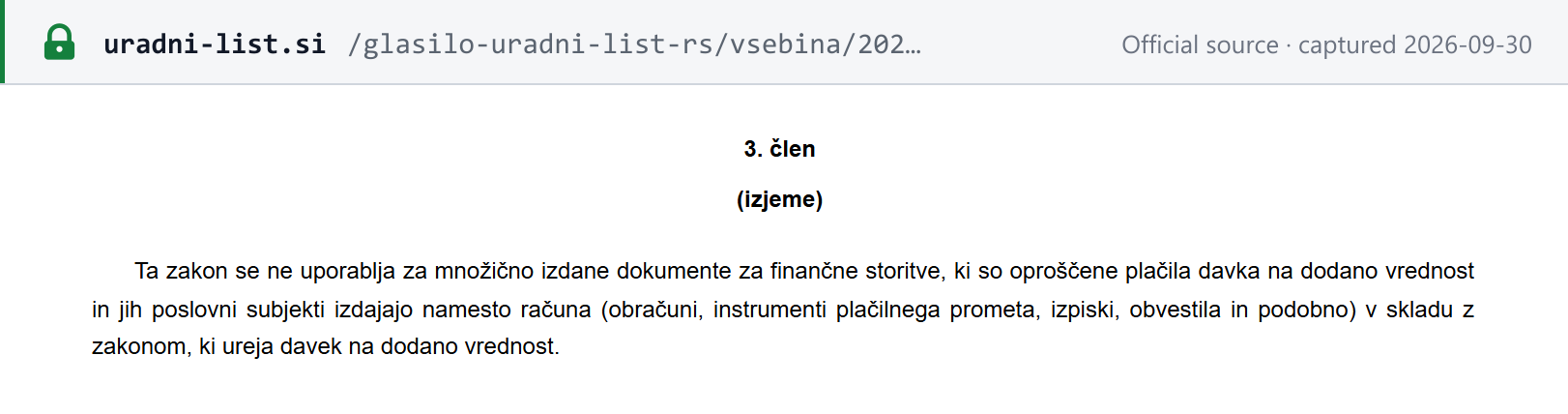
Art. 3 contains the only statutory exclusion: mass-issued documents for VAT-exempt financial services that are issued instead of an invoice (statements, payment instruments, bank statements, notices and the like). ZIERDED contains no exemption for cash transactions, no de-minimis or turnover threshold and no carve-out for imports or reverse-charge supplies. Art. 7(1) covers supplies "opravljene v Sloveniji" (made in Slovenia), so supplies made outside Slovenia are not covered; for foreign suppliers making supplies in Slovenia, see Non-established businesses.
 Source snapshot captured 2026-09-30 — original
B2B invoices paid in cash or by card. No official guidance has been published on how the B2B mandate interacts with fiscal verification. An invoice paid in cash or by card must be verified by FURS in real time under ZDavPR (see B2C). For public-sector buyers, ZPJS Art. 50 exempts invoices issued in cash transactions from e-invoicing; ZIERDED has no equivalent exemption, and no official text says whether a cash-paid B2B invoice must also be exchanged as an e-invoice from 2028 (none had been published as of 30 September 2026).
Simplified invoices. ZIERDED sets no separate regime or value threshold for simplified invoices; invoice content follows the VAT Act (Art. 6).
B2G
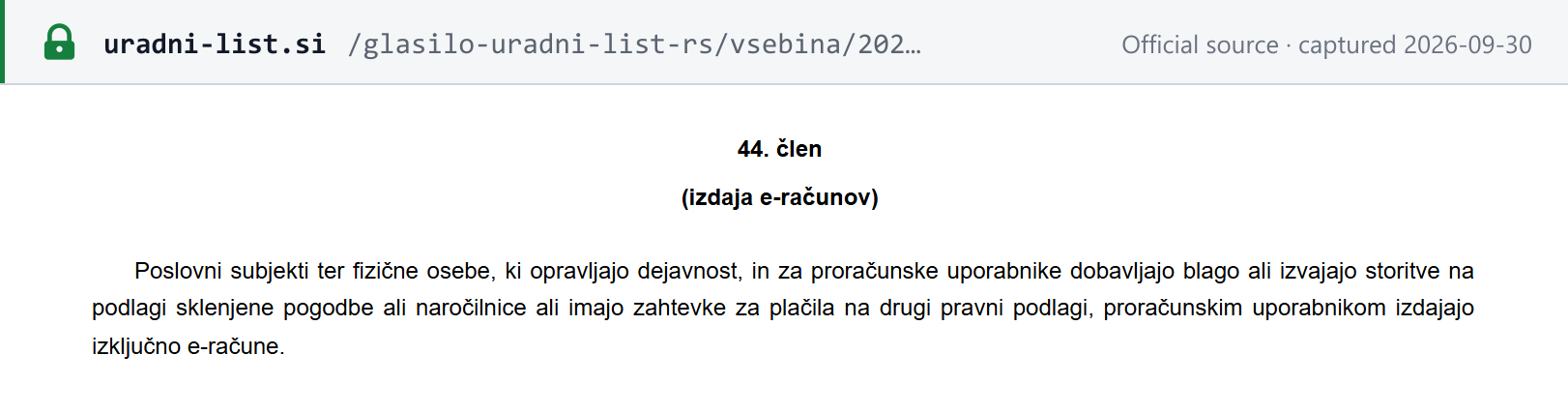
B2G e-invoicing has been mandatory since 1 January 2015 and does not change in 2028. Under ZPJS Art. 44, businesses and self-employed persons supplying budget users "proračunskim uporabnikom izdajajo izključno e-račune" (issue exclusively e-invoices to budget users). E-invoices are exchanged with budget users only through UJP (Art. 46(1)), either with UJP's web application or through participants contracted with UJP (Art. 46(2)). [2]
 Source snapshot captured 2026-09-30 — original
- Formats: e-SLOG or an EN 16931 syntax on the Commission list (Art. 45(1)); e-SLOG is mandatory only for other e-documents (Art. 45(2)).
- Contracting authorities (naročniki) must accept EN 16931 e-invoices from domestic and foreign contractual partners (Art. 48); refusing costs EUR 2,500–10,000 (Art. 60).
- Exemptions (Art. 50): classified defence and security procurement; health-insurance (ZZZS) billing by healthcare providers, care homes and long-term-care providers; treasury (EZRLKV) documents; invoices issued in cash transactions; and mass-issued documents for VAT-exempt financial services.
- Existing UJP contracts with exchange providers continue under Art. 46(2) (Art. 67).
B2C
E-invoices to consumers are voluntary. Under ZIERDED Art. 8, a business sends a consumer an e-invoice only "če se stranki o tem predhodno izrecno dogovorita" (if the parties have expressly agreed in advance), and the business must be able to prove the agreement. It must attach a visualisation in a standard format, and the consumer can ask for paper at any time. Consumers may receive e-invoices through a receiving service, by e-mail or in the business's own app; the e-mail ban applies only between businesses and providers.
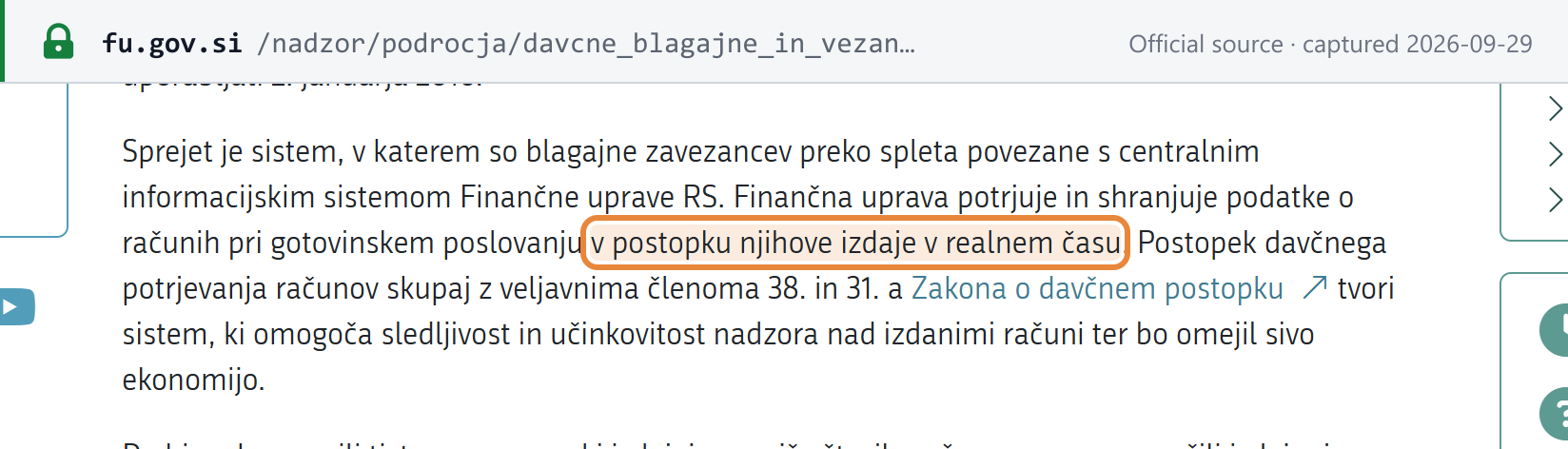
Separately, fiscal cash registers (davčne blagajne) have been mandatory since 2 January 2016 (ZDavPR Art. 24). The seller sends the data of every invoice paid in "cash" to FURS, signed with a free certificate issued by the ministry responsible for public administration (ZDavPR Art. 4(2)) and requested through FURS's eDavki portal, and FURS returns a unique invoice identifier (EOR) in real time. The invoice carries the EOR and the issuer's protective mark (ZOI). "Cash" in ZDavPR Art. 2, point 4 means any payment that is not a direct transfer to a transaction account, so it includes payment cards and cheques. The rule turns on how the invoice is paid, not on whether the buyer is a consumer. [3] [6]
 Source snapshot captured 2026-09-29 — original
 Source snapshot captured 2026-09-29 — original
Format & network
CTC model: decentralised interchange
Slovenia uses decentralised interchange. The e-invoice goes from the issuer to the recipient through one of the permitted channels, and no government platform validates, stamps, numbers or returns it. ZIERDED contains no provision for clearance, for transmitting invoice data to FURS, or for a QR code, hash or cryptographic stamp. The unique identification number that providers must give each e-invoice (Art. 17(1)) is a transport reference, not a tax clearance ID. FURS supervises the duty to exchange e-invoices after the fact (Art. 23(3)).
The only real-time reporting in Slovenia is the fiscal verification of cash and card invoices under ZDavPR, described under B2C. There is no e-reporting alongside B2B or B2G e-invoicing.
Formats: e-SLOG, EN 16931 syntaxes, or a contractual standard
Art. 5(1) permits three options:
- e-SLOG, the national standard published by GZS;
- a syntax compliant with EN 16931 that is on the European Commission's implementing-decision list (in practice UBL 2.1 and UN/CEFACT CII; the Act refers only to "the list");
- another internationally established standard, if the issuer and recipient agreed it in advance in their contract.
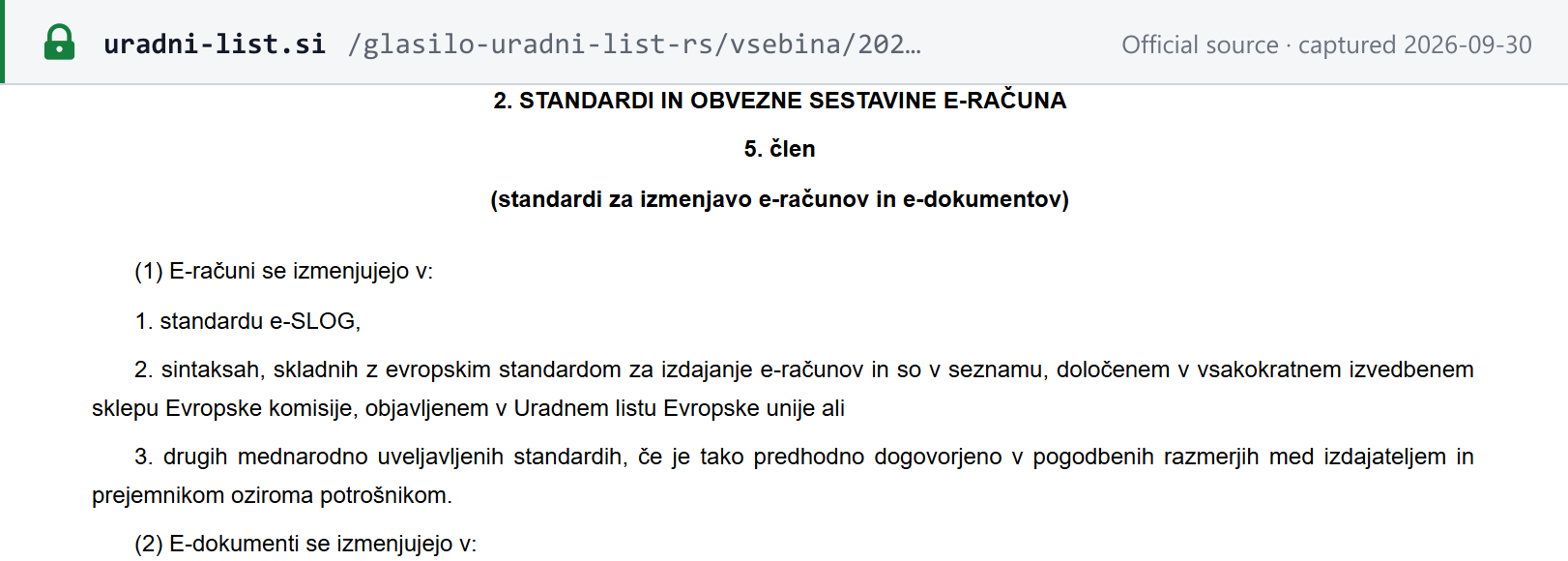
Where the two parties use different standards, the issuer's e-route provider converts the invoice into the syntax the recipient receives (Art. 5(4)). The free FURS application accepts only options 1 and 2 (Art. 7(3)). Orders, delivery notes and other e-documents use e-SLOG or a contractually agreed standard (Art. 5(2)). Invoice content follows the VAT Act (Art. 6).
 Source snapshot captured 2026-09-30 — original
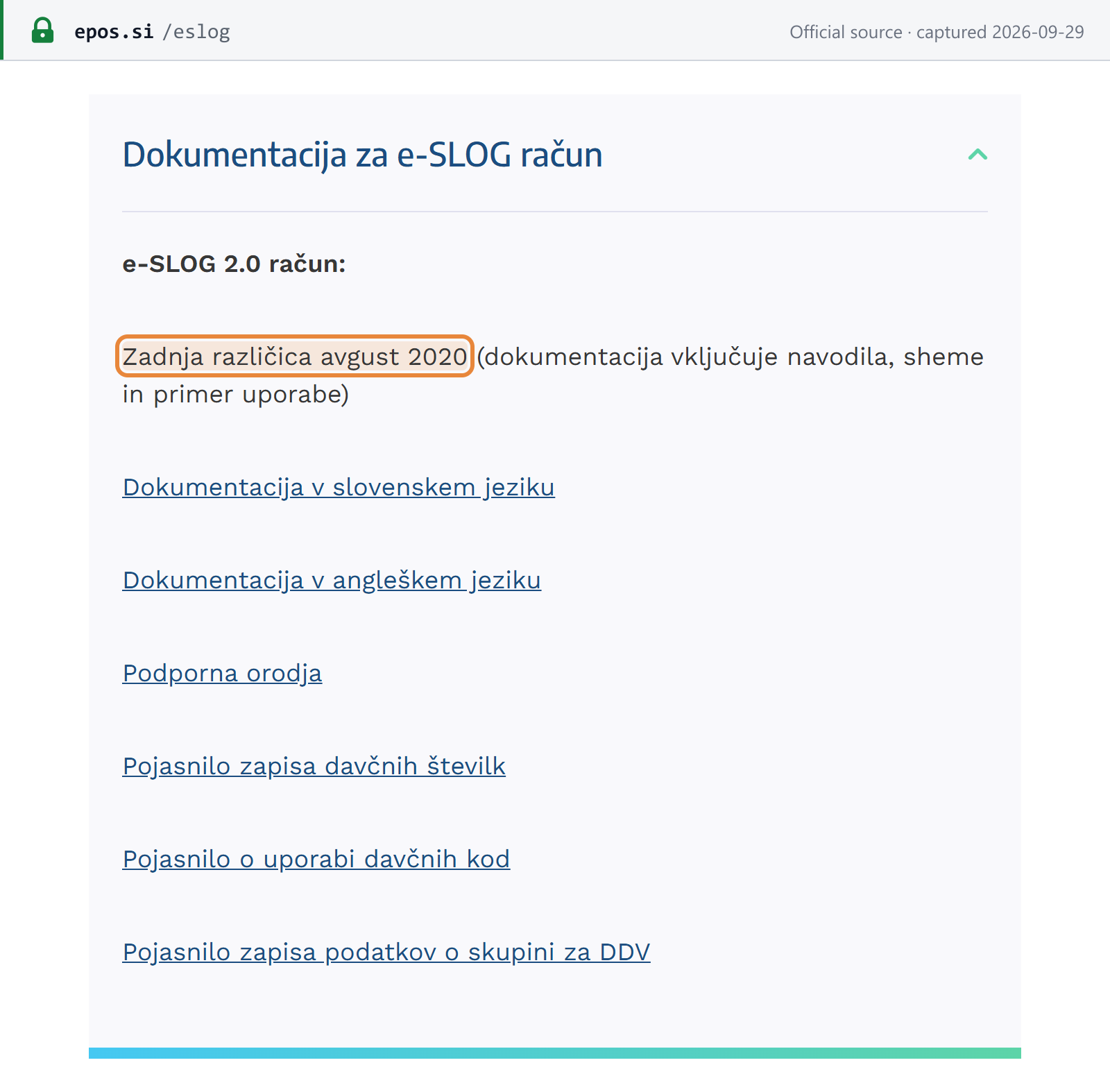
Current e-SLOG version: e-SLOG 2.0. GZS's Centre for e-Business (ePOS) gives the latest release of the e-SLOG 2.0 invoice as August 2020. (GZS — epos.si, checked 2026-09-29) Version 2.0, which replaced e-SLOG 1.6, was prepared in 2018 under the ROSE project to comply with EN 16931. (GZS — projekt ROSE) For invoices to budget users, ZPJS Art. 45(1) allows either e-SLOG or an EN 16931 syntax; e-SLOG is mandatory there only for other e-documents (Art. 45(2)).
 Source snapshot captured 2026-09-29 — original
VAT groups. VAT groups have been available since 1 January 2026. UJP announced on 6 August 2026 that GZS has published how group and member data are written into an e-SLOG 2.0 e-invoice. (UJP, checked 2026-09-29)
Network: four channels, no e-mail
Under Arts. 9 and 11, business entities exchange e-invoices through one of four channels. Art. 9(1) lists the first three; the FURS application comes from Art. 9(3) and (5) and Art. 11:
| Channel | What it is | Condition |
|---|---|---|
| E-route providers (ponudniki e-poti) | Service providers entered on UJP's list | Registered by UJP from 1 April 2027; list established 1 October 2027 |
| Peppol | The Peppol network or certified Peppol access points | — |
| Direct exchange | The businesses' own systems exchanging with each other | Both issuer and recipient must consent, and both must meet the quality points in Art. 17(1) items 2, 3, 4, 6 and 8 |
| Free FURS application | FURS's app, routed through UJP as the single entry and exit point | For taxpayers with few, simple or repetitive transactions; formats e-SLOG or EN 16931 only |
Art. 9(1) states: "Izmenjava e-računov in e-dokumentov med poslovnimi subjekti in ponudniki e-poti ni dovoljena po elektronski pošti." (Exchange of e-invoices and e-documents between business entities and e-route providers by e-mail is not permitted.) Every business must have chosen at least one e-route provider; if it uses the FURS application, UJP performs that role (Art. 9(3)). A business may use several providers.
 Source snapshot captured 2026-09-29 — original
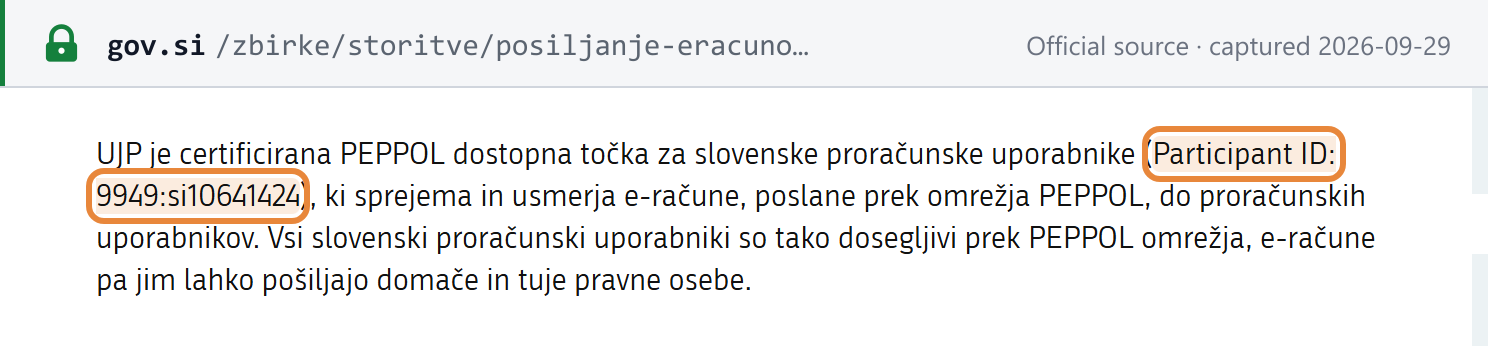
Peppol. Peppol is one permitted channel, not the whole system. No official source has said whether a Peppol access point also counts as the "chosen e-route provider" under Art. 9(3), which Peppol participant identifier scheme Slovenian B2B endpoints will use, or whether Slovenia will appoint a Peppol Authority; none had been published as of 30 September 2026. For B2G, UJP is the certified Peppol access point for all Slovenian budget users, with participant ID 9949:si10641424, and domestic and foreign legal persons can send to them over Peppol. (UJP, checked 2026-09-29)
 Source snapshot captured 2026-09-29 — original
Archiving
| Who | What | How long | Source |
|---|---|---|---|
| Issuer and recipient (not consumers) | The e-invoice | As the VAT and accounting rules require: 10 years, or 20 years for invoices relating to immovable property | ZIERDED Art. 18(1); FURS VAT guide [7] |
| FURS application | E-invoices sent or received through it | 5 years from issue or receipt | ZIERDED Art. 18(2) |
| E-route providers | The e-invoice | Deleted after successful delivery, unless longer storage is agreed | ZIERDED Art. 18(3)–(4) |
| Providers, UJP, direct-exchange businesses | Traffic and conversion data | 2 years | ZIERDED Art. 19(1) |
| Providers, UJP, direct-exchange businesses | Return messages | 5 years | ZIERDED Art. 19(3) |
The FURS application keeps e-invoices for five years (Art. 18(2)), but VAT law requires you to keep invoices for ten years (twenty for immovable property). If you use the app, download and archive your invoices yourself for the full VAT period. Providers are no fallback: they delete an invoice once it is delivered unless you agree longer storage.
 Source snapshot captured 2026-09-29 — original
Onboarding: how to comply
Steps for a Slovenian business before 1 January 2028
- Check your invoicing flows. Every invoice, credit note and advance invoice you send to or receive from another business for a supply in Slovenia must become a structured e-invoice. Invoices to consumers and supplies made outside Slovenia are outside the B2B duty; foreign suppliers should read Non-established businesses.
- Choose a channel. Pick one or more e-route providers from UJP's list once it exists (1 October 2027), connect over Peppol, agree direct exchange with a trading partner, or use the free FURS application. Whatever the channel, Art. 9(3) requires you to have chosen at least one e-route provider; with the FURS application, UJP fills that role.
- Make sure you can receive. The duty binds recipients as well as issuers. Your provider records you on UJP's recipient list with your registration number, tax number and the standard you receive (Art. 12(4)), and must update that list by the next working day after your contract starts or ends (Art. 16(1)).
- Settle the format (e-SLOG 2.0 or an EN 16931 syntax) and, if you want another standard, agree it in the contract in advance.
- Stop e-mailing invoices to business customers from 1 January 2028. E-mail stays allowed for consumers who have agreed to e-invoices.
- Plan your archive for the full ten-year VAT retention period, especially if you use the FURS application, which keeps invoices for only five years.
The implementing regulations due by about December 2026 will fill in the detail of provider registration and of access to the FURS application. Until they are published (none had been as of 30 September 2026), treat any vendor claim of "ZIERDED certification" with care: UJP cannot register providers before 1 April 2027.
The free FURS application (MiniBLAGAJNA)
ZIERDED Art. 11 gives businesses a free application from the tax authority, "primerno za zavezance z manjšim številom transakcij ali za zavezance z enostavnimi oziroma ponavljajočimi se transakcijami" (suitable for taxpayers with few transactions or with simple or repetitive transactions). Exchange through it runs via UJP as the single entry and exit point, and it accepts only e-SLOG and EN 16931 syntaxes.
 Source snapshot captured 2026-09-29 — original
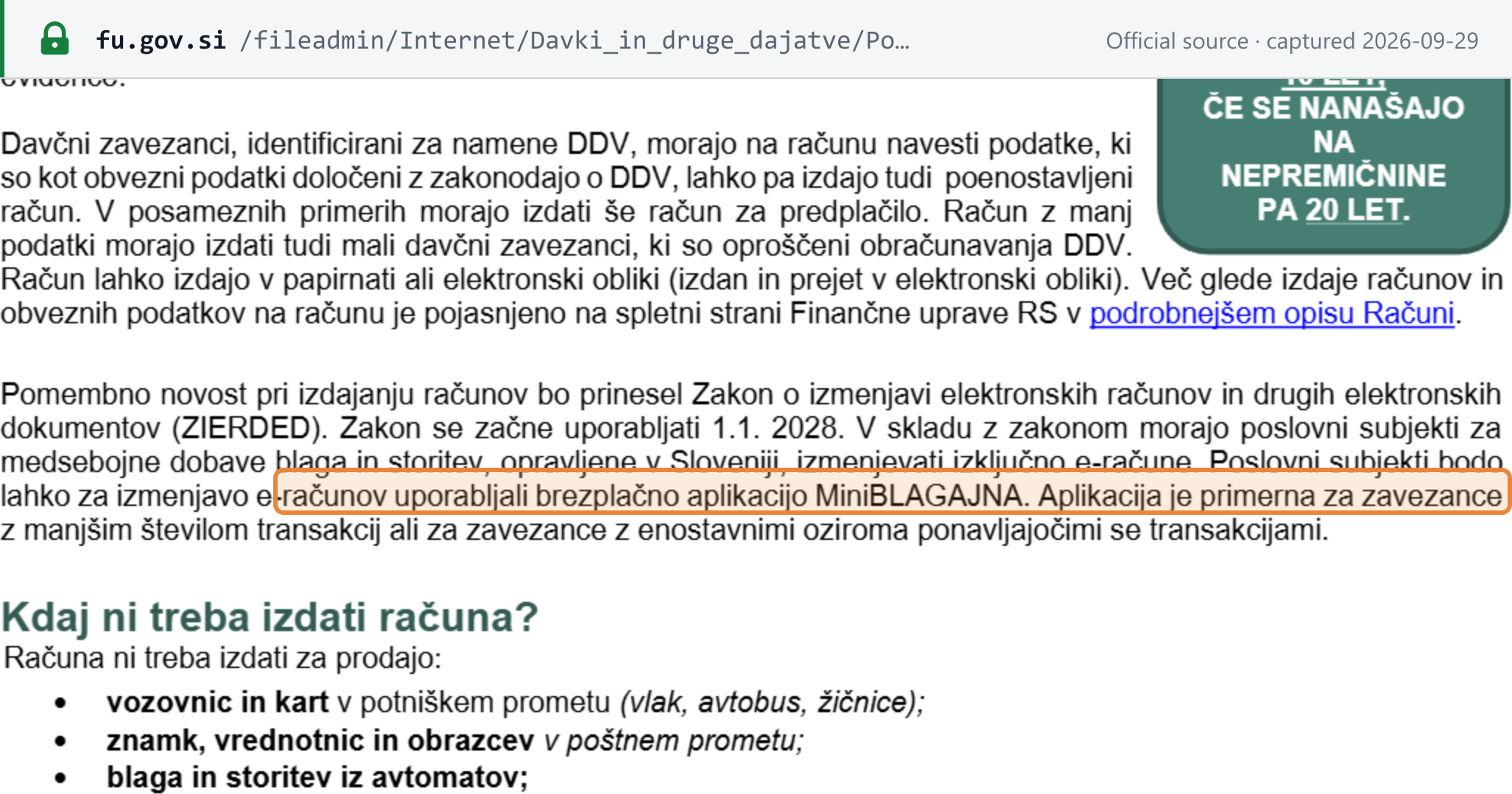
FURS's guidance for new businesses names it: "Poslovni subjekti bodo lahko za izmenjavo e-računov uporabljali brezplačno aplikacijo MiniBLAGAJNA." (Business entities will be able to use the free MiniBLAGAJNA application to exchange e-invoices.) MiniBLAGAJNA is FURS's existing free cash-register app. FURS has not yet published volume limits, onboarding steps, a launch or test date, or whether businesses outside the VAT system can use it; those depend on the Art. 11(5) regulation; none had been published as of 30 September 2026. (FURS — Davki za začetnike, checked 2026-09-29)
 Source snapshot captured 2026-09-29 — original
Registration of e-route providers
From 1 April 2027 UJP enters a provider on its list by decision (odločba) once it ensures the service quality required by Art. 17(1) and passes UJP's tests of exchanging e-invoices and return messages and of exchanging data with the list (Art. 13). UJP publishes the list on its website (Art. 12(1)). Each entry shows the provider's code, registration number, name and address, type of service, its recipient list and a link to its terms.
A registered provider must, among other things (Art. 17(1)):
- publish its terms of service;
- give each e-invoice a unique identification number;
- exchange securely and preserve the invoice's authenticity and integrity in transit;
- interconnect openly with other providers, including across different standards;
- send automatic delivery receipts and content acceptance or rejection messages;
- deliver e-invoices at the latest the next working day.
UJP strikes off a provider that ceases to exist, keeps its recipient data out of date, falls below the quality standard or can no longer exchange with UJP (Art. 14(2)). Refusals and strike-offs cannot be appealed within the administration; only an administrative dispute (upravni spor) is available (Arts. 13(7), 14(3)). The Act sets no term or expiry for a registration. Offering exchange services without being on the list costs a legal person EUR 1,000–3,000 from 1 January 2028 (Art. 24(1), point 3).
The providers that already hold B2G contracts with UJP are a different list. UJP's "Seznam bank in ponudnikov elektronske poti", last changed on 28 September 2026, lists 77 banks and providers; it is not the ZIERDED Art. 12 list, which starts on 1 October 2027. (UJP provider list, PDF, checked 2026-09-29)
B2G: sending e-invoices to budget users
| Sender | Channels |
|---|---|
| Legal persons | A provider contracted with UJP; the UJPeRačun portal; or Peppol (UJP access point 9949:si10641424) |
| Natural persons | The UJPeRačun portal only |
Issuers can send at most 100 e-invoices a year through UJPeRačun, and access requires a qualified Slovenian digital certificate or SI-PASS. (UJP's English page still says 60; the Slovenian page, which carries the current ZPJS legal basis, says 100.) (UJP, checked 2026-09-29)
 Source snapshot captured 2026-09-29 — original
Testing and connection modes
No official test environment for B2B exchange under ZIERDED had been published as of 30 September 2026; UJP's provider tests start with Chapter 4 on 1 April 2027. To check an e-SLOG file today, use UJP's e-invoice structure check.
| Mode | Suits |
|---|---|
| E-route provider (API, EDI or ERP connector, as the provider offers) | Most businesses; the provider converts between standards |
| Peppol access point | Businesses already on Peppol, including those trading across the EU |
| Direct exchange | Large trading partners with their own integration, by mutual consent |
| FURS application (MiniBLAGAJNA) | Businesses with few, simple or repetitive invoices |
| UJPeRačun portal (B2G only) | Occasional suppliers to the public sector, up to 100 e-invoices a year |
Penalties
All ZIERDED fines apply from 1 January 2028 (Art. 28(1)). Chapter 4, which applies from 1 April 2027, covers only Arts. 12–17 (the provider list and provider duties); the penalty provisions are in Chapter 9 and apply from 2028, including the fine for acting as an unlisted provider.
| Offence | Legal person | Sole trader / self-employed | Responsible person |
|---|---|---|---|
| Art. 24(1): not exchanging e-invoices as Art. 7(1) requires; exchanging contrary to the Art. 9(1) channel rules, including by e-mail; providing exchange services while not on the provider list; not keeping traffic, conversion or return-message data (Art. 19) | EUR 1,000–3,000 | EUR 500–1,500 | EUR 100–500 |
| Art. 25(1), B2C: sending a consumer an e-invoice without prior express agreement; no visualisation attached; refusing paper on request | EUR 500–1,500 | EUR 100–500 | EUR 50–250 |
 Source snapshot captured 2026-09-29 — original
Who enforces (Art. 23). FURS supervises Art. 7(1), the duty to exchange e-invoices (Art. 23(3)). UJP supervises the channel, provider-list, recipient-record, quality and data-retention rules (Arts. 9, 10, 12(1), 16, 17(1) and 19). The Market Inspectorate supervises B2C (Art. 8). Because the Art. 7(1) duty is to "exchange", read with the recipient-list rules in Arts. 12(4) and 16, it covers both issuer and recipient; the Act sets no separate fine for failing to receive. No grace period or enforcement tolerance had been announced as of 30 September 2026.
B2G. A contracting authority that refuses an EN 16931 e-invoice faces EUR 2,500–10,000 (ZPJS Art. 60).
Fiscal cash registers (ZDavPR). Failing to verify a cash or card invoice in real time is a serious tax offence. FURS's August 2026 guide gives these ranges in EUR:
| Offender | Tax offence (Art. 18) | Serious (Art. 19) | Particularly serious (Art. 20) |
|---|---|---|---|
| Medium or large legal person | 5,000–75,000 | 10,000–125,000 | up to 150,000 |
| Other legal person | 2,000–50,000 | 4,000–75,000 | up to 100,000 |
| Sole trader / self-employed | 1,500–25,000 | 3,000–50,000 | up to 75,000 |
| Responsible person | 800–5,000 | 1,200–10,000 | up to 20,000 |
"Serious" offences include not verifying an invoice, not issuing it on time and not using the bound invoice book when the device fails. A buyer who does not take the receipt can be fined EUR 40 (Art. 17). (FURS — Davčne blagajne in davčno potrjevanje računov, 4th ed., August 2026, checked 2026-09-29)
Frequently asked questions
Can we keep e-mailing PDF invoices to Slovenian business customers after 1 January 2028?
No. From 1 January 2028, ZIERDED Art. 7(1) requires businesses to exchange exclusively structured e-invoices for supplies to each other made in Slovenia, and Art. 9(1) forbids exchanging them by e-mail. A legal person that breaches either rule faces a fine of EUR 1,000 to 3,000. You can still e-mail invoices to consumers who have agreed to receive e-invoices (Art. 8(4)). (ZIERDED, Uradni list RS 85/2025, checked 2026-09-29)
Do we have to pay for an e-route provider?
Not necessarily. ZIERDED Art. 11 provides a free application from FURS, which FURS calls MiniBLAGAJNA, for businesses with few, simple or repetitive transactions. If you use it, UJP acts as your chosen e-route provider (Art. 9(3)). It accepts only e-SLOG and EN 16931 formats, and it keeps invoices for only five years, so you must archive your own copies for the ten-year VAT period. FURS has not yet published its access conditions. (ZIERDED; FURS, checked 2026-09-29)
Is Peppol enough to comply?
Peppol is one of the four permitted channels in ZIERDED Arts. 9 and 11, alongside registered e-route providers, direct exchange with both parties' consent and the free FURS application. Art. 9(3) also requires every business to have chosen at least one e-route provider, and no official source has yet said whether a Peppol access point counts as that provider. The implementing regulations due by about December 2026 had not been published as of 30 September 2026. (ZIERDED, checked 2026-09-29)
Does FURS receive a copy of our B2B invoices?
No. ZIERDED contains no clearance and no e-reporting: invoices travel between the parties, and FURS supervises the e-invoicing duty after the fact (Art. 23(3)). The only real-time reporting in Slovenia is the fiscal verification of invoices paid in cash or by card under ZDavPR, in force since 2 January 2016. (ZIERDED)
We are a foreign company with a Slovenian VAT number. Are we covered from 2028?
No official guidance had been published on this as of 30 September 2026. ZIERDED applies to "business entities", defined in Art. 2, point 1 as units of the Slovenian Business Register and self-employed natural persons, and to supplies made in Slovenia. FURS, UJP and the Ministry of Finance have not said how this applies to a foreign company with only a Slovenian VAT registration, or what a Slovenian customer must do with its invoices. A Slovenian branch is a unit of the Business Register.
Does anything change in 2028 for e-invoices to public bodies?
No. Suppliers to budget users have had to send e-invoices only, through UJP, since 1 January 2015. Since 21 November 2025 the rule sits in ZPJS Art. 44, which replaced the repealed ZOPSPU-1. Legal persons send through a provider contracted with UJP, the UJPeRačun portal (at most 100 e-invoices a year) or Peppol, where UJP's participant ID is 9949:si10641424. (ZPJS, Uradni list RS 85/2025; UJP, checked 2026-09-29)
Recent changes
- 2025-12-06 — ZIERDED (Uradni list RS 85/2025) entered into force: structured e-invoices become the only permitted invoices between Slovenian businesses from 1 January 2028, with the e-route provider rules applying from 1 April 2027. (Uradni list RS) — see event · issue
Ahead — scheduled changes that have not yet taken effect:
- 2027-04-01 — Chapter 4 of ZIERDED applies: UJP can register e-route providers; the list is established on 1 October 2027. (Uradni list RS)
- 2028-01-01 — Exclusive B2B e-invoicing applies under ZIERDED Art. 7(1). (Uradni list RS) — see event
For the full chronology, see Slovenia tax changes on Lookuptax.
Related resources
- Slovenia VAT guide — rates, registration, invoice content, retention and fiscal cash registers
- E-invoicing status and networks worldwide — Slovenia's row in global context
- Slovenia tax-change chronology — every tracked Slovenian change, dated and sourced
- Validate a Slovenian VAT (DDV) number
- How to verify an EU VAT number (VIES) — for supplies made outside Slovenia, which ZIERDED does not cover
- Peppol network explainer — one of the four ZIERDED channels
- ViDA — VAT in the Digital Age — ZIERDED transposes part of Directive (EU) 2025/516
- Neighbouring mandates for comparison: Croatia, Belgium
Important websites
- UJP — Sending e-invoices (Pošiljanje e-računov) — B2G channels, UJPeRačun, Peppol access point
- UJPeRačun portal — web entry for B2G e-invoices (up to 100 a year)
- UJP list of banks and e-route providers (PDF) — current B2G contract list
- UJP e-invoice structure check — validate an e-SLOG file
- GZS / ePOS — e-SLOG documentation — e-SLOG 2.0 specifications, schemas and guidance
- FURS — miniBLAGAJNA — the free app FURS names for e-invoice exchange
- FURS — Fiscal cash registers — real-time verification of cash and card invoices
- PISRS — ZIERDED and PISRS — ZPJS — consolidated texts; implementing regulations will appear here
Reference links
- Uradni list RS 111/2013 — ZOPSPU-A (B2G e-invoices from 2015)
- Uradni list RS 85/2025, item 3030 — ZPJS (B2G, Arts. 44–50; repeal of ZOPSPU-1)
- Uradni list RS 57/2015 — ZDavPR (fiscal verification of invoices)
- Uradni list RS 85/2025, item 3032 — ZIERDED
- Uradni list RS 32/2019 — Pravilnik on B2G exchange through UJP
- FURS — Fiscal cash registers and fiscal verification
- FURS — General VAT description (.doc), invoice retention
- FURS — Davki za začetnike (PDF), MiniBLAGAJNA for e-invoices
- FURS — Davčne blagajne in davčno potrjevanje računov, 4th ed., August 2026 (.docx)
- GZS / ePOS — e-SLOG
- UJP — Pošiljanje e-računov
- UJP — VAT-group data in an e-SLOG 2.0 e-invoice, 6 August 2026