E-invoicing in Bulgaria: consent-based today, clearance proposed for 2028
Overview
Bulgaria has no B2B or B2C e-invoicing mandate and no clearance or real-time reporting system in force. Under the VAT Act (Закон за данък върху добавената стойност, ЗДДС) an electronic invoice is optional: supplies may be documented by e-invoices "при условие че това документиране се приема от получателя с писмено или мълчаливо съгласие" (provided the recipient accepts this by written or tacit consent) (art. 114(9)). The consolidated VAT Act, current to State Gazette 115/2025, contains no e-invoicing obligation and no clearance system. (ЗДДС, consolidated text hosted by ДАМТН, checked 2026-09-30)
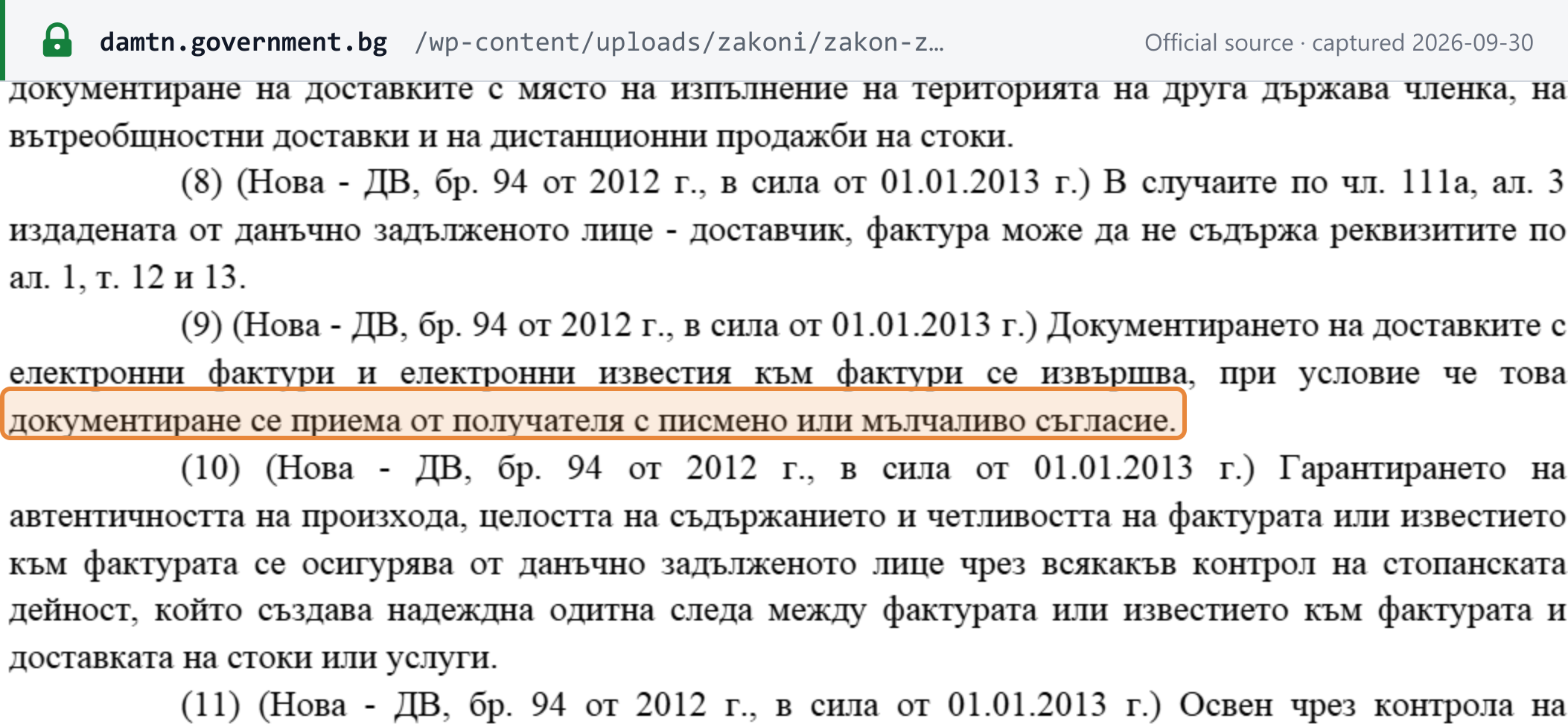 Source snapshot captured 2026-09-30 from the consolidated text (Ciela export of 09.07.2026) — original
Two layers sit on top of that baseline:
- B2G, in force. Since 1 November 2019 contracting authorities must accept and process e-invoices that meet the European standard EN 16931 (Public Procurement Act, Закон за обществените поръчки, ЗОП, art. 115a). The duty falls on the public buyer. Suppliers are not obliged to send e-invoices.
- B2B and B2G supplier mandate, proposed. On 23 September 2026 the Ministry of Finance published a draft law amending the VAT Act for public consultation until 23 October 2026. It proposes that VAT-registered suppliers established in Bulgaria issue structured e-invoices that carry a unique compliance code (уникален код за съответствие) from a National Revenue Agency (Национална агенция за приходите, НАП/NRA) system from 1 January 2028. The draft has not been approved by the Council of Ministers and is not before the National Assembly. Every date, figure and rule of the draft on this page is a proposal.
The proposed system is the Национална информационна система за структурирано електронно фактуриране и цифрово отчитане (national information system for structured e-invoicing and digital reporting). The Ministry of Finance's explanatory memorandum abbreviates it НИССЕФ (NISSEF). The NRA would run it; the Ministry of Finance owns the policy. No NISSEF portal, address or sandbox is published. (Draft law, v1.0 of 23.09.2026; explanatory memorandum, checked 2026-09-30)
| Bulgaria (as at 2026-09-30) | |
|---|---|
| B2B (domestic) | No mandate. E-invoices only with the buyer's written or tacit consent (ЗДДС art. 114(9)). Proposed: mandatory structured e-invoices with NRA clearance from 1 January 2028 |
| B2G | Contracting authorities must accept and process EN 16931 e-invoices since 1 November 2019 (ЗОП art. 115a); no supplier-side duty. Proposed: supplier-side duty from 1 January 2028, including for unregistered established suppliers |
| B2C | No mandate. Proposed: supplies to individuals stay outside the mandate |
| Non-residents | No mandate. Proposed: VAT-registered suppliers not established in Bulgaria are excluded |
| Model | Today: none (consent-based exchange). Proposed: centralised clearance, invoice deemed issued when the NRA system generates the compliance code |
| Format | B2G: EN 16931 (Implementing Decision (EU) 2017/1870) "or an equivalent standard". Proposed: EN 16931, syntax to be fixed by Minister of Finance ordinance |
| Network | Not Peppol. B2G: optional central platform CAIS EOP (ЦАИС ЕОП) or each authority's own system. Proposed: delivery to the buyer on specifications agreed between the parties |
| Authority | B2G: Public Procurement Agency (АОП) runs CAIS EOP. Proposed B2B/B2G clearance: National Revenue Agency, policy by the Ministry of Finance |
| Legislation | ЗДДС art. 113(12), 114(6)–(11), 121; ЗОП art. 36(3), 39a and 115a (State Gazette 86/2018, 107/2020). Draft ZID na ZDDS (consultation 12733-K) |
Mandate status & timeline
Status (as at 2026-09-30): no B2B or B2C mandate in force. B2G receive-and-process duty in force since 1 November 2019. Supplier-side structured e-invoicing proposed from 1 January 2028, in public consultation until 23 October 2026, not law.
| Date | Scope | What | Status | Legal basis |
|---|---|---|---|---|
| 1 January 2013 | B2B, B2C, all | E-invoices allowed with the recipient's written or tacit consent; authenticity and integrity by business controls | in force | ЗДДС art. 114(9)–(11), State Gazette 94/2012 [1] |
| 1 March 2019 | B2G | Public Procurement Act definition of "electronic invoice": a structured format that allows automatic processing | in force | ЗОП § 2 item 10a, State Gazette 86/2018 [2] |
| 1 November 2019 | B2G, all contracting authorities | Authorities must accept and process EN 16931 e-invoices; suppliers are not obliged to send them | in force (passed) | ЗОП art. 115a; State Gazette 86/2018 § 65, § 141 [2] |
| 1 January 2021 | B2G | CAIS EOP mandatory for tendering; submitting and receiving e-invoices through it optional | in force | ЗОП art. 39a(4)–(5), State Gazette 107/2020 [3] |
| 23 September – 23 October 2026 | — | Ministry of Finance draft amending the VAT Act in public consultation 12733-K | consultation open | strategy.bg [4] |
| Within 6 months of promulgation | — | Minister of Finance ordinance on technical requirements (art. 120a(4)) | proposed | draft § 104 [5] |
| Intended: 6 months before go-live; start date not fixed (see note) | VAT-registered persons | NRA integration-test access to NISSEF | proposed | draft § 103 [5] |
| 1 January 2028 | Bulgaria-established VAT-registered suppliers, domestic supplies to established taxable persons, non-taxable legal persons and public bodies; unregistered established suppliers for supplies to public bodies | Mandatory structured e-invoice with NRA compliance code; real-time data transfer; buyer's input VAT denied without it; purchase and sales ledgers abolished; prefilled VAT returns; software-maker penalty | proposed | draft §§ 6–16, 33–45, 98, 105(1) [5] |
| 1 July 2028 | Issuers | Penalty for not issuing a structured e-invoice (new art. 182a) | proposed | draft § 85, § 105(2) [5] |
| 1 July 2030 | Intra-EU supplies | EU cross-border e-invoicing and digital reporting under ViDA | not transposed by this draft | Directive (EU) 2025/516 |
Latest development: the draft of 23 September 2026
The latest development is the Ministry of Finance draft law amending the VAT Act (ЗИД на ЗДДС), version 1.0 of 23 September 2026. The public-consultation portal lists consultation 12733-K as active from 23 September to 23 October 2026, with the Ministry of Finance as submitter (its tax policy directorate is the contact point). The consultation file places the draft in the Council of Ministers' legislative programme for October 2026, and shows no report on comments received and no final Council of Ministers act as at 2026-09-30. (strategy.bg — consultation 12733, checked 2026-09-30)
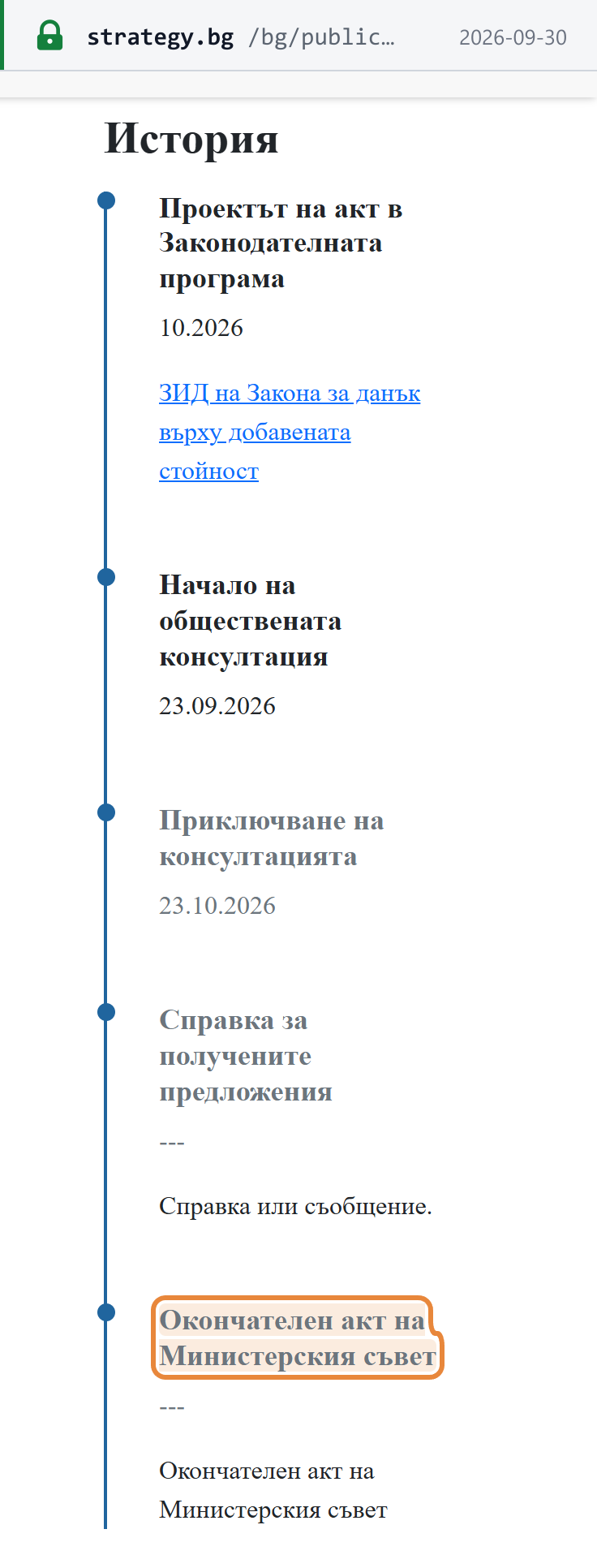 Source snapshot captured 2026-09-30 — original
The next steps are Council of Ministers approval, introduction in the Народно събрание (National Assembly), adoption, and promulgation in the State Gazette (Държавен вестник). None has happened as at 2026-09-30. The consultation is still open, no final Council of Ministers act exists, and no bill amending the VAT Act along these lines is before the National Assembly. Any point of the draft can change.
The draft's commencement clause, § 105, brings the Act into force on 1 January 2027 for other measures (among them the proposed EUR 75,000 registration threshold). It holds back the e-invoicing block until 1 January 2028, and the issuer penalty in art. 182a until 1 July 2028. The draft applies one start date to everyone in scope: there is no phasing by size or turnover. The 1 July 2028 date defers only the art. 182a fine. The obligation itself, the input-VAT denial and the software-maker penalty would all start on 1 January 2028.
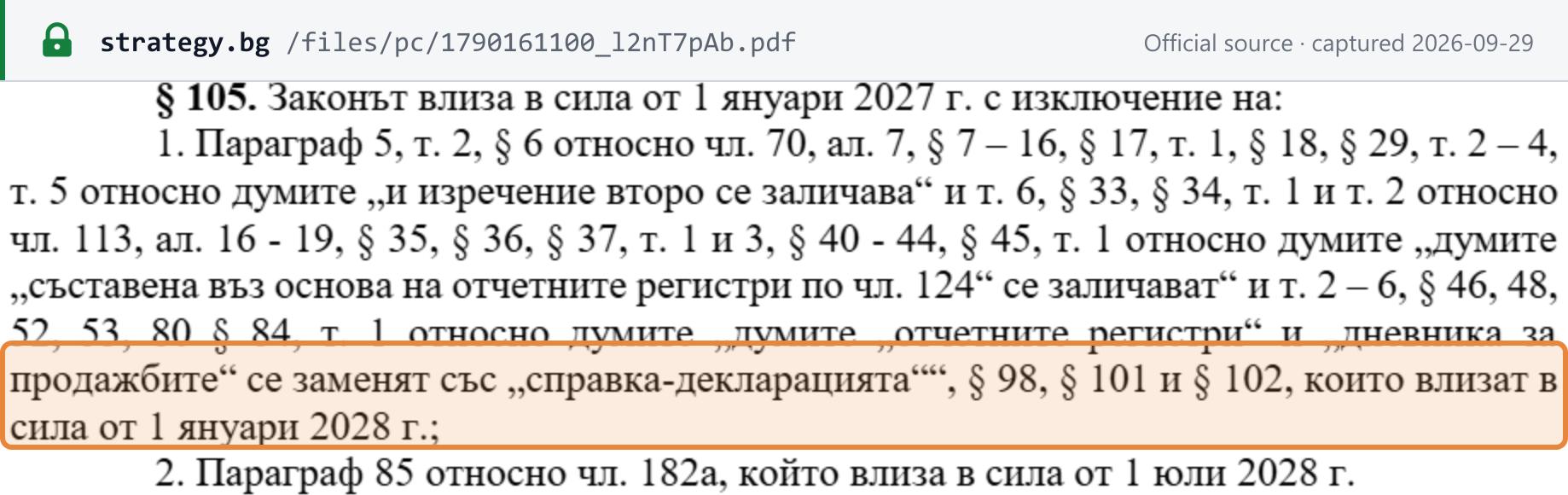 Source snapshot captured 2026-09-29 — original
Transitional rules (proposed, draft §§ 101–102). The VAT return, VIES declaration and ledgers for December 2027 are filed under the old rules. Where the chargeable event falls on or before 31 December 2027 but the invoice is issued after 1 January 2028, a structured e-invoice must be issued. An advance received before 2028 for a supply chargeable after 1 January 2028 is invoiced with a structured e-invoice for the full taxable amount. (Draft, pp. 19–20, checked 2026-09-30)
Test window note. Draft § 103 intends a 6-month NRA integration-test window before go-live, but its start date is not fixed: § 103 runs the 6 months "before the entry into force of § 104, item 1", and § 104 has no item 1 (it is a single sentence on the ordinance). Watch the post-consultation text for a correction.
Postponements
None. The European Commission's Bulgaria eInvoicing page (last updated August 2025) already referred to an earlier consultation on a clearance model, but no e-invoicing date was ever enacted in Bulgaria, so no enacted date has been postponed. Some secondary sources describe a phased roll-out by company size. That phasing belongs to SAF-T (Standard Audit File for Tax), a separate obligation already in law and phased in from 2026 to 2030 (see the SAF-T explainer and the Bulgaria VAT guide). The e-invoicing draft has a single date.
Legal basis
In force
- VAT Act (ЗДДС), consolidated to State Gazette 115/2025. The provisions that govern
e-invoices today:
- art. 113(12): an e-invoice is deemed issued on the date the supplier, or a person acting for it, makes it available so that the customer can receive it;
- art. 114(9): e-invoices only with the recipient's written or tacit consent (in force since 1 January 2013, State Gazette 94/2012);
- art. 114(6), (10) and (11): authenticity of origin, integrity of content and legibility, by business controls with a reliable audit trail; a qualified electronic signature and EDI are example technologies;
- art. 121–122: retention and online access for the NRA. [1]
- Public Procurement Act (ЗОП), as last amended by State Gazette 71/2026 (7 August 2026).
- art. 115a: contracting authorities must accept and process e-invoices whose content meets ЗДДС art. 114(1) and which conform to the European standard approved by Commission Implementing Decision (EU) 2017/1870, "или еквивалентен стандарт, с който е въведен" (or an equivalent standard by which it is introduced);
- § 2 item 10a (supplementary provisions): an "electronic invoice" is one "issued, provided and received in a structured electronic format that allows its automatic electronic processing";
- art. 36(3) and art. 39a: the central e-procurement platform (CAIS EOP), maintained by the Public Procurement Agency (art. 36(3)), and the uses it is mandatory or optional for (art. 39a). [3]
- State Gazette 86 of 18 October 2018, the act amending the Public Procurement Act that transposed Directive 2014/55/EU. Its § 65 inserted art. 115a, and its § 141 brought § 65 into force on 1 November 2019. The gazette date is not the start of the obligation. [2]
- State Gazette 107/2020, which inserted art. 39a(4)–(5) of the Public Procurement Act from 1 January 2021.
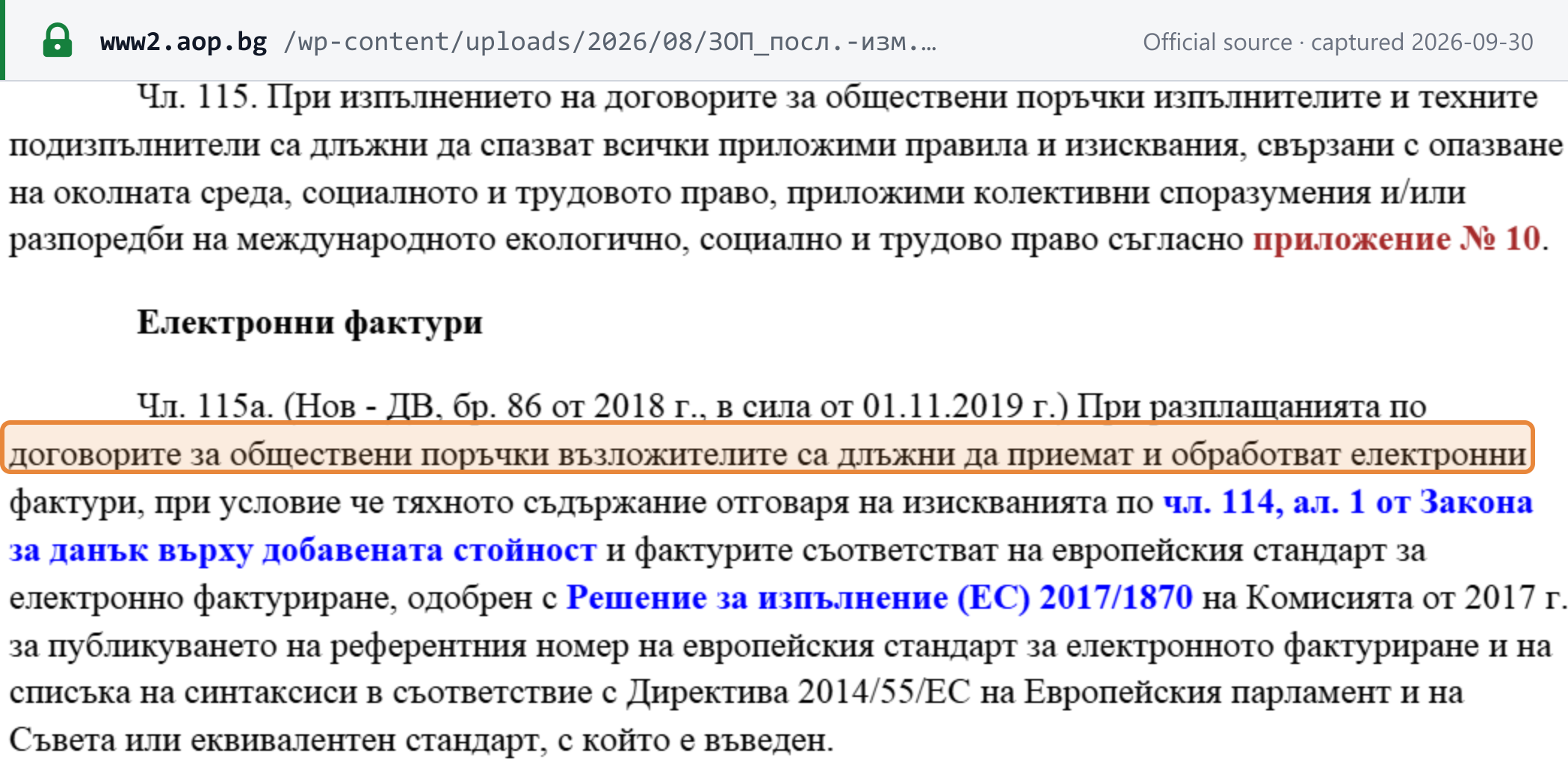 Source snapshot captured 2026-09-30 from the consolidated text published by the Public Procurement Agency (Ciela export of 07.08.2026) — original
Proposed
- Draft law amending the VAT Act (ЗИД на ЗДДС), v1.0 of 23 September 2026, with its explanatory memorandum (мотиви) and impact assessment. As drafted, it would insert art. 112(4)–(5), art. 113(16)–(20) (paragraphs (16)–(19) are the e-invoicing rules; (20) concerns art. 97г registrants), a new chapter 11a (arts 120a, 120b, 120v, 120g and 120d), art. 70(7), art. 182a and art. 192b, repeal art. 124(1)–(6), and rewrite art. 125 on the VAT return. [5]
- Legal base claimed. The memorandum grounds the domestic mandate in the option under art. 218 of Directive 2006/112/EC, as amended by Directive (EU) 2025/516 (ViDA), which lets Member States require e-invoices for domestic supplies without a separate derogation. The draft adds Directive (EU) 2025/516 to the Act's list of transposed directives. [6]
- Technical ordinance. Issuing, sending, verifying, receiving and storing structured e-invoices would be set by a Minister of Finance ordinance under draft art. 120a(4), due within 6 months of promulgation (draft § 104). It is not published and cannot be until the law is promulgated.
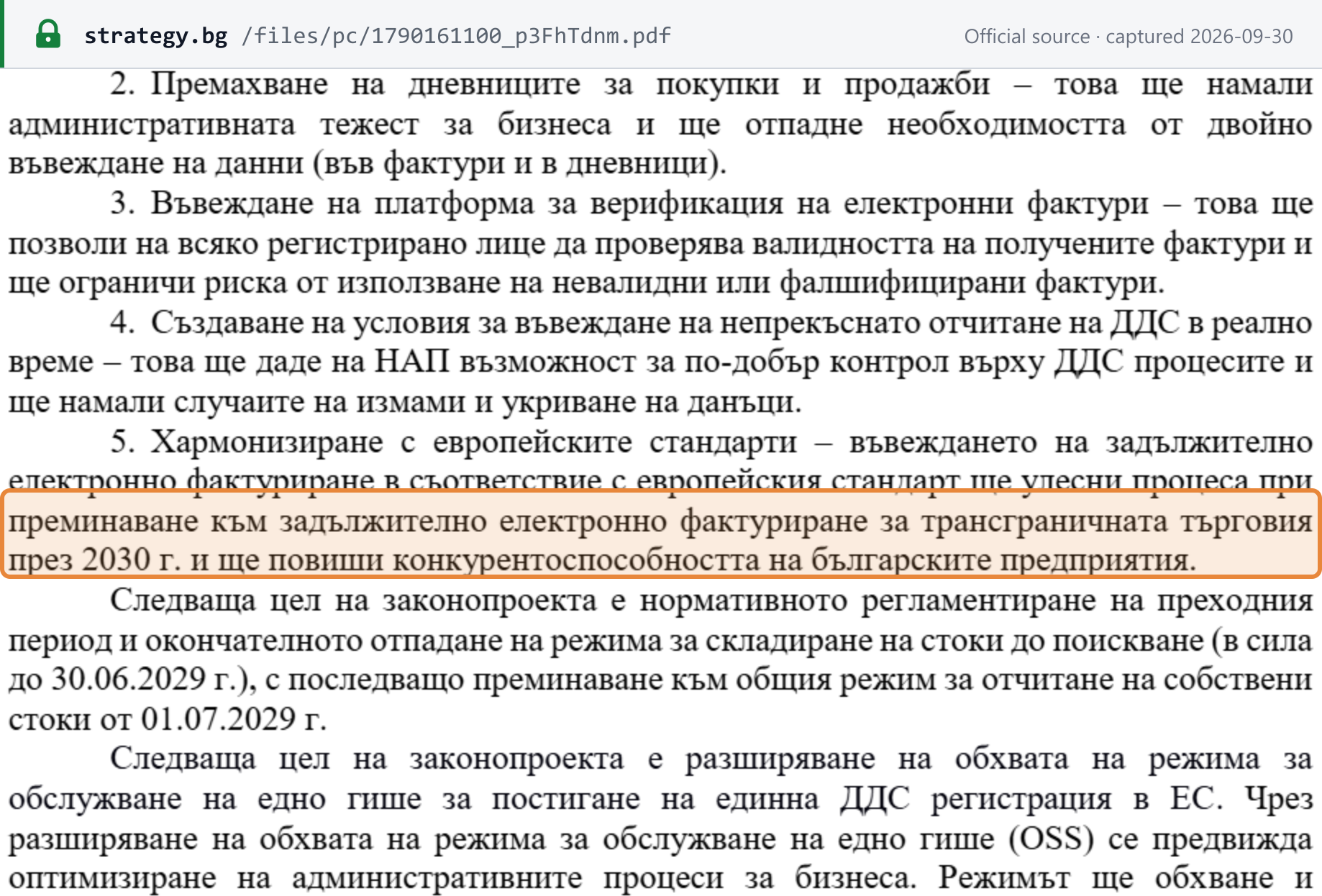
- ViDA. The draft transposes only parts of Directive (EU) 2025/516. The EU cross-border e-invoicing and digital reporting regime due from 1 July 2030 is not in it. The memorandum says the domestic EN 16931 mandate "ще улесни процеса при преминаване към задължително електронно фактуриране за трансграничната търговия през 2030 г." (will ease the move to mandatory e-invoicing for cross-border trade in 2030). See the ViDA explainer.
 Source snapshot captured 2026-09-30 — original
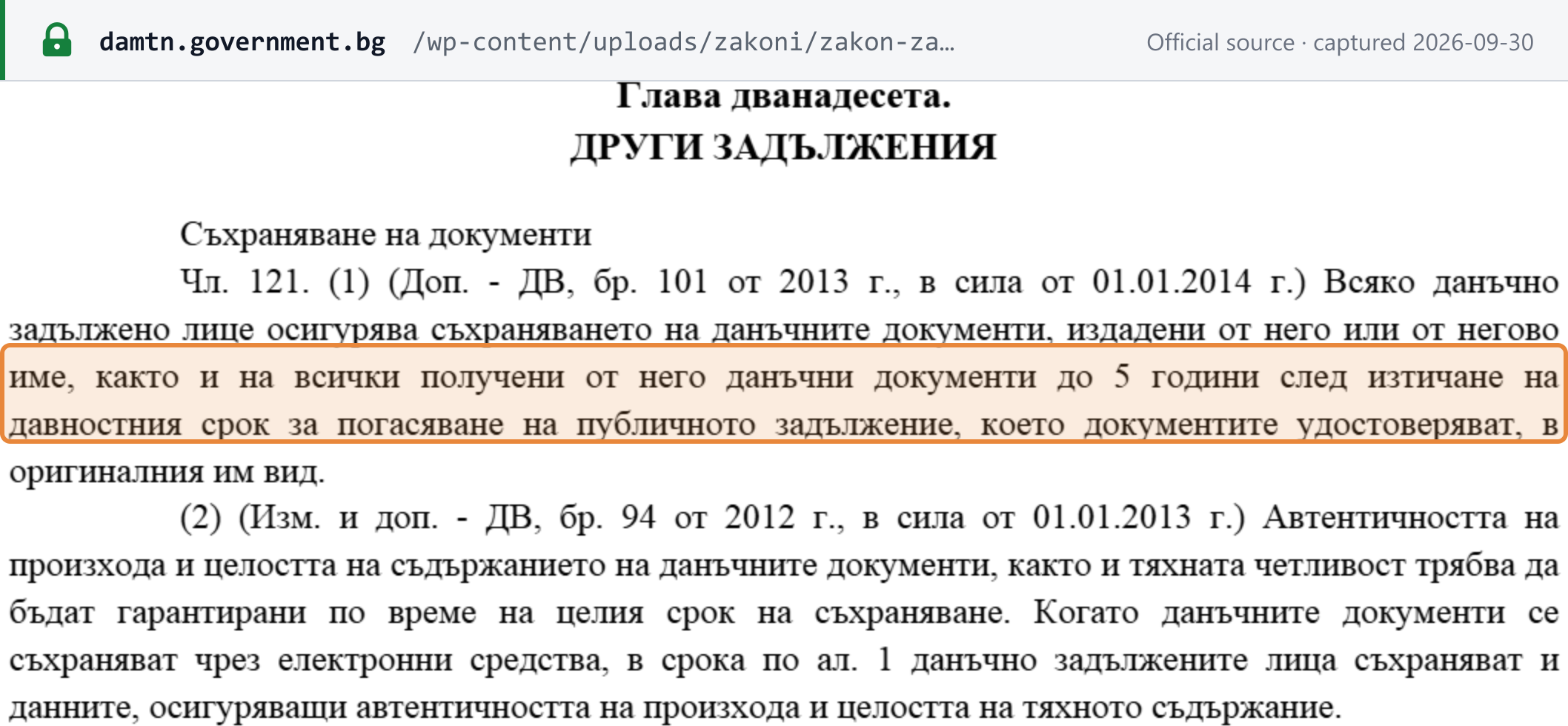
Retention (in force). Every taxable person keeps the tax documents it issues and receives "до 5 години след изтичане на давностния срок" (until 5 years after the limitation period expires) for the public liability they evidence, in their original form (ЗДДС art. 121(1)). For documents stored electronically, the data that ensure authenticity and integrity are kept for the same period (art. 121(2)). Where storage gives online access, the NRA must have electronic online access (art. 122). The total number of years depends on the limitation period under the Tax and Social Insurance Procedure Code, which this page does not restate. Under the draft, NISSEF would also store data on all structured e-invoices; the draft does not lift the taxpayer's own art. 121 duty.
 Source snapshot captured 2026-09-30 from the consolidated text (Ciela export of 09.07.2026) — original
Scope
B2B
Today: no mandate. A business may send e-invoices, including a PDF by email, only if the buyer accepts them in writing or tacitly (ЗДДС art. 114(9)). Paper invoices remain valid.
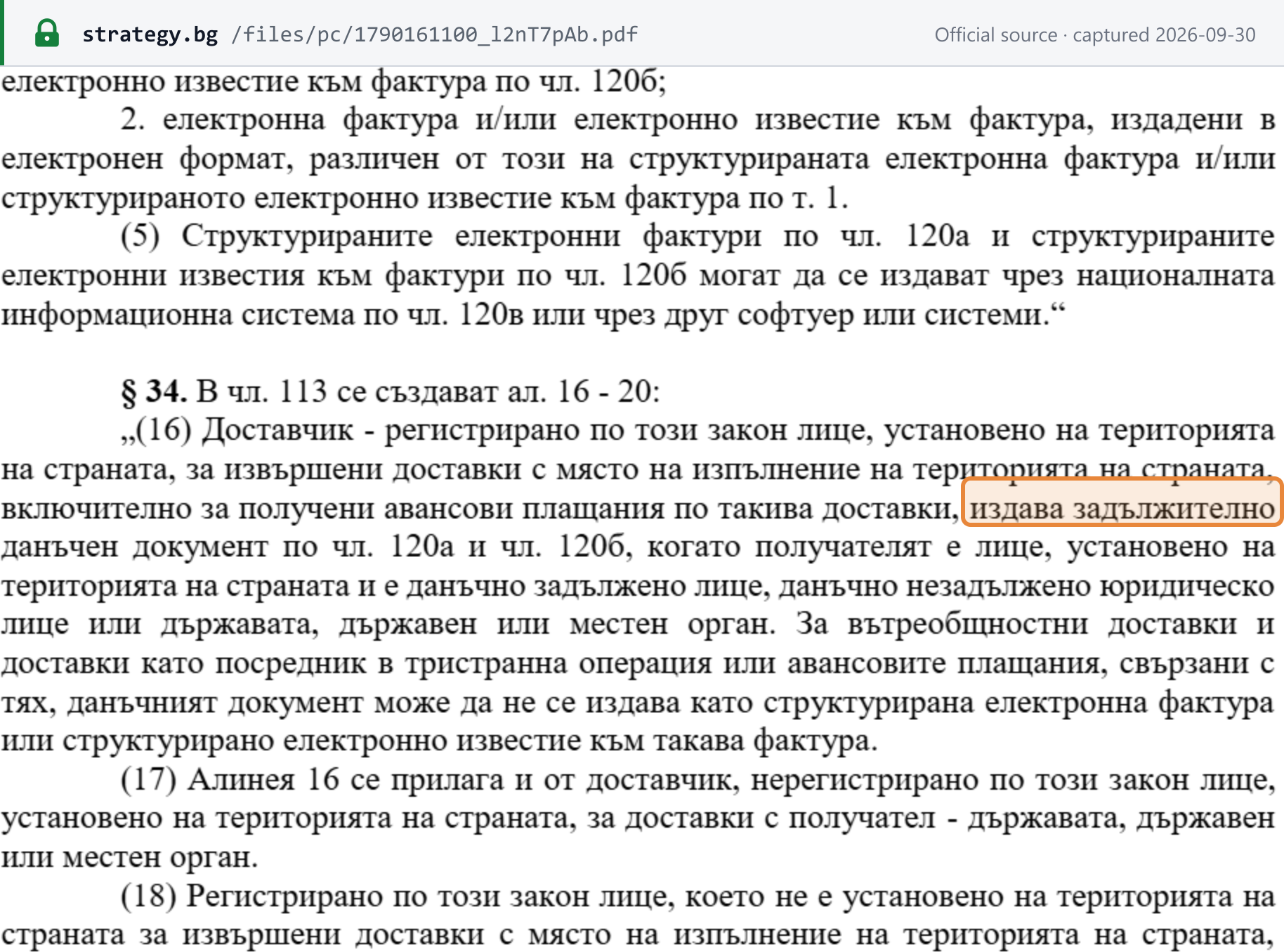
Proposed from 1 January 2028. Draft art. 113(16) says a supplier that is registered under the VAT Act and established in Bulgaria "издава задължително" (must issue) a structured e-invoice (art. 120a) and structured notes (art. 120b) when all of these hold:
- the supply has its place of supply in Bulgaria, including advance payments for such a supply;
- the recipient is established in Bulgaria; and
- the recipient is a taxable person, a non-taxable legal person, or the state or a state or local body.
For intra-Community supplies and supplies as intermediary in a triangular transaction, and their advances, the supplier may issue a document other than a structured e-invoice. The buyer's consent would no longer be needed (draft art. 120d(1)), and consent under art. 114(9) would survive only for invoices outside the mandate. (Draft § 34–35, pp. 5–6, checked 2026-09-30)
 Source snapshot captured 2026-09-30 — original
B2G
Today. Under ЗОП art. 115a, in payments under public procurement contracts, contracting authorities "са длъжни да приемат и обработват електронни фактури" (must accept and process electronic invoices) that meet ЗДДС art. 114(1) and EN 16931. The duty has applied to all contracting authorities since 1 November 2019. The text sets no value threshold and does not split central from sub-central authorities. It imposes no duty on suppliers to send e-invoices: a supplier may still invoice on paper or by PDF. Because ЗОП § 2 item 10a defines an e-invoice as a structured, machine-processable one, a PDF or scan does not trigger the authority's acceptance duty. [3]
Proposed from 1 January 2028. Supplies to the state or to a state or local body fall inside draft art. 113(16), so established VAT-registered suppliers would have to issue structured e-invoices to public bodies. Draft art. 113(17) extends the same duty to suppliers that are established in Bulgaria but not VAT-registered, for their supplies to public bodies.
B2C
Today: no mandate. Proposed: the draft's recipient test covers taxable persons, non-taxable legal persons and public bodies only, so supplies to individuals stay outside the mandate. Sales documented at the moment of sale by an extended fiscal or system receipt from a fiscal device or integrated sales-management system are excluded (draft art. 118(24)).
Non-established businesses
Today: e-invoicing is voluntary for everyone. Proposed: a supplier that is VAT-registered in Bulgaria but not established there issues an ordinary art. 112 invoice and does not apply art. 113(16) (draft art. 113(18)). A separate draft change would make the Bulgarian business customer liable for the VAT on such supplies from 1 January 2028 (draft art. 82(2)(4)); see the Bulgaria VAT guide.
Unregistered established businesses
Proposed: in scope only for supplies to public bodies (draft art. 113(17)). The impact assessment says persons that are not registered may keep issuing paper invoices or electronic invoices in a format other than a structured e-invoice for their other supplies. (Impact assessment, checked 2026-09-30)
Exempt supplies and simplified invoices
Unknown. The draft attaches the duty to supplies with a place of supply in Bulgaria and contains no express carve-out for exempt supplies or for simplified invoices of up to EUR 100 (ЗДДС art. 114(7)). The draft text, the memorandum and the impact assessment do not say whether one is intended (checked 2026-09-30).
Format & network
CTC model
Today: none. No invoice passes through a tax-authority system before or after it reaches the buyer. The VAT Act has no submission, clearance or real-time reporting duty for invoices.
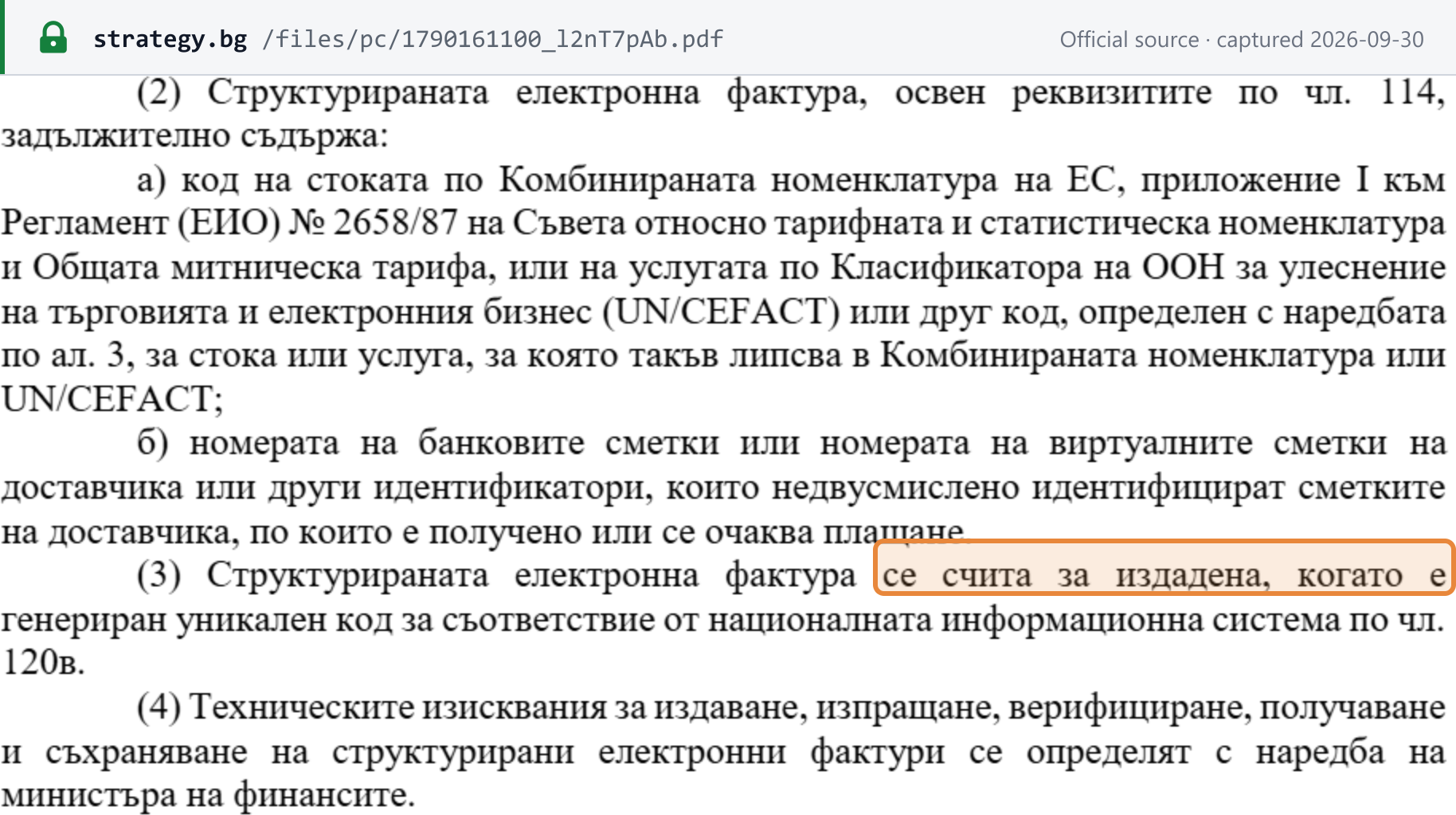
Proposed: centralised clearance. Under draft art. 120a(1), a structured e-invoice meets three conditions at once: it complies with the VAT Act; it is issued, transmitted and received electronically in a structured format that meets the European e-invoicing standard and the list of syntaxes under Directive 2014/55/EU (EN 16931); and it carries a unique compliance code from the national information system. The invoice "се счита за издадена, когато е генериран уникален код за съответствие" (is deemed issued when the unique compliance code has been generated) (art. 120a(3)), and it is deemed received by the buyer at the same moment (art. 120d(2)). Structured notes must quote the compliance code of the invoice or note they correct (art. 120b). The memorandum lists among the aims a platform on which every registered person can check that invoices it receives are valid. (Draft § 42, pp. 7–9; memorandum, p. 6, checked 2026-09-30)
 Source snapshot captured 2026-09-30 — original
What NISSEF would do (draft art. 120v, Cyrillic 120в). Compose invoices; receive data on invoices made in other software; run a semantic check against arts 120a and 120b; generate the compliance code; notify both supplier and recipient of the code; give each person access to all structured invoices issued by and to it; and store data on all structured invoices.
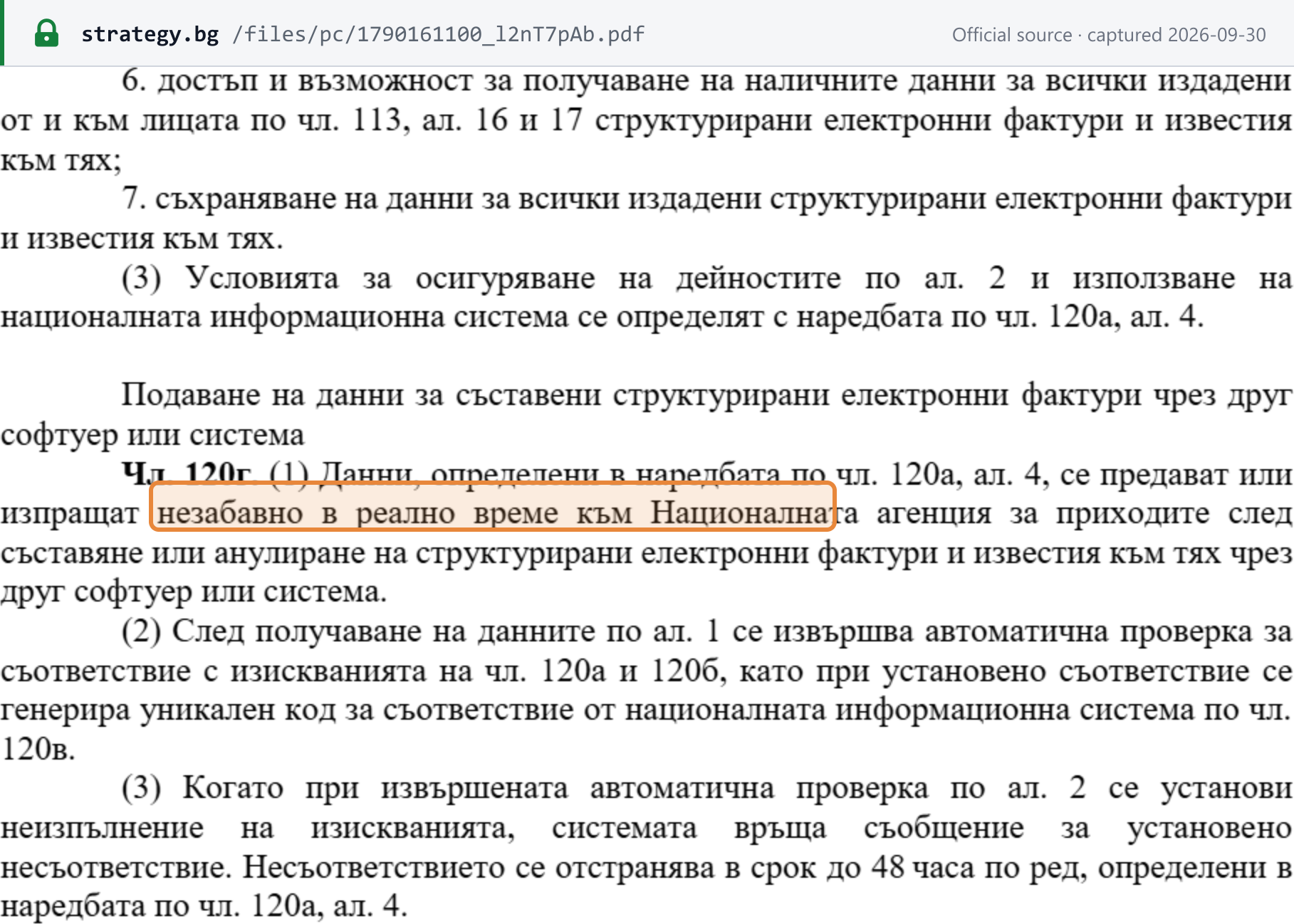
Invoices made in other software (draft art. 120g, Cyrillic 120г). Structured e-invoices may be issued in NISSEF itself or "чрез друг софтуер или системи" (through other software or systems) (draft art. 112(5)). In that case the data set by the ordinance go to the NRA "незабавно в реално време" (immediately, in real time) after an invoice or note is issued or cancelled. The system checks them automatically and, if they comply, generates the code. If they do not, it returns a mismatch message, and the mismatch must be fixed within 48 hours under the ordinance's procedure.
 Source snapshot captured 2026-09-30 — original
Delivery to the buyer (draft art. 120d(3), Cyrillic 120д). The supplier must still send the structured e-invoice to the buyer electronically, and the buyer must be able to receive and process it reliably "съобразно договорените между страните технически спецификации" (according to the technical specifications agreed between the parties). The draft prescribes no delivery network.
System outages. The draft sets no fallback or outage procedure. Because the invoice exists only once the code is generated, an unavailable system would stop invoicing under the draft as written.
Format
- B2G today: EN 16931, as approved by Commission Implementing Decision (EU) 2017/1870, which covers the standard and its list of syntaxes (UBL 2.1 and UN/CEFACT CII), "or an equivalent standard" (ЗОП art. 115a). The European Commission's Bulgaria eInvoicing page says Bulgaria applies no national CIUS and no extensions beyond EN 16931. (European Commission — eInvoicing in Bulgaria, checked 2026-09-30)
- Proposed from 2028: EN 16931 under Directive 2014/55/EU. The draft and the memorandum name neither UBL nor CII and mention no national CIUS: the syntax, the data set for real-time transfer and the validation rules are to be set by ordinance (art. 120a(4)).
- Extra mandatory fields (proposed, art. 120a(2)): besides the art. 114 particulars, the Combined Nomenclature code of goods or the UN/CEFACT code of services (or another code set by ordinance), and the supplier's bank or virtual account numbers, or other identifiers of the accounts where payment is received or expected.
- Invoice particulars and currency (in force): every invoice, electronic or paper, carries the art. 114(1) particulars. Since euro adoption on 1 January 2026, an invoice in another currency must still show the taxable amount and the VAT in euro (art. 114(5)); see Invoice requirements in the country guide, including the 10-digit numbering rule.
Network
Not Peppol-based. Neither the Public Procurement Act, the draft VAT amendment of 23 September 2026, nor the European Commission's Bulgaria eInvoicing page refers to Peppol (checked 2026-09-30). There is no Bulgarian Peppol participant-identifier rule and no Peppol Authority named in these sources.
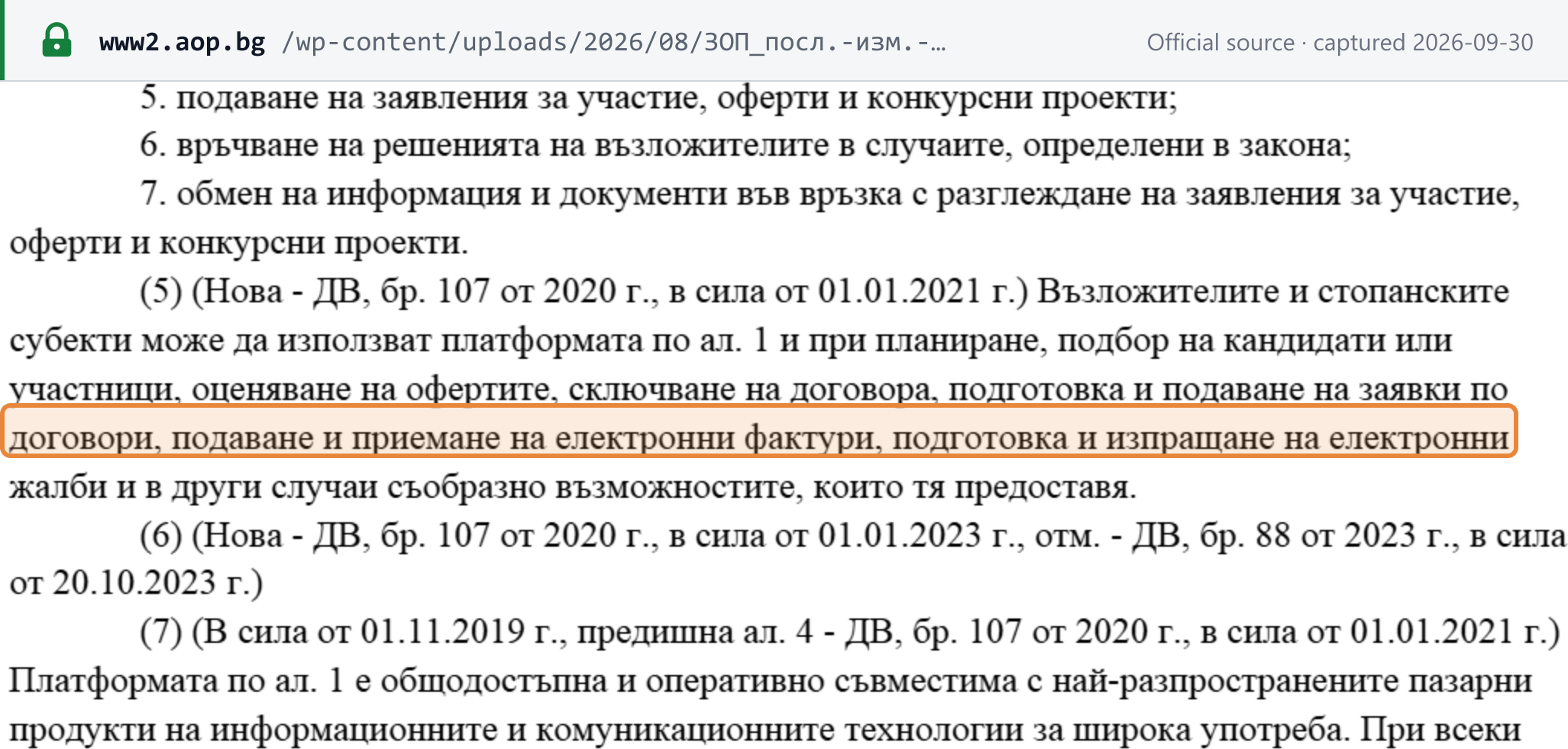
B2G channel today: CAIS EOP. The Централизирана автоматизирана информационна система „Електронни обществени поръчки" (ЦАИС ЕОП, CAIS EOP) at app.eop.bg is the central e-procurement platform, maintained by the Public Procurement Agency (Агенция по обществените поръчки, АОП) under ЗОП art. 36(3). Since 1 January 2021 it is mandatory for tendering steps (art. 39a(4)). For invoices it is optional: authorities and economic operators "може да използват" (may use) the platform for "подаване и приемане на електронни фактури" (submitting and receiving electronic invoices) (art. 39a(5)). A supplier may therefore send an EN 16931 invoice through CAIS EOP or directly to the authority's own system. There is no single mandatory B2G hub.
 Source snapshot captured 2026-09-30 from the consolidated text published by the Public Procurement Agency (Ciela export of 07.08.2026) — original
Integrity mechanics
Today: no mandatory e-signature, QR code or hash. Each taxable person ensures authenticity of origin, integrity of content and legibility "по избран от него начин" (by a method of its choice) (ЗДДС art. 114(6)), through any business control that creates a reliable audit trail between invoice and supply (art. 114(10)). A qualified electronic signature under Regulation (EU) 910/2014 and EDI are examples, not requirements (art. 114(11)).
Proposed: the NRA compliance code becomes the validity marker. The draft text, the memorandum and the impact assessment publish no QR-code, hash or cryptographic-stamp requirement (checked 2026-09-30). The ordinance may add one.
E-reporting alongside e-invoicing
Today: none tied to invoices. Monthly VAT returns with purchase and sales ledgers are filed by the 14th, and SAF-T is a separate monthly file phased in from 2026 (see the SAF-T explainer).
Proposed from 1 January 2028:
- the NRA gives every VAT-registered person a pre-generated draft VAT return for each period, built from structured e-invoices issued by and to it and from customs declarations (draft art. 125(3) creates the draft return; art. 125(15) sets its data sources), available through NRA e-services no later than the 2nd of the following month (art. 125(18)). The person adds supplies that structured e-invoices do not cover (art. 125(19));
- the monthly purchase and sales ledgers (дневник за покупките, дневник за продажбите) are abolished: draft § 44 repeals art. 124(1)–(6);
- the memorandum names continuous real-time VAT reporting as a future aim the system should make possible. It is an intention, not an obligation in the draft.
Onboarding / how to comply
B2G today
- Check what the authority accepts. Every contracting authority must accept EN 16931 e-invoices (UBL or CII) under ЗОП art. 115a. Ask whether it takes them through CAIS EOP or through its own system.
- CAIS EOP. Register at app.eop.bg. The Public Procurement Agency's CAIS EOP FAQ confirms the system has invoice functions: on the authority's side, an employee registered in the system with "права за работа с фактури" (rights to work with invoices) approves the invoice. The FAQ adds that the system has no pro-forma invoice function.
- Test environment. The Public Procurement Agency links a CAIS EOP test instance at app-test.eop.bg.
 Source snapshot captured 2026-09-30 — original
Unknown: whether CAIS EOP registration needs a qualified electronic signature, which invoice formats it accepts on upload, and whether it validates against EN 16931. The Public Procurement Agency's user manuals were not located (checked 2026-09-30).
Preparing for the proposed 2028 mandate
- Registration with NISSEF: not published. No portal, credential scheme or device registration exists yet.
- Accreditation of providers: none proposed. The draft allows "other software or systems" without certification (art. 112(5)). The only software-side rule is the penalty in art. 192b (see Penalties).
- Testing: a 6-month NRA integration-test window is intended before go-live (draft § 103), but its start date is not fixed because § 103 refers to a non-existent § 104, item 1 (see Test window note).
- Connection modes (proposed): compose the invoice in NISSEF, or issue it in your own accounting or invoicing software and transmit the data in real time. The API, authentication and data set are left to the ordinance.
- Cost and budget (government estimates): the memorandum puts the cost of the NRA system at EUR 20 million, to be built in 2027, and expects EUR 350,000,000 of extra budget revenue in 2028 from the measure. (Memorandum, p. 7, checked 2026-09-30)
- Comment on the draft: submit comments on the consultation page by 23 October 2026.
Penalties
In force
There is no penalty specific to e-invoicing. The general invoice penalties of the VAT Act apply:
| Breach | Penalty | Provision |
|---|---|---|
| Tax document not issued or not reflected, leading to understated VAT or an overstated refund | The uncharged tax, not less than BGN 1,000 | ЗДДС art. 182(1) |
| The same document issued or reflected in the following period | 25% of the uncharged tax, not less than BGN 250 | ЗДДС art. 182(2) |
The BGN amounts are still the statutory figures. The Euro Introduction Act reads them as euro at the fixed rate of 1.95583 (art. 11(2)). [1]
Proposed (draft of 23 September 2026, not law)
| Breach | Proposed penalty | Draft provision | Proposed start |
|---|---|---|---|
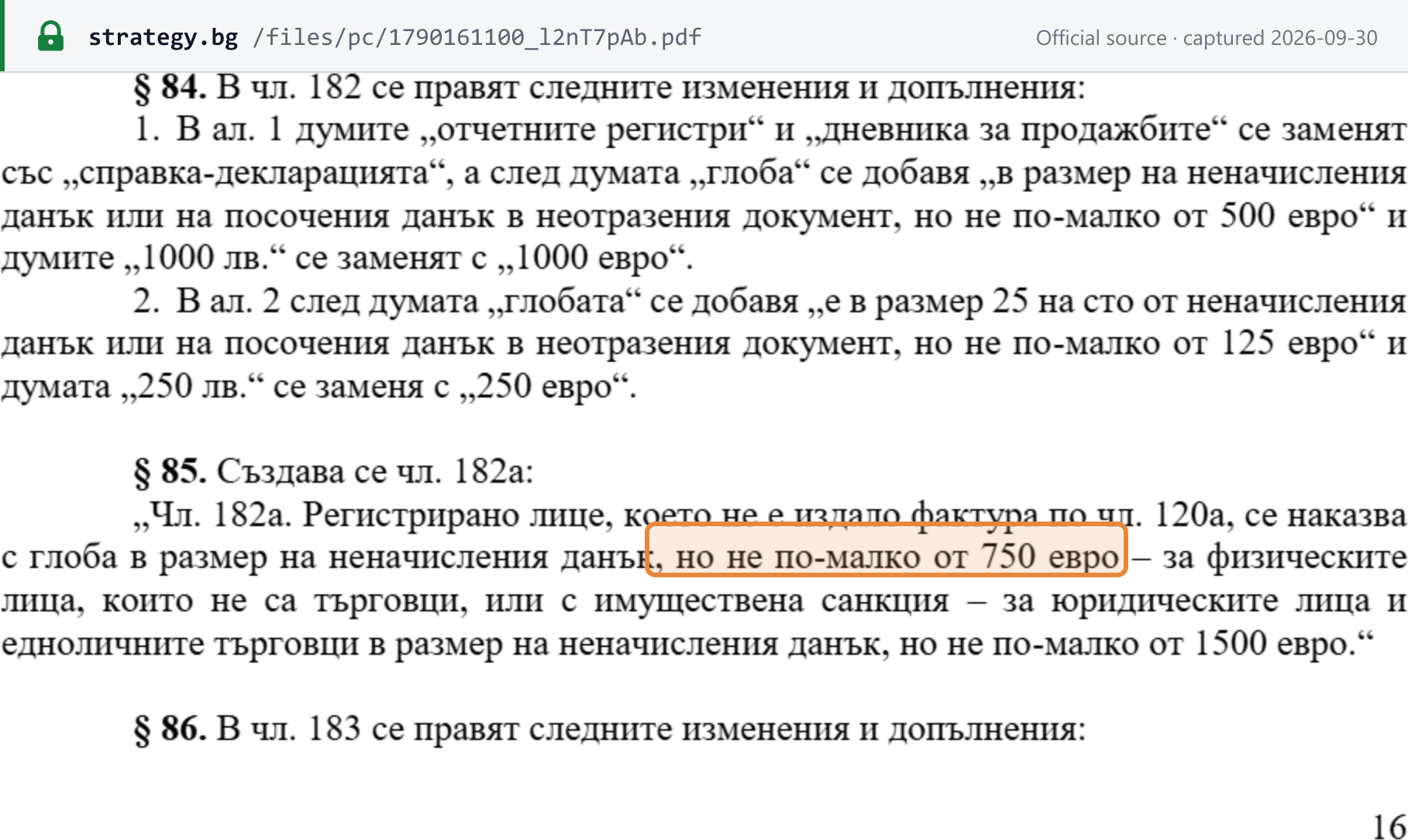
| Registered person does not issue a structured e-invoice (art. 120a) | The uncharged tax, not less than EUR 750 (individuals who are not traders) or EUR 1,500 (legal persons and sole traders) | art. 182a (§ 85) | 1 July 2028 |
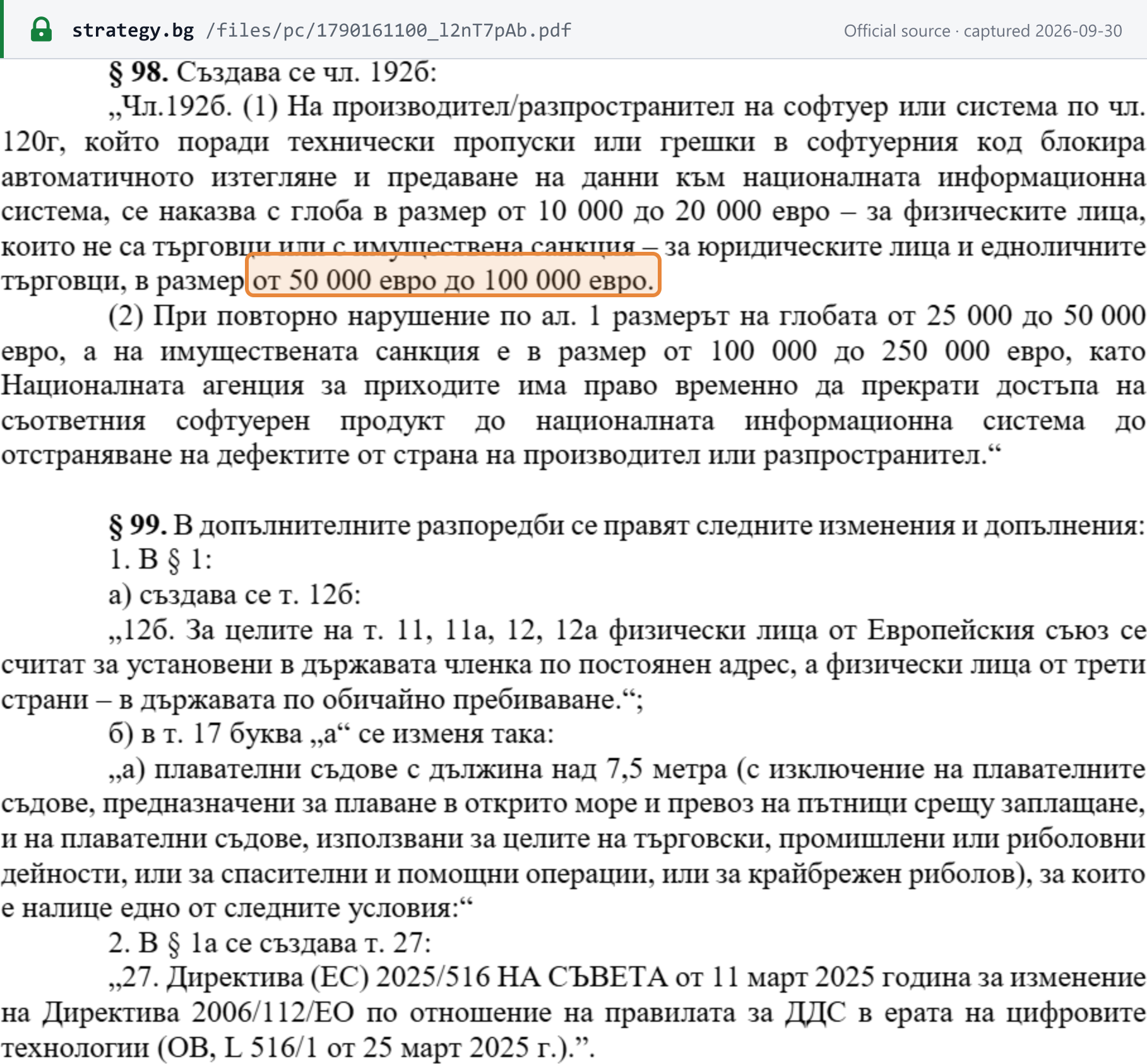
| Software producer or distributor whose code, through technical gaps or errors, blocks automatic extraction and transmission of data to NISSEF | EUR 10,000–20,000 (individuals); EUR 50,000–100,000 (legal persons and sole traders) | art. 192b (§ 98) | 1 January 2028 |
| Repeat of the software breach | EUR 25,000–50,000 / EUR 100,000–250,000; the NRA may temporarily cut the product's access to NISSEF | art. 192b(2) | 1 January 2028 |
| Buyer: tax not charged by a structured e-invoice although the supplier was obliged to issue one | No right to deduct input VAT | art. 70(7) (§ 6) | 1 January 2028 |
The draft would also restate the general art. 182 penalties in euro (draft § 84).
 Source snapshot captured 2026-09-30 — original
 Source snapshot captured 2026-09-30 — original
Input VAT (proposed). Draft art. 70(7) says "Не е налице право на данъчен кредит" (there is no right to input tax credit) for a supply on which tax was not charged by a structured e-invoice or note where the supplier was obliged to issue one. Art. 71, item 1 would make an issued structured e-invoice the condition for the credit. A late claim goes through a correction of the return for the period in which the right arose, within 12 tax periods (draft art. 72(2)). The exposure falls on the buyer, which is why Bulgarian buyers would have a direct interest in their suppliers' compliance.
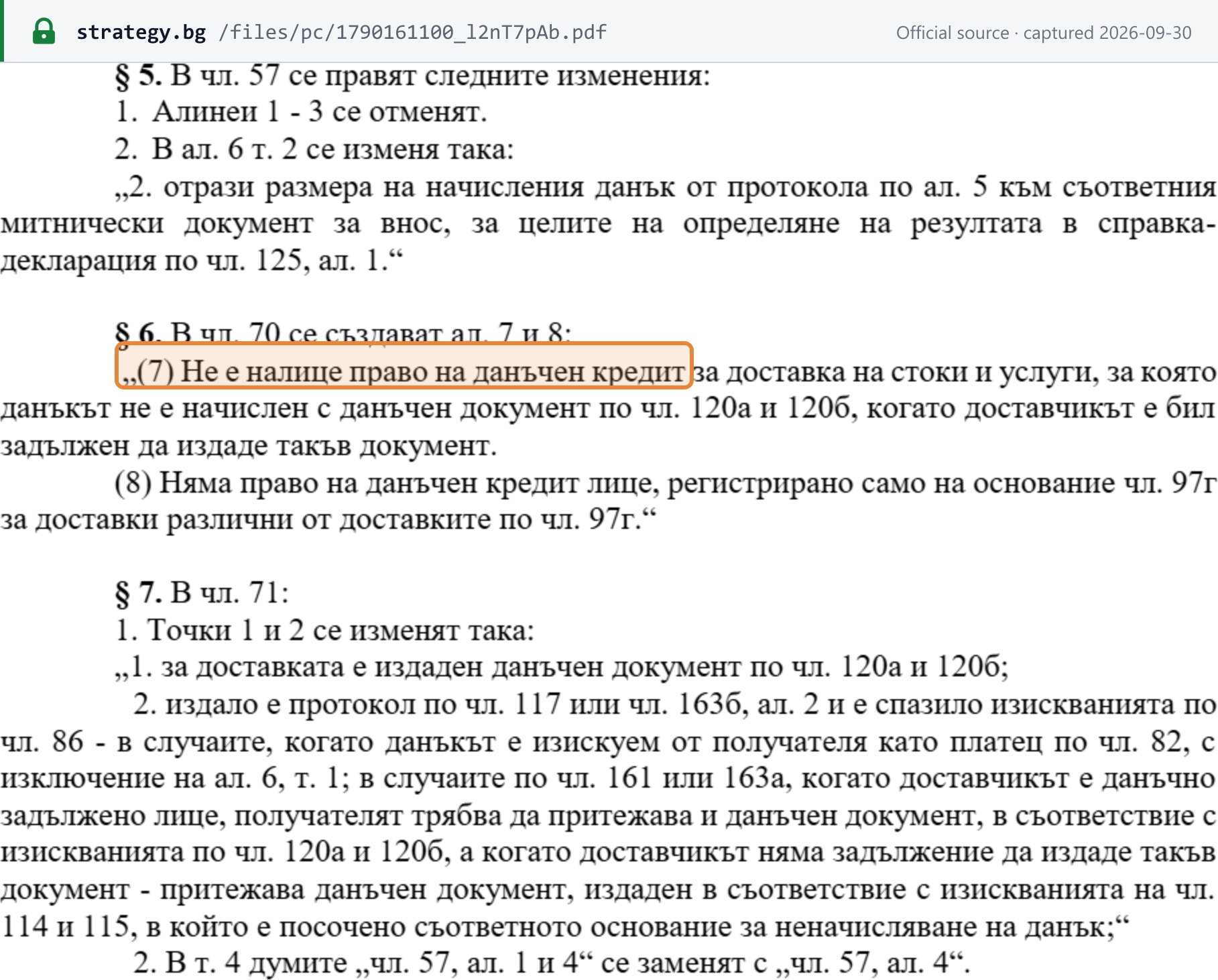 Source snapshot captured 2026-09-30 — original
Enforcement posture. The draft does not describe the gap between 1 January and 1 July 2028 as a grace period. It defers only the art. 182a fine; the obligation, the input-VAT rule and the software penalty would apply from 1 January 2028.
Frequently asked questions
Is e-invoicing mandatory in Bulgaria yet?
No, as at 30 September 2026. There is no B2B or B2C mandate: an e-invoice may be used only if the buyer accepts it by written or tacit consent (VAT Act art. 114(9)). A Ministry of Finance draft proposes mandatory structured e-invoices cleared by the National Revenue Agency from 1 January 2028. It is in public consultation until 23 October 2026 and still needs Council of Ministers approval and adoption by the National Assembly.
Do we have to send e-invoices to Bulgarian public bodies?
Not today. Since 1 November 2019 contracting authorities must accept and process EN 16931 e-invoices (Public Procurement Act art. 115a), but suppliers are not obliged to send them. Under the draft, from 1 January 2028 suppliers established in Bulgaria would have to issue structured e-invoices to public bodies, even if they are not VAT-registered (proposed art. 113(16)–(17)).
Is a PDF sent by email an e-invoice in Bulgaria?
For VAT purposes today, yes, if the buyer consents (VAT Act art. 114(9)). For the public-procurement acceptance duty, no: the Public Procurement Act defines an e-invoice as one in a structured format that allows automatic processing. Under the draft, from 1 January 2028 only an EN 16931 invoice carrying a National Revenue Agency compliance code would satisfy the mandate.
We are a foreign company registered for VAT in Bulgaria. Would the 2028 mandate apply to us?
Not as drafted. A VAT-registered supplier that is not established in Bulgaria would keep issuing ordinary invoices and would not apply the structured e-invoice rule (proposed art. 113(18)). The draft is not law and may change after the consultation that closes on 23 October 2026.
As a buyer, what happens if my supplier does not issue a structured e-invoice after 2028?
Under the draft you would lose the right to deduct the input VAT on that supply where the supplier was obliged to issue a structured e-invoice (proposed art. 70(7), from 1 January 2028). The supplier would face a fine equal to the uncharged tax, at least EUR 750 or EUR 1,500, from 1 July 2028 (proposed art. 182a). Both are proposals.
Do we need Peppol or a certified provider?
No. No Bulgarian source refers to Peppol, and the draft has no accredited-provider model: structured e-invoices could be issued in the National Revenue Agency system or in any other software, and delivery to the buyer follows specifications the parties agree (proposed arts 112(5) and 120d(3)). For public bodies today, the optional CAIS EOP platform or the authority's own system is used.
Is the 2028 mandate phased by company size?
No. The draft has one start date, 1 January 2028, for everyone in scope. The size-based phasing some sources describe belongs to SAF-T, a separate reporting obligation already in law and phased in from 2026 to 2030.
Which XML syntax will Bulgaria use, UBL or CII?
Not decided. The draft requires EN 16931 but leaves the technical rules, including syntax and the data set sent in real time, to a Minister of Finance ordinance due within 6 months of the law's promulgation. For public bodies today, EN 16931 in either syntax on the EU list is accepted, and Bulgaria applies no national CIUS.
Recent changes
- 2026-09-23 — Proposed, not law. The Ministry of Finance published a draft law amending the VAT Act for public consultation until 23 October 2026: structured e-invoices with a National Revenue Agency compliance code would be mandatory for Bulgaria-established VAT-registered suppliers from 1 January 2028, with the issuer penalty (art. 182a) from 1 July 2028. (Ministry of Finance, via strategy.bg) — see event · issue
- 2021-01-01 — CAIS EOP became mandatory for public tendering; submitting and receiving e-invoices through it is optional (Public Procurement Act art. 39a(4)–(5)). (Public Procurement Agency)
- 2019-11-01 — Contracting authorities became obliged to accept and process EN 16931 e-invoices (Public Procurement Act art. 115a, State Gazette 86/2018). (State Gazette)
Related resources
- Bulgaria VAT guide — rates, registration, invoice requirements, SAF-T and filing
- Bulgaria tax identification numbers — the EIK/BULSTAT and VAT number formats
- How to verify a Bulgarian VAT number
- Bulgaria tax-change chronology — every tracked Bulgarian change, dated and sourced
- E-invoicing status and networks worldwide — Bulgaria's row in global context
- ViDA — VAT in the Digital Age — the EU framework behind the 2030 cross-border stage
- SAF-T explainer — the separate audit-file obligation
- Peppol network explainer — for comparison; Bulgaria's rules do not use Peppol
- Other clearance models: Poland (KSeF), Romania (RO e-Factura)
Important websites
- Public consultation 12733 (strategy.bg) — the draft, documents and public comments; comments until 23 October 2026
- Draft law amending the VAT Act (PDF), explanatory memorandum (PDF) and impact assessment (PDF)
- CAIS EOP — the Public Procurement Agency's e-procurement platform, with optional e-invoice exchange; test environment
- CAIS EOP FAQ — Public Procurement Agency questions and answers, including invoicing
- Public Procurement Agency — national legislation — consolidated Public Procurement Act
- NRA e-services portal — where the prefilled VAT returns would be offered under the draft
- State Gazette — promulgation of any adopted law
- NISSEF portal and sandbox — none published (proposed system)