E-invoicing in Argentina: ARCA factura electrónica and the CAE
Overview
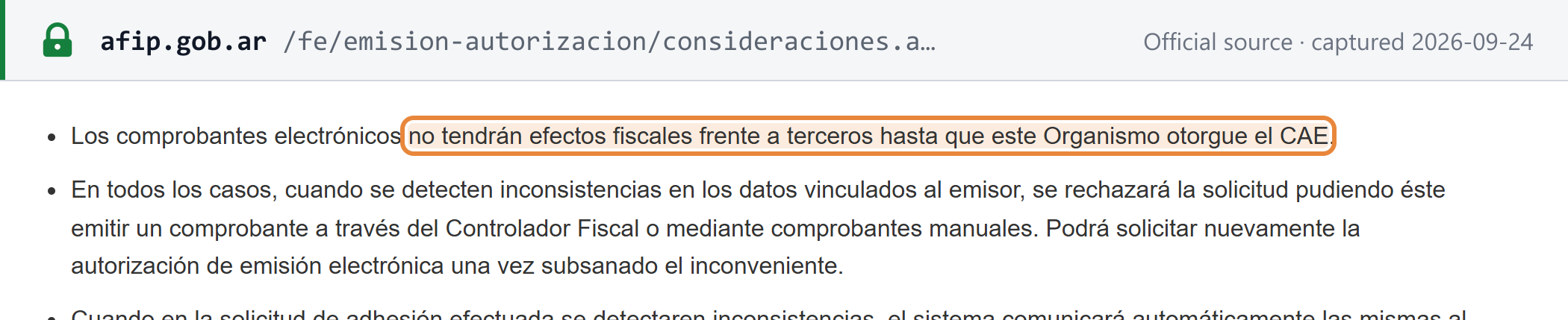
Argentina has run mandatory electronic invoicing for years. It is a clearance regime: the issuer sends each invoice's data to the tax authority, and the authority authorises it by returning a CAE (Código de Autorización Electrónico). An invoice without a CAE has no tax effect. ARCA's rule, word for word: "Los comprobantes electrónicos no tendrán efectos fiscales frente a terceros hasta que este Organismo otorgue el CAE." In English: electronic invoices have no tax effect against third parties until ARCA grants the CAE. (ARCA — Factura electrónica, consideraciones, checked 2026-09-24)
 Source snapshot captured 2026-09-24 — original
- What the system is called. The legal name is the "Régimen de Emisión de Comprobantes Electrónicos" (R.E.C.E.). Readers will mostly meet the everyday terms factura electrónica and comprobantes electrónicos originales. ARCA describes the e-invoice as "un comprobante digital funcional y legalmente equivalente a la factura en formato papel": a digital document that is functionally and legally equivalent to a paper invoice. (ARCA — ¿Qué es?, checked 2026-09-24)
- Who runs it. ARCA (Agencia de Recaudación y Control
Aduanero), which replaced AFIP. RG 5616/2024 art. 4 says references to AFIP in the invoicing
resolutions (RG 1415, 3561, 4291, 5198) are to be read as references to ARCA.
(Boletín Oficial, RG 5616/2024, checked 2026-09-24)
ARCA still serves its e-invoicing microsites, web services and legal library from the older
afip.gob.ar/afip.gov.arhosts. - Legal basis in one line. RG 4290/2018 sets which issuing methods exist and who must use electronic invoices. RG 4291/2018 sets up the R.E.C.E. regime and the CAE. Both were issued under Ley 11.683. The full list of instruments is under Legal basis.
| Argentina | |
|---|---|
| B2G | Mandatory. Suppliers to the national public sector must issue only electronic invoices under RG 4291 art. 1. Same CAE clearance; there is no separate B2G platform |
| B2B | Mandatory, in force. Covers all domestic operations of VAT-registered (responsables inscriptos), VAT-exempt and Monotributo taxpayers. They issue electronic invoices and/or use a fiscal controller (RG 4290 art. 6). A MiPyME selling to a large company must issue a Factura de Crédito Electrónica (FCE) for operations of ARS 5,549,862 or more (from 14 Apr 2026) |
| B2C | In scope, under the same duty. Invoices must carry the legend "A CONSUMIDOR FINAL". The buyer's ID is required only at ARS 10,000,000 or more (RG 5866, from 1 Jul 2026) |
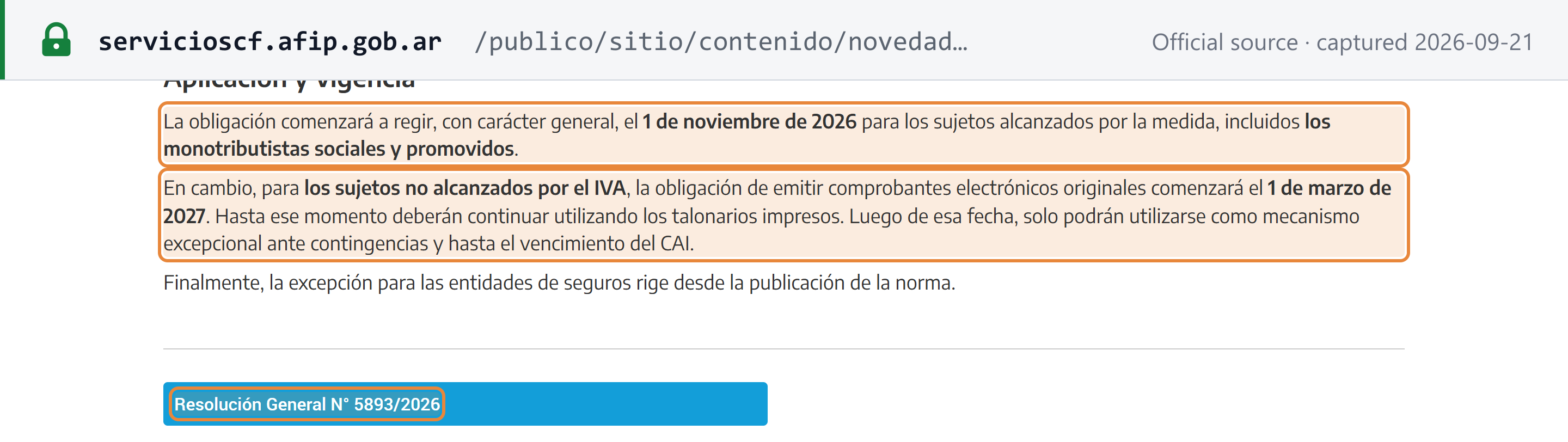
| Newly obliged groups | Monotributo social and promovido from 1 Nov 2026. Taxpayers outside VAT (no alcanzados) from 1 Mar 2027 (RG 5893/2026) |
| Non-residents | The regime covers taxpayers registered with ARCA under a CUIT. It provides no issuing channel for an unregistered foreign supplier. VAT on B2C digital services from abroad is collected by payment intermediaries (RG 4240) |
| CTC model | Clearance: ARCA authorises each invoice in real time and returns a CAE. The CAEA (advance authorisation code) is a contingency-only fallback from 1 Aug 2026 |
| Format | ARCA's own SOAP/XML web services (WSFEv1 developer manual v4.7, revision of 1 Sep 2026). Not UBL/CII, and not Peppol |
| Network | Direct exchange between the taxpayer and ARCA, through the web service or the "Comprobantes en línea" portal. No interoperability network |
| Integrity | Mandatory QR code (RG 4892/2020) pointing to ARCA, with the invoice data in Base64 JSON |
| Authority | ARCA (formerly AFIP) |
| Legislation | Ley 11.683 · Ley 27.440 (FCE) · RG 4290/2018 · RG 4291/2018 · RG 4892/2020 · RG 5782 and RG 5785/2025 · RG 5852, RG 5866 and RG 5893/2026 |
Mandate status & timeline
The regime itself has been in force since 2018. What changes in 2026–2027 is who is inside it, and how contingencies work. Dates marked (passed) were in the past on 2026-09-24.
| Phase | Who / what | Date | Legal basis |
|---|---|---|---|
| R.E.C.E. regime | RG 4291 applies, replacing RG 2485 and the earlier resolutions that phased e-invoicing in | 6 Aug 2018 (passed) | RG 4291 arts. 41 and 44 [1] |
| QR code | Required on every RG 4291 invoice. Immediate for Comprobantes en línea and Facturador Móvil. Web-service issuers phased in by 2020 turnover, from 1 Mar 2021 (above ARS 10,000,000) to 1 Jun 2021 (everyone else) | 24 Dec 2020 – 1 Jun 2021 (passed) | RG 4892/2020 art. 5 [2] |
| Buyer's VAT status | Every e-invoice must identify the customer's VAT condition. The new web-service version became mandatory | 15 Apr 2025 (passed) | RG 5616/2024 [3] |
| Class "M" abolished | Former "M" issuers moved to class "A" with the legend "OPERACIÓN SUJETA A RETENCIÓN", keeping codes 051–054 | 1 Dec 2025 (passed) | RG 5762/2025 and RG 5764/2025 [4] |
| FCE threshold | A MiPyME must issue an FCE to a large company for operations of ARS 5,549,862 or more | 14 Apr 2026 (passed) | ARCA, citing Resolución 1/2026 [5] |
| Regime reorganised | RG 5866 in force: consumer-ID threshold of ARS 10,000,000, optional monthly consolidated invoice for five sector groups, RG 5824 abrogated | 1 Jul 2026 (passed) | RG 5866/2026 arts. 1 f)–g), 3 and 4 [6] |
| CAEA contingency-only | CAE becomes the only primary method. CAEA may be used only in contingencies. Originally set for 1 Jun 2026, then postponed | 1 Aug 2026 (passed) | RG 5782 and RG 5785/2025, as postponed by RG 5852/2026 [7] |
| Insurers, stage 1 | Insurers (Ley 20.091), for operations with parties that are not VAT-registered or VAT-exempt | 1 Sep 2026 (passed) | RG 5866 art. 4 a) [6] |
| Banks, stage 1 | Financial entities (Ley 21.526), for leasing and foreign-trade operations | 1 Oct 2026 | RG 5866 art. 4 b) [6] |
| FCE temporary rules end | The 21-day tacit-acceptance window and the carve-out for invoices assigned before acceptance both run to this date (see Scope) | 31 Oct 2026 | ARCA FCE microsite; Res. 219/2025 [8] |
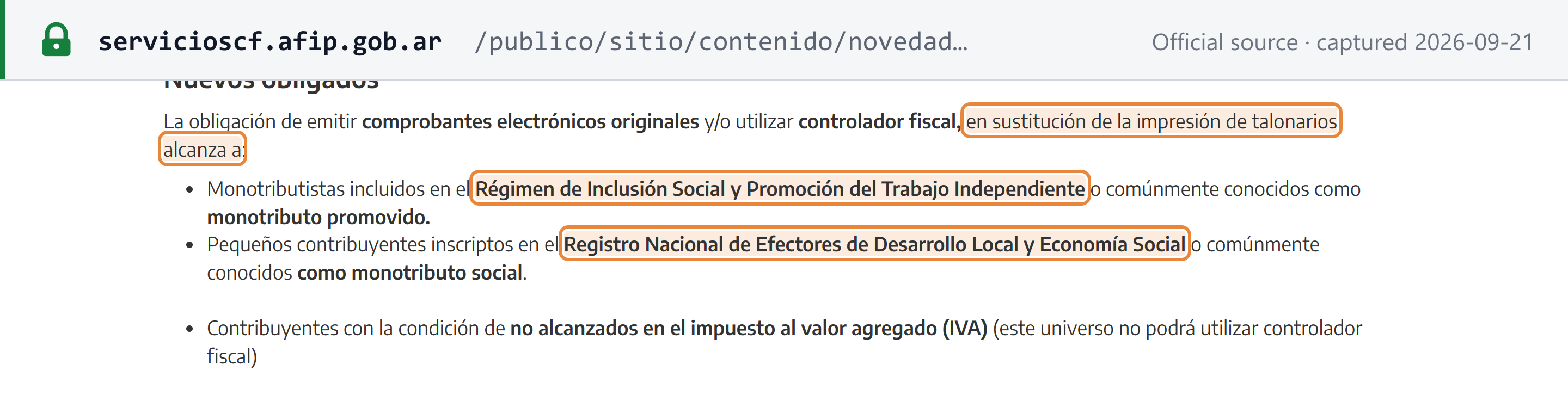
| Monotributo social / promovido | Must issue electronic invoices or use a fiscal controller. ARCA opens a point of sale for any Monotributo taxpayer who has none | 1 Nov 2026 | RG 5893/2026 art. 5 [9] |
| Banks and card operators, stage 2 | Financial entities, for loans (except overdrafts) and for operations with parties that are not VAT-registered or exempt. Banks, card issuers and administrators (Ley 25.065) and transfer-payment participants (BCRA Comunicación "A" 7153), for amounts in cardholder statements | 1 Dec 2026 | RG 5866 art. 4 c) [6] |
| Caution-insurance legacy service | The old wsseg web service may still be used for surety-insurance policies | until 31 Dec 2026 | RG 5866 art. 4 [6] |
| Taxpayers outside VAT | Subjects no alcanzados by VAT must issue electronic invoices, and may not use a fiscal controller. They keep using printed RG 100 booklets until then | 1 Mar 2027 | RG 5893/2026 art. 5 [9] |
| Insurers and card operators, stage 3 | Insurers, for co-insurance, and insurers whose operations are all outside VAT (added by RG 5893 art. 4). Banks, card entities and transfer-payment participants, for periodic settlements to merchants | 1 Mar 2027 | RG 5866 art. 4 d), with the insurance change made by RG 5893 art. 4 [6] |
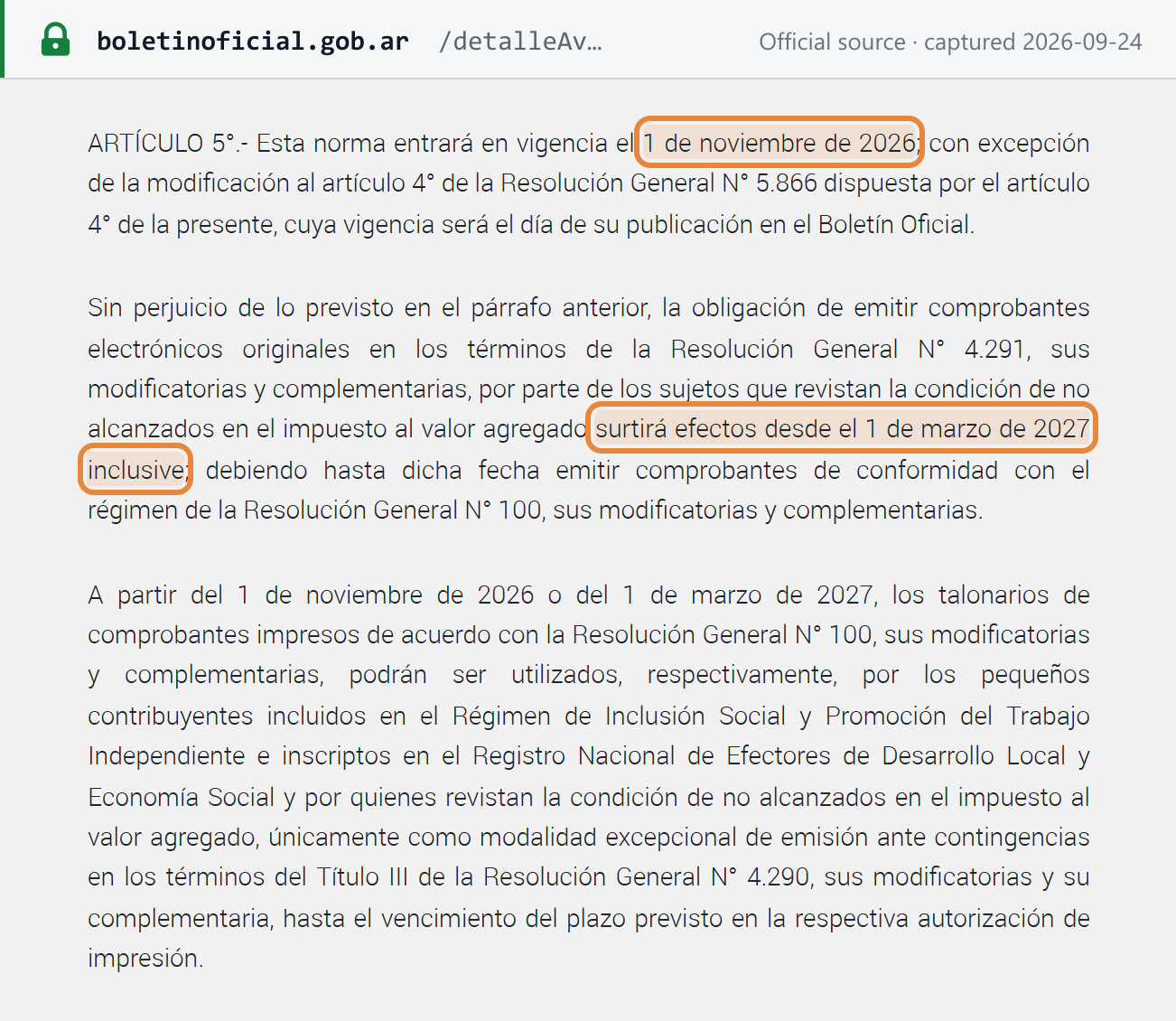
Latest announced phase. RG 5893/2026 was published in the Boletín Oficial on 31 Aug 2026. It brings the last groups still allowed to use printed booklets into the regime. The general obligation starts on 1 Nov 2026. For taxpayers outside VAT, it starts on 1 Mar 2027: "la obligación de emitir comprobantes electrónicos originales en los términos de la Resolución General N° 4.291, sus modificatorias y complementarias, por parte de los sujetos que revistan la condición de no alcanzados en el impuesto al valor agregado surtirá efectos desde el 1 de marzo de 2027 inclusive". In English: for subjects outside VAT, the duty to issue original electronic invoices under RG 4291 takes effect from 1 March 2027 inclusive. (Boletín Oficial, RG 5893/2026 art. 5, checked 2026-09-24)
 Source snapshot captured 2026-09-24 — original
After those dates, printed booklets may be used only in a contingency, and only until their CAI expires. RG 5893 art. 5 applies its change for insurers from publication (31 Aug 2026).
 Source snapshot captured 2026-09-21 — original
 Source snapshot captured 2026-09-21 — original
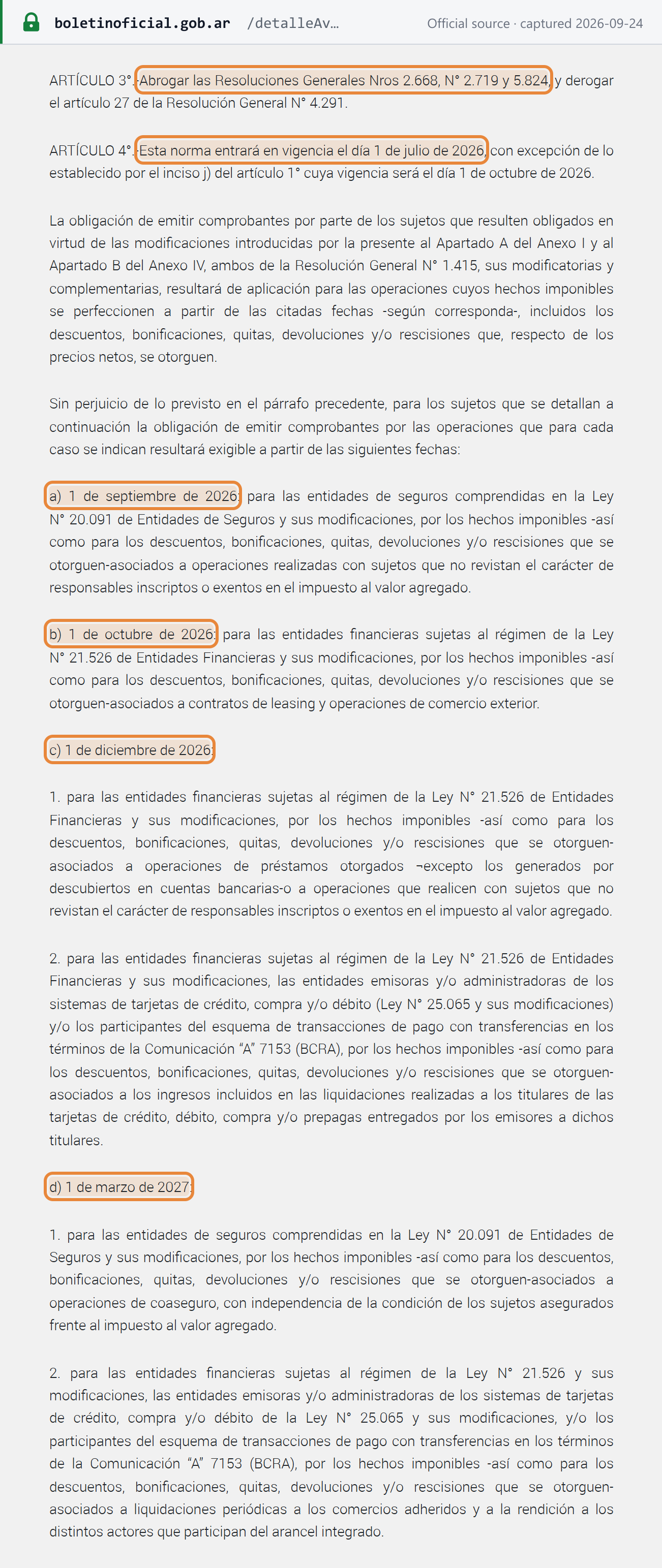
The RG 5866 staged schedule. RG 5866/2026 was published on 29 Jun 2026. It is in force from 1 Jul 2026, except its art. 1 j), which applies from 1 Oct 2026. Its art. 3 abrogates RG 2668, RG 2719 and RG 5824/2026, and repeals RG 4291 art. 27. RG 5824, published in February 2026, had created a monthly electronic settlement document for 1 Jul 2026. RG 5866 took effect that same day and moved RG 5824's content (the monthly settlement, fewer excepted operations, consumer identification) into RG 1415 and RG 4291. Anyone who planned against RG 5824 should work from RG 5866 instead. Banks are also excused until 30 Nov 2026 inclusive from reporting associated perceptions on the invoice. Until then they list them on the commercial document, such as the bank statement. (Boletín Oficial, RG 5866/2026, checked 2026-09-24)
 Source snapshot captured 2026-09-24 — original
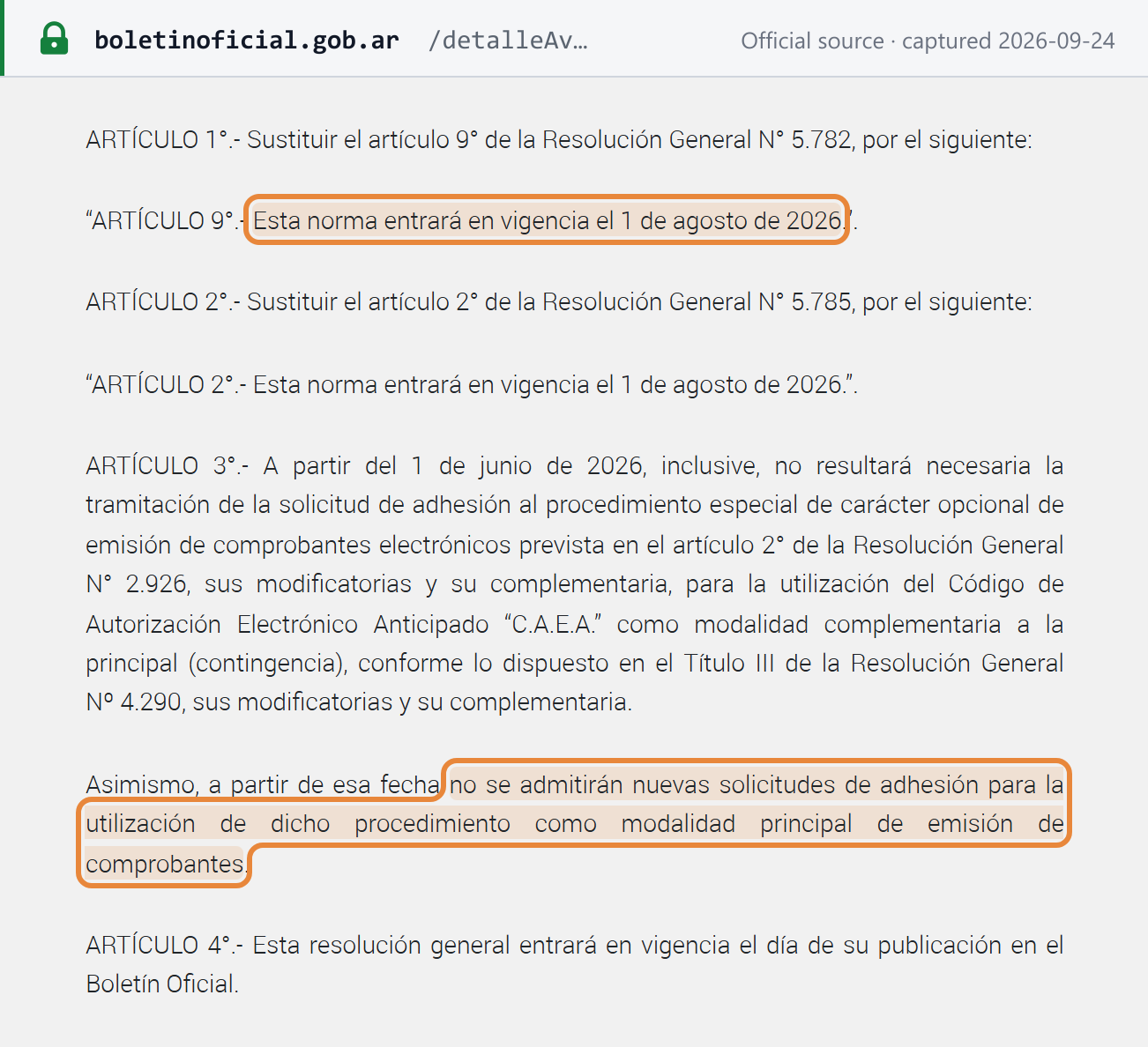
Postponement: CAEA becomes contingency-only. RG 5782/2025 (Boletín Oficial 30 Oct 2025) turned the CAEA (Código de Autorización Electrónico Anticipado) from an optional primary method into an exceptional procedure for contingencies. RG 5785/2025 made it the first contingency option for web-service issuers. Both were due on 1 Jun 2026. RG 5852/2026 (Boletín Oficial 29 May 2026) moved both to 1 Aug 2026. It left one part at 1 Jun 2026: from that date, no adhesion request is needed to use CAEA as a contingency, and "no se admitirán nuevas solicitudes de adhesión para la utilización de dicho procedimiento como modalidad principal de emisión de comprobantes". In English: no new requests are accepted to use it as the main issuing method. If you built a CAEA-first integration against the old calendar, the per-invoice CAE flow is now the one that must work. CAEA survives only as a fallback, and it has usage limits. (Boletín Oficial, RG 5852/2026, checked 2026-09-24)
 Source snapshot captured 2026-09-24 — original
Legal basis
Instruments, publication dates and in-force dates as at 2026-09-24:
| Instrument | What it does | Published | In force | Official text |
|---|---|---|---|---|
| Ley 11.683 (t.o. 1998), arts. 33, 36, 39, 40 | Tax procedure law. Arts. 33 and 36 are the powers RG 4291 was issued under. Arts. 39 and 40 set the penalties | — | — | InfoLEG |
| Ley 27.440, Title I | Creates the Factura de Crédito Electrónica MiPyMEs | 11 May 2018 | — | InfoLEG |
| RG 4290/2018 | Sets the three issuing methods: fiscal controllers (RG 3561), electronic invoices (RG 4291) and printed invoices with a CAI (RG 100). Arts. 6–7 say who must invoice electronically | 3 Aug 2018 | per article | ARCA Biblioteca |
| RG 4291/2018 | The R.E.C.E. e-invoicing regime and the CAE | 3 Aug 2018 | 6 Aug 2018 | ARCA Biblioteca |
| RG 4892/2020 | Mandatory QR code | 24 Dec 2020 | 24 Dec 2020 (web-service issuers Mar–Jun 2021) | Boletín Oficial |
| RG 5616/2024 | Exchange rate for foreign-currency invoices; buyer's VAT condition on every invoice | 18 Dec 2024 | on publication; new web-service version mandatory 15 Apr 2025 | Boletín Oficial |
| RG 5762/2025 and RG 5764/2025 | Abolish class "M" and create the class-"A" variants that replace it; adapt related resolutions | RG 5764: 25 Sep 2025 | applies from 1 Dec 2025 | Boletín Oficial (RG 5764) · Gobierno de Argentina (RG 5762) |
| RG 5782/2025 | Makes CAEA an exceptional, contingency-only procedure; replaces RG 2926 | 30 Oct 2025 | 1 Jun 2026, moved to 1 Aug 2026 | Boletín Oficial |
| RG 5785/2025 | Makes CAEA the first contingency option for web-service issuers | 3 Nov 2025 | 1 Jun 2026, moved to 1 Aug 2026 | Boletín Oficial |
| Ley 27.799 | Updates the fine and closure amounts in Ley 11.683 | 2 Jan 2026 | on publication | Boletín Oficial |
| RG 5852/2026 | Postpones RG 5782 and RG 5785 to 1 Aug 2026 | 29 May 2026 | on publication | Boletín Oficial |
| RG 5866/2026 | Reorganises RG 1415 and RG 4291; stages in the financial and insurance sectors; abrogates RG 5824/2026 | 29 Jun 2026 | 1 Jul 2026 (art. 1 j: 1 Oct 2026) | Boletín Oficial |
| RG 5893/2026 | Extends the duty to Monotributo social and promovido and to taxpayers outside VAT | 31 Aug 2026 | 1 Nov 2026 (outside VAT: 1 Mar 2027) | Boletín Oficial |
RG 5824/2026 (published 13 Feb 2026) is no longer law. RG 5866 art. 3 abrogated it; see the timeline above. RG 4367/2018, which implements the FCE regime, is listed on ARCA's normativa page; ARCA's FCE microsite sets out the operating rules.
Technical standards. ARCA publishes no binding XML syntax standard of the UBL/CII kind. The binding technical specification is ARCA's developer manual for each web service. For WSFEv1 this is "RG 4291 – Proyecto FE v4.7", with the "Revisión correspondiente al 1 de Septiembre de 2026". (ARCA — Manual para el desarrollador, checked 2026-09-24)
Scope
B2B and B2C: every domestic operation, no turnover threshold. RG 4290 art. 6, in the version set by RG 5893, requires the listed taxpayers to issue electronic invoices and/or use a fiscal controller "para respaldar todas sus operaciones realizadas en el mercado interno": to back all of their domestic operations. The listed taxpayers are:
- "a) Responsables inscriptos, exentos y no alcanzados en el impuesto al valor agregado." (VAT-registered, VAT-exempt and outside-VAT taxpayers. The outside-VAT group from 1 Mar 2027.)
- "b) Aquellos adheridos al Régimen Simplificado para Pequeños Contribuyentes (RS)." (All Monotributo taxpayers. The 2018 carve-out for monotributo social and promovido is removed from 1 Nov 2026.)
Some taxpayers may use only electronic invoices, not a fiscal controller (RG 4290 art. 7): a MiPyME selling to a large company, or to a MiPyME that has opted into the FCE regime; taxpayers outside VAT (from 1 Mar 2027); and the special sectors listed in RG 4291 Anexo II (below). (ARCA Biblioteca, RG 4290, checked 2026-09-24)
B2G. RG 4291 art. 1 covers suppliers to the national public sector. That means suppliers to the entities in Ley 24.156 art. 8 a)–d) that can be assessed under RG 4164. They "deberán emitir exclusivamente comprobantes electrónicos originales conforme a lo previsto en la presente": they must issue only original electronic invoices under this regime. No separate B2G platform or network appears in the regime. These are the same CAE-cleared invoices. (ARCA Biblioteca, RG 4291, checked 2026-09-24)
B2B with large companies: the Factura de Crédito Electrónica MiPyME (FCE). Under Ley 27.440 art. 1, a MiPyME (micro, small or medium company) that must issue an electronic invoice to a large company must issue an FCE instead. The FCE is an enforceable, tradable credit instrument, recorded in ARCA's Registro de Facturas de Crédito Electrónicas. Between two MiPyMEs the regime is optional. ARCA defines large companies as those whose annual sales exceed the ceiling for "medium tramo 2" companies in their main declared activity. (InfoLEG, Ley 27.440; ARCA FCE — sujetos, checked 2026-09-24)
- Minimum amount: "Desde el 14 de abril de 2026, el monto mínimo a partir del cual las empresas están obligadas a emitir Facturas de Crédito Electrónicas se actualizó a $ 5.549.862 (Resolución 1/2026)". In English: from 14 April 2026, the minimum amount from which companies must issue an FCE was updated to ARS 5,549,862. ARCA attributes the update to Resolución 1/2026, which updated the MiPyME size limits. (ARCA FCE microsite, checked 2026-09-24)
- Requirements: both parties need an electronic tax domicile (Domicilio Fiscal Electrónico, DFE). The issuer registers a CBU bank account. Codes are 201–203 (A), 206–208 (B) and 211–213 (C). The FCE must get its CAE between 5 days before and 1 day after its date.
- Tacit acceptance: 21 days, until 31 Oct 2026. An FCE that the buyer has not rejected, accepted or cancelled within 21 calendar days of its arrival in the DFE is accepted tacitly. ARCA sets that window as "desde el 1 de noviembre de 2025 hasta el 31 de octubre de 2026: 21 días". ARCA's schedule gives no window beyond 31 Oct 2026; check the FCE microsite for the rule that applies from 1 Nov 2026. (ARCA FCE — comprobantes, checked 2026-09-24)
- Assigned-invoice carve-out, until 31 Oct 2026. Resolución 219/2025 of the Secretaría de la Pequeña y Mediana Empresa (published 28 Oct 2025) creates an exception until 31 Oct 2026. The FCE regime does not apply to a MiPyME's invoices to a large company that are assigned under art. 1618 of the Civil and Commercial Code before the buyer cancels, rejects or accepts them. (Source: the InfoLEG note to Ley 27.440 art. 1, checked 2026-09-24.) This is a temporary rule; no extension had been published as at 2026-09-24.
 Source snapshot captured 2026-09-24 — original
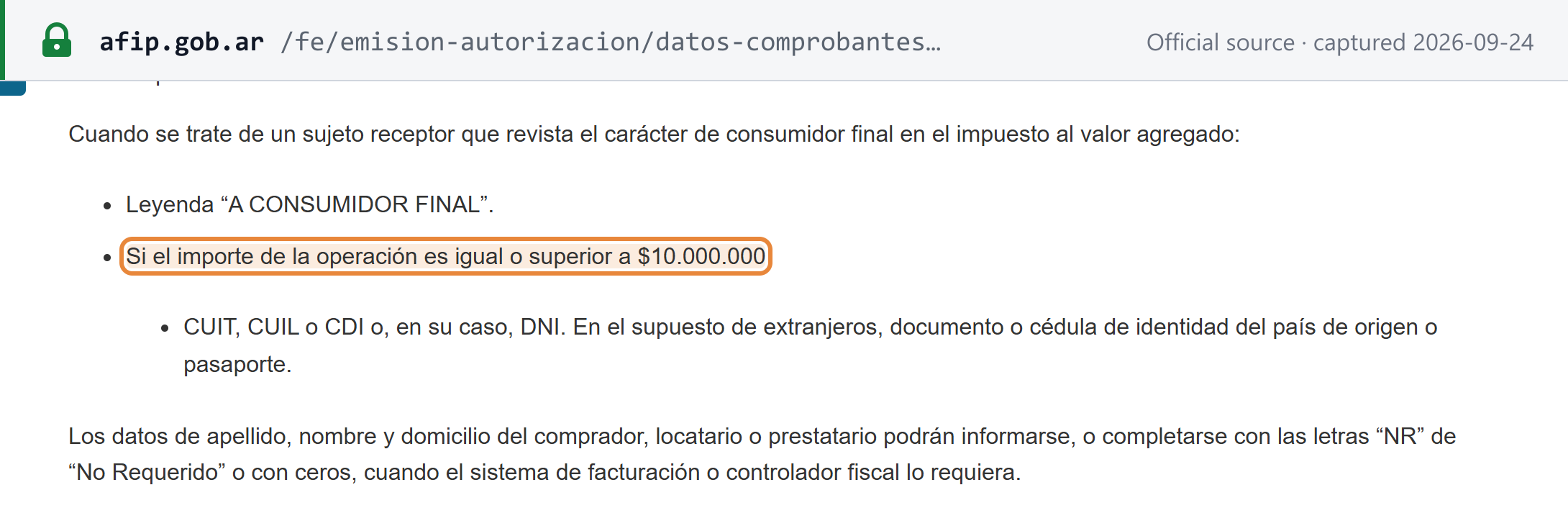
B2C: buyer identification only at ARS 10,000,000 or more. Since 1 Jul 2026, RG 1415 Anexo II (as replaced by RG 5866 art. 1 f) requires invoices to final consumers to carry the legend "A CONSUMIDOR FINAL". The buyer must be identified only where "el importe de la operación es igual o superior a PESOS DIEZ MILLONES ($10.000.000.-)", that is, at ARS 10,000,000 or more. The ID can be a DNI, CUIL or CDI, or for foreigners a home-country ID or passport. Below the threshold, name and address may be filled with "NR" (No Requerido) or zeros. At any amount, the buyer's CUIT must be shown if the buyer asks for it in order to deduct the expense for income tax. (Boletín Oficial, RG 5866/2026; ARCA — datos de los comprobantes, checked 2026-09-24)
 Source snapshot captured 2026-09-24 — original
Simplified B2C handling. Argentina has no separate simplified-invoice document with its own value threshold. The simplifications are procedural:
- Class A invoices need one CAE record per invoice.
- Class B and C invoices to final consumers that need no buyer ID may be authorised in a batch (lote), with one record carrying the summed amount (RG 4291 art. 8). Caution-insurance invoices are the exception.
- Electronic "Tique C" and "Tique Nota de Crédito C" are issued through the "Facturador" service (RG 4291 art. 6).
- Under Ley 27.743, every printed or image version of a consumer invoice must show a block titled "Régimen de Transparencia Fiscal al Consumidor (Ley 27.743)", with "IVA Contenido" and "Otros Impuestos Nacionales Indirectos" (RG 1415 Anexo II B g), as substituted by RG 5614/2024).
(ARCA Biblioteca, RG 4291, checked 2026-09-24)
Non-established businesses. RG 4290 art. 2 lists the taxpayers covered: VAT-registered, Monotributo, VAT-exempt and outside-VAT persons. Each of these is registered with ARCA under a CUIT, and the regime provides no issuing channel for an unregistered foreign supplier. When a foreign provider supplies digital services to Argentine users who are not VAT-registered, the VAT is not collected through an invoice. Under RG 4240/2018, the Argentine intermediary that handles the payment abroad collects it as a perception agent. Where no such intermediary is involved, the user pays it. The foreign provider does not issue a CAE invoice. (ARCA — RG 4240, checked 2026-09-24) A foreign company with an Argentine CUIT is a local taxpayer and follows the rules above. See the Argentina TIN guide for how to obtain a CUIT and Clave Fiscal.
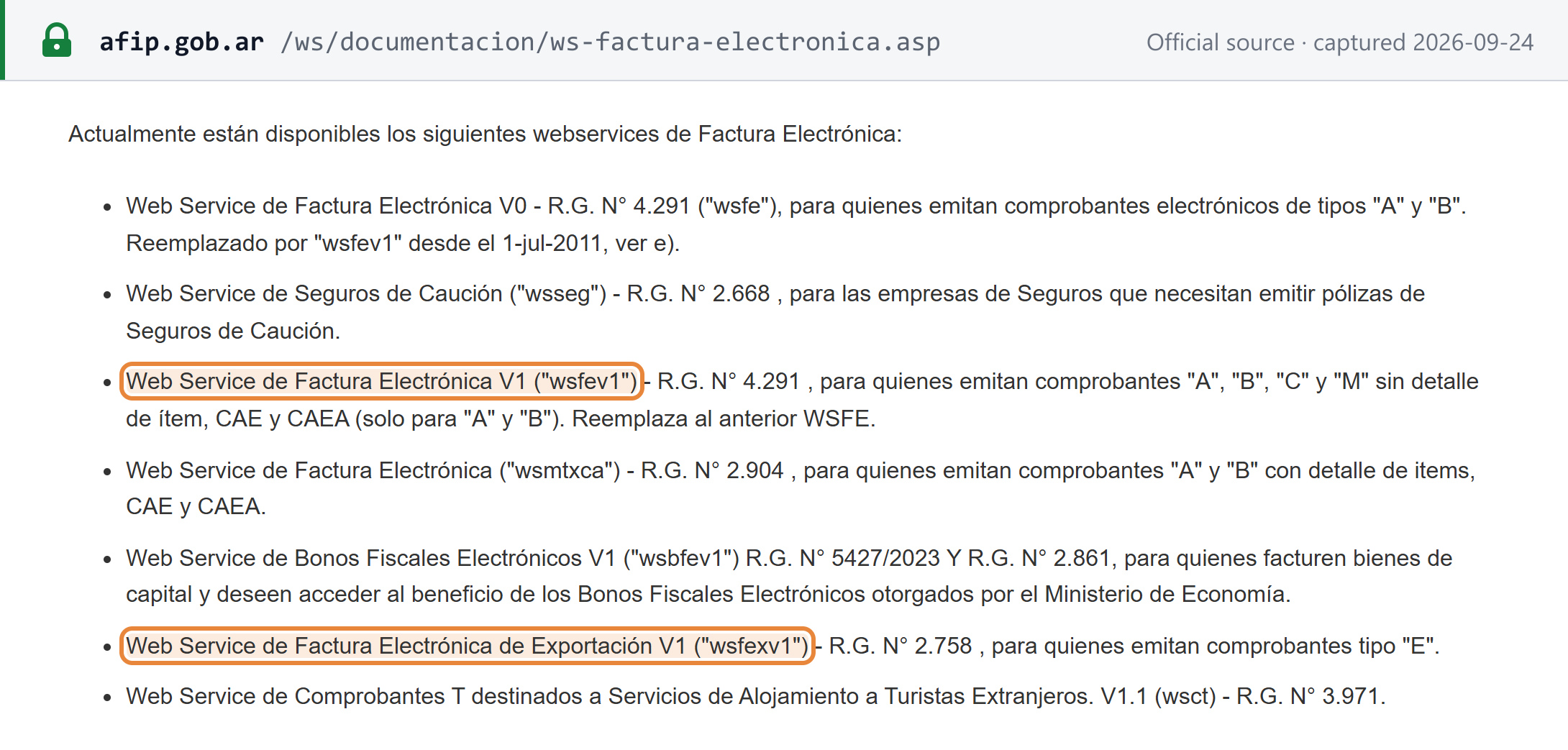
Exports. Exporters must issue electronic invoices under RG 2758/2010. Class "E" invoices go
through the export web service wsfexv1. Invoices for exported services and other non-goods
items must include a payment-date field.
(ARCA — exportación de servicios, checked 2026-09-24)
For an invoice issued in a foreign currency and settled in that same currency, RG 5616/2024 uses
the Banco de la Nación Argentina "tipo de cambio vendedor divisa" of the previous exchange business
day, filled in by the system (see Format & network).
Excluded documents and excepted operations. RG 4290 art. 5 excludes documents from taxpayers with special invoicing treatment under RG 1415 Anexo IV. Examples are stockbrokers, national airport concessionaires and newspaper and magazine distributors. It also excludes the excepted operations in RG 1415 Anexo I Apartado A. RG 5866 replaced Anexo I with a new annex and narrowed Anexo IV Apartado B. This is how banks, insurers and card operators came into the duty on the staged dates above. The list of operations that stay excepted is in the new Anexo I, which is published as a separate annex to RG 5866 in the Boletín Oficial. RG 5866 also removes point 10 of Anexo IV Apartado B from 1 Oct 2026. Check the annex itself before relying on an exception.
Sectors that must e-invoice regardless of VAT status (RG 4291 art. 17 and Anexo II, as amended by RG 5866):
- holders of promoted projects (Leyes 22.021, 22.702 and 22.973)
- prepaid-health entities (Ley 26.682)
- private primary and secondary schools (Ley 26.206)
- operators of temporary tourist rentals (1 day to 3 months)
- insurers issuing surety (caución) policies (Ley 20.091)
Each must fill the "Adicionales por R.G." fields.
Optional monthly consolidated invoice. Since 1 Jul 2026, five groups may invoice each customer either per operation or once a month:
- financial entities
- insurers (except caución operations)
- card issuers and administrators, and transfer-payment operators
- private schools and prepaid-health entities set up as non-profit associations or foundations
- virtual-asset service providers (PSAV) registered with the CNV
The comprobante de liquidación electrónica mensual must be issued by the last day of the month. It must reach the recipient within 10 calendar days of issue (RG 5866 art. 1 g). (Boletín Oficial, RG 5866/2026, checked 2026-09-24)
Format & network
CTC model: clearance. The issuer sends the invoice data to ARCA. ARCA checks the request and either authorises the invoice or rejects it. On authorisation it returns a CAE and the CAE's expiry date. For an FCE, the expiry date is the issue date.
- Rejection. Where ARCA finds inconsistencies in the issuer's data, it rejects the request. The issuer may then invoice through a fiscal controller or manual invoices, and ask again once the problem is fixed. (ARCA — consideraciones, checked 2026-09-24)
- Authorised with observations. Where a class A invoice has inconsistencies in the receiver's VAT or Monotributo status, ARCA still grants the CAE but attaches observation codes. The buyer then cannot take the VAT shown as an input credit: "El impuesto discriminado en tales comprobantes no podrá computarse como crédito fiscal del impuesto al valor agregado ni a efectos del Régimen de Sostenimiento e Inclusión Fiscal para Pequeños Contribuyentes de la Ley Nº 27.618." (RG 4291 art. 12)
- What the CAE proves. The check is formal only. RG 4291 art. 23: the authorisation "sólo considerará sus aspectos formales al momento de otorgamiento del “C.A.E.” y no implicará reconocimiento alguno de la existencia y legitimidad de la operación". It considers only formal aspects and does not recognise that the underlying operation exists or is legitimate. (ARCA Biblioteca, RG 4291, checked 2026-09-24)
Timing.
- Sending to ARCA. Where the request carries an invoice date, it must reach ARCA within 5 calendar days of that date. For services the window is 10 calendar days before or after (RG 4291 art. 9). If the request carries no date, the CAE date is the issue date.
- Delivering to the buyer. The authorised invoice must be made available to the buyer "dentro de los 10 días corridos contados desde la asignación del CAE": within 10 calendar days of the CAE. (ARCA — consideraciones, checked 2026-09-24)
Channels. Taxpayers have two ways to request authorisation, and each works per point of sale, with sequential numbering:
- ARCA's web service WSFE (WSFEv1), called from ERP or billing software.
- The "Comprobantes en línea" online service, used with a Clave Fiscal (ARCA calls it a "servicio con clave fiscal"). It includes the "Facturador Móvil" phone app.
(ARCA — solicitud de autorización, checked 2026-09-24)
Format: ARCA's own SOAP/XML web services. Not Peppol. Messages follow ARCA's SOAP schemas: for
example FECAESolicitar to request a CAE and FECAEASolicitar to request a CAEA. They are
specified in the WSFEv1 developer manual, "RG 4291 – Proyecto FE v4.7", "Revisión correspondiente
al 1 de Septiembre de 2026". Version 4.7 adds validations for caución insurance and new checks on
class B invoices to "Sujeto No Categorizado". The endpoints are:
- homologation (testing):
https://wswhomo.afip.gov.ar/wsfev1/service.asmx - production:
https://servicios1.afip.gov.ar/wsfev1/service.asmx
(ARCA — Manual para el desarrollador v4.7, checked 2026-09-24) ARCA's e-invoicing and web-service microsites publish no UBL, CII, EN 16931 or Peppol profile. The exchange runs between the taxpayer and ARCA only, with no network between trading partners. Argentina is therefore not Peppol-based. For contrast, see the Peppol explainer.
ARCA's catalogue has one web service per document family:
| Service | Rule | Use |
|---|---|---|
wsfev1 | RG 4291 | Classes A, B, C without item detail; CAE and CAEA |
wsmtxca | RG 2904 | Classes A and B with item detail; CAE and CAEA |
wsfexv1 | RG 2758 | Class E (exports) |
wsbfev1 | RG 5427/2023 and RG 2861 | Electronic fiscal bonds for capital goods |
wsseg | RG 2668 | Caución insurance, usable until 31 Dec 2026 (RG 5866) |
wsct | RG 3971 | Class T, tourist accommodation for foreign tourists |
 Source snapshot captured 2026-09-24 — original
Document classes in scope. ARCA's "Comprobantes alcanzados" page lists class A invoices and receipts, "clase A con leyenda “PAGO EN CBU INFORMADA” y clase A con leyenda “OPERACIÓN SUJETA A RETENCIÓN”", and classes B, C and E, among others. (ARCA — comprobantes alcanzados, checked 2026-09-24) Class "M" was abolished from 1 Dec 2025. Former M issuers moved to class A with the legend "OPERACIÓN SUJETA A RETENCIÓN", keeping the same codes (051–054) and numbering unless they open a new point of sale. (Gobierno de Argentina, checked 2026-09-24) The TIN guide explains which class applies to which pair of seller and buyer.
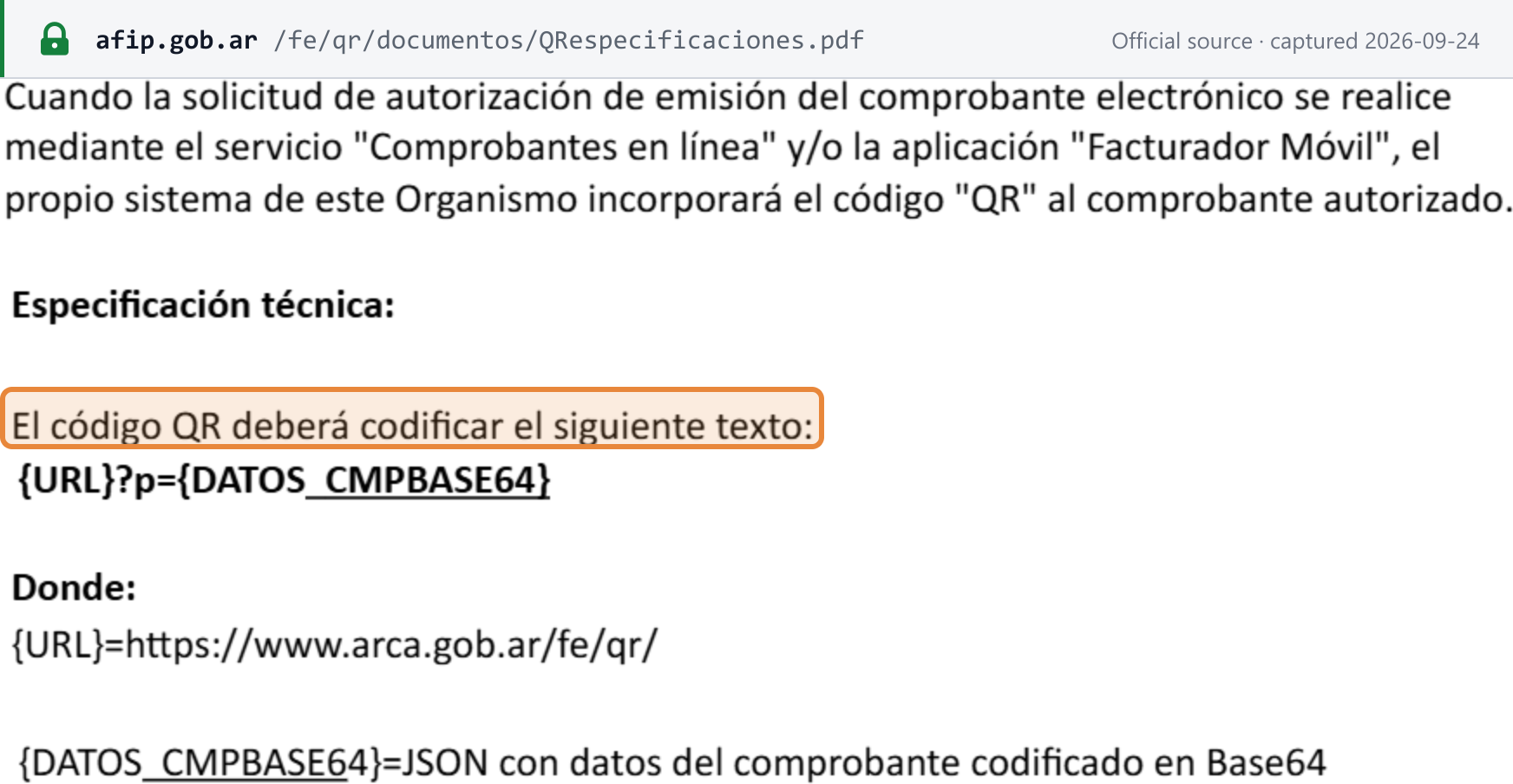
QR code (RG 4892/2020). Every invoice authorised under RG 4291 must carry a QR code. Scanning it
opens the invoice's details on ARCA. The code encodes {URL}?p={DATOS_CMPBASE64}, where the URL is
https://www.arca.gob.ar/fe/qr/ and the parameter is a JSON of the invoice data in Base64.
- Mandatory JSON fields (spec version 1):
ver,fecha,cuit,ptoVta,tipoCmp,nroCmp,importe,moneda,ctz,tipoCodAut,codAut. - Conditional fields:
tipoDocRec,nroDocRec. - Who builds it. Comprobantes en línea and Facturador Móvil add the QR automatically. Web-service issuers must generate it themselves.
- Checking it. ARCA tells readers to make sure a scanned QR opens
serviciosweb.afip.gob.ar.
(ARCA — QR specification; Boletín Oficial, RG 4892/2020, checked 2026-09-24)
 Source snapshot captured 2026-09-24 — original
CAEA contingency rules (since 1 Aug 2026).
- Periods. A taxpayer gets one CAEA per fortnight (days 1–15 and 16 to month-end). It can be requested from 5 calendar days before the fortnight starts.
- Points of sale. CAEA invoices need dedicated contingency points of sale, tied to the main issuing address.
- Reporting. Every CAEA invoice must be reported, with its generation date and time, "hasta el octavo día corrido posterior al de su finalización": by the 8th calendar day after the fortnight ends (RG 5782 art. 6). An FCE issued with a CAEA must be reported within 24 hours.
- Exceptionality tests. ARCA treats contingency use as abnormal in two cases. The first is when CAEA or CAI invoices reach 5% or more of the branch's monthly invoices. The second is when CAEA time exceeds 5% of ARCA's monthly service availability, measured per branch. Either one counts if it happens in 2 consecutive or 3 alternate months in a calendar year. ARCA can then require a new-technology fiscal controller and bar e-invoicing for a calendar year (see Penalties).
(Boletín Oficial, RG 5782/2025; ARCA — contingencias, checked 2026-09-24)
Foreign currency. RG 5616/2024 art. 1 covers invoices issued in a foreign currency and paid in that currency. They use the Banco de la Nación Argentina "tipo de cambio vendedor divisa" (selling rate) at the close of the exchange business day before the invoice. For e-invoices the system fills it in. RG 5616 also requires every e-invoice to identify the customer's VAT condition. (Boletín Oficial, RG 5616/2024, checked 2026-09-24) ARCA's WSFEv1 manual v4.7 lists the missing buyer-VAT condition as a rejecting error (code 10246). An invalid value is rejected for CAE and flagged as an observation for CAEA. (ARCA — Manual para el desarrollador v4.7, checked 2026-09-24)
E-reporting alongside. CAE invoices are cleared in real time, so ARCA runs no separate reporting of invoice data for them. The two reporting legs found in the regime are the CAEA reporting of contingency invoices (above) and the FCE registry, which records acceptance, rejection and cancellation. RG 5616's recitals link the buyer-VAT field to the "Libro de IVA Digital" (RG 4597), which is a VAT record book rather than a report of invoice data.
Onboarding: how to comply
-
Get a CUIT and a Clave Fiscal at security level 3. "Comprobantes en línea" requires a Clave Fiscal at level 3 or higher (RG 4291 art. 6 c). Taxpayers who are obliged to e-invoice do not need to enrol: "Los contribuyentes alcanzados por la obligación de emitir sus comprobantes electrónicos no deben realizar empadronamiento para comenzar a emitir factura electrónica." (ARCA — solicitud de autorización, checked 2026-09-24) See the Argentina TIN guide for CUIT and Clave Fiscal levels.
-
Enable a point of sale for each issuing channel. Use the "Administración de Puntos de Venta y Domicilios" service (RG 4291 art. 11).
- The point of sale must be separate from any fiscal-controller or RG 100 printed-invoice point.
- A new point of sale must be notified at least 3 business days before operations start there (RG 1415 art. 47, restated by RG 5866).
- A point of sale that has been deregistered can never be used again (RG 1415 art. 47, as restated by RG 5866).
- From 1 Nov 2026, ARCA itself opens a point of sale, linked to "Factura en línea - Monotributo", for any Monotributo taxpayer who has none (RG 5893 art. 3).
(Boletín Oficial, RG 5866/2026; RG 5893/2026, checked 2026-09-24)
-
Choose a connection mode.
- Comprobantes en línea / Facturador Móvil suit low volumes. ARCA adds the QR code.
- The WSFEv1 web service suits ERPs and point-of-sale systems. It needs a digital certificate, obtained with the Clave Fiscal and linked to the e-invoicing service. The certificate is used to get an access ticket from WSAA, ARCA's authentication and authorisation service. The ticket lasts 12 hours. Production certificates are managed in "Administración de Certificados Digitales" and "Administrador de Relaciones de Clave Fiscal". (ARCA — certificados, checked 2026-09-24)
-
Test in homologation. Developers get test certificates through WSASS ("Autoservicio de Acceso a APIs de Homologación"). They request it in the Administrador de Relaciones with the Clave Fiscal of a natural person, not a company. For FCE testing, ARCA publishes a list of test "large companies". (ARCA — entorno de prueba, checked 2026-09-24)
Providers. Taxpayers connect to ARCA's web services directly, with their own digital certificate and a WSAA access ticket (steps 3 and 4 above). A software vendor can operate the web service on the taxpayer's behalf: the taxpayer authorises the vendor's CUIT in the Administrador de Relaciones, the vendor accepts, and the vendor then connects with its own certificate. (ARCA — certificados; ARCA — Delegación de Webservices con el Administrador de Relaciones, checked 2026-09-24)
Verifying a received invoice. RG 4291 art. 25 requires ARCA to offer a public lookup confirming that a CAE was granted. This is the Constatación de comprobantes service. ARCA also publishes a database of apocryphal invoices. To check the issuer's CUIT, see how to verify a CUIT.
Penalties
RG 4291 art. 24 sends every breach of the e-invoicing regime to Ley 11.683: "El incumplimiento de las disposiciones de la presente resolución general será pasible de las sanciones previstas en la Ley N° 11.683, texto ordenado en 1998 y sus modificaciones." Ley 27.799 (Boletín Oficial 2 Jan 2026, in force on publication) raised the amounts in Ley 11.683.
| Breach | Sanction | Article |
|---|---|---|
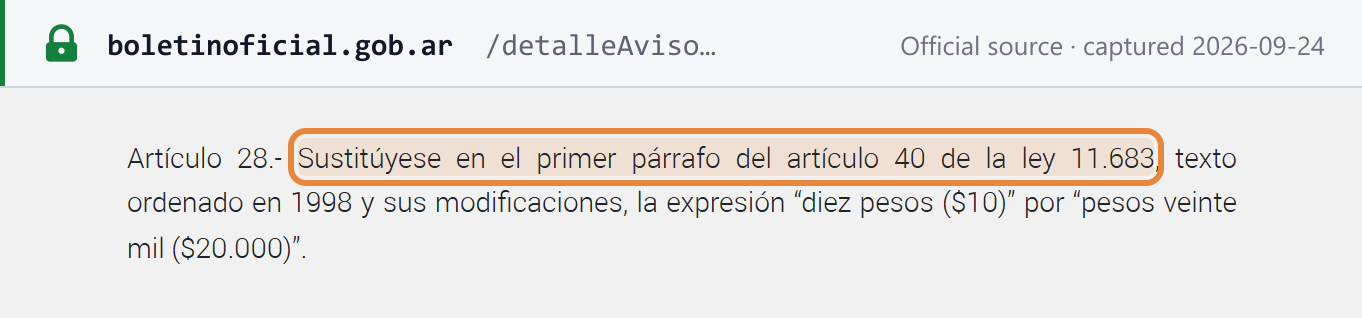
| Not issuing invoices in the form ARCA requires, where the goods or services exceed ARS 20,000 | Closure of the business for 2 to 6 days. The minimum and maximum double for a repeat art. 40 offence within 2 years of the previous one being detected. A licence or registration may also be suspended | Ley 11.683 art. 40 a); threshold raised from ARS 10 to ARS 20,000 by Ley 27.799 art. 28 |
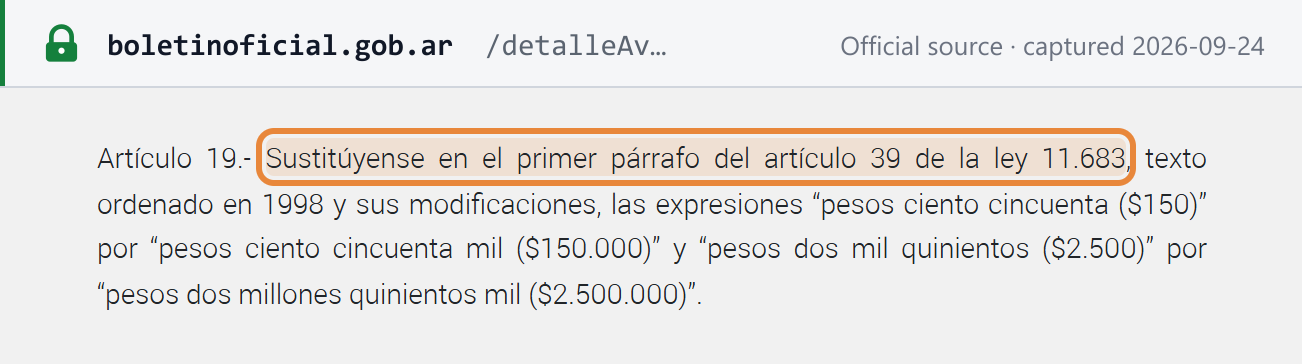
| Breach of formal duties under ARCA rules (the general fine for formal breaches, e.g. defective invoice data short of not issuing at all) | ARS 150,000 to ARS 2,500,000 | Ley 11.683 art. 39; raised from ARS 150–2,500 by Ley 27.799 art. 19 |
Art. 40's second paragraph also carries a fine of ARS 200,000–7,500,000. It concerns employees who are not registered, not invoicing, so it is left out of the table. Art. 39 is the general fine for formal breaches: ARCA's regulations do not name it as "the e-invoicing fine". Amounts apply for 2026; from 1 Jan 2027 they are updated each year by the UVA index and ARCA publishes the new figures (Ley 27.799 art. 43). (InfoLEG, Ley 11.683; Boletín Oficial, Ley 27.799, checked 2026-09-24)
 Source snapshot captured 2026-09-24 — original
 Source snapshot captured 2026-09-24 — original
Consequences inside the regime (not fines):
- Overusing contingency modes can lead ARCA to require a new-technology fiscal controller and bar e-invoicing for a calendar year. ARCA's wording: "no pudiendo emitir nuevamente comprobantes electrónicos hasta después de transcurrido un año calendario". (ARCA — contingencias, checked 2026-09-24)
- Missing CAEA reports, or missing F. 2051 returns, let ARCA refuse CAEA as a contingency method, grant only partial CAI, or move the taxpayer to class A invoices with the legend "PAGO EN CBU INFORMADA" or "OPERACIÓN SUJETA A RETENCIÓN" (RG 5785, new RG 4290 art. 25). (Boletín Oficial, RG 5785/2025, checked 2026-09-24)
- Class A invoices with receiver inconsistencies still get a CAE, but the buyer loses the input VAT credit (see Format & network).
Frequently asked questions
I am a monotributista social or promovido. What changes on 1 November 2026?
From 1 November 2026 you must issue electronic invoices (or use a fiscal controller) instead of printed booklets (RG 5893/2026). If you have no e-invoicing point of sale, ARCA opens one for you and links it to "Factura en línea - Monotributo" at your tax address. After that date, any printed booklets you still hold may be used only in a contingency, and only until their CAI expires. Taxpayers outside VAT (no alcanzados) follow later, from 1 March 2027, and may not use a fiscal controller. (Boletín Oficial, RG 5893/2026; ARCA, checked 2026-09-24)
Can we still run a high-volume point of sale on CAEA instead of per-invoice CAE?
No. Since 1 June 2026 ARCA has accepted no new requests to use CAEA as the main issuing method. Since 1 August 2026 (postponed from 1 June 2026 by RG 5852/2026), CAEA may be used only in contingencies, and the per-invoice CAE is the rule. Contingency use counts as abnormal if CAEA or CAI invoices reach 5% or more of the branch's monthly invoices, or CAEA time exceeds 5% of ARCA's monthly service availability, measured per branch. Either one counts in 2 consecutive or 3 alternate months in a calendar year. ARCA can then require a new-technology fiscal controller and bar e-invoicing for a calendar year. (RG 5782/2025, RG 5852/2026; ARCA contingencias page, checked 2026-09-24)
When does an invoice to a final consumer have to identify the buyer?
When the operation is ARS 10,000,000 or more. The invoice then needs the buyer's DNI, CUIL or CDI, or for foreigners a home-country ID or passport. Below that amount, name and address may be filled with "NR" or zeros. At any amount, show the buyer's CUIT if the buyer asks for it to deduct the expense for income tax. Every consumer invoice carries the legend "A CONSUMIDOR FINAL". This rule applies from 1 July 2026 (RG 5866/2026). (Boletín Oficial; ARCA, checked 2026-09-24)
Do we have to issue a Factura de Crédito Electrónica (FCE) to a large customer?
Yes, if you are a MiPyME invoicing a large company and the operation is ARS 5,549,862 or more (from 14 April 2026, per ARCA citing Resolución 1/2026). Between MiPyMEs the FCE is optional. Two temporary rules run until 31 October 2026. First, an FCE not rejected, accepted or cancelled within 21 calendar days is accepted tacitly. Second, invoices assigned under art. 1618 of the Civil and Commercial Code before acceptance are carved out of the FCE regime (Res. 219/2025). Check ARCA's FCE microsite for what applies from 1 November 2026. (ARCA FCE microsite; InfoLEG, Ley 27.440, checked 2026-09-24)
What replaced Factura M?
Class "M" was abolished from 1 December 2025 (RG 5762/2025 and RG 5764/2025). Former M issuers were moved to class "A" with the legend "OPERACIÓN SUJETA A RETENCIÓN", keeping the same codes (051–054) and numbering unless they open a new point of sale. A second variant, class "A" with the legend "PAGO EN CBU INFORMADA", was created at the same time. (Gobierno de Argentina; Boletín Oficial, checked 2026-09-24)
What is the penalty for not issuing an invoice?
Closure of the business for 2 to 6 days, where the goods or services exceed ARS 20,000 (Ley 11.683 art. 40 a). The minimum and maximum double for a repeat offence within 2 years. Ley 27.799 raised the threshold from ARS 10 to ARS 20,000 from 2 January 2026. Other breaches of formal duties carry the general fine of ARS 150,000 to ARS 2,500,000 (art. 39, as amended by Ley 27.799). Amounts apply for 2026; from 1 Jan 2027 they are updated each year by the UVA index and ARCA publishes the new figures (Ley 27.799 art. 43). (InfoLEG; Boletín Oficial, checked 2026-09-24)
Can a foreign SaaS provider issue Argentine e-invoices to its customers?
The regime covers taxpayers registered with ARCA under a CUIT. It provides no channel for an unregistered foreign supplier to obtain a CAE. For digital services supplied from abroad to users who are not VAT-registered, VAT is collected by the Argentine payment intermediary as a perception agent under RG 4240/2018, or paid by the user. It is not collected through the supplier's invoice. A foreign company that registers and gets a CUIT is a local taxpayer and follows the ordinary rules. (ARCA, checked 2026-09-24)
Recent changes
- 2026-08-31 — RG 5893/2026 published: e-invoicing becomes mandatory for monotributo social and promovido from 1 Nov 2026, and for taxpayers outside VAT from 1 Mar 2027. (Boletín Oficial) — see event record
- 2026-08-01 — CAEA becomes contingency-only and per-invoice CAE the rule, as RG 5782 and RG 5785 take effect on the date set by RG 5852/2026 (moved from 1 Jun 2026). (Boletín Oficial) — see event record
- 2026-07-01 — RG 5866/2026 in force: it abrogates RG 5824/2026 (superseded record) and takes its monthly settlement invoice into RG 1415/4291. It also sets consumer ID at ARS 10,000,000 or more, and stages banks, insurers and card operators from 1 Sep 2026 to 1 Mar 2027. (Boletín Oficial) — see event record
- 2026-04-14 — FCE MiPyME minimum raised to ARS 5,549,862 (Resolución 1/2026). (ARCA)
- 2026-01-02 — Ley 27.799 raises the Ley 11.683 penalty amounts: closure for not invoicing applies above ARS 20,000, and formal-duty fines are ARS 150,000–2,500,000. (Boletín Oficial)
- 2025-12-01 — Class "M" invoices abolished and replaced by class "A" with the legend "OPERACIÓN SUJETA A RETENCIÓN" (RG 5762/2025 and RG 5764/2025). (Boletín Oficial)
Related resources
- Argentina VAT (IVA) country guide — IVA rates, registration and Monotributo, invoice classes, the monthly F.2051 return and penalties
- E-invoicing status and networks worldwide — Argentina in global context
- Argentina tax identification numbers (CUIT, CUIL, CDI) — CUIT, Clave Fiscal levels and invoice classes
- How to verify a CUIT in Argentina
- How to verify an Argentine DNI — the ID a consumer invoice needs at ARS 10,000,000 or more
- Brazil e-invoicing (NF-e) — the other large clearance regime in the region
- Peppol network explainer — for contrast: Argentina does not use Peppol
- Argentina tax-change chronology — every tracked Argentine change, dated and sourced
- Validate an Argentine CUIT
Important websites
- ARCA — Factura electrónica — official e-invoicing microsite (mirror at afip.gob.ar/fe)
- Comprobantes en línea — ARCA's web invoicing service (Clave Fiscal login)
- Web services for e-invoicing — service catalogue and developer manuals, including the WSFEv1 manual v4.7
- Test environment (homologación) and digital certificates
- QR code specification
- Factura de Crédito Electrónica MiPyME — FCE microsite
- Constatación de comprobantes — check that an invoice's CAE was granted
- E-invoicing regulations list — ARCA normativa page