E-Invoicing in Sweden — B2G Peppol Mandate and the B2B Inquiry
Overview
Sweden has no national e-invoicing platform. What it has is a supplier-side B2G mandate: since 1 April 2019, every invoice a supplier issues to a contracting authority or entity after a public procurement must be an electronic invoice that conforms to the European standard, EN 16931. The rule is 4 § of lag (2018:1277) om elektroniska fakturor till följd av offentlig upphandling, usually called the e-fakturalagen: "De fakturor som en leverantör utfärdar till en upphandlande myndighet eller enhet ska vara elektroniska fakturor som överensstämmer med den europeiska standard för elektronisk fakturering som Europeiska kommissionen har hänvisat till i Europeiska unionens officiella tidning." (The invoices a supplier issues to a contracting authority or entity must be electronic invoices conforming to the European e-invoicing standard the European Commission has referenced in the Official Journal.) (Sveriges riksdag — lag 2018:1277)
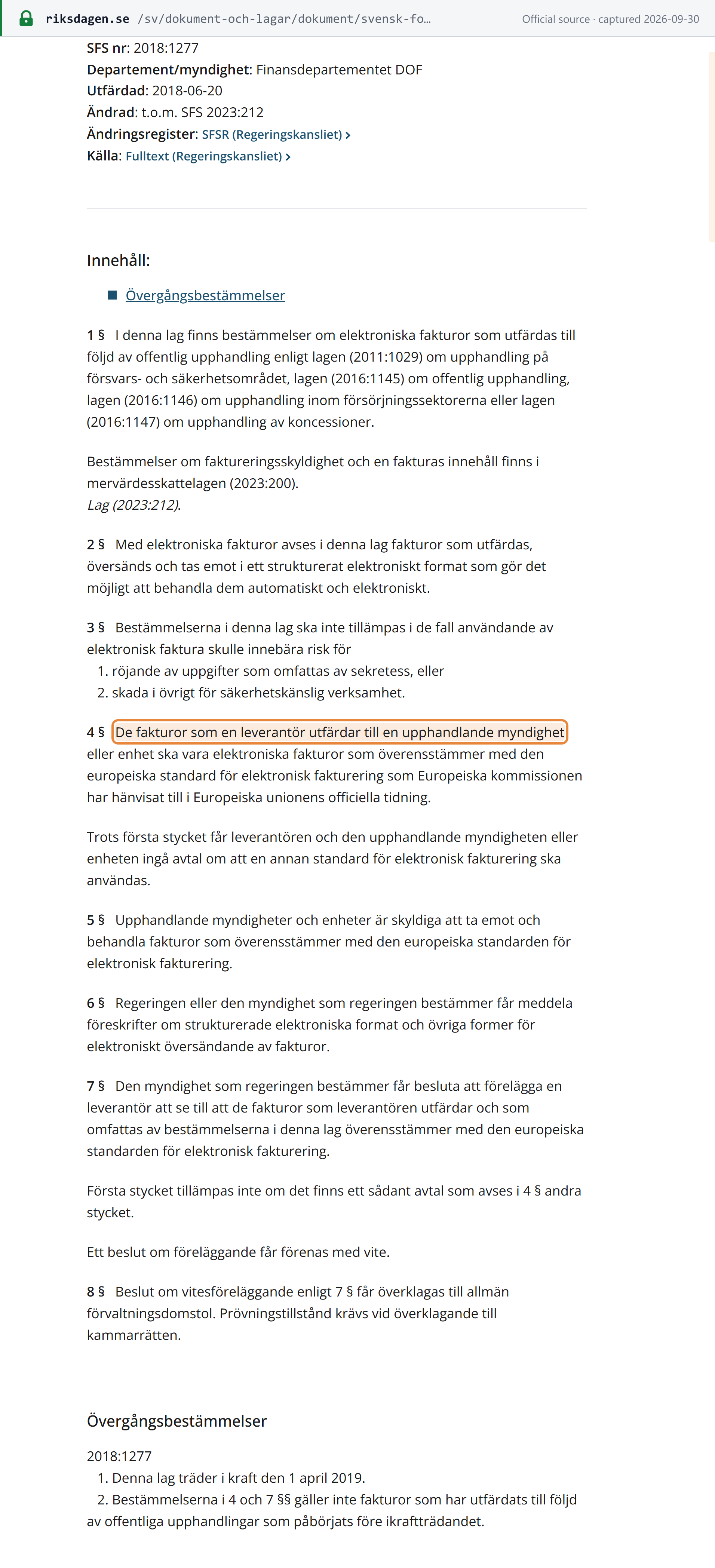 Source snapshot captured 2026-09-30 — original
That goes further than EU law requires. Directive 2014/55/EU obliges public buyers only to receive e-invoices; Sweden also obliged suppliers to send them. The Government chose this deliberately in the bill, prop. 2017/18:153, because a receive-only duty would not deliver the savings, and it rejected calls to limit the law to reception. (Sveriges riksdag — prop. 2017/18:153)
Who runs it. Since 1 July 2026 the Upphandlingsmyndigheten (the National Agency for Public Procurement) supports suppliers, decides orders against suppliers that do not comply, may issue format rules, and is responsible for connection to the European infrastructure for electronic procurement (förordning (2015:527) 2 b–2 d §§, as amended by SFS 2026:598) — a role the agency describes as Sweden's Peppol Authority (Peppolmyndighet). Before that date these tasks sat with DIGG (Myndigheten för digital förvaltning), which is itself being wound up: its instruction is repealed from 1 January 2027, when the new Digitaliseringsmyndigheten starts (SFS 2026:1769).
B2B is voluntary. Under the VAT Act, ML (2023:200) 17 kap. 20 §, an electronic invoice may be issued only if the recipient accepts it. A government inquiry, Fi 2026:03, is preparing proposals to implement the EU's cross-border ViDA reporting and assessing whether domestic e-invoicing should follow; it reports by 30 November 2027. No domestic B2B mandate has been proposed.
| Sweden | |
|---|---|
| System | No national platform. B2G e-invoices travel over the Peppol network (4-corner interchange) or through a buyer's supplier portal |
| B2G | Mandatory for suppliers since 1 April 2019, for procurements begun on or after that date (LOU, LUF, LUFS, LUK; direct awards included). Buyers must receive EN 16931 invoices |
| B2B (domestic) | Voluntary; an e-invoice needs the recipient's consent (ML 17 kap. 20 §). A domestic mandate is under assessment by inquiry Fi 2026:03, report due 30 November 2027 |
| B2C | Voluntary; in most sales to private individuals no invoice is required at all |
| Non-established businesses | In B2G scope, whatever country the supplier is in |
| Format | EN 16931 in UBL or CII (buyers must accept both); Peppol BIS Billing 3 recommended, and required of state agencies. SFTI Svefaktura 1.0 only in state-agency relationships established before 1 March 2021 |
| Clearance / e-reporting | None |
| Authority | Upphandlingsmyndigheten since 1 July 2026 (supervision, orders, format rules, Peppol Authority); DIGG before that |
| Legislation | Lag (2018:1277); förordning (2015:527) 2 b–2 d §§ as inserted by SFS 2026:598; MDFFS 2019:1 and 2021:1 (amended by MDFFS 2026:1 and 2026:2); ML (2023:200) 17 kap.; Bokföringslag (1999:1078) 7 kap. |
| Penalty | An order (föreläggande) that may carry a conditional fine (vite), set case by case; no fixed amount |
Mandate status & timeline
B2G: in force since 2019
| Phase | Who / what | Date | Status | Legal basis |
|---|---|---|---|---|
| Law adopted | The Riksdag adopts prop. 2017/18:153 (committee report 2017/18:FiU40) | 14 June 2018 | passed | [2] |
| Law issued | Lag (2018:1277) issued | 20 June 2018 | passed | [1] |
| State agencies on Peppol | State agencies must be able to use Peppol's infrastructure (earlier agency rules) | 1 November 2018 | passed | prop. 2017/18:153 [2] |
| B2G mandate | Suppliers send EN 16931 e-invoices; buyers receive them. Invoices from procurements begun before this date are outside 4 § and 7 § | 1 April 2019 | passed, in force | Lag (2018:1277), transitional provisions [1] |
| Buyers in Peppol SMP | Contracting authorities and entities registered in Peppol's SMP to receive e-invoices | 1 December 2019 | passed | MDFFS 2019:1 2 § [5] |
| State-agency standards | State agencies send via Peppol and use Peppol BIS Billing 3; Svefaktura 1.0 only in relationships established before this date | 1 March 2021 | passed | MDFFS 2021:1 [6] |
| Technical amendments | MDFFS 2026:1 modernised the Peppol-registration regulation's heading and 1–2 §§; MDFFS 2026:2 re-pointed MDFFS 2021:1's VAT references to ML (2023:200) | 23 January 2026 | passed | [6] |
| Authority transfer | Supervision, orders, format rules and the Peppol role move from DIGG to Upphandlingsmyndigheten | 1 July 2026 | passed | SFS 2026:598, SFS 2026:599 [3] |
| DIGG abolished | DIGG's instruction repealed; Digitaliseringsmyndigheten starts | 1 January 2027 | enacted, upcoming | SFS 2026:1769 [4] |
The memorandum Ds 2017:31 proposed a start on 1 November 2018; the bill set 1 April 2019 instead, and no enacted date has moved since.
The July 2026 transfer. Förordning (2026:598), issued on 13 May 2026, published on 20 May 2026 and in force on 1 July 2026, inserts 2 a–2 d §§ into Upphandlingsmyndigheten's instruction, förordningen (2015:527). The e-invoicing tasks are in 2 b–2 d §§:
- 2 b § — support and information for private suppliers on e-invoices in public procurement, and decisions on orders (förelägganden) under 7 § of lag (2018:1277);
- 2 c § — the power to issue regulations on structured electronic formats and other forms of electronic transmission under 6 § of the same Act;
- 2 d § — "Myndigheten ska ansvara för frågor om anslutning till den europeiska infrastrukturen för elektroniska inköp." (The Agency is responsible for matters of connection to the European infrastructure for electronic procurement.) This is the Peppol role.
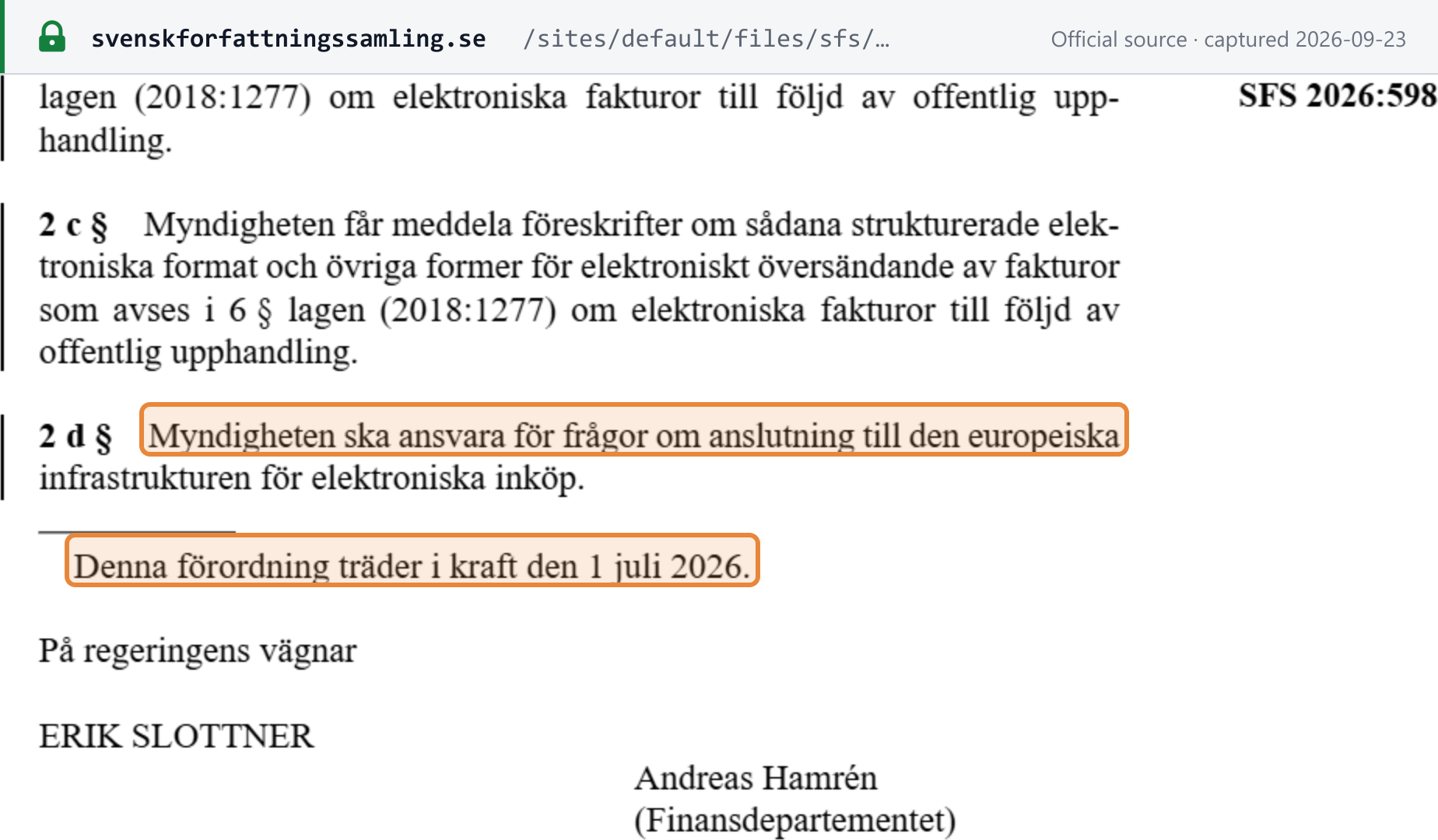 Source snapshot captured 2026-09-23 — original
On the same day, SFS 2026:599 repealed 5 § and 21 § of DIGG's instruction, including DIGG's power to issue regulations. SFS 2026:1769, published on 8 September 2026, is the instruction for the new Digitaliseringsmyndigheten; from 1 January 2027 it repeals DIGG's instruction (2018:1486) along with that of Post- och telestyrelsen. The MDFFS regulations were issued by DIGG and are still published on digg.se; Upphandlingsmyndigheten says it has been responsible for them since 1 July 2026. How the MDFFS series will be published after DIGG closes had not been announced as of 30 September 2026.
B2B: under assessment, no mandate
| Step | What | Date | Status | Source |
|---|---|---|---|---|
| Inquiry appointed | Dir. 2026:9 appoints a special investigator on ViDA e-invoicing and digital reporting, and on whether domestic e-invoicing should follow | 5 February 2026 | passed; inquiry ongoing | [8] |
| ViDA step 2 bill | Prop. 2025/26:278 tabled in the Riksdag (platforms, OSS/IOSS, distance sales; no e-invoicing content) | 9 June 2026 | in committee | [10] |
| Motion period | Motion period for prop. 2025/26:278 ends | 5 October 2026 | upcoming | Riksdag document status for prop. 2025/26:278 [10] |
| ViDA step 2 in force | Proposed in-force date of prop. 2025/26:278, if adopted | 1 January 2027 | proposed | [10] |
| Inquiry report | Fi 2026:03 reports, including its assessment of domestic e-invoicing and digital reporting | 30 November 2027 | scheduled | [9] |
| ViDA steps 3 and 4 | EU application dates; Swedish law left to future legislation | 1 July 2028, 1 July 2029 | not legislated in Sweden | [10] |
| ViDA step 5 | EU date for EN 16931-based digital reporting of intra-EU B2B supplies, replacing the EC sales list | 1 July 2030 | not legislated in Sweden | Dir. 2026:9 [8] |
The inquiry. Dir. 2026:9, Moderniserad och brottsförebyggande hantering av mervärdesskatt, was decided at the Government meeting of 5 February 2026. The Riksdag's committee register names the inquiry Utredningen om e-faktura och digital momsrapportering (Fi 2026:03), under the Ministry of Finance, with Gabriella Loman as special investigator from 1 March 2026. Its status is ongoing, it lists no interim reports, and "Uppdraget ska redovisas senast den 30 november 2027" (the assignment is to be reported by 30 November 2027).
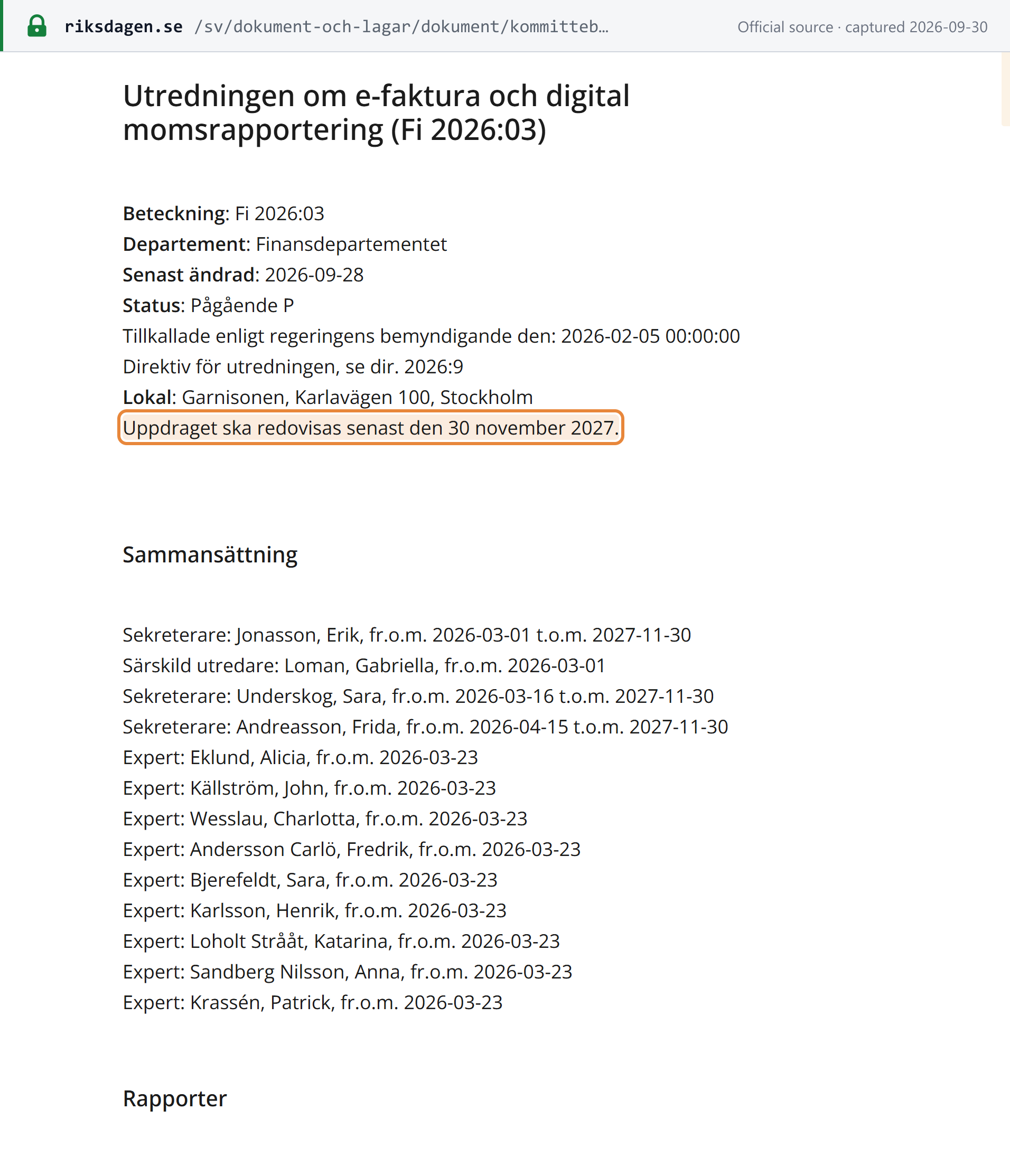 Source snapshot captured 2026-09-30 — original
The remit has two parts. The cross-border part is mandatory under ViDA: analyse the legislative changes needed for digital reporting of intra-EU B2B transactions, based on e-invoicing, from 1 July 2030, and decide on the directive's options. The domestic part is an assessment only: "Utredaren ska också undersöka om elektronisk fakturering och digital rapportering bör införas även för inhemska transaktioner och i så fall i vilken omfattning." (The investigator shall also examine whether e-invoicing and digital reporting should be introduced for domestic transactions too, and if so to what extent.) If the answer is yes, the investigator proposes scope, timing and technical design. The Government ruled out two things for the domestic analysis: changes to the exemptions from the invoicing obligation, and sanctions that alter input-VAT deduction rights. The directive records that Bolagsverket, DIGG and Skatteverket jointly petitioned for mandatory e-invoicing to be investigated (hemställan Fi2023/00570).
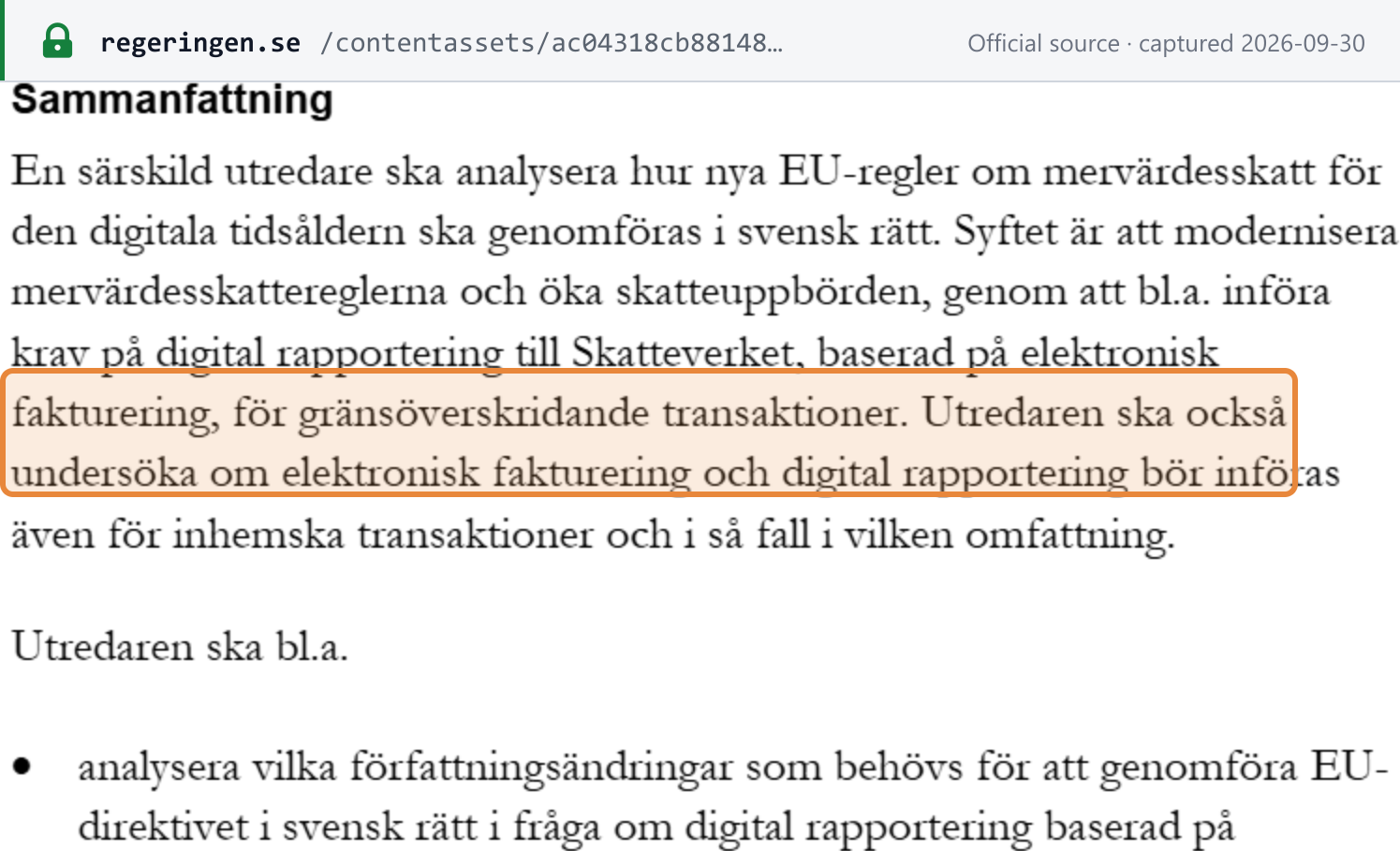 Source snapshot captured 2026-09-30 — original
An inquiry is the first stage of Swedish lawmaking: its report (an SOU) goes out to consultation, and only then can a bill follow. Until then there is no bill and no date for domestic B2B e-invoicing.
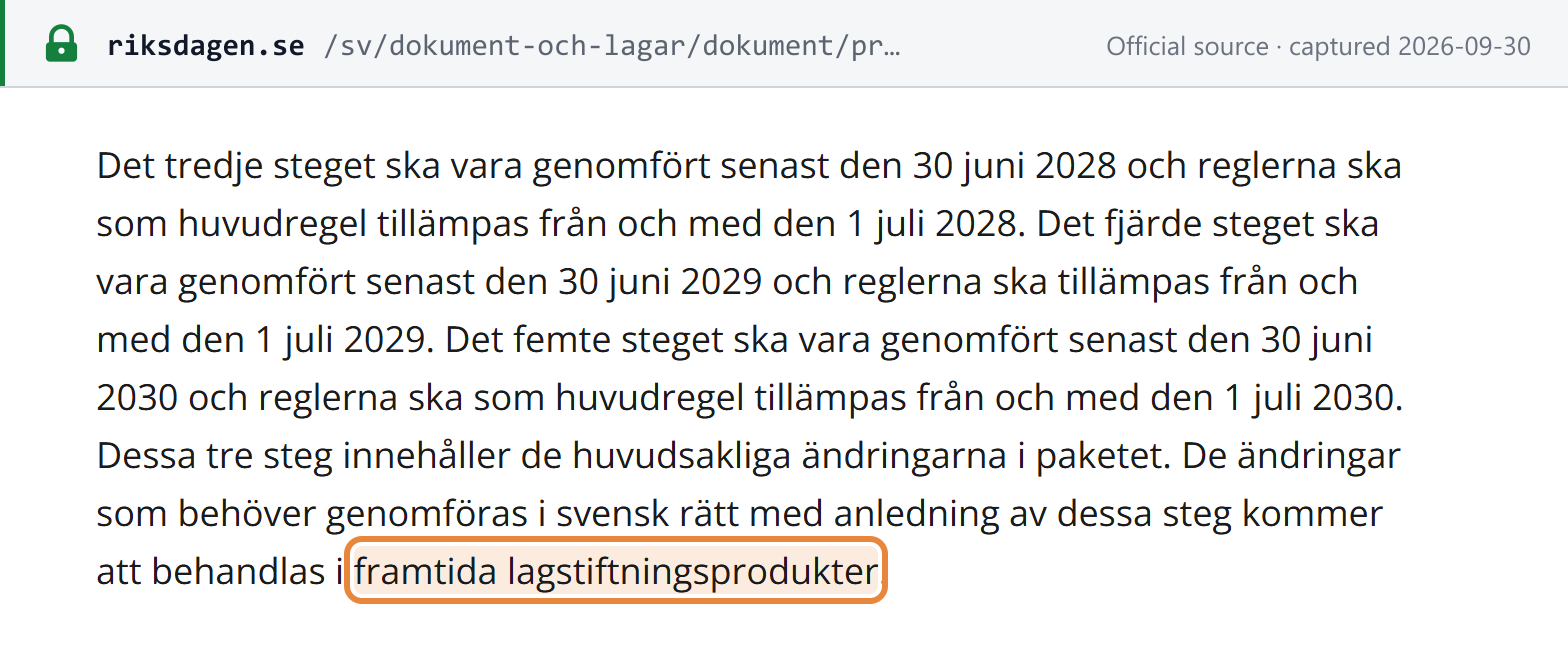
The Government's ViDA timetable. Prop. 2025/26:278, Teknisk översyn av mervärdesskattereglerna vid gränsöverskridande handel, sets out the five steps of Council Directive (EU) 2025/516 (ViDA). It implements only step 2, which applies from 1 January 2027. For steps 3 to 5 (1 July 2028, 1 July 2029 and 1 July 2030), which carry the main changes, the bill says: "De ändringar som behöver genomföras i svensk rätt med anledning av dessa steg kommer att behandlas i framtida lagstiftningsprodukter." (The amendments needed in Swedish law for these steps will be dealt with in future legislative products.) The bill was decided by the Government on 4 June 2026, tabled on 9 June 2026 and referred to the Committee on Taxation (Skatteutskottet) on 10 June 2026; as at 30 September 2026 there was no committee report or chamber decision.
 Source snapshot captured 2026-09-30 — original
Legal basis
- Lag (2018:1277) om elektroniska fakturor till följd av offentlig upphandling — issued 20 June 2018, in force 1 April 2019, consolidated up to SFS 2023:212. It implements Directive 2014/55/EU. 1 § sets the scope (procurement under LUFS 2011:1029, LOU 2016:1145, LUF 2016:1146 and LUK 2016:1147); 2 § defines an e-invoice as structured; 3 § excludes secrecy and security cases; 4 § obliges suppliers; 5 § obliges buyers to receive; 6 § allows format rules; 7–8 §§ provide orders with a conditional fine and appeals. [1]
- Preparatory works — memorandum Ds 2017:31; bill prop. 2017/18:153, tabled 19 March 2018; Finance Committee report 2017/18:FiU40; Riksdag decision 14 June 2018. The bill states that the law introduces no civil-law sanctions. [2]
- Förordning (2015:527) med instruktion för Upphandlingsmyndigheten, 2 b–2 d §§, inserted by SFS 2026:598 (issued 13 May 2026, in force 1 July 2026). [3]
- SFS 2026:599 (issued 13 May 2026, in force 1 July 2026) repealed 5 § and 21 § of DIGG's instruction, förordningen (2018:1486). [11]
- SFS 2026:1769, the instruction for Digitaliseringsmyndigheten (issued 3 September 2026, published 8 September 2026, in force 1 January 2027), repeals DIGG's instruction. [4]
- MDFFS 2019:1, issued by DIGG (decided 13 May 2019, in force 1 December 2019): contracting authorities and entities must be registered in Peppol's Service Metadata Publisher (SMP) to receive e-invoices. Amended by MDFFS 2026:1 (in force 23 January 2026), which only modernises the heading and 1–2 §§. [5]
- MDFFS 2021:1, issued by DIGG (decided 4 February 2021, in force 1 March 2021, replacing ESV Cirkulär 2012:6), binds state agencies under förordning (2003:770), not municipalities, regions or suppliers. Amended by MDFFS 2026:2 (in force 23 January 2026), which re-points its VAT references to ML (2023:200) 17 kap. Upphandlingsmyndigheten has been responsible for both MDFFS regulations since 1 July 2026. [6]
- Mervärdesskattelag (2023:200) — 2 kap. 10 § (the VAT definition of an electronic invoice), 17 kap. 20 § (recipient consent), 17 kap. 26 § (simplified invoices), 17 kap. 30–31 §§ (authenticity, integrity, legibility and keeping a copy). Consolidated up to SFS 2026:1025. [7]
- Bokföringslag (1999:1078) 7 kap. — retention period, format and place of storage; consolidated up to SFS 2024:342. [12]
- Technical standards — EN 16931 binds through 4 § of the Act. Peppol BIS Billing 3 is a recommendation for suppliers and a requirement for state agencies (MDFFS 2021:1 20 §). SFTI's Swedish validation rules and mapping guides are guidance, not law.
Scope
B2G: who must send, and what
Suppliers. 4 § applies to every invoice a supplier issues to a contracting authority or entity as a result of a procurement under LOU, LUF, LUFS or LUK. Upphandlingsmyndigheten's guidance makes three points of scope explicit: the Act applies whatever procedure was used, direct awards (direktupphandlingar) included; it covers suppliers of goods and services whatever country they are in; and an interest invoice (räntefaktura) is a new invoice with a new number, so it must be an e-invoice too. (Upphandlingsmyndigheten — Regler för e-handel och e-faktura)
Buyers. 5 §: "Upphandlande myndigheter och enheter är skyldiga att ta emot och behandla fakturor som överensstämmer med den europeiska standarden för elektronisk fakturering." (Contracting authorities and entities must receive and process invoices conforming to the European standard.) Every contracting organisation covered must be registered as an e-invoice receiver in Peppol.
What counts as an e-invoice. 2 § of the Act requires a structured format: invoices "som utfärdas, översänds och tas emot i ett strukturerat elektroniskt format som gör det möjligt att behandla dem automatiskt och elektroniskt" (issued, transmitted and received in a structured electronic format that allows automatic and electronic processing). Upphandlingsmyndigheten: "En PDF-faktura eller inskannad pappersfaktura räknas därför inte som e-faktura enligt e-fakturalagen." (A PDF invoice or a scanned paper invoice therefore does not count as an e-invoice under the e-invoicing act.)
The VAT Act uses the same words differently. ML 2 kap. 10 § defines an electronic invoice as one "som utfärdas och tas emot i ett elektroniskt format" (issued and received in an electronic format), with no structure requirement. Read side by side, the two definitions mean that a PDF sent by e-mail is an electronic invoice for VAT purposes, with the buyer's consent, but is not a compliant invoice to a Swedish public buyer. (Sveriges riksdag — ML 2023:200)
Parties may agree another standard. Under 4 § second paragraph, the supplier and the buyer may contract to use a different e-invoicing standard. Where they have, no order can be issued (7 §).
Exclusions from the B2G duty
| Excluded | Basis |
|---|---|
| Invoices where an e-invoice would risk disclosing classified information or harming security-sensitive activity; the contracting organisation decides the risk for each invoice flow | Lag (2018:1277) 3 §; Upphandlingsmyndigheten |
| Invoices from procurements begun before 1 April 2019 | Transitional provision 2 |
| Payments made in cash or by payment card | Upphandlingsmyndigheten guidance |
| Payment reminders (not invoices) and debt-collection demands (inkassokrav, sent on paper) | Upphandlingsmyndigheten guidance |
Imports and reverse-charge supplies carry no separate rule: the test is whether the invoice arises from a Swedish public procurement.
Non-established businesses
In scope for B2G. Upphandlingsmyndigheten: "Alla varu- och tjänsteleverantörer omfattas av e-fakturalagen, oavsett vilket land leverantören finns i." (All suppliers of goods and services are covered by the e-invoicing act, whatever country the supplier is in.) A foreign supplier to a Swedish public buyer needs a Peppol access point or the buyer's supplier portal, like a Swedish one. For B2B, the voluntary regime and consent rule below apply to foreign sellers as they do to Swedish ones.
B2B: voluntary, with the recipient's consent
No Swedish statute requires B2B e-invoicing. ML 17 kap. 20 §: "Elektronisk faktura får utfärdas bara om mottagaren godkänner det." (An electronic invoice may be issued only if the recipient accepts it.) Its second paragraph points to the separate public-sector duty to receive under 5 § of lag (2018:1277). The content requirements are the same whether an invoice is electronic or on paper (Skatteverket).
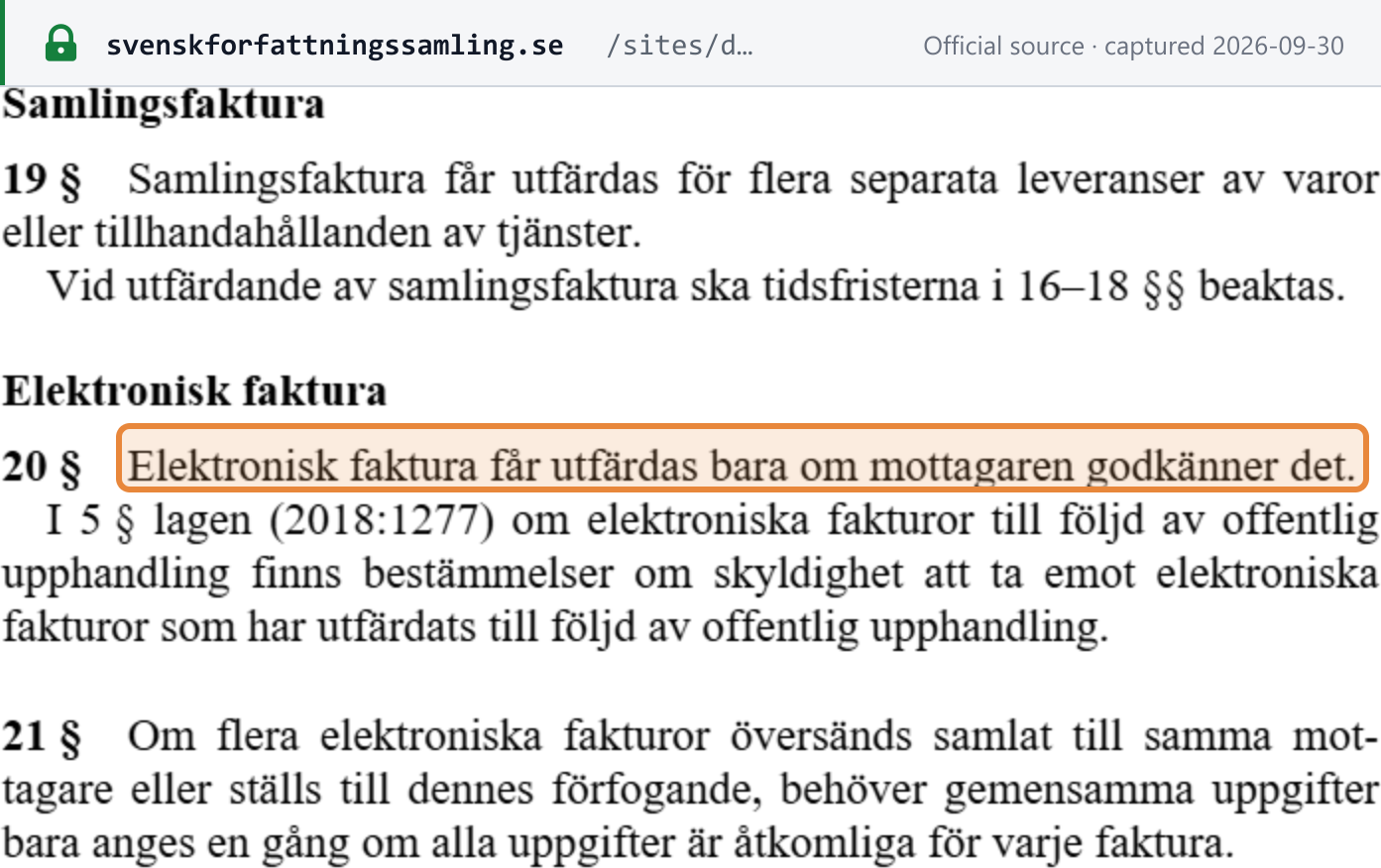 Source snapshot captured 2026-09-30 — original. The wording of 20 § is unchanged in the consolidated text.
The ViDA amending directive will let an EN 16931 e-invoice be issued without the recipient's acceptance, but Sweden has not amended 17 kap. 20 §, and neither prop. 2025/26:278 nor any other bill does so (checked 2026-09-30). Whether domestic B2B e-invoicing should become mandatory is the open question for inquiry Fi 2026:03 (see the timeline).
B2C
Voluntary. Skatteverket: "I de flesta fall behöver säljaren inte utfärda en faktura om köparen av varorna eller tjänsterna är en privatperson." (In most cases the seller need not issue an invoice if the buyer is a private individual.) Skatteverket lists exceptions: construction services, new means of transport taxed in another EU country, and intra-EU distance sales into Sweden unless the seller uses the OSS. Where an invoice is issued electronically, the consent rule in 17 kap. 20 § applies. (Skatteverket — Momslagens regler om fakturering)
Simplified invoices
ML 17 kap. 26 § allows a simplified invoice (förenklad faktura) when, among other conditions, "fakturans totalbelopp inte överstiger 4 000 kronor inklusive mervärdesskatt" (the invoice total does not exceed SEK 4,000 including VAT) (as at 2026-09-30). Skatteverket adds that a buyer cannot deduct VAT on a simplified invoice above that amount. Lag (2018:1277) contains no exception for simplified invoices, so on the Act's wording a simplified invoice arising from a public procurement is still subject to 4 §.
Format & network
CTC model: Peppol 4-corner interchange, no clearance
Sweden uses post-audit interchange. A B2G e-invoice goes from the supplier's Peppol access point to the buyer's access point, the arrangement Upphandlingsmyndigheten calls a 4-hörnsmodell (4-corner model), or is entered in the buyer's supplier portal. No authority validates, stamps, numbers or returns the invoice. Skatteverket's invoicing guidance, ML 17 kap. and Upphandlingsmyndigheten's rules and Peppol pages describe no tax-authority platform, clearance step, QR code, hash or cryptographic stamp, and no e-reporting alongside e-invoicing (checked 2026-09-30). The VAT integrity rule in ML 17 kap. 30 § (authenticity of origin, integrity of content, legibility) is technology-neutral.
Formats: EN 16931 in UBL or CII; Peppol BIS Billing 3 recommended
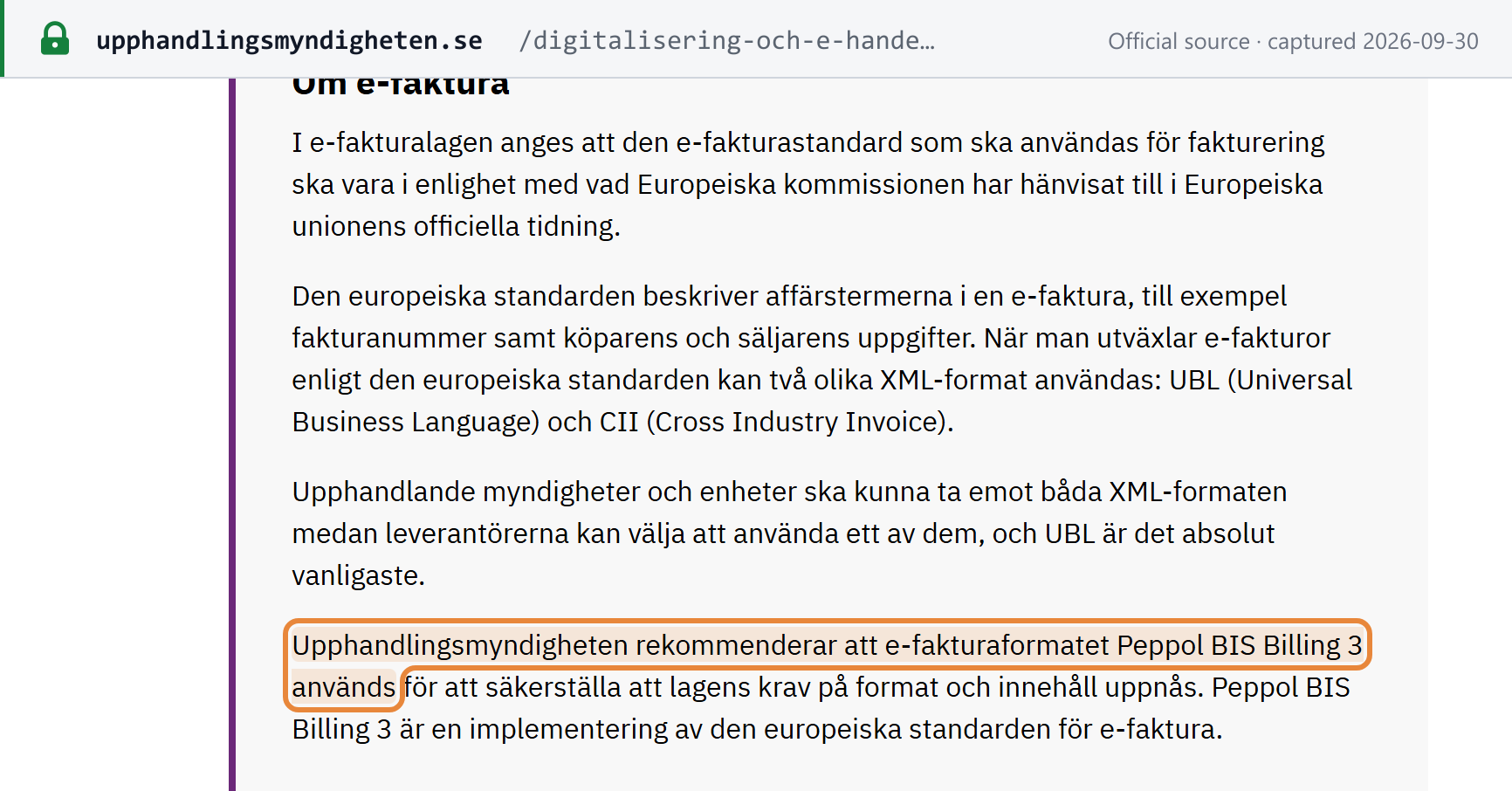
Upphandlingsmyndigheten: EN 16931 e-invoices can use two XML syntaxes, UBL and CII. Contracting authorities must be able to receive both; suppliers may choose one, and UBL is by far the most common. "Upphandlingsmyndigheten rekommenderar att e-fakturaformatet Peppol BIS Billing 3 används för att säkerställa att lagens krav på format och innehåll uppnås." (Upphandlingsmyndigheten recommends the Peppol BIS Billing 3 format to make sure the law's format and content requirements are met.) It also recommends sending over the Peppol network, because converting between formats can lose information.
 Source snapshot captured 2026-09-30 — original
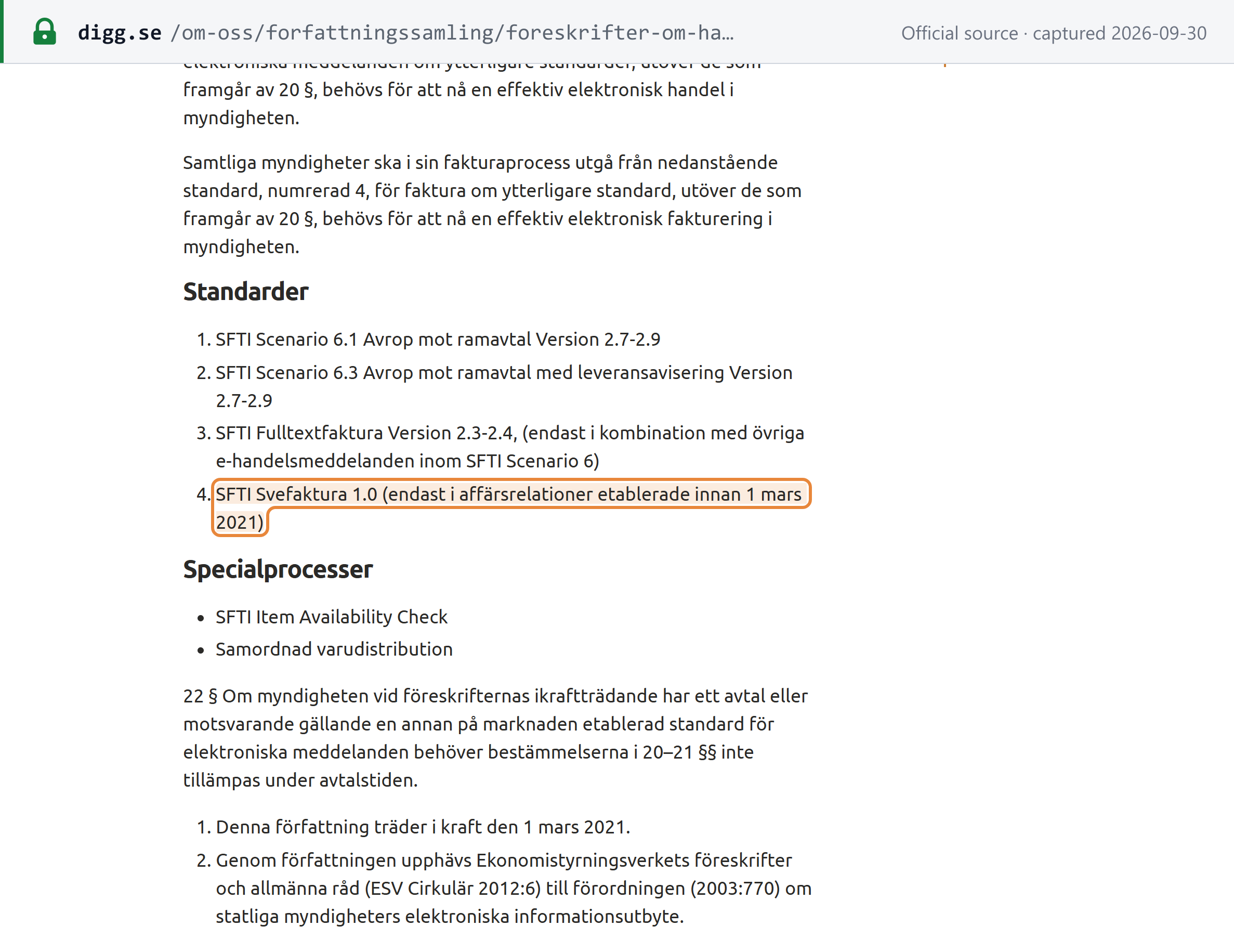
State agencies are held to more: under MDFFS 2021:1, every state agency must be registered in Peppol's SMP, be able to send e-invoices over Peppol (19 §) and be able to use Peppol BIS Billing 3 (20 §). 21 § lets agencies use additional standards, including "SFTI Svefaktura 1.0 (endast i affärsrelationer etablerade innan 1 mars 2021)" (only in business relationships established before 1 March 2021). Svefaktura is therefore a legacy format, not an option for new relationships.
 Source snapshot captured 2026-09-30 — original
Swedish guidance. SFTI, a joint programme of SKR (Sveriges Kommuner och Regioner), Kammarkollegiet and Upphandlingsmyndigheten, recommends Peppol BIS Billing 3 for meeting the law and for all new public-sector development. Its BIS Billing 3 page describes the Swedish validation rules and offers mapping guides from Svefaktura 1.0 and Svefaktura BIS 5A 2.0 to EN 16931. The validation artefacts are Peppol's own and are updated every spring and autumn. (SFTI — Peppol BIS Billing 3)
Attachments. Supporting documents may be attached to a Peppol invoice, but Upphandlingsmyndigheten says the invoice image itself must not be: "Själva fakturabilden ska däremot inte bifogas."
Network: Peppol, with Upphandlingsmyndigheten as Peppol Authority
"Som Sveriges Peppolmyndighet (från 1 juli 2026) har Upphandlingsmyndigheten ansvar för att sluta avtal (Peppol Service Provider Agreement) med de företag som vill bli Service provider" (As Sweden's Peppol Authority from 1 July 2026, Upphandlingsmyndigheten concludes Peppol Service Provider Agreements with companies that want to become service providers) for access points (AP) and SMP services. It does not sell Peppol services and does not register Peppol IDs. (Upphandlingsmyndigheten — Peppol för blivande Service Provider)
Peppol IDs. A Swedish Peppol ID is a scheme code plus a number:
| Scheme | Identifier | When to use |
|---|---|---|
| 0007 | Swedish organisationsnummer, e.g. 0007:5512345678 | Recommended for legal entities |
| 0088 | GLN (Global Location Number) | Alternative, e.g. for sole traders whose organisationsnummer is their personnummer |
Upphandlingsmyndigheten advises against VAT numbers and bank account numbers as Peppol IDs. (Upphandlingsmyndigheten — Instruktion för val av Peppol-ID) It also does not allow several legal entities to share one Peppol ID, and requires the seller's EndpointID to point to the seller, not to a factoring company. (Upphandlingsmyndigheten — Så fungerar Peppol)
Archiving
| What | Rule | Source |
|---|---|---|
| How long | Accounting records, invoices included, are kept "fram till och med det sjunde året efter utgången av det kalenderår då räkenskapsåret avslutades" (up to and including the seventh year after the end of the calendar year in which the financial year ended). Counted from the invoice date, that is often close to eight years | Bokföringslag 7 kap. 2 § |
| In what form | Electronic records are kept "i det format och med det innehåll de hade när de kom till företaget" (in the format and with the content they had when received); keep the e-invoice in the format received — conversion is allowed only if nothing can change or be lost (Bokföringslag 7 kap. 6 §) | Bokföringslag 7 kap. 1 § (Lag 2024:342), 6 § |
| Where | In Sweden, or in another EU country if the location is notified to Skatteverket, Skatteverket and Tullverket get immediate electronic access on request, and the records can be printed in Sweden at once | Bokföringslag 7 kap. 3 a § |
| VAT copy | A copy of each invoice must be kept; for electronic invoices it must be producible within reasonable time and without delay in legible form on screen or on paper | ML 17 kap. 31 §; Skatteverket |
Onboarding: how to comply
Steps for a supplier to the Swedish public sector
- Check whether the invoice arises from a public procurement begun on or after 1 April 2019, direct awards included. If it does, a PDF or paper invoice does not comply.
- Choose a channel. Most suppliers contract a certified Peppol service provider (access point). Suppliers that send few invoices to the public sector can ask the buyer whether it offers a supplier portal (leverantörsportal or fakturaportal). State agencies must offer one (MDFFS 2021:1 8 §); no text requires municipalities or regions to, so ask the buyer.
- Get a Peppol ID through your provider: scheme 0007 with your organisationsnummer, or 0088 with a GLN.
- Send Peppol BIS Billing 3 (EN 16931) unless you and the buyer have agreed another standard in the contract.
- Find the buyer's endpoint in Upphandlingsmyndigheten's search of organisations connected to Peppol or in the Peppol Directory.
- Archive the e-invoice in the format received or sent, for the Bokföringslag retention period.
Accreditation of providers
Access points are certified within the Peppol network run by OpenPeppol, which publishes the list of certified service providers. Upphandlingsmyndigheten, as Sweden's Peppol Authority, signs the Peppol Service Provider Agreement with access point and SMP providers; it does not sell Peppol services and does not register Peppol IDs.
Testing
There is no government test environment, because there is no government platform. SFTI offers IT vendors a free, voluntary quality-assurance and verification process for issuing and receiving Peppol BIS Billing 3 invoices: "Kvalitetssäkringen är kostnadsfri och helt frivillig." (The quality assurance is free and entirely voluntary.) (SFTI — Peppol BIS Billing 3)
Connection modes
| Mode | Suits |
|---|---|
| Peppol access point (API, ERP connector or web service, as the provider offers) | Most suppliers, and any supplier invoicing several public buyers |
| Buyer's supplier portal | Occasional suppliers with few public-sector invoices |
| Another standard agreed in the contract | Suppliers with an established link to one buyer |
Public bodies invoicing businesses. Under MDFFS 2021:1 13 §, a state agency sends e-invoices to recipients outside the state only if the recipient agrees. A business that wants e-invoices from a state agency can ask for them.
Penalties
No fixed fine. Under lag (2018:1277) 7 §, the designated agency, since 1 July 2026 Upphandlingsmyndigheten, may order a supplier to comply, and "Ett beslut om föreläggande får förenas med vite" (an order may carry a conditional fine). No order is possible where the parties agreed another standard under 4 §. Under 8 §, an order with a conditional fine can be appealed to the general administrative court, with leave required at the administrative court of appeal (kammarrätt). The Act sets no fixed amount, and no Swedish authority publishes one (checked 2026-09-30).
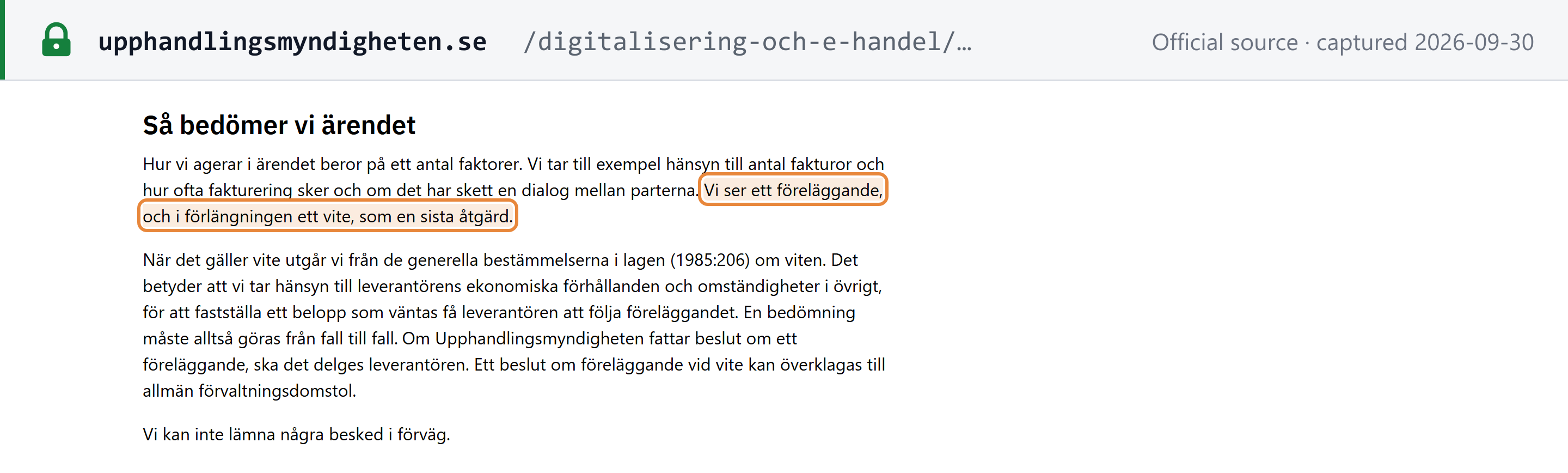
Enforcement posture. A buyer should first raise the problem with the supplier, then report it to Upphandlingsmyndigheten, which must then investigate. Upphandlingsmyndigheten: "Vi ser ett föreläggande, och i förlängningen ett vite, som en sista åtgärd." (We see an order, and ultimately a conditional fine, as a last resort.) It weighs the number and frequency of invoices and whether the parties have talked, sets any fine under the general lag (1985:206) om viten with regard to the supplier's finances, and gives no advance rulings. It cannot act on procurements begun before 1 April 2019, on cases where another standard was agreed, or on buyer requirements unrelated to the Act. (Upphandlingsmyndigheten — Fakturor som inte uppfyller kraven)
 Source snapshot captured 2026-09-30 — original
Buyers and VAT. The Act sets no sanction on a buyer that fails to receive, and the bill states that the law introduces no civil-law sanctions. The VAT Act contains no penalty specific to e-invoicing.
Frequently asked questions
We e-mail PDF invoices to a Swedish municipality. Is that enough?
No. Under lag (2018:1277) 2 §, an e-invoice must be in a structured format that allows automatic processing, and Upphandlingsmyndigheten says a PDF or scanned paper invoice does not count. Send a Peppol BIS Billing 3 invoice through a Peppol access point, or ask the buyer whether it has a supplier portal. (Lag 2018:1277; Upphandlingsmyndigheten)
We are a supplier based outside Sweden. Does the e-invoicing law apply to us?
Yes. Upphandlingsmyndigheten states that all suppliers of goods and services are covered, whatever country they are in, and that direct awards are covered too. You need a Peppol access point and a Peppol ID, or the buyer's supplier portal. (Upphandlingsmyndigheten)
Is a PDF an electronic invoice for Swedish VAT purposes?
Yes. ML 2 kap. 10 § defines an electronic invoice as one issued and received in an electronic format, with no structure requirement, and ML 17 kap. 20 § allows it only if the recipient accepts it. The e-invoicing law for public procurement uses a narrower, structured definition, so the same PDF is not a compliant invoice to a public buyer. (ML 2023:200; lag 2018:1277)
Do we have to send e-invoices to Swedish businesses?
No. B2B e-invoicing is voluntary and needs the recipient's consent (ML 17 kap. 20 §). Inquiry Fi 2026:03 is assessing whether domestic e-invoicing and digital reporting should be introduced and reports by 30 November 2027; no bill or date exists. Under ViDA, digital reporting of intra-EU B2B supplies, based on e-invoicing, starts on 1 July 2030, and Sweden has left that step to future legislation. (Dir. 2026:9; prop. 2025/26:278, checked 2026-09-30)
Our contract with a public buyer dates from 2018. Do we have to switch?
Not for invoices under that procurement. The transitional provisions of lag (2018:1277) say that 4 § and 7 § do not apply to invoices from procurements begun before 1 April 2019. A new procurement, including a direct award, is covered. (Lag 2018:1277)
Who do we contact now that DIGG no longer handles e-invoicing?
Upphandlingsmyndigheten. Since 1 July 2026 it supports suppliers, decides orders under 7 § of lag (2018:1277), may issue format rules and is responsible for connection to the European e-procurement infrastructure (SFS 2026:598) — in the agency's own words, Sweden's Peppol Authority. DIGG's own instruction is repealed from 1 January 2027, when Digitaliseringsmyndigheten starts (SFS 2026:1769). (Svensk författningssamling, checked 2026-09-30)
What happens if we keep sending paper invoices to a public buyer?
The buyer can report you to Upphandlingsmyndigheten, which must investigate. It can order you to comply, and the order can carry a conditional fine (vite) set case by case under lag (1985:206) om viten, but it treats an order and a fine as a last resort. There is no fixed fine. (Lag 2018:1277 7–8 §§; Upphandlingsmyndigheten)
Which Peppol ID should we use?
Scheme 0007 with your Swedish organisationsnummer, for example 0007:5512345678, is recommended. A GLN under scheme 0088 is the alternative, for example for a sole trader whose organisationsnummer is their personnummer. Upphandlingsmyndigheten advises against VAT numbers and bank account numbers, and does not register Peppol IDs itself: your service provider does. (Upphandlingsmyndigheten)
Do payment reminders and debt-collection letters have to be e-invoices?
No. A payment reminder is not an invoice, and debt-collection demands are outside the law and are sent on paper. An interest invoice, however, is a new invoice with a new number and must be sent as an e-invoice. (Upphandlingsmyndigheten)
How long must we keep e-invoices, and in what form?
Up to and including the seventh year after the end of the calendar year in which the financial year ended (Bokföringslag 7 kap. 2 §), in the format and with the content they had when received (7 kap. 1 §). Conversion to another format is allowed only if nothing can change or be lost (7 kap. 6 §). Storage in another EU country is allowed on conditions, including notifying Skatteverket (7 kap. 3 a §). (Bokföringslag 1999:1078)
Recent changes
- 2026-07-01 — B2G e-invoicing support, orders under lag (2018:1277) 7 §, the format-rule power under 6 § and responsibility for connection to the European e-procurement infrastructure (the Peppol Authority role) moved from DIGG to Upphandlingsmyndigheten (SFS 2026:598). (Svensk författningssamling) — see event · issue
- 2026-06-09 — Prop. 2025/26:278 (ViDA step 2) was tabled, proposed to apply from 1 January 2027; it contains no e-invoicing mandate and leaves ViDA steps 3–5 to future legislation. (Sveriges riksdag)
- 2026-02-05 — Dir. 2026:9 appointed inquiry Fi 2026:03 on ViDA e-invoicing and digital reporting, including an assessment of domestic e-invoicing; it reports by 30 November 2027. (Regeringen)
- 2026-01-23 — MDFFS 2026:1 modernised the Peppol-registration regulation's heading and 1–2 §§; MDFFS 2026:2 re-pointed MDFFS 2021:1's VAT references to ML (2023:200). (DIGG)
Ahead — scheduled changes that have not yet taken effect:
- 2026-10-05 — The motion period for prop. 2025/26:278 ends. (Sveriges riksdag)
- 2027-01-01 — DIGG's instruction is repealed and Digitaliseringsmyndigheten starts (SFS 2026:1769). (Svensk författningssamling)
- 2027-11-30 — Inquiry Fi 2026:03 is due to report. (Sveriges riksdag)
For the full chronology, see Sweden tax changes on Lookuptax.
Related resources
- Sweden VAT guide — rates, registration, invoice content, filing and the e-invoicing summary
- OCR number in Sweden — the Bankgiro payment reference often carried on Swedish invoices
- Sweden tax-change chronology — every tracked Swedish change, dated and sourced
- Validate a Swedish VAT (moms) number
- E-invoicing status and networks worldwide — Sweden's row in global context
- Peppol network explainer and Peppol requirements by country
- ViDA — VAT in the Digital Age — the directive behind the 2030 cross-border reporting
- Neighbouring Nordic mandates: Norway, Finland
Important websites
- Upphandlingsmyndigheten — Regler för e-handel och e-faktura — the B2G rules, exclusions and FAQ
- Upphandlingsmyndigheten — Fakturor som inte uppfyller kraven — how buyers report non-compliant suppliers
- Upphandlingsmyndigheten — Kom igång med Peppol — connecting to Peppol
- Upphandlingsmyndigheten — Instruktion för val av Peppol-ID — choosing a 0007 or 0088 ID
- Upphandlingsmyndigheten — Sök organisationer anslutna till Peppol — check whether a buyer is registered
- Peppol Directory and Peppol-certified service providers
- SFTI — Peppol BIS Billing 3 and SFTI — Verifiering — Swedish validation rules, mapping guides and free verification
- DIGG — MDFFS 2021:1 — the state-agency regulation; this address may change after DIGG closes on 1 January 2027
Reference links
- Sveriges riksdag — Lag (2018:1277) om elektroniska fakturor till följd av offentlig upphandling
- Sveriges riksdag — Prop. 2017/18:153 Elektroniska fakturor till följd av offentlig upphandling
- Svensk författningssamling — SFS 2026:598 (Upphandlingsmyndigheten's instruction, 2 a–2 d §§)
- Svensk författningssamling — SFS 2026:1769 (instruction for Digitaliseringsmyndigheten)
- DIGG — MDFFS 2019:1 (registration in Peppol)
- DIGG — MDFFS 2021:1 (orders and standards in electronic information exchange)
- Sveriges riksdag — Mervärdesskattelag (2023:200)
- Regeringen — Dir. 2026:9 Moderniserad och brottsförebyggande hantering av mervärdesskatt
- Sveriges riksdag — Kommittéberättelse Fi 2026:03
- Sveriges riksdag — Prop. 2025/26:278 Teknisk översyn av mervärdesskattereglerna vid gränsöverskridande handel
- Svensk författningssamling — SFS 2026:599 (amending DIGG's instruction)
- Sveriges riksdag — Bokföringslag (1999:1078)