E-Invoicing in Germany — B2B Mandate, XRechnung and ZUGFeRD
| Country | Germany |
| Status - B2G | Mandatory for suppliers to the federal administration since 27 November 2020 (ERechV); federal states set their own rules |
| Status - B2B | Mandatory between businesses established in Germany since 1 January 2025 (must be able to receive); paper/PDF allowed as a transitional measure to 31 December 2026, or 31 December 2027 for issuers with prior-year total turnover ≤ €800,000 and for EDI |
| Status - B2C | Not in scope |
| Formats | EN 16931: XRechnung; ZUGFeRD from 2.0.1 (not MINIMUM or BASIC-WL); agreed formats if extractable to EN 16931 |
| Authority | Bundesministerium der Finanzen (BMF, Federal Ministry of Finance) |
| Network name | B2B: no clearance platform or mandated network; B2G (federal): OZG-RE, into which the ZRE was merged on 19 September 2025 |
| Legislation | § 14 and § 27(38) UStG (Wachstumschancengesetz, BGBl. 2024 I Nr. 108); §§ 33, 34, 34a UStDV; E-Rechnungsverordnung (ERechV) for B2G |
Overview
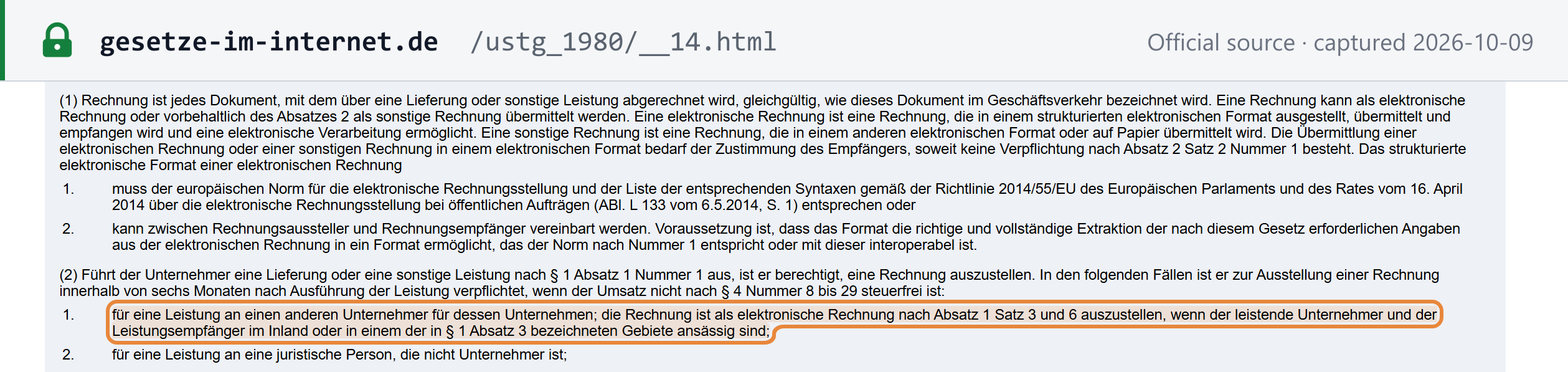
Since 1 January 2025, invoices for supplies between businesses established in Germany must be issued as e-invoices. That is the legal default under § 14 UStG, as amended by the Wachstumschancengesetz of 27 March 2024 (BGBl. 2024 I Nr. 108). An e-invoice is "an invoice issued, transmitted and received in a structured electronic format that enables electronic processing"; paper and unstructured electronic formats such as a plain PDF are "other invoices" (sonstige Rechnungen). [1]
 Source snapshot captured 2026-10-09 — original
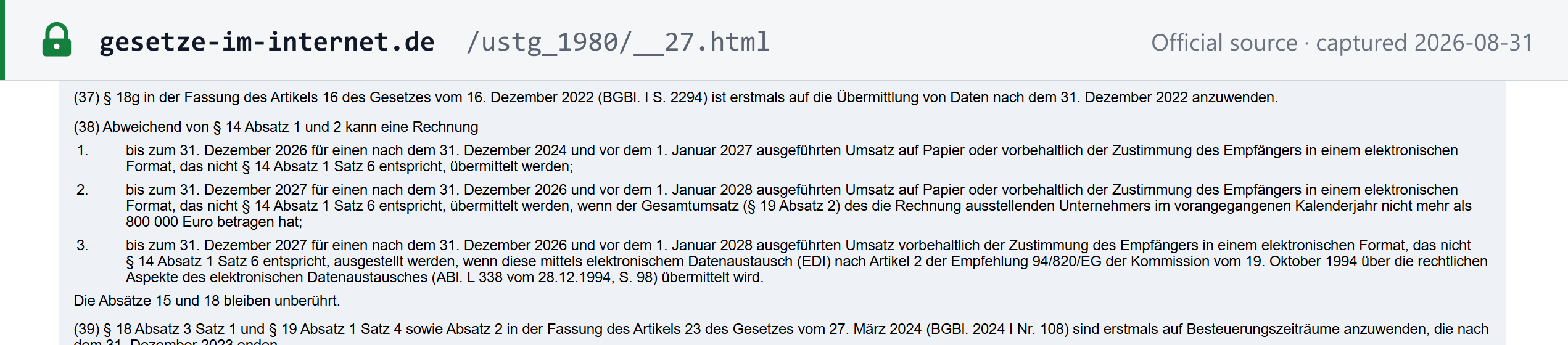
Two consequences follow straight away. Every business established in Germany must be able to receive e-invoices from 1 January 2025, because a business customer's consent is not needed where the e-invoice duty applies. And issuers may keep sending paper or PDF invoices only because § 27(38) UStG grants a transitional allowance, which ends on 31 December 2026 or, for smaller issuers and EDI, on 31 December 2027. [2]
Germany's model is decentralised, post-audit: there is no clearance platform and no state validation of B2B invoices. Neither § 14 UStG nor § 27(38) requires invoices to be transmitted to the tax authority, so e-invoices travel directly between the parties by any channel, such as e-mail, EDI, Peppol or portals. No e-reporting obligation has been enacted.
B2G e-invoicing is separate and older: suppliers to the federal administration have had to invoice electronically since 27 November 2020 under the E-Rechnungsverordnung (ERechV).
Mandate status & timeline
| Phase | Who / what | Rule | Legal basis |
|---|---|---|---|
| B2G — federal | Suppliers to the federal administration | E-invoice (XRechnung) since 27 November 2020 | ERechV § 3(1), in force under § 11(3) [3] [7] |
| B2B — receive | Every business established in Germany | Must be able to receive e-invoices from 1 January 2025 | § 14(1)–(2) UStG [1] |
| B2B — transition, all issuers | Supplies made 1 Jan 2025 – 31 Dec 2026 | Paper, or another electronic format (e.g. PDF) with the recipient's consent, until 31 December 2026 | § 27(38) Nr. 1 UStG [2] |
| B2B — transition, smaller issuers | Supplies made in 2027 by issuers whose total turnover (Gesamtumsatz, § 19(2) UStG) in the previous calendar year was ≤ €800,000 | Paper, or PDF with consent, until 31 December 2027 | § 27(38) Nr. 2 UStG [2] |
| B2B — transition, EDI | Supplies made in 2027, any turnover | EDI invoices (Commission Recommendation 94/820/EC) with the recipient's consent until 31 December 2027 | § 27(38) Nr. 3 UStG [2] |
| B2B — e-invoice only | Issuers above €800,000 not using EDI: supplies from 1 January 2027; everyone: supplies from 1 January 2028 | E-invoice in EN 16931 format, or an agreed format extractable to EN 16931 | § 14(1)–(2) UStG [1] |
 Source snapshot captured 2026-08-31 — original
After these dates, an e-invoice is the only permitted invoice for domestic B2B supplies. Formats other than EN 16931 remain possible permanently only where the parties agree on them and the VAT-relevant data can be extracted correctly and completely into an EN 16931-conformant format (§ 14(1) sentence 6 Nr. 2 UStG). That is where EDI-style formats sit after 2027.
No deferral has been enacted. As at 9 October 2026 the 1 January 2027 date stands. The craft trades federation ZDH has asked for a one-year deferral, but no draft law proposes one: the government draft of the Annual Tax Act 2026 (Jahressteuergesetz 2026, BR-Drs. 447/26) amends § 14 UStG only editorially, correcting a cross-reference in § 14(7), and does not touch § 27(38). [4]
Legal basis
- § 14 UStG (as amended by Art. 23 of the Wachstumschancengesetz of 27 March 2024, BGBl. 2024 I Nr. 108, applying from 1 January 2025): the e-invoice definition, the EN 16931 / agreed-format rule, and the B2B e-invoice duty between businesses established in Germany. [1]
- § 27(38) UStG: the transitional rules for 2025–2027. [2]
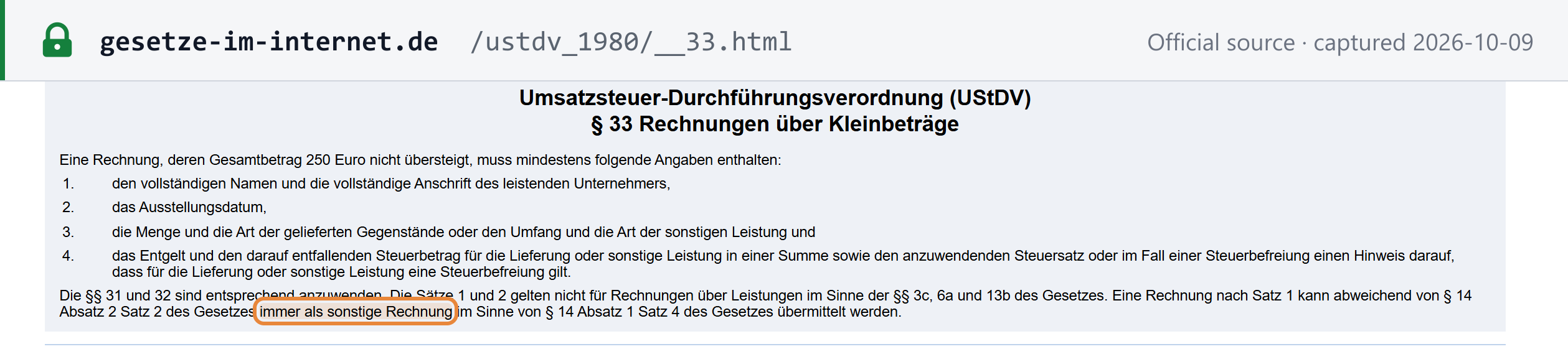
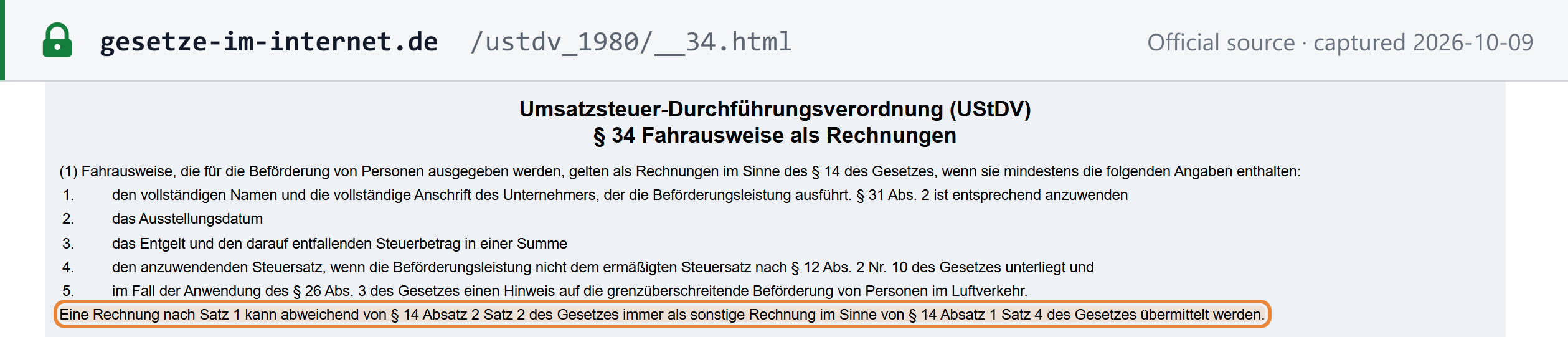
- §§ 33, 34 and 34a UStDV: small-value invoices, tickets and Kleinunternehmer invoices (see Scope).
- BMF letters: 2 October 2023, 15 October 2024 ("Einführung der obligatorischen elektronischen Rechnung bei Umsätzen zwischen inländischen Unternehmern ab dem 1. Januar 2025"), and 15 October 2025 (GZ III C 2 - S 7287-a/00019/007/243), which supplements the 2024 letter. They set out the administration's view on formats, hybrid invoices and the transitional rules. The BMF also maintains an official FAQ on the e-invoice.
- B2G: E-Rechnungsverordnung (ERechV) for invoices to the federal administration. [3]
- EU footing: Germany's mandate was originally authorised by Council Implementing Decision (EU) 2023/1551 of 25 July 2023. Since 14 April 2025, Council Directive (EU) 2025/516 (ViDA) lets member states mandate domestic e-invoicing without a derogation. See the ViDA explainer.
Scope
In scope: a supply to another business for its business, where both the supplier and the recipient are established in Germany. "Established" means a seat, place of management, a permanent establishment involved in the supply, or, failing a seat, domicile or habitual residence. VAT registration alone is not the test. [1]
Out of scope:
- Foreign businesses without a German establishment involved in the supply, even if VAT-registered in Germany: they are not bound to issue e-invoices, and a German supplier invoicing them need not use one.
- Cross-border supplies, because both parties must be established in Germany.
- B2C: the e-invoice duty attaches only to supplies to another business.
- Exempt supplies under § 4 Nr. 8–29 UStG (for example financial services, insurance, and letting of immovable property): these fall outside the § 14(2) UStG duty to issue an invoice, so the e-invoice duty does not apply.
Exempt from the issuing duty (these invoices may always be sent as paper or PDF):
- Small-value invoices up to €250 gross (§ 33 UStDV).
- Tickets (Fahrausweise, § 34 UStDV).
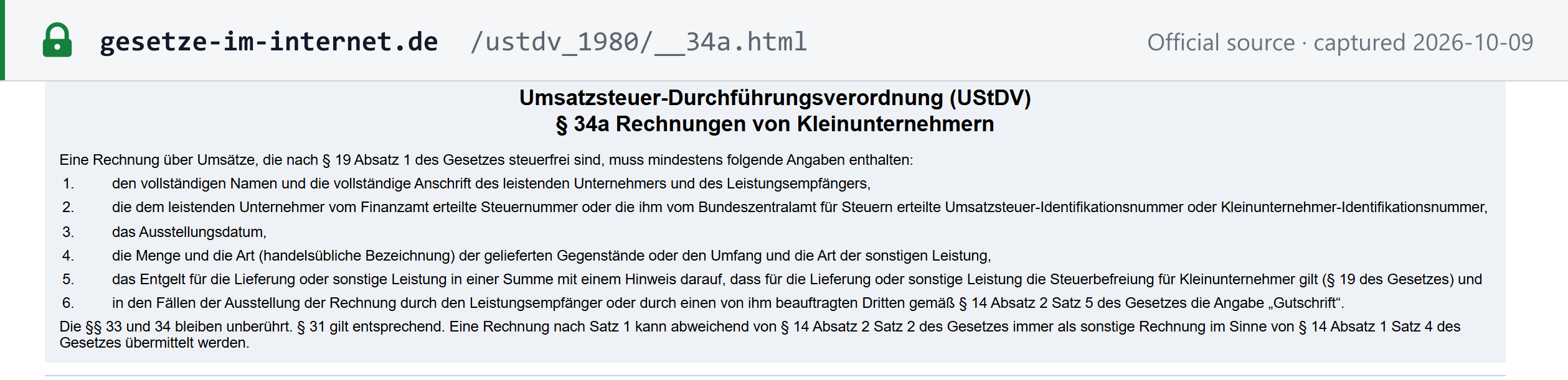
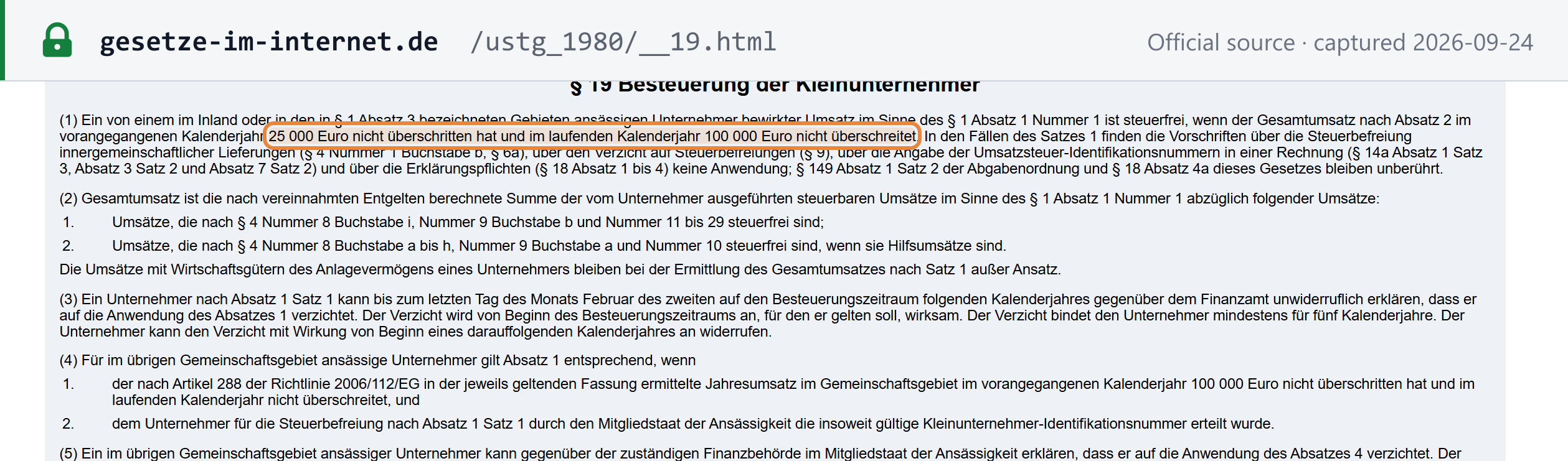
- Kleinunternehmer under § 19 UStG (§ 34a UStDV). They must still be able to receive e-invoices. Since 2025 a Kleinunternehmer is a business with prior-year turnover of no more than €25,000 and current-year turnover of no more than €100,000 (§ 19(1) UStG).
 Source snapshot captured 2026-10-09 — original
 Source snapshot captured 2026-10-09 — original
 Source snapshot captured 2026-10-09 — original
 Source snapshot captured 2026-09-24 — original
Format & network
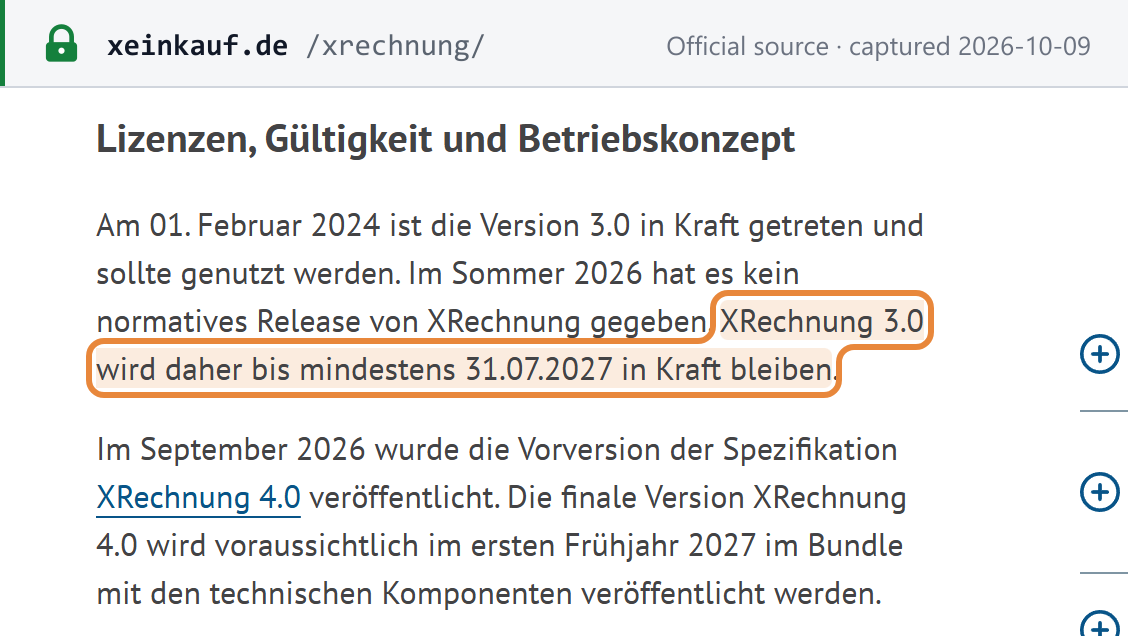
- XRechnung: the German implementation (CIUS) of EN 16931, in UBL or CII syntax, published by KoSIT. It is the standard format for invoices to the federal administration under the E-Rechnungsverordnung (ERechV), which also accepts other EN 16931-conformant formats. Version 3.0 has been in force since 1 February 2024 and, according to KoSIT, stays in force until at least 31 July 2027; a pre-release of XRechnung 4.0 was published in September 2026. [9]
 Source snapshot captured 2026-10-09 — original
- ZUGFeRD: a hybrid PDF with an embedded XML invoice. According to the BMF letters of 2 October 2023 and 15 October 2024, ZUGFeRD from version 2.0.1 qualifies as an e-invoice, except the MINIMUM and BASIC-WL profiles, which lack the VAT-required data.
- Hybrid invoices: where the PDF and the XML differ, the XML part prevails; the PDF is a readable view.
- Plain PDF: an "other invoice", not an e-invoice. It is permitted only under the transitional rules or the exemptions above.
- Agreed formats (for example EDI): permitted permanently if the data can be extracted into an EN 16931-conformant format (§ 14(1) sentence 6 Nr. 2 UStG).
- Network: there is no mandated B2B network and no clearance step. Peppol is one possible channel, not a requirement. No e-reporting obligation is in force; EU ViDA digital reporting for intra-EU supplies applies from 1 July 2030.
How to send B2G e-invoices
If you invoice a public-sector entity, first establish whether it belongs to the federal administration or to a federal state (Land).
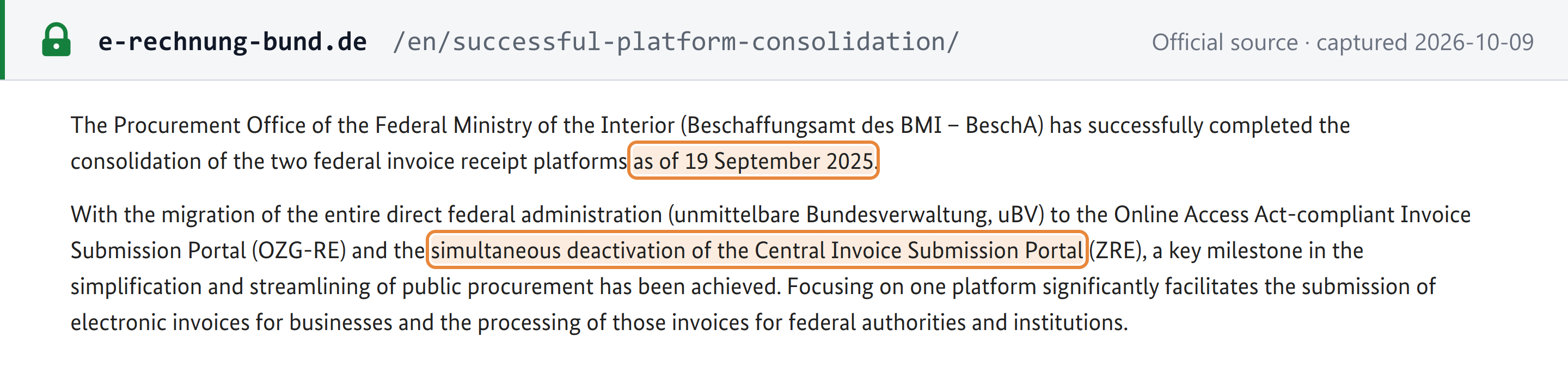
- Federal administration: the direct federal administration receives invoices only through the OZG-konforme Rechnungseingangsplattform (OZG-RE). The former Zentrale Rechnungseingangsplattform (ZRE) was merged into it on 19 September 2025 and has been shut down. Indirect federal bodies are not obliged to use the OZG-RE (more than 170 do) and some use their own receiving solution, so follow the channel your contracting authority names. Some federal states also use the OZG-RE. [6] [10]
 Source snapshot captured 2026-10-09 — original
- Leitweg-ID: the routing identifier your contracting authority gives you; it tells the platform where the invoice goes.
- Exemption: invoices issued after a direct award (Direktauftrag) of up to €1,000 are exempt from the federal e-invoicing duty (ERechV § 3(3)). This is not a general €1,000 threshold: other invoices below €1,000 to federal authorities must still be electronic. [3]
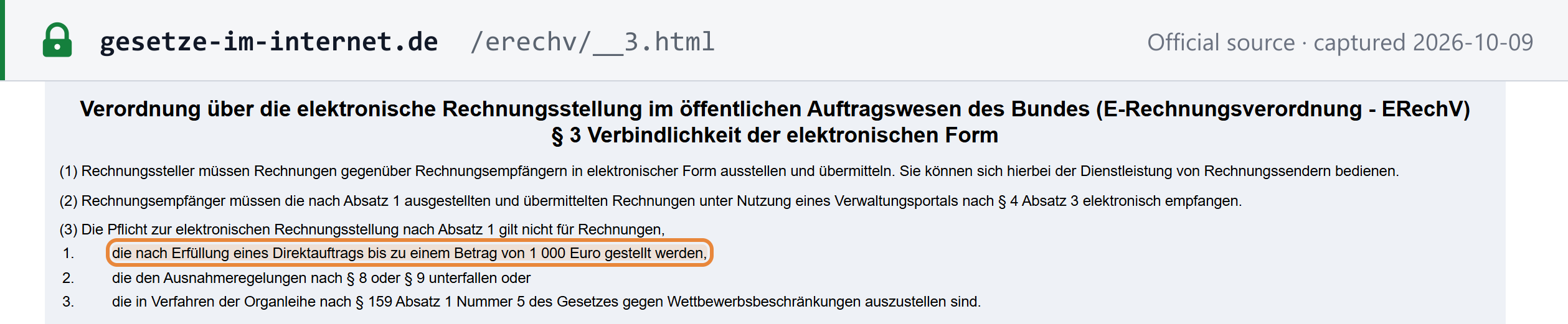 Source snapshot captured 2026-10-09 — original
You can enter an XRechnung in the OZG-RE web form, upload one generated in your ERP system, send it by e-mail, or connect via Peppol. [8]
Federal states each have their own e-invoicing law, dates and receiving channels for their authorities. Check the contracting authority's purchasing terms or the state's e-invoicing portal for the channel to use.
Frequently Asked Questions
Is B2B e-invoicing mandatory in Germany?
Yes. Since 1 January 2025, § 14 UStG as amended by the Wachstumschancengesetz (BGBl. 2024 I Nr. 108) requires invoices for supplies between businesses established in Germany to be issued as e-invoices, and the business customer's consent is not needed, so every such business must be able to receive e-invoices. Paper, and other electronic formats such as PDF with the recipient's consent, remain allowed only as a transitional measure under § 27(38) UStG: for all issuers until 31 December 2026, and until 31 December 2027 where the issuer's total turnover in the previous calendar year was no more than €800,000. EDI invoices may be used with the recipient's consent until 31 December 2027. After that, only an e-invoice in EN 16931 format, or in an agreed format from which the data can be extracted into EN 16931 form, is permitted. [1] [2] [5]
XRechnung or ZUGFeRD — which format should I use for German e-invoices?
Both qualify. XRechnung is the German implementation of the European standard EN 16931, in UBL or CII syntax, and is the standard format for invoices to the federal administration under the E-Rechnungsverordnung (ERechV), which also accepts other EN 16931-conformant formats. ZUGFeRD is a hybrid: a PDF with an embedded XML invoice. According to the Federal Ministry of Finance (BMF letters of 2 October 2023 and 15 October 2024), ZUGFeRD from version 2.0.1 qualifies as an e-invoice for domestic B2B supplies, except the MINIMUM and BASIC-WL profiles, and where the PDF and the XML differ, the XML prevails. A plain PDF is not an e-invoice. [1]
Does the mandate apply to foreign businesses registered for VAT in Germany?
Only if they are established in Germany. The duty in § 14(2) UStG applies when both the supplier and the business customer are established in Germany: seat, place of management, a permanent establishment involved in the supply, or, failing a seat, domicile or habitual residence. A foreign business that is only VAT-registered in Germany, without such an establishment, is not bound to issue e-invoices, and a German supplier invoicing it does not have to use one. [1]
Has the 1 January 2027 deadline been postponed?
No. As at 9 October 2026 the transitional dates in § 27(38) UStG are unchanged. The craft trades federation ZDH has asked for a one-year deferral of the 2027 date, but no draft law proposes one: the government draft of the Annual Tax Act 2026 (BR-Drs. 447/26) amends § 14 UStG only editorially and does not touch § 27(38). [4]
Which portal do I use for invoices to federal authorities?
The OZG-RE (OZG-konforme Rechnungseingangsplattform). Since 19 September 2025 it is the single receiving platform for the direct federal administration; the former ZRE was merged into it. Indirect federal bodies are not obliged to use it, although more than 170 do, and some federal states also use it. Your contracting authority tells you which Leitweg-ID (the routing identifier) to use. Suppliers to the federal administration have had to invoice electronically since 27 November 2020 under the ERechV; invoices issued after a direct award (Direktauftrag) of up to €1,000 are exempt. Each federal state sets its own e-invoicing rules for its authorities. [3] [6]
Related resources
- E-invoicing status and networks worldwide — Germany row in global context
- Germany VAT guide
- Germany tax identification numbers
- How to register for VAT in Germany
- GoBD compliance in Germany — archiving e-invoices
- CTC e-invoicing models explained
- Peppol network explainer