The Value Added Tax Act in Germany - An In-Depth Explanation
The Value Added Tax Act (Umsatzsteuergesetz) serves as the legal foundation for levying and administering value added tax (VAT) in Germany. First enacted in 1979, it establishes important elements like taxable transactions, VAT rates, rules for calculation of tax liability and input tax credit, invoicing requirements, filing of returns and payment procedures. The law aims to ensure neutrality of taxation along the production-distribution chain and achieve broad coverage of consumption taxes on goods and services.
Scope and Coverage
The VAT law applies to the following four types of transactions taking place within Germany:
-
Supply of goods and services: Any supply made for a consideration by a business in the course of its economic activity is subject to VAT. Certain categories like factory deliveries, vouchers, exchanges etc. have special rules.
-
Importation of goods: Imports of goods into Germany from outside the EU are subject to import VAT in addition to customs duty.
-
Intra-Community acquisitions: Purchases of goods from EU member states by VAT registered businesses are treated as deemed sales liable to VAT.
-
Reverse charge services: Specified services rendered to a German business by foreign EU suppliers are subject to reverse charge, i.e. VAT is paid by the recipient business.
The territorial scope extends to the region of Germany as defined in the EU VAT Directive. The law uses terms like ‘domestic territory’, ‘intra-Community’ and ‘third territories’ to delimit the chargeability of VAT on transactions.
Registration and Exemptions
Germany has no VAT registration threshold. Every Unternehmer within §2 UStG registers with the Finanzamt from the outset, through the Fragebogen zur steuerlichen Erfassung required by §138(1) and (1b) AO, whatever the turnover — §19 is an exemption from tax, not a threshold for registering. Registering does not by itself create a right to deduct input tax on exempt supplies: that requires either the option to tax certain otherwise-exempt supplies under §9 UStG, or the §19(3) waiver, both of which work by making the supplies taxable. Under §19(1) UStG, turnover is exempt as a small business (Kleinunternehmer) by operation of law — not by opting in — where turnover did not exceed €25,000 in the prior calendar year and does not exceed €100,000 in the current year — the exemption ends the moment that limit is crossed, and the very supply that breaches it is already taxable (this €25,000/€100,000 pair replaced the former €22,000/€50,000 thresholds with effect from 1 January 2025). A business that would otherwise qualify can waive the exemption under §19(3). Some supplies like exports, financial services, rental, health and education are exempt from VAT.
Tax Rates
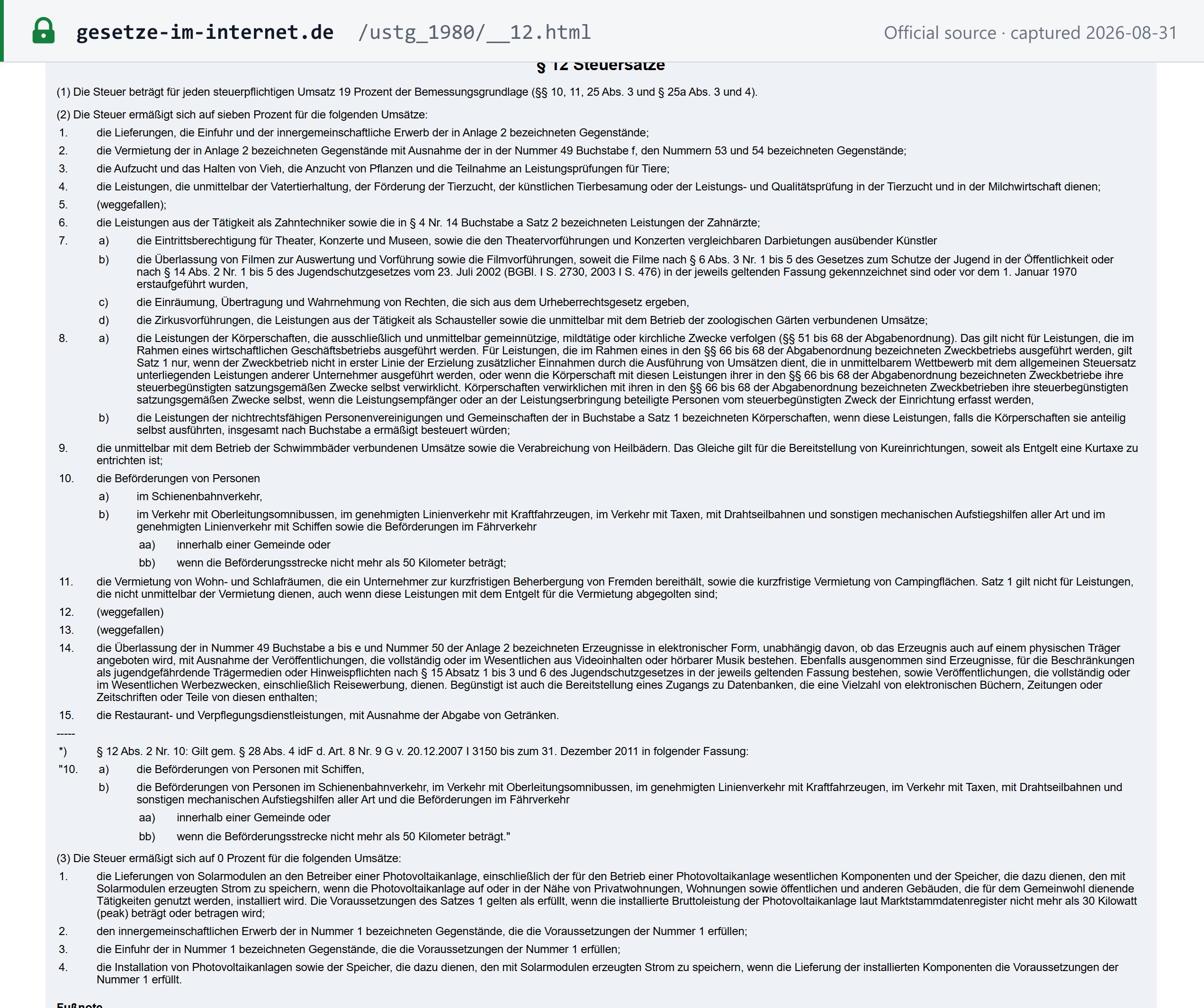
The standard VAT rate in Germany is 19%. A reduced rate of 7% applies to everyday essential supplies like food, books, public transport, hotels etc. Education (§4 Nr. 21 UStG), health (§4 Nr. 14) and insurance (§4 Nr. 10) are exempt supplies, not zero-rated — unlike a true 0% rate, an exemption under §4 nos. 8–29 generally carries no right to deduct input tax — §15(3) preserves it for the nos. 1–7 exemptions, which is why exports keep theirs, and, in third-country cases only, for §4 nos. 8 a–g, 10 and 11 (§15(2) Nr. 1 UStG: "Vom Vorsteuerabzug ausgeschlossen ist die Steuer für ... steuerfreie Umsätze"). The UStG's only true 0% rate is §12(3), which applies to solar modules and photovoltaic installations. VAT rates are fixed by the VAT Act and apply uniformly across Germany.
 Source snapshot captured 2026-08-31 — original
Time of Supply
The tax point or time of supply determines when VAT becomes due on a transaction. For supplies, VAT becomes chargeable when the service is completed or part payment received, whichever is earlier. For intra-Community acquisitions, §13(1) Nr. 6 UStG fixes liability on issue of the invoice, but at the latest at the end of the calendar month following the month of acquisition — so the tax point cannot be deferred indefinitely by simply not receiving an invoice. In case of reverse charge services, VAT is due when the service is performed.
Valuation Rules
The taxable base for VAT is the total consideration received, excluding the VAT amount. All incidental expenses are included. In barter transactions, open market value is taken as the tax base. For imports, the value as per customs rules is considered. Second hand margin scheme and other special valuation rules apply for certain categories.
Input Tax Deduction
A taxable person can deduct VAT already paid on goods and services procured for business use as input tax credit. Restrictions apply where purchases are used for non-business activities. Under §15(1a) UStG deduction is denied for input tax on gifts, guest houses, hunting, fishing and yachts, and on unreasonable expenses (§4(5) sentence 1 nos. 1–4 and 7 EStG, and §12 no. 1 EStG, which covers private living costs). Gifts are the narrower case: §4(5) sentence 1 no. 1 sentence 2 EStG spares those costing no more than €50 per recipient per year, so input tax on them stays deductible. Entertainment is expressly carved out of that denial — input VAT on reasonable, substantiated Bewirtung is deductible in full — and motor vehicles are not in the list at all: input tax on a business car is deductible, with private use taxed as an output supply under §3(9a). Partial deduction is allowed in case of mixed usage. Input VAT credit creates a chain of reimbursement along the production-distribution system.
VAT Reporting and Payment
Under §18(2) UStG, the calendar quarter is the default Voranmeldungszeitraum (advance-return period), but a business whose prior-year VAT liability exceeded €9,000 must instead file monthly. Voranmeldungen (advance VAT returns) are due by the 10th day after the end of the period, showing output tax collected and input tax deducted, with net VAT payable after adjusting the input tax credit. Where prior-year tax was €2,000 or less, the Finanzamt may waive the obligation to file Voranmeldungen altogether (§18(2) Satz 3) — but even then, the annual return (Umsatzsteuererklärung, §18(3)) is still due. Payment is done electronically in most cases. Default in payment attracts a late-payment surcharge and, where assessed, statutory interest (see the FAQ below for the figures). Refund arises when input tax credit exceeds output tax.
Invoice requirements
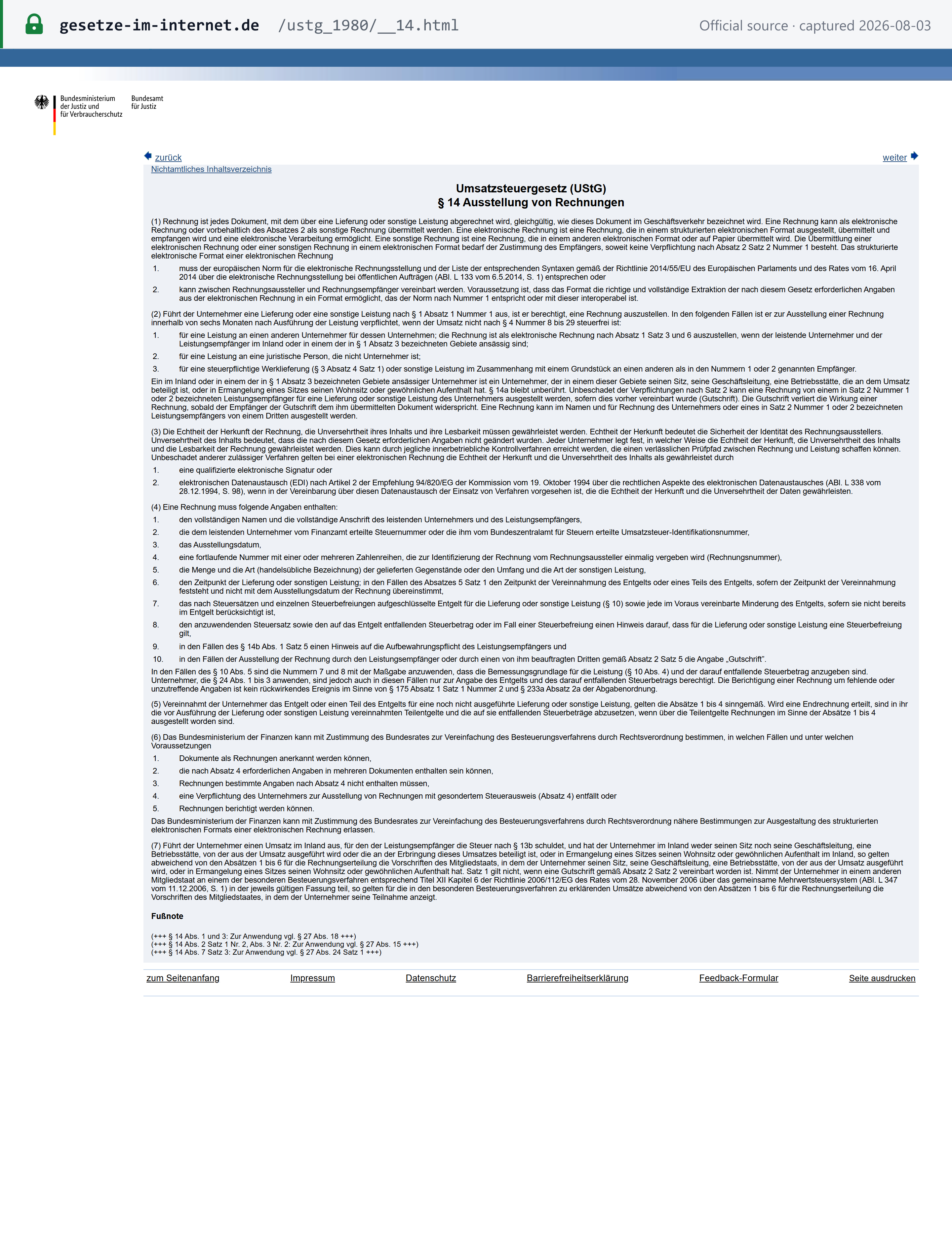
A Rechnung is any document by which a supply of goods or a service is settled, whether transmitted as an elektronische Rechnung (a structured electronic format that can be processed automatically) or as a sonstige Rechnung (paper, or any other electronic format such as a plain PDF). [1] The particulars below apply to both — invoice validity is a general VAT rule, separate from the B2B e-invoicing rollout summarised in the FAQ below and in the Germany e-invoicing guide.
Mandatory content
Every invoice must contain the ten particulars listed in § 14 Abs. 4 UStG:
| Required field | Notes |
|---|---|
| Full name and full address of the supplying entrepreneur and of the recipient | § 14 Abs. 4 Nr. 1. The requirement is met where the designations used in the invoice allow both parties to be unambiguously identified. [1] [3] |
| The supplier's Steuernummer or USt-IdNr | § 14 Abs. 4 Nr. 2 — either number satisfies the rule. For an intra-Community supply the USt-IdNr of both parties is separately required under § 14a. [1] [2] |
| Date of issue | § 14 Abs. 4 Nr. 3. [1] |
| A consecutive invoice number, assigned once only by the issuer | § 14 Abs. 4 Nr. 4 — a fortlaufende Nummer, die zur Identifizierung der Rechnung vom Rechnungsaussteller einmalig vergeben wird. [1] |
| Quantity and type of the goods supplied, or extent and type of the service | § 14 Abs. 4 Nr. 5. Abbreviations, letters, numbers or symbols may be used where their meaning is unambiguously fixed in the invoice or in other documents held by both parties. [1] [3] |
| Date of the supply — or, for an advance payment, the date the consideration was received | § 14 Abs. 4 Nr. 6. The calendar month in which the supply was performed may be stated instead of the exact day. [1] [3] |
| The consideration, broken down by tax rate and by exemption, together with any reduction agreed in advance and not already deducted | § 14 Abs. 4 Nr. 7. [1] |
| The applicable tax rate and the tax amount, or — for an exempt supply — a reference to the exemption | § 14 Abs. 4 Nr. 8. [1] |
| A reference to the recipient's retention obligation, in the cases of § 14b Abs. 1 Satz 5 (work supplies and services connected with land, invoiced to a private recipient) | § 14 Abs. 4 Nr. 9. [1] [5] |
| The word "Gutschrift" where the invoice is raised by the recipient or by a third party they commissioned (self-billing) | § 14 Abs. 4 Nr. 10. Note the false friend: in German VAT law Gutschrift means a self-billed invoice, not a credit note. [1] |
 Source snapshot captured 2026-08-03 — original
Additional statements in special cases (§ 14a UStG): Steuerschuldnerschaft des Leistungsempfängers where the recipient owes the tax under the reverse charge; Sonderregelung für Reisebüros for travel services; and Gebrauchtgegenstände/Sonderregelung, Kunstgegenstände/Sonderregelung or Sammlungsstücke und Antiquitäten/Sonderregelung under the margin scheme. [2]
The particulars need not all sit in one document: a sonstige Rechnung may consist of several documents, provided one of them shows the consideration and the tax amount in aggregate and identifies all the others. [3]
What a compliant invoice looks like
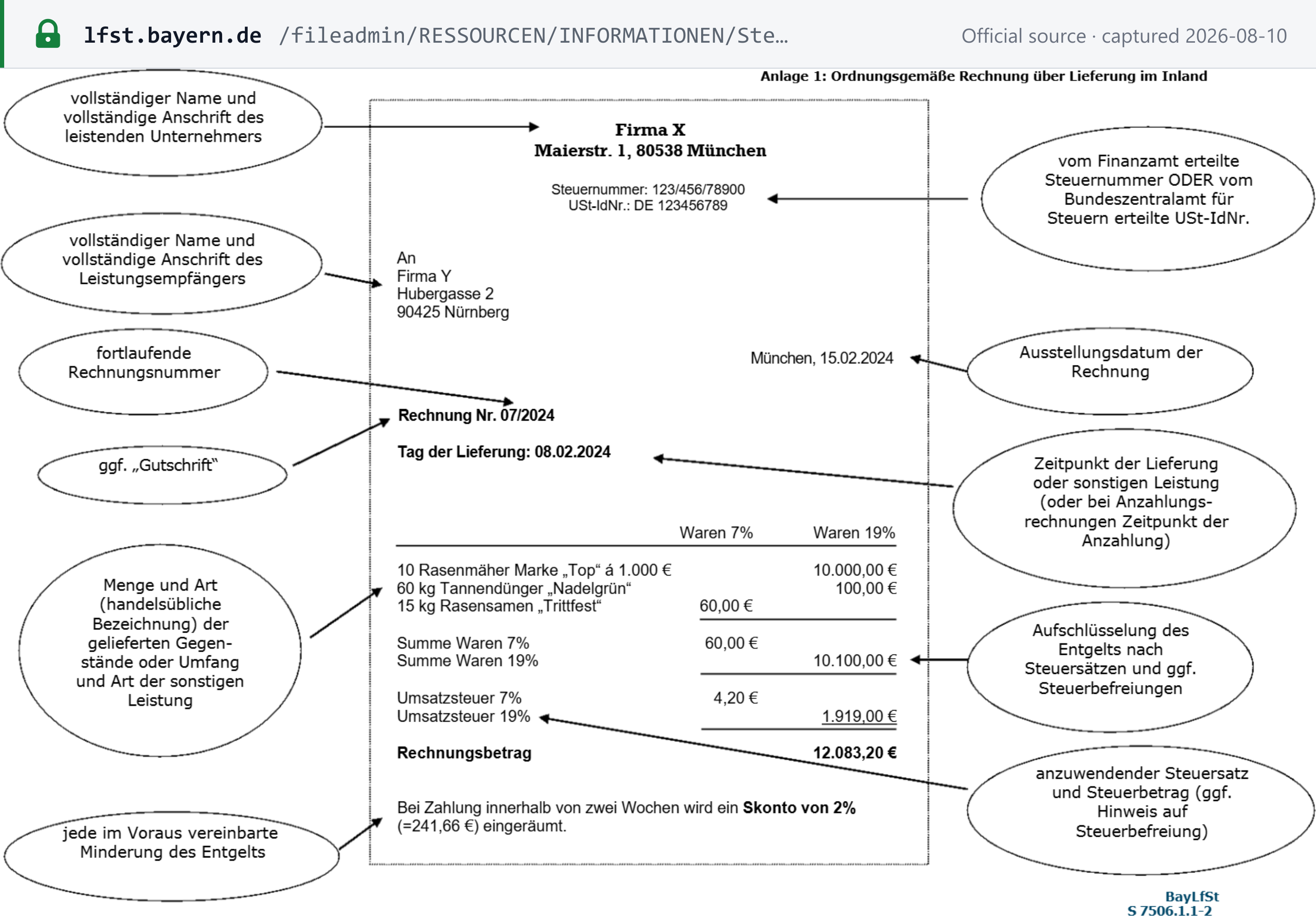
The Bayerisches Landesamt für Steuern publishes annotated specimen invoices that label each mandatory particular on the face of the document — a full domestic invoice (Anlage 1), a small-value Kleinbetragsrechnung under § 33 UStDV (Anlage 2), and a Kleinunternehmer invoice carrying the § 19 Abs. 1 UStG exemption wording (Anlage 3). The callouts map one-to-one onto the table above: vollständiger Name und vollständige Anschrift des leistenden Unternehmers, fortlaufende Rechnungsnummer, Ausstellungsdatum der Rechnung, Aufschlüsselung des Entgelts nach Steuersätzen, and so on. [9]
German VAT is administered by the Länder, so a State tax office is a genuine tax authority here — but note this is a Bavarian publication, not a federal BMF one. The specimen illustrates the statutory particulars; no layout is prescribed by § 14 itself.
 Source snapshot captured 2026-08-10 — original
Issuance deadline and numbering
An entrepreneur must issue an invoice within six months of performing the supply where the supply is made to another entrepreneur for their business, to a legal person that is not an entrepreneur, or is a taxable work supply or service connected with land (in that last case, even to a private customer). [1]
A shorter deadline applies to cross-border EU transactions: for an intra-Community supply, and for a service supplied in another member state on which the customer accounts for the tax under the reverse charge, the invoice must be issued by the fifteenth day of the month following the month in which the transaction was carried out. [2]
On numbering, the statute prescribes only that the number be consecutive and assigned once only by the issuer so as to identify the invoice; no particular format or single unbroken series is imposed by § 14 Abs. 4 Nr. 4 itself. [1]
Credit and debit notes
German VAT law has no separate statutory "credit note" or "debit note" instrument. Corrections work as follows:
- A mere change in the taxable amount under § 17 UStG does not require the invoice to be corrected — for example a settlement discount (Skonto), a reduction granted after a complaint that does not change the supply itself, or the cancellation of a supply. [8]
- A change to the scope or content of the supply does require a Rechnungsberichtigung, at least as regards the description of the supply. Only the missing or incorrect particulars need be transmitted, in a document that refers specifically and unambiguously to the original invoice. Where agreed in advance, the correction may be issued by the recipient as a Gutschrift under § 14 Abs. 2, which must likewise reference the original invoice. [3] [8]
- Correcting an eRechnung must use the same prescribed form and the corresponding invoice type; transmitting the missing or incorrect particulars in any other form is not sufficient. Where the transaction was never subject to the eRechnung obligation, the correction may be made without one. [8]
- Overstated VAT — if an entrepreneur separately states more tax than is due, they owe the excess as well (§ 14c Abs. 1); the liability falls away only once the invoice is corrected towards the recipient, applying § 17 Abs. 1. A person who states VAT without being entitled to do so owes the amount shown (§ 14c Abs. 2), and may correct it only once the risk to the revenue has been eliminated. [6]
Currency and language
The UStG does not restrict the currency an invoice may be denominated in, but foreign-currency amounts must be converted into euro to compute the tax and the deductible input tax, using the monthly average rates published by the Bundesministerium der Finanzen for the month in which the supply was performed or the consideration received. The Finanzamt may allow conversion at the daily rate instead, evidenced by a bank statement or an exchange list; under the OSS/IOSS schemes (§§ 18i to 18k) the ECB rates for the last day of the tax period apply. [7]
On language, a BMF letter of 17 September 2025 confirms that for certain invoice particulars under §§ 14 and 14a UStG the wording used for the corresponding item of Article 226 of the EU VAT Directive in another official EU language may be used in place of the German term — the letter inserts a new Anlage 8 to the Umsatzsteuer-Anwendungserlass covering Abschnitte 14.5 and 14a.1. [9]
Simplified invoices (Kleinbetragsrechnungen)
Where the total amount of the invoice does not exceed €250 (gross), only four particulars are required: the supplier's full name and full address; the date of issue; the quantity and type of the goods or the extent and type of the service; and the consideration together with the tax falling on it in one sum, plus the applicable tax rate or a reference to the exemption. The recipient's details, the consecutive invoice number and the supplier's tax number are not required. [4]
The simplification does not apply to distance sales (§ 3c UStG), intra-Community supplies (§ 6a UStG) or supplies on which the recipient owes the tax (§ 13b UStG). [4]
Kleinbetragsrechnungen, invoices issued by Kleinunternehmer, and passenger transport tickets (Fahrausweise) may always be issued and transmitted as a sonstige Rechnung rather than as an eRechnung. If a non-structured electronic format is used, the recipient must consent — consent requires no particular form and may be implied. [8]
Retention
- VAT rule (§ 14b Abs. 1 UStG): an entrepreneur must keep a duplicate of every invoice issued and every invoice received for eight years, counted from the end of the calendar year in which the invoice was issued. Authenticity of origin, integrity of content and legibility must be assured throughout. A private recipient of a work supply or service connected with land keeps the invoice for two years. [5] [1]
- eRechnung: at least the structured part must be stored so that it remains intact in its original form. Storing and archiving eRechnungen outside a GoBD-compliant data-processing system does not, on that ground alone, breach § 14b Abs. 1. [8]
- Where (§ 14b Abs. 2 and 4 UStG): a German-established entrepreneur must keep invoices in Germany; electronic storage elsewhere in the EU is permitted where there is full remote online access, which the tax authorities may use to inspect, download and process the invoices. Storage outside the EU follows § 146 Abs. 2b AO. Foreign entrepreneurs must designate a storage location within the EU and make the records available without delay on request. [5]
- Beyond VAT: an invoice received is a Buchungsbeleg, kept eight years under both § 147 Abs. 3 AO and § 257 Abs. 4 HGB; books, records, inventories, opening balance sheets and annual accounts stay at ten years, and commercial and business letters at six years. Credit institutions, insurance undertakings and investment firms keep Buchungsbelege for ten years. All periods run from the end of the calendar year in which the last entry was made or the voucher arose. [10] [11]
- The eight-year figure is recent: the Viertes Bürokratieentlastungsgesetz (BGBl. 2024 I Nr. 323, 29 October 2024) cut the retention period for Buchungsbelege in the HGB, the AO and the UStG from ten years to eight, and the carve-back to ten years for banks, insurers and investment firms was adopted by the federal cabinet on 6 August 2025. Check the transitional rule before destroying records whose ten-year period was already running. [12] [13]
Technical format
Where a structured e-invoice is required, § 14 Abs. 1 UStG accepts a format that complies with the European standard EN 16931 (Directive 2014/55/EU) or a format agreed between the parties that permits correct and complete extraction of the required particulars into an EN 16931-compliant or interoperable format. The BMF confirms that the purely structured national standard XRechnung (XML) meets EN 16931, and that the hybrid ZUGFeRD format from version 2.0.1 — excluding the MINIMUM and BASIC-WL profiles — also qualifies; non-German EN 16931-compliant formats are equally acceptable, and which one is used is a matter of contract between the parties. [1] [8] For the rollout dates and who must send when, see the Germany e-invoicing guide and the FAQ below.
Compliance with these rules matters commercially as well as formally: a complete invoice is the documentary basis for the recipient's input tax deduction. [1]
Special Schemes
To reduce compliance burden, simplified VAT schemes exist for small businesses, farmers, travel agents and intra-EU transactions. Second hand goods can be taxed under margin scheme. Special accounting schemes apply to retailers and tour operators. Vouchers and electronically supplied services also have specific rules.
Administration and Compliance
The federal tax authorities consisting of Federal Central Tax Office and state tax offices administer VAT in Germany. Extensive powers exist to ensure tax compliance through audits, recovery of arrears, imposition of penalties etc. Tax authorities maintain databases and exchange information to detect tax evasion. Taxpayers have statutory rights to appeal adverse orders. Complete and correct reporting of VAT transactions as per applicable rules is essential for businesses to avoid disputes.
Anti-Avoidance Measures
The VAT law contains anti-avoidance provisions to prevent abusive practices aimed at tax evasion. Transactions lacking commercial substance can be disregarded to deny tax benefit. Reversal of input tax credit, cancellation of registration, heavy penalties etc. act as deterrence against fake invoicing, sham supplies and missing trader frauds. Recipient liability and reverse charge mechanism also counter VAT losses.
Exports
Exports to third countries carry no German VAT, but the mechanism is an exemption with credit, not a 0% rate: §4 no. 1a with §6 UStG exempts the supply, and §15(3) no. 1a preserves the exporter's input tax deduction, which an ordinary §4 exemption would not. Documents like customs export declaration must evidence physical exportation of goods, otherwise local VAT applies. Cross-border transport and handling services that relate directly to exported goods are likewise exempt, under §4 no. 3 letter a UStG — and because no. 3 falls inside the nos. 1–7 band, §15(3) preserves the deduction there too. The result is the same as a zero rate in cash terms; the mechanism is not.
Exemptions and Exceptions
Key exemptions cover financial services, insurance, rental, passenger transport, health, education etc. Exempt suppliers cannot charge VAT on output nor deduct input VAT. German law has no general zero rate: the effect is achieved either by §12(3) (a true 0% rate, for solar) or by an exemption that §15(3) pairs with a preserved input tax deduction, as for exports and intra-Community supplies. Some exceptions permit option to tax under VAT laws of member states.
Customs Warehousing and Free Zones
Germany does not operate a "Special Economic Zone" regime in the sense used elsewhere. What exists, under the EU's Union Customs Code framework as implemented in German VAT law, is customs warehousing and free zones: goods held under a customs warehousing procedure can be stored, and moved, without import duty becoming due, but may undergo only the usual forms of handling (übliche Behandlungen) and only where that is authorised — genuine processing needs a separate inward-processing or end-use authorisation, and the goods then cease to be under the customs warehousing procedure (Article 241(2) UCC). Free zones go further: industrial, commercial and service activities are permitted in them (Article 244(2) UCC). For German VAT specifically a free zone is not a deferral: §1(2) UStG excludes Freizonen from Inland altogether, and §1(3) UStG then puts a defined list of transactions carried out in Freihäfen back into scope, treating them as if they were domestic — so operating in a free zone does not simply postpone a German VAT charge, it changes which rule applies. [1] [2]
Recent changes
Dated, officially-sourced changes to German VAT, newest first. The full history is in our worldwide tax-updates feed.
-
2026-09-23 — Germany's Federal Cabinet approved a government bill, not yet law, that would abolish the obligation to issue paper receipts from 2028 — receipts would be provided digitally, with paper only on customer request — and introduce, also from 2028, an obligation to use an electronic cash register for businesses with total annual turnover of EUR 100,000 or more, exempting taxpayers with annual cash sales below EUR 12,000. The bill must still pass the Bundestag and Bundesrat. (Die Bundesregierung) — see event and issue
-
2026-09-01 — Article 5 of the Ninth Act amending provisions of tax-advisory law and tax law (9. StBerRÄndG, BGBl. 2026 I Nr. 197, of 29 June 2026) replaces § 22a(2) UStG: persons and companies within § 3 sentence 1 of the Steuerberatungsgesetz, and forwarders and other customs representatives authorised under § 4d of that Act, may act as fiscal representatives; a fiscal representative under point 2 must be resident within the territory of the Steuerberatungsgesetz and may not use the small-business scheme under § 19. § 22e(1) UStG (prohibition of fiscal representation) is conformed to refer to fiscal representation by the persons in § 22a(2) sentence 1 point 2. (BGBl. 2026 I Nr. 197; Bundesministerium der Justiz — gesetze-im-internet.de) — see event record
-
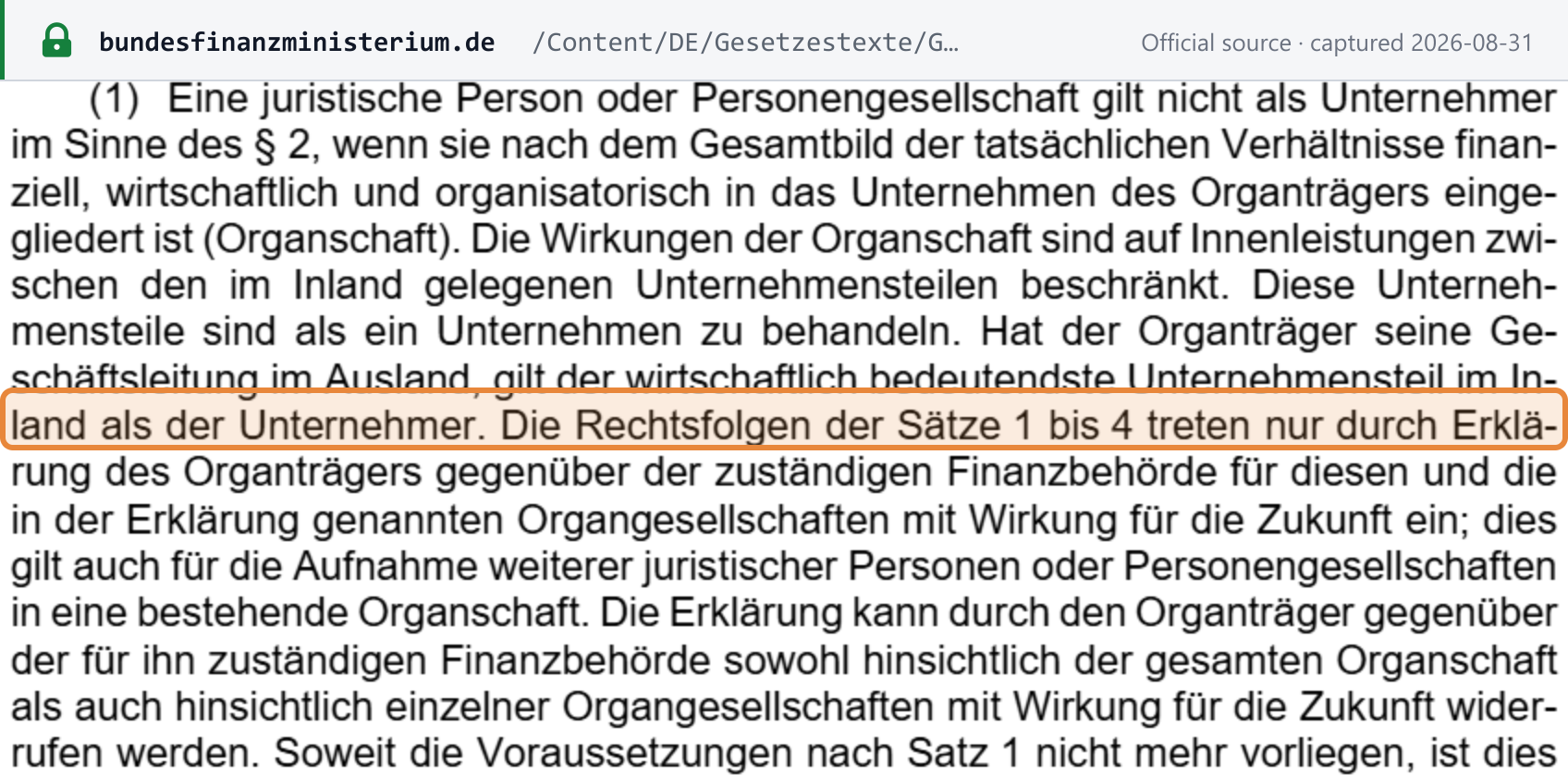
2026-08-12 — Germany's Federal Cabinet approves the government draft of the Jahressteuergesetz 2026 (Regierungsentwurf). This is a draft bill, not enacted law, and it has since moved on: the draft was transmitted to the Bundesrat on 14 August 2026 as BR-Drs. 447/26; the Bundesrat's Finanzausschuss is to consider it at a sitting for which no date has been published, with the Bundesrat's first plenary reading on 25 September 2026. If passed as drafted, the bill would insert a new § 2c UStG for VAT group taxation (Organschaft). §2c does not replace the existing financial/economic/organisational integration test — it substantially reproduces that test and adds a further condition: the legal effects of an Organschaft, and the addition of further group members, would arise only once the controlling entity files a declaration with its competent tax office, with effect for the future (and revocable prospectively). The draft would also newly extend Organgesellschaft status to partnerships (Personengesellschaften), which cannot be controlled entities under the current rule. On timing, two dates matter and they are not the same: Article 32(7) of the draft puts §2c into force on 1 July 2029, but draft § 27(42) UStG provides that §2c first applies from 1 January 2030 — the existing §2(2) Nr. 2 UStG rule continues to apply until 31 December 2029, and a declaration under §2c may be filed from 1 July 2029 with effect from 1 January 2030. For planning purposes, 1 January 2030 is the date that matters, not 1 July 2029. (Bundesministerium der Finanzen) — see issue
 Source snapshot captured 2026-08-31, government draft — original
 -
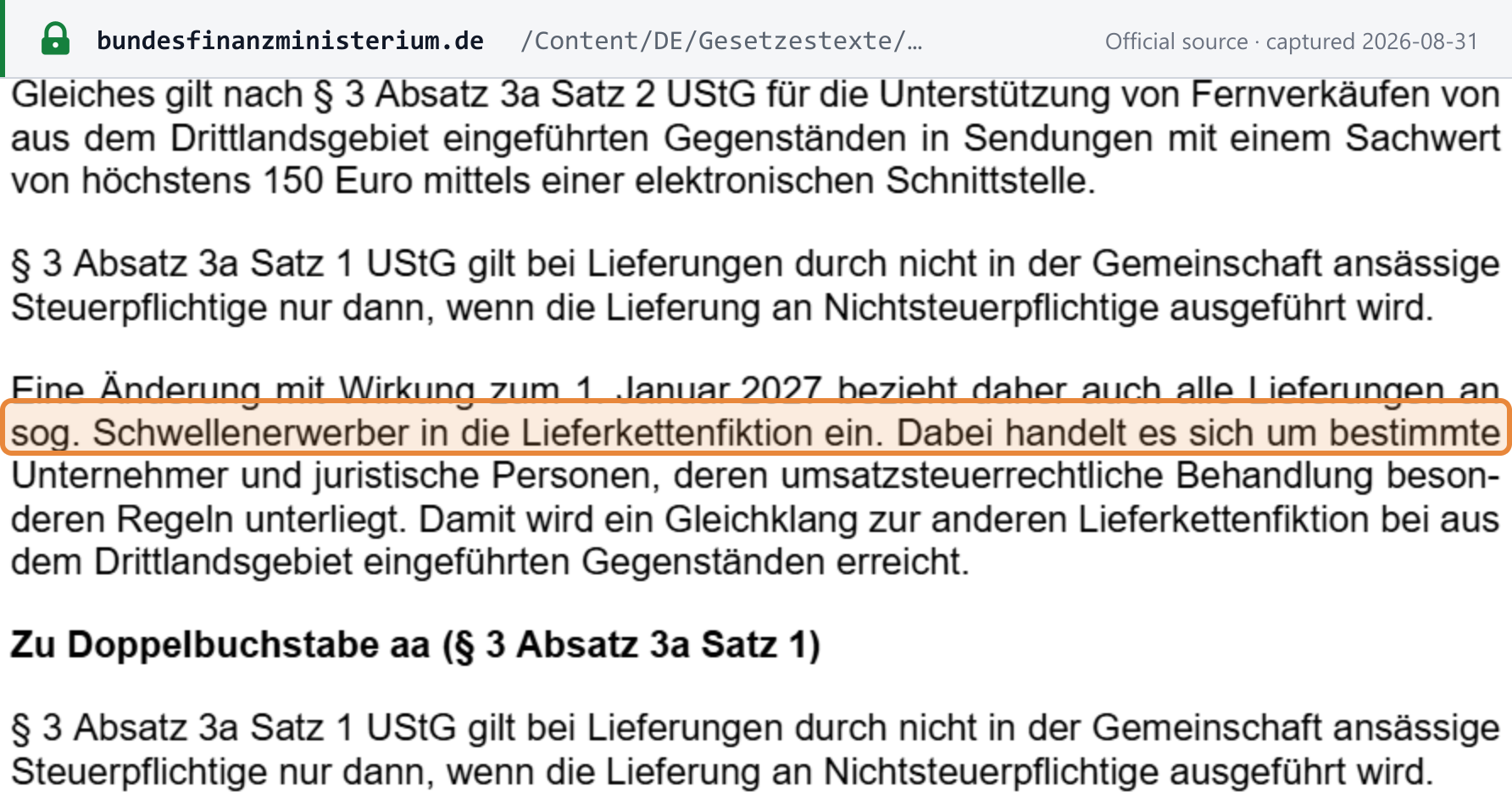
2026-08-12 — The same government draft Jahressteuergesetz 2026, approved by the Federal Cabinet on 12 August 2026 and now with the Bundesrat as BR-Drs. 447/26 (Finanzausschuss sitting date not published, first plenary 25 September 2026), would amend § 3(3a) UStG to extend the electronic-interface deemed-supplier fiction — currently limited to supplies made to non-taxable persons — to supplies made to Schwellenerwerber (certain taxable persons and legal entities subject to the special intra-Community acquisition rules), transposing amended Article 14a of the EU VAT Directive. This is a draft bill, not enacted law. Under Article 32(5) of the draft, this provision would enter into force on 1 January 2027. (Bundesministerium der Finanzen) — see issue
 Source snapshot captured 2026-08-31, government draft — original
Frequently Asked Questions
Which number must appear on a German VAT invoice — the Steuernummer or the USt-IdNr?
For domestic German B2B invoices, either the Steuernummer (format: XX/XXX/XXXXX) or USt-IdNr (format: DE + 9 digits) is acceptable. For intra-EU cross-border B2B supplies, the USt-IdNr of both supplier and customer is mandatory — the Steuernummer alone is insufficient. The USt-IdNr is applied for separately from the Steuernummer, at a different time; BZSt does not publish a standard processing time, so treat any specific week-count you see elsewhere as indicative only. [1]
Can my German business use the Kleinunternehmerregelung (§19 UStG) to avoid charging VAT?
Yes — and it applies automatically, not as an election. Under §19(1) UStG, domestic revenue is exempt by operation of law where prior-year revenue did not exceed €25,000 (this replaced the former €22,000 figure from 1 January 2025) and current-year revenue does not exceed €100,000 — the exemption ends the moment that limit is crossed, and the very supply that breaches it is already taxable; a business may waive the exemption under §19(3). Under §34a UStDV, the invoice must refer to the Kleinunternehmer exemption — no exact wording is prescribed, e.g. "Steuerbefreiung für Kleinunternehmer gemäß §19 UStG" — and must still show the recipient's full name and address plus the supplier's Steuernummer, USt-IdNr, or Kleinunternehmer-IdNr; no VAT rate or amount may appear — that prohibition comes from §14c(2) UStG, which makes anyone who states VAT without being entitled to owe the amount shown, rather than from §34a itself. Input tax (Vorsteuer) cannot be deducted. Note: the §19 exemption only covers domestic German output VAT — intra-EU B2B reverse-charge still applies. [1] [2]
When does the German domestic reverse charge (§13b UStG) apply?
Under §13b UStG, a German VAT-registered recipient becomes liable for VAT when receiving services from foreign EU suppliers established outside Germany. The recipient self-assesses VAT and claims it as input tax on the same return — net effect is zero cash but compliance is required (the specific box numbers on the current Voranmeldung form are not given here, as they change between form versions; check the current Vordruck or ELSTER). Construction services (§13b(2) No. 4 UStG) also have domestic reverse charge rules for German-established subcontractors where the main contractor is VAT-registered. Failure to self-account correctly triggers assessments plus, where applicable, a Säumniszuschlag — a late-payment surcharge under §240 AO of 1% per month commenced, not interest — and, on formal assessment, statutory interest under §233a AO of 0.15% per month (1.8% per year) per §238(1a) AO. [1] [2] [3]
My German supplier's VIES number fails validation — is their USt-IdNr still valid?
A German DE + 9-digit USt-IdNr that fails VIES most commonly means: (1) the supplier received their Steuernummer but hasn't yet applied for or received the USt-IdNr — these are separate numbers issued at different times, and BZSt does not publish a standard processing time for the USt-IdNr; (2) data entry error (missing DE prefix, wrong digit count); (3) deregistration from VAT; (4) temporary BZSt database outage. Ask for a Finanzamt certificate confirming VAT registration. Zero-rating intra-EU supplies without a VIES-confirmed number exposes you to German VAT assessment on those supplies. [1]
Germany is mandating B2B e-invoicing — what is the timeline?
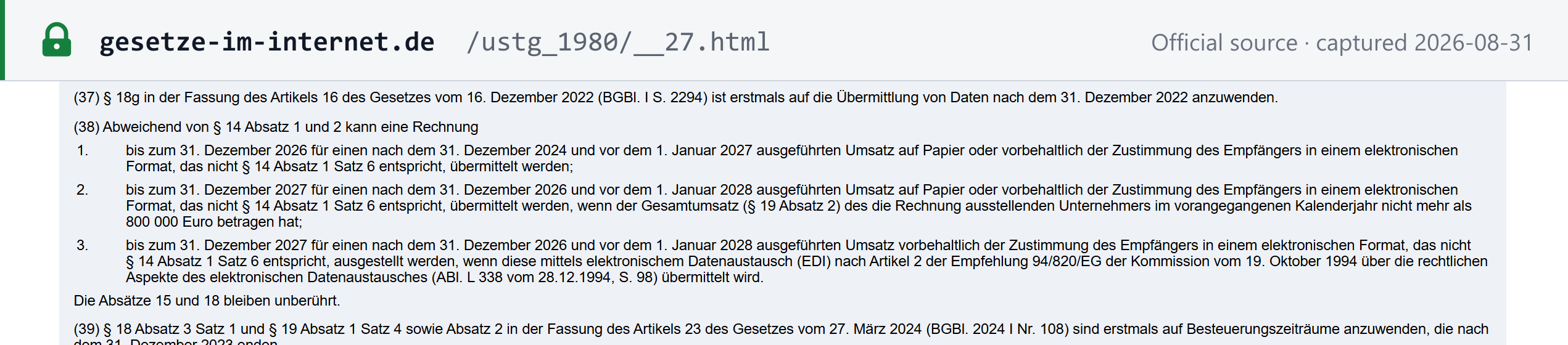
Germany's B2B e-invoicing mandate (Wachstumschancengesetz): (1) From 1 January 2025: all businesses must be able to receive structured e-invoices; (2) From 1 January 2027: businesses with >€800,000 revenue in 2026 must send structured e-invoices for domestic B2B; (3) From 1 January 2028: the transitional periods end for the remaining businesses — but the issuance obligation is not universal even then. Kleinunternehmer invoices (§34a UStDV), Kleinbetragsrechnungen up to €250 (§33 UStDV), passenger tickets (Fahrausweise), and supplies exempt under §4 Nr. 8–29 UStG (§14(2) Satz 2) stay permanently outside the eRechnung issuance obligation and may still be issued as a sonstige Rechnung — see Simplified invoices above. Required format: XRechnung or ZUGFeRD from version 2.0.1, excluding the MINIMUM and BASIC-WL profiles (EN 16931-compliant). [1] [2]
 Source snapshot captured 2026-08-31 — original
For more details on German tax identifiers, see our Germany Tax ID Guide. To verify a German VAT number, see our EU VAT verification guide.