Netherlands VAT guidelines
| FACTSHEET | |
|---|---|
| Country code | NL |
| Tax name | Value Added Tax — omzetbelasting, commonly btw (belasting over de toegevoegde waarde) |
| Tax Authority | Belastingdienst (Netherlands Tax and Customs Administration) |
Overview
The Netherlands levies Value Added Tax under the Wet op de omzetbelasting 1968 (Wet OB), in force since 1 January 1969. The statutory name is omzetbelasting (turnover tax); in everyday use, and on invoices, it is btw (belasting over de toegevoegde waarde). Article 1 levies it on supplies of goods and services made in the Netherlands for consideration by an entrepreneur acting as such, on intra-Community acquisitions of goods and on imports. [1]
Authority. The tax is administered by the Belastingdienst (Tax and Customs Administration); import VAT is collected by its customs arm, Douane. Foreign businesses are handled centrally by the Belastingdienst's Department of International Issues in Heerlen, unless they act through a fiscal representative, in which case the representative's tax office deals with their VAT. [3]
Currency. All amounts in this guide are in euros (EUR). An invoice may be made out in any currency, but the VAT amount must be stated in euros (Wet OB art. 35a(4)) — see Invoice requirements. [1]
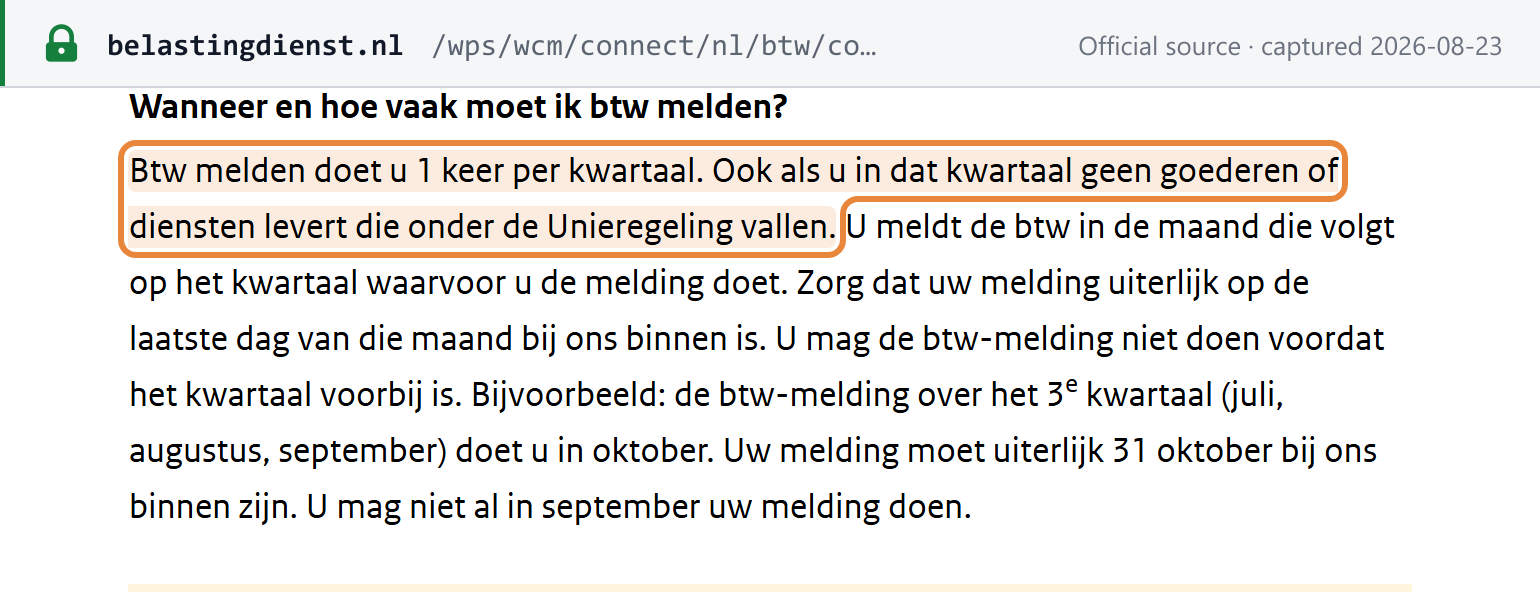
Tax period. The VAT return is filed per calendar quarter by default — "Btw-aangifte doet u meestal per kwartaal" (you usually file your VAT return per quarter) — with monthly and annual periods possible on conditions described under Filing and payment. [40]
Layering. The Wet OB is a single national act administered by the Belastingdienst; there is no provincial or municipal VAT layer. [1]
Registration
Who should register
Every entrepreneur is inside the VAT system; there is no registration turnover threshold. Liability follows from being an ondernemer. Wet OB art. 7(1)–(2): "Ondernemer is ieder die een bedrijf zelfstandig uitoefent" — an entrepreneur is anyone who independently carries on a business, and "business" includes a profession and the exploitation of an asset to obtain lasting income from it. The Wet OB contains no turnover figure that triggers registration; its only turnover-based reliefs, the KOR and the registration threshold below, are exemptions limited to businesses established in the Netherlands or the EU. [1]
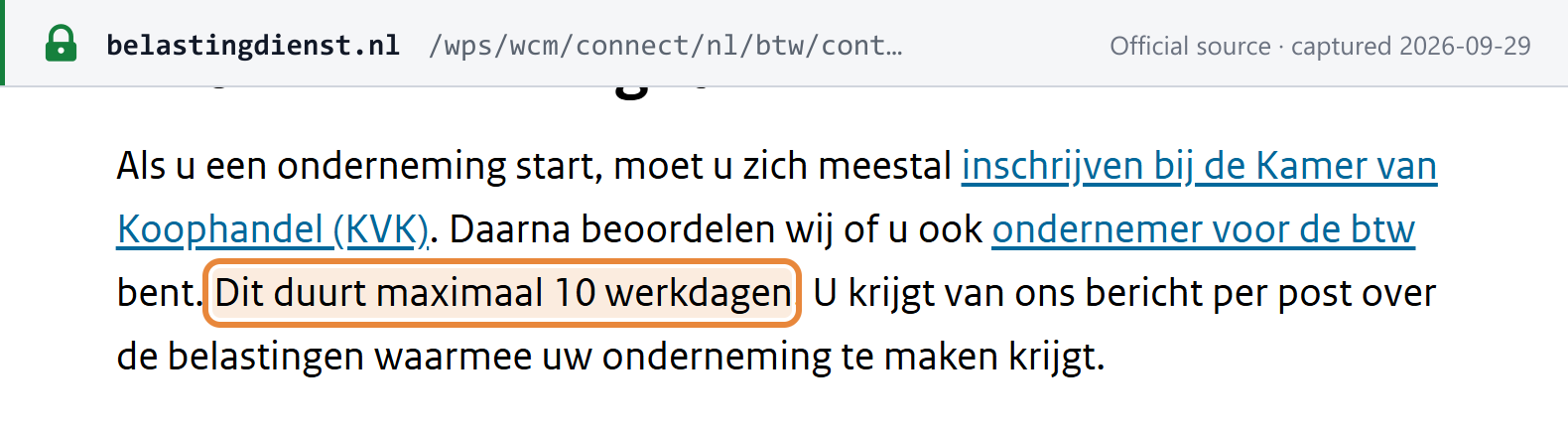
Most Dutch businesses are registered automatically. After a business enrols with the KVK (Chamber of Commerce), the Belastingdienst assesses whether it is an entrepreneur for VAT: "Dit duurt maximaal 10 werkdagen" — this takes at most 10 working days — and it then notifies the business by post of the taxes it will deal with. [4]
Threshold
Two small-business figures are often mistaken for a registration threshold. Neither is one:
| Figure | What it is | Who can use it |
|---|---|---|
| EUR 20,000 (calendar year) — KOR (kleineondernemersregeling) | An optional exemption: no VAT charged, no VAT return, no input-tax deduction, and VAT may not be shown on invoices | Businesses established in the Netherlands with Dutch turnover ≤ EUR 20,000 (art. 25a(1)); EU businesses only via the EU-KOR, with EU-wide turnover ≤ EUR 100,000 (art. 25a(2)); not businesses established outside the EU |
| EUR 2,200 — registratiedrempel | No need to register for VAT at all | Businesses with annual turnover ≤ EUR 2,200 that are not obliged to enrol with the KVK and have not registered for VAT |
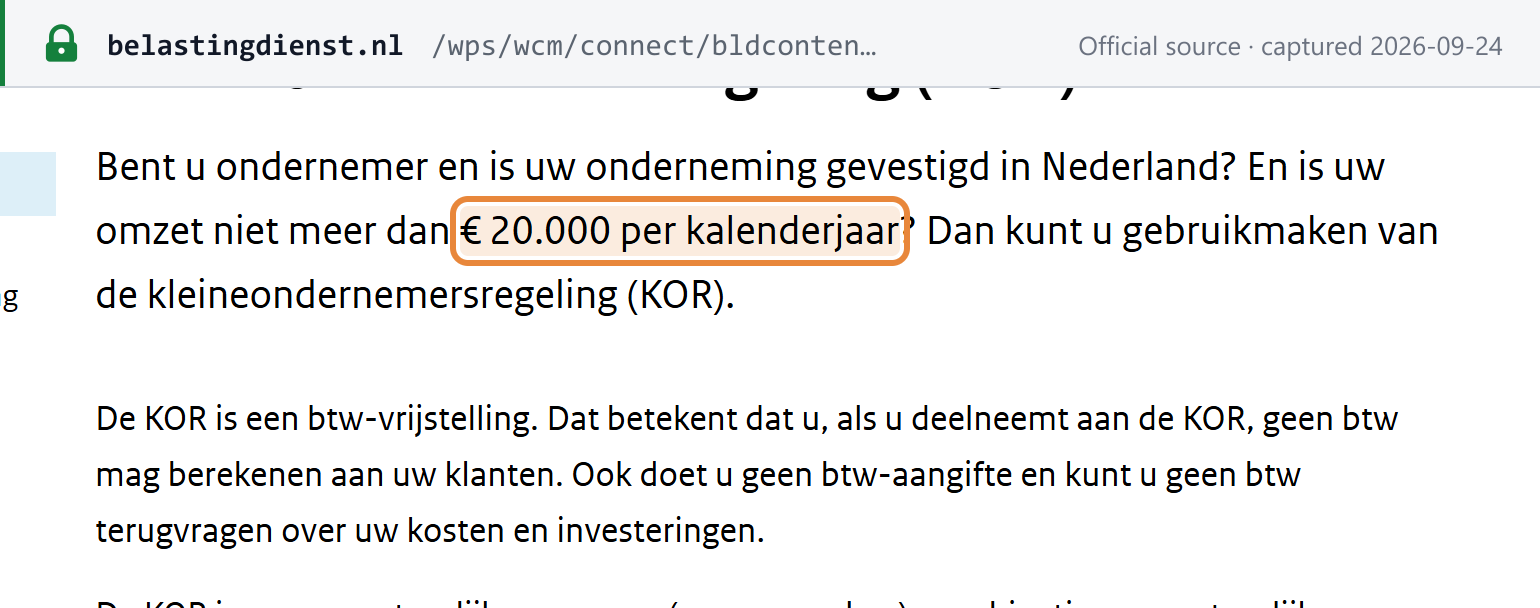
KOR. Wet OB art. 25a(1): "Een ondernemer die in Nederland is gevestigd en van wie de jaaromzet in Nederland niet meer bedraagt dan € 20.000 kan kiezen voor toepassing van vrijstelling" — an entrepreneur established in the Netherlands whose annual Dutch turnover does not exceed EUR 20,000 may choose the exemption. The Belastingdienst: "De KOR is een btw-vrijstelling … Ook doet u geen btw-aangifte en kunt u geen btw terugvragen over uw kosten en investeringen" (the KOR is a VAT exemption; you also file no VAT return and cannot reclaim VAT on your costs and investments). [1] [5]
- Joining takes effect from the first tax period starting at least 4 weeks after notification (art. 25a(5)). [1]
- Leaving on turnover. When Dutch turnover passes EUR 20,000, the exemption no longer applies from the supply that crosses the limit, which is itself taxable, for the rest of that calendar year and the following one (art. 25a(9)). [1]
- Leaving voluntarily. Exit takes effect from the first calendar quarter starting at least 4 weeks after notice, and re-entry is barred for the rest of that calendar year and the following one (art. 25a(7)). [1]
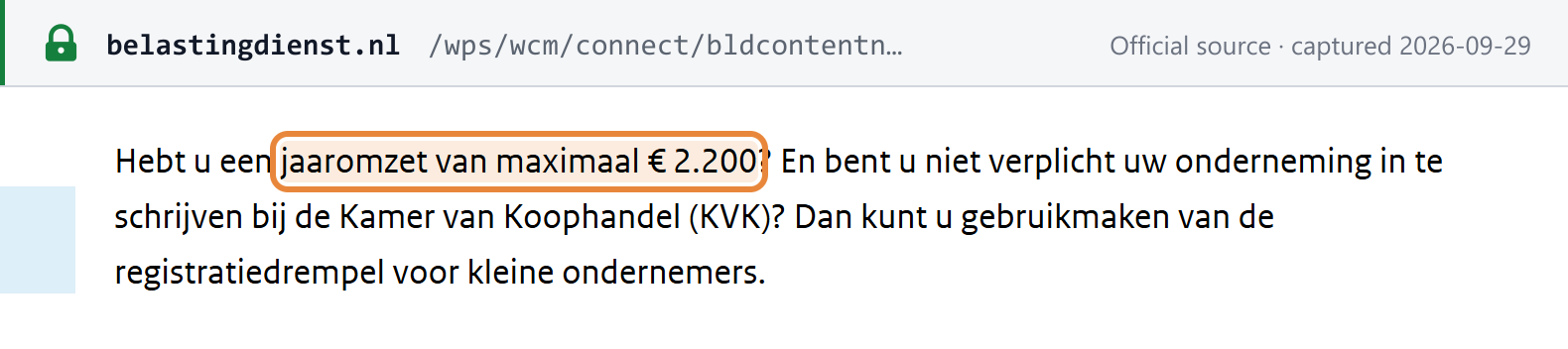
Registration threshold (EUR 2,200). "Hebt u een jaaromzet van maximaal € 2.200? En bent u niet verplicht uw onderneming in te schrijven bij de Kamer van Koophandel (KVK)? Dan kunt u gebruikmaken van de registratiedrempel voor kleine ondernemers" (is your annual turnover at most EUR 2,200 and are you not obliged to enrol with the KVK? Then you can use the registration threshold for small businesses). [6]
For the Netherlands alongside other jurisdictions, see Lookuptax's VAT registration thresholds table and the EU VAT SME scheme guide behind the EU-KOR.
Non-resident registration
The threshold for non-residents is zero. A business established outside the Netherlands cannot use the KOR unless it is established in the EU and qualifies for the EU-KOR, and businesses established outside the EU cannot use it at all (art. 25a(1)–(2)). [1]
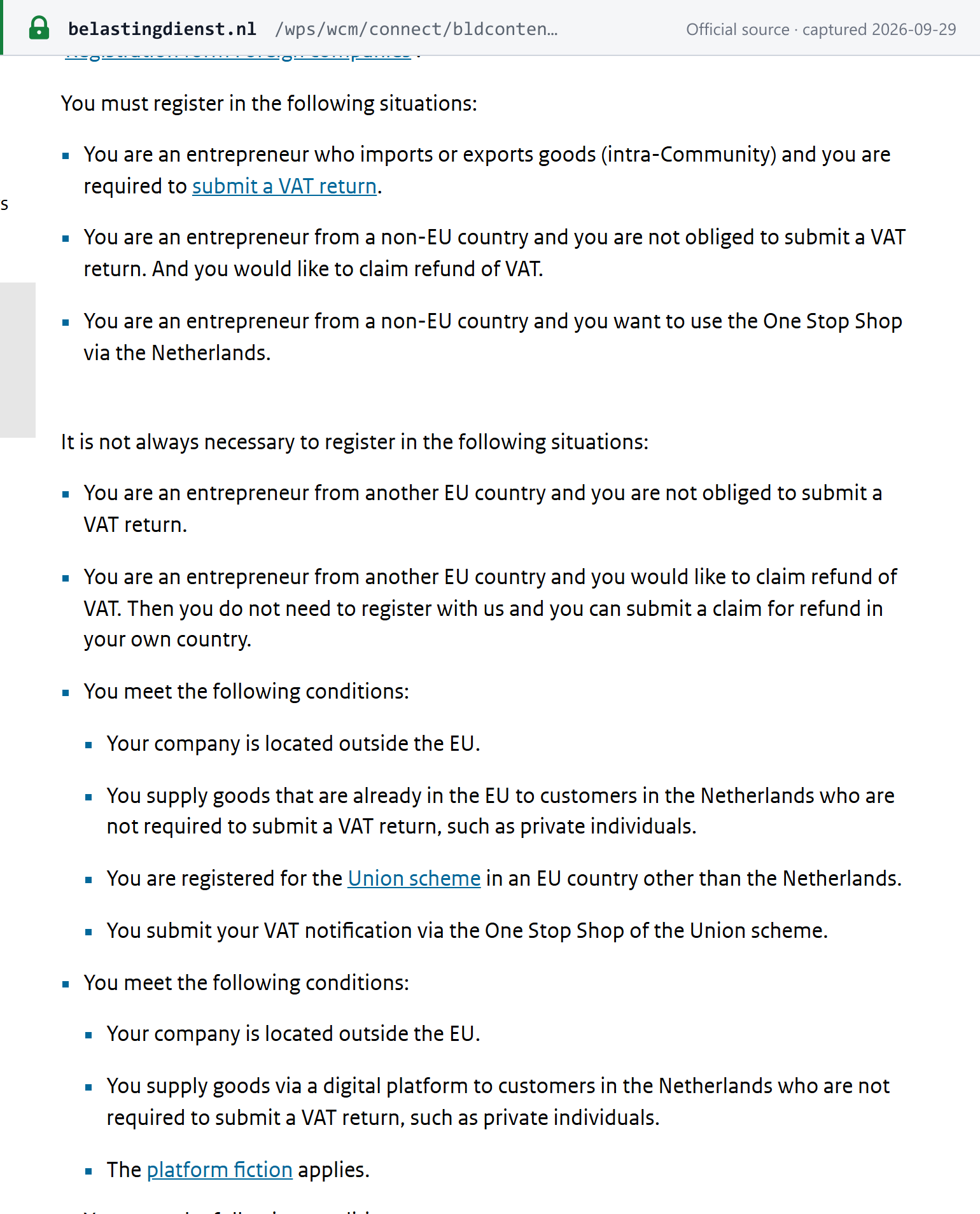
The Belastingdienst's page for foreign entrepreneurs says registration is required in these situations: "You are an entrepreneur who imports or exports goods (intra-Community) and you are required to submit a VAT return. You are an entrepreneur from a non-EU country and you are not obliged to submit a VAT return. And you would like to claim refund of VAT. You are an entrepreneur from a non-EU country and you want to use the One Stop Shop via the Netherlands." The same page lists cases where registration is not needed, including EU businesses with no Dutch return obligation, EU businesses reclaiming Dutch VAT through their home-state portal, and non-EU sellers covered by OSS or IOSS in another member state or by the platform fiction. [3]
In practice, a foreign business selling only to Dutch businesses often needs no Dutch number at all, because the Dutch customer accounts for the VAT under the reverse charge — see Foreign companies selling into the Netherlands.
Fiscal representative — optional, except for import deferral. A business not established in the Netherlands "kan in Nederland een fiscaal vertegenwoordiger aanstellen" — may appoint a fiscal representative, who must hold a licence from the inspector (Wet OB art. 33g(1), (3)). The Belastingdienst adds that the representative must be established in the Netherlands and provide financial security for the VAT. It is not required for ordinary registration, but it is the only route for a foreign business to use the article 23 import-VAT deferral: "U kunt als buitenlandse ondernemer niet zelf een vergunning artikel 23 aanvragen. Wel kunt u hiervoor een fiscaal vertegenwoordiger inschakelen" (as a foreign entrepreneur you cannot apply for an article 23 licence yourself, but you can engage a fiscal representative for it). A business using a limited fiscal representative, which uses its own licence, "hoeft zich niet bij ons te laten registreren" — need not register with the Belastingdienst at all. [1] [8] [9]
Tax identification number
Two numbers are issued: [4]
- btw-identificatienummer (btw-id) — the VAT identification number used with customers and suppliers, on invoices and websites, and in VIES. Format: NL + 9 digits + B + 2 digits (14 characters), for example
NL123456789B01. - omzetbelastingnummer (ob-nummer) — used only in contact with the Belastingdienst: "Uw ob-nummer gebruikt u alleen bij contact met ons." Format: 9 digits + B + 2 digits, for example
111234567B01. For a sole trader it contains the citizen service number (BSN); the btw-id does not.
For the structure of Dutch identifiers in detail, see Lookuptax's Netherlands tax ID guide. To check a number, use Lookuptax's Netherlands btw-nummer validator, or see how to verify an EU VAT number in VIES and the list of official VAT-number lookups.
How to register
- Businesses established in the Netherlands enrol with the KVK; the Belastingdienst then decides on VAT status within at most 10 working days and posts the btw-id and ob-nummer. [4]
- Foreign businesses use the paper "Registration form Foreign companies", which covers VAT and the EU VAT One Stop Shop among other taxes. It is printed, signed and posted to Belastingdienst/Klantgegevens, Postbus 2892, 6401 DJ Heerlen, the Netherlands. Attachments include evidence of the business activity at home; a foreign chamber-of-commerce extract where registered; for businesses established outside the EU, a tax statement from the home country; a copy of an authorisation where represented; and an identity document for natural persons without a BSN. Attachments not in Dutch, German or English must be translated. [7]
- Timeline for foreign registrations. The Belastingdienst publishes no processing time for foreign registrations; the 10-working-day figure applies to the KVK route.
Voluntary registration
There is no separate voluntary regime, because every entrepreneur is already inside the system. A small Dutch business that would qualify for the KOR simply does not opt in, and so charges VAT and deducts input tax (art. 25a(1) "kan kiezen"). A business under the EUR 2,200 registration threshold may register, for example to reclaim VAT, but then loses the threshold: "Of hebt u zich al aangemeld als ondernemer voor de btw … bijvoorbeeld omdat u eerder btw wilde terugvragen? Dan kunt u geen gebruik maken van deze registratiedrempel." [1] [6]
Deregistration
- Threshold: none — registration follows the business, not a turnover level.
- Returns up to cessation. A return is due for every period in which the business is an entrepreneur, including nil returns. [41]
- OSS must be ended separately. "Gebruikt u het eenloketsysteem (One Stop Shop, OSS) en wilt u deze registratie beëindigen? Maak dit in orde voordat u zich uitschrijft bij de KvK en voordat de eHerkenning eindigt" — otherwise the last OSS returns may not be fileable, with a risk of exclusion from the OSS for 2 years. [10]
- Private use on cessation. Stock and business assets not supplied to someone else pass to private use; where VAT was deducted on purchase, VAT is due on that deemed supply. [10]
- Transfer of a going concern (overgang van een algemeenheid van goederen) is outside the scope of VAT (Wet OB art. 37d). [1]
Group registration
Available — the fiscale eenheid. Entrepreneurs established in the Netherlands that are financially, organisationally and economically intertwined are treated as one entrepreneur by decision of the inspector, from the first day of the month after the decision (Wet OB art. 7(4)). The Belastingdienst: businesses are in any case financially intertwined if "meer dan 50% van de aandelen, inclusief de zeggenschap daarover" (more than 50% of the shares, including control) is directly or indirectly in the same hands, and "de eenheid [moet] gevormd worden met minstens 1 bv, cv, stichting of vereniging" — at least one member must be a bv, cv, foundation or association. Only Dutch establishments can join. [1] [11]
Rates
| Rate | Applies to | Basis |
|---|---|---|
| 21% (general, "high") | Every taxable supply not covered by an exemption, the reverse charge, the 0% rate or the 9% rate | Wet OB art. 9(1) |
| 9% (reduced, "low") | Goods and services in Tabel I — see below | Wet OB art. 9(2)(a) |
| 0% (nil, with input-tax deduction) | Goods and services in Tabel II — exports, intra-EU supplies and related services, solar panels on dwellings | Wet OB art. 9(2)(b) |
| Exempt | See Exemptions | Wet OB art. 11 |
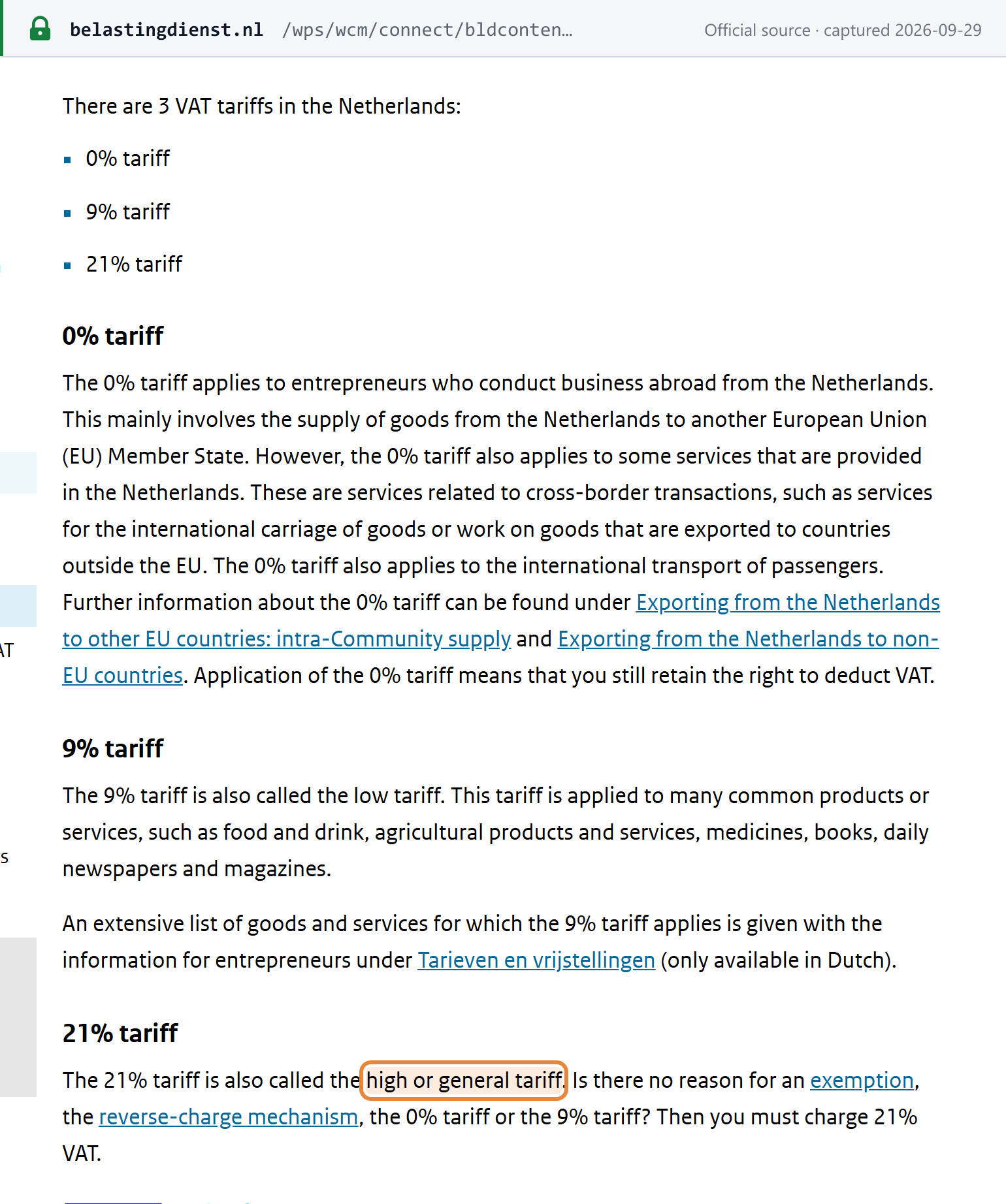
The Belastingdienst's English rates page: "There are 3 VAT tariffs in the Netherlands: 0% tariff 9% tariff 21% tariff" and "The 21% tariff is also called the high or general tariff. Is there no reason for an exemption, the reverse-charge mechanism, the 0% tariff or the 9% tariff? Then you must charge 21% VAT." Wet OB art. 9(1): "De belasting bedraagt 21 percent." [12] [1]
The 21% rate has applied since 1 October 2012 (Wet OB art. 9 as amended by Stb. 2012, 321).
Super-reduced or parking rate: none. Wet OB art. 9 provides three rates only — 21%, 9% and nil. [1]
What the 9% rate covers. Goods: "voedingsmiddelen, water, sierteeltproducten, geneesmiddelen en hulpmiddelen, kunst, verzamelvoorwerpen en antiek, boeken en periodieken" — foodstuffs (not alcoholic drinks), water, ornamental horticulture (flowers, plants, bulbs), medicines and medical aids, art, collectibles and antiques (on conditions), and books and periodicals. Services include repairs of bicycles, shoes, leather goods and clothing; hairdressing; certain painting, plastering and insulation work on dwellings; camping pitches; admission to cultural and recreational events and facilities such as museums, cinemas, zoos, circuses, sports events and amusement parks; performing artists; sports facilities, swimming pools and saunas; passenger transport; e-books and news sites comparable to print; restaurant food (not alcohol); and cleaning inside dwellings. [13] [14]
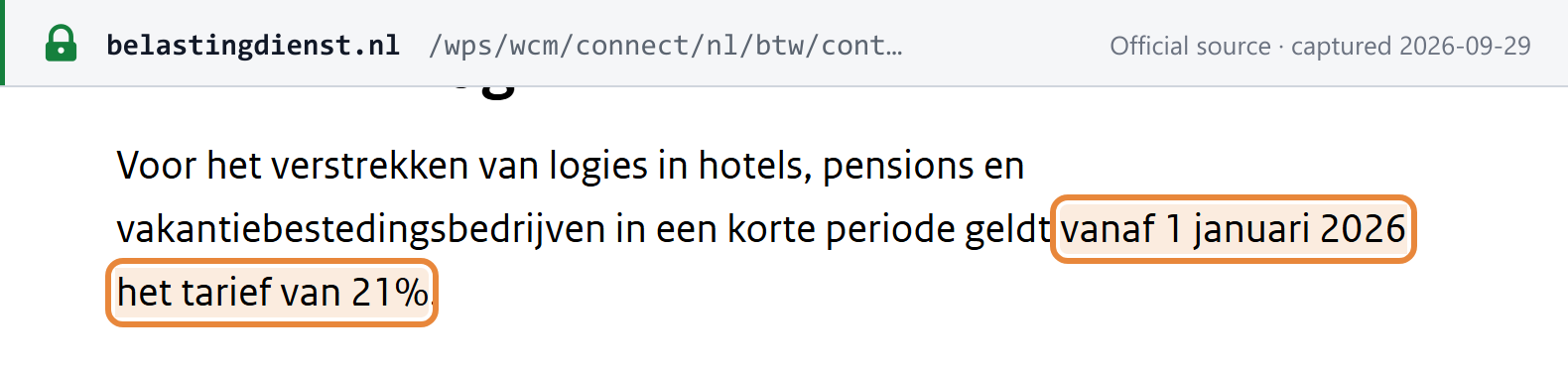
Accommodation moved to 21% on 1 January 2026. "Voor het verstrekken van logies in hotels, pensions en vakantiebestedingsbedrijven in een korte periode geldt vanaf 1 januari 2026 het tarief van 21%." Payments made in 2025 for stays in 2026 or later are also at 21%, as are single-purpose vouchers for 2026 stays. Facilities billed separately, such as breakfast or access to a swimming pool or amusement park, stay at 9%; an all-in price is split by the market value of each part. [15] [61]
What the 0% rate covers. Goods supplied abroad (exports and intra-EU supplies), goods not yet imported, goods supplied to or in a VAT warehouse, the supply and provisioning of qualifying ships and aircraft, fish catches, excise goods in an excise warehouse, and solar panels installed on or next to dwellings (Tabel II post a.10), plus related services such as international goods transport, work on goods for export and international passenger transport. "Application of the 0% tariff means that you still retain the right to deduct VAT." [16] [12]
Announced future rates
Proposed: ornamental horticulture and hot-air balloon flights from 9% to 21% on 1 January 2028. The Belastingplan 2027, sent to parliament on 15 September 2026, contains these two VAT measures. Bill art. XXII: "De Wet op de omzetbelasting 1968 wordt met ingang van 1 januari 2028 als volgt gewijzigd: A. Tabel I, onderdeel a, post 48, komt te vervallen" — removing bulbs, flowers, plants and nursery products from the 9% table; the same article removes balloons from the passenger-transport entry. Under transitional art. LXI, balloon flights take the rate in force at the time of the flight — "Ook als de ballonvaart eerder is geboekt en betaald" (even if booked and paid earlier) — and single-purpose vouchers follow the flight date. Status (as of 2026-09-29): proposed. Both chambers must still approve; the government says they vote in November and December 2026. [17] [18] — see the event record.

For the Netherlands alongside other jurisdictions, see Lookuptax's worldwide tax rates table.
Cross-border rules
Imports and exports
- Imports of goods. Import VAT is paid to Douane on the customs value — the value of the goods plus transport and insurance costs to the EU destination, plus duties. [62]
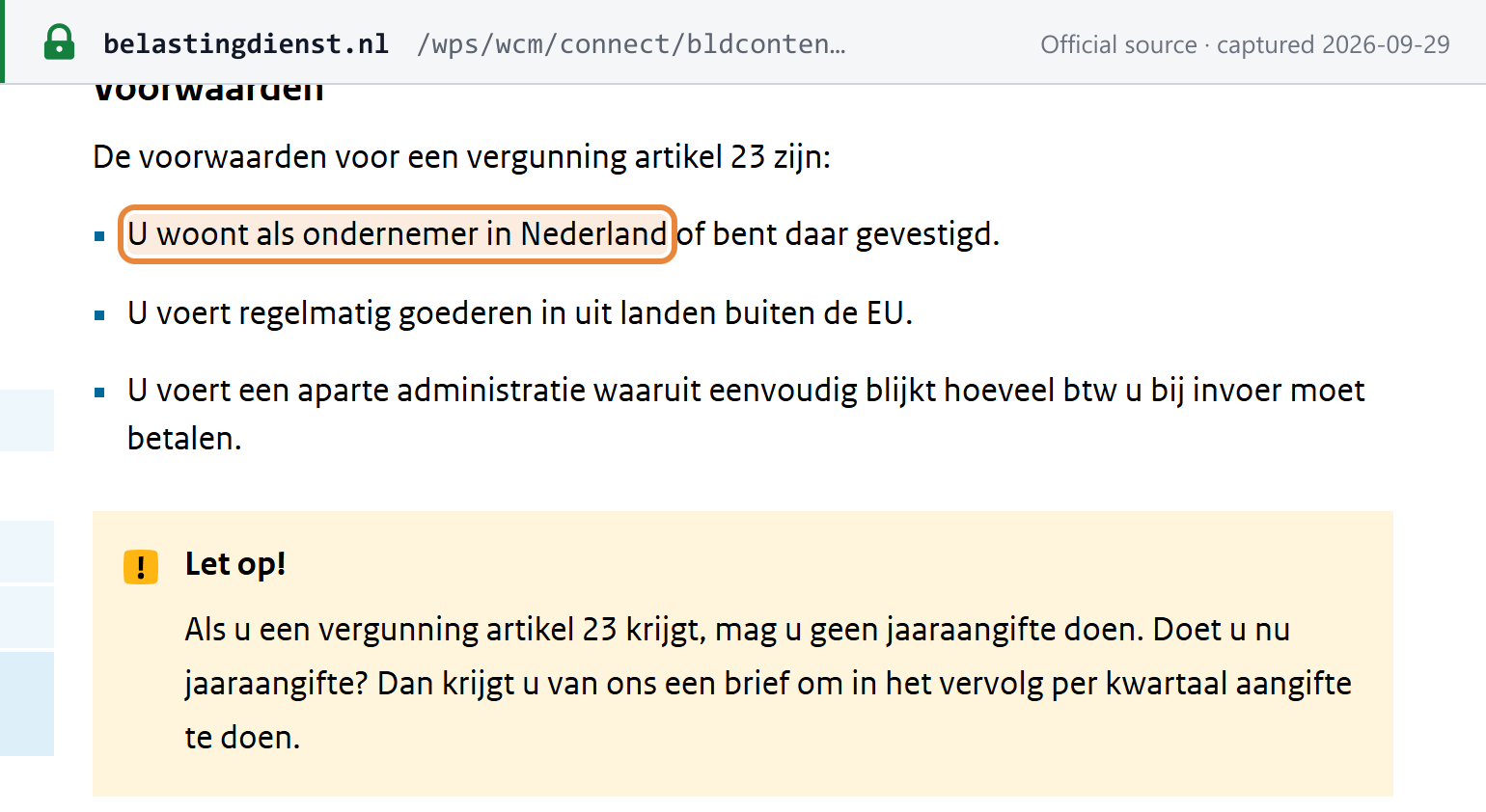
- Import deferral — the article 23 licence. "Het is ook mogelijk om de invoer-btw aan te geven in uw btw-aangifte. U moet dan schriftelijk een vergunning artikel 23 aanvragen bij uw belastingkantoor. Dan hoeft u bij de Douane geen btw te betalen" — with a licence, import VAT is declared in the periodic return, and deducted in the same return, instead of being paid at the border. Conditions: the entrepreneur lives or is established in the Netherlands (a foreign business acts through a fiscal representative — see Non-resident registration); imports regularly from outside the EU; and keeps separate records of import VAT. A licence holder may not file annually and is moved to quarterly returns; a business in the KOR cannot get one (art. 23(5)); the Belastingdienst decides within 8 weeks. [24] [1]
- De minimis. No Dutch-specific VAT de minimis for imported goods. The EU Import One-Stop Shop (Invoerregeling) covers consignments of intrinsic value up to EUR 150 — "Hiervoor geldt een maximum van € 150 per zending" — with a monthly return; an intermediary is compulsory for sellers established outside the EU. See Lookuptax's IOSS guide. [23]
- Exports outside the EU are at 0%; the goods leave VAT-free and input VAT stays deductible. [25]
- Intra-EU B2B supplies of goods are at 0%; the invoice shows the customer's VAT number and the supply goes into the return and the Opgaaf ICP (EC sales list). If an audit shows the customer was not an entrepreneur, Dutch VAT is assessed — "krijgt u een naheffingsaanslag" — so the customer's number should be checked in VIES. [26] See Lookuptax's VIES and Intrastat guide.
- Reverse charge on imported services. A Dutch business receiving B2B general-rule services from a foreign supplier accounts for the Dutch VAT itself (art. 12(2)). See Lookuptax's reverse charge explainer. [1]
- Domestic reverse charge (verleggingsregeling binnenland) also applies to subcontracting and staff hire in construction, shipbuilding, cleaning and gardening; waste and scrap; mobile phones, chips, games consoles, laptops and tablets; immovable property where the option to tax is used; forced sales; gas and electricity certificates; gold; and emission allowances. The Belastingdienst's overview does not state the value threshold for the electronics category. [27]
Digital products and services
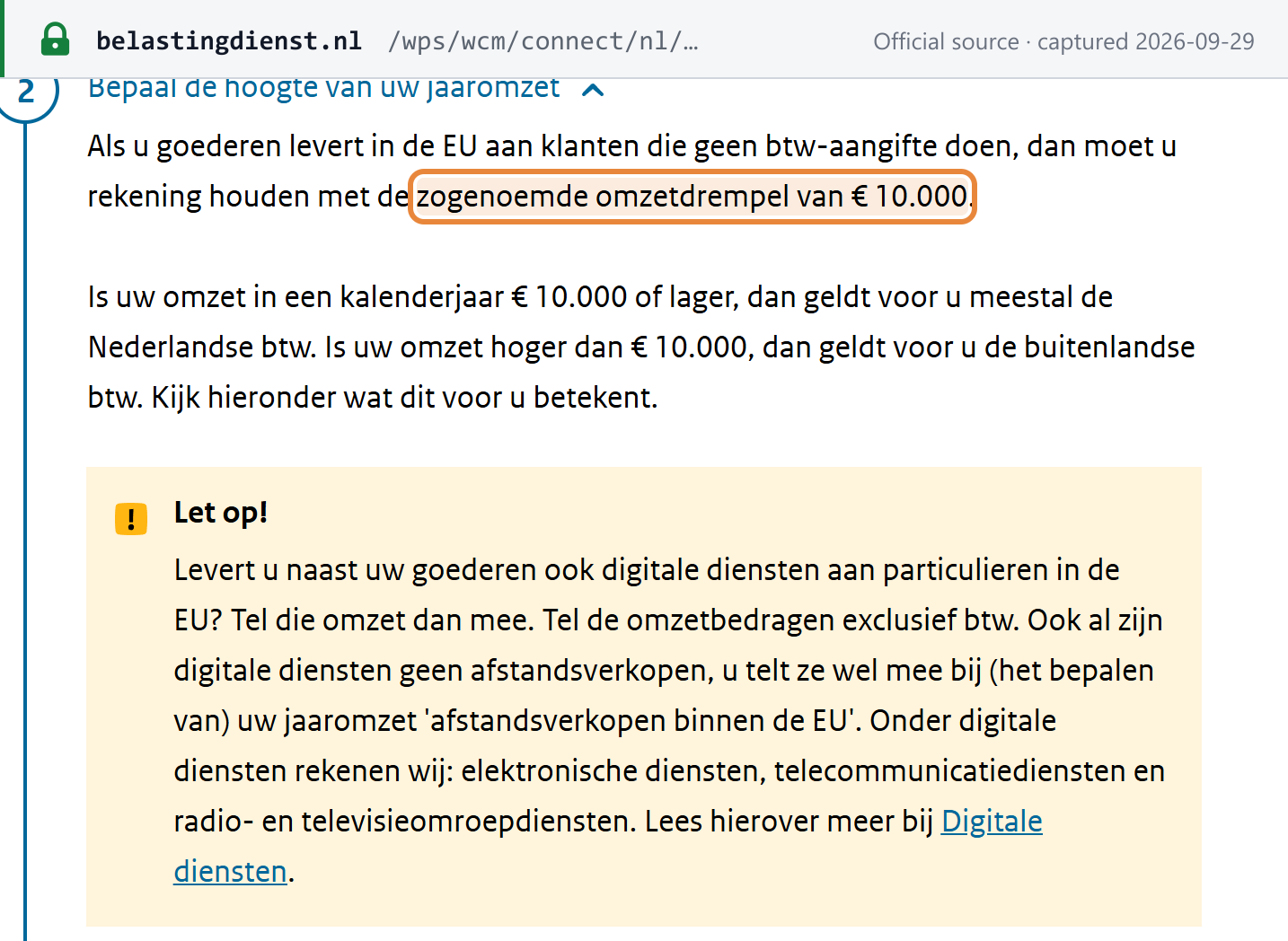
Telecommunications, broadcasting and electronically supplied services to consumers are taxed where the consumer is (Wet OB art. 6h). For an EU supplier they count, with intra-EU distance sales of goods, towards the EU-wide EUR 10,000 calendar-year threshold (art. 6k); above it, Dutch VAT at 21% or 9% applies, declared through the Union OSS in the home state or by registering in the Netherlands. The threshold does not apply to a business with a fixed establishment in another member state. A supplier established outside the EU charges Dutch VAT from the first sale, through the non-Union OSS in any member state or a Dutch registration. [1] [21] [22]
See Lookuptax's One-Stop Shop guide and VAT on digital services by non-resident suppliers.
Foreign companies selling into the Netherlands — B2B and B2C
The answer depends on who the customer is:
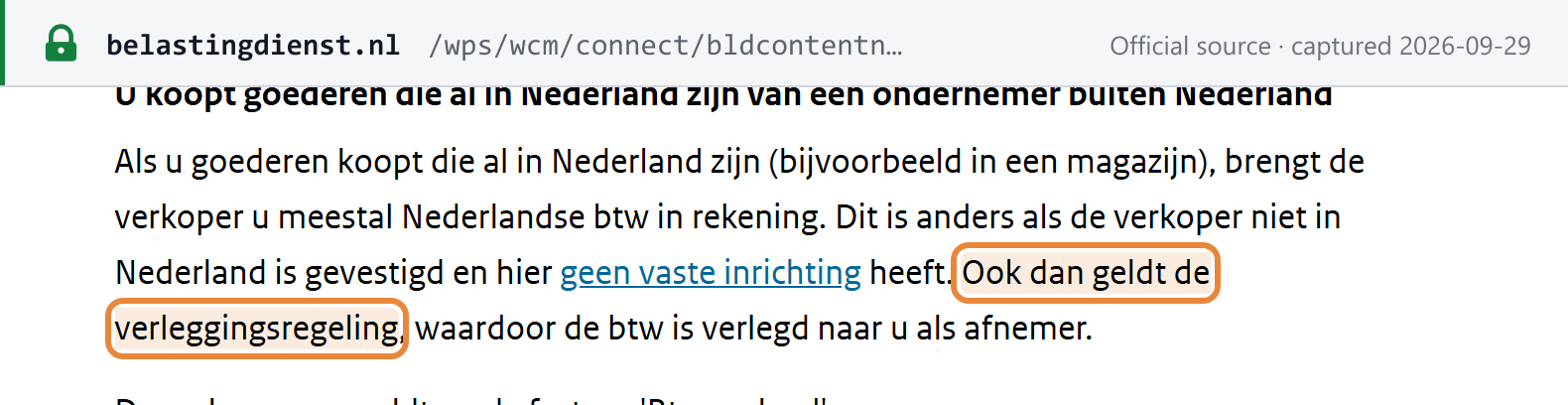
- B2B — reverse charge, for goods and services alike. Where a supplier not established in the Netherlands (and not supplying from a Dutch fixed establishment) makes a supply taxable in the Netherlands to an entrepreneur or legal entity established there, "wordt de belasting geheven van degene aan wie de levering wordt verricht of de dienst wordt verleend" — the customer pays the VAT (Wet OB art. 12(3); art. 12(2) for general-rule services). The supplier invoices without VAT and marks it "btw verlegd"; the customer reports it in box 2a of its return. This is broader than the EU minimum: it also catches goods already in the Netherlands. The Belastingdienst: "Als u goederen koopt die al in Nederland zijn (bijvoorbeeld in een magazijn) … Dit is anders als de verkoper niet in Nederland is gevestigd en hier geen vaste inrichting heeft. Ook dan geldt de verleggingsregeling." [1] [19] [20]
- B2C — Dutch VAT, through OSS/IOSS or a Dutch registration. EU sellers of goods and digital services pay Dutch VAT above the EUR 10,000 EU-wide threshold; non-EU sellers of services pay it from the first sale; imported consignments up to EUR 150 can go through IOSS. "If you do not use any of the schemes, you have to register at the Tax Administration Department of International Issues." [22] [3]
Marketplace / platform deemed-supplier liability
Applies. Under Wet OB art. 3c, an electronic interface — "een marktplaats, platform, portaal of soortgelijk middel" — that facilitates (1) distance sales of goods imported in consignments of intrinsic value up to EUR 150, or (2) supplies of goods within the EU by a seller not established in the EU to consumers, is deemed to have received and supplied the goods itself. The platform keeps records of the facilitated supplies for 10 years and makes them available electronically on request (art. 34(5)–(7)). The EU's later platform rule for short-term accommodation and passenger transport under ViDA is to be implemented by a separate Dutch bill; its Dutch start date has not been set (as of 2026-09-29). [1] [39] See Lookuptax's marketplace deemed-supplier explainer.
Place of supply
- Goods. Where transport begins, or where the goods are when supplied if not transported (Wet OB art. 5); distance sales where transport ends (art. 5a), subject to the EUR 10,000 threshold (art. 6k). [1]
- Services, B2B. Where the customer has its business seat or the fixed establishment receiving the service: "De plaats van een dienst, verricht voor een als zodanig handelende ondernemer, is de plaats waar die ondernemer de zetel van zijn bedrijfsuitoefening heeft gevestigd" (art. 6(1)). [1]
- Services, B2C. Where the supplier is established (art. 6(2)). [1]
- Exceptions. Services connected with immovable property (art. 6b); passenger transport (6c); admission to events (6d); restaurant services (6f); short-term hire of means of transport (6g); and telecom, broadcasting and electronic services to consumers, taxed where the consumer is (6h), subject to the EUR 10,000 rule for EU micro-businesses (6k). [1]
Invoice requirements
The invoice rules sit in Wet OB articles 34c–35c. [1]
Who must invoice. An invoice is required for supplies to other entrepreneurs and to non-business legal entities (including foreign ones), for intra-Community supplies of goods, for EU distance sales not declared through OSS, and for advance payments (except advances for intra-Community supplies) — Wet OB art. 34c(1). There is no duty to invoice consumers, except for wholesalers of food, tobacco and dental materials with at least 80% business customers, and for a new means of transport sent to another EU country. [1] [28]
Mandatory content
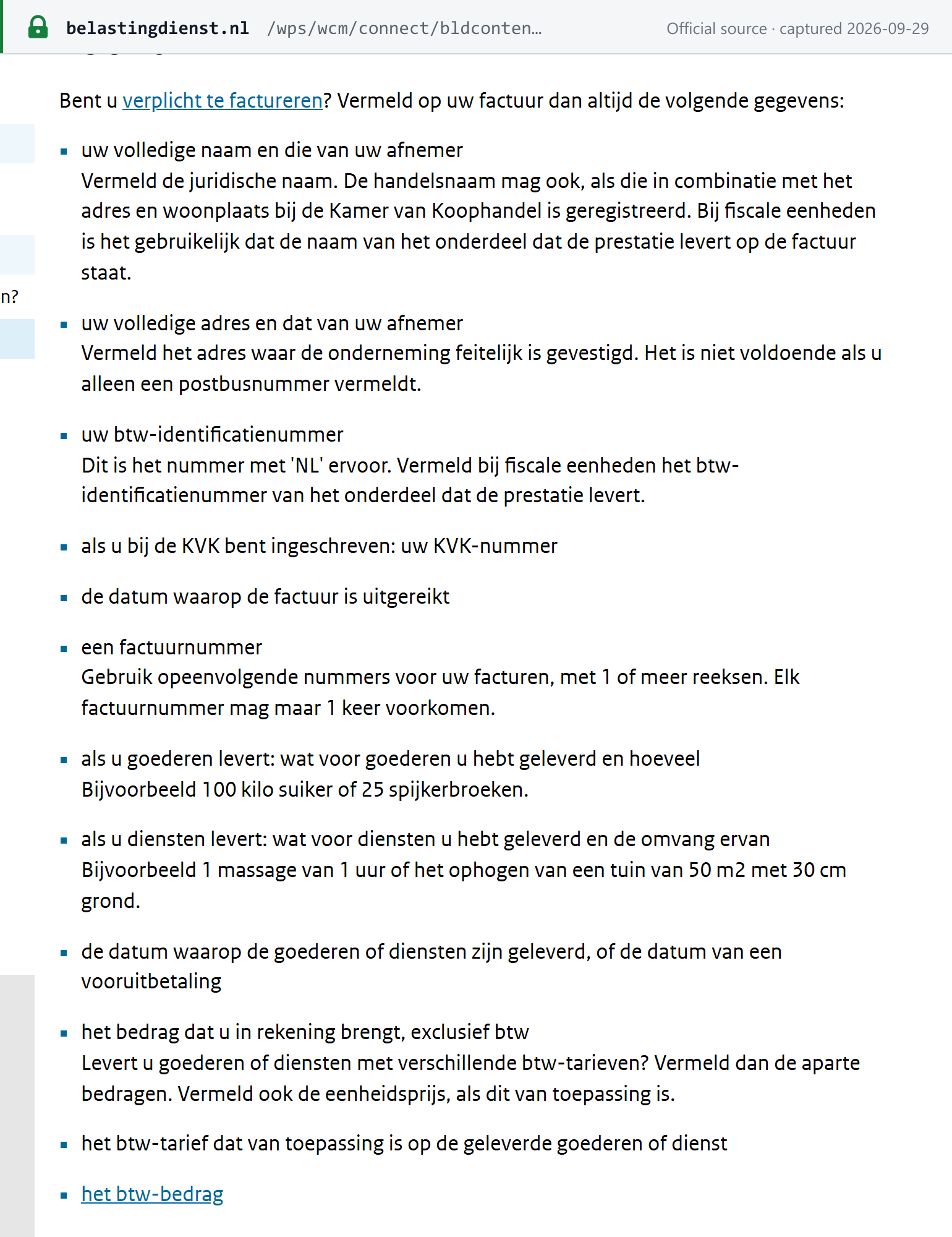
Wet OB art. 35a(1): "Op de factuur zijn de volgende vermeldingen verplicht" (the following particulars are mandatory on the invoice): [1] [29]
| # | Required field | Legal cite |
|---|---|---|
| 1 | Date of issue | Art. 35a(1)(a) |
| 2 | Sequential number, in one or more series, uniquely identifying the invoice | Art. 35a(1)(b) |
| 3 | Supplier's VAT identification number (btw-id, NL…B..) | Art. 35a(1)(c) |
| 4 | Customer's VAT identification number, where the customer is liable for the VAT or receives an intra-Community supply | Art. 35a(1)(d) |
| 5 | Full name and full address of supplier and customer — the actual business address; a PO box alone is not enough | Art. 35a(1)(e) |
| 6 | Quantity and nature of goods, or extent and nature of services | Art. 35a(1)(f) |
| 7 | Date of supply or completion, or of the advance payment, where it differs from the issue date | Art. 35a(1)(g) |
| 8 | Taxable amount per rate or exemption, unit price excluding VAT, and any discounts not included in the unit price | Art. 35a(1)(h) |
| 9 | VAT rate applied | Art. 35a(1)(i) |
| 10 | VAT amount payable — in euros | Art. 35a(1)(j), 35a(4) |
| 11 | "factuur uitgereikt door afnemer", where the customer issues the invoice (self-billing) | Art. 35a(1)(k) |
| 12 | Reference to the exemption, or to the basis for the intra-EU 0% rate | Art. 35a(1)(l) |
| 13 | "btw verlegd", where the customer is liable for the VAT | Art. 35a(1)(m) |
| 14 | Details of a new means of transport supplied intra-EU | Art. 35a(1)(n) |
| 15 | "bijzondere regeling reisbureaus" (travel agents) or the margin-scheme wording | Art. 35a(1)(o)–(p) |
| 16 | Fiscal representative's VAT number, full name and address, where the representative pays the VAT | Art. 35a(1)(q) |
| 17 | KVK number, if the business is registered with the Chamber of Commerce | Belastingdienst invoice list (the duty sits in company-register law, not the Wet OB) |
Issuance deadline
"De factuur wordt uitgereikt uiterlijk op de vijftiende dag van de maand volgende op die waarin de goederenlevering of de dienst is verricht" — no later than the 15th day of the month after the month of supply (Wet OB art. 34g). An invoice for an advance payment is issued before the payment falls due. Issuing late does not delay the tax point: VAT becomes due when the invoice should have been issued (art. 13(1)(a)). A periodic invoice may cover several supplies within a period of no more than one calendar month (art. 35(1)). [1] [30]
Numbering and sequencing
"Gebruik opeenvolgende nummers voor uw facturen, met 1 of meer reeksen. Elk factuurnummer mag maar 1 keer voorkomen" — use sequential numbers in one or more series; each invoice number may occur only once (art. 35a(1)(b)). [29]
Credit and debit notes
"Ieder document of bericht dat wijzigingen aanbrengt in, en specifiek en ondubbelzinnig verwijst naar de oorspronkelijke factuur, geldt als factuur" — any document or message that amends the original invoice and refers to it specifically and unambiguously counts as an invoice (art. 34f), and it may take the simplified form, stating the changes made (art. 35a(2)(e)). [1]
Currency and language
- Currency. "Op een factuur kunnen bedragen in willekeurig welke munteenheid voorkomen, mits het te betalen … bedrag van de belasting is uitgedrukt in euro's" — amounts may be in any currency provided the VAT amount is in euros, converted under the Article 91 VAT Directive mechanism (art. 35a(4)). [1]
- FX rule. "To enable conversion there are 2 kinds of rates to choose from: The latest listed selling rate at the time when VAT is payable. The exchange rate, at the time when VAT is payable, which is the latest made available by the European Central Bank." [32]
- Language. No language is prescribed; the inspector may demand a Dutch translation where needed for control (art. 35a(5)). [1]
Document types
| Document | When it is used | Cite |
|---|---|---|
| Full invoice | Default for supplies to businesses and legal entities | Art. 35a(1) |
| Simplified invoice | Invoice amount up to EUR 100 — the Belastingdienst reads this as "inclusief btw" (including VAT); documents amending an earlier invoice; businesses in the KOR. Not allowed for intra-EU supplies of goods, EU distance sales outside OSS, or supplies where a non-established supplier's customer pays the VAT | Art. 34d(1) |
| Amending document (credit / debit note) | Changes to an issued invoice, with a specific reference to it | Art. 34f |
| Receipt to a consumer | Outside the invoice rules — there is no B2C invoicing duty | Art. 34c |
A simplified invoice shows at least the issue date, the supplier's identity, the nature of the goods or services, and the VAT amount or the data needed to compute it (art. 35a(2)). "U factureert voor een bedrag tot maximaal € 100, inclusief btw (vereenvoudigde factuur)." [1] [31]
Self-billing
Permitted where both parties have agreed in advance and each invoice goes through an acceptance procedure by the supplier (Wet OB art. 35(2)); the invoice states "factuur uitgereikt door afnemer" (art. 35a(1)(k)). [1]
Retention and audit trail
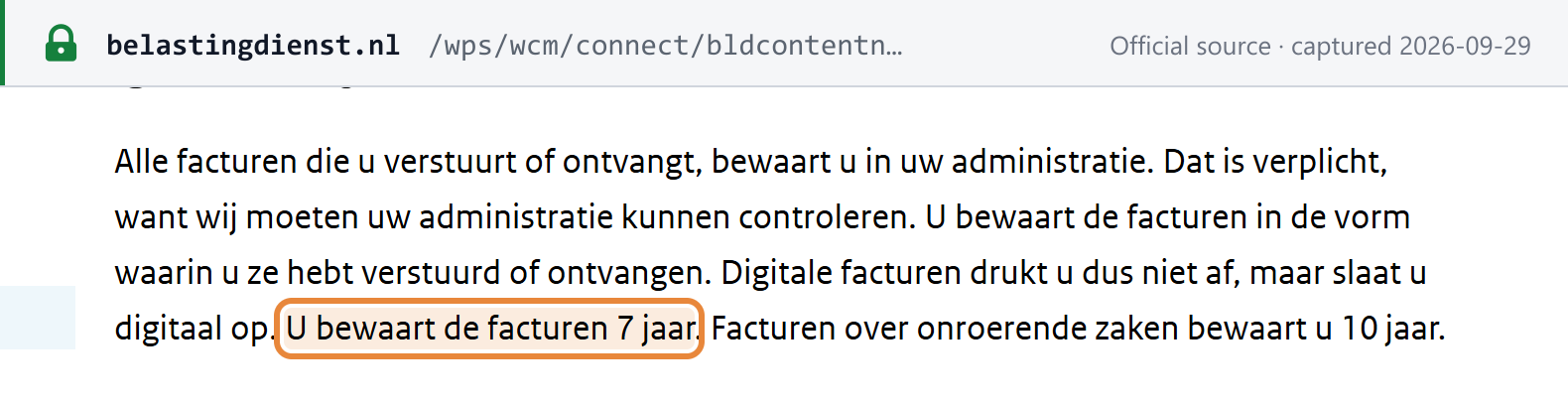
- Retention. "U bewaart de facturen 7 jaar. Facturen over onroerende zaken bewaart u 10 jaar" — 7 years (AWR art. 52(4)), and 10 years for invoices on immovable property (the statute, Wet OB art. 34a, says nine years following the year the property was first used). Supplies under the OSS Union scheme or the Import scheme carry a 10-year retention duty. [33] [2] [1]
- Form and electronic archiving. Invoices are kept in the form in which they were sent or received: "Digitale facturen drukt u dus niet af, maar slaat u digitaal op." Paper invoices and receipts may be scanned and kept digitally. Records may be moved to another medium if they stay complete, available and readable within a reasonable time (AWR art. 52(5)). [33] [2]
- Audit trail. Authenticity of origin, integrity of content and legibility must be guaranteed from issue to the end of retention; the business chooses how, including "elke bedrijfscontrole die een betrouwbaar controlespoor tussen een factuur en een verrichte prestatie oplevert" — any business control that creates a reliable audit trail between an invoice and a supply (art. 35b(2)). Where invoices are stored electronically with online access, the inspector may view, download and use them, and the data guaranteeing authenticity and integrity must be stored too (art. 35c(2)–(3)). [1]
A specimen of a compliant invoice
The Belastingdienst publishes the list of particulars but no annotated specimen invoice. The layout below is Lookuptax's own illustration of the Wet OB art. 35a(1) particulars for a domestic B2B supply with a 21% line and a 9% line. Every name, number and amount in it is fictional:
Factuur — Invoice
| DescriptionArt. 35a(1)(f) | QuantityArt. 35a(1)(f) | Unit price (excl. VAT)Art. 35a(1)(h) | VAT rateArt. 35a(1)(i) | Value (excl. VAT) |
|---|---|---|---|---|
| IT consulting (hours) | 10 | EUR 100.00 | 21% | EUR 1,000.00 |
| Printed reference books | 4 | EUR 50.00 | 9% | EUR 200.00 |
- Taxable amount at 21%Art. 35a(1)(h)
- EUR 1,000.00
- VAT at 21%Art. 35a(1)(j)
- EUR 210.00
- Taxable amount at 9%Art. 35a(1)(h)
- EUR 200.00
- VAT at 9%Art. 35a(1)(j)
- EUR 18.00
- Total including VAT
- EUR 1,428.00
- The VAT amounts must be stated in euros, even if the rest of the invoice is in another currency — art. 35a(4).
- If the supplier were not established in the Netherlands, it would charge no VAT: the invoice would carry "btw verlegd" and the customer's VAT ID, and the customer would account for the VAT — art. 12(3) and art. 35a(1)(d), (m).
- Where the customer issues the invoice under a self-billing agreement, it carries "factuur uitgereikt door afnemer" — art. 35a(1)(k).
- Issue by the 15th day of the month after the supply — art. 34g.
E-invoicing status
Status (as of 2026-09-29): B2G mandatory for suppliers to central government; B2B voluntary, with a mandate announced for 1 July 2030 but not yet law; B2C voluntary. For the Netherlands alongside other mandates, see Lookuptax's e-invoicing status and networks table and the dedicated Netherlands e-invoicing guide.
B2B — voluntary today
Electronic invoicing is permitted subject to the customer's acceptance: "Elektronische facturering wordt toegepast behoudens aanvaarding door de afnemer" (Wet OB art. 35b(1)). The Belastingdienst: "U bepaalt zelf of u uw facturen op papier of digitaal verstuurt. Een digitale factuur moet voldoen aan een extra voorwaarde: uw afnemer moet ermee akkoord gaan dat u digitaal factureert." No clearance or real-time invoice-reporting system exists. [1] [30]
B2B — announced: mandatory from 1 July 2030
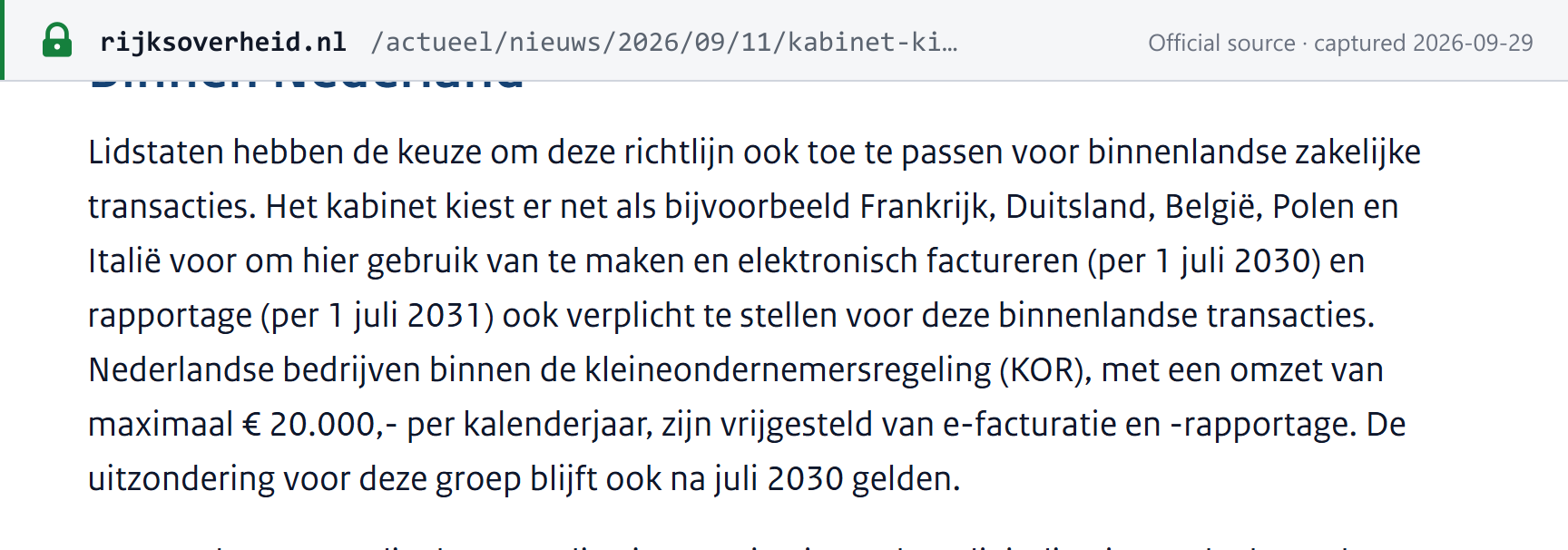
On 11 September 2026 the cabinet decided to introduce e-invoicing and reporting for transactions between businesses, both cross-border and domestic. It will use the ViDA option to extend the rules to domestic transactions: "elektronisch factureren (per 1 juli 2030) en rapportage (per 1 juli 2031) ook verplicht te stellen voor deze binnenlandse transacties." Businesses in the KOR (turnover of at most EUR 20,000 a calendar year) will be exempt, also after July 2030. "Het conceptwetsvoorstel wordt dit najaar in internetconsultatie gebracht. Het kabinet wil het wetsvoorstel vervolgens voor de zomer van 2027 aanbieden aan de Tweede Kamer." [37]
| Date | What happens | Status |
|---|---|---|
| Autumn 2026 | Draft bill in public internet consultation | Announced |
| Before summer 2027 | Bill sent to the Tweede Kamer | Announced |
| 1 July 2030 | Mandatory B2B e-invoicing, domestic and cross-border; cross-border digital reporting under ViDA | Announced (domestic); EU law (cross-border reporting) |
| 1 July 2031 | Domestic e-reporting | Announced |
Status: policy decision, not law. The format, network and reporting platform have not been announced (as of 2026-09-29). [37]
EU baseline and the Dutch ViDA bills. The EU's VAT in the Digital Age package was adopted on 11 March 2025 as Directive (EU) 2025/516 and published in the Official Journal on 25 March 2025; its digital reporting requirements apply to cross-border B2B transactions from 1 July 2030. [38] The Netherlands implements it in separate bills. The first, bill 36 920 on the single VAT registration, passed the Tweede Kamer as a formality (hamerstuk) on 17 September 2026; the Eerste Kamer finance committee issued a blank report on 29 September 2026 and the Senate is scheduled to dispose of it as a hamerstuk on 6 October 2026. It provides for entry into force on 1 January 2027 (or retroactively to that date if published later). Status (as of 2026-10-05): pending in the Eerste Kamer. E-invoicing, digital reporting and the platform fiction follow in later bills. [39] See Lookuptax's ViDA guide.

B2G — mandatory for suppliers to central government
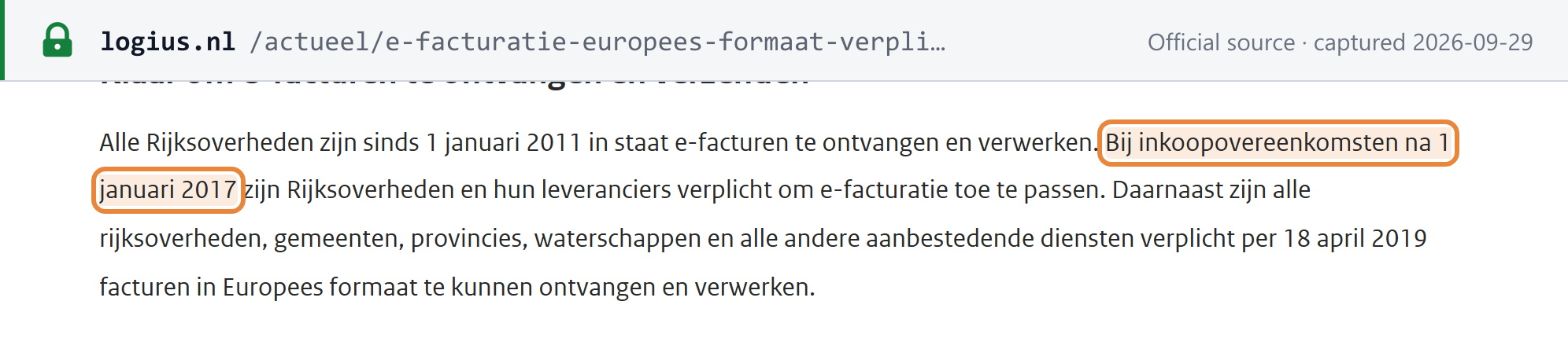
Logius, the government's digital-infrastructure agency: "Alle Rijksoverheden zijn sinds 1 januari 2011 in staat e-facturen te ontvangen en verwerken. Bij inkoopovereenkomsten na 1 januari 2017 zijn Rijksoverheden en hun leveranciers verplicht om e-facturatie toe te passen. Daarnaast zijn alle rijksoverheden, gemeenten, provincies, waterschappen en alle andere aanbestedende diensten verplicht per 18 april 2019 facturen in Europees formaat te kunnen ontvangen en verwerken." [34]
| Date | What happens |
|---|---|
| 1 January 2011 | Central government bodies able to receive and process e-invoices |
| 1 January 2017 | Suppliers under purchase agreements concluded from this date must invoice central government electronically |
| 18 April 2019 | All contracting authorities — central government, municipalities, provinces, water boards and others — must be able to receive and process invoices in the European standard EN 16931 |
- Channels to central government: the Peppol network through an access point, the government Leveranciersportaal (supplier portal), or a direct Digipoort connection for high volumes. Government bodies are addressed by their OIN, which can be looked up in the Peppol Directory. "Facturen die per e-mail worden gestuurd, bijvoorbeeld als pdf, zijn geen e-facturen." [35]
- Formats: Peppol BIS 3, NLCIUS (the Dutch core invoice usage specification) and UBL-OHNL; the Basisfactuur Rijk sets the minimum data and "is volledig compliant met de internationale factuurstandaarden NLCIUS en Peppol BIS". [36] See Lookuptax's Peppol guide.
B2C — voluntary
There is no duty to invoice consumers at all (see Invoice requirements), and no B2C e-invoicing mandate has been announced (as of 2026-09-29). [28]
Filing and payment
Filing frequency
- Quarterly is the default: "Btw-aangifte doet u meestal per kwartaal." [40]
- Monthly on written request, or imposed after late filing or payment: "Ontvangen wij uw btw-aangifte of betaling niet op tijd? Dan kunnen wij u verplichten om maandelijks btw-aangifte te doen." [40]
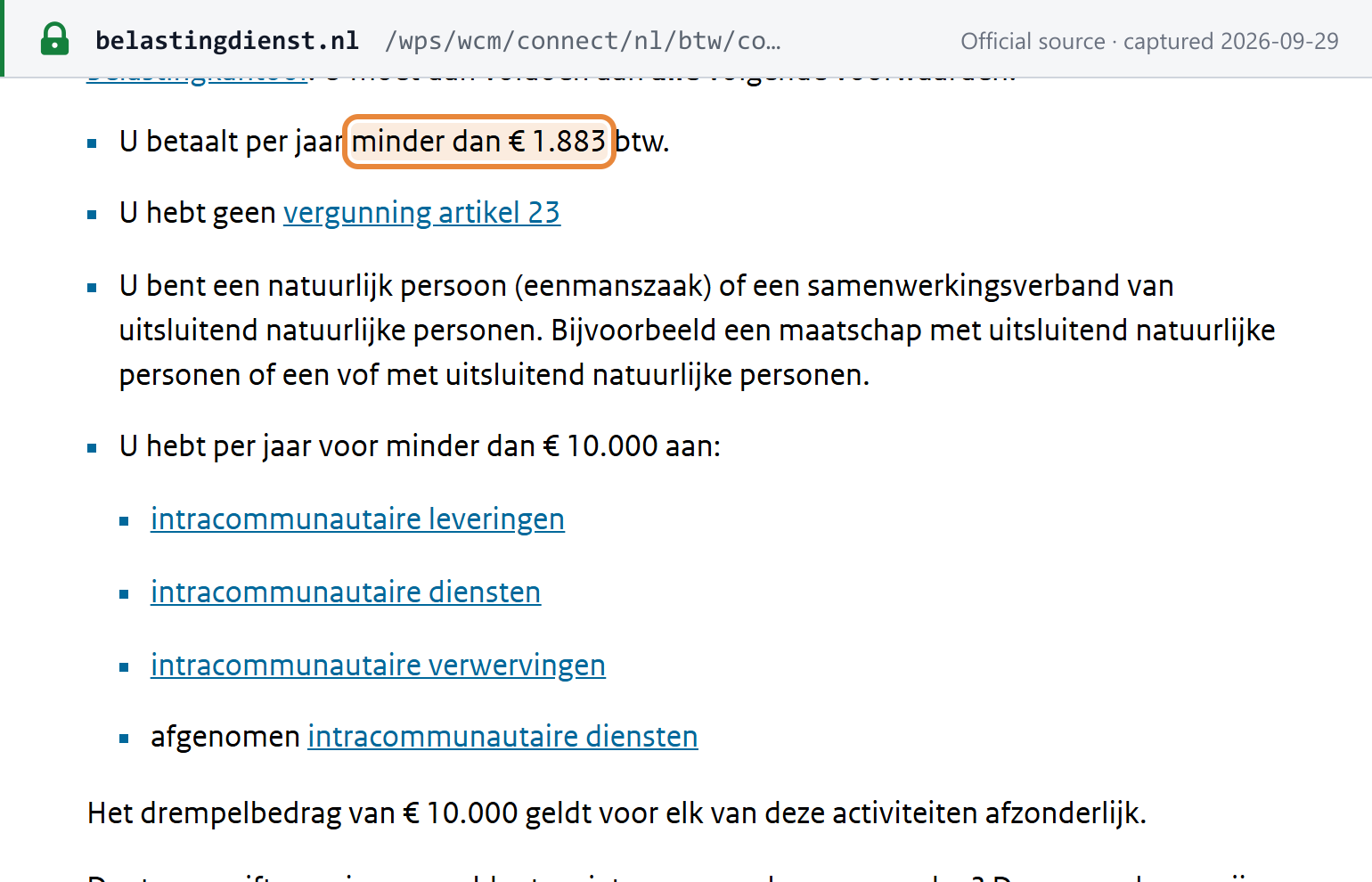
- Annual on request, only if all of these hold: VAT payable of less than EUR 1,883 a year; no article 23 licence; a sole trader or a partnership of natural persons only; and less than EUR 10,000 a year in each of intra-Community supplies, intra-Community services, intra-Community acquisitions and intra-Community services received. The Belastingdienst answers a request to change period within 6 weeks, effective from the start of a new period. [40]
- Nil returns are required: "als ondernemer voor de btw moet u altijd btw-aangifte doen, ook als u in de periode van de aangifte geen btw in rekening hebt gebracht" — a 0-aangifte or nihilaangifte. Businesses in the KOR file no returns. [41] [5]
Return due date
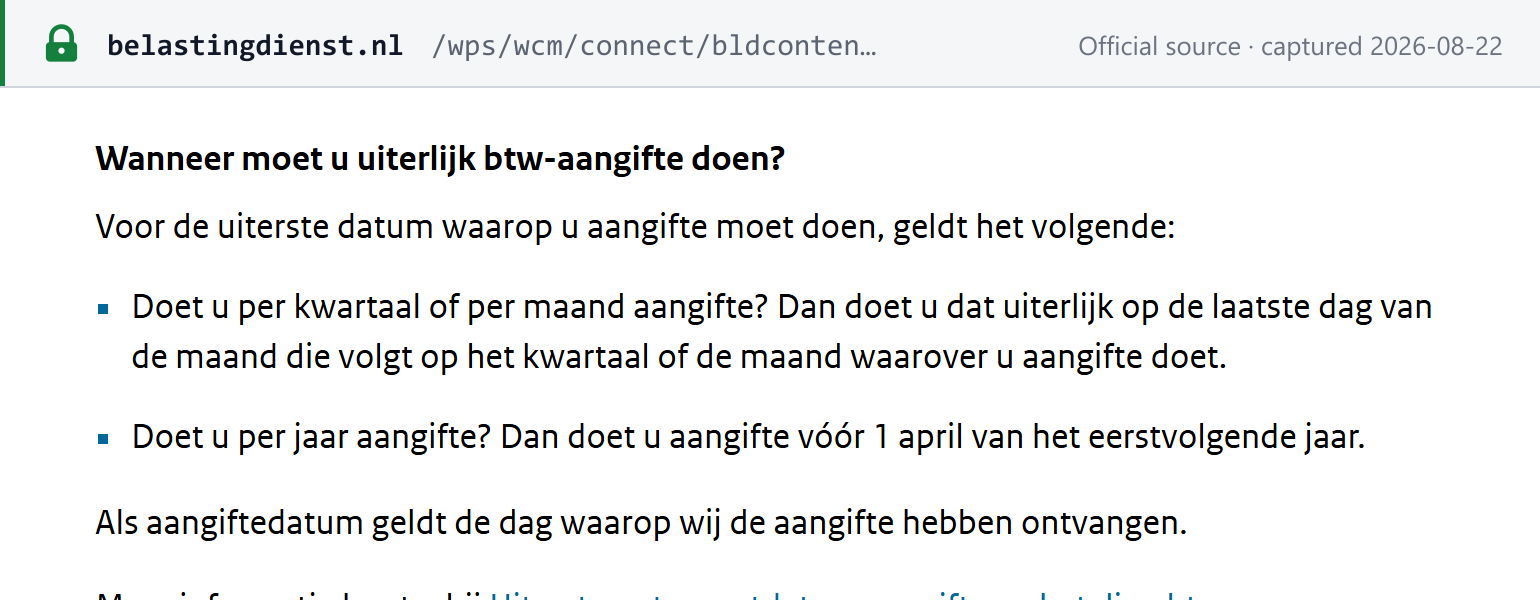
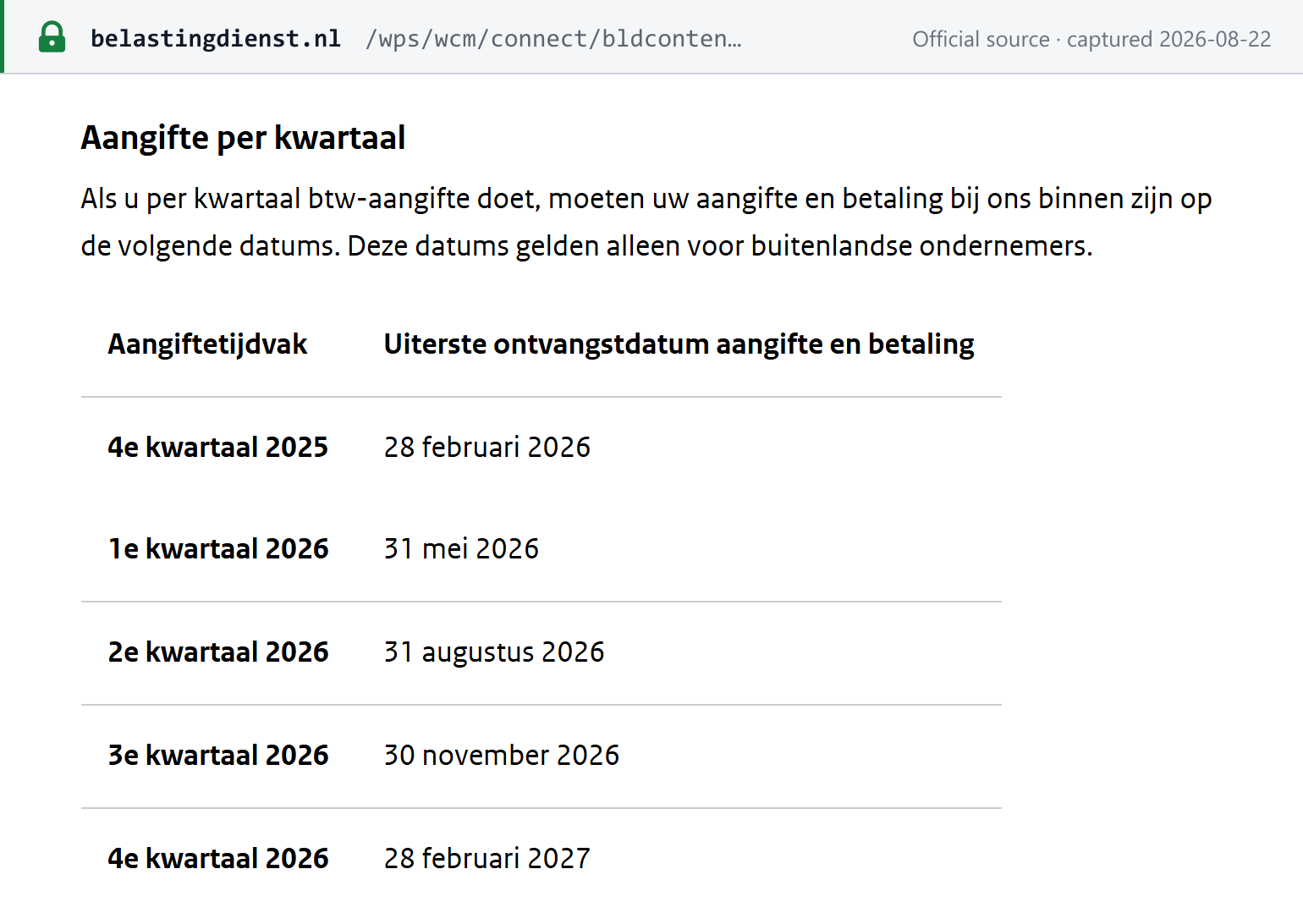
- Established in the Netherlands: "Doet u per kwartaal of per maand aangifte? Dan doet u dat uiterlijk op de laatste dag van de maand die volgt op het kwartaal of de maand waarover u aangifte doet. Doet u per jaar aangifte? Dan doet u aangifte vóór 1 april van het eerstvolgende jaar. Als aangiftedatum geldt de dag waarop wij de aangifte hebben ontvangen." — by the last day of the month after the period; annual returns before 1 April; the return counts as filed on the day it is received. [42]
- Not established in the Netherlands: "Return the digital tax return within 2 months after the end of the period. … The 2 months period only applies to foreign companies." [43]
- No weekend shift. AWR art. 19(5): "De Algemene termijnenwet is niet van toepassing op de in het eerste en in het derde lid gestelde termijn van één maand" — the General Time Limits Act, which would move a deadline falling on a weekend or holiday, does not apply; the Belastingdienst's deadline tables list Saturday and Sunday dates unshifted. [2]
- No extension of the filing deadline except in a serious calamity: "Wij geven alleen in uitzonderlijke situaties uitstel … Er moet dan sprake zijn van een ernstige calamiteit." [44]
- Returns are filed online through Mijn Belastingdienst Zakelijk.
Payment due date and method
Payment is due on the same date as the return — within one month after the end of the period (AWR art. 19(1)), or two months for businesses not established in the Netherlands — to the Belastingdienst's account, quoting the betalingskenmerk (payment reference). A payment counts on the day it is credited: "Als betaaldatum geldt de datum waarop uw betaling is bijgeschreven op onze rekening", so a transfer started on the last day can be late. [2] [55]
Additional listings
| Filing | Content | Due |
|---|---|---|
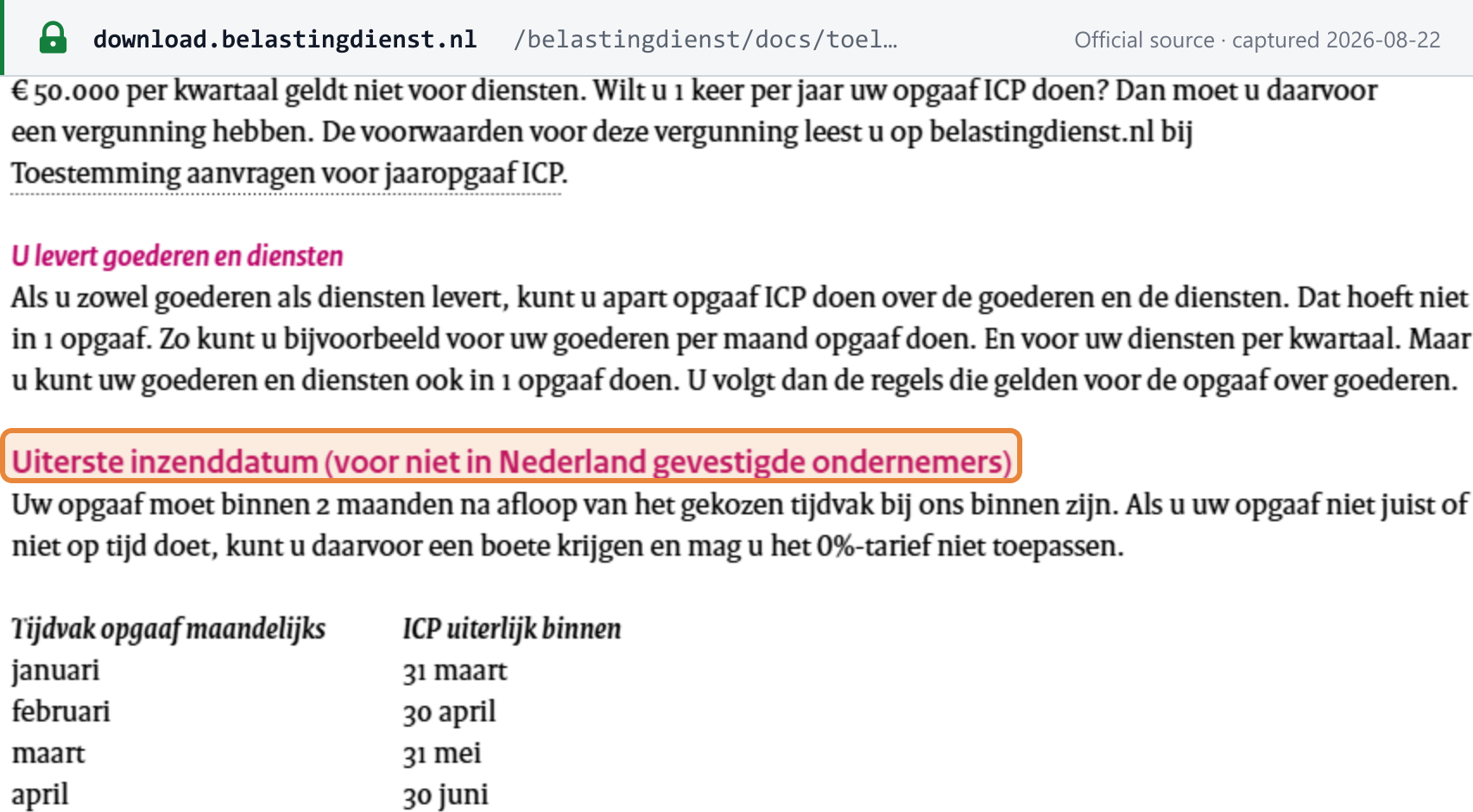
| Opgaaf ICP (EC sales list) | Intra-Community supplies of goods, intra-EU B2B general-rule services, triangulation, call-off stock (Wet OB art. 37a) | Last day of the month after each month; quarterly for goods if they did not exceed EUR 50,000 in the quarter or any of the four preceding quarters, and for services regardless of amount. Two months for non-established businesses |
| OSS Union / non-Union return | B2C distance sales and services in other EU states | Quarterly, by the last day of the month after the quarter; nil returns required |
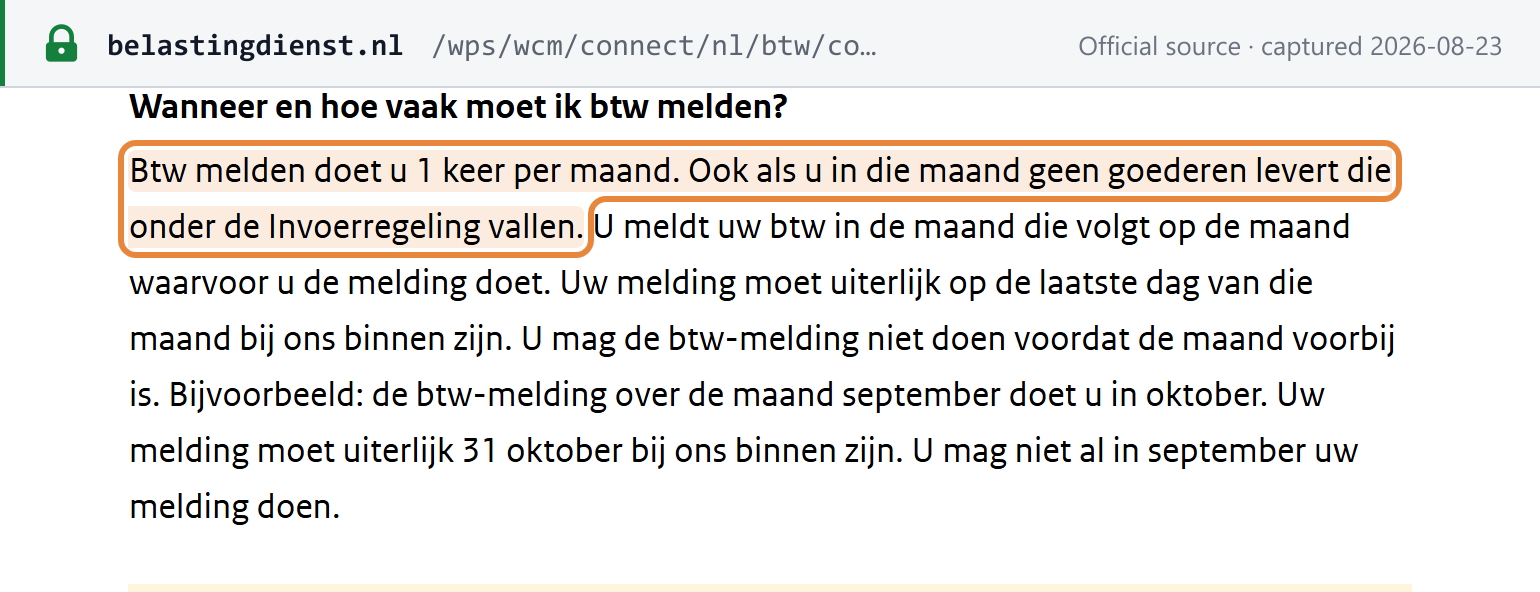
| IOSS return | Imported consignments up to EUR 150 | Monthly, by the last day of the month after the month |
| Annual reconciliation return | None as a separate form — but four year-end corrections go into the last return of the year: private use of business goods and services, private use of a company car, the pro-rata recalculation for mixed businesses, and the BUA correction | Last return of the year |
| Correction (suppletie) | Errors in past returns | Within 8 weeks of discovering the error (since 1 January 2025), and before the inspector knows of it (Uitvoeringsbesluit OB 1968 art. 15(2)) |
[1] [57] [59] [56] [58] See Lookuptax's VAT listings explainer.
Input-tax recovery and blocked items
Input VAT charged on "een op de voorgeschreven wijze opgemaakte factuur" (a correctly drawn-up invoice), plus import VAT, reverse-charged VAT and VAT on intra-EU acquisitions, is deductible to the extent the goods and services are used for taxed supplies (Wet OB art. 15). [1]
- Exempt and non-taxable activity: "de btw over de kosten voor vrijgestelde en/of niet-belaste goederen en diensten is niet aftrekbaar"; mixed businesses deduct pro rata. [46]
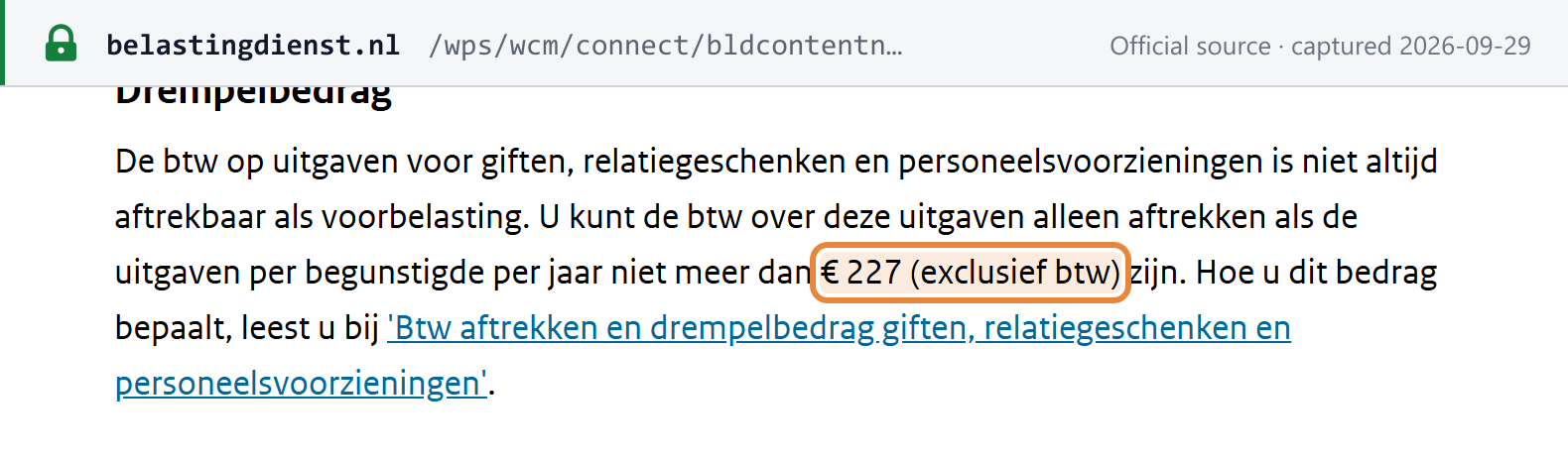
- Gifts, business gifts and staff provisions (BUA — Besluit uitsluiting aftrek omzetbelasting 1968): deductible only if spending stays within EUR 227 excluding VAT per recipient per year, where the recipients could themselves deduct less than 30%. [45]
- Carousel fraud: "als u wist of had moeten weten dat u betrokken was bij btw-carrouselfraude, dan kunnen wij deze btw-aftrek weigeren." [46]
- Private use of business goods and services, including a company car, is corrected in the last return of the year. [56]
Refunds
- Excess credit is refunded on request through the return (Wet OB art. 17). If the refund decision is not issued within 8 weeks of the request, tax interest (belastingrente) is paid — but only from 3 months after the end of the calendar year the refund relates to (AWR art. 30ha). The rate is 5% from 1 January 2026. [1] [2] [47]
- EU businesses reclaim Dutch VAT through their home-state portal by 30 September of the following year (Wet OB art. 32l). [1]
- Non-EU businesses register first and file before 1 July of the year following the year the VAT relates to. [60]
- Bad debts. The supplier may reclaim the VAT on an unpaid invoice; the right is deemed to arise at the latest one year after the consideration fell due. The customer must repay deducted VAT when it is clear it will not pay, and in any case one year after the due date (Wet OB art. 29(2), (7)). [1]
Exemptions
Exempt supplies
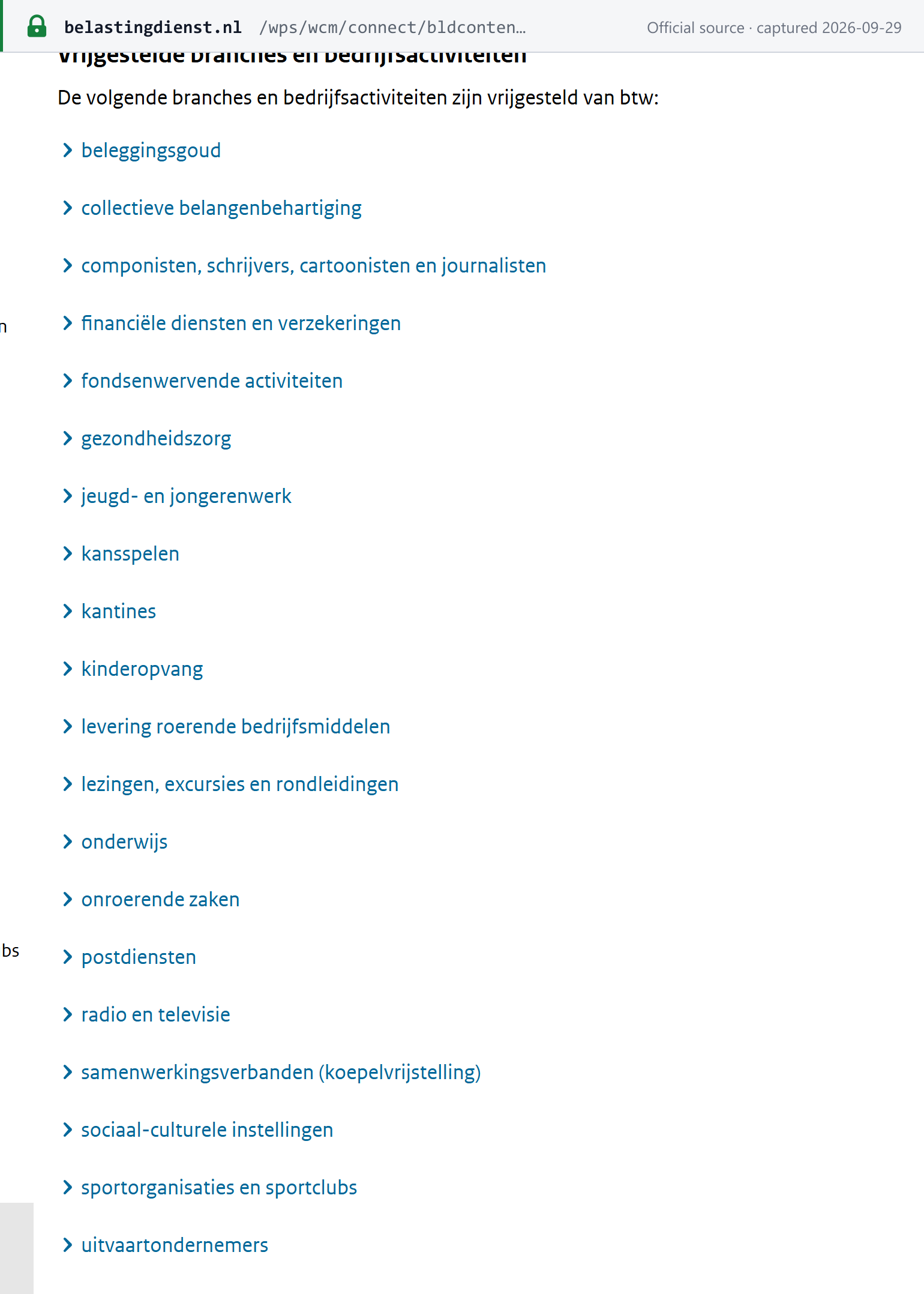
The Belastingdienst lists these exempt sectors and activities: investment gold; collective interest representation; composers, writers, cartoonists and journalists; financial services and insurance; fundraising; healthcare; youth work; gambling; canteens; childcare; supply of movable business assets used for exempt activity; lectures, excursions and guided tours; education; immovable property; postal services; public radio and television; cost-sharing groups (koepelvrijstelling); socio-cultural institutions; sports organisations and clubs; and funeral services. The exemptions also apply to imports and intra-EU acquisitions. [48]
Immovable property. The supply of a building is exempt except before, on or up to two years after first occupation and the supply of building land (Wet OB art. 11(1)(a)(1°)), with an option to tax where the buyer has a full or near-full deduction right. Letting is exempt, except for short-stay accommodation, parking and safes, with an option to tax for business tenants. [1]
Exempt is not zero-rated. An exempt supplier charges no VAT and cannot deduct the VAT on its related costs — "de btw over de kosten voor vrijgestelde … goederen en diensten is niet aftrekbaar". A supplier making 0% supplies, such as exports and intra-EU supplies, also charges no VAT but "still retain[s] the right to deduct VAT". [46] [12]
Special regimes
- Small-business scheme (KOR / EU-KOR): EUR 20,000 for Dutch businesses; EU-KOR, with EUR 100,000 EU-wide turnover, available since 1 January 2025 — see Registration. [5]
- Cash accounting (kasstelsel) — VAT on receipts rather than invoices. It is the default for retailers (including webshops), market traders, hairdressers, hospitality businesses, driving schools, lawyers in sole practice and others supplying mainly to consumers, who may opt out; others may apply if at least 80% of their supplies go to consumers for more than a calendar year. The Belastingdienst's page sets no turnover ceiling. [49]
- Margin scheme for second-hand goods, works of art, collectors' items and antiques (Wet OB arts. 28b–28i); travel agents' scheme (28z–28zg); investment gold exemption with an option to tax (28j–28n); vouchers (28zh–28zj). [1]
- Group registration (fiscale eenheid) — see Registration.
- Free zones. The Wet OB contains no free-zone VAT regime; the relevant tools are customs and VAT warehouses, whose supplies are at 0% (Tabel II). [1]
Offences and penalties
Offences
Criminal offences sit in the General Tax Act (AWR) arts. 68–69a and Wet OB arts. 38 and 42. Fine categories are set by the Criminal Code (Sr art. 23): 3rd category EUR 11,000, 4th category EUR 27,500, 5th category EUR 110,000, amounts from 1 January 2026. [2] [54] [1]
| Conduct | Maximum sanction | Cite |
|---|---|---|
| Failing to provide information, keep, retain or produce records, or cooperate; issuing an incorrect or incomplete invoice ("een onjuiste of onvolledige factuur of nota verstrekt") | 6 months' detention or a 3rd-category fine | AWR art. 68(1) |
| Intentionally not filing, or filing late, where this leads to too little tax, or the art. 68 acts done intentionally | 4 years' imprisonment or a 4th-category fine, or up to once the evaded tax if higher | AWR art. 69(1) |
| Intentionally filing an incorrect or incomplete return, or producing false or falsified records | 6 years' imprisonment or a 5th-category fine, or up to once the evaded tax if higher | AWR art. 69(2) |
| Intentionally not paying tax due on a return | 6 years' imprisonment or a 5th-category fine, or up to once the unpaid tax — not punishable if deferral was requested in time or inability to pay was notified promptly | AWR art. 69a |
| Quoting VAT-exclusive prices to consumers | 3rd-category fine | Wet OB arts. 38, 42 |
Voluntary disclosure before the authorities know of an incorrect return removes prosecution under art. 69(2) (art. 69(3)). Showing VAT on an invoice when it is not due is not itself an offence, but makes that VAT payable (Wet OB art. 37). Failure to register is not a separate offence in these provisions; it surfaces as late filing and payment. [2] [1]
Penalties
| Default | Standard | Maximum | Basis |
|---|---|---|---|
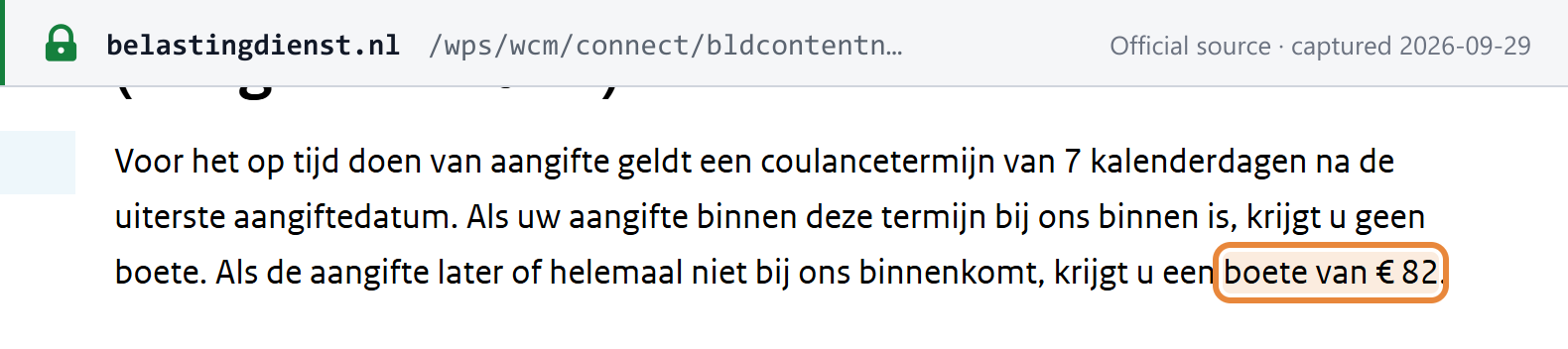
| Late or missing return (aangifteverzuim) — 7-day grace period | EUR 82 | EUR 165 in repeat cases | AWR art. 67b(1) |
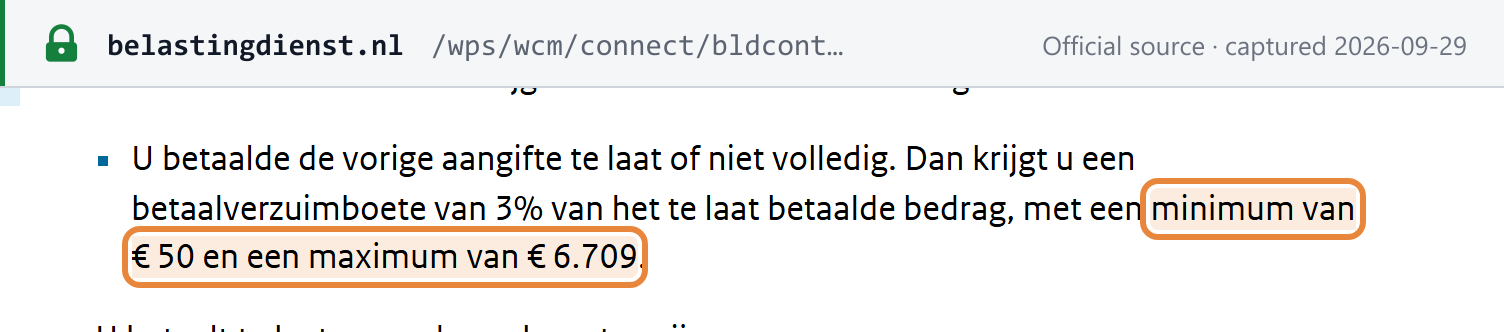
| Late, missing or short payment (betaalverzuim) — 7-day grace if the previous return was paid on time | 3% of the late amount, minimum EUR 50 | EUR 6,709; up to 10% for frequent late payers, never above EUR 6,709 a year | AWR art. 67c(1) |
| Late filing and late payment together | Two separate fines | — | Belastingdienst |
| Gross negligence or intent (vergrijpboete) | — | Up to 100% of the tax not (timely) paid or over-refunded; criminal prosecution in extreme cases | AWR art. 67f |
| Late or incorrect Opgaaf ICP or OSS return | — | Up to a 3rd-category fine (EUR 11,000) | Wet OB art. 40(1) |
| Tax interest (belastingrente) on late assessments | 5% from 1 January 2026 (6.5% in 2025) | — | AWR art. 30h |
| Collection interest (invorderingsrente) | 4.3% from 1 January 2026, from the day after the payment deadline; not charged if EUR 49 or less | — | Belastingdienst |
[50] [51] [52] [2] [47] [53] (Checked 2026-09-29.)
Failure to issue a compliant invoice carries no fixed administrative fine in the Belastingdienst's penalty pages; the exposures are the criminal provision AWR art. 68(1)(g) and, for the customer, loss of input-tax deduction, since art. 15 requires a correctly drawn-up invoice. Late registration has no specific fine either; it surfaces as late filing and payment, with an assessment (naheffingsaanslag) and the fines above. [2] [1]
Frequently asked questions
Our Dutch turnover passed EUR 20,000 — do we now have to register for VAT?
There is no turnover threshold for VAT registration in the Netherlands. Anyone who independently carries on a business is an entrepreneur (ondernemer) for VAT under article 7 of the Wet op de omzetbelasting 1968, and a Dutch business is normally registered automatically after enrolling with the KVK. The EUR 20,000 figure is the small-business scheme (KOR): an optional exemption that a business established in the Netherlands can choose while its Dutch turnover stays within EUR 20,000 a calendar year. Once turnover passes EUR 20,000 the exemption stops applying from the supply that crosses the limit, which is itself taxable, and the business charges VAT and files returns from then on; it cannot use the KOR again for the rest of that calendar year and the following year (article 25a(9)). [1] [4]
We are a non-EU company selling goods and services to Dutch businesses — do we need a Dutch VAT number?
Usually not. Where a supplier not established in the Netherlands supplies goods or services taxable there to a business or legal entity established in the Netherlands, the customer pays the Dutch VAT under the reverse charge in article 12(3) of the Wet op de omzetbelasting 1968. The supplier invoices without VAT and marks the invoice btw verlegd (VAT reverse-charged). The rule also covers goods already in the Netherlands, for example stock in a Dutch warehouse sold to a Dutch business. A Dutch registration is needed when the business has a Dutch VAT return to file, for example for intra-EU movements of goods or for sales to consumers that are not declared through an OSS or IOSS scheme. [1] [19] [3]
Can a foreign business defer import VAT with an article 23 licence?
Not in its own name. An article 23 licence lets an importer declare import VAT in its periodic VAT return and deduct it in the same return instead of paying it to customs at the border. The Belastingdienst grants it to entrepreneurs who live or are established in the Netherlands, import regularly from outside the EU and keep separate records of import VAT, and decides within 8 weeks. A foreign business cannot apply itself but can use a fiscal representative: a general fiscal representative can apply for the licence on its behalf, and a business using a limited fiscal representative, which uses its own licence, does not need to register for Dutch VAT at all. Licence holders cannot file annual returns, and businesses in the KOR cannot get a licence. [24] [9]
When is a Dutch VAT return due for a business not established in the Netherlands, and does a weekend deadline move?
Businesses established in the Netherlands file and pay by the last day of the month after the quarter or month. Foreign businesses have two months after the end of the period, for both the return and the payment. Deadlines do not move when they fall on a weekend or public holiday: article 19(5) of the General Tax Act (AWR) disapplies the General Time Limits Act for the payment term, and the Belastingdienst's deadline tables list weekend dates unshifted. The return counts as filed on the day the Belastingdienst receives it, and a payment counts on the day it is credited to the Belastingdienst's account, so a transfer started on the last day can be late. A return is required even for a period with no transactions. [42] [43] [2] [55] [41]
Will B2B e-invoicing become mandatory in the Netherlands?
It has been announced but is not yet law. On 11 September 2026 the Dutch cabinet decided to make e-invoicing mandatory for transactions between businesses, both domestic and cross-border, from 1 July 2030, with domestic reporting to follow from 1 July 2031. Businesses in the KOR, with turnover of at most EUR 20,000 a calendar year, will be exempt. The draft bill is due for public internet consultation in autumn 2026, and the cabinet aims to send it to the Tweede Kamer before summer 2027. Until then, electronic invoices between businesses are voluntary and need the customer's acceptance. Suppliers to central government have had to invoice electronically under purchase agreements concluded since 1 January 2017. [37] [30] [34]
Hotel stays moved from 9% to 21% VAT — what happens to breakfast?
Short-stay accommodation in hotels, pensions, holiday parks and similar businesses has been taxed at 21% since 1 January 2026, including payments made in 2025 for stays in 2026 or later. Facilities offered separately, such as breakfast or access to a swimming pool or amusement park, stay at the reduced 9% rate. Where one all-in price covers both, it is split according to the market value of each part. [15] [61]
Important websites
| Site | Purpose |
|---|---|
| Mijn Belastingdienst Zakelijk | File and pay VAT returns, OSS registration and returns, look up your btw-id and ob-nummer |
| KVK | Register a business in the Netherlands (triggers VAT registration); search the business register |
| Registration form Foreign companies | VAT and OSS registration for businesses not established in the Netherlands (paper form, by post) |
| Belastingdienst — VAT for foreign businesses (English) | Rules for non-resident businesses |
| Belastingdienst — 9% goods and 0% goods | Rate lookup |
| Aanvraag vergunning artikel 23 | Apply for the article 23 import-VAT licence |
| Douane | Import VAT and customs |
| VIES | Check an EU VAT number |
| Logius — e-invoicing to government | Peppol, supplier portal and Digipoort for B2G invoices |
| Peppol Directory | Look up a government body's OIN or a company's Peppol ID |
| Non-resident tax line | +31 55 538 53 85 (Tax Information Line for Non-resident Tax Issues, from the foreign-company registration form) |
Also see Lookuptax's own Netherlands btw-nummer validator.
Recent changes
- 2026-09-17 — The ViDA single-VAT-registration bill 36 920 passed the Tweede Kamer as a hamerstuk; the Eerste Kamer finance committee issued a blank report on 29 September 2026 and the Senate is scheduled to dispose of it as a hamerstuk on 6 October 2026, for entry into force on 1 January 2027 (or retroactively to that date if published later). (Eerste Kamer) — see event
- 2026-09-15 — Belastingplan 2027 proposes moving ornamental horticulture and hot-air balloon flights from 9% to 21% from 1 January 2028 (proposed). (Rijksoverheid) — see event
- 2026-09-11 — The cabinet decided on mandatory B2B e-invoicing from 1 July 2030 and domestic reporting from 1 July 2031, with KOR businesses exempt (announced, not yet law). (Rijksoverheid) — see event
- 2026-01-01 — Short-stay accommodation moved from 9% to 21%. (Belastingdienst)
- 2025-01-01 — The KOR was rewritten: EUR 20,000 kept, the EU-KOR (EUR 100,000 EU-wide turnover) introduced; the deadline for correcting past returns became 8 weeks. (Belastingdienst; Uitvoeringsbesluit OB 1968)
For the full chronology, see Netherlands tax changes on Lookuptax.
Reference links
- Wet op de omzetbelasting 1968 (BWBR0002629), consolidated 1 January 2026
- Algemene wet inzake rijksbelastingen (BWBR0002320), consolidated 11 April 2026
- Belastingdienst — Your tax office and registration (English)
- Belastingdienst — Btw-identificatienummer en omzetbelastingnummer
- Belastingdienst — Kleineondernemersregeling (KOR)
- Belastingdienst — Registratiedrempel voor kleine ondernemers
- Belastingdienst — Registration form Foreign companies
- Belastingdienst — Tax representative (English)
- Belastingdienst — Verleggingsregeling bij import uit niet-EU-landen (foreign businesses)
- Belastingdienst — Btw bij wijzigen of beëindigen van uw onderneming
- Belastingdienst — Voorwaarden fiscale eenheid
- Belastingdienst — VAT tariffs (English)
- Belastingdienst — Goederen met 9% btw
- Belastingdienst — Diensten met 9% btw
- Belastingdienst — Btw op logies
- Belastingdienst — Goederen met 0% btw
- Rijksoverheid — Plannen kabinet voor hogere btw op sierteelt en ballonvaart
- Rijksoverheid — Wetsvoorstel Belastingplan 2027 (PDF, 15 September 2026)
- Belastingdienst — Verlegging bij zakendoen met het buitenland
- Belastingdienst — VAT relating to services (English)
- Belastingdienst — Btw bij goederen aan particulieren in de EU
- Belastingdienst — Distance sales (English)
- Belastingdienst — Afstandsverkopen en diensten voor particulieren in andere EU-landen
- Belastingdienst — Vergunning artikel 23 aanvragen
- Belastingdienst — Btw berekenen als u zakendoet buiten de EU
- Belastingdienst — Btw berekenen bij export van goederen naar EU-landen
- Belastingdienst — Wanneer btw verleggen
- Belastingdienst — Wie zijn verplicht te factureren
- Belastingdienst — Factuureisen
- Belastingdienst — Facturen maken
- Belastingdienst — Aangepaste regels voor facturen
- Belastingdienst — Calculating VAT (English)
- Belastingdienst — Uw facturen bewaren
- Logius — E-facturatie in Europees formaat verplicht vanaf 18 april (2019)
- Logius — E-factureren: hoe werkt het
- Logius — Handreiking Basisfactuur Rijk
- Rijksoverheid — Kabinet kiest voor invoering e-facturatie en rapportage voor bedrijven (11 September 2026)
- European Commission — VAT in the Digital Age (ViDA)
- Eerste Kamer — Wetsvoorstel 36 920, implementation of Directive (EU) 2025/516 (single VAT registration)
- Belastingdienst — Wijziging aangiftetijdvak btw
- Belastingdienst — Moet ik altijd btw-aangifte doen?
- Belastingdienst — Btw-aangifte: waar moet u aan denken
- Belastingdienst — Filing a VAT return (English)
- Belastingdienst — Uitstel aanvragen voor btw-aangifte
- Belastingdienst — Personeelsvoorzieningen en relatiegeschenken
- Belastingdienst — Btw aftrekken
- Belastingdienst — Overzicht percentages belastingrente
- Belastingdienst — Vrijstellingen
- Belastingdienst — Voor wie geldt het kasstelsel
- Belastingdienst — U doet geen of te laat aangifte
- Belastingdienst — U betaalt niet, te laat of te weinig
- Belastingdienst — Uitzonderlijke of bijzondere situaties (boetes)
- Belastingdienst — Invorderingsrente
- Wetboek van Strafrecht (BWBR0001854), consolidated 1 July 2026 — art. 23 fine categories
- Belastingdienst — Op tijd betalen
- Belastingdienst — Laatste btw-aangifte van het jaar
- Belastingdienst — Toelichting digitale Opgaaf intracommunautaire prestaties (PDF)
- Uitvoeringsbesluit omzetbelasting 1968 (BWBR0002633), consolidated 1 January 2026
- Belastingdienst — Btw melden via het eenloketsysteem
- Belastingdienst — Nederlandse btw terugvragen voor ondernemers uit niet-EU-landen
- Belastingdienst news — Btw op logies
- Belastingdienst — Btw berekenen bij invoer van goederen uit niet-EU-landen
Related Lookuptax pages:
- Netherlands tax ID guide — btw-id, ob-nummer, BSN and KVK number
- Netherlands e-invoicing guide — Peppol and B2G
- Netherlands btw-nummer validator
- How to verify an EU VAT number in VIES
- How to register for VAT, sales tax or GST
- EU VAT SME scheme
- Reverse charge explained
- VAT in the Digital Age (ViDA)
- Peppol e-invoicing guide
- E-invoicing status and networks worldwide
- VAT registration thresholds worldwide
- Worldwide tax rates