Nepal VAT guidelines
| FACTSHEET | |
|---|---|
| Country code | NP |
| Tax name | Value Added Tax (VAT) — मूल्य अभिवृद्धि कर |
| Tax Authority | Inland Revenue Department (आन्तरिक राजस्व विभाग) |
Overview
Nepal levies Value Added Tax — मूल्य अभिवृद्धि कर — under the Value Added Tax Act, 2052, published on 20 March 1996 (2052.12.07), together with the Value Added Tax Rules, 2053 made under section 41 of the Act. [1] [2]
VAT is administered by the Inland Revenue Department (आन्तरिक राजस्व विभाग) of the Ministry of Finance. VAT on electronic services supplied by non-residents is administered specifically by the Large Taxpayers Office (ठूला करदाता कार्यालय). [7]
Currency. All figures in this guide are in Nepalese Rupees (NPR).
Tax period basis — read this before any deadline below. Nepal runs on the Bikram Sambat (BS) calendar, not the Gregorian one. The tax period is one BS month (VAT Rules, r.26(1)), and the fiscal year runs from Shrawan 1 to the end of Asar. Fiscal year 2083/84 began on 17 July 2026 and runs to around 16 July 2027. Every statutory deadline in Nepali law is expressed in BS dates; the Gregorian equivalents in this guide are conversions, and where a date matters operationally you should work from the BS date your filing system shows you.
Layering. VAT is a single federal tax, levied under the VAT Act 2052 and collected by the IRD and the Department of Customs. There is no provincial or municipal VAT. One point of possible confusion: section 15(3) requires the Government of Nepal, provincial governments and local levels to collect VAT when they sell taxable goods or services — that makes sub-national bodies taxable persons under the federal Act, not separate VAT authorities. [1]
A word on sources. IRD publishes an English translation of the VAT Act, but it is current only to the Financial Act 2078 (2021) and contains none of the provisions this guide describes as new — so figures in it can be years out of date. Where this guide states a figure it is taken from the Nepali consolidation or the Finance Act 2083 gazette — for example the services and mixed-business threshold is तीस लाख (NPR 3,000,000) and the nil-return deregistration trigger runs over twelve months (बाह्र महिना), both confirmed against the Nepali text.
Registration
Who should register
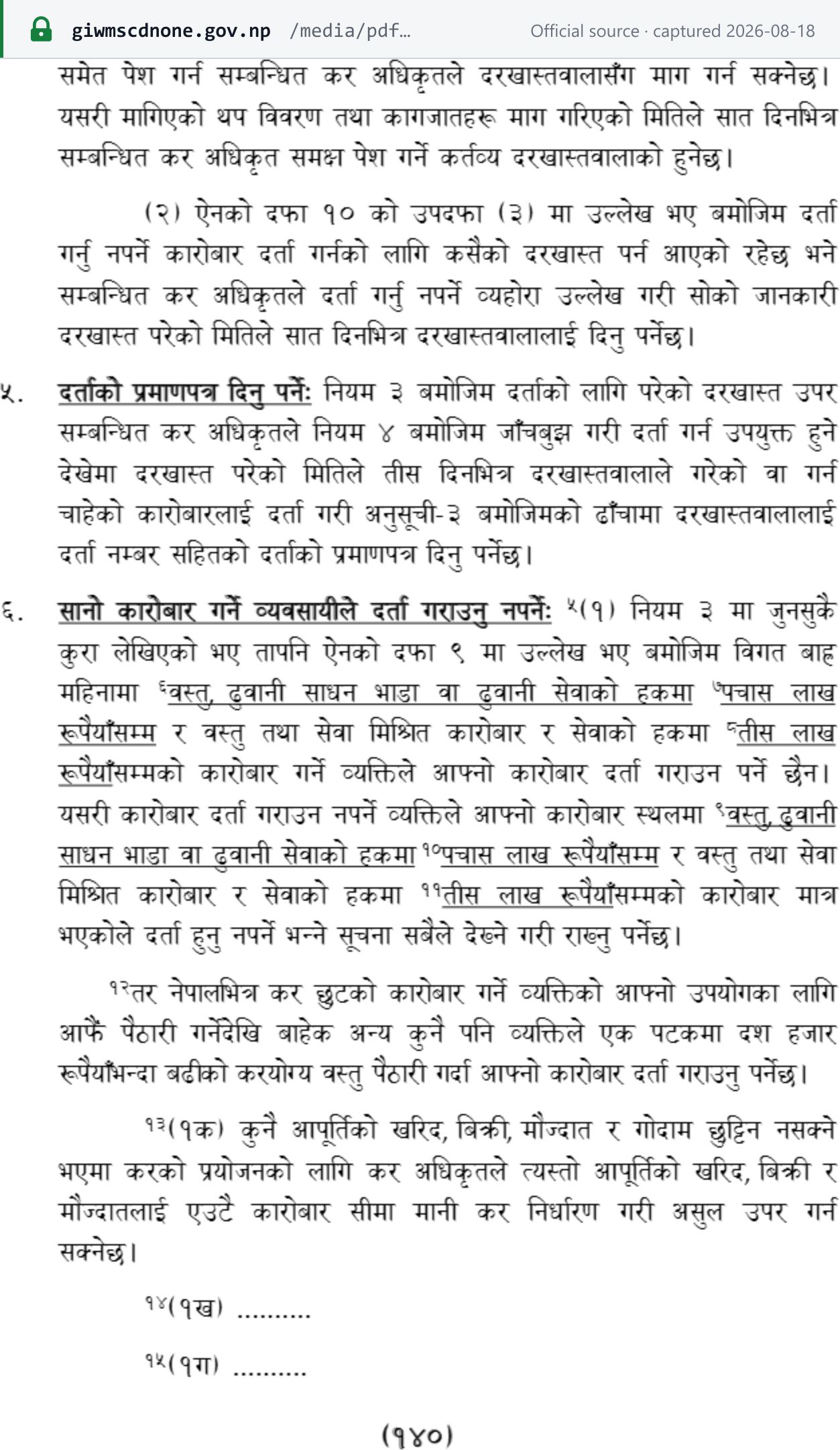
Section 10 sets out two limbs. Under s.10(1) anyone wishing to engage in any transaction must apply before commencing it. Under s.10(2) a person carrying on transactions in goods or services liable to tax must apply within thirty days of the date the tax became leviable or of the operation of the transaction. Under s.10(3) a person dealing only in Schedule 1 (exempt) supplies need not register. Those obligations are cut back by the small-vendor relief in s.9 read with Rule 6(1). [2]
Registration threshold
| Type of business | Threshold, past 12 months |
|---|---|
| Goods, hire of freight vehicles, or freight (ढुवानी) services | NPR 5,000,000 |
| Services, and mixed goods-and-services businesses | NPR 3,000,000 |
| Non-resident supplying electronic services or offline air-transport services | NPR 3,000,000 |
| Any person importing taxable goods worth more than NPR 10,000 in one consignment | nil — register regardless of turnover |
Two features are easy to miss. Turnover is measured under Rule 8 as the higher of the purchase value or the sale value over the past twelve months — not simply sales. And hire of freight vehicles and freight services sit on the goods side of the test at NPR 5,000,000, not the services side, which is a genuine Nepali quirk. Once the threshold is exceeded, apply within thirty days.
The NPR 2,000,000 figure is stale. It still appears in advisory material for services businesses. The current figure is NPR 3,000,000.
The old "register regardless of turnover" business list no longer exists. Nepal used to require registration irrespective of turnover for a long list of businesses — hardware, sanitary, furniture, automobiles and motor parts, electronics, marble, educational consultancy, discotheques, health clubs, massage therapy, beauty parlours, catering, party palaces, parking, machine dry-cleaning, restaurants with bars, colour labs, boutiques, tailoring, and uniform supply — where carried on inside a metropolitan or sub-metropolitan city or municipality. That list sat in s.10(2) and was removed by the Financial Ordinance and Financial Act 2078 (2021), which replaced s.10(2) with the general wording above. It now survives only in a footnote to IRD's consolidated text, headed "साविकको व्यवस्था" — "the former provision". (Checked 2026-08-18.) [1]
The one "regardless of turnover" trigger that does survive is the proviso to Rule 6(1): any person importing taxable goods worth more than NPR 10,000 in a single consignment must register — except a person carrying on an exempt business in Nepal who imports for their own use.
Non-resident threshold
Section 10B1 (10ख1) requires a non-resident person with taxable transactions in Nepal exceeding NPR 3,000,000 over the past twelve months in electronic services or offline air-transport services to register for VAT. A "non-resident person" (s.2(ड1)) is a person outside Nepal with no permanent place of transaction, no business representative and no legally recognised representative in Nepal.
The provision was inserted by the Finance Act 2079 (2022) at NPR 2,000,000 and covering electronic services only; the Finance Act 2081 raised it to NPR 3,000,000 and extended it to offline air transport. [1]
How a non-resident registers. Under IRD's procedure for VAT on non-resident electronic services, apply online within 30 days of the liability arising, on Annex-1 (or Annex-1क if already registered for Digital Service Tax). Voluntary registration is expressly allowed where annual turnover is expected to exceed NPR 3,000,000. Documents required, all notarised and in English: the home-country company registration certificate; the home-country tax identification certificate; a power of attorney naming an authorised person, with that person's passport, photograph and specimen signature; and, where a Nepali tax representative is appointed, the appointment letter with their citizenship or passport. The Large Taxpayers Office registers within seven days and issues the Annex-2 certificate online. Failure to register costs NPR 20,000 per instance. Once registered, VAT is charged regardless of how small later transactions are. [7]
Tax registration number
Nepal issues a single Permanent Account Number (PAN — स्थायी लेखा नम्बर) which serves as the identifier for income tax, VAT, excise and customs. There is no separate VAT number. VAT registration produces a दर्ता नम्बर which in practice is the PAN, and s.10(6) requires its use "in relation to all transactions relating to value-added tax, excise and customs and also to such other transactions as prescribed". [2]
Format: not stated on a current official page. IRD's PAN lookup restricts input to digits only, but publishes no digit-length specification, and the booklet that reportedly carried the format now returns a 404. This guide therefore does not state a digit count. (Checked 2026-08-18.) Verify a counterparty through the IRD PAN search — note the page is protected by a CAPTCHA.
Not available for Nepal: LookupTax has no Nepal tax-ID page, no how-to-verify page and no Nepal VAT-number validator route. Where this guide would normally link one, it does not, rather than pointing at something that does not exist.
How to register
A resident applies to the Tax Officer in the Schedule-1 form. After examination under Rule 4 — which allows a demand for further particulars, to be supplied within seven days — the office registers within thirty days of the application and issues the certificate with the registration number in the Schedule-3 format (Rule 5). The practical route is the IRD Taxpayer Portal, then the Inland Revenue Office or Taxpayer Service Office. [3]
Businesses supplying electricity run on the same machinery but a shorter clock — the same Schedule-1 application and Schedule-3 certificate, but the office must register within seven days rather than thirty, under the 2083 electricity directive. Do not generalise the seven days to other sectors. [6]
Registration fee: none prescribed. Neither the Act nor the Rules prescribes a registration fee; Rule 13 charges NPR 100 for a duplicate certificate. (Checked 2026-08-18.)
Voluntary registration
Available. The proviso to s.9 lets a small entrepreneur below the threshold register voluntarily via ss.10, 10क and 10ख — except a taxpayer filing pre-estimated-income returns under s.4(4) of the Income Tax Act 2058. Rule 6(2) repeats this, and s.11(2) lets a voluntary registrant that falls below the deregistration floor keep its registration by applying with the final twelve-month return. [2]
Nepal also has two registration types most jurisdictions lack. Temporary registration (s.10क with r.7क) covers exhibitions and fairs: the organiser and unregistered traders must register before trading, a deposit of 2% of estimated event income is lodged, and the registration must be cancelled within seven days of the event ending. Joint-venture registration (s.10ख) is taken at the office of any one participant, and participants are jointly and severally liable.
Deregistration
Under s.11(1) the Tax Officer shall cancel registration where a body corporate is closed, sold, transferred or ceases to exist; a sole proprietor dies; a partnership is dissolved or a partner dies; the person stops making taxable supplies; nil returns are filed for twelve consecutive months, or none at all; taxable turnover in the last twelve months did not reach NPR 5,000,000 (goods) or NPR 3,000,000 (mixed or services); or registration was made in error. [1]
Apply within thirty days of the cancellation event under Rule 12, with the Schedule-11 return and the tax due; supply documents within fifteen days of that return; and the Tax Officer must within three months either cancel or notify otherwise — if that window is missed, no further returns are due. Closing stock, including capital goods on which input tax was recovered, is deemed supplied at market value and taxed (s.11(4)).
Group registration
Not available in Nepal. The VAT Act 2052 recognises only four registration routes — ordinary (s.10), temporary or event (s.10क), joint venture (s.10ख) and non-resident (s.10ख1) — and ss.2(ड) and 2(ढ) define "registered person" and "registration number" exclusively by reference to those four. Neither the Act nor the VAT Rules 2053 contains a grouping, consolidated-return or single-taxable-person provision. (Checked 2026-08-18.) [1]
Rates
Nepal has no general reduced-rate band. The structure is a single standard rate, two narrow 5% charges introduced in 2026, a zero-rated schedule and an exempt schedule.
| Rate | Legal basis | Applies to |
|---|---|---|
| 13% standard | s.7(1) — "the rate of tax … shall be the flat rate of thirteen percent" | everything not otherwise listed |
| 5% | s.7(1ख), inserted by Finance Act 2083 s.55(1)(क) | ride-sharing and delivery platform fares, and electricity supplied to a household final consumer above 50 units a month |
| 0% zero | s.7(2), Schedule 2 | exports; services to a person outside Nepal; supplies to an SEZ industry; specified domestically produced machinery for hydro, solar, wind and fertiliser projects; and other listed items |
| exempt | s.5(3), Schedule 1 | basic agricultural products, education, health, financial services, passenger transport, land and buildings, and the other listed groups |
The 13% rate is unchanged by the Finance Act 2083. This guide states it as the rate in force at 18 August 2026 rather than giving a start date, because tracing the original 10% → 13% move requires a gazette we could not obtain. [1]
The Finance Act 2083 also inserted s.7(1क), a new enabling power letting the Government fix further rates not exceeding the s.7(1) rate by Nepal Gazette notice. We found no such notice published as at 18 August 2026 — though the Nepal Gazette publishes no searchable index, so treat that as "none found" rather than "none exists". [4]
Electricity — the three-way split
This is the rule most often summarised wrongly, including in our own earlier coverage. The electricity directive — made by the Government of Nepal, Ministry of Finance under Rule 61 of the VAT Rules 2053, and published by IRD — defines "अन्तिम उपभोक्ता" (final consumer) as a natural person consuming electricity for household purposes — and everything follows from that definition. [6]
| Supply | VAT |
|---|---|
| Electricity sold between electricity businesses — a generator or community micro-hydro selling to the Nepal Electricity Authority | exempt (Schedule 1) |
| Household natural person, consumption up to 50 units a month | exempt (Schedule 1) |
| Household natural person, consumption above 50 units a month | 5%, on the tariff for the excess units only |
| Anyone who is not a household final consumer — business, government office, institution | 13% on the entire consumption, no 50-unit relief |
The directive's own worked examples settle the two questions readers ask. A household using 60 units is charged NPR 400 for the first 50 with no VAT and NPR 80 for the extra 10 with NPR 4 of VAT — so the 50 units is a slice exemption, not a cliff. A District Administration Office using 100 units pays 13% on the whole NPR 800, because it is not a household natural person. A VAT-registered factory paying the 13% may recover it as input tax.
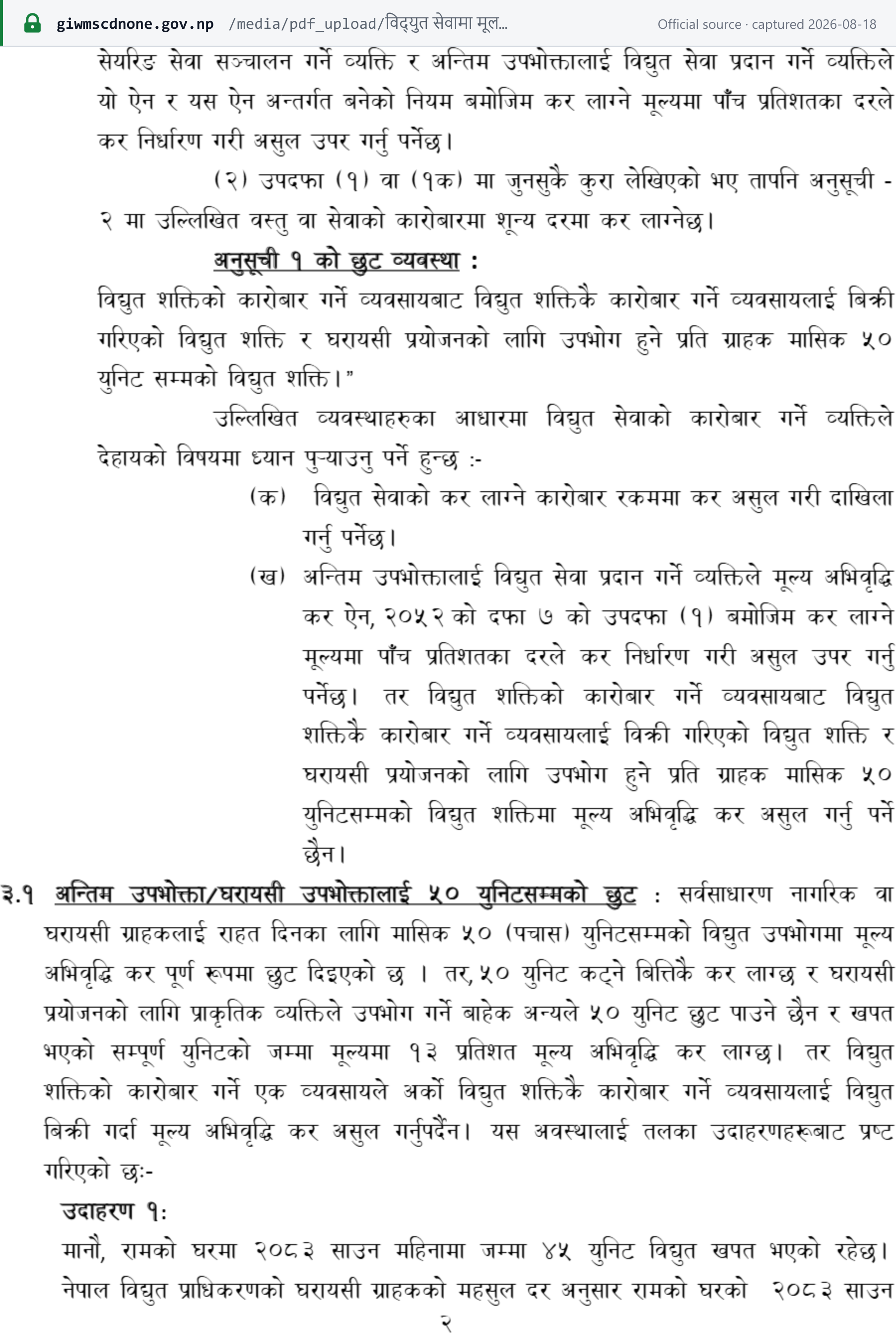
One consequence for suppliers: the VAT Rules 2053 (28th amendment, 2083) added r.41(1)(ङ), blocking input-tax credit on goods and services purchased by a person supplying electricity to a final consumer, so such suppliers must apportion proportionally under rr.39 and 41.
Ride-sharing and delivery platforms
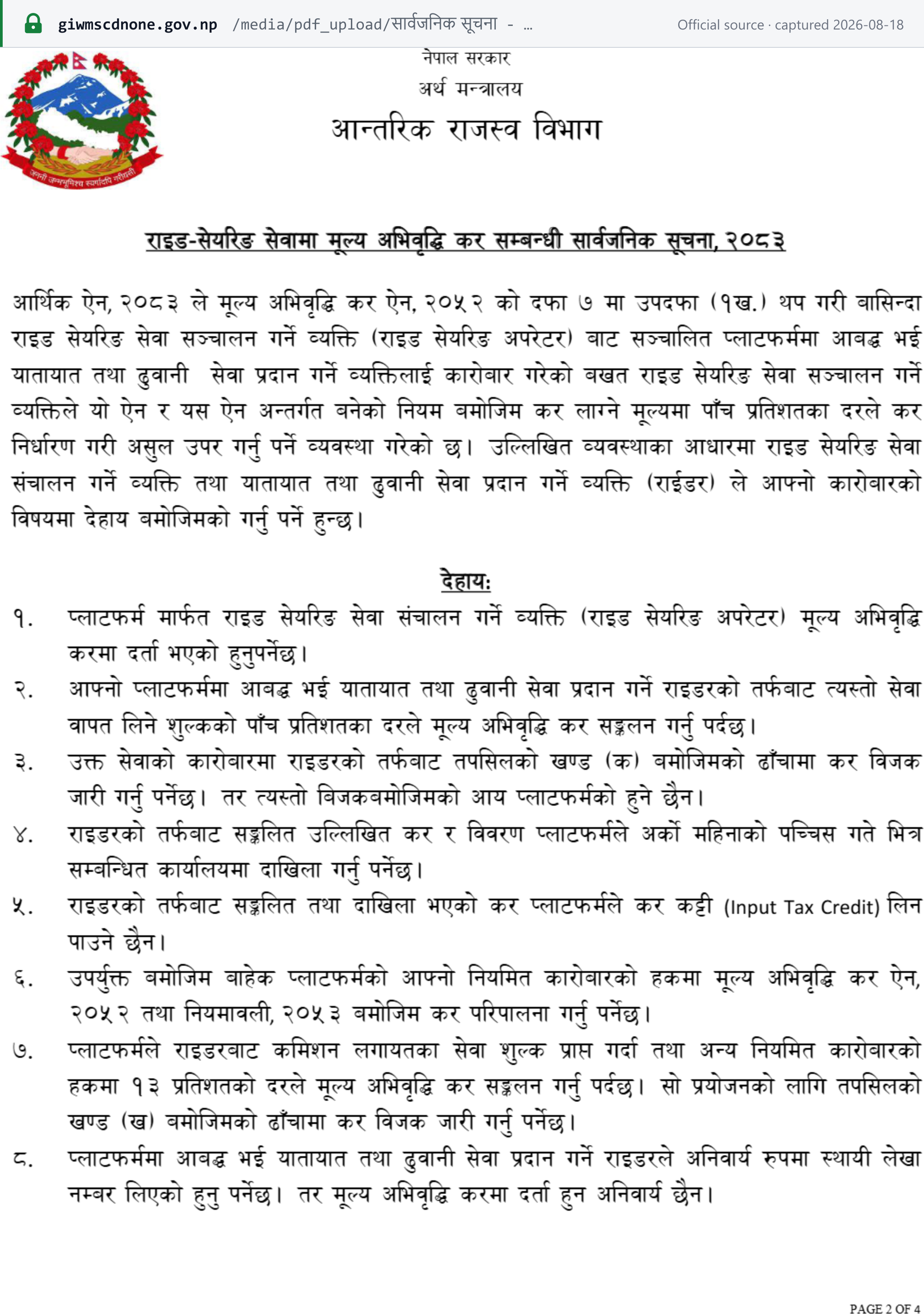
From 17 July 2026 (Shrawan 1, 2083), s.7(1ख) charges 5% where a resident ride-sharing operator transacts with a person affiliated to its platform providing transport or delivery services, and s.8(2ख) — added by Finance Act 2083 s.55(2) — puts the assessment-and-collection duty on the operator. IRD's public notice of 2083/03/31 sets out the mechanics: [5]
- 5% on the rider's fare, collected by the platform on the rider's behalf, on a tax invoice the platform issues in the rider's name. The notice states expressly that the income under that invoice is not the platform's income.
- 13% on the platform's own commission and other service fees, and on its other ordinary business, on a separate invoice.
- The platform cannot claim input tax credit on the 5% it collects for riders.
- Amounts collected on the rider's behalf must be deposited by the 25th of the following month.
- The platform must be VAT-registered; the rider must hold a PAN but is not required to register for VAT.
Keep the two rates apart. Several reports have described the 5% as falling on "platform services"; it does not — the platform's own service is taxed at 13%.
Cross-border rules
Imports and exports
Imports. Except as the Ministry of Finance otherwise specifies, the customs officer collects VAT on imported goods at import (s.28(1)). The taxable value is the import value including freight, insurance, agents' and other commission, plus import duty and other charges, excluding VAT (s.12(5)). There is no de-minimis — on the contrary, importing taxable goods worth more than NPR 10,000 in one consignment triggers a registration obligation. [1]
Exports are zero-rated (Schedule 2). A registered person exporting more than forty percent of total monthly sales may claim a lump-sum refund of excess input tax immediately rather than waiting the four months others must (s.24(4)). Under s.8क, an industry exporting more than 40% of total sales over the last twelve months may import raw materials against a bank guarantee instead of paying VAT, provided the exported goods carry 10% value addition.
Reverse charge on imported services
Section 8(2) is broader than most jurisdictions' equivalent: "A person who is registered or not registered to acquire a service from any person outside Nepal shall assess and realize the tax on the taxable value … at the time of payment or at the time of acquisition of the service, whichever occurs earlier." An unregistered Nepali recipient is caught. Section 17(5ख) allows a registered recipient to deduct the tax accounted for. [2]
A parallel domestic reverse charge sits in s.8(2क): a registered or unregistered person hiring a freight vehicle, or acquiring freight services, from an unregistered person must self-assess at the earlier of payment or receipt. IRD publishes a dedicated directive on it. [14]
Foreign companies selling into Nepal — B2B and B2C
Nepal's answer is unusually clean, because the IRD procedure states the B2B carve-out in terms.
B2B — the foreign supplier charges nothing. The procedure provides that VAT is not charged on sales made through a digital interface to business users in Nepal for business purposes, and that the user must instead account for the tax under s.8(2) — the reverse charge. An anti-abuse clause adds that a user who falsely declares business use is itself liable in that respect. [7]
B2C — the foreign supplier registers and charges 13%, once its taxable electronic-service or offline air-transport turnover in Nepal exceeds NPR 3,000,000 over the past twelve months (s.10ख1). Filing is monthly and payment online.
Digital products and services
Section 2(ट2) defines विद्युतीय सेवा (electronic service) as a service requiring information technology and delivered automatically over the internet with minimal human intervention, and lists: paid personal promotion; targeted online advertising; film, television, music, OTT and similar subscription services; data collection; cloud services; gaming; mobile applications; internet marketplace services and services provided through them; supply and updating of software; downloads including data and images; consulting, skill development and training; and other similar services. [1]
Do not conflate VAT with the Digital Service Tax. Finance Act 2083 s.23 re-enacts a 2% Digital Service Tax on the transaction value of electronic services a non-resident supplies to users in Nepal. It excludes annual transactions up to NPR 3,000,000 and sales through a digital interface to business users for business purposes. It is filed within three months of the fiscal year end, with a late-filing charge of 0.1% of the annual transaction amount per year. DST sits under the Finance Act, not the VAT Act, and has its own IRD procedure. [11]
Marketplace and platform deemed-supplier liability
Four distinct regimes, and they should not be merged: [7] [3]
- Non-resident online marketplaces — the operator must include the value of both goods and services in the transaction value it declares; but where a resident supplies through that marketplace, the non-resident need not include that amount.
- Resident ride-sharing and delivery platforms — 5% on the rider's fare on the rider's behalf, 13% on the platform's own commission, as above.
- VAT withholding on contract payments (Rule 6ग) — a government body, or a body wholly or partly owned by the Government of Nepal, paying a contractor or supplier under a contract must deposit thirty percent of the VAT amount to the revenue head in the payee's name and pay only the balance; the payee sets it off.
- Contracting restrictions — Rule 6क stops government bodies, public institutions and registered persons awarding contracts or taking consultancy services exceeding NPR 500,000 a year from an unregistered person, and Rule 6ख requires commercial construction of a building, apartment or shopping complex costing more than NPR 5,000,000 to be carried out by a registered person.
Place of supply
Goods: Rule 15. Services: Rule 16 — "the place of supply of a service is the place where the benefit of the service is received."
Electronic services from a non-resident (Rule 16क) are deemed supplied in Nepal if any one of six tests is met: the service is provided within Nepal; the invoice is issued to a Nepali address; payment comes from a bank account in Nepal or a licensed payment institution; payment is by a card issued by a Nepali bank or licensed payment service provider; the service is provided using an IP address inside Nepal; or the service is provided using a SIM card with Nepal's country code or a Nepali landline. [3]
Invoice requirements
Mandatory content
Rule 17(1) with the Schedule-5 template. Note that Nepal requires the transaction date and the issue date as two separate fields: [3]
| Field | Requirement |
|---|---|
| The words "कर बीजक" (Tax Invoice), clearly legible on the face of the invoice | Mandatory (r.17(2)) |
| Invoice number (बीजक नम्बर) | Mandatory |
| Transaction date (कारोबार मिति) | Mandatory |
| Date the invoice was issued (बीजक जारी भएको मिति) — a separate field | Mandatory |
| Seller's name and address | Mandatory |
| Seller's taxpayer registration number (PAN) | Mandatory |
| Buyer's name and address | Mandatory |
| Buyer's taxpayer registration number | Mandatory |
| Method of payment — cash, cheque, credit or other | Mandatory |
| Line items: S.No., HS code, description, quantity, unit price, total value | Mandatory |
| Per item: type, size, model and brand, and for imported goods at least the first four digits of the Harmonized Code as shown on the customs declaration | Mandatory where applicable (r.17(1)) |
| Discount at …% | Mandatory field on the template |
| Taxable value (कर लाग्ने मूल्य) | Mandatory |
| Tax at …% | Mandatory |
| Total | Mandatory |
| Seller's signature | Mandatory |
Two variant templates exist: Schedule-5क for insurance companies, and Schedule-5ख where the Department has directed publication of the consumer-level retail price, which adds phone, email, fax and website and a per-unit final consumer price column.
Number of copies
A Nepal-specific rule worth its own line. Rule 17(2) requires the tax invoice to be prepared in three copies: the original (सक्कल) goes to the recipient; the second copy is kept in a separate record to be produced when the office demands it; and the third copy is retained by the registered person for its own business records. [3]
Issuance deadline
There is no outer deadline expressed in days. The invoice must be issued at the time of supply, which s.6(2) fixes as the earliest of: the supplier issuing the invoice; for goods, the recipient taking or receiving them from the supplier's place of business; for services, the service being provided; or the supplier receiving consideration. Section 6(3) sets special cases — continuously supplied telecommunication and similar public services take the invoice date; instalment contracts take the earlier of payment or the contractual due date. For non-resident e-service suppliers the invoice is issued at the time of providing the service or receiving the consideration, whichever is first. [2]
Numbering and sequencing
An invoice number is required on every tax invoice, and a sequential number (क्रमागत सङ्ख्या) on every credit and debit note (r.20(1)(क)). The VAT Rules 2053 publish no separate annual-series, gapless-sequence or reset requirement. (Checked 2026-08-18.)
Credit and debit notes
Under Rule 20(1), where the value of a supply changes the note must be clearly marked as a credit or debit note and must state: its sequential number; date of issue; the supplier's name, address and registration number; the recipient's name, address and, if registered, registration number; the number and date of the tax invoice relating to the transaction; a description of the goods or services and the reason for the credit or debit; the amount credited or debited; and the amount of tax credited or debited. Rule 20(2) requires a monthly account of credit and debit notes. [3]
Currency and language
Rule 21: where consideration is received in convertible foreign currency, the tax invoice must state the Nepali rupee equivalent at the exchange rate fixed by Nepal Rastra Bank on the day the transaction took place. Non-resident e-service suppliers get a looser rule: they may keep the account in the foreign currency of the period and must record the transaction in both the foreign currency and its NPR equivalent at the NRB rate on the day the return is filed. [3]
Language: not prescribed. The Rules prescribe the invoice format but not the language; the Schedules are printed in Nepali, and IRD's non-resident procedure expressly permits any format. Treat this as unregulated rather than as permission to use English. (Checked 2026-08-18.)
Document types
The abbreviated tax invoice (संक्षिप्त कर बीजक) under Rule 18 is available to a registered person making retail sales, on application to the Tax Officer, in the Schedule-6 format. Its limits: [3]
- Value ceiling NPR 10,000. It may not be issued for a transaction exceeding ten thousand rupees; and even below that, if the recipient asks for a full Rule 17 invoice the registered person must provide one.
- The recipient cannot claim input tax on an abbreviated invoice (r.18(3)).
- Where many low-value items are sold, each item must still be named separately.
- Records required: a duplicate of the original invoice, till-roll copies with a daily total, and a record of the tax-inclusive value of each transaction. The Tax Officer may revoke the permission if these are not kept.
- Tax is extracted using the tax fraction, rate ÷ (rate + 100) — 13/113 at the standard rate.
A related rule that catches transporters: under s.14(4) a person moving taxable goods worth more than NPR 10,000 outside an area designated by the Department must carry the tax invoice with them. Breach costs NPR 10,000 per instance.
Self-billing
Not provided for. The VAT Act 2052 places the invoicing duty on the supplier (s.14(1)) and makes taking the invoice the recipient's duty (s.14(3)); the VAT Rules 2053 publish no recipient-created-invoice procedure. The only invoice issued on another party's behalf is the ride-sharing platform invoice under IRD's 2083 public notice, which is a specific statutory delegation rather than general self-billing. (Checked 2026-08-18.)
Retention and audit trail
Retention: six years. Rule 23(7) requires records to be preserved for ६ वर्ष — six years. What must be kept (r.23(1)): the Schedule-7 information; trading, accounting, cash-receipt and payment records; tax invoices and abbreviated invoices issued and received; all import and export documents; all debit and credit notes; the purchase book (Schedule-8); and the sales book (Schedule-9). [3]
Electronic archiving is allowed with the Department's permission (r.23(3)). Inspection may occur at any time during business hours; the taxpayer must print requested records at its own expense and make staff available.
Audit trail. Nepal's provisions here are unusually strong. Section 16(1क) lets the Department obtain continuous access to the taxpayer's computer database, and s.16क(1) makes computer-processed taxpayer records held by the Department admissible as evidence unless proved otherwise. Under the e-invoicing procedure 2074, billing software must be built on a DBMS able to process SQL queries, must ensure data once entered cannot be deleted, and must have log archiving enabled so every database action is recorded. Using software capable of deleting or altering data costs NPR 500,000. Separately, s.16(3) requires every person carrying on taxable transactions, registered or not, to use a self-certified purchase and sales book for each fiscal year.
A specimen of a compliant invoice
Nepal is one of the few jurisdictions where the authority publishes annotated invoice templates: Schedule-5 of the VAT Rules 2053 for the ordinary tax invoice, and खण्ड (क) and खण्ड (ख) in the schedule to IRD's 2083 ride-sharing notice. The sheet below reproduces the खण्ड (क) shape — the invoice a platform issues on a rider's behalf — because it is the most distinctive document in Nepali VAT and the hardest to picture from a field list. All names, numbers and figures are fictional:
कर बीजक — Tax invoice issued by a platform on a rider's behalf
| Service description | Trips | Rate | Total |
|---|---|---|---|
| Passenger transport — Naxal to Pulchowk | 1 | NPR 400.00 | NPR 400.00 |
- Total taxable amount
- NPR 400.00
- VAT at 5%s.7(1kha), VAT Act 2052
- NPR 20.00
- Grand total
- NPR 420.00
- The rider is named on the invoice with their own PAN — the notice requires both, because the income under this invoice is the rider's and not the platform's.
- Rider: Bikash Tamang · Rider PAN: 610987654 (fictional).
- The platform deposits the 5% collected on the rider's behalf by the 25th of the following month, and may not claim it as its own input tax credit.
- The platform's own commission is invoiced separately at 13% on the खण्ड (ख) template — a different document, not another line on this one.
- The amount must also be stated in words on the official template.
E-invoicing status
As at 18 August 2026 Nepal has a partial, turnover-driven e-invoicing mandate with no clearance model. Invoices are monitored through the Central Billing Monitoring System (CBMS — केन्द्रीय बीजक अनुगमन प्रणाली) at cbms.ird.gov.np. [9]
Legal basis. Section 14क was replaced in full by Finance Act 2083 s.55(3). The old provision required the taxpayer's prior approval to issue e-invoices; the new one empowers the Department to set standards and procedure, and adds IRD's own billing system as an alternative to connecting a private system to CBMS. [4]
Who must connect. By an IRD decision of 2082/12/27, published as a Departmental notice on 2083/01/04 (≈ 17 April 2026), all taxpayers with annual turnover exceeding NPR 200,000,000 must issue invoices electronically and connect them to CBMS at the moment of issue — except entities that by the nature of their business do not invoice consumers directly, such as banks and financial institutions. [9]
The NPR 100,000,000 figure is an announced policy, not yet a Departmental mandate, and it is narrower than it is usually quoted: point 70(ख) of the FY 2083/84 Budget Speech applies it to businesses above that turnover that issue electronic invoices, not to every business above it. Individual Inland Revenue Offices began issuing local notices implementing it from 2083/03/05 (≈ 19 June 2026). We found no Department-level notice carrying the NPR 100 million figure as at 18 August 2026, so this guide keeps the two apart rather than merging them into one number. [15] [10]
Below the threshold: voluntary, but permission-based. A resident who wishes to issue electronically must obtain permission from the office first, applying in Annex-3 under the 2074 procedure with details of each branch and its software. Registered non-residents are treated differently: they may issue tax invoices electronically in any format carrying the listed fields and do not need the Department's approval. [8]
Scope: B2B, B2G and B2C are not separated. The mandate is expressed purely by turnover, not counterparty type. There is no B2G-first phase and no separate B2C phase.
Formats: no Peppol, no UBL, no prescribed XML syntax. The procedure regulates the device and software — DBMS-based, non-erasable data, log archiving, IRD certification — and the connection to CBMS, not an interchange format. Nepal is not a Peppol authority.
Timeline
- ≈ 31 December 2017 (2074/09/16) — the e-invoicing procedure 2074 comes into force; permission-based e-invoicing and CBMS introduced.
- ≈ 10 April 2026 (2082/12/27) — IRD decides taxpayers above NPR 200 million must issue e-invoices and connect to CBMS; notice published ≈ 17 April 2026.
- ≈ 19 June 2026 (2083/03/05) — Inland Revenue Offices begin notifying the NPR 100 million policy from the FY 2083/84 budget.
- ≈ 14 July 2026 (Asar 30, 2083) — the Finance Act 2083 replaces s.14क, allowing IRD to mandate use of its own billing system.
Filing and payment
Filing frequency
Monthly by default. Under s.18(1) with r.26(1), a registered person self-assesses and files in the Schedule-10 format within twenty-five days of the end of each Bikram Sambat month, "whether or not any taxable transaction was carried on in that month" — so nil returns are compulsory. [3]
A four-monthly (चौमासिक) period may be fixed by the Department, at the taxpayer's request, for print, electronic and print-and-electronic publication or broadcasting houses, and for taxpayers with annual turnover up to NPR 10,000,000 (r.26(3ख)). A registered person keeping accounts on a computer system may apply for a different tax period under r.26(2). Where any period other than one month is fixed, the return is still due within twenty-five days of that period's end.
Several older options have been repealed and still circulate in advisory material: a two-monthly period for hotel and tourism businesses (removed by the 22nd amendment) and a four-monthly period for voluntarily-registered small taxpayers (removed by the 17th).
Non-residents file monthly with no option, by the 25th of the month following the tax period, online in Annex-3. [7]
Return due date
Within twenty-five days of the end of the tax period — in practice the 25th of the following Nepali month.
Two changes for FY 2083/84. Section 18(1क), as replaced, lets taxpayers in a district with no Inland Revenue Office pay and file by the 15th of the filing month at the local level or the District Treasury Comptroller Office, which forwards the return within seven days. And a new s.18(4) allows a return filed on time to be amended within seven days of filing under a procedure the Department specifies — a genuinely new facility. [4]
Enforcement escalates. If a return is still not filed four months after its due date, the Tax Officer may block the taxpayer's imports and exports (s.18(3)). Failure to file for six consecutive months may lead to name publication, withheld input credits and suspension of registration (s.30(2)).
Payment due date and method
The same date as the return — within twenty-five days of the period end (s.19(1)). Payment may be electronic or by a bank-guaranteed ("good for payment") cheque; an electronic payment counts as made on the date of the payment order, a good-for-payment cheque on the date the office receives it. Payments over NPR 1,000,000 must be by cheque, draft or electronic means (s.19(7क)). Non-residents pay online to revenue head no. 33316. [1]
Late payment carries an additional fee of 10% per annum (s.19(2)) and interest at 15% per annum on any amount unpaid past its deadline (s.26), which continues to run during administrative review or a Revenue Tribunal appeal. There is no interest on interest, additional fee or penalty (s.19(8)).
The Director General may waive the additional fee for circumstances beyond the taxpayer's control, but the application must be made within thirty days of the payment deadline and no waiver is given if the application is late (r.36). Rule 35 lists qualifying circumstances — road closure, complete transport shutdown, fire, earthquake and similar disasters — several requiring a recommendation from the relevant rural or urban municipality.
Additional listings
No annual VAT return, and no EC-sales-list equivalent. What Nepal requires instead: the certified purchase book (Schedule-8) and sales book (Schedule-9) for each fiscal year; and electronic filing of purchase and sales transaction details with each period's return by taxpayers permitted to issue electronic invoices or otherwise designated (r.25(2)). (Checked 2026-08-18.)
Input-tax recovery and blocked items
Input tax is deductible on goods and services imported or acquired for taxable transactions (s.17(1)), with partial credit where use is mixed (s.17(3), r.39). Tax on capital goods bought under a financial lease or loan agreement is deductible (s.17(5क)), as is tax accounted for under the reverse-charge provisions (s.17(5ख)). Under s.16ख, VAT on goods lost to fire, theft, accident, breakage — and, from FY 2083/84, natural disaster — or whose use-by date has expired, may be deducted as prescribed. [1]
Blocked and restricted under Rule 41:
| Item | Credit |
|---|---|
| Beverages (पेय पदार्थ) | none |
| Alcohol or alcohol-mixed beverages | none |
| Petrol for vehicles | none |
| Entertainment expenses (मनोरञ्जन खर्च) | none |
| Goods and services purchased by a person supplying electricity to a final consumer — added by the VAT Rules 28th amendment, 2083 | none |
| Automobiles — any road passenger vehicle with three or more wheels | 40% of the purchase price |
Rule 41(3) disapplies these restrictions where supplying those very items is the registered person's main business.
Refunds
An excess credit is first set off against other amounts payable for the month, then carried forward; after four consecutive months of carry-forward you may claim a lump-sum refund (s.24(1)–(3)). Exporters above the 40% test claim immediately (s.24(4)). Refunds are due within sixty days in the ordinary case and thirty days for exporters; if late, the Government pays interest at 15% per annum (r.47). [1]
Special refunds under s.25(1) cover diplomats and diplomatic missions, the United Nations and its specialised agencies, MoF-approved international organisations, project purchases under bilateral or multilateral agreements, and tax collected in error — claimable within three years of the transaction, with no diplomatic refund for a single purchase below NPR 10,000. A foreign tourist leaving Nepal by air with taxable goods worth more than NPR 25,000 may reclaim the VAT, less a 3% service charge (s.25क). No refund is available unless claimed within three years of the end of the tax period (s.25घ).
One FY 2083/84 change worth noting: the consumer electronic-payment incentive in s.25(1ख) was reworded from "instantly refunded" to "instantly discounted", so the 10% now operates as a point-of-sale discount rather than a refund.
Bad-debt relief: none found. The VAT Act 2052 and the VAT Rules 2053 publish no bad-debt relief for VAT already accounted for on an unpaid invoice; s.16ख provides only for input tax on goods lost to fire, theft, accident, breakage, natural disaster or expiry. (Checked 2026-08-18.)
Exemptions
Exempt supplies
Schedule 1 was replaced in full by Finance Act 2083 s.55(10), in force from around 14 July 2026. Its groups include: basic agricultural products; goods of basic need (salt, and now electricity as described above, plus drinking water supplied openly from taps and tankers); live animals and their products; agricultural inputs; medicine, treatment and health services; education; books, newspapers and printed materials; artistic and craft services; passenger and goods transport services; professional and vocational services of artists, sportspersons, writers, designers, translators and interpreters; other goods and services — including cold-store and silo storage, postal services operated by the Government of Nepal, services provided by federal, provincial or local government, and a broad financial-services item newly extended to digital financial service fees and services provided by insurance agents; buildings and land, excluding hotel, guesthouse and apartment services and entities operating commercially like a hotel; and betting, casino and lottery. [4]
Exempt is not zero-rated
Nepal's statute states the consequence explicitly, which is unusual and worth quoting. Section 5(3) provides that tax is not levied on Schedule 1 supplies, and that the tax previously paid on the purchase of such goods or services cannot be deducted under section 17 nor refunded under section 24.
So an exempt supply blocks input recovery, while a zero-rated Schedule 2 supply is taxable at 0% and preserves full recovery. If you are choosing how to characterise a supply, that sentence is the whole difference. [1]
Special regimes
- Special Economic Zones — supplies of raw materials and finished goods to an industry operating in an SEZ are zero-rated under Schedule 2. Note the direction: it is the supply into the SEZ industry that is zero-rated.
- Small-business or flat-rate scheme — none. Relief takes the form of the registration threshold, not a flat-rate or presumptive scheme. A person below the threshold must display a notice at its place of business stating that its turnover is within the small-vendor limits and it need not register (r.6(1)).
- Margin scheme for second-hand goods — available. Section 17(5) leaves the input-credit facility for dealers in used goods to the Rules, and Rule 33 supplies it as a genuine margin basis: tax is assessed only on the difference between the sale price and the purchase price, with prescribed purchase and sale record fields. Rule 44, made expressly for the purposes of s.17(5), blocks credit on used goods bought from an unregistered person and on goods also taken into personal use.
- Cash accounting — not available. Section 6(2) fixes the time of supply as the earliest of invoice, delivery, performance or payment, with no cash-basis election in the Act or Rules.
- Bonded warehouse and duty-free — s.8क provides a bank-guarantee facility for exporters and for imports for duty-free shops through a bonded warehouse.
Offences and penalties
Offences
Section 29(2) is Nepal's offences provision and it is expressly criminal. A person is liable to a fine equal to one hundred percent of the tax shortfall, or imprisonment for up to six months, or both, for: preparing false accounts, invoices or other documents; evading tax by fraud (जालसाजी); an unregistered person behaving as a registered person; selling with under-invoicing (न्यून बीजकीकरण); or carrying on transactions while registration is suspended. [1]
Beyond that:
- Fake invoicing — a seller who issues an invoice without transferring the goods or services faces 50% of the invoice value, or up to six months' imprisonment, or both (s.29(1ग)).
- Abetment — a person who knowingly or negligently helps, assists, incites or advises an offender is liable to 50% of the tax the offender under-paid (s.29(3)).
- Officer liability — under s.29ख, every employee acting as an officer of a body at the time is responsible, and every officer in office (or in office within the previous six months) is jointly and severally liable for unpaid tax, unless the offence occurred without their knowledge or consent or they exercised ordinary care and diligence to prevent it.
- Business suspension — where a registered person commits any s.29 offence two or more times, the Director General may order the registration suspended and the place of business closed for up to seven days, each time (s.30(1)).
- Investigation powers — a Tax Officer investigating an offence has the powers of the police (s.23); bank accounts may be frozen for up to three months, extendable by three more; and there is provision for detention for up to fifteen days at a time, to a maximum of forty-five days, where cash deposit or property security is not furnished.
- Compounding — where a person admits in writing before proceedings begin, the Department may order a penalty not exceeding the penalty for the offence, and the Department's order is final (s.29क).
Penalties
Section 29(1), as amended by Finance Act 2083 s.55(8): [4]
| Breach | Penalty |
|---|---|
| Failing to register, including a non-resident under s.10ख1(1) | NPR 20,000 each time |
| Not displaying the certificate or not using the registration number | NPR 1,000 each time |
| Not putting up the tax board (कर पाटी), or not in the prescribed place | NPR 2,000 each time |
| Not notifying a change within 15 days | NPR 10,000 each time |
| Failing to issue an invoice | NPR 10,000 each time |
| Failing to take an invoice (the recipient's breach) | NPR 1,000 each time |
| Transporting goods over NPR 10,000 without the tax invoice | NPR 10,000 each time |
| Unregistered person collecting tax | 100% of the tax collected |
| Not keeping accounts up to date | NPR 10,000 |
| Not allowing inspection of accounts | NPR 20,000 each time |
| Using e-invoicing software capable of deleting or altering data | NPR 500,000 |
| Other breaches of s.14क by such a taxpayer | NPR 100,000 (new for FY 2083/84) |
| Late or non-filing of a return | 0.05% of the tax per day, or NPR 1,000 per tax period, whichever is higher |
| Under-invoicing | NPR 2,000 per invoice, or the s.29(2) penalty, whichever is higher |
| Trading from an uncertified branch or warehouse | NPR 10,000 each time |
| Any other breach of the Act or Rules | NPR 10,000 each time (raised from NPR 1,000 for FY 2083/84) |
| Breach of the Department's directive on internal movement of commercial goods | NPR 50,000 each time (new for FY 2083/84) |
| Reducing tax liability by non-compliance | up to 25% of the tax shortfall |
| Stock found in excess of the purchase book | 50% of the market value of the excess |
| Carrying on business while liable to register, without registering | 50% of the tax shortfall |
| Late payment | additional fee of 10% per annum |
| Any amount unpaid past its deadline | interest at 15% per annum |
Recovery powers are wide. Fees, interest and penalties are treated as tax for recovery (s.27), and s.21 allows set-off against refunds, seizure and auction of movable and immovable property, deduction from bank balances, deduction from amounts owed by federal, provincial or local government, third-party debt claims, blocking imports and exports, and barring the taxpayer from leaving Nepal.
There is also an informant reward of twenty percent of the tax recovered on the strength of the evidence, with up to NPR 10,000 payable immediately as expenses and the informant's identity kept confidential (s.40).
Frequently asked questions
I drive for a ride-hailing app in Nepal — do I now have to register for VAT?
No. You must hold a PAN, but IRD's public notice states expressly that a rider affiliated to a platform is not required to register for VAT. The mechanics run through the platform.
Since 17 July 2026, s.7(1ख) requires the platform operator to collect 5% VAT on the fare charged for your transport or delivery service, and to issue the tax invoice for that fare on your behalf. The notice is explicit that the income under that invoice is not the platform's income — it is yours, and the platform is merely collecting. The platform deposits what it collects by the 25th of the following month and cannot claim it as its own input tax credit.
Keep the two charges apart: the 5% is on the rider's fare, while the commission and other service fees the platform charges you are taxed at 13% on a separate invoice. Several reports have blurred these; the Act and the notice do not.
My electricity bill has VAT on it now — is it 5% or 13%?
It depends entirely on who you are, and the widely repeated "first 50 units exempt" summary applies only to households.
The electricity directive defines "final consumer" as a natural person consuming electricity for household purposes. If that is you, consumption up to 50 units a month is exempt and 5% applies only to the tariff on the units above 50 — the directive's worked example has a consumer using 60 units pay NPR 400 for the first 50 with no VAT and NPR 80 for the extra 10 with NPR 4 of VAT. So it is a slice exemption, not a cliff.
If you are anyone else — a business, a government office, an institution — you get no 50-unit relief and pay 13% on your entire consumption. The directive illustrates this with a District Administration Office paying 13% on 100 units. Electricity sold between electricity businesses is exempt outright. A VAT-registered business paying the 13% can generally recover it as input tax.
Is Nepal's VAT registration threshold NPR 2 million or NPR 3 million?
Neither figure alone answers it, and the NPR 2,000,000 number still circulating in advisory material is stale.
There are two thresholds, measured over the past twelve months: NPR 5,000,000 for a business dealing in goods, in the hire of freight vehicles, or in freight services; and NPR 3,000,000 for a services business and for a mixed goods-and-services business. Note the oddity that freight-vehicle hire and freight services sit on the goods side of the test. Turnover is measured under Rule 8 as the higher of the purchase value or the sale value over those twelve months, not simply sales. Once you exceed the applicable figure, apply within thirty days.
Two traps sit outside the threshold entirely. The proviso to Rule 6(1) requires any person importing taxable goods worth more than NPR 10,000 in a single consignment to register, whatever their turnover. And a non-resident supplying electronic or offline air-transport services must register once its Nepali turnover exceeds NPR 3,000,000 over twelve months.
Does a foreign software company have to charge my Nepali business VAT on its subscription?
No, if you are buying for business purposes — and Nepal states this carve-out unusually clearly. IRD's procedure provides that VAT is not charged on sales made through a digital interface to business users in Nepal for business purposes, and that the user must instead account for the tax under s.8(2), the reverse charge. You self-assess at the earlier of payment or acquisition of the service.
Nepal's reverse charge is broader than many: s.8(2) binds a person "registered or not registered", so an unregistered Nepali recipient is caught too.
If you are a consumer rather than a business, the position flips — the foreign supplier must itself register and charge 13% once its Nepali turnover in electronic services exceeds NPR 3,000,000 over the past twelve months. One caution the procedure adds directly: a user who falsely declares business use is itself liable in that respect. And do not confuse any of this with the separate 2% Digital Service Tax, which sits under the Finance Act rather than the VAT Act.
Do I have to connect my billing system to CBMS?
There are two numbers in circulation and only one is currently a binding Departmental mandate.
By a decision of 2082/12/27, published on 2083/01/04 (≈ 17 April 2026), all taxpayers with annual turnover exceeding NPR 200,000,000 must issue invoices electronically and connect them to CBMS at the moment the invoice is issued. Entities that by the nature of their business do not invoice consumers directly — banks and financial institutions — are excepted.
Separately, point 70(ख) of the FY 2083/84 Budget Speech announces a policy of extending that to businesses above NPR 100,000,000 that issue electronic invoices, and individual Inland Revenue Offices have been issuing local notices to that effect since around 19 June 2026. Treat NPR 200 million as the rule and NPR 100 million as an announced policy being implemented through local notices.
Below the threshold, electronic invoicing is voluntary but permission-based: a resident must apply to the office first. Registered non-residents may issue tax invoices electronically in any format without the Department's approval.
Important websites
| Site | Purpose |
|---|---|
| Inland Revenue Department | Notices, directives and tax laws |
| IRD Taxpayer Portal | Registration, return filing and e-payment |
| PAN search | Verifying a counterparty's PAN — CAPTCHA-protected |
| Tax clearance certificate lookup | Checking a tax clearance certificate |
| CBMS External Portal | Electronic invoicing — connection and monitoring |
| VAT Act 2052 | The Act and its schedules |
| VAT Rules 2053 | The Rules and their schedules |
| VAT directives | Sector directives, including electricity and freight |
| Digital Service Tax and non-resident procedures | The non-resident e-service and DST procedures |
| Finance Acts | Annual Finance Acts, including 2083 |
| Nepal Gazette (Rajpatra) | Official publication |
| Department of Customs | Import VAT at the border |
| Office of the Company Registrar | Company registration, which precedes PAN and VAT |
Recent changes
- 2026-07-17 — 5% VAT begins on ride-sharing and delivery platform fares, collected by the platform on the rider's behalf, and on electricity supplied to household final consumers above 50 units a month; the platform's own commission stays at 13%. VAT Act 2052 ss.7(1ख) and 8(2ख), inserted by Finance Act 2083 ss.55(1)(क) and 55(2), which s.1(2) of that Act carves out of the immediate-commencement list so that they start on Shrawan 1. (Inland Revenue Department — Finance Act 2083 gazette) — see event record and issue
- 2026-07-17 — The Directive on the collection of VAT on electricity service, 2083, made by the Ministry of Finance under Rule 61 of the VAT Rules 2053, takes effect, defining "final consumer" as a natural person consuming for household purposes and setting out the exempt / 5% / 13% split with worked examples. (Inland Revenue Department) — see event record and issue
- 2026-07-15 — IRD issues its public notice implementing the new s.7(1ख) collection procedure for ride-sharing and delivery platforms, two days before the charge begins. (Inland Revenue Department) — see event record and issue
- 2026-07-14 — The Finance Act 2083 (Nepal Gazette, Act No. 10 of 2083) replaces Schedule 1, rewrites s.14क on electronic invoicing and CBMS, adds a seven-day return-amendment window (new s.18(4)), raises the residual penalty from NPR 1,000 to NPR 10,000, and adds a NPR 50,000 penalty for breaching the goods-movement directive. (Inland Revenue Department)
- 2026-06-19 — Inland Revenue Offices begin notifying taxpayers that, per FY 2083/84 budget point 70(ख), businesses with annual turnover above NPR 100 million issuing electronic invoices must connect to CBMS. (Inland Revenue Department)
- 2026-04-17 — IRD publishes its decision of 2082/12/27: taxpayers with annual turnover above NPR 200 million (banks and financial institutions excepted) must issue invoices electronically and connect them to CBMS at the moment of issue. (Inland Revenue Department)
Reference links
- Inland Revenue Department — Value Added Tax Act, 2052, consolidated to the Finance Act 2082 (Nepali)
- Inland Revenue Department — Value Added Tax Act, 1996 (2052), English translation
- Inland Revenue Department — VAT Act schedules (English)
- Inland Revenue Department — Value Added Tax Rules, 2053, with the 27th amendment
- Inland Revenue Department — Finance Act, 2083 (Nepal Gazette, Asar 30, 2083)
- Inland Revenue Department — Public Notice on VAT in Ride-Sharing Services, 2083
- Inland Revenue Department — Directive on the collection of VAT on electricity service, 2083
- Inland Revenue Department — Procedure on VAT on electronic services provided by non-resident persons, 2079 (3rd amendment, 2082)
- Inland Revenue Department — Digital Service Tax Procedure, 2082
- Inland Revenue Department — Electronic Invoice Procedure, 2074 (4th amendment)
- Inland Revenue Department — Directive on implementation of VAT on freight services, 2080
- Inland Revenue Department — CBMS notice of 2083/01/04
- Ministry of Finance — FY 2083/84 Budget Speech (point 70(kha), CBMS policy, PDF)
- Inland Revenue Department — CBMS user guide for taxpayers
- Lookuptax — E-invoicing status and the networks worldwide
- Lookuptax — Official links to check VAT numbers worldwide