Denmark VAT (moms) guidelines
| FACTSHEET | |
|---|---|
| Country code | DK |
| Tax name | Value Added Tax (VAT) — Merværdiafgift (moms) |
| Standard rate | 25% — no reduced rate, one 0% rate for newspapers |
| Tax Authority | Skattestyrelsen (Danish Tax Agency) |
| Registration threshold | DKK 50,000 (Danish-established businesses, and EU businesses with an EX number) |
Overview
Denmark levies Value Added Tax — merværdiafgift, universally called moms — under the Momsloven (currently consolidated as LBK, kept up to date on retsinformation.dk), administered by Skattestyrelsen (the Danish Tax Agency), part of the Ministry of Taxation (Skatteministeriet). [1]
Currency. All figures in this guide are in Danish kroner (DKK) unless stated otherwise. Denmark is an EU member state but retains its own currency and has not adopted the euro.
Layering. Danish moms is a single national tax — there is no separate state, regional or municipal VAT layer. The Danish VAT area covers mainland Denmark and its territorial sea and airspace; it does not include the Faroe Islands or Greenland, both of which run their own indirect-tax systems outside the EU VAT area. [1]
Tax period basis. The VAT period (afgiftsperiode) is monthly, quarterly or half-yearly depending on turnover — see Filing and payment.
The one fact to get right first. Denmark applies a flat 25% rate to almost everything — it has no general reduced rate. The only carve-out is a true 0% rate for newspapers published at least monthly. A widely repeated claim that Denmark also zero-rates books is wrong: the bill that would have done so (L 125) lapsed when the 2026 general election was called, and books remain taxed at 25%. See Rates.
 Source snapshot captured 2026-09-07 — original
Registration
Who should register
Under momsloven § 47, any taxable person (afgiftspligtig person) carrying on a business supplying goods or services must notify Skattestyrelsen for registration. This does not apply to a business that supplies only goods or services exempt under § 13 (see Exemptions), or to a business that only supplies goods held duty-free in the Copenhagen Freeport, a customs warehouse or an excise warehouse. [1]
Registration threshold
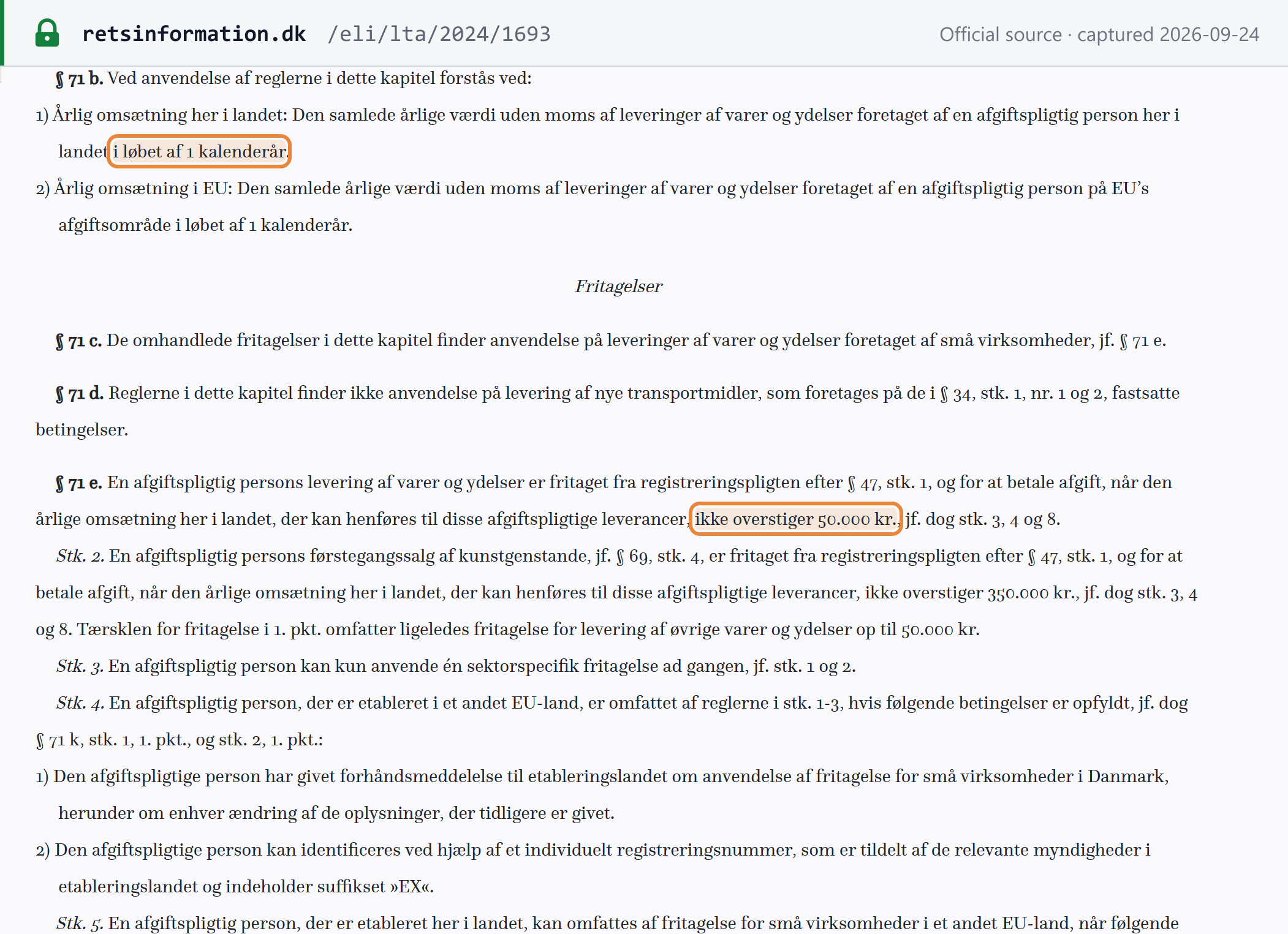
DKK 50,000, measured per calendar year ("i løbet af 1 kalenderår", momsloven § 71 b, nr. 1), for businesses established in Denmark (momsloven § 71 e, stk. 1, as inserted by Lov nr. 1693/2024). Below this figure a Danish-established business need not register — but registration is always required, regardless of turnover, for a Danish business that supplies new means of transport to another EU country. [1] The Danish Business Authority's own guidance states the deadline plainly: if you know your sales will exceed DKK 50,000, you must register no later than 8 days before you start your business. [2]
 Source snapshot captured 2026-09-24 — original
 Source snapshot captured 2026-09-07 — original
Proposed, not law. A consultation draft bill (published 28 August 2026) would raise the threshold to DKK 350,000 for supplies of licences to copyright-protected works of art, from 1 July 2027. It would extend the existing DKK 350,000 limit for first sales of works of art to licences; artists licensing their own works are already exempt, so the change mainly affects third parties such as heirs and collecting societies. The DKK 50,000 threshold above remains the rule in force. See Recent changes.
Non-resident registration
The DKK 50,000 threshold does not apply to non-EU businesses. A business established in another EU member state with an EX number can use the exemption (momsloven § 71 e, stk. 4, Lov nr. 1693/2024); only non-EU businesses have no threshold: a non-EU taxable person making a taxable supply with a Danish place of supply must register regardless of turnover, unless the customer is made liable for the tax under reverse charge (§ 47, stk. 2, last sentence). [1]
A taxable person established outside the EU, in a country with which Denmark has no mutual-assistance instrument equivalent to the EU's, must register through a person resident in Denmark or a business established in Denmark — a fiscal representative — and the representative and the foreign business are jointly and severally liable for the VAT (§ 47, stk. 2 and § 46, stk. 8). The same representative requirement applies where the foreign business makes intra-EU acquisitions of goods. [1]
Tax registration number
The Danish VAT number is the CVR number (for Danish-established entities) or the SE-nummer (typically for foreign businesses without a Danish establishment), each 8 digits, prefixed DK for the EU VAT identifier (e.g. DK28866984). For the full format, checksum and worked examples, see our Denmark TIN guide, and use the Denmark CVR validator or how to verify a CVR number to check one.
How to register
Danish-established businesses register through Erhvervsstyrelsen's Start Virksomhed / Virk.dk portal, which issues the CVR number; VAT registration is completed as part of the same process. Foreign businesses without a Danish establishment register directly with Skattestyrelsen. Once registered, the business receives a password for TastSelv Erhverv (or E-tax for businesses), which must be activated within 30 days, and is used for filing and payment. [2]
Voluntary registration
Available. A Danish-established business below the DKK 50,000 threshold may choose to register — Erhvervsstyrelsen's own guidance states plainly that below the threshold, registering is "up to you." A voluntarily registered business must charge, declare and pay VAT like any other registered business, even while under the threshold — it may be worth it to recover input VAT on costs. [2]
Deregistration
A business must notify Skattestyrelsen within 8 days of ceasing taxable activity (momsloven § 47, stk. 7); official guidance frames this the same way — deregister within 8 days of stopping, and the same VAT number can be reissued if the business resumes later. [1] [2] Deregistration has a cash consequence: selling the business's remaining assets, or simply deregistering while holding assets on which input tax was deducted, is treated as a deemed taxable supply (§ 8), and any capital-goods adjustment period still running on equipment, real property or work on real property (5 years for equipment/services, 10 years for real property, under §§ 43–44) is accelerated — the remaining adjustment is due at deregistration rather than spread over the rest of the period.
Group registration
Available (fællesregistrering). Under momsloven § 47, stk. 4, two or more taxable persons that carry on exclusively registrable business may, on request, be registered as one for VAT purposes. Skattestyrelsen may also permit a group to include entities with no VAT-registrable activity, but only where one entity (the parent) owns, directly or indirectly, all the shares in the others, and all members are established in Denmark. The application must be made at least 1 month before the group registration is to start. [1]
Rates
| Rate | Legal basis | Applies to |
|---|---|---|
| 25% standard | momsloven § 33 | Everything not covered by an exemption or the 0% rate below — in force since 1 January 1992. |
| 0% (true zero rate) | momsloven § 34, stk. 1, nr. 18 | Newspapers, including electronic newspapers, published at least once a month. |
| Exemption with credit | momsloven § 34 (other items) | Exports outside the EU, intra-EU supplies to VAT-registered EU customers, and other listed transactions — economically equivalent to zero-rating (VAT-free with input recovery preserved), but structured in the Act as an exemption rather than a rate. |
Denmark has essentially no reduced rate. Unlike almost every other EU member state, Denmark did not adopt a reduced-rate band under the EU VAT Directive: food, books, restaurant meals, hotel accommodation, domestic passenger transport and similar categories that carry a reduced rate elsewhere in the EU are all taxed at the full 25% in Denmark. The single true-zero exception is newspapers under § 34, stk. 1, nr. 18. [3]
Rate history. Skattestyrelsen's own legal guidance (Den juridiske vejledning, D.A.9) records the rate as 25% (20% of the VAT-inclusive price) continuously since 1 January 1992, up from 22% between 1980 and 1991. [3]
Announced future rates — the books zero-rating that lapsed
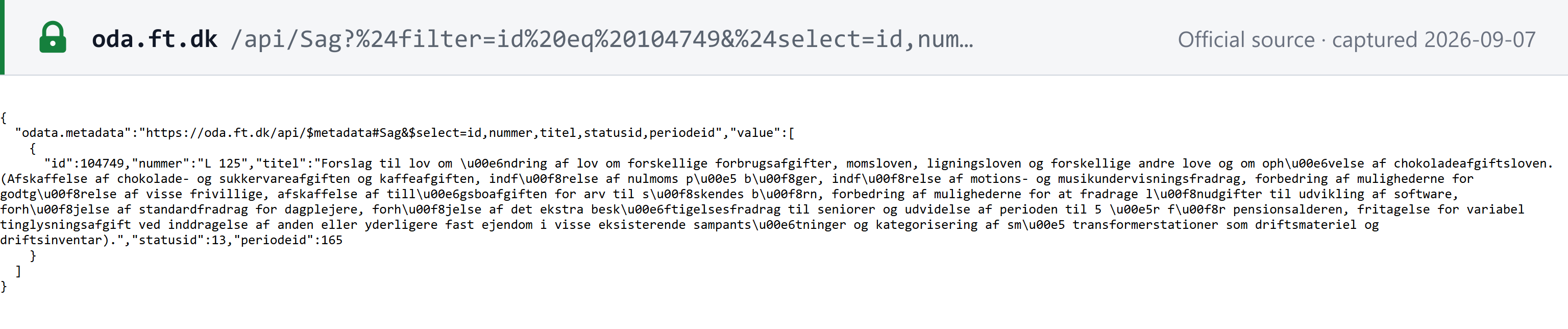
Do not cite this as current or upcoming law. A government bill, Lovforslag L 125 (Folketinget, session 2025-26, 1. samling), was presented ("fremsat") on 25 February 2026. Among other things it would have inserted a 0% VAT rate on books into § 34, stk. 1, nr. 18, alongside newspapers, to take effect 1 July 2026. The Prime Minister called a general election the day after the bill was presented; under Danish parliamentary procedure, every bill not yet passed lapses (bortfalder) when an election is called. L 125 lapsed with the rest of that legislative package and was never enacted. As of 2026-09-07 we found no re-introduced bill on this topic in the new Folketing. Books remain taxed at the standard 25% rate. [4] [4a] (ft.dk blocks automated requests; Folketinget's own open-data API records case 104749 with status Bortfaldet — lapsed — and no lovnummer, confirming it was never enacted.)
 Source snapshot captured 2026-09-07 — original
We could not fetch ft.dk directly (it returns HTTP 403 to automated requests), so this account rests on the bill's own official title and metadata as indexed, cross-checked against contemporaneous professional reporting (Deloitte, BDO, FSR and Grakom all describe the same sequence — L 125 presented 25 February 2026, election called 26 February 2026, bill lapsed). We did not find a source contradicting this.
Cross-border rules
Imports and exports
Imports. VAT on goods imported from outside the EU is payable by the importer (momsloven § 46, stk. 6), assessed by Toldstyrelsen (the Danish Customs Agency) at the point of import, based on the customs value.
Exports. Goods supplied by a Danish business (or on its behalf) to a place outside the EU are exempt with credit (momsloven § 34, stk. 1, nr. 5) — VAT-free, with input tax recovery preserved, economically equivalent to zero-rating.
Intra-EU supplies. A supply of goods dispatched to a VAT-registered business in another EU country is likewise exempt with credit (§ 34, stk. 1, nr. 1).
Reverse charge on imported services
Under momsloven § 46, stk. 1, nr. 3, where a business established here receives services covered by § 16, stk. 1 (the general B2B place-of-supply rule) from a supplier not established in Denmark, the Danish recipient — if a registered business or a VAT-registered non-taxable legal person — must self-account for the VAT. Use of reverse charge is mandatory even if the foreign supplier happens to hold a Danish VAT number (§ 46 a). [1]
Digital products and services
Electronically supplied services, telecommunications and broadcasting services follow the EU place-of-supply rules: B2B supplies are taxed where the business customer is established (general rule, reverse-charged if the supplier is foreign); B2C supplies are taxed where the private consumer is located. A foreign supplier of these B2C services can avoid registering in every EU country by using the OSS (One Stop Shop) — see below. Below a combined EUR 10,000 per calendar year (net), a business established in only one EU member state may still apply its home-country VAT rate instead of the customer's; above that figure, the destination country's rate applies from the first euro. [5]
Foreign companies selling in — B2B and B2C
These are answered very differently and should not be conflated:
- B2B. A foreign business supplying services to a Danish VAT-registered customer generally does not need to register — the reverse charge under § 46, stk. 1, nr. 3 shifts the liability to the customer, and § 47, stk. 2 expressly relieves the foreign supplier of the registration duty "to the extent the recipient is made liable to pay." Supplies of goods are different: a foreign business making a taxable supply of goods with a Danish place of supply, where the Danish business does not self-account, still needs Danish registration.
- B2C. There is no reverse charge available against a private consumer, so a foreign business making a taxable B2C supply with a Danish place of supply must generally register and charge Danish moms itself, from the first supply — subject to the EUR 10,000 combined EU threshold and the OSS scheme for qualifying digital services and intra-EU distance sales of goods.
Marketplace and platform deemed-supplier liability
Denmark, as an EU member state, applies the EU's electronic-interface deemed-supplier rule (Article 14a of the VAT Directive 2006/112/EC, as amended by Directive (EU) 2017/2455): an online marketplace that facilitates certain B2C sales — low-value goods (≤ EUR 150) imported from outside the EU, and EU-to-EU sales of goods by a non-EU seller — is treated as if it had itself received and supplied the goods, and must account for the VAT. We did not independently confirm the specific Danish momsloven section implementing this EU rule; it applies in Denmark as a directly-transposed EU-wide rule regardless. [5]
Place of supply
Goods (momsloven, kapitel 4): generally, where transport to the customer begins, or where the goods are located if not transported, subject to distance-selling and installation-and-assembly special rules. Services: the general B2B rule taxes the supply where the business customer is established; the general B2C rule taxes it where the supplier is established, with listed exceptions — electronically supplied, telecommunications and broadcasting services to consumers are taxed where the consumer is located. [1]
Invoice requirements
Mandatory content
Momsbekendtgørelsen (the VAT executive order) § 58, stk. 1 requires every invoice (including a self-billed afregningsbilag) to contain: [6]
| # | Required field |
|---|---|
| 1 | Date of issue |
| 2 | A sequential number, built on one or more series, identifying the invoice |
| 3 | The registered business's (seller's) registration number |
| 4 | The registered business's and the buyer's name and address |
| 5 | The quantity and nature of the goods, or the scope and nature of the services, supplied |
| 6 | The date of supply or completion, or the date an instalment is paid, if that date is fixed and differs from the issue date |
| 7 | The taxable amount, unit price excluding tax, and any discounts, bonuses or rebates not already included in the unit price |
| 8 | The applicable tax rate |
| 9 | The amount of tax payable |
Any document or notice that specifically and unambiguously amends or refers to the original invoice is itself treated as an invoice (§ 58, stk. 2).
Issuance deadline
Momsloven § 52a requires an invoice for every supply of goods or services, and a separate invoice for any advance payment, but sets no fixed number of days after the supply for purely domestic invoices — we checked and found no such general deadline in the Act. A specific deadline does apply to cross-border cases: an invoice for an exempt intra-EU supply of goods, or for a cross-border B2B service where the customer accounts for the tax under § 16, stk. 1, must be issued no later than the 15th day of the month following the month of supply (momsloven § 52b). [1]
Numbering and sequencing
The invoice number must be sequential, built on one or more series, sufficient to identify the invoice — the executive order does not prescribe a single unbroken series or a particular format (momsbekendtgørelsen § 58, stk. 1, nr. 2). [6]
Credit and debit notes
Danish VAT law has no separately named "credit note" instrument distinct from the general correction rule: any document or notice that specifically and unambiguously amends or refers to the original invoice counts as an invoice (momsbekendtgørelsen § 58, stk. 2). Momsloven § 52a, stk. 5 requires a kreditnota where goods are returned or the supplier later reduces the price after the invoice was issued, and a further invoice where a later additional payment is due. [1] [6]
Currency and language
An invoice may state amounts in any currency, provided the VAT amount itself is also shown in Danish kroner or euro (momsbekendtgørelsen § 97, stk. 2). Bookkeeping itself may be kept in DKK, EUR, or another foreign currency relevant to the business under the Bookkeeping Act. The conversion rate is the latest published rate at the time the tax point arises; a business may use the European Central Bank's DKK/EUR rate, or the customs rate as an alternative, and its choice is binding for at least 2 years. [6] Skattestyrelsen may, for control purposes, require an invoice to be translated into Danish where the place of supply is Denmark or the recipient is Danish-established (momsbekendtgørelsen § 71).
Document types
- Standard invoice — momsbekendtgørelsen § 58 particulars, above.
- Simplified invoice — for supplies of DKK 3,000 or less, or for a document that amends or refers to the original invoice under § 58, stk. 2, a business may issue a simplified invoice showing: issue date; sequential number; the seller's registration number, name and address; the quantity and nature of the goods/services; the total amount and the tax payable, or the information needed to calculate it — e.g. a statement that tax is 20% of the total; and, for an amending document, a specific and unambiguous reference to the original invoice (momsbekendtgørelsen § 66, stk. 1).
- Cash-register receipt (kassebon) — retailers selling mainly to private consumers may issue a simplified invoice or cash-register receipt instead of a full invoice, subject to further conditions and thresholds in § 66.
- Self-billing (afregningsbilag) — see below.
Self-billing
Permitted. The customer may issue the invoice (afregningsbilag) on the supplier's behalf where the parties have a prior agreement setting out a procedure under which the supplier approves each invoice (momsloven § 52a, stk. 3). The self-billed document must meet the same content requirements as an ordinary invoice, must carry the words "selvfakturering" or "self-billing," and must state the buyer's registration number (momsbekendtgørelsen § 70). [1] [6]
Retention and audit trail
5 years from the end of the accounting year the material relates to, for accounting records generally (Bookkeeping Act § 12) and for VAT invoices and accounting material specifically (momsbekendtgørelsen § 92, stk. 1) — this applies even to businesses below the DKK 50,000 registration threshold. Retail cash-register slips need be kept only 1 year from signing the annual accounts. Records supporting a capital-goods adjustment on real property must be kept 10 years from the acquisition or improvement work (§ 92, stk. 3), and records for the OSS special schemes must be kept 10 years from the end of the year of the transaction (momsloven § 66h). [6]
An invoice, paper or electronic, must have its authenticity of origin, integrity of content, and legibility assured from issue until the end of the retention period (momsbekendtgørelsen § 68, stk. 1); a business decides for itself how to secure this, but the Bookkeeping Act's transaktionsspor (transaction trail, linking each entry to the year-end accounts) and kontrolspor (audit trail, linking each entry to its supporting voucher) requirements apply in parallel (Bookkeeping Act §§ 8–9). Any correction to a voucher must leave both the original content and the change clearly visible.
A specimen of a compliant invoice
No Danish authority publishes an annotated specimen invoice — momsbekendtgørelsen § 58 lists the required particulars but does not fix a layout. The sheet below is built by LookupTax to show where each particular sits; every name, number and figure is fictional.
Faktura — invoice
| Varens/ydelsens artnr. 5 | Mængde | Enhedspris ekskl. moms | Momssats | Beløb ekskl. moms |
|---|---|---|---|---|
| Kontorreoler, model Fjord | 8 stk. | 1.450,00 kr. | 25 % | 11.600,00 kr. |
| Montering på adressen | 6 timer | 650,00 kr. | 25 % | 3.900,00 kr. |
- Beløb ekskl. momsnr. 7
- 15.500,00 kr.
- Moms (25%)nr. 8–9
- 3.875,00 kr.
- Beløb inkl. moms
- 19.375,00 kr.
- Below DKK 3,000, or for a document that only amends or refers to the original invoice, a simplified invoice under momsbekendtgørelsen § 66 may be used instead — see Document types above.
- A self-billed invoice (afregningsbilag) must carry "selvfakturering" or "self-billing" and the buyer's registration number (§ 70) instead of the seller preparing the document.
- For a cross-border reverse-charge service to another EU country, the invoice must instead state that the customer accounts for the tax, e.g. "omvendt betalingspligt, køber afregner momsen" or "reverse charge, buyer settles the VAT" (§ 62), with no Danish VAT rate or amount shown.
- Newspapers taxed at the 0% rate (§ 34, stk. 1, nr. 18) would show "0%" in the rate column rather than 25% — this specimen is an ordinary standard-rated domestic supply.
E-invoicing status
As of 2026-09-30, Denmark has a long-standing B2G mandate and no B2B or B2C mandate. Digital bookkeeping systems must be able to send and receive e-invoices, and since 29 September 2026 registered systems must enrol their customers in e-invoicing by default. For the full picture, see our Denmark e-invoicing guide.
- B2G — mandatory. Denmark has required electronic invoicing to public-sector customers since 2005, run through Nemhandel, the Danish e-invoicing infrastructure, using the Danish OIOUBL format alongside the pan-European Peppol BIS 3.0 format (the two networks are interoperable). Recipients — public or private — register in the Nemhandelsregistret (NHR), identified by CVR number, SE-nummer or GLN. [7]
- B2B — no general statutory mandate. There is no law requiring every B2B invoice to be sent as a structured e-invoice through Nemhandel or Peppol. The VAT executive order still lets a business issue electronic invoices only to a recipient that accepts them (momsbekendtgørelsen, BEK nr. 1435/2023, § 68, stk. 4). [6]
- Digital bookkeeping is a related but separate requirement. The Bookkeeping Act (Lov om bogføring, LOV nr. 700 af 24. maj 2022) requires a business that must file an annual report, or whose net turnover exceeds DKK 300,000 in two consecutive income years, to keep its books in a digital bookkeeping system that is either registered with Erhvervsstyrelsen or independently meets the Act's requirements (§§ 15–16). Those requirements include the system supporting automatic sending and receipt of e-invoices (§ 15, stk. 1, nr. 3) — the software must be e-invoicing-capable, which is not the same as every invoice being legally required to travel through Nemhandel. Businesses that do not file an annual report join this requirement under BEK nr. 297/2025, in force 1 January 2026, from their first financial year after that date, if net turnover exceeded DKK 300,000 in two consecutive income years. [8] [12]
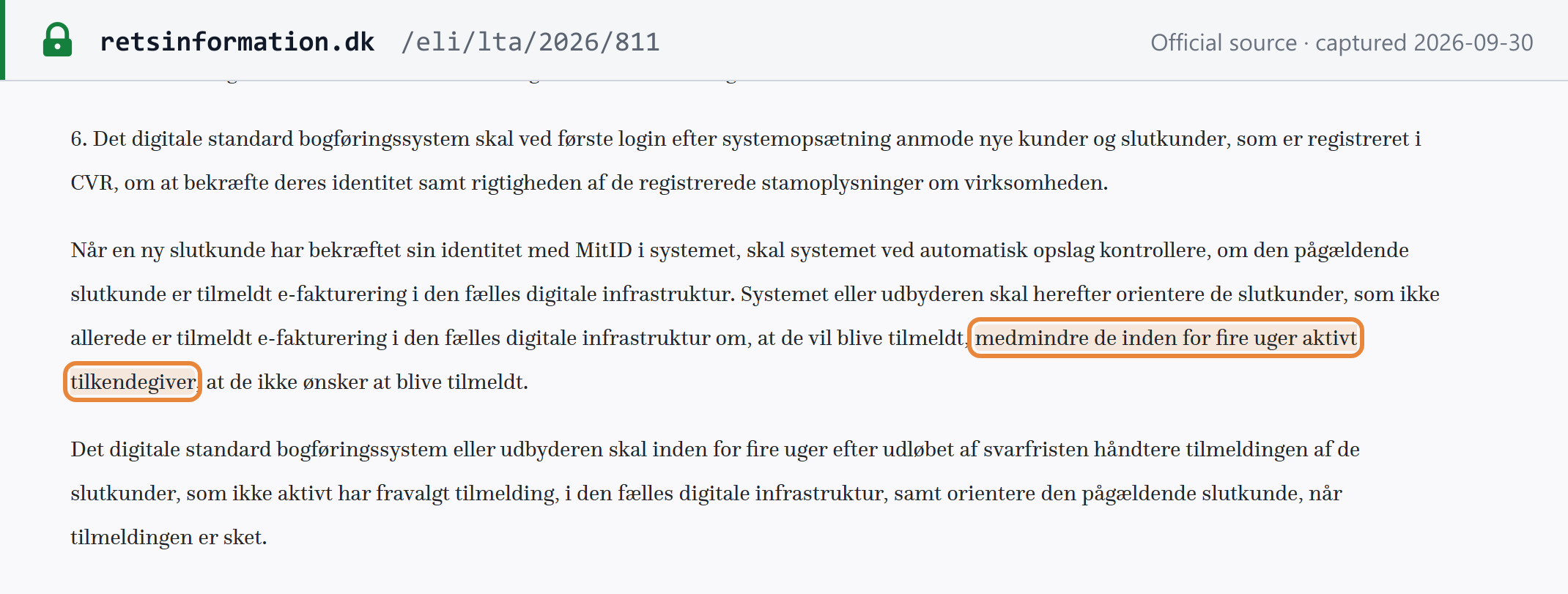
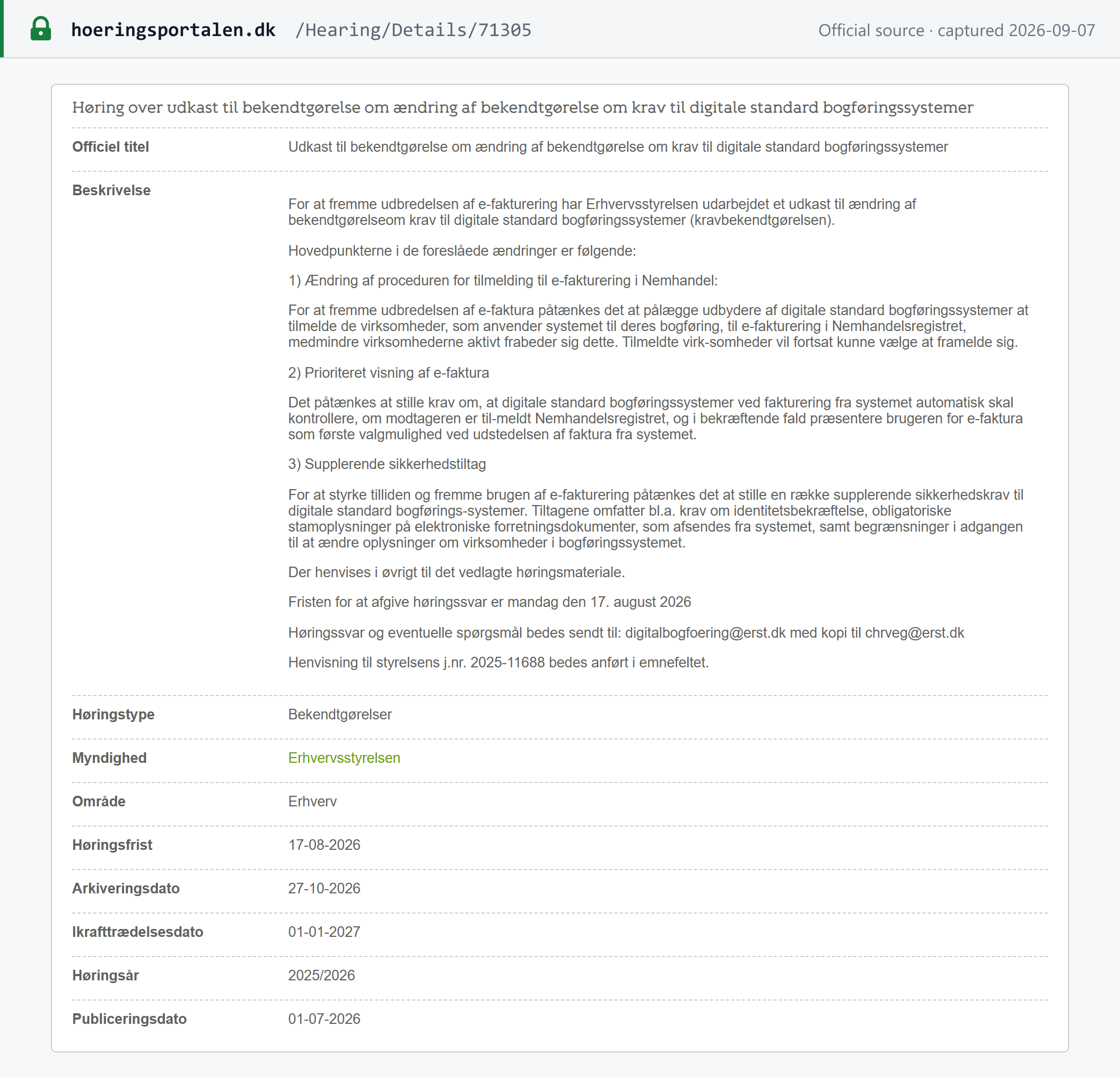
- Default enrolment is now in force. BEK nr. 811/2026, published on 28 September 2026 and in force on 29 September 2026, requires providers of registered digital bookkeeping systems to tell customers not already enrolled that they will be enrolled in e-invoicing unless they actively opt out within four weeks, and to enrol them within four weeks after that deadline. Existing customers go through this after the MitID identity check that applies from 1 March 2027; locked sender data from CVR follows on 1 January 2028. When a user invoices manually, the system must clearly alert the user if the recipient is registered in Nemhandelsregistret and can receive an e-invoice. Enrolment does not oblige a business to use only e-invoices. The rule was consulted on from 1 July to 17 August 2026 (hearing 71305), when the planned start was 1 January 2027. [11] [10]
- Format. OIOUBL 2.1 (Danish native XML standard) and Peppol BIS 3.0, both routed through Nemhandel/Peppol.
- Scope. B2G mandatory; B2B and B2C voluntary.
 Source snapshot captured 2026-09-30 — original
 Source snapshot captured 2026-09-07 — original
Filing and payment
Filing frequency
Set by momsloven § 57, based on the business's total taxable supplies over the year: [1]
| Annual taxable supplies | Period | Return due |
|---|---|---|
| More than DKK 50 million | Monthly | 25th of the following month (for June: 1 month and 17 days after period-end) |
| More than DKK 5 million, up to DKK 50 million | Quarterly | 1st of the third month after the quarter ends |
| DKK 5 million or less | Half-yearly (1st/2nd half of the calendar year) | 1st of the third month after the half-year ends |
A newly registering business is placed on the quarterly period by default, unless its expected annual taxable supplies exceed DKK 55 million, in which case it is registered monthly from the outset (§ 47, stk. 6). A business may apply to move to a shorter period than its turnover requires; a change to a longer period takes effect only from 1 January following a full 12-month period of on-time filing and payment, and a business that changes period cannot request another change for 2 years.
Return due date
See the table above — due dates run from the end of the VAT period, not from a fixed calendar date, and differ by period length.
Payment due date and method
Payment is due by the same date as the return, made electronically through TastSelv Erhverv.
Additional listings
A registered business supplying goods or services to another EU country where the customer accounts for the tax on services under § 16, stk. 1 must submit periodic EU sales lists to Skattestyrelsen (momsloven § 54). Businesses using the OSS special schemes file a separate quarterly OSS return, due by the end of the month following the end of the calendar quarter — 30 April for Q1, and so on — regardless of whether any qualifying supply was made in the period (§ 66 g). The older "within 20 days" deadline belonged to the pre-July-2021 MOSS regime and no longer applies.
Input-tax recovery and blocked items
Input VAT is generally deductible where goods or services are used for the business's taxable supplies. Deduction is denied for VAT on: gifts (beyond a de-minimis amount); guest accommodation for staff, holiday homes and similar; entertainment, restaurant services, representation and gifts generally; and the acquisition and running of passenger cars designed to carry 9 people or fewer — subject to a partial 25% deduction on restaurant costs that are strictly business-related, and to specific partial-deduction rules for leased passenger cars used at least 10% for taxable business purposes. [1]
Refunds
Where deductible input VAT exceeds output VAT for a period, the excess is refunded. Foreign businesses not registered in Denmark can recover Danish VAT on costs incurred here through the EU cross-border refund mechanism (for EU-established claimants) or an equivalent non-EU refund procedure, subject to reciprocity. We did not independently verify the current processing-time figures for Danish VAT refunds and omit them here rather than repeat an unsourced number.
Exemptions
Exempt supplies
Momsloven § 13 exempts a long, closed list of supplies from VAT, including: hospital treatment and medical practice (including dental care); social welfare and childcare/eldercare services; school and further education; qualifying non-profit membership and sports-body activities; cultural activities (libraries, museums, zoos); authors' and artists' own creative work; letting and leasing of real property (with exceptions for hotels, short lets, camping/parking/advertising space and storage boxes); most sales of existing real property (new buildings and building land are not exempt); insurance and reinsurance; core financial services (lending, payments, currency, securities, fund management); lotteries and gambling; universal postal services; stamps at face value; passenger transport; funeral-related services; charitable events and charity-shop sales meeting specified conditions; and investment gold. [1]
Exempt is not zero-rated
An exempt supply under § 13 carries no right to deduct input VAT on costs used to make it. This is different from the 0% rate on newspapers, or the exemption-with-credit treatment of exports and intra-EU supplies under § 34, both of which preserve full input-tax recovery. A business making both exempt and taxable supplies must apportion input VAT between them.
Special regimes
- Group registration (fællesregistrering) — see Registration.
- Voluntary registration below the DKK 50,000 threshold — see Registration.
- OSS/IOSS — see Cross-border rules and Filing and payment.
- Margin scheme for used goods, art, antiques and collectors' items — momsloven, kapitel 17, taxes only the dealer's margin rather than the full sale price; we did not verify further detail for this guide.
- Free zones and customs/excise warehousing — goods held in the Copenhagen Freeport, a customs warehouse or an excise warehouse can be supplied without VAT becoming due at that point (§ 34, stk. 1, nr. 19, and the registration exclusion in § 47).
Offences and penalties
Offences
Momsloven § 81 makes it an offence, where committed intentionally or through gross negligence, to: give false or misleading information, or withhold information, relevant to VAT control; breach specified registration, invoicing, accounting, filing or notification provisions; miss the filing deadlines under § 62; fail to notify or breach the notification deadline for new-means-of-transport sales under § 65; issue a deliberately false invoice or other false supporting documentation capable of being used as the basis for a VAT return; or knowingly buy goods or services on terms indicating the supplier will not account for the VAT. Deliberate evasion, and carrying on registrable business after registration has been refused or withdrawn, carry a fine or imprisonment of up to 1 year and 6 months, unless a heavier penalty applies under the Criminal Code § 289. [1]
Penalties
- Failure to comply with a formal order (e.g. to remedy a registration breach) — Skattestyrelsen may impose daily fines of at least DKK 1,000 per day until the order is complied with (§ 77).
- A fee of DKK 65 applies to reminder letters for a business's failure to submit EU sales lists (§ 54, stk. 3).
- Intentional or grossly negligent evasion, false invoicing, or trading with a supplier known to be evading VAT — fine or imprisonment up to 1 year and 6 months, unless a heavier Criminal Code penalty applies (§ 81, stk. 3–5).
- We did not independently verify a separate, general late-registration or late-filing administrative penalty schedule (as distinct from the criminal offences above) for this guide and omit specific figures rather than repeat an unsourced number; check current guidance from Skattestyrelsen before relying on a specific late-filing fee.
Frequently asked questions
Does Denmark have a reduced VAT rate for food, books, or children's items?
No. Denmark is one of the few EU countries with essentially no reduced VAT rate — momsloven § 33 sets a single 25% rate that applies uniformly to almost all goods and services, food and children's items included. The only exception is a true 0% rate under § 34, stk. 1, nr. 18, for newspapers published at least once a month, including electronic newspapers — inserted into the Act to support the newspaper industry, not part of a general reduced-rate band. Do not confuse this with an EU-permitted reduced rate: Denmark chose not to adopt one at all.
I heard Denmark was about to zero-rate books — can I already sell VAT-free books there?
No — that bill lapsed, and books remain taxed at the standard 25% rate. Lovforslag L 125 (2025-26, 1. samling), which would have added a 0% rate on books to § 34, stk. 1, nr. 18, was presented to the Folketing on 25 February 2026. The Prime Minister called a general election the next day, and under Danish parliamentary procedure every bill not yet passed lapses when an election is called — L 125 lapsed with the rest of its legislative package. The proposed rate, which would have taken effect 1 July 2026, never became law. If you see L 125 cited as authority for zero-rated books, it describes a lapsed proposal, not current law.
Do I need to register for Danish moms as a small non-resident business selling into Denmark?
Almost certainly yes, and immediately — unless you are established in another EU member state and hold an EX number, the DKK 50,000 threshold does not apply to you. Momsloven § 71 e, stk. 1 exempts a business from registering while its annual Danish turnover, counted per calendar year (§ 71 b, nr. 1), does not exceed DKK 50,000, and § 71 e, stk. 4 lets a business established in another EU member state that holds an EX number use the same exemption; non-EU businesses have no such threshold. [Lov nr. 1693/2024] A non-resident business making taxable B2C supplies with a Danish place of supply must register from its first supply, unless a reverse-charge mechanism or a special scheme such as OSS applies. B2B services to a Danish VAT-registered customer are usually reverse-charged instead, so registration turns on whether your customer is a registered business or a private consumer.
I'm a non-EU company selling into Denmark — do I need a Danish fiscal representative?
It depends on where you are established. Momsloven § 47, stk. 2 requires a taxable person established outside the EU, in a country with which Denmark has no mutual-assistance instrument equivalent to the EU's, to register through a person resident in Denmark or a business established in Denmark — a fiscal representative, in effect, jointly and severally liable for the VAT with you. The same requirement applies if you make intra-EU acquisitions of goods. It does not apply where your Danish customer is made liable for the VAT instead (reverse charge), and businesses established in the EU, or in a country with an equivalent mutual-assistance agreement, register directly with no representative needed.
Denmark's 2026 e-invoicing changes — is NemHandel now mandatory for my B2B invoices?
No, and two separate things are being conflated here. First, the Bookkeeping Act (LOV nr. 700 af 24. maj 2022) requires businesses that must file annual reports, or whose net turnover exceeds DKK 300,000 in two consecutive income years, to keep their books in a digital bookkeeping system — businesses without an annual-report duty join this under BEK nr. 297/2025, in force 1 January 2026. That system must be capable of sending and receiving e-invoices automatically, but the Act does not force every B2B invoice through Nemhandel. Second, BEK nr. 811/2026, in force 29 September 2026, requires providers of registered bookkeeping systems to enrol their customers in e-invoicing unless they opt out within four weeks; existing customers go through this after the MitID identity check that applies from 1 March 2027. Enrolment does not oblige a business to send or accept only e-invoices, and the VAT executive order (BEK nr. 1435/2023, § 68) still lets a business issue electronic invoices only to a recipient that accepts them. Denmark's hard mandate is for the public sector (B2G) only, in place since 2005. See our Denmark e-invoicing guide.
Important websites
| Site | Purpose |
|---|---|
| Skattestyrelsen — skat.dk | Rates, guidance, VAT registration for foreign businesses, TastSelv Erhverv login |
| TastSelv Erhverv / E-tax for businesses | File VAT returns, view and pay assessments |
| Erhvervsstyrelsen / Virk.dk — Start Virksomhed | Register a Danish business and obtain a CVR number |
| Business in Denmark | Plain-English guidance for foreign businesses on registering, filing and paying Danish VAT |
| Det Centrale Virksomhedsregister (CVR lookup) | Free lookup and verification of a Danish CVR number |
| Nemhandelsregistret (NHR) | Register to send or receive e-invoices via Nemhandel/Peppol |
| Toldstyrelsen | Customs and import VAT |
| EU VIES | Verify a Danish (or any EU) VAT number for cross-border transactions |
Recent changes
Dated, officially-sourced developments in Danish VAT and related compliance rules. Items with an event record link to it; the others are cited directly to their official sources. Bills and consultation drafts are listed for tracking only and are not law.
- 2026-09-29 — BEK nr. 811/2026 entered into force (published 28 September 2026): providers of registered digital bookkeeping systems must enrol customers in e-invoicing unless they opt out within four weeks; MitID identity checks from 1 March 2027. E-invoicing stays voluntary for B2B. See the Denmark e-invoicing guide. (retsinformation.dk)
- 2026-08-28 — Consultation draft bill (Skatte- og Vækstministeriet, J.nr. 2025-5042) to implement parts of the ViDA Directive: from 1 January 2027 until other rules take effect on 1 July 2028, supplies of gas, electricity and cooling would be treated as distance sales of goods, so a supplier could use a single One Stop Shop registration. A draft, not law; comments were due 25 September 2026. (event record, høringsportalen.dk)
- 2026-08-28 — The same draft bill would narrow the exemption for goods and services supplied in close connection with an exempt activity where the supply competes directly with VAT-liable businesses, and extend the margin scheme to works of art bought with VAT, proposed from 1 January 2027. A draft, not law. (event record, høringsportalen.dk)
- 2026-08-28 — The same draft bill would raise the VAT registration threshold for supplies of licences to copyright-protected works of art from DKK 50,000 to DKK 350,000, proposed from 1 July 2027. A draft, not law; the current DKK 50,000 threshold stays in force. (event record, høringsportalen.dk)
- 2026-07-01 — Erhvervsstyrelsen consulted (until 17 August 2026) on a draft amendment to the executive order on digital standard bookkeeping systems, under which providers would register business users for e-invoicing in the Nemhandel register unless they opt out; the hearing page gave 1 January 2027 as the proposed start. This was superseded by BEK nr. 811/2026, in force 29 September 2026 (see above). (event record, høringsportalen.dk)
- 2026-03-24 — New Folketing convened following the 2026 Danish general election, called on 26 February 2026 — the event that caused L 125 (the bill that would have zero-rated books) to lapse. (ft.dk)
- 2026-02-25 — Lovforslag L 125 (2025-26, 1. samling) presented, including a proposed 0% VAT rate on books — lapsed the following day when the election was called, and never enacted. (ft.dk)
- 2026-01-01 — BEK nr. 297/2025 entered into force: businesses without an annual-report duty, with net turnover exceeding DKK 300,000 in two consecutive income years, become subject to the Bookkeeping Act's digital-bookkeeping requirement from their first financial year after that date. (retsinformation.dk)
Reference links
- Momsloven — Bekendtgørelse af lov om merværdiafgift (retsinformation.dk, kept current)
- Momsbekendtgørelsen — BEK nr. 1435 af 29/11/2023 om merværdiafgift (retsinformation.dk)
- Lov om bogføring — Bookkeeping Act, LOV nr. 700 af 24/05/2022 (retsinformation.dk)
- Skattestyrelsen — Den juridiske vejledning, D.A.9 Momssatsen ML § 33
- BEK nr. 297 af 20/03/2025 — digital bookkeeping for businesses without an annual-report duty (retsinformation.dk)
- BEK nr. 811 af 22/09/2026 — default enrolment in e-invoicing (retsinformation.dk)
- Erhvervsstyrelsen — public hearing on digital bookkeeping systems amendment (draft stage)
- Lookuptax — Denmark e-invoicing guide (Nemhandel, OIOUBL, Peppol)
- Folketinget — L 125, 2025-26, 1. samling, som fremsat
- Business in Denmark (Erhvervsstyrelsen) — register and pay VAT
- Nemhandel — Nemhandelsregistret (NHR) guidance
- European Commission — VAT One Stop Shop
- Lookuptax — Denmark TIN guide (CPR, CVR, SE-nummer)
- Lookuptax — how to verify a Danish CVR number
For Danish tax identifiers, see our Denmark TIN guide. To verify a Danish CVR/VAT number, see how to verify a CVR number in Denmark or use our Denmark CVR validator. For EU-wide cross-border verification, see our EU VAT verification guide.