Egypt VAT guidelines
| FACTSHEET | |
|---|---|
| Country code | EG |
| Tax name | Value Added Tax (VAT) — الضريبة على القيمة المضافة |
| Tax Authority | Egyptian Tax Authority (ETA) — مصلحة الضرائب المصرية |
Overview
Egypt levies Value Added Tax (VAT) — الضريبة على القيمة المضافة — under Law No. 67 of 2016 ("قانون رقم ٦٧ لسنة ٢٠١٦ بإصدار قانون الضريبة على القيمة المضافة"), administered by the Egyptian Tax Authority (ETA) — مصلحة الضرائب المصرية. All values in this guide are in Egyptian Pounds (EGP). [1]
Layering. Egyptian VAT is a single national tax — there is no state, provincial or municipal VAT layer. But "layering" matters here in a different sense that a general guide easily misses: Egypt charges a second, separate tax — the schedule tax (ضريبة الجدول) — on specific goods and services, on top of ordinary VAT. The schedule tax is due once, at first sale, performance or import, "without prejudice to" VAT itself, meaning both can apply to the same transaction — and, critically, the schedule tax is not creditable as input VAT. See Rates for the mechanics and current items, and Exemptions for how this differs again from an exempt or zero-rated supply. [1]
Law 67/2016 is a layered instrument; cite it as amended. The current text reflects amendments by, in sequence: 66/2017 (Executive Regulations), 208/2017, 329/2017 (regs), 13/2020, 3/2022, 24/2023 (regs), 177/2023, 157/2025, MoF Decision 417/2025 (regs) and Law 149 of 2026 — the current amending law, published in Official Gazette Issue No. 30 bis (a) of 28 July 2026. Procedure, invoicing and penalties for tax administration generally sit in a separate instrument, the Unified Tax Procedures Law No. 206 of 2020 (in force 20 October 2020), itself amended by Law 211/2020, Law 7/2025 and Law 150/2026. Which VAT Law articles no longer apply. Law 206/2020's issuing law (Article Four) repealed VAT Law Articles 12, 13, 14, 15 (except its second paragraph), 16 (paragraphs 3 and 4), 19, 20, 31 (first paragraph), 34, 35, 48, 50, 51 and 53; the appeals chapter (Articles 55-61, keeping Article 62); Article 63 (first paragraph); Article 64 (except its first two paragraphs); Articles 66, 70, 72 and 73; and items 7, 9 and 11 of Article 68. Law 3/2022 later gave three of those numbers new text: Article 14, now a power for ETA to assess the tax for any period for which no return was filed; Article 31, replaced in full (public bodies remitting schedule tax and 20% of VAT within 10 days); and Article 50, a general-violations fine (see Penalties). So the filing deadline, payment date, registration procedure, bookkeeping and most fines now come from Law 206/2020; the rest of this guide refers back to this list rather than repeating it. A bare citation of the 2016 text understates both the current rate structure and the current schedule-tax items, and overstates procedure rules that no longer apply. [2] [3] [25] [26]
Tax period basis. The operative unit is the monthly tax period used for filing (see Filing and payment); Egyptian VAT has no separate fixed "VAT year" the way corporate income tax has a fiscal year. [1]
Registration
Who should register
Under Article 16, any natural or legal person selling a taxable good or performing a taxable service whose combined sales of taxable and exempt goods and services over the preceding 12 months reaches or exceeds EGP 500,000 must apply to register, within 30 days of reaching that figure. Article 16's first two paragraphs — this threshold rule, and the zero-threshold rule below — are still in force; its paragraphs 3 and 4, on an ETA notice and registration by operation of law, were repealed (see Overview). [1] [25]
The procedure now sits in Article 25 of the Unified Tax Procedures Law 206/2020. A person applies within 30 days of starting the activity or becoming liable. If the application is incomplete, the tax office notifies the applicant, who then has 15 days from that notice to supply the missing data. Where a person does not apply at all, the office registers them on the data it holds and notifies them within 5 working days, without prejudice to criminal liability. Failing to register within the specified period is still an act of tax evasion under VAT Law Article 68(1) (see Offences and penalties). Changes to the registration data must be notified within 30 days of the change (Law 206/2020, Article 28). [3]
 Source snapshot captured 2026-09-20 — original
Zero-threshold categories, regardless of turnover. Article 16 separately requires every importer of a taxable good or service for trading purposes, every exporter, and every distribution agent to register "no matter the size of their transactions" (مهما كان حجم معاملاته) — and the same applies to anyone dealing in schedule (جدول) goods or services. [1]
ETA's own FAQ confirms both halves in plain language, re-checked live on 2026-09-20 against the unchanged answer: "the mandatory VAT registration threshold is EGP 500,000, and on reaching it the taxpayer must register … for schedule goods and services, distribution agents, importers and exporters, there is no registration threshold at all" (حد التسجيل الإلزامي في ضريبة القيمة المضافة هو 500 ألف جنيه، وعند بلوغ هذا الحد يلتزم الممول بالتسجيل … وبالنسبة لسلع وخدمات الجدول ووكلاء التوزيع والمستوردين والمصدرين ليس هناك حد تسجيل). [4]
Registration threshold
| Trigger | Threshold | Measurement period | Notes |
|---|---|---|---|
| Compulsory registration (resident) | EGP 500,000 (Art. 16) | Any preceding 12-month period, taxable + exempt sales combined | 30-day application clock once reached; a non-applicant is registered by the tax office on the data it holds and notified within 5 working days (Law 206/2020, Art. 25). [1] [3] |
| Importers (for trading purposes), exporters, distribution agents | None | — | Register regardless of transaction size. [1] |
| Dealers in schedule (جدول) goods/services | None | — | Register regardless of turnover. [1] |
| Non-resident, remote/digital services | EGP 500,000 | Any 12-month period | See Cross-border rules — except professional/consultancy services, which register from day one. [7] |
Tax registration number
ETA issues a Tax Registration Number (TRN) to every registered person, used on invoices, e-invoicing/e-receipt submissions and filings. No digit-length or checksum specification is stated here: ETA publishes no text setting one out, so any format claim would be unsourced. See Lookuptax's Egypt TIN/TRN guide for the commonly cited format and further detail, and treat any specific digit-length or checksum claim (there or elsewhere) as unverified against an official ETA source unless you can confirm it directly. [19]
How to register
- Resident businesses — application to ETA under Article 16 of the VAT Law and Article 25 of Law 206/2020; ETA's registration and e-services are reached through its taxpayer e-services portal (see Important websites).
- Non-resident remote-service vendors — email the required particulars (entity name, confirmation of foreign-supplier status, home-country registration certificate, correspondence details, and any Mauritius-style local agent's details, where relevant) to ETA's dedicated digital-services mailbox; ETA then issues a TRN/username, and the supplier completes registration on ETA's VAT e-filing portal, directly or through an approved e-Filing Service Centre. ETA issues a registration certificate (Form 3-VAT) and notifies by email within 10 days. A vendor who fails to register is treated as registered by law from the date the threshold was reached. [7]
Voluntary registration
Not confirmed. The sources reviewed for this guide did not surface an ETA text describing a voluntary-registration route below the EGP 500,000 threshold; treated as unconfirmed rather than asserted unavailable.
Deregistration
Two limbs are documented; the resident threshold-reversal procedure is not.
- Final return and timing. Article 68(13) makes it an act of tax evasion to fail to file a final return and pay the tax due in full within six months of the date registration is cancelled — so a final return is required, on a six-month clock. [1]
- Non-resident remote-service vendors. ETA's digital-services guideline provides that a vendor "may apply for cancellation of VAT registration if the registered person ceases to carry on the activity in Egypt", with deregistration taking effect the day after the Deregistration Form is delivered in the ETA portal. [7]
What is not documented here is the procedure for a resident registrant whose turnover falls back below EGP 500,000 — whether deregistration is available on that ground at all, and on what form. (Checked against VAT Law 67/2016 and ETA's published guidance, 2026-09-20.)
Group registration
Not confirmed. No VAT-grouping provision is stated here — VAT Law 67/2016 was not exhaustively checked on this point, so treat it as unconfirmed rather than unavailable. (Checked 2026-09-20.)
Rates
| Rate | Applies to | Effective |
|---|---|---|
| 13% | Standard rate for FY2016/2017 | From Law 67/2016's commencement [1] |
| 14% (standard) | Standard rate from FY2017/2018 onward — the extra percentage point earmarked for social-justice spending | Since FY2017/2018 [1] |
| 5% (exception) | Machinery, equipment and medical devices used in producing a good or rendering a service, excluding buses and passenger cars | Medical devices added by Law 149/2026, effective 29 July 2026 [5] |
| 0% (zero-rated) | Exported goods and services, per conditions in the Executive Regulations | Ongoing [1] |
| Exempt | See Exemptions | Ongoing [1] |
Article 3, as amended by Law 149/2026, reads: "By way of exception, the tax rate on machinery, equipment and medical devices used in producing a good or rendering a service is 5%, excluding buses and passenger cars; devices used for medical purposes are treated as medical devices for this exception" (واستثناء مما تقدم يكون سعر الضريبة على الآلات والمعدات والأجهزة الطبية المستخدمة في إنتاج سلعة أو تأدية خدمة (٥٪)، وذلك عدا الأتوبيسات وسيارات الركوب، وتعد الأجهزة التي تستخدم فى الأغراض الطبية في حكم الأجهزة الطبية فى تطبيق أحكام هذا الاستثناء). The pre-amendment text (enacted 2016) covered only "machinery and equipment used in producing a good or rendering a service" — medical devices were not in the 5% exception before 29 July 2026. [5]
 Source snapshot captured 2026-08-10 — original
Announced future rates. None identified beyond the schedule-tax escalator described below. No change to the 13%/14%/5%/0% rate structure itself is scheduled.
The schedule tax (ضريبة الجدول) — a separate, non-creditable tax layered on top of VAT
This is the single most commonly garbled fact about Egyptian indirect tax in general write-ups, which tend to collapse "14% / 5% / 10%" into one undifferentiated VAT rate list. It is not one. Goods and services listed in the Schedule annexed to the VAT Law bear the schedule tax once, at first sale, performance, or importation, "without prejudice to" VAT itself — both taxes can apply to the same transaction. Article 38: "the schedule tax is due on the goods and services listed in the attached Schedule once, upon the occurrence of their first sale, performance, or importation, without prejudice to the tax due under Part Two of this Law" (تستحق ضريبة الجدول على السلع والخدمات المنصوص عليها فى الجدول المرافق مرة واحدة عند تحقق واقعة بيعها أو أدائها لأول مرة أو استيرادها، وذلك دون الإخلال باستحقاق الضريبة المنصوص عليها فى الباب الثانى من هذا القانون). Article 22 then blocks it from deduction: "the deduction does not apply to: 1 - the schedule tax … 2 - input tax included within cost … 3 - exempt goods and services" (ولا يسرى الخصم … على ما يأتى: ١ – ضريبة الجدول … ٢ – ضريبة المدخلات المدرجة ضمن التكلفة. ٣ – السلع والخدمات المعفاة). [1]
Current schedule-tax items, after Law 157/2025 (in force 18 July 2025) and Law 149/2026 (in force 29 July 2026):
- Cigarettes — 50% of the final consumer price, plus EGP 5.00-8.00 per packet by price band.
- Trade-name/goodwill component of commercial premises — 10% of value.
- Wine, spirits and beer — EGP 2,800 / 3,600 / 4,800 per hectolitre, by alcohol strength, escalating 15% per year for three years, then 12% per year, fixed by MoF Decision 417/2025 from 1 January 2026.
- Crude petroleum — 10% of value: "16 | crude petroleum | value | 10%" (١٦ | البتـرول الخـام | القيمـة | ١٠٪) — a new item introduced by Law 157/2025.
- Natural gas — EGP 20 per thousand cubic feet — new item 17, introduced by Law 149/2026, effective 29 July 2026.
- Item (9) and two exemption-list items were repealed by Law 157/2025; schedule items 8 and 10 were separately repealed by Law 149/2026.
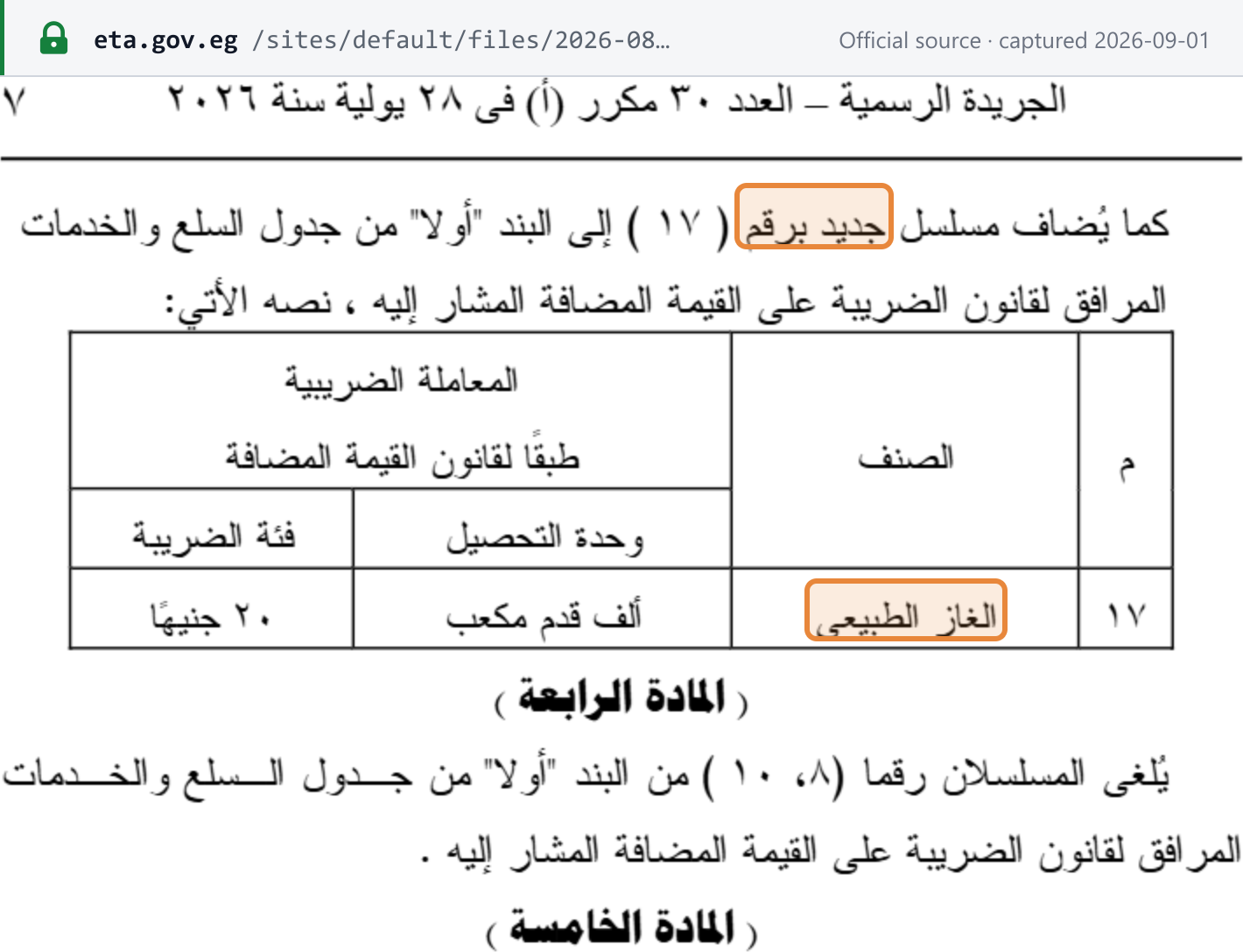 Source snapshot captured 2026-09-01 — original
Law 157/2025 restructured the schedule — cigarettes, trade-name/goodwill, alcohol, crude petroleum and two exemption-list items.
Cross-border rules
Imports and exports
- Exports — zero-rated, per the conditions in the Executive Regulations (see Rates). [1]
- Importers — every importer of a taxable good or service for trading purposes must register regardless of turnover (see Registration). [1]
- De-minimis — not documented in ETA's published texts as at 2026-09-20; not stated rather than guessed.
- Reverse charge on imported services (B2B) — see the dedicated subsection below.
Digital products and services
Non-resident vendors of "remote services" — digital content, apps and software, website design, and legal, accounting or consultancy services supplied without a necessary link between customer location and place of performance — register under a simplified vendor registration regime, introduced by MoF Decision No. 160 of 2023, which published ETA's "Guideline on VAT on digital services and other remote services provided by non-resident persons, first edition." This guide cannot confirm the decision's commencement date — the PDF carries the decree text and signature but no visible date line, and the commonly repeated "22 June 2023" traces to a promotional passage describing a registration deadline, not the decree's commencement; it is not restated here as a commencement date. [8] [7]
The threshold mirrors the domestic EGP 500,000 figure over any 12-month period — except that a non-resident supplying a professional or consultancy service must register from day one, whatever the turnover. ETA's guideline states this directly: "The Threshold under a simplified vendor registration regime is applied for: Remote services sales that exceed the supplier threshold of EGP 500,000 for any period of 12 months. But if the service is a professional and consultancy service, so he should be registered from day one whatever his turnover." No fiscal representative is required: "The non-resident vendor will not be required to have a fiscal representative." A non-resident operating through a permanent establishment in Egypt must not use this regime — it registers under the standard rules instead. [7]
A "person in Egypt" is tested for place-of-supply purposes using a multi-factor rule; a person is not treated as receiving the service in Egypt if the remote service is predominantly used by that person's permanent establishment in another country — a carve-out designed to avoid double taxation for multi-establishment customers. [7]
Foreign companies selling into Egypt — B2B and B2C
The two tracks are answered separately in ETA's own guideline, and it matters which one applies:
- B2B — where the Egyptian customer is a registered taxable person, the reverse charge applies: "the registered taxpayer should apply the reverse charge scheme & he is obligated to provide his tax registration number to the non-resident vendor, and then the resident registered taxpayer shall self-account for VAT on supplies and pay it to the ETA within thirty days from the service supply date." The non-resident vendor does not charge VAT on that transaction and must obtain/verify the customer's tax registration number. [7]
- B2C — where the recipient is not registered, "Non-resident vendor via his own portal or own application to the consumer. In this case, the vendor has to register and remit a VAT (simplified vendor registration regime)" — the non-resident vendor itself must register and remit VAT. [7]
Marketplace / platform deemed-supplier liability
Where a vendor (local or non-resident) sells remote services to a non-registered Egyptian customer through an electronic distribution platform (EDP), the platform is deemed to have rendered the service itself and must collect and account for the VAT — non-resident EDPs use the same simplified vendor regime described above. A narrow carve-out exists where the underlying vendor has agreed in writing to be responsible for the VAT, the receipt names the vendor and the service, and the platform neither authorizes charging nor delivery nor sets the sale terms: "platforms that only process payments, only advertise offers, or only operate as click-through referral platforms" fall outside the deemed-supplier rule. [7]
Fiscal representative
Under the base VAT Law, Article 17 requires a non-resident, non-registered person with no permanent establishment in Egypt, selling to a non-registered Egyptian person, to appoint a local representative or agent responsible for all taxable-person obligations, including registration and payment — if none is appointed, the Egyptian counterparty must pay the tax itself. The simplified vendor regime for remote/digital services explicitly disapplies this requirement: "The non-resident vendor will not be required to have a fiscal representative." Both rules are real; the second overrides the first specifically for remote-service vendors registered under MoF Decision 160/2023, not for non-resident sellers generally. [1] [7]
Place of supply
- Services (remote/digital) — the multi-factor "person in Egypt" test and the multi-establishment carve-out described above. [7]
- Goods, and services outside the digital-services regime — not documented in ETA's published texts as at 2026-09-20; not stated rather than guessed.
Invoice requirements
Mandatory content
The invoicing rules now sit in Article 37 of the Unified Tax Procedures Law 206/2020; the VAT Law's own invoice article (Article 12) was repealed (see Overview). Article 37 provides that every taxpayer or registrant, and anyone else the law requires, must issue a tax invoice — or, for the free professions, a professional receipt — on selling a good or performing a service. The invoice is made out as an original and a copy: the original goes to the buyer and the copy stays with the seller. [3]
Article 37 lists the content every invoice or receipt must carry:
- the invoice or receipt serial number;
- the date of issue;
- the seller's (taxpayer's or registrant's) name, address and registration number;
- the buyer's name and address, and the buyer's registration number, if the buyer has one;
- a description of the good sold or service performed, its value, the applicable VAT or schedule-tax rate and the tax amount, with the total value of the invoice or receipt;
- any other data set by the Executive Regulations of Law 206/2020.
The Executive Regulations of Law 206/2020 also set the content of the professional receipt. This guide has not reviewed those regulations, so it lists only the fields Article 37 itself names. [3]
 Source snapshot captured 2026-09-23 — original
 Source snapshot captured 2026-09-23 — original
Article 37 further provides that the invoice or receipt must be issued in electronic form, under the controls set by the Executive Regulations. The Minister may prescribe a special e-invoice form for particular categories of taxpayer, and may set simplified systems for establishments that cannot issue an invoice at each sale. If an invoice or receipt is cancelled, the original and all its copies must be kept. [3]
Issuance deadline
No separate day-count grace period (e.g. "within 14 days of supply") appears in Article 37 of Law 206/2020, which requires the invoice or receipt on the sale of the good or performance of the service itself, rather than within a stated number of days afterwards. [3]
Numbering and sequencing
Article 37 provides that invoices and receipts must be numbered serially by date of issue and be free of erasure or scratching-out. [3]
Credit and debit notes
Not confirmed. No dedicated credit-note/debit-note provision is stated here; ETA's published texts were not checked exhaustively on this point. (Checked 2026-09-20.)
Currency and language
Not confirmed for domestic invoices. No general currency-or-language requirement for the standard tax invoice was sourced for this guide. On the specific question of what currency non-resident remote-service vendors are paid in: ETA's digital-services guideline (as at its March 2023 edition) states "ETA accepts payments in EGP & USD only while other currencies will be available from the end of December 2023" — that is a forward-looking statement from a 2023 edition, not a confirmed current rule, and this guide does not restate it (as either "EGP/USD only" or "EGP/USD/EUR") as a current fact without a fresher official read. [7]
Document types
Law 206/2020 Article 37 recognises the tax invoice and, for the free professions, the professional receipt; the separate B2C e-receipt runs under MoF Decision 230/2022 (see E-invoicing status). A distinct threshold governs when the buyer's national ID number must appear on an e-invoice specifically: from 1 August 2024, that minimum e-invoice value was cut from EGP 50,000 to EGP 25,000 — only the ID number is recorded, not a copy of the ID card. A three-month grace period preceded enforcement. This is a different figure and a different document type from the EGP 150,000 threshold that ETA's e-receipt FAQ (v24, 31 January 2024) shows for the equivalent requirement on receipts — do not merge the two. [14] [12]
Self-billing
Not confirmed. No self-billing provision was sourced for this guide from an ETA text.
Retention and audit trail
A taxpayer must keep records, books and documents — including copies of invoices — for five years following the tax period for which the return is filed, under Article 38 (third paragraph) of the Unified Tax Procedures Law 206/2020, which provides that "in all cases, the taxpayer or registrant must keep the records, books and documents, including copies of invoices, for five years following the tax period for which the return is filed." The VAT Law's own retention rule in Article 13 was repealed (see Overview). Under Law 206/2020 Article 71, breaching Article 38 (paragraphs 1-3) carries a fine of EGP 20,000-100,000, and failing to keep books and records for the legal period a fine of up to EGP 50,000. [3]
 Source snapshot captured 2026-09-23 — original
The audit-trail / tamper-evidence obligation specifically is a different duty, from different instruments — the e-invoicing framework, not the base law's retention rule. ETA Decision 323/2022, Article 2, requires an electronic seal certificate and issuance through the production environment; MoF Decision 230/2022, Article 2, requires real-time transmission (لحظيًا) of e-receipts. Do not conflate the base-law's 5-year retention duty with the e-invoicing system's real-time audit-trail duty. [9] [10]
A specimen of a compliant invoice
No official annotated specimen invoice was found on eta.gov.eg for this guide (checked across the e-invoicing taxpayer guides, the e-receipt guides, and ETA's published services guide). The sheet below shows where the Law 206/2020 Article 37 fields sit on the page. All names, numbers and figures are fictional, for illustration only:
Tax invoice — الفاتورة الضريبية
| Description of good/service | Quantity | Value (excl. tax) |
|---|---|---|
| Industrial packaging materials | 200 units | EGP 40,000.00 |
- Value of the supply (excl. tax)
- EGP 40,000.00
- Tax at 14%
- EGP 5,600.00
- Total invoice value
- EGP 45,600.00
- The buyer's registration number is shown where the buyer has one (Law 206 Art. 37). The invoice is issued as an original for the buyer and a copy kept by the seller.
- For e-invoices with a value of EGP 25,000 or more, the buyer's national ID number must also be recorded, effective 1 August 2024 — only the number, not a copy of the ID card.
- The applicable tax rate and tax amount shown here reflect the standard 14% rate; goods or services on the separate schedule (جدول) also carry the non-creditable schedule tax on top, and machinery, equipment and medical devices used in production may instead carry 5%.
E-invoicing status
Egypt runs two separate continuous transaction-control (CTC) systems — B2B e-invoicing and B2C e-receipts — each with its own legal basis and its own phase clock. Treating them as one mandate is a common source of confusion.
B2B e-invoicing
Status: mandatory and universal, since 15 December 2022, for ETA-registered VAT businesses.
- Legal basis — ETA Head Decision No. 323 of 2022.
- Phase timeline — Phase 1 (ETA Decision 386/2020): 134 large taxpayers only, from 15 November 2020. Sub-phases under Decision 323/2022: 15 September 2022 (Alexandria, Beheira, Marsa Matrouh); 15 October 2022 (five more governorates); 15 November 2022 (six more); and the fourth, catch-all sub-phase, 15 December 2022, covering "all taxpayers registered with the Egyptian Tax Authority in every governorate of the Republic who were not made subject to a prior obligation decision in any earlier phase" (وجميع الممولين المسجلين بمصلحة الضرائب المصرية بجميع محافظات الجمهورية، الذين لم يصدر لهم قرارات إلزام بالأنضمام إلى منظومة الفاتورة الإلكترونية فى أى مرحلة سابقة). 15 December 2022 is the universal date — not November 2020 (Phase 1 only, 134 taxpayers) and not April 2023 (no ETA/MoF instrument with that date was located). [9]
- Technical conditions (Article 2) — electronic seal certificate, GS1/EGS coding, ERP integration or issuance through ETA's e-invoicing Portal, and issuance through the production environment. Companies issuing fewer than 200 invoices a month without a computerised accounting system may use the Portal instead of integrating an ERP. [9] [12]
- The instrument is headed "Decision of the Head of the Egyptian Tax Authority" (قرار رئيس مصلحة الضرائب المصرية), not a ministerial decree, as secondary summaries sometimes describe it.
E-receipts (B2C / point of sale)
Status: phased and mandatory, on a separate rolling schedule, currently at phase 9.
- Legal basis — MoF Decision No. 230 of 2022 (Official Gazette 116 تابع, 25 May 2022). Article 1: "registered taxpayers must issue electronic tax invoices (electronic tax receipts) for services rendered and goods sold to the final consumer" (يلتزم الممولون والمكلفون المسجلون بمصلحة الضرائب المصرية بإصدار فواتير ضريبة إلكترونية (إيصالات ضريبية إلكترونية) عن الخدمات المؤداة والسلع المبيعة للمستهلك النهائى). [10]
- Phase timeline — a base phased table by sector (health, transport, jewellery, alcohol/tobacco/air-conditioning, personal care, food, and more) running October 2022 through 2024, re-cut in part for phases 5-6 by MoF Decision 38/2024. Beyond the ministerial phases, the ETA head issues rolling named-taxpayer decisions, most recently Decision 361/2025 (phase 9, sub-phase 1) and Decision 281/2025 (phase 8, sub-phase 2, effective 15 September 2025), back through 15 decisions to Decision 289/2022 (phase 1). [11] [13]
- Technical conditions (Article 2) — self-registration, ERP/POS integration, GS1/EGS coding, and real-time transmission (لحظيًا) to the production environment from each phase's fixed date. A printed e-receipt must carry a UUID and a QR code so the consumer can look the receipt up on ETA's system. [10] [12]
- Decision 281/2025, read directly, states the taxpayers named in its annexed list "must issue electronic tax receipts on the production environment … from 15 September 2025" (على الممولين والمكلفين الوارد أسماؤهم بالقائمة المرفقة بالقرار رقم (281) لسنة 2025، إصدار إيصالات ضريبية إلكترونية على بيئة التشغيل الفعلي … وذلك اعتبارًا من 15 سبتمبر 2025) — this decision governs e-receipt phase 8 only, and has nothing to do with the VAT registration threshold discussed under Registration, despite being cited that way in some secondary sources. [13]
Penalties for e-invoicing and e-receipt failures
Two invoicing failures remain evasion acts under VAT Law Article 68, punished under Article 67 (see Offences and penalties): a registrant failing to issue invoices (item 6), and issuing invoices without genuine underlying sales (item 10). The duty to issue a tax invoice or receipt, including in electronic form, now sits in Law 206/2020 Article 37, and Article 71 fines breaches of Article 37 (paragraphs 1 and 4) and of Article 35 (paragraphs 1-2, the electronic sales-recording system) at EGP 20,000-100,000. Other breaches of the VAT Law's provisions or procedures that do not amount to evasion carry the general VAT Law Article 50 fine (1% of the tax due, EGP 1,000-10,000). [3] [26] This guide has not confirmed which of these provisions ETA applies to a particular e-invoice or e-receipt failure.
Filing and payment
Filing frequency
Monthly, by default, for every registrant. Enterprises with annual turnover up to EGP 20 million, registered under Law No. 6 of 2025, file quarterly instead — see below.
Return due date
Every registrant files a monthly return of VAT and/or schedule tax within the month following the end of the tax period — in practice, by the last day of the next month. The rule is Article 31(a) of the Unified Tax Procedures Law 206/2020, in force since 20 October 2020. It replaced the two-month window in the original VAT Law Article 14 (see Overview). [3] [25]
ETA's Form 10 notice states the rule directly: "the deadline for filing the VAT return is within the month following the end of the tax period" (مهلة تقديم إقرار الضريبة على القيمة المضافة خلال الشهر التالي من تاريخ انتهاء الفترة الضريبية). The same notice describes the tax period as ending on the last day of the calendar month. [22]
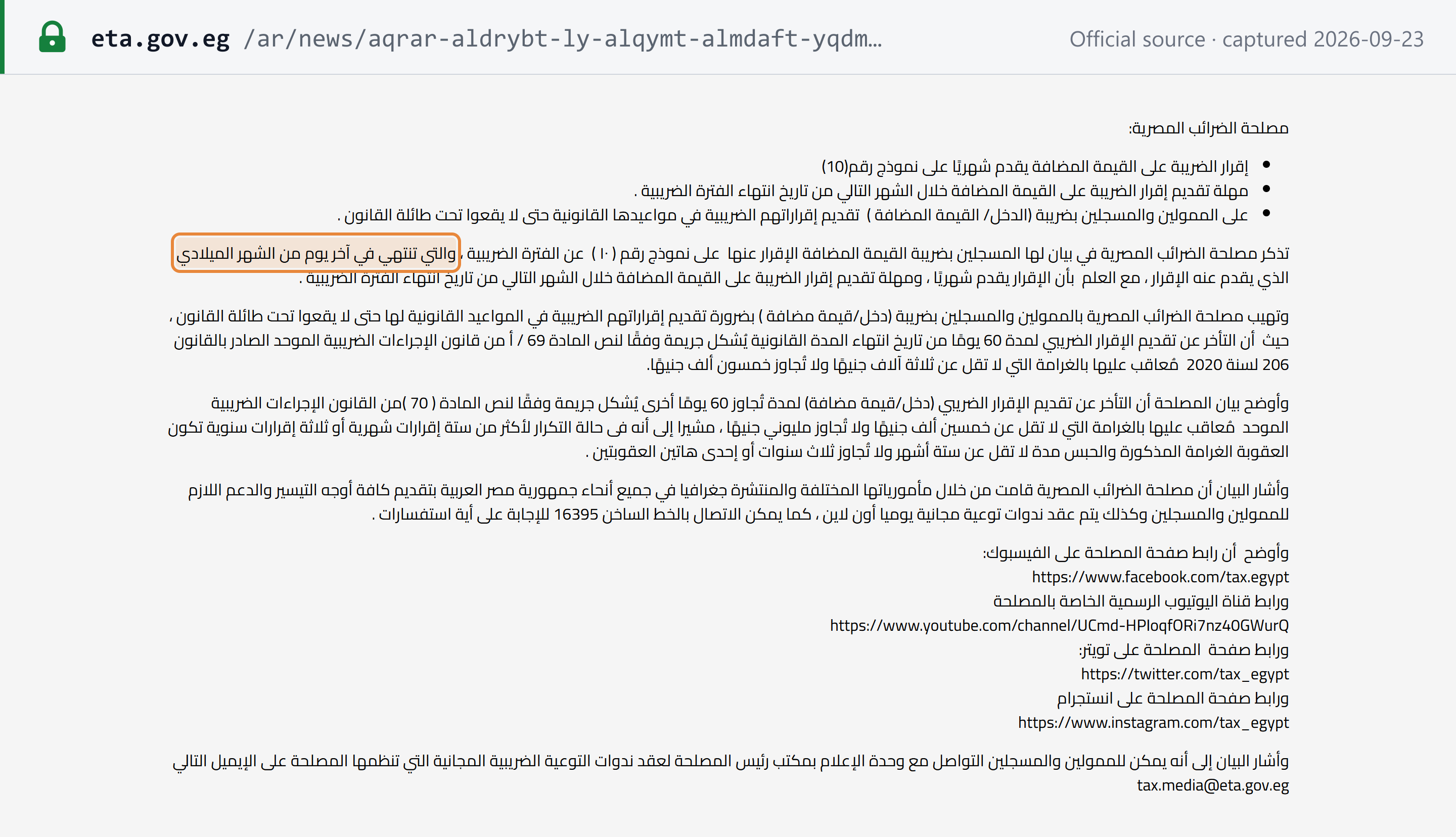 Source snapshot captured 2026-09-23 — original
Article 31(a) provides that "every registrant shall submit to the competent tax office a monthly return of the value added tax and the schedule tax due, or either of them, as the case may be, on the form prepared for this purpose, within the month following the end of the tax period." The same article makes a nil return compulsory: the return is due even if the registrant made no taxable sales and supplied no services in the period. It also lets the ETA head, or a delegate, allow exporters, importers and service providers who export, import or supply only once or twice a year to file only for the month in which the transaction takes place, without monthly returns — provided the transaction coincides with a sale, or with payment for the service, in that same period. [3]
Not filing lets ETA assess the tax. Article 14 of the VAT Law, as re-added by Law 3/2022, gives ETA the right to assess the tax for any tax period for which the registrant filed no return, stating the basis of its assessment. [26]
 Source snapshot captured 2026-09-23 — original
 Source snapshot captured 2026-09-23 — original
Worked examples from ETA. ETA's deadline notices apply the one-month rule. The May 2024 return was due on 30 June 2024, and the September 2025 return on 31 October 2025. A deadline that falls on an official holiday moves to the next working day: ETA announces the extension by notice, citing Article 18 of the Civil and Commercial Procedures Law. On that basis the September 2025 deadline moved to Sunday 2 November 2025, and the May 2024 deadline to 1 July 2024. [24] [23]
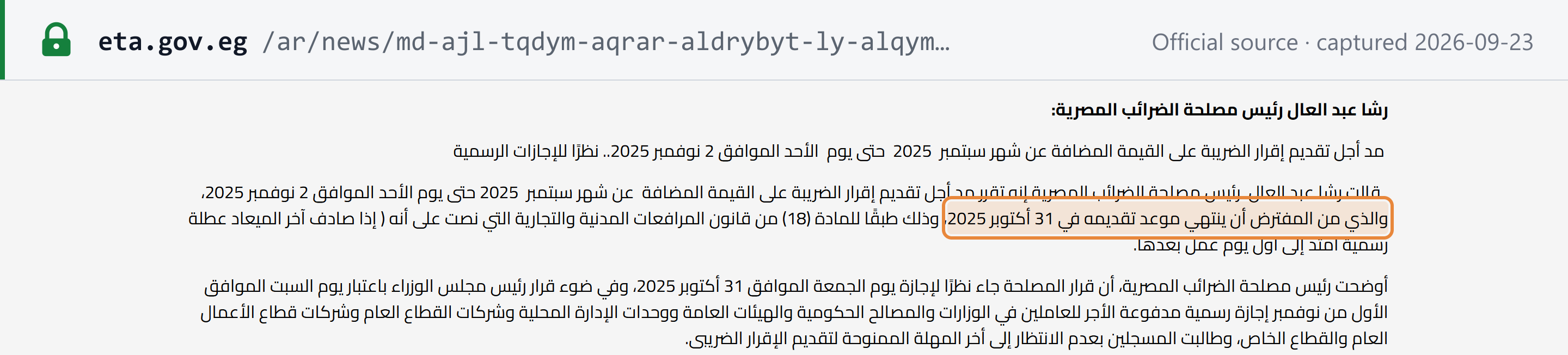 Source snapshot captured 2026-09-23 — original
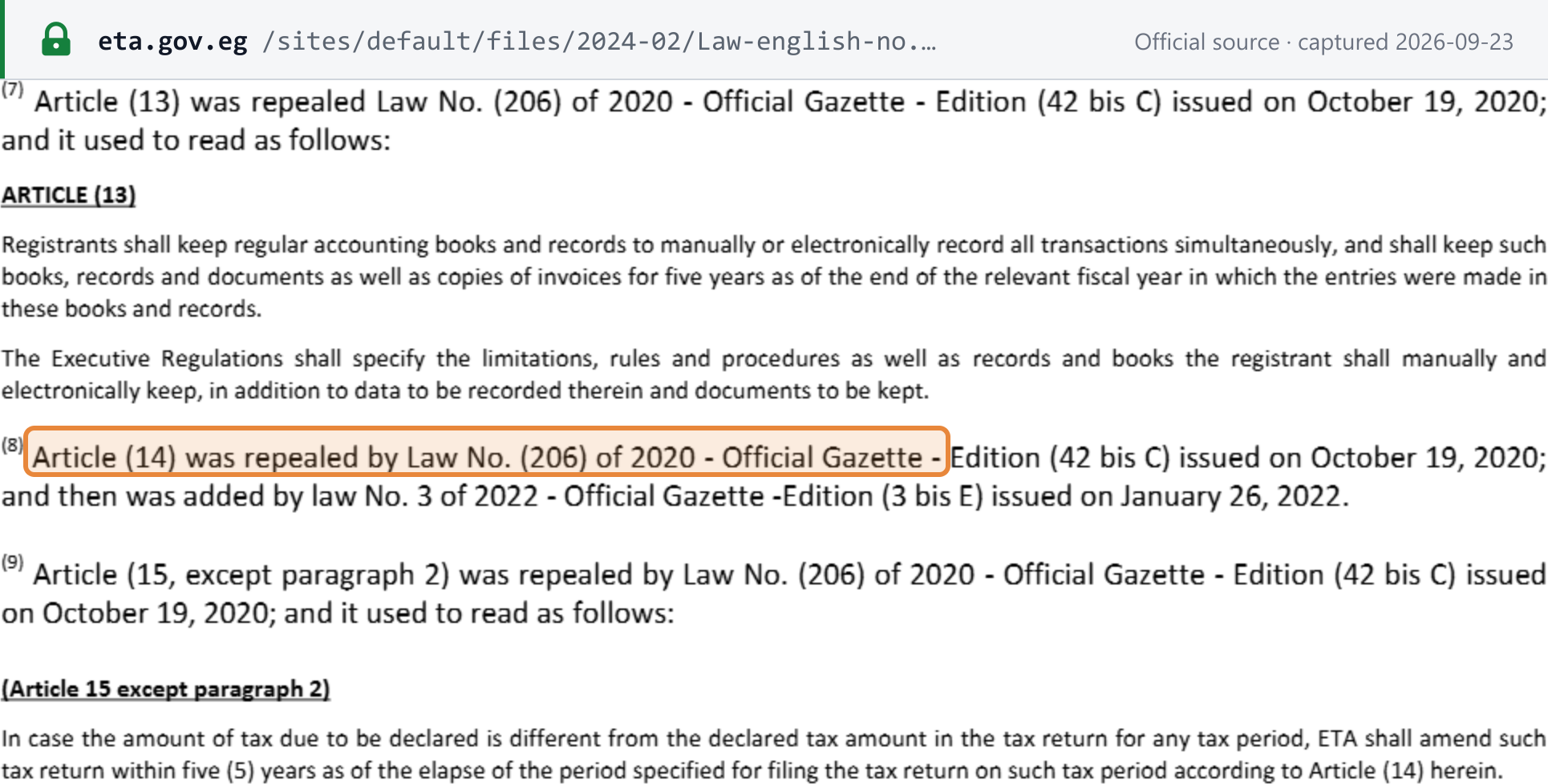 Source snapshot captured 2026-09-23 — original
Small enterprises — quarterly filing under Law 6/2025
Law No. 6 of 2025 (Official Gazette 6 مكرر (و), 12 February 2025), Article 12: enterprises with annual turnover not exceeding EGP 20 million file their VAT return every three months, within the month following the end of that period, together with payment — conditioned on timely filing and on joining the applicable e-invoicing or e-receipt system per the relevant obligation decisions. Returns under this regime are not examined until 5 years after the date of application to the regime. Article 12: "as for the tax return relating to Value Added Tax, it is submitted every three months on the prescribed form, within the month following the end of that period, together with payment of the tax" (أما بالنسبة إلى الإقرار الضريبي الخاص بالضريبة على القيمة المضافة فيتم تقديمه عن كل ثلاثة أشهر على النموذج المعد لهذا الغرض خلال الشهر التالي لانتهاء هذه الفترة مقترنًا بسداد الضريبة). [15]
Payment due date and method
Payment is due on the same day the return is filed. Article 32 of Law 206/2020 requires the tax shown on the return to be paid on the day the return is submitted, after deducting tax withheld or collected and any advance payments; its first paragraph requires returns to be filed electronically, with an electronic signature. [3] Quarterly filers under Law 6/2025 file "together with payment of the tax" (مقترنًا بسداد الضريبة), under Article 12 of that law. [15]
 Source snapshot captured 2026-09-23 — original
Additional listings
Not confirmed. No additional-listing obligation (annual return, sales/purchase listing) was sourced for this guide from an ETA text.
Input-tax recovery and blocked items
Input tax previously borne or accounted for is deductible against output tax, capped at the tax due, with the undeducted balance carried forward. Not deductible: the schedule tax (see Rates); input tax already included in cost; and tax on exempt goods and services. Opening-stock input tax at registration (Executive Regulations Article 29, as substituted by MoF Decision 417/2025) requires regular books, original purchase invoices or customs clearance/payment proof, a stock statement on Form 123 ض.ق.م filed at registration (or when sales become taxable), and no prior cost-inclusion of the input tax unless corrected within one year of purchase or import. [1] [17]
Refunds
A VAT credit balance outstanding for more than four consecutive tax periods qualifies for refund; for Law 6/2025 enterprises (turnover up to EGP 20 million), more than three months suffices. This is the current text after Law 149/2026 replaced item 3 of Article 30(1), effective 29 July 2026: "the credit balance which has been outstanding for more than four consecutive tax periods, excluding the credit balance of taxpayers under enterprises subject to the provisions of Law No. 6 of 2025 …" (٣-٣- الرصيد الدائن الذي مر عليه أكثر من أربع فترات ضريبية متتالية، فيما عدا الرصيد الدائن للمكلفين من المشروعات الخاضعة لأحكام القانون رقم ٦ لسنة ٢٠٢٥ ٢٠٢٥). [5]
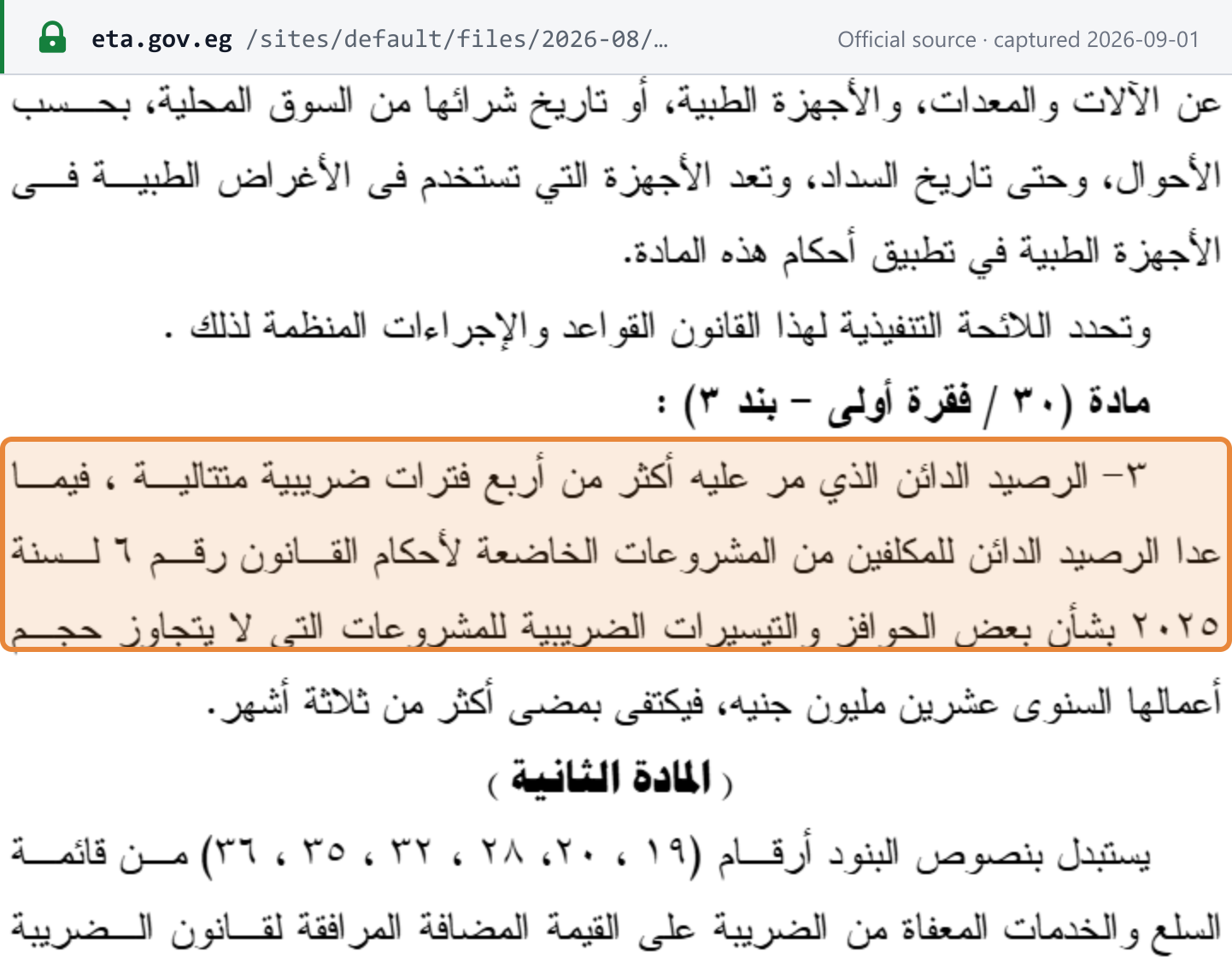 Source snapshot captured 2026-09-01 — original
ETA also operates a departing-traveller VAT refund scheme; this guide did not research its mechanics or timing in enough depth to state figures — see Important websites for the portal link rather than an unsourced summary here.
Exemptions
Exempt supplies
Exempt supplies are only those on the exemption list annexed to the VAT Law; ETA states plainly that exemption cannot be widened except by legislative text: "exempt goods and services are only those listed on the exemption schedule annexed to the VAT Law, and the exemption cannot be widened except by legislative text" (أما السلع والخدمات المعفاة، فهي فقط الواردة بقائمة الإعفاءات المرافقة لقانون الضريبة على القيمة المضافة، ولا يجوز التوسع في الإعفاء إلا بنص قانوني). [4]
Exempt is not zero-rated. An exempt supply carries no output VAT but also no input-VAT recovery (Article 22(3)); a zero-rated supply (exports) carries no output VAT but full input-VAT recovery. [1]
Six exemption-list items reworded by Law 149/2026 — effective 29 July 2026. The basis clause: "the texts of items 19, 20, 28, 32, 35 and 36 of the list of goods and services exempt from Value Added Tax annexed to the referenced VAT Law are replaced with the following texts" (يُستبدل بنصوص البنود أرقام (١٩، ٢٠، ٢٨، ٣٢، ٣٥، ٣٦) من قائمة السلع والخدمات المعفاة من الضريبة على القيمة المضافة المرافقة لقانون الضريبة على القيمة المضافة المشار إليه، النصوص الآتية). As replaced:
- Item 19 — butane gas (LPG cylinders).
- Item 20 — natural raw materials from mines/quarries in their natural state, excluding crude oil and natural gas.
- Item 28 — sale/lease of vacant land, agricultural land, and residential/non-residential buildings and units, except units run as an independent commercial management concern.
- Item 32 — wheelchairs and their separate parts; artificial body organs and their parts; hearing aids for the deaf and their parts; other devices worn, carried or implanted in the body, and their production inputs, to compensate for a deficiency, disability or defect, and their parts and accessories; kidney-dialysis machines and their parts and accessories including artificial kidney filters and their inputs; infant incubators; sera, vaccines, blood and its derivatives, blood-collection bags; and family-planning materials — verbatim: "٣٢ – مقاعد ذات عجل وأجزاؤها وقطعها المنفصلة، وأعضاء الجسم الصناعية وأجزاؤها، وأجهزة تسجيل السمع للصم وأجزاؤها، وغيرها من الأجهزة التي تلبس أو تحمل أو تزرع في الجسم ومدخلات إنتاجها لتعويض نقص أو عجز أو عاهة وأجزاؤها ولوازمها، وأجهزة الغسيل الكلوى وأجزاؤها ولوازمها بما فيها مرشحات الكلى الصناعية ومدخلات تلك الأجهزة والأجزاء واللوازم، وحضانات الأطفال، والأمصال واللقاحات والدم ومشتقاته وأكياس جمع الدم ووسائل تنظيم الأسرة."
- Item 35 — postal savings-fund financial services.
- Item 36 — non-banking financial services supervised by the Financial Regulatory Authority or the Central Bank.
Article Four of the same law separately repeals serials 8 and 10 of the schedule of goods and services (the schedule-tax table, not this exemption list) — see Rates. All of the reworded items remain exemptions, not zero-ratings — no input-VAT recovery attaches to any of them. [5]
The five-year disposal restriction
Under Article 44, disposing of exempted goods, or using them for a purpose other than the one for which they were exempted, is prohibited within the 5 years following the exemption, unless ETA is notified and the tax is paid at the disposal-date rate; the tax due can never exceed the value originally exempted or refunded. [1]
Special regimes
VAT suspension on industrial machinery, equipment and medical devices (Article 28 bis, new by Law 149/2026). VAT on machinery, equipment and medical devices imported or purchased locally by factories and production units for industrial-production use is suspended for one year from customs release or local purchase, extendable for justified reasons up to three further years (four years total). Once industrial use within that period is established, the items are exempted. The producer may not dispose of them for other purposes during the following five years without notifying ETA and paying the tax; if the period lapses without such use, tax plus additional tax becomes payable from the customs-release or purchase date until payment. An earlier press description of this measure described it as extending the suspension "from two to four years" — the enacted Article 28 bis text is "one year, extendable by up to three further years in aggregate," the same four-year outcome under different framing; this guide states the enacted framing. [5]
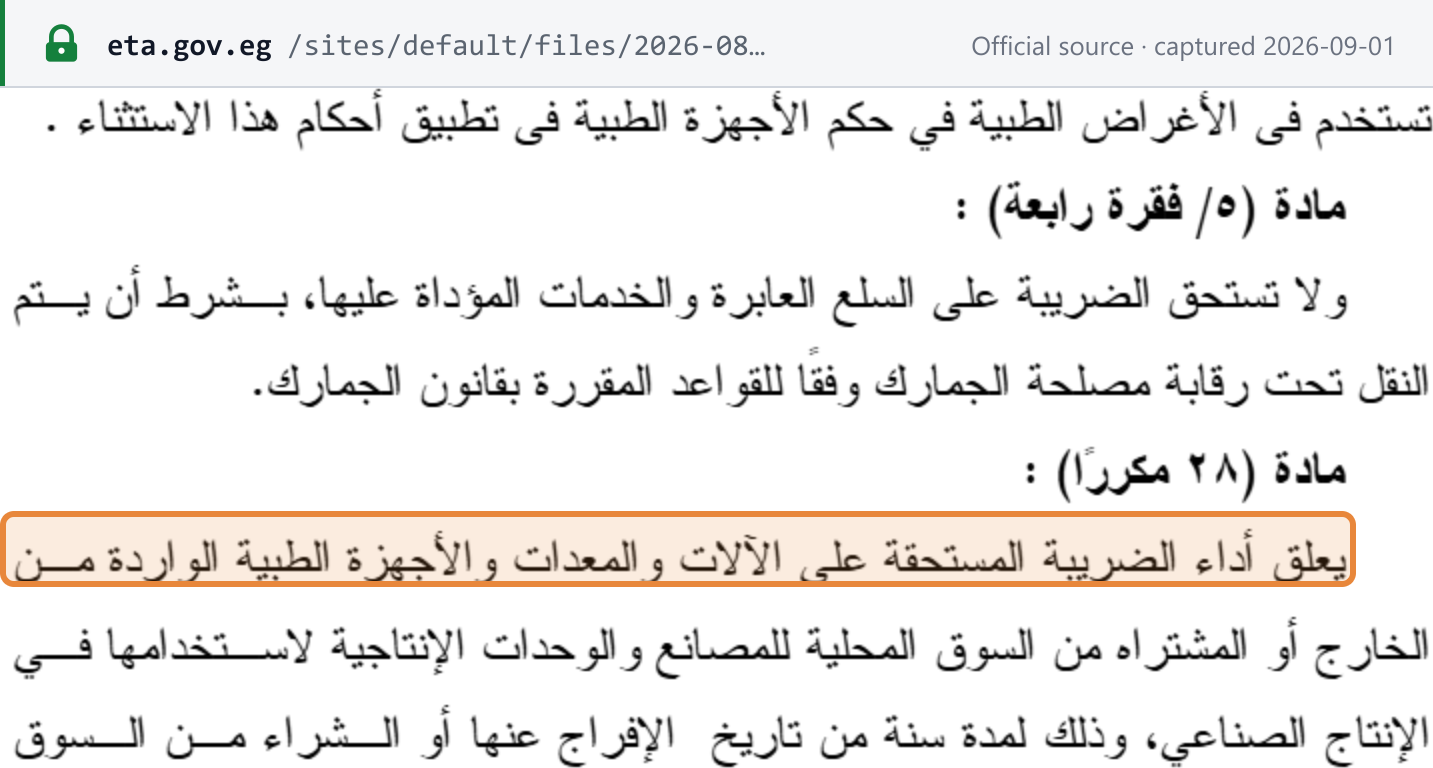 Source snapshot captured 2026-09-01 — original
Free zones and special economic zones. Not confirmed. VAT treatment of Egypt's free zones and SEZs sits partly in the Investment Law and Customs Law, outside eta.gov.eg, and was not researched for this guide. Treated as unconfirmed rather than asserted either way.
Margin schemes, bad-debt relief, small-business/flat-rate schemes (beyond the Law 6/2025 filing-frequency change already described). Not confirmed. Not researched for this guide; do not assume none exists.
Offences and penalties
Offences (Article 68)
Article 68 of VAT Law 67/2016 lists the acts that constitute tax evasion of VAT and schedule tax, punished under Article 67: "the following is deemed tax evasion of VAT and schedule tax, punishable under Article 67 of this Law" (يعد تهربًا من الضريبة وضريبة الجدول يعاقب عليه بالعقوبات المنصوص عليها فى المادة (٦٧) من هذا القانون، ما يأتى). The list is still numbered 1 to 19, but items 7, 9 and 11 were repealed (see Overview), so sixteen acts remain in force. [1] [25]
Items 1-12 as they now stand:
- 1 — failing to register within the specified period.
- 2 — selling or importing without declaring and paying the tax due.
- 3 — unauthorized deduction.
- 4 — unauthorized recovery of tax.
- 5 — using forged or fabricated documents.
- 6 — a registrant failing to issue invoices.
- 7 — repealed. It treated letting 60 days lapse after the payment deadline without declaring and paying as evasion.
- 8 — a non-registrant issuing invoices bearing tax.
- 9 — repealed. It covered breaching the invoice-issuance controls.
- 10 — fabricating invoices for third parties that do not arise from genuine sales. The maker and the beneficiary are jointly liable.
- 11 — repealed. It covered failing to keep regular books and records.
- 12 — knowingly possessing smuggled taxable goods for trading.
Items 13-19 cover:
- 13 — failing to file a final return and pay the tax due in full within six months of deregistration.
- 14 — breaching Article 40 (stock-transition schedule-tax declarations) or Article 42 (unlicensed production of schedule-tax goods).
- 15 — affixing artificial marks or seals to evade schedule tax.
- 16 — selling schedule goods above the price used to calculate the tax without paying tax on the excess.
- 17 — holding schedule goods for trade without the excise stamp (بندرول).
- 18 — disposing of exempted goods during the restriction period without notifying ETA and paying the tax.
- 19 — breaching Articles 4 or 5 of the enactment provisions.
Late filing is no longer an evasion act in itself. It is an offence under Articles 69-70 of Law 206/2020 (see Penalties). Not filing for more than 60 days carries imprisonment when repeated. Undeclared sales remain evasion under item 2. [3] [21]
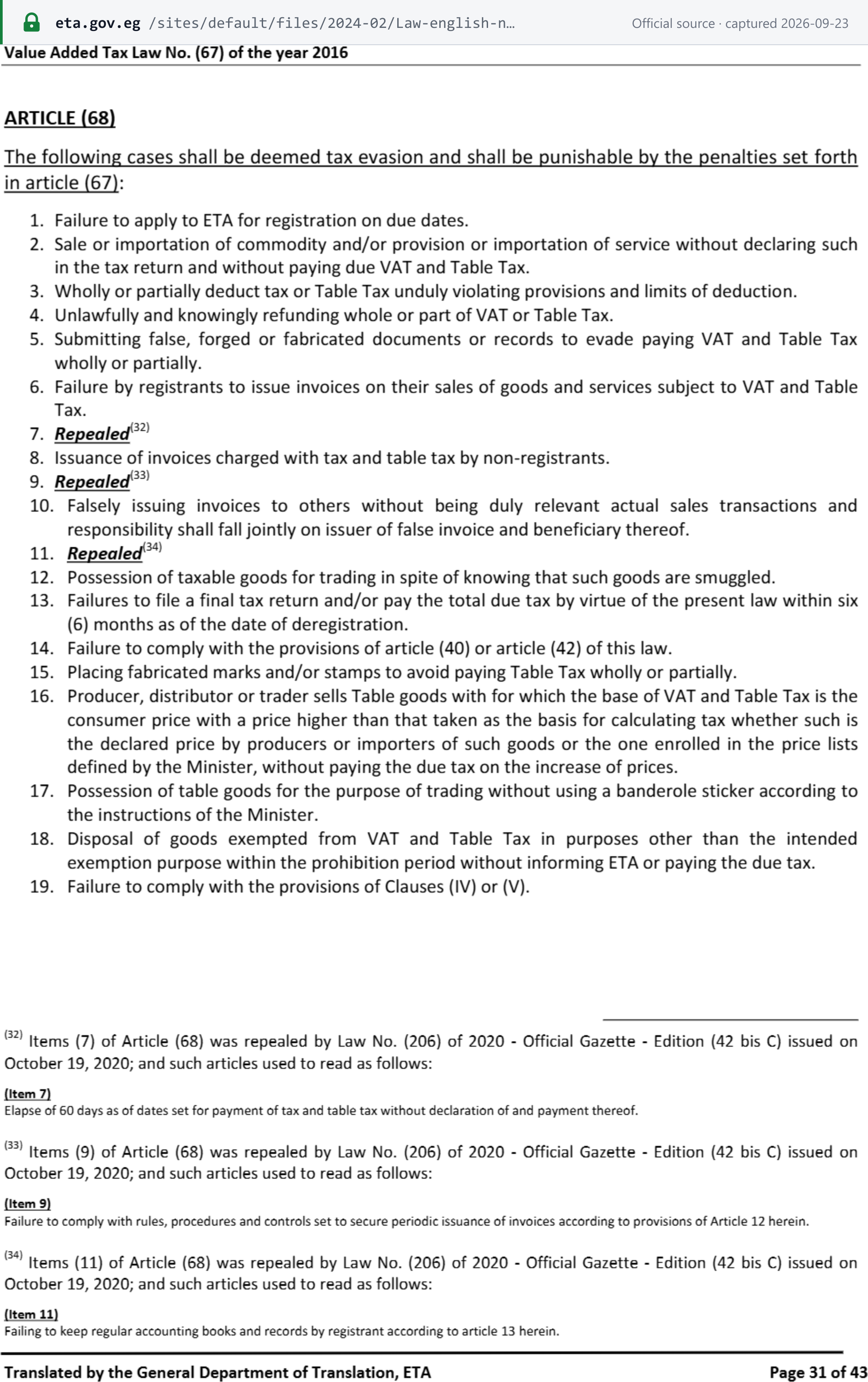 Source snapshot captured 2026-09-23 — original
Penalties
Fines now come from two instruments. Law 206/2020 covers late filing, non-filing and its own procedural duties (Articles 69-71). VAT Law Article 50, as re-added by Law 3/2022, is a general fine for any breach of the VAT Law's provisions or procedures that does not amount to evasion. Evasion stays under VAT Law Articles 67-68, and Law 206/2020 Article 73 bis, added by Law 211/2020, applies a tax law's own criminal provisions wherever Law 206/2020's penalty chapter is silent. The old Article 66 general-violations fine is gone (see Overview). [3] [21] [26]
| Conduct | Fine | Imprisonment | Notes |
|---|---|---|---|
| Evasion (VAT Law Art. 67) — the sixteen Art. 68 acts still in force | EGP 5,000-50,000 | 3-5 years | Either penalty alone, or both; doubled on repetition within 3 years; a crime of moral turpitude (مخلة بالشرف والأمانة). [1] |
| Late filing and payment of up to 60 days past the Art. 31 deadline; also understated returns, obstructing ETA staff, and breaching listed Law 206 articles including Art. 32 (same-day payment) — Law 206/2020 Art. 69 | EGP 3,000-50,000 | — | In addition to the tax and other amounts due; both limits are tripled for a repeat offence ("لثلاثة أمثالها فى حالة العود"). [3] |
| Not filing for more than 60 days after the Art. 31 deadline — Law 206/2020 Art. 70, as replaced by Law 211/2020 (in force 4 December 2020) | EGP 50,000-2,000,000 | 6 months-3 years where the offence is repeated for more than six monthly returns (or three annual returns) | On repetition: the fine and imprisonment, or either. The original Art. 70 figure (EGP 5,000-200,000) applied only from 20 October to 3 December 2020. [21] |
| Not notifying changes to registration data within 30 days (Law 206/2020 Art. 28), and breaches of Law 206 Arts. 24, 35 (paras 1-2), 37 (paras 1 and 4, invoice issuance) and 38 (paras 1-3) — Law 206/2020 Art. 71 | EGP 20,000-100,000 | — | The same article sets a fine of up to EGP 50,000 for failing to keep books and records for the legal period. [3] |
| General violations of the VAT Law not amounting to evasion — including not notifying registration changes on time, and shortages or surpluses of goods held in free zones — VAT Law Art. 50, as re-added by Law 3/2022 | 1% of the tax and schedule tax due, minimum EGP 1,000, maximum EGP 10,000 | — | In addition to the tax, schedule tax and additional tax due; doubled on repetition within 3 years. [26] |
Article 67, verbatim: "evasion of the tax and schedule tax is punished with imprisonment of not less than three years and not more than five years, and a fine of not less than five thousand pounds and not more than fifty thousand pounds, or either of these two penalties" (يعاقب على التهرب من الضريبة وضريبة الجدول بالسجن مدة لا تقل عن ثلاث سنوات ولا تجاوز خمس سنوات وبغرامة لا تقل عن خمسة آلاف جنيه ولا تجاوز خمسين ألف جنيه أو بإحدى هاتين العقوبتين). [1]
 Source snapshot captured 2026-09-23 — original
 Source snapshot captured 2026-09-23 — original
 Source snapshot captured 2026-09-23 — original
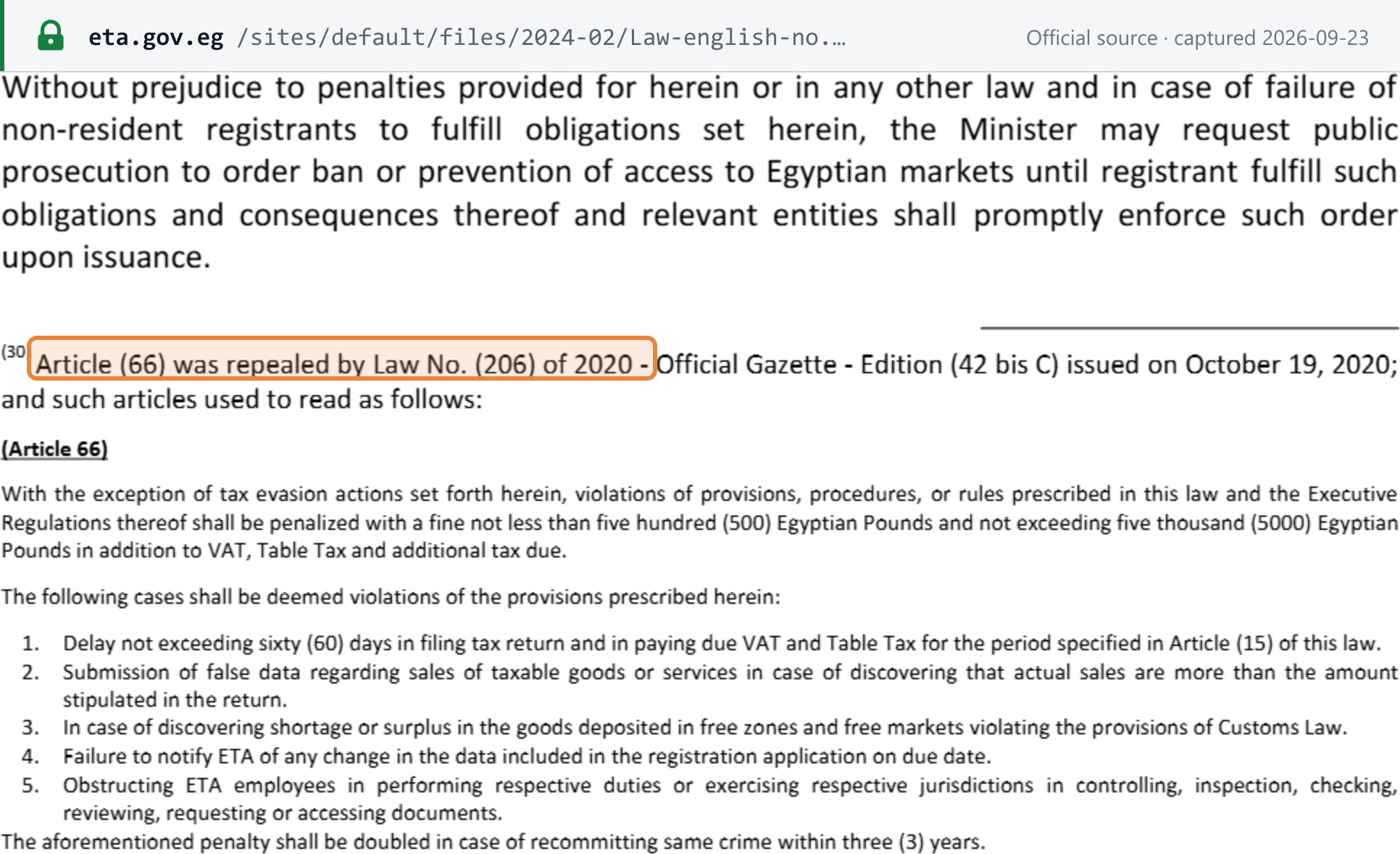 Source snapshot captured 2026-09-23 — original
ETA's own FAQ page and its Form 10 notice read Article 70 as applying after a further 60 days (120 days in total), and the FAQ also gives the Article 69 maximum as EGP 5,000. The statute sets 60 days from the filing deadline and a maximum of EGP 50,000; this guide follows the statute. [22]
Late payment — the VAT "additional tax". Unpaid VAT or schedule tax carries additional tax of 1.5% for each month or part of a month, from the end of the payment period until payment. That is the Article 1 definition of "additional tax" in ETA's English consolidation of VAT Law 67/2016, updated 15 January 2023: "Additional tax of 1.5% of unpaid VAT or Table Tax including due tax resulting from amendments of the tax returns for each or part of the month as of the end of the period specified for payment until the payment date." [25]
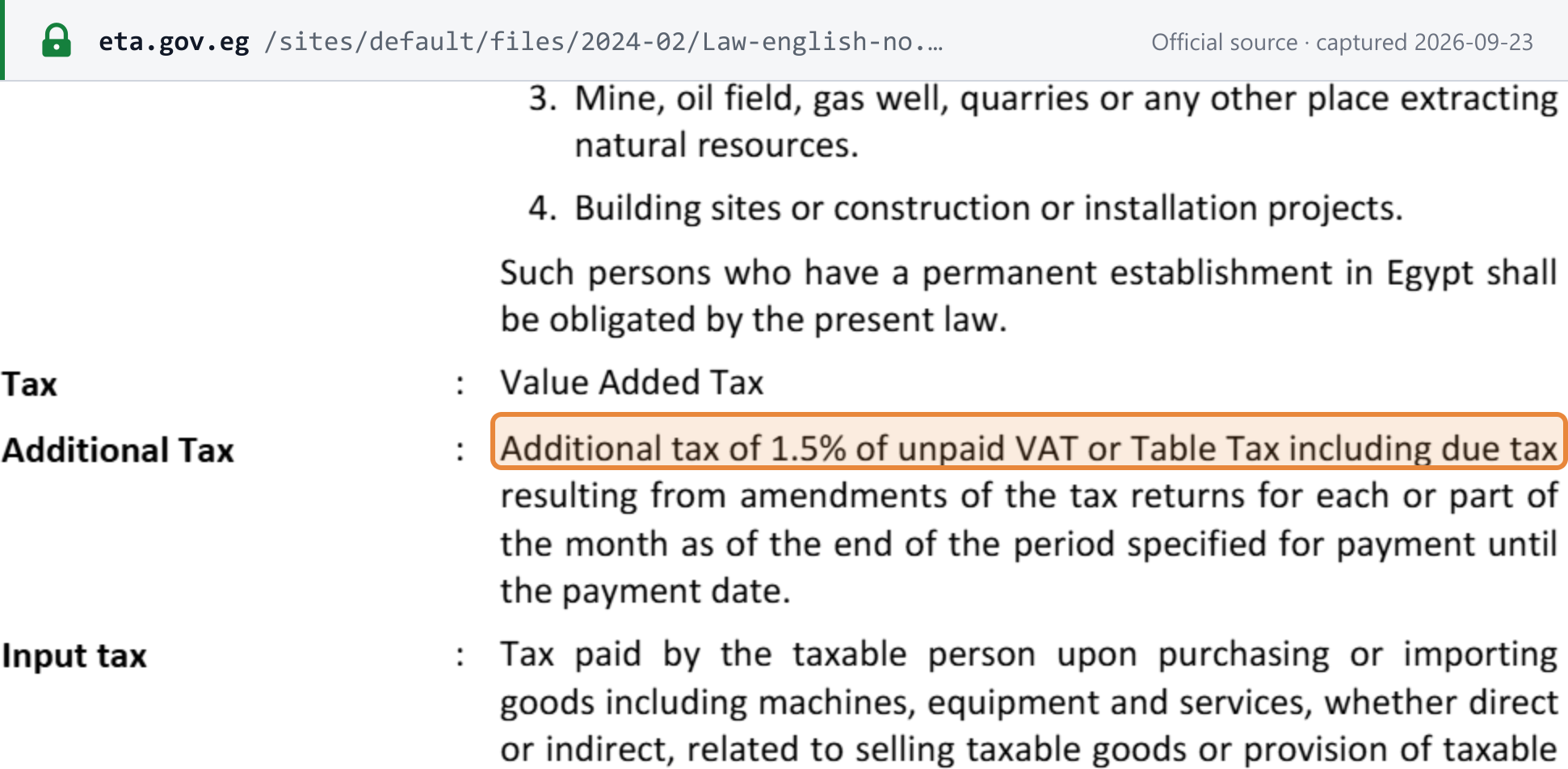 Source snapshot captured 2026-09-23 — original
Additional tax is capped at 100% of the original tax due by Article 45 bis of the Unified Tax Procedures Law 206/2020, added by Law 7/2025 (in force 13 February 2025). The article opens "in applying the provisions of the tax laws" (في تطبيق أحكام القوانين الضريبية), so the cap is general: it is not a Law 6/2025 small-enterprise concession. It caps both the income-tax late-payment charge (مقابل التأخير) and the VAT additional tax (الضريبة الإضافية). [20]
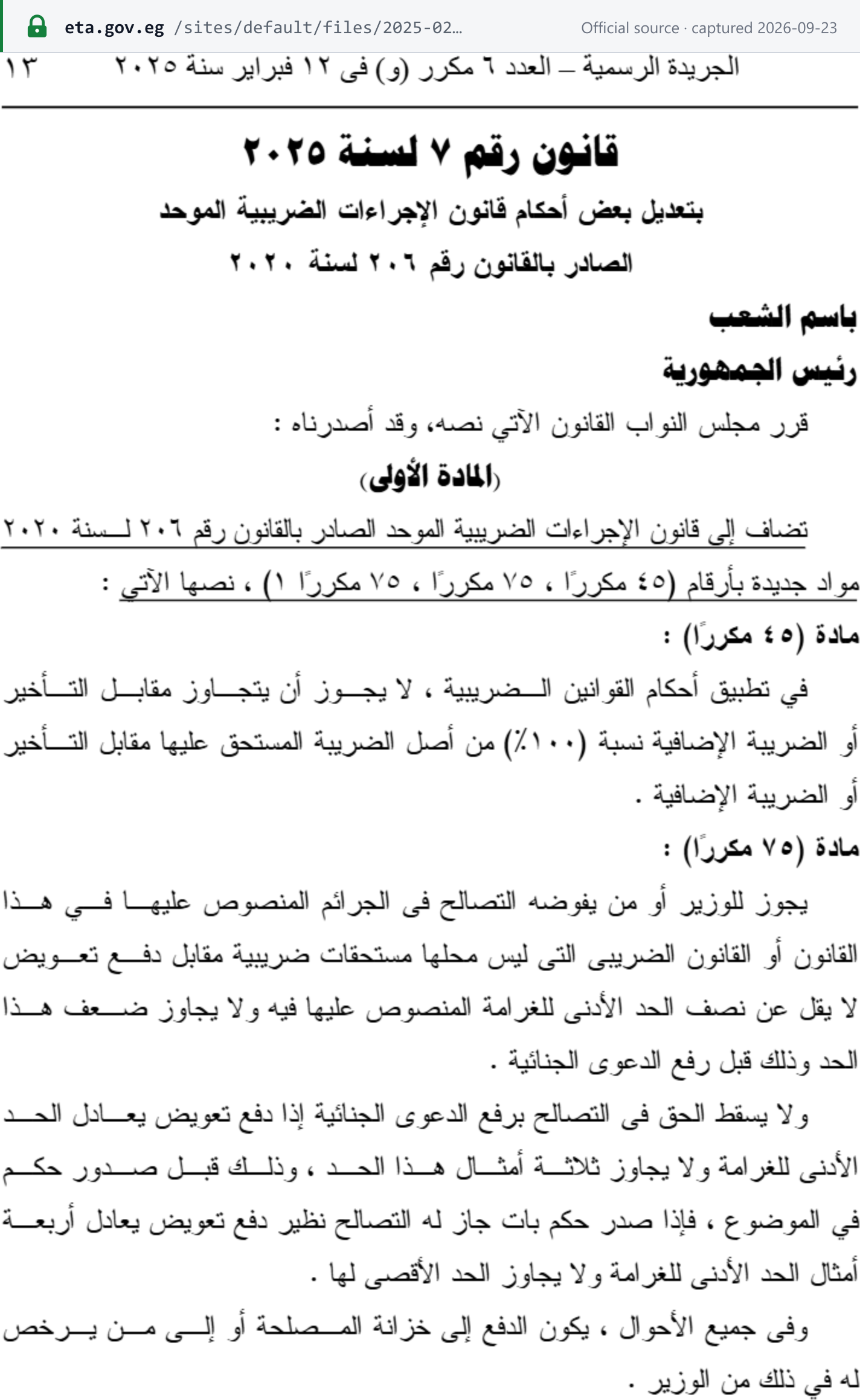 Source snapshot captured 2026-09-23 — original
Not the VAT charge: the CBE rate plus 2 points. ETA's Periodic Circular 1/2026 publishes the Central Bank of Egypt's credit-and-discount rate announced on 1 January 2026: "the credit and discount rate announced by the Central Bank on the first of January 2026 is 20.50%" (سعر الإئتمان والخصم المعلن من البنك المركزي فى الأول من يناير ٢٠٢٦ هو ٢٠٫٥٠٪). The circular uses that rate for income-tax purposes — the late-payment charge under Income Tax Law 91/2005 Article 110 (the rate plus 2 points) and advance payments under Article 63(4) — and for the interest ETA owes on late refunds (Law 206/2020, Article 53). It does not cite the VAT Law, so it does not set the VAT late-payment charge. [18]
 Source snapshot captured 2026-09-20 — original
Frequently asked questions
Egypt's standard VAT rate is 14% — so why do some invoices show extra tax on top of that?
Because Egypt layers a second, separate tax on certain goods and services — the schedule tax (ضريبة الجدول) — on top of ordinary VAT, and it is generally not creditable. Article 38 of VAT Law 67/2016 makes the schedule tax due once, on the good or service's first sale, performance, or importation, "without prejudice to" the VAT charged under the rest of the law — meaning both taxes can apply to the same transaction. Article 22 then blocks the schedule tax from being deducted as input tax, alongside input tax already folded into cost and tax on exempt supplies. Items currently on the schedule include cigarettes (50% of the final consumer price plus EGP 5.00-8.00 per packet, by price band), the trade-name/goodwill component of commercial premises (10% of value), wine, spirits and beer (EGP 2,800/3,600/4,800 per hectolitre by alcohol strength, escalating annually), crude petroleum (10% of value, added by Law 157/2025), and natural gas (EGP 20 per thousand cubic feet, added by Law 149/2026, effective 29 July 2026). A general VAT/GST guide that lists Egypt's rates as "14% / 5% / 10%" on one line is usually conflating this separate excise-style tax with a VAT rate band. [1] [16] [5]
Do I have to register for VAT in Egypt if my turnover is below EGP 500,000?
In most cases, no — but there are turnover-independent exceptions worth checking before you assume you're exempt. Article 16 of VAT Law 67/2016 sets compulsory registration at EGP 500,000 of combined taxable-and-exempt sales over the preceding 12 months, with a 30-day window to apply for registration once that figure is reached. If a person does not apply, Article 25 of the Unified Tax Procedures Law 206/2020 lets the Egyptian Tax Authority (ETA) register them on the data it holds and notify them within 5 working days, without prejudice to criminal liability. (Article 16's former paragraphs on a 14-day ETA notice and registration by operation of law were repealed by Law 206/2020.) A lower EGP 250,000 figure circulates in some secondary sources — it is not supported by Article 16 or by ETA's own published guidance, which states plainly that “the mandatory VAT registration threshold is EGP 500,000” (re-checked live against eta.gov.eg on 2026-09-20). Separately, and irrespective of turnover, every importer of a taxable good or service for trading purposes, every exporter, and every distribution agent must register whatever the size of their transactions — plus anyone dealing in schedule (جدول) goods or services. [3] [1] [4]
When did e-invoicing actually become mandatory for all VAT-registered businesses in Egypt — November 2020 or later?
November 2020 only started the rollout for a small group of large taxpayers — it did not make e-invoicing universal. ETA Decision 386/2020 brought in the first phase, covering 134 large taxpayers only, from 15 November 2020. The mandate then widened in named sub-phases under ETA Head Decision No. 323 of 2022: 15 September 2022, 15 October 2022, 15 November 2022, and finally the fourth sub-phase, effective 15 December 2022, which the decision itself describes as covering "all taxpayers registered with the Egyptian Tax Authority in every governorate of the Republic who were not made subject to a prior obligation decision in any earlier phase." So 15 December 2022 — not November 2020 — is the date e-invoicing became universal for ETA-registered VAT businesses; a separate instrument (MoF Decision 230/2022) governs e-receipts to consumers on its own rolling phase schedule, currently at phase 9. [9]
I'm a non-resident company selling digital services into Egypt — do I need to register, and do I need a local fiscal representative?
You likely need to register, but you do not need a fiscal representative. Non-resident vendors of "remote services" — digital content, apps and software, website design, and legal, accounting or consultancy services delivered without a necessary link between the customer's location and the place of performance — register under a simplified vendor registration regime introduced by MoF Decision No. 160 of 2023. The threshold mirrors the domestic one, EGP 500,000 over any 12-month period, except that a professional or consultancy service must be registered "from day one whatever his turnover." ETA's own guideline states plainly: "The non-resident vendor will not be required to have a fiscal representative" — a deliberate carve-out from Article 17 of the base VAT Law, which otherwise requires a non-resident, non-registered seller with no permanent establishment in Egypt to appoint a local representative. A non-resident operating through a permanent establishment in Egypt cannot use this simplified regime and must register under the standard rules instead. Registration runs through ETA's dedicated web portal; ETA issues a registration certificate (Form 3-VAT) and notifies by email within 10 days. [7] [8] [1]
What's the difference between an exempt supply and a zero-rated supply in Egypt, and why does it matter for the schedule tax?
A zero-rated supply is still a taxable supply — VAT is charged at 0%, and the seller keeps full recovery of the input tax used to make it (chiefly exports). An exempt supply sits outside VAT altogether: no output VAT is charged, but the input tax used to make it is also not recoverable, under Article 22(3). ETA's own guidance states the exemption list cannot be expanded informally: "exempt goods and services are only those listed on the exemption schedule annexed to the VAT Law, and the exemption cannot be widened except by legislative text." Law 149/2026, effective 29 July 2026, reworded six exemption-list items (19, 20, 28, 32, 35 and 36); the two items it repealed, serials 8 and 10, are in the separate schedule-tax table, not this exemption list — for example, item 32 now exempts wheelchairs, artificial body organs, hearing aids, kidney-dialysis machines and consumables, infant incubators, sera, vaccines, blood and blood-collection bags, and family-planning materials. These remain exemptions, not zero-ratings: none of them carries input-VAT recovery. Separately, the schedule tax is non-creditable regardless of whether the underlying supply is standard-rated, zero-rated or exempt — a third, independent restriction. [1] [4] [5]
What happens if I file or pay my Egypt VAT return late?
It depends how late. The monthly return is due within the month following the tax period, with payment the same day (Law 206/2020, Arts. 31-32). Up to 60 days late: a fine of EGP 3,000-50,000 on top of the tax (Art. 69), tripled for a repeat offence. Not filed for more than 60 days: EGP 50,000-2,000,000 (Art. 70, as replaced by Law 211/2020), plus 6 months-3 years' imprisonment, or either penalty, if repeated for more than six monthly returns. ETA may also assess the tax for any period with no return (VAT Law Art. 14). Unpaid VAT carries additional tax of 1.5% per month or part month, capped at 100% of the tax (Law 206/2020, Art. 45 bis). Undeclared sales are evasion: 3-5 years' imprisonment and/or EGP 5,000-50,000 (VAT Law Arts. 67-68). [3] [21] [26] [20] [25]
My business already issues e-invoices to other companies (B2B) — do I also need to issue e-receipts to consumers?
Very likely yes, on a separate track. Egypt runs two distinct continuous transaction-control systems, each with its own legal basis and its own phase clock. B2B e-invoicing runs under ETA Head Decision 323/2022 and reached full national scope for VAT-registered businesses on 15 December 2022. E-receipts to final consumers are a different instrument — MoF Decision No. 230 of 2022 — obliging registered taxpayers to issue electronic tax receipts, rolled out by sector in phases from October 2022, re-cut in part by MoF Decision 38/2024, and continuing today through rolling named-taxpayer decisions issued by the ETA head: the most recent are Decision 361/2025 (phase 9, sub-phase 1) and Decision 281/2025 (phase 8, sub-phase 2, effective 15 September 2025). Article 1 of MoF Decision 230/2022 states the base obligation directly: registered taxpayers must issue electronic tax receipts for services rendered and goods sold to the final consumer. Both systems require real-time transmission to ETA's production environment; a company issuing fewer than 200 invoices a month without a computerised accounting system may use ETA's e-invoicing Portal instead of full ERP integration. Being live on one system does not put you live on the other — check your obligation status separately for each on ETA's einvoice-inquiry and ereceipt-inquiry lookup tools. [10] [11] [13]
Important websites
| Site | Purpose |
|---|---|
| ETA home (Arabic) | Egyptian Tax Authority main site |
| Taxpayer e-services portal | Registration, filing and account services |
| E-invoicing portal | B2B e-invoicing onboarding and issuance |
| E-invoicing/e-receipt SDK & API docs | Technical integration documentation |
| POS / e-receipt portal | B2C e-receipt onboarding |
| Self-service facilitation portal | Taxpayer self-service |
| "Am I in scope for e-invoicing?" lookup | Check e-invoicing obligation status |
| "Am I in scope for e-receipt?" lookup (by TRN) | Check e-receipt obligation status |
| Register of e-invoicing obligation decisions | Full list of e-invoicing phase decisions |
| Register of e-receipt obligation decisions | Full list of e-receipt phase decisions |
| VAT legislation index | All VAT Law amendments in sequence |
| Departing-traveller VAT refund | Refund scheme for departing travellers |
| Complaints portal | File a tax complaint |
| Customs single window (NAFEZA) | Import/export customs clearance |
| Company registry (GAFI) | Business registration |
| Egypt tax-changes chronology on Lookuptax | Curated timeline of Egyptian tax-law changes |
Contact numbers (official): integrated call centre 16395; tax-evasion reporting hotline 16189 (09:00-16:00, except Friday/Saturday).
Also see Lookuptax's own Egypt tax-ID validator.
Note: the English-language ETA pages for the e-invoice and e-receipt scope-lookup tools and e-invoice services returned HTTP 404 at the time of research, while the Arabic equivalents above resolve; use the Arabic URLs for those three.
Recent changes
- 2026-07-29 — Law 149 of 2026: the 5% rate extended to medical devices; new Article 28 bis VAT suspension on industrial machinery/medical devices; credit-balance refund window shortened to 4 tax periods (3 months for Law 6/2025 enterprises); new EGP 20/thousand-cubic-feet tax on natural gas; exempt-list items 19, 20, 28, 32, 35 and 36 reworded; separately, schedule serials 8 and 10 repealed. (Egyptian Tax Authority)
- 2025-10-27 — MoF Decision 417/2025 amends the VAT Executive Regulations (opening-stock input tax, continuous-nature services, and the alcohol schedule-tax escalator from 1 January 2026). (Egyptian Tax Authority)
- 2025-09-15 — ETA Decisions 281/2025 and 361/2025: e-receipt phase 8 sub-phase 2 and phase 9 sub-phase 1. (Egyptian Tax Authority)
- 2025-07-18 — Law 157/2025: schedule tax restructured — cigarettes, trade-name/goodwill, alcohol per hectolitre, crude petroleum at 10%, and exemption-list changes. (Egyptian Tax Authority)
- 2025-02-12 — Law 6/2025: enterprises with turnover up to EGP 20 million file VAT quarterly; e-invoice/e-receipt enrolment is a condition of the regime. (Egyptian Tax Authority)
- 2024-08-01 — the buyer national-ID threshold on e-invoices was cut to EGP 25,000, from EGP 50,000. (Egyptian Tax Authority)
- 2022-12-15 — B2B e-invoicing became mandatory for all remaining ETA-registered VAT businesses in every governorate (ETA Head Decision 323/2022, fourth sub-phase) — the universal date, distinct from Phase 1's 134 large taxpayers on 15 November 2020. (Egyptian Tax Authority)
- 2020-10-20 — Unified Tax Procedures Law 206/2020 in force: the VAT return is due within the month following the tax period, with payment the same day (Arts. 31-32), and a block of VAT Law procedure and penalty articles is repealed (see Overview). Its non-filing fine (Art. 70) was replaced by Law 211/2020 from 2020-12-04. (Egyptian Tax Authority)
Reference links
- Egyptian Tax Authority — VAT Law No. 67 of 2016 (PDF)
- Egyptian Tax Authority — Executive Regulations, MoF Decision 66/2017 (PDF)
- Egyptian Tax Authority — Unified Tax Procedures Law 206 of 2020 (PDF)
- Egyptian Tax Authority — registration-threshold and exemption FAQ
- Egyptian Tax Authority — Law 149 of 2026 (PDF)
- Egyptian Tax Authority — Guideline on VAT for digital services and other remote services by non-residents (PDF)
- Egyptian Tax Authority — MoF Decision 160 of 2023 (PDF)
- Egyptian Tax Authority — ETA Head Decision 323 of 2022, universal B2B e-invoicing (PDF)
- Egyptian Tax Authority — MoF Decision 230 of 2022, e-receipt base obligation (PDF)
- Egyptian Tax Authority — MoF Decision 38 of 2024 (PDF)
- Egyptian Tax Authority — e-receipt FAQ v24, 31 January 2024 (PDF)
- Egyptian Tax Authority — news: Decision 281/2025, e-receipt phase 8 wave 2
- Egyptian Tax Authority — news: buyer national-ID e-invoice threshold cut to EGP 25,000
- Egyptian Tax Authority — Law 6 of 2025 (PDF)
- Egyptian Tax Authority — Law 157 of 2025 (PDF)
- Egyptian Tax Authority — MoF Decision 417 of 2025 (PDF)
- Egyptian Tax Authority — Periodic Circular 1 of 2026, CBE base rate for the income-tax late-payment charge and late-refund interest (PDF)
- Egyptian Tax Authority — VAT legislation index
- Lookuptax — Egypt TIN/TRN: Complete Tax ID Guide
- Egyptian Tax Authority — Law 7 of 2025 (Art. 45 bis, 100% cap on the late-payment charge and additional tax)
- Egyptian Tax Authority — Law 3 of 2022 amending the VAT Law (Arts. 14 and 50 re-added) (PDF)
- Egyptian Tax Authority — Law 211 of 2020, amending the Unified Tax Procedures Law (Art. 70 replaced) (PDF)
- Egyptian Tax Authority — news: the VAT return is filed monthly on Form 10, within the month following the tax period
- Egyptian Tax Authority — news: September 2025 VAT return deadline extended to 2 November 2025 (official holiday)
- Egyptian Tax Authority — news: May 2024 VAT return deadline extended to 1 July 2024 (official holiday)
- Egyptian Tax Authority — VAT Law 67 of 2016, English consolidation with repeal footnotes, updated 15 January 2023 (PDF)
- Lookuptax — Official links to check VAT numbers worldwide
- Lookuptax — E-invoicing status and the networks worldwide
- Lookuptax — Global VAT registration thresholds
- Lookuptax — How to register for VAT/Sales Tax/GST worldwide
- Lookuptax — Worldwide VAT/GST/Sales Tax rates
- Lookuptax — Egypt tax-changes chronology