Indonesia VAT guidelines
| FACTSHEET | |
|---|---|
| Country code | ID |
| Tax name | Value Added Tax — Pajak Pertambahan Nilai (PPN); luxury-goods sales tax — Pajak Penjualan atas Barang Mewah (PPnBM) |
| Tax Authority | Directorate General of Taxes — Direktorat Jenderal Pajak (DJP) |
Overview
Indonesia levies Value Added Tax — Pajak Pertambahan Nilai (PPN) — under the VAT Law, UU 8/1983, as amended most recently in its VAT provisions by UU 7/2021 on the Harmonisation of Tax Regulations (Harmonisasi Peraturan Perpajakan, HPP). Alongside it sits a single-stage luxury-goods sales tax, Pajak Penjualan atas Barang Mewah (PPnBM), which is "dikenakan hanya 1 (satu) kali pada waktu penyerahan Barang Kena Pajak yang tergolong mewah oleh pengusaha yang menghasilkan atau pada waktu impor" — charged only once, on supply by the manufacturer or on import (VAT Law art. 5). [1] [2]
Authority. The tax is administered by the Directorate General of Taxes (Direktorat Jenderal Pajak, DJP) of the Ministry of Finance. Import VAT is collected at the border by the Directorate General of Customs and Excise (DJBC).
Platform. Since 1 January 2025 registration, invoicing, returns and payment run on Coretax DJP: "Sistem Inti Administrasi Perpajakan Direktorat Jenderal Pajak yang selanjutnya disebut sebagai CORETAX DJP … mulai diimplementasikan sejak tanggal 1 Januari 2025" (KMK 456/2024). [16]

Currency. VAT and PPnBM are computed in rupiah (IDR) (PER-11/PJ/2025 art. 36(1)). All amounts in this guide are in rupiah. [7]
Tax period. "Masa Pajak sama dengan 1 (satu) bulan kalender atau jangka waktu lain yang diatur dengan Peraturan Menteri Keuangan paling lama 3 (tiga) bulan kalender" — the tax period is one calendar month, or another period of up to three calendar months set by Ministry of Finance regulation (General Tax Provisions Law, UU KUP, art. 2A). VAT is returned monthly; see Filing and payment. [3]
Layering. PPN is a single national tax administered by DJP. The VAT Law provides for no provincial or municipal VAT (as at 2026-10-07). What the VAT Law does instead is carve some supplies out of VAT because they are regional-tax objects — restaurant food and drink, hotel rooms, parking, arts and entertainment, catering (see Exemptions). [1]
For Indonesia's tax identifiers in detail, see Lookuptax's Indonesia NPWP tax ID guide. For neighbouring systems, see the Vietnam, Malaysia, Thailand, Philippines and Singapore guides.
Registration
Who should register
A business that makes taxable supplies or exports must report itself to be confirmed as a VAT-registered entrepreneur — Pengusaha Kena Pajak (PKP): "Pengusaha yang melakukan penyerahan dan/ atau ekspor … wajib melaporkan usahanya untuk dikukuhkan sebagai Pengusaha Kena Pajak" (PMK 81/2024 art. 60(1)). The duty does not apply to a small entrepreneur (pengusaha kecil) below the threshold set by the Minister (art. 60(2)). [4]
Registration threshold
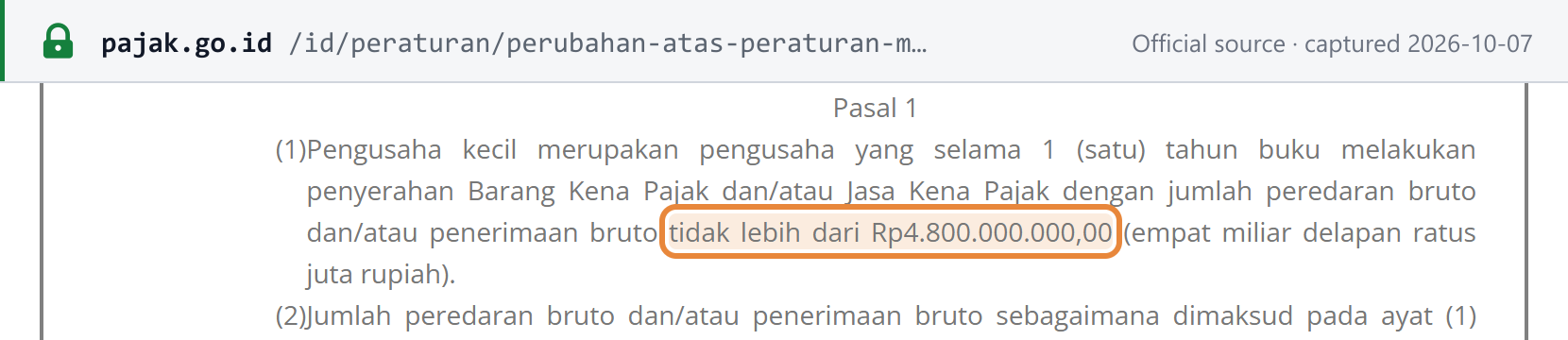
A small entrepreneur is one whose gross turnover or receipts from taxable supplies in one book year are not more than IDR 4,800,000,000 (as at 2026-10-07): "Pengusaha kecil merupakan pengusaha yang selama 1 (satu) tahun buku melakukan penyerahan … dengan jumlah peredaran bruto dan/atau penerimaan bruto tidak lebih dari Rp4.800.000.000,00" (PMK 197/PMK.03/2013 art. 1(1)). The figure has applied since 1 January 2014. [6]
- Measurement period. The book year; for individuals who do not keep books, the calendar year. [6]
- When to apply. "paling lama akhir bulan berikutnya setelah bulan saat jumlah peredaran bruto dan/ atau penerimaan brutonya melebihi Rp4.800.000.000,00" — by the end of the month after the month in which turnover passes IDR 4.8 billion (PMK 197 art. 4(2)). DJP can also confirm a PKP ex officio. [6]
For Indonesia alongside other jurisdictions, see Lookuptax's VAT registration thresholds table.
Non-resident registration
The IDR 4.8 billion threshold is a rule for businesses making supplies in Indonesia. A foreign business reaches the Indonesian VAT system by one of three routes, and they differ:
- Digital goods and services sold from abroad — PMSE VAT collector. DJP appoints a foreign seller, service provider or platform as a collector (Pihak Lain) once, in Indonesia, "a. nilai transaksi … melebihi Rp600.000.000,00 (enam ratus juta rupiah) dalam 1 (satu) tahun atau Rp50.000.000,00 (lima puluh juta rupiah) dalam 1 (satu) bulan; dan/atau b. jumlah traffic atau pengakses di Indonesia melebihi 12.000 (dua belas ribu) dalam 1 (satu) tahun atau 1.000 (seribu) dalam 1 (satu) bulan" — transactions above IDR 600 million a year or IDR 50 million a month, and/or traffic above 12,000 a year or 1,000 a month (PER-12/PJ/2025 art. 4(1); as at 2026-10-07). The appointment runs from the start of the month after DJP's decree (art. 3(2)). A foreign appointee "diberikan nomor identitas perpajakan dalam bentuk Nomor Pokok Wajib Pajak" — is given an NPWP (art. 7(1)); no Indonesian entity is needed. A business below the limits may ask to be appointed, "secara langsung ke kantor pelayanan pajak atau melalui Portal Wajib Pajak" — at a tax office or through the Taxpayer Portal (art. 5). [9] [10]
- Imported services and intangibles not covered by a collector — the Indonesian recipient self-assesses (see Cross-border rules). The foreign supplier does not register.
- Imported goods — import VAT is paid at customs.
DJP's English digital-tax page states the same thresholds: "The transaction value with users in Indonesia exceeds IDR 600,000,000 (six hundred million rupiah) annually or IDR 50,000,000 (fifty million rupiah) monthly; and/or The number of users or traffic from Indonesia exceeds 12,000 annually or 1,000 monthly." [10]

PMK 81/2024 and PER-12/PJ/2025 provide no separate VAT registration route for other foreign businesses without a permanent establishment (as at 2026-10-07).
Tax identification number
Taxpayers are identified by the NPWP (Nomor Pokok Wajib Pajak), 16 digits. On a tax invoice, a resident individual buyer's NIK (national identity number) "mempunyai kedudukan yang sama dengan Nomor Pokok Wajib Pajak dalam rangka pembuatan Faktur Pajak dan pengkreditan Pajak Masukan" — has the same standing as an NPWP for making tax invoices and crediting input VAT (PMK 81/2024 art. 385(2)). Business locations are identified by a 22-digit NITKU (the NPWP plus a six-digit suffix), as shown in DJP's official e-Faktur specimen. [4] [8]
The NPWP's structure, the 15-to-16-digit migration and NITKU are covered on Lookuptax's Indonesia NPWP tax ID guide. To check a number, use Lookuptax's Indonesia NPWP validator.
How to register
- Where. At the tax office (Kantor Pelayanan Pajak, KPP) where the business is registered, through Coretax. The KPP checks identity, establishment and business data against what DJP already holds (PMK 81/2024 art. 63(4)). A virtual office is accepted only under the conditions in art. 61(4)–(5). [4]
- Timeline. A receipt "diterbitkan paling lama 1 (satu) hari kerja setelah permohonan … diterima lengkap" — within one working day of a complete application (art. 63(2)) — and the decision follows "paling lama 10 (sepuluh) hari kerja" — within 10 working days (art. 63(6)). [4]
- Invoicing access. On approval, "Kepala Kantor Pelayanan Pajak memberikan akses pembuatan Faktur Pajak" — the KPP grants access to create tax invoices (art. 64(1)). [4]
- Documents. PMK 81/2024 sets no fixed document list; the KPP checks the application against DJP's data (art. 63(4)).
Voluntary registration
Available. "Pengusaha kecil … dapat memilih untuk melaporkan usahanya untuk dikukuhkan sebagai Pengusaha Kena Pajak" — a small entrepreneur may choose to be confirmed as a PKP (PMK 81/2024 art. 60(3)), and a business that intends from the outset to make taxable supplies or exports may register before trading (art. 60(4)). The usual reason is input VAT: VAT paid before confirmation can only be credited as a deemed 80% of the output VAT that should have been charged (VAT Law art. 9(9a), as amended by HPP). [4] [1]
Deregistration
A PKP whose book-year turnover is not more than IDR 4.8 billion "dapat mengajukan permohonan pencabutan pengukuhan" — may apply to be deregistered (PMK 197 art. 7). A request is decided after an audit, within six months of a complete request; if DJP does not decide in time, "permohonan Pengusaha Kena Pajak dianggap dikabulkan" — the request is deemed granted (PMK 81/2024 art. 68(3)–(5)). DJP can also deregister a PKP ex officio. PMK 81/2024 arts. 66–68 set no separate final-return requirement on deregistration (as at 2026-10-07). [6] [4]
Group registration
Not available. PMK 81/2024 and the VAT Law contain no VAT-grouping provision (as at 2026-10-07). Branches are not separate taxpayers: a DJP regional speaker, reported by DJP in January 2025, said VAT has been centralised at head office ex officio since January 2025, so a separate centralisation request is no longer needed, while adding that the office was still awaiting technical guidance from DJP headquarters. [18]
Rates
| Rate | Applies to | Basis and effective date |
|---|---|---|
| 12% of the full price (statutory standard rate) | Goods subject to luxury-goods sales tax (PPnBM), including motor vehicles | VAT Law art. 7(1)(b) (HPP), from 1 January 2025; PMK 131/2024 art. 2 [1] [5] |
| 12% × 11/12 base (effectively 11% of the price) | All other taxable goods and services, imports and imported services | PMK 131/2024 art. 3, from 1 January 2025 [5] |
| 0% | Exports of goods, intangibles and services | VAT Law art. 7(2) [1] |
| Fixed percentage (besaran tertentu) | Certain businesses and supplies on a final fixed-percentage VAT | VAT Law art. 9A [1] |
Standard rate — 12% statutory, 11% effective on most supplies (as at 2026-10-07). HPP set the rate in two steps: "a. sebesar 11% (sebelas persen) yang mulai berlaku pada tanggal 1 April 2022; b. sebesar 12% (dua belas persen) yang mulai berlaku paling lambat pada tanggal 1 Januari 2025" (VAT Law art. 7(1)). The rate can be changed by Government Regulation to between 5% and 15% (art. 7(3)). [1]
PMK 131/2024 then splits how the 12% is applied, from 1 January 2025:
- Luxury goods — 12% "dengan Dasar Pengenaan Pajak berupa harga jual atau nilai impor" — on the selling price or import value (art. 2(2)–(3)). This is a true 12%. For retail sales of luxury goods to final consumers, the reduced base applied for January 2025 only; the full base applies from 1 February 2025 (arts. 5–6).
- Everything else — 12% on a tax base of "nilai lain" (another value), which "dihitung sebesar 11/12 (sebelas per dua belas) dari nilai impor, harga jual, atau penggantian" — is 11/12 of the import value, selling price or consideration (art. 3(2)–(3)). Supplies already on their own nilai lain or besaran tertentu regimes are outside arts. 2–3 (art. 4).

DJP's explanation: the regulation sets the base at 11/12, "Dengan demikian nilai PPN yang dibayarkan tidak berubah dari kondisi sebelumnya" — so the VAT paid does not change from before — and the goods getting this treatment are "semua Barang dan Jasa Kena Pajak yang tidak tergolong mewah" — all taxable goods and services that are not luxury goods. [18]
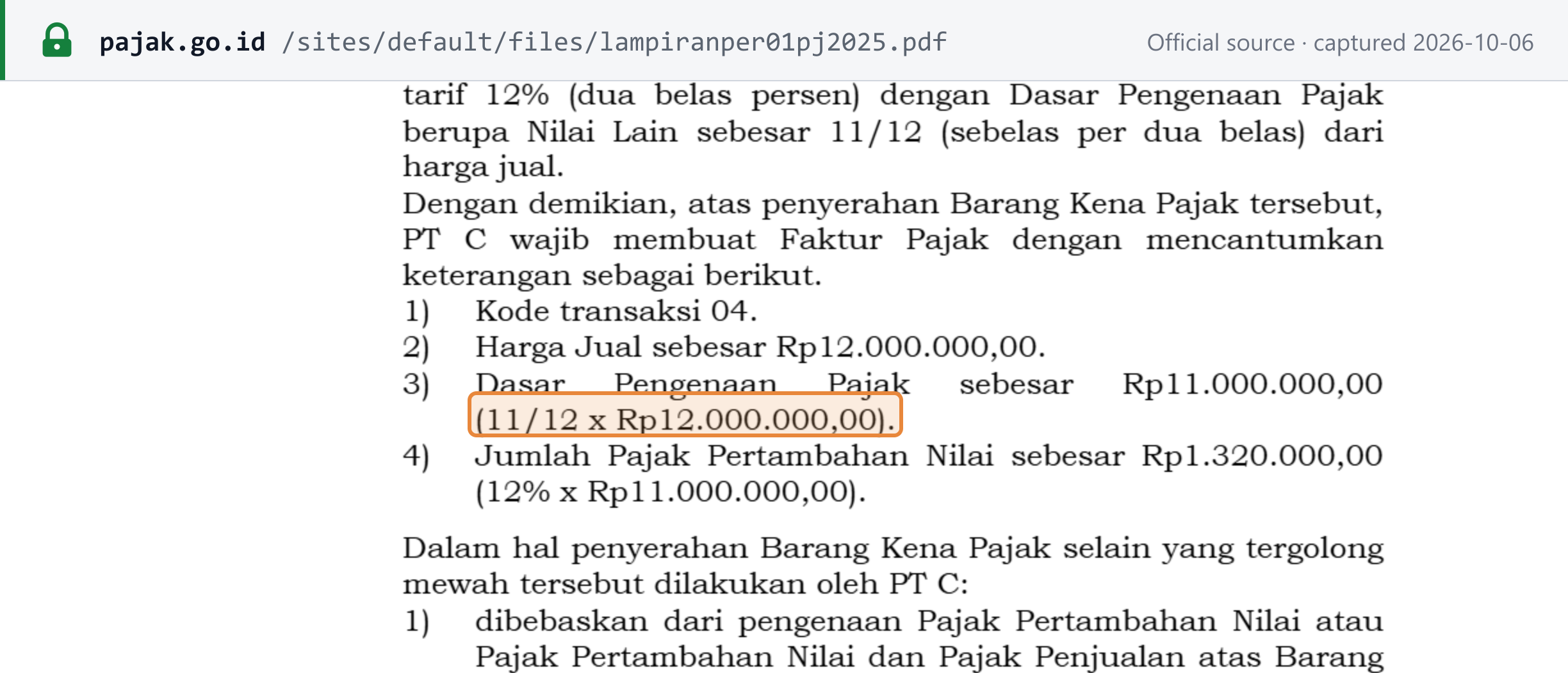
DJP's worked example. The attachment to PER-1/PJ/2025 shows a non-luxury computer sold for Rp12,000,000: "1) Kode transaksi 04. 2) Harga Jual sebesar Rp12.000.000,00. 3) Dasar Pengenaan Pajak sebesar Rp11.000.000,00 (11/12 x Rp12.000.000,00). 4) Jumlah Pajak Pertambahan Nilai sebesar Rp1.320.000,00 (12% x Rp11.000.000,00)." Transaction code 04 is the code for the 11/12 base (see Numbering and sequencing). In the same example, a luxury car uses code 01: tax base Rp300,000,000, VAT Rp36,000,000. [17]
| Supply | Price | Tax base (DPP) | VAT | Effective rate |
|---|---|---|---|---|
| Non-luxury goods or services (code 04) | Rp12,000,000 | Rp11,000,000 | Rp1,320,000 | 11% |
| Luxury good (code 01) | Rp300,000,000 | Rp300,000,000 | Rp36,000,000 | 12% |
Reduced rates. Indonesia has no reduced-rate band. In its place are: [1] [19]
- Fixed-percentage VAT (besaran tertentu) for PKPs below a turnover limit, in certain businesses, or making certain supplies (VAT Law art. 9A(1)). Input VAT related to those supplies "tidak dapat dikreditkan" — cannot be credited (art. 9A(2)).
- Sector bases (nilai lain) under PMK 11/2025 — for example own use, at "11/12 (sebelas per dua belas) dari Harga Jual atau Penggantian setelah dikurangi laba kotor" — 11/12 of the price or consideration less gross profit. PMK 11/2025 sets the percentage for each sector.
- Facilities — supplies where VAT is not collected or is exempt (see Exemptions).
Announced future rates. None found. DJP's regulation catalogue lists no instrument amending PMK 131/2024, which shows as in force ("Aktif"), and any rate change needs a Government Regulation (VAT Law art. 7(4)) (as at 2026-10-07). [5]
For Indonesia alongside other jurisdictions, see Lookuptax's worldwide tax rates table.
Cross-border rules
Imports and exports
- Imports of goods. VAT is charged on import (VAT Law art. 4(1)), on the 11/12 base for non-luxury goods. Import VAT paid by the importer "wajib dilunasi bersamaan dengan saat pembayaran bea masuk" — is paid together with import duty; import VAT collected by customs is remitted by DJBC within one working day (PMK 81/2024 art. 94(3)(a)). [2] [4]
- Low-value consignments. Low-value import relief for consignments (barang kiriman) is set by customs (DJBC) regulations.
- Exports. Exports of goods, intangibles and services are zero-rated (VAT Law art. 7(2)). A PKP issues a tax invoice for exports of intangibles and services (PMK 81/2024 art. 382). Exporters can claim refunds monthly (see Refunds). [1] [4]
- Imported services and intangibles — self-assessment. "Orang pribadi atau badan yang memanfaatkan Barang Kena Pajak Tidak Berwujud dari luar Daerah Pabean … dan/atau yang memanfaatkan Jasa Kena Pajak dari luar Daerah Pabean … wajib memungut, menyetor, dan melaporkan Pajak Pertambahan Nilai yang terutang" — any person or entity using foreign intangibles or services in Indonesia must self-collect, pay and report the VAT, whether or not it is a PKP (VAT Law art. 3A(3)). The base is 11/12; payment is due by the 15th of the following month (PMK 81/2024 art. 94(2)), and a PKP reports it in its monthly return. See Lookuptax's reverse charge explainer. [2] [4]
Digital products and services
Indonesia collects VAT on foreign digital supplies through two parallel mechanisms.
1. PMSE VAT collectors (since 1 July 2020). DJP: "Effective from 1 July 2020, Value Added Tax (VAT) on the utilization of intangible taxable goods and/or taxable services from outside the customs area … through Electronic Transactions (PMSE) shall be collected, remitted, and reported by VAT Collectors". Under PER-12/PJ/2025: [10] [9]
- Amount. The VAT rate times a base of "nilai lain sebesar 11/12 (sebelas per dua belas) dari nilai berupa uang yang dibayar oleh Pemanfaat Barang dan/atau Pemanfaat Jasa, tidak termasuk Pajak Pertambahan Nilai yang dipungut" — 11/12 of the amount paid, excluding the VAT — collected at the time of payment (art. 9(1)–(3)).
- Proof. A commercial invoice, billing statement or order receipt serves as the collection document.
- Remittance. Monthly, "paling lambat diterima oleh Collecting Agent pada akhir bulan berikutnya setelah Masa Pajak berakhir" — received by the collecting agent by the end of the following month (art. 12(1)). A foreign collector may pay in rupiah or US dollars (art. 12(4)). A PMSE monthly VAT return is due by the same month-end.
- Platforms. Foreign and domestic platforms can be appointed to collect for third-party sellers (art. 10(2)).
- Not consumer-only. A PKP buyer can credit the VAT if its name and NPWP, NIK or registered email appear on the collection document (art. 11(5)–(6)).

2. SPP-TDLN — collection by payment issuers (from 25 September 2026). Under PMK 49/2026, appointed payment issuers — banks and non-bank issuers — collect VAT on foreign digital purchases where collection has not been done by a PMSE collector: the regulation covers collection "dilakukan oleh selain pelaku usaha perdagangan melalui sistem elektronik yang telah ditunjuk sebagai Pihak Lain" (art. 5(1)). DJP's notice: "Indonesia will implement the VAT Collection System for Cross-Border Digital Transactions (SPP-TDLN) effective 25 September 2026." and "The SPP-TDLN does not introduce a new tax and does not impose a new VAT rate." [11] [12]

- Amount. The issuer multiplies "formula 11/111 (sebelas per seratus sebelas) dengan harga atau pembayaran … yang telah memperhitungkan Pajak Pertambahan Nilai" — 11/111 of the VAT-inclusive price (art. 7(2)), which equals 11% of the net price. [11]
- Remittance. The collecting party pays the VAT "paling lama 7 (tujuh) hari terhitung sejak tanggal Penyelenggara SPP-TDLN memberikan konfirmasi" — within seven days of the system operator's confirmation (art. 12(1)). [11]
- Start. DJP's press release says the government began applying SPP-TDLN on 25 September 2026, after a sandbox testing and stabilisation phase. [15]
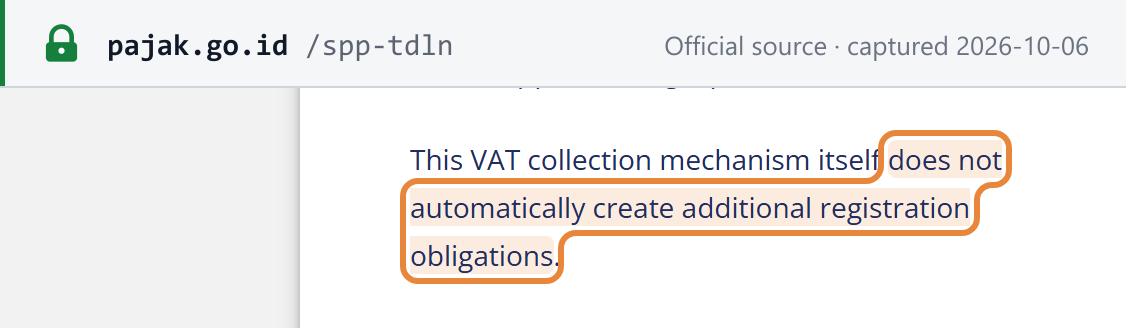
- Effect on foreign sellers. The seller's payout is reduced by the VAT collected. On registration, DJP's merchant page answers "Does this mean I have to register for VAT in Indonesia?" with "Not necessarily. … This VAT collection mechanism itself does not automatically create additional registration obligations." [13]
- Business buyers. DJP's FAQ: the collection document "merupakan dokumen tertentu yang kedudukannya dipersamakan dengan faktur pajak" — is a document with the same standing as a tax invoice (Q15), so a PKP buyer can credit it. Fund transfers and migrant remittances "bukan merupakan objek PPN" — are not subject to VAT (Q5–Q6). [14]
See the event record for PMK 49/2026 and Lookuptax's explainer on VAT on digital services by non-resident suppliers.
Foreign companies selling into Indonesia — B2B and B2C
- B2C digital. A foreign seller above the PER-12 limits is appointed as a PMSE collector and charges 12% on the 11/12 base. If it is not a collector, an appointed payment issuer may collect 11/111 of the price under SPP-TDLN. [9] [11]
- B2B digital. The same collection mechanisms apply — PMSE is not limited to consumers. A PKP buyer named on the PMSE document, or holding an SPP-TDLN collection document, can credit the VAT. [9] [14]
- B2B and B2C services where no VAT was collected. The Indonesian recipient self-assesses (VAT Law art. 3A(3)); the foreign supplier does not register. [2]
- Goods. Import VAT is paid at customs by the importer. [4]
Marketplace / platform deemed-supplier liability
Applies to digital supplies. DJP can appoint foreign and domestic platforms as PMSE collectors for goods and services sold by third-party sellers through them (PER-12/PJ/2025 art. 10(2)). See Lookuptax's marketplace deemed-supplier explainer. [9]
Place of supply
VAT applies to "penyerahan Barang Kena Pajak di dalam Daerah Pabean yang dilakukan oleh Pengusaha; impor Barang Kena Pajak; penyerahan Jasa Kena Pajak di dalam Daerah Pabean …; pemanfaatan Barang Kena Pajak Tidak Berwujud dari luar Daerah Pabean di dalam Daerah Pabean; pemanfaatan Jasa Kena Pajak dari luar Daerah Pabean di dalam Daerah Pabean; ekspor …" (VAT Law art. 4(1)). In practice: [2]
- Goods are taxed when supplied within the customs area (Daerah Pabean) or imported.
- Services and intangibles from abroad are taxed where they are used (pemanfaatan) within the customs area — a use test, not a residence test.
- Exports are separate, zero-rated taxable events.
Invoice requirements
The tax invoice is the faktur pajak. Its rules sit in PMK 81/2024 arts. 382–391 and PER-11/PJ/2025, which in its Attachment D also publishes an official e-Faktur display specimen. [4] [7]
Every faktur is an e-Faktur approved by DJP. A faktur must be "a. berbentuk elektronik; b. dibuat dengan menggunakan modul dalam Portal Wajib Pajak atau laman lain yang terintegrasi dengan sistem administrasi Direktorat Jenderal Pajak; dan c. dicantumkan tanda tangan berbentuk Tanda Tangan Elektronik" — electronic, made in the Taxpayer Portal module or an integrated system, and electronically signed (PMK 81/2024 art. 386(1)). It must be uploaded and approved by DJP; one that is not approved "bukan merupakan Faktur Pajak" — is not a tax invoice — and its VAT "merupakan Pajak Masukan yang tidak dapat dikreditkan" — is input VAT that cannot be credited (art. 387). [4]
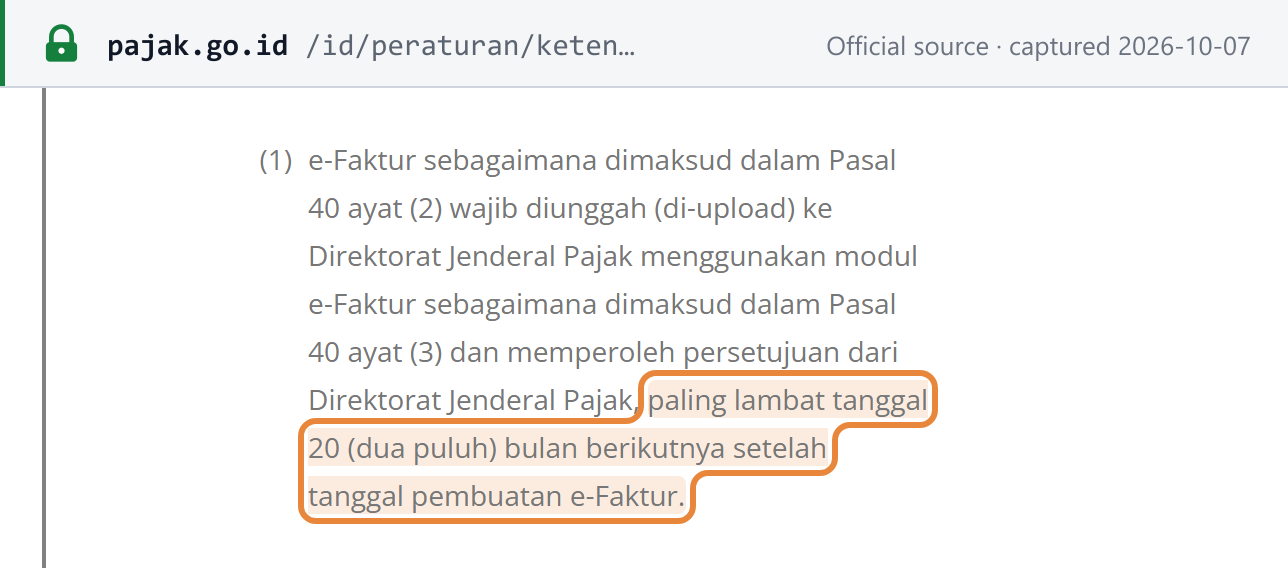
Upload deadline. An e-Faktur "wajib diunggah (di-upload) ke Direktorat Jenderal Pajak … dan memperoleh persetujuan dari Direktorat Jenderal Pajak, paling lambat tanggal 20 (dua puluh) bulan berikutnya setelah tanggal pembuatan e-Faktur" — must be uploaded and approved by the 20th of the month after the invoice date (PER-11/PJ/2025 art. 44(1)). It need not be printed: "e -Faktur tidak diwajibkan untuk dicetak dalam bentuk kertas (hardcopy)" (art. 40(6)). Paper is allowed only in force majeure declared by DJP (art. 61). [7]
Mandatory content
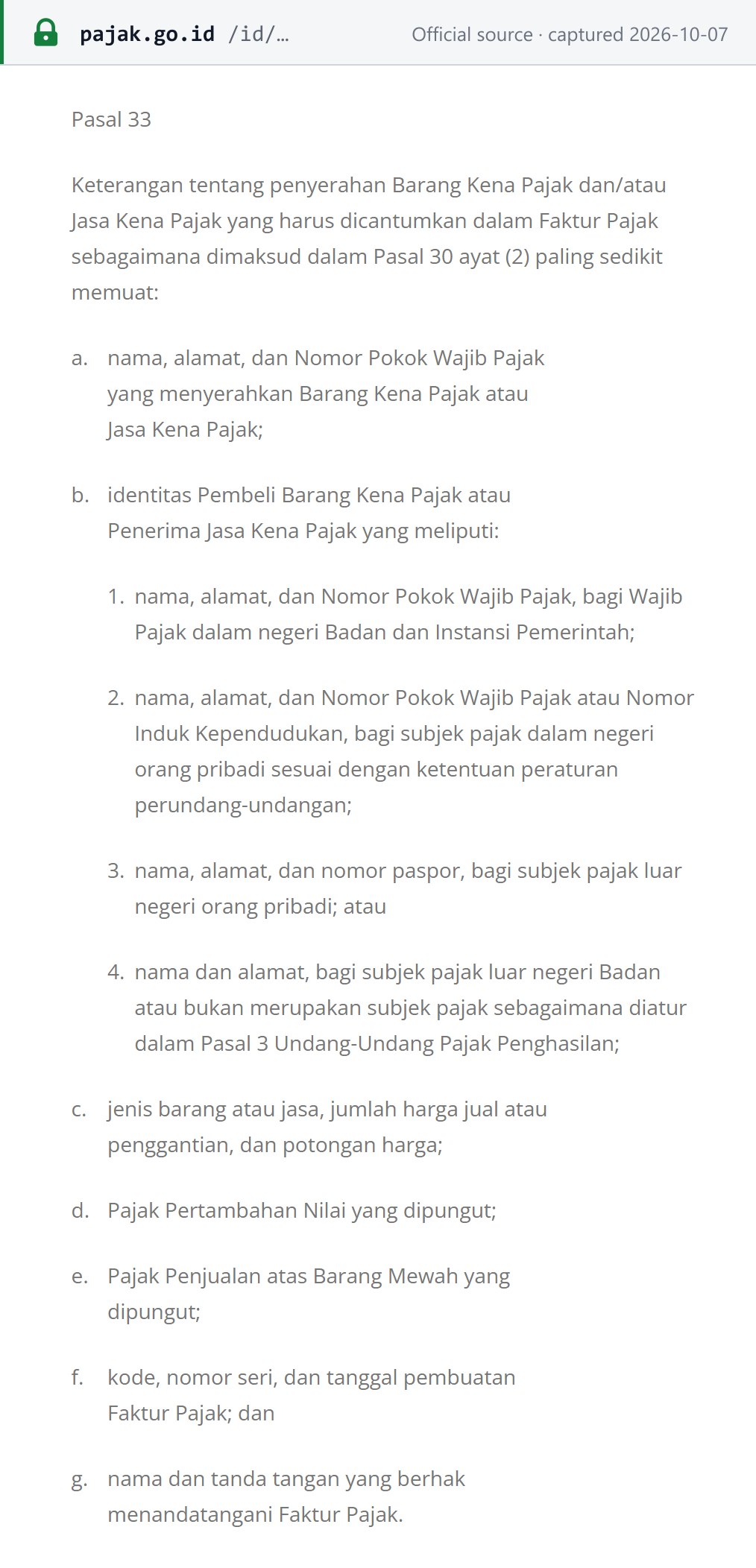
A faktur "paling sedikit memuat" — must contain at least (PMK 81/2024 art. 385(1); repeated in PER-11/PJ/2025 art. 33): [4] [7]
| # | Required field | Legal cite |
|---|---|---|
| 1 | Seller's name, address and NPWP, as registered with DJP | art. 385(1)(a); PER-11 art. 34(1) |
| 2 | Buyer identity — domestic entity or government body: name, address, NPWP | art. 385(1)(b)(1) |
| 3 | Buyer identity — resident individual: name, address, and NPWP or NIK | art. 385(1)(b)(2) |
| 4 | Buyer identity — foreign individual: name, address, passport number | art. 385(1)(b)(3) |
| 5 | Buyer identity — foreign entity: name and address | art. 385(1)(b)(4) |
| 6 | Type of goods or services, selling price or consideration, and discount | art. 385(1)(c) |
| 7 | VAT collected | art. 385(1)(d) |
| 8 | PPnBM collected | art. 385(1)(e) |
| 9 | Code, serial number and date of the faktur | art. 385(1)(f) |
| 10 | Name and signature of the authorised signer (registered in the portal; name as on the KTP or passport; electronic signature) | art. 385(1)(g); PER-11 art. 38 |
Extra fields. New motor vehicles show brand, type, variant and chassis number; land and buildings show the full address; supplies to free-trade zones show the HS code (PER-11/PJ/2025 art. 35). Supplies under a VAT facility carry a legend citing the legal basis (art. 46). Additional information may be added (art. 39). [7]
Issuance deadline
A faktur "harus dibuat pada" — must be made (PMK 81/2024 art. 382(2)): [4]
- at the time of supply;
- on receipt of payment, if payment comes before supply;
- on receipt of each instalment (termin); or
- at export.
Monthly combined faktur. One faktur per buyer may cover a calendar month's supplies (faktur gabungan), and "harus dibuat paling lambat akhir bulan penyerahan" — must be made by the end of the month of supply (art. 383(3)). It is not allowed for supplies where VAT is not collected under a facility. [4]
Late fakturs. A late faktur costs a 1% of the tax base fine (see Penalties). A faktur made "setelah melewati jangka waktu 3 (tiga) bulan sejak saat Faktur Pajak seharusnya dibuat … tidak diperlakukan sebagai Faktur Pajak" — more than three months after it should have been made is not treated as a faktur at all (art. 384(1)): the 1% fine applies and the buyer cannot credit the VAT (PER-11/PJ/2025 arts. 58–59). [4] [7]
Numbering and sequencing
The code and serial number "terdiri atas 17 (tujuh belas) digit, yaitu: 2 (dua) digit kode transaksi; 2 (dua) digit kode status; dan 13 (tiga belas) digit Nomor Seri Faktur Pajak yang diberikan oleh Direktorat Jenderal Pajak" — 17 digits: a 2-digit transaction code, a 2-digit status code and a 13-digit serial number assigned by DJP (PER-11/PJ/2025 art. 37(1)). The serial number is "diberikan secara otomatis" — assigned automatically when the e-Faktur is uploaded and approved (art. 43). The seller does not run its own sequence. [7]
| Code | Meaning (PER-11/PJ/2025 Attachment D) |
|---|---|
| 01 | Ordinary supply where VAT is due |
| 02, 03 | Supplies to government or other VAT collectors |
| 04 | Supplies on a nilai lain base — the standard 11/12 case |
| 05 | Fixed-percentage VAT (besaran tertentu) under VAT Law art. 9A(1) |
| 06 | Supplies to foreign tourists |
| 07 | VAT not collected or borne by the government (facilities) |
| 08 | Exempt supplies |
| 09 | Sales of assets |
| 10 | Other rates or bases |
| Status 00 | Normal faktur; 01 is the first replacement, and so on |
Attachment D's example: "01002500000000001, berarti penyerahan yang terutang Pajak Pertambahan Nilai … (kode transaksi 01), status Faktur Pajak normal (kode status 00)"; code 04 is "Digunakan untuk penyerahan … yang dasar pengenaan pajaknya menggunakan nilai lain". [8]
Credit and debit notes
- Errors are corrected "dengan cara membuat Faktur Pajak pengganti" — with a replacement faktur (status 01, 02 …), except errors in the buyer's identity (PER-11/PJ/2025 art. 48(1)–(2)). A wrong buyer identity means cancelling the faktur and issuing a new one (art. 49(3)). Cancellation needs evidence that the transaction was cancelled. Replacement and cancellation are possible only while the monthly VAT return for that period can still be filed or corrected (art. 50(1)). [7]
- Returned goods — the buyer issues an electronic nota retur, made and uploaded in the Taxpayer Portal, e-signed and approved by DJP, and "harus dibuat pada saat Barang Kena Pajak dikembalikan" — made when the goods are returned (PMK 81/2024 art. 288(2), (4)). It references the original faktur's code, serial number and date. Cancelled services use a nota pembatalan (art. 289). Output VAT is reduced in the period of the return (VAT Law art. 5A). [4] [2]
- Debit notes. PMK 81/2024 and PER-11/PJ/2025 contain no debit-note mechanism (as at 2026-10-07); an upward correction is made with a replacement faktur.
Currency and language
- Currency and FX. Where a supply is priced in another currency, the VAT "harus dikonversi ke dalam satuan mata uang rupiah dengan menggunakan kurs yang ditetapkan dalam Keputusan Menteri Keuangan … yang berlaku pada saat Faktur Pajak seharusnya dibuat" — is converted to rupiah at the Minister of Finance (KMK) rate in force when the faktur should have been made (PER-11/PJ/2025 art. 36(2)). Only the tax base, VAT and PPnBM are converted. A replacement faktur uses the rate of the original (status 00) faktur. Amounts are rounded to whole rupiah. [7] [8]
- Language. PMK 81/2024 and PER-11/PJ/2025 set no language rule for the faktur, which is generated by DJP's module (as at 2026-10-07). The monthly VAT return must be in Bahasa Indonesia, in Latin script and rupiah (PMK 81/2024 art. 161(1)). [4]
Document types
| Document | When it is used | Cite |
|---|---|---|
| Full e-Faktur | Every supply by a PKP, unless the retail rule below applies | PMK 81/2024 arts. 385–387 |
| Retail faktur (faktur pajak pedagang eceran) | Sales to buyers with final-consumer characteristics — who consume the goods or services directly and not for business, including e-commerce sales. No buyer identity or signer is needed; it may be a cash receipt, sales invoice, till slip, ticket or kuitansi, possibly electronic, and the retailer may set its own code and serial number (art. 52(7)) | PER-11/PJ/2025 arts. 51–53 |
| Nota retur / nota pembatalan | Returned goods / cancelled services | PMK 81/2024 arts. 288–289 |
The retail test is per transaction, not by sector, and there is no value threshold. VAT on a retail faktur "merupakan Pajak Masukan yang tidak dapat dikreditkan" — cannot be credited by the buyer (PER-11/PJ/2025 art. 52(10)). A full faktur is always required for motor vehicles, yachts, aircraft, land and buildings, firearms, and rentals of these (art. 55(2)–(3)). [7]
Self-billing
Not provided for. "Pengusaha Kena Pajak yang menyerahkan Barang Kena Pajak dan/atau Jasa Kena Pajak wajib memungut Pajak Pertambahan Nilai yang terutang dan membuat Faktur Pajak" — the supplying PKP must collect the VAT and make the faktur (PER-11/PJ/2025 art. 30(1)). PER-11/PJ/2025 contains no self-billing provision (as at 2026-10-07); only the nota retur is issued by the buyer. [7]
Retention and audit trail
- Retention. Books, records and documents, "termasuk hasil pengolahan data dari pembukuan yang dikelola secara elektronik atau secara program aplikasi on-line wajib disimpan selama 10 (sepuluh) tahun di Indonesia" — including electronically processed data, are kept for 10 years in Indonesia (UU KUP art. 28(11)). Failing to keep them in Indonesia is a criminal offence where it causes a loss of revenue (art. 39(1)). [3]
- Audit trail. Built into the system: DJP approves each faktur and assigns its serial number, status codes record each replacement, and cancellations are recorded in the portal. PMK 81/2024 and PER-11/PJ/2025 set no separate hash or tamper-evidence requirement for the issuer (as at 2026-10-07). [4] [7]
A specimen of a compliant invoice
DJP publishes an official display specimen of an e-Faktur in PER-11/PJ/2025 Attachment D, "Contoh Tampilan e-Faktur" (PDF page 170). It is the official source for the layout below. It shows a free-trade-zone luxury-car supply under code 07, where VAT is not collected — not the everyday case. [8]
The example below is ours — Lookuptax's illustration of the everyday code-04 case, using DJP's own field labels from that specimen and the figures from DJP's computer example in PER-1/PJ/2025. Every name, number and amount in it is fictional:
Faktur Pajak — Tax invoice (code 04)
| No. | Kode Barang/Jasa | Nama Barang Kena Pajak/Jasa Kena Pajakart. 385(1)(c) | Harga Jual/Penggantian/ Uang Muka/Termin (Rp)art. 385(1)(c) |
|---|---|---|---|
| 1 | (goods code) | Komputer — 1 unit | 12.000.000,00 |
- Harga Jual / Penggantian / Uang Muka / Terminart. 385(1)(c)
- 12.000.000,00
- Dikurangi Potongan Harga (discount)art. 385(1)(c)
- 0,00
- Dikurangi Uang Muka yang telah diterima (advances received)
- 0,00
- Dasar Pengenaan Pajak (tax base — nilai lain, 11/12)PMK 131/2024 art. 3
- 11.000.000,00
- Jumlah PPN (Pajak Pertambahan Nilai) — 12% × DPPart. 385(1)(d)
- 1.320.000,00
- Jumlah PPnBM (Pajak Penjualan atas Barang Mewah)art. 385(1)(e)
- 0,00
- Signature block: "JAKARTA SELATAN, 05 OKTOBER 2026 — ditandatangani secara elektronik — SPECIMEN SIGNER". The signer is registered in the Taxpayer Portal and signs electronically — PMK 81 art. 385(1)(g), art. 386(1)(c); PER-11 art. 38.
- DJP footer on the official specimen: "Sesuai dengan ketentuan yang berlaku, Direktorat Jenderal Pajak mengatur bahwa Faktur Pajak ini telah ditandatangani secara elektronik sehingga tidak diperlukan tanda tangan basah pada Faktur Pajak ini." and "Pemberitahuan: Faktur Pajak ini telah dilaporkan ke Direktorat Jenderal Pajak dan telah memperoleh persetujuan sesuai dengan ketentuan peraturan perpajakan yang berlaku."
- A supply under a VAT facility (code 07 or 08) carries a legend citing its legal basis, for example "PAJAK PERTAMBAHAN NILAI TIDAK DIPUNGUT BERDASARKAN …" — PER-11 art. 46. A luxury good (code 01) would show the full price as the tax base.
- Amounts are in rupiah, written in Indonesian notation (12.000.000,00 = 12,000,000.00). A foreign-currency price is converted at the KMK rate — PER-11 art. 36(2).
E-invoicing status
Status (as at 2026-10-07): mandatory clearance e-invoicing for every PKP, through DJP's Coretax system, since 1 January 2025. Every full faktur "wajib berbentuk Dokumen Elektronik" — must be an electronic document (PER-11/PJ/2025 art. 30(3)) — and must be uploaded and approved by DJP before it counts as a faktur (PMK 81/2024 art. 387). [7] [4] [16]
| Item | Position |
|---|---|
| System | e-Faktur in Coretax DJP, live since 1 January 2025 (KMK 456/2024) |
| Model | Clearance — DJP approval assigns the serial number; unapproved fakturs are not fakturs |
| Channel | The Taxpayer Portal (Portal Wajib Pajak) module, or a system integrated with DJP (PMK 81/2024 art. 386(1)(b)) |
| Deadline | Upload and approval by the 20th of the month after the faktur date (PER-11 art. 44(1)) |
| B2B and B2G | Mandatory for every PKP; no phasing by size |
| B2C | Retail sales to final consumers may use a retail faktur, which can be a receipt-form document numbered by the retailer — except motor vehicles, yachts, aircraft, land and buildings, and firearms (PER-11 arts. 51–55) |
| Format | Generated by DJP's module. PMK 81/2024 and PER-11/PJ/2025 name no Peppol, UBL or other external standard (as at 2026-10-07) |
Access can be switched off. Under PER-19/PJ/2025, DJP can deactivate a PKP's access to create fakturs where, among other grounds, it "tidak menyampaikan Surat Pemberitahuan Masa Pajak Pertambahan Nilai … berturut-turut selama 3 (tiga) bulan" — has not filed monthly VAT returns for three consecutive months — or for six periods in a calendar year, or has tax arrears of at least IDR 250,000,000 (taxpayers at a KPP Pratama) or IDR 1,000,000,000 (other KPPs) after a warning (art. 2(2)). If no clarification is accepted within 30 days, the KPP revokes PKP status ex officio (PMK 81/2024 art. 65(4)). [20] [4]

For Indonesia alongside other jurisdictions, see Lookuptax's e-invoicing status and networks table.
Filing and payment
Filing frequency
Monthly, for every PKP. The tax period is one calendar month (UU KUP art. 2A), and PMK 81/2024 provides no quarterly or annual VAT return for ordinary PKPs (as at 2026-10-07). [3]
Return due date
The monthly VAT return — SPT Masa PPN — is due "paling lambat akhir bulan berikutnya setelah Masa Pajak berakhir" — by the end of the month after the tax period (PMK 81/2024 art. 171(13)). VAT collectors and PMSE collectors have the same month-end deadline. Each faktur is reported in the return for the period of its date (PER-11/PJ/2025 art. 60(1)). [4] [7]
Payment due date and method
VAT for the period "wajib disetor paling lambat akhir bulan berikutnya setelah Masa Pajak berakhir dan sebelum Surat Pemberitahuan Masa Pajak Pertambahan Nilai disampaikan" — is paid by the end of the following month and before the return is filed (PMK 81/2024 art. 94(3)). VAT self-assessed on imported services and intangibles is due earlier, by the 15th of the following month (art. 94(2)). [4]

Payment is made with a billing code — "Satu kode billing dapat digunakan untuk membayar lebih dari satu jenis setoran pajak" (one billing code can pay more than one type of tax) — or from a tax deposit (Deposit Pajak) held in Coretax. [22]
Additional listings
Coretax builds the return's sales and purchase detail from the approved e-Fakturs, so there is no separate EC-sales-style listing. PMK 81/2024 sets no annual VAT return for PKPs.
Input-tax recovery and blocked items
Input VAT is credited in the same period, or "paling lama 3 (tiga) Masa Pajak setelah berakhirnya Masa Pajak saat Faktur Pajak dibuat" — up to three periods later (VAT Law art. 9(9)). A valid faktur is required. [1]
After HPP, the blocked list in VAT Law art. 9(8) is short. Input VAT cannot be credited for: [1]
- purchases "yang tidak mempunyai hubungan langsung dengan kegiatan usaha" — not directly related to the business (art. 9(8)(b));
- purchases whose faktur does not meet the rules or "tidak mencantumkan nama, alamat, dan Nomor Pokok Wajib Pajak pembeli" — omits the buyer's name, address and NPWP (art. 9(8)(f)); and
- imported services or intangibles whose faktur does not meet the rules (art. 9(8)(g)).
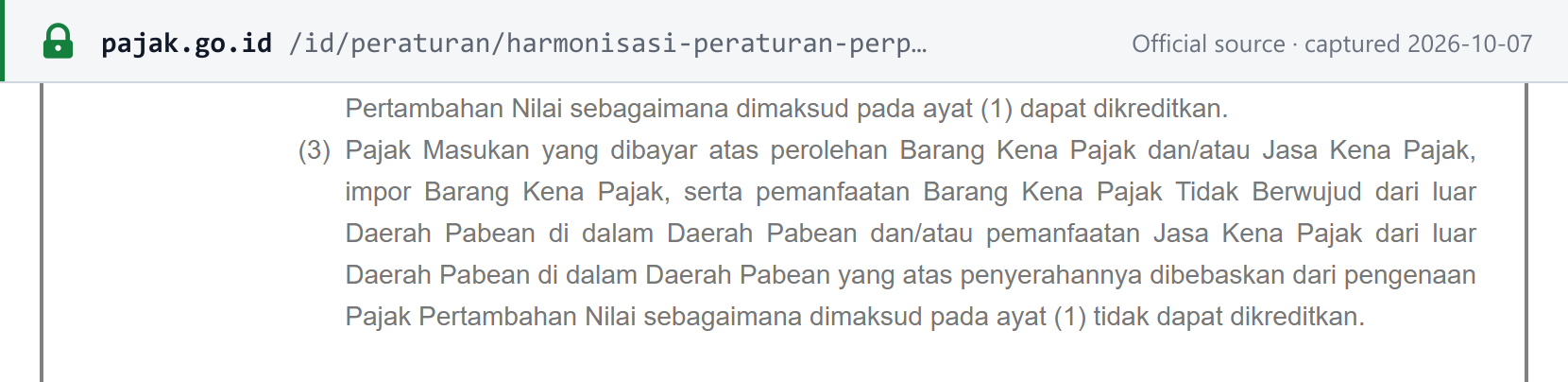
HPP deleted the other items, including the former block on sedans and station wagons (art. 9(8)(c), "dihapus"). Structurally, input VAT is also not creditable on exempt supplies (art. 16B(3)), on supplies under fixed-percentage VAT (art. 9A(2)), on retail fakturs, and on e-Fakturs DJP did not approve. VAT paid before PKP confirmation is credited as a deemed 80% of output VAT (art. 9(9a)). [1]
Refunds
- Default. Excess input VAT is carried forward; a refund "dapat diajukan permohonan pengembalian pada akhir tahun buku" — can be claimed at the end of the book year (VAT Law art. 9(4a)). [1]
- Monthly refunds are open to exporters of goods, intangibles and services, suppliers to VAT collectors, and businesses whose supplies are not collected under a facility (art. 9(4b)). Low-risk PKPs get a preliminary refund (art. 9(4c)). [1]
- Timing. Where a refund is audited, DJP "harus menerbitkan surat ketetapan pajak paling lama 12 (dua belas) bulan sejak surat permohonan diterima secara lengkap" — must issue an assessment within 12 months of a complete claim (UU KUP art. 17B(1)). [3]
- Tourists can recover VAT on goods bought on code-06 fakturs (PER-11/PJ/2025 art. 47(2)).
- Not available. The VAT Law, PMK 81/2024 and PER-11/PJ/2025 contain no refund scheme for non-resident businesses and no bad-debt relief (as at 2026-10-07).
Exemptions
Outside VAT, not collected, and exempt
Indonesian law separates three kinds of relief, and the input-VAT consequence differs:
- Outside the scope of VAT (VAT Law art. 4A, as narrowed by HPP). Mostly supplies that are regional-tax objects instead. Goods: food and drink served in hotels, restaurants and similar outlets; money, gold bullion held for state reserves, and securities. Services: religious services, arts and entertainment, hotel accommodation, government services, parking, and catering (art. 4A(2)–(3)). [1]
- VAT not collected (tidak dipungut, art. 16B). The input VAT "dapat dikreditkan" — can be credited (art. 16B(2)). In effect this works like a zero rate.
- VAT exempt (dibebaskan, art. 16B). The input VAT "tidak dapat dikreditkan" — cannot be credited (art. 16B(3)).
Basic necessities, health, education, financial and insurance services were moved by HPP out of art. 4A into the art. 16B facilities. Art. 16B(1a)(j) lists "1. barang kebutuhan pokok yang sangat dibutuhkan oleh rakyat banyak; 2. jasa pelayanan kesehatan medis tertentu …; 3. jasa pelayanan sosial; 4. jasa keuangan; 5. jasa asuransi; 6. jasa pendidikan; 7. jasa angkutan umum di darat dan di air …; dan 8. jasa tenaga kerja" — basic necessities, certain medical services, social services, financial services, insurance, education, public land and water transport, and labour services. The operative lists sit in PP 49/2022 (listed as in force in DJP's catalogue, 2026-10-07). [1] [23]
Exempt is not "not collected", and neither is zero-rated in name. A business whose supplies are exempt charges no VAT and cannot recover the VAT on its costs. A business whose supplies are not collected also charges no VAT, but can recover it — as an exporter at 0% can. Fakturs for both carry a legend citing the legal basis (PER-11/PJ/2025 art. 46). [1] [7]
Special regimes
- Zones. Bonded zones, Special Economic Zones (KEK) and free trade zones and free ports (KPBPB, such as Batam) have their own VAT rules. Supplies into them where VAT is not collected use code 07 (PER-11/PJ/2025 Attachment D). [7]
- Small business. Below IDR 4.8 billion turnover, a business stays outside PKP status unless it opts in (see Registration). [6]
- Fixed-percentage VAT for certain businesses and supplies (VAT Law art. 9A; PMK 11/2025). [19]
Offences and penalties
Indonesia separates tax crimes under UU KUP arts. 39 and 39A from administrative sanctions — fines and interest — under arts. 7, 9 and 14.
Offences
| Offence | Conduct | Sanction |
|---|---|---|
| UU KUP art. 39(1) | Intentionally, and causing a loss of state revenue: not registering for an NPWP or not reporting for PKP status; misusing an NPWP or PKP status; not filing a return, or filing a false one; refusing an audit; keeping false books; not keeping records in Indonesia; not remitting tax collected | 6 months to 6 years' imprisonment and a fine of 2 to 4 times the unpaid tax; doubled for a repeat offence within a year |
| UU KUP art. 39A | Intentionally issuing or using fakturs "yang tidak berdasarkan transaksi yang sebenarnya" — not based on real transactions — or issuing fakturs before being confirmed as a PKP | 2 to 6 years' imprisonment and a fine of 2 to 6 times the tax on the documents |
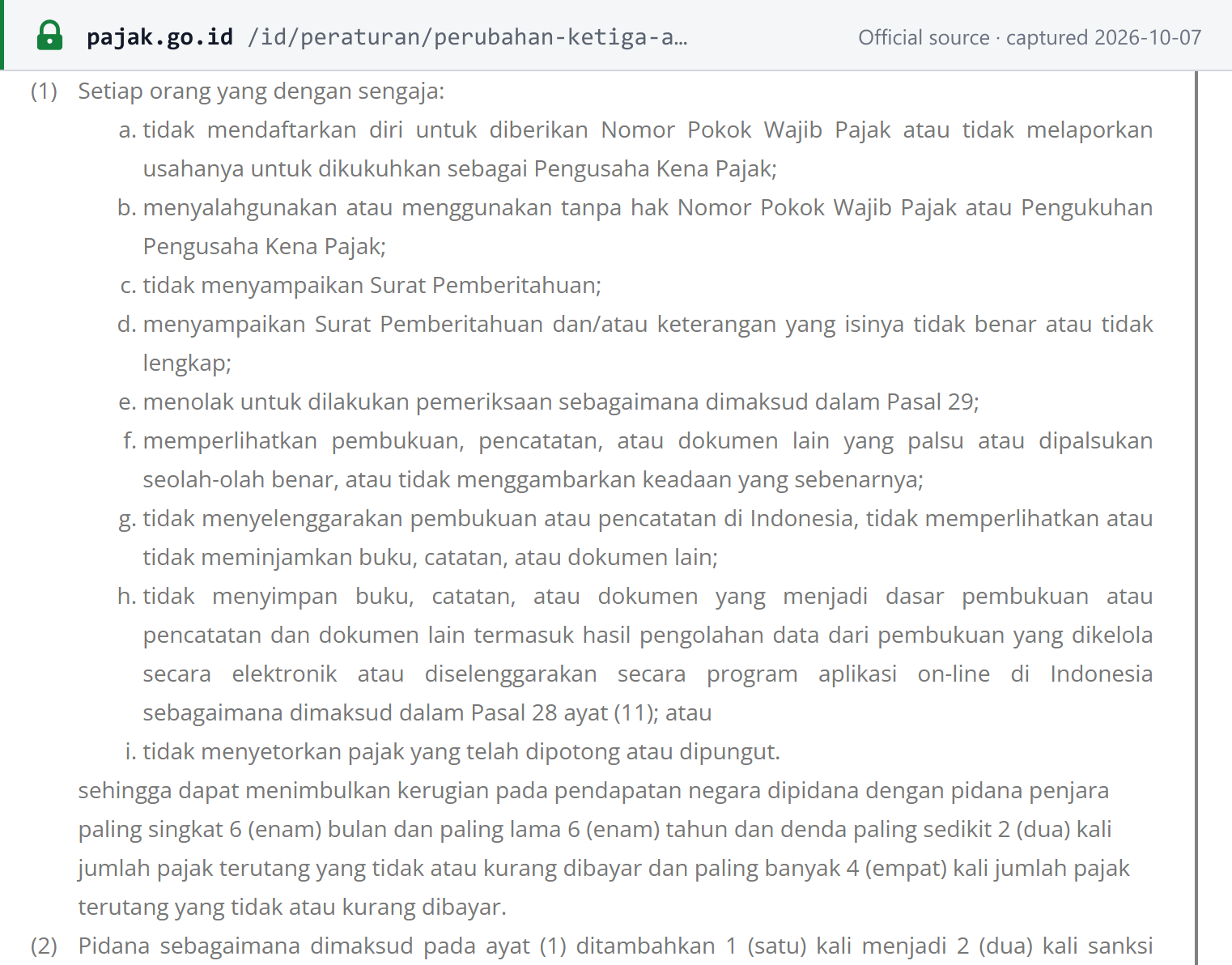
Art. 39(1): "Setiap orang yang dengan sengaja: tidak mendaftarkan diri untuk diberikan Nomor Pokok Wajib Pajak atau tidak melaporkan usahanya untuk dikukuhkan sebagai Pengusaha Kena Pajak; … dipidana dengan pidana penjara paling singkat 6 (enam) bulan dan paling lama 6 (enam) tahun". An investigation can be stopped if the taxpayer pays the tax plus a fine — for fakturs not based on real transactions, "denda sebesar 4 (empat) kali jumlah pajak dalam faktur pajak" — 4 times the tax on the fakturs (UU KUP art. 44B, as amended by HPP). [3] [1]
Penalties
- Faktur not issued, late or incomplete — 1% of the tax base. A PKP that does not make a faktur or makes it late, among other failures, "selain wajib menyetor pajak yang terutang, dikenai sanksi administratif berupa denda sebesar 1% (satu persen) dari Dasar Pengenaan Pajak" — besides paying the tax due, is fined 1% of the tax base (UU KUP art. 14(1)(d) and (4), as amended by HPP). This covers fakturs made more than three months late. [1]

- Late or missing monthly VAT return — IDR 500,000 per return: "denda sebesar Rp500.000,00 (lima ratus ribu rupiah) untuk Surat Pemberitahuan Masa Pajak Pertambahan Nilai" (UU KUP art. 7(1); as at 2026-10-07). [3]
- Late payment — monthly interest. Interest is charged "sebesar tarif bunga per bulan yang ditetapkan oleh Menteri Keuangan" from the due date to payment, "paling lama 24 (dua puluh empat) bulan serta bagian dari bulan dihitung penuh 1 (satu) bulan" — for at most 24 months, part-months counting as whole months. The monthly rate is "suku bunga acuan ditambah 5% (lima persen) dan dibagi 12 (dua belas)" — the reference rate plus 5%, divided by 12 (UU KUP art. 9(2a), (2c), as amended by UU 11/2020). The Minister of Finance publishes the monthly figure. [21]
- Loss of invoicing access — see E-invoicing status. [20]
Frequently asked questions
Is Indonesian VAT 11% or 12%?
Both figures appear, for different reasons. The statutory rate has been 12% since 1 January 2025 (VAT Law article 7(1)(b), as amended by UU 7/2021). Under PMK 131/2024, however, the 12% is applied to a tax base of 11/12 of the price for every supply that is not a luxury good, so the VAT is effectively 11% of the price. Only goods subject to luxury-goods sales tax (PPnBM) bear 12% of the full price. A standard invoice therefore uses transaction code 04: on a price of Rp12,000,000 the tax base is Rp11,000,000 and the VAT Rp1,320,000. [5] [17]
Why is our payout from Indonesian card payments lower since late September 2026?
If you sell digital goods or services to Indonesia and are not an appointed PMSE VAT collector, appointed payment issuers may now be collecting VAT on those purchases. Under PMK 49/2026, the SPP-TDLN system started on 25 September 2026: the issuer collects 11/111 of the VAT-inclusive price, and the seller's payout is reduced by the VAT collected. DJP says the mechanism does not by itself create a duty to register for VAT in Indonesia. [12] [13]
Do we have to become a PMSE VAT collector?
DJP appoints foreign sellers, service providers and platforms as PMSE VAT collectors once their transactions with Indonesian users exceed IDR 600,000,000 a year or IDR 50,000,000 a month, or their Indonesian traffic or users exceed 12,000 a year or 1,000 a month (PER-12/PJ/2025 article 4). A business below those limits may ask to be appointed, at a tax office or through the Taxpayer Portal (article 5). An appointed foreign collector receives an NPWP and needs no Indonesian entity. [9]
Can an Indonesian company credit VAT charged by a foreign digital provider?
Yes. PMSE collection is not limited to consumers. A VAT-registered (PKP) buyer can credit VAT collected by a PMSE collector if its name and NPWP, NIK or registered email appear on the collection document (PER-12/PJ/2025 article 11(5)–(6)). DJP's SPP-TDLN FAQ treats the collection document issued under PMK 49/2026 as equivalent to a tax invoice as well. Where no collector charged VAT, the Indonesian recipient self-assesses the VAT on the imported service. [9] [14]
Our supplier's e-Faktur was never approved — can we still claim the input VAT?
No. An e-Faktur must be uploaded and approved by DJP. One that is not approved is not a tax invoice, and the VAT on it is input VAT that cannot be credited (PMK 81/2024 article 387). The supplier must upload and obtain approval by the 20th of the month after the invoice date (PER-11/PJ/2025 article 44). [4] [7]
What happens if a faktur is issued four months late?
A faktur made more than three months after it should have been made is not treated as a tax invoice (PMK 81/2024 article 384). The supplier is fined 1% of the tax base under article 14(4) of the General Tax Provisions Law, and the buyer cannot credit the VAT on it. [4] [1]
Important websites
| Site | Purpose |
|---|---|
| Coretax DJP — Taxpayer Portal | PKP registration, e-Faktur creation and upload, monthly VAT returns, billing codes and tax deposit (login required) |
| DJP — Digital tax (PMSE) | PMSE VAT collector rules, thresholds and the published collector list |
| DJP — SPP-TDLN | Notice and merchant FAQ for VAT collection by payment issuers on cross-border digital transactions |
| DJP — Coretax information | Guidance on the Coretax system |
| DJP — Regulation catalogue | Full texts of laws, PMKs and DJP regulations, with in-force status |
| Ministry of Finance — tax exchange rates | KMK rates for converting foreign-currency fakturs |
| Ministry of Finance — interest rates | Monthly interest rates for late payment |
| DJBC — Customs | Import VAT and customs procedures |
Also see Lookuptax's own Indonesia NPWP validator.
Recent changes
- 2026-09-25 — SPP-TDLN live: appointed payment issuers collect VAT of 11/111 of the price on foreign digital purchases not already covered by a PMSE collector (PMK 49/2026). (DJP) — see event
- 2025-10-22 — PER-19/PJ/2025: DJP may deactivate faktur access for PKPs that miss VAT returns or carry arrears. (DJP)
- 2025-05-22 — PER-11/PJ/2025 sets the e-Faktur rules under Coretax, including upload and approval by the 20th, and PER-12/PJ/2025 restates the PMSE collector rules. (DJP)
- 2025-01-01 — Coretax DJP launched (KMK 456/2024); VAT rate 12%, applied to an 11/12 base for non-luxury supplies (PMK 131/2024). (DJP)
For the full chronology, see Indonesia tax changes on Lookuptax.
Reference links
- DJP — UU 7/2021, Harmonisation of Tax Regulations (HPP)
- DJP — UU 42/2009, third amendment to the VAT Law
- DJP — UU 28/2007, third amendment to the General Tax Provisions Law (KUP)
- DJP — UU 11/2020, tax cluster of the Job Creation Law
- DJP — PMK 81/2024 on tax provisions for the core tax administration system
- DJP — PMK 131/2024 on VAT on imports and supplies (11/12 base)
- DJP — PMK 197/PMK.03/2013 on the small-entrepreneur limit
- DJP — PMK 11/2025 on other values and fixed percentages
- DJP — PMK 49/2026 on SPP-TDLN (PDF)
- DJP — KMK 456/2024 on the implementation of Coretax
- DJP — PER-1/PJ/2025 attachment (PDF)
- DJP — PER-11/PJ/2025 on tax reporting and tax invoices
- DJP — PER-11/PJ/2025 attachment (PDF)
- DJP — PER-12/PJ/2025 on PMSE VAT collectors
- DJP — PER-19/PJ/2025 on deactivating faktur access
- DJP — PP 49/2022 on exempt and not-collected VAT
- DJP — PENG-6/PJ/2026, SPP-TDLN notice
- DJP — SP-22/2026, SPP-TDLN press release
- DJP — SPP-TDLN FAQ (PDF)
- DJP — SPP-TDLN merchant page
- DJP — Digital tax (PMSE)
- DJP — news on PMK 131/2024
- DJP — SP-40/2024 on billing codes and tax deposit
- Lookuptax — Indonesia NPWP tax ID guide
- Lookuptax — VAT on digital services by non-resident suppliers
- Lookuptax — E-invoicing status and networks worldwide
- Lookuptax — VAT registration thresholds worldwide
- Lookuptax — Worldwide tax rates