Italy VAT guidelines
| FACTSHEET | |
|---|---|
| Country code | IT |
| Tax name | Imposta sul Valore Aggiunto (IVA) — Value Added Tax (VAT) |
| Tax Authority | Agenzia delle Entrate (Italian Revenue Agency) |
Overview
Italy levies Imposta sul Valore Aggiunto (IVA) — the Italian implementation of EU VAT — under DPR 26 ottobre 1972, n. 633 (the "decreto IVA" / Testo unico IVA). Article 17 states the liability rule directly: "L'imposta è dovuta dai soggetti che effettuano le cessioni di beni e le prestazioni di servizi imponibili" — the tax is owed by whoever makes the taxable supply of goods or services. [1]
Administering authority. VAT is administered by the Agenzia delle Entrate (Italian Revenue Agency), reachable at agenziaentrate.gov.it.
Currency. All figures in this guide are in euro (EUR).
Tax period basis. The reference period is the calendar year, with VAT settled either monthly or quarterly through the year and reconciled on an annual return the following spring — see Filing and payment.
Layering. Italian VAT is a single national tax with no regional or municipal VAT layer — every rate and threshold on this page applies uniformly across the country. Italy does levy a separate regional production tax (IRAP) and municipal property taxes, but neither is a VAT layer and neither is covered here. (Checked against DPR 633/1972, 2026-09-20.)
What is different about Italy. Three things set Italy apart from most VAT systems a reader has seen before, and each gets its own section below: there is no registration turnover threshold at all for an established business (see Registration); the Sistema di Interscambio (SdI) runs the EU's most mature mandatory clearance-model e-invoicing regime (see E-invoicing status); and split payment (scissione dei pagamenti) diverts the VAT on specified public-sector supplies straight to the Treasury instead of to the supplier (see Split payment and domestic reverse charge).
Registration
Who should register
Anyone starting a business, an art or profession, or establishing a permanent establishment in Italy must register — registration is triggered by starting the activity, not by crossing a revenue figure. Article 35 comma 1 of DPR 633/1972 requires a declaration to the local Agenzia delle Entrate office within 30 calendar days of starting the activity. The statute says "trenta giorni" without qualifying calendar or business days, so the count runs on calendar days. [2]
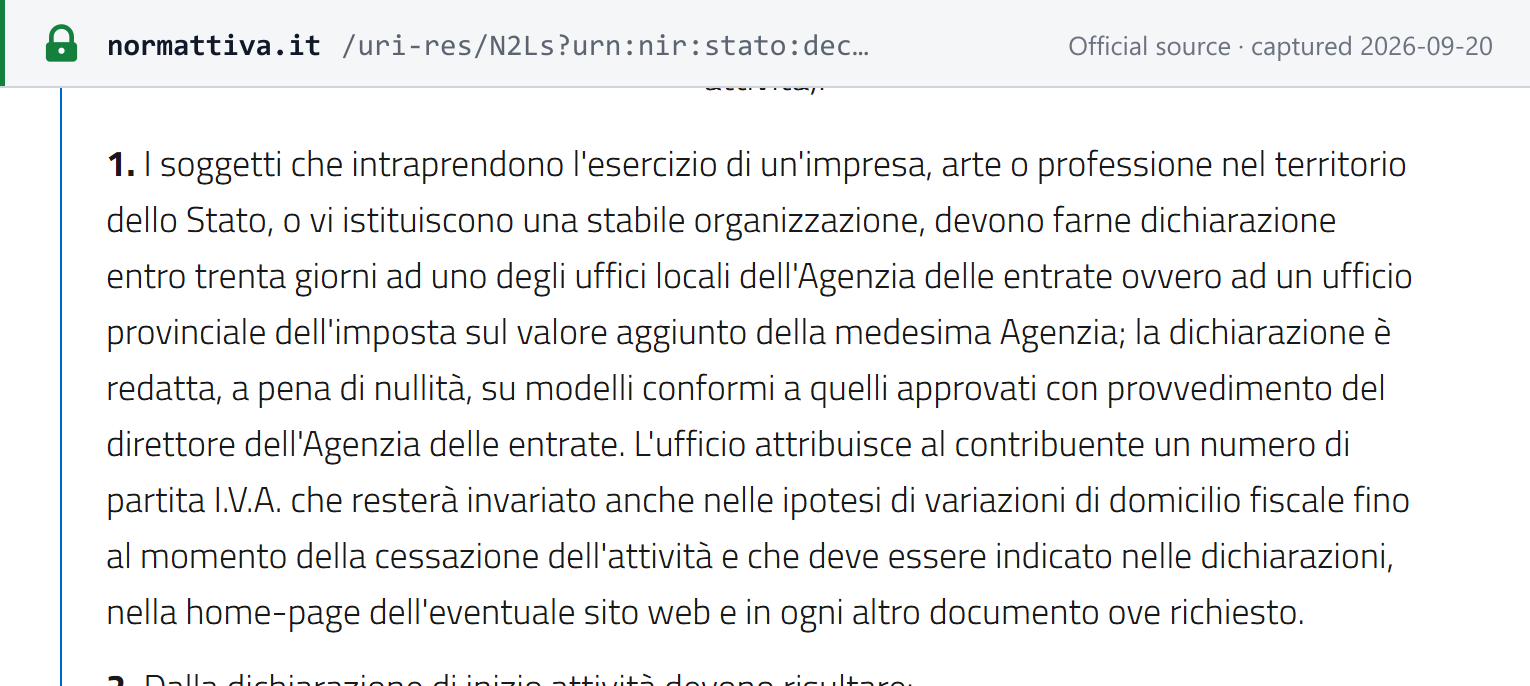 Source snapshot captured 2026-09-20 — original
A note on which article to cite. Some sources point to art. 35 as scheduled for repeal. That is correct only from 1 January 2027: the consolidated Testo Unico IVA (D.Lgs. 10/2026) applies from that date under its own art. 171, and re-enacts the registration rule as art. 68 of the new code — but as of this guide's update date, art. 35 DPR 633/1972 remains in force with no repeal yet in effect. See Recent changes. [2]
Registration threshold — there isn't one
Italy has no VAT registration threshold for an established business. This is the checklist item readers most often get wrong about Italy, and it is worth stating without hedging: whatever your turnover, starting a taxable activity in Italy triggers the 30-day registration duty above. [2]
Do not confuse this with the regime forfettario cap. The regime forfettario is a flat-rate scheme a registered taxpayer can elect into, which lets it stop charging VAT on its own invoices below a turnover ceiling — currently EUR 85,000, raised from EUR 65,000 by the 2023 Budget Law. It is an opt-out from charging VAT after registering, not a threshold that excuses registration in the first place. The superseded EUR 65,000 figure is still widely repeated in third-party summaries. See our worldwide VAT threshold table, which records Italy as having no registration threshold. [3]
Non-resident registration
- Non-EU business, Italian customers exclusively VAT-registered — under art. 17 comma 2, reverse charge shifts the obligations to the Italian business customer, so the foreign supplier is not required to register at all for that transaction. [1]
- Business established in another EU member state, or in a third country with mutual-assistance instruments in place — may use direct identification (identificazione diretta) under art. 35-ter, without appointing a local representative. Comma 5 sets that scope; it is not limited to the EU/EEA. [4]
- Non-EU business needing to register — direct identification is not open to it; it must appoint an Italian-resident fiscal representative (rappresentante fiscale) under art. 17 comma 3, who is jointly liable for the VAT obligations. Since April 2025 a further EUR 50,000 financial-guarantee requirement applies to non-EU applicants tied to VIES registration — the mechanics of that guarantee, and the Codice Fiscale/Partita IVA formats, are covered on Lookuptax's Italy TIN guide rather than repeated here. [1]
Tax registration number
Italy uses two identifiers: the Codice Fiscale (16-character personal tax code, individuals) and the Partita IVA (11-digit VAT number, businesses and professionals). For the full format breakdown, the checksum algorithm and worked examples, see Lookuptax's Italy TIN guide. To check a counterparty's number, use the Italy Partita IVA validator or, for intra-EU trade, VIES.
How to register
- Forms. Modello AA9/12 for individuals not required to register with the Registro delle Imprese; Modello AA7/10 for all other entities (companies, partnerships and similar). [5]
 Source snapshot captured 2026-09-19 — original
- Deadline. Filed within 30 days of starting the activity, at a local Agenzia delle Entrate office. [2]
- This section is the step-by-step registration reference for Italy. There is no separate Italian registration walkthrough on the site.
Voluntary registration
The usual "opt in below a threshold" framing does not apply in Italy, because there is no resident threshold to opt below — anyone starting a taxable activity must register regardless of turnover. The adjacent concept is the regime forfettario described above: a registered small taxpayer under the EUR 85,000 cap can elect it to stop charging VAT on its invoices, which is an opt-out from charging VAT rather than an opt-in to registering. See Lookuptax's Italy TIN guide for the regime forfettario's eligibility rules.
Deregistration
The same 30-day rule applies to cessation of activity as to registration — notify the local Agenzia delle Entrate office within 30 calendar days of stopping the activity, under art. 35 — a later comma of the same article, not the comma 1 that governs inizio attività. [2]
Group registration
Available. VAT taxpayers established in Italy that are linked by financial, economic and organisational ties may elect to become a single taxable person — the Gruppo IVA — under Title V-bis (arts. 70-bis to 70-duodecies) of DPR 633/1972: "I soggetti passivi stabiliti nel territorio dello Stato esercenti attività d'impresa... possono divenire un unico soggetto passivo, di seguito denominato 'gruppo IVA'." The mechanism was introduced by the 2017 Budget Law, with the election first exercisable from 2018 — the year is stated approximately; the enacting instrument's exact commencement date is not given here. [6]
Rates
| Rate | Applies to | Legal basis |
|---|---|---|
| 22% (standard) | Every taxable supply not specifically reduced, zero-rated or exempt | In effect since 1 October 2013, raised from 21% under DL 98/2011 art. 40 comma 1-ter, as amended by DL 76/2013 art. 11 comma 1 lett. a). The 22% figure is confirmed directly by Agenzia delle Entrate; for the binding text of the 2013 rate change consult the two decrees on Normattiva. |
| 10% (reduced) | Agenzia delle Entrate's own examples: electricity and gas for domestic use, medicines, building-renovation work | Tabella A, parte III, DPR 633/1972 |
| 5% (reduced) | Agenzia delle Entrate's own example: certain foodstuffs (not itemised further on the source page) | Tabella A, parte II-bis, DPR 633/1972 |
| 4% (super-reduced) | Agenzia delle Entrate's own examples: foodstuffs, beverages and agricultural products, generically | Tabella A, parte II, DPR 633/1972 |
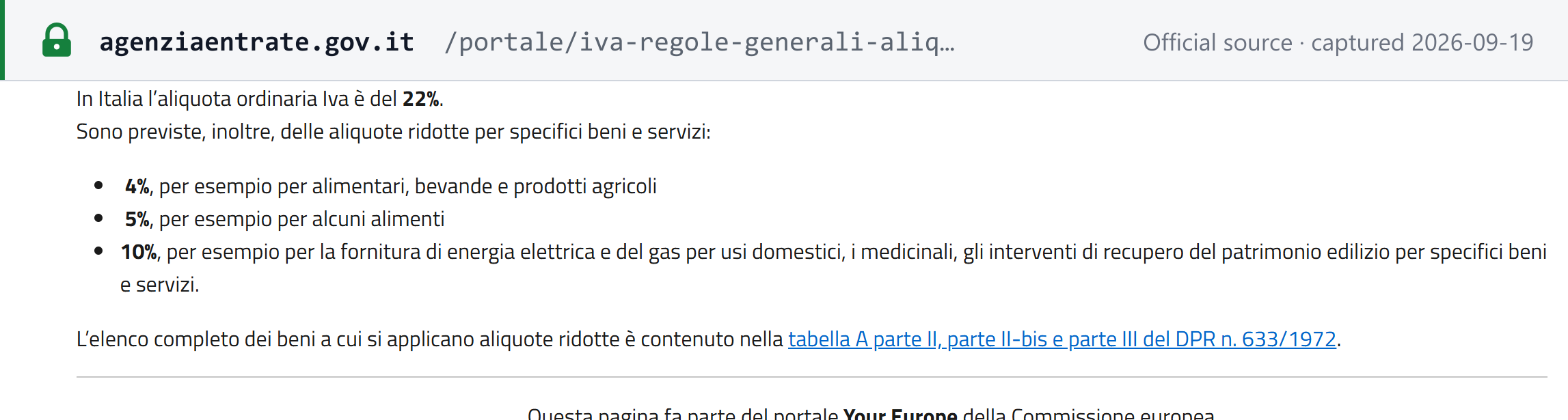
The 4% band is the one readers get wrong. Agenzia delle Entrate's summary page ties 4% to "foodstuffs, beverages and agricultural products" generically — it does not enumerate which specific foodstuffs sit at 4% versus 10% versus the 22% standard rate. This page therefore does not state which individual staples sit in that band — bread, milk and books are commonly reported as 4% examples elsewhere, but only Tabella A settles it. Treat any specific goods list beyond the three generic categories above as unconfirmed, and consult Tabella A parti II, II-bis and III of DPR 633/1972 directly for a binding answer. [7]
Announced future rates. None found. No source surfaces a scheduled change to the 22%, 10%, 5% or 4% figures as of 2026-09-20 — treat this as "no announced change" rather than a gap.
Cross-border rules
Foreign companies selling into Italy — B2B and B2C answered separately
- B2B. Article 17 comma 2 shifts the obligations to the Italian business recipient by reverse charge: "gli obblighi relativi alle cessioni di beni e alle prestazioni di servizi... sono adempiuti dai cessionari o committenti" — the recipient performs the obligations. The foreign supplier generally has no Italian VAT registration obligation for that supply. [1]
- B2C. Reverse charge does not apply where the Italian customer is a private, non-taxable person — a consumer cannot self-account. A non-resident seller making B2C supplies into Italy must register: directly under art. 35-ter (EU/EEA) or via a fiscal representative under art. 17 comma 3 (non-EU), or use the EU-wide OSS/IOSS scheme where the transaction qualifies (see Filing and payment for Italy's OSS/IOSS cadence). [4]
Imports, exports and digital services — scope of this page
This page has not independently researched Italy's import-VAT mechanics — customs interaction, postponed accounting and the plafond regime that lets frequent exporters (esportatori abituali) buy and import goods VAT-free up to their prior-year export volume — consult Agenzia delle Dogane e dei Monopoli directly for import-VAT procedure. Similarly, place-of-supply rules for goods and services (arts. 7 to 7-octies DPR 633/1972) and Italy's implementation of the EU platform/marketplace deemed-supplier rule are not covered on this page — see Lookuptax's ViDA explainer for the EU-level framework both rest on.
Digital and electronic services sold cross-border into Italy follow the EU-wide OSS/IOSS mechanism rather than a separate Italian digital-services regime; see Filing and payment for Italy's return cadence under that scheme, and Lookuptax's EU VAT number verification guide for VIES checks on an Italian or EU counterparty.
Split payment and domestic reverse charge
Split payment (scissione dei pagamenti)
Scissione dei pagamenti applies to supplies made to specified public and public-controlled buyers: public administrations as defined by Legge 196/2009 (comma 1), and — under comma 1-bis — national/regional/local public economic entities, foundations that are 70%+ publicly controlled, companies directly controlled by the Presidency of the Council of Ministers or by ministries, companies 70%+ directly or indirectly publicly controlled, and companies with 70%+ public shareholding. "L'imposta è in ogni caso versata dai medesimi secondo modalità e termini" — the buyer pays the VAT directly to the Treasury rather than to the supplier. Supplies already subject to withholding tax on income are excluded from split payment. [8]
Italy's EU authorisation to run split payment — a derogation from Directive 2006/112/EC arts. 206 and 226 — was extended from 30 June 2026 to 30 June 2029 by Council Implementing Decision (EU) 2026/1728 of 10 July 2026, amending Implementing Decision (EU) 2017/784; Italy's own reporting deadline to the Commission moves to 30 September 2027. [9]
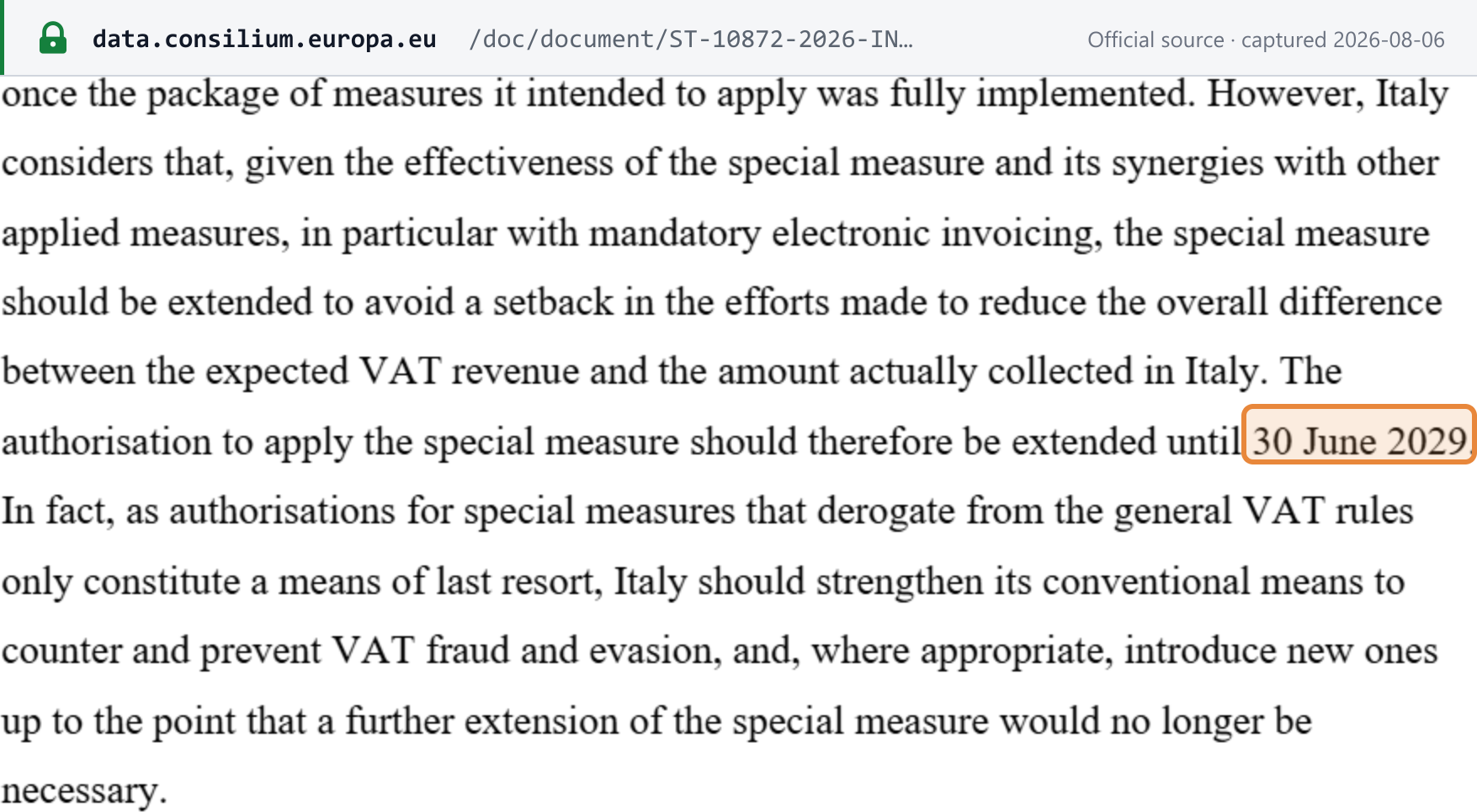 Source snapshot captured 2026-08-06 — original
Domestic reverse charge (reverse charge interno)
Beyond the cross-border B2B case above, art. 17 comma 6 lists domestic transactions where the Italian customer, not the supplier, accounts for VAT: construction subcontracting services; transfers of gold bullion, investment gold and certain refined precious metals; sales of gaming consoles, tablets, laptops and integrated-circuit devices before retail installation; greenhouse-gas emission allowance transfers; and energy and gas transfers to resellers. Comma 7 lets further categories be added by ministerial decree under EU Directive 2006/112/EC arts. 199 to 199-ter. [1]
Invoice requirements
Mandatory content
Article 21 DPR 633/1972 prescribes the particulars of an Italian VAT invoice (fattura):
| # | Required field | Notes |
|---|---|---|
| 1 | Issuance date | — |
| 2 | Unique progressive number | See Numbering and sequencing |
| 3 | Supplier and customer identification | Business name or individual name, residence/domicile, VAT numbers |
| 4 | Nature, quality and quantity of goods/services (natura, qualità e quantità dei beni e dei servizi) | — |
| 5 | Consideration and other data needed to determine the taxable base (corrispettivi ed altri dati necessari per la determinazione della base imponibile) | — |
| 6 | Rate, and the amounts of tax and taxable base (aliquota, ammontare dell'imposta e dell'imponibile) | — |
Issuance deadline
- Immediate invoice (fattura immediata). "La fattura è emessa entro dodici giorni dall'effettuazione dell'operazione" — 12 days from the taxable event. [10]
- Deferred invoice (fattura differita). Permitted for multiple shipments to the same customer within a month — issued by the 15th of the following month. The same 15th-of-the-following-month rule also applies to certain cross-border services. [10]
- Inbound cross-border integration documents (a separate rule, not the issuance deadline above). Where the document is a self-billing or integration record for a purchase from abroad rather than an invoice the Italian party itself issues, it must reach SdI by the 15th of the month following receipt — excluding customs-declared transactions, transactions already sent through SdI, and non-territorial purchases under arts. 7 to 7-octies up to EUR 5,000 per transaction. This is the same deadline the E-invoicing status section below covers in full. [11]
Numbering and sequencing
A unique progressive number is mandatory. This guide has not located a statutory rule on the numbering pattern itself — for example, whether the sequence must restart each calendar year — beyond the uniqueness requirement in art. 21; common Italian practice is an annual restart, but that is reported practice, not a cited statutory rule, and is not asserted as one here.
Credit and debit notes
Article 26 governs variations after an invoice is issued (nota di variazione). A variation increasing the taxable amount or the tax must always be documented. A variation reducing it — nullity, cancellation, revocation, rescission or an agreed discount — may be deducted by the seller, but only within one year of the original operation where the variation stems from a later agreement between the parties, a time bar that catches readers unaware. Non-payment and insolvency variations are extended under comma 3-bis on the same one-year anchor logic. The variation is registered following the same procedure as the original invoice under art. 25. The comma 3 wording is paraphrased rather than quoted here; consult the article for the binding text. [12]
Currency and language
Not stated here. Italian invoices are conventionally issued in euro, and this guide has not located a statutory rule mandating Italian-language invoicing or a specific FX-conversion rule for foreign-currency invoices, so none is stated here.
Document types
| Document | When it is allowed | Threshold |
|---|---|---|
| Full invoice (fattura) | The default, under art. 21 | — |
| Simplified invoice (fattura semplificata) | May omit the taxable-amount breakdown and the buyer's full name/registered office, under art. 21-bis: "La fattura di ammontare complessivo non superiore a euro quattrocento può essere emessa in modalità semplificata" | EUR 400, raised from EUR 100 by Decreto MEF 10 maggio 2019 (Gazzetta Ufficiale n. 120, 24 May 2019) |
Self-billing
Not stated here. Autofatturazione is well established for reverse-charge self-invoicing under art. 17 (see Split payment and domestic reverse charge), but this page does not state a dedicated statutory provision for an ordinary B2B self-billing agreement outside the reverse-charge context.
Retention and audit trail
- Retention period. Not a fixed year-count: invoices and accounting records must be kept "fino a quando non siano definiti gli accertamenti relativi al corrispondente periodo d'imposta" — until the assessment window for that tax period closes (art. 22 DPR 600/1973, cross-referenced by art. 39 DPR 633/1972). [14] [15]
- Electronic archiving. Expressly permitted: "Le fatture elettroniche sono conservate in modalità elettronica", and paper documents "possono essere conservate elettronicamente", including storage in another EU state under conditions guaranteeing automated access and print/transfer capability. [15]
- A distinct 10-year retention rule also appears in art. 39, but it reads as a platform-operator record-keeping obligation rather than the general invoice-retention rule above — the two should not be conflated.
- Audit trail. Because in-scope invoices move through SdI, a transmitted invoice already carries a tamper-evident acceptance record on Agenzia delle Entrate's own systems; see Lookuptax's SdI network guide for the transmission and notification chain rather than repeating it here.
A specimen of a compliant invoice
Agenzia delle Entrate publishes the FatturaPA XML schema rather than a labelled paper specimen, so no official annotated Italian specimen exists to reproduce. The sheet below is ours: it places the art. 21 particulars on a document a human reader can picture. Every name, number and figure is fictional.
Fattura — VAT invoice
| Natura, qualità e quantitàart. 21, co. 2, lett. d) | Corrispettivo unitarioart. 21, co. 2, lett. e) | Aliquotaart. 21, co. 2, lett. g) |
|---|---|---|
| Servizi di consulenza — advisory services, 20 ore | €150,00 | 22% |
| Licenza annuale — annual licence, 1 unità | €3.000,00 | 22% |
- Imponibile (22%)art. 21, co. 2, lett. e)
- €6.000,00
- Imposta (22%)art. 21, co. 2, lett. g)
- €1.320,00
- Totale documento
- €7.320,00
- This invoice is illustrative of the art. 21 particulars only. Where the buyer is a split-payment public body (art. 17-ter) or the supply falls under domestic reverse charge (art. 17 comma 6), the invoice would carry the corresponding annotation — this guide has not independently verified the exact statutory wording required for either annotation, so none is printed here.
- A real in-scope invoice is transmitted through the Sistema di Interscambio (SdI) as a FatturaPA XML document — see Lookuptax's SdI network guide for the transmission mechanics this specimen does not attempt to reproduce.
- A simplified invoice (fattura semplificata, art. 21-bis) may omit the buyer's full name and the taxable-amount breakdown where the total does not exceed EUR 400.
E-invoicing status
Status: mandatory. B2B and B2C domestic e-invoicing has been mandatory since 1 January 2019; cross-border invoicing was brought into scope from 1 July 2022; B2G has been mandatory since 2014/2015. Network: Sistema di Interscambio (SdI). Format: FatturaPA XML. Authority: Agenzia delle Entrate. Italy has a dedicated e-invoicing guide covering SdI mechanics, transmission channels, Peppol integration and the FatturaPA format in depth — read it at What is SDI? — Italy e-invoicing guide. This section states only the status, scope and dates a reader of the country guide needs.
- Forfettari (flat-rate scheme) e-invoicing extension. E-invoicing became mandatory for regime forfettario/minimi taxpayers exceeding EUR 25,000 in prior-year revenue from 1 July 2022, and for all remaining forfettari regardless of revenue from 1 January 2024 — closing the exemption that previously existed under D.Lgs. 127/2015. [16]
- Technical specification version. FatturaPA technical specifications version 1.9.1 became usable from 15 May 2026 (published 31 March 2026). This guide confirms the date at fetched-official grade but has not confirmed the widely repeated claim that pre-1.9.1 invoices are auto-rejected after that date — that detail appears only on advisory blogs, not on Agenzia delle Entrate's own technical-specification page, and is not asserted here. [17]
- Esterometro is dead — pages describing it as live are wrong. The esterometro (quarterly cross-border reporting) was abolished from 1 July 2022 and folded into SdI cross-border transmission. For outbound cross-border invoices, SdI transmission is issuance — there is no separate periodic deadline. For inbound cross-border documents (self-billing/integration, since there is no invoice the Italian party itself issues), the deadline is the 15th of the month following receipt, excluding customs-declared transactions, transactions already sent through SdI, and non-territorial purchases under arts. 7 to 7-octies up to EUR 5,000 per transaction. [11]
Filing and payment
Filing frequency
Determined by prior-year turnover (volume d'affari):
| Frequency | Who | Basis |
|---|---|---|
| Monthly (default) | Taxpayers above the quarterly-election thresholds below | Art. 1 DPR 100/1998 |
| Quarterly (elective) | Prior-year turnover not exceeding EUR 500,000 (self-employed persons and service businesses) or EUR 800,000 (other businesses) | DPR 542/1999 art. 7, anchored by L. 183/2011 art. 14 comma 11 and DPR 600/1973 art. 18 comma 1 |
No periodic VAT return — a structural oddity
Italy has no monthly or quarterly VAT return at all. The periodic liquidazione (settlement) is a book computation under DPR 100/1998 art. 1 — the money moves, nothing is filed for it. The only periodic filing is the LIPE (quarterly communication of settlement data) under DL 78/2010 art. 21-bis — a comunicazione, not a dichiarazione. [19]
Payment due dates
- Monthly filers settle and pay by the 16th of the following month (December due 16 January).
- Quarterly filers pay by the 16th of the second month after each of the first three quarters — 16 May, 20 August (Ferragosto-deferred from 16 August, see below), 16 November — plus 1% interest, a cost monthly filers do not carry. Q4 does not follow this pattern: it settles on the annual reconciliation by 16 March of the following year.
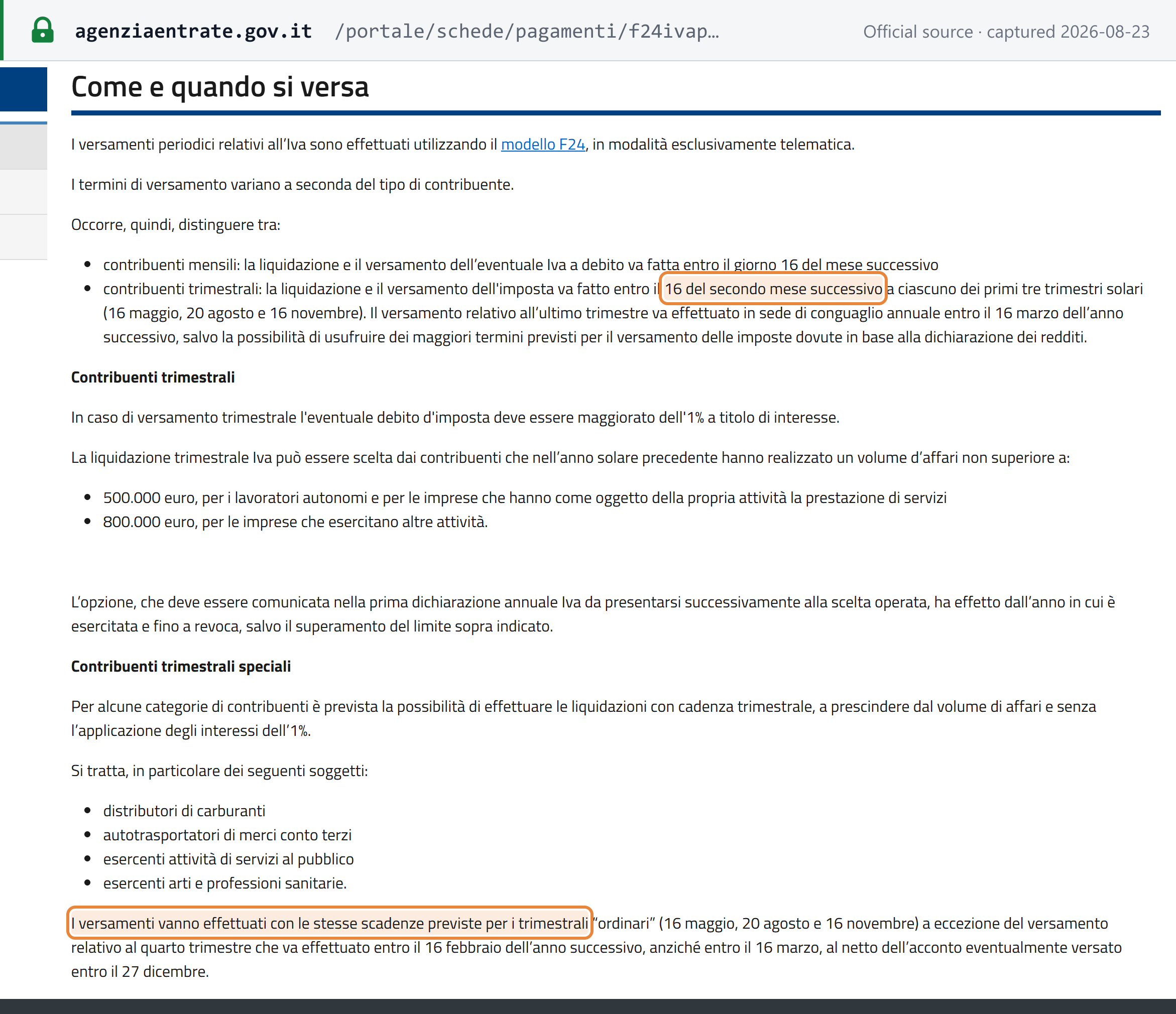 Source snapshot captured 2026-08-23 — original
LIPE (quarterly settlement communication)
Due by the last day of the second month after each quarter, except Q2, a statutory exception due 30 September rather than 31 August. Derived dates: Q1 31 May, Q2 30 September, Q3 30 November, Q4 28/29 February (or folded into the annual return, filed by the end of February instead). [19]
Annual VAT return
Filed electronically 1 February – 30 April of the following year — a window, not a single date. Required even for nil returns and for non-residents (direct-identified or via fiscal representative) and Italian permanent establishments, on the same deadline as resident filers. Exempt: regime forfettario/minimi taxpayers and taxpayers recording only art. 10 exempt operations (with carve-outs). [20]
Acconto IVA (December advance) and saldo IVA (annual balance)
- Acconto IVA — due 27 December, calculated storico (88% of prior year), previsionale (88% forecast) or analitico (100% of a special settlement to 20 December); no advance below EUR 103.29. [21]
- Saldo IVA — due 16 March, payable in full or in monthly instalments (last no later than 16 December) at 0.33%/month interest after the first instalment, or deferred to the income-tax deadline at 0.40%/month. [22]
Stamp duty on e-invoices (imposta di bollo)
Quarterly, on the same LIPE dates — 31 May / 30 September / 30 November / 28 February — with small-amount deferrals (Q1 duty at or below EUR 5,000 may be paid by 30 September; Q1+Q2 combined at or below EUR 5,000 by 30 November). Applies to invoices over EUR 77.47 that are exempt from, or outside the scope of, VAT. [23]
Additional listings — INTRASTAT and OSS/IOSS
- INTRASTAT. Monthly filing of goods acquisitions is required where quarterly acquisitions reach EUR 2,000,000 in any of the prior four quarters — raised from EUR 350,000 in February 2026; that older figure is stale wherever seen. Services-received listings stay monthly above EUR 100,000/quarter; dispatch/services-rendered listings may be quarterly if at or below EUR 50,000/quarter in each of the prior four quarters. All due by the 25th of the following month. [24] [25]
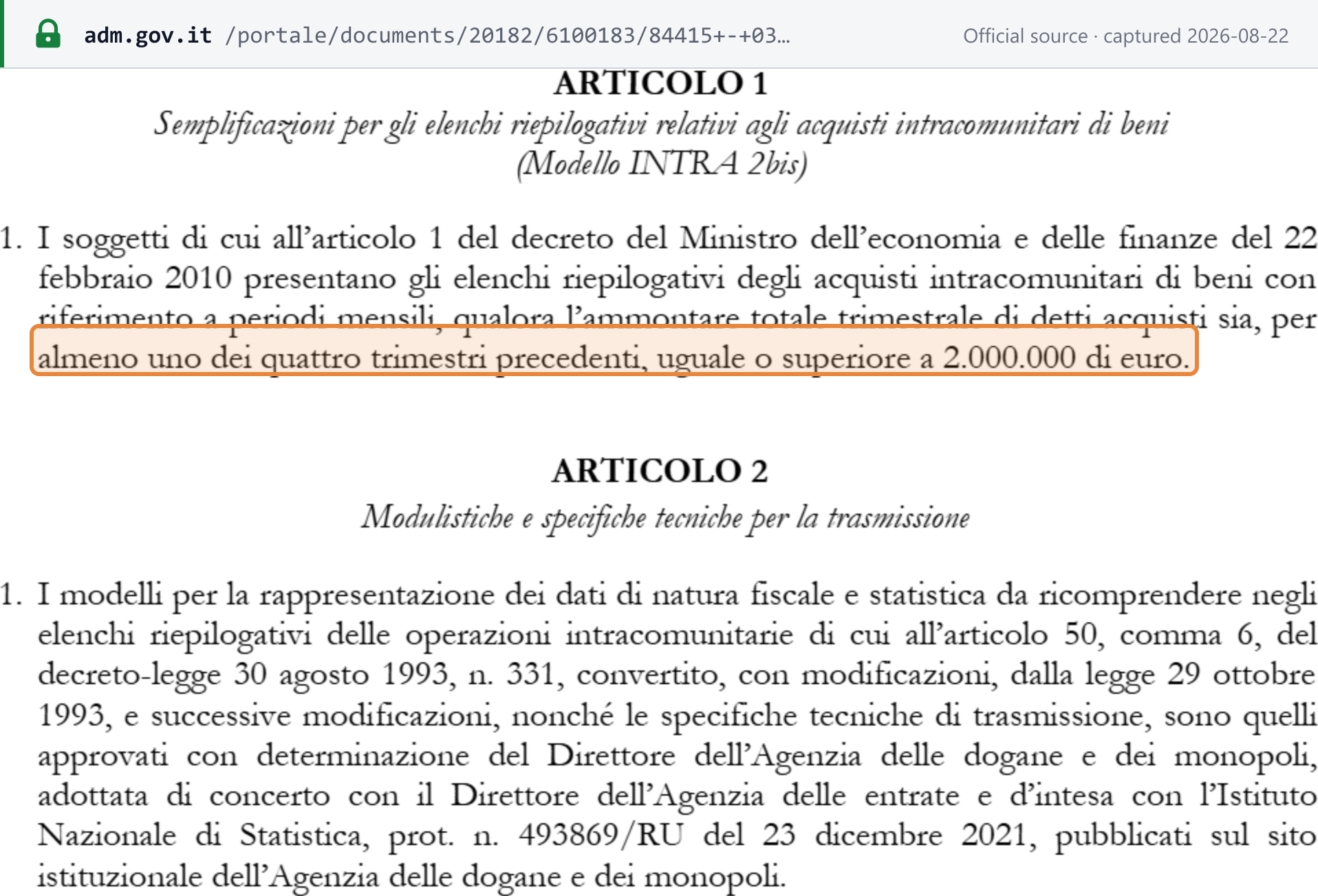 Source snapshot captured 2026-08-22 — original
- OSS/IOSS. OSS (non-EU and EU schemes) returns are quarterly, due by the end of the month after the quarter; IOSS returns are monthly, due by the end of the following month. [26]
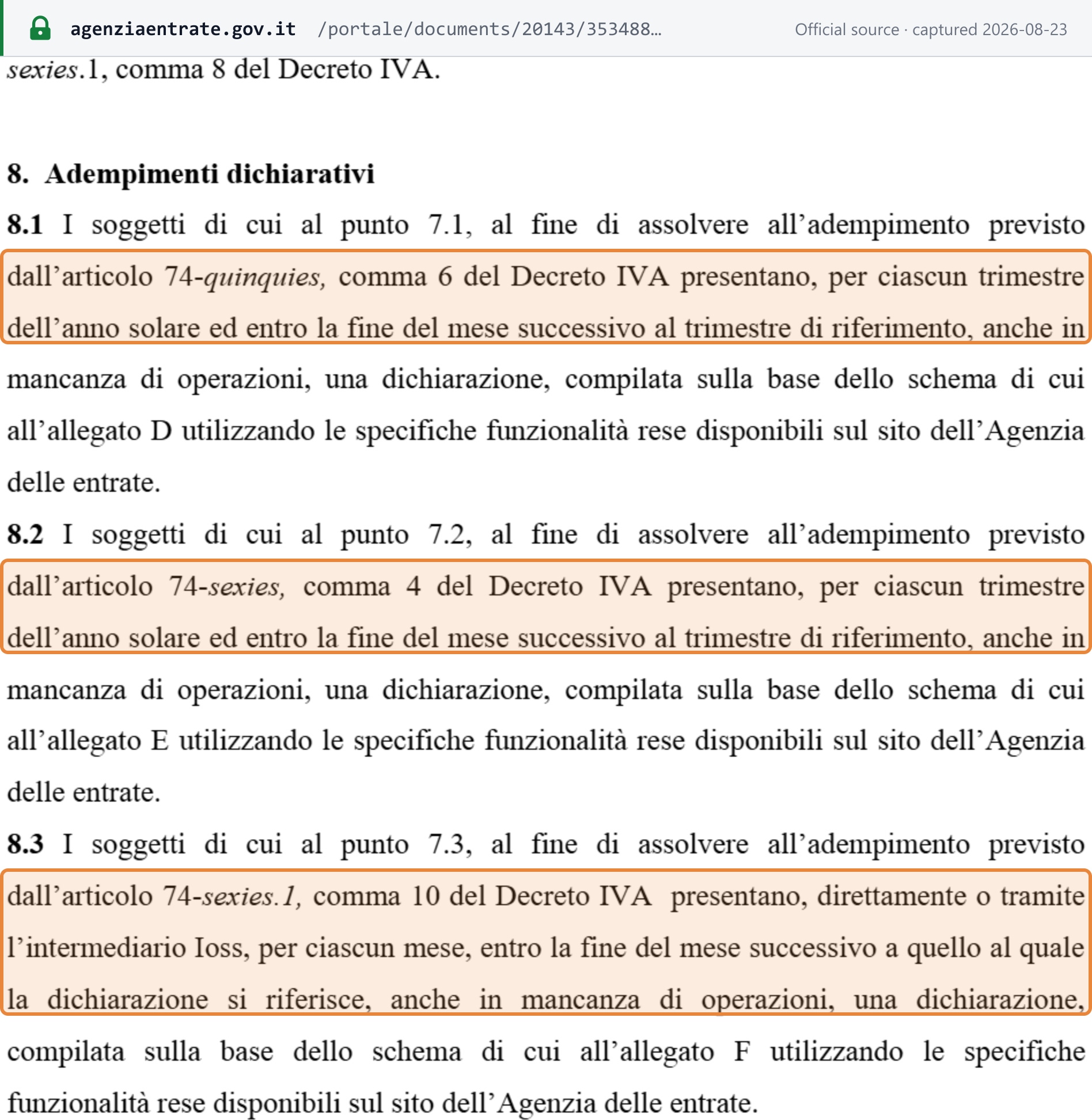 Source snapshot captured 2026-08-23 — original
Weekend, holiday and Ferragosto deferrals
- Weekend/holiday shift. Deadlines falling on a Saturday or a public holiday move to the next working day (DL 70/2011 art. 7 comma 1 lett. h — not the D.Lgs. 241/1997 art. 18 version, which sunsets 1 January 2027). A new national holiday, 4 October (San Francesco d'Assisi), applies from 2026 — harmless in 2026 (a Sunday) but lands on a Monday in 2027. [27]
- Ferragosto deferral. Obligations and payments due 1–20 August move to 20 August without surcharge (DL 223/2006 art. 37 comma 11-bis) — this is why Agenzia delle Entrate publishes "20 agosto" for the Q2 quarterly payment; it is a deferral outcome applied to the underlying 16th-of-month rule, not a separate base rule. [28]
2027 statute recast — no deadline changes
The consolidated Testo Unico IVA (D.Lgs. 10/2026) applies from 1 January 2027, repealing a named list of DPR 633/1972 articles (not the whole decree) and re-enacting those rules under new article numbers — registration moves from art. 35 to art. 68, and the cross-border day-15 rule moves with D.Lgs. 127/2015 arts. 1, 2 and 4. Two anchors this page cites do not move at all: the 16th-of-month liquidazione rule stays in DPR 100/1998, which art. 170 does not repeal and which the Testo Unico expressly preserves by cross-reference, and the LIPE obligation stays in DL 78/2010 art. 21-bis, which does not appear in the repeal list. No deadline itself moves. [29]
Input-tax recovery, blocked items and refunds
Deduction window extended to the second following year (from 12 August 2026). Article 12 of Legislative Decree No. 148 of 7 August 2026 (Gazzetta Ufficiale No. 185, Supplemento Ordinario No. 30/L, 11 August 2026; in force 12 August 2026) amends articles 19(1) and 25 of DPR 633/1972 so that input VAT may be deducted up to the return for the second year following the year the right to deduct arose (art. 19(1)), and purchase invoices may be recorded up to the return for the second year following the year of receipt (art. 25) — both extended from the same year. The same change is made to arts. 56 and 88 of the consolidated VAT text (D.Lgs. No. 10 of 19 January 2026, the Testo Unico IVA taking effect 1 January 2027). [31]
Otherwise not covered here beyond the filing/payment calendar above. Italy operates a resident VAT-credit carry-forward and refund mechanism under art. 30 DPR 633/1972, and non-residents can reclaim Italian VAT through the EU's 13th/8th-Directive-successor refund routes — but this guide has not independently verified the procedural detail (refund timelines, minimum amounts, guarantee conditions, blocked-item categories such as entertainment or passenger vehicles) and does not state figures for them.
Exemptions
Exempt supplies
Article 10 DPR 633/1972 lists numbered exempt-operation categories, including: credit provision and negotiation (1); insurance, reinsurance and annuities (2); legal-tender currency and securities transactions (3–4); agricultural land and building leasing with exclusions (8); gambling and lottery operations (6–7); postal services (16); medical diagnosis, treatment and rehabilitation by licensed professionals (18); hospitalisation and care by hospital entities (19); and education by recognised schools (20). [30]
Exempt is not zero-rated
Exempt operations (art. 10) generally block input-tax recovery on related purchases, under the pro-rata mechanics of arts. 19 and 19-bis — this guide has not independently verified those pro-rata mechanics in numerical detail and does not state specific percentages for them. Exports and intra-EU supplies, by contrast, are "non imponibili" (not zero-rated in name, but functionally so): VAT-free with full input-tax recovery preserved, under arts. 8 and 41. The direction of the distinction — exempt blocks recovery, non-imponibile does not — is well-settled and stated here with confidence; the exact pro-rata numbers are not. [30]
Special regimes
Regime forfettario — the flat-rate scheme described under Registration, turnover cap EUR 85,000. This guide has not independently verified whether Italy operates separate margin schemes for second-hand goods, a general cash-accounting election, or free-zone VAT rules beyond the regime forfettario, and does not state details for them here.
Offences and penalties
Penalties
- Late/omitted payment. 25% of the unpaid amount, reduced to 12.5% for payment within 90 days, and for payment within 15 days to 1/15 of that 12.5% for each day of delay — about 0.833% per day, reaching 12.5% at day 15 (D.Lgs. 471/1997 art. 13). The per-day fraction applies to the already-halved penalty, not to the 25% base. [31]
- Omitted annual VAT return. 120% of the tax owed, minimum EUR 250 (D.Lgs. 471/1997 art. 5 comma 1). This is independently corroborated by a 2026 automated-assessment provvedimento — see below. [32]
- Inaccurate (infedele) return. 70% of the additional tax owed, minimum EUR 150 (art. 5 comma 4); rising to 105–140% where false invoices or non-existent operations are involved (comma 4-bis); reduced by one-third where the extra tax is under 3% of the declared amount and below EUR 30,000 combined (comma 4-ter). Late-but-pre-audit filing carries a tripled art. 13-comma-1 penalty, or the EUR 250 minimum if no tax is owed (comma 1-bis). [32] Under D.Lgs. 471/1997 art. 6 comma 1 the penalty for supplies not correctly documented or recorded is 70% of the tax on the undocumented taxable amount, with a floor of EUR 300 (comma 4); where the violation did not affect the settlement of the tax, the penalty is EUR 250–2,000. Under art. 9 comma 1, failures in keeping or retaining accounting records carry EUR 1,000–8,000. (A 90–180% figure circulates for art. 6; it does not appear in the current consolidated text.) [471/1997]
Automated assessment of omitted returns (2026). Under art. 54-bis.1 DPR 633/1972, inserted by Legge 199/2025 art. 1 comma 111 lett. a), Agenzia delle Entrate may now assess VAT on an omitted annual return using automated procedures, drawing on e-invoice and corrispettivi data, within 31 December of the seventh year following the year the return should have been filed. Interest runs at 4% annually, with the 120% penalty above, reduced to one-third with 3.5% interest if paid within 60 days of notice — Provvedimento Prot. n. 239129/2026 of 28 August 2026 lays down the implementing rules. [33] Paying after the communication: Agenzia delle Entrate Risoluzione n. 34/E of 30 September 2026 sets the F24 tax codes for sums due after communications under art. 54-bis.1 — code 9005 for the full amount, and codes 95AA (tax), 95BB (interest) and 95CC (penalties) for partial payment. Compensation under art. 17 of D.Lgs. 241/1997 and instalment payment under art. 3-bis of D.Lgs. 462/1997 are not available for these payments. (Agenzia delle Entrate) Looking ahead: the separate Testo unico on adempimenti e accertamento (D.Lgs. 5 agosto 2026, n. 141, GU n. 181, S.O. n. 28, 6 August 2026) applies from 1 January 2027 under its art. 368, and its art. 367 abrogates arts. 40, 51 to 54-bis, 54-ter to 57, 60 to 60-bis, 63 to 66-bis and 75, and paragraphs 1, 2 and 5 of art. 54-bis.1 of DPR 633/1972 (the VAT assessment and audit provisions). (Gazzetta Ufficiale)
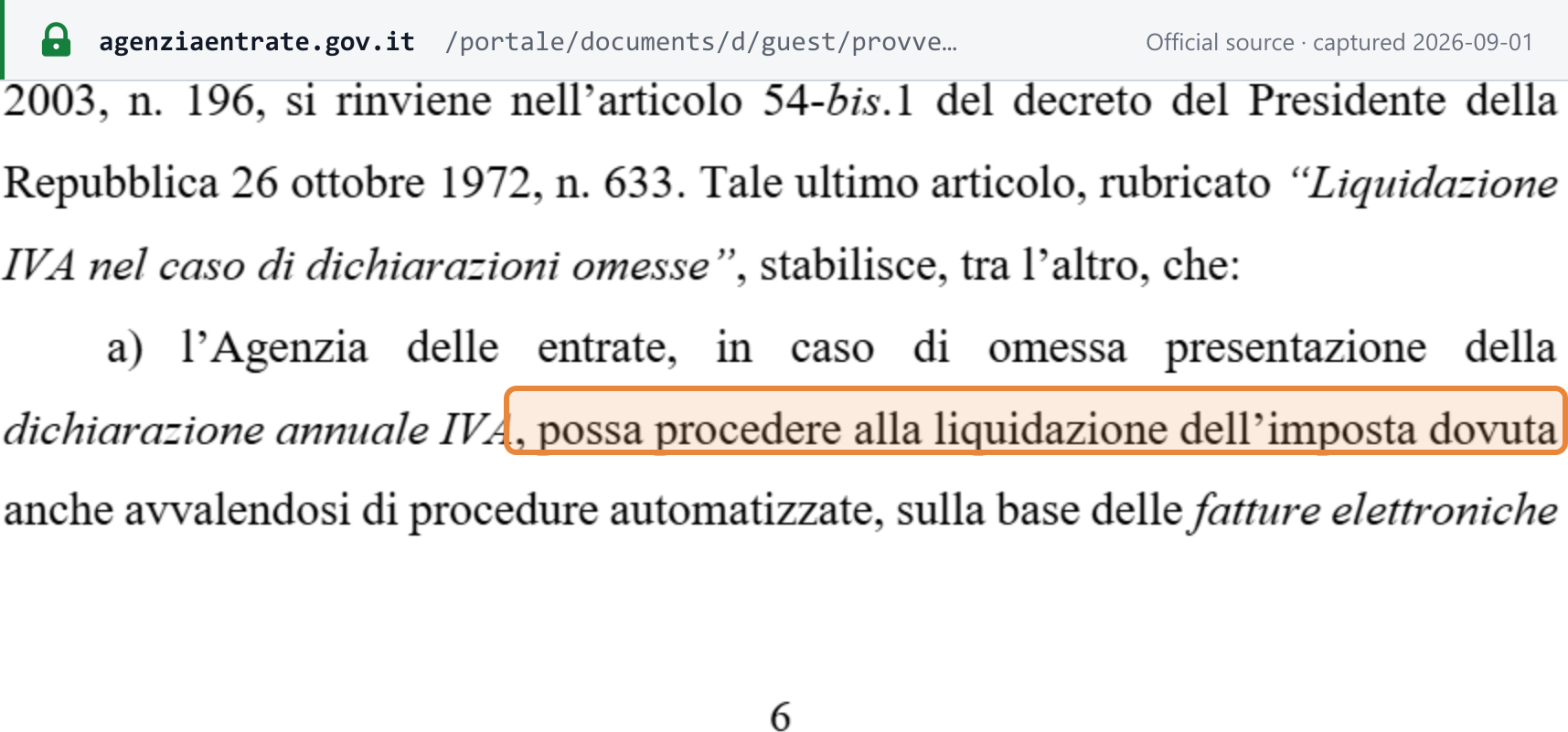 Source snapshot captured 2026-09-01 — original
Ravvedimento operoso — the reduced-penalty ladder
D.Lgs. 472/1997 art. 13 lets a taxpayer who self-corrects reduce the applicable penalty to a fraction of the minimum, tiered by promptness: 1/10 within 30 days of the violation; 1/9 within 90 days; 1/8 by the return deadline for the violation year (or within one year where no periodic return exists); 1/7 after the return deadline but before a compliance letter (L. 212/2000 art. 6-bis); 1/6 after a violation notice under L. 4/1929 art. 24 without an adhesion request; 1/5 after a compliance letter without a prior adhesion request; and 1/10 for a late return filed within 90 days. Every tier requires no prior formal notice of the violation and no known audit, plus concurrent payment of interest at the legal rate. [34]
Offences
Omesso versamento IVA (failure to pay VAT) is a criminal offence, distinct from the administrative 25% payment penalty above, where unpaid VAT for a tax period exceeds EUR 250,000 and remains unpaid by 31 December of the year following the annual return. It is punishable by 6 months to 2 years' imprisonment (D.Lgs. 74/2000 art. 10-ter). Where an instalment plan is revoked, the criminal threshold for the residual debt drops to EUR 75,000. [35]
Frequently asked questions
I'm a small Italian sole trader turning over well under EUR 65,000 — do I still need a partita IVA?
Yes. Italy has no revenue threshold that lets an established business trade without registering. Article 35 comma 1 of DPR 633/1972 requires anyone starting a business, an art or profession, or a permanent establishment in Italy to file a registration declaration within 30 calendar days of starting the activity — the trigger is starting the activity, not crossing a turnover figure. The EUR 65,000 figure some sources quote is not a registration threshold at all: it is the old cap (superseded in 2023) for the regime forfettario, a flat-rate scheme a taxpayer under the current EUR 85,000 cap can elect into after registering, which lets it stop charging VAT on its invoices — an opt-out from charging VAT, not a permission to stay unregistered. The EUR 65,000 figure is still widely repeated in third-party summaries. See our worldwide VAT threshold table, which records Italy as having no registration threshold. [2] [3]
My customer is a state-owned company and it only paid me the net amount, not the VAT on my invoice — is that a mistake?
No — that is split payment (scissione dei pagamenti) working as intended, not an underpayment. Article 17-ter of DPR 633/1972 requires specified public and public-controlled buyers — public administrations under Legge 196/2009, and under comma 1-bis a wider list including companies directly or indirectly controlled at 70% or more by the state, by regions, by local authorities or by ministries — to pay the VAT on the invoice directly to the Treasury rather than to the supplier, who receives only the taxable amount. Supplies already subject to withholding tax on income are excluded. The mechanism is a derogation from the ordinary EU VAT rules, and the European Council most recently extended Italy's authorisation to run it from 30 June 2026 to 30 June 2029. If your invoice was correctly marked for split payment, the VAT was not withheld improperly — it went to the state instead of through you. [8] [9]
Italy has no monthly VAT return, so why do I still have to file something every quarter?
Because the periodic settlement (liquidazione) and the periodic filing (LIPE) are two different things, and only one of them is a return. Under DPR 100/1998 art. 1, the liquidazione is a book computation — money moves on the 16th of the month, but nothing is filed for it. The only periodic document actually filed is the LIPE, the quarterly communication of settlement data required by DL 78/2010 art. 21-bis, which the statute itself calls a comunicazione, not a dichiarazione. It is due by the last day of the second month after each quarter, with one trap: the second-quarter LIPE is a statutory exception due 30 September, not 31 August. So the derived calendar is Q1 by 31 May, Q2 by 30 September, Q3 by 30 November and Q4 by the end of February (or folded into the annual return, filed by the end of February instead). Italy's only actual annual VAT return is the separate dichiarazione IVA, filed electronically between 1 February and 30 April of the following year. [19]
I'm a foreign business invoicing an Italian company — do I charge Italian VAT, or does my customer handle it?
It depends entirely on whether the Italian customer is a business or a consumer. For B2B supplies, art. 17 comma 2 of DPR 633/1972 shifts the obligations to the Italian recipient by reverse charge: the foreign supplier generally does not register in Italy or charge Italian VAT for that transaction, and the Italian business self-accounts for it instead. For B2C supplies, reverse charge does not apply, because a private consumer cannot self-account for VAT — the foreign seller must either register directly (if EU/EEA-established, under art. 35-ter) or appoint an Italian fiscal representative (if established outside the EU, under art. 17 comma 3), or use the EU-wide OSS/IOSS scheme where the transaction qualifies. Getting this backwards — assuming the B2B rule also covers consumer sales — is the single most common Italian VAT registration mistake for foreign sellers. [1] [4]
I paid my Italian VAT 10 days late by mistake — can I fix it myself before the tax office notices, and what does it cost?
Yes, through ravvedimento operoso, and the earlier you self-correct the cheaper it is. The base late-payment penalty under D.Lgs. 471/1997 art. 13 is 25% of the unpaid amount. Within 90 days it is halved to 12.5%, and within 15 days that halved figure is reduced again to 1/15 of it for each day of delay — about 0.833% per day, reaching 12.5% at day 15. The daily fraction bites on the 12.5%, not on the 25%. On top of that, D.Lgs. 472/1997 art. 13 sets a further reduced-penalty ladder for a taxpayer who corrects voluntarily: 1/10 of the minimum penalty for a correction within 30 days of the violation, 1/9 within 90 days, 1/8 by the return deadline for that year, and coarser fractions the longer the wait. For a 10-day delay you would be inside both the 15-day and 30-day windows at once, so the payment carries roughly 0.833% per day, reduced further under ravvedimento, plus interest at the legal rate. All of this requires paying before receiving any formal notice of the violation or becoming aware of an audit. [31] [34]
Do I need an Italian fiscal representative to get a partita IVA as a non-EU company, or can I register directly?
Direct identification is not open to you — you need a fiscal representative. Article 35-ter of DPR 633/1972 (identificazione diretta) is available only to businesses established in the EU/EEA or in a country with which Italy has mutual-assistance arrangements; a non-EU business without that route must appoint an Italian-resident fiscal representative (rappresentante fiscale) under art. 17 comma 3, who becomes jointly liable for the VAT obligations. Since April 2025, non-EU applicants using a fiscal representative also face a EUR 50,000 financial-guarantee requirement tied to VIES registration — the full mechanics of that guarantee, and the Codice Fiscale/Partita IVA formats themselves, are covered on Lookuptax's Italy TIN guide rather than repeated here. Where your only Italian customers are themselves VAT-registered businesses, note the separate point above: you may not need to register in Italy at all, because reverse charge shifts the obligation to them. [1] [4]
I keep seeing EUR 350,000 quoted as Italy's INTRASTAT threshold — is that still right?
No, that figure is stale. From the filing due 25 February 2026, the threshold that requires monthly (rather than the now-eliminated quarterly) INTRASTAT listing of intra-EU goods acquisitions rose to EUR 2,000,000, measured on the total in any one of the four preceding calendar quarters — set by Agenzia delle Dogane e dei Monopoli determinazione direttoriale 84415/RU of 3 February 2026. Two other thresholds run independently and did not change: the services-received listing stays monthly above EUR 100,000/quarter, and dispatches/services-rendered listings may be filed quarterly where each stayed at or below EUR 50,000/quarter in every one of the four preceding quarters. All INTRASTAT listings are due by the 25th of the following month. [24] [25]
Is DPR 633/1972 being replaced — will the article numbers on this page still be correct after 2026?
Mostly yes through the end of 2026, and no starting 1 January 2027. D.Lgs. 19 gennaio 2026, n. 10 enacts a consolidated Testo Unico IVA whose own commencement article, art. 171, states the new code applies from 1 January 2027. It repeals a named list of DPR 633/1972 articles rather than the whole decree, and re-enacts the operative rules — including registration — under new numbers; the registration rule currently at art. 35 DPR 633/1972 becomes art. 68 of the Testo Unico. As of this guide's update date, art. 35 itself is still in force with no repeal yet in effect, and no deadline this page cites moves. Be precise about which citations do: the cross-border day-15 rule moves with D.Lgs. 127/2015 arts. 1, 2 and 4, but the 16th-of-month liquidazione rule stays in DPR 100/1998 — not repealed, and expressly preserved by cross-reference — and the LIPE obligation stays in DL 78/2010 art. 21-bis, which is not in the repeal list at all. Readers relying on this page after 1 January 2027 should expect DPR 633/1972 article citations to have Testo Unico IVA successors, but not those two. [29]
Important websites
| Site | What it is for |
|---|---|
| Agenzia delle Entrate | Registration guidance, rates, filing calendar, forms |
| Fatture e Corrispettivi portal | Sign-in area for e-invoices, receipts and SdI monitoring tools |
| Sistema di Interscambio / FatturaPA | The e-invoicing network — documentation, format specs and channel accreditation |
| Fiscal Code (Codice Fiscale) verification | Official checker for a Codice Fiscale |
| VIES | EU-wide validation of an Italian or other member-state VAT number for intra-Community trade |
| Registry of Italian Public Administrations (IndicePA) | Look up a public body's SdI codice destinatario for B2G invoicing |
Also see Lookuptax's own Italy Partita IVA validator and the Italy TIN guide.
Recent changes
- 2026-09-30 (in force) — Agenzia delle Entrate Risoluzione n. 34/E establishes F24 tax codes for paying sums due after communications under art. 54-bis.1 DPR 633/1972 (automated liquidation of VAT for omitted annual returns): 9005 for the full amount, 95AA (tax), 95BB (interest) and 95CC (penalties) for partial payment; compensation under art. 17 of D.Lgs. 241/1997 is not available. (Agenzia delle Entrate) — see the event record
- 2026-08-28 (in force) — Agenzia delle Entrate provvedimento Prot. n. 239129/2026 sets implementing rules for art. 54-bis.1 DPR 633/1972: the Agency may assess VAT by automated procedures, drawn from e-invoice and corrispettivi data, where the annual VAT return has been omitted, carrying a 120% penalty and 4% interest (reduced to one-third with 3.5% interest if paid within 60 days). (Agenzia delle Entrate) — see the event record
- 2026-08-12 (in force) — Article 12 of Legislative Decree No. 148 of 7 August 2026 (Gazzetta Ufficiale No. 185, Supplemento Ordinario No. 30/L) amends arts. 19(1) and 25 DPR 633/1972 (and the corresponding arts. 56/88 of the Testo Unico IVA) so that input VAT may be deducted up to the return for the second year following the year the right to deduct arose (art. 19(1)), and purchase invoices recorded up to the return for the second year following the year of receipt (art. 25), both extended from the same year. (Gazzetta Ufficiale) — see event and issue
- 2026-07-01 (in force) — Italy's split-payment derogation (Implementing Decision (EU) 2017/784) is extended from 30 June 2026 to 30 June 2029 by Council Implementing Decision (EU) 2026/1728 of 10 July 2026; Italy's reporting deadline to the Commission moves to 30 September 2027. (Council of the European Union) — see the event record
- 2026-05-15 (in force) — FatturaPA technical specifications version 1.9.1 become usable (published 31 March 2026). (Agenzia delle Entrate)
- 2026-04-20 (in force) — Deadline for the first mandatory online pairing of electronic cash registers (registratori telematici) with POS payment instruments active in January 2026. (Agenzia delle Entrate) — see the event record
- 2026-02-03 (in force, applying from the 25 February 2026 filing) — Agenzia delle Dogane e dei Monopoli determinazione direttoriale 84415/RU raises the INTRASTAT monthly-filing threshold for goods acquisitions to EUR 2,000,000, superseding the widely quoted but stale EUR 350,000 figure. (Agenzia delle Dogane e dei Monopoli)
- 2024-01-01 (in force, historical) — E-invoicing became mandatory for all remaining regime forfettario taxpayers, regardless of revenue, closing the exemption that previously applied below the EUR 25,000 threshold introduced on 1 July 2022 (DL 36/2022 art. 18). (Normattiva)
Ahead — scheduled changes that have not yet taken effect:
- 2027-01-01 (scheduled) — The Testo Unico IVA (D.Lgs. 19 gennaio 2026, n. 10) applies from this date under its own art. 171, and its art. 170 repeals a named list of DPR 633/1972 articles, re-enacting the operative rules under new numbers — registration moves from DPR 633/1972 art. 35 to Testo Unico IVA art. 68. No filing or payment deadline itself moves. (Normattiva) — see the event record
- 2027-01-01 (scheduled) — The Testo unico adempimenti e accertamento (D.Lgs. 5 agosto 2026, n. 141; GU n. 181, S.O. n. 28, 6 August 2026; in force 7 August 2026) applies from this date under its art. 368, and its art. 367 abrogates arts. 40, 51 to 54-bis, 54-ter to 57, 60 to 60-bis, 63 to 66-bis and 75, and paragraphs 1, 2 and 5 of art. 54-bis.1 of DPR 633/1972 (the VAT assessment and audit provisions). (Gazzetta Ufficiale; Normattiva) — see the event record
Reference links
- DPR 633/1972 art. 17 — chi deve versare l'imposta, reverse charge, rappresentante fiscale (Normattiva)
- DPR 633/1972 art. 35 — dichiarazioni di inizio, variazione e cessazione attività (Normattiva)
- DPR 633/1972 art. 35-ter — identificazione diretta (Normattiva)
- Agenzia delle Entrate — apertura partita IVA, modello AA9/12
- Agenzia delle Entrate — regime forfetario
- DPR 633/1972 art. 70-bis — Gruppo IVA (Normattiva)
- Agenzia delle Entrate — aliquote IVA (norme generali e aliquote imprese)
- DPR 633/1972 art. 17-ter — scissione dei pagamenti (Normattiva)
- Council Implementing Decision (EU) 2026/1728 — split-payment derogation extension (EUR-Lex)
- DPR 633/1972 art. 21 — contenuto della fattura (Normattiva)
- DPR 633/1972 art. 21-bis — fattura semplificata (Normattiva)
- D.Lgs. 148/2026 art. 12 — estensione del termine di detrazione IVA al secondo anno successivo (Gazzetta Ufficiale)
- DPR 633/1972 art. 26 — variazioni dell'imponibile o dell'imposta (Normattiva)
- DPR 600/1973 art. 22 — conservazione delle scritture contabili (Normattiva)
- DPR 633/1972 art. 39 — conservazione delle fatture (Normattiva)
- DL 36/2022 art. 18 — estensione fatturazione elettronica forfettari (Normattiva)
- Agenzia delle Entrate — specifiche tecniche FatturaPA v1.9.1
- D.Lgs. 127/2015 — obbligo fatturazione elettronica, integrazione transfrontaliera (Normattiva)
- Agenzia delle Entrate — F24 IVA, come e quando si versa
- Agenzia delle Entrate — comunicazione liquidazioni periodiche IVA (LIPE)
- Agenzia delle Entrate — dichiarazione IVA annuale
- Agenzia delle Entrate — acconto IVA, F24IVAACC
- Agenzia delle Entrate — saldo IVA annuale
- Agenzia delle Entrate — imposta di bollo sulle fatture elettroniche (PDF)
- Agenzia delle Dogane e dei Monopoli — determinazione direttoriale 84415/RU, soglia INTRASTAT EUR 2.000.000 (PDF)
- Agenzia delle Dogane e dei Monopoli — provvedimento 194409/2017, soglia servizi INTRA 2-quater (PDF)
- Agenzia delle Entrate — provvedimento OSS/IOSS 168315/2021 (PDF)
- DL 70/2011 art. 7 — proroga scadenze in caso di sabato o festivo (Normattiva)
- DL 223/2006 art. 37 — proroga di Ferragosto (Normattiva)
- D.Lgs. 10/2026 art. 171 — decorrenza del Testo Unico IVA (Normattiva)
- DPR 633/1972 art. 10 — operazioni esenti (Normattiva)
- D.Lgs. 471/1997 art. 13 — sanzioni per ritardati od omessi versamenti (Normattiva)
- D.Lgs. 471/1997 art. 5 — violazioni relative alla dichiarazione IVA (Normattiva)
- Agenzia delle Entrate — provvedimento 239129/2026, liquidazione automatizzata IVA omessa
- D.Lgs. 472/1997 art. 13 — ravvedimento operoso (Normattiva)
- D.Lgs. 74/2000 art. 10-ter — omesso versamento IVA (Normattiva)
- Lookuptax — Italy TIN guide (Codice Fiscale & Partita IVA)
- Lookuptax — What is SDI? Italy e-invoicing guide
- Lookuptax — EU VAT number verification (VIES)
- Lookuptax — ViDA explainer
- Lookuptax — Official links to check VAT numbers worldwide
- Lookuptax — E-invoicing status and the networks worldwide
- Lookuptax — Worldwide VAT/GST rates
- Lookuptax — VAT registration thresholds worldwide