Lithuania VAT guidelines
| FACTSHEET | |
|---|---|
| Country code | LT |
| Tax name | Value Added Tax (pridėtinės vertės mokestis, PVM) |
| Tax Authority | State Tax Inspectorate (Valstybinė mokesčių inspekcija, VMI) |
Overview
Lithuania levies value added tax — pridėtinės vertės mokestis (PVM) — under the Law on Value Added Tax of 5 March 2002, No. IX-751 (Lietuvos Respublikos pridėtinės vertės mokesčio įstatymas). This guide follows the consolidated edition in force from 1 July 2026 to 31 December 2026. Article 1(1) sets the Law's scope: «Šis Įstatymas nustato apmokestinimą pridėtinės vertės mokesčiu (toliau – PVM)…» ("This Law establishes the imposition of value added tax (hereinafter — VAT)…"). [1]
Authority. The tax is administered by the State Tax Inspectorate under the Ministry of Finance (VMI) — Valstybinė mokesčių inspekcija prie Lietuvos Respublikos finansų ministerijos, Vasario 16-osios g. 14, LT-01107 Vilnius. VAT on imported goods is controlled by Lithuanian Customs (Lietuvos Respublikos muitinė), not VMI, unless it is credited through the VAT return or declared under the import scheme (IOSS) — those stay with VMI (Art. 120(1)–(2)). [1]
Currency. All amounts in this guide are in euro (EUR). Invoices must show the VAT amount in euro — see Currency and language.
Tax period. The tax period is the calendar month by default, with quarterly and half-yearly options — see Filing frequency.
Layering. VAT is a single national tax. The Law credits VAT to the State budget (Art. 125) and provides no regional or municipal rate (checked 2026-09-23). [1]
What sets Lithuania apart. Every VAT payer except those in the small-business scheme sends its invoice register data to VMI through i.SAF — monthly (half-yearly for natural persons on half-yearly returns). Road consignment notes go to i.VAZ before the goods move. And VMI can demand a full SAF-T accounting file during an audit. All three sit in VMI's smart tax administration system, i.MAS — see i.MAS: i.SAF, i.VAZ and i.SAF-T.
A note on article numbers: Lithuanian statutes insert articles with superscript numbers, such as Art. 71¹ or Art. 115¹⁷. These are separate articles, not paragraphs. Art. 115¹⁷ is the seventeenth article inserted after Art. 115, not paragraph 17 of Art. 115.
Registration
Who should register
The duty to register, charge VAT and pay it falls on any taxable person that supplies goods or services in Lithuania (Art. 71(1)). One exception is a person whose only Lithuanian supplies are ones on which the customer must account for the VAT under Art. 95(2)–(4). Failing to register does not remove the duty to charge VAT: «Neįsiregistravimas PVM mokėtoju neatleidžia apmokestinamojo asmens nuo prievolės skaičiuoti PVM…» ("Failure to register as a VAT payer does not release a taxable person from the obligation to calculate VAT…", Art. 71(4)). [1]
The EUR 45,000 threshold is an exemption from that duty — the small-business scheme in Lithuania (smulkiojo verslo schema Lietuvoje, SVS) — not the trigger for it.
Registration threshold
| Test | Threshold | How it is measured | Legal basis |
|---|---|---|---|
| Lithuanian taxable persons (small-business scheme) | EUR 45,000 | Consideration for supplies in Lithuania in the previous calendar year, and not expected to be exceeded in the current calendar year. A newly established person applies only the forward test. | Art. 71(2) |
| Taxable persons established in another EU Member State | EUR 45,000 in Lithuania and EUR 100,000 EU-wide, plus an identification number ending in "EX" | Previous and current calendar year, for both limits | Art. 71(2¹) |
| Taxable persons established outside the EU | None | — | Art. 71(2)–(3) |
| Intra-Community acquisitions of goods — only flat-rate farmers, taxable persons whose only activity carries no right to deduct, and non-taxable legal persons | EUR 14,000 | Acquisitions from other Member States, excluding new means of transport and excise goods, in the previous year or expected in the current year | Art. 71¹(1) |
| Intra-Community acquisitions of goods — any other taxable person not registered for VAT | None — register from the first euro | — | Art. 71¹(1) |
| Receiving reverse-charged services from abroad, or supplying services taxed in another Member State | None | — | Art. 71¹(2) |
Art. 71(2) sets the limit at «45 000 eurų» and continues: «PVM turi būti pradėtas skaičiuoti nuo to mėnesio, kurį minėta riba buvo viršyta» ("VAT must begin to be calculated from the month in which the said limit was exceeded"). VAT is then due on all the supplies by which the limit was exceeded, not only on the excess. The test is not a rolling 12 months. (EUR 45,000 as at 2026-09-23.) [1]
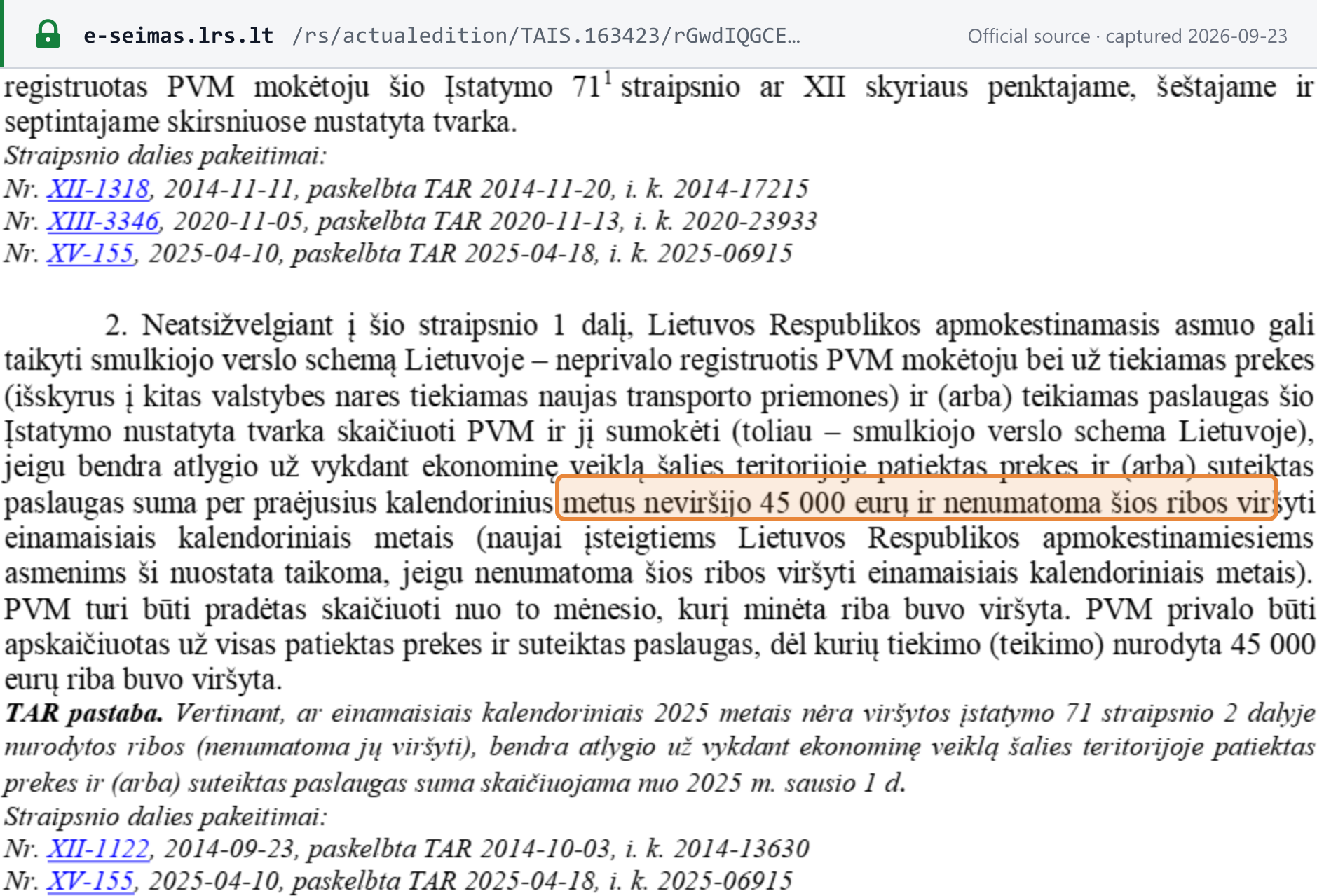
What is left out of the count (Art. 71(2²)): consideration for supplies whose input VAT would be non-deductible under Art. 62(1); supplies of fixed assets used in the business; advances received; and incidental supplies of immovable property and of Art. 28 financial services. [1]
Anti-splitting rule (Art. 71(7)). Where one person, alone or with related persons, controls several legal persons, all of them must register once their combined consideration exceeded EUR 45,000 in both the previous and the current calendar year. They escape this only by showing that they share no management body or board member, carry on different kinds of activity, and do not act for each other's benefit. [1]
Act No. XV-155 of 10 April 2025 recast Art. 71 into this form, including the cross-border small-business scheme. [2]
Non-resident registration
Established outside the EU: no threshold. The Art. 71(2) exemption is open only to Lithuanian taxable persons, and Art. 71(2¹) only to persons established in another Member State. VMI's official commentary on the Law states the result in terms: a foreign taxable person that is not registered «privalo skaičiuoti ir mokėti į biudžetą PVM, nepriklausomai nuo gauto atlygio dydžio» ("must calculate and pay VAT into the budget, irrespective of the amount of consideration received"). [3]
Fixed establishment or fiscal agent. A foreign taxable person established in a third country, or with only a fixed establishment in some Member State, registers through its fixed establishment in Lithuania or, if it has none, through an appointed fiscal agent in Lithuania (Art. 71(3)). Two groups may register directly instead: persons established in countries or territories with mutual-assistance instruments broadly equivalent to Directive 2010/24/EU and Regulation (EU) No 904/2010, and persons registering only to use the OSS/IOSS special schemes. The fixed establishment or fiscal agent is jointly and severally liable for the foreign person's VAT (Art. 71(5)). [1]
Established in another Member State: the cross-border small-business scheme. An EU business need not register in Lithuania only if all three conditions in Art. 71(2¹) hold: its Lithuanian supplies did not exceed EUR 45,000 last year and are not expected to this year; its EU-wide supplies did not exceed EUR 100,000 last year (converted at the ECB rates published on 18 January 2018) and are not expected to this year; and its Member State of establishment has issued it an identification number «su žymeniu „EX“ numerio pabaigoje» ("with the suffix 'EX' at the end of the number"). [1]
The mirror rule applies to Lithuanian businesses: to use another Member State's scheme they register for that purpose under Art. 74¹ (Art. 71²), and then file a quarterly report by the last day of the first month of the following quarter, whether or not they traded (Art. 88³(1)). [1]
Carve-outs for foreign sellers. A foreign taxable person need not register if its only Lithuanian supplies are ones on which a customer established in Lithuania must account for the VAT under Art. 95(2)–(4). [3] Under Art. 71(3), a person established in a third country, or with only a fixed establishment in a Member State, also need not register if it makes only exempt supplies, supplies outside the scope of VAT, or zero-rated supplies. The zero-rate carve-out does not cover supplies under Arts. 41 and 49, Art. 53(1) points 1, 2, 5 and 6, Art. 53(5), (6) and (10), or Art. 53¹. [1]
Tax identification number
A registered person is assigned a VAT payer code (PVM mokėtojo kodas) under Art. 74. The Law leaves its composition to VMI: the code is one «kurio sudarymo tvarką nustato centrinis mokesčio administratorius» ("the rules for the composition of which are laid down by the central tax administrator"). [1]
For the formats of the PVM code and of Lithuania's other identifiers, see Lookuptax's Lithuania tax ID guide. To check a number, use Lookuptax's Lithuanian PVM number validator, or see how to verify an EU VAT number in VIES. VMI itself publishes no web look-up form. It publishes the register of VAT registrations and deregistrations as an XML file, «atnaujinami kiekvieną dieną 3.00 val.» ("updated every day at 3.00") — see Important websites. [4]
How to register
Registration is an online request in Mano VMI: Paslaugos > PVM mokestis ir registravimas > PVM mokėtojo arba/ir SVS Lietuvoje dalyvio įregistravimas > Pildyti prašymą > Įregistravimas PVM mokėtoju. Art. 76 allows the application to be made electronically. [5] [1]
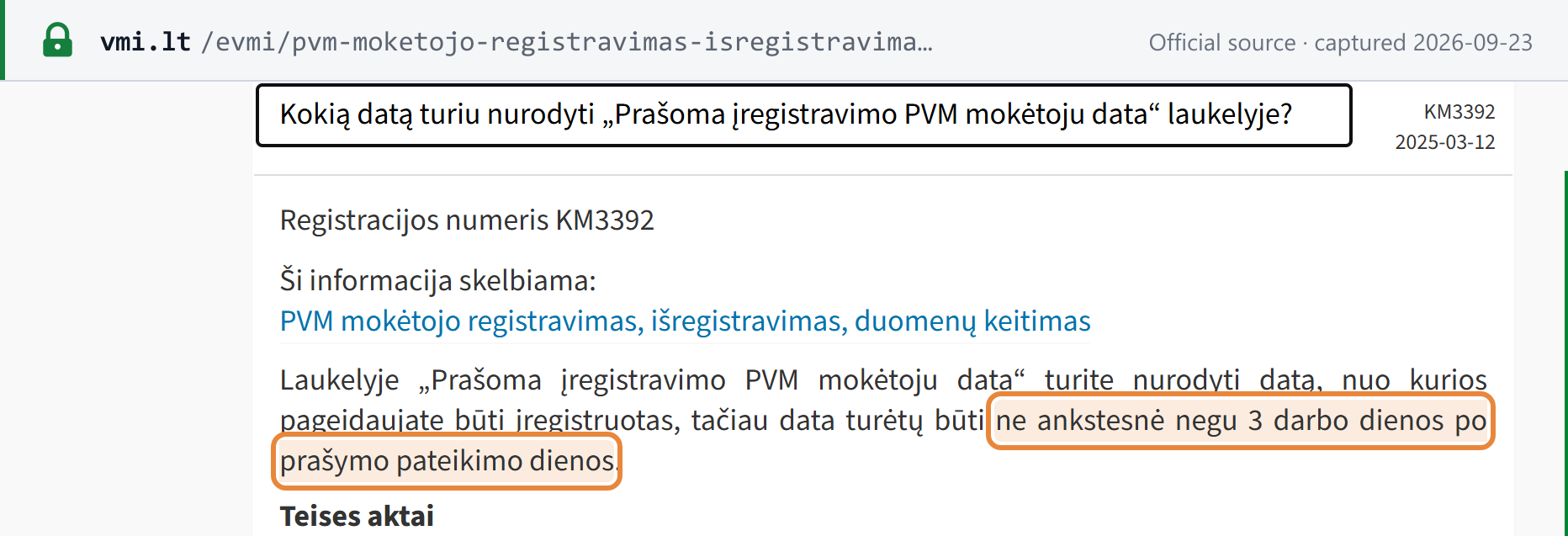
- Requested date. VMI's answer KM3392: the requested registration date «turėtų būti ne ankstesnė negu 3 darbo dienos po prašymo pateikimo dienos» ("should be no earlier than 3 working days after the day the application is submitted").
- Missing information. Within 3 working days of receiving the application, VMI either contacts the applicant or issues a notice requesting additional data (form FR0619) in Mano VMI. The notice states how many working days you have to reply.
- Decision. You become a VAT payer from the date stated in the registration decision (form FR0618), which is placed in Mano VMI.
Voluntary registration
Available. A Lithuanian or other-Member-State person that carries on, or intends to carry on, economic activity in Lithuania may register below the thresholds, unless all its activity is of a kind whose input VAT would be non-deductible under Art. 62(1) (Art. 72(1)). A person acquiring goods from other Member States may likewise register for those acquisitions below EUR 14,000, unless it acquires only new means of transport or excise goods (Art. 72(2)). [1]
The 24-month lock — intra-Community acquisitions only. The lock applies only to voluntary registration for intra-Community acquisitions under Art. 72(2), not to a person that registered voluntarily under Art. 72(1). A person that registered voluntarily under Art. 72(2) «negali būti išregistruotas iš PVM mokėtojų nepraėjus 24 kalendoriniams mėnesiams nuo jo įregistravimo» ("cannot be deregistered as a VAT payer before 24 calendar months have elapsed from its registration"), except on liquidation (Art. 75(3)). [1]
Deregistration
- When. On application or on VMI's initiative, where no duty to register would have arisen under Arts. 71 or 71¹ (Art. 75(1)). A person registered only for cross-border services may apply if it neither received services from abroad nor supplied services in other Member States in the previous and/or current year (Art. 75(2)). VMI may deregister, of its own motion, a person that on its data carries on no economic activity (Art. 75(4)). [1]
- Procedure. Apply in Mano VMI (Paslaugos > PVM mokestis ir registravimas > PVM mokėtojo arba/ir SVS Lietuvoje dalyvio išregistravimas) no later than 5 working days before the requested date. VMI decides within 5 working days (form FR0518) (VMI answer KM0745). For VAT payers in the small-business scheme (SVS) only, the application must be filed no earlier than 30 calendar days and no later than 5 working days before the requested date, and the deregistration date can be no earlier than 5 working days and no later than 30 calendar days after the application (VMI answers KM3833 and KM3834). [5]
- Final return. Within 20 days of deregistration, file a special VAT return for a person being deregistered or liquidated, declaring all remaining obligations; a person being liquidated files it before liquidation (Art. 88(1)). Any additional VAT on it is payable the same day the return is filed, and at the latest by its deadline (Art. 90(5)). [1]
Group registration
Not available. The consolidated Law on VAT in force from 1 July 2026 to 31 December 2026 contains no VAT-grouping provision (checked 2026-09-23). The nearest rule works the other way: the Art. 71(7) anti-splitting rule adds commonly controlled companies' turnover together to force each to register. [1]
Rates
Rates in force as at 2026-09-23:
| Rate | Applies to (examples) | Legal basis | In force |
|---|---|---|---|
| 21% (standard) | Every supply, intra-Community acquisition and import not given another rate — including, since 1 January 2026, heat for homes, hot water and household firewood, and goods imported under the special import VAT procedure for consignments up to EUR 150 | Art. 2(32), Art. 19(1)–(2), Art. 115¹⁹ | In force as at 2026-09-23 |
| 12% (reduced) | Accommodation services provided under the tourism legislation; passenger transport on regular routes set by the Ministry of Transport and Communications, a body it authorises or a municipality, and those passengers' baggage; admission to art and culture institutions and events where Art. 23 does not exempt it | Art. 19(3) | From 1 January 2026 |
| 5% (reduced) | Reimbursed medicines, medical aid devices and foods for special medical purposes; prescription medicines; technical assistance devices for persons with disabilities and their repair; newspapers, magazines and periodicals (printed and electronic); printed and electronic books and non-periodical information publications | Art. 19(4) | Varies by item — see below |
| 0% | Exports, intra-Community supplies, international transport, vessels and aircraft, supplies to diplomats and EU bodies, aid and humanitarian goods, and goods under free-zone, customs-warehousing or inward-processing procedures | Art. 19(5)(1) and Chapter VI (Arts. 41–56) | In force as at 2026-09-23 |
| Exempt (no VAT, no input-tax recovery) | See Exemptions | Chapter IV (Arts. 20–33) | — |
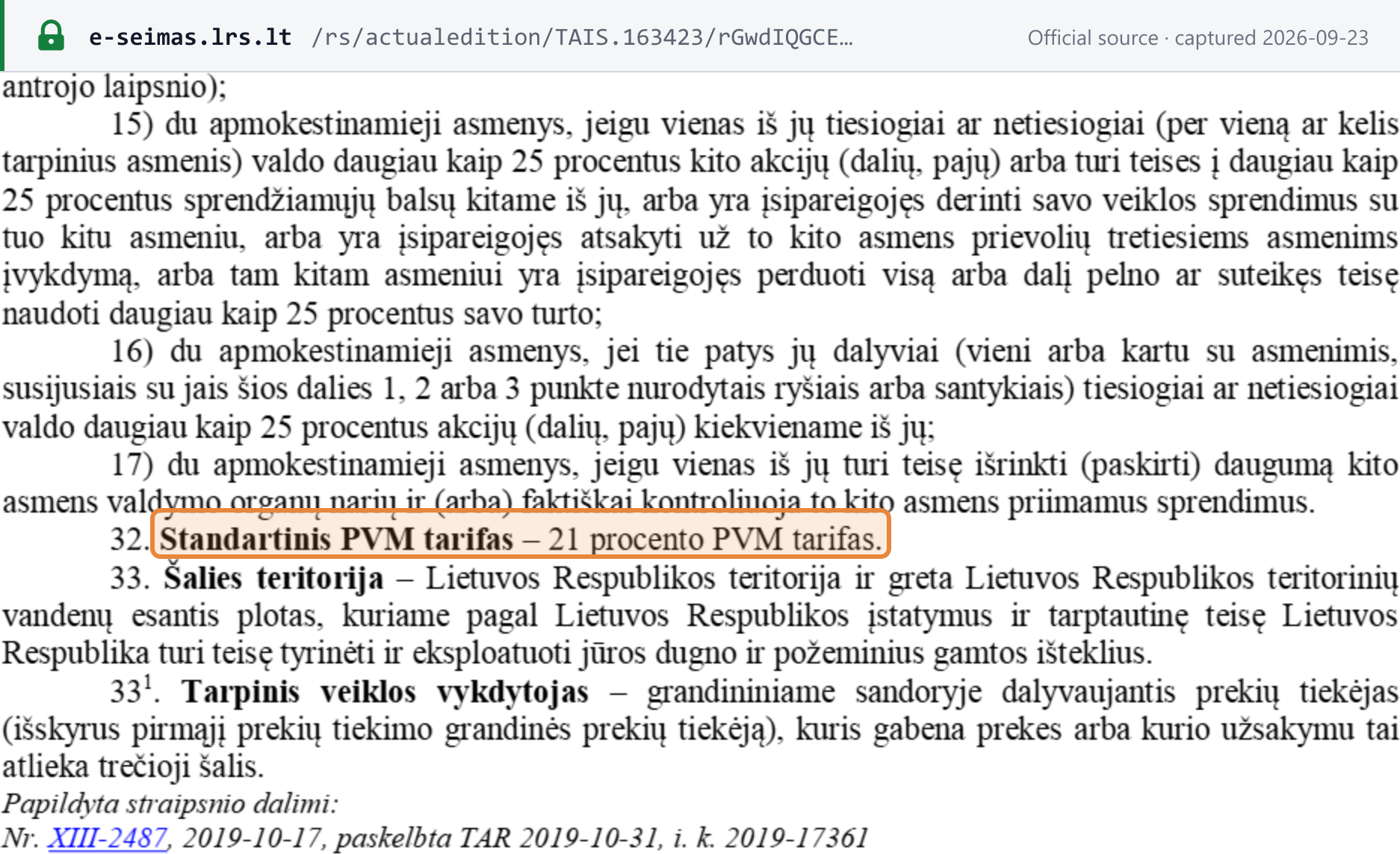
Standard rate. The figure is in the Law's definitions, not in Art. 19: «32. Standartinis PVM tarifas – 21 procento PVM tarifas.» ("32. Standard VAT rate — the VAT rate of 21 per cent.", Art. 2(32)). Art. 19(1) then applies «standartinis PVM tarifas» to every case not given another rate. [1]
The 5% list, with the date each item entered it (VMI's own dating, which VMI notes is generalised): [8] [1]
- Medicines and medical aid devices whose cost is wholly or partly reimbursed under the Law on Health Insurance, and foods for special medical purposes — from 2004-01-01. Prescription medicines that are not reimbursed — from 2017-01-01. VMI (answer KM0179): the 5% rate applies to prescription medicines «visose tiekimo grandyse» ("at all stages of supply"), reimbursed or not (Art. 19(4)(1)).
- Technical assistance devices for persons with disabilities, and their repair — from 2013-01-01; wording restated by Act No. XV-366 from 2026-01-01 (Art. 19(4)(2)).
- Printed newspapers, magazines and other periodicals — from 2019-01-01; electronic versions — from 2021-01-01. Excluded: technical and bibliographic databases, erotic or violent publications, publications where paid advertising exceeds four-fifths of the whole, and publications consisting wholly or mostly of music or video (Art. 19(4)(3)).
- Printed and electronic books and non-periodical information publications — from 2026-01-01. Included: textbooks, workbooks, encyclopaedias, dictionaries, reference books, brochures, photo and reproduction albums, children's picture books, drawing and colouring books, sheet music, maps, diagrams and drawings. Excluded: «kalendorius, užrašų knygeles ir kitus panašaus pobūdžio spaudinius» ("calendars, notebooks and other printed matter of a similar nature"), publications where advertising exceeds four-fifths, and publications that are wholly or mostly music or video (Art. 19(4)(4)).
Zero rate. The two COVID-era 0% items in Art. 19(5)(2)–(3) — COVID-19 vaccines and in vitro diagnostic devices — applied only to supplies made «iki 2022 m. gruodžio 31 d.» ("until 31 December 2022") and are spent. [1]
The 6% "compensatory rate" is not charged to customers. Art. 100 sets «Kompensacinis PVM tarifas – 6 procentai» ("The compensatory VAT rate is 6 per cent"). It is the rate at which VAT is compensated to farmers in the flat-rate farmers' scheme — see Special regimes. [1]
The 1 January 2026 reform — the 9% rate is abolished
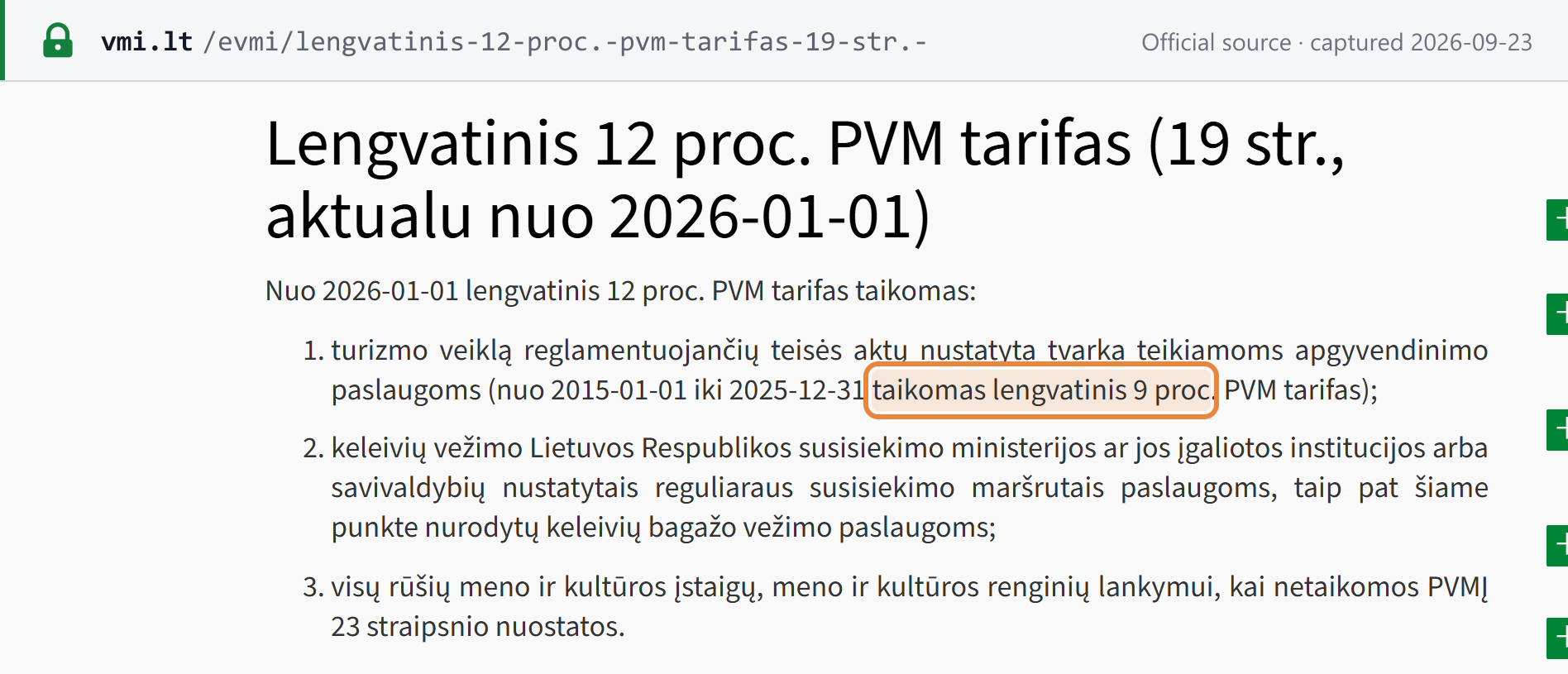
Act No. XV-287 of 17 June 2025 rewrote Art. 19(3) and added Art. 19(4)(4), with effect from 1 January 2026: «Šis įstatymas įsigalioja 2026 m. sausio 1 d.» ("This Law enters into force on 1 January 2026"). The Act sets no end date for these changes. VMI's summary: «Nuo 2026 m. sausio 1 d. bus taikomi 2 lengvatiniai PVM tarifai – 5 ir 12 procentų dydžio» ("From 1 January 2026, 2 reduced VAT rates will apply — of 5 and 12 per cent"). [9] [10]
| What happened on 1 January 2026 | Supplies affected | Rate now |
|---|---|---|
| New 12% rate | Accommodation, and scheduled passenger transport and baggage — both at 9% until 2025-12-31 (VMI answers KM3670 and KM0176); admission to art and culture institutions and events | 12% |
| Moved from 9% to 5% | Printed and electronic books and non-periodical information publications | 5% |
| Relief withdrawn entirely | Heat energy for heating residential premises (including heat delivered through a hot-water system); hot water supplied to residential premises, and the cold water and heat used to prepare it; firewood and wood products for burning supplied to household energy consumers | 21% |
| 9% rate abolished | — | No longer exists |
VMI's circular on the Act lists the withdrawals: «Taip pat nuo 2026 m. sausio 1 d. panaikinamas 9 proc. lengvatinis PVM tarifas šioms prekėms ir paslaugoms» ("Also, from 1 January 2026 the reduced 9 per cent VAT rate is abolished for the following goods and services"), followed by heat energy and hot water, books, and household firewood. Books went to 5%; the heating and firewood items received no reduced rate. [10]
Invoicing across the change — four different trigger tests. Art. 2 of Act No. XV-287 keeps the pre-2026 rules for supplies started before 2026, but the test depends on which old sub-point of Art. 19(3) the supply fell under: [9] [7]
| Old provision (to 2025-12-31) | The old rate still applies if… | Example |
|---|---|---|
| Art. 19(3)(1) (goods) | the goods were actually supplied by 31 December 2025 | — |
| Art. 19(3)(2) and (5) | the obligation to calculate VAT arose by 31 December 2025 | — |
| Art. 19(3)(3) | the advance order (reservation) was registered by 31 December 2025 | Accommodation. VMI answer KM3670: a reservation registered by 2025-12-31 takes 9%; one registered on 2026-01-01 or later takes 12%. |
| Art. 19(3)(4) and (7) | the service was paid for by 31 December 2025 | Scheduled passenger transport. VMI answer KM0176: 9% where paid by 2025-12-31; 12% where paid on 2026-01-01 or later. |
VMI also changed the return forms for the new rate from 1 January 2026 — see Return due date.
Spent provisions. Arts. 125³ and 125⁴, which compensated the budget for reduced-rate supplies, ceased to have effect on 2023-05-01 and 2024-05-01. [1]
Announced future rates. None enacted (as at 2026-09-27). VMI's rate pages set out no rate change after 1 January 2026, and Act No. XV-1036 of 18 June 2026 changes no rates. For announced non-rate changes from 2027, see Changes announced for 2027 and 2029.
A bill to restore 9% on residential heating — registered, not law. A bill registered in the Seimas on 17 September 2026 as No. XVP-1853 (sponsor: MP Arvydas Anušauskas) would add paragraph 3¹ to Art. 19 to apply a 9% rate to heat energy supplied for heating residential premises — including hot water supplied to residential premises and the heat used to heat it — from 1 January 2027. This would partially reverse the 1 January 2026 withdrawal above, which moved these supplies to 21%. The bill is at the registration stage and has not been debated (checked 2026-09-27); it is not law and may not be enacted as drafted. [16]
For Lithuania alongside other jurisdictions, see Lookuptax's worldwide tax rates table and VAT registration thresholds table.
Cross-border rules
Imports and exports
- Exports. Goods removed from the EU are zero-rated under Art. 41, with the evidence rules in Art. 56; goods exported by travellers under Art. 42. Art. 53 also zero-rates supplies of goods under customs procedures: goods placed under the free-zone, customs-warehousing or inward-processing procedure (Art. 53(1)(2)); goods in temporary storage or under the free-zone or inward-processing procedure, provided that still applies at the time of supply (Art. 53(1)(3)); and goods under temporary admission with full relief or external or internal transit. [1]
- Imports — the general rule. Art. 94(1): «Importo PVM už prekes mokamas tokiais pačiais terminais, kaip būtų mokami importo muitai už šias prekes…» ("Import VAT on goods is paid within the same time limits as import duties on those goods would be paid…"), as laid down in the Union Customs Code and the EU acts supplementing and implementing it. The importer pays (Art. 94(3)). VAT payers may credit import VAT in their return instead of paying it at the border, in the manner and on the criteria set by the Government. Where import VAT is not paid in advance or immediately, its payment is secured like a customs import debt. [1]
- Who controls it. Import VAT is controlled by Lithuanian Customs unless it is credited through the return or declared under the import scheme (IOSS), which VMI controls (Art. 120(1)–(2)). [1]
- Low-value consignments (up to EUR 150). The special import VAT procedure covers imported goods, other than excise goods, sent in consignments whose intrinsic value does not exceed EUR 150, where the import scheme (IOSS) is not used (Art. 115¹⁶(1)). Goods imported under it are taxed at the 21% standard rate, whatever Art. 19 says (Art. 115¹⁹). [1]
- Reverse charge on imported services. A Lithuanian customer that is a taxable person accounts for VAT on B2B services supplied to it by a foreign person not established in Lithuania (Art. 95(2)). A business that must self-account this way must register for VAT for that purpose, with no threshold (Art. 71¹(2)). [1]
The import-VAT deadline change of 1 July 2026. Act No. XV-984 of 4 June 2026 amended Article 115¹⁷(2) — the article on paying VAT under the special import VAT procedure — to read: «Taikant specialią importo PVM procedūrą importo PVM sumokamas ir jo sumokėjimas užtikrinamas šio Įstatymo 94 straipsnyje nustatyta tvarka» ("When the special import VAT procedure is applied, import VAT is paid and its payment is secured in the manner laid down in Article 94 of this Law"). It repealed Article 115¹⁷(3), the procedure's separate deadline, which «Neteko galios nuo 2026-07-01» ("ceased to have effect from 2026-07-01"). The Act entered into force on 1 July 2026. Its effect is to put import VAT under the special procedure on the same calendar as customs duty. [11] [1]
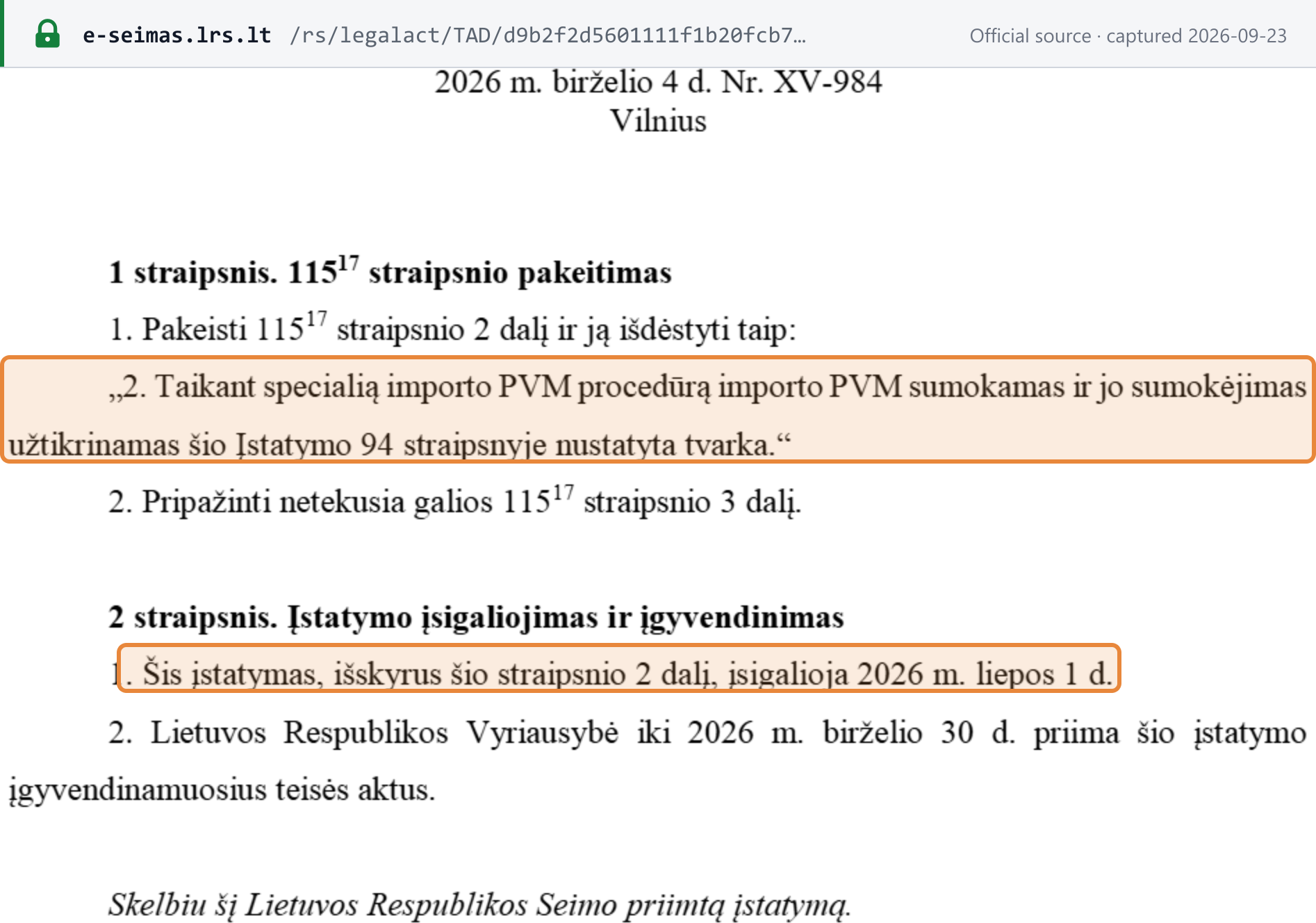
The Lithuanian statute does not itself state a day of the month for paying import VAT; it refers to the Union Customs Code. Check the customs-duty payment terms that apply to your import with Lithuanian Customs.
Digital products and services
Telecommunications, broadcasting and electronically supplied services to non-taxable persons follow the destination rule in Art. 13(15). Intra-EU distance sales of goods follow Art. 12(3)(1). [1]
The EUR 10,000 micro-business threshold (Art. 13²). The destination rules do not apply — the supply stays taxed where the supplier is — only while all three conditions hold: the supplier is established in one Member State only (or, if established outside the EU, has a fixed establishment in one Member State only); its cross-border distance sales of goods and Art. 13(15) services to consumers in other Member States, excluding VAT, did not exceed EUR 10,000 last year and do not exceed it this year; and it has not opted into the destination rules. Once the limit is crossed, the destination rules apply including to the supply that crossed it. An opt-in binds for at least 24 months. [1]
For a non-EU seller of digital services to Lithuanian consumers there is no registration threshold — see Non-resident registration. A seller already registered in any Member State for the OSS schemes need not register in Lithuania where its duty arises solely from those supplies (Art. 71(11)).
Foreign companies selling into Lithuania — B2B and B2C
The answer depends on who the customer is.
B2B — the Lithuanian customer usually accounts for the VAT. Where a foreign taxable person that is not established in Lithuania, and not in the Lithuanian small-business scheme, makes taxable supplies in Lithuania, the customer accounts for the VAT (Art. 95): [1]
- Services — a customer that is a taxable person accounts for VAT on Art. 13(2)(1) B2B services (Art. 95(2)).
- Goods — a customer that is a VAT payer accounts for VAT on gas, electricity, heating and cooling energy, and on goods installed or assembled in Lithuania (Art. 95(3)), and on goods supplied on the Art. 33¹(3) conditions (Art. 95(4)).
- Catch-all — for any other activity in Lithuania by an unregistered foreign person, a customer that is a taxable person accounts for the VAT, unless that customer is itself a foreign person with no establishment and no VAT registration in Lithuania (Art. 95(5)).
The foreign supplier must not show Lithuanian VAT on its document: «Užsienio asmenų išrašomuose apskaitos dokumentuose … Lietuvos Respublikos PVM nenurodomas» ("The VAT of the Republic of Lithuania is not stated in the accounting documents issued by foreign persons", Art. 95(8)). The customer declares the VAT as payable and may deduct it as input VAT on the same return (Art. 95(6)). A customer that is not a VAT payer pays it by the 25th day of the month after the month it had to be calculated (Art. 95(7)), using the statement for non-VAT payers (FR0608 in VMI's forms list). A foreign supplier whose only Lithuanian supplies fall under Art. 95(2)–(4) need not register. [1] [12]
B2C — the seller registers, or uses OSS/IOSS. There is no threshold for a seller established outside the EU. An EU seller is relieved only under the EUR 45,000 + EUR 100,000 + "EX" conditions of Art. 71(2¹), and its distance sales are taxed in Lithuania once the EUR 10,000 EU-wide limit in Art. 13² is exceeded. The seller then registers in Lithuania or accounts through the Union OSS, the non-Union OSS, or — for imported goods in consignments up to EUR 150 — the IOSS. A person already registered in any Member State for those schemes need not register in Lithuania where its duty arises solely from those supplies (Art. 71(11)). [1]
Marketplace / platform deemed-supplier liability
Applies today (Art. 4³). A taxable person that uses an electronic interface — «prekyvietę, platformą, portalą ar panašias priemones» ("a marketplace, platform, portal or similar means") — to facilitate either of the following is deemed to receive and supply the goods itself: [1]
- distance sales of goods imported from outside the EU in consignments of intrinsic value not exceeding EUR 150; or
- supplies of goods by a taxable person not established in the EU to a non-taxable person in the EU.
The interface operator must keep records of the supplies it facilitates to non-taxable persons in the EU for 10 calendar years from the end of the year of the transaction, and make them available electronically on request (Art. 78(5²)).
Widened from 1 January 2027 by Act No. XV-1036. Art. 4³(2) will also catch supplies by a non-EU seller to a taxable person, or to a non-taxable legal person whose intra-Community acquisition in another Member State is outside the scope of VAT, as well as to any other non-taxable person in the EU. [13]
Place of supply
- Goods (Art. 12). Goods that must be transported are supplied in Lithuania «kai šių prekių gabenimas pirkėjui prasidėjo šalies teritorijoje» ("where the transport of those goods to the purchaser began within the territory of the country"), whoever transports them. Goods transported from outside the EU are supplied in Lithuania, by the importer and on any later supply, if they were imported in Lithuania. Goods assembled or installed are supplied where assembled or installed. Intra-EU distance sales are supplied in Lithuania where the transport ends there (Art. 12(3)).
- Services (Art. 13). B2B: a service to a taxable person acting as such is supplied in Lithuania if the customer is established in Lithuania, unless it is supplied to the customer's fixed establishment abroad. B2C: a service to a non-taxable person is supplied in Lithuania if the supplier is established in Lithuania, unless it is supplied through the supplier's fixed establishment abroad (Art. 13(2)).
- Exceptions. Intermediary services to non-taxable persons follow the main transaction (Art. 13(3)). Services connected with immovable property, including construction, design and survey works, are supplied where the property is (Art. 13(4)). Telecommunications, broadcasting and electronic services to consumers follow Art. 13(15).
Domestic reverse charge
Under Art. 96(1), the VAT payer to whom the invoice is issued withholds and pays the VAT in these cases: assets taken over as a contribution in kind or on a reorganisation; the essential improvement of a building transferred under Art. 9(4); construction works as defined in Art. 2(90) of the Law on Construction, ordered by a VAT payer (Art. 96(1)(3), restated by Act No. XV-366 from 2026-01-01); and other cases set by the Government (Art. 96(1)(4)). The customer declares the withheld VAT as payable and may deduct it as input VAT (Art. 96(3)). [1]
The categories, per VMI's official commentary on Art. 96 and its FAQ: [14] [15]
| Category | Legal basis | From | Until |
|---|---|---|---|
| Metal waste and scrap (metalų atliekos ir laužas) | Government resolution No. 900 (2002) | 2002-07-01 | No end date |
| Construction works | VAT Law Art. 96(1)(3) | 2015-07-01 | No end date |
| Mobile phones, tablets and laptops | Government resolution No. 395 (2019-04-24) | 2019-08-01 | 31 December 2026 |
| Hard drives (ended) | Government resolution No. 395 | 2019-08-01 | 28 February 2022 |
| Timber (mediena) (ended) | Government resolution No. 579 | 2010-06-01 | 31 December 2021 |
| Bankrupt or insolvent undertakings (ended) | Government resolution No. 900 | 2002-07-01 | 31 December 2021 |
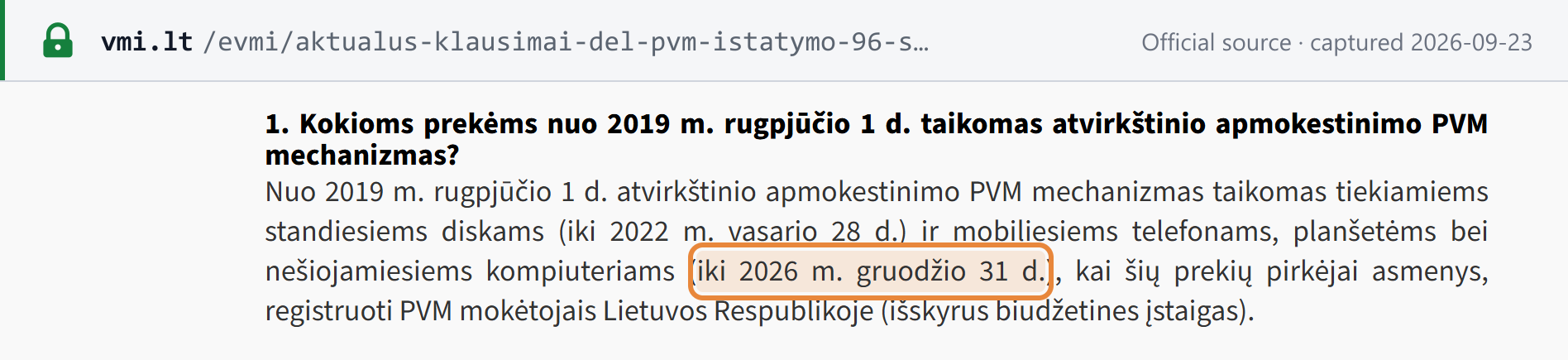
VMI's commentary on Art. 96: «4. Atvirkštinis PVM iki 2021-12-31 buvo taikomas tiekiant medieną» ("4. The reverse charge applied to supplies of timber until 2021-12-31"). The categories still in force are metal waste and scrap, construction works, and mobile phones, tablets and laptops until 31 December 2026. [14]
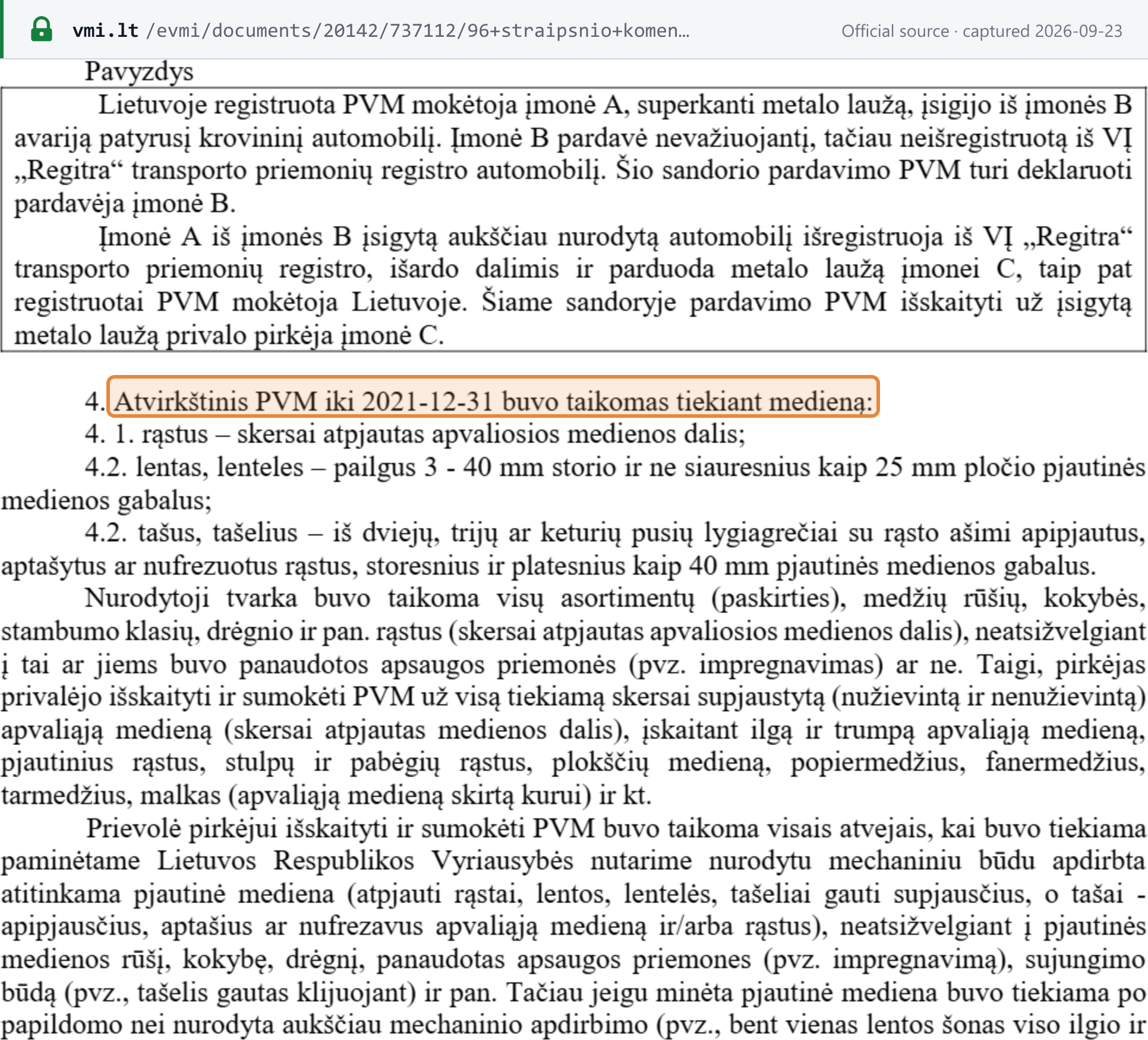
The electronics reverse charge ends on 31 December 2026. VMI's FAQ: the reverse charge applies «mobiliesiems telefonams, planšetėms bei nešiojamiesiems kompiuteriams (iki 2026 m. gruodžio 31 d.), kai šių prekių pirkėjai asmenys, registruoti PVM mokėtojais Lietuvos Respublikoje (išskyrus biudžetines įstaigas)» ("to mobile phones, tablets and laptops (until 31 December 2026), where the purchasers of those goods are persons registered as VAT payers in the Republic of Lithuania (excluding budgetary institutions)"). A seller invoicing these goods in 2027 should check VMI's page first: the date above is the one VMI published when checked on 2026-09-23. [15]
Points from the same FAQ that catch sellers: [15]
- Classification. Mobile phones, including smartphones, are goods under Combined Nomenclature heading 8517 13; tablets and laptops under 8471 30 00. Desktop computers are not covered, even with a hard drive inside.
- Cash-register receipt. Where a cash-register receipt is issued together with a VAT invoice, the seller stays liable, whoever the buyer is.
- Foreign buyers. It does not apply to a foreign buyer that is not VAT-registered in Lithuania, even if it is VAT-registered elsewhere in the EU.
- Budgetary institutions are excluded as buyers.
- Invoice wording. An invoice for a supply on which the customer accounts for the VAT must carry the reference «Atvirkštinis apmokestinimas» ("reverse charge") — Art. 80(1)(17); see Mandatory content.
Changes announced for 2027 and 2029
Act No. XV-1036 of 18 June 2026 transposes Council Directive (EU) 2025/516 of 11 March 2025. It has two commencement dates: [13]
- 1 January 2027 — the widened marketplace deemed-supplier rule (Art. 4³(2)); a reworded EUR 10,000 threshold, with a new Art. 13²(3) excluding persons registered in Lithuania for the Union OSS from the micro-business carve-out; call-off stock treatment only for goods dispatched by 30 June 2028; restated scopes for the non-Union OSS and the Union OSS (gas, heating and cooling energy supplies included in the Union OSS only until 30 June 2028); and IOSS registration changes.
- 1 July 2029 — repeal of the call-off stock regime (the whole of Art. 4²), the call-off stock register in Art. 78(5¹), and the call-off stock line in the EU sales report (Art. 88¹(1¹)).
The Act's Art. 15(1)–(2): «Šis įstatymas … įsigalioja 2027 m. sausio 1 d.» and «Šio įstatymo 1, 3, 5–7, 9 ir 10 straipsniai įsigalioja 2029 m. liepos 1 d.» ("This Law … enters into force on 1 January 2027"; "Articles 1, 3, 5–7, 9 and 10 of this Law enter into force on 1 July 2029"). VMI must adopt the implementing rules by 31 December 2026.
Invoice requirements
The Lithuanian VAT invoice is the PVM sąskaita faktūra. The Law prescribes its content in Art. 80 and its issue in Art. 79; it prescribes no form or template. [1]
Who must issue one. Every taxable person documents its supplies by VAT invoice, or makes sure the customer or a third party does so in its name (Art. 79(1)). The exception is a Lithuanian taxable person in the Lithuanian small-business scheme, unless it is registered under Art. 71¹. B2C is included: Lithuanian VAT payers — and persons in the Lithuanian small-business scheme — must also invoice supplies made in Lithuania «fiziniams asmenims, kurie nėra apmokestinamieji asmenys» ("to natural persons who are not taxable persons"), except in cases set by the Government (Art. 79(3)). A person that is not a VAT payer must still invoice a new means of transport supplied to another Member State (Art. 79(7)). [1]
Mandatory content
Art. 80(1) opens: «PVM sąskaitoje faktūroje privalo būti nurodyta:» ("A VAT invoice must state:"). The 19 particulars: [1]
| # | Required field | When | Legal cite |
|---|---|---|---|
| 1 | Date of issue | Always | Art. 80(1)(1) |
| 2 | Series and number identifying the invoice | Always | Art. 80(1)(2) |
| 3 | Supplier's VAT payer code, or its "EX" identification number under Art. 71(2¹)(3) or Art. 74¹(1) | Always | Art. 80(1)(3) |
| 4 | Customer's VAT payer code or VAT identification number as given by the customer | Where the customer gives one; always where a Lithuanian taxable person supplies in Lithuania to a VAT-registered customer | Art. 80(1)(4) |
| 5 | Supplier's name (or name and surname) and address | Always | Art. 80(1)(5) |
| 6 | Customer's name (or name and surname) and address | Always | Art. 80(1)(6) |
| 7 | Name of the goods or services, and their quantity | Always | Art. 80(1)(7) |
| 8 | Date of supply; for an advance, the day it was received | Where it differs from the date of issue | Art. 80(1)(8) |
| 9 | Unit price excluding VAT, and discounts not included in the unit price | Always | Art. 80(1)(9) |
| 10 | Taxable amount of the goods or services taxed at each rate | Always | Art. 80(1)(10) |
| 11 | VAT rate(s) | Not where the issuer is in a small-business scheme | Art. 80(1)(11) |
| 12 | VAT amount in euro | Not where the issuer is in a small-business scheme | Art. 80(1)(12) |
| 13 | Reference to the provision of the Law or of Directive 2006/112/EC, or another indication, showing the supply is exempt or zero-rated | Exempt and zero-rated supplies | Art. 80(1)(13) |
| 14 | The Art. 2(16) data on a new means of transport (start of operation, mileage, hours) | New means of transport supplied to another Member State | Art. 80(1)(14) |
| 15 | «Maržos apmokestinimo schema. Kelionių agentūros», or «… Naudotos prekės», «… Meno kūriniai», «… Kolekcionavimo objektai ir antikvariniai daiktai» | Margin schemes for travel services and for second-hand goods, works of art, and collectors' items and antiques | Art. 80(1)(15) |
| 16 | Fiscal agent's VAT payer code, name and address | Where a fiscal agent is liable for the VAT | Art. 80(1)(16) |
| 17 | «Atvirkštinis apmokestinimas» ("reverse charge") | Where the customer must account for (or withhold) and pay the VAT | Art. 80(1)(17) |
| 18 | «Pinigų apskaitos sistema» ("cash accounting system") | Where VAT becomes chargeable on receipt of payment | Art. 80(1)(18) |
| 19 | «Sąskaitų faktūrų išsirašymas» ("self-billing") | Where the customer issues the invoice in the supplier's name | Art. 80(1)(19) |
Variations. Where the customer accounts for the VAT under Art. 95 and does not issue the invoice itself, items 9–12 may be replaced by the taxable amount alone (Art. 80(8)). In the Chapter XII special-scheme cases, the VAT rate and amount are not shown at all (Art. 80(5)). Where several invoices go electronically to the same customer at the same time, information common to them may be stated once (Art. 80(6)). [1]
Issuance deadline
Art. 79(2) sets three deadlines, not one: [1]
| Supply | Deadline |
|---|---|
| General rule | «nedelsiant patiekus prekes ar suteikus paslaugas» — immediately after the goods are supplied or the services provided |
| Continuous supplies (telecommunications, leasing and the like; long-running supplies of electricity, gas, heat and other energy) | One invoice for the whole month may be issued by the 10th day of the following month |
| Intra-Community supplies of goods, and services on which the customer self-accounts under Art. 95 or another Member State's equivalent | By the 15th day of the month following the month of supply |
Advances. Where an advance received before the supply makes VAT chargeable under Art. 14, the advance itself must be documented by a VAT invoice, and the later invoice for the supply deducts it (Art. 79(4)).
General (consolidated) invoice. One invoice may document all supplies in a period whose VAT became chargeable in the same calendar month. It must carry every item required for each supply, other than information common to them (Art. 79(6)).
Numbering and sequencing
Art. 80(1)(2) requires a series and number that identify the invoice. The Law prescribes no number format, no single national sequence and no pre-authorisation of number ranges (checked 2026-09-23). [1]
Credit and debit notes
Where, after a supply is invoiced, the taxable amount or quantity changes, a discount is given, goods are returned, goods or services are refused, or the price changes for any other reason, the person who issued the original document must issue a credit document (kreditinis dokumentas). By agreement, the customer may instead issue a debit document (debetinis dokumentas), but only if the customer is a VAT payer. Both parties enter the change in their VAT accounts (Art. 83(1)). [1]
The credit or debit document carries the Art. 80(1) information, including the information not being adjusted, plus the issue date, series and number of the invoice being adjusted. Where that invoice cannot be identified precisely, other identifying data such as the period of supply are given (Art. 83(3)). A person may instead use the simplified Art. 80(9) content, adding the adjusted invoice's references and the other information being adjusted, except in the Art. 79(14) cases. [1]
Currency and language
- Currency. Where the taxable amount is expressed in another currency, the VAT amount must still be stated in euro — «PVM suma eurais» (Art. 80(1)(12) and Art. 80(9)(9)). [1]
- Exchange rate — imports. The taxable amount is converted under the Union Customs Code and its implementing acts (Art. 15(20)).
- Exchange rate — everything else. Art. 15(21), in its wording since 1 May 2025 (Act No. XV-155, Art. 3; in force under its Art. 36(1): «įsigalioja 2025 m. gegužės 1 d.»): the taxable amount is converted into euro «taikant euro ir užsienio valiutos santykį, nustatytą pagal Lietuvos Respublikos finansinės apskaitos įstatymą apmokestinimo momentu» ("applying the euro/foreign-currency rate determined under the Law on Financial Accounting of the Republic of Lithuania at the moment of taxation"). From 1 January 2026, Act No. XV-366 narrowed the fallback for Art. 83 price changes: the rate on the day the change is documented now applies only where the adjusted document cannot be identified. [1] [2] [16]
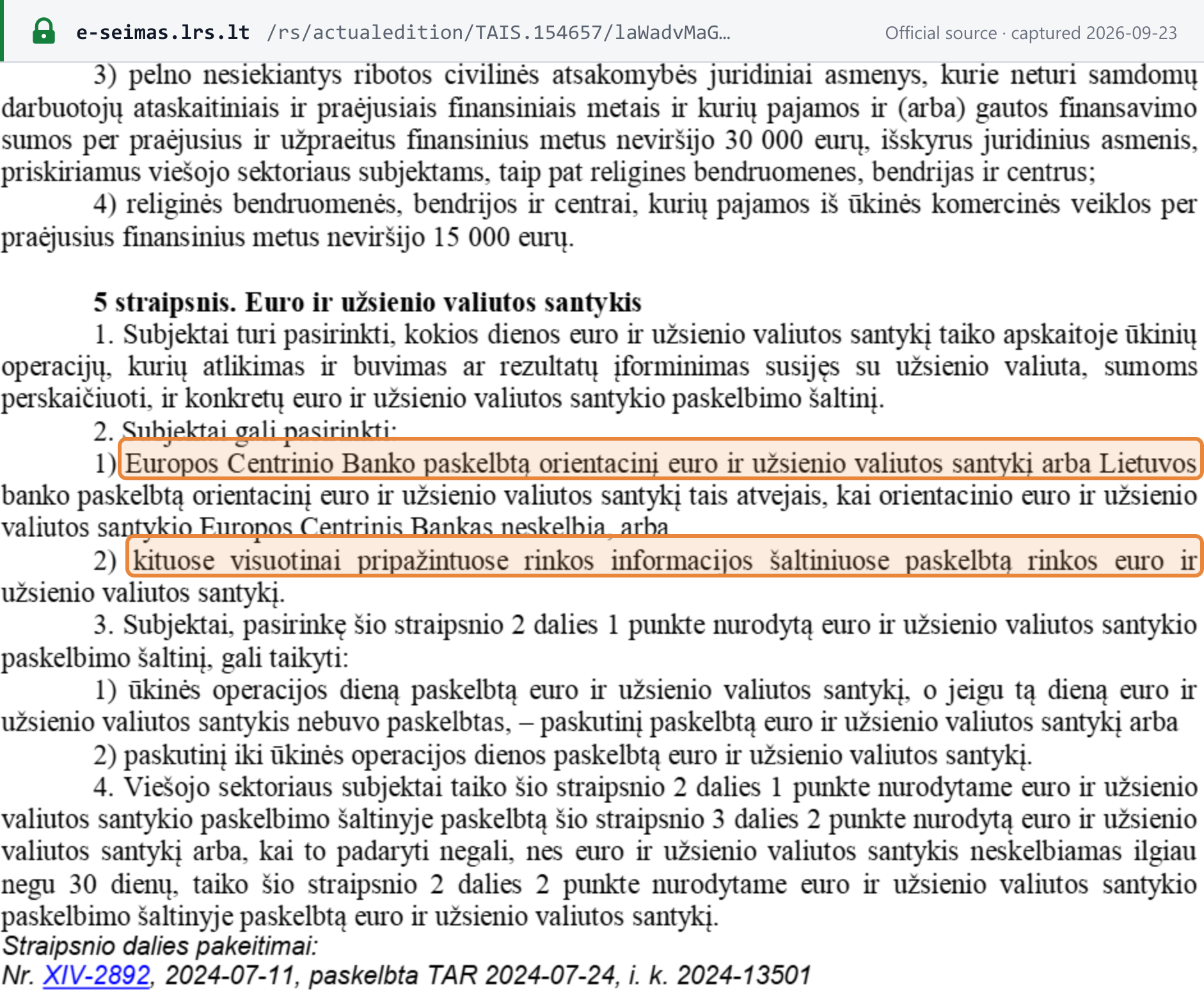
- Which rate — the business chooses. Art. 5 of the Law on Financial Accounting makes the source an election. The business chooses which day's rate it applies and the specific source of publication, from: (1) the European Central Bank's indicative rate, or the Bank of Lithuania's indicative rate for currencies the ECB does not publish; or (2) a market rate published in another generally recognised market information source. A business that chose source (1) may use the rate published on the transaction day (or the last published rate if none was published that day), or the last rate published before the transaction day. A business that chose source (2) uses the transaction-day rate. Public-sector entities must use source (1) with the last rate published before the transaction day, and may fall back to source (2) only where no rate has been published for more than 30 days. [17]
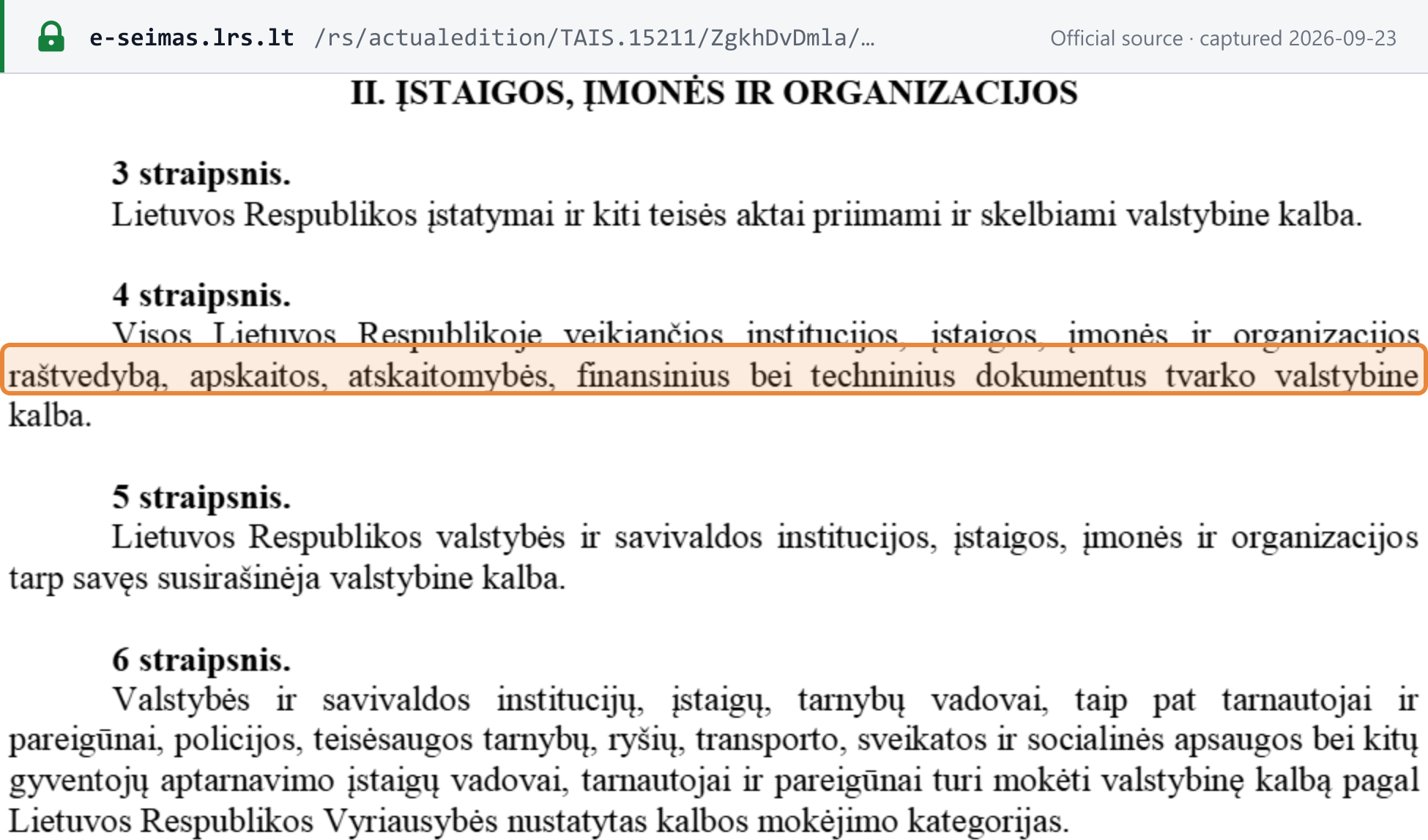
- Language — Lithuanian. The VAT Law itself sets no invoice language; the Law on the State Language does. Under its Art. 4, enterprises operating in Lithuania «…raštvedybą, apskaitos, atskaitomybės, finansinius bei techninius dokumentus tvarko valstybine kalba» ("…keep their records, accounting, reporting, financial and technical documents in the state language"). Documents of foreign entities need not carry the mandatory particulars listed in Art. 7 of the Law on Financial Accounting (Art. 7(7)). [18] [17]
Document types
| Document | When it may be used | Cite |
|---|---|---|
| Full VAT invoice (PVM sąskaita faktūra) | Default for every supply | Art. 80(1) |
| Simplified VAT invoice (supaprastinta PVM sąskaita faktūra) | Total value of the invoice including VAT does not exceed EUR 100; or the issuer is in the Lithuanian small-business scheme, or is an other-Member-State person in that scheme | Art. 79(13), content in Art. 80(9) |
| Fuel cash-register receipt | Retail sales of motor petrol, diesel and liquefied gas where the value including VAT does not exceed EUR 150 and the receipt carries the mandatory cash-register data plus data identifying the customer — the receipt counts as a VAT invoice | Art. 80(7) |
| General (consolidated) invoice | All supplies whose VAT became chargeable in the same calendar month | Art. 79(6) |
| Credit / debit document | Adjustments after invoicing | Art. 83 |
Simplified invoice. Art. 79(13)(1): «kai bendra PVM sąskaitoje faktūroje nurodomų patiektų prekių ir (arba) suteiktų paslaugų vertė (įskaitant PVM) neviršija 100 eurų» ("where the total value of the goods supplied and/or services provided stated in the VAT invoice (including VAT) does not exceed EUR 100"). It carries nine items (Art. 80(9)): issue date; a number identifying the invoice; the supplier's VAT payer code or identification number; the supplier's name; the customer's VAT payer code or identification number as given (always, where a Lithuanian taxable person supplies in Lithuania to a VAT-registered customer); the name of the goods or services; the taxable amount per rate; the VAT rate(s); and the VAT amount in euro. The last two are omitted where the issuer is in a small-business scheme. It is not available where Art. 79(1)(2)–(3) or Art. 79(7) require a full invoice, or where the supplier is not established in the Member State of supply and the customer there must self-account (Art. 79(14)). [1]
Bill of supply. Not applicable — the VAT Law defines no such document (checked 2026-09-23).
Self-billing
Permitted with a prior agreement. A third party may issue the invoice in the supplier's name; the customer may do so «tik tuo atveju, kai yra išankstinis tiekėjo (teikėjo) ir pirkėjo susitarimas» ("only where there is a prior agreement between the supplier and the purchaser", Art. 79(8)). The invoice carries «Sąskaitų faktūrų išsirašymas» (Art. 80(1)(19)). Where the customer or third party is established in a territory without mutual-assistance instruments equivalent to Directive 2010/24/EU and Regulation (EU) No 904/2010, VMI may set extra conditions (Art. 79(10)). [1]
Compulsory self-billing for agricultural produce. Invoices for agricultural produce supplied by Lithuanian VAT payers are in all cases issued by the purchaser, if the purchaser is a Lithuanian VAT payer (Art. 79(9)). Where the farmer has chosen the cash-basis tax point in Art. 14(9), the purchaser must also document each payment, with a copy to the supplier (Art. 81). [1]
Retention and audit trail
These are two obligations. Art. 78(7) states both in one paragraph.
- Retention — 10 years from the date of issue. VAT invoices for supplies in Lithuania, and VAT invoices received by taxable persons established in Lithuania, «privalo būti saugomos 10 metų nuo jų išrašymo dienos» ("must be stored for 10 years from the date of their issue", Art. 78(7)). The same period applies to non-taxable persons that acquire goods or services from other Member States, or that buy or supply new means of transport across the EU (Art. 78(8)). Both paragraphs were restated by Act No. XV-366 from 1 January 2026. Marketplace operators keep their records for 10 calendar years from the end of the year of the transaction (Art. 78(5²)). [1] [16]
- Audit trail — authenticity, integrity and legibility. For the whole retention period the taxable person must preserve «PVM sąskaitų faktūrų kilmės autentiškumas ir turinio vientisumas» ("the authenticity of origin and the integrity of the content of the VAT invoices") and keep them legible (Art. 78(7)). For an electronic invoice, authenticity means the genuineness of the supplier's or issuer's identity; integrity means that the information the Law requires has not been changed. They may be assured by any business controls that create a reliable link between the invoice and the supply, or for e-invoices by an advanced or qualified electronic signature, or by EDI under an interchange agreement that guarantees authenticity and integrity (Art. 79(11)). [1]
- Electronic-only archiving and storage abroad. Where invoices are electronic or stored electronically, the data proving authenticity and integrity must be stored electronically with them. Lithuanian taxable persons must store paper documents in Lithuania. Electronically stored documents with full online access may be stored outside Lithuania, but never in a territory without mutual-assistance instruments equivalent to Directive 2010/24/EU and Regulation (EU) No 904/2010. [1]
- Invoice registers. Taxable persons must keep registers of VAT invoices issued and received, containing every invoice except Art. 80(7) fuel receipts, and provide their data to VMI (Art. 78(5)) — this is the statutory basis of i.SAF. See i.MAS: i.SAF, i.VAZ and i.SAF-T. [1]
A specimen of a compliant invoice
VMI publishes no annotated specimen invoice and no prescribed invoice form. Neither the official VMI commentary on the VAT Law (edition current 2026-04-23) nor VMI's invoicing and i.SAF pages carries one; the i.SAF pages publish an example XML data file, which is not an invoice. The layout below is Lookuptax's own illustration of the Art. 80(1) particulars. Every name, number and amount in it is fictional: [3]
PVM sąskaita faktūra — VAT invoice
| Goods or servicesArt. 80(1)(7) | QuantityArt. 80(1)(7) | Unit price excl. VATArt. 80(1)(9) | VAT rateArt. 80(1)(11) | Value excl. VAT |
|---|---|---|---|---|
| Office chairs | 20 | EUR 60.00 | 21% | EUR 1,200.00 |
| Printed reference books | 10 | EUR 30.00 | 5% | EUR 300.00 |
- Discounts not included in unit priceArt. 80(1)(9)
- EUR 0.00
- Taxable amount at 21%Art. 80(1)(10)
- EUR 1,200.00
- VAT at 21%Art. 80(1)(12)
- EUR 252.00
- Taxable amount at 5%Art. 80(1)(10)
- EUR 300.00
- VAT at 5%Art. 80(1)(12)
- EUR 15.00
- Total VAT (in euro)Art. 80(1)(12)
- EUR 267.00
- Total including VAT
- EUR 1,767.00
- Each rate has its own taxable amount and VAT amount — Art. 80(1)(10)–(12). Books take the 5% rate under Art. 19(4)(4) from 1 January 2026.
- If the invoice were in another currency, the VAT amount would still be shown in euro, converted at the rate from the source the supplier chose under Art. 5 of the Law on Financial Accounting, at the moment of taxation — VAT Law Art. 15(21).
- If the customer had to account for the VAT, the invoice would carry «Atvirkštinis apmokestinimas» — Art. 80(1)(17). If the customer issued it in the supplier's name, «Sąskaitų faktūrų išsirašymas» — Art. 80(1)(19).
- An exempt or zero-rated line would carry a reference to the provision of the VAT Law or Directive 2006/112/EC that exempts or zero-rates it — Art. 80(1)(13).
- At EUR 1,767 including VAT the simplified form is not available; the ceiling is EUR 100 — Art. 79(13).
- Both parties enter this invoice in their i.SAF invoice registers — Art. 78(5).
E-invoicing status
Status (as of 2026-09-23): B2G mandatory; no B2B or B2C mandate.
| Scope | Status | Legal basis |
|---|---|---|
| B2G | Mandatory. Only electronic accounting documents may be given to public-sector entities and other contracting authorities, in the cases the Government sets; EN-standard e-invoices go through the PEPPOL network from 1 January 2025 | Law on Financial Accounting Art. 6(4); Public Procurement Law Art. 22(3); Government resolution No. 405, point 1.4 |
| B2B | No mandate. An electronic invoice may be used only with the customer's prior consent | VAT Law Art. 79(11); Law on Financial Accounting Art. 6(3) |
| B2C | No mandate (same consent rule). Invoicing itself is compulsory for supplies to consumers in Lithuania — see Invoice requirements | VAT Law Art. 79(3), 79(11) |
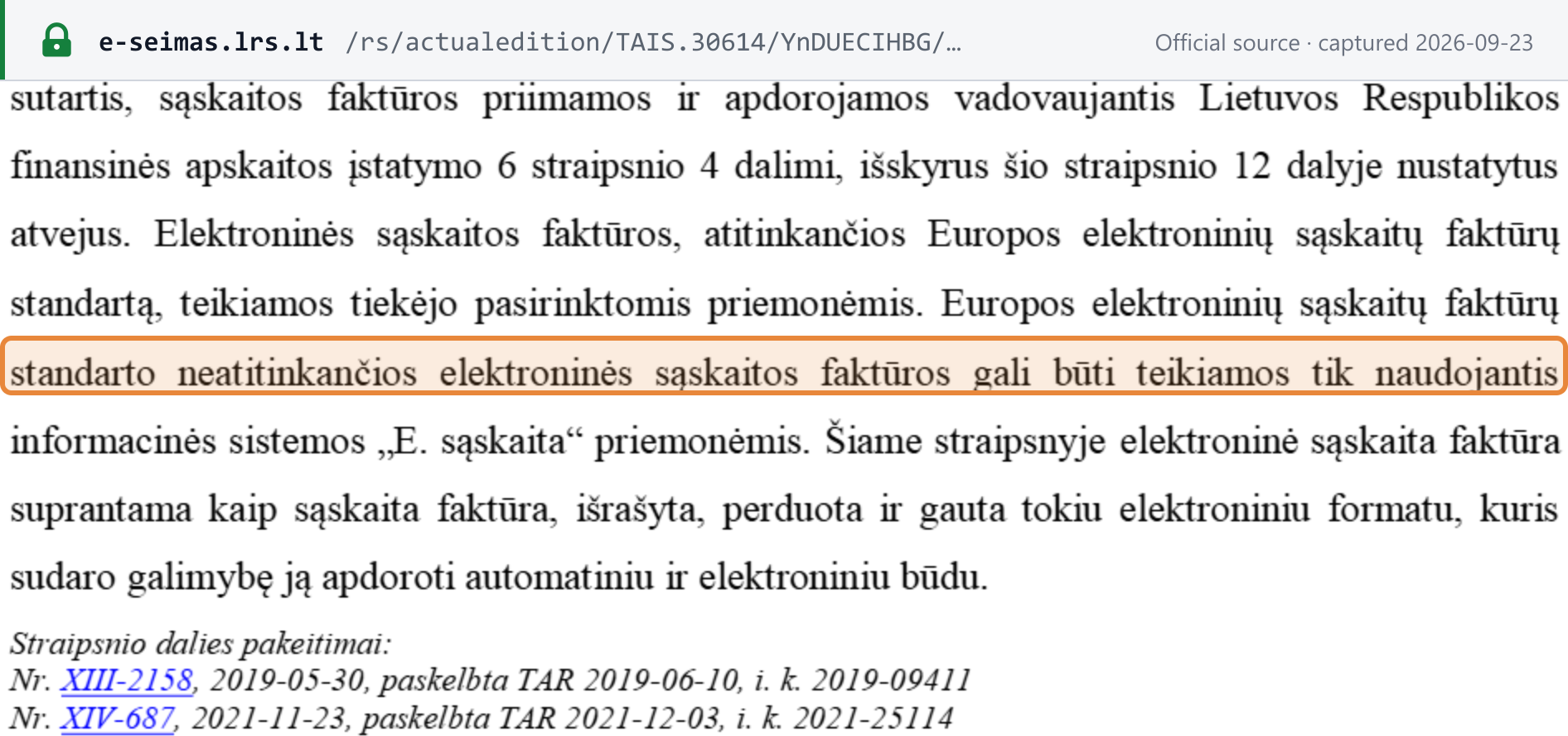
The B2G rule. Public Procurement Law Art. 22(3): invoices under procurement contracts are accepted and processed under Art. 6(4) of the Law on Financial Accounting, except in the Art. 22(12) emergency cases. E-invoices that conform to the European e-invoicing standard «teikiamos tiekėjo pasirinktomis priemonėmis» ("are submitted by means chosen by the supplier"). E-invoices that do not conform «gali būti teikiamos tik naudojantis informacinės sistemos „E. sąskaita“ priemonėmis» ("may be submitted only using the means of the 'E. sąskaita' information system"). Contracting authorities must be able to receive and process EN-standard e-invoices through E. sąskaita (Art. 22(13)). [19]
System. The statutory name is the „E. sąskaita“ information system. Its public address, www.esaskaita.eu, redirects to SABIS (sabis.nbfc.lt), operated by the National Shared Services Centre (Nacionalinis bendrųjų funkcijų centras).
Last gap closed on 1 January 2025. Government resolution No. 947 of 6 December 2023 let invoices under orally concluded contracts be given on paper only «iki 2024 m. birželio 30 d.» ("until 30 June 2024"), and made such invoices free of charge through the system «nuo 2024 m. liepos 1 d.» ("from 1 July 2024"). [20] Invoices under oral contracts worth up to EUR 1,000 excluding VAT could stay non-electronic for six months longer — resolution No. 405, point 1.2.2: «iki 2024 m. gruodžio 31 d. – kai sąskaitos faktūros teikiamos pagal žodžiu sudaromas sutartis, kurių vertė neviršija 1 000 eurų» ("until 31 December 2024 — where invoices are provided under orally concluded contracts whose value does not exceed EUR 1,000"). [21]
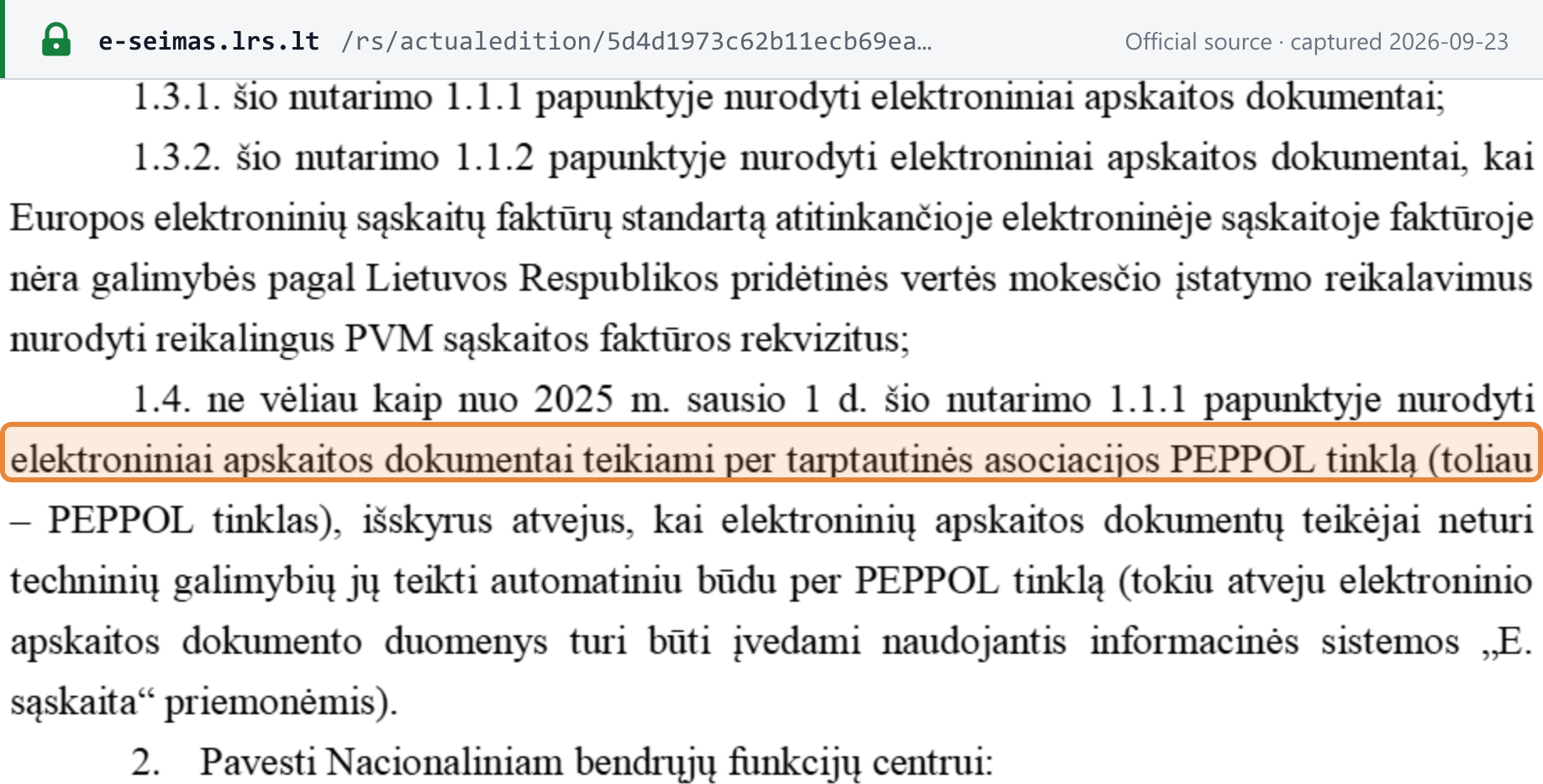
Network — PEPPOL since 1 January 2025. Government resolution No. 405 of 27 April 2022 (consolidated text from 2023-12-12), point 1.4: «1.4. ne vėliau kaip nuo 2025 m. sausio 1 d. šio nutarimo 1.1.1 papunktyje nurodyti elektroniniai apskaitos dokumentai teikiami per tarptautinės asociacijos PEPPOL tinklą» ("1.4. from no later than 1 January 2025, the electronic accounting documents referred to in point 1.1.1 of this resolution are submitted through the network of the international association PEPPOL"). So EN-standard e-invoices to public-sector buyers and contracting authorities go through the PEPPOL network. A supplier that cannot send automatically through PEPPOL keys the invoice data into E. sąskaita instead. Under point 1.3.2, an invoice that does not follow the EN standard is allowed only through E. sąskaita, and only where the EN format cannot carry the particulars the VAT Law requires. [21]
Both texts apply: Public Procurement Law Art. 22(3) says EN-standard e-invoices are submitted «tiekėjo pasirinktomis priemonėmis» ("by means chosen by the supplier"), and resolution No. 405 — adopted for the cases the Government sets under Law on Financial Accounting Art. 6(4) — names PEPPOL as the channel for them, with manual entry in E. sąskaita as the alternative. [19]
Formats and standards. The European e-invoicing standard is defined by reference to Commission Implementing Decision (EU) 2017/1870 under Directive 2014/55/EU (Public Procurement Law Art. 2(8¹)). An electronic invoice is one «išrašyta, perduota ir gauta tokiu elektroniniu formatu, kuris sudaro galimybę ją apdoroti automatiniu ir elektroniniu būdu» ("issued, transmitted and received in such an electronic format as allows it to be processed automatically and electronically", Art. 22(3)). [19]
Phase timeline by taxpayer size. Not applicable. The B2G obligation is not phased by size or turnover; it applies because the customer is a contracting authority.
Not the same thing as i.SAF. Lithuania's monthly i.SAF submission reports invoice-register data to VMI after the fact. It is not a channel for delivering invoices to customers — see i.MAS: i.SAF, i.VAZ and i.SAF-T.
For Lithuania alongside other mandates, see Lookuptax's e-invoicing status and networks table.
Filing and payment
Filing frequency
The tax period is the calendar month by default: «Mokestinis laikotarpis yra kalendorinis mėnuo…» ("The tax period is the calendar month…", Art. 84(1)). [1]
| Period | Who | Legal basis |
|---|---|---|
| Calendar month | Default for every VAT payer | Art. 84(1) |
| Calendar quarter | On application, a VAT payer other than a natural person whose total income from economic activity in the previous calendar year did not exceed EUR 300,000; also a new VAT payer expecting not to exceed it. Can be changed back no earlier than the end of the quarter. | Art. 84(2)–(3) |
| Calendar half-year | Default for a natural person VAT payer, unless it applies for monthly periods. A switch takes effect from the next half-year. | Art. 84(4) |
| Custom period of up to 60 days | On application, a legal person or foreign taxable person aligning with a foreign parent's reporting; the first and last periods of the year start and end with the calendar year | Art. 84(5) |
Who is locked into monthly periods. The quarterly, half-yearly and custom options are not available to VAT payers that acquire goods from other Member States and services on which they self-account under Art. 95(2), nor to VAT payers in the Lithuanian small-business scheme (Art. 84(7)). VMI may also impose monthly periods where needed to secure the tax, including to check a VAT refund (Art. 84(6)). [1]
Return due date
The VAT return is form FR0600, filed through VMI's electronic declaration system (EDS). Art. 85: [1] [12]
- Monthly — «ne vėliau kaip iki kito mėnesio 25 dienos» ("no later than the 25th day of the following month").
- Quarterly — by the 25th day of the first month of the following quarter.
- Half-yearly — by the 25th day of the first month of the following half-year.
- Custom period — within 25 days of its end.
- OSS/IOSS returns follow Arts. 115³, 115⁸ and 115¹³ instead.
- A VAT payer in the Lithuanian small-business scheme files (form PVM101) only for periods in which it had to calculate and pay VAT, or supplied services taxed in another Member State (Art. 85(7)).
The form changed on 1 January 2026. VMI order No. VA-129 of 22 December 2025 added box 29A to FR0600 for output VAT at the 12% rate, and boxes 8A and 12A to the FR0608 statement for non-VAT payers. VMI order No. VA-117 of 4 December 2025 extended the PVM101 codes for 12%. In the VAT classifier, the 9% codes were given an end date of 2025-12-31. Use the updated versions for every period from 1 January 2026. [22]
Payment due date and method
Payment is due by the return deadline — there is no separate payment date: VAT for a period «privalo būti sumokėta į biudžetą ne vėliau kaip iki šio Įstatymo 85 straipsnyje nustatyto mokestinio laikotarpio PVM deklaracijos pateikimo termino pabaigos» ("must be paid into the budget no later than by the end of the deadline for submitting the VAT return", Art. 90(1)). Additional VAT on the annual return is due by that return's deadline (Art. 90(4)); on a deregistration return, the same day it is filed (Art. 90(5)). [1]
How to pay. Transfer to one of VMI's budget revenue collection accounts, quoting payment code 1001 for taxes administered by VMI (as at 2026-09-23). VMI publishes the account list, which covers several commercial banks. Pay by online banking, or generate a printable payment order in Mano VMI (Paslaugos > Mokesčių suderinimas ir grąžinimas > Mokėjimo pavedimo suformavimas) and pay it where barcode readers are used. Paying on someone else's behalf needs the extended payment-order form with the original payer's code and name. [23]
Additional listings
| Listing | Who | Due | Legal basis |
|---|---|---|---|
| EU sales report (prekių tiekimo ir (arba) paslaugų teikimo į kitas valstybes nares ataskaita) | VAT payers supplying goods to other Member States, and VAT payers — including those in the small-business scheme — supplying services taxed in another Member State under the reverse charge | Monthly, by the 25th of the following month. The Article sets no threshold and no quarterly option. | Art. 88¹ |
| Annual VAT return (metinė PVM deklaracija, FR0516) | Only VAT payers that must adjust their input-VAT deduction under Chapter VIII once the year's actual figures are known. It is not an annual summary of the monthly returns. | By 1 October of the following year | Art. 87 |
| Statement for non-VAT payers (FR0608) | Persons not registered as VAT payers that must pay VAT, e.g. a customer self-accounting under Art. 95 | Under Art. 95(7), the VAT is payable by the 25th of the month after it had to be calculated | Art. 92, Art. 95(7) |
| Farmers' scheme purchaser report (FR0617K) | Purchasers buying from farmers in the flat-rate scheme | — | Art. 99 |
| Cross-border SME scheme report | Lithuanian businesses registered to use other Member States' small-business schemes | Quarterly, by the last day of the first month of the following quarter | Art. 88³ |
| i.SAF, i.VAZ, i.SAF-T | See below | See below | — |
The annual return rule, Art. 87(1): the VAT payer «ne vėliau kaip iki kitų kalendorinių metų spalio 1 dienos privalo pateikti metinę PVM deklaraciją» ("must, no later than 1 October of the following calendar year, submit an annual VAT return") where the deduction must be adjusted.
i.MAS: i.SAF, i.VAZ and i.SAF-T
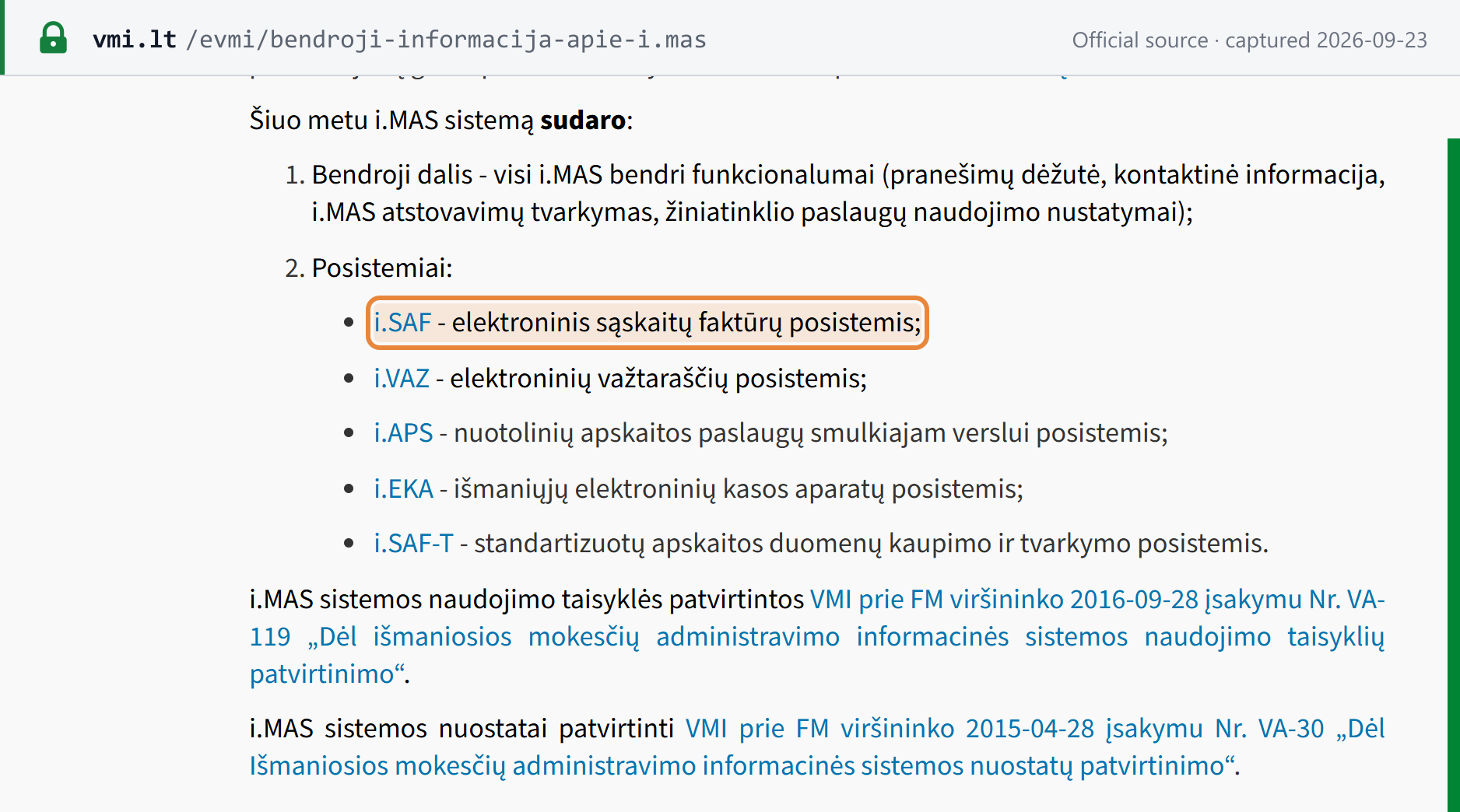
i.MAS — išmanioji mokesčių administravimo informacinė sistema, VMI's smart tax administration information system — is made up of a general part (message box, contact details, representation management, web-service settings) and five subsystems. The three that matter for VAT are i.SAF (e-invoice registers), i.VAZ (e-consignment notes) and i.SAF-T (standard audit file); the others are i.APS (remote accounting for small business) and i.EKA (smart cash registers). Its regulations were approved by VMI order No. VA-30 of 28 April 2015 and its rules of use by VMI order No. VA-119 of 28 September 2016. [24]
Access. You sign in through the ESKIS/VIISP identification service. Rights are granted automatically from the Taxpayer Register — for example to the head of a legal person, and to its bookkeeper for i.SAF only, and only if the taxpayer is a VAT payer — or manually by a representative with the "i.MAS atstovų administravimas" role. On first connection you must confirm an e-mail address, or the system cannot be used. [24]
i.SAF — invoice register data, due on the 20th
| What | The data of your registers of VAT invoices issued and received (Art. 78(5)). All invoices go in, except Art. 80(7) fuel receipts. |
| Who | «apmokestinamieji asmenys, kurie yra registruoti PVM mokėtojais Lietuvoje, išskyrus PVM mokėtojus, taikančius smulkiojo verslo schemą (SVS) Lietuvoje» ("taxable persons registered as VAT payers in Lithuania, except VAT payers applying the small business scheme (SVS) in Lithuania"). No turnover threshold — VAT registration is the test. Also exempt: VAT payers registered only for intra-Community acquisitions that carry on no economic activity. |
| Mixed activity | A VAT payer that also carries on non-economic activity (e.g. state or municipal functions) submits data for all invoices, from the month it carried on economic activity to the end of that calendar year, whether or not it traded in the later months. |
| Deadline — legal persons | Monthly, by the 20th day of the following month |
| Deadline — natural persons | On their VAT return cycle: by the 20th of the following month if they file monthly; by the 20th of the first month of the next half-year if they file half-yearly |
| Format and channel | XML to the i.SAF data-file XSD (VMI cites version i.SAF1.1), uploaded in the i.SAF portal or sent through a web service. One web-service certificate, ordered in i.MAS, serves both i.SAF and i.VAZ. |
| Rules | VMI order No. VA-55 of 21 April 2004 on VAT invoice registers |
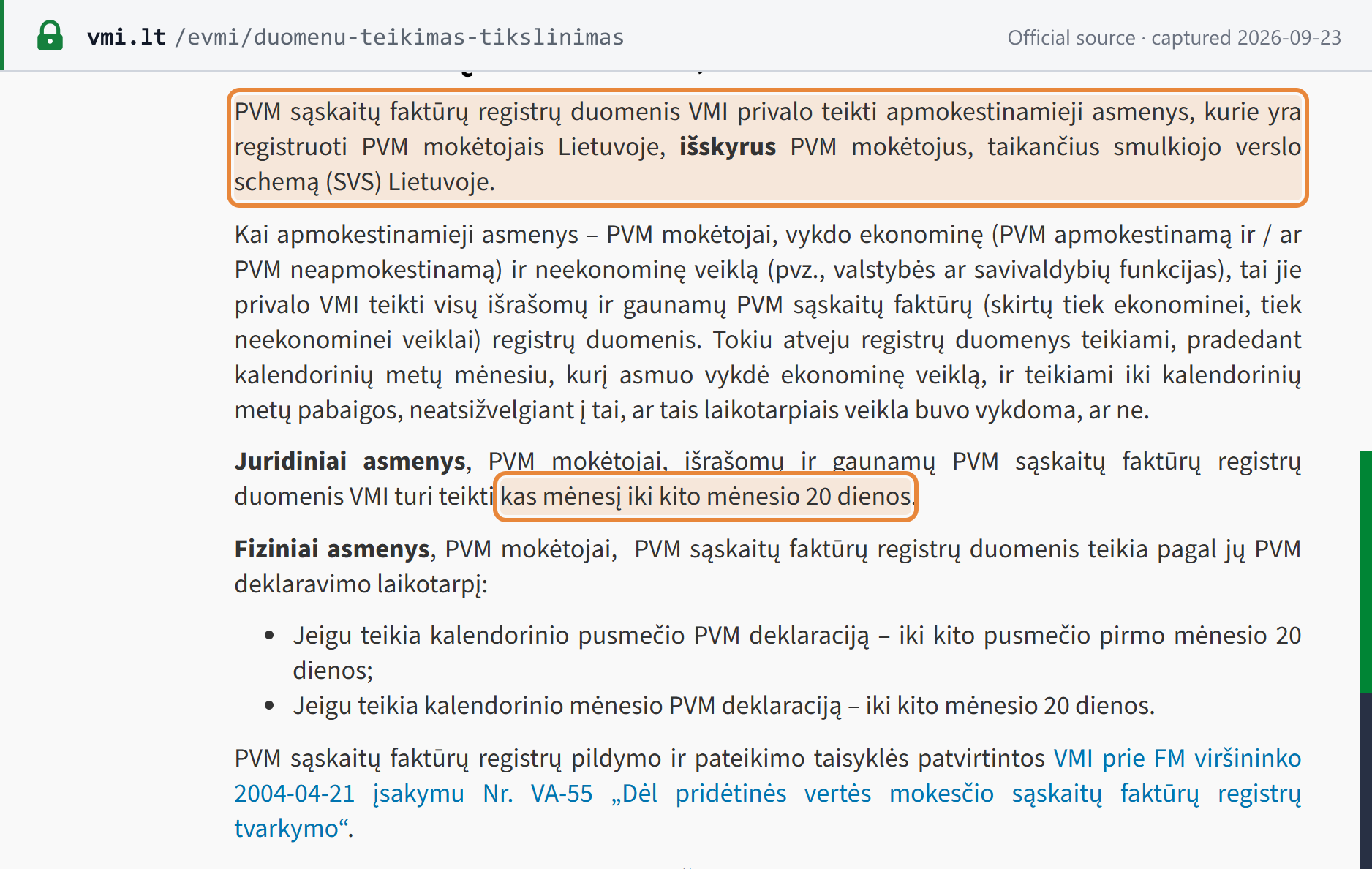
The 20th is not the 25th. i.SAF is due on the 20th; the FR0600 VAT return and the VAT payment are due on the 25th. They are separate obligations with separate deadlines, and a missed i.SAF submission is its own breach — see Penalties.
Two field rules you will meet at once: [25]
- Supply date. Fill it only where the supply date differs from the invoice date (mirroring Art. 80(1)(8)). Leave it empty for a monthly invoice for continuous energy supplies issued by the 10th of the following month under Art. 79(2).
- VATRegistrationNumber. The element must always be present in the XML, but may carry the value "ND" (nėra duomenų — no data) where the counterparty is not a VAT payer or its code is unknown.
i.VAZ — consignment notes, before the goods move
| What | The data of consignment notes (važtaraščiai) for cargo carriage |
| Who | The consignment-note preparer (važtaraščio rengėjas) — the consignor, or another person who prepares the note or submits its data. «Patys pervežimo operacijos dalyviai turi nuspręsti, kas bus važtaraščio rengėjas» ("The participants in the carriage must themselves decide who will be the preparer"). |
| Deadline | «ne anksčiau kaip likus 7 dienoms iki numatytos krovinio išgabenimo dienos, bet ne vėliau kaip važtaraštyje nurodyti krovinio išgabenimo data ir laikas» ("no earlier than 7 days before the intended day of dispatch, but no later than the date and time of dispatch stated in the consignment note") — before the goods move |
| Channel | i.VAZ portal or web service (same certificate as i.SAF). If your own system fails, the backup channel a.VAZ may be used; it does not remove the duty to hold a consignment note and submit the full data later. |
| Rules | VMI order No. VA-36 of 1 April 2016; further exceptions in its point 11 |
When i.VAZ data are not due, and when they are: [26]
- Own-account carriage — no commercial carriage relationship, which VMI says exists only where consignor, carrier and consignee are the same person — not due.
- Carriage into or out of Lithuania under a CMR — not due. But if the goods are reloaded in a Lithuanian warehouse and carried on within Lithuania under a new consignment note — due.
- Consignee not a Lithuanian taxpayer, but delivery to another warehouse in Lithuania or to an export customs post under a consignment note — due.
- A VAT invoice used as the consignment note, carrying all the Road Transport Code Art. 29 particulars — its data must go to i.VAZ.
i.SAF-T — on demand during an audit, not a periodic return
| What | Accounting data in a standard audit file (SAF-T) |
| Who | For-profit economic operators that keep their accounting registers by technical means, by reference to their net sales income. VMI: «Microsoft Office Excel skaičiuoklė nėra laikoma technine priemone» ("A Microsoft Office Excel spreadsheet is not regarded as a technical means"). |
| Not required from | A foreign company registered as a VAT payer in Lithuania, branches and representative offices of foreign companies, permanent establishments, public-sector entities and other non-profit legal persons |
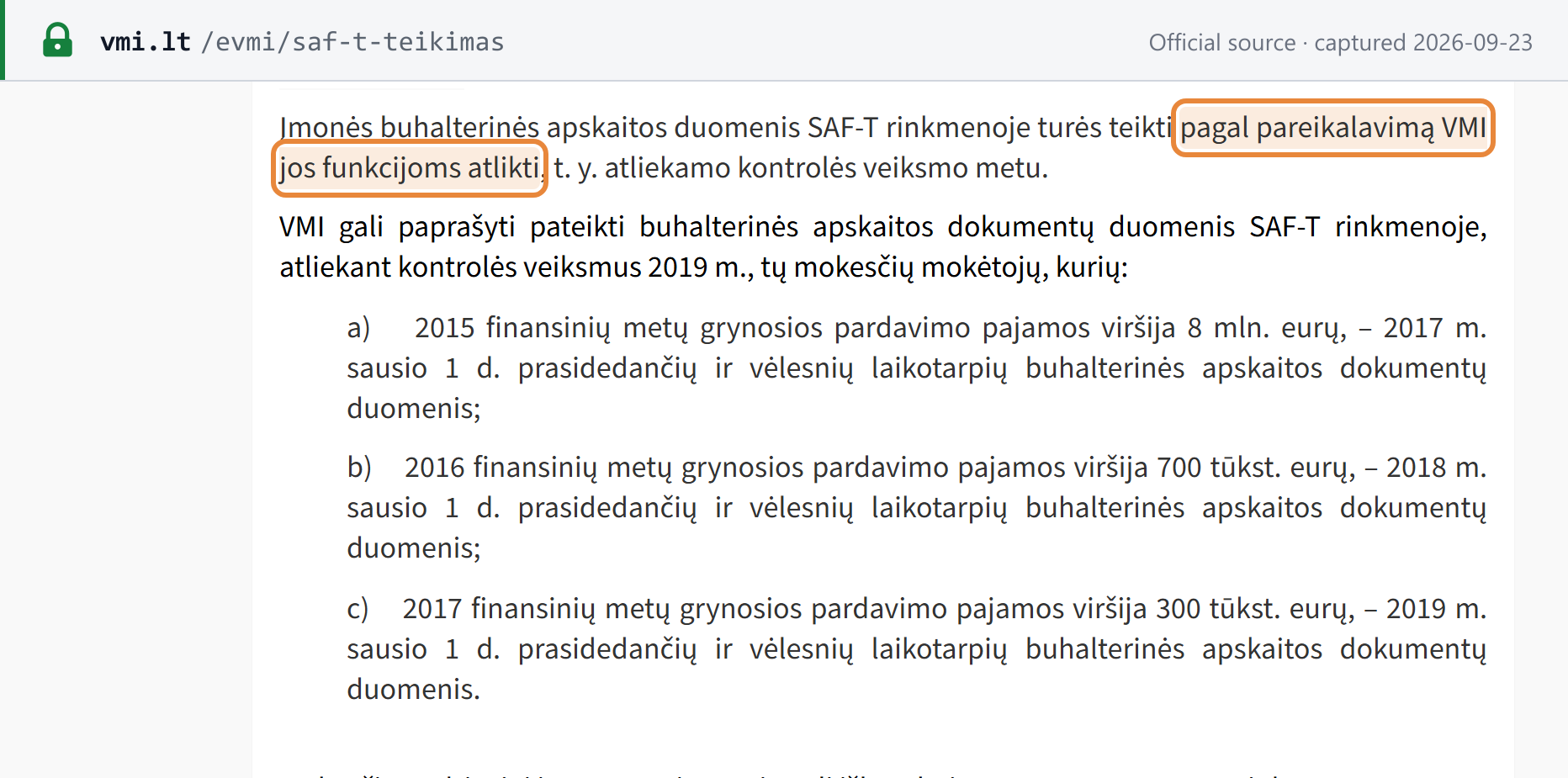
| When | On VMI's demand during a control action — «pagal pareikalavimą VMI jos funkcijoms atlikti, t. y. atliekamo kontrolės veiksmo metu» ("on demand to VMI for the performance of its functions, i.e. during a control action") |
| Lead time | At least 10 days from service of the notice to the day the data are due, unless the taxpayer asks for or agrees to less (Law on Tax Administration Arts. 121–126) |
| Phase-in (VMI's table, for control actions from 2019) | Net sales income over EUR 8 million in financial year 2015 → data for periods from 2017-01-01; over EUR 700,000 in 2016 → from 2018-01-01; over EUR 300,000 in 2017 → from 2019-01-01. Where the financial year is not the calendar year, the duty runs from the start of the relevant financial year. |
| Format | The SAF-T file to VMI's technical specification. Files can be tested in the i.SAF-T evaluation environment without a control action. |
| Rules | Government resolution No. 699 of 1 July 2015; VMI order No. VA-49 of 21 July 2015 (technical specification) |
"Net sales income" is the sales income in box 1 of the profit (loss) statement — income from goods and services, less returns, write-downs and discounts. [28]
Input-tax recovery and blocked items
Input and import VAT is deductible on goods and services used for (1) taxable supplies; (2) supplies outside Lithuania that would be taxable if made in Lithuania; and (3) insurance and Art. 28(1)–(5) financial services supplied outside the EU (Art. 58(1)). Mixed use is apportioned directly where the records allow, otherwise pro rata (Arts. 59–60). [1]
Blocked (Art. 62(2)): [1]
- Entertainment (representation). Wholly non-deductible where the cost is not treated as representation expenditure for profit or income tax; 50% non-deductible where it is.
- Passenger cars for no more than 8 people besides the driver, and off-road vehicles of that class, unless supplied, leased out or used for paid passenger transport — the same applies to hiring them. Exception: M1-class electric vehicles worth no more than EUR 50,000 including VAT, and special-purpose vehicles (current wording applies from 2023-01-01).
- Passenger transport services in such vehicles, unless the VAT payer acts as an undisclosed intermediary.
- VAT paid on another person's behalf in the Art. 15(7)(2) cases.
Input VAT attributable to any other activity, including exempt supplies, is not deductible (Art. 62(1)).
Refunds
- Residents. An excess of input VAT is a VAT difference (PVM skirtumas), refunded or credited under the Law on Tax Administration (Arts. 89(4), 91(1)).
- The 6-month brake. For VAT payers that do not meet the minimum criteria of a reliable taxpayer (Law on Tax Administration Art. 40¹), an un-credited VAT difference may be refunded «ne anksčiau negu praėjus 6 mėnesiams nuo permokos susidarymo» ("no earlier than 6 months after the overpayment arose", Art. 91(2)). This does not apply to refunds claimed on the annual return, or on liquidation or deregistration (Art. 91(3)). Refunds are suspended while a criminal investigation into the payer's VAT affairs is under way (Art. 91(4)).
- Bad-debt relief. Available: Art. 89¹ lets the VAT payable for a period be reduced by the output VAT on debts recognised as bad under that Article.
- EU businesses claim through their own Member State's electronic VAT refund system (Art. 119(2)).
- Non-EU businesses claim on a reciprocity basis (Art. 116(2)). Reciprocity is not required for OSS/IOSS users reclaiming VAT on inputs for those schemes, or for businesses established in an OECD member state that has no VAT or equivalent tax. The claimant must have had no fixed establishment in Lithuania through which it traded during the claim period (Art. 117(1)(1)).
- Claim periods and minimum amounts for non-resident refunds are set by the Government or an authorised institution (Art. 119(1)).
Exemptions
Exempt supplies
Chapter IV of the Law (Arts. 20–33) exempts: [1]
- health care (Art. 20);
- social services supplied by social-service providers under the Law on Social Services, and goods and services those providers supply to their service users in connection with them (Art. 21, recast by Act No. XV-324 from 1 January 2026);
- education and training (Art. 22);
- culture and sport (Art. 23);
- activities of bodies not covered by Arts. 20–23 (Art. 24);
- postal services (Art. 25);
- radio and television (Art. 26);
- independent groups of persons (Art. 26¹);
- insurance (Art. 27);
- financial services (Art. 28);
- special stamps (Art. 29);
- gambling and lotteries (Art. 30);
- letting of immovable property (Art. 31);
- sale or other transfer of immovable property (Art. 32);
- the special cases in Art. 33.
Imports of goods whose domestic supply is exempt are also exempt (Art. 34), with further import exemptions in Arts. 35–40. [1] [29]
Financial services — narrowed from 1 January 2026. Act No. XV-366 repealed Art. 28(8) and added Art. 28(9): «Vien administracinio, fizinio, techninio ar panašaus pobūdžio paslaugų teikimas, nesukeliantis … sandorio šalių teisinės ir finansinės padėties pokyčio, nelaikomas … finansinių paslaugų … teikimu» ("The mere supply of administrative, physical, technical or similar services that does not bring about a change in the legal and financial position of the parties to a transaction … is not regarded as the supply of … financial services"). VMI has published an updated Art. 28 commentary agreed with the Lithuanian Banking Association and the Bank of Lithuania, relevant from 1 January 2026. [16] [22]
Exempt is not zero-rated
The difference is the input VAT. Input VAT is deductible only for the activities listed in Art. 58(1). Input VAT attributed, directly or pro rata, to any other activity — which includes domestic exempt supplies — «negali būti atskaitomas» ("cannot be deducted", Art. 62(1)). Zero-rated supplies fall within Art. 58(1) and keep full deduction. [1]
Charging VAT on an exempt supply does not make it taxable. Art. 58(4): an exempt supply «netampa PVM apmokestinama veikla net ir tuo atveju, kai PVM mokėtojas už jį apskaičiuoja PVM» ("does not become an activity subject to VAT even where the VAT payer calculates VAT on it"), unless the Law gives an option to tax and the VAT payer has declared it. [1]
Special regimes
Chapter XII of the Law sets out the special schemes: [1]
- Flat-rate compensatory scheme for farmers (Arts. 97–100) — for farmers whose previous-year consideration did not exceed EUR 45,000 and is not expected to. VAT is compensated at the 6% compensatory rate; purchasers report their purchases (FR0617K).
- Margin scheme for travel services (Arts. 101–105) — travel services bought from other taxable persons and supplied in the VAT payer's own name. Invoice wording: «Maržos apmokestinimo schema. Kelionių agentūros».
- Margin scheme for second-hand goods, works of art, collectors' items and antiques (Arts. 106–110), with the matching invoice wording.
- Investment gold (Arts. 111–115).
- OSS and IOSS — the non-Union scheme, the Union scheme and the import scheme (Arts. 115¹–115¹⁵).
- Special import VAT procedure for consignments up to EUR 150 (Arts. 115¹⁶–115¹⁹) — see Imports and exports.
- Small-business scheme — the EUR 45,000 exemption and the EU cross-border scheme — see Registration threshold. It is an exemption, not a flat-rate scheme: the invoice shows no rate and no VAT amount, and the business is outside i.SAF.
Cash accounting. No general scheme. The only cash-basis tax point is Art. 14(9), for a VAT payer supplying agricultural produce that is invoiced by the purchaser: VAT becomes chargeable when the consideration is paid. The choice is declared to VMI, applies from the next tax period, and cannot be withdrawn for 24 months. Such invoices carry «Pinigų apskaitos sistema» (checked 2026-09-23). [1]
Free economic zones. No separate VAT regime. Art. 53(1)(2) zero-rates supplies of goods placed under the free-zone, customs-warehousing or inward-processing procedure; Art. 53(1)(3) zero-rates supplies of goods in temporary storage or under the free-zone or inward-processing procedure, provided that still applies at the time of supply. That is a customs-procedure relief available anywhere in Lithuania, not a free-zone privilege (checked 2026-09-23). [1]
Offences and penalties
Offences
Administrative offences. VMI draws up administrative-offence records against natural persons under the Code of Administrative Offences (Administracinių nusižengimų kodeksas, ANK, No. XII-1869; VMI's powers in Art. 589(66)). The articles a VAT-registered business meets: [30] [31]
- ANK Art. 187 — breach of the procedure for submitting returns, reports or other data VMI needs; late submission or non-submission; entering incorrect data. This is the article for a missed i.SAF or i.VAZ submission as well as a missed VAT return.
- ANK Art. 187¹ — failing, while solvent, to pay taxes calculated on a filed return, after a reminder.
- ANK Art. 188 — breach of the transfer-pricing documentation rules.
- ANK Art. 205 — breach of the financial-accounting rules, including negligent and fraudulent accounting below the criminal thresholds.
Criminal offences. Where a tax audit finds signs of a crime, VMI must inform the law-enforcement authorities (Law on Tax Administration Art. 127). VMI lists the Criminal Code (Baudžiamasis kodeksas, BK) articles most often found: Art. 182 (fraud), 202 (unlawful economic activity), 203 (unlawful activity of an undertaking), 209 (criminal bankruptcy), 219 (non-payment of taxes), 220 (incorrect data on income, profit or assets), 221 (failure to file a return or report), 222 (fraudulent accounting), 223 (negligent accounting) and 300 (forgery). Legal persons are liable under Arts. 219–223 as well as individuals. [30] [32]
The Criminal Code states thresholds in MGL, which equals the base amount of penalties (BBND) set by the Government at EUR 50 (in force since 2018-01-01): «Patvirtinti bazinį bausmių ir nuobaudų dydį – 50 eurų» ("To approve the basic amount of penalties and sanctions — EUR 50"). So 400 MGL is EUR 20,000 and 900 MGL is EUR 45,000. [33]
| Criminal Code article | Conduct | Punishment |
|---|---|---|
| Art. 219(1) | Failing, while solvent and after a reminder, to pay over 400 MGL of taxes calculated on a filed return | Fine, restriction of liberty, arrest, or imprisonment up to 4 years |
| Art. 219(2) | The same, over 900 MGL | Fine or imprisonment up to 7 years |
| Art. 220(1) | Entering knowingly incorrect data on income, profit or assets in a return or report, to evade over 400 MGL of taxes | Fine, restriction of liberty, arrest, or imprisonment up to 4 years |
| Art. 220(2) | The same, over 900 MGL or in an organised group | Fine or imprisonment up to 8 years |
| Art. 221 | Failing, after a written reminder, to file a return or report to evade over 400 MGL (over 900 MGL) | Up to 4 years (up to 7 years) |
| Art. 222 | Fraudulent accounting, failing to keep accounting documents for the statutory period, or concealing or destroying them, causing major damage or making the business's position impossible to establish (very major damage) | Up to 4 years (up to 7 years) |
| Art. 223 | Negligent accounting with the same consequences | Community service, fine, restriction of liberty, arrest, or imprisonment up to 2 years |
Art. 219(1) in the original: «…baudžiamas bauda arba laisvės apribojimu, arba areštu, arba laisvės atėmimu iki ketverių metų» ("…shall be punished by a fine or by restriction of liberty, or by arrest, or by imprisonment for a term of up to four years").
Penalties
Under-declared or unpaid VAT — 20% to 100%. Where a VAT payer unjustifiably reduced the VAT payable (or increased the VAT refundable), the extra VAT is assessed with a fine «nuo 20 iki 100 procentų apskaičiuotos papildomai mokėtinos PVM sumos dydžio» ("of from 20 to 100 per cent of the calculated additional amount of VAT payable", VAT Law Art. 123(2)). The same range applies to a person that should have paid VAT but was not registered (Art. 123(3)). The exact percentage is set under Art. 140 of the Law on Tax Administration (MAĮ); MAĮ Art. 139 sets the parallel general fine of 20% to 100% of the missing tax. Breaches committed before 2023-05-01 are penalised under the earlier text of Art. 123. [1] [30]
Late payment — default interest (delspinigiai), 0.027% per day as at 2026-09-23. VMI: «Nuo 2026 m. rugpjūčio 1 d. LR finansų ministro įsakymu delspinigių dydis yra 0,027 procento už kiekvieną pavėluotą dieną» ("From 1 August 2026, by order of the Minister of Finance, the rate of default interest is 0.027 per cent for each day of delay"), set by Minister of Finance order No. 1K-246 of 28 July 2026. [34]
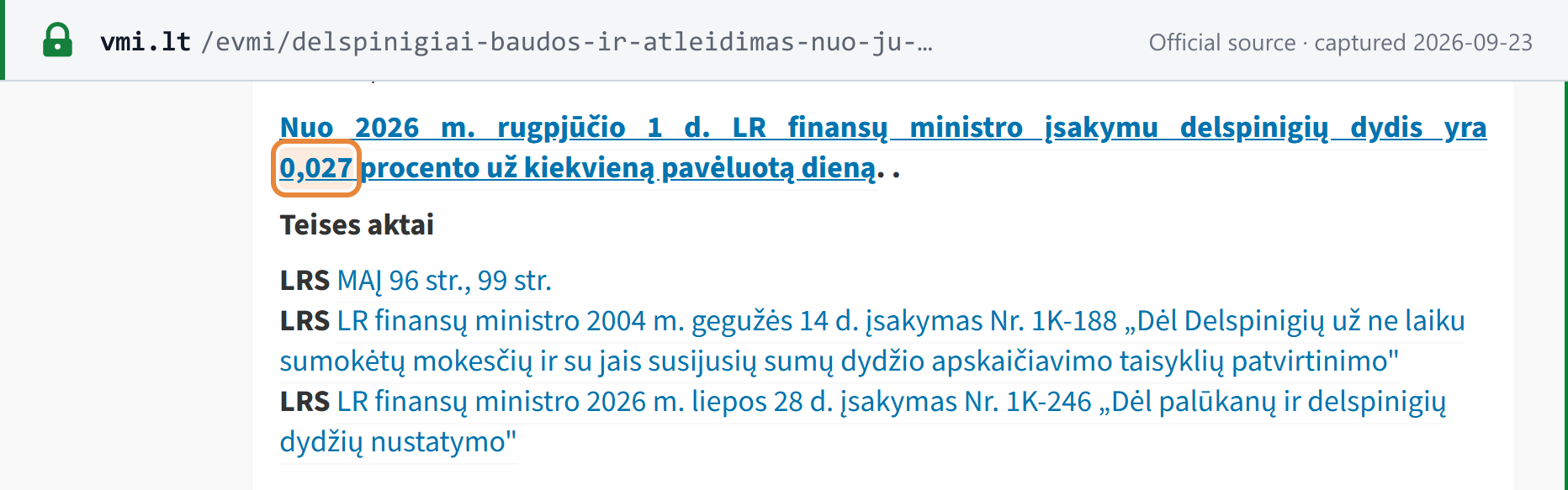
The rate moves. Under MAĮ Art. 99 the Minister of Finance sets it from the yield, on the last working day of the previous quarter, of the Government security with a redemption period closest to 12 months, plus 7 percentage points, divided by 365, rounded to three decimals (minimum 0.001, never below zero). If no new rate is set, the last one continues. Interest runs for no more than 180 calendar days from the day after the payment deadline (or, for an amended or late return, from the day after filing). Budgetary institutions and the Bank of Lithuania are not charged it. [34]
Fixed administrative fines (ANK, consolidated 2026-08-01 to 2026-09-30): [31]
| Default | Fine | ANK article |
|---|---|---|
| Late or missing return, report or data — including i.SAF and i.VAZ — or incorrect data | A warning or EUR 200 to EUR 390 (one range, not a first/repeat scale) | Art. 187(2) |
| Breach of the asset and income declaration procedure | A warning or EUR 80 to EUR 180 | Art. 187(1) |
| Failing, after a written reminder, to file returns to evade taxes up to 400 BBND | EUR 400 to EUR 6,000 | Art. 187(3) |
| Knowingly entering incorrect data to evade taxes up to 400 BBND | EUR 1,000 to EUR 6,000 | Art. 187(4) |
| Non-payment while solvent, after a reminder, of taxes up to 400 BBND calculated on a filed return | EUR 700 to EUR 6,000 | Art. 187¹ |
| Breach of the financial-accounting rules | A warning or EUR 40 to EUR 140; repeat EUR 180 to EUR 780 | Art. 205(1)–(2) |
| Negligent accounting causing damage over 30 and up to 150 BBND (over 150 and up to 400 BBND) | EUR 1,200 to EUR 1,820 (EUR 1,820 to EUR 4,300) | Art. 205(3)–(4) |
| Fraudulent accounting causing damage over 10 and up to 150 BBND (over 150 BBND) | EUR 4,000 to EUR 5,590 (EUR 5,200 to EUR 6,000) | Art. 205(5)–(6) |
| Transfer-pricing documentation breach | EUR 1,820 to EUR 5,590; repeat EUR 3,770 to EUR 6,000 | Art. 188 |
ANK Art. 187(2) in the original: the breach «užtraukia įspėjimą arba baudą … nuo dviejų šimtų iki trijų šimtų devyniasdešimt eurų» ("shall incur a warning or a fine … of from two hundred to three hundred and ninety euros").
Relief. VMI or, in a dispute, the body hearing it may release a taxpayer from fines and default interest under MAĮ Arts. 100 and 141 (and, for individuals, on hardship grounds under MAĮ Art. 113(1)(3)). The procedure is VMI order No. VA-144 of 26 July 2004. Applying suspends enforced recovery of those amounts until the decision. [30]
Frequently asked questions
We took a hotel booking in November 2025 for a stay in February 2026 — is it taxed at 9% or 12%?
At 9%. Act No. XV-287 keeps the pre-2026 rate for accommodation services whose advance order (reservation) was registered by 31 December 2025, and VMI's published answer KM3670 says the same. A reservation registered on or after 1 January 2026 is taxed at 12%. Other supplies use other tests: scheduled passenger transport follows the date the service was paid for, and some supplies follow the date the goods were actually supplied or the date the obligation to calculate VAT arose. [9] [7]
Our heating bill went up in January 2026 — did the VAT rate change?
Yes. From 1 January 2026 the 9% reduced rate was abolished for heat energy supplied to heat residential premises (including heat delivered through a hot-water system), for hot water supplied to residential premises and the cold water and heat used to prepare it, and for firewood and wood products for burning supplied to household energy consumers. These supplies did not move to 12% or 5%. They lost the relief entirely and are now taxed at the 21% standard rate (VMI letter No. RM-32963 of 26 June 2025). [10]
We sell laptops to Lithuanian VAT-registered businesses. Do we still apply the reverse charge?
Until 31 December 2026, yes. VMI states that the domestic reverse charge on mobile phones, tablets and laptops applies until that date where the buyer is registered as a VAT payer in Lithuania and is not a budgetary institution. It does not apply where a cash-register receipt is issued together with the VAT invoice, or where the buyer is a foreign business not registered for VAT in Lithuania. Desktop computers are not covered. VMI's page stated the 31 December 2026 end date when checked on 23 September 2026. [15]
Is the i.SAF submission due on the same day as the VAT return?
No. They are two different obligations. Legal persons must submit their i.SAF VAT invoice register data by the 20th day of the following month. The VAT return, form FR0600, is due by the 25th day of the month after a monthly tax period (VAT Law Art. 85), and the VAT is payable by the same deadline (Art. 90). Natural persons submit i.SAF data on their return cycle: by the 20th of the following month if they file monthly, or by the 20th of the first month of the next half-year if they file half-yearly. [25] [1]
We are not established in Lithuania. What is our VAT registration threshold?
If you are established outside the EU, there is none. The EUR 45,000 small-business threshold is available only to Lithuanian taxable persons and, on conditions, to persons established in another EU Member State. VMI's commentary states that a foreign taxable person must calculate and pay VAT irrespective of the amount of consideration received. An EU-established business can stay unregistered only if its Lithuanian supplies stay within EUR 45,000, its EU-wide supplies stay within EUR 100,000, and it holds an identification number with the suffix EX from its own Member State. A foreign business whose only Lithuanian supplies are ones on which the customer must account for the VAT under Article 95(2)–(4) does not need to register. [3] [1]
Which exchange rate do we use for a VAT invoice issued in US dollars?
The VAT amount must be shown in euro. Article 15(21) of the VAT Law converts the taxable amount at the rate determined under the Law on Financial Accounting, at the moment VAT becomes chargeable. Article 5 of that Law lets each business choose its source: the European Central Bank's indicative rate (or the Bank of Lithuania's rate for currencies the ECB does not publish), or a market rate published by another generally recognised source. The business also chooses which day's rate it applies. Imports are different: their taxable amount is converted under the Union Customs Code (Art. 15(20)). [1] [17]
We are a foreign company registered for VAT in Lithuania. Can VMI demand a SAF-T file from us?
No, according to VMI. Its SAF-T guidance states that a foreign company registered as a VAT payer in Lithuania, branches and representative offices of foreign companies, permanent establishments, public-sector entities and other non-profit legal persons are not required to provide accounting data in a SAF-T file. For everyone else, SAF-T is not a periodic filing: VMI asks for it during a control action, with at least 10 days between the notice and the day the data are due. As a VAT payer in Lithuania you still owe i.SAF invoice register data. [28] [25]
We import low-value parcels into Lithuania. When is the import VAT due now?
Since 1 July 2026, import VAT under the special import VAT procedure for consignments with an intrinsic value of up to EUR 150 is paid, and its payment secured, in the manner laid down in Article 94 of the VAT Law. Article 94 ties import VAT to the same time limits as import duties under the Union Customs Code. Act No. XV-984 made this change and repealed the procedure's separate deadline in Article 115¹⁷(3). Goods imported under this procedure are taxed at the 21% standard rate (Art. 115¹⁹). [11] [1]
Important websites
Checked 2026-09-23.
| Site | Purpose |
|---|---|
| Mano VMI | VAT registration and deregistration requests, changes to your details, enquiries, generating a payment order |
| EDS — electronic declaration system | Filing returns: FR0600, PVM101, FR0516, FR0608, FR0617K |
| i.MAS | VMI's smart tax administration system — the hub for the portals below |
| i.SAF | Monthly VAT invoice register data |
| i.VAZ | Consignment-note data |
| a.VAZ | Backup channel for consignment-note data when your own system fails |
| i.SAF-T | SAF-T files on demand, and the test environment |
| VMI taxpayer information — VAT payer files | The daily XML file of VAT registrations and deregistrations (there is no web look-up form), and links to the EU tools below |
| VIES VAT number validation | Checking an EU VAT number |
| EU SME scheme — EX number verification | Checking an "EX" number under the cross-border small-business scheme |
| Register of Legal Entities (Registrų centras) | Company code and legal status |
| VMI accounts and payment codes | Where to pay; payment code 1001 for taxes administered by VMI |
| How to pay (VMI) | Payment instructions |
| E. sąskaita / SABIS | Submitting invoices to public-sector buyers (redirects to sabis.nbfc.lt) |
| VMI rate pages — 21%, 12%, 5% | VMI's guidance on each rate |
| e-seimas — Law on VAT | The consolidated Law and its amendments |
VMI telephone consultations: +370 5 260 5060 (Monday–Thursday 08:00–17:00, Friday 08:00–15:45).
Also see Lookuptax's Lithuanian PVM number validator, the Lithuania tax ID guide and how to verify an EU VAT number in VIES.
Recent changes
- 2026-08-01 — Late-payment interest (delspinigiai) set at 0.027% per day under Minister of Finance order No. 1K-246 of 28 July 2026. (VMI)
- 2026-07-01 — Import VAT under the special import VAT procedure for consignments up to EUR 150 is now paid and secured on the customs-duty calendar under Art. 94 of the VAT Law; the procedure's separate deadline in Art. 115¹⁷(3) — a distinct superscript-numbered article in the 115¹–115¹⁹ series — was repealed (Act No. XV-984 of 4 June 2026). (e-seimas) — see event record
- 2026-06-18 — Act No. XV-1036 transposes Council Directive (EU) 2025/516: a wider marketplace deemed-supplier rule and a reworded EUR 10,000 threshold from 2027-01-01; call-off stock treatment only for goods dispatched by 2028-06-30 and the regime repealed from 2029-07-01. (e-seimas)
- 2026-01-01 — The reduced 9% rate was abolished. A new reduced 12% rate applies to accommodation, scheduled passenger transport and admission to art and culture events; books and non-periodical information publications moved to 5%; heat energy for homes, hot water and household firewood moved to the 21% standard rate. (VMI)
- 2026-01-01 — Art. 15(21): the exchange rate on the day an Art. 83 price change is documented now applies only where the adjusted document cannot be identified; the 10-year invoice retention wording in Art. 78(7)–(8) was restated; the financial-services exemption now excludes purely administrative, physical or technical services (Act No. XV-366). (e-seimas)
- 2025-05-01 — Act No. XV-155 recast the small-business scheme: EUR 45,000 in Lithuania, and for other Member States' taxable persons EUR 45,000 plus EUR 100,000 EU-wide with an "EX" identification number. The same Act made Art. 15(21) convert foreign-currency amounts at the rate determined under the Law on Financial Accounting at the tax point. (e-seimas)
Ahead — 31 December 2026, the last day of the domestic reverse charge on mobile phones, tablets and laptops as VMI states it; 1 January 2027 and 1 July 2029, the two commencement dates of Act No. XV-1036; and, only as a registered bill (No. XVP-1853, not yet debated), a proposed 9% rate on residential heating from 1 January 2027 — see The 1 January 2026 reform. See Domestic reverse charge and Changes announced for 2027 and 2029. For the full chronology, see Lithuania tax changes on Lookuptax.
Reference links
- e-seimas — Law on Value Added Tax No. IX-751, consolidated edition 2026-07-01 to 2026-12-31 (PDF)
- e-seimas — Law on Value Added Tax No. IX-751 (landing page)
- e-seimas — Act No. XV-287 of 17 June 2025 (reduced rates from 2026) (PDF)
- e-seimas — Act No. XV-155 of 10 April 2025 (small-business scheme) (PDF)
- e-seimas — Act No. XV-324 of 25 June 2025 (social services exemption) (PDF)
- e-seimas — Act No. XV-366 of 26 June 2025 (PDF)
- e-seimas — Act No. XV-984 of 4 June 2026 (import VAT, Art. 115¹⁷) (PDF)
- e-seimas — Act No. XV-1036 of 18 June 2026 (Directive (EU) 2025/516) (PDF)
- e-seimas — Bill No. XVP-1853 of 17 September 2026 (proposed 9% residential-heating rate, not law) (PDF)
- e-seimas — Law on Financial Accounting No. IX-574 (PDF)
- e-seimas — Law on Public Procurement No. I-1491 (PDF)
- e-seimas — Government resolution No. 947 of 6 December 2023 (PDF)
- e-seimas — Code of Administrative Offences No. XII-1869 (PDF)
- e-seimas — Criminal Code No. VIII-1968 (PDF)
- e-seimas — Government resolution No. 1031 (BBND = EUR 50) (PDF)
- VMI — Official commentary on the Law on VAT, edition current 2026-04-23 (PDF)
- VMI — Commentary on Art. 96 (PDF)
- VMI — Letter No. RM-32963 of 26 June 2025 on the 2026 rate changes (PDF)
- VMI — Standard 21% VAT rate
- VMI — Reduced 12% VAT rate
- VMI — Reduced 5% VAT rate
- VMI — VAT changes from 2026
- VMI — VAT payer registration, deregistration and changes
- VMI — VAT returns (Chapter IX)
- VMI — General information on i.MAS
- VMI — i.SAF data submission
- VMI — i.VAZ
- VMI — i.VAZ backup tools
- VMI — SAF-T submission
- VMI — FAQ on the reverse charge for mobile phones, tablets and laptops
- VMI — Taxpayer liability
- VMI — Default interest, fines and relief
- VMI — Accounts and payment codes
- VMI — Taxpayer information
- Lookuptax — Lithuania tax ID guide
- Lookuptax — How to verify an EU VAT number in VIES
- Lookuptax — Lithuanian PVM number validator
- Lookuptax — Lithuania tax changes
- Lookuptax — E-invoicing status and the networks worldwide
- Lookuptax — VAT registration thresholds worldwide
- Lookuptax — Worldwide tax rates