Turkey VAT guidelines
| FACTSHEET | |
|---|---|
| Country code | TR |
| Tax name | Katma Değer Vergisi (KDV) — Value Added Tax (VAT) |
| Tax Authority | Gelir İdaresi Başkanlığı (GİB — Revenue Administration) |
Overview
Türkiye levies Katma Değer Vergisi (KDV) — Value Added Tax — under Law No. 3065 (Katma Değer Vergisi Kanunu), which catches supplies of goods and services made in the course of commercial, industrial, agricultural or professional activity, and all imports of goods and services. [1] KDV is administered by the Gelir İdaresi Başkanlığı (GİB — Revenue Administration) within the Hazine ve Maliye Bakanlığı (Ministry of Treasury and Finance) — GİB is the authority that issues the KDV and Vergi Usul Kanunu (VUK) general communiqués published in the Resmî Gazete (Official Gazette). [8]
Currency. All values in this guide are in Turkish lira (TRY, symbol ₺).
Tax period basis. Law No. 3065 sets the statutory taxable period as calendar quarters, but empowers the Ministry to substitute monthly periods by reference to taxpayers' annual gross turnover — and monthly is the norm for ordinary (real-procedure) taxpayers in practice. Withholding agents — those responsible for withholding KDV under the tevkifatı mechanism (see Withholding VAT) — are always on a one-month period, regardless of turnover. [1]
Layering. KDV is levied nationally only — Law No. 3065 assigns it wholly to the central administration, and there is no state, provincial or municipal VAT. Separate municipal taxes exist under the Belediye Gelirleri Kanunu (Law No. 2464) — an entertainment tax (eğlence vergisi), a communications tax (haberleşme vergisi), an electricity and gas consumption tax (elektrik ve havagazı tüketim vergisi), and a fire-insurance tax (yangın sigortası vergisi) — but these are distinct levies with their own return types in GİB's own filing-deadline table, entirely outside KDV. [14]
Registration
Who should register
Law No. 3065 states the KDV taxpayer as a liability rule, not a registration number to apply for. Article 8/1 makes the following persons the taxpayer: those who make a supply of goods or perform a service; importers of goods and services; those liable at customs on transit transactions; sellers at auction houses; PTT (the postal administration) and broadcasters; organisers of games of chance; lessors of the rights described in article 70 of the Gelir Vergisi Kanunu (Income Tax Law); and anyone who opts in voluntarily (isteğe bağlı mükellefiyet) under article 8/1(ı). [1]
Registration threshold
Law No. 3065 sets no turnover threshold for KDV liability — article 1 makes every in-scope supply taxable, and article 8 makes the supplier the taxpayer, with no de-minimis figure in either provision. What exists instead is a subject-matter exemption, not a registration threshold: supplies made by traders who are themselves exempt from income tax (vergiden muaf esnaf) and by taxpayers whose profits are assessed on the basit usul (simplified) basis are exempt from KDV under article 17/4-a, irrespective of turnover, because of who is supplying rather than how much was sold. (Checked against Katma Değer Vergisi Kanunu No. 3065, 2026-09-07.) [1]
Non-resident threshold. Also none — the electronic-services regime described under Cross-border rules applies to a qualifying non-resident supplier from the very first taxable transaction, with no turnover trigger of any kind.
Tax registration number
Every Turkish natural and legal person is issued a vergi numarası (VKN) under article 8 of the Vergi Usul Kanunu (VUK, Law No. 213), and Turkish citizens additionally carry a Türkiye Cumhuriyeti kimlik numarası (TCKN) under the Nüfus Hizmetleri Kanunu (Law No. 5490), which must appear on essentially every official form, declaration and identity document issued to them. [2] [12] A separate provision (Law No. 4358, article 2) requires public bodies and private parties alike to capture the VKN of anyone they transact with in Ministry-designated dealings, and a party without one must obtain one before the transaction completes — concealing a VKN, or falsely declaring one, is itself a criminal offence (see Offences and penalties). [11] This guide could not independently source an official, current description of the VKN's digit length or check-digit algorithm — the statutory provisions establish the number but do not describe its structure — so it does not restate one here. For the fuller identifier walkthrough, see Lookuptax's Turkey TIN number guide. [15]
How to register
- Individuals — notify the tax office of commencement of business (işe başlama bildirimi) within 10 days of starting, under VUK article 153/168.
- Companies — the trade registry (ticaret sicili) transmits the incorporation file to the relevant tax office, and this discharges the company's own notification duty — also within 10 days, but counted from the işe başlama (start-of-business) date, not from the registry filing. [2]
- Other notifications, cessation and changes — must be notified within one month of the event, under the same VUK article 168.
- Non-resident electronic-services suppliers — no işe başlama bildirimi is required at all. Instead, the supplier completes a form at digitalservice.gib.gov.tr; on electronic submission and approval, GİB opens the "Elektronik Hizmet Sunucularına Özel KDV Mükellefiyeti" at the Büyük Mükellefler Vergi Dairesi Başkanlığı (Large Taxpayers' Tax Office) in the supplier's name. See Cross-border rules for the full mechanics. [5]
 Source snapshot captured 2026-09-20 — original
Voluntary registration
Available. Article 8/1(ı) of Law No. 3065 names "those who apply under voluntary liability" (isteğe bağlı mükellefiyette talepte bulunanlar) among the KDV taxpayers — the Law names the category but publishes no separate application procedure for it. [1]
Deregistration
Ceasing business (işi bırakma) must be notified to the tax office within one month of the event, under the same general VUK article 168/1 notification duty that governs changes and other post-registration events. Türkiye publishes no dedicated VAT-specific deregistration procedure, final-return mechanism or associated threshold beyond that general duty. (Checked against VUK No. 213, 2026-09-07.) [2]
Group registration
Not available. This guide found no VAT-grouping provision in Law No. 3065 — registration and returns operate on a strictly per-taxable-person basis under article 8, with no mechanism located that would let two or more related entities register as a single KDV unit. (Checked 2026-09-07.) [1]
Rates
| Rate | Applies to | Effective |
|---|---|---|
| 20% (standard) | Everything not listed in the annexes below | Since 10 July 2023 [3] |
| 10% (reduced, "List II") | A defined annex list — confirmed examples include toothbrushes, toothpaste and dental floss | Since 10 July 2023 [3] |
| 1% (super-reduced, "List I") | A separate defined annex list; unchanged by the 2023 decision | Since 31 December 2007 — Karar 2007/13033 art. 4 brought its general provisions into force the day after publication (30 December 2007, RG 26742). The 1 January 2008 date applies only to five named List II entries. [4] |
The rate structure is set by Karar No. 2007/13033 ("Mal ve Hizmetlere Uygulanacak Katma Değer Vergisi Oranlarının Tespitine İlişkin Karar", 24 December 2007), made under KDV articles 28 and 36: a general rate for everything not in an annex, 1% for goods and services in annex List (I), and a middle rate for annex List (II) — finance-lease supplies take the rate of the underlying asset. [4]
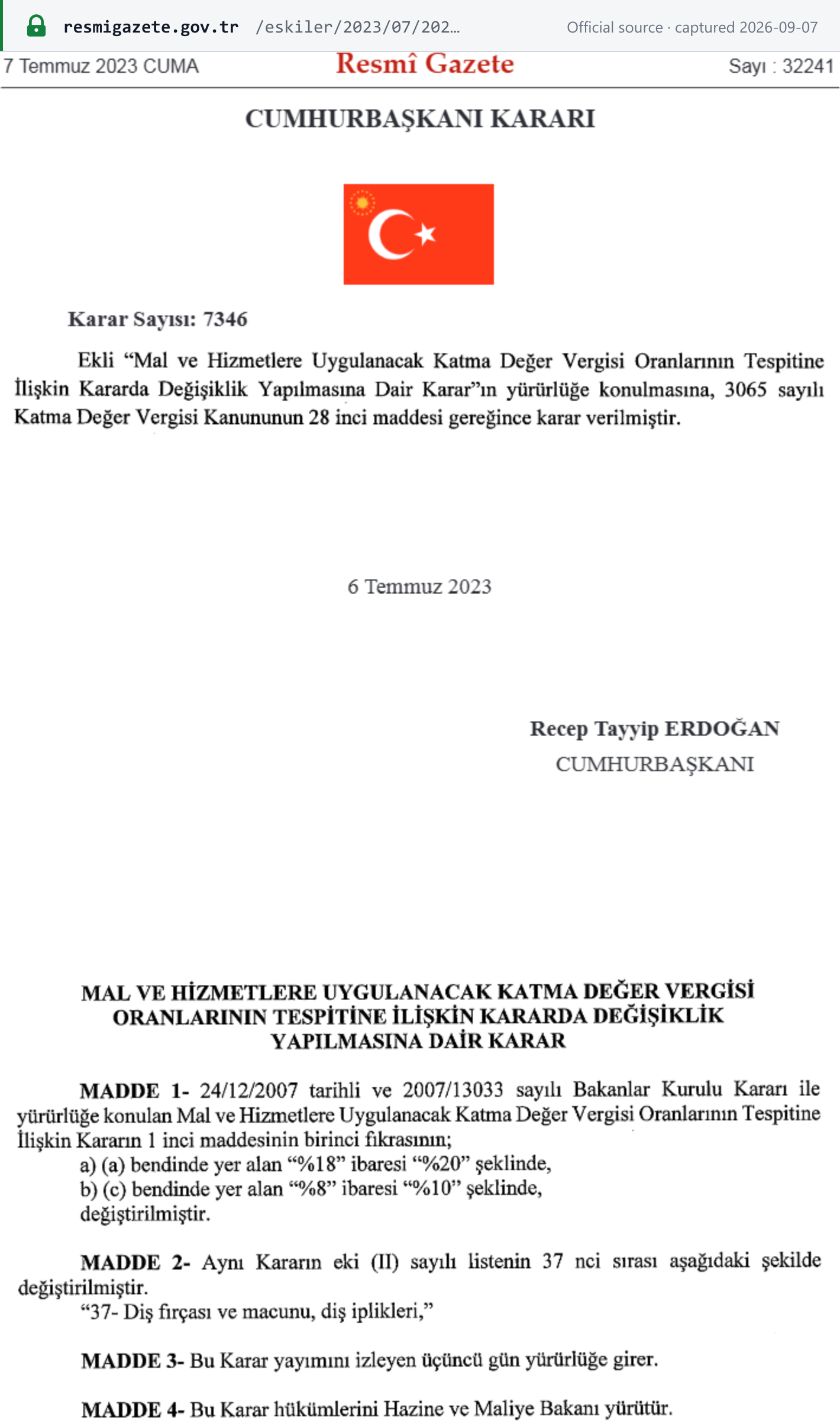
Presidential Decision No. 7346 — signed 6 July 2023, published in Resmî Gazete 7 July 2023, No. 32241, entering into force on the third day following publication (10 July 2023) — replaced the "%18" standard rate with "%20" and the "%8" reduced rate with "%10" in article 1(1) of Decision 2007/13033. The 1% super-reduced rate on List I goods was not changed by this decision. [3]
 Source snapshot captured 2026-09-07 — original
Independent corroboration of both current figures in a single official document: GİB's own worked examples in KDVGUT Seri No 50 compute a supply at "(500.000 x 0,10 =) 50.000 TL KDV" and another at "(1.000.000 x 0,20 =) 200.000 TL KDV" in an April 2024 fact pattern. [8]
What sits on List I and List II. Both annexes have been amended repeatedly since 2007, and GİB publishes no consolidated item-by-item schedule of them; the binding lists are the annexes to Karar 2007/13033 as amended. Two confirmed amendments: Karar 7346 (above) rewrote List II item 37 to read "Diş fırçası ve macunu, diş iplikleri" (toothbrushes, toothpaste and dental floss now sit at 10%); and Karar 5359 of 28 March 2022 deleted the List I entry for residential supplies of up to 150 m² net area, with effect from 1 April 2022, subject to a saving for projects whose building permit was obtained, or whose public tender was held, before that date. [7] Treat the rate levels above as reliable and the annex lists as a lookup task for GİB's own rate-list page, not as a schedule this guide reproduces.
Announced future rates. None found — no decision amending the 20%/10%/1% structure beyond Karar 7346 was located.
Cross-border rules
Imports and exports
- Imports are within scope of KDV by definition — article 1 taxes "her türlü mal ve hizmet ithalatı" (all imports of goods and services). [1]
- Exports — export supplies, related services, services rendered to customers abroad, toll manufacturing for free-zone customers, and reciprocal international roaming are a full exemption (tam istisna) under article 11/1-a, conditional on the article 12 requirements: the supply must go to a customer abroad, a free-zone buyer, or a duty-free shop/authorised customs warehouse, and the goods must actually leave Turkish customs territory. Because article 11 is one of the exemptions listed in article 32, the related input KDV remains deductible and, where it cannot be fully absorbed, is refundable — claimable until the end of the second calendar year following the transaction. [1] This "exempt but recoverable" position is the exact opposite of most of the exemptions in article 17 — see Exemptions for why "exempt" is not one single thing in Turkish KDV.
- Manufacturer's export refund cap. A manufacturer exporting goods it made itself may, instead of computing actual input KDV, claim a refund of up to 10% of the export value, capped at the carried-forward KDV balance, reported on line code 338 of the KDV return. This option is optional and cannot be combined with an input-KDV claim for the same export. [7]
- De minimis. Not confirmed — Law No. 3065 taxes all imports with no stated de-minimis threshold in the Act itself; any low-value customs relief sits in separate customs legislation outside the scope of this guide.
- Reverse charge on imported (B2B) services. See the next subsection.
Digital products and services
Since 1 January 2018, article 9 of Law No. 3065 (as amended by Law No. 7061) charges KDV on electronic services supplied for consideration to persons in Turkey who are not KDV taxpayers, by a supplier with no residence, place of business, legal seat or business centre in Turkey. The supplier itself declares and pays the tax by opening the "Elektronik Hizmet Sunucularına Özel KDV Mükellefiyeti" at the Büyük Mükellefler Vergi Dairesi Başkanlığı, after completing the form at digitalservice.gib.gov.tr. No işe başlama bildirimi is required, no statutory books need be kept, and the return does not need to be countersigned by a licensed professional. The return is the 3 No.lu KDV Beyannamesi, filed monthly in Turkish lira through the internet tax office; a period with nothing to declare needs no return at all. Foreign-currency consideration is converted using the TCMB (Central Bank) buying rate published in the Resmî Gazete on the day the taxable event occurs, or the current market rate for currencies TCMB does not publish. [5]
Türkiye also levies a Digital Services Tax at 7.5% of gross revenue, under Law No. 7194, on digital advertising, digital sale of content and related services, and providing or operating interactive digital platforms (including intermediation) — irrespective of residence or permanent establishment. The exemption runs the other way from a threshold: a supplier is exempt only if it falls below a limb — Turkish revenue under 20 million TL or worldwide revenue under EUR 750 million in the preceding accounting period. Reaching exactly 20 million TL therefore makes you liable, not exempt (group revenue counts for consolidated groups). No deductions are allowed from the base, and DST is not shown separately on invoices. The return is due by the last day of the month following the taxable period. A non-resident B2C digital seller can be inside both the 3 No.lu KDV regime described above and DST, on different thresholds and different calendars — the two are entirely separate taxes assessed on the same business. [13] [14]
Foreign companies selling into Turkey — B2B and B2C
The two tracks answer differently:
- B2B (ordinary, non-digital services). Where the foreign supplier has no residence, place of business, legal seat or business centre in Turkey, article 9/1 of Law No. 3065 lets the Ministry hold the Turkish recipient liable for the KDV — a reverse charge exercised through the Katma Değer Vergisi Genel Uygulama Tebliği rather than a self-executing statutory charge. The Turkish business self-assesses on the 2 No.lu KDV Beyannamesi (due the 25th) and deducts the same amount as input tax on its own 1 No.lu return; the foreign supplier does not register. [1] [9]
- B2C (electronic services). The foreign supplier itself registers under the electronic-services regime above and files the 3 No.lu return (due the 28th). [5]
The dividing line in the statute is literally whether the Turkish recipient is a "katma değer vergisi mükellefi olmayan gerçek kişi" (a natural person who is not a KDV taxpayer). Outside the electronic-services list, this guide found no separate non-resident B2C KDV mechanism for ordinary (non-digital) services sold directly to a Turkish private consumer, and does not assume one exists.
Marketplace / platform deemed-supplier liability
A deemed-supplier rule exists for electronic services, but not a general marketplace one. Where the electronic service supplier is not clearly identified — and the contract and invoices do not clearly show both the service and its supplier — the KDV is declared and paid by the intermediary facilitating the supply, under the KDV General Application Communiqué section I/C-2.1.2.1.2.1 (inserted by Seri No 17). The Communiqué applies a control test close to the EU's Article 9a: anyone with the authority to charge the customer, to set the general terms of the supply, or with the obligation to perform it "elektronik hizmet sunucusu olarak kabul edilir" — is treated as the electronic service supplier. Note where the rule lives: it is in the Communiqué, not in Law No. 3065, which is why a reading of the Law alone suggests no such regime.
Outside electronic services there is no general deemed-supplier regime making an online marketplace liable for KDV on goods sales it merely facilitates, of the kind found in EU or UK law. Two narrower obligations reach online intermediaries instead: an e-invoicing obligation — online marketplaces, classified-ad sites and internet sellers above defined revenue thresholds must be on e-Fatura (see E-invoicing status) — and an information-reporting obligation under VUK Genel Tebliği Sıra No: 538, extended by Sıra No: 595 to hosting and social-network providers reporting listing data monthly (see Recent changes). Separately, Digital Services Tax Law 7194 art. 3 lets the Ministry hold those who intermediate the transaction or the payment liable for DST. [5] [10] [16]
Place of supply
Article 6 of Law No. 3065 sets the test for whether a transaction is "made in Türkiye":
- Goods — the goods must be in Turkey at the moment of delivery.
- Services — the service must be performed in Turkey, or benefited from in Turkey. The "benefited from in Turkey" limb is what pulls inbound cross-border services into charge even where nothing is physically performed in the country. [1]
Withholding VAT (KDV tevkifatı)
Turkey's partial withholding (kısmi tevkifat) mechanism is domestic, distinctive, and commonly confused with the cross-border reverse charge above — they are different mechanisms with different triggers.
How it works. Under kısmi tevkifat, the buyer withholds a stated fraction of the KDV shown on the supplier's invoice for a listed category of supply, declares and pays the withheld amount itself on the 2 No.lu KDV Beyannamesi, while the seller declares only the un-withheld remainder on its own 1 No.lu return. [9]
Who can be made to withhold. Two groups: (a) ordinary KDV taxpayers, excluding those who pay KDV only in a withholding capacity; and (b) "belirlenmiş alıcılar" (designated buyers), whether or not they are themselves KDV-registered — this list includes public bodies covered by Law No. 5018, döner sermayeli kuruluşlar, professional bodies with public-institution status, banks, insurers, state economic enterprises (kamu iktisadi teşebbüsleri), organised industrial zones, exchanges (including Borsa İstanbul), companies more than half-owned by the listed public bodies, and companies whose shares trade on Borsa İstanbul. Designated buyers do not withhold from each other (professional sports clubs are the one exception), and supplies made by exempt transactions or under the ihraç-kayıtlı export regime are never subject to tevkifat. [9] [6]
De minimis. No withholding applies where the KDV-inclusive value of the individual transaction does not exceed the VUK article 232 invoicing threshold for the year in question — 12,000 TL for 2026. Once that figure is exceeded, withholding applies to the whole amount, and an invoice may not be split into smaller amounts to avoid the obligation. [8] [2]
Voluntary full withholding (isteğe bağlı tam tevkifat). A buyer may sign a one-year written contract with a supplier and then withhold the whole of the KDV on the listed transaction types, whether or not it would otherwise be a withholding agent for that supplier. The contract must be renewed on the same term to continue and cannot be abandoned before the year is up; the buyer must file a copy of each contract with its own tax office before filing the return for the period it first applies. [7]
Current rates, as amended through KDVGUT Seri No 58 (16 June 2026). Every amending communiqué from Seri No 42 to Seri No 58 was read individually against the Resmî Gazete — including the four issued in mükerrer editions that a plain daily-index sweep misses (Seri No 44, 48, 53 and 56) — because GİB publishes no consolidated KDVGUT text that can be read directly. Exactly one of them moved a rate in this table: Seri No 43 (2022) raised demir-çelik from 4/10 to 5/10. The 5 million TL yapım işleri trigger is unchanged.
| Supply | Rate | Amending instrument |
|---|---|---|
| Yapım işleri (construction work) to designated buyers; ≥5 million TL to ordinary KDV taxpayers, plus related engineering/architecture/etüt-proje services | 4/10 | Seri No 35 (2021) [6] |
| Etüt, plan-proje, danışmanlık, denetim (consultancy, planning, audit-type services) | 9/10 | 2014 enacting text [9] |
| Makine, teçhizat, demirbaş, taşıt tadil/bakım/onarım (machinery/equipment/vehicle repair and maintenance) | 7/10 | Seri No 35 [6] |
| Yemek servis ve organizasyon (catering and event organisation) | 5/10 | 2014 enacting text [9] |
| İşgücü temin hizmetleri (labour supply) | 9/10 | 2014 enacting text [9] |
| Fason tekstil/konfeksiyon, çanta/ayakkabı dikim (textile and footwear subcontracting) | 7/10 | Seri No 35 [6] |
| Temizlik, çevre ve bahçe bakım (cleaning and grounds maintenance) | 9/10 | Seri No 35 [6] |
| Yük taşımacılığı (freight transport) | 2/10 | Seri No 35 [6] |
| Servis taşımacılığı (staff/passenger shuttle transport) | 5/10 | Seri No 35 [6] |
| Her türlü baskı ve basım (printing and publishing services) | 7/10 | Seri No 35 [6] |
| Ticari reklam hizmetleri (commercial advertising services) | 3/10 | Seri No 35 [6] |
| Demir-çelik ürünleri (iron and steel products) | 5/10 | Seri No 43 (2022), in force 1 November 2022 — raised from 4/10 set by Seri No 41 [17] |
 Source snapshot captured 2026-09-20 — original
Invoice requirements
Mandatory content
Under VUK article 230, every fatura must show at least: [2]
| Required field | Notes |
|---|---|
| Issue date, series and sequence number | — |
| Issuer's name, trade name (if any), business address, tax office and account number | — |
| Customer's name, trade name, address and (if any) tax office and account number | — |
| Nature, quantity, unit price and amount of the goods or work | — |
| Delivery date and irsaliye (delivery-note) number | For goods sold |
For an e-Fatura or e-Arşiv Fatura, VUK GT 509 adds: the VKN of both issuer and customer, the tax type, rate and amount alongside the goods/service description, and a karekod (QR) or barcode whose content GİB defines, mandatory for documents issued from 1 September 2023. GT 509 itself sets no date — it defers to a GİB announcement, which fixed 1/9/2023 on 17 February 2023; the Karekod Standardı Kılavuzu was then revised on 6 November 2023 for documents issued from 15 December 2023. [18] [10]
Issuance deadline
A fatura must be issued within a maximum of 7 days of the goods being delivered or the service being performed; the Ministry may shorten that window, or require issuance at the moment of supply, for specific cases. An invoice not issued within the applicable period is treated in law as never having been issued at all. [2]
Numbering and sequencing
Invoices run in unbroken sequence; where a business uses separate invoice books per branch, each starting at the same number, the branch name or a distinguishing series mark is compulsory. At least one original and one copy must be issued. [2]
Credit and debit notes
Not documented. This guide could not confirm a specific VUK or KDV Law provision governing credit and debit notes in the sources reviewed, and does not describe a procedure it has not sourced.
Currency and language
Where consideration is expressed in a foreign currency, it is converted into Turkish lira at the current rate on the date the taxable event occurs — the Ministry sets conversion rules for currencies with no quoted rate. [1] For the 3 No.lu electronic-services return specifically, the rule is more precise: the TCMB buying rate published in the Resmî Gazete on the day of the taxable event, or the current market rate where TCMB publishes none. [5] This guide did not locate a stated statutory invoice-language requirement and does not assume one.
Document types
First- and second-class merchants, basit usul taxpayers and book-keeping farmers must issue a fatura to, and demand one from, each other and from professionals and tax-exempt tradesmen. For anyone else — i.e., a private consumer — a fatura is only compulsory where the consideration exceeds 12,000 TL for 2026, or, below that, on the customer's request (VUK article 232). Below the threshold, the supply is instead evidenced by a perakende satış vesikası (retail sales slip, cash-register roll, or entry/travel ticket) under VUK article 233, which must show the business or taxpayer name, the date and the amount received, run in sequence, and be issued in two copies with one given to the customer. [2]
Self-billing
Not documented. No self-billing provision was identified in the Vergi Usul Kanunu.
Retention and audit trail
Books and the documents referred to in VUK's Part Three (which includes invoices) must be retained for 5 years, counted from the beginning of the calendar year following the year they relate to. A person not required to keep books must retain the invoices, expense notes and producer receipts they are obliged to take, in date order, on the same 5-year basis. [2]
For e-Belge (e-Fatura/e-Arşiv), integrity and non-repudiation are guaranteed by the Mali Mühür (fiscal seal) or a qualified electronic certificate — because those can only be validated electronically, an issuer cannot satisfy its retention duty by printing the document. Retention must cover the seal/signature and every record, database, storage medium and verification/display tool needed to render the document intelligibly and reproduce a readable paper print on demand. Storage must take place within the territory of the Republic of Türkiye; a secondary archive abroad is permitted, but the primary archive is not. Third-party archiving providers need a GİB permit, and outsourcing archiving does not displace the taxpayer's own retention responsibility. [10]
A specimen of a compliant invoice
GİB publishes XSD schemas and XSLT renderers for the e-Fatura and e-Arşiv packages rather than a labelled worked example, so there is no official annotated specimen fatura to reproduce. The layout below is LookupTax's own illustration, built from the VUK article 230 field list. All names, numbers and figures are fictional:
Fatura
| Mal/Hizmet (Description) | Miktar (Quantity) | Tutar (Amount, excl. KDV) |
|---|---|---|
| Danışmanlık hizmeti (Consultancy service) | 1 | 10.000,00 TL |
- KDV matrahı (Taxable amount)
- 10.000,00 TL
- KDV (%20)
- 2.000,00 TL
- Genel toplam (Total)
- 12.000,00 TL
- Delivery date and irsaliye (delivery-note) number are additionally required where the fatura relates to a supply of goods (VUK m.230/1(5)).
- An e-Fatura or e-Arşiv Fatura version of this same document would also carry both parties' VKN, the tax type/rate/amount, and a karekod (QR code) — see Invoice requirements above.
- This fatura must be issued within 7 days of delivery or performance (VUK m.231/5) — an invoice issued later is treated in law as never having been issued.
E-invoicing status
Status: mandatory and phased, run by GİB as the e-Belge programme under Vergi Usul Kanunu Genel Tebliği Sıra No: 509 (Resmî Gazete 19 October 2019, No. 30923), amended repeatedly since — most recently by Sıra No 573 (12 November 2024) and Sıra No 589 (31 December 2025, RG No. 33124, 5. Mükerrer). [10]
- System and network. GİB's own central hub plus licensed özel entegratör (private integrator) providers. The family covers e-Fatura, e-Arşiv Fatura, e-İrsaliye (delivery note), e-Serbest Meslek Makbuzu, e-Müstahsil Makbuzu, e-Gider Pusulası, e-Bilet, e-Dekont, e-Döviz, e-Adisyon and e-Sigorta documents. There is no published Peppol access-point requirement — GİB distributes its own UBL-TR schemas (current package UBL-TR 1.2.1) and XSLT renderers. [18]
- Scope, by relationship. B2B — e-Fatura, where both parties are registered e-Fatura users. B2C, and B2B where the counterparty is not a registered e-Fatura user — e-Arşiv Fatura. B2G — VUK GT 509 expressly defers to the Ministry of Treasury and Finance's Bütünleşik Kamu Mali Yönetim Sistemi for public bodies covered by Law No. 5018. [10]
- e-Fatura thresholds. Compulsory for a taxpayer with gross sales revenue at or above 3 million TL for 2022 or any later accounting period (5 million TL for 2018–2020, 4 million TL for 2021); for online intermediaries, classified-ad sites and any taxpayer selling goods or services over the internet, at or above 500,000 TL for 2022 or later (1 million TL for 2020–2021); and separately for EPDK-licensed fuel dealers, ÖTV List (III) makers/importers, fruit and vegetable commission agents, SGK-contracted healthcare providers, and certain real-estate/motor-vehicle traders and hotel operators. A taxpayer below the thresholds may opt in voluntarily. [10]
- When to go live. A taxpayer that meets the revenue test in an accounting period must be on e-Fatura from the start of the seventh month of the following year (i.e. broadly 1 July). EPDK licensees and ÖTV List (III) makers/importers must be in from the start of the fourth month after licensing, manufacture or import. A merger, full division, or change of legal form pulls the successor in no later than 3 months from the start of the month following trade-registry registration. [10]
- e-İrsaliye (e-delivery note) scope. Compulsory for EPDK fuel licensees, ÖTV List (III) makers/importers/distributors, mining-licence holders, sugar manufacturers, iron and steel makers/importers/exporters (GTİP 72/73, excluding basit usul taxpayers), Gübre Takip Sistemi (fertiliser tracking) users, and — the broadest category — e-Fatura users with gross revenue at or above 10 million TL for 2021 or later (25 million TL for 2018–2020). [10]
- e-Arşiv Fatura, from 1 January 2026. See Invoice requirements — Document types and Recent changes: the amount test that used to gate the e-Arşiv obligation for non-e-Fatura invoices was removed entirely from 1 January 2026 for most taxpayers (1 January 2027 for basit usul and işletme hesabı taxpayers).
- Format. Structured UBL-TR XML (package UBL-TR 1.2.1). The schema package is distributed and versioned through GİB's e-Belge announcements, not through GT 509, whose text does not mention UBL-TR. [18]
- Penalties. See Offences and penalties — paper instead of a required e-Belge draws the VUK article 353 special-irregularity penalty separately for each document.
Filing and payment
Filing frequency
Statutorily quarterly, but the Ministry is empowered to substitute monthly periods by reference to taxpayers' annual gross turnover — monthly is the norm in practice for ordinary (real-procedure) taxpayers, and withholding agents are always monthly regardless of turnover. [1]
Return due date
Statutory dates (KDV articles 41 and 46): returns due by the evening of the 24th of the month following the period (the 21st for withholding agents); payment due by the 26th (the 23rd for withholding agents). In force, as published by GİB and checked against its own deadline table on 2026-09-07 (the table carries no publication date on its face; instruments named are VUK Sirküleri 149 and 164): [14]
| Return | Due (in force) | Payment |
|---|---|---|
| 1 No.lu KDV Beyannamesi (ordinary, monthly) | 23:59 on the 28th of the following month | Within the filing period |
| 1 No.lu KDV Beyannamesi (ordinary, quarterly) | 28th of the month following the quarter | Within the filing period |
| 2 No.lu KDV Beyannamesi (sorumlu sıfatıyla — reverse charge / tevkifat) | 23:59 on the 25th | Evening of the 25th |
| 3 No.lu KDV Beyannamesi (electronic-services, non-resident) | 23:59 on the 28th | With the return |
| 4 No.lu KDV Beyannamesi (hasılat esaslı vergilendirme) | 28th | With the return |
| 5 No.lu KDV Beyannamesi (execution-office sales) | Close of business the day after collecting the price | With the return |
Nil returns are still required under article 40/3 for taxpayers with no taxable transactions in a period — except the 3 No.lu electronic-services return, where GİB's own guidance says no return is needed for a period with nothing to declare. [1] [5]
Payment due date and method
Payment for the 3 No.lu return may be made at tax offices and authorised collection banks, or through GİB's own website (www.gib.gov.tr) by debit or credit card at an authorised bank. [5] For all other returns, payment follows the schedule in the table above.
Additional listings
Özel Tüketim Vergisi (ÖTV, special consumption tax) runs on its own return and calendar under Law No. 4760, separate from KDV: fuel products (List I) have two monthly periods, declared by the 25th of the same month and the 10th of the following month respectively; other List II (non-registrable), List III and List IV goods are declared by the 15th of the following month; registrable List II vehicles are declared before first-acquisition formalities complete. [14] The two fuel ÖTV decisions in Recent changes both sit on this List I fuel row.
Input-tax recovery and blocked items
A taxpayer deducts the KDV shown on invoices for supplies made to it (article 29/1-a). Blocked under article 30: (a) input tax attributable to non-taxable or exempt supplies, other than the categories article 30 itself cross-refers back into recovery; (b) input tax on passenger cars (binek otomobil) owned by the business, unless the business is wholly or partly car hire or car operation; (c) input tax on goods lost or destroyed, other than in an earthquake, flood, or a fire the Ministry has declared force majeure — with a carve-out for depreciable assets that have already completed their useful life. [1]
Refunds
- Exports — full exemption under article 32; unabsorbed input tax is refundable, claimable until the end of the second calendar year following the transaction (see Cross-border rules).
- Manufacturer's export refund cap — up to 10% of export value, optional, in place of computing actual input tax (see Cross-border rules).
- Non-resident refund — narrow and reciprocity-based: only for KDV paid on goods and services bought for transport operations, or for participating in fairs, exhibitions and trade shows, under article 11/1-b — there is no general 13th-Directive-style refund scheme for other non-resident input KDV. [1]
Exemptions
Exempt supplies, and why "exempt" is not one single thing
Türkiye distinguishes tam istisna (full exemption — input tax deductible and refundable) from kısmi istisna (partial exemption — input tax blocked), and the dividing line is literal and citable. Article 32 lists the exemptions that carry input-tax recovery — articles 11, 13, 14, 15 and article 17/4-s. Article 30/a blocks input tax on everything else that is exempt. So the social, cultural, military and "other" exemptions in article 17 — which include supplies by income-tax-exempt tradesmen and basit usul taxpayers (17/4-a) and by non-real-procedure farmers and income-tax-exempt professionals (17/4-b) — are partial: no output tax is charged, but the related input tax is also not recoverable. [1]
GİB's own worked illustration: "wool and fleece supplied by a farmer not taxed on the real-procedure basis are exempt from KDV under article 17/4-b, so no KDV is calculated on the consideration for that transaction and, consequently, no withholding is applied to it either" — a single example that shows both halves of the rule (no output tax, and no tevkifat because there was never any KDV to withhold from). [9]
Special regimes
- Hasılat esaslı vergilendirme (revenue-based taxation) — GİB's deadline table confirms a dedicated 4 No.lu KDV Beyannamesi exists for this regime, Article 38 makes it an optional regime, available on application to işletme hesabı and serbest meslek taxpayers in sectors and professional groups designated by Presidential decision; this page does not state its rate. [14]
- Free-zone supplies are treated as exports under article 12/1-a (see Cross-border rules).
- İhraç kayıtlı teslim (export-registered delivery, article 11/1-c and geçici madde 17) is expressly outside the tevkifat mechanism (see Withholding VAT).
Offences and penalties
Turkish law keeps civil penalties (money) and criminal offences (imprisonment) genuinely distinct, and both carry real figures for 2026.
Penalties — special irregularity (VUK article 353)
Failure to issue or take a fatura, gider pusulası, müstahsil makbuzu or serbest meslek makbuzu — including issuing one on paper where an e-Belge was required — draws a special-irregularity penalty of 10% of the amount (or the shortfall), with a floor for 2026 of:
| Document category | Floor per document (first detection, 2026) | Annual cap per document type |
|---|---|---|
| Fatura, gider pusulası, müstahsil makbuzu, serbest meslek makbuzu | 17,000 TL | 17,000,000 TL |
| Perakende satış fişi, ÖKC fişi, tickets, sevk irsaliyesi, taşıma irsaliyesi and other Ministry-mandated documents | 14,000 TL; art. 353(2) caps the per-detection total by cross-reference to the Kanuna bağlı 2 sayılı cetvel rather than stating a figure | 14,000,000 TL |
Where the recipient reports the omission within 5 working days, no penalty is imposed on the recipient ("alıcı adına özel usulsüzlük cezası kesilmez") and the issuer's penalty is tripled. A non-VUK-compliant document issued instead doubles the penalty, and sixfold where the recipient reports that substitution. [2]
Penalties — vergi ziyaı (tax-loss) penalty (VUK article 344)
A penalty of one times the tax lost, three times where the loss was caused by the criminal acts in article 359 (one times for an accomplice), reduced to 50% for returns filed late but before an audit begins or a case is referred to the assessment commission, and increased by 50% where the taxpayer traded without registering when it should have. [2]
Late-payment interest (gecikme zammı and gecikme faizi, under Law No. 6183 and a related Presidential Decision setting the monthly rate) is not confirmed, and no figure is stated here.
Offences — kaçakçılık suçları (tax-fraud offences, VUK article 359)
These are criminal offences, not civil penalties, and imprisonment applies:
- Accounting fraud — hesap ve muhasebe hileleri, opening accounts in fictitious names, or keeping a second set of records to reduce the tax base; and falsifying, concealing, or issuing/using misleading documents — 18 months to 5 years imprisonment. Refusing to produce books and records to an authorised inspector counts as concealment.
- Destroying books, records or documents, substituting pages, or issuing or using wholly or partly fake documents — 3 years and up.
- A criminal conviction under article 359 does not displace the vergi ziyaı penalty above — both can apply to the same conduct. An accomplice who received no personal benefit gets a 50% reduction. [2]
VKN offences (Law No. 4358, article 5). Failing to record a counterparty's VKN in Ministry-designated dealings: the VUK article 353/7 special-irregularity penalty, plus 3 months to 1 year imprisonment. Concealing a VKN, or knowingly making a false VKN declaration: 3 to 10 months imprisonment. [11]
Frequently asked questions
Is there a minimum turnover before I have to register for KDV in Turkey?
No. Law No. 3065 sets no turnover threshold for KDV liability. Article 1 makes every in-scope supply of goods and services taxable, and article 8 makes the person who makes the supply, or imports the goods or services, the taxpayer — neither article carries a de-minimis figure. What looks like a threshold from a distance is actually a subject-matter exemption under article 17/4-a: supplies made by traders who are themselves exempt from income tax and by taxpayers whose profits are assessed on the basit usul basis are exempt from KDV regardless of turnover, because of who is supplying rather than how much they sold. A person outside those categories is in scope for KDV from the first taxable transaction. [1]
I run a foreign SaaS or streaming business with no office in Turkey — do I have to register and charge KDV to Turkish consumers?
Yes, if the recipient is not itself a KDV taxpayer. Since 1 January 2018, article 9 of Law No. 3065 (as amended by Law No. 7061) puts the KDV liability on a supplier with no residence, place of business, legal seat or business centre in Turkey that supplies electronic services for consideration to persons in Turkey who are not registered for KDV. The supplier opens an "Elektronik Hizmet Sunucularına Özel KDV Mükellefiyeti" at the Büyük Mükellefler Vergi Dairesi Başkanlığı, after first completing the registration form at digitalservice.gib.gov.tr, then files the 3 No.lu KDV Beyannamesi monthly, in Turkish lira, through the internet tax office. No işe başlama bildirimi is required, no statutory books need be kept, and a period with nothing to declare needs no return at all. If the supply is instead made through a Turkish permanent establishment, that establishment files the ordinary 1 No.lu return. [1] [5]
My Turkish company buys a service from a foreign supplier with no Turkish registration — who accounts for the KDV?
You do, if you are KDV-registered. Article 9/1 of Law No. 3065 lets the Ministry hold the Turkish counterparty to the transaction liable for the tax wherever the supplier has no residence, place of business, legal seat or business centre in Turkey — a reverse-charge mechanism exercised through the Katma Değer Vergisi Genel Uygulama Tebliği. The Turkish recipient self-assesses the KDV on the 2 No.lu KDV Beyannamesi (due the 25th) and deducts the same amount as input tax on its own 1 No.lu return for the same period. This B2B route is separate from the B2C electronic-services regime: the statutory dividing line is literally whether the Turkish recipient is a natural person who is not a KDV taxpayer — if the recipient is registered, reverse charge applies and the foreign supplier does not register; if the recipient is an unregistered consumer buying an electronic service, the foreign supplier registers instead. [1] [9]
What is KDV tevkifatı (withholding VAT), and does it apply to the invoice I just received?
KDV tevkifatı (partial VAT withholding) is a domestic mechanism, separate from the cross-border reverse charge above, under which a buyer withholds a stated fraction of the KDV shown on a supplier's invoice for a listed category of supply, declares and pays the withheld portion itself on the 2 No.lu KDV Beyannamesi, while the seller declares only the un-withheld remainder on its own 1 No.lu return. Two groups of buyers can be made liable: ordinary KDV taxpayers (other than those who only pay KDV in a withholding capacity), and a list of "belirlenmiş alıcılar" (designated buyers) who withhold whether or not they are themselves KDV-registered. No withholding applies where the KDV-inclusive value of the individual transaction does not exceed the annual invoicing threshold set under VUK article 232 — 12,000 TL for 2026 — and a price cannot be split into smaller amounts to avoid it. The rates themselves have been amended repeatedly since 2014; treat any rate you see quoted as a starting point to verify against the current Katma Değer Vergisi Genel Uygulama Tebliği, not as a number to rely on without checking. [9] [2]
Do I have to issue e-Fatura or e-Arşiv Fatura, or can I still use a paper invoice?
It depends on your gross sales revenue and, from 1 January 2026, on almost nothing else for most taxpayers. e-Fatura is compulsory at 3 million TL or more gross sales revenue for 2022 or later (5 million TL for 2018–2020, 4 million TL for 2021), and separately for online marketplaces and internet sellers at 500,000 TL or more for 2022 or later. Below those thresholds, a taxpayer may opt in voluntarily. For everyone else, the position changed sharply on 1 January 2026: previously, a non-e-Fatura taxpayer only had to issue an e-Arşiv Fatura once a single invoice's tax-inclusive total exceeded 3,000 TL; from 1 January 2026 that amount test is gone entirely, and every invoice not eligible for e-Fatura must be an e-Arşiv Fatura regardless of value. Basit usul and işletme hesabı taxpayers get an extra year, with the unconditional rule starting 1 January 2027 for them. Issuing paper instead of the required e-Belge draws the VUK article 353 special-irregularity penalty separately for each paper invoice, against both the issuer and any VAT-registered recipient. [10] [2]
Can I get a KDV refund as a foreign business with no establishment in Turkey?
Only in two narrow, reciprocity-based cases — there is no general refund scheme for other non-resident input KDV. Article 11/1-b of Law No. 3065 refunds the KDV paid by a person with no residence, place of business, legal seat or business centre in Turkey, but only on goods and services bought for transport operations, or bought in connection with participating in fairs, exhibitions and trade shows in Turkey, and only where the relationship with the claimant's home country is reciprocal. Outside those two categories, this guide found no non-resident input-KDV refund mechanism in Law No. 3065. A non-resident registered under the electronic-services regime is in a different position: it may deduct KDV on Turkish purchases against the KDV it declares on its own 3 No.lu return. [1]
Can two related Turkish companies register as a single KDV group?
No. This guide found no VAT-grouping provision anywhere in Law No. 3065 — registration and KDV returns operate strictly per taxable person under article 8, with no statutory mechanism to combine related entities into a single registered unit. Each company in a Turkish group files, and is separately liable for, its own KDV. (Checked 2026-09-07.) [1]
What actually happens if I fail to issue a fatura, or my Turkish counterparty says they never received one?
There is a real, escalating money penalty, plus separate criminal exposure for deliberate concealment. Under VUK article 353, failing to issue or take a fatura — including issuing one on paper where an e-Belge was required — draws a special-irregularity penalty of 10% of the amount involved, with a 2026 floor of 17,000 TL per document on the first detection in a calendar year, rising on later detections, and capped at 17,000,000 TL per document type per year. The penalty triples where the recipient reports the omission within 5 working days, and rises further where a non-compliant document was substituted for it. Separately, VUK article 344 imposes a "vergi ziyaı" (tax-loss) penalty equal to the tax lost — tripled where caused by the criminal acts in article 359 (falsifying, concealing or issuing misleading documents), which itself carries 18 months to 5 years' imprisonment, rising to 3 years and up for wholly or partly fake documents. A criminal conviction under article 359 does not displace the article 344 penalty — a taxpayer can face both. [2]
Important websites
| Site | Purpose |
|---|---|
| Dijital Vergi Dairesi (Digital Tax Office) | Registration, filing and payment |
| İnteraktif Vergi Dairesi (Interactive Tax Office) | Authenticated online tax-office services |
| digitalservice.gib.gov.tr | Non-resident electronic-services VAT registration and the 3 No.lu return |
| e-Belge hub | e-Fatura/e-Arşiv/e-İrsaliye documentation and packages |
| e-Belge announcements | Technical package updates and go-live dates |
| e-Belge application | e-Fatura/e-Arşiv application |
| e-Arşiv Fatura query | Verify an e-Arşiv invoice you received |
| e-Fatura registered-user list | Check whether a counterparty is on e-Fatura |
| Filing and payment deadlines (GİB table) | Official return due-date and payment table |
| Resmî Gazete daily index | Official Gazette (add ?tarih=YYYY-MM-DD) |
| Consolidated legislation (mevzuat.gov.tr) | Law No. 3065 (KDV) and No. 213 (VUK), current text |
This guide found no open, unauthenticated public VKN lookup or validation service published by GİB — verification runs through the authenticated İnteraktif Vergi Dairesi above rather than an open checker. Lookuptax's own format check is at lookuptax.com/validate/turkey/vkn.
Recent changes
-
2026-09-14 — GİB's republished e-Fatura package, e-Arşiv Fatura package and UBL-TR (Kod Listeleri) Kılavuzu — issued 27 July 2026 and patched twice since (e-Arşiv package fixed 11 August 2026; e-Fatura package fixed again 24 August 2026) — went live. (GİB e-Belge duyurular)
-
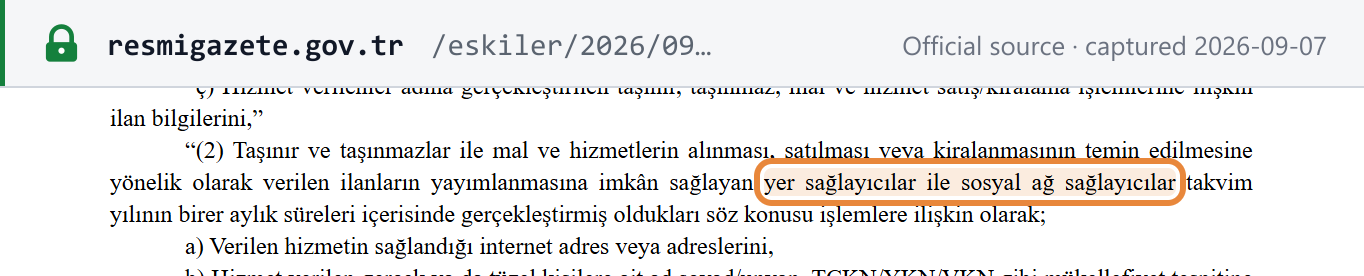
2026-09-05 — VUK Genel Tebliği Sıra No: 595 widened the continuous information-reporting duty under Sıra No 538 to also reach hosting providers (yer sağlayıcılar) and social-network providers, who must now report listing data — internet addresses, the name/title and TCKN/YKN/VKN of persons served, and transaction details — to GİB monthly. (Resmî Gazete No. 33361)
 Source snapshot captured 2026-09-07 — original
 -
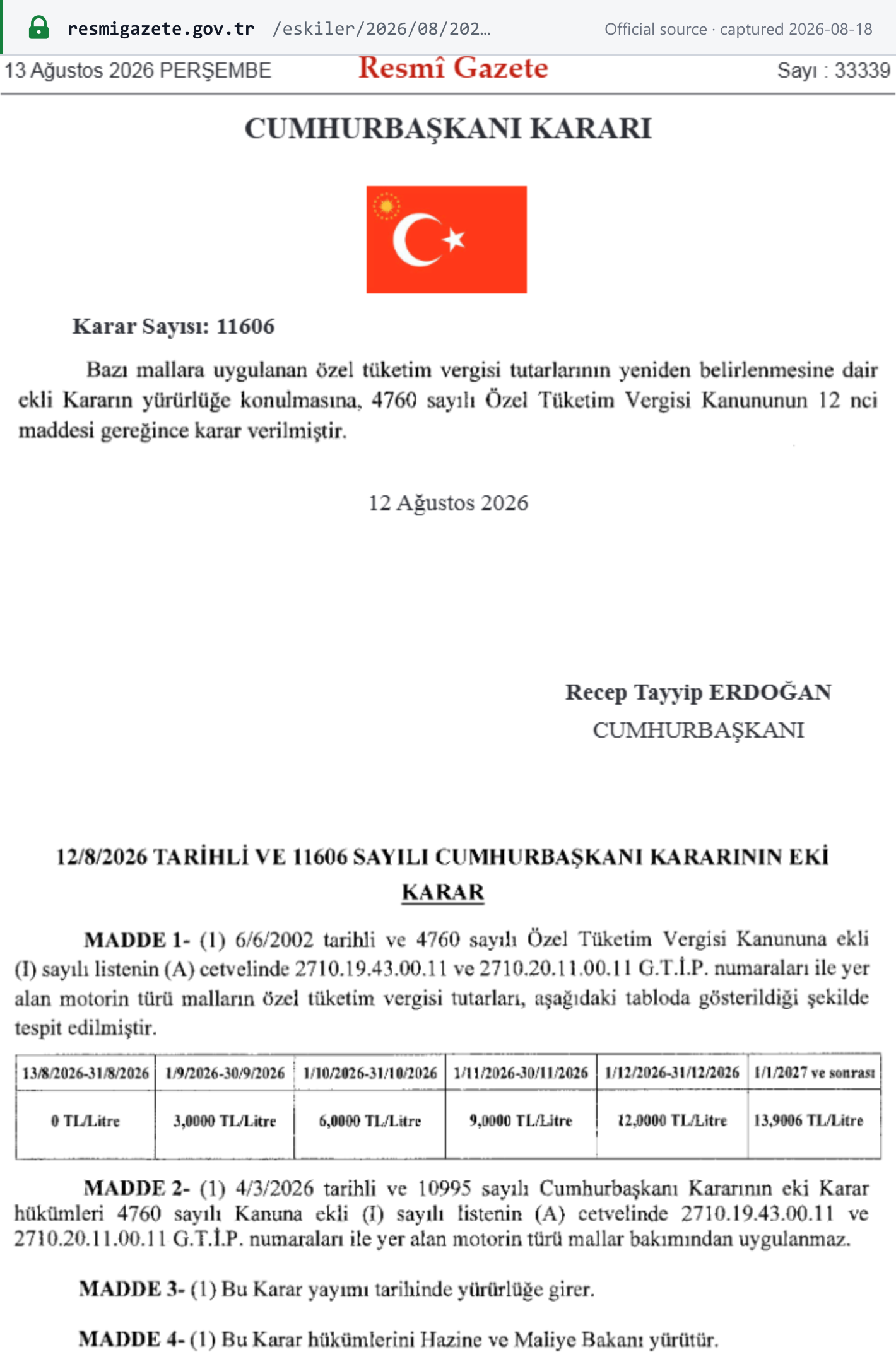
2026-08-13 — Presidential Decision No. 11606 redetermined diesel-fuel ÖTV amounts (Law No. 4760, List I, Table A): set to 0 TL/litre for 13–31 August 2026, then phased back in through monthly step-ups to 13.9006 TL/litre from 1 January 2027, superseding the diesel provisions of the earlier Decision No. 10995. (Resmî Gazete No. 33339) — see the event record and issue
 Source snapshot captured 2026-08-18 — original
 -
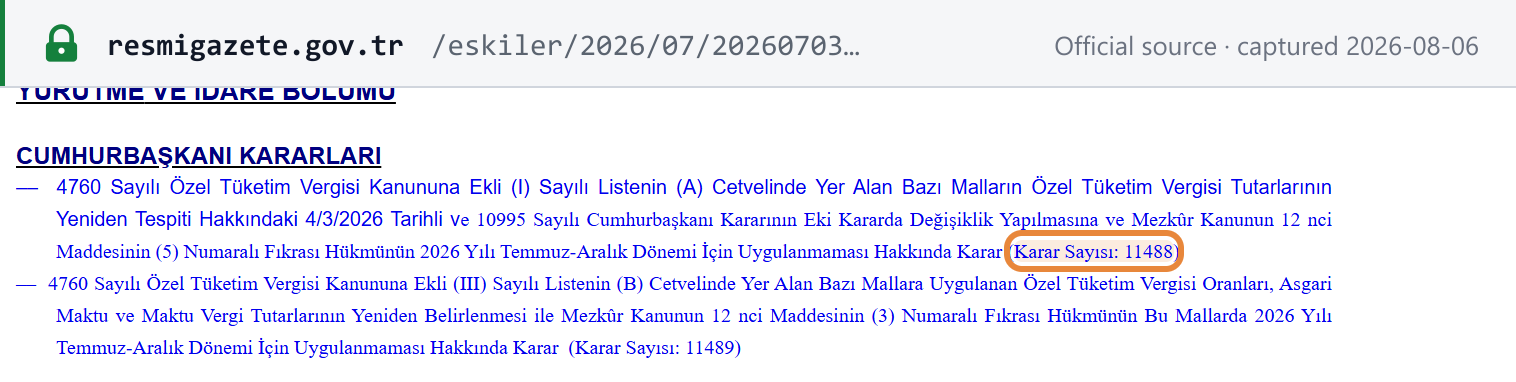
2026-07-03 — Presidential Decision No. 11488 amended fuel-product ÖTV amounts under Decision No. 10995 and disapplied the usual automatic six-monthly producer-price-index revaluation for the July–December 2026 period. (Resmî Gazete No. 33299, Mükerrer) — see the event record and issue
 Source snapshot captured 2026-08-06 — original
 -
2026-03-27 — GİB deferred the KDV-rate-versus-activity-code control on özel entegratör-issued documents, originally due 1 April 2026, indefinitely — "ikinci bir duyuruya kadar", until a second announcement. No replacement date has been set. The same announcement withdrew the 16 March 2026 e-Fatura Paketi / UBL-TR notice. (GİB e-Belge duyurular)
-
2026-01-01 — VUK Genel Tebliği Sıra No: 588 (Resmî Gazete No. 33124, 5. Mükerrer, 31 December 2025) revalues the fixed Vergi Usul Kanunu amounts for 2026, raising the mandatory-invoice threshold under article 232 to 12,000 TL. (Resmî Gazete) — see the event record and the issue
-
2026-01-01 — The e-Arşiv Fatura amount test was removed for most taxpayers: previously an invoice only had to be e-Arşiv once its tax-inclusive total exceeded 3,000 TL; from this date every non-e-Fatura invoice must be an e-Arşiv Fatura regardless of value. Basit usul and işletme hesabı taxpayers keep the 3,000 TL test for longer — see the 2027-01-01 entry above. (VUK Genel Tebliği Sıra No: 509, section IV.2.4.3, as amended by Sıra No: 589)
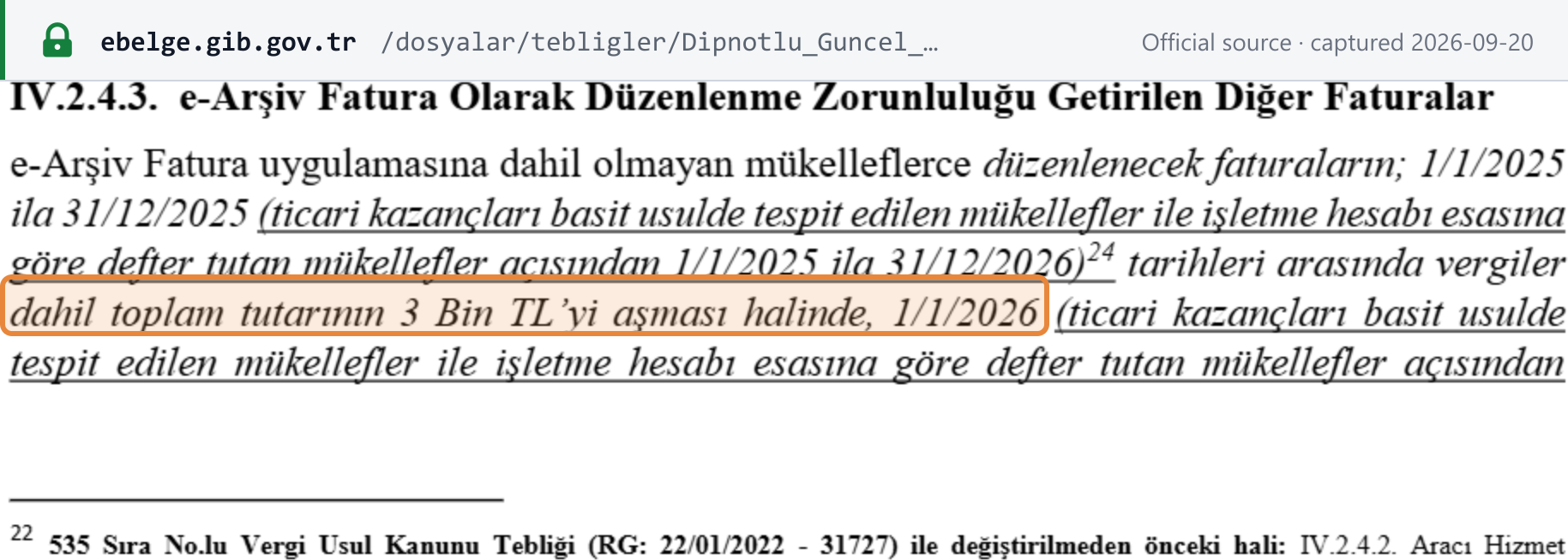 Source snapshot captured 2026-09-20, page 21 of the consolidated Tebliğ — original
- 2023-07-10 — Standard KDV rate raised from 18% to 20%, and the reduced rate from 8% to 10%, under Cumhurbaşkanı Kararı 7346; the 1% super-reduced rate was not changed. (Resmî Gazete No. 32241)
Ahead — scheduled changes that have not yet taken effect:
- 2027-01-01 (scheduled) — VUK Genel Tebliği Sıra No: 589 (Resmî Gazete No. 33124, 5. Mükerrer, 31 December 2025), amending Sıra No: 509, extends the e-Arşiv Fatura transition for taxpayers on the simplified (basit usul) method or keeping işletme hesabı books: their 3,000 TL amount-test window (see the 2026-01-01 entry below) now runs to 31 December 2026, with the unconditional e-Arşiv rule (see Invoice requirements — Document types) starting 1 January 2027 for them instead of 1 January 2026. (Resmî Gazete) — see the event record and the issue
Reference links
- mevzuat.gov.tr — Katma Değer Vergisi Kanunu No. 3065 (consolidated)
- mevzuat.gov.tr — Vergi Usul Kanunu No. 213 (consolidated)
- mevzuat.gov.tr — Kanun No. 4358 (vergi kimlik numarası)
- mevzuat.gov.tr — Nüfus Hizmetleri Kanunu No. 5490
- mevzuat.gov.tr — Kanun No. 7194 (Dijital Hizmet Vergisi)
- Resmî Gazete — Cumhurbaşkanı Kararı 7346 (7 Temmuz 2023, Sayı 32241)
- Resmî Gazete — Karar 2007/13033 (30 Aralık 2007, Sayı 26742)
- Resmî Gazete — KDVGUT Seri No: 43 (25 Ekim 2022, Sayı 31994) — demir-çelik tevkifat 4/10 → 5/10
- Resmî Gazete — KDVGUT Seri No: 17 (31 Ocak 2018, Sayı 30318)
- Resmî Gazete — KDVGUT Seri No: 35 (16 Şubat 2021, Sayı 31397)
- Resmî Gazete — KDVGUT Seri No: 41 (21 Nisan 2022, Sayı 31816)
- Resmî Gazete — KDVGUT Seri No: 50 (10 Şubat 2024, Sayı 32456)
- Resmî Gazete — Katma Değer Vergisi Genel Uygulama Tebliği (26 Nisan 2014, Sayı 28983)
- GİB — Dipnotlu Güncel Şekli ile 509 Sıra No'lu VUK Genel Tebliği (consolidated)
- GİB — e-Belge Duyurular
- GİB — Beyanname Verme ve Ödeme Süreleri
- Resmî Gazete — VUK Genel Tebliği Sıra No: 595 (5 Eylül 2026, Sayı 33361)
- Resmî Gazete — Cumhurbaşkanı Kararı 11488 (3 Temmuz 2026 Mükerrer, Sayı 33299)
- Resmî Gazete — Cumhurbaşkanı Kararı 11606 (13 Ağustos 2026, Sayı 33339)
- Resmî Gazete — Vergi Usul Kanunu Genel Tebliği Sıra No: 588 (31 Aralık 2025, 5. Mükerrer, Sayı 33124) — 2026 revaluation, VUK m.232 threshold
- Resmî Gazete — Vergi Usul Kanunu Genel Tebliği Sıra No: 589 (31 Aralık 2025, 5. Mükerrer, Sayı 33124) — e-Arşiv transition for basit usul/işletme hesabı taxpayers
- Lookuptax — Turkey TIN number guide
- Lookuptax — Worldwide VAT/GST rates
- Lookuptax — VAT registration thresholds worldwide
- Lookuptax — E-invoicing status and the networks worldwide
- Lookuptax — Official links to check VAT numbers worldwide
- Lookuptax — How to register for VAT, Sales Tax and GST
- Lookuptax — Tax glossary
- Lookuptax — Important tax links