Czech Republic VAT guidelines
| FACTSHEET | |
|---|---|
| Country code | CZ |
| Tax name | Value Added Tax — Daň z přidané hodnoty (DPH) |
| Tax Authority | Financial Administration of the Czech Republic — Finanční správa České republiky |
Overview
The Czech Republic levies Value Added Tax — in Czech daň z přidané hodnoty (DPH) — under Act No. 235/2004 Sb., on value added tax (zákon o dani z přidané hodnoty). This guide follows the consolidated text in force from 1 January 2026, the latest version published in the official Collection of Laws, e-Sbírka. Procedure, deadlines and most penalties sit in the Tax Procedure Code, Act No. 280/2009 Sb. (daňový řád). [1] [2]
Authority. DPH is administered by the Financial Administration of the Czech Republic (Finanční správa České republiky): the General Financial Directorate (Generální finanční ředitelství, GFŘ) and the regional tax offices (finanční úřady). Customs (Celní správa) administers VAT on imports, except where a VAT payer declares the import VAT itself (§ 93(1)(b)). [1]
Currency. Amounts in this guide are in Czech koruna (CZK, Kč). An invoice may be made out in another currency, but the VAT on it must be stated "v české měně" — in Czech currency (§ 29(1)(l)). [1]
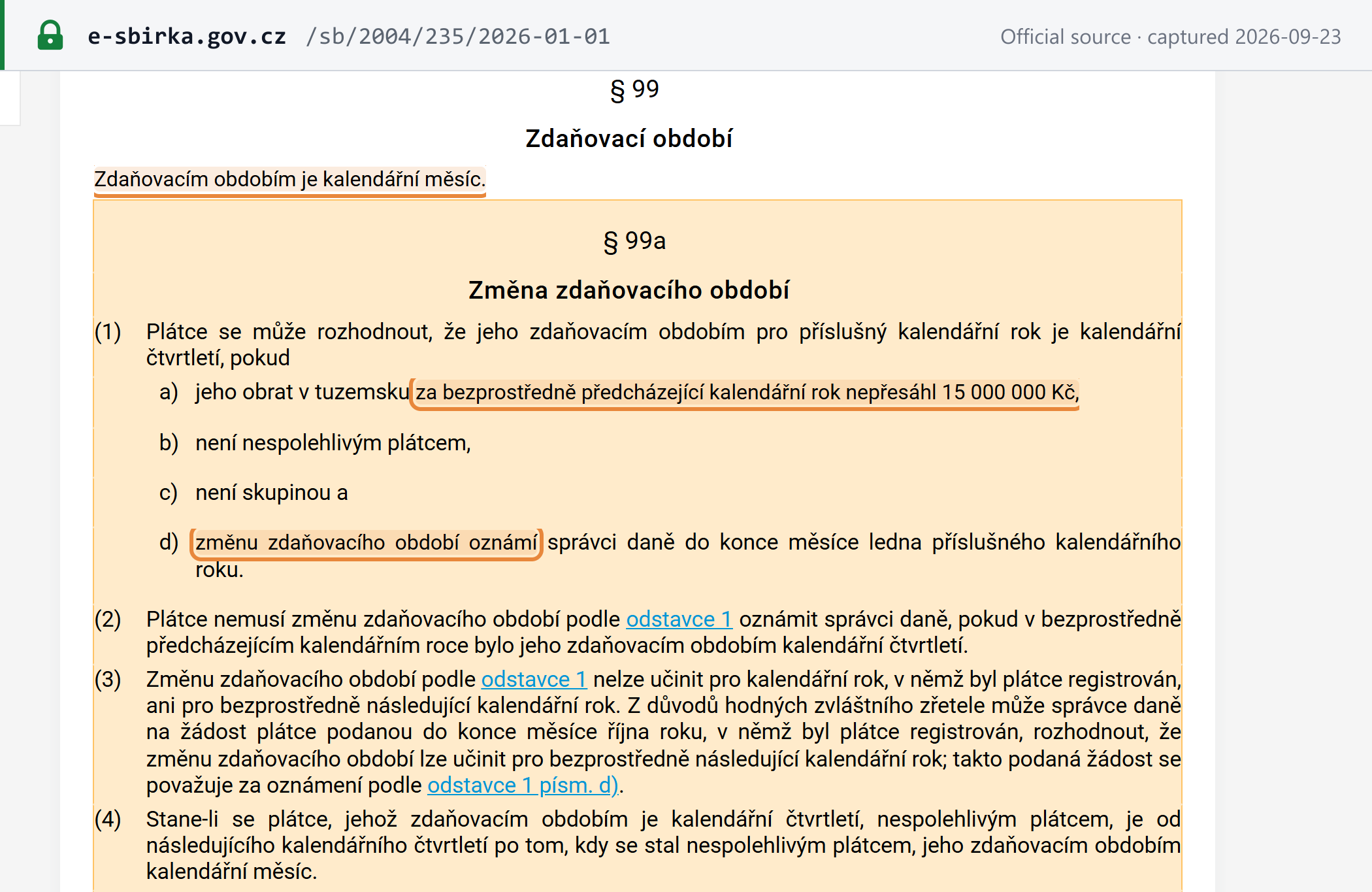
Tax period. "Zdaňovacím obdobím je kalendářní měsíc" — the tax period is the calendar month (§ 99). A payer can opt for the calendar quarter under the conditions in Filing and payment. [1]
Layering. DPH is a single national tax. The VAT Act creates no regional or municipal VAT layer. [1]
Registration
A registered business is a VAT payer (plátce). A business that registers only to account for VAT on cross-border services is an identified person (identifikovaná osoba), covered below.
Who should register
A taxable person with its seat in the Czech Republic becomes a VAT payer by law once its domestic turnover crosses the thresholds in § 6. Since 1 January 2025 the test is the calendar year: [1]
"(1) Osoba povinná k dani se sídlem v tuzemsku … je plátcem od prvního dne kalendářního roku bezprostředně následujícího po kalendářním roce, ve kterém její obrat v tuzemsku překročil částku 2 000 000 Kč."
(A taxable person with its seat in the Czech Republic … is a payer from the first day of the calendar year immediately following the calendar year in which its domestic turnover exceeded CZK 2,000,000.)
| Domestic turnover in the calendar year | Becomes a VAT payer | Cite |
|---|---|---|
| Above CZK 2,000,000 | From 1 January of the following year | § 6(1) |
| Above CZK 2,000,000, and the business elects an earlier start in a timely application | From the day after crossing CZK 2,000,000 | § 6(2)(a) |
| Above CZK 2,536,500 | From the day after crossing CZK 2,536,500 | § 6(2)(b) |
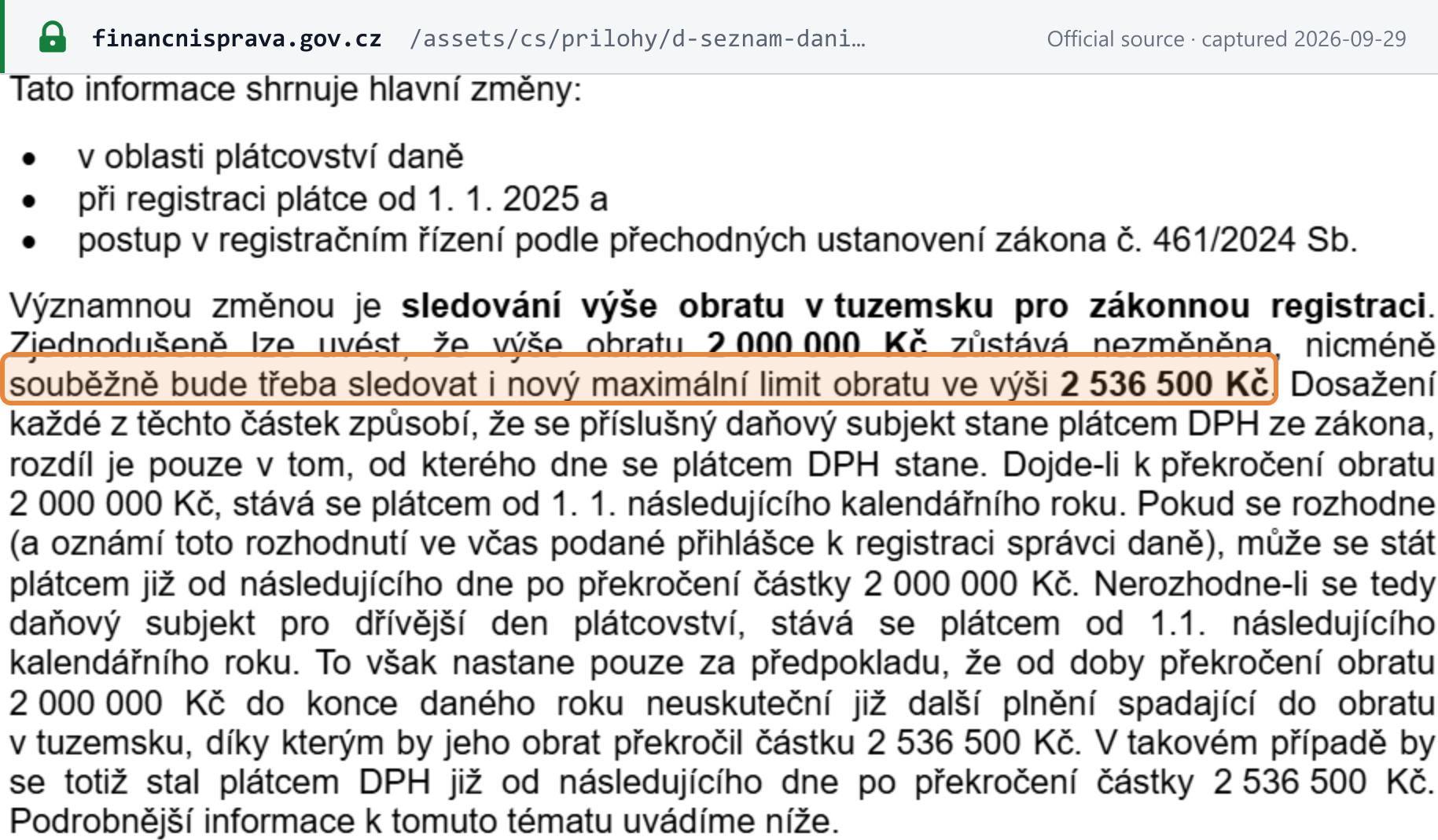
The GFŘ's information on the 2025 changes puts it this way: the CZK 2,000,000 figure is unchanged, but a new maximum limit of CZK 2,536,500 must be watched alongside it; reaching either makes the business a VAT payer by law, and the only difference is the day from which it does. [3]
What counts as turnover. Domestic turnover (obrat v tuzemsku) is the consideration, excluding VAT, for supplies with their place of supply in the Czech Republic that are taxable (or would be but for the small-business exemption), exempt with a right to deduct, or exempt financial, insurance and real-estate supplies unless those are ancillary and occasional (§ 4a(1)). Sales of long-term assets are left out, unless they are an integral part of the business's usual activity (§ 4a(3)). [1]
History. Until 31 December 2024 the test was turnover over at most 12 consecutive preceding months above CZK 2,000,000 (§ 6(1), 2024 version). The amount itself rose from CZK 1,000,000 to CZK 2,000,000 on 1 January 2023; Act No. 461/2024 Sb. then replaced the rolling test with the calendar year and added the CZK 2,536,500 trigger from 1 January 2025. [21] [6] [4]
Identified persons. A business that is not a payer becomes an identified person when, for example, it buys services from a foreign supplier on which it must account for the VAT, or supplies B2B services taxed in another member state. It must apply within 15 days of becoming one (§ 97), and it files a return only for months in which it has a liability. [1]
Non-resident registration
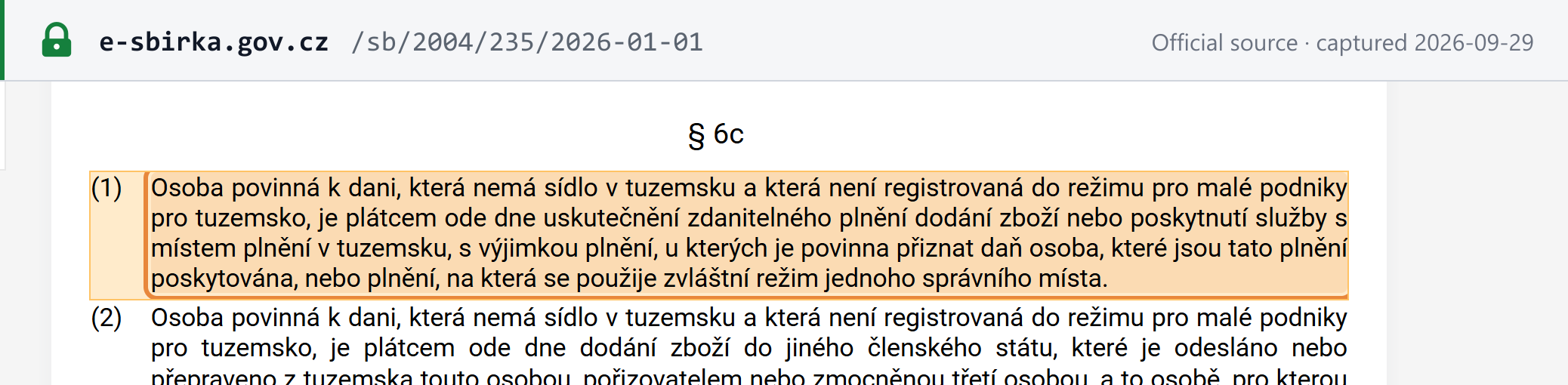
There is no threshold for a business without a Czech seat. Under § 6c(1), a taxable person that has no seat in the Czech Republic (and is not in the small-business scheme) becomes a payer from the day of its first taxable supply of goods or services with its place of supply in the Czech Republic, except supplies on which the customer must declare the tax and supplies declared through the One-Stop Shop. It also becomes a payer from its first intra-EU supply of goods dispatched from the Czech Republic, and from its first transfer of its own goods out of the country (§ 6c(2)–(3)). [1]
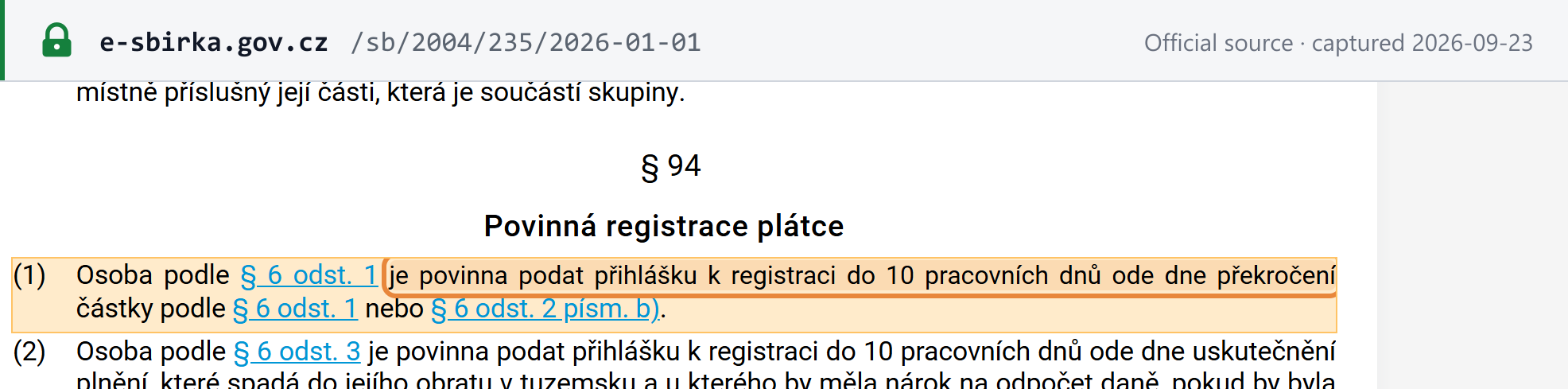
- Deadline. The application is due within 10 working days of the day the business became a payer (§ 94(4)). [1]
- Competent office. For any taxable person without a Czech seat, residence or establishment, it is the Tax Office for the Moravian-Silesian Region (Finanční úřad pro Moravskoslezský kraj) (§ 93a(2)). [1]
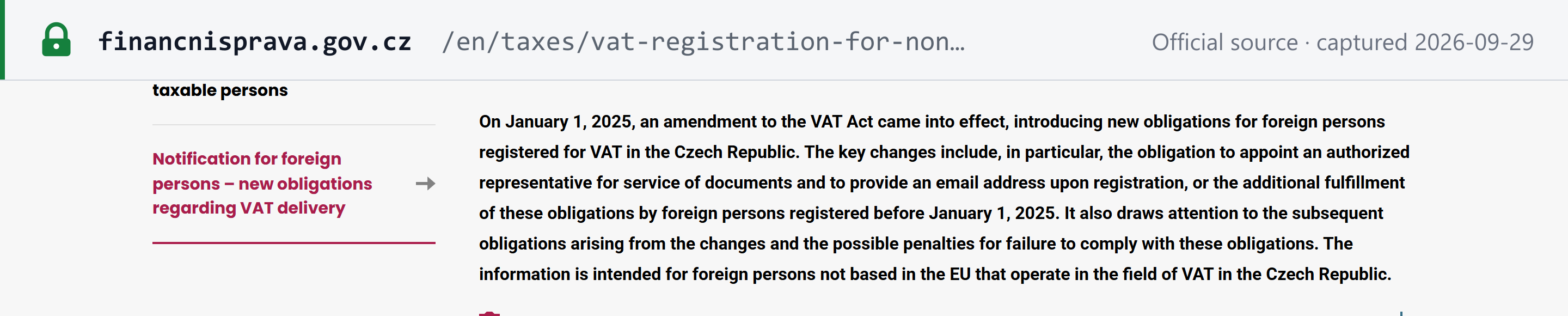
- Service agent and e-mail, from 2025. A foreign person — one with no seat or establishment in the EU (§ 4(1)(g)) — must appoint a service agent (zmocněnec pro doručování) that has a statutory data box, no later than the registration deadline, unless it has its own data box (§ 98b(1)). It must also give an e-mail address in its application (§ 96(3)). Failing to appoint the agent, or appointing one late, costs CZK 1,000 for each day (§ 98b(3)). [1] [7]
- No registration for reverse-charged B2B sales. Supplies to Czech payers on which the customer declares the VAT do not trigger registration — see Foreign companies selling into the Czech Republic.
Tax identification number
The Czech VAT number is the DIČ (daňové identifikační číslo) with the prefix CZ. For a legal person it is CZ followed by its 8-digit IČO (company identification number); for an individual it is CZ followed by 9 or 10 digits. The tax office publishes, in the online register of payers and identified persons, each payer's DIČ, name and seat, the bank accounts it designated for publication, and whether it has no Czech seat or establishment (§ 98); a decision that a payer is unreliable is published there too (§ 106ac(4)). For the format in detail, see Lookuptax's Czech Republic tax ID guide. [1]
To check a counterparty, see how to verify a DIČ in the Czech Republic or use Lookuptax's Czech DIČ validator.
How to register
- Where. The application (přihláška k registraci) and any change of registration data "pouze elektronicky lze podat" — may only be filed electronically (§ 101a(2)), through the MOJE daně tax portal or a data box. [1]
- Deadline. Within 10 working days of the day turnover exceeds CZK 2,000,000 or CZK 2,536,500 (§ 94(1)); 15 days for an identified person (§ 97). [1]
- Timeline. Mandatory payer status arises by law on the dates in the table above, not on the date of the registration decision. Where a business applies by 30 September because it crossed CZK 2,000,000 and did not choose an earlier start, the tax office checks the data within 30 days (§ 97b(1)) and issues the registration decision by the end of the calendar year, but not before 1 December (§ 97b(4)). A voluntary registrant becomes a payer from the day after the registration decision is notified (§ 6f(1)). [1] [1]
- Documents. The VAT Act prescribes the electronic form, the e-mail address for foreign persons and the service-agent appointment; the list of attachments for each type of applicant is part of the registration form on MOJE daně.
Voluntary registration
Available. A taxable person with a seat or establishment in the Czech Republic that makes, or will make, supplies carrying a right to deduct can register at any turnover (§ 6f(1)). A business without a Czech seat that will make Czech supplies with a right to deduct, and is not in the small-business scheme, can also register (§ 6f(2)). An unreliable person cannot apply (§ 94a(1)). The usual reason to opt in is to recover input VAT before reaching the threshold, or to meet B2B customers who expect VAT invoices. [1]
Deregistration
- On request, established payer. The tax office cancels the registration of a payer with its seat in the Czech Republic that is not a group, where at least one calendar year has passed since it became a payer and its turnover exceeded CZK 2,000,000 in neither the previous nor the current calendar year (§ 106(4)(a)). [1]
- On request, voluntary payer. After at least 6 months as a payer, if its turnover stayed within CZK 2,000,000 (§ 106(6)). [1]
- On request, non-established payer. After 2 consecutive months with no Czech taxable supplies other than those the customer reverse-charges or those declared through OSS, and no exempt intra-EU supplies of goods; supplies made as the middle person in a triangular trade are not counted (§ 106(4)(b)). [1]
- Ex officio. For example, where the payer made no turnover-relevant supply in the previous calendar year (§ 106(2)), or seriously breaches its obligations (§ 106(3)). [1]
Group registration
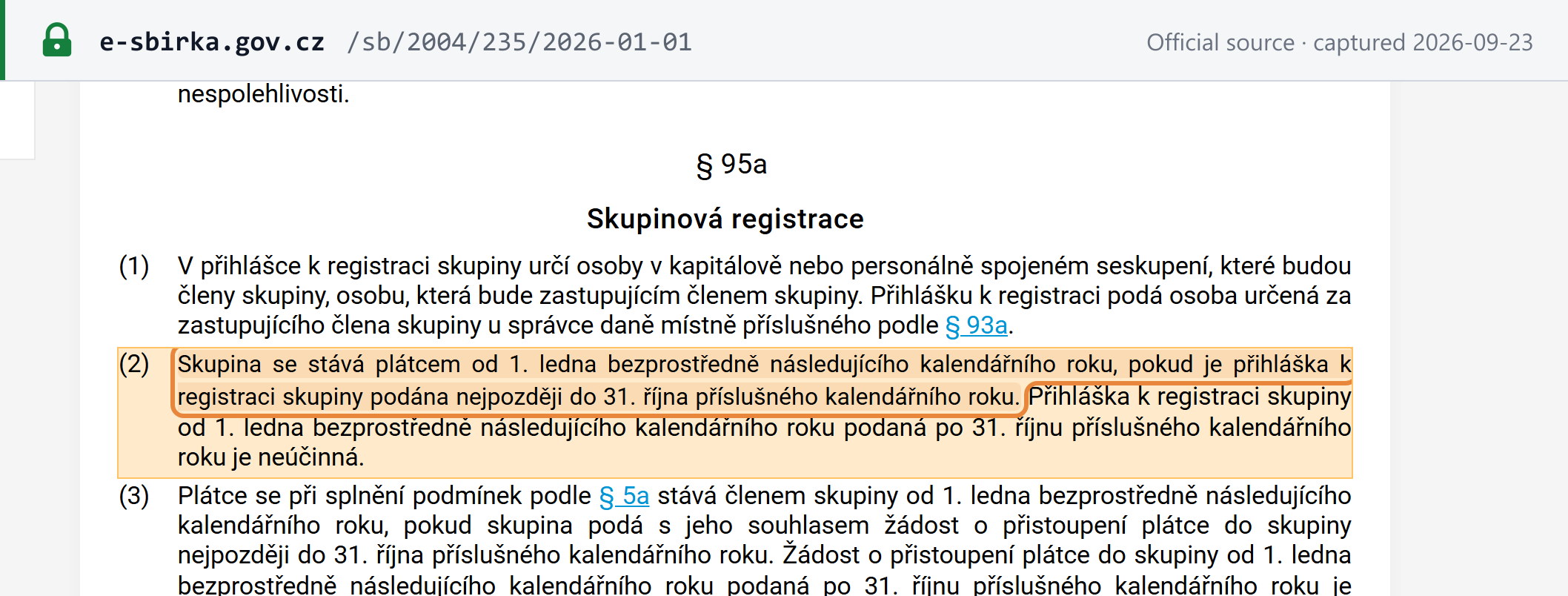
Available. Persons linked by personnel, or by capital where the holding in share capital or voting rights is at least 40%, can form a VAT group (skupina); every member must have a seat or establishment in the Czech Republic (§ 5a(1)). The application must be filed by 31 October for the group to become a payer from 1 January; a later application is ineffective (§ 95a(2)). The Financial Administration's 2026 calendar moves that date off the weekend to 2 November 2026. [1] [20]
Rates
| Rate | Applies to | Effective |
|---|---|---|
| 21% (standard) | Every taxable supply not given the reduced rate | Since 1 January 2013 [1] |
| 12% (reduced) | Goods in Annex 3, heat and cooling, and services in Annex 2 — see below | Since 1 January 2024 [5] |
| Exempt with a right to deduct | Exports, intra-EU supplies, books — the zero-rate equivalent; see below | — |
| Exempt without a right to deduct | See Exemptions | — |
§ 47(1): "U zdanitelného plnění nebo přijaté úplaty se uplatňuje a) základní sazba daně ve výši 21 %, nebo b) snížená sazba daně ve výši 12 %" — a taxable supply or payment received bears the standard rate of 21% or the reduced rate of 12%. The rate is the one in force on the day the obligation to declare the tax arises (§ 47(2)). [1]
How the rates got here. The rates were 20% and 14% in 2012, and 21% and 15% from 1 January 2013; a second reduced rate of 10% applied until the end of 2023. On 1 January 2024, Act No. 349/2023 Sb. (the public-finance consolidation package) kept the standard rate at 21%, abolished the 10% rate and replaced the 15% rate with a single reduced rate of 12%. [5] [1]
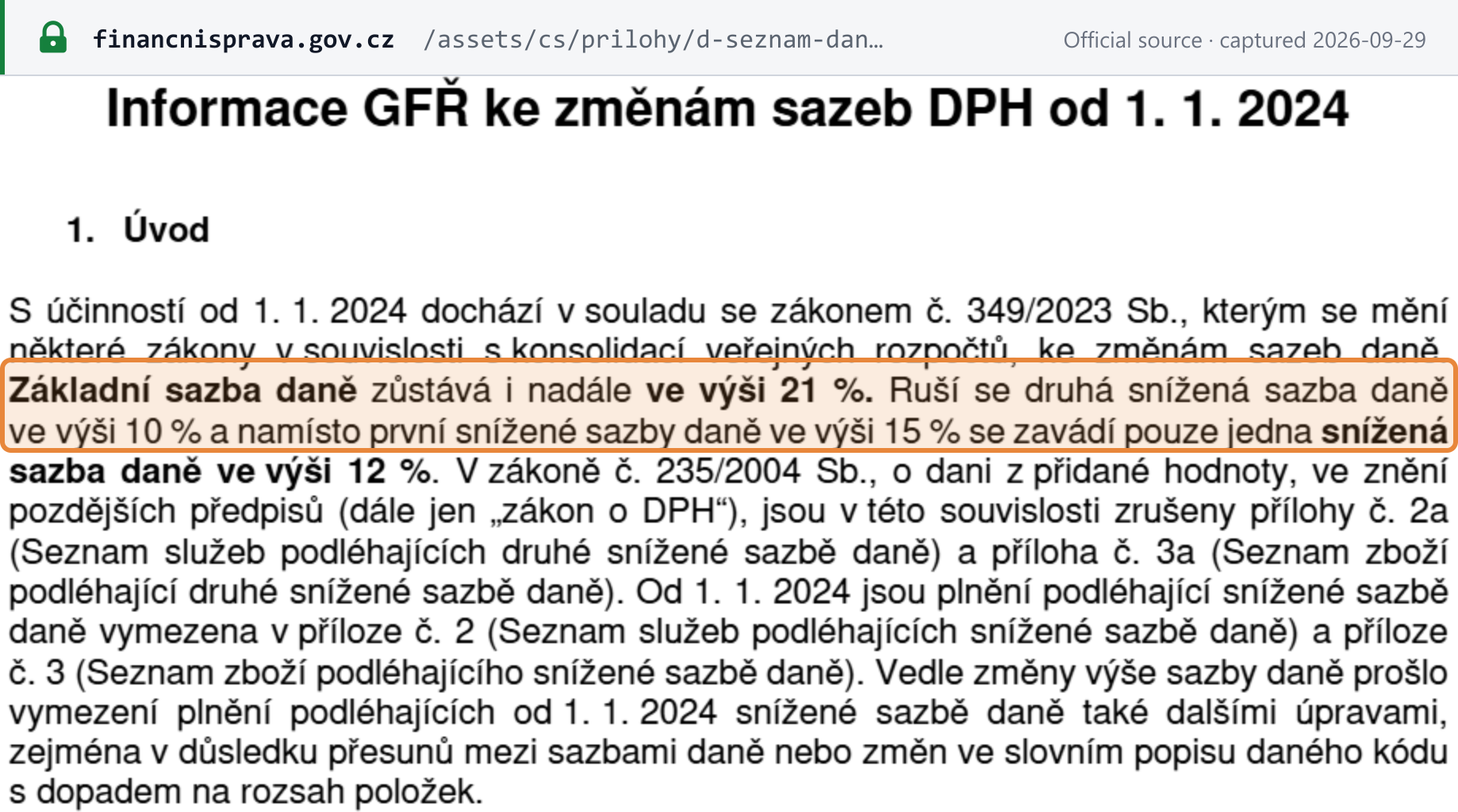
What the 12% rate covers. Goods listed in Annex 3, heat and cooling, and services listed in Annex 2 (§ 47(3)–(4)). Examples: [1]
- Goods (Annex 3): food and animal feed — but drinks and water are excluded, except "selected drinks" (milk, liquid dairy products and plant-based milk alternatives); tap drinking water; pharmaceuticals; newspapers and periodicals; listed medical devices; spectacles and lenses.
- Services (Annex 2): water supply and sewerage; scheduled public passenger transport; accommodation; catering — except serving drinks other than drinking water and the selected drinks, which stay at 21%; admission to cultural events, museums, zoos and cinemas; sports events and facilities; health and social care; funeral services; saunas.
- Social housing construction and supply (§§ 48a–49).
Moved to 21% in 2024. Among others: hairdressing; repairs of shoes, clothing and bicycles; household cleaning; cut flowers; firewood; scheduled air passenger transport; leaflets. [5]
Zero rate. The VAT Act has no 0% rate. Exports, intra-EU supplies, services to third countries and international passenger transport are instead exempt with a right to deduct (§ 63(1)). Books and similar services, including e-books, have been exempt with a right to deduct since 1 January 2024 (§ 71i); before that they were taxed at 10%. [1] [5]
Announced future rates. No change to the 21% or 12% rate had been enacted or published as of 29 September 2026: the VAT Act has no consolidated version later than 1 January 2026. One change to the scope of the 12% rate is enacted for 1 January 2027: Part Three of the sales-records act (Sněmovní tisk 189, signed by the President on 17 September 2026 and sent for publication in the Collection of Laws on 1 October 2026) amends Annex 2 so that the reduced-rate catering item covers the serving of non-alcoholic drinks generally (alcoholic drinks excluded), replacing the present limit to drinking water and the selected drinks. Until then the text above applies. [14] [1]
For the Czech Republic alongside other jurisdictions, see Lookuptax's worldwide tax rates table and VAT registration thresholds table.
Cross-border rules
Foreign companies selling into the Czech Republic — B2B and B2C
The answer depends on who the customer is.
B2B — usually no Czech registration. Where the supplier is not established in the Czech Republic, the Czech customer declares the VAT (§ 108(3)): [1]
- a payer or identified person does so for services under §§ 9–10d, for goods supplied with installation or assembly by an unregistered supplier, and for goods supplied through gas and electricity networks;
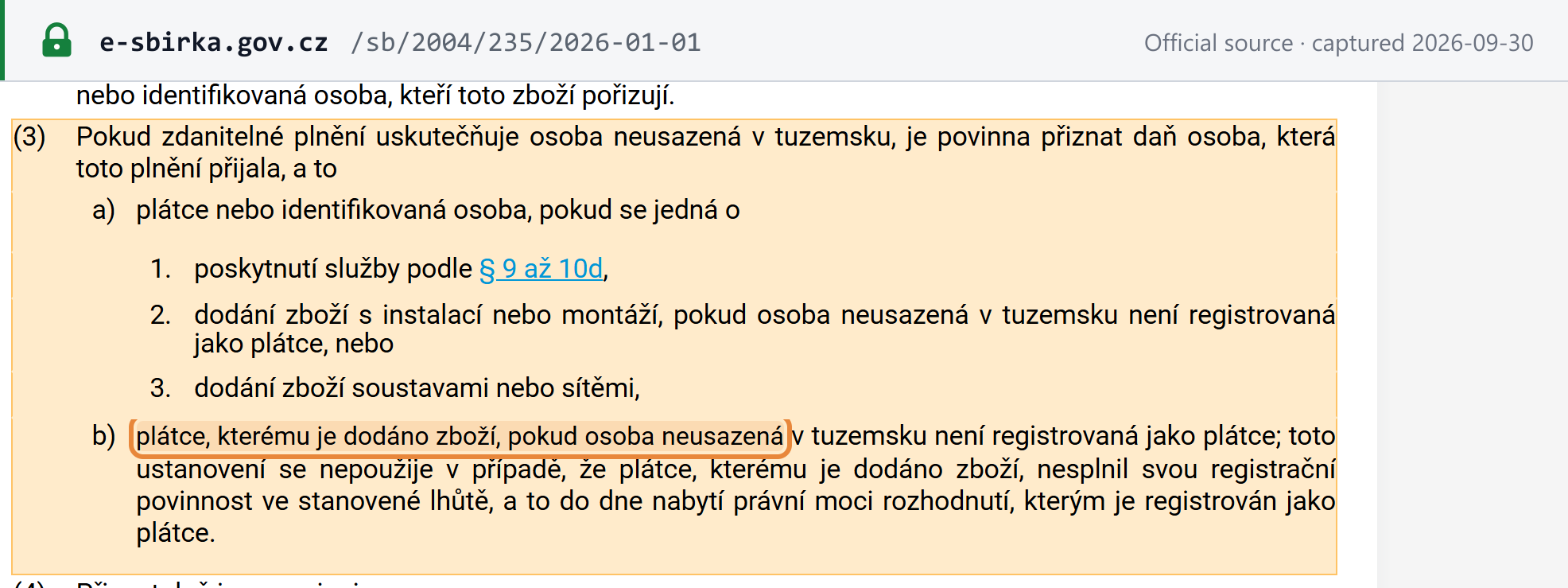
- a payer does so for any supply of goods to it by a non-established supplier that is not registered as a Czech payer — except while the buyer has itself failed to register on time, until its registration decision becomes final (§ 108(3)(b)).
So a foreign company selling goods located in the Czech Republic to Czech VAT payers does not have to register for those sales: § 6c(1) leaves reverse-charged supplies out of the registration trigger. The foreign supplier still issues the invoice (§ 28(4)), marked "daň odvede zákazník" (tax to be paid by the customer) (§ 29(2)(c)). See Lookuptax's reverse charge explainer. [1]
B2C — register from the first sale, or use an OSS scheme. A non-established seller making a supply to a consumer that is located in the Czech Republic becomes a payer from its first such supply, with no threshold, unless it declares the supply through the One-Stop Shop (§ 6c(1)). Distance sales of goods from another member state, and B2C telecommunications, broadcasting and electronic services, are located in the Czech Republic once the EU-wide EUR 10,000 threshold is exceeded in the current or previous calendar year (§ 8(2)(c), § 8(3)); below it the seller may opt in (§ 8(4)). [1]
Digital products and services
Telecommunications, broadcasting and electronically supplied services to non-taxable customers are supplied where the customer is (§ 10i(1)). An EU supplier counts them, with its intra-EU distance sales of goods, towards the EUR 10,000 threshold above. A supplier established outside the EU has no threshold: it charges Czech VAT from the first sale and declares it through the non-Union OSS or registers in the Czech Republic. See Lookuptax's guide to VAT on digital services by non-resident suppliers. [1]
The OSS schemes in the Czech Republic. Three schemes are available: the Union scheme (režim EU), the non-Union scheme (režim mimo EU) and the import scheme (dovozní režim, IOSS) for consignments of intrinsic value up to EUR 150. The Financial Administration notes that using OSS "není povinné" — is not compulsory. Where the Czech Republic is the member state of identification, the tax administrator is the Tax Office for the South Moravian Region, Brno I territorial office (Finanční úřad pro Jihomoravský kraj, Územní pracoviště pro Brno I) (§ 110a(3)). OSS and IOSS returns are due by the end of the month after the period, and — unlike the domestic return — the date is not moved off a weekend or holiday (§ 110zc). See Lookuptax's One-Stop Shop guide and IOSS guide. [8] [1]

Marketplace / platform deemed-supplier liability
Applies. An electronic interface is deemed to buy and resell goods where it facilitates (§ 13a): [1]
- distance sales of imported goods of intrinsic value not above EUR 150; or
- supplies of goods by a foreign person (established outside the EU) to non-taxable persons in the EU.
See Lookuptax's marketplace deemed-supplier explainer.
Imports and exports
- Imports by a VAT payer. When customs releases the goods into free circulation, the payer declares the import VAT in its own return for that period (§ 23(2)); customs does not collect it. The customs decision serves as the tax document (§ 33). [1]
- Imports by a non-payer. VAT is paid to customs (§ 108(5)(a)). [1]
- Low-value consignments. Up to EUR 150, through IOSS or the special arrangement in § 110, under which the supplementary customs declaration is filed monthly. [1]
- Exports. Exempt with a right to deduct (§ 63(1)(c), § 66). Intra-EU supplies of goods are exempt with a right to deduct and reported on the EC Sales List. [1]
- Imported services. Reverse-charged by the Czech payer or identified person (§ 108(3)(a)(1)). [1]
Domestic reverse charge
Between two Czech payers, the buyer declares the VAT on: gold (§ 92b); waste and scrap listed in Annex 5 (§ 92c); real estate where the seller opts to tax (§ 92d); construction and assembly work within CZ-CPA codes 41–43, and the supply of workers for it (§ 92e); and, under Government Decree No. 361/2014 Sb. (§ 92f), greenhouse-gas allowances, electricity certificates, electricity and gas supplied to traders, wholesale electronic-communications services, and — where the taxable amount of all such goods in the supply exceeds CZK 100,000 — cereals and technical crops, metals, mobile phones, integrated circuits, laptops and tablets, and video-game consoles. The reverse charge cannot be used if either party is not published as a payer in the register on the day of supply (§ 92a(6)). [1] [17]
Place of supply
- Goods without transport. Where the goods are when supplied (§ 7(1)). [1]
- Goods with transport. Where the transport begins (§ 7(2)); distance sales follow § 8. [1]
- Services, B2B. "Místem plnění při poskytnutí služby osobě povinné k dani … je místo, kde má tato osoba sídlo" — where the business customer has its seat, or the fixed establishment the service is supplied to (§ 9(1)). [1]
- Services, B2C. Where the supplier has its seat (§ 9(2)). [1]
- Special rules for real estate, transport, events, electronic services to consumers and others take precedence (§ 9(4), § 10i). [1]
Invoice requirements
A tax document (daňový doklad) is governed by §§ 26–35a of the VAT Act. It may be on paper or electronic; an electronic one requires the customer's consent (§ 26(3)). [1]
Mandatory content
"Daňový doklad musí obsahovat tyto údaje" — a tax document must contain these particulars (§ 29(1)): [1]
| # | Required field | Legal cite |
|---|---|---|
| a | Supplier designation — name (with any name suffix) and seat | § 29(1)(a), § 29(4) |
| b | Supplier's DIČ | § 29(1)(b) |
| c | Customer designation | § 29(1)(c) |
| d | Customer's DIČ | § 29(1)(d) |
| e | Document number (evidenční číslo daňového dokladu) | § 29(1)(e) |
| f | Scope and subject of the supply | § 29(1)(f) |
| g | Date of issue | § 29(1)(g) |
| h | Date of the taxable supply or of the payment received, where it differs from the date of issue | § 29(1)(h) |
| i | Unit price excluding VAT, and any discount not included in it | § 29(1)(i) |
| j | Taxable amount | § 29(1)(j) |
| k | VAT rate | § 29(1)(k) |
| l | VAT amount, in Czech currency | § 29(1)(l) |
Conditional particulars (§ 29(2)): the reference to the exemption; "vystaveno zákazníkem" where the customer issues the invoice; "daň odvede zákazník" where the customer declares the tax; the data of a new means of transport; and the triangulation statement. May be omitted (§ 29(3)): a DIČ that has not been assigned, and the rate and VAT amount on exempt or reverse-charged supplies. [1]
The VAT Act's list does not include the IČO (company identification number); other laws governing business documents may require it.
Issuance deadline
- General rule: "Daňový doklad musí být vystaven do 15 dnů ode dne, kdy vznikla povinnost přiznat daň, nebo přiznat plnění" — within 15 days of the day the obligation to declare the tax (or the supply) arose (§ 28(8)). [1]
- Exempt intra-EU supplies of goods, and B2B services taxed in another member state or a third country: within 15 days of the end of the month of the supply (§ 28(9)). [1]
- Summary invoice for a calendar month: within 15 days of the month's end (§ 31b(2)). [1]
- The supplier must make reasonable efforts to get the document to the customer within the deadline (§ 28(11)). [1]
Numbering and sequencing
Each tax document carries an evidenční číslo — a document number (§ 29(1)(e)). The VAT Act prescribes no format for it and no rule that the numbers run without gaps. [1]
Credit and debit notes
When the taxable amount changes, the payer issues a corrective tax document (opravný daňový doklad) and makes reasonable efforts to get it to the customer within 15 days (§ 42(5)). It must show both parties and their DIČs, the numbers of the original and the corrective document, the reason for the correction, the differences in taxable amount, VAT and total, and the date of the correcting event (§ 45(1)). A downward correction is declared for the period in which the delivery efforts were made (§ 42(6)); the rate and exchange rate of the original supply apply (§ 42(7)); and corrections are possible until the end of the seventh calendar year after the year of the original supply (§ 42(8)). [1]
Currency and language
- Currency. Any currency, but the VAT amount must be in CZK (§ 29(1)(l)). Foreign currency is converted at the Czech National Bank's exchange-market rate or the European Central Bank's reference rate, as used by the person converting, on the day the obligation to declare the tax arises (§ 4(8)). [1]
- Language. The VAT Act sets no invoice-language rule, but the keeper of the document must provide a Czech translation on the tax office's request (§ 35(5)). [1]
Document types
| Document | When it is used | Cite |
|---|---|---|
| Full tax document | A payer supplying another taxable person or a non-taxable legal person (except exempt supplies without a right to deduct), and the other cases listed in § 28(1) | § 28(1), § 29 |
| Simplified tax document (zjednodušený daňový doklad) | Where the total for the supply is not more than CZK 10,000. Not allowed for exempt intra-EU supplies, distance sales into the Czech Republic, reverse-charged supplies or certain tobacco sales. May omit the customer's name and DIČ, the unit price, the taxable amount and the VAT amount; if the VAT is omitted, it shows the total price. | § 30, § 30a |
| Summary tax document (souhrnný daňový doklad) | Several supplies to one customer in a calendar month | § 31b |
| Instalment and payment schedules | Where they carry the invoice particulars | §§ 31, 31a |
| Self-supply document (doklad o použití) | Private or non-business use | § 32 |
| Customs decision | Imports | § 33 |
| Corrective tax document | Changes to the taxable amount | § 45 |
§ 28(1)(a) lists only taxable persons and non-taxable legal persons, so a supply to a private individual does not in itself require a tax document. [1] [1]
Self-billing
Permitted by agreement. Another person, including the customer, may issue the tax document "na základě jejich ujednání" — on the basis of their agreement — and then has the same rights and duties as the supplier; the tax office can ask it to prove the agreement (§ 28(10)). The document carries "vystaveno zákazníkem" (§ 29(2)(b)), and the supplier remains responsible for the correctness of its data and its timely issue (§ 26(4)). [1]
Retention and audit trail
- Retention. "Daňové doklady se uchovávají po dobu 10 let od konce zdaňovacího období, ve kterém se plnění uskutečnilo" — 10 years from the end of the tax period in which the supply took place (§ 35(2)). [1]
- Where. A keeper established in the Czech Republic keeps its documents there, unless they are held with continuous remote access; it must notify the tax office in advance if they are stored abroad (§ 35(3)–(4)). [1]
- Electronic archiving. Paper documents may be converted to electronic form and kept electronically only; the data proving integrity must be kept too (§ 35a). [1]
- Audit trail. Authenticity of origin, integrity of content and legibility must be ensured from issue until the end of retention (§ 34(1)) — through business controls "vytvářejících spolehlivou vazbu mezi daňovým dokladem a daným plněním" (creating a reliable link between the tax document and the supply) (§ 34(3)), or, for electronic documents, a recognised electronic signature, a recognised electronic seal or EDI (§ 34(4)). The Act sets no hash, QR-code or registration-number requirement for invoices. [1]
A specimen of a compliant invoice
The Financial Administration publishes no annotated specimen invoice. The layout below is Lookuptax's own illustration of the § 29(1) particulars for a domestic B2B supply. Every name, number and amount in it is fictional:
Faktura — daňový doklad (Tax invoice)
| Description§ 29(1)(f) | Quantity§ 29(1)(f) | Unit price (excl. VAT)§ 29(1)(i) | VAT rate§ 29(1)(k) | Value (excl. VAT) |
|---|---|---|---|---|
| IT consulting (hours) | 10 | CZK 2,500.00 | 21% | CZK 25,000.00 |
| Catering for workshop | 1 | CZK 5,000.00 | 12% | CZK 5,000.00 |
- Taxable amount at 21%§ 29(1)(j)
- CZK 25,000.00
- VAT at 21%§ 29(1)(l)
- CZK 5,250.00
- Taxable amount at 12%§ 29(1)(j)
- CZK 5,000.00
- VAT at 12%§ 29(1)(l)
- CZK 600.00
- Total including VAT
- CZK 35,850.00
- The VAT amounts must be stated in Czech koruna even if the rest of the invoice is in another currency — § 29(1)(l); convert at the CNB or ECB rate — § 4(8).
- Where the customer declares the tax, the invoice carries "daň odvede zákazník" and may omit the rate and VAT amount — § 29(2)(c), § 29(3); where the customer issues it, "vystaveno zákazníkem" — § 29(2)(b).
- Catering is at 12%, but drinks served with it other than drinking water and the selected drinks are at 21% — Annex 2.
- An electronic version needs the customer's consent — § 26(3). The customer should pay only to a bank account published for the supplier in the VAT payer register — § 109(2)(c).
E-invoicing status
Status (as of 2026-09-29): no B2B or B2C e-invoicing mandate and no clearance platform; B2G receive-only since 2019/2020. For the detail, see Lookuptax's Czech Republic e-invoicing guide (ISDOC), and for other countries the e-invoicing status and networks table.
- B2B and B2C — voluntary. "S použitím daňového dokladu v elektronické podobě musí souhlasit osoba, pro kterou se plnění uskutečňuje" — the customer must agree to an electronic tax document (§ 26(3)). [1]
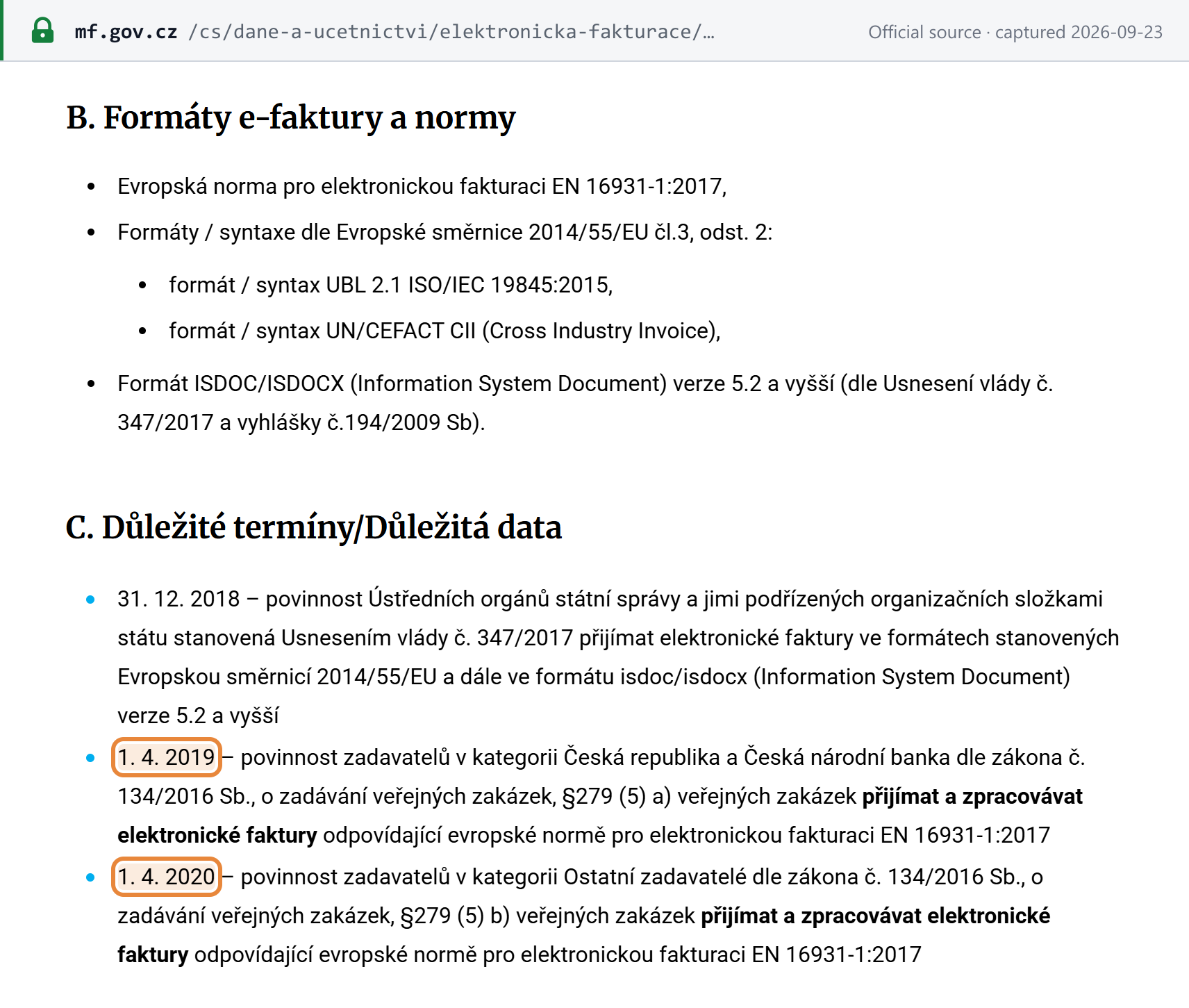
- B2G — authorities must accept, suppliers need not send. A contracting authority "nesmí odmítnout elektronickou fakturu" whose format complies with the European standard (§ 221 of the Public Procurement Act, No. 134/2016 Sb.). This has applied since 1 April 2019 to the State and the Czech National Bank and since 1 April 2020 to all other contracting authorities. Suppliers are not obliged to e-invoice. [12] [11]
- Formats. Per the Ministry of Finance, authorities must accept e-invoices that comply with EN 16931 in UBL 2.1 or UN/CEFACT CII, as well as the national ISDOC/ISDOCX format, version 5.2 or higher. [11]
- Control statement is reporting, not e-invoicing. Since 2016 payers report their transactions periodically on the kontrolní hlášení — see Filing and payment.
- ViDA. The EU's VAT in the Digital Age directive makes e-invoicing the default for intra-EU B2B supplies from 1 July 2030. Print 218, a government bill amending the VAT Act to implement first elements of the ViDA directive, is before the Chamber of Deputies: first reading 14 July 2026, the budget committee recommended approval on 17 September 2026, and the second reading is proposed for the session from 13 October 2026. It would treat a taxable person registered in the EU One Stop Shop as having elected the OSS rules and let supplies of gas, electricity, heating and cooling count as OSS distance sales from 1 January 2027, and repeal the call-off stock scheme (§ 18) from 1 July 2028 with transitional use to 30 June 2029; it has not passed second or third reading. See Lookuptax's ViDA guide. [22]
Related regime: EET 2.0 sales recording (not e-invoicing)
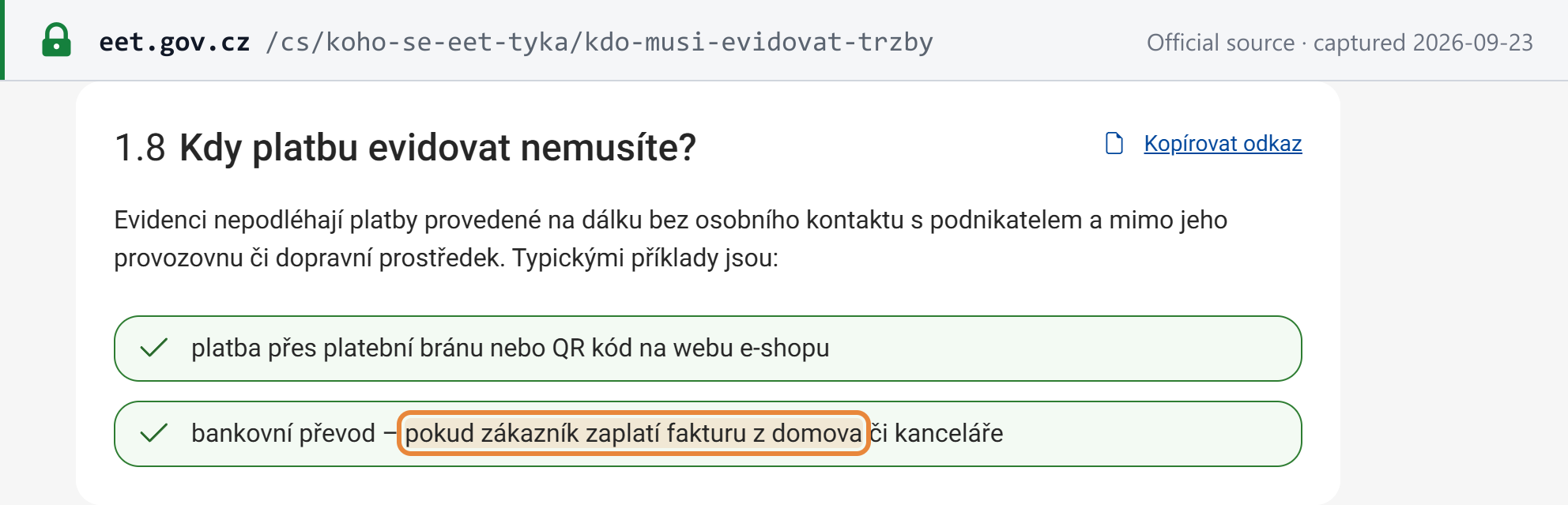
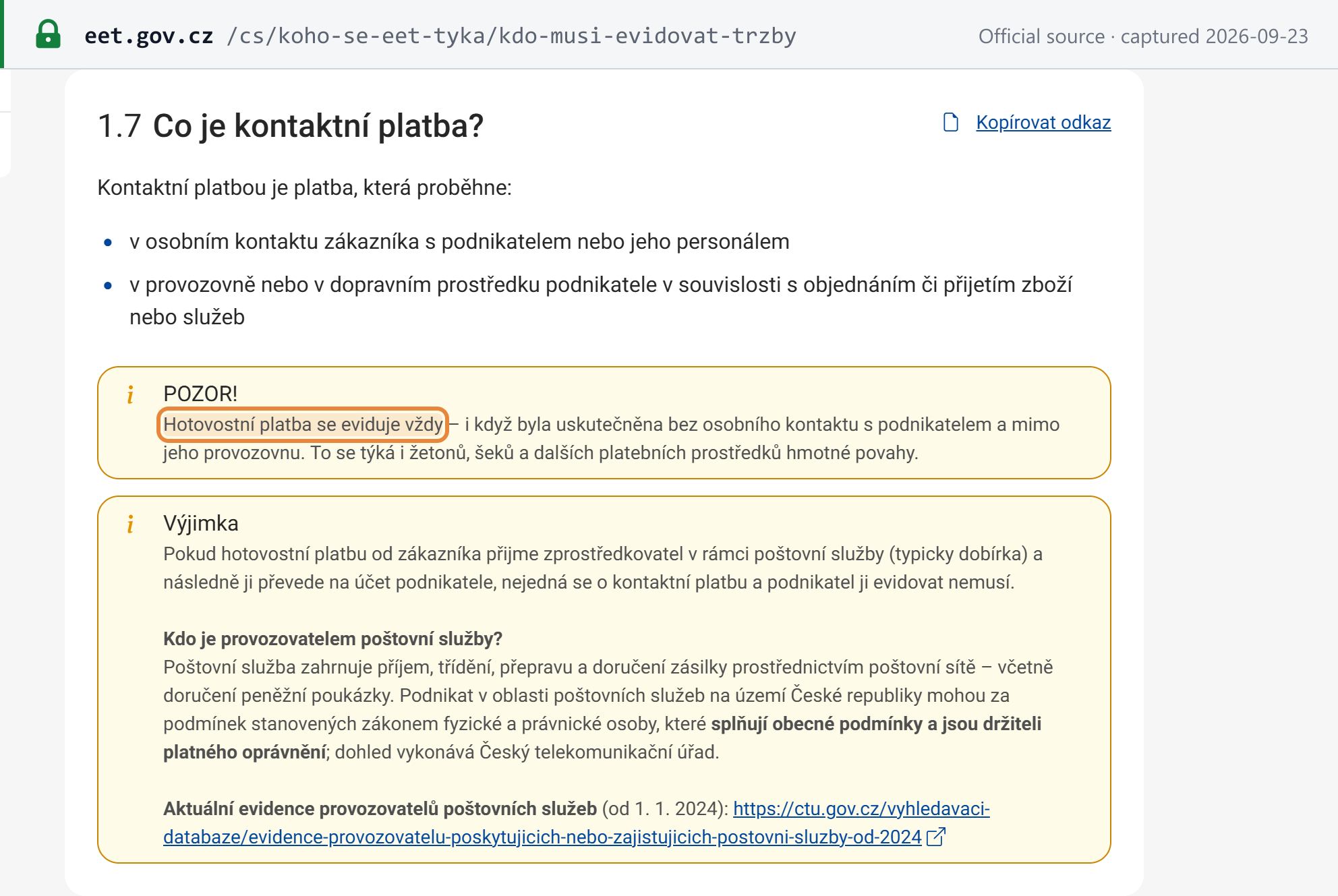
EET 2.0 (evidence tržeb) is a real-time sales-recording regime for personal and corporate income-tax payers, not a VAT e-invoicing system. From 1 January 2027 each recorded sale is sent to the Financial Administration as it happens, carrying minimal data and no VAT amounts. Cash is always recorded, even when it is paid without personal contact, and so are tokens, cheques and other physical means of payment; cash on delivery through a postal service is the exception. Other payments made remotely, without personal contact — such as a payment gateway on an e-shop, or a customer paying an invoice by bank transfer from home or the office — are outside it. The President signed the act on 17 September 2026; it was sent for publication in the Collection of Laws on 1 October 2026; it had not yet been published in the Collection of Laws at that date. [13] [14] [23]
Filing and payment
Filing frequency
Monthly by default (§ 99). A payer may choose the calendar quarter if its turnover in the previous calendar year did not exceed CZK 15,000,000, it is not an unreliable payer and not a group, and it notifies the tax office by the end of January. The quarter is not available in the calendar year of registration or the year after (§ 99a). [1]
Return due date
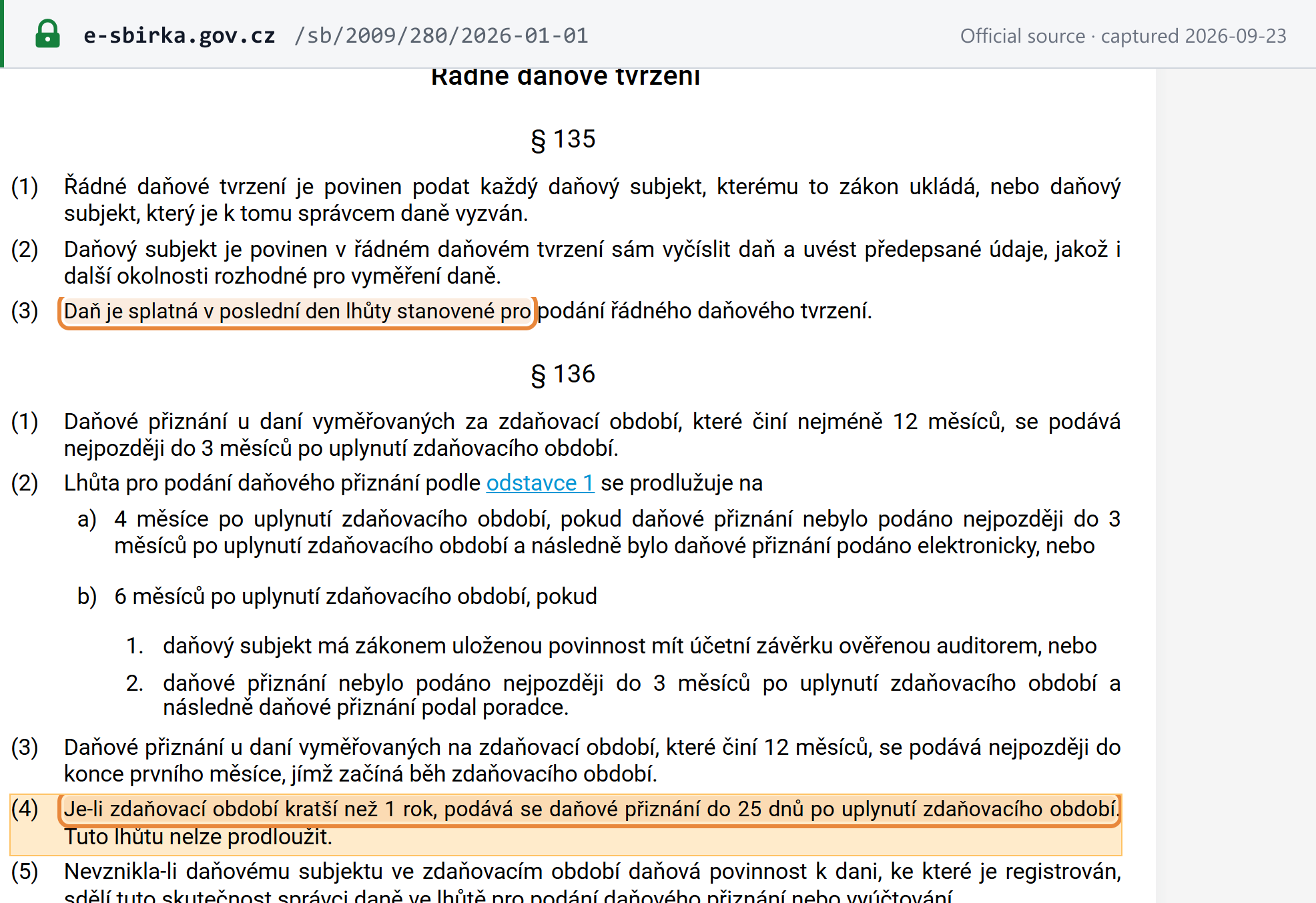
The VAT return (přiznání k DPH) is due within 25 days after the end of the tax period, and that deadline cannot be extended (Tax Procedure Code § 136(4)). A deadline that falls on a Saturday, Sunday or public holiday moves to the next working day (§ 33(4)) — so the September 2026 return is due on 26 October 2026 — but the OSS, IOSS and SME-scheme dates do not move. [2] [20]
- Electronic only. The return, the control statement and the EC Sales List must be filed electronically in the prescribed format and structure; a filing made any other way is ineffective (§ 101a(1), (4)). An e-mailed PDF is not a filing. [1]
- Nil returns. A payer established in the Czech Republic files for every period, even with no transactions (§ 101(3)); a non-established payer files only for periods with activity (§ 101(4)). [1]
- No annual VAT return.
Payment due date and method
"Daň je splatná v poslední den lhůty stanovené pro podání řádného daňového tvrzení" — VAT is payable on the last day of the filing deadline (Tax Procedure Code § 135(3)), so payment and return fall due together. Payment goes to the competent tax office's account; this guide does not list the account numbers. [2]
Additional listings
| Filing | Who and what | Due |
|---|---|---|
| Kontrolní hlášení (VAT control statement) | A payer with transactions covered by § 101c in the period; with none, no statement is filed. Legal persons file monthly, even if they file quarterly returns; individuals file with their return. | 25 days after the month (legal persons); cannot be extended — § 101e |
| Souhrnné hlášení (EC Sales List) | Intra-EU supplies of goods, call-off stock, triangulation and B2B services under § 9(1). Services-only filers on quarterly returns may file quarterly. | 25 days after the month — § 102(5)–(6) |
| OSS / IOSS returns | Users of the One-Stop Shop schemes | End of the month after the period, not moved off weekends — § 110zc |

Input-tax recovery and blocked items
- Conditions. Input VAT is deductible on purchases used for taxable supplies, supplies exempt with a right to deduct, and listed foreign supplies (§ 72(1)); the payer must hold a tax document (§ 73(1)(a)). A document missing some particulars can be supported by other evidence (§ 73(5)). Mixed use gives a partial deduction (§ 72(9)). [1]
- Timing. "Plátce je oprávněn uplatnit nárok na odpočet daně nejdříve za zdaňovací období, ve kterém jsou splněny podmínky" — no earlier than the period in which the conditions are met (§ 73(2)). The Financial Administration's statement of 13 April 2026 confirms that an invoice received in a later period is deductible no earlier than that later period. [1] [15]
- Time limit. The claim expires at the end of the second calendar year after the year in which it arose (§ 73(3)). [1]
- Entertainment (reprezentace): no deduction on inputs used for entertainment that are not deductible for income tax (§ 72(6)). [1]
- Passenger cars. Input VAT on acquiring a selected passenger car held as a long-term asset is capped at CZK 420,000 per car (§ 72(3)); ambulances, hearses, licensed transport vehicles and sports vehicles are outside the definition (§ 72(10)). The cap was introduced on 1 January 2024. The same act (Sněmovní tisk 189) repeals the passenger-car input-tax rules in § 72(3), (4), (10) and § 77a from 1 January 2027. [1]
- Donated goods. Under GFŘ guidance applied since 1 July 2026, goods that have lost their commercial value can be donated without reversing the input-VAT deduction. [16]

Refunds
- Excess deduction (nadměrný odpočet). A refundable overpayment arising from it is refunded without a request: within 15 days of notification of the assessment, or within 30 days of the day the assessment is deemed delivered where it is not notified — the usual case for an accepted return (Tax Procedure Code § 155b(3)). [2]
- Advance during verification. While the tax office checks a claim, the payer can receive an advance (záloha) on the undisputed part if it reaches CZK 50,000 (Tax Procedure Code § 174a; VAT Act § 105a). [2]
- Interest on a delayed refund. Accrues after 4 months from the return deadline, at half the late-payment interest rate (Tax Procedure Code § 254a). [2]
- EU businesses claim Czech VAT through their home-state portal; the Czech administrator is the Tax Office for the Capital City of Prague (§ 82b(1)). Czech payers claim VAT from other member states by 30 September of the following year (§ 82(3)). [1]
- Non-EU businesses: "Daň se vrací na základě principu vzájemnosti" — only on reciprocity (§ 83(3)), for a business making no Czech supplies other than those listed in § 83(1); the claim is due by the end of the calendar year after the year of supply (§ 83(5)). [1]
- Bad-debt relief. The creditor may reduce the taxable amount of an irrecoverable receivable in enforcement, insolvency or estate proceedings (§ 46(1)). A small-debt route covers receivables up to CZK 10,000 including VAT, at least 6 months overdue, after two written demands, up to CZK 20,000 per debtor a year (§ 46(1)(i)). From 1 January 2027 (Sněmovní tisk 189, signed 17 September 2026) the limit becomes CZK 20,000 per receivable, the overdue period 3 months, and the per-debtor annual aggregate CZK 100,000 including VAT; the 6-month period in § 74b(3) for the debtor's correction of its input-tax deduction also becomes 3 months. The general limit is 3 years from the end of the period of supply (§ 46(5)). [1]
Unreliable payers and guarantee liability
This is the check behind every Czech purchase-to-pay run.
Unreliable payer. The tax office decides that a payer that seriously breaches its obligations is a nespolehlivý plátce (§ 106a(1)); a non-payer can be declared an unreliable person (§ 106aa). The decision can be appealed within 15 days, with suspensive effect, and is published in the payer register (§ 106ac(4)). An unreliable payer is forced onto monthly periods and can ask to have the status lifted after one year without serious breaches. [1]
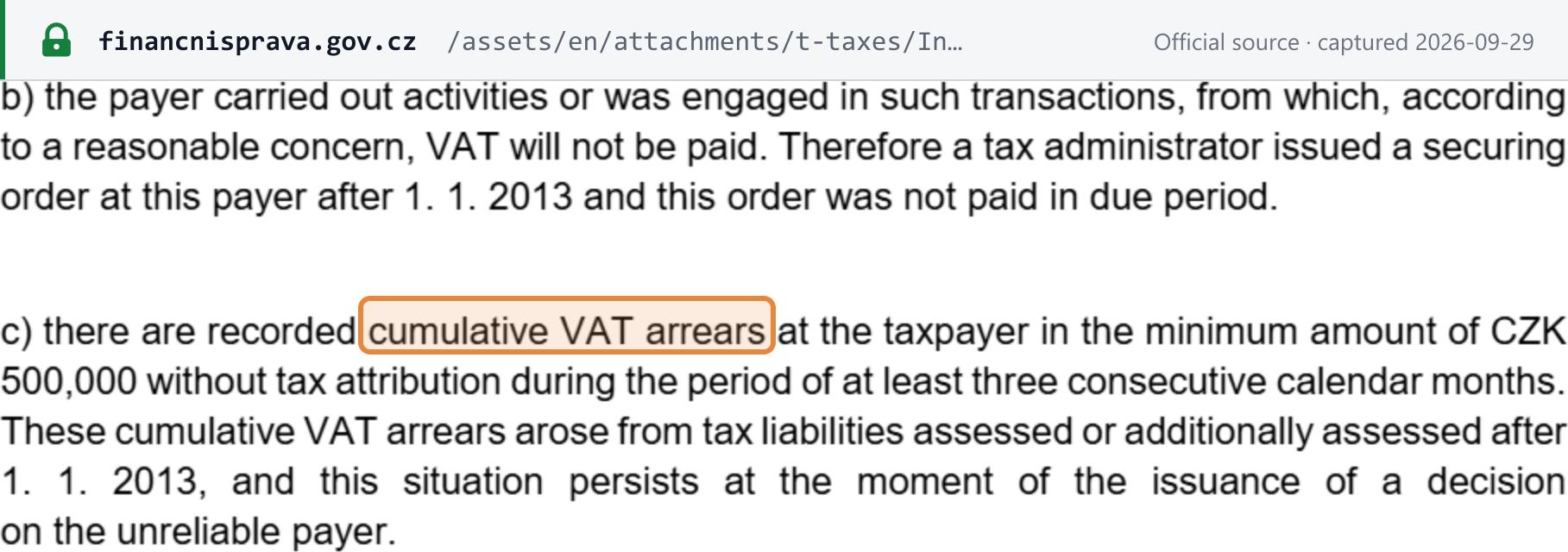
The Act does not define a "serious breach". The GFŘ publishes nine criteria, (a) to (i). Four turn on CZK 500,000: an assessment by estimate of at least CZK 500,000; cumulative VAT arrears of at least CZK 500,000 for at least three consecutive calendar months; a deduction reduced by at least CZK 500,000 and left unpaid; and output tax increased by at least CZK 500,000 and left unpaid. The others cover an unpaid securing order, repeated estimate assessments, non-cooperation, repeated non-filing and false registration data. Each is a separate criterion. [9]
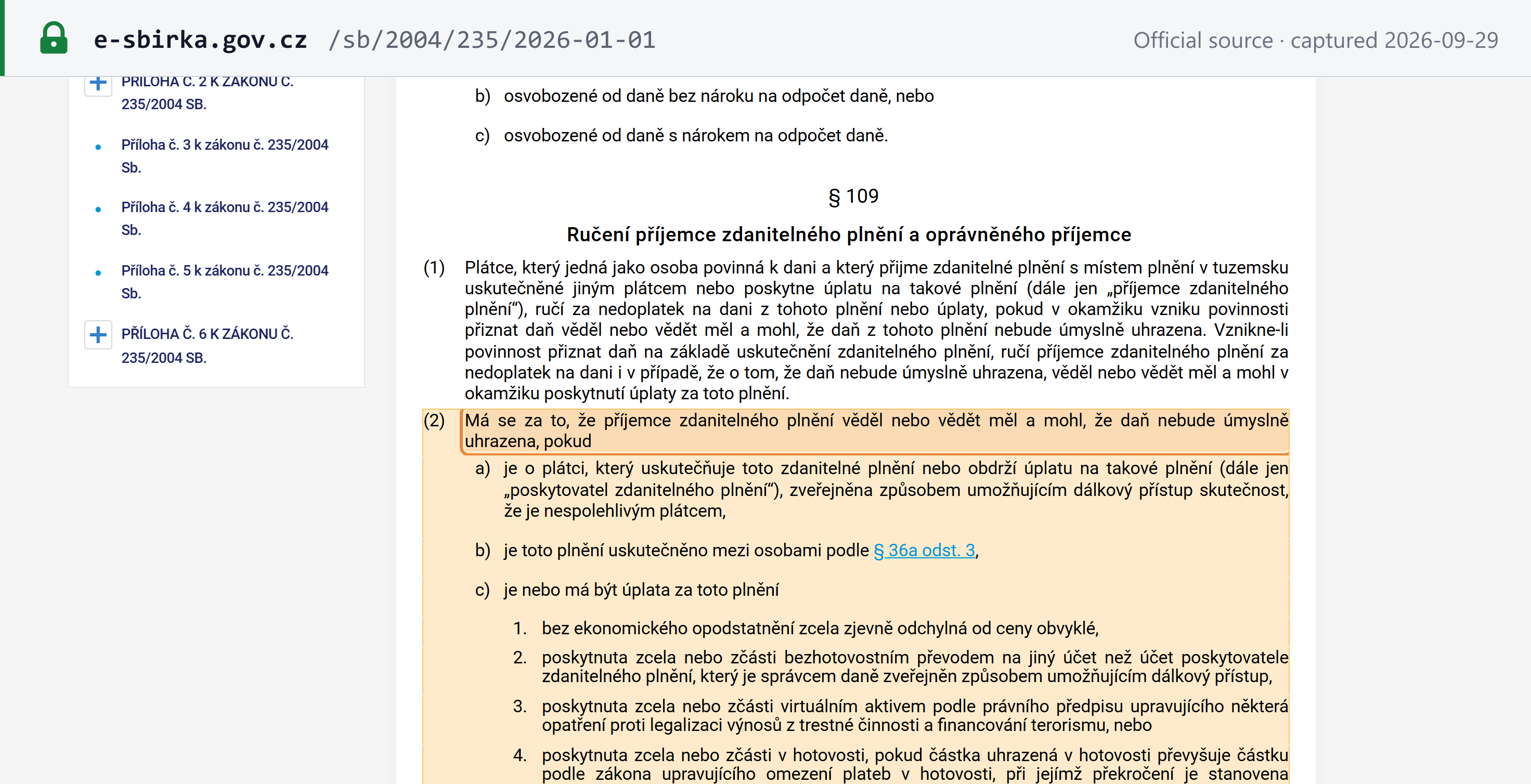
Guarantee liability, rewritten from 1 January 2025. A payer receiving a taxable supply in the Czech Republic from another payer guarantees (ručí) the supplier's unpaid VAT on it "pokud v okamžiku vzniku povinnosti přiznat daň věděl nebo vědět měl a mohl, že daň z tohoto plnění nebude úmyslně uhrazena" — if, when the tax became chargeable, it knew or should and could have known that the tax would deliberately not be paid (§ 109(1)). The recipient is presumed to have known — a rebuttable presumption ("má se za to") — in each of these separate cases (§ 109(2)): [1]
- the supplier is published as an unreliable payer (§ 109(2)(a));
- the parties are connected persons (§ 109(2)(b));
- the price is obviously off-market without economic reason, or is paid wholly or partly by transfer to an account not published in the register, whatever the amount, or in virtual assets, or in cash above the statutory cash-payment limit (§ 109(2)(c));
- a fuel supplier is not published as a registered fuel distributor (§ 109(2)(d)).
Either trigger is enough on its own: a published unreliable status, or payment to an unpublished account. Until 2024 the Act made the buyer liable outright, without a knowledge test, for paying to an unpublished account only above twice the cash-payment limit, and for buying from a published unreliable payer; that amount threshold and the foreign-account trigger are gone. The buyer can still pay the VAT directly to the supplier's tax office under § 109a. [1] [21]
Exemptions
Exempt supplies
- Exempt without a right to deduct (§ 51(1)): basic postal services; public broadcasting; financial services (§ 54); pension services; insurance (§ 55); supplies of land and of older buildings; letting of real estate (§ 56a); education (§ 57); health services and health goods (§ 58); social assistance; gambling; and other listed supplies. An option to tax exists for land, buildings and lettings. [1]
- Exempt with a right to deduct (§ 63(1)): intra-EU supplies of goods, exports, services to third countries, international passenger transport, books, and others. [1]
Exempt is not zero-rated. A business making supplies exempt without a right to deduct charges no VAT and cannot recover the VAT on the purchases used for them, because the right to deduct covers only the uses listed in § 72(1). A business making supplies exempt with a right to deduct also charges no VAT, but keeps its right to deduct. Mixed use gives a partial deduction (§ 72(9)). [1]
Special regimes
- Small-business exemption. The supplies of a Czech-established business that is not a payer are exempt (§ 50(1)) — the other side of the CZK 2,000,000 threshold. The EU cross-border SME scheme has applied since 2025 (§§ 109bb–109bt): businesses from other member states can use it in the Czech Republic, and Czech businesses using it abroad file quarterly notifications. See Lookuptax's EU VAT SME scheme guide. [1]
- Margin scheme for second-hand goods, works of art, collectors' items and antiques (§ 90); a global margin per period is allowed for items bought for up to CZK 1,000 each (§ 90(4)). [1]
- Travel services scheme, compulsory for a provider dealing with the customer in its own name (§ 89(1)). [1]
- Investment gold (§ 92). [1]
- Cash accounting — none. The VAT Act provides no cash-accounting scheme. [1]
Offences and penalties
Offences
- Tax evasion is a crime. Under § 240 of the Criminal Code (Act No. 40/2009 Sb.), whoever evades tax, VAT included, "ve větším rozsahu" (to a larger extent), or fraudulently obtains a tax advantage, faces 6 months to 3 years in prison or a ban on activity (§ 240(1)). The range is 2 to 8 years where the offence is committed with at least two others or to a considerable extent (§ 240(2)), and 5 to 10 years to a large extent, or to a considerable extent within an organised group operating in several states (§ 240(3)). Preparation is punishable (§ 240(4)). [18]
- Administrative breaches. Failing to register (Tax Procedure Code § 247a(1)(a)); filing a return late or not at all (§ 250); filing the control statement late or not at all (VAT Act § 101h); obstructing tax administration (§ 247; VAT Act § 101h(4)); and, for foreign persons, failing to appoint a service agent (VAT Act § 98b). [2]
- Showing VAT on a document makes the issuer liable to pay it, whether or not it was due (VAT Act § 108(4)(g)). [1]
Penalties
| Exposure | Figure | Cite |
|---|---|---|
| Failure to register (any registration duty) | Fine up to CZK 500,000 | Tax Procedure Code § 247a(1)(a) |
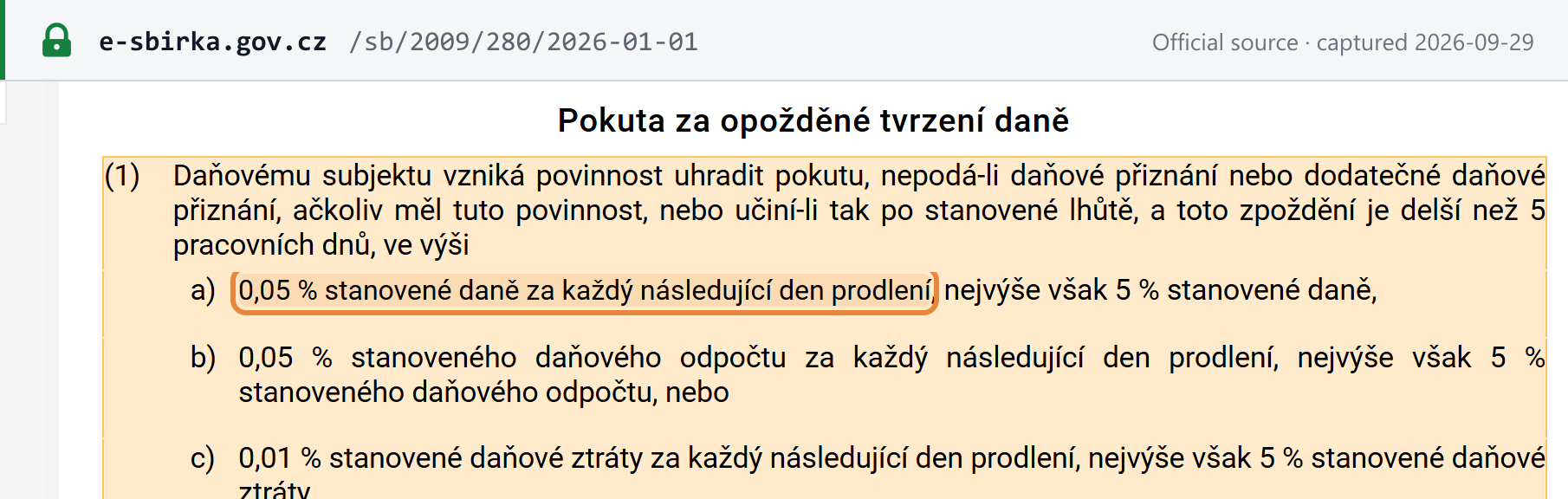
| Late return | 0.05% of the assessed tax per day, capped at 5%, where the delay exceeds 5 working days; not charged below CZK 1,000; at least CZK 500 if the return is never filed; never above CZK 300,000; halved if filed within 30 days of the deadline and it is the only late filing that year | § 250(1), (3)–(5), (7) |
| Late return claiming an excess deduction | 0.05% of the deduction per day, capped at 5% | § 250(1)(b) |
| Additional assessment by the tax office | Penalty (penále) of 20% of the tax increase or the deduction reduction; none where the payer's own supplementary return led to it | § 251(1), (4) |
| Late payment | Interest from the 4th day after the due date, at the Czech National Bank repo rate on the first day of the calendar half-year plus 8 percentage points a year | § 252(2), (4); Government Regulation No. 351/2013 Sb. § 2(1) |
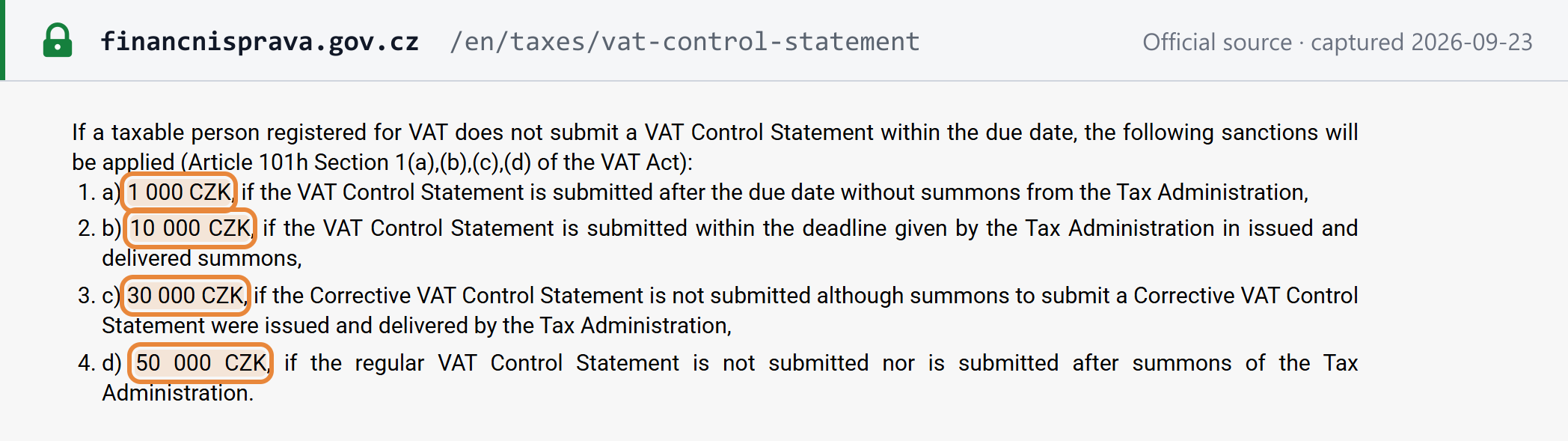
| Control statement | Fixed CZK 1,000 / 10,000 / 30,000 / 50,000 by type of failure; tiers 2–4 halved for individuals, quarterly filers and single-member s.r.o. owned by an individual; up to CZK 50,000 for not correcting after a summons; up to CZK 500,000 for serious obstruction; no fine for the first CZK 1,000-type or CZK 10,000-type delay in a calendar year | VAT Act § 101h(1)–(4), § 101j |
| No service agent (foreign person) | CZK 1,000 per day | VAT Act § 98b(3) |
| Obstruction / ignoring a summons | Procedural fine up to CZK 500,000 | Tax Procedure Code § 247(2) |
| Failure to issue a compliant invoice | The VAT Act sets no invoice-specific fine | — |
The repo rate moves, so the interest rate changes each half-year; check the Czech National Bank for the rate in force on the first day of the relevant half-year.
Frequently asked questions
Our Czech turnover passed CZK 2,000,000 in October — do we charge VAT from the next day?
Not by default. Under § 6(1) of the VAT Act, as amended from 1 January 2025, a business established in the Czech Republic whose domestic turnover exceeds CZK 2,000,000 in a calendar year becomes a VAT payer from 1 January of the following year. It must still apply for registration within 10 working days of crossing the amount (§ 94(1)). Two cases bring the date forward: if turnover passes CZK 2,536,500 in the same calendar year, you become a payer from the day after (§ 6(2)(b)); and you can choose to become a payer from the day after crossing CZK 2,000,000 by saying so in a timely application (§ 6(2)(a)). The test is the calendar year, not a rolling 12 months. [1] [3]
We are a German company selling goods from a Czech warehouse to Czech VAT payers — do we need a Czech VAT registration?
Not for those sales. Where a supplier that is not established in the Czech Republic and not registered there as a payer supplies goods to a Czech VAT payer, the customer declares the VAT (§ 108(3)(b)), and § 6c(1) leaves such supplies out of the registration trigger. You must register, with no threshold, from your first supply that the customer does not account for, such as a sale to a consumer that is not declared through the One-Stop Shop, and from your first intra-EU supply or transfer of your own goods dispatched from the Czech Republic (§ 6c(2)–(3)). The application is filed electronically within 10 working days of becoming a payer (§ 94(4)). [1] [1]
Our Czech supplier asked us to pay into a new bank account — is that a VAT risk?
Yes. Since 1 January 2025, a VAT payer is liable for its supplier's unpaid VAT if, when the tax became chargeable, it knew or should and could have known that the tax would deliberately not be paid (§ 109(1)). That knowledge is presumed, unless you prove otherwise, where the price is paid wholly or partly by transfer to an account that the tax office has not published in the VAT payer register (§ 109(2)(c)(2)), whatever the amount. It is separately presumed where the supplier is published as an unreliable payer (§ 109(2)(a)). Check the supplier's status and published accounts in the register before paying. [1]
We file VAT quarterly — why is the tax office fining us for a missing control statement?
Because a payer that is a legal person files the control statement (kontrolní hlášení) monthly, within 25 days of the month's end, whatever its VAT return period (§ 101e(1)), for every month in which it has transactions that the statement covers (§ 101c); only individuals file it with their return. The fines are fixed: CZK 1,000 for a late filing made without a summons, CZK 10,000 for one filed only after a summons, CZK 30,000 for not filing in response to a summons to amend, supplement or confirm data, and CZK 50,000 for not filing after a summons to file (§ 101h(1)). No fine arises for the first CZK 1,000-type delay, or the first CZK 10,000-type delay, in a calendar year (§ 101j). [1] [10]
Is EET 2.0 an e-invoicing mandate?
No. EET 2.0 is a sales-recording regime for personal and corporate income-tax payers: from 1 January 2027, each recorded sale is reported to the Financial Administration as it happens. Cash is always recorded, even when paid without personal contact; other payments made remotely, such as a customer paying an invoice by bank transfer from home or the office, are outside it, and it records no VAT amounts. The President signed the act on 17 September 2026; it was sent for publication in the Collection of Laws on 1 October 2026. The Czech Republic has no B2B or B2C e-invoicing mandate: an electronic invoice needs the customer's consent (VAT Act § 26(3)), and public contracting authorities may not reject an e-invoice that complies with the European standard EN 16931. [13] [14] [1] [12]
We are a US software company selling subscriptions to Czech consumers — what do we have to do?
Charge Czech VAT from the first sale: electronically supplied services to consumers are taxed where the customer is (§ 10i), and no registration threshold applies to a business without a Czech seat (§ 6c(1)). You can either declare the sales through the non-Union One-Stop Shop or register directly. If you register directly, the competent office is the Tax Office for the Moravian-Silesian Region (§ 93a(2)), and since 1 January 2025 a foreign person with no seat or establishment in the EU must appoint a service agent that has a statutory data box by the registration deadline, unless it has its own data box, and give an e-mail address in its application. Failing to appoint the agent costs CZK 1,000 for each day (§ 98b). [1] [7]
Can we issue invoices to Czech customers in euros?
Yes, but the VAT amount on the invoice must be stated in Czech koruna (§ 29(1)(l)). Convert it at the Czech National Bank's exchange-market rate or the European Central Bank's reference rate, as used by the person converting, valid on the day the obligation to declare the tax arises (§ 4(8)). The VAT Act sets no language rule for invoices, but the tax office can ask for a Czech translation of an invoice issued in a foreign language (§ 35(5)). [1]
Important websites
| Site | Purpose |
|---|---|
| MOJE daně | Tax portal: VAT registration, returns, control statement and EC Sales List (EPO electronic forms) |
| VAT payer register — Subjekty DPH | Check a DIČ, unreliable-payer status and the supplier's published bank accounts before paying |
| VIES | EU VAT-number check |
| Financial Administration — VAT (DPH) | VAT guidance and news |
| Registration for non-established persons (EN) | Registering a foreign business, including the 2025 service-agent rules |
| VAT control statement (EN) | Who files the kontrolní hlášení, deadlines and fines |
| One-Stop Shop (OSS / IOSS) | Registering for and filing the OSS schemes |
| Tax calendar | The year's filing and payment dates, with weekend shifts applied |
| Czech Customs | Import VAT for non-payers |
| e-Sbírka — VAT Act | The official consolidated text of Act No. 235/2004 Sb. |
| EET 2.0 | Sales recording from 2027 (income tax, not VAT) |
| Ministry of Finance — electronic invoicing | Accepted e-invoice formats and the B2G acceptance rules |
Also see Lookuptax's own Czech DIČ validator and how to verify a DIČ.
Recent changes
- 2026-09-17 — The President signed the EET 2.0 sales-recording act (income-tax payers, general effect 1 January 2027); it was sent for publication in the Collection of Laws on 1 October 2026. It is not VAT e-invoicing. The act also amends the VAT Act from 1 January 2027: non-alcoholic drinks in catering move to the 12% rate, the bad-debt limits rise to CZK 20,000 per receivable (CZK 100,000 per debtor a year, 3-month period) and the selected-car input-tax rules are repealed. (Chamber of Deputies) — see event — see event: catering drinks — see event: bad-debt and car rules
- 2026-07-01 — GFŘ guidance applies from this date: goods that have lost their commercial value can be donated without reversing the input-VAT deduction. (Finanční správa) — see event
- 2026-04-13 — The Financial Administration confirmed that an invoice received in a later period is deductible no earlier than that period. (Finanční správa) — see event
- 2025-01-01 — Act No. 461/2024 Sb. applied: the calendar-year threshold test and the CZK 2,536,500 next-day trigger; 10 working days to register; the quarterly-filing limit raised to CZK 15,000,000; § 109 guarantee liability rewritten around a knowledge test and presumptions; a service agent and e-mail address for non-EU foreign persons; the EU SME scheme. (Finanční správa)
- 2024-01-01 — Act No. 349/2023 Sb. applied: rates of 21% and 12% (the 10% rate abolished, 15% replaced by 12%); books exempt with a right to deduct. (Finanční správa)
- 2023-01-01 — The registration threshold rose from CZK 1,000,000 to CZK 2,000,000. (Finanční správa)
Scheduled, enacted: from 1 January 2027 the sales-records act (Sněmovní tisk 189) extends the 12% catering rate to non-alcoholic drinks generally, raises the bad-debt limits to CZK 20,000 per receivable and CZK 100,000 per debtor a year with a 3-month period, and repeals the selected-passenger-car input-tax rules. (Chamber of Deputies) — see event: catering drinks — see event: bad-debt and car rules
Pending, not law: print 218, a government bill amending the VAT Act to implement first ViDA elements (OSS from 1 January 2027, call-off stock repeal from 1 July 2028), awaits its second reading in the Chamber of Deputies, proposed for the session from 13 October 2026. (Chamber of Deputies) — see event
For the full chronology, see Czech Republic tax changes on Lookuptax.
Reference links
- e-Sbírka — Act No. 235/2004 Sb., on value added tax, consolidated from 1 January 2026
- e-Sbírka — Act No. 280/2009 Sb., Tax Procedure Code, consolidated from 1 January 2026
- GFŘ — Information on the changes to VAT payer status and registration from 1 January 2025, ref. 11977/25 (PDF)
- Finanční správa — Changes to VAT payer status and registration from 1 January 2025
- GFŘ — Information on the VAT rate changes from 1 January 2024 (PDF)
- Finanční správa — Amendment raising the registration threshold to CZK 2,000,000 from 1 January 2023
- Finanční správa — Notification for foreign persons (EN)
- Finanční správa — One-Stop Shop (OSS)
- GFŘ — Information on an unreliable VAT payer (EN, PDF)
- Finanční správa — VAT control statement (EN)
- Ministry of Finance — Electronic invoicing, basic information
- e-Sbírka — Act No. 134/2016 Sb., on public procurement, § 221
- EET 2.0 — Who must record sales
- Chamber of Deputies — Print 189 (EET 2.0), legislative history
- Finanční správa — Statement on the timing of the input-VAT deduction
- Finanční správa — VAT rules for donating goods, 2026
- e-Sbírka — Government Decree No. 361/2014 Sb., extended reverse charge
- e-Sbírka — Act No. 40/2009 Sb., Criminal Code, § 240
- e-Sbírka — Government Regulation No. 351/2013 Sb., on interest rates
- Finanční správa — Tax calendar
- e-Sbírka — Act No. 235/2004 Sb., version from 1 January 2024
- Chamber of Deputies — Print 218 (VAT Act amendment), legislative history
- EET 2.0 — Press release: the President signed the EET 2.0 act
Related Lookuptax pages: