Brazil VAT (CBS/IBS) guidelines
| FACTSHEET | |
|---|---|
| Country code | BR |
| Tax name | CBS (Contribuicao sobre Bens e Servicos) + IBS (Imposto sobre Bens e Servicos) — replacing ICMS, ISS, PIS, COFINS and IPI |
| Tax Authority | Receita Federal do Brasil (CBS, federal); Comite Gestor do IBS — CGIBS (IBS, state/municipal) |
Overview
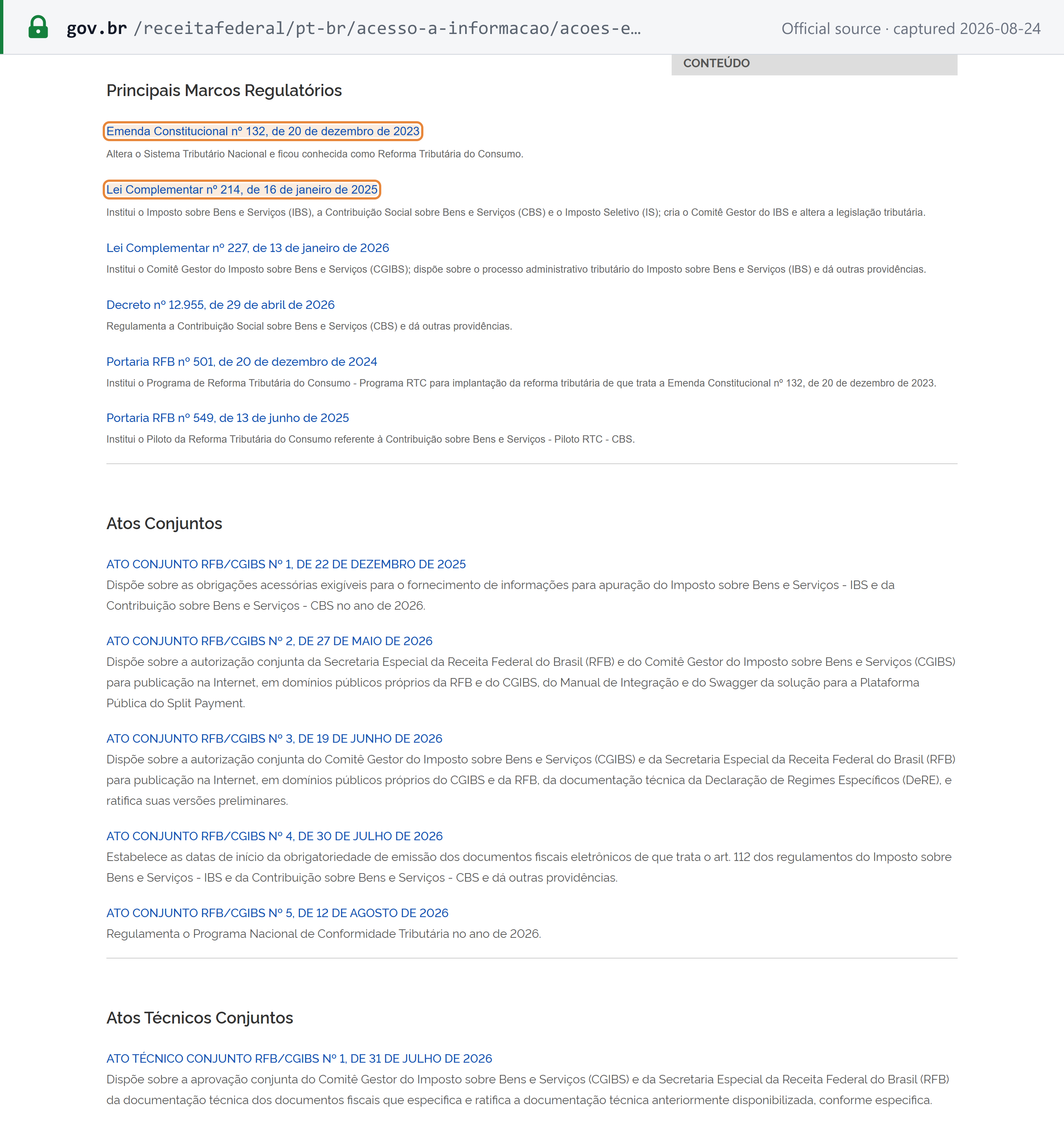
Brazil is mid-transition from a fragmented indirect-tax stack — ICMS (state tax on goods and some services), ISS (municipal services tax), PIS/COFINS (federal turnover contributions) and IPI (federal excise on manufactured goods) — to a dual VAT: a federal CBS (Contribuicao sobre Bens e Servicos) and a state/municipal IBS (Imposto sobre Bens e Servicos), alongside a Selective Tax (Imposto Seletivo, IS) on specific goods. The reform was created by Emenda Constitucional 132/2023 (20 December 2023) and regulated by Lei Complementar 214/2025 (16 January 2025), which also created the IBS Management Committee; Lei Complementar 227/2026 (13 January 2026) further institutes the Comite Gestor do IBS (CGIBS) and its administrative tax process. [1]
 Source snapshot captured 2026-08-24 — original
CBS is administered by Receita Federal do Brasil; IBS is administered by the Comite Gestor do IBS (CGIBS). Implementation is carried out under the Federal Revenue's Consumption Tax Reform Program (Portaria RFB no 501/2024), with a CBS pilot instituted by Portaria RFB no 549/2025. [1]
CNPJ and registration
- CNPJ (Cadastro Nacional da Pessoa Juridica) is Brazil's national taxpayer-registration number for legal entities, administered by Receita Federal do Brasil. [1]
- The obligation to register for a CNPJ is set out in Chapter II (articles 3 and 4) of Instrucao Normativa RFB no 2.119, of 6 December 2022. [2]
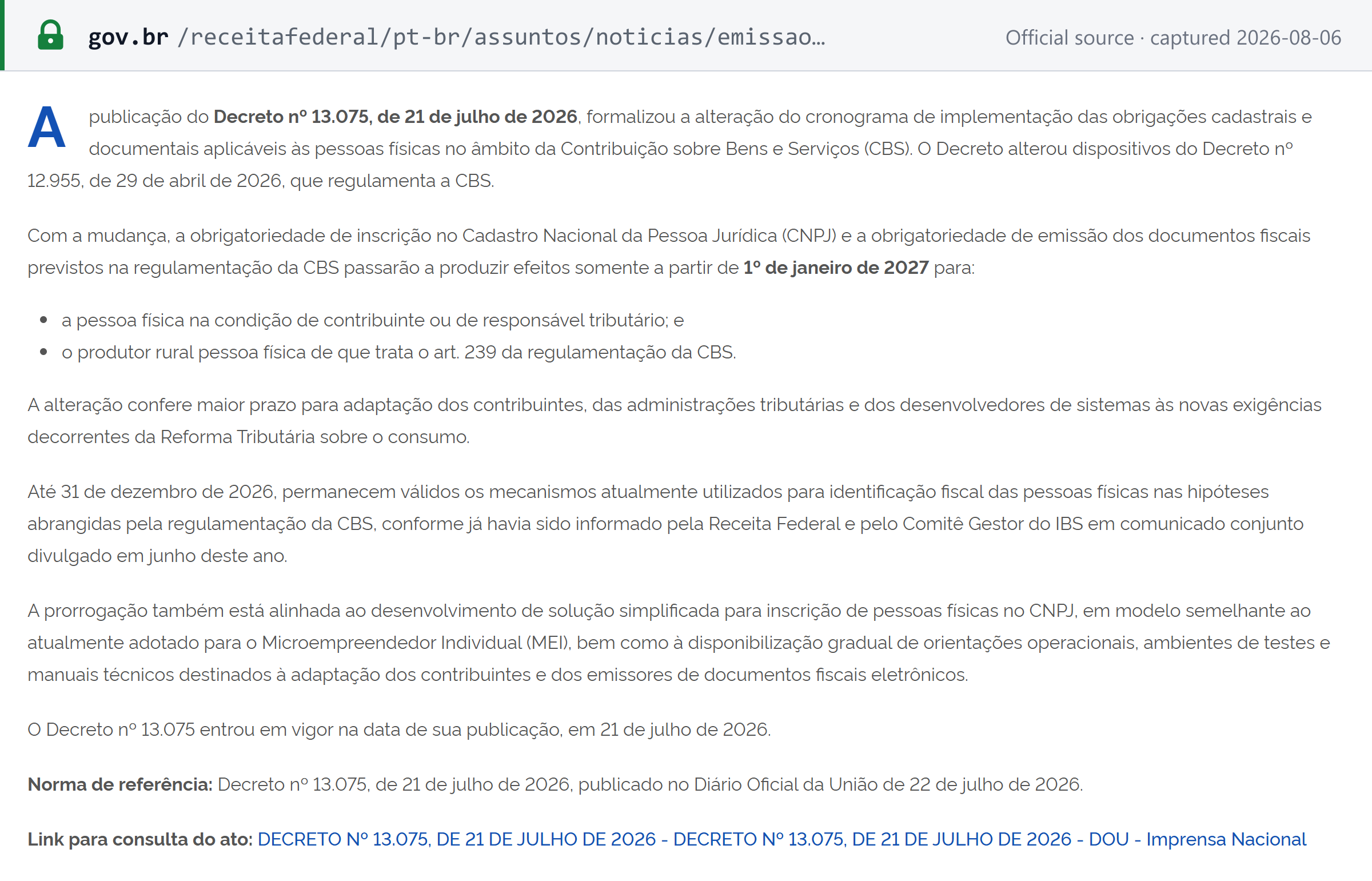
- From 1 January 2027: individual persons (pessoas fisicas) who are taxpayers of CBS and/or IBS must also register for a CNPJ and issue the fiscal documents provided for in the CBS regulations. [3] Receita Federal is explicit that this registration does not convert the individual into a legal entity — it exists solely to facilitate CBS/IBS assessment. [4]
- Both obligations were postponed from 1 July 2026 to 1 January 2027 by Decreto no 13.075, of 21 July 2026, which amends Decreto no 12.955, of 29 April 2026 (the CBS regulations) and applies the same deferral to the pessoa fisica rural producer covered by art. 239 of those regulations. Until 31 December 2026 the identification mechanisms currently used for individuals in the situations covered by the CBS regulations remain valid, so no individual has to hold a CNPJ to keep trading during the 2026 test year. Decreto no 13.075 entered into force on its publication date, 21 July 2026, and was published in the Diario Oficial da Uniao of 22 July 2026. [3]
- The nanoempreendedor category is separately waived from CNPJ registration and e-invoice issuance altogether, through 31 December 2028. Ato Conjunto RFB/CGIBS No. 6, de 28 de agosto de 2026 — jointly issued by Receita Federal and the Comite Gestor do IBS — dispenses the nanoempreendedor referred to in art. 25, caput, inciso IV of Decreto no 12.955/2026 and CGIBS Resolucao no 6/2026 from (i) registering in the unified-identification cadastre via CNPJ, and (ii) issuing the electronic fiscal documents the CBS/IBS regulations otherwise require. The waiver does not apply to a nanoempreendedor who opts into the regular IBS/CBS regime under art. 26, paragrafo 1, inciso II, of Lei Complementar no 214/2025. The Act entered into force on its publication date, 28 August 2026, and produces effects until 31 December 2028. This is distinct from the general pessoa-fisica CNPJ obligation above: a nanoempreendedor who stays in the simplified regime never needs a CNPJ for CBS/IBS purposes at all. [9] (signed text)
 Source snapshot captured 2026-08-06 — original
-
Businesses register through REDESIM, the national integrated business-registration system (viability check, tax inscription, then municipal/state licensing), which works together with the state Juntas Comerciais and DREI. [5]
-
Cooperative societies (sociedades cooperativas) can elect the specific IBS/CBS regime for 2027. Under article 271 of Lei Complementar 214/2025, cooperatives may opt for the specific regime, in which rates are reduced to zero on the operations expressly provided in law. Receita Federal and the Comitê Gestor do IBS announced the Joint Guidance on 18 September 2026: for effect in 2027 the option can be made in the Receita Federal Services Portal between 1 September and 31 October 2026, takes effect on 1 January 2027, and requires both registering the option and sending the list of members with their admission dates. [6] [7]
The Receita Federal "Orientacoes da Reforma Tributaria para 2026" page still reads "A partir de julho de 2026, as pessoas fisicas que sejam contribuintes da CBS e do IBS deverao se inscrever no CNPJ" (checked 28 July 2026). That sentence was superseded by Decreto no 13.075/2026 — the operative start date is 1 January 2027. Cite the Decreto or the Receita Federal news release, not the 2026 guidance page, for the start date.
Current rate picture and the CBS/IBS transition timeline
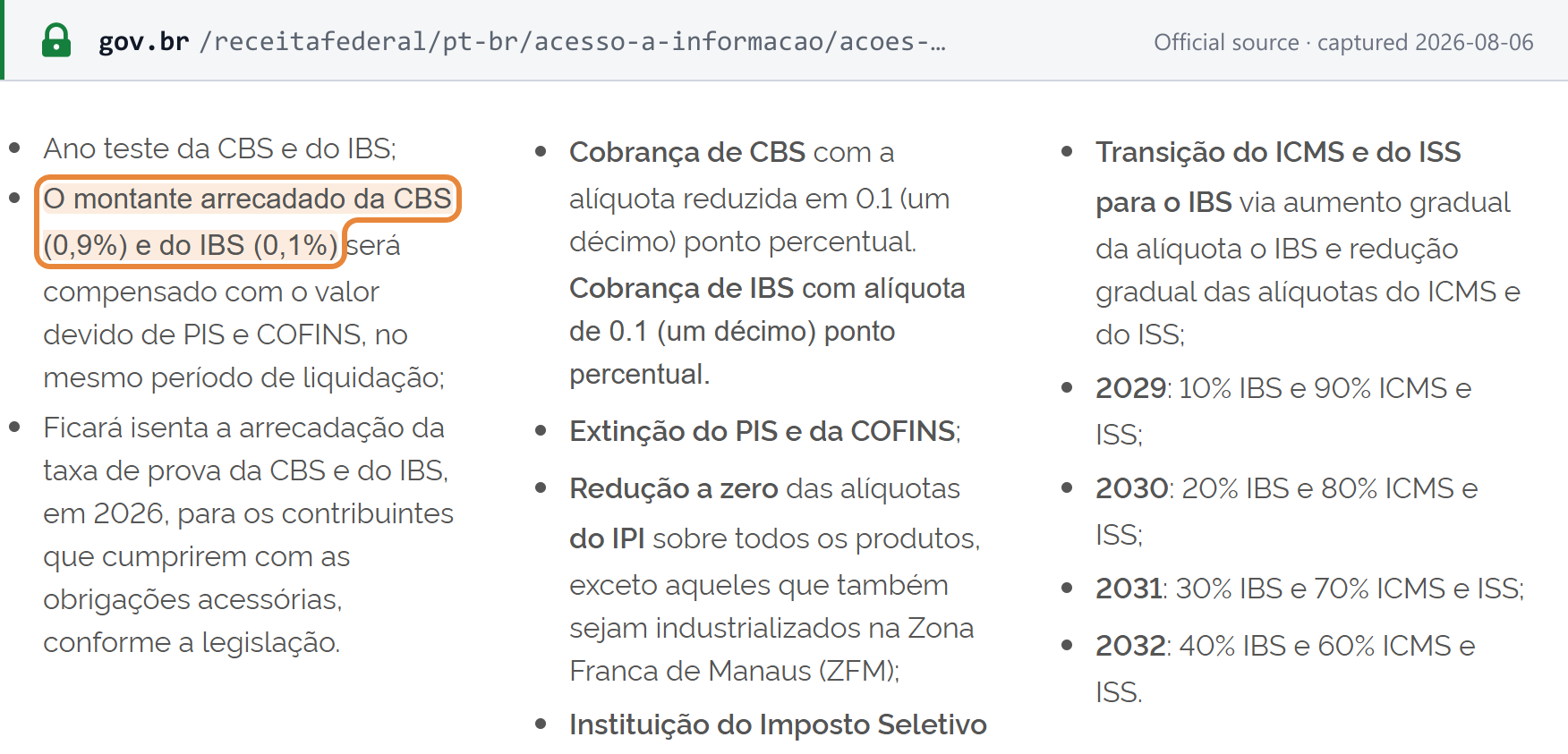
The reform phases in over several years. Confirmed milestones: [1]
| Period | What applies |
|---|---|
| 2026 (test year) | Combined 1% test rate — CBS 0.9% + IBS 0.1% — charged and shown on qualifying electronic fiscal documents. The amount is offset against the taxpayer's PIS/COFINS liability for the same period; a contributor who issues fiscal documents observing the current rules is dispensed from actually paying CBS/IBS. |
| 2027-2028 | PIS and COFINS are extinguished; IPI is reduced to zero (except for goods produced in the Manaus Free Trade Zone / Zona Franca de Manaus); the Selective Tax (Imposto Seletivo) is introduced. CBS begins to be charged at its reference rate less 0.1 percentage point — a substantial step up from the 0.9% test rate — while IBS remains at the 0.1% test rate. |
| 2029 | IBS phases in at 10% of the combined ICMS+ISS+IBS burden, with ICMS/ISS reduced correspondingly. |
| 2030 | IBS share rises to 20%. |
| 2031 | IBS share rises to 30%. |
| 2032 | IBS share rises to 40%. |
| 2033 | ICMS and ISS are fully extinguished; CBS, IBS and the Selective Tax become Brazil's consumption-tax system. |
 Source snapshot captured 2026-07-20 — original
This timeline is sourced directly from Receita Federal's official reform-explainer page; the eventual reference rates for CBS and IBS beyond the 2026 test year had not been fixed by law as of this guide's last update, so they are not stated here.
Registration thresholds
There is no turnover floor for ordinary CNPJ registration — that obligation follows from being classified as a CBS/IBS taxpayer, per Instrucao Normativa RFB no 2.119/2022 (arts. 3-4). [1] The most recent extension of this obligation is to individuals (pessoas fisicas) who are CBS/IBS taxpayers, who must register for a CNPJ from 1 January 2027 — postponed from 1 July 2026 by Decreto no 13.075/2026 (see CNPJ and registration, above). [2]
But a genuine minimum-turnover exemption does exist for CBS/IBS itself. Under article 26 of Lei Complementar 214/2025, a natural person whose gross revenue is below 50% of the MEI ceiling — currently around R$40,500 a year, half of the R$81,000 MEI limit — is a "nanoempreendedor": not a CBS/IBS taxpayer at all, not required to formalise, and not liable to collect IBS or CBS. Ato Conjunto RFB/CGIBS No. 6, de 28 de agosto de 2026 makes this concrete: it waives the nanoempreendedor from CNPJ registration and from issuing the CBS/IBS electronic fiscal documents through 31 December 2028, unless the individual opts into the regular IBS/CBS regime (see CNPJ and registration above). Separately, MEI retains its differentiated treatment, with no change to its obligations in 2026. [3] [9] (signed text)
The existing Simples Nacional sublimit now also gates IBS. Simples Nacional's R$3.6 million gross-revenue sublimit — the point above which a Simples optante must start collecting certain taxes under the regular regime rather than the unified Simples payment — previously applied only to ICMS and ISS. Resolução CGSN nº 190/2026 (dated 4 August 2026, published in the Diário Oficial da União of 10 August 2026, seção 1-A, página 1 — not 12 August 2026, Receita's press-release date, nor 10 August alone, which was only the gazette date) extends that same R$3.6 million sublimit to also govern IBS collection, effective 1 January 2027, and amends Resolução CGSN nº 140, de 22 de maio de 2018. A Simples Nacional company should therefore track projected gross revenue against R$3.6 million to know when ICMS, ISS and now IBS move outside the unified Simples payment. (Source: Receita Federal do Brasil / Comite Gestor do Simples Nacional (SIJUT), normasinternet2.receita.fazenda.gov.br) The same resolution separately opened a 1–30 September 2026 election window for how Simples Nacional companies collect CBS and IBS from 2027 (pure-Simples vs. hybrid regular-regime collection) — a distinct provision, not detailed on this page.
Invoice requirements
Brazil has no free-form invoice. Every taxable operation travels on a standardised electronic fiscal document whose layout is fixed by federal technical note and authorised by the tax administration before the sale can proceed. The compliance question is therefore not "does my invoice carry the right fields" but "does my XML validate against the current layout version".
Which document applies
| Document | Covers |
|---|---|
| NF-e | Goods |
| NFC-e | Consumer sales (retail, presencial) |
| NFS-e | Services |
| CT-e | Transport |
| NFCom | Communications |
| NF3e | Electricity |
| BP-e | Passenger transport |
NFS-e Nacional: mandatory issuance date for Simples Nacional ME/EPP
This is a separate obligation from the IBS/CBS field-population dates in the table below — it concerns which platform micro and small enterprises must use to issue the NFS-e itself, not which tax fields the document carries.
Resolução CGSN nº 191/2026 (dated 4 August 2026, published in the Diário Oficial da União of 10 August 2026, seção 1-A, página 8 — not 12 August 2026, which was only Receita's press-release date) requires micro and small enterprises (ME/EPP) opting for Simples Nacional that render services subject to NFS-e to issue that invoice through the Emissor Nacional da NFS-e (web application or API integration) from 1 November 2026. The resolution expressly revoked Resolução CGSN nº 189/2026, which had set the original date at 1 September 2026 — a two-month postponement, not a new mandate. Resolução CGSN nº 191/2026 amends Resolução CGSN nº 140, de 22 de maio de 2018. (Source: Receita Federal do Brasil / Comite Gestor do Simples Nacional (SIJUT), normasinternet2.receita.fazenda.gov.br)
This is distinct from the 1 January 2027 date in the table below, which is when Simples Nacional optantes must start populating the IBS/CBS fields on every DF-e type under Ato Conjunto RFB/CGIBS no 4 — that date is unchanged by Resolução CGSN nº 191/2026.
What the printed document looks like
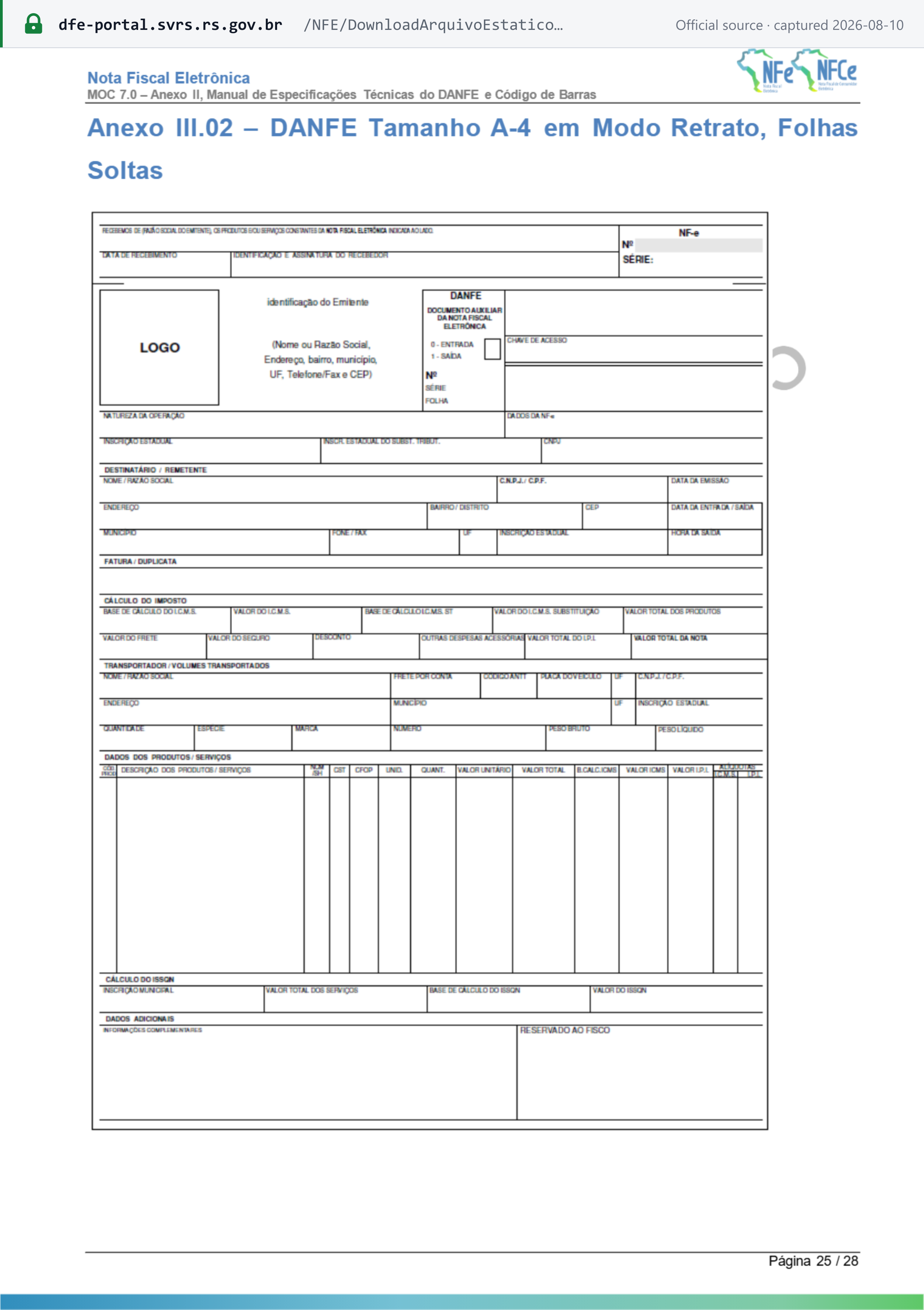
The NF-e itself is XML, so there is nothing to look at — what a buyer, a driver or an auditor actually handles is the DANFE (Documento Auxiliar da Nota Fiscal Eletrônica), the printed representation. Unusually among the jurisdictions in this guide set, Brazil prescribes that representation down to block positions and minimum type sizes, in MOC 7.0 Anexo II, Manual de Especificações Técnicas do DANFE e Código de Barras. Anexo III.02 of that manual is the A-4 portrait model reproduced below.
Two things about it are worth reading closely. First, the top strip is a receipt stub, not part of the invoice: RECEBEMOS DE … OS PRODUTOS E/OU SERVIÇOS CONSTANTES DA NOTA FISCAL ELETRÔNICA INDICADA AO LADO, with a date and signature line for the recipient. Second, the CHAVE DE ACESSO block beside the DANFE title is the load-bearing field: it carries the 44-digit access key, printed and as a CODE-128C barcode, and it is what ties the paper back to the authorised XML. A DANFE is not itself the fiscal document — it is a pointer to one, which is why the manual governs the barcode as tightly as the layout.
The model also shows the 0 - ENTRADA / 1 - SAÍDA direction box, the DESTINATÁRIO / REMETENTE block, the CÁLCULO DO IMPOSTO row of ICMS bases and totals, the TRANSPORTADOR / VOLUMES TRANSPORTADOS block that makes the DANFE double as a goods-movement document, and RESERVADO AO FISCO. The reform fields described below land inside this same frame rather than replacing it.
 Source snapshot captured 2026-08-10 — original, MOC 7.0 Anexo II p.25
The manual is distributed by the SEFAZ Virtual do Rio Grande do Sul DFe portal, an official state distribution of the same federal document — the Portal Nacional serves it only through a session-gated download that this guide does not attempt to work around.
The layout is a moving target
The NF-e/NFC-e layout is being reworked for the consumption tax reform under Nota Técnica 2025.002-RTC, maintained jointly by the Comitê Gestor do IBS and ENCAT, adding the IBS, CBS and Imposto Seletivo (IS) fields, events and validation rules. From 1 January 2026 these documents must show CBS and IBS itemised per operation. [1] [2]
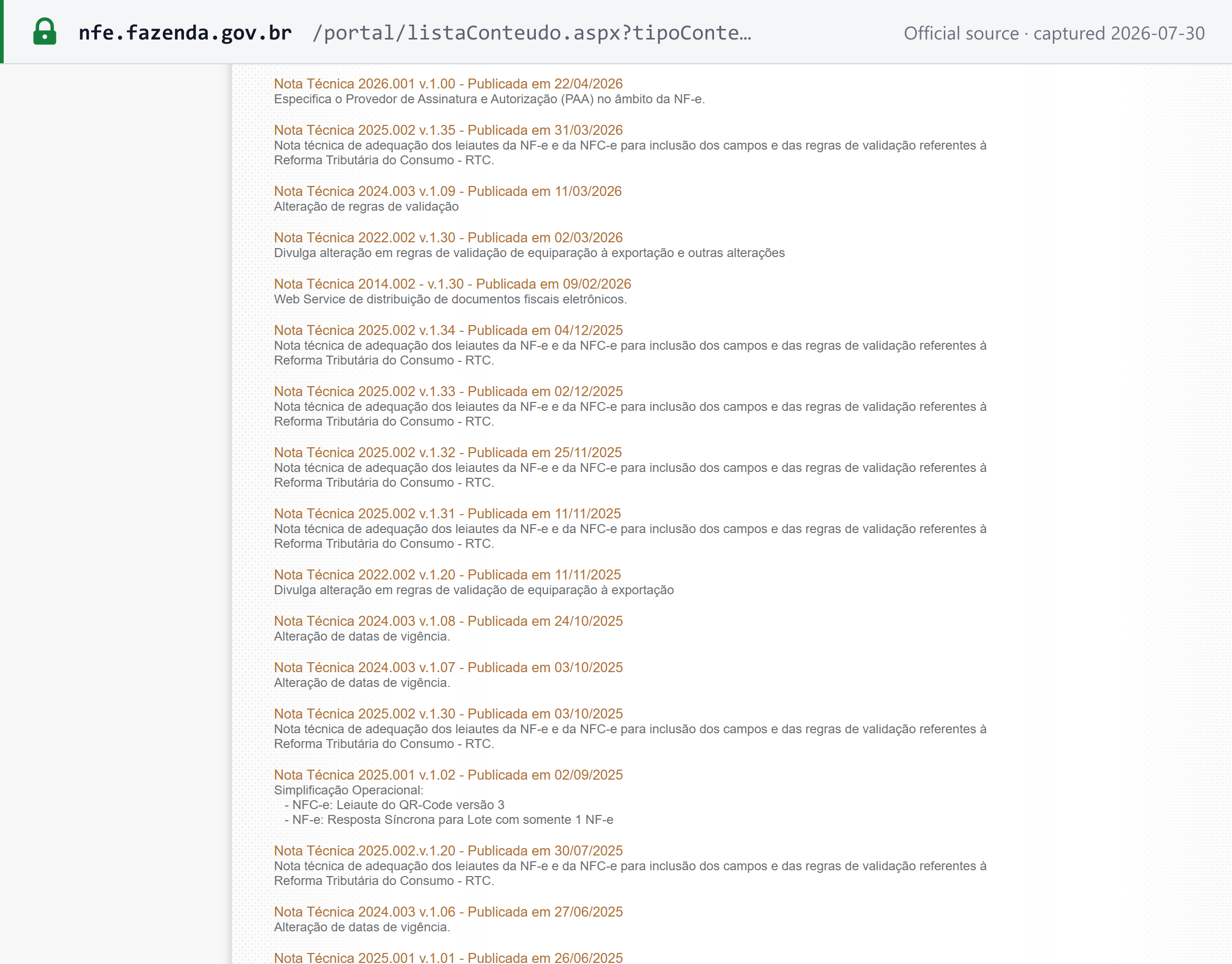 Source snapshot captured 2026-07-30 — original
NT 2025.002 is not a document you read once. The Portal Nacional da NF-e shows it revised repeatedly through the transition — v.1.20 (30 July 2025), v.1.30 (3 October 2025), then v.1.31, v.1.32, v.1.33, v.1.34 in November and December 2025, reaching v.1.35 on 31 March 2026. Roughly a revision a month at peak. Any integration built against a fixed copy of the note will drift out of validity; track the version list on the portal rather than a cached PDF. [2]
Brazil is the one country in this guide set with a legally prescribed invoice layout. The DANFE — the paper representation of the NF-e — is specified in Anexo II of the Manual de Orientação do Contribuinte, which tabulates every field's height, width and position in centimetres from the page origin, and requires that the arrangement of fields follow the relevant annex. Four blank forms are published: A4 portrait and landscape, each in loose-leaf and continuous-stationery versions. The obligation is anchored in Ajuste SINIEF 07/05. [6]
No snapshot is embedded for it: the Portal Nacional da NF-e serves the manual as a forced file download rather than a viewable page, so it cannot be captured in a browser the way our other source snapshots are. Open the link above and turn to the Anexo III.02–III.05 pages at the end.
The reformed DANFE does not exist yet. NT 2025.002-RTC v1.50 (June 2026) says of the DANFE that changes to display the new taxes "estão em estudo, e serão publicadas em uma nova versão desta Nota Técnica" — under study, to be published in a future version. Until then the classic DANFE layout stands, and there is no official picture of a CBS/IBS-era DANFE to work from. [7]
Related notes worth watching alongside it: NT 2026.001 (22 April 2026) specifying the Provedor de Assinatura e Autorização (PAA) for NF-e, and NT 2025.001 on operational simplification, including NFC-e QR-Code layout version 3. [2]
Mandatory start dates for the IBS/CBS fields, by document type
Ato Conjunto RFB/CGIBS no 4, de 30 de julho de 2026 — jointly issued by Receita Federal do Brasil and the Comite Gestor do IBS, in force from its publication in the Diario Oficial da Uniao — fixes the date each electronic fiscal document type must start carrying the IBS/CBS fields required by art. 112 of the CBS and IBS regulations (Decreto no 12.955/2026 and Resolucao CGIBS no 06/2026). The obligation attaches to generating facts (fatos geradores) occurring on or after each date: [3]
| Start date | Document types |
|---|---|
| 3 August 2026 | NF-e (modelo 55), NFC-e (modelo 65), CT-e, CT-e OS, MDF-e, GTV-e, NF3e, DC-e, NFS-e Via, and BP-e not otherwise classified below |
| 1 October 2026 | NFCom, DIR, the DeRE "Eventos de Tabela do Contribuinte", and the NFS-e supplies not covered by the other NFS-e dates (art. 1, III, "d") |
| 15 November 2026 | DeRE "Eventos Periodicos Mensais" (D-1101, D-1106, D-1121, D-2101, D-1198, D-1199) — the first submission covers the October 2026 filing period |
| 1 December 2026 | Most remaining NFS-e supplies (digital-platform services, ISS subitems 1.03/1.05/1.09/16.01, intangible-goods supplies, condominium charges, movable/immovable-property leases, and unclassified services), semi-urban/metropolitan and air BP-e, NFGas, NFAg, NF-e ABI, and (art. 1 §4) NF-e for a non-ICMS-taxpayer IBS/CBS taxpayer moving goods or handling returns |
| 1 January 2027 | Simples Nacional optantes, for every document type above (art. 1 §1); Duimp, including NF-e for imports of tangible goods, which follows the Duimp date instead of the general NF-e date (art. 1 §3); NF-e recording supplies taxed on a monofasica basis (art. 1 §2); and any remaining DeRE events not listed above |
Coverage summaries of this Ato Conjunto (including the trade press) round it to four dates. The text itself carries three narrower carve-outs worth checking against your own document mix: DeRE's monthly recurring events start 15 November 2026, not October or December; import of tangible goods follows the Duimp date (1 January 2027) instead of NF-e's general 3 August 2026 date (art. 1 §3); and an NF-e issued by an IBS/CBS taxpayer who is not an ICMS taxpayer, for goods movements or returns, only becomes mandatory on 1 December 2026 (art. 1 §4). [3]
Article 2 of the same Ato Conjunto committed RFB and CGIBS to publish, within 30 days, a further joint act creating a 2026 compliance program for these obligations. The act that followed is Ato Conjunto RFB/CGIBS No. 5, de 12 de agosto de 2026 (published and in force 13 August 2026), which regulates the Programa Nacional de Conformidade Tributaria (PNCT) for 2026 — see National Tax Compliance Program (PNCT) for 2026 below.
On 1 August 2026, Receita Federal and the Comite Gestor do IBS announced that they would relax, by a joint Ato Técnico Conjunto, the requirement to complete CBS/IBS information on electronic fiscal documents. [4] The measure, Ato Técnico Conjunto nº 01/2026, only defers the start of the IBS/CBS validation rules originally due on 3 August 2026: NF-e, NFC-e, CT-e, CT-e OS, GTV-e, BP-e, NF3e and NFCom are still authorised even when some CBS/IBS fields are missing. On 6 August 2026 the two bodies clarified that "não houve suspensão da obrigatoriedade" — the obligation was not suspended — and that the schedule in the table above remains valid and unchanged. See Brazil e-invoicing for more. [CGIBS]
During the transition
Because the CBS/IBS transition runs alongside the legacy ICMS/ISS regime (see Current rate picture and the CBS/IBS transition timeline above), documents issued in the transition years must carry both the legacy and the new tax fields. Treat the 2026 test-rate year as a validation exercise for your XML pipeline, not as an optional phase.
Split payment: new NF-e/NFC-e group YC
Nota Tecnica 2026.006, version 1.00, published by the Portal Nacional da NF-e in August 2026, creates a new NF-e and NFC-e layout group YC, carrying information that links the fiscal document to its split-payment transaction, together with a related event of code 110300 — ahead of Brazil's IBS/CBS split-payment mechanism, which is planned to enter force from 2027. Homologation testing opens 5 October 2026 and production implementation is scheduled for 3 November 2026, but filling the new fields is not required in the production environment during 2026. [8]
E-invoicing status
Brazil has a long-standing, broad mandate for standardized electronic fiscal documents, including NF-e (goods), NFC-e (consumer sales), NFS-e (services), CT-e (transport), NFCom (communications), NF3e (electricity) and BP-e (passenger transport). [1]
As part of the consumption tax reform, these documents must show CBS and IBS itemized per operation from 1 January 2026. [1] The underlying NF-e/NFC-e technical layout is being updated under Nota Tecnica 2025.002-RTC, maintained jointly by the Comite Gestor do IBS and ENCAT, to add the IBS, CBS and Imposto Seletivo (IS) fields, events and validation rules the reform requires. [2]
That 1 January 2026 date is when the reform's test regime and the layout requirement begin in principle; the mandatory issuance date for each document type is staggered, not universal. Ato Conjunto RFB/CGIBS no 4, de 30 de julho de 2026, phases it in from 3 August 2026 (NF-e, NFC-e, CT-e and most other current document types) through 1 October 2026, 15 November 2026, 1 December 2026 and 1 January 2027 (Simples Nacional optantes, Duimp, monofasica-taxed NF-e and the last DeRE events) — see Mandatory start dates for the IBS/CBS fields, by document type above for the full breakdown. [3] Ato Técnico Conjunto nº 01/2026 deferred only the automatic rejection of documents missing the fields; the obligation and these dates are unchanged — see the callout above. [CGIBS]
National Tax Compliance Program (PNCT) for 2026
Ato Conjunto RFB/CGIBS No. 5, de 12 de agosto de 2026 — signed jointly by Receita Federal do Brasil and the Comite Gestor do IBS — regulates the Programa Nacional de Conformidade Tributaria (PNCT) for 2026 under articles 471-A to 471-C of Lei Complementar no 214, de 16 de janeiro de 2025, with the object of assisted adaptation of taxpayers to fiscal-document issuance obligations under the reform. [1]
- Taxpayers are treated as enrolled in the program where they comply with their IBS and CBS ancillary obligations.
- Taxpayers with inconsistencies in their IBS/CBS fiscal documents remain enrolled where they show progressive correction, respond to notices from the tax authorities in time, correct the communicated inconsistencies by 31 December 2026, and keep a designated accountant of record.
- The Act entered into force on its publication in the Diário Oficial da União, 13 August 2026 (Edição 152-A). [1]
No further action is required beyond monitoring: this is an assisted-adaptation program, not a new filing or payment obligation, but a taxpayer that receives an inconsistency notice should track the 31 December 2026 correction deadline closely.
Recent changes
- 2026-09-18 — Receita Federal and the Comitê Gestor do IBS announced the Joint Guidance opening the option for cooperative societies (art. 271, Lei Complementar 214/2025) to elect the specific IBS/CBS regime: the option can be made in the Receita Federal Services Portal between 1 September and 31 October 2026, takes effect on 1 January 2027, and requires registering the option and sending the list of members with admission dates. See CNPJ and registration. (Receita Federal do Brasil) — see event
- 2026-08-28 — Ato Conjunto RFB/CGIBS No. 6, de 28 de agosto de 2026, waives the nanoempreendedor category from registering for CNPJ and from issuing CBS/IBS electronic fiscal documents, through 31 December 2028; the waiver does not apply to a nanoempreendedor who opts into the regular IBS/CBS regime. (Comite Gestor do IBS) — see issue
- 2026-11-01 — Resolução CGSN nº 191/2026 (dated 4 August 2026; published DOU 10 August 2026, seção 1-A, página 8) postpones from 1 September 2026 to 1 November 2026 the date from which Simples Nacional micro and small enterprises (ME/EPP) must issue the national-standard NFS-e via the Emissor Nacional da NFS-e; the resolution expressly revokes Resolução CGSN nº 189/2026, which had set the original September date. (Receita Federal do Brasil) — see issue
- 2027-01-01 — Resolução CGSN nº 190/2026 (dated 4 August 2026; published DOU 10 August 2026, seção 1-A, página 1) extends the existing R$3.6 million Simples Nacional sublimit — previously applied only to ICMS and ISS — to also govern IBS collection, effective 1 January 2027; the same resolution separately opened a 1–30 September 2026 election window for how Simples Nacional companies collect CBS/IBS from 2027 (a distinct provision, not detailed here). (Receita Federal do Brasil) — see issue
- 2026-10-05 — Nota Tecnica 2026.006 v1.00 created a new NF-e/NFC-e layout group YC, carrying information linking the fiscal document to its split-payment transaction, together with a related event 110300, ahead of the IBS/CBS split-payment mechanism; homologation testing opens 5 October 2026, production implementation is 3 November 2026, and the fields need not be populated in production during 2026. (Portal Nacional da NF-e / Receita Federal do Brasil) — see issue
- 2026-08-12 — Ato Conjunto RFB/CGIBS No. 5, de 12 de agosto de 2026, regulates the Programa Nacional de Conformidade Tributaria (PNCT) for 2026 under arts. 471-A to 471-C of Lei Complementar 214/2025: taxpayers stay enrolled if they comply with IBS/CBS ancillary obligations, or — where inconsistencies are flagged — show progressive correction, respond to notices in time, correct communicated inconsistencies by 31 December 2026, and keep a designated accountant of record. (Receita Federal do Brasil / CGIBS) — see issue
- 2026-08-06 — Ato Técnico Conjunto nº 01/2026 deferred only the start of the IBS/CBS validation rules originally due on 3 August 2026, so NF-e, NFC-e, CT-e, CT-e OS, GTV-e, BP-e, NF3e and NFCom are authorised even when some CBS/IBS fields are missing; Receita Federal and the Comite Gestor do IBS stated on 6 August 2026 that the obligation to show CBS/IBS under Ato Conjunto RFB/CGIBS No. 4 was not suspended and the schedule is unchanged. (Comite Gestor do IBS) — see issue
- 2027-01-01 — Decreto no 13.075, of 21 July 2026, postpones to 1 January 2027 both mandatory CNPJ registration and the issuance of CBS fiscal documents by individuals (pessoas fisicas) who are CBS taxpayers, and by pessoa fisica rural producers; existing individual fiscal-identification mechanisms stay valid until 31 December 2026 (updated from 1 July 2026). (Receita Federal do Brasil) — see issue
- 2026-08-03 — Ato Conjunto RFB/CGIBS no 4, de 30 de julho de 2026, fixed the mandatory start date, per document type, for issuing DF-e with the IBS/CBS fields required by art. 112 of the CBS/IBS regulations: 3 August 2026 for NF-e, NFC-e, CT-e, CT-e OS, MDF-e, GTV-e, NF3e, DC-e, NFS-e Via and unclassified BP-e; 1 October 2026 for NFCom, DIR and certain NFS-e/DeRE events; 15 November 2026 for DeRE's monthly recurring events; 1 December 2026 for most remaining NFS-e, air/metro BP-e, NFGas, NFAg and NF-e ABI; and 1 January 2027 for Simples Nacional optantes, Duimp, monofasica-taxed NF-e and the remaining DeRE events. (Receita Federal do Brasil / Comite Gestor do IBS) — see issue
- 2026-08-03 — Electronic fiscal documents must carry the IBS/CBS fields, including the 1% test rate (IBS 0.1% + CBS 0.9%), from 3 August 2026 for NF-e, NFC-e, CT-e and the other first-wave documents, with other types phased to 1 January 2027 under Ato Conjunto RFB/CGIBS nº 4. During the earlier adaptive period under Ato Conjunto RFB/CGIBS nº 1/2025, leaving the fields blank caused neither fines nor document rejection. The 1% is the test rate the documents must show, not a penalty; fines for IBS/CBS ancillary-obligation failures are the ones listed in art. 341-G of Lei Complementar 214/2025. Automatic rejection of documents missing the fields has been deferred by Ato Técnico Conjunto nº 01/2026 — see Mandatory start dates. (Ato Conjunto RFB/CGIBS nº 4; Comite Gestor do IBS; Comite Gestor do IBS — validation deferral) — see issue
Reference links
- Receita Federal — Entenda a Reforma Tributaria do Consumo
- Receita Federal — Legislacao da Reforma Tributaria do Consumo (Principais Marcos Regulatorios)
- Receita Federal — Orientacoes da Reforma Tributaria para 2026
- Receita Federal — Quem esta obrigado a se inscrever no CNPJ
- Receita Federal — Emissao do CNPJ e de documentos fiscais por pessoas fisicas contribuintes da CBS comecara em 1o de janeiro de 2027 (Decreto no 13.075/2026)
- REDESIM — Registro de empresas
- Portal Nacional da NF-e — Notas Tecnicas
- Ato Conjunto RFB/CGIBS no 4, de 30 de julho de 2026 (mandatory start dates for IBS/CBS fields on DF-e)
- Receita Federal — Receita Federal e CGIBS flexibilizarao obrigatoriedade de informacoes em documentos fiscais (announced suspension of CBS/IBS fields, 1 August 2026)
- Portal Nacional da NF-e — Nota Tecnica 2026.006 v1.00 (split-payment group YC)
- Receita Federal / CGIBS — Ato Conjunto RFB/CGIBS No. 5, de 12 de agosto de 2026 (Programa Nacional de Conformidade Tributaria 2026)
- Receita Federal — Simples Nacional: NFS-e Nacional sera obrigatoria para ME e EPP a partir de 1o de novembro de 2026 (Resolucao CGSN no 191/2026)
- Receita Federal — CGSN atualiza regras do Simples Nacional para adequacao a Reforma Tributaria do Consumo (Resolucao CGSN no 190/2026 — R$3,6 milhoes sublimite passa a incluir o IBS)
- Consulta de normas — Resolucao CGSN no 190, de 4 de agosto de 2026
- Consulta de normas — Resolucao CGSN no 191, de 4 de agosto de 2026
- Comite Gestor do IBS — Receita Federal do Brasil e o Comite Gestor do IBS publicam norma que estabelece dispensas para o nanoempreendedor (Ato Conjunto RFB/CGIBS No. 6, de 28 de agosto de 2026) — signed text (PDF)
Frequently Asked Questions
What is Brazil's CBS/IBS reform replacing?
Emenda Constitucional 132/2023 (20 December 2023) and Lei Complementar 214/2025 (16 January 2025) replace ICMS, ISS, PIS, COFINS and IPI with a dual VAT: CBS, a federal tax administered by Receita Federal do Brasil, and IBS, a state/municipal tax administered by the Comite Gestor do IBS (CGIBS), plus a Selective Tax (IS) on specific goods. [1]
What is the 2026 test rate for CBS and IBS?
CBS at 0.9% and IBS at 0.1% (combined 1%), shown on qualifying electronic fiscal documents. The amount is offset against the taxpayer's PIS/COFINS liability for the same period, so a contributor who follows the current rules has no real additional CBS/IBS payment in 2026. [1]
Are nanoempreendedores exempt from CNPJ registration and e-invoicing in Brazil?
Yes, through 31 December 2028. Ato Conjunto RFB/CGIBS No. 6, de 28 de agosto de 2026 waives the nanoempreendedor referred to in art. 25, caput, inciso IV of Decreto no 12.955/2026 and CGIBS Resolucao no 6/2026 from registering in the unified-identification cadastre via CNPJ and from issuing the electronic fiscal documents the CBS/IBS regulations otherwise require. The waiver does not apply to a nanoempreendedor who opts into the regular IBS/CBS regime under art. 26, paragrafo 1, inciso II, of Lei Complementar no 214/2025. The Act took effect on its publication date, 28 August 2026, and produces effects until 31 December 2028. [1] (signed text)
Do individuals (pessoas fisicas) need to register for a CNPJ in Brazil?
Only if they are taxpayers of CBS and/or IBS — and not yet. Decreto no 13.075, of 21 July 2026, postponed to 1 January 2027 both the mandatory CNPJ registration and the obligation to issue the fiscal documents required by the CBS regulations for CBS-taxpayer individuals and for pessoa fisica rural producers (art. 239 of the CBS regulations); both had been due to start on 1 July 2026. Until 31 December 2026 the identification mechanisms currently used for individuals remain valid. [1] When it does apply, the registration is purely to facilitate CBS/IBS assessment — it does not convert the individual into a legal entity. [2]
How long does Brazil's ICMS/ISS-to-IBS transition take?
The transition runs from the 2026 test year to full replacement in 2033. In 2027-2028, PIS and COFINS are extinguished, IPI is zeroed (except for goods from the Manaus Free Trade Zone), and the Selective Tax is introduced. IBS's share of the combined ICMS+ISS+IBS burden then rises in fixed steps — 10% (2029), 20% (2030), 30% (2031), 40% (2032) — before ICMS and ISS are fully extinguished in 2033. [1]
Is e-invoicing mandatory in Brazil?
Yes. Brazil already requires standardized electronic fiscal documents — NF-e, NFC-e, NFS-e, CT-e, NFCom, NF3e and BP-e among them. [1] Under the reform, these documents must show CBS and IBS itemized per operation from 1 January 2026, and the NF-e/NFC-e layout is being updated under Nota Tecnica 2025.002-RTC to add the required IBS/CBS/Imposto Seletivo fields. [2] The mandatory issuance date with those fields is staggered by document type, not universal — see the next question.
When must Brazil's NF-e, NFC-e and other electronic fiscal documents (DF-e) carry the mandatory IBS/CBS fields?
It is phased by document type under Ato Conjunto RFB/CGIBS no 4, de 30 de julho de 2026: from 3 August 2026 for NF-e (modelo 55), NFC-e (modelo 65), CT-e, CT-e OS, MDF-e, GTV-e, NF3e, DC-e, NFS-e Via and unclassified BP-e; from 1 October 2026 for NFCom, DIR, certain NFS-e supplies and the DeRE "Eventos de Tabela do Contribuinte"; from 1 December 2026 for most remaining NFS-e services, semi-urban/metropolitan and air BP-e, NFGas, NFAg and NF-e ABI, plus NF-e for a non-ICMS-taxpayer IBS/CBS taxpayer moving goods or handling returns; and from 1 January 2027 for Simples Nacional optantes (every document type), Duimp (and NF-e for imports of tangible goods, which follows the Duimp date instead), monofasica-taxed NF-e, and the remaining DeRE events. DeRE's monthly recurring events ("Eventos Periodicos Mensais") start earlier still, on 15 November 2026. [1]
Ato Tecnico Conjunto no 01/2026 deferred only the start of the IBS/CBS validation rules originally due on 3 August 2026, so documents such as NF-e, NFC-e, CT-e, CT-e OS, GTV-e, BP-e, NF3e and NFCom are still authorised for now even when some CBS/IBS fields are missing. Receita Federal and the Comite Gestor do IBS stated on 6 August 2026 that the obligation itself was not suspended and that the schedule above remains unchanged. [CGIBS]
When must Simples Nacional micro and small businesses start issuing the national NFS-e via the Emissor Nacional?
From 1 November 2026, not 1 September 2026 as originally set. Resolução CGSN nº 191/2026 (dated 4 August 2026, published in the Diário Oficial da União of 10 August 2026, seção 1-A, página 8 — not 12 August 2026, which was only Receita's press-release date) requires micro and small enterprises (ME/EPP) opting for Simples Nacional that provide services subject to NFS-e to issue that document through the Emissor Nacional da NFS-e (web application or API integration). The resolution expressly revoked Resolução CGSN nº 189/2026, which had set the original 1 September 2026 date — a two-month postponement of the platform mandate, distinct from the 1 January 2027 date on which Simples Nacional optantes must start populating the IBS/CBS fields on every DF-e type (see the previous question). (Source: Receita Federal do Brasil / Comite Gestor do Simples Nacional, normasinternet2.receita.fazenda.gov.br)
Does the R$3.6 million Simples Nacional sublimit apply to IBS?
Yes, from 1 January 2027. Resolução CGSN nº 190/2026 (dated 4 August 2026, published in the Diário Oficial da União of 10 August 2026, seção 1-A, página 1 — not 12 August 2026, which was only Receita's press-release date) extends the existing R$3.6 million Simples Nacional sublimit — previously applied only for ICMS and ISS collection — so that it also governs IBS collection. Above that gross-revenue sublimit, a Simples Nacional company collects ICMS, ISS and, from 1 January 2027, IBS under the regular regime rather than inside the unified Simples Nacional payment. The same resolution separately opened a 1–30 September 2026 election window covering how Simples Nacional companies collect CBS and IBS from 2027 (pure-Simples vs. hybrid regular-regime collection) — a different provision of Resolução CGSN nº 190/2026, not the sublimit rule. (Source: Receita Federal do Brasil / Comite Gestor do Simples Nacional, normasinternet2.receita.fazenda.gov.br)
To verify a Brazilian CNPJ, see our Brazil CNPJ validator.