E-invoicing in Brazil: the NF-e/DF-e system
| Country | Brazil |
| Status - B2G | Mandatory — not a separate layer; the public sector receives the same DF-e (mainly NF-e/NFS-e) as any other buyer |
| Status - B2B | Mandatory — transaction-triggered, not business-model gated |
| Status - B2C | Mandatory — mainly via NFC-e (retail) and NFS-e (consumer services) |
| Status - Non-residents | Historically out of scope without a Brazilian CNPJ/e-CNPJ; a reported 2026 extension is unconfirmed — see Scope |
| Formats | DF-e family (NF-e, NFC-e, NFS-e, CT-e, MDF-e, NFCom, NF3e, BP-e and others) — national XSD-based XML schemas, not UBL/CII |
| Authority | Receita Federal do Brasil (federal); 27 state SEFAZ via CONFAZ/ENCAT; municipalities via CGNFS-e; Comitê Gestor do IBS (CGIBS) |
| Network name | No single network — Portal Nacional da NF-e (state-hosted by SEFAZ-RS) and the SEFAZ Virtual contingency environments (SVRS, SVAN, SVCAN) |
| Legislation | Ajuste SINIEF 07/2005 (NF-e) and document-specific Ajustes SINIEF; Lei Complementar 214/2025 for the CBS/IBS field layer |
Overview
Brazil has no single "e-invoicing system". It runs a federation of standardised Documentos Fiscais Eletrônicos (DF-e) — electronic fiscal documents — each with its own legal instrument, technical manual and issuing-authority layer. The flagship is NF-e (modelo 55, for goods), created by Ajuste SINIEF 07/2005, which also instituted the DANFE, its printed representation. [1] The instrument number and date are corroborated across CONFAZ's own Ajustes index and multiple state-SEFAZ mirrors that quote it verbatim; this guide did not independently re-fetch the primary CONFAZ text (confaz.fazenda.gov.br) this session, so treat the surrounding recitals as reported rather than a verbatim quote of the primary instrument.
Brazil's clearance model has been live since 2006 — the oldest mandatory e-invoicing regime
this guide set describes; every other jurisdiction covered under docs/einvoicing/ started its
mandate from 2018 onward. That head start is also why the estate is fragmented: NF-e, NFC-e, CT-e
and the rest each accreted their own rules over two decades, rather than launching as one unified
platform.
Brazil is also mid-way through the largest indirect-tax reform in its history — the CBS/IBS dual VAT under Emenda Constitucional 132/2023 and Lei Complementar 214/2025 — which is now laying a new field-mandate layer across every DF-e type without replacing any of them. This page covers the CTC mechanics: which document to issue, who administers what, and how the authorisation, certificate, contingency, correction and retention machinery works. The CBS/IBS rates, registration rules and the full reform timeline live on the Brazil country guide — read that first for the tax-policy picture, this page for the plumbing.
Four authority layers, not one
| Layer | Administers | Documents |
|---|---|---|
| Federal — Receita Federal do Brasil | CBS; the SPED digital-bookkeeping ecosystem; NFCom (jointly with CONFAZ); joint acts with CGIBS | — |
| State — 27 SEFAZ (26 states + the Distrito Federal), coordinated via CONFAZ/ENCAT | ICMS-based DF-e, issued under state competence but built to one national technical layout (the MOC) so documents are interoperable across states | NF-e, NFC-e, CT-e, CT-e OS, MDF-e, GTV-e, NF3e, BP-e |
| Municipal — thousands of municipalities, being consolidated | ISS-based services invoicing, now being nationalised (see the document table below) | NFS-e |
| New — Comitê Gestor do IBS (CGIBS) | Co-signs joint acts with Receita Federal (the Ato Conjunto RFB/CGIBS series) that overlay field-mandate requirements onto the existing DF-e types for the reform; it does not replace the state/municipal issuing layers | — |
The Portal Nacional da NF-e is technically hosted and operated by SEFAZ Rio Grande do Sul on behalf of ENCAT, the state tax authorities' national technical body — not by Receita Federal directly. That is also why the DANFE technical manual the country guide walks through is served from a Rio Grande do Sul domain (dfe-portal.svrs.rs.gov.br) rather than a federal one. [2]
Document types: which DF-e do I issue?
This is the reader's first question, and it rarely gets answered cleanly elsewhere. Each row below is a distinct electronic fiscal document with its own model number and, in most cases, its own instituting Ajuste SINIEF:
| Document | Model | Covers | Legal instrument | Administering layer |
|---|---|---|---|---|
| NF-e | 55 | Goods (sale, transfer, return) | Ajuste SINIEF 07/2005 | State SEFAZ (national layout via CONFAZ/ENCAT) |
| NFC-e | 65 | Retail / consumer sales (in-person) | Ajuste SINIEF (reported, not independently confirmed this session — see note below) | State SEFAZ |
| NFS-e | — | Services (ISS) | Historically municipal law; national standard under the June 2022 CONFAZ/municipal convênio and Lei Complementar 214/2025 | Municipal, being consolidated under CGNFS-e (a joint federal/state/municipal committee) |
| CT-e | 57 | Cargo transport | Ajuste SINIEF (reported, not independently confirmed this session) | State SEFAZ |
| CT-e OS | 67 | Transport service (companion to CT-e, specific regimes) | Companion instrument to CT-e | State SEFAZ |
| MDF-e | 58 | Manifest grouping the CT-e/NF-e travelling on one vehicle or trip | Ajuste SINIEF (reported, not independently confirmed this session) | State SEFAZ |
| GTV-e | 64 | Valuables transport (Guia de Transporte de Valores eletrônica) | State-level instrument | State SEFAZ |
| NFCom | 62 | Communications and telecom services, replacing paper models 21 and 22 | Ajuste SINIEF 07/2022 | State SEFAZ (ICMS on communications), jointly with Receita Federal |
| NF3e | 66 | Electricity supply | Ajuste SINIEF (reported, not independently confirmed this session) | State SEFAZ |
| BP-e | 63 | Passenger transport tickets | Ajuste SINIEF (reported, not independently confirmed this session) | State SEFAZ |
| DC-e | — | Appears in the RTC field-mandate list alongside NF-e/NFC-e (Ato Conjunto RFB/CGIBS nº 4) | Not applicable — unresolved. This guide could not confirm what DC-e stands for or which transactions it covers; the Ato Conjunto's own defined-terms clause is the place to check. | Unknown |
NFCom's instituting instrument and its 1 July 2024 mandatory-use start date for ICMS taxpayers are corroborated across a state SPED portal (Paraná) and the federal SPED portal (sped.rfb.gov.br, which should be treated as the primary federal cite among the two). [3]
NFC-e — Ajuste SINIEF 19/2016; CT-e — 09/2007; MDF-e — 21/2010; NF3e — 01/2019; BP-e — 01/2017. Confirmed from the SEFAZ-RS DF-e portal (dfe-portal.svrs.rs.gov.br) after CONFAZ itself proved unreachable.
Every DF-e type in this table is confirmed currently live and mandatory — corroborated by the RTC field-mandate table in Ato Conjunto RFB/CGIBS nº 4, which names each one as an existing document now also carrying IBS/CBS fields (see Mandate status & timeline, below).
Mandate status & timeline
Brazil's DF-e mandate itself is not phasing in — it has been in force since 2006. What is phasing in, document type by document type, is the CBS/IBS field requirement the reform adds to each DF-e's existing layout. The full phased table (by document type, five start dates from 3 August 2026 to 1 January 2027) lives on the country guide — Mandatory start dates for the IBS/CBS fields, by document type. In outline:
| Start date | What becomes mandatory | Instrument |
|---|---|---|
| 3 August 2026 | NF-e, NFC-e, CT-e, CT-e OS, MDF-e, GTV-e, NF3e, DC-e, NFS-e Via and unclassified BP-e must carry the IBS/CBS fields | Ato Conjunto RFB/CGIBS nº 4, de 30 de julho de 2026 |
| 1 October 2026 | NFCom, DIR, certain NFS-e supplies and one DeRE event class | same instrument |
| 15 November 2026 | DeRE "Eventos Periódicos Mensais" | same instrument |
| 1 December 2026 | Most remaining NFS-e services, air/semi-urban BP-e, NFGas, NFAg, NF-e ABI | same instrument |
| 1 January 2027 | Simples Nacional optantes (every document type), Duimp/import NF-e, monofásica NF-e, remaining DeRE events | same instrument |
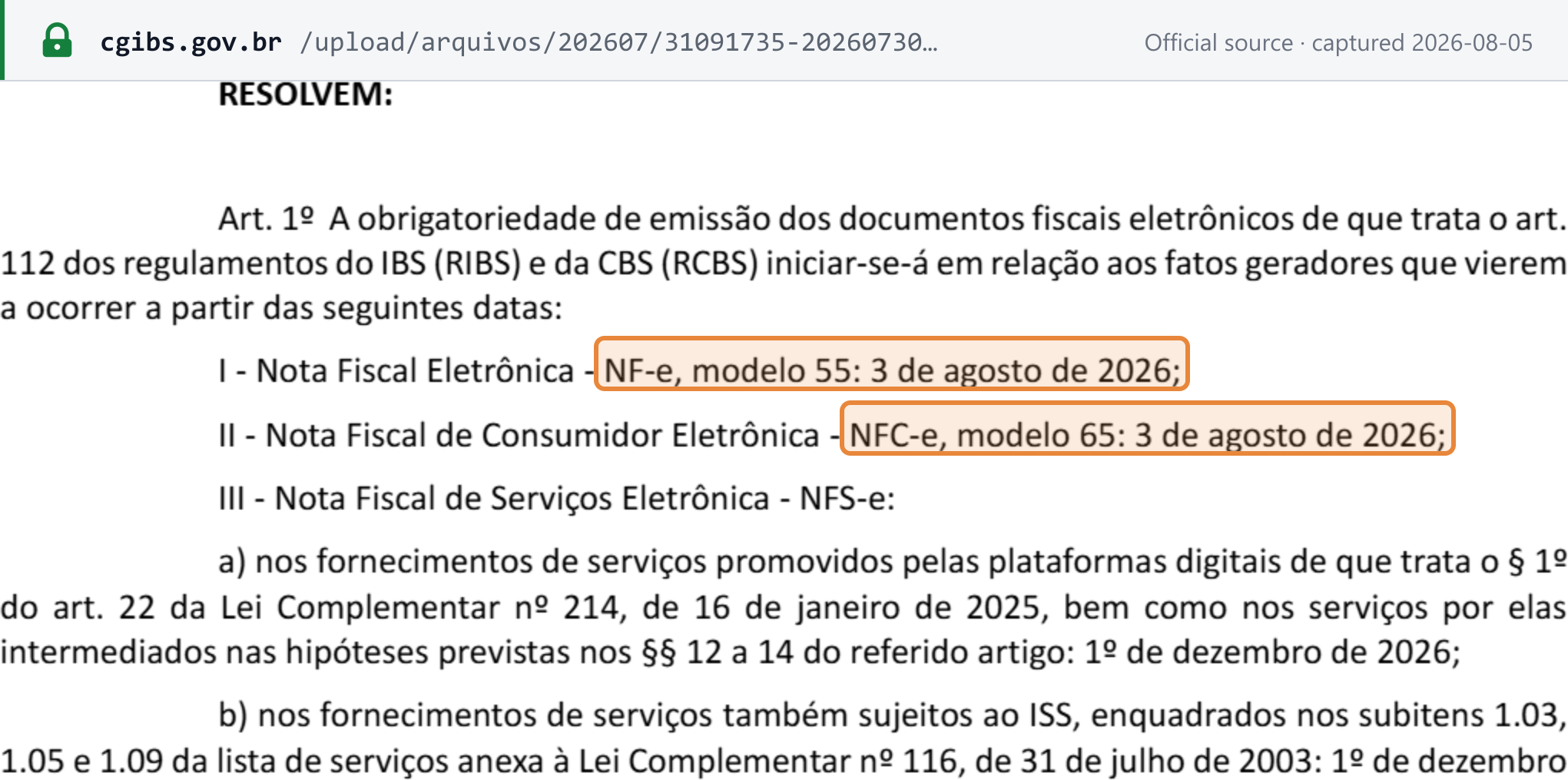 Source snapshot captured 2026-08-05 — original
The underlying schema is a moving target
The NF-e/NFC-e XML layout that carries these fields is Nota Técnica 2025.002-RTC, revised roughly monthly through the transition (see the country guide's version list, which tracks it from v1.20 to v1.50). Version 1.40, published 20 May 2026, is a useful checkpoint: it added the mandatory IBS/CBS group (validation rule UB12-10), required in the homologation (test) environment from 1 July 2026 and in production, for CRT 3 / Regime Normal taxpayers, from 3 August 2026 — the date from which NF-e/NFC-e issued without the IBS/CBS fields are rejected. [2]
Source snapshot captured 2026-08-07 — original
"Rejection deferred" is not "obligation suspended"
A narrower, mechanics-specific event worth separating from the country guide's broader "suspension announced" narrative: Ato Técnico Conjunto RFB/CGIBS nº 1, de 31 de julho de 2026, deferred the start of the automatic-rejection validation for missing CBS/IBS fields — meaning a DF-e is still authorised for issue even where those fields are incomplete. A joint clarification published 6 August 2026 stated plainly that this was not a suspension of the underlying obligation: "não houve suspensão da obrigatoriedade" ("there was no suspension of the obligation") — the duty to populate and report CBS/IBS information, and the implementation schedule in the table above, remained fully valid and unaltered. [4] In short: rejection was deferred; the field-population duty was not.
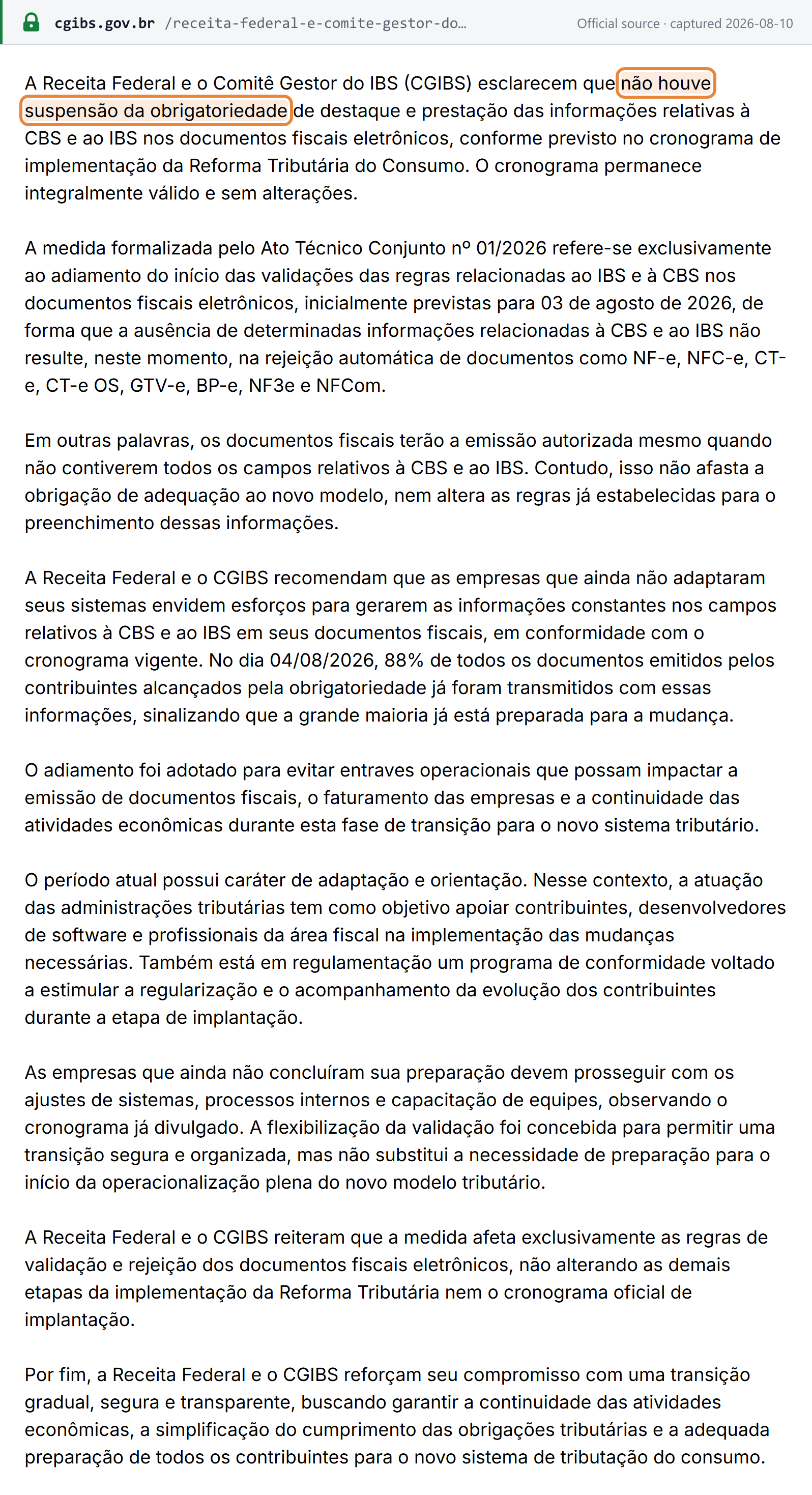 Source snapshot captured 2026-08-10 — original
Split payment: a new NF-e/NFC-e layout group
Nota Técnica 2026.006, version 1.00, published August 2026, creates a new NF-e/NFC-e layout group YC, carrying the information that links a fiscal document to its split-payment transaction, plus a related event of code 110300 — ahead of the IBS/CBS split-payment mechanism, planned from 2027. Homologation testing opens 5 October 2026 and production implementation is scheduled for 3 November 2026, but the new fields do not need to be populated in production during 2026. [5]
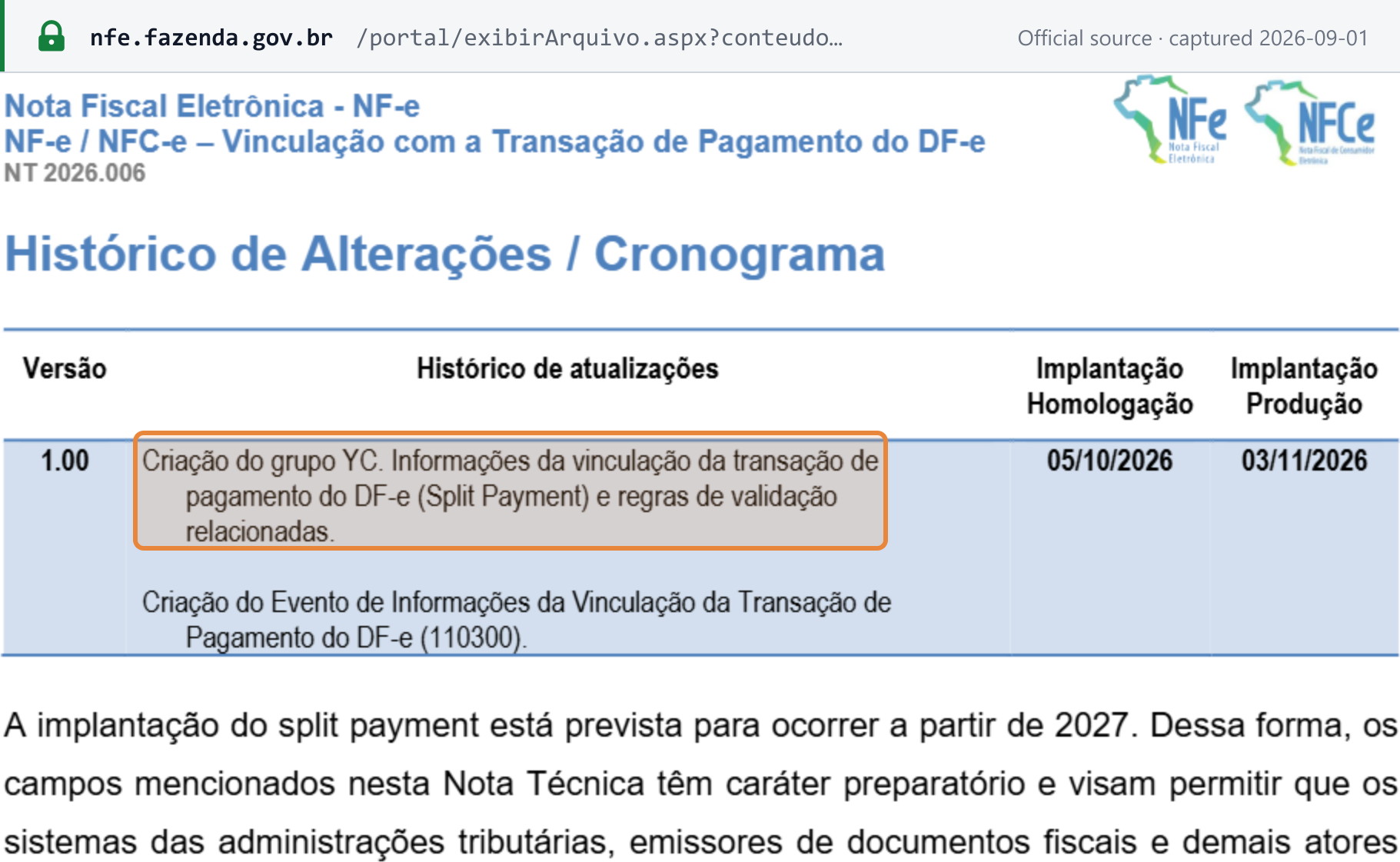 Source snapshot captured 2026-09-01 — original
Legal basis
- Ajuste SINIEF 07/2005 (CONFAZ) — institutes NF-e (modelo 55) and the DANFE. Instrument number and date corroborated across CONFAZ's own Ajustes index and state-SEFAZ mirrors; the primary CONFAZ text was not independently re-fetched this session. [1]
- Ajuste SINIEF 07/2022 — institutes NFCom (modelo 62), mandatory for ICMS taxpayers from 1 July 2024, replacing paper models 21/22. [2]
- Manual de Orientação do Contribuinte (MOC), currently generation 7.0 — the technical standard governing NF-e/NFC-e XML structure and the DANFE's printed layout down to field positions in centimetres. See the country guide's DANFE walkthrough for the full deep-dive; this is not repeated here.
- Nota Técnica 2025.002-RTC — the CBS/IBS/Imposto Seletivo field addendum to the NF-e/NFC-e layout, maintained jointly by CGIBS and ENCAT, revised roughly monthly (see Mandate status & timeline, above).
- Ato Conjunto RFB/CGIBS nº 4, de 30 de julho de 2026 — fixes the mandatory IBS/CBS field start date per document type (see the table above). [3]
- Emenda Constitucional 132/2023 and Lei Complementar 214/2025 — the constitutional and statutory basis for the CBS/IBS reform itself. Covered in full on the country guide; not repeated here.
- Código Tributário Nacional, art. 173 — the general 5-year tax-record limitation period (see Document lifecycle, below).
Scope
DF-e issuance is transaction-triggered, not business-model-triggered. Unlike EU-style CTC systems, Brazil layers no separate "B2G mandate" on top of B2B — a government counterparty simply receives the same NF-e or NFS-e as any other buyer. B2B, B2C and domestic B2G are therefore all in scope wherever a taxable operation occurs, gated by CNPJ/taxpayer status rather than by counterparty type.
Non-residents. Historically, a foreign company without a Brazilian establishment and CNPJ cannot issue NF-e or NFS-e directly — the systems require a Brazilian digital certificate (e-CNPJ) tied to a CNPJ. Whether the CBS/IBS reform extends DF-e obligations to non-resident digital-service providers is unresolved. One August 2026 trade-press report claims such an extension; this guide could not trace it to a primary Receita Federal or CGIBS instrument this session, so it is reported here as an open question, not stated as a scope fact. If your business is a non-resident digital-service provider assessing Brazilian exposure, treat this as unconfirmed and check directly with Receita Federal or a local adviser rather than relying on secondary reporting. (Checked 2026-09-20.)
Minimum-turnover exemption. A genuine floor exists for CBS/IBS itself — the "nanoempreendedor" threshold under art. 26 of Lei Complementar 214/2025 — but it is a tax-registration threshold, not an e-invoicing-specific one. See the country guide's Registration thresholds for the figure; not repeated here.
Simplified-invoice regime. Not applicable in the EU sense. Brazil has no separate threshold-gated "simplified invoice" layered on top of NF-e — the retail-facing equivalent is NFC-e itself (see the document table above), which is its own full DF-e, not a stripped-down variant. (Checked 2026-09-20.)
Format & network
CTC model: clearance, not post-audit and not interchange. Every DF-e must be transmitted to, and authorised by, the issuing authority — the state SEFAZ for most document types, or the national ADN/ANS for NFS-e — before the underlying transaction can lawfully proceed; the buyer only receives a document carrying an authorisation protocol. Multiple state SEFAZ FAQ pages describe this in close to identical language: the document's legal validity "is guaranteed by the issuer's digital signature and by the authorisation of use by the State Treasury Department (SEFAZ)" (paraphrased from state guidance such as Mato Grosso do Sul's; the primary Ajuste SINIEF 07/2005 text was not independently re-fetched this session, so treat this as a close paraphrase of the statutory definition rather than a verbatim quote of it). [1]
Not Peppol-based. Brazil's DF-e network predates Peppol and has no relationship to it — state clearly for comparison purposes, since most other pages in this guide set name a Peppol profile.
XML standard. NF-e/NFC-e XML is XSD-based (not UBL, not CII), maintained via the MOC — currently generation 7.0. See the country guide's DANFE section for the layout deep-dive; not repeated here.
E-reporting. There is no separate e-reporting obligation layered alongside e-invoicing the way some jurisdictions run — the DF-e's authorisation event is the report. The closest analogue is the SPED digital-bookkeeping ecosystem, which is a broader compliance system rather than a document type (do not confuse it with a DF-e, a defect this guide's baseline data previously had — see the note under Related resources).
Integrity mechanics: access key, signature, certificate
Every DF-e carries a 44-digit chave de acesso (access key), printed on the DANFE both as text and as a CODE-128C barcode — the field that ties the printed representation back to the authorised XML. See the country guide's DANFE walkthrough for where it sits on the page.
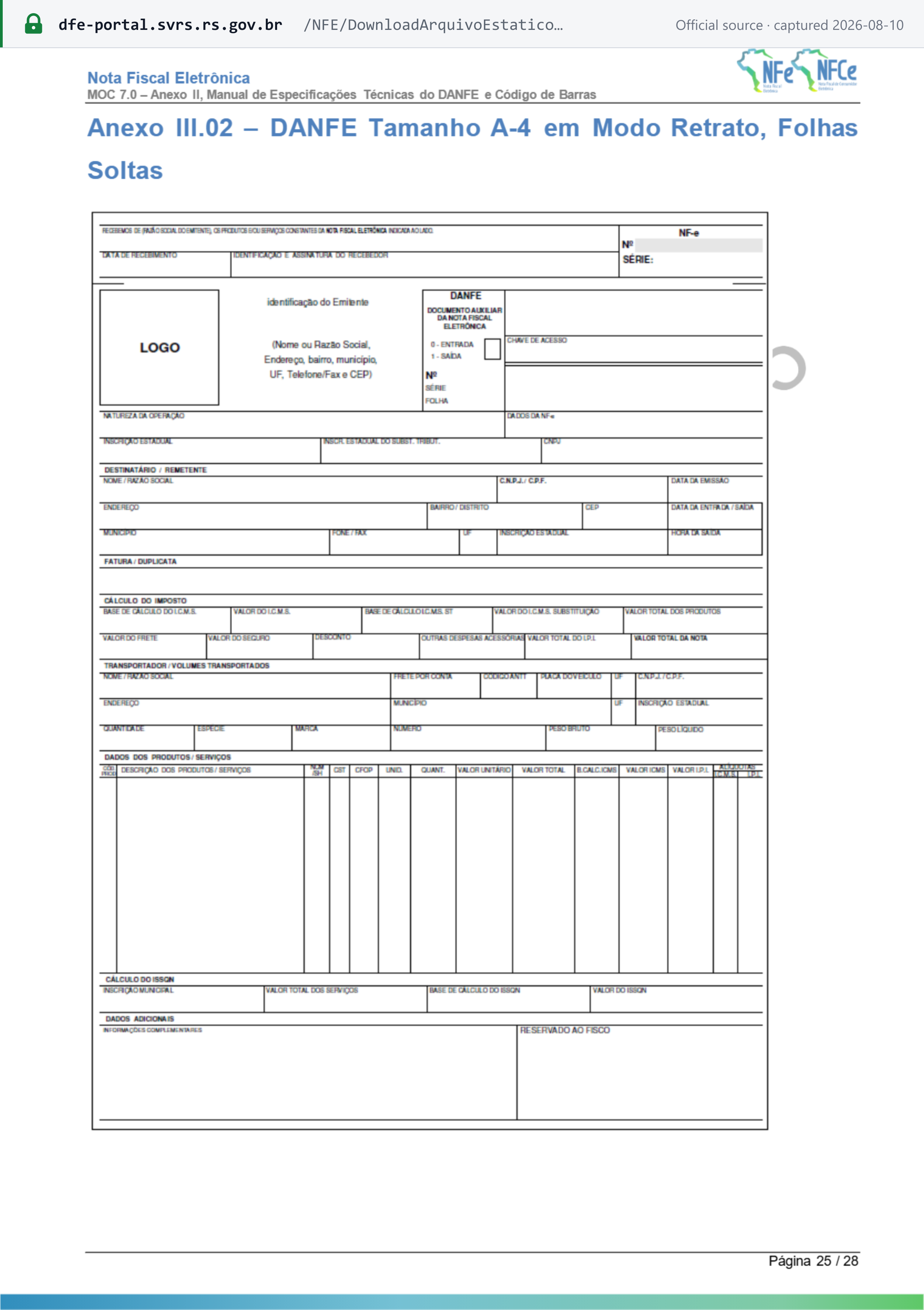 Source snapshot captured 2026-08-10 — original, MOC 7.0 Anexo II p.25
To sign a DF-e, the issuer needs an ICP-Brasil-accredited digital certificate — an e-CNPJ, either A1 (software-based, reissued roughly every 12 months) or A3 (hardware token or smartcard, valid for up to around 3 years). This requirement is well-established and undisputed across the NF-e technical manual and certificate-authority guidance, but this guide could not independently pull the exact MOC clause number or the precise A1/A3 validity periods from a primary ITI (Instituto Nacional de Tecnologia da Informação, the ICP-Brasil root authority) source this session — treat the validity windows as approximate pending that confirmation. Obtaining a CNPJ is the prerequisite step before any certificate can be issued; see Brazil tax identification numbers and how to verify a Brazilian CNPJ.
Onboarding: how to comply
- Get a CNPJ, if you don't already hold one — see Brazil tax identification numbers.
- Obtain an ICP-Brasil-accredited e-CNPJ certificate (A1 or A3 — see Integrity mechanics, above) from an accredited certificate authority.
- Complete credenciamento with your home-state SEFAZ. This is a state-level enrolment step, typically activated automatically alongside CNPJ/state tax registration — not a separate national application. [1]
- Integrate against the SEFAZ web services (or a service provider) for your document type. Not applicable: there is no separate "e-invoicing service provider" accreditation regime at the federal or state level, unlike France's PA/PDP model or Poland's KSeF authorisation — any ERP or software vendor can connect directly once the taxpayer holds a valid certificate and has completed credenciamento. This is a structural contrast worth naming explicitly, since a reader coming from an EU-style mandate will expect a certified-provider list that Brazil does not have. (Checked 2026-09-20.)
- Test in the homologation environment before going live in production — the RTC changes above give two concrete, dated examples of this pattern: NT 2025.002-RTC's IBS/CBS group was required in homologation from 1 July 2026, a month ahead of its 3 August 2026 production date, and NT 2026.006's split-payment group opens for homologation 5 October 2026, a month ahead of its 3 November 2026 production date.
Contingency modes
When a state's SEFAZ authorisation service is unavailable, three contingency channels exist: SVC-AN and SVC-RS (Sefaz Virtual de Contingência — Ambiente Nacional / Rio Grande do Sul), standby authorisation environments that specific states route to, and EPEC (Evento Prévio de Emissão em Contingência), a pre-emission event sent to the national environment ahead of a goods movement, used when even SVC is unreachable. Secondary technical guidance describing Nota Técnica 2013.007 (the SVC instrument) reports that, once normal service resumes, the complete NF-e must be transmitted within 168 hours (7 days), and that a DF-e authorised via EPEC cannot later be cancelled — a return or reversal document is used instead. The primary NT text was not independently fetched this session, so treat these figures as reported rather than confirmed verbatim. [2]
Document lifecycle: cancellation, correction and retention
Cancellation. In the standard (non-contingency) flow, most states allow a DF-e to be cancelled within 24 hours of authorisation; some states extend that to 168 hours (7 days). This is a state-level variance, not a single national rule — check your own state's ICMS regulation rather than assuming one figure applies everywhere.
Carta de Correção Eletrônica (CC-e). For a correction that does not affect the fiscal substance of the document — an address typo, for instance — an issuer may send a CC-e reportedly within 720 hours (30 days) of the original authorisation. A CC-e explicitly cannot alter values, taxes, or the parties to the transaction; those require cancellation and reissue instead. This figure comes from the NF-e MOC's events chapter (the same MOC 7.0 the country guide cites for the DANFE layout) via secondary paraphrase; it was not independently re-fetched and quoted verbatim this session.
Retention. The safe, well-established baseline is Brazil's general tax-law limitation period of 5 years — the period during which Receita Federal or a state authority can assess or audit a taxpayer (Código Tributário Nacional, art. 173). Secondary reporting describes a newer, DF-e-specific digital-storage rule requiring up to 132 months (11 years) of exclusively digital retention from 1 May 2025. This guide could not trace that figure to a specific Ajuste SINIEF instrument this session — treat it as reported, not confirmed, and rely on the 5-year figure as the safe baseline until it is resolved. (Checked 2026-09-20.)
Penalties
DF-e non-issuance: no single federal figure. Because ICMS-based DF-e (NF-e, NFC-e, CT-e, MDF-e, NF3e, BP-e) sit under state competence, the penalty for failing to issue one, or for issuing one that is rejected, is set by each state's own ICMS regulation. There is no single federal penalty article to cite the way a reader might expect coming from a single-VAT-law country — genuinely heterogeneous across 27 states. Check your own state's ICMS regulation (RICMS) for the applicable figure rather than relying on one state's number as if it were national.
CBS/IBS field-omission penalty. A figure of "up to 1% of the transaction value per tax" circulates for omitting the IBS/CBS fields. It does not appear to be a penalty at all. The 1% in Brazil's 2026 transition is the pilot tax rate — 0.9% CBS plus 0.1% IBS — that documents must carry for informational purposes; the two figures have been conflated. What the cited CGIBS source actually describes is automatic rejection of non-compliant documents from 3 August 2026, which is a validation consequence rather than a fine. The statutory penalty framework for fiscal-document deficiencies sits in LC 214/2025 art. 341-G and runs from 66% to 100% of the reference tax value for the relevant limbs — with a separate 1% ceiling that applies only to "outras hipóteses de infração", not to CBS/IBS field omission. That severity is itself under challenge as disproportionate. Do not plan against a 1% figure: establish the applicable limb of art. 341-G for the specific failure.
Frequently asked questions
Which document do I issue — NF-e, NFC-e or NFS-e?
It depends on the transaction, not the business. NF-e (modelo 55) covers goods — sale, transfer, return. NFC-e (modelo 65) covers retail, in-person consumer sales. NFS-e covers services and is subject to ISS. A business that sells both goods and services typically issues both NF-e/NFC-e and NFS-e depending on what each transaction is. See the full document map above for the remaining transport, communications, electricity and passenger-transport document types. (Checked 2026-09-20.)
Is Brazil's e-invoicing a clearance model or a post-audit model?
Clearance. A DF-e must be transmitted to and authorised by the state SEFAZ (or, for NFS-e, the national platform) before the underlying transaction can lawfully proceed — the buyer only receives a document carrying an authorisation protocol. This is structurally different from post-audit systems, where an invoice is valid on issue and only checked later, and it predates Brazil's other reforms by two decades: the NF-e clearance model has been live since 2006. (Checked 2026-09-20.)
Do I need to connect to Peppol to send Brazilian e-invoices?
No. Brazil's DF-e network has no relationship to Peppol — it predates the network and uses its own XSD-based national XML schemas (via the MOC), not UBL or CII. If your organisation issues to both Brazil and a Peppol-based jurisdiction, the two integrations are entirely separate. (Checked 2026-09-20.)
What certificate do I need to sign a DF-e?
An e-CNPJ — an ICP-Brasil-accredited digital certificate tied to your CNPJ — either A1 (software-based, reissued roughly every 12 months) or A3 (hardware token or smartcard, valid for up to around 3 years). The certificate is the prerequisite for signing, transmitting and getting a DF-e authorised; a CNPJ registration comes first. (Checked 2026-09-20.)
Can I still issue an NF-e if the SEFAZ authorisation service is down?
Yes, via one of three contingency channels: SVC-AN or SVC-RS (standby national/Rio Grande do Sul environments specific states route to) or, when even those are unreachable, EPEC, a pre-emission event sent ahead of the goods movement. Once service resumes, the complete NF-e must reportedly be transmitted within 168 hours, and a DF-e authorised via EPEC reportedly cannot later be cancelled — a return or reversal document is used instead. (Checked 2026-09-20.)
How do I correct a mistake on an already-authorised NF-e?
It depends what needs fixing. A non-fiscal-impacting error — an address typo, for instance — is corrected with a Carta de Correção Eletrônica (CC-e), reportedly available within 720 hours (30 days) of authorisation; a CC-e cannot change values, taxes or the parties. Anything that does affect values, taxes or the parties requires cancellation instead — available within 24 hours of authorisation in most states, up to 168 hours in some, followed by reissue. (Checked 2026-09-20.)
How long do I need to keep my DF-e records?
The safe, well-established baseline is 5 years — Brazil's general tax-law limitation period (Código Tributário Nacional, art. 173), during which the authorities can assess or audit you. A newer, digital-storage-specific rule requiring up to 11 years of exclusively digital retention has been reported but could not be traced to a specific instrument in this guide's research — treat that figure as unconfirmed and rely on the 5-year baseline until it is resolved. (Checked 2026-09-20.)
Does Brazil's e-invoicing mandate apply to non-resident businesses?
Historically, no — issuing NF-e or NFS-e requires a Brazilian CNPJ and an e-CNPJ certificate, which a foreign company without a Brazilian establishment cannot obtain. Whether the CBS/IBS reform extends DF-e obligations to non-resident digital-service providers is unresolved: one August 2026 trade-press report claims an extension, but this guide could not trace it to a primary Receita Federal or CGIBS instrument. Treat this as an open question, not a confirmed scope change. (Checked 2026-09-20.)
Recent changes
- 2026-11-01 — Resolução CGSN nº 191/2026 postpones from 1 September 2026 to 1 November 2026 the date from which Simples Nacional micro and small enterprises (ME/EPP) must issue the national-standard NFS-e via the Emissor Nacional da NFS-e; the resolution expressly revokes Resolução CGSN nº 189/2026, which had set the original September date. (Receita Federal do Brasil) — see issue
- 2026-10-05 — Nota Técnica 2026.006 v1.00 created a new NF-e/NFC-e layout group YC, plus event 110300, linking the fiscal document to its split-payment transaction, ahead of the IBS/CBS split-payment mechanism; homologation testing opens 5 October 2026, production implementation is 3 November 2026, and the fields need not be populated in production during 2026. (Portal Nacional da NF-e / Receita Federal do Brasil) — see issue
- 2026-08-06 — Receita Federal and CGIBS clarified that Ato Técnico Conjunto RFB/CGIBS nº 1 (31 July 2026) had deferred only the automatic-rejection validation for missing CBS/IBS fields, not the underlying field-population obligation, which remained in force on its original schedule. (Comitê Gestor do IBS) — see issue
- 2026-08-03 — Ato Conjunto RFB/CGIBS nº 4, de 30 de julho de 2026, fixed the mandatory IBS/CBS field start date per document type: 3 August 2026 for NF-e, NFC-e, CT-e, CT-e OS, MDF-e, GTV-e, NF3e, DC-e, NFS-e Via and unclassified BP-e; 1 October, 15 November and 1 December 2026 for further document classes; and 1 January 2027 for Simples Nacional optantes, Duimp, monofásica NF-e and the remaining DeRE events. (Receita Federal do Brasil / Comitê Gestor do IBS) — see issue
Related resources
- Brazil country guide — CBS/IBS legal basis, rates and transition timeline, CNPJ registration, the full RTC field-mandate table, and the DANFE layout deep-dive
- E-invoicing status and networks worldwide — Brazil row in global context (corrected this week to list NF-e explicitly and drop SPED/REINF as document types — they are not DF-e)
- Brazil tax identification numbers — CPF and CNPJ
- How to verify a Brazilian CNPJ
- How to verify a Brazilian CPF
- Brazil tax-change chronology — every tracked Brazilian change, dated and sourced
- Validate a Brazilian CNPJ
Important links
- Portal Nacional da NF-e — Notas Técnicas, contingency environments, state-hosted MOC distribution
- gov.br/nfse — the national NFS-e portal (CGNFS-e)
- Ato Conjunto RFB/CGIBS nº 4, de 30 de julho de 2026 — mandatory IBS/CBS field start dates by document type
- Receita Federal — Reforma Tributária do Consumo — the CBS/IBS reform explainer