E-invoicing in the Philippines: the BIR EIS issuance mandate
Overview
The Philippines runs a seller-side e-invoice issuance mandate. Covered taxpayers must issue their sales invoices as system-generated, structured electronic invoices that go from seller to buyer, and whose data can be extracted and transmitted to the Bureau of Internal Revenue (BIR). The statutory basis is Section 237 of the National Internal Revenue Code (NIRC), as rewritten by Republic Act No. 12066 (CREATE MORE, approved 8 November 2024), which tells the BIR to require exporters, e-commerce taxpayers and taxpayers under the Large Taxpayers Service to issue electronic invoices, and lets the Secretary of Finance extend the duty to other taxpayers. (RA 12066 s.12 — lawphil.net, checked 2026-10-07)
The rules are implemented by Revenue Regulations (RR) No. 11-2025, as amended by RR No. 26-2025, and put into operation by Revenue Memorandum Circular (RMC) No. 98-2026 (22 September 2026). The system is the BIR's EIS, which RMC 98-2026 expands as "Electronic Invoicing and Sales Reporting". (RMC 98-2026, checked 2026-10-07)
Two duties need to be kept apart. Issuing electronic invoices (NIRC s.237) is due by 31 December 2026 for the covered groups. Reporting sales data electronically to the BIR (NIRC s.237-A, the Electronic Sales Reporting System) is, in RMC 98-2026's words, "separate and distinct", and applies only once the BIR issues implementing rules for it. As at 2026-10-07, no BIR revenue issuance setting such rules had been located.
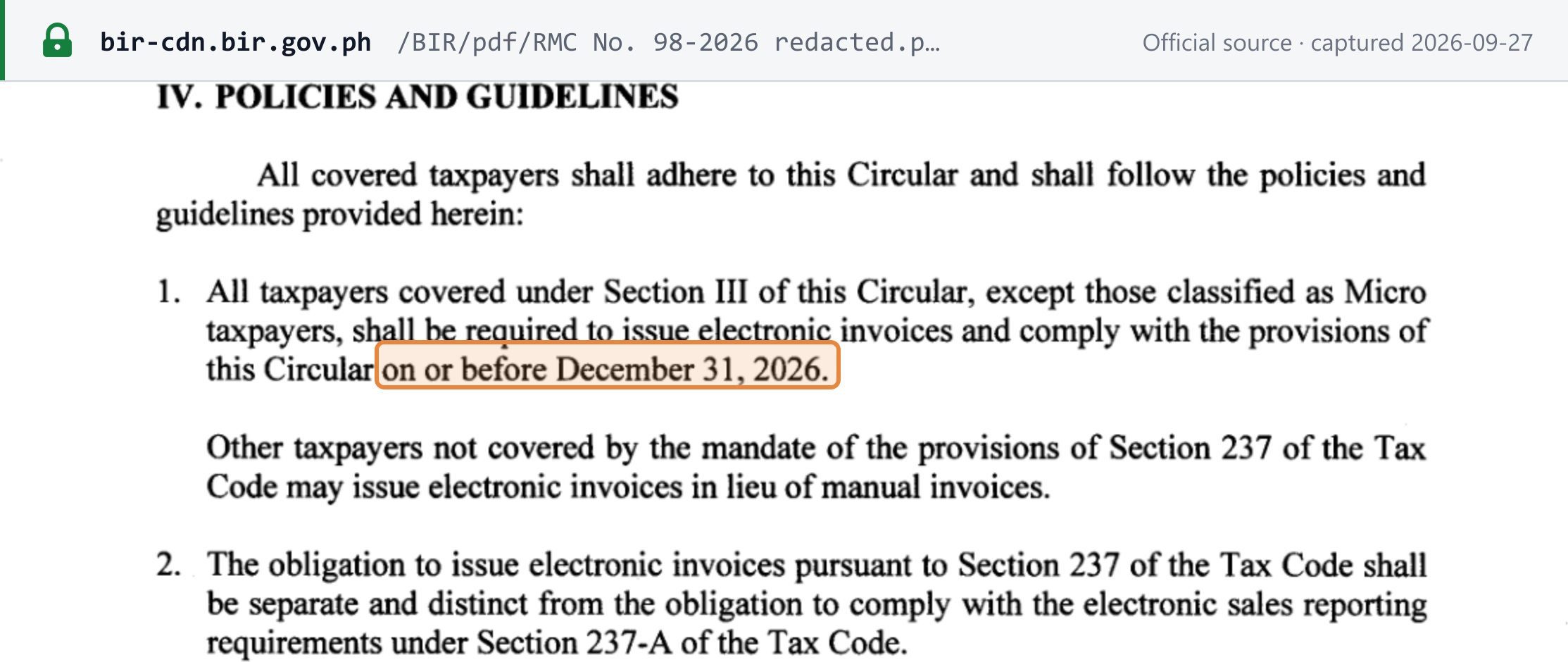 Source snapshot captured 2026-09-27 — original
| Philippines | |
|---|---|
| Model | Seller-side issuance of structured e-invoices; as at 2026-10-07, the BIR issuances prescribe no clearance step |
| B2B / B2C | Coverage is defined by the seller's category, not by the buyer. Covered sellers must issue e-invoices by 31 December 2026 |
| Covered now | E-commerce / internet-transaction taxpayers classified Small, Medium or Large; Large Taxpayers Service (LTS) taxpayers; Large Taxpayers under RA 11976 (EOPT) and RR 8-2024; users of CAS, CBA with e-invoicing, or other invoicing software. RMC 98-2026 Section III adds "other taxpayers as may be required by the Commissioner" |
| Deferred | Exporters, incentive-holding Registered Business Enterprises (RBEs), POS users and others the Commissioner names, to separate RRs, except exporters and RBEs using CAS/CBA/invoicing software, which are in the current group |
| Exempt | Micro Taxpayers (gross sales under PHP 3,000,000), who may adopt e-invoicing voluntarily |
| B2G | No separate B2G e-invoicing regime appears in RR 11-2025, RR 26-2025 or RMC 98-2026 (as at 2026-10-07) |
| Non-residents | As at 2026-10-07, no BIR revenue issuance expressly bringing non-resident digital service providers into the mandate had been located |
| Format | JSON for transmission to the BIR's EIS; other internal structured formats allowed if convertible |
| Network | Not Peppol-based (observation; see Format & network) |
| Gating steps | Permit to Issue (PTI) Electronic Invoice before the first e-invoice; EIS Certification within 6 months of the PTI |
| Sales reporting | NIRC s.237-A; waits for BIR implementing rules; a Permit to Transmit applies only on the Commissioner's directive |
| Authority | Bureau of Internal Revenue (BIR) |
| Legislation | NIRC ss.237, 237-A (RA 12066 ss.12–13); RR 11-2025; RR 26-2025; RMC 98-2026; EOPT Act (RA 11976); RR 8-2024 |
Mandate status & timeline
| Date | Scope | What | Status (as at 2026-10-07) | Legal basis |
|---|---|---|---|---|
| 27 April 2024 | All taxpayers | Manual "Official Receipts" issued without a stamped "Invoice" become supplementary documents and cannot support input-tax claims, completing the EOPT switch from receipts to invoices | passed | RR 7-2024 §8(2.2), as amended by RR 11-2024 §2 [1] |
| 8 November 2024 | — | RA 12066 rewrites NIRC s.237 ("Issuance of Invoices") and s.237-A; the earlier TRAIN-law "within five (5) years" window is dropped | in force | RA 12066 ss.12–13 [2] |
| 27 February 2025 (issued) | E-commerce, LTS and EOPT Large Taxpayers | RR 11-2025 gives these groups one year from its effectivity to issue e-invoices; effectivity is 15 days after publication in the Official Gazette or on the BIR website, whichever comes first | superseded by RR 26-2025 | RR 11-2025 §§6, 9 [3] |
| 16 October 2025 (issued) | Same groups, plus CAS/CBA and invoicing-software users | RR 26-2025 replaces the transitory provision: all four groups have until 31 December 2026; the Commissioner may extend further | in force | RR 26-2025 §§2–3 [4] |
| 22 September 2026 | All covered taxpayers and voluntary adopters | RMC 98-2026: PTI before issuing, EIS Certification within 6 months, JSON format, corrections, downtime and reclassification rules; effective immediately | in force | RMC 98-2026 [5] |
| 31 December 2026 | The four covered groups (Micro Taxpayers exempt) | Deadline to issue electronic invoices. A hard deadline ("until"), not a start date | upcoming | RR 11-2025 §6 as amended by RR 26-2025 §2; RMC 98-2026 IV.1 [4] |
| no date | Exporters, RBEs, POS users, others named by the Commissioner | Issuance of e-invoices, "as may be prescribed through the issuance of separate Revenue Regulations" | not yet set; as at 2026-10-07, no such RR had been located | RR 26-2025 §2 [4] |
| no date | All eight groups | Electronic sales reporting (s.237-A), through separate Revenue Regulations | not yet set; as at 2026-10-07, no BIR revenue issuance with implementing rules had been located | RR 26-2025 §2; RMC 98-2026 IV.2 [4] |
The postponement. RR 11-2025 originally gave e-commerce, LTS and EOPT Large Taxpayers one year from its effectivity, and set no transitory period for CAS/CBA users. RR 26-2025 replaced that with a single date, 31 December 2026, for all four groups. The original deadline ran one year from RR 11-2025's effectivity, which was 15 days after its publication in the Official Gazette or on the BIR website. If you planned against the original deadline, your system work still counts: only the date moved. (RR 11-2025 p.5; RR 26-2025, checked 2026-10-07)
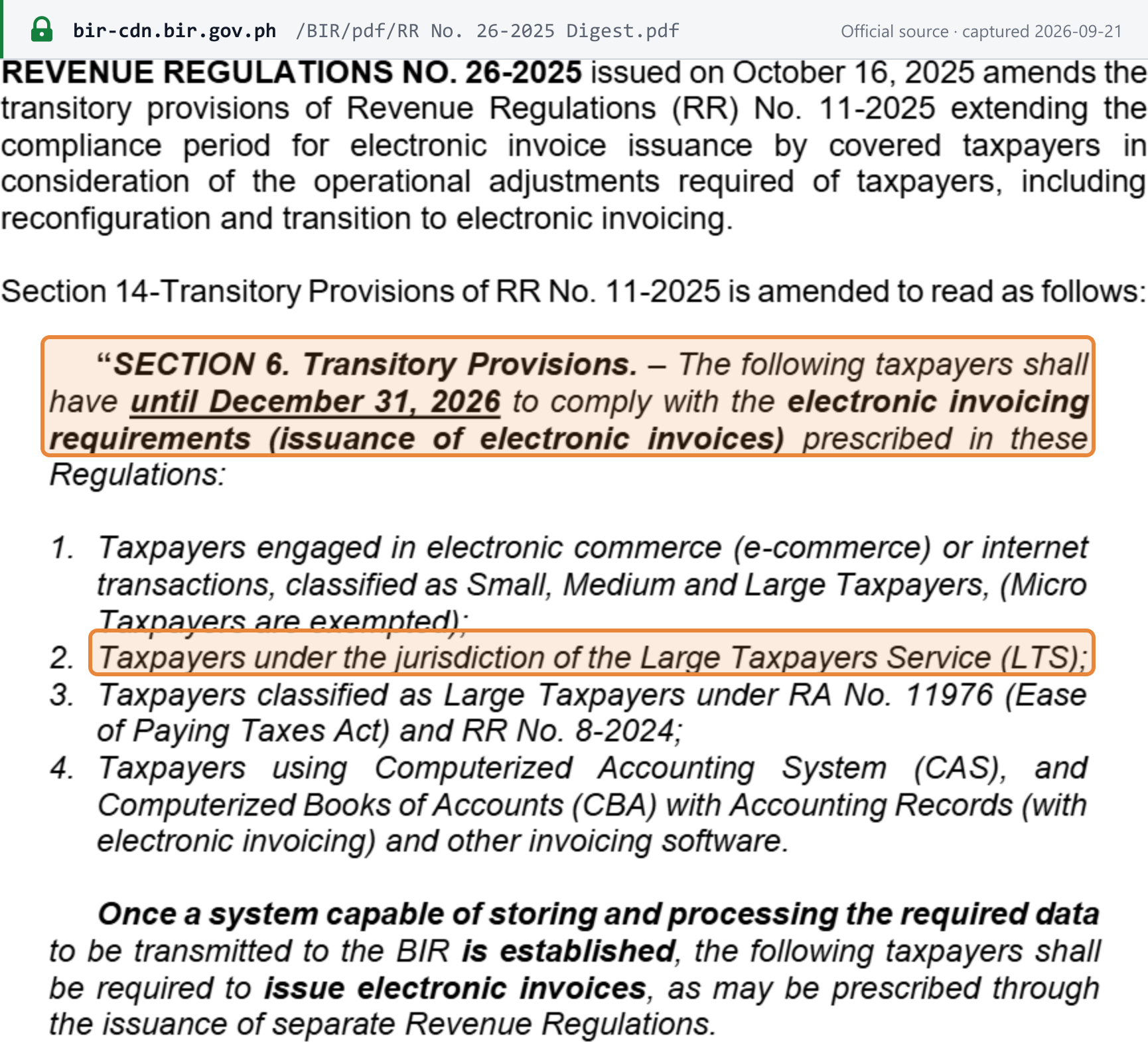 Source snapshot captured 2026-09-21 — original
A drafting quirk. RR 26-2025 says it amends "Section 14 – Transitory Provisions" of RR 11-2025, but the text it substitutes is headed "SECTION 6", and in RR 11-2025 the transitory provisions are §6; there is no §14. This guide cites the rule as RR 11-2025 §6 (Transitory Provisions), as amended by RR 26-2025 §2.
More extensions are possible. RR 26-2025 §3: "The Commissioner of Internal Revenue may further extend the deadlines or compliance period on the transition period prescribed in these Regulations as may be deemed necessary." As at 2026-10-07, no BIR revenue issuance granting a further extension had been located. (RR 26-2025, checked 2026-10-07)
Legal basis
| Instrument | Date | What it does | Link |
|---|---|---|---|
| NIRC s.237, as amended by RA 12066 s.12 (CREATE MORE) | Approved 8 November 2024 | The issuance mandate for exporters, e-commerce and LTS taxpayers once the BIR has a system able to store and process the data; other taxpayers may e-invoice voluntarily; the Secretary of Finance may require others | lawphil.net |
| NIRC s.237-A, as amended by RA 12066 s.13 | Same | Electronic Sales Reporting System: exporters and LTS taxpayers report sales data through electronic point-of-sale systems; the Secretary of Finance may add others. Extra deduction for the cost of setting it up | lawphil.net |
| RA 11976 (Ease of Paying Taxes, EOPT) | Approved 5 January 2024 | "Invoice" replaces "official receipt" for goods and services (s.237, s.113); taxpayer size bands; 5-year record retention (s.235) | lawphil.net |
| RR 8-2022 | 2022 | RR 8-2022, which RMC 98-2026 implements alongside RR 11-2025 for e-invoice issuance | — |
| RR 7-2024 | Issued 11 April 2024 | EOPT registration and invoicing rules; the source of the minimum invoice information the JSON file draws on | BIR digest |
| RR 8-2024 | 2024 | EOPT taxpayer classification: Micro, Small, Medium, Large | BIR digest |
| RR 11-2024 | Dated 27 May 2024 | Amends RR 7-2024, including §8: transition from official receipts to invoices; CAS/CBA re-registration as a major enhancement | BIR |
| RR 11-2025 | Dated 25 February 2025; issued 27 February 2025 | Implements ss.237 and 237-A as amended by RA 12066: definition of an e-invoice, covered groups, head-office and branch rule, Micro exemption, deduction, penalties. In force 15 days after publication (§9) | BIR full text · digest |
| RR 26-2025 | Dated 5 September 2025; issued 16 October 2025 | Replaces RR 11-2025's transitory provision: deadline 31 December 2026; deferred groups; Commissioner may extend. In force on publication on the BIR website (§6) | BIR full text · digest |
| RMC 98-2026 | 22 September 2026, effective immediately | Consolidated policies and guidelines on issuing e-invoices: validity tests, JSON, PTI, EIS Certification, corrections, downtime, reclassification, ESPs | BIR |
Statute texts are cited from lawphil.net (Arellano Law Foundation). RR 11-2025 §1 names RA 12066 ss.12, 13 and 32 as its legal basis; RR 26-2025 §1 names RA 12066 ss.12–13.
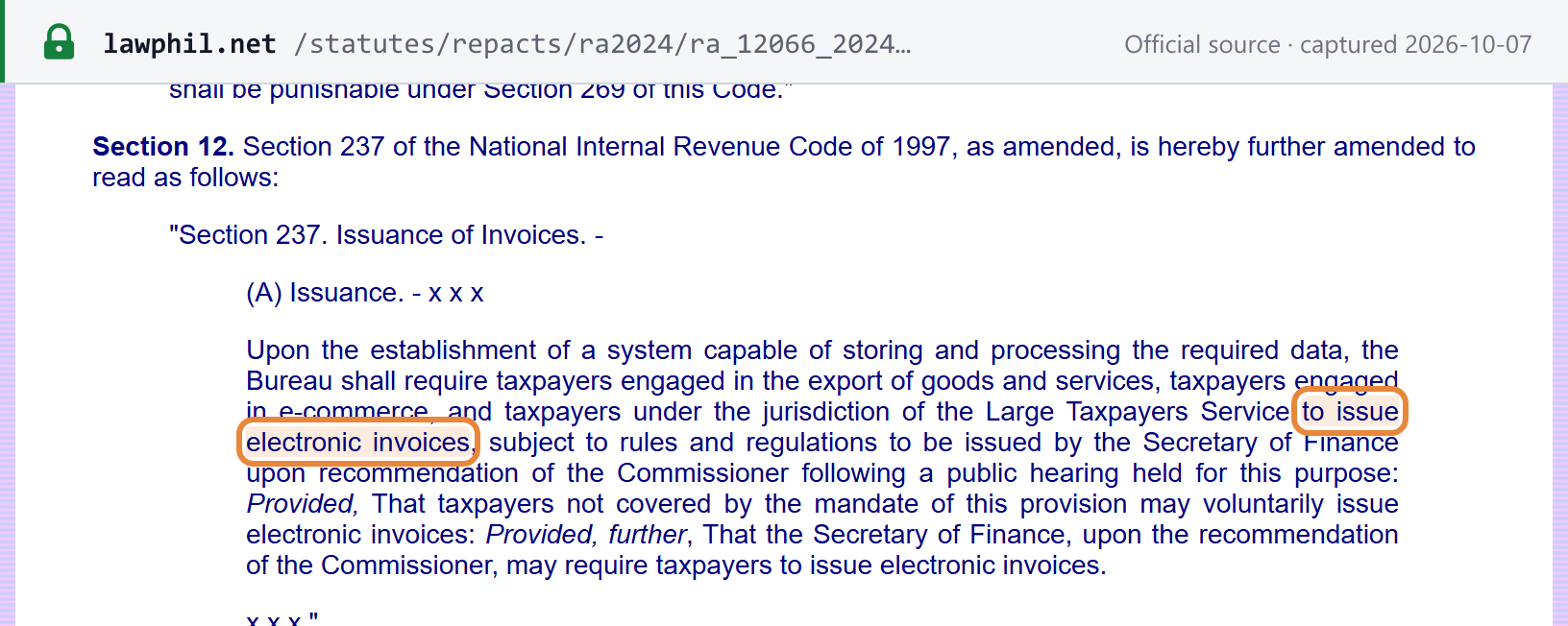 Source snapshot captured 2026-10-07 — original
What an e-invoice is. RR 11-2025 §2.1 defines it as "a system-generated invoice issued to the buyers electronically in a digital/electronic format" (a PDF attachment, email content, or viewing in a mobile or system application) or later printed, "provided that, it is system-generated in a structured invoice data which can be easily extracted electronically from the invoice and its data can be readily transmitted to the BIR for electronic sales reporting". A photo or scan of a paper invoice is not an e-invoice. (RR 11-2025 p.1, checked 2026-10-07)
Scope
Who must issue e-invoices by 31 December 2026
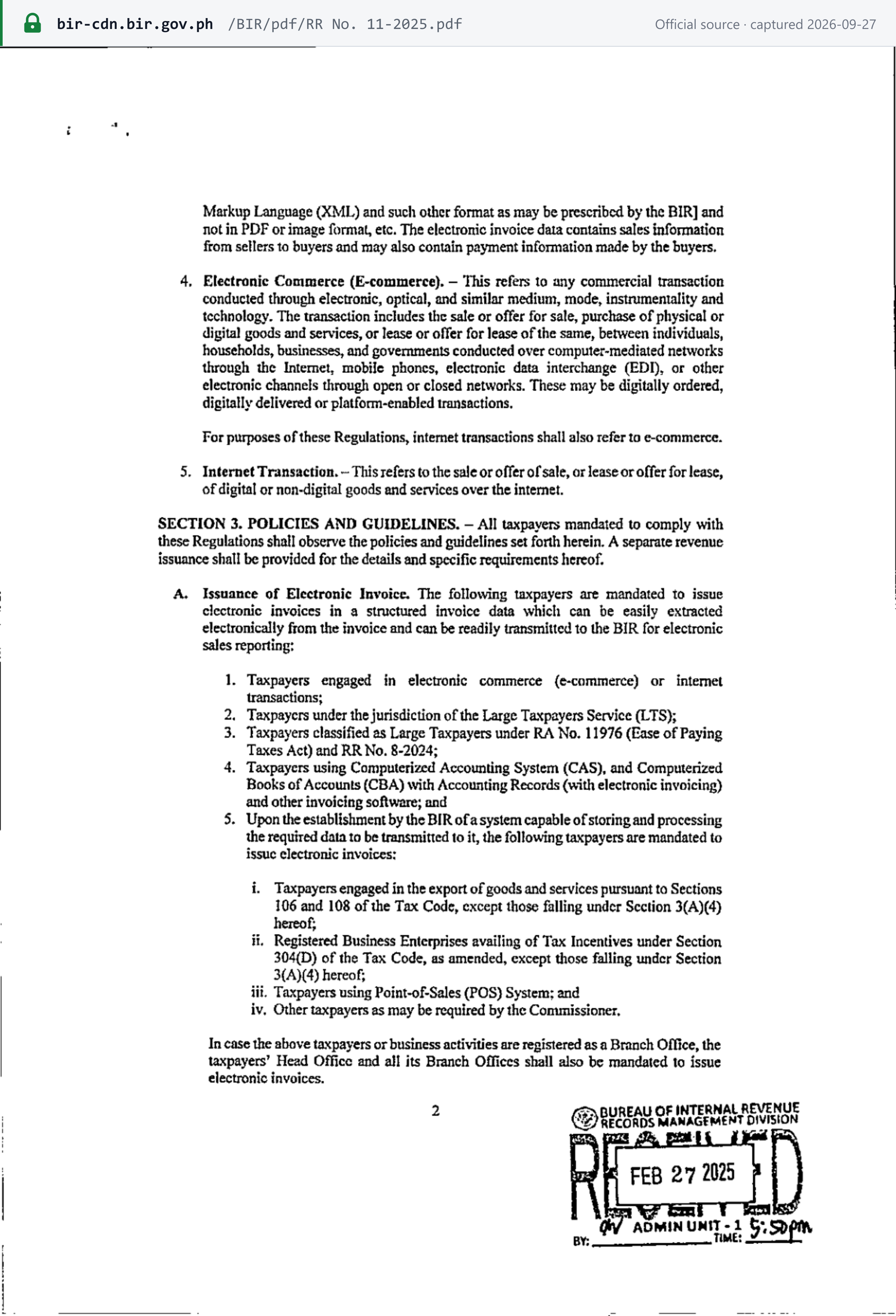
RR 11-2025 §6 as amended by RR 26-2025 lists four groups. RMC 98-2026 Section III repeats them and adds a fifth, "other taxpayers as may be required by the Commissioner":
- taxpayers engaged in e-commerce or internet transactions classified as Small, Medium or Large (Micro Taxpayers are exempt);
- taxpayers under the jurisdiction of the Large Taxpayers Service (LTS);
- taxpayers classified as Large Taxpayers under RA 11976 (EOPT) and RR 8-2024;
- taxpayers using a Computerized Accounting System (CAS), Computerized Books of Accounts (CBA) with Accounting Records (with electronic invoicing), or other invoicing software.
(RR 26-2025; RMC 98-2026 Section III and IV.1, checked 2026-10-07)
E-commerce is broad. RR 11-2025 §3(C) covers persons engaged in trade or business in the Philippines through, among others: online businesses selling physical or digital goods; digital platforms and e-marketplaces; sale or lease through digital platforms; income-generating content creation and streaming (advertising, blogging/vlogging, subscriptions, commissions); e-retail; online professional, freelance or digital services; on-demand services such as ride-sharing and food delivery; transport and delivery contracted through an online platform; and any other business conducted online. (RR 11-2025 pp.3–4, checked 2026-10-07)
Taxpayer size bands (gross sales for the taxable year, net of VAT), as at 2026-10-07:
| Band | Gross sales |
|---|---|
| Micro | less than PHP 3,000,000 |
| Small | PHP 3,000,000 to less than PHP 20,000,000 |
| Medium | PHP 20,000,000 to less than PHP 1,000,000,000 |
| Large | PHP 1,000,000,000 and above |
(RR 8-2024 digest, checked 2026-10-07)
Deferred groups, and the exception for CAS/CBA users
RR 26-2025 defers four more groups until "a system capable of storing and processing the required data to be transmitted to the BIR is established", through separate Revenue Regulations:
- exporters of goods and services under NIRC ss.106 and 108, except those falling under Section 3(A)(4) of RR No. 11-2025;
- Registered Business Enterprises (RBEs) availing of tax incentives under NIRC s.304(D), except those falling under Section 3(A)(4) of RR No. 11-2025;
- taxpayers using a POS system;
- other taxpayers the Commissioner requires.
Section 3(A)(4) is the CAS/CBA/invoicing-software group. So an exporter or RBE that uses CAS, CBA with e-invoicing, or other invoicing software is not deferred: it falls in group 4 and has the 31 December 2026 deadline. Only exporters and RBEs outside that group wait for a later RR. As at 2026-10-07, no such RR had been located.
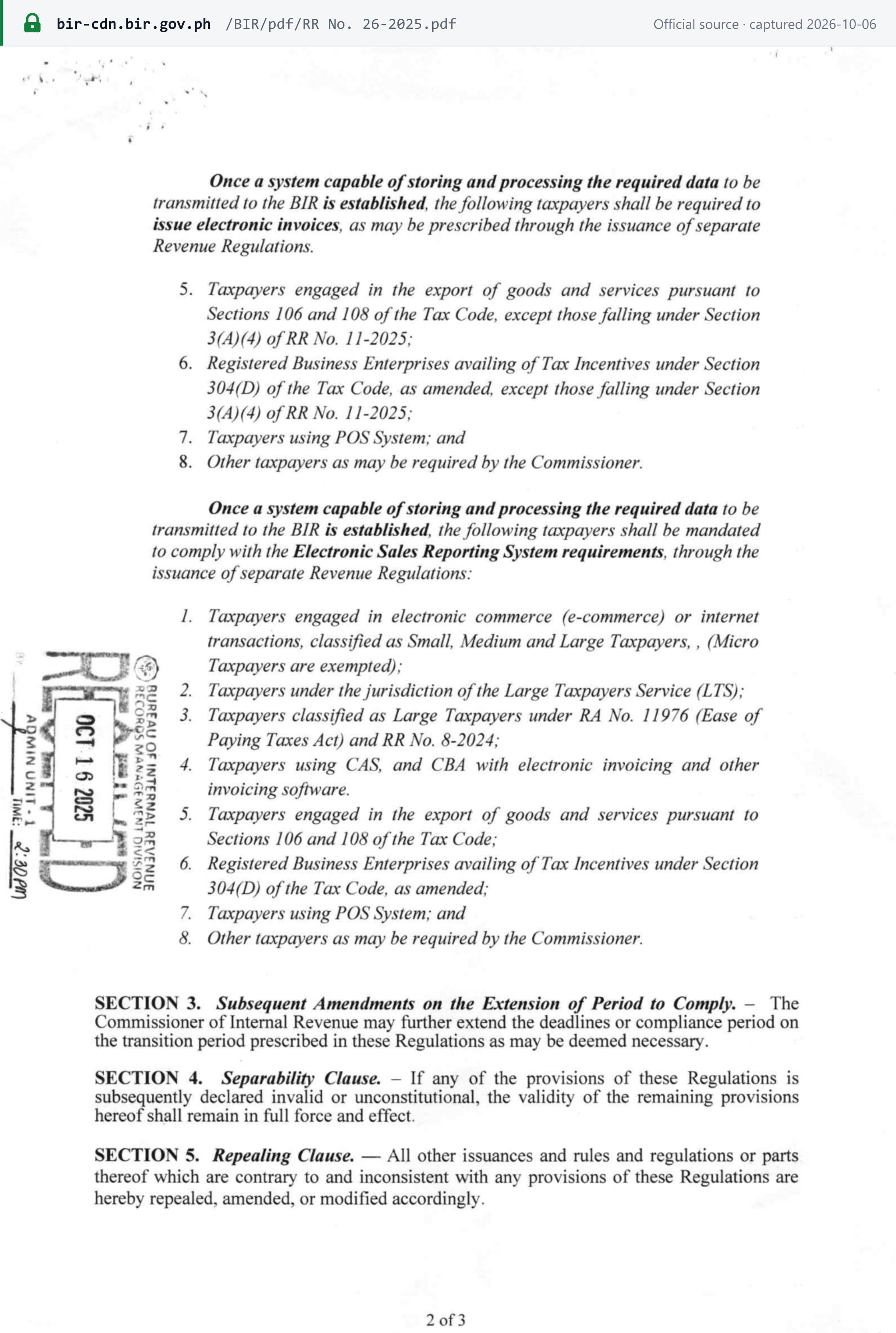 Source snapshot captured 2026-10-06 — original
Head office and all branches
If a covered taxpayer or activity is registered as a branch, "the taxpayers' Head Office and all its Branch Offices shall also be mandated to issue electronic invoices" (RR 11-2025 §3.A; §3.B applies the same rule to sales reporting). RMC 98-2026 IV.10 says compliance applies "to the taxpayer as a whole", whether or not the covered activity happens at a particular branch.
 Source snapshot captured 2026-09-27 — original
Micro Taxpayers and voluntary adopters
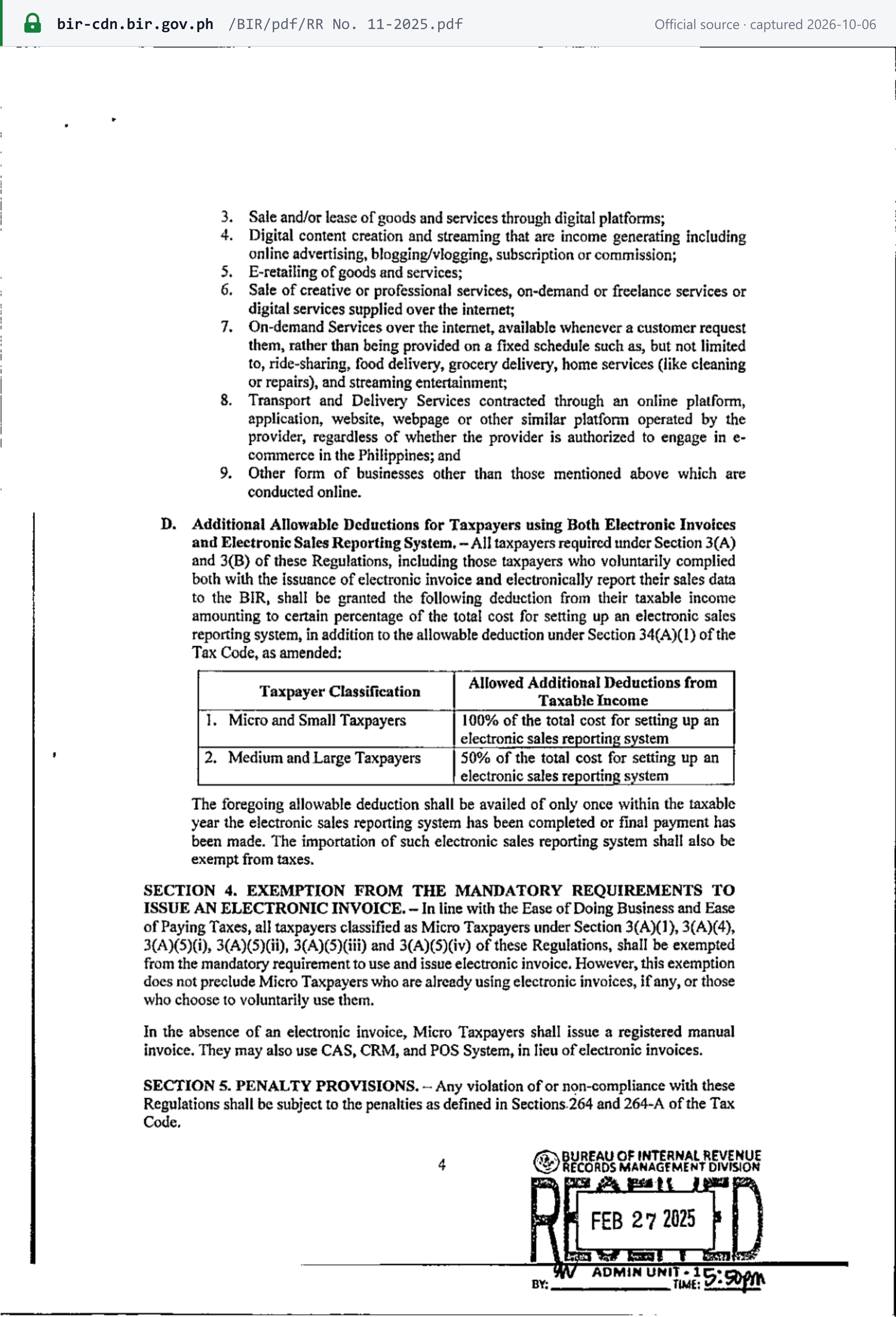
Micro Taxpayers are exempt from the mandatory requirement but may adopt e-invoicing voluntarily. In the absence of an e-invoice they issue a registered manual invoice, or use CAS, Cash Register Machines (CRM) or a POS system (RR 11-2025 §4). Taxpayers outside s.237's mandate "may issue electronic invoices in lieu of manual invoices" (RMC 98-2026 IV.1), but a voluntary adopter needs a PTI too (see Onboarding).
 Source snapshot captured 2026-10-06 — original
B2B, B2C and B2G
B2B and B2C. The issuances define coverage by the seller's category; as at 2026-10-07, none of them splits the duty by buyer type. A covered seller issues e-invoices to businesses and consumers alike. For B2C, RMC 98-2026 allows a printed copy where electronic delivery is impracticable, provided the invoice was generated, and can be issued, electronically. A buyer may always ask for a printed copy.
B2G. No separate B2G e-invoicing channel or rule appears in RR 11-2025, RR 26-2025 or RMC 98-2026 (as at 2026-10-07).
Non-established businesses
As at 2026-10-07, no BIR revenue issuance that expressly brings non-resident digital service providers (NRDSPs) into the PTI/EIS mandate, or expressly excludes them, had been located. RR 11-2025 §3(C) defines covered e-commerce as trade or business "in the Philippines". Separately, under RR 3-2025 the invoices of a nonresident VAT-registered digital service provider "may be electronic and need not be registered with the BIR", must be in English or carry an English translation, and need no Authority to Print. (RR 3-2025 digest, checked 2026-10-07) See the digital services VAT explainer.
The invoice itself: EOPT rules that still apply
The e-invoice is the same "invoice" the EOPT Act created. Since RA 11976, s.237 requires a duly registered sales or commercial invoice for each sale of PHP 500 or more (with a daily aggregate invoice below that amount, and an invoice on request; the PHP 500 threshold is adjusted for inflation (CPI) every 3 years), while VAT-registered persons invoice every sale regardless of amount. Section 113(A) requires a VAT invoice for every sale of goods or services: the official receipt is gone. Amounts as at 2026-10-07. (RA 11976 ss.35, 21 — lawphil.net, checked 2026-10-07)
Retention. Books of accounts and accounting records are kept for 5 years from the day after the return deadline, or the filing date if later, for the year of the last entry (NIRC s.235 as amended by RA 11976).
Format & network
CTC model: issuance, not clearance
The invoice goes from the seller to the buyer. As at 2026-10-07, RR 11-2025, RR 26-2025 and RMC 98-2026 prescribe no step in which the BIR validates, stamps or approves an invoice before it is issued. What they require is that the invoice data be capable of being extracted and sent to the BIR. Actually sending it is the separate s.237-A reporting duty, which is not yet operative.
What counts as a valid e-invoice
RMC 98-2026 IV.4 sets three cumulative tests. The invoice must be:
- (a) generated by a duly registered, approved or accredited accounting or invoicing system in a structured electronic format;
- (b) electronically generated and transmitted to the buyer by email, online viewing, QR code, mobile application, web platform or other electronic means;
- (c) such that its data can be electronically extracted, processed and transmitted to the BIR.
Not e-invoices: invoices "created manually using office productivity applications, including but not limited to Microsoft Word, Microsoft Excel, Google Docs, Google Sheets", and invoices printed from a CAS, CBA or POS system that cannot issue and send the invoice to the buyer electronically and report the sales data to the BIR. Those are treated as system-generated invoices under the non-electronic rules. (RMC 98-2026 pp.3–4, checked 2026-10-07)
Format: JSON
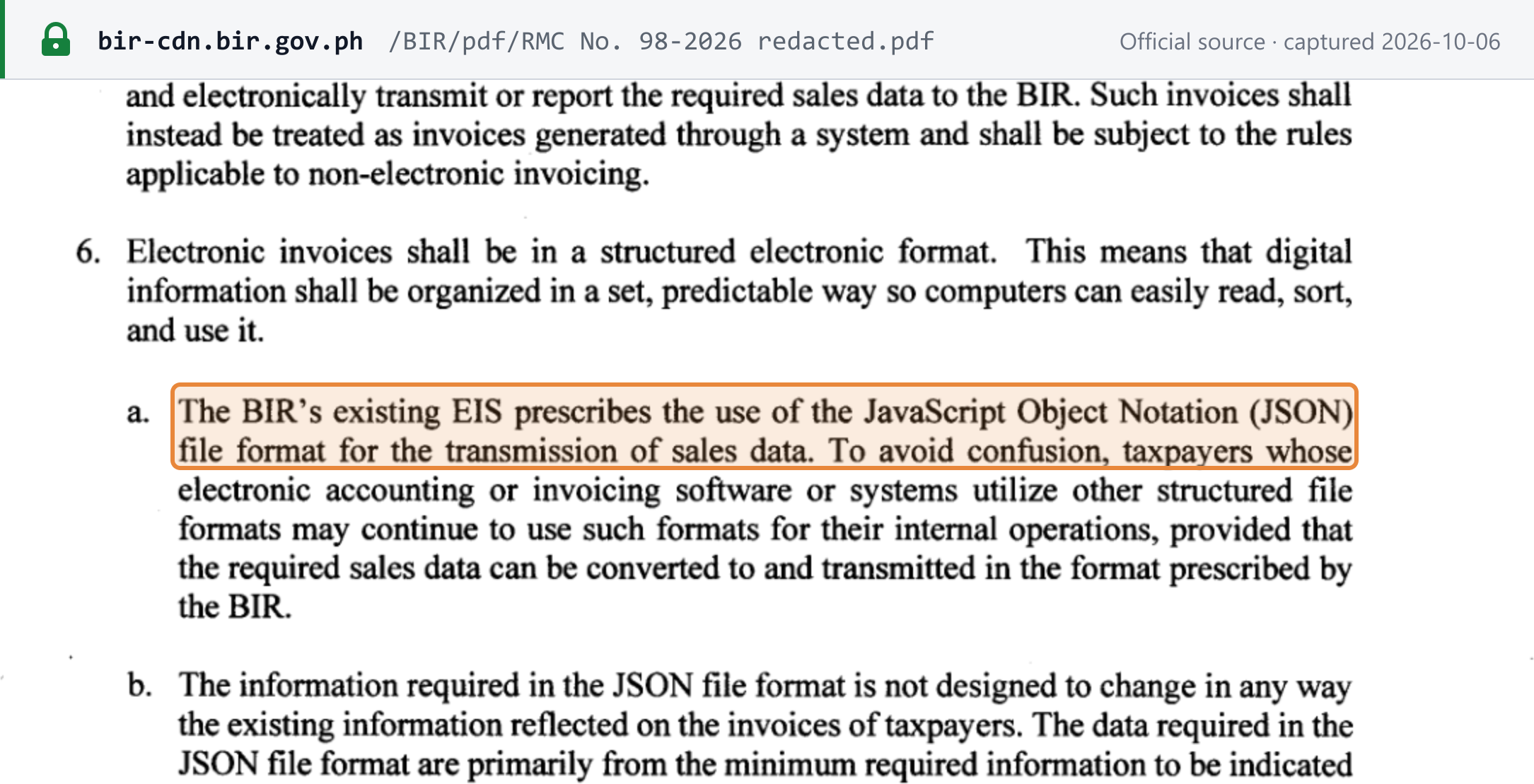
"The BIR's existing EIS prescribes the use of the JavaScript Object Notation (JSON) file format for the transmission of sales data." Taxpayers may keep other structured formats internally if the data can be converted to the BIR format. The JSON content comes mainly from the minimum invoice information under NIRC s.113 and RR 7-2024, plus details such as discounts and withholding taxes. RR 11-2025 §2.3, which defines the Electronic Sales Reporting System, describes the reported sales data as JSON, XML "and such other format as may be prescribed by the BIR", "and not in PDF or image format". (RMC 98-2026 IV.6; RR 11-2025 §2.3, checked 2026-10-07)
 Source snapshot captured 2026-10-06 — original
RMC 98-2026 IV.15 says the EIS Certification Portal (eis-cert.bir.gov.ph) includes "the applicable
technical specifications, guides, and requirements" (see Testing).
Network: not Peppol
As at 2026-10-07, the governing texts (RA 12066 ss.12–13, RR 11-2025, RR 26-2025, RMC 98-2026) name no Peppol network, no UBL or CII syntax and no national CIUS. Delivery to the buyer is open: email, online viewing, QR code, app or web platform.
Integrity: QR codes, stamps, hashes
As at 2026-10-07, the BIR issuances prescribe no cryptographic stamp, hash chain or BIR-issued identifier on the invoice. A QR code appears only as one permitted way of delivering the invoice to the buyer (RMC 98-2026 IV.4(b)).
Corrections and downtime
- Corrections are made only by a separate document referencing the original: a credit note or memo for a decrease, a new e-invoice for an increase. "An issued electronic invoice shall not be deleted, altered, or modified." Detailed sales-adjustment rules are left to a separate issuance.
- Downtime. If a system failure, connectivity loss, power interruption, cybersecurity incident or force majeure prevents issuance, issue a manual invoice authorised by the BIR, then replace every such invoice with an e-invoice bearing the manual invoice's reference number once systems are restored.
(RMC 98-2026 pp.4–5, checked 2026-10-07)
E-reporting: Section 237-A, not yet operative
Under s.237-A as amended by RA 12066, exporters and LTS taxpayers must report sales data to the BIR through electronic point-of-sale systems, and the Secretary of Finance may add others. RR 26-2025 lists all eight groups as subject to the Electronic Sales Reporting System "through the issuance of separate Revenue Regulations". RMC 98-2026 IV.2 says covered taxpayers must report only once the BIR issues implementing policies, guidelines and procedures. A Permit to Transmit (PTT) applies "only upon notification or directive from the Commissioner". As at 2026-10-07, no BIR revenue issuance with such rules, and no such directive, had been located.
A taxpayer that both issues e-invoices and reports sales data electronically gets an extra deduction from taxable income for the cost of setting up the reporting system: 100% for Micro and Small taxpayers, 50% for Medium and Large, available once. Importing such a system is tax-exempt (NIRC s.237-A; RR 11-2025 §3(D)).
Onboarding: how to comply
Steps for a covered taxpayer
- Check your group against the four covered groups and the deferred list above. A head office with any covered branch is covered as a whole.
- Choose a solution. RMC 98-2026 IV.3 lets you use an in-house or commercially acquired system, or an Electronic Invoicing Service Provider (ESP).
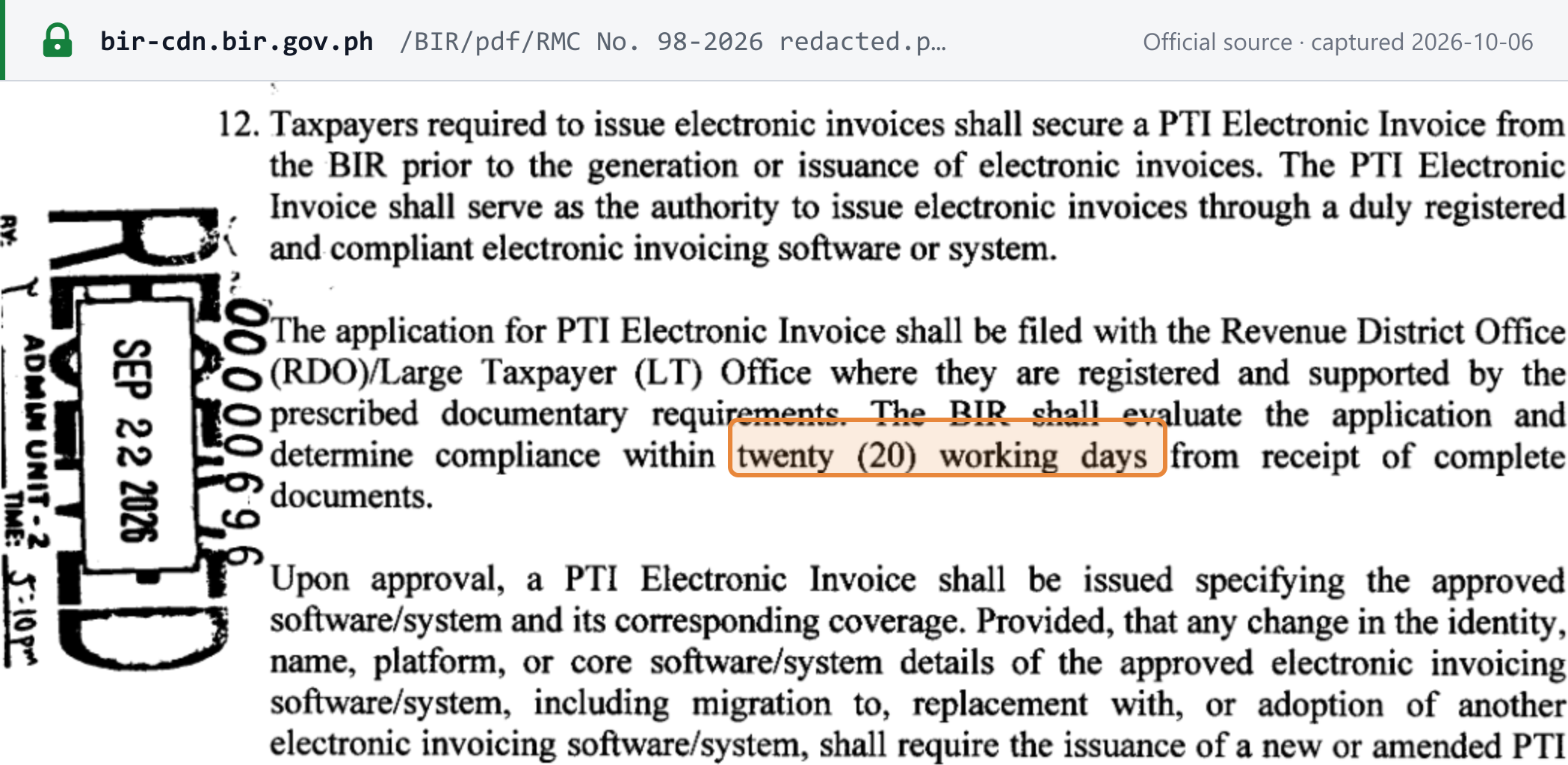
- Apply for a Permit to Issue (PTI) Electronic Invoice at the Revenue District Office (RDO) or Large Taxpayer (LT) Office where you are registered, before you generate or issue any e-invoice. The BIR evaluates the application within 20 working days of complete documents.
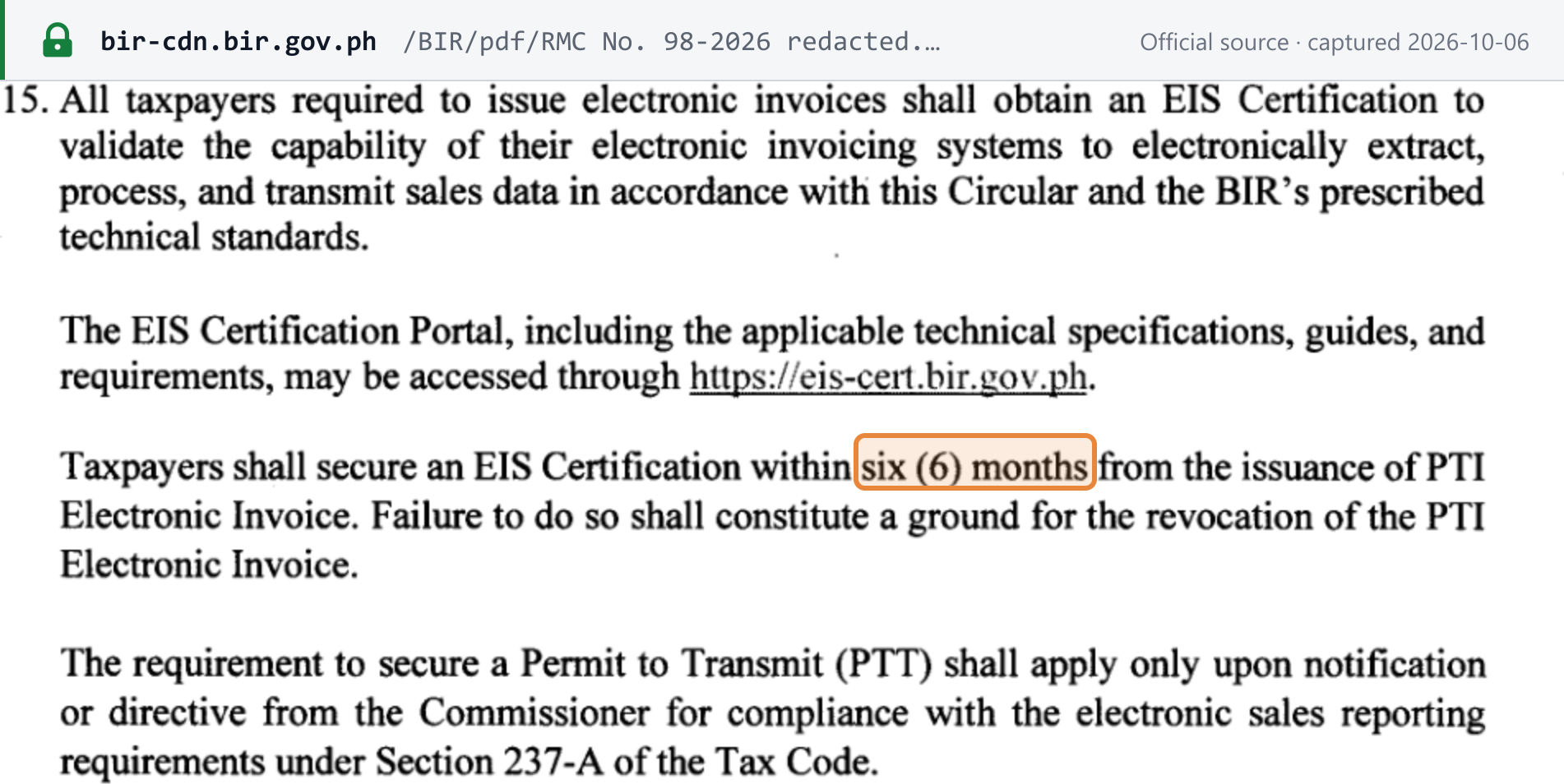
- Obtain EIS Certification within 6 months of the PTI, or the PTI may be revoked.
- Issue e-invoices by 31 December 2026.
 Source snapshot captured 2026-10-06 — original
PTI rules (RMC 98-2026, checked 2026-10-07):
- One PTI number covers the head office and each branch, with a permit per branch naming it.
- Each distinct invoicing software or system needs its own PTI.
- Any change in the identity, name, platform or core details of the approved system, including migration or replacement, needs a new or amended PTI.
- New branches using the same system notify the BIR; they need no new PTI number.
- The PTI is distinct from the CAS Permit to Use (PTU) or Acknowledgement Certificate (AC). Those authorise use of the system; they do not authorise issuing e-invoices.
- The PTI application procedure and documentary requirements are to be set by "a separate revenue issuance". As at 2026-10-07, no such issuance had been located.
Reclassification. A taxpayer moved up a category (for example Medium to Large, or enlisted in the LTS) must comply within a period the BIR sets, of at least 6 months from reclassification. A taxpayer moved down keeps complying with its approved e-invoicing set-up.
Accreditation of providers
RMC 98-2026 defines an ESP as a juridical entity organised or licensed in the Philippines, which must keep an authorised representative and accountable technical, compliance, data-protection and security officers in the Philippines. "Policies and guidelines governing ESPs shall be prescribed through a separate revenue issuance." As at 2026-10-07, no BIR revenue issuance setting ESP accreditation rules, and no official list of accredited ESPs, had been located. (RMC 98-2026 pp.2–3, checked 2026-10-07)
Testing
EIS Certification is the BIR's online testing environment for a taxpayer's system: 5 mandatory
tests, or 7 with API callback (RMC 98-2026, definitions). RMC 98-2026 IV.15 says the EIS
Certification Portal, including "the applicable technical specifications, guides, and requirements",
may be accessed through eis-cert.bir.gov.ph.
 Source snapshot captured 2026-10-06 — original
Connection modes
RMC 98-2026 mentions an API callback as an optional part of certification. RR 11-2025, RR 26-2025 and RMC 98-2026 set out no other connection modes (portal, API, file upload) (as at 2026-10-07).
CAS and CBA users
A CAS covers the full accounting cycle; if invoices are issued manually, RMC 98-2026 treats the system as a CBA with Accounting Records. When the EOPT Act replaced receipts with invoices, RR 11-2024 treated the reconfiguration of a CAS/CBA as a major enhancement, requiring updated system registration and a new AC, while CRM, POS and e-invoicing software that only renamed "Official Receipt" to "Invoice" made a minor enhancement, with no reaccreditation and no new PTU. (RR 11-2024 pp.3–4, checked 2026-10-07)
Penalties
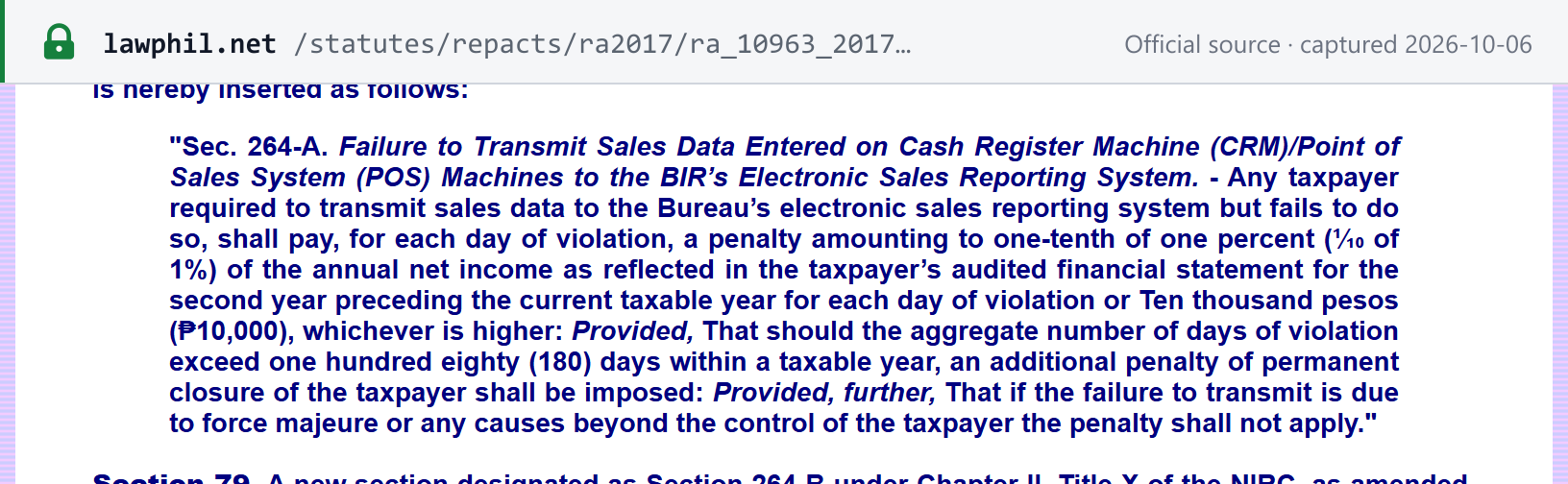
RR 11-2025 §5: "Any violation of or non-compliance with these Regulations shall be subject to the penalties as defined in Sections 264 and 264-A of the Tax Code." Figures as at 2026-10-07:
| Obligation | Provision | Exposure |
|---|---|---|
| Issue — failing or refusing to issue an invoice, issuing one that lacks required information, or using multiple or double invoices | NIRC s.264(a) | Fine of PHP 1,000 to PHP 50,000 and imprisonment of 2 to 4 years, for each act, on conviction |
| Report — failing to transmit sales data to the Electronic Sales Reporting System, where required | NIRC s.264-A | Per day of violation, 1/10 of 1% of annual net income (audited financial statements of the second preceding year) or PHP 10,000, whichever is higher; over 180 days in a taxable year adds permanent closure. Not yet triggered: the reporting duty is not operative |
| Sales suppression devices | NIRC s.264-B | Fine of PHP 500,000 to PHP 10,000,000 and imprisonment of 2 to 4 years |
| VAT invoicing failures | NIRC s.115 (EOPT) | The Commissioner may suspend the business operations and temporarily close the business establishment of a VAT-registered person for failure to issue invoices |
| Certification | RMC 98-2026 item 15 | Failing to obtain EIS Certification within 6 months is a ground for revoking the PTI |
Under the EOPT Act s.45(e), Micro and Small taxpayers get compromise penalties for violations of ss.113, 237 and 238 reduced by at least 50%. RR 7-2024 §8(4), as amended by RR 11-2024 §2, restates the s.264(a) figures for invalid receipt-styled documents. (NIRC s.264(a) — RA 8424; ss.264-A, 264-B — RA 10963; ss.115, 45 — RA 11976; RR 11-2024 p.4, checked 2026-10-07)
 Source snapshot captured 2026-10-06 — original
As at 2026-10-07, no BIR revenue issuance granting a grace period or enforcement tolerance after 31 December 2026 had been located.
Frequently asked questions
We export and use a Computerized Accounting System. Are we deferred with the other exporters?
No. RR 26-2025 defers exporters and incentive-holding RBEs "except those falling under Section 3(A)(4) of RR No. 11-2025", which is the group of CAS, CBA-with-e-invoicing and invoicing-software users. An exporter or RBE on CAS, CBA or invoicing software must issue e-invoices by 31 December 2026. Only exporters and RBEs outside that group wait for a separate Revenue Regulation. (RR 26-2025 §2; RR 11-2025 §3(A))
Do we have to send every invoice to the BIR in real time from 31 December 2026?
No. The 31 December 2026 deadline is for issuing electronic invoices (NIRC s.237). Reporting sales data to the BIR (s.237-A) is "separate and distinct", and applies only once the BIR issues implementing rules; a Permit to Transmit is needed only on the Commissioner's directive. As at 7 October 2026, no BIR revenue issuance setting such rules had been located. Your system must still be able to extract and transmit the data, which EIS Certification tests. (RMC 98-2026 IV.2 and item 15)
Is a PDF invoice made in Excel or Word an e-invoice?
No. RMC 98-2026 says invoices created manually in office applications such as Microsoft Word, Microsoft Excel, Google Docs or Google Sheets are not valid electronic invoices. An e-invoice must be generated by a registered or accredited system in a structured format, sent to the buyer electronically, and have data that can be extracted and transmitted to the BIR. A PDF is fine as the delivery format only if it comes from such a system. (RMC 98-2026 IV.4–5; RR 11-2025 §2.1)
We already have a CAS Permit to Use. Do we still need a Permit to Issue?
Yes. RMC 98-2026 says the PTI is distinct from the CAS Permit to Use or Acknowledgement Certificate, which authorise use of the system but not the issuing of electronic invoices. Apply for the PTI at your RDO or LT Office before issuing any e-invoice; the BIR evaluates within 20 working days of complete documents. (RMC 98-2026 II.7 and item 12)
What happens if we do not finish EIS Certification within six months of the PTI?
The BIR may revoke the PTI. RMC 98-2026 requires EIS Certification within six months of the PTI's issue and says failure "shall constitute a ground for the revocation of the PTI Electronic Invoice". Certification has 5 mandatory tests, or 7 with an API callback. (RMC 98-2026 item 15)
Our system went down. Can we issue paper invoices?
Yes, temporarily. During system downtime, connectivity failure, power interruption, a cybersecurity incident or force majeure, issue manual invoices duly authorised by the BIR. Once the system is restored, replace every manual invoice with an electronic invoice bearing the manual invoice's reference number. (RMC 98-2026)
We are a Micro Taxpayer. Do we have to e-invoice?
No. Micro Taxpayers (gross sales under PHP 3,000,000 a year, net of VAT) are exempt from the mandatory requirement. You may adopt e-invoicing voluntarily, but then you need a PTI like anyone else. Otherwise issue registered manual invoices, or use CAS, cash register machines or POS. (RR 11-2025 §4; RR 8-2024; RMC 98-2026)
Recent changes
- 2026-09-22 — RMC No. 98-2026 set the e-invoice issuance guidelines: covered taxpayers other than Micro must issue e-invoices by 31 December 2026, secure a Permit to Issue, and obtain EIS Certification within six months of it; sales reporting waits for separate rules; compliance applies to the taxpayer as a whole, head office and all branches. (Bureau of Internal Revenue) — see event · issue
- 2025-10-16 — RR No. 26-2025 replaced RR No. 11-2025's transitory provision, giving e-commerce, LTS, EOPT Large Taxpayers and CAS/CBA users until 31 December 2026 to issue e-invoices, and deferring other exporters, RBEs and POS users to separate regulations. (Bureau of Internal Revenue) — see event
- 2025-02-27 — RR No. 11-2025 issued, implementing NIRC Sections 237 and 237-A as amended by RA 12066; where a covered taxpayer or activity is registered as a branch, the head office and all branches must issue e-invoices (Section 3.A; 3.B for sales reporting). (Bureau of Internal Revenue)
- 2024-11-08 — RA 12066 (CREATE MORE) approved, rewriting NIRC Section 237 (issuance of e-invoices) and Section 237-A (electronic sales reporting). (lawphil.net)
Related resources
- Philippines VAT guide — rates, registration, invoice requirements and filing
- Philippines tax identification numbers — the TIN is a mandatory invoice field
- Philippines tax-change chronology — every tracked Philippine change, dated and sourced
- E-invoicing status and networks worldwide — the global comparison table
- VAT on digital services from non-resident suppliers — the NRDSP regime
- Philippines TIN validator
Important websites
- BIR Electronic Invoicing System (EIS):
eis.bir.gov.ph— the BIR's e-invoicing system - EIS Certification Portal:
eis-cert.bir.gov.ph— testing, technical specifications and guides - BIR Revenue Issuances — revenue regulations and memorandum circulars
- RMC No. 98-2026 — full text
- RR No. 11-2025 — full text and RR No. 26-2025 — full text