E-invoicing in Hungary: Online Számla real-time reporting
Overview
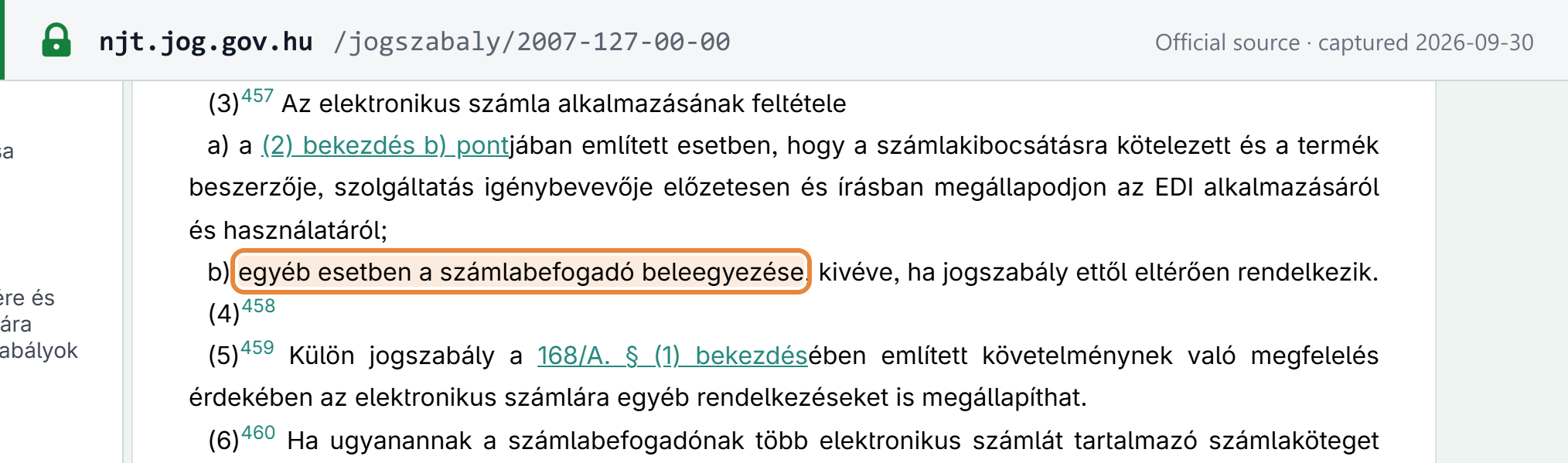
Hungary has no general B2B or B2C e-invoicing mandate. Under §175(3) of the VAT Act (2007. évi CXXVII. törvény, Áfa tv.), an electronic invoice may be used only with a prior written EDI agreement or, in every other case, with the recipient's consent, "kivéve, ha jogszabály ettől eltérően rendelkezik" (unless law provides otherwise). The statutory definition of an electronic invoice (§259 point 5) is format-neutral: any invoice issued and received electronically, so a PDF sent by email counts. NAV adds that consent can be tacit, for example by paying the invoice. (Áfa tv. §175(3), §259; NAV information booklet 18, 2 March 2026, p. 11, checked 2026-09-30)
 Source snapshot captured 2026-09-30 — original
What Hungary does have is near-real-time invoice data reporting. Every invoice issued under the Hungarian invoicing rules has been reported to the tax authority's Online Számla rendszer (NAV Online Invoice System, often called RTIR) since 4 January 2021. The system is run by the Nemzeti Adó- és Vámhivatal (NAV), the National Tax and Customs Administration. It is a reporting model, not clearance: issuing a valid invoice does not depend on NAV's acknowledgement, and NAV neither stamps the invoice nor returns an identifier the invoice must carry.
| Hungary | |
|---|---|
| B2B (domestic) | No e-invoicing mandate: e-invoices need recipient consent (Áfa tv. §175(3)). Every invoice is reported to Online Számla, in real time for software invoices |
| B2G | Contracting authorities must receive and process EN 16931 e-invoices since 18 April 2019 (Kbt. §27/A). No supplier issuing mandate, no named platform or CIUS |
| B2C | No e-invoicing mandate. B2C invoices are reported (without the buyer's name and address) since 4 January 2021; receipts are reported through cash registers, and pad and computer receipts since 1 September 2026 |
| Sector rules | Electricity and natural-gas suppliers (from 1 July 2025) and water utilities (from 1 January 2026) must invoice non-household customers electronically only (format-free) |
| Non-residents | In scope of Online Számla reporting when registered for Hungarian VAT, with or without an establishment |
| Format | Reporting: NAV national XML schema, interface v3.0 (the only accepted version since 1 April 2021). E-invoice: any electronic format; EN 16931 for B2G |
| Network | Not Peppol-based; Online Számla REST API |
| Future | Domestic and intra-EU B2B e-invoicing (EN 16931) exists only as an NGM/NAV concept with no date and no bill |
| Authority | NAV (Nemzeti Adó- és Vámhivatal) |
| Legislation | Áfa tv. §175, §257/G, Annexes 10 and 11; NGM Decree 23/2014 (VI. 30.) §§13/A–13/C; Kbt. §27/A; Art. §229 |
Mandate status & timeline
The table lists every dated step. "Passed" means the rule took effect and still applies.
| Date | Scope | What | Status (as at 2026-09-30) | Legal basis |
|---|---|---|---|---|
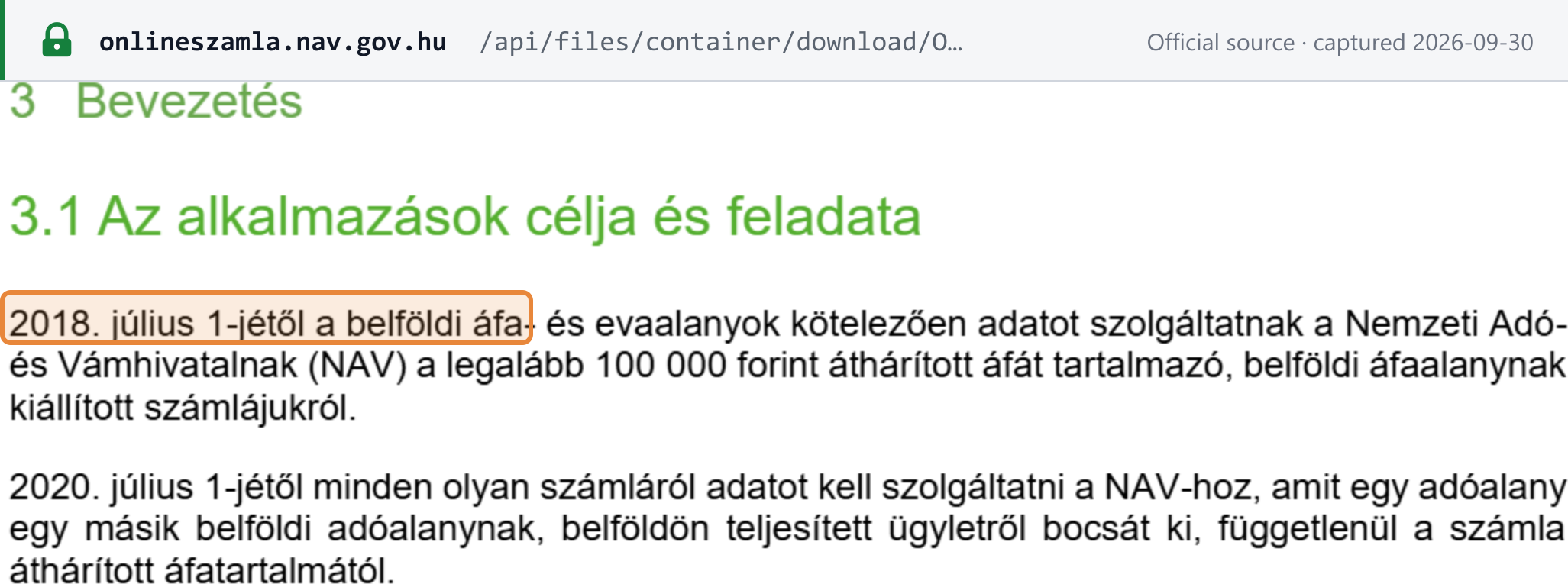
| 1 July 2018 | Invoices to domestic VAT-registered buyers carrying HUF 100,000 or more of VAT | Online Számla invoice data reporting begins | passed | Áfa tv.; Számlarendelet [1] |
| 18 April 2019 | Contracting authorities (bodies under Kbt. §5(2) and (4) excepted) | Must receive and process EN 16931 e-invoices | in force | Kbt. §27/A; Act LXXXIII of 2018 [2] |
| 1 July 2020 | Every invoice to a domestic taxable person for a domestic supply | Reporting threshold removed | passed | Áfa tv. Annex 10 [1] |
| 4 January 2021 | Every invoice under the Hungarian invoicing rules, including to private individuals and foreign taxable persons | Reporting extended to all invoices | passed | Áfa tv. Annex 10 [3] |
| 1 April 2021 | All reporters | Only XML interface / XSD v3.0 accepted; 1.0, 1.1 and 2.0 rejected | in force | NAV technical rule [4] |
| 1 July 2025 | Electricity and gas suppliers to non-household customers | Electronic-only invoicing; paper tolerated for existing contracts' bills due until 1 July 2026 | in force; paper tolerance ended | Govt. Decree 273/2007 §21/B(1a); Govt. Decree 19/2009 §115/E(1a) [5] |
| 1 July 2025 | Receipt issuers | E-cash registers and e-receipts usable (decree in force 1 April 2025) | in force | NGM Decree 8/2025 (III. 31.) §57 [6] |
| 15 September 2025 | All reporters | 15 former WARN messages become blocking ERRORs | in force | NAV validation change [7] |
| 1 January 2026 | Water utilities to non-household customers | Electronic-only invoicing | in force | Govt. Decree 58/2013 §65(5a) [14] |
| 31 July 2026 | Buyers (VAT return) | Stricter received-invoice (M-sheet) format made optional; the earlier rules apply also to the period including 1 July 2026 | in force | Act XXXV of 2026; Áfa tv. §380 [8] |
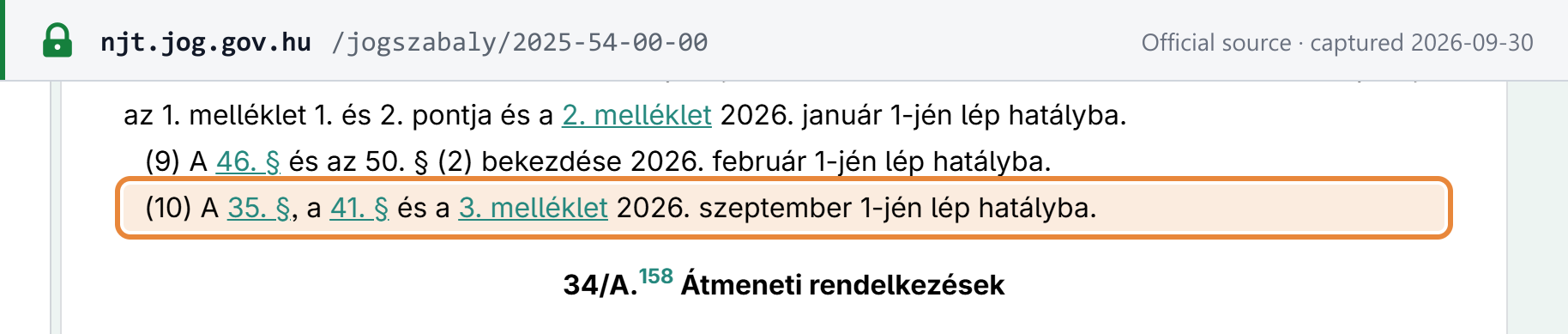
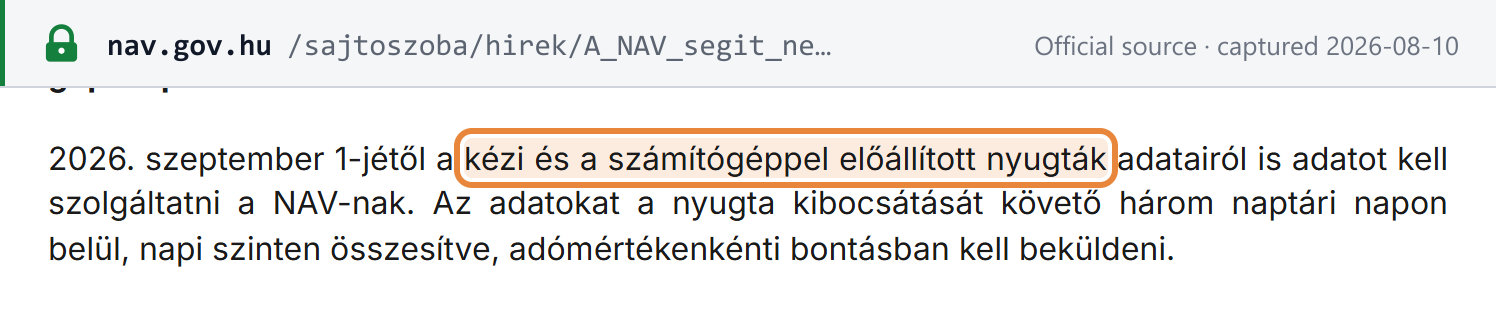
| 1 September 2026 | Issuers of hand-written and computer-generated receipts | Receipt data reporting within 3 calendar days, aggregated daily by VAT rate | in force; NAV fines no one before 2027 | Act LIV of 2025 §§35, 41, 153(10) [9] |
| 1 January 2027 | Same | Fines for receipt reporting become possible | upcoming | NAV announcement [10] |
| 1 July 2028 | Online cash register users | Last day online cash registers may be used | upcoming | NAV, 1 April 2025 [11] |
| 2030 (EU date) | Intra-EU B2B | ViDA e-invoicing and real-time reporting; the recapitulative statement (form A60) is replaced | EU law adopted; Hungarian transposition pending | Directive (EU) 2025/516, as described by NAV [12] |
| no date | Domestic B2B and intra-EU B2B | Mandatory structured e-invoicing (EN 16931 XML) | concept only — no bill, no date | NGM/NAV ViDA concept [13] |
Use 4 January 2021, not 1 January. NAV's own notice gives 4 January 2021 as the date from which invoices to non-taxable persons and foreign taxable persons are also reported. (NAV — rules in force from 4 January 2021, checked 2026-09-30)
 Source snapshot captured 2026-09-30 — original
Announced, not law: the ViDA e-invoicing concept
The Ministry for National Economy (NGM) and NAV drew up a joint e-invoicing concept for implementing ViDA. NAV opened a consultation on it on 21 November 2025, with comments due by 20 January 2026, and the government document store lists the concept under 25 November 2025. NAV has since posted a version supplemented after the consultation. The concept describes:
- mandatory e-invoicing for domestic B2B and for B2B supplies between Hungarian and other EU businesses, with paper left only for private individuals and non-EU buyers by agreement;
- an invoice built on EN 16931 whose legally authentic content is the XML;
- transmission only over secure, authenticated channels, not by email;
- a model in which the domestic B2B e-invoice itself serves as the data report to NAV, with NAV giving every taxpayer a default receiving endpoint;
- Hungary joining Peppol, with a Hungarian Peppol Authority to be created and Peppol use optional for businesses;
- accreditation of all invoicing software;
- a 10-day issue deadline for intra-EU invoices, with the domestic 8-day deadline unchanged.
The document says it sets the main directions but "nem tekinthető végleges álláspontnak" (cannot be regarded as a final position). As at 30 September 2026 it carries no start date, and no bill or Magyar Közlöny instrument implements it. Treat every point above as a plan. (NAV, 21 November 2025; NGM/NAV — A ViDA implementációja Magyarországon; kormany.hu — E-számla koncepció, 25 November 2025, checked 2026-09-30)
 Source snapshot captured 2026-09-30 — original
At EU level, NAV states that the ViDA package entered into force on 14 April 2025 (NAV, 21 November 2025) and that from 2030 it requires e-invoicing and real-time reporting for B2B supplies between businesses established in different member states, replacing the recapitulative statement (form A60). (NAV, 7 April 2025, checked 2026-09-30) See the ViDA explainer for the EU framework.
Legal basis
| Instrument | What it does | Link |
|---|---|---|
| 2007. évi CXXVII. törvény (VAT Act, Áfa tv.), adopted 12 November 2007, promulgated 16 November 2007 | Invoice rules (§§158/A–179), e-invoice consent (§175(3)), definition (§259 pt 5), reporting hook (§257/G), Annex 10 "Összesítő jelentés" (invoice data reporting and buyer declarations), Annex 11 (receipt and e-cash-register reporting), §380 (M-sheet transition) | NJT |
| 23/2014. (VI. 30.) NGM rendelet (Számlarendelet) | Machine-to-machine reporting mechanics: immediate XML reporting (§13/A), outage rules (§13/B), optional e-invoice delivery through NAV's infrastructure (§13/C, inserted by 17/2020. (XII. 30.) PM rendelet) | NJT |
| 2015. évi CXLIII. törvény (Public Procurement Act, Kbt.) §27/A | B2G: contracting authorities must receive EN 16931 e-invoices; introduced by 2018. évi LXXXIII. törvény (transposing Directive 2014/55/EU), in force 18 April 2019 for this provision (§68(4)) | Kbt. · Act LXXXIII/2018 |
| 273/2007. (X. 19.) Korm. rendelet §21/B(1a) and 19/2009. (I. 30.) Korm. rendelet §115/E(1a) | Electricity and gas suppliers invoice non-household customers electronically only; inserted by 466/2024 and 467/2024 (XII. 30.) Korm. rendelet | 273/2007 · 19/2009 |
| 58/2013. (II. 27.) Korm. rendelet §65(5a)–(5c) | Water utilities invoice non-household users electronically only from 1 January 2026 | NJT |
| 2025. évi LIV. törvény, adopted 11 June 2025, promulgated 19 June 2025 | §35 (new Áfa tv. §257/G) and §41 (Annex 11): receipt data reporting, in force 1 September 2026 (§153(10)) | NJT |
| 8/2025. (III. 31.) NGM rendelet | E-cash registers (e-pénztárgép) and e-receipts; operative chapters from 1 July 2025 (§57(2)) | NJT |
| 2026. évi XXXV. törvény (Magyar Közlöny 2026/102), in force 31 July 2026 | Reset the Annex 10 buyer-declaration text (§15) and added Áfa tv. §380 | Magyar Közlöny |
| 2017. évi CL. törvény (Tax Administration Act, Art.) | Penalties (§§220, 228, 229, 234/A); limitation (§202) | NJT |
| 2000. évi C. törvény (Accounting Act, Szt.) §169 | 8-year retention of accounting documents | NJT |
| Online Számla interface specification v3.0 (NAV) | Binding technical format for reporting; latest Hungarian revision dated 12 February 2026 | NAV GitHub |
The interface specification is the technical standard NAV publishes under the Számlarendelet, which requires reporting "az állami adó- és vámhatóság közleményében meghatározott módon és adatszerkezetben" (in the manner and data structure set out in NAV's notice) (§13/A(1)).
Scope
Hungary splits into two questions: may you issue an e-invoice (consent, except where a sector rule requires electronic invoices), and must you report the invoice (almost always yes). The answers below take each flow in turn.
B2B: e-invoicing and invoice data reporting
E-invoicing. Not mandatory. A supplier may send an e-invoice, including a PDF, once the buyer has consented, and consent can be tacit (Áfa tv. §175(3); NAV booklet 18). Sector rules for electricity and gas (from 1 July 2025) and water utilities (from 1 January 2026) require electronic invoices to non-household customers; see below.
Invoice data reporting. Mandatory for every Hungarian VAT taxable person (holder of an adószám), including taxpayers that are subjectively exempt (alanyi adómentes), on special schemes, or making only exempt supplies. It covers every invoice, and every modifying or cancelling document, issued under the Hungarian invoicing rules (Áfa tv. §158/A), whether the buyer is a business, a private individual or a foreign taxable person. (NAV — rules from 4 January 2021; NAV booklet 18, p. 28, checked 2026-09-30)
Buyer side. A buyer that deducts input VAT declares received invoices per invoice in its VAT return (the M-sheet, Áfa tv. Annex 10 points 9–15): the supplier's first 8 tax-number digits, the tax base, the VAT, the invoice number and the supply date. Taxpayers that file through eÁFA, approving NAV's draft return under §184(2)(b) or (c), are exempt from these declarations (Annex 10 point 15). Since 31 July 2026, Act XXXV of 2026 lets buyers keep using the declaration format in force on 30 June 2026; see Recent changes. (Áfa tv. Annex 10, §380, checked 2026-09-30)
Electricity and gas. From 1 July 2025, electricity traders and distributors must issue only electronic invoices to non-household users (Govt. Decree 273/2007 §21/B(1a)). Gas traders and system operators must do the same for non-household users, and system operators also for gas traders (Govt. Decree 19/2009 §115/E(1a)). §21/B(1a) was inserted by Government Decree 466/2024 (XII. 30.) §18 and §115/E(1a) by Government Decree 467/2024 (XII. 30.) §7; both took effect on 1 July 2025 (466/2024 §38(4); 467/2024 §16(2)). The transitional clauses (273/2007 §126/A; 19/2009 §153) let suppliers still send bills due between 1 July 2025 and 1 July 2026 on paper under contracts in force on 1 July 2025, where the customer gave no e-invoice address despite a warning. That tolerance has ended. The decrees prescribe no format, so any electronic invoice under Áfa tv. §259 point 5, including a PDF, meets the rule. (Govt. Decree 273/2007; Govt. Decree 19/2009, checked 2026-09-30)
 Source snapshot captured 2026-09-30 — original
Water utilities. "A víziközmű-szolgáltató a nem lakossági felhasználó részére 2026. január 1-jétől kizárólag elektronikus számlát bocsát ki" (from 1 January 2026 the water utility issues only electronic invoices to non-household users) (Govt. Decree 58/2013 (II. 27.) §65(5a)). Non-household users had to give the utility an e-mail address for e-invoices by 31 October 2025 (§65(5b)); otherwise the utility uses the address in the company register (§65(5c)). Other utility sectors, such as district heating, are not covered on this page. (Govt. Decree 58/2013, checked 2026-09-30)
 Source snapshot captured 2026-09-30 — original
Non-established businesses
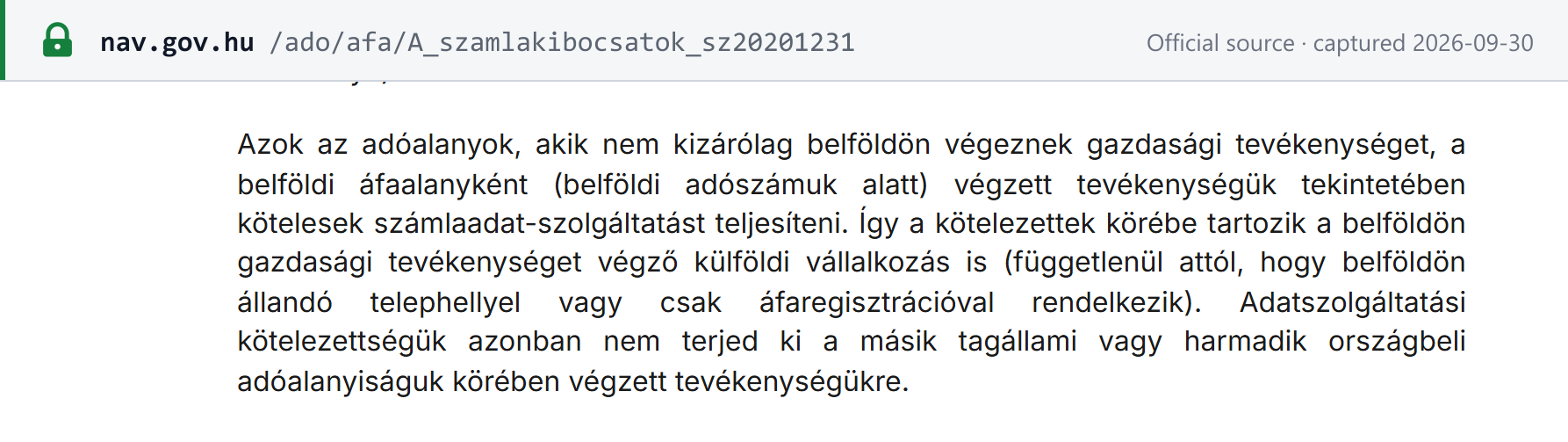
In scope for invoice data reporting. NAV says foreign businesses carrying on economic activity in Hungary must report for the activity they carry on under their Hungarian tax number, whether they have a fixed establishment or only a VAT registration. The duty does not extend to activity under their taxable status in another member state or a third country. (NAV — rules from 4 January 2021, checked 2026-09-30)
 Source snapshot captured 2026-09-30 — original
Registration itself is covered in the Hungary VAT guide.
Excluded transactions and simplified invoices
- OSS and IOSS supplies taxed in another member state under the special schemes of Áfa tv. Chapters XIX/A and XIX/B are not reported (Annex 10 point 1).
- Invoices issued by cash registers or e-cash registers are excluded from invoice data reporting (§257/G(2)); the till reports its own data. NAV confirms that simplified invoices produced by an online cash register are not recorded in Online Számla.
- B2C invoices are reported without the buyer's name and address (Annex 10 point 4).
- Supplies located outside Hungary that are invoiced under Hungarian rules are reported with an out-of-scope flag (Annex 10 point 5/A).
(Áfa tv. §257/G, Annex 10; NAV — common errors in invoice data reporting, checked 2026-09-30)
B2G
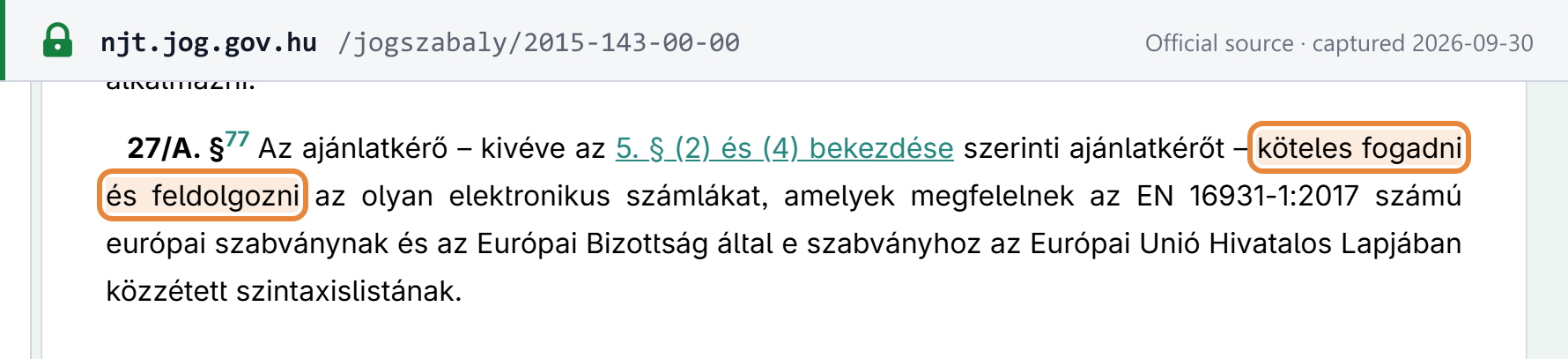
Since 18 April 2019, every contracting authority (bodies under Kbt. §5(2) and (4) are excepted) "köteles fogadni és feldolgozni" (must receive and process) electronic invoices that conform to EN 16931-1:2017 and to the syntax list the European Commission published for it. The rule comes from Act LXXXIII of 2018, which transposes Directive 2014/55/EU, in force 18 April 2019 for this provision (§68(4)). (Kbt. §27/A; Act LXXXIII of 2018 §68, checked 2026-09-30)
This is a receive-only rule. Kbt. §27/A and Act LXXXIII of 2018 impose no duty on suppliers to issue e-invoices to public buyers, and name no CIUS, no receiving platform and no Peppol requirement (checked 2026-09-30). Invoices to public bodies are reported to Online Számla like any other invoice.
 Source snapshot captured 2026-09-30 — original
B2C
There is no B2C e-invoicing mandate. B2C invoices are reported to Online Számla (since 4 January 2021). Receipts (nyugta) follow three separate reporting routes:
- Online cash registers report their own data to NAV (Áfa tv. §178(1a)). NAV says they remain usable until 1 July 2028.
- E-cash registers (e-pénztárgép, NGM Decree 8/2025), in hardware or cloud form, issue e-receipts (e-nyugta), which exist only electronically and are reported when they are issued (Áfa tv. §174(2), Annex 11 Part A). The buyer reaches the e-receipt through a customer app and may ask for a paper copy. NAV offers a free cloud e-cash register app, NAV ePénztárgép.
- Hand-written and computer-generated receipts must be reported within 3 calendar days of issue, aggregated per day and split by VAT rate, from 1 September 2026 (Áfa tv. §257/G(3), Annex 11 Part B, inserted by Act LIV of 2025). Businesses can report through the ePénztárgép app, a web form on NAV's KOBAK portal, or a machine interface. NAV will not fine for faulty or missing receipt reports before 1 January 2027.
(Áfa tv. §174, §257/G, Annex 11; Act LIV of 2025 §153; NAV, 4 August 2026; NAV, 1 April 2025, checked 2026-09-30)
 Source snapshot captured 2026-09-30 — original
 Source snapshot captured 2026-09-30 — original
Format & network
CTC model: near-real-time reporting, not clearance
Online Számla is a post-issuance reporting system. The supplier issues the invoice, and its invoicing software sends the invoice data to NAV. NAV validates the data and answers with ERROR (the report is rejected and counts as not received) or WARN (accepted but flagged). It does not approve, stamp or number the invoice, and the invoice is valid without a NAV response. NAV's ViDA concept restates the principle that invoicing and data reporting stay separate, so reporting is not a condition of issuing an invoice.
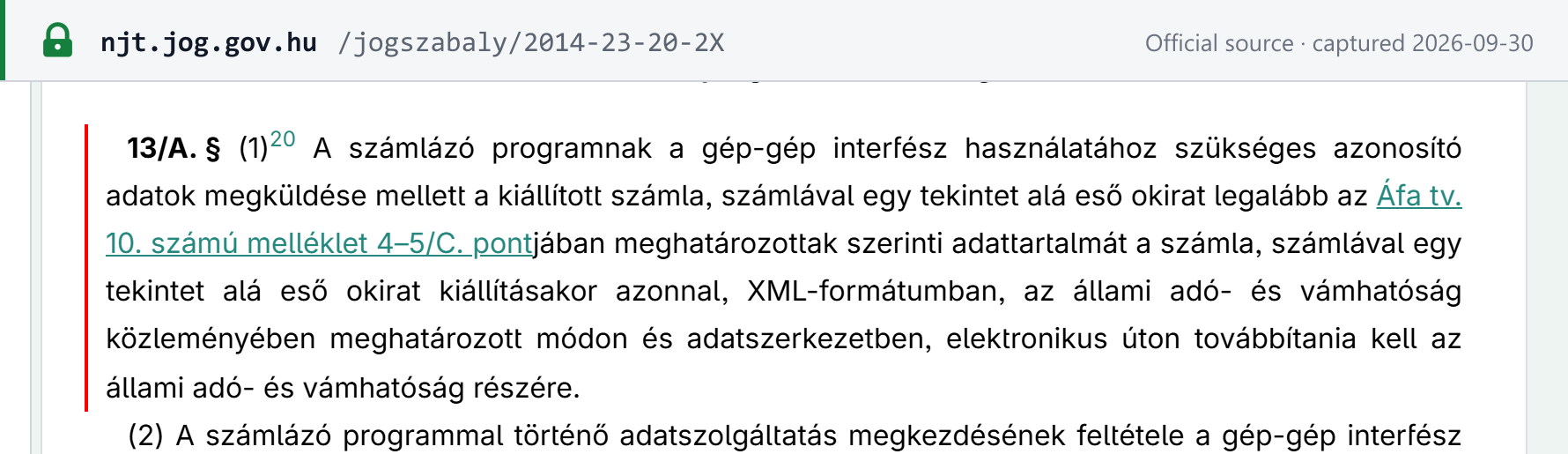
Optional delivery through NAV (§13/C). Under a rule inserted by 17/2020. (XII. 30.) PM rendelet, a taxpayer may meet its reporting duty by making the electronic invoice itself available to the buyer through NAV's infrastructure: the invoice XML is sent with a special flag, and the buyer, identified by tax number, downloads the identical XML. The route is voluntary and does not apply to invoices to private individuals. (Számlarendelet §13/A–13/C, checked 2026-09-30)
Timing
- Invoicing software: the invoice data go machine-to-machine, in XML, "kiállításakor azonnal" (immediately on issue) (Számlarendelet §13/A(1)). Reporting counts as done only when NAV's system confirms successful processing (§13/A(3)).
- NAV outage: transmit within 24 hours of recovery (§13/B(3)).
- Outage on the taxpayer's side: transmit within 24 hours of recovery; if it lasts more than 48 hours, flag it in the NAV system and enter the data manually within the following 24 hours (§13/B(4)–(5)).
- Pre-printed invoice pads: entered manually on the web interface by the next calendar day if the invoice carries HUF 500,000 or more of VAT, otherwise within 4 calendar days (Áfa tv. Annex 10 point 3). The HUF 500,000 figure is a deadline trigger, not a scope threshold.
The reporting clock follows the invoice issue deadline in Áfa tv. §163(2), which is generally 8 days for invoices carrying VAT; see the Hungary VAT guide for invoice content and deadlines.
 Source snapshot captured 2026-09-30 — original
Format: the NAV XML schema v3.0
The reporting format is a national XML schema, not UBL, CII or EN 16931. The XSDs (invoiceData, invoiceApi, invoiceBase, invoiceAnnulment, serviceMetrics) are published on NAV's official GitHub repository together with the interface specification.
- Only v3.0 is accepted, since 1 April 2021. Reports in versions 1.0, 1.1 or 2.0 are rejected with an error message.
- Latest specification revision: "Online_Szamla_interfesz specifikacio_HU_v3.0. (2026.02.12)". That revision changed WARN messages 11400 and 11401 (delivery-date checks) and made related ERROR and WARN changes. WARN 11400 has been active in production since 1 January 2026.
- Stricter validation since 15 September 2025. NAV turned 15 WARN messages into blocking ERRORs (testable from 1 September 2025). NAV warned that a report stopped by an ERROR is, in practice, as if no report had been made for that invoice.
(NAV — common errors; NAV, 21 July 2025; NAV, 23 June 2025; NAV Online-Invoice repository, checked 2026-09-30)
 Source snapshot captured 2026-09-30 — original
 Source snapshot captured 2026-09-30 — original
What is reported. The invoice's statutory content (Áfa tv. §§169–172, 176) plus extra data: the currency and exchange rate, HUF amounts for software invoices, the net difference after an advance, the out-of-scope flag, a legal predecessor's tax number and, for VAT groups, the member's tax number (Annex 10 points 4–5/C). Modifying and cancelling documents must reference the original invoice.
E-invoice format. For the invoice itself, Hungarian law sets no format outside B2G: any invoice issued and received electronically qualifies (§259 point 5). B2G buyers must accept EN 16931 in the syntaxes on the Commission's list.
Network: not Peppol-based
Hungary does not use Peppol today. NAV's ViDA concept states that a Hungarian Peppol Authority still has to be created for Hungary to join. Reporting runs over the Online Számla REST API.
Integrity
Each API request carries a request signature built with the technical user's XML signing key, and tokens are decrypted with an XML exchange key (see Onboarding). The interface specification and NAV's guidance set no QR-code or cryptographic-stamp requirement for the invoice itself (checked 2026-09-30).
Archiving
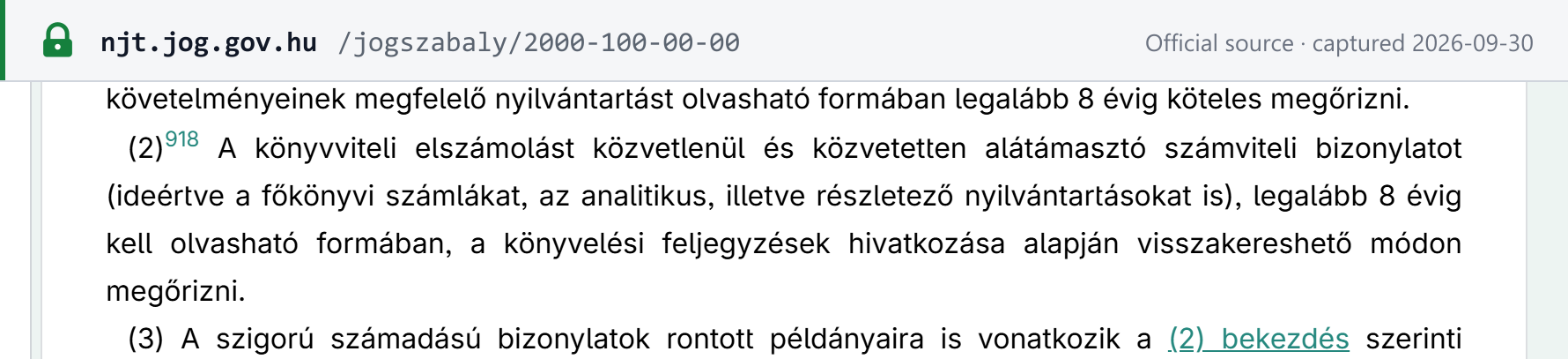
Keep invoices at least until the right to assess the tax lapses (Áfa tv. §179(1)): five years from the end of the calendar year in which the return was due (Art. §202(1)). An electronic document may be kept only in electronic form (§179(2)). Bookkeeping entities must keep accounting documents, invoices included, for at least 8 years (Accounting Act §169(2)), so the 8-year rule is the longer one in practice.
 Source snapshot captured 2026-09-30 — original
E-cash-register users need not keep receipts, because NAV's receipt store keeps the data for ten years. (Áfa tv. §179; Art. §202; Szt. §169; NAV, 1 April 2025, checked 2026-09-30)
Onboarding: how to comply
Steps for a business
- Register in Online Számla on the web (onlineszamla.nav.gov.hu). The primary user is the taxpayer or its permanent authorised representative (Áfa tv. Annex 10 points 6–8).
- Create a technical user for machine-to-machine reporting. Web users (primary or secondary) cannot use the reporting API.
- Generate the keys for each technical user: an XML signing key and an XML exchange key.
- Give rights to third parties such as accountants or software vendors as secondary users, where needed.
- Configure the invoicing software with the technical user's credentials and test it in the test environment before going live.
Connection modes
| Mode | Who it suits |
|---|---|
| M2M REST API from an ERP or invoicing program | Anyone issuing invoices from software; the default route |
| Manual web entry in Online Számla | Only invoices issued on pre-printed pads; it cannot issue invoices |
| NAV Online Számlázó, NAV's free web invoicing program (szamlazo.nav.gov.hu) | Small businesses; invoices issued there are reported automatically |
Accreditation of providers
Not applicable today. Neither the Számlarendelet nor NAV's guidance names any accreditation or certification scheme for invoicing software or service providers (checked 2026-09-30). Accreditation of all invoicing software appears only as a plan in the ViDA concept.
Testing
NAV runs a separate test environment: frontend onlineszamla-test.nav.gov.hu and API api-test.onlineszamla.nav.gov.hu. Registration, users and keys must be set up separately there, and test data never appear in NAV's records. (NAV Online-Invoice repository; NAV — common errors, checked 2026-09-30)
Penalties
Penalties sit in the Tax Administration Act (2017. évi CL. törvény, Art.). Figures as at 2026-09-30:
| Breach | Maximum fine | Provision |
|---|---|---|
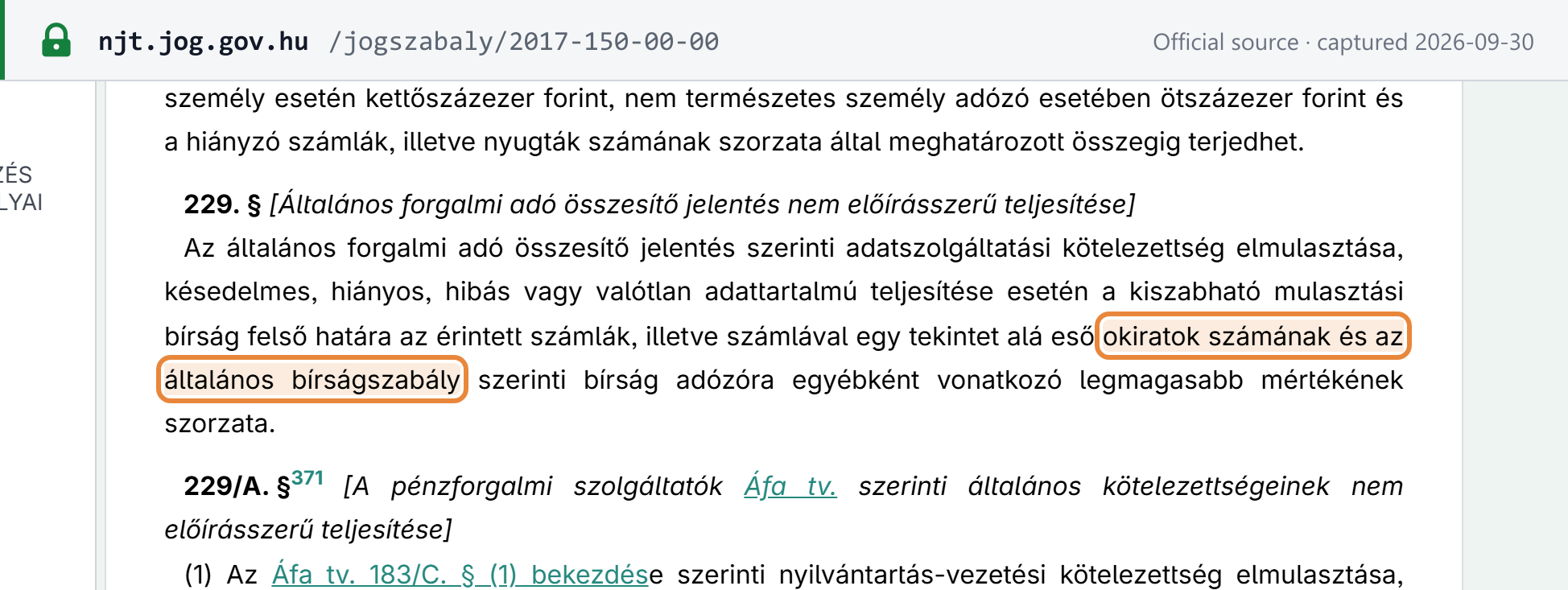
| Invoice data reporting to Online Számla (Áfa tv. Annex 10) missed, late, incomplete, wrong or false | Number of affected invoices × the general maximum: up to HUF 1,000,000 per invoice for a company, HUF 400,000 per invoice for an individual | Art. §229 with §220(1) |
| General maximum for other failures | HUF 400,000 (natural person), HUF 1,000,000 (non-natural person) | Art. §220(1) |
| Failing to issue an invoice, simplified invoice or receipt, or issuing it for other than the real consideration | up to HUF 2,000,000 | Art. §228(1) |
| Failing to keep pre-printed invoices or receipts | HUF 200,000 (natural person) or HUF 500,000 (non-natural person) × the missing documents | Art. §228(3) |
| E-cash-register breaches | up to HUF 500,000 (natural person) or HUF 1,000,000 (non-natural person) | Art. §234/A |
Annex 10 of the VAT Act is titled "Összesítő jelentés" (summary report) and covers both the supplier's invoice data reporting and the buyer's per-invoice declarations, so §229 is the penalty provision for Online Számla failures. No fine for lateness is imposed where the taxpayer shows it acted with the care that could be expected in the circumstances (§220(3)). (Art. §§220, 228, 229, 234/A; Áfa tv. Annex 10, checked 2026-09-30)
 Source snapshot captured 2026-09-30 — original
Enforcement posture. Since 15 September 2025, a report that hits one of the blocking ERRORs is not received, which NAV says is in practice the same as not reporting. For the receipt data reporting that started on 1 September 2026, NAV announced a transition with no fines until 31 December 2026; fines are possible from 1 January 2027. (NAV, 23 June 2025; NAV, 4 August 2026, checked 2026-09-30)
 Source snapshot captured 2026-08-10 — original
Frequently asked questions
Is Online Számla e-invoicing? Is a PDF invoice still valid in Hungary?
Online Számla is invoice data reporting, not e-invoicing or clearance. A PDF invoice remains valid: Hungarian law defines an electronic invoice as any invoice issued and received electronically, and it needs only the buyer's consent, which can be tacit, for example by paying. Whatever the format, the invoice data must still be reported to NAV. Sector rules for electricity and gas (from 1 July 2025) and water utilities (from 1 January 2026) require electronic invoices to non-household customers. (Áfa tv. §175(3), §259; NAV booklet 18; Govt. Decrees 273/2007, 19/2009, 58/2013)
We are a foreign company registered for Hungarian VAT with no establishment. Do we report?
Yes. NAV says foreign businesses active in Hungary report invoice data for everything they do under their Hungarian tax number, whether they have a fixed establishment or only a VAT registration. Activity under their taxable status in another country is not covered. (NAV, rules from 4 January 2021)
What happens if NAV returns an ERROR on our invoice data?
The report is rejected and treated as not received, so the invoice counts as unreported until you resend corrected data. Since 15 September 2025, 15 former WARN messages are blocking ERRORs. The fine for reporting failures can reach the number of affected invoices multiplied by HUF 1,000,000 for a company, or HUF 400,000 for an individual. (NAV, 21 July 2025; Art. §229, §220(1))
NAV or our invoicing system was down when we issued invoices. What now?
Send the data within 24 hours of the system coming back. If your own system is down for more than 48 hours, flag the outage in the NAV system and enter the invoice data manually within the following 24 hours. (Számlarendelet §13/B)
Can we report in UBL or send invoices over Peppol?
Not for reporting. Online Számla accepts only NAV's own XML schema, version 3.0, which has been the only accepted version since 1 April 2021. Hungary is not on Peppol. Public buyers must accept EN 16931 e-invoices, but that is a separate rule and does not replace reporting. (NAV common-errors page; Kbt. §27/A)
Is HUF 500,000 a reporting threshold?
No. Every invoice is reported, whatever its amount. HUF 500,000 of VAT only decides the deadline for invoices issued on pre-printed pads: the next calendar day at or above it, otherwise within 4 calendar days. (Áfa tv. Annex 10 point 3)
We hand-write receipts. What changed on 1 September 2026?
Receipt data must now be reported to NAV within 3 calendar days of issue, aggregated per day and split by VAT rate, through the NAV ePénztárgép app, the KOBAK web form or a machine interface. NAV will not fine before 1 January 2027. (Act LIV of 2025; NAV, 4 August 2026)
When will B2B e-invoicing become mandatory in Hungary?
No date has been set. A ministry and NAV ViDA concept, put to consultation by NAV on 21 November 2025 (the government document store lists it on 25 November), plans mandatory EN 16931 e-invoicing for domestic and intra-EU B2B, but as at 30 September 2026 there is no bill and no start date. Separately, EU law requires e-invoicing for intra-EU B2B supplies from 2030. (NGM/NAV concept; NAV, 21 November 2025 and 7 April 2025)
Recent changes
- 2026-09-01 — Receipt data reporting began: hand-written and computer-generated receipts are reported to NAV within 3 calendar days, aggregated daily by VAT rate, under Act LIV of 2025; NAV fines no one before 1 January 2027. (NAV) — see event · issue
- 2026-07-31 — Act XXXV of 2026 in force: buyers may keep declaring received invoices in the M-sheet format in force on 30 June 2026, including for the return covering 1 July 2026 (Áfa tv. §380); supplier-side Online Számla reporting is unchanged. (Magyar Közlöny) — see event · issue
- 2026-07-01 — The paper tolerance for electricity and gas bills to non-household customers ended; those bills must now be electronic. (Nemzeti Jogszabálytár)
- 2026-02-12 — NAV published revision 2026.02.12 of the Online Számla interface specification v3.0, changing WARN messages 11400 and 11401 with related ERROR and WARN changes. (NAV Online-Invoice repository)
- 2026-01-01 — Water utilities must invoice non-household users electronically only (Govt. Decree 58/2013 §65(5a)). (Nemzeti Jogszabálytár)
- 2025-11-21 — The ministry and NAV opened consultation, until 20 January 2026, on a ViDA concept for mandatory domestic and intra-EU B2B e-invoicing; it has no start date and no bill. (NAV)
- 2025-09-15 — 15 Online Számla WARN messages became blocking ERRORs. (NAV)
Related resources
- Hungary VAT guide — rates, registration, invoice content, issue deadlines and filing
- Hungary tax identification numbers — the adószám is the Online Számla identity
- Hungary tax-change chronology — every tracked Hungarian change, dated and sourced
- E-invoicing status and networks worldwide — the global comparison table
- ViDA — VAT in the Digital Age — the EU framework behind the 2030 intra-EU mandate
- Peppol network explainer
- How to verify an EU VAT number (VIES)
Important websites
- Online Számla — NAV's invoice data reporting portal (registration, users, keys, manual entry)
- Online Számla test environment — separate registration and keys
- NAV Online-Invoice repository — interface specification and XSDs, maintained by NAV
- NAV Online Számlázó — NAV's free invoicing program, which reports automatically
- NAV — common errors in invoice data reporting
- NAV eNyugta hub — e-receipts and receipt data reporting
- NAV ViDA concept — the e-invoicing concept and consultation material
- VAT Act (Áfa tv.) and Számlarendelet (23/2014 NGM) — consolidated texts on Nemzeti Jogszabálytár