E-invoicing in the Czech Republic
Overview
The Czech Republic has no mandatory B2B or B2C e-invoicing and no clearance (CTC) platform. What it has is four separate regimes, and they are easy to confuse:
- B2G, receive-only. Contracting authorities may not reject an electronic invoice whose format complies with the European standard (Act 134/2016 Sb. §221, transposing Directive 2014/55/EU). Suppliers are not obliged to send one.
- B2B and B2C. An electronic invoice is allowed, but only if the customer consents (VAT Act 235/2004 Sb. §26(3)).
- Kontrolní hlášení (the VAT control statement). A periodic XML return in force since 1 January 2016. It is transaction-level reporting, not e-invoicing.
- EET 2.0 (electronic recording of sales). A real-time payment-recording regime from 1 January 2027 for contact payments (made in person or at the premises) and every cash payment, wherever it is made. It is not e-invoicing either.
The Ministry of Finance (Ministerstvo financí, MF) publishes the standing e-invoicing reference for public bodies. It defines an e-invoice, in line with Directive 2014/55/EU, as one "issued, sent and received in a structured electronic format" that complies with EN 16931-1:2017, and it also accepts the national ISDOC/ISDOCX format from version 5.2. (Ministry of Finance — Základní informace, page dated 2 October 2018, checked 2026-09-23) The page dates from 2018 and the Ministry's e-invoicing news list stops in 2019, so read it as the standing reference rather than recent guidance. VAT, the control statement and EET are run by the Financial Administration (Finanční správa, FS).
| Czech Republic (checked 2026-09-23) | |
|---|---|
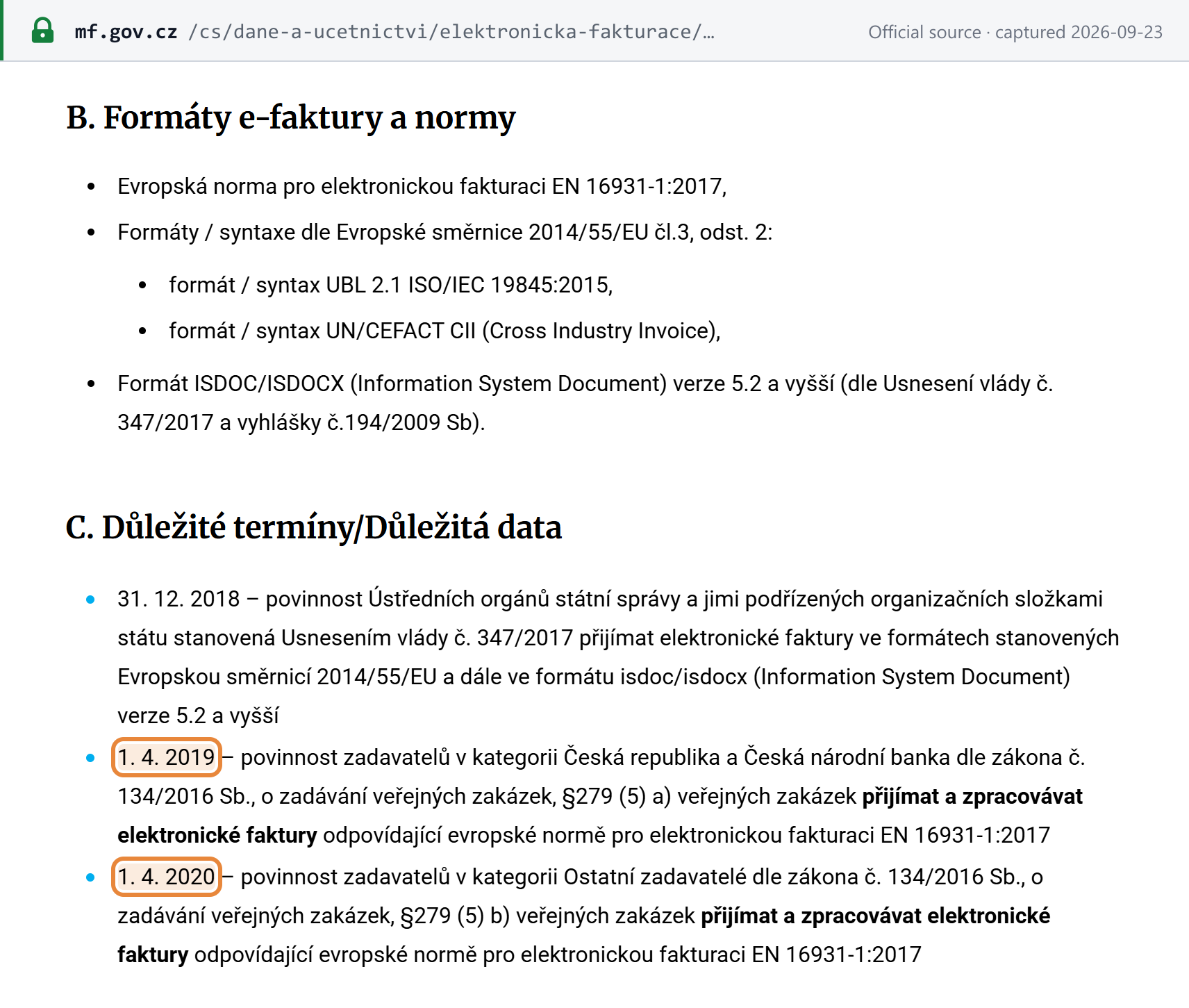
| B2G | Receive-only: contracting authorities may not reject an EN 16931 e-invoice. The State (all its organisational units) and the Czech National Bank from 1 April 2019, all others from 1 April 2020. Suppliers may still send paper or PDF. |
| B2B | Not mandatory. E-invoices only with the recipient's consent. |
| B2C | Not mandatory. Same consent rule. |
| Non-established businesses | No e-invoicing mandate. The consent rule applies to them too. |
| Formats | EN 16931 syntaxes (UBL 2.1, UN/CEFACT CII); ISDOC/ISDOCX 5.2 or higher (current version 6.0.2) |
| National CIUS | None |
| Network | No national e-invoice hub or clearance platform; no Czech Peppol Authority |
| Authority | Ministry of Finance (e-invoicing reference); Financial Administration (VAT, control statement, EET 2.0) |
| Legislation | Act 134/2016 Sb. §221 and §279(5); VAT Act 235/2004 Sb. §26(3); Government Resolution 347/2017 |
| Related regimes (not e-invoicing) | Kontrolní hlášení since 1 January 2016; EET 2.0 from 1 January 2027 |
Mandate status & timeline
Every date in the B2G rows has passed. There is no B2B or B2C phase to list.
| Scope | What applies | Date | Legal basis |
|---|---|---|---|
| Central state bodies and their subordinate units | Must accept e-invoices in EN 16931 formats and ISDOC | 31 December 2018 (passed) | Government Resolution 347/2017 [1] |
| Ministry of Finance itself | Ready to receive EN 16931 and ISDOC/ISDOCX 5.2+ e-invoices | 1 January 2019 (passed) | Resolution 347 of 10 May 2017 [2] |
| Contracting authorities in the "Czech Republic and Czech National Bank" category | May not reject an EN 16931 e-invoice (receive-only) | 1 April 2019 (passed) | Act 134/2016 Sb. §221, §279(5)(a) [3] |
| All other contracting authorities | May not reject an EN 16931 e-invoice (receive-only) | 1 April 2020 (passed) | Act 134/2016 Sb. §221, §279(5)(b) [3] |
| All suppliers, B2B and B2C | No obligation to issue e-invoices. Electronic form needs the recipient's consent | — | VAT Act §26(3) [4] |
Section 279(5) did not name the 2019 and 2020 dates directly. It deferred §221 to the first day of the 18th month (the state and the Czech National Bank) or the 30th month (all other contracting authorities) after the reference to the European standard was published in the EU Official Journal. The Ministry of Finance gives the resulting dates as 1 April 2019 and 1 April 2020. (e-Sbírka, Act 134/2016 Sb. §279(5); Ministry of Finance, checked 2026-09-23)
No domestic B2B plan has been announced. As at 2026-09-23, none of these sources announces a B2B or B2C e-invoicing mandate: the Ministry of Finance e-invoicing section, the government's January 2026 programme statement, or the ViDA transposition bill (tisk 218, below). The programme statement does commit to EET 2.0: "Od roku 2027 zavedeme EET 2.0" ("from 2027 we will introduce EET 2.0"). The only place it mentions invoices is the passage on VAT refunds for bad debts. (Government programme statement, checked 2026-09-23)
ViDA: what binds Czechia, and when
The EU's VAT in the Digital Age package, Council Directive (EU) 2025/516 of 11 March 2025, was published in the Official Journal on 25 March 2025 and entered into force on 14 April 2025. The parts that matter here: (Directive (EU) 2025/516, checked 2026-09-23)
- The Art 218 option. Member states may now require taxable persons established in their territory to issue electronic invoices for domestic supplies, without a derogation. Czechia has not used this option: no enacted law or pending bill we found introduces one.
- 1 July 2030. Member states must apply the digital-reporting measures from this date. Under them, invoices are electronic by default, an invoice for an intra-EU supply is due no later than 10 days after the chargeable event, and the recapitulative statement (Arts 265–271) is deleted.
- 1 January 2035 does not apply to Czechia. The directive gives that date only to member states that, before 1 January 2024, had a domestic digital real-time transaction-based reporting obligation in place, had been granted an Art 395 authorisation, or had adopted national legislation for one. Czechia meets none of the three: its control statement is a periodic return, not a real-time system. Claims that Czechia must mandate domestic e-invoicing "by 2035" misread the directive. ViDA sets Czechia no deadline to mandate domestic e-invoicing.
- The control statement can stay. Art 273 lets member states that had a general transaction-based reporting obligation on 1 January 2024, such as the control statement, keep it until they implement digital reporting.
Czech transposition: tisk 218 (a bill, not law). The government submitted the first ViDA VAT bill (sněmovní tisk 218) to the Chamber of Deputies on 5 June 2026. First reading was on 14 July, and on 17 September 2026 the Budget Committee recommended approval (tisk 218/2). The bill would take effect on 1 January 2027, with some points from 1 July 2028. It contains no domestic e-invoicing provision. The explanatory report says the next VAT amendment will cover transfers of own goods, the platform economy and digital reporting, because those apply from 1 July 2028 or, for digital reporting, from 1 July 2030. (Chamber of Deputies — tisk 218 history; tisk 218 text and explanatory report, checked 2026-09-23)
Legal basis
| Instrument | What it does | In force |
|---|---|---|
| Directive 2014/55/EU | EU B2G e-invoicing directive; defines the e-invoice by reference to EN 16931 | Transposed by Act 134/2016 Sb. §221 |
| Act 134/2016 Sb. (Public Procurement Act), §221 | "Zadavatel nesmí odmítnout elektronickou fakturu … z důvodu jejího formátu, který je v souladu s evropským standardem" (a contracting authority may not reject an e-invoice because of its format where that format complies with the European standard). As worded, §221 sets no contract-value threshold. | 1 April 2019 / 1 April 2020 via §279(5) [1] |
| Act 134/2016 Sb., §279(5) | Defers §221 to the 18th or 30th month after publication of the standard's reference in the Official Journal | See above [2] |
| Government Resolution 347 of 10 May 2017 | Central state bodies must accept EN 16931 formats and ISDOC | 31 December 2018 [3] |
| Decree 194/2009 Sb., Annex 3 | Lists "isdoc/isdocx … verze 5.2 a vyšší" among permitted data-box message formats. This is the statutory reference to ISDOC we found, and it does not make ISDOC mandatory for invoicing. | Consolidated 2026-01-01 [4] |
| VAT Act 235/2004 Sb., §§26, 28, 30, 34, 35 | Electronic tax documents (consent), issue deadline, simplified invoice, integrity, retention | Consolidated 2026-01-01 [5] |
| VAT Act 235/2004 Sb., §§101a, 101c–101k | Kontrolní hlášení (VAT control statement). §§101c–101i were inserted, and §101a amended, by Act 360/2014 Sb. (adopted 22 December 2014); §§101j–101k were added by Act 243/2016 Sb. | 1 January 2016 [6] |
| ČSN EN 16931 | The European semantic standard, adopted as a Czech standard | Listed by the Ministry of Finance [7] |
| Act on the recording of sales (EET 2.0, tisk 189) | Real-time recording of contact payments and every cash payment. Not e-invoicing. Signed 17 September 2026; not yet promulgated as at 2026-09-23 | 1 January 2027 (§36) [8] |
| Council Directive (EU) 2025/516 (ViDA) | Art 218 option; digital reporting from 1 July 2030 | In force 14 April 2025 [9] |
The Ministry of Finance's legal-framework page lists the full set of instruments: Act 134/2016 (transposition, §221 and §279), Accounting Act 563/1991 Sb., VAT Act 235/2004 Sb., Decree 194/2009 Sb., Resolution 347/2017 and ČSN EN 16931. (Ministry of Finance — Právní rámce, checked 2026-09-23)
Scope
B2G: receive-only. The obligation falls on contracting authorities, not on suppliers. An authority may not reject a supplier's e-invoice for a public contract because of its format when that format complies with the European standard. Nothing in §221 obliges a supplier to send an e-invoice, and paper or PDF invoices to public bodies remain lawful. (e-Sbírka, §221, checked 2026-09-23)
B2B and B2C: e-invoices by consent only. The VAT Act treats a tax document as electronic when it is issued and received electronically, and it makes the customer's agreement a condition:
"S použitím daňového dokladu v elektronické podobě musí souhlasit osoba, pro kterou se plnění uskutečňuje." (The person for whom the supply is made must agree to the use of a tax document in electronic form.) (VAT Act §26(3), e-Sbírka, checked 2026-09-23)
The same invoicing rules apply whether the document is paper or electronic: (e-Sbírka, VAT Act, checked 2026-09-23)
- Issue deadline: within 15 days of the day the obligation to declare tax, or to declare the supply, arose (§28(8)).
- Simplified invoice: permitted where the total for the supply is not more than CZK 10,000 (§30(1)). It is not permitted for exempt intra-EU supplies, distance sales, reverse-charge supplies, or sales of excise-duty tobacco products at other than the fixed retail price (§30(2)).
- Retention: 10 years from the end of the tax period in which the supply took place (§35(2)).
Non-established businesses. No e-invoicing obligation applies to them either.
- §221 binds the contracting authority wherever the supplier is based.
- Foreign persons issuing invoices for reverse-charged supplies are covered by §28(4) of the VAT Act, and the §26(3) consent rule applies to their electronic invoices as to anyone else's. (e-Sbírka, VAT Act §28)
- Only Czech-registered VAT payers file the control statement (below).
- EET 2.0 reaches non-residents only for Czech-source income from sales received in the Czech Republic.
Excluded transactions. With no mandate, there is no e-invoicing exclusion list. The §30(2) exclusions above concern the simplified invoice only.
Related regime: EET 2.0 (sales recording, not e-invoicing)
EET 2.0 is often reported as a Czech "e-invoicing" change. It is a real-time sales-recording regime for income-tax payers, and it does not touch invoice exchange.
Legislative status (as at 2026-09-23).
- Timeline: submitted 11 May 2026 → passed at third reading 15 July 2026 (vote 88, resolution 263) → returned by the Senate with amendments 19 August 2026 (resolution 510) → the Chamber insisted on its own text 9 September 2026 (vote 38, resolution 274) → sent to the President 11 September → signed 17 September 2026.
- Not yet promulgated in the Collection of Laws (Sbírka zákonů). There is no Sbírka number yet, and the FS says promulgation "will follow".

(Chamber of Deputies — tisk 189 history; EET press release, 17 September 2026, checked 2026-09-23)
Effective date. §36 of the adopted text sets 1 January 2027 as the general effective date. §§14, 15, 18, 21, 23, 25 and 26 take effect the day after promulgation. Under transitional §29, the certificate and registration provisions (§§14, 15 and 18) apply no earlier than 1 November 2026. (adopted text, tisk 189/5, checked 2026-09-23)
Who and what. EET 2.0 applies to personal and corporate income-tax payers, for sales made in the Czech Republic (§2).
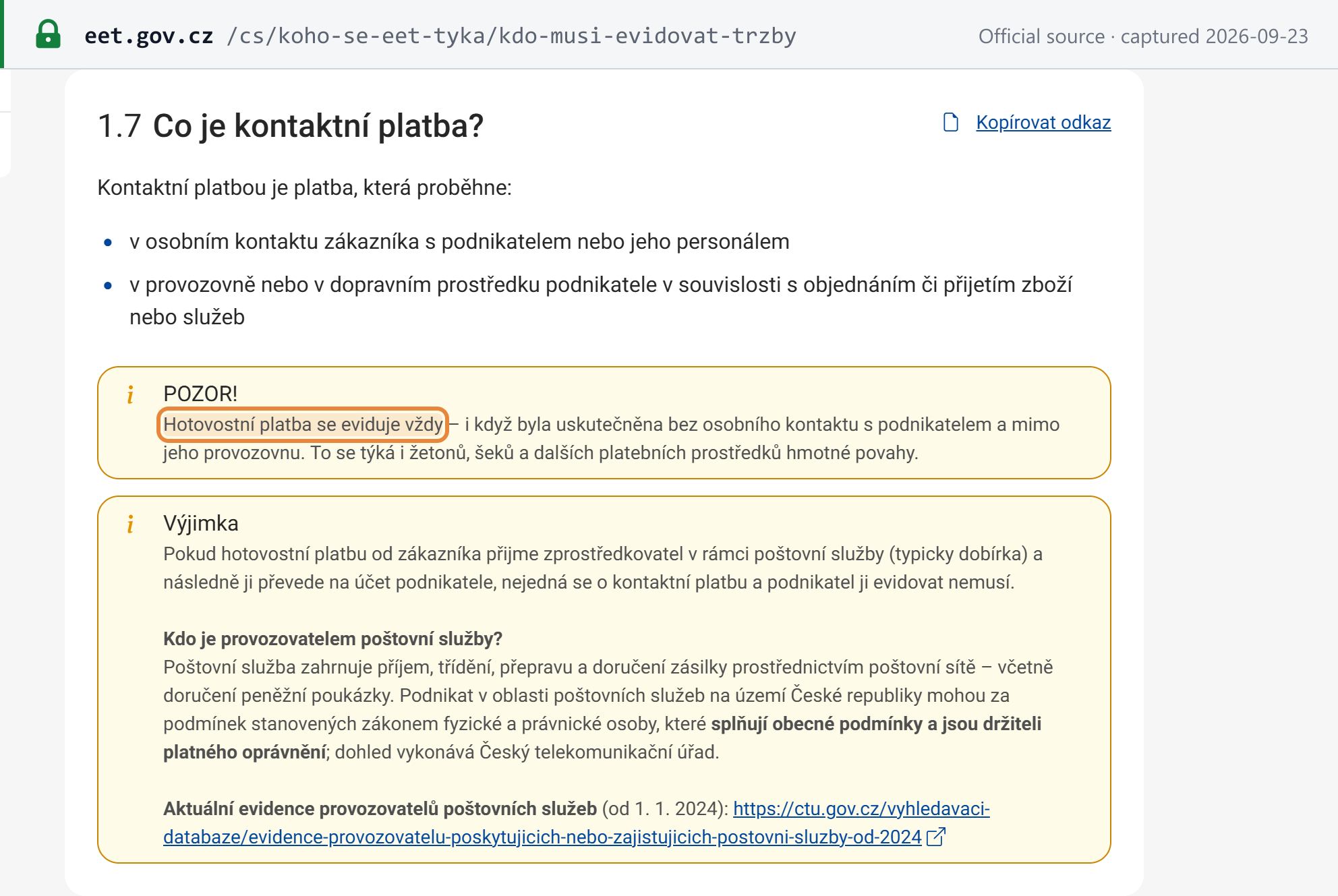
Contact payments and all cash. It records contact payments (made in person or at the premises) and every cash payment, wherever it is made (§6(2)). A payment by physical means, such as cash, cheques or tokens, counts even without personal contact and outside the premises. The FS puts it plainly: "Hotovostní platba se eviduje vždy" (a cash payment is always recorded). The exception is cash on delivery collected by a postal intermediary and passed on to the seller.
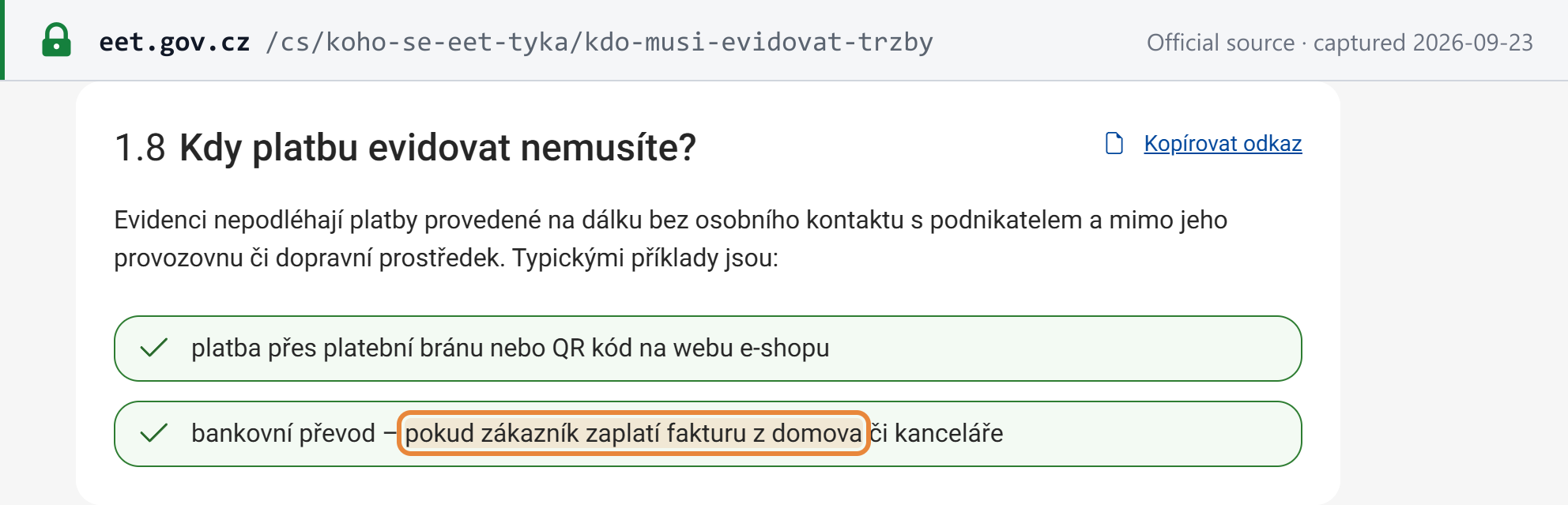
Remote payments are outside it. The FS lists remote payments as outside the regime. Its examples are a payment through a gateway or QR code on an e-shop, and a bank transfer "pokud zákazník zaplatí fakturu z domova či kanceláře" (where the customer pays an invoice from home or the office).
- Non-residents are covered only for Czech-source income from sales received in the Czech Republic. Sales recorded in a comparable way under a treaty partner's law are excluded (§28).
- Exempt under §11: the state, public bodies, banks and insurers, and taxpayers using the "EET OFF" flat-tax option.
(FS — Kdo musí evidovat tržby; adopted text, checked 2026-09-23)
Format & network
CTC model: none. There is no clearance, no real-time invoice reporting and no government platform that validates or stamps invoices. B2G is receive-only. B2B and B2C invoices travel however the parties agree, in paper or, with consent, electronic form.
Accepted formats. The Ministry of Finance lists: (Ministry of Finance, checked 2026-09-23)
- UBL 2.1 (ISO/IEC 19845:2015)
- UN/CEFACT CII
- ISDOC/ISDOCX version 5.2 or higher
ISDOC. ISDOC is the national e-invoicing format (Národní standard pro elektronickou fakturaci).
- The current version is 6.0.2 of 23 March 2022, maintained by the Ministry of the Interior (MV ČR). The distribution includes XSD schemas and a Schematron file. (isdoc.cz/6.0.2, checked 2026-09-23)
- The 6.0.2 specification contains no reference to EN 16931. ISDOC is a national syntax accepted alongside UBL and CII, not an EN 16931 CIUS.
- We found no version later than 6.0.2 (checked 2026-09-23).
National CIUS: none. "Czechia does not apply any national Core Invoice Usage Specifications (CIUS) or additional extensions beyond the European standard (EN 16931)." (European Commission, eInvoicing in Czech Republic, last updated 6 March 2026)
Network: no national e-invoice hub, no Czech Peppol Authority.
- The European Commission's country page lists NEN (Národní elektronický nástroj) as the B2G operating model. NEN's own documentation describes it as the mandatory e-procurement tool, and we found no official source saying it exchanges invoices. There is no national e-invoice hub equivalent to a Peppol Authority or a clearance platform.
- A 2018 paper by a working group of the Government Council for the Information Society (RVIS), with Ministry of Finance commentary, describes e-invoices reaching public bodies through a data box (datová schránka) or the authority's electronic filing office (e-podatelna). They arrive either in the output data format under §23 of Decree 259/2012 Sb. or in another format, such as ISDOC or the European formats. When an e-invoice arrives by data box, both the message and the invoice inside it are verified. (RVIS working-group paper with MF commentary, 2018)
- Whether a data box is a mandatory B2G channel has not been established.
- OpenPeppol's list of Peppol Authorities has no Czech entry, while Poland, Slovakia and Germany are listed (checked 2026-09-23). Where no national authority exists, OpenPeppol "also acts as the Peppol Authority". (OpenPeppol — Peppol Authorities)
Integrity. Integrity of origin and content can be ensured by business controls. For an electronic tax document, the VAT Act also allows: (VAT Act §34(4), checked 2026-09-23)
- a recognised electronic signature
- a recognised electronic seal
- EDI
With no clearance platform, there is no tax-authority stamp or invoice identifier to obtain.
E-reporting alongside: kontrolní hlášení (VAT control statement)
The control statement is Czechia's existing transaction-level reporting, in force since 1 January 2016. It was introduced by Act 360/2014 Sb., adopted on 22 December 2014. It is a periodic XML return built from the payer's own records. It is not e-invoicing. (FS — kontrolní hlášení, checked 2026-09-23)
- Who files: "Only taxable persons registered for VAT in the Czech Republic (with assigned CZ VAT ID number)." (FS — VAT Control Statement)
- When: a VAT payer that is a legal person files monthly, within 25 days after the end of the calendar month (§101e(1)). The deadline cannot be extended (§101e(3)). (VAT Act §101e)
- How: electronically only (§101a), through the EPO application on the FS tax portal or a data box. Filing by email is not accepted. (FS — form of filing)
- What: tax documents above CZK 10,000 including VAT are itemised in sections A.4 and B.2. The CZK 10,000 limit decides whether a document goes in A.4/B.2 or in A.5/B.3. (FS — FAQ)

EET 2.0 mechanics (related regime)
These rules come from the adopted text (§§16, 17 and 20) and the Ministry of Finance press release of 4 May 2026, republished by the FS. (adopted text; Ministry of Finance press release, 4 May 2026, checked 2026-09-23)
- When: each sale is recorded no later than the moment it happens.
- How: as an XML message (§16(4)) authenticated with an EET certificate (§16(1)).
- What: tax ID, recording unit, cash device, sequence number, date and time, total in CZK and message ID (§17). VAT amounts are no longer recorded, and no customer data is included.
- Fallback: if the response time is exceeded, the data must be sent within 48 hours of the sale (§20).
Onboarding / how to comply
E-invoicing platform registration: not applicable. There is no government e-invoicing platform to register with. Provider accreditation is not applicable either: with no platform, there is no certified-provider model.
Invoicing a Czech public body.
- Send an EN 16931-compliant e-invoice (UBL 2.1 or CII) or ISDOC/ISDOCX 5.2+. The authority may not reject it for its format.
- Deliver it the way the authority receives electronic documents, typically its data box or e-podatelna. A data box delivery is verified both as a message and as an invoice.
- Paper or PDF remains lawful if you prefer it. The obligation is the authority's, not yours.
Invoicing Czech businesses and consumers.
- Obtain the customer's consent before issuing an electronic tax document (VAT Act §26(3)).
- Keep the 15-day issue deadline, and secure integrity by business controls, a recognised signature or seal, or EDI.
- Retain invoices for 10 years.
Control statement. File through the EPO application on the FS tax portal or through a data box, by the 25th day after the month (legal persons).
EET 2.0 (contact and cash payments). Onboarding timeline from the FS (as at 2026-09-23): (EET 2.0 timeline)
| Date | Step | Status on eet.gov.cz |
|---|---|---|
| 5 June 2026 | Developer documentation published | Done |
| 1 July 2026 | Playground test environment opened | Done |
| 1 November 2026 | Registration and EET certificates in DIS+ on the MOJE daně portal | In progress ("Probíhá") |
| 1 December 2026 | Free MOJE eet web application | Planned |
| 1 January 2027 | Regular operation, with January run as a pilot month | Planned |
The last two rows are plans, not completed steps. Developer documentation and the Playground are on eet.gov.cz/cs/pro-vyvojare.
Penalties
E-invoicing: no penalty, because there is no mandate. No sanction attaches to issuing or not issuing an e-invoice in B2B, B2C or B2G.
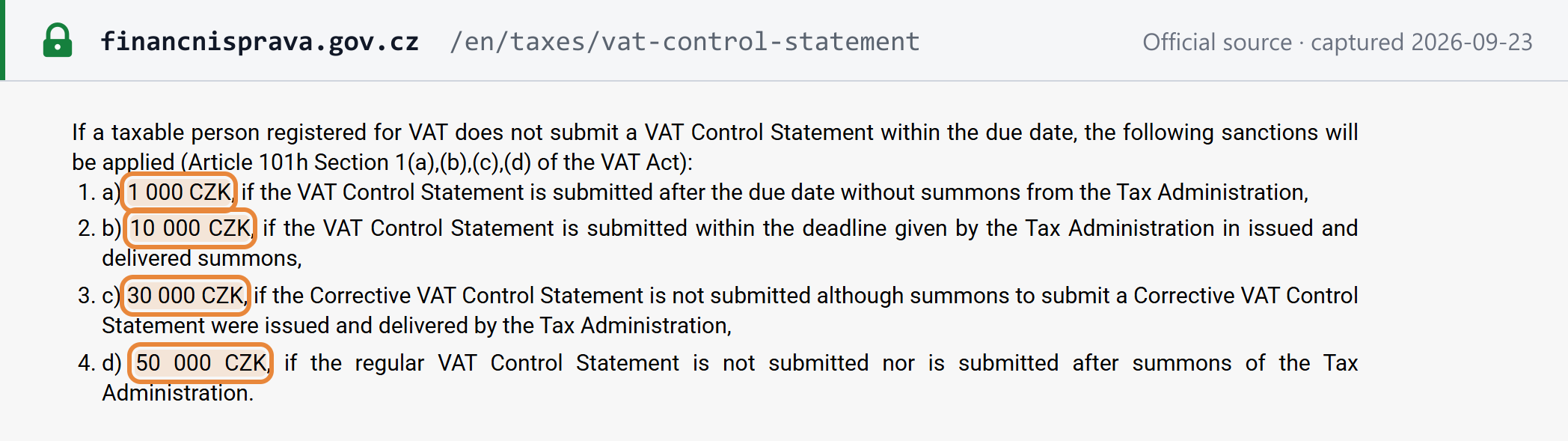
Control statement (VAT Act §101h), checked 2026-09-23:
| Situation | Fine |
|---|---|
| (a) Filed late without a summons | CZK 1,000 |
| (b) Filed within the substitute deadline after a summons from the tax administrator | CZK 10,000 |
| (c) Not filed in response to a summons to change, supplement or confirm data | CZK 30,000 |
| (d) Not filed in response to a summons under §101g(1) | CZK 50,000 |
| Failing to correct after a summons (§101h(3)) | up to CZK 50,000 |
| Seriously obstructing tax administration (§101h(4)) | up to CZK 500,000 |
- Halved fines: tiers (b)–(d) are halved for natural persons, quarterly filers and single-member companies owned by an individual.
- Automatic waiver (§101j): no fine arises for the first delay of type (a), or the first of type (b), in a calendar year.
- Remission on application (§101k): fines (b)–(d) can be remitted on application, for an administrative fee of CZK 1,000.
(VAT Act §101h; §101j; FS — VAT Control Statement)
EET 2.0 offences (adopted text, from 1 January 2027): (adopted text)
- seriously obstructing sales recording: up to CZK 500,000 (§23(3))
- failing to send sales data: up to CZK 500,000 (§24(2))
Frequently asked questions
Is B2B e-invoicing mandatory in the Czech Republic?
No. As at 23 September 2026 the Czech Republic has no mandatory B2B or B2C e-invoicing and no clearance platform. Under §26(3) of the VAT Act (235/2004 Sb.), a tax document may be electronic only if the customer agrees to it, so paper and PDF invoices remain valid. No domestic e-invoicing mandate has been announced, and Czechia has not used the ViDA Article 218 option to introduce one.
Source: VAT Act §26(3), e-Sbírka
Is EET 2.0 an e-invoicing mandate?
No. EET 2.0 is a real-time sales-recording regime for income-tax payers. It covers contact payments (made in person or at the premises) and every cash payment, wherever it is made. The President signed the act on 17 September 2026. As at 23 September 2026 it had not yet been promulgated, and it takes effect on 1 January 2027 under §36 of the adopted text. The Financial Administration states that remote payments are outside it, including a bank transfer when a customer pays an invoice from home or the office.
Do I have to send e-invoices to Czech public authorities?
No. The obligation runs the other way. Under §221 of Act 134/2016 Sb., a contracting authority may not reject an e-invoice whose format complies with the European standard EN 16931. This applies from 1 April 2019 for the Czech Republic and the Czech National Bank and from 1 April 2020 for all other contracting authorities. Suppliers are not obliged to send e-invoices. Central state bodies also accept ISDOC/ISDOCX version 5.2 or higher under Government Resolution 347/2017.
Source: Ministry of Finance
Must the Czech Republic introduce domestic e-invoicing by 2035 under ViDA?
No. The 1 January 2035 date in Directive (EU) 2025/516 applies only to member states that, before 1 January 2024, had a domestic digital real-time transaction-based reporting obligation in place, an Article 395 authorisation, or national legislation adopted for one. Czechia meets none of these, since its control statement is a periodic return. ViDA's digital reporting applies to Czechia from 1 July 2030. The Czech ViDA bill before the Chamber (tisk 218, not enacted) leaves digital reporting to a later VAT amendment.
Source: Directive (EU) 2025/516
Is the kontrolní hlášení (VAT control statement) a form of e-invoicing?
No. The control statement, in force since 1 January 2016, is a periodic XML return filed only by Czech-registered VAT payers. Legal persons file monthly, within 25 days after the month ends, through the EPO application or a data box, and the deadline cannot be extended. Documents above CZK 10,000 including VAT are itemised. It reports invoice data after the fact. It does not change how invoices are issued or exchanged.
What penalties apply if I do not use e-invoices in the Czech Republic?
None, because there is no e-invoicing mandate. The penalties that do exist attach to the neighbouring regimes. For the control statement, §101h of the VAT Act sets fixed fines of CZK 1,000, 10,000, 30,000 or 50,000 depending on the failure, and up to CZK 500,000 for serious obstruction. The first delay of type (a) or (b) in a calendar year carries no fine. For EET 2.0, fines of up to CZK 500,000 apply from 1 January 2027.
Source: VAT Act §101h, e-Sbírka
Recent changes
- 2026-09-17 — The President signed the EET 2.0 sales-records act (tisk 189), after the Chamber of Deputies insisted on its text over the Senate's amendments on 9 September. It takes effect on 1 January 2027 (§36) and is not yet promulgated. It is a sales-recording regime, not an e-invoicing mandate. (Poslanecká sněmovna) — see issue (covers the 9 September Chamber override and the 11 September transmission to the President); the Senate's return is in this issue
Related resources
- E-invoicing status and networks worldwide. Czech Republic in global context.
- ViDA (VAT in the Digital Age) explained
- Peppol network explainer
- E-invoicing in Poland (KSeF). A neighbouring clearance model, for contrast.
- E-invoicing in Germany (XRechnung and ZUGFeRD)
- Czech Republic tax identification numbers (DIČ and IČO)
- How to verify a Czech DIČ
- Czech Republic tax-change chronology. Every tracked Czech change, dated and sourced.
Important links
- Ministry of Finance — e-invoicing hub. Formats, legal framework, B2G reference.
- ISDOC 6.0.2 specification. National format, XSD and Schematron.
- Financial Administration — kontrolní hlášení. Filing form and requirements.
- MOJE daně. FS taxpayer portal (EET 2.0 registration and certificates from 1 November 2026).
- EET 2.0 for developers. Documentation and the Playground test environment.